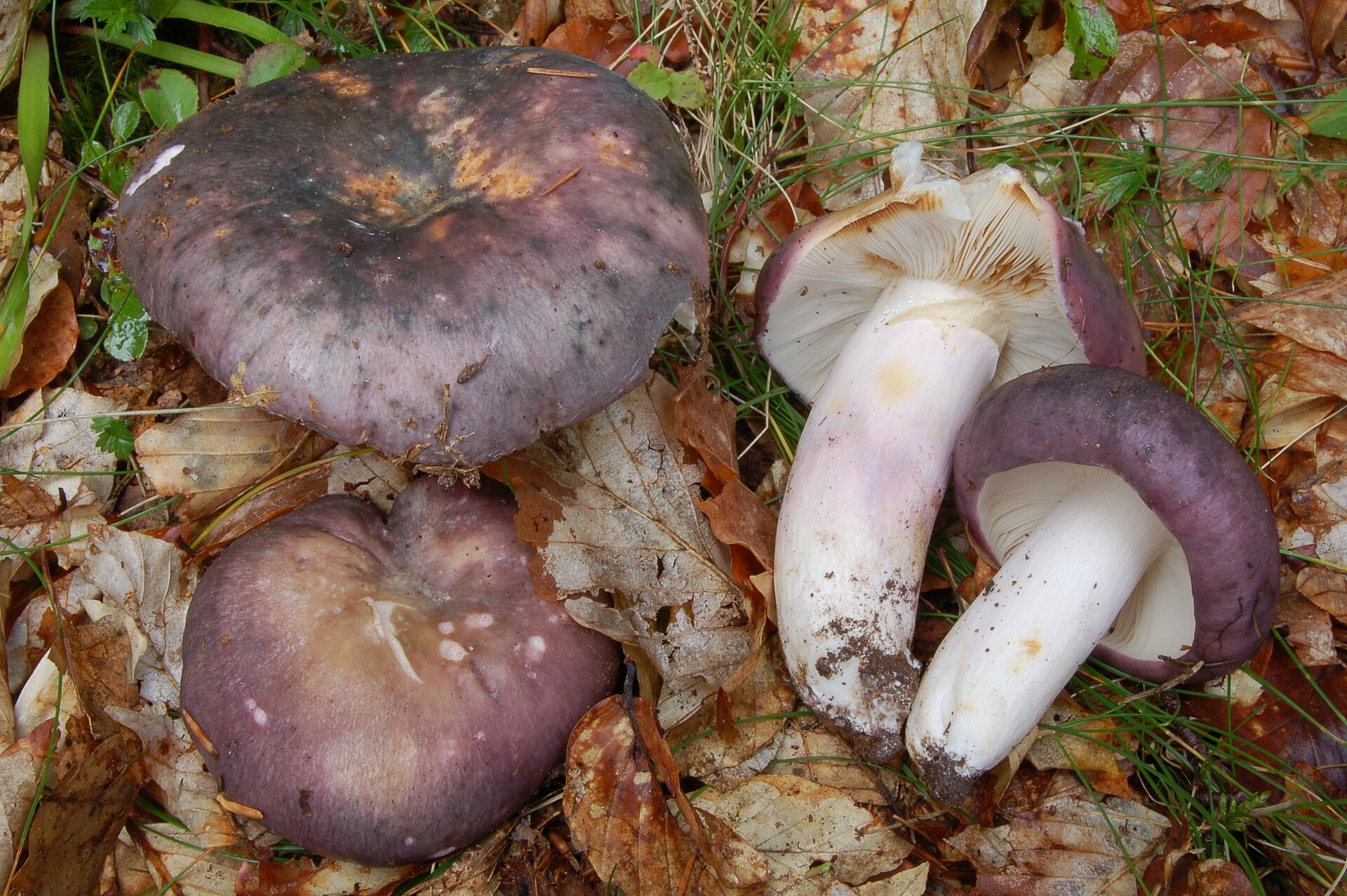
Russula cyanoxantha, commonly known as the Charcoal Burner, is a distinctive Russula with a highly variable cap that can combine purple, green, blue-gray, violet, and olive tones. Its color is often attractive but unreliable because different fruit bodies can look dramatically different from one another.
The most useful field character is not the cap color but the unusually flexible gills. Unlike the brittle gills of most Russulas, the gills of Russula cyanoxantha tend to bend under gentle pressure rather than crumble immediately.
⚠️ Important: Russulas are difficult to identify from cap color alone. Always combine gill texture, cap surface, spore print, habitat, stem structure, and regional taxonomy before assigning a species name.
Quick Identification
| Feature | Russula cyanoxantha |
|---|---|
| Common name | Charcoal Burner |
| Cap color | Purple, violet, green, blue-gray, olive, mixed |
| Cap shape | Convex, later flat to shallowly depressed |
| Cap surface | Smooth, often slightly greasy when wet |
| Gills | White to cream, unusually flexible |
| Stem | White, stout, brittle |
| Ring | Absent |
| Volva | Absent |
| Latex | Absent |
| Flesh | White, brittle |
| Spore print | White to very pale cream |
| Ecology | Mycorrhizal |
| Habitat | Deciduous and mixed woodland |
| Common hosts | Beech, oak and other broadleaf trees |
| Season | Summer to autumn |
| Edibility | Edible when correctly identified |
| Main look-alikes | Russula virescens, Russula vesca, other green and purple Russulas |
What Does Russula cyanoxantha Look Like?
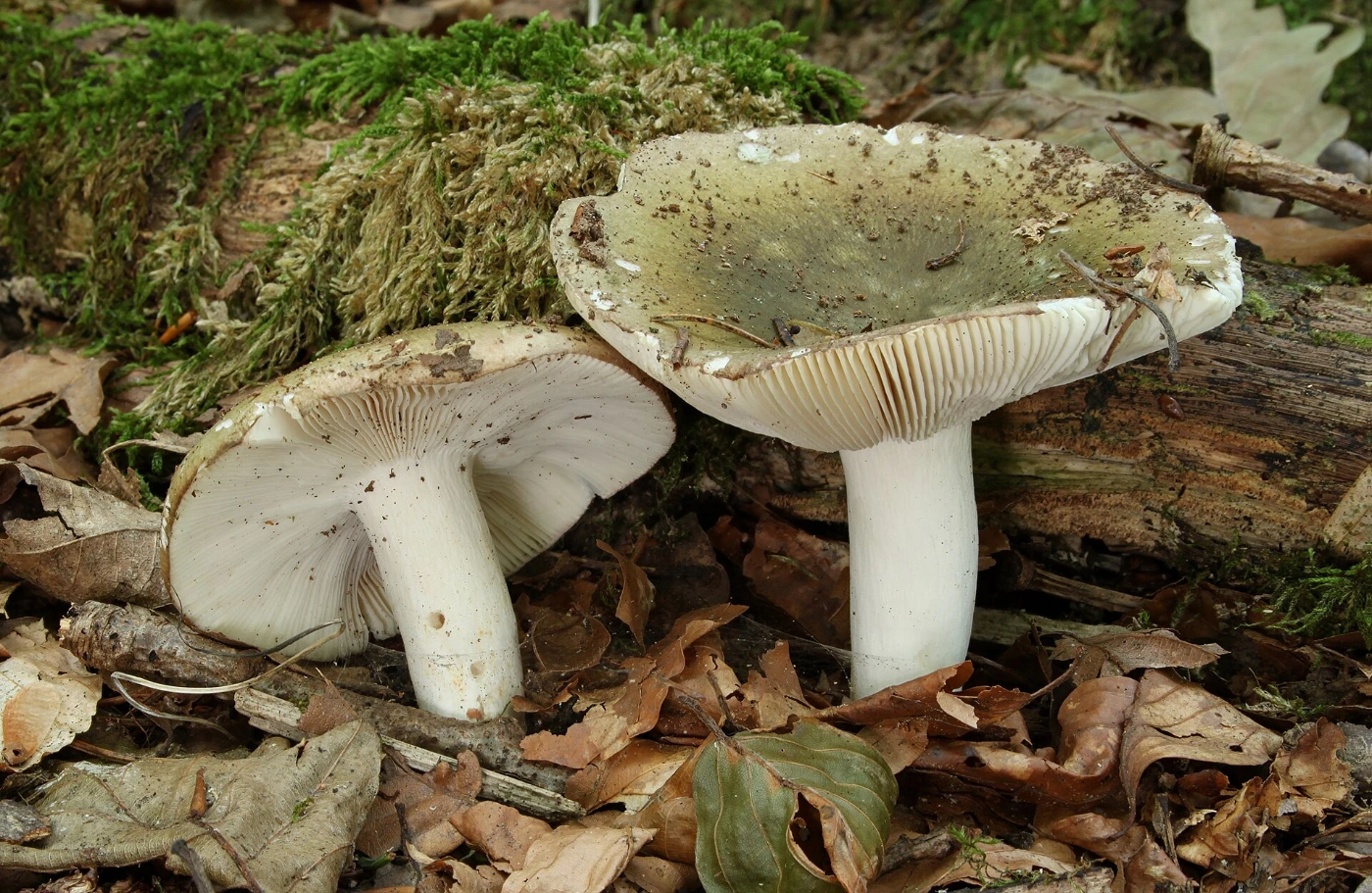
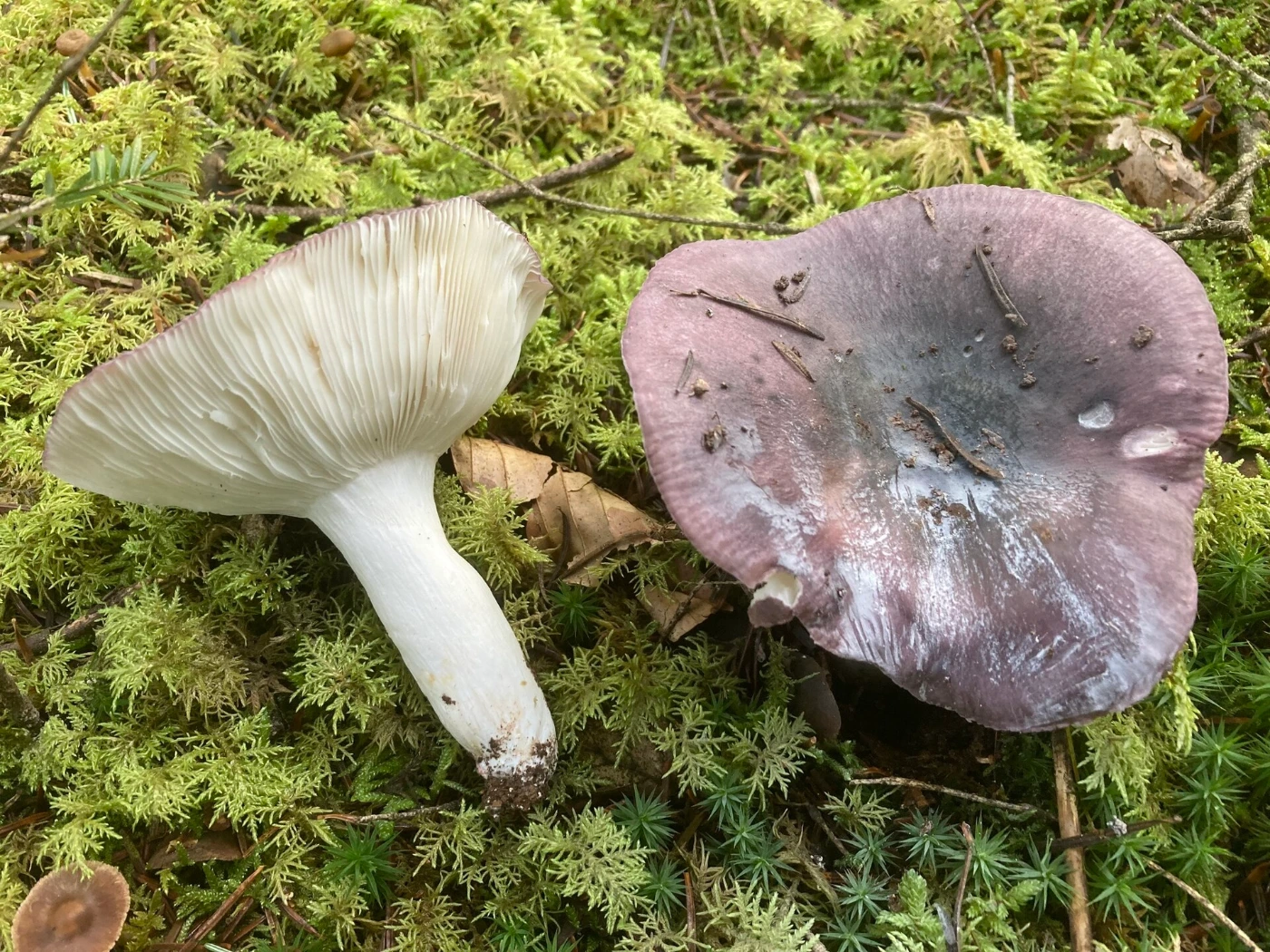
The cap is usually broad and fleshy, with colors that can shift from violet and purple to green, gray, blue-gray, or olive. Many specimens show several colors at once rather than one uniform shade.
This mixed coloration is one reason the common name Charcoal Burner is useful. The cap can look smoky, mottled, or as if several muted pigments have blended together.
Cap
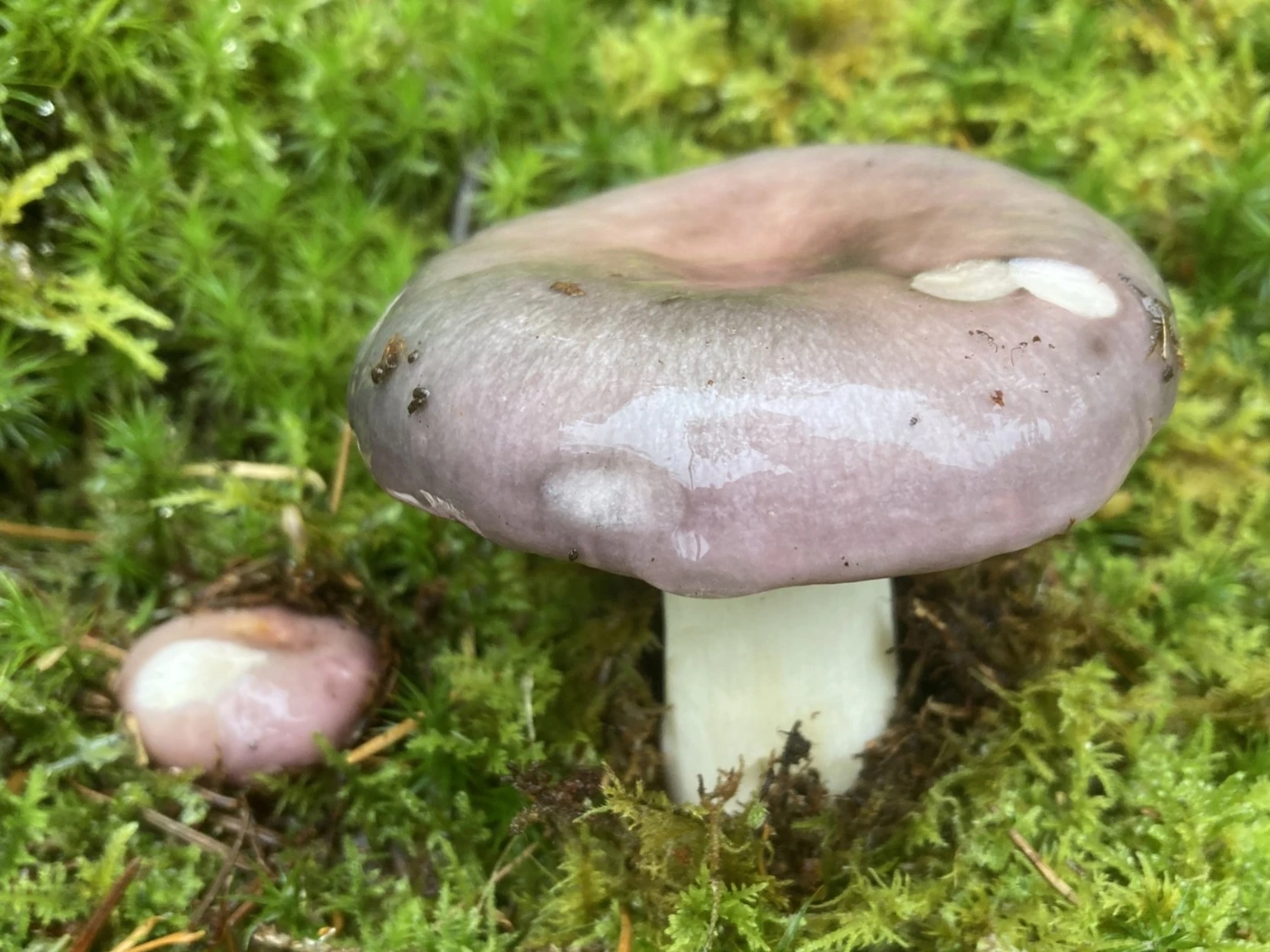
Young caps are convex and gradually flatten with age. Mature specimens often develop a shallow central depression.
The cap skin is smooth and may become slightly greasy or slippery when wet. In dry weather it can appear more matte and subdued.
Cap Color
Color variation is one of the defining features of the species. Some specimens are mostly purple, others mostly green, and many show violet, gray, and olive areas together.
Because the cap can vary so much, color alone is a poor diagnostic feature. The gills are much more useful for confirming the identification.
Gills
The gills are white to cream and fairly crowded. They are attached beneath the cap in the usual Russula pattern and do not release latex.
Their unusual flexibility is the key field character. When gently rubbed or pressed sideways, they tend to bend rather than shatter like the brittle gills of most other Russulas.
Why the Gills Are So Important
Most Russulas have fragile gills that break easily because of the brittle tissue structure typical of the family. Russula cyanoxantha is unusual because its gills feel more elastic and waxy.
This difference is especially useful when the cap color is ambiguous. A greenish or purple Russula with flexible gills deserves strong consideration as R. cyanoxantha.
Stem
The stem is white, firm, and usually stout. It may become slightly grayish or stained with age, but strong coloration is unusual.
There is no ring and no volva. The flesh remains brittle overall even though the gills are more flexible than expected.
Flesh
The flesh is white and does not usually show strong color changes when cut. It has the chalk-like break typical of Russulas.
The contrast between brittle flesh and flexible gills is particularly useful. This combination separates R. cyanoxantha from many superficially similar species.
Smell
The smell is usually mild and not strongly diagnostic. Some specimens may have a faint mushroom-like odor.
Odor should be treated as supporting evidence only. Cap color and gill texture are much more important.
Spore Print
The spore print is white to very pale cream. This fits the pale-spored Russula group.
Spore color can help confirm the broader identification but is not enough to separate R. cyanoxantha from similar pale-spored species. Gill flexibility remains the better field character.
Where Does Russula cyanoxantha Grow?
Russula cyanoxantha is mycorrhizal and grows in association with living trees. It is most common in deciduous and mixed woodland.
Beech and oak are especially important host trees in Europe. The species can also occur with other broadleaf trees depending on local habitat.
Beech Woodland
Beech forest is one of the classic habitats for Charcoal Burner. Fruit bodies may appear among leaf litter, moss, and relatively open woodland soil.
Several Russulas often grow in the same area. This makes the flexible gills particularly useful when multiple green or purple species are present.
Oak Woodland
Oak woodland can also support Russula cyanoxantha. The cap colors blend easily with shaded leaf litter and can vary strongly between individual fruit bodies.
The species may occur singly or in loose groups. It does not grow directly from dead wood.
Season
Charcoal Burner typically fruits from summer into autumn. Warm wet periods can produce substantial flushes.
In mild regions, fruiting may continue late into the season. Exact timing depends on rainfall, latitude, and temperature.
Distribution
The species is widely reported across Europe and other temperate parts of the Northern Hemisphere. Similar Russulas occur in North America, but regional taxonomy should be considered carefully.
For international identification, it is better not to assume that every green-purple Russula belongs to the same European species. Local species concepts may differ.
Is Russula cyanoxantha Edible?
Russula cyanoxantha is generally regarded as edible when correctly identified. It is considered one of the better edible Russulas in regions where it is collected.
Correct identification still matters because many Russulas share overlapping colors. A green or purple cap is not enough to confirm the species.
Look-Alikes
The main look-alikes are other green, purple, gray, or pink Russulas. The easiest separation usually comes from gill texture, cap surface, and overall color pattern rather than one isolated feature.
Russula virescens — Green-Cracking Russula
Identification
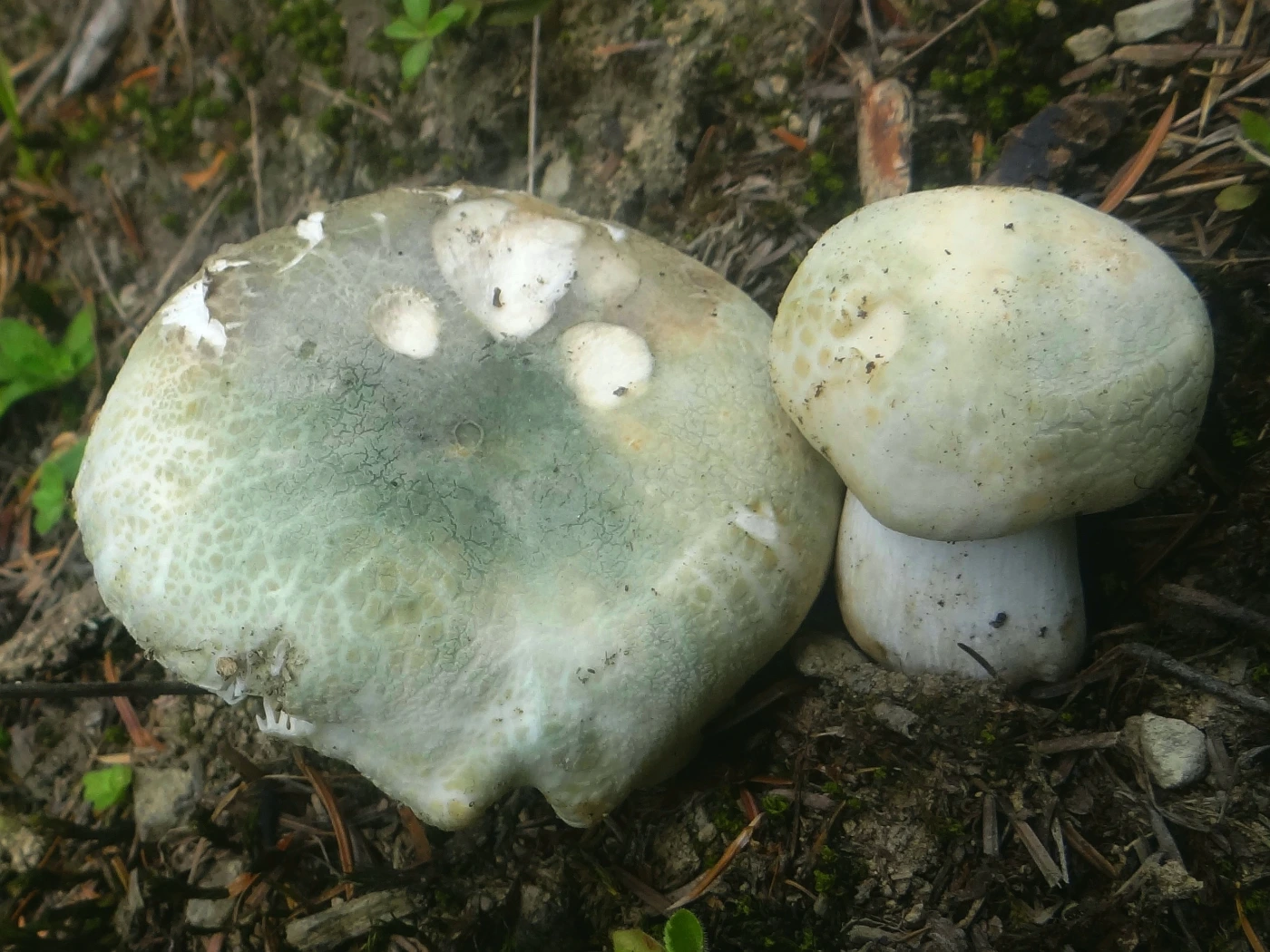
Russula virescens has a green to gray-green cap with a distinctive cracked mosaic pattern. Its gills are pale but remain brittle in the more typical Russula way.
The cap surface is therefore much more structured than in R. cyanoxantha. The mosaic pattern often looks like cracked paint or small polygonal plates.
Main Difference
A cracked green mosaic cap favors R. virescens. Smooth mixed-color cap plus flexible gills favors R. cyanoxantha.
Russula vesca — The Flirt
Identification
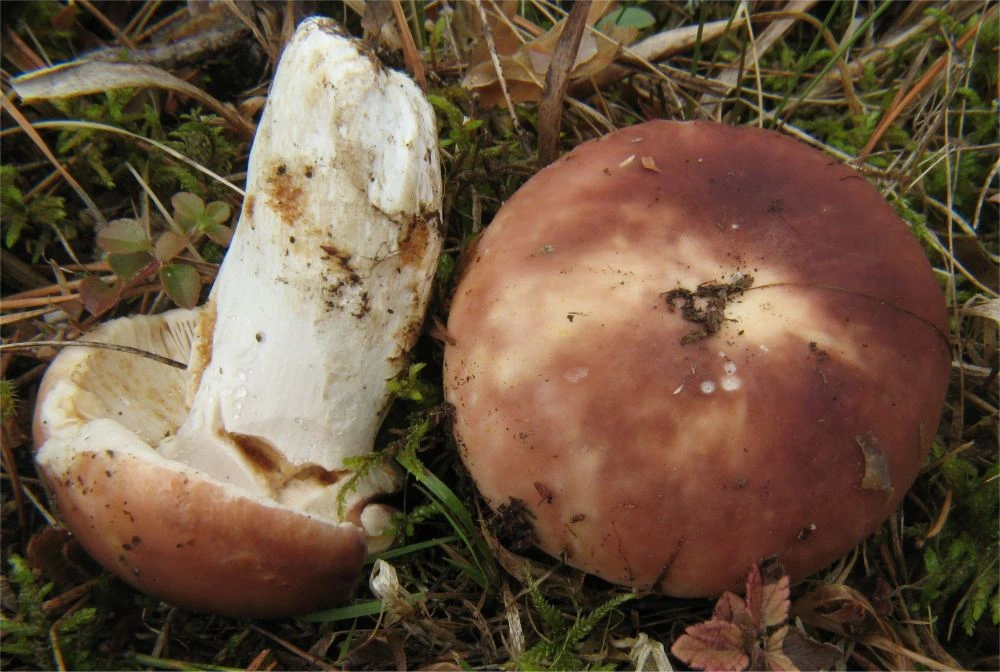
Russula vesca usually has muted pink, reddish-brown, or flesh-colored caps. The cap skin may stop short of the edge and leave a narrow pale rim of exposed flesh.
Its gills are brittle rather than unusually flexible. The overall color palette is also warmer and more pink-brown.
Main Difference
A pale exposed rim and pink-brown cap fit R. vesca. Flexible gills and purple-green-gray cap colors fit R. cyanoxantha.
Russula emetica — The Sickener
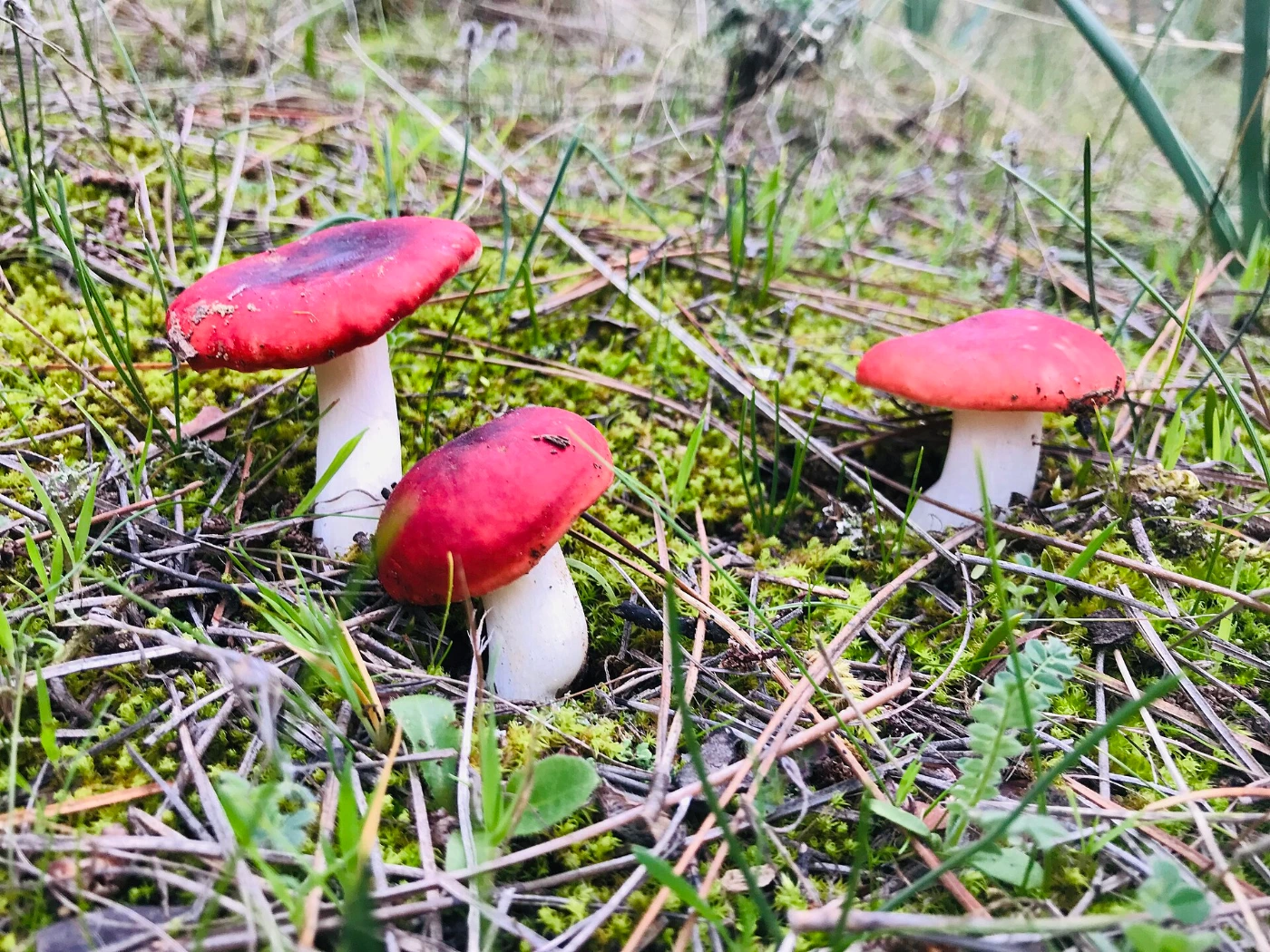
Identification
Russula emetica usually has a bright red cap, white gills, and a white stem. It is strongly acrid and often associated with wet or coniferous habitats.
Its gills are brittle and break easily. The cap is also usually much more uniformly red than the mixed tones of Charcoal Burner.
Main Difference
Bright red cap plus brittle gills points toward R. emetica. Flexible gills and mixed purple-green tones point toward R. cyanoxantha.
Other Purple Russulas
Identification
Several Russulas can develop violet, purple, blue-gray, or greenish caps. Many overlap substantially in habitat and season.
Exact separation can sometimes require spore ornamentation, microscopy, or regional knowledge. This is especially true with old or atypically colored specimens.
Main Difference
The unusual flexibility of the gills remains the most practical field clue. If the gills crumble normally, the mushroom is less likely to be R. cyanoxantha.
Russula cyanoxantha vs Russula virescens
| Feature | Russula cyanoxantha | Russula virescens |
|---|---|---|
| Cap | Purple, green, gray, mixed | Green, cracked mosaic |
| Surface | Smooth | Distinctly cracked |
| Gills | Flexible | Brittle |
| Stem | White | White |
| Spore print | White to pale cream | Cream to pale yellowish |
| Best clue | Flexible gills | Mosaic cap |
These species can occur in similar broadleaf woodland. Gill texture and cap surface are the quickest practical differences.
Russula cyanoxantha vs Russula vesca
| Feature | Russula cyanoxantha | Russula vesca |
|---|---|---|
| Cap color | Purple-green-gray, mixed | Pink-brown, flesh-colored |
| Gills | Flexible | Brittle |
| Cap margin | Usually normal | Often pale exposed rim |
| Stem | White | White |
| Habitat | Broadleaf/mixed woodland | Broadleaf/mixed woodland |
| Best clue | Flexible gills | White rim + pink-brown cap |
The two can grow in the same forests. A gentle gill-flex test is often more useful than trying to judge cap shade.
How to Identify Russula cyanoxantha
First confirm that the mushroom is a Russula. Look for brittle flesh, pale gills, no latex, no ring, and no volva.
Then examine the gills carefully. If they flex and bend rather than snapping immediately, that strongly supports Russula cyanoxantha.
Finally, check the cap pattern and habitat. A smooth mixed purple-green-gray cap in broadleaf woodland fits the species well.
Young vs Mature Charcoal Burners
Young specimens are often firmer and show stronger cap colors. Their gills may appear bright white and feel especially elastic.
Older mushrooms can fade toward gray, olive, or dull violet. The gills may become cream but often retain their characteristic flexibility.
How Weather Changes the Appearance
Rain can deepen the cap color and make the surface slightly greasy. Dry weather can dull the tones and make purple or green patches less obvious.
Older rain-washed mushrooms may look almost gray. This is another reason not to rely on color alone.
Common Identification Mistakes
One common mistake is identifying every green Russula as Russula virescens. Charcoal Burner can also be strongly green, but its cap lacks the characteristic cracked mosaic.
Another mistake is ignoring gill texture. This is one of the rare cases where gently testing the gills provides a genuinely useful species-level clue.
A third mistake is assuming that a purple cap automatically points to another genus. Russulas can show a remarkably wide range of purple, violet, and blue-gray colors.
How to Photograph Russula cyanoxantha
Take a clear top-down photograph showing the full color pattern of the cap. Mixed green, purple, and gray areas can be useful when they are visible in natural light.
Also photograph the gills and full stem. A short video or close-up sequence showing the gills bending under gentle pressure can be especially helpful for identification.
Can AI Identify Russula cyanoxantha?
AI can often suggest Charcoal Burner when a smooth mixed-color cap and pale gills are visible. Exact confidence increases when the flexible gills are documented.
A single cap photo is less reliable because several Russulas can share the same colors. Underside images and habitat information improve the result considerably.
Interesting Facts
Charcoal Burner is unusual among Russulas because its gills are far less brittle than expected. This single feature makes it one of the easier species to separate from close relatives in the field.
The cap can vary so much that two mushrooms from the same patch may look like different species. One may be mostly green, while another is strongly purple or blue-gray.
Like other Russulas, the species forms mycorrhizal relationships with trees. The visible fruit body is only the reproductive part of a much larger underground fungal network.
Its common name probably reflects the smoky, mixed coloration of the cap. Gray, purple, green, and olive shades can create a surface that looks as if it has been dusted with charcoal.
Frequently Asked Questions
Why are the gills of Russula cyanoxantha flexible?
Their tissue structure differs from the more brittle gills typical of many Russulas. This makes them bend rather than shatter immediately under gentle pressure.
Does the cap always have purple color?
No. Some specimens are mostly green, gray, olive, or blue-gray. Mixed coloration is common, but exact shades vary strongly.
Can Russula cyanoxantha be green like Russula virescens?
Yes. The difference is that R. virescens usually has a cracked mosaic cap, while R. cyanoxantha has a smoother surface and flexible gills.
Does it produce latex?
No. The absence of latex confirms that it is a Russula rather than a Lactarius or Lactifluus.
What color is the spore print?
It is white to very pale cream. This is consistent with the pale gills of the species.
Can it grow under beech and oak?
Yes. Both are common host trees in Europe, and mixed broadleaf woodland is typical habitat.
Is Russula cyanoxantha common in Europe?
Yes, it is widely reported in European broadleaf and mixed forests. Local abundance varies with habitat and weather.
Can it be identified from cap color alone?
No. The cap is too variable for that. Flexible gills are a much stronger field character.
Final Identification Notes
Russula cyanoxantha is best recognized by the combination of a smooth cap with variable purple, green, gray, or olive tones, white to cream gills, brittle white flesh, no latex, and unusually flexible gills.
Its closest visual comparisons include Russula virescens and Russula vesca. The cracked cap of R. virescens and the pale exposed margin of R. vesca provide useful distinctions, but the flexible gills remain the strongest practical clue.
The simplest field pattern is: mixed purple-green Russula + smooth cap + pale flexible gills + no latex = strong Russula cyanoxantha candidate.
Upload a photo and get possible matches in seconds.