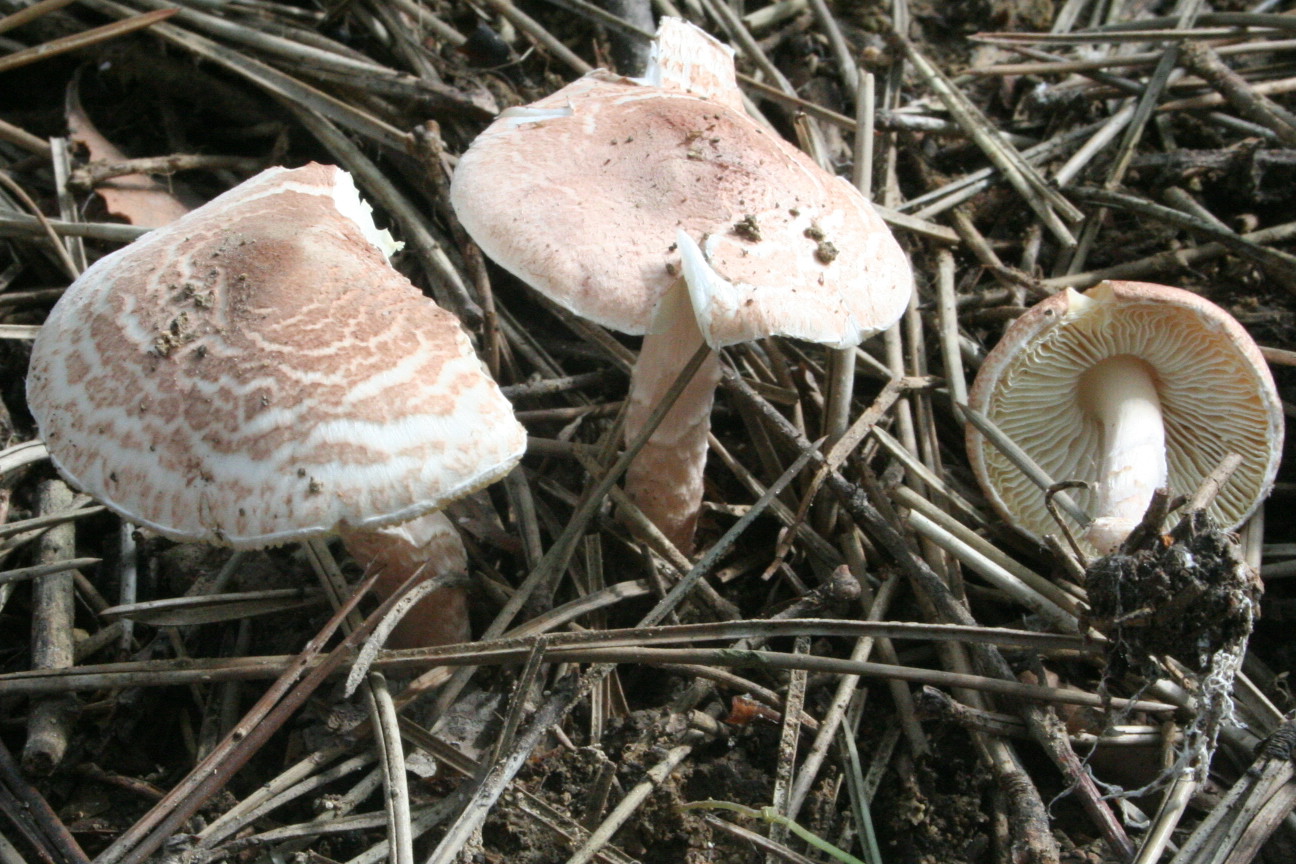
The deadly dapperling (Lepiota brunneoincarnata) is a small but extremely poisonous mushroom in the family Agaricaceae. Despite its attractive brown-scaled cap and harmless appearance, it contains amatoxins — the same group of toxins responsible for many fatal poisonings caused by the death cap (Amanita phalloides).
The species is known in English as the deadly dapperling. It occurs in Europe and parts of Asia and is particularly dangerous because it may grow in parks, gardens, lawns, and other places close to human habitation. Cooking, boiling, drying, or freezing does not make this mushroom safe to eat.
1. Characteristic Features
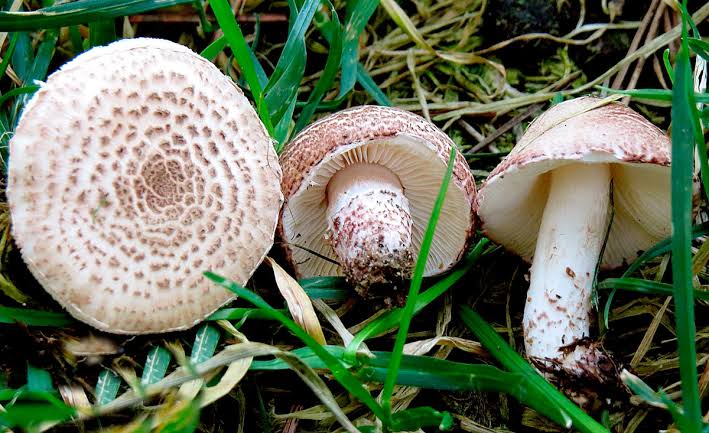
The cap is relatively small, generally around 2–6 cm across. In young specimens it is hemispherical or bell-shaped, later becoming convex and eventually almost flat. A low central bump may remain in mature mushrooms.
The background of the cap is usually whitish, cream, or pale pinkish-brown. Its most noticeable feature is the covering of reddish-brown, chestnut, or dark brown scales. These scales tend to be especially dense near the center, where they can form an almost continuous dark patch. Toward the edge of the cap they become more widely separated.
The gills are free from the stem, crowded, and initially white. They generally remain whitish or cream as the mushroom matures. The spore print is white.
The stem is slender and usually measures approximately 3–6 cm in height. Above the ring zone it is relatively pale and smooth. Below it, the surface often develops brownish scales or bands and may have pinkish, reddish-brown, or wine-colored tones.
A small ring may be present on the stem, but it is fragile and can disappear as the mushroom ages. Consequently, the absence of an obvious ring does not rule out Lepiota brunneoincarnata.
The flesh is whitish and relatively thin. Damaged areas, particularly toward the lower stem, may develop pinkish or reddish-brown tones. The odor is sometimes described as fruity or slightly unpleasant, but smell alone is not a reliable identification feature. The mushroom should never be tasted.
| Feature | Lepiota brunneoincarnata |
|---|---|
| Cap | Small, usually 2–6 cm; cream to pinkish-brown with reddish-brown scales |
| Cap center | Usually darker, with densely packed brown scales |
| Gills | Crowded, white to cream, free from the stem |
| Stem | Slender, pale above; brownish or wine-colored below |
| Ring | Small and fragile; may disappear with age |
| Spore print | White |
| Flesh | Whitish; may become pinkish or reddish-brown when damaged |
| Habitat | Parks, gardens, lawns, paths, woodland edges, deciduous woodland |
| Season | Mainly summer to autumn |
| Key warning | Small parasol-like mushroom; deadly poisonous and contains amatoxins |
2. What Species Are There?
The genus Lepiota contains hundreds of species worldwide. Many are small mushrooms with pale caps covered in darker scales. Identification can be difficult, and separating closely related species may require microscopic examination.
Some notable European species include:
- Lepiota brunneoincarnata — deadly dapperling, a highly poisonous amatoxin-containing species.
- Lepiota subincarnata — another dangerously poisonous species containing amatoxins.
- Lepiota castanea — chestnut dapperling, a small brown-scaled species that should not be eaten.
- Lepiota cristata — stinking dapperling, a widespread small species with brownish scales.
- Lepiota clypeolaria — shield dapperling, usually somewhat larger and characterized by a shaggy stem.
- Numerous other small Lepiota species that can be difficult to identify reliably in the field.
For mushroom pickers, the most important point is that small Lepiota species should not be treated as miniature versions of edible parasol mushrooms. Some members of the genus are dangerously poisonous.
3. When Does It Grow?
The deadly dapperling must never be collected for food. However, knowing its fruiting season is useful because it can appear in the same places and at the same time as edible mushrooms.
In Europe, Lepiota brunneoincarnata mainly fruits from summer through autumn. Depending on local climate, mushrooms can begin appearing around June or July, with most records occurring from late summer into autumn. In warmer regions, fruiting may continue into October or November.
Warm, moist conditions favor the production of fruiting bodies. The mushrooms can appear relatively quickly after periods of rain.
Because the species often occurs outside forests, people may encounter it unexpectedly while walking through a park, garden, or grassy area.
4. Where Does It Grow?
Unlike many familiar wild mushrooms, Lepiota brunneoincarnata is not restricted to woodland. It is a saprotrophic species that obtains nutrients by decomposing organic material in soil and plant litter.
Typical habitats include:
- parks and gardens;
- lawns and grassy areas;
- woodland edges;
- deciduous woodland;
- roadsides and paths;
- disturbed or nutrient-rich soils.
It can grow singly, scattered across an area, or in small groups.
The species is primarily known from Europe and temperate parts of Asia, although its documented distribution has expanded as mycologists and poison-control specialists have become more familiar with it.
Its ability to grow close to houses is one reason it deserves particular attention. A deadly poisonous mushroom does not necessarily have to come from a remote forest.
5. What Can It Be Confused With?
One of the greatest risks is confusing the deadly dapperling with small edible parasol-like mushrooms. Its pale cap with brown scales, white gills, slender stem, and ring can give it the general appearance of a miniature parasol.
The true parasol mushroom (Macrolepiota procera) is normally much larger, with a broad cap that can exceed 20 cm and a long stem carrying a substantial movable ring. Nevertheless, size alone should never be used to decide whether a mushroom is edible.
Young mushrooms may also be mistaken for some species of Agaricus. A useful distinction is the color of the gills. Agaricus species generally develop pink and eventually chocolate-brown gills, whereas Lepiota brunneoincarnata retains pale gills.
The mushroom can also be confused with other small Lepiota species. This is particularly problematic because several members of the genus are themselves poisonous, and field identification may be extremely difficult.
A small mushroom with white gills, a scaly cap, and a ring or ring zone should therefore never be assumed edible simply because it resembles a parasol.
6. Interesting Facts and References in Literature
Lepiota brunneoincarnata was scientifically described in 1889 by the Swiss botanists Robert Hippolyte Chodat and Charles-Édouard Martin. The specific name combines words referring to its brown and flesh-colored or pinkish appearance.
The English common name “deadly dapperling” is unusually accurate. “Dapperling” is applied to various small Lepiota species, while “deadly” reflects the presence of amatoxins.
These toxins include compounds such as alpha-amanitin. They interfere with RNA polymerase II, an enzyme essential for normal cellular function. The liver is particularly vulnerable, and severe poisoning can result in acute liver failure.
One of the most dangerous aspects of amatoxin poisoning is the delay before symptoms appear. A person may initially feel well for several hours after eating the mushrooms. Severe vomiting, diarrhea, and abdominal pain can then develop. This may be followed by an apparent improvement even while liver damage continues. Without appropriate medical treatment, the condition can become life-threatening.
Medical literature contains documented cases of severe and fatal poisoning caused by Lepiota brunneoincarnata. Such reports have helped establish small Lepiota species as an important group in clinical mushroom toxicology.
The deadly dapperling is also a good example of why traditional rules for recognizing poisonous mushrooms do not work. It does not necessarily have a frightening appearance, unpleasant color, or obvious warning sign. It is simply a small, attractive brown-and-white mushroom that can contain extremely powerful toxins.
Another unusual feature is its preference for human-modified habitats. While many famous poisonous mushrooms are associated with forests and particular trees, L. brunneoincarnata may appear in landscaped parks, gardens, lawns, and along paths.
Conclusion
The deadly dapperling (Lepiota brunneoincarnata) is a small, dangerously poisonous mushroom characterized by a pale cap covered with reddish-brown scales, white free gills, a slender stem, and a fragile ring or ring zone. It commonly appears from summer through autumn and can grow in gardens, parks, grassy areas, woodland edges, and deciduous forests.
Its greatest danger is its resemblance to small parasol-like mushrooms and other seemingly harmless species. Because Lepiota brunneoincarnata contains amatoxins capable of causing severe or fatal liver damage, it must never be eaten. Unknown small Lepiota-like mushrooms are best left untouched, and suspected ingestion requires urgent medical attention even if no symptoms have appeared yet.