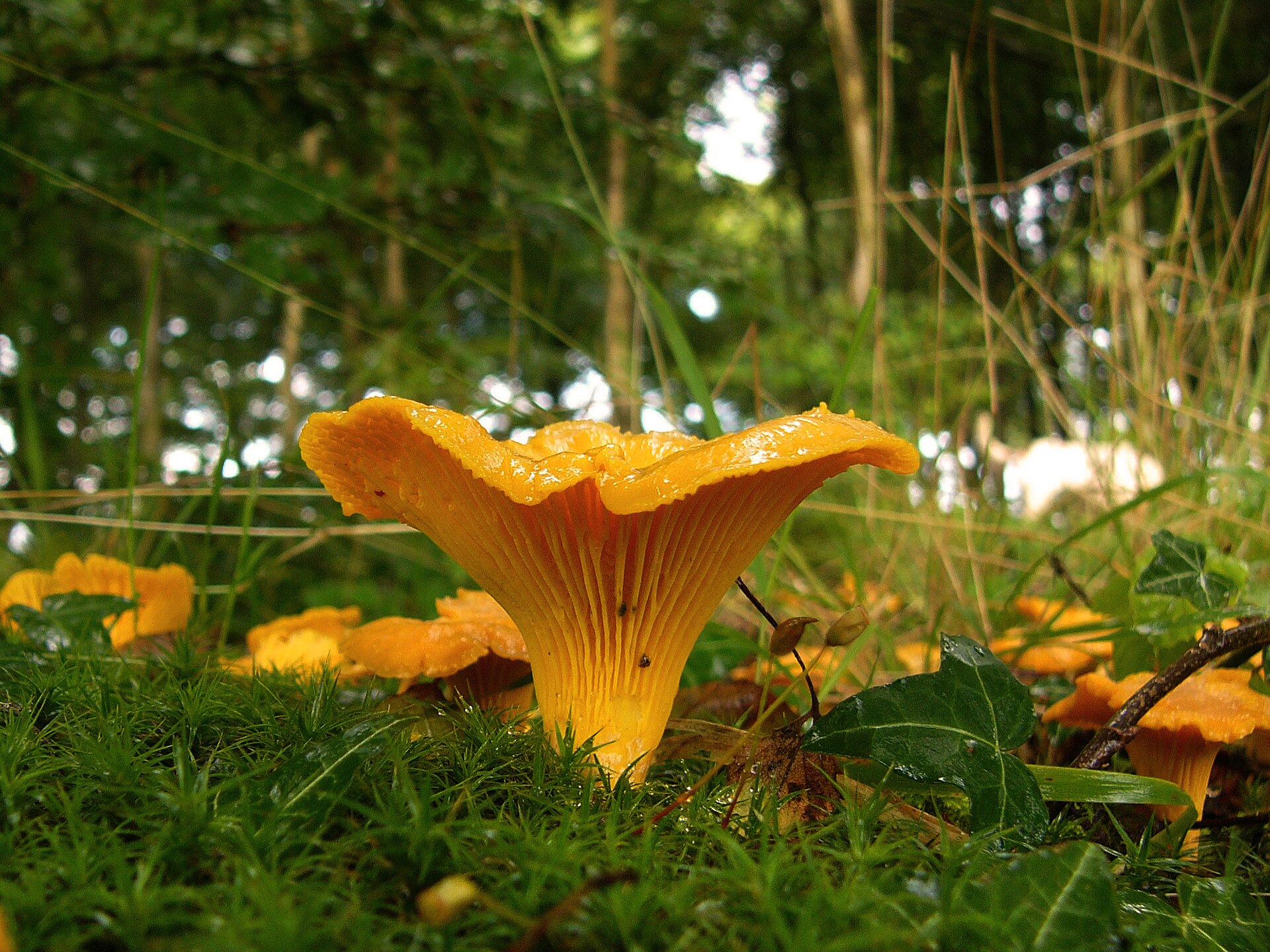
September is one of the most productive months for mushroom foraging across much of North America. Cooler nights, moist soil, and autumn rains encourage many popular edible fungi to fruit. Chanterelles, porcini, hedgehog mushrooms, lobster mushrooms, chicken of the woods, and several other sought-after species may all be found during this period.
However, North America covers an enormous range of climates. September mushroom conditions in the Pacific Northwest are very different from those in New England, the Great Lakes, the Rocky Mountains, or southern Canada. Rainfall, elevation, forest type, and local temperatures are often more important than the calendar itself.
Chanterelles
Chanterelles are among the most popular wild mushrooms collected in North America. Unlike Europe, where Cantharellus cibarius is the familiar reference species, North America contains numerous distinct Cantharellus species.
On the Pacific coast, the Pacific golden chanterelle (Cantharellus formosus) is particularly important. Other chanterelle species occur across eastern North America, the Great Lakes region, the Appalachians, and Canada.
Chanterelles typically have yellow, golden, or orange fruiting bodies. Instead of thin, blade-like true gills, the underside of the cap has blunt folds or ridges that run partly down the stem. Many species have a pleasant fruity aroma.
September can be an excellent month for chanterelles where late-summer and early-autumn rainfall is sufficient.
Porcini and Other King Boletes
Porcini-type mushrooms are among the most highly valued edible boletes. In North America, several species and regional forms belong to the Boletus edulis group rather than all of them being the European Boletus edulis.
These mushrooms generally have thick, solid stems, brown caps, and a sponge-like layer of pores rather than gills. Young specimens have white pores, which become yellowish and eventually olive as they mature.
In September, king boletes can be particularly productive in mountainous and northern regions. They form mycorrhizal relationships with trees including spruce, pine, fir, and various hardwoods.
When collecting boletes, identification should not be based simply on the presence or absence of blue staining. North America has a very diverse bolete flora, including bitter, inedible, and potentially toxic species.
Lobster Mushroom
The lobster mushroom is one of North America’s most unusual edible fungi. It is generally known as Hypomyces lactifluorum, but what appears to be a single mushroom is actually the result of a parasitic fungus attacking another mushroom, usually a species of Russula or Lactarius.
The parasite dramatically transforms its host. The resulting fruiting body becomes firm and irregular, with a characteristic bright orange to reddish-orange exterior reminiscent of a cooked lobster shell.
Lobster mushrooms are widespread across much of North America and are commonly found from summer into autumn. September is often an excellent month for them.
Fresh specimens should be firm and dense. Old, soft, foul-smelling, or badly decayed fruiting bodies should be left behind.
Hedgehog Mushrooms
Hedgehog mushrooms are excellent autumn edibles and relatively distinctive because the underside of the cap is covered with small downward-pointing teeth rather than gills or pores.
Several species occur in North America, including members of Hydnum and related groups. Their taxonomy has changed substantially in recent years, so older field guides may use broader species names than modern references.
The caps are generally cream, buff, pale orange, or salmon-colored. The flesh is firm, and the teeth underneath the cap are usually pale and easily broken.
Hedgehog mushrooms grow on the ground in association with trees. They can occur in both coniferous and hardwood forests and often fruit in groups. September is an important month for them in many northern and mountainous regions.
Chicken of the Woods
Chicken of the woods refers to several species of Laetiporus. These spectacular mushrooms form large clusters of overlapping yellow, orange, and sometimes salmon-colored shelves on trees or wood.
Species vary geographically and ecologically. Laetiporus sulphureus is widespread in eastern North America, while other species occur in western regions and on different host trees.
Young specimens are tender and are the stage generally collected for food. Older fruiting bodies become tough and less desirable.
Some people experience gastrointestinal reactions even to correctly identified Laetiporus, so it is advisable to try only a small amount the first time and always eat it thoroughly cooked.
Hen of the Woods
Hen of the woods, or maitake (Grifola frondosa), is an important autumn mushroom in eastern North America.
It produces large clusters consisting of many overlapping gray-brown, fan-shaped caps. A single fruiting body can become remarkably large.
Maitake typically grows at the base of mature hardwood trees, especially oaks. The same tree may produce mushrooms in approximately the same location in subsequent years.
September marks the beginning of prime maitake season in many parts of the northeastern and midwestern United States, with fruiting often continuing through October.
Oyster Mushrooms
Oyster mushrooms of the genus Pleurotus occur widely throughout North America. They grow directly from dead or weakened wood and form clusters of fan-shaped or oyster-shaped caps.
Depending on species and region, oyster mushrooms can appear during several seasons. Cool, damp September weather can produce good flushes, particularly on hardwood logs and standing dead trees.
The gills run down the stem or toward the point where the mushroom attaches to the wood. The stem may be short, off-center, or almost absent.
Because several unrelated wood-growing mushrooms can superficially resemble oysters, collectors should check all identification characteristics rather than relying solely on the shape of the cap.
Puffballs
Several edible puffball species fruit during late summer and autumn. One of the most impressive is the giant puffball (Calvatia gigantea), which can grow larger than a football.
Edible puffballs must be completely white and uniform inside when cut from top to bottom. Any yellow, brown, olive, or developing internal structures indicate that the mushroom should not be eaten.
Cutting a suspected puffball vertically is particularly important because immature Amanita mushrooms can sometimes resemble small puffballs externally. A young Amanita will reveal the developing cap, gills, and stem inside rather than the homogeneous white interior of a true puffball.
Black Trumpets
Black trumpets are dark, thin-fleshed, funnel-shaped mushrooms related to chanterelles. Several Craterellus species occur in North America.
Their gray, charcoal, brownish, or almost black coloration makes them remarkably difficult to see among fallen leaves. Once one is discovered, however, it is worth examining the surrounding area because they frequently grow in groups.
The underside lacks true gills and is generally smooth or slightly wrinkled. Black trumpets are valued for their intense aroma and are particularly suitable for drying.
In some eastern and northern regions, their season extends into September, although timing varies considerably with rainfall and latitude.
Cauliflower Mushrooms
Species of Sparassis, commonly called cauliflower mushrooms, form large masses of curled or folded branches that resemble a cauliflower or a pile of egg noodles.
They are associated with trees, particularly conifers, and may appear around the bases of trunks, stumps, or roots. Different Sparassis species occur in eastern and western North America.
Young, clean specimens are edible and highly regarded, although their complicated structure can trap considerable amounts of soil, needles, and insects.
Late summer and early autumn are productive periods for several North American species.
Where Is September Foraging Best?
The Pacific Northwest — particularly Oregon, Washington, British Columbia, and nearby areas — is one of North America’s most famous mushroom regions. Autumn rains can trigger chanterelles, boletes, lobster mushrooms, hedgehog mushrooms, and many other species.
The northeastern United States and southeastern Canada can also be extremely productive. New England, New York, Pennsylvania, Ontario, Quebec, and surrounding regions offer diverse hardwood and mixed forests where September may bring maitake, chicken of the woods, boletes, chanterelles, puffballs, and other mushrooms.
The Great Lakes region combines extensive forests with relatively moist autumn conditions. In the Rocky Mountains, elevation plays an especially important role: the mushroom season can begin much earlier at high elevations, and September conditions vary considerably from year to year.
What Poisonous Mushrooms Should You Watch For?
September is also a major season for poisonous fungi. North American forests contain deadly Amanita species, including members of the destroying angel group. Death caps (Amanita phalloides), an introduced species now established particularly on the West Coast, are another major concern.
Deadly Galerina species can grow on decaying wood and may be confused with edible wood-growing mushrooms. Some small Lepiota species contain amatoxins, while various Cortinarius species should also be treated with caution.
False chanterelles and jack-o’-lantern mushrooms (Omphalotus species) are important look-alikes for inexperienced chanterelle hunters. Jack-o’-lanterns grow in clusters from wood or buried roots and have true, sharp-edged gills; eating them can cause severe gastrointestinal poisoning.
Never rely on folk rules such as whether a mushroom changes color, whether insects eat it, or whether it can be peeled. These methods cannot determine whether a wild mushroom is safe.
Tips for September Mushroom Foraging
Rainfall is one of the best indicators of mushroom activity. A productive period often follows substantial rain combined with moderate temperatures, although different species respond at different speeds.
Search according to habitat rather than simply walking randomly through the forest. If you are looking for maitake, concentrate on mature oaks. For king boletes, learn the trees associated with local species. For lobster mushrooms and chanterelles, identify productive forest types in your region.
North American mushroom identification also requires particular attention to geography. A European field guide is not sufficient for identifying North American fungi. Many mushrooms that look almost identical on different continents have proved to be separate species.
Local regulations should also be checked before collecting. National parks, state or provincial parks, national forests, and other public lands can have very different rules concerning mushroom harvesting.
Conclusion
September is one of the most exciting mushroom months in North America. Depending on the region, foragers may encounter chanterelles, king boletes, lobster mushrooms, hedgehog mushrooms, chicken of the woods, hen of the woods, oyster mushrooms, puffballs, black trumpets, and cauliflower mushrooms.
The best choices vary dramatically by location. The Pacific Northwest is especially famous for autumn chanterelles and boletes, while eastern North America offers excellent opportunities for maitake and many hardwood-associated species.
Successful September foraging depends on rainfall, temperature, elevation, and knowledge of local trees. Most importantly, every mushroom intended for food should be positively identified using characteristics appropriate to North American species. When identification is uncertain, the mushroom should not be eaten.