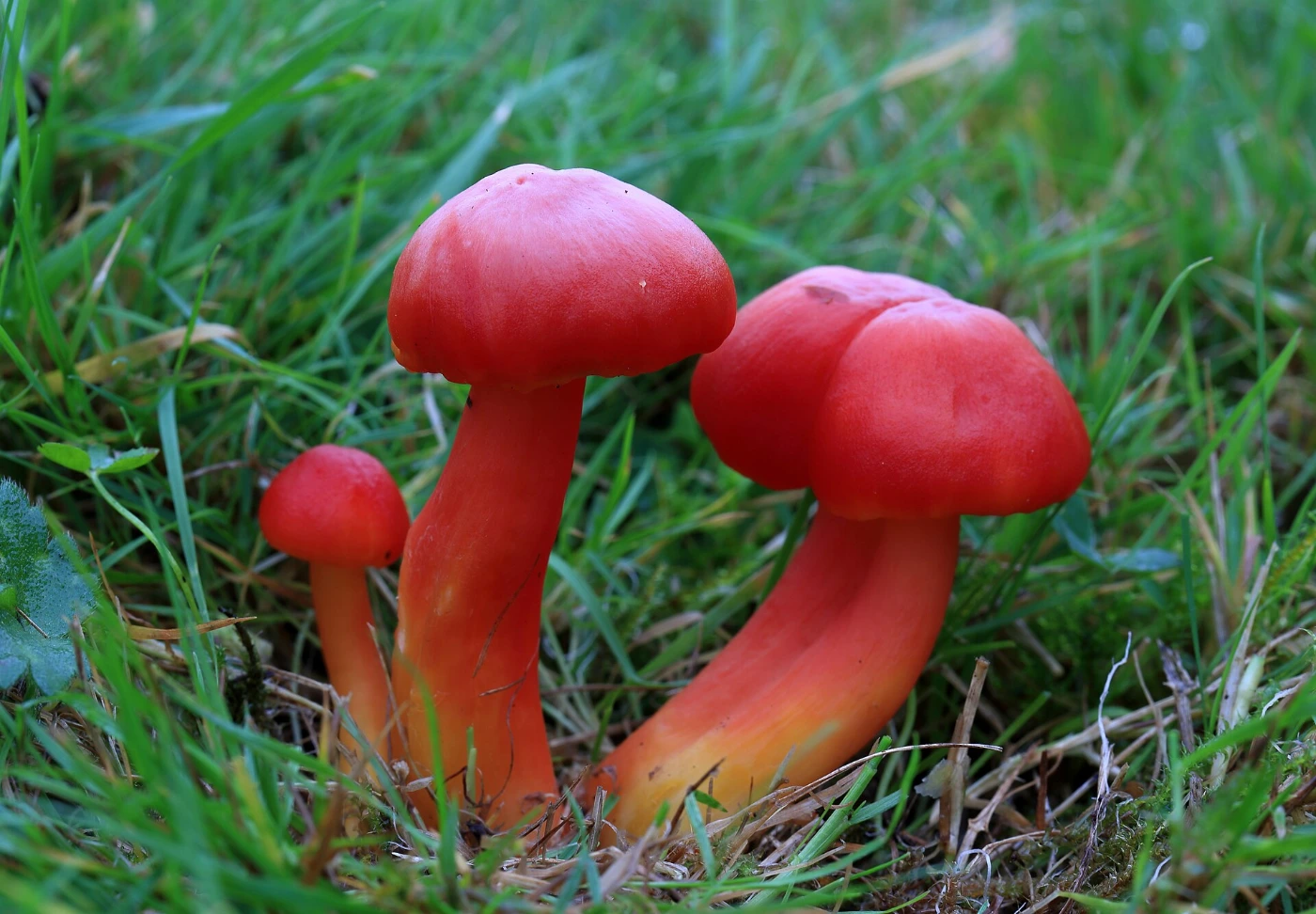
Hygrocybe coccinea, commonly known as the Scarlet Waxcap, is a small but striking grassland mushroom with a vivid red to scarlet cap, waxy gills, and a similarly colored stem. It often appears in old lawns, meadows, churchyards, and other low-nutrient grasslands, especially during cool, wet autumn weather.
Its bright color makes it easy to notice, but exact identification can still be challenging because several other waxcaps are red, orange, or crimson. The most reliable identification comes from combining cap color, gill structure, stem texture, size, habitat, and comparison with closely related species.
⚠️ Important: This guide is for identification and education only. Scarlet Waxcap is not a good beginner food mushroom, and wild mushrooms should never be eaten based only on photographs, AI identification, or one visible feature.
Quick Identification
| Feature | Hygrocybe coccinea |
|---|---|
| Scientific name | Hygrocybe coccinea |
| Common name | Scarlet Waxcap |
| Family | Hygrophoraceae |
| Cap color | Scarlet-red to orange-red |
| Cap shape | Convex, later flatter |
| Cap surface | Smooth, moist to slightly greasy |
| Gills | Waxy, pale yellow to orange-red |
| Gill attachment | Adnate to slightly decurrent |
| Stem | Red to orange-red, paler toward base |
| Ring | Absent |
| Volva | Absent |
| Flesh | Thin, pale to reddish |
| Spore print | White |
| Habitat | Unimproved grassland, lawns, meadows |
| Season | Mainly autumn |
| Edibility | Not recommended |
| Main look-alikes | Hygrocybe punicea, H. miniata, H. reidii, H. ceracea |
What Does Hygrocybe coccinea Look Like?
Scarlet Waxcap is usually a small to medium-sized mushroom with intense red coloration across the cap and upper stem. Fresh specimens can look almost lacquered after rain, although the cap is not usually as slimy as some other waxcaps.
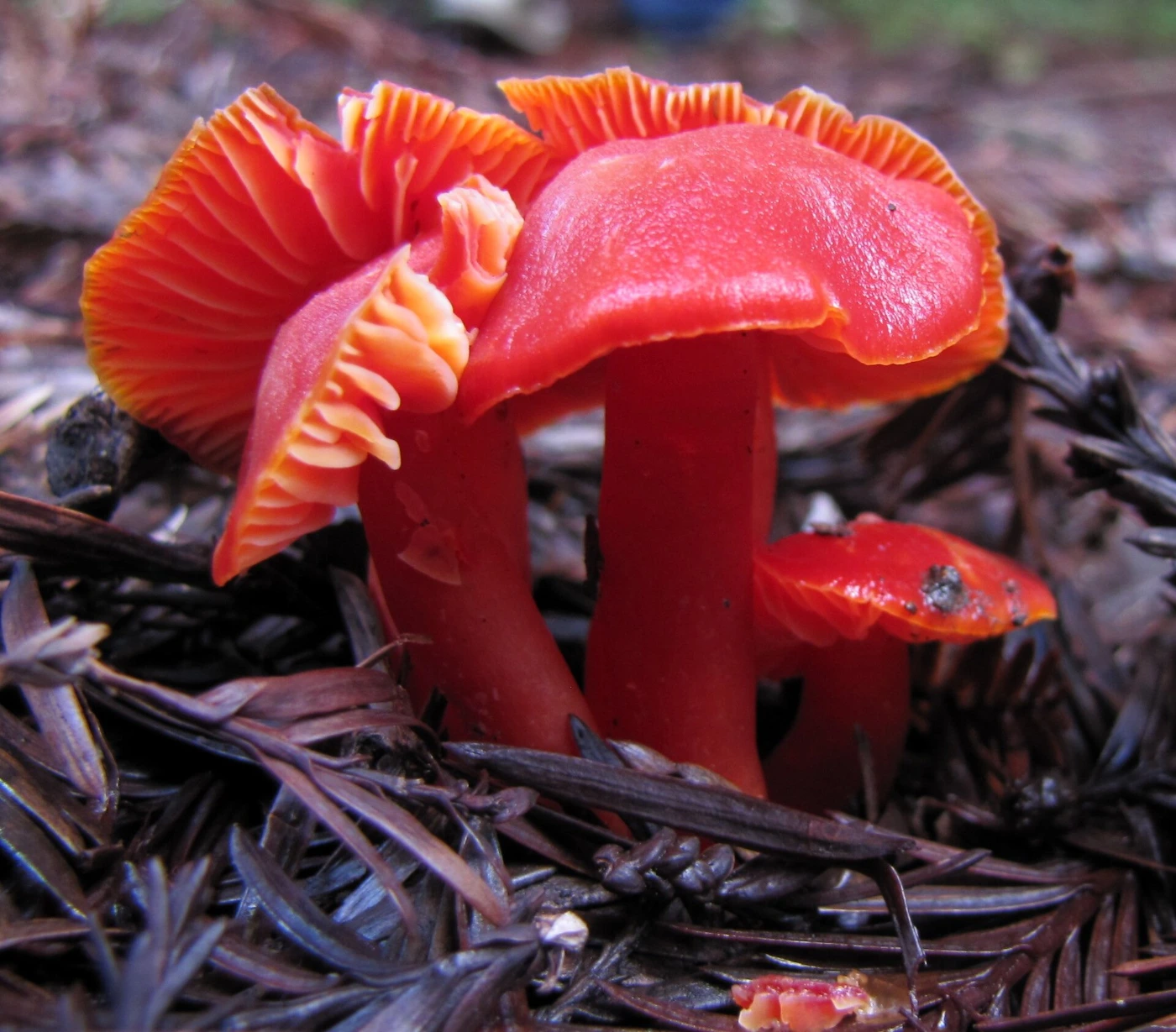
The gills are thick and waxy rather than thin and papery. Their color can range from pale yellow through orange to reddish tones, depending on age and individual variation.
Cap
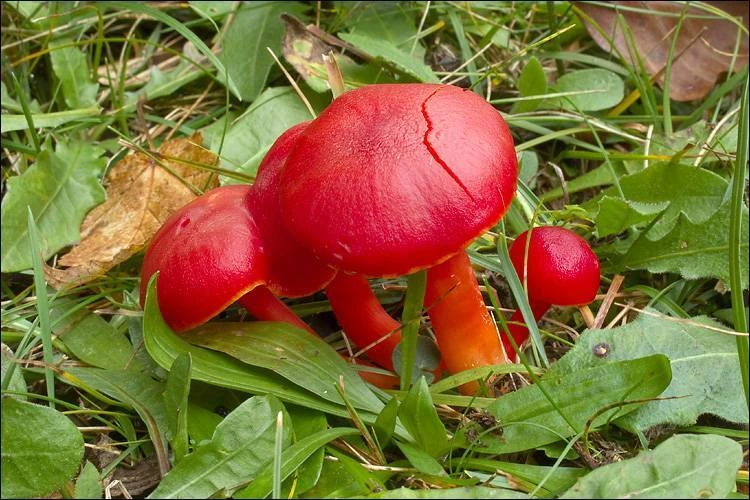
The cap begins convex and may later flatten, sometimes developing a slightly depressed center. Typical colors range from vivid scarlet and blood-red to orange-red.
Young fruit bodies often show the deepest coloration. Older caps may fade toward orange or yellowish red, especially at the margin.
Cap Surface
The surface is smooth and can feel moist or slightly greasy in wet weather. It is generally not strongly slimy or covered with scales.
As the cap dries, it can become more matte. Weather can therefore change the overall appearance quite noticeably.
Gills
The gills are relatively thick, waxy, and more widely spaced than in many ordinary small gilled mushrooms. They may be yellow, orange-yellow, or reddish.
Their waxy texture is one of the best clues that the mushroom belongs to the waxcap group. Thin crowded gills would suggest a different type of mushroom.
Gill Attachment
The gills are usually attached to the stem and may run slightly downward. The exact attachment can vary enough that it should not be used alone.
Color and texture are generally more useful than the precise gill connection.
Stem
The stem is slender, smooth, and usually red to orange-red. It often becomes paler or more yellowish toward the base.
There is no ring or volva. The stem is relatively fragile compared with larger woodland mushrooms.
Stem Texture
The surface is typically smooth and somewhat moist rather than fibrous or scaly. It lacks the coarse ornamentation seen in many unrelated red mushrooms.
The combination of a smooth red stem and waxy gills strongly supports a waxcap identification.
Flesh
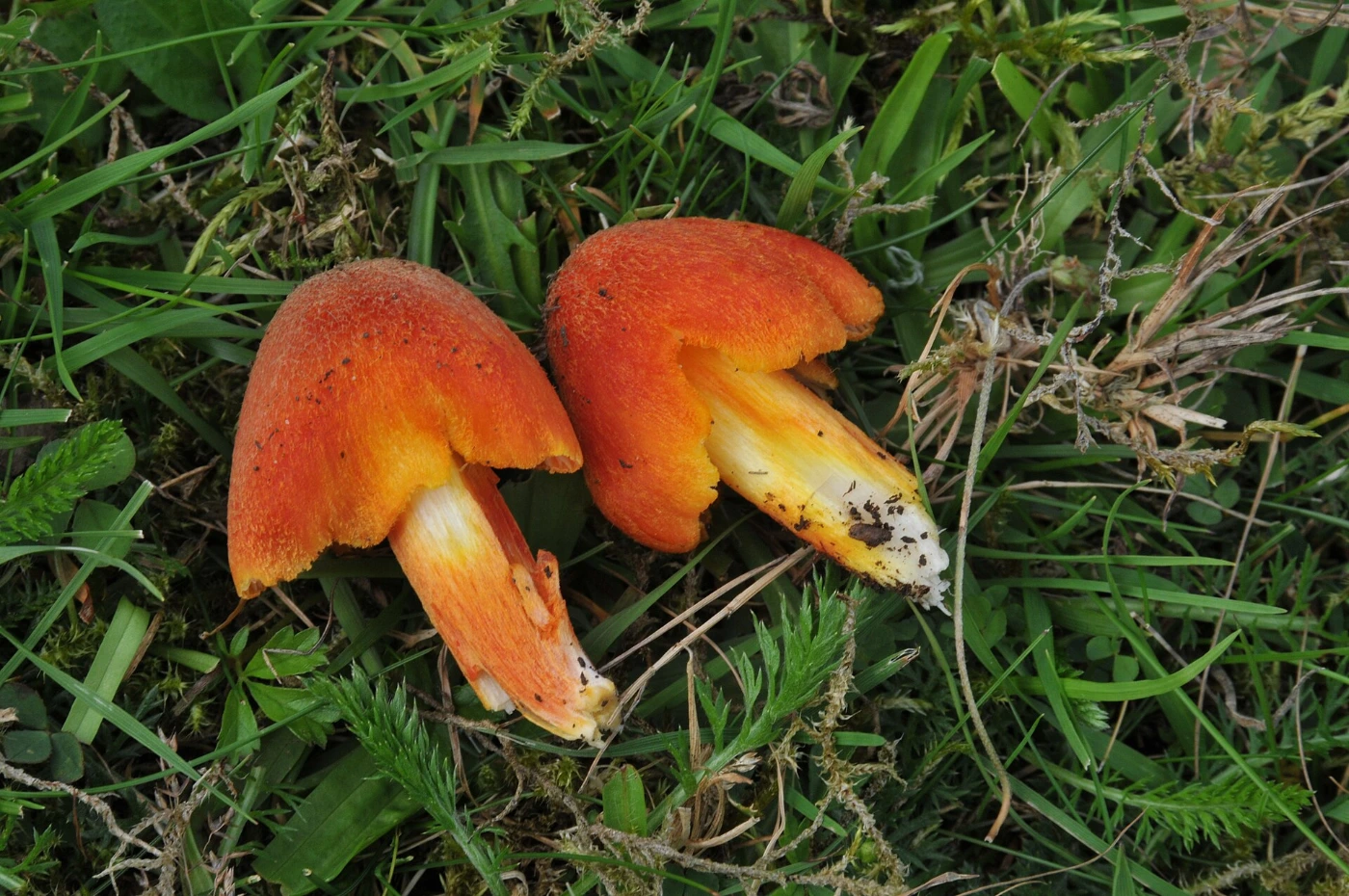
The flesh is thin and relatively delicate. Inside, it may be pale yellowish, orange-tinted, or reddish near the outer tissues.
There is no dramatic blue, black, or green bruising reaction. Strong color changes after damage would suggest another species or group.
Smell
The smell is generally mild and not especially distinctive. Unlike Hygrocybe reidii, Scarlet Waxcap is not known for a strong honey-like odor.
Because smell can be subjective, it should only support the identification after structural features have been checked.
Spore Print
The spore print is white. This is typical for many waxcaps and helps confirm the broader group.
Spore print color is not especially useful for separating closely related red Hygrocybe species.
Where Does Scarlet Waxcap Grow?
Scarlet Waxcap is strongly associated with low-nutrient grassland. It is especially characteristic of old meadows, unimproved lawns, pastures, churchyards, and other sites that have not been heavily fertilized.
These habitats are often called waxcap grasslands because several brightly colored species can occur together.
Unimproved Grassland
Waxcaps tend to decline when grasslands receive large amounts of fertilizer or undergo major soil disturbance. Old, nutrient-poor turf can therefore support surprisingly rich fungal communities.
This makes habitat unusually important for identification. A small red waxcap in an old unfertilized lawn fits Hygrocybe coccinea much better than an identical-looking mushroom growing from wood chips.
Lawns and Churchyards
Scarlet Waxcap can occur in lawns that have been managed for many years without heavy fertilization. Historic churchyards and old cemeteries are well-known habitats for diverse waxcap communities in parts of Europe.
Regular mowing does not necessarily prevent waxcaps from fruiting. In some cases, short grass even makes them easier to notice.
When Does Hygrocybe coccinea Grow?
The main season is autumn, particularly during cool, moist weather. Fruiting can continue into early winter in mild regions.
Timing varies with rainfall and temperature. After a dry period, fruit bodies may appear quickly following sustained rain.
Distribution
Hygrocybe coccinea is widespread in temperate regions of Europe and is also reported from other parts of the Northern Hemisphere. Exact distribution can be complicated because similar red waxcaps have historically been confused with one another.
Regional taxonomy should therefore be considered when identifying specimens outside the best-known European range.
Is Hygrocybe coccinea Edible?
Scarlet Waxcap is not generally recommended as a food mushroom. Even where some waxcaps have historically been described as edible, their small size, identification difficulty, and ecological value make them poor targets for foraging.
For practical purposes, Scarlet Waxcap is much more interesting as an indicator of valuable grassland habitat than as a culinary species.
Hygrocybe coccinea Look-Alikes
The main look-alikes are other red, orange, and yellow waxcaps. Several share the same grassland habitat and can fruit at the same time.
The most useful differences involve size, cap texture, smell, coloration, and exact gill structure.
Hygrocybe punicea — Crimson Waxcap
Identification
Hygrocybe punicea is generally larger and more robust than Scarlet Waxcap. It has a deep red to crimson cap and a relatively thick stem that may become yellowish toward the base.
The cap can be strongly colored and may appear darker or more wine-red than H. coccinea.
Main Difference
Size is one of the easiest field clues. Crimson Waxcap is usually notably larger and more substantial.
Scarlet Waxcap tends to look smaller, thinner, and more delicate overall.
Hygrocybe miniata — Vermilion Waxcap
Identification
Vermilion Waxcap is another small red to orange-red grassland mushroom. It often has a dry or finely scaly cap rather than a smooth moist one.
The cap may also become more flattened or depressed with age.
Main Difference
The cap texture is particularly useful. H. miniata often looks drier and more finely granular or scaly, while Scarlet Waxcap is generally smoother.
The two can still be difficult to separate in poor photographs.
Hygrocybe reidii — Honey Waxcap
Identification
Honey Waxcap is orange to reddish-orange and can overlap strongly in size and habitat with Scarlet Waxcap. Its gills are waxy and pale to orange.
The most distinctive clue is the characteristic sweet smell, often compared with honey.
Main Difference
A clear honey-like odor strongly supports Hygrocybe reidii. Scarlet Waxcap usually has a much milder and less distinctive smell.
Color alone is not reliable enough because both can appear reddish-orange.
Hygrocybe ceracea — Butter Waxcap
Identification
Butter Waxcap is usually yellow to yellow-orange rather than deep scarlet. It is small and delicate, with waxy gills and a smooth moist cap.
The stem is often similarly yellowish or orange.
Main Difference
The overall coloration is typically much more yellow. A deeply scarlet cap is more consistent with Hygrocybe coccinea.
Faded Scarlet Waxcaps can become more orange, however, so several features should still be compared.
Hygrocybe coccinea vs Hygrocybe punicea
| Feature | Scarlet Waxcap | Crimson Waxcap |
|---|---|---|
| Size | Small to medium | Medium to large |
| Cap color | Scarlet to orange-red | Deep red to crimson |
| Cap surface | Smooth, moist | Smooth, often moist |
| Stem | Slender | Thicker and more robust |
| Habitat | Old grassland | Old grassland |
| Best clue | Smaller, delicate build | Larger, more substantial form |
This is one of the most common comparisons among red waxcaps.
Hygrocybe coccinea vs Hygrocybe miniata
| Feature | Scarlet Waxcap | Vermilion Waxcap |
|---|---|---|
| Cap surface | Smooth | Often dry or finely scaly |
| Cap color | Scarlet-red | Orange-red to vermilion |
| Build | Relatively smooth and clean | Often smaller and more textured |
| Gills | Waxy | Waxy |
| Habitat | Grassland | Grassland |
A close photograph of the cap surface is particularly helpful in this comparison.
How to Identify Hygrocybe coccinea Step by Step
Start by confirming that the mushroom is growing from grassland rather than wood, mulch, or forest litter. Then examine the waxy gills and overall red coloration.
After that, compare size, cap texture, and smell with other red or orange waxcaps.
Step 1: Confirm the Habitat
Old grassland, lawn, pasture, or churchyard strongly supports a waxcap identification. Growth directly from wood would point toward a completely different group.
Habitat is particularly important because many unrelated small red mushrooms occur elsewhere.
Step 2: Check the Gills
Look for thick, waxy, relatively widely spaced gills. Thin crowded gills are not typical.
Their pale yellow to orange-red color should fit the rest of the fruit body.
Step 3: Examine the Cap Surface
The cap should be smooth and moist to slightly greasy. Heavy scales or a strongly fibrous surface point away from Scarlet Waxcap.
A dry granular cap may suggest Hygrocybe miniata.
Step 4: Compare Size
Scarlet Waxcap is usually smaller and more delicate than Hygrocybe punicea. Large robust red fruit bodies deserve closer comparison with Crimson Waxcap.
Several specimens together often make size differences easier to judge.
Step 5: Check the Smell
A strong honey-like smell suggests Hygrocybe reidii. A mild or indistinct smell fits Scarlet Waxcap better.
Use smell only after the other visible features already match.
How to Photograph Scarlet Waxcap for Identification
Take one image showing the mushroom in its grassland habitat. Including surrounding turf is useful because ecology is such an important clue. Then photograph the cap surface, gills, and full stem. A side view can show both gill attachment and the change in stem color toward the base. If several waxcaps are present, photograph different ages together. Young and mature caps can vary significantly in color and shape.
Can AI Identify Hygrocybe coccinea?
AI can often recognize that a bright red grassland mushroom belongs to the waxcap group. Exact separation of similar Hygrocybe species is more difficult.
Results improve when the habitat, cap texture, gills, size, and stem are all visible. A single top-down photograph of a red cap may not contain enough information for a confident species-level identification.
For difficult specimens, a result such as “red waxcap” may be more accurate than forcing an exact species.
Common Identification Mistakes
One common mistake is identifying every red waxcap as Scarlet Waxcap. Several species share almost the same basic color and grassland habitat.
Another mistake is ignoring the cap surface. Smooth, greasy, dry, or finely scaly textures can be important for separating similar species.
A third mistake is treating habitat as irrelevant. A red mushroom from old grassland belongs in a very different identification pathway from a red mushroom growing from wood chips or forest litter.
Interesting Facts About Hygrocybe coccinea
Waxcaps are often associated with biologically rich old grasslands. Their presence can indicate land that has experienced relatively low levels of fertilizer and soil disturbance over long periods.
Because of this ecological relationship, waxcap diversity is sometimes used as a sign of grassland conservation value. A meadow containing many waxcap species can be much more important ecologically than its simple appearance suggests.
The intense red coloration of Scarlet Waxcap also illustrates how brightly colored fungi can evolve outside tropical forests. Old temperate grasslands can support mushrooms in scarlet, yellow, orange, green, and violet tones.
Taxonomy within the waxcap group has changed considerably over time. Species once placed together based mainly on appearance are increasingly separated using microscopic and molecular evidence.
Frequently Asked Questions
Why do Scarlet Waxcaps sometimes fade to orange?
Age, sunlight, drying, and weather can all reduce the intensity of the red pigment. Older fruit bodies may therefore look much more orange than fresh young ones.
Can several waxcap species grow in the same lawn?
Yes. High-quality waxcap grasslands can support many species at once, sometimes with different colors appearing only a few meters apart.
Why do waxcaps disappear after fertilizing a lawn?
High nutrient levels can alter the soil and grassland community in ways that reduce suitable habitat for waxcaps. Their ecology is strongly linked to low-nutrient conditions.
Can mowing damage Scarlet Waxcaps?
Mowing can cut visible fruit bodies, but the fungal organism itself remains in the soil. New mushrooms may appear later if conditions remain suitable.
Why are some caps much shinier after rain?
Surface moisture reflects light and makes the smooth cap appear more polished. The same mushroom may look matte again once it dries.
Can Scarlet Waxcap grow in very short grass?
Yes. Short old turf is a classic habitat, especially where the soil has not been heavily fertilized.
Are red waxcaps always small?
No. Some species, especially Crimson Waxcap, can become relatively large and robust. Size is one reason closely related species need to be compared carefully.
Can an old Scarlet Waxcap lose most of its red color?
Yes. Very old fruit bodies may become orange, yellowish, or dull reddish, which can make them much harder to identify from color alone.
Final Identification Notes
Hygrocybe coccinea is best recognized by the combination of a scarlet to orange-red smooth cap, waxy pale-to-orange gills, a slender red stem, white spores, and growth in old low-nutrient grassland.
Its main look-alikes are other brightly colored waxcaps, especially Hygrocybe punicea, H. miniata, H. reidii, and H. ceracea. Size, cap texture, smell, and overall coloration provide the most useful distinctions.
The simplest identification pattern is: small scarlet waxcap + smooth moist cap + waxy gills + unimproved grassland = strong Scarlet Waxcap candidate.
Upload a photo and get possible matches in seconds.