Wood chips and bark mulch can produce an impressive variety of mushrooms. After rain, landscaped beds, garden paths, playgrounds, parks, and recently mulched areas may suddenly fill with brown, orange, white, or reddish fruit bodies.
Many of these fungi are decomposers feeding on woody material, but identification can be difficult because several unrelated species share the same habitat. Some are edible when correctly identified, others are inedible or poisonous, and a few wood-chip mushrooms can be dangerously toxic.
⚠️ Important: Never eat a mushroom simply because it is growing in wood chips or resembles a familiar species. Mulch beds can contain both harmless mushrooms and dangerous look-alikes, including amatoxin-containing species.
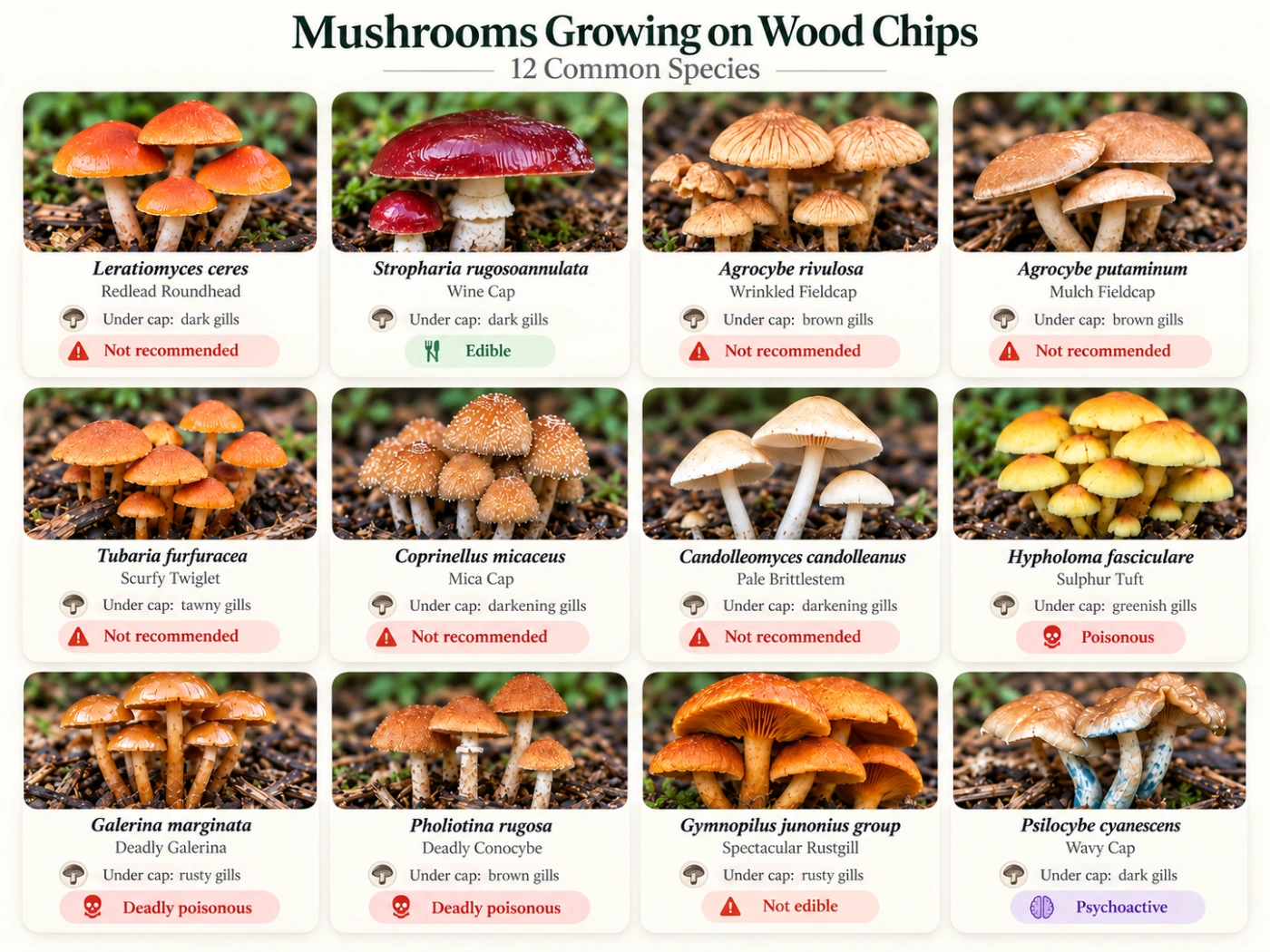
12 Common Mushrooms Found in Wood Chips
| Species | Common name | Main clue | Safety |
|---|---|---|---|
| Leratiomyces ceres | Redlead Roundhead | Orange-red cap, dark gills | Not recommended |
| Stropharia rugosoannulata | Wine Cap | Wine-red cap, large ring | Edible when correctly identified |
| Agrocybe rivulosa | Wrinkled Fieldcap | Pale brown cap, darkening gills | Not recommended |
| Agrocybe putaminum | Mulch Fieldcap | Brown cap, robust stem | Not recommended |
| Tubaria furfuracea group | Scurfy Twiglet | Small tawny-brown mushroom | Not recommended |
| Coprinellus micaceus | Mica Cap | Clustered brown caps with glitter-like granules | Edibility not recommended for beginners |
| Candolleomyces candolleanus | Pale Brittlestem | Pale cap, fragile stem | Not recommended |
| Hypholoma fasciculare | Sulphur Tuft | Yellow clusters, greenish gills | Poisonous |
| Galerina marginata | Deadly Galerina | Small brown mushroom, rusty spores | Deadly poisonous |
| Pholiotina rugosa | Deadly Conocybe | Small brown cap, ringed stem | Deadly poisonous |
| Gymnopilus junonius group | Spectacular Rustgill | Orange-brown clusters, rusty gills | Not edible |
| Psilocybe cyanescens | Wavy Cap | Wavy caramel cap, blue bruising | Psychoactive; not a food mushroom |
Why Do Mushrooms Grow So Well in Wood Chips?
Wood chips provide fungi with a concentrated source of cellulose, hemicellulose, and lignin. Once moisture enters the mulch layer, fungal mycelium can spread through the chips and gradually break them down.
Fresh landscaping can therefore create ideal habitat almost overnight from a fungal perspective. A bed that looked empty in summer may produce dozens or hundreds of mushrooms after autumn rain.
Mulch Is an Artificial Fungal Habitat
Natural forests contain fallen branches, leaves, and decaying trunks, but landscaped mulch concentrates woody material into a shallow moist layer. This can favor species that spread rapidly through disturbed environments.
Some wood-chip fungi are now common far outside their original ranges because mulch, nursery plants, and landscaping materials help move fungal mycelium from place to place.
1. Leratiomyces ceres — Redlead Roundhead
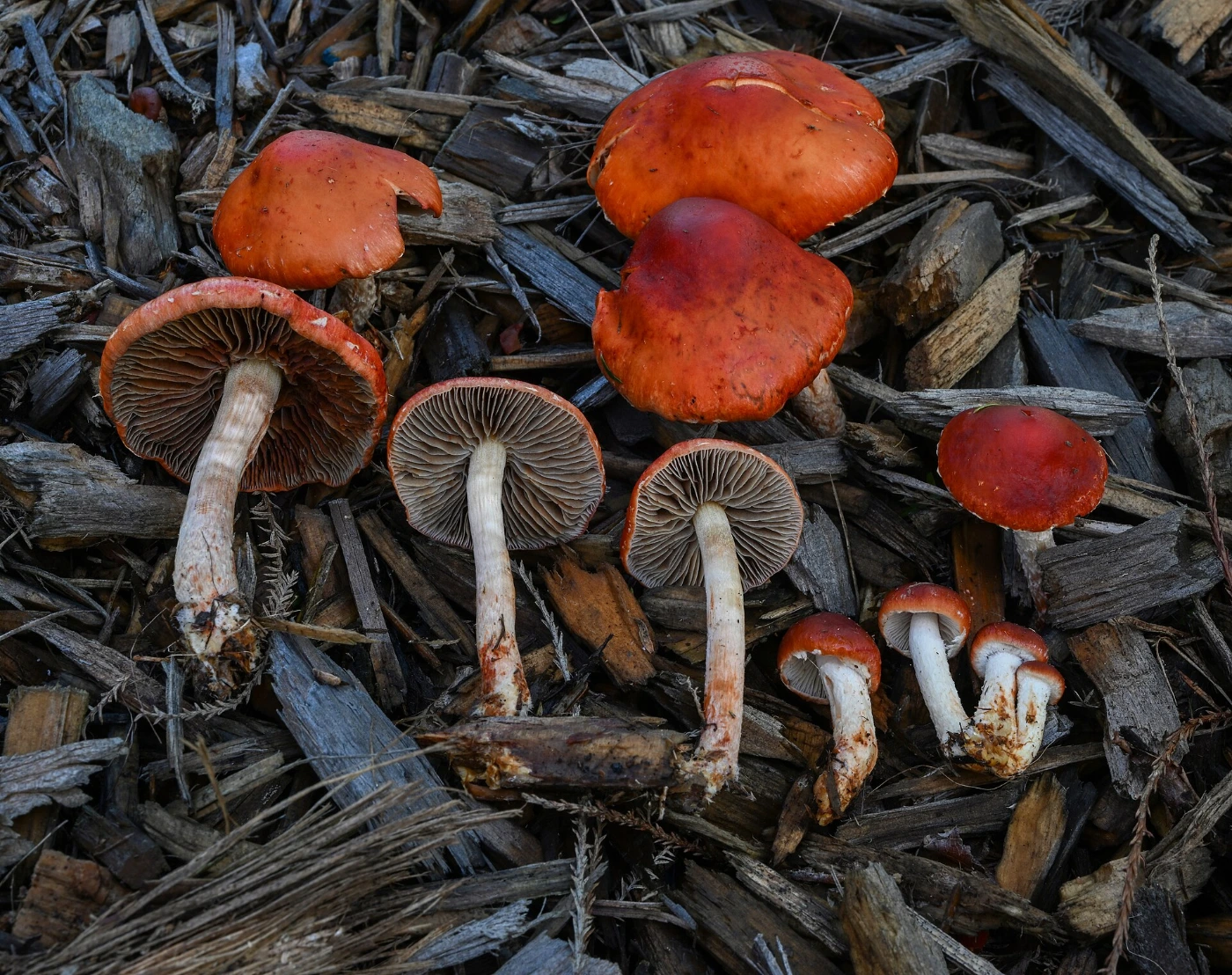
Leratiomyces ceres is one of the most characteristic mushrooms of urban wood-chip beds. It has a bright orange-red to brick-red cap and usually appears in loose groups or clusters.
The gills begin pale and become grayish to dark purple-brown as the spores mature. The stem is pale and may retain fragments of veil tissue.
Habitat
Wood chips, bark mulch, landscaped garden beds, and park plantings are classic habitats.
This species is particularly common in disturbed urban environments.
Main Identification Clue
The vivid red-orange cap against pale wood chips is often the first clue. Mature dark gills help separate it from many other orange mulch mushrooms.
2. Stropharia rugosoannulata — Wine Cap
Wine Cap is a large, robust mushroom with a reddish-purple, wine-red, or brownish cap. Older specimens may fade substantially.
The stem is pale and usually carries a thick, prominent ring. Mature gills become dark purple-brown.
Habitat
It thrives in wood chips, straw, compost-rich beds, and garden mulch.
It is sometimes intentionally cultivated because it grows readily in woody garden substrates.
Main Identification Clue
A large burgundy to brown mushroom with a substantial ring and dark mature gills is a strong Wine Cap candidate.
Very young pale specimens should still be identified carefully because cap color can fade.
3. Agrocybe rivulosa — Wrinkled Fieldcap
This mushroom typically has a pale buff to brown cap that may develop wrinkles or cracks. The gills darken toward brown as spores mature.
It can appear in large numbers in freshly mulched areas.
Habitat
Recently installed wood-chip beds are especially characteristic.
Urban parks, gardens, and roadside landscaping can produce extensive fruitings.
Main Identification Clue
A pale brown mushroom growing abundantly from fresh mulch, with darkening gills and a somewhat wrinkled cap, fits this species well.
4. Agrocybe putaminum — Mulch Fieldcap
Agrocybe putaminum is another brown wood-chip mushroom associated with landscaped environments.
It tends to be more robust than many tiny mulch species, with a brown cap and a substantial stem.
Habitat
Wood chips and garden mulch are typical substrates.
It is especially associated with disturbed ground and landscaped areas.
Main Identification Clue
The relatively sturdy build and mulch habitat help separate it from smaller, more fragile brown mushrooms.
Exact separation from related Agrocybe species can still require closer examination.
5. Tubaria furfuracea Group — Scurfy Twiglets
These are small tawny, cinnamon, or orange-brown mushrooms that commonly appear among wood chips, twigs, and leaf litter.
The caps are often hygrophanous, meaning they change color noticeably as they dry.
Habitat
Mulch, small woody debris, garden beds, and woodland litter can all support them.
They often fruit in cooler, damp weather.
Main Identification Clue
Small size, tawny-brown coloration, and strong color change during drying are useful clues.
Species-level identification within the group can be difficult from photographs alone.
6. Coprinellus micaceus — Mica Cap
Mica Caps form clusters of tan to honey-brown mushrooms, often around buried wood or roots.
Fresh caps may carry tiny glitter-like granules that resemble mica, although rain can wash them away.
Habitat
They may appear to grow directly from soil or mulch while actually emerging from buried roots or pieces of wood.
Stumps, old tree roots, and wood-chip beds can all support them.
Main Identification Clue
Clustered growth plus delicate bell-shaped brown caps strongly suggests the group.
Older mushrooms may darken and begin to collapse as the gills mature.
7. Candolleomyces candolleanus — Pale Brittlestem
This mushroom has a pale cream to tan cap and a thin, fragile stem.
Young caps may retain small white veil fragments around the margin, while mature gills become darker.
Habitat
It grows from buried wood, stumps, roots, and woody mulch.
Groups can appear in gardens, parks, and woodland margins.
Main Identification Clue
The very fragile stem and pale cap with veil remnants are useful clues.
Because many small brown mushrooms look similar, cap-only identification is unreliable.
8. Hypholoma fasciculare — Sulphur Tuft
Sulphur Tuft forms dense clusters of bright yellow to sulfur-yellow mushrooms.
The gills can become greenish-yellow before darkening toward gray-purple as spores mature.
Habitat
It usually grows from decaying wood, including stumps and buried roots.
In mulch beds it may appear to grow from chips or soil when hidden woody material is underneath.
Safety
This species is poisonous and can cause gastrointestinal illness.
Its clustered growth and bright color do not make it safe.
9. Galerina marginata — Deadly Galerina
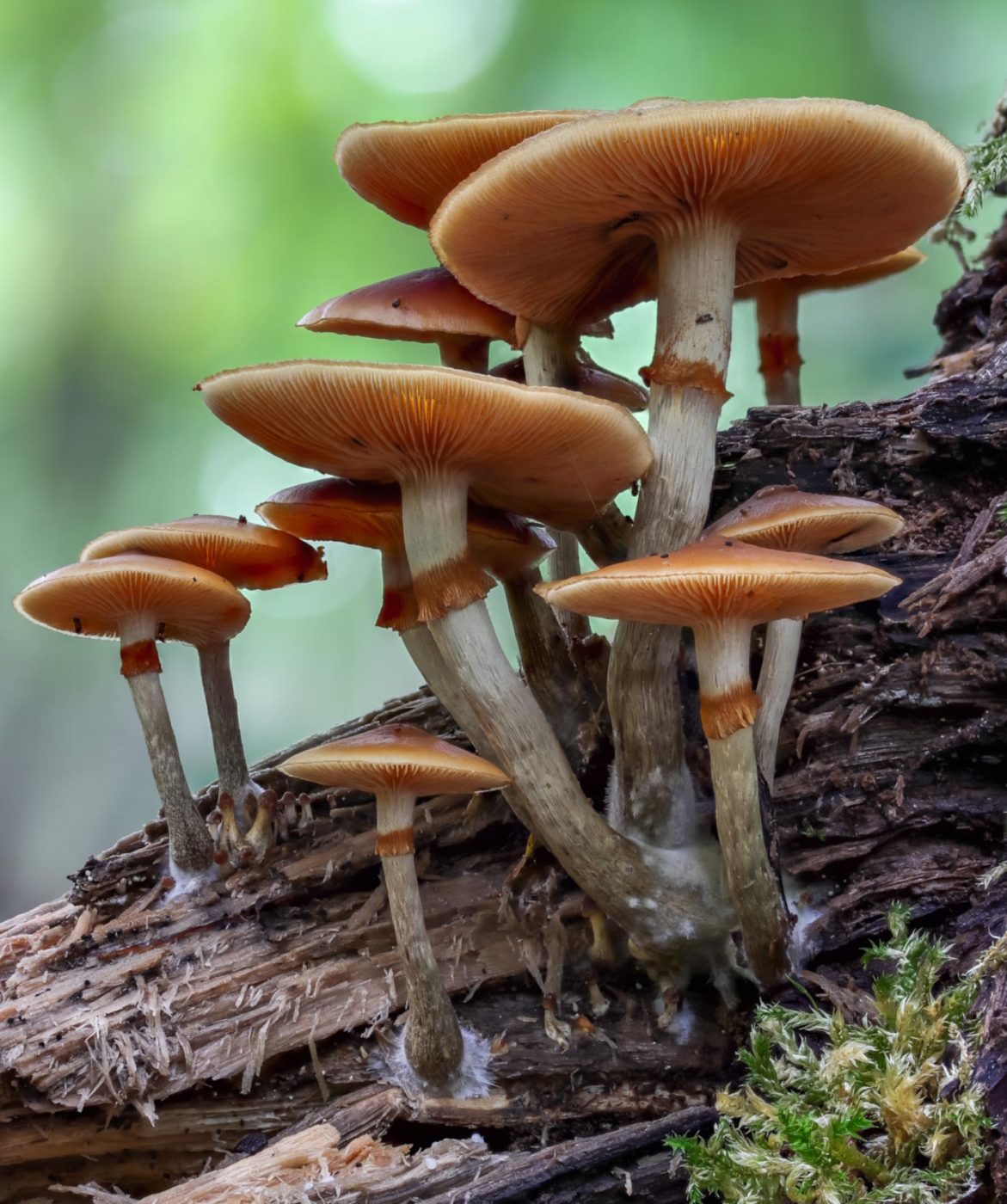
Galerina marginata is one of the most important dangerous small brown mushrooms to recognize.
It has a brown to honey-brown cap, rusty-brown mature gills, and often a ring or ring zone on the stem.
Habitat
It is usually associated with decaying wood and can occur on buried woody material.
Wood-chip environments can therefore provide suitable conditions.
Why It Is Dangerous
Deadly Galerina contains amatoxins, the same major toxin class associated with Death Cap.
These toxins can cause severe liver damage and potentially fatal poisoning.
Main Identification Clue
Rusty-brown spores are an important feature.
Any small brown mushroom growing from wood should be treated cautiously until dangerous species have been excluded.
10. Pholiotina rugosa — Deadly Conocybe
This is another small brown mushroom capable of containing amatoxins.
It usually has a smooth brown cap, relatively slender stem, and a distinct ring.
Habitat
Mulch, wood chips, gardens, and other disturbed organic substrates are known habitats.
Its small size makes it easy to overlook.
Why It Is Dangerous
Pholiotina rugosa can contain amatoxins and therefore belongs among the most important dangerous mulch mushrooms.
A tiny brown ringed mushroom should never be judged safe from appearance alone.
11. Gymnopilus junonius Group — Spectacular Rustgill
These mushrooms form large yellow-orange to rusty-orange clusters.
The gills become rusty as the spores mature, and the stems are comparatively robust.
Habitat
They normally grow from wood, especially stumps and buried roots.
Wood-chip beds near old trees can therefore produce apparently soil-growing fruit bodies.
Main Identification Clue
Large clustered orange-brown mushrooms with rusty mature gills strongly suggest Gymnopilus.
The overall size usually separates them from tiny Galerina and Tubaria species.
12. Psilocybe cyanescens — Wavy Cap
Psilocybe cyanescens is strongly associated with wood chips in some temperate regions. Mature specimens typically have caramel-brown caps that develop a distinctly wavy margin.
Damaged areas may stain blue, especially along the cap margin or stem.
Habitat
Mulched beds, woody debris, and landscaped environments can provide suitable habitat.
Its geographic abundance varies considerably.
Main Identification Clue
A caramel-colored wavy cap combined with blue bruising and wood-chip habitat is characteristic.
However, similar small brown mushrooms include dangerous species, so a superficial visual match is not sufficient.
Small Brown Mushrooms in Wood Chips
Brown mushrooms are probably the hardest mulch fungi to identify safely. Tubaria, Agrocybe, Candolleomyces, Galerina, Pholiotina, and several other genera can all produce relatively small brown fruit bodies.
This is a classic example of why “little brown mushroom” is not a useful final identification.
Check the Gills and Spores
Gill color changes can narrow the possibilities significantly.
Rusty-brown spores suggest groups such as Galerina or Gymnopilus, while purple-brown spores point toward other groups such as Stropharia.
The distinction matters because these genera can differ dramatically in toxicity.
Orange and Red Mushrooms in Wood Chips
Brightly colored mulch mushrooms are often easier to notice than brown ones.
Leratiomyces ceres is one of the most typical examples, with a strong orange-red cap.
Other orange mushrooms may actually be growing from buried roots rather than from the chips themselves.
The substrate should therefore be checked carefully.
Yellow Mushrooms in Wood Chips
Dense yellow clusters may indicate Sulphur Tuft when buried wood or stumps are present.
Color alone is not enough, though, because several unrelated fungi can be yellow.
The gills, growth pattern, and hidden woody substrate provide much more useful information.
Why Mushrooms Sometimes Appear to Grow From Soil
Mulch beds often cover old roots, tree stumps, branches, or previous layers of woody material.
A mushroom may therefore look like a soil-growing species even though its mycelium is actually decomposing buried wood.
Expose the Base Carefully
You do not need to dig extensively, but gently examining the base can sometimes reveal attached wood fibers or buried chips.
This can help distinguish wood-decaying fungi from soil-associated species.
Are Mushrooms in Wood Chips Edible?
Some are, but wood-chip habitat is not a safety indicator.
Wine Cap is a well-known edible species when correctly identified, while the same general environment can support poisonous Sulphur Tuft and deadly amatoxin-containing fungi.
The correct sequence is always identify the species first, consider edibility second.
Dangerous Wood-Chip Mushrooms
The most important safety concern is not usually large brightly colored mushrooms but small brown species that look unremarkable.
Galerina marginata and Pholiotina rugosa deserve particular attention because both can contain amatoxins.
Why Amatoxin Mushrooms Are Especially Dangerous
Symptoms may be delayed for many hours after consumption.
By the time severe gastrointestinal symptoms begin, toxins may already be damaging the liver.
This is why uncertain small brown mushrooms should never be used for food.
How to Identify a Mushroom Growing in Wood Chips
Start with size and growth pattern, then examine the underside.
A single robust mushroom, a dense cluster, and dozens of tiny scattered mushrooms each suggest different groups.
Step 1: Confirm the Substrate
Determine whether the mushroom is actually growing from loose chips, buried wood, roots, or underlying soil.
The substrate can immediately narrow the ecological possibilities.
Step 2: Check the Gills
Record whether the gills are pale, yellow, greenish, rusty, purple-brown, or nearly black at maturity.
Mature gill color often reflects spore color and can be extremely informative.
Step 3: Look for a Ring
A ring can separate closely related possibilities.
Wine Cap has a substantial ring, while Pholiotina rugosa may have a much smaller ring on a delicate stem.
Step 4: Check for Bruising
Some species show characteristic bruising reactions.
Blue staining is especially notable in certain wood-chip species, but bruising should never be used as a toxicity test.
Step 5: Compare Young and Mature Mushrooms
Young specimens often hide important mature characters.
If a patch contains many fruit bodies, compare different ages before making an identification.
How to Photograph Wood-Chip Mushrooms
Take one wide image showing the entire patch and the mulch surface.
Then photograph a complete mushroom from the side, including the stem base and any ring.
An underside image should show mature gills clearly. If mushrooms of different ages are present, photograph them together because color changes can be highly informative.
Can AI Identify Mushrooms Growing in Wood Chips?
AI can use mulch habitat as a useful clue and may identify distinctive species such as Wine Cap or Redlead Roundhead reasonably well from good photographs.
Small brown species remain much more difficult because many genera overlap visually.
A cautious system should sometimes return several possibilities rather than force an exact species, especially when Galerina or other dangerous look-alikes cannot be excluded.
Common Identification Mistakes
A common mistake is assuming every mushroom in mulch is feeding directly on the visible chips. Buried roots or old wood can support completely different species.
Another mistake is identifying small brown mushrooms from cap shape alone. Mature gill and spore colors are often far more informative.
The most serious mistake is assuming a familiar-looking wood-chip mushroom is safe because the same patch produced an edible species before. Multiple species can fruit together in the same mulch bed.
Interesting Facts About Wood-Chip Mushrooms
Urban landscaping has created enormous new habitats for wood-decaying fungi. A species that once depended mainly on natural woody debris can now encounter suitable substrate in gardens, parks, parking lots, and roadside plantings.
Wood chips can also help fungi travel. Mycelium may be moved with nursery plants, compost, bark, and landscaping materials, allowing species to establish in new regions.
Some mulch fungi appear remarkably quickly after wood chips are installed. Their mycelium may already be present in the material before it reaches the garden.
A wood-chip bed is also a miniature ecosystem rather than a habitat for one fungus. Different species may dominate as the mulch ages and the chemistry of the decomposing wood changes.
Frequently Asked Questions
Why did hundreds of mushrooms suddenly appear after rain?
The fungal mycelium was already growing through the mulch. Moisture and suitable temperatures triggered many fruit bodies to develop at approximately the same time.
Will wood-chip mushrooms damage garden plants?
Most mulch decomposers feed on dead organic material rather than healthy plants. They are usually participating in decomposition rather than attacking garden vegetation.
Why do different mushrooms appear in the same mulch bed in different years?
As wood chips decompose, moisture, nutrient levels, and structure change. Different fungal species can become favored at different stages.
Can replacing the mulch introduce new mushroom species?
Yes. New wood chips may contain fungal mycelium or spores and can also create a different substrate from the previous mulch.
Why are some mushrooms only around old trees?
Buried roots and decaying wood can provide additional food sources beneath the mulch. The mushrooms may actually be associated with those hidden materials.
Can mushroom mycelium remain after the fruit bodies disappear?
Yes. The visible mushrooms may last only days, while the underlying mycelium can remain active for months or years.
Does removing the mushrooms eliminate the fungus?
No. Picking fruit bodies removes only the reproductive structures. Most of the organism remains within the chips or buried wood.
Can several dangerous and harmless species grow together?
Yes. A single mulch bed can support multiple species at exactly the same time, so each type must be identified separately.
Final Identification Notes
Wood chips support a surprisingly diverse fungal community, including Redlead Roundhead, Wine Cap, fieldcaps, Mica Caps, Sulphur Tuft, Deadly Galerina, Deadly Conocybe, Rustgills, and many small brown mushrooms.
The safest identification strategy begins with the substrate and mature gills. Ring structure, growth pattern, bruising, and spore color can then narrow the possibilities.
Most importantly, never treat “growing in wood chips” as evidence that a mushroom is edible. The same mulch bed can contain both edible species and dangerously toxic ones.
Upload a photo and get possible matches in seconds.