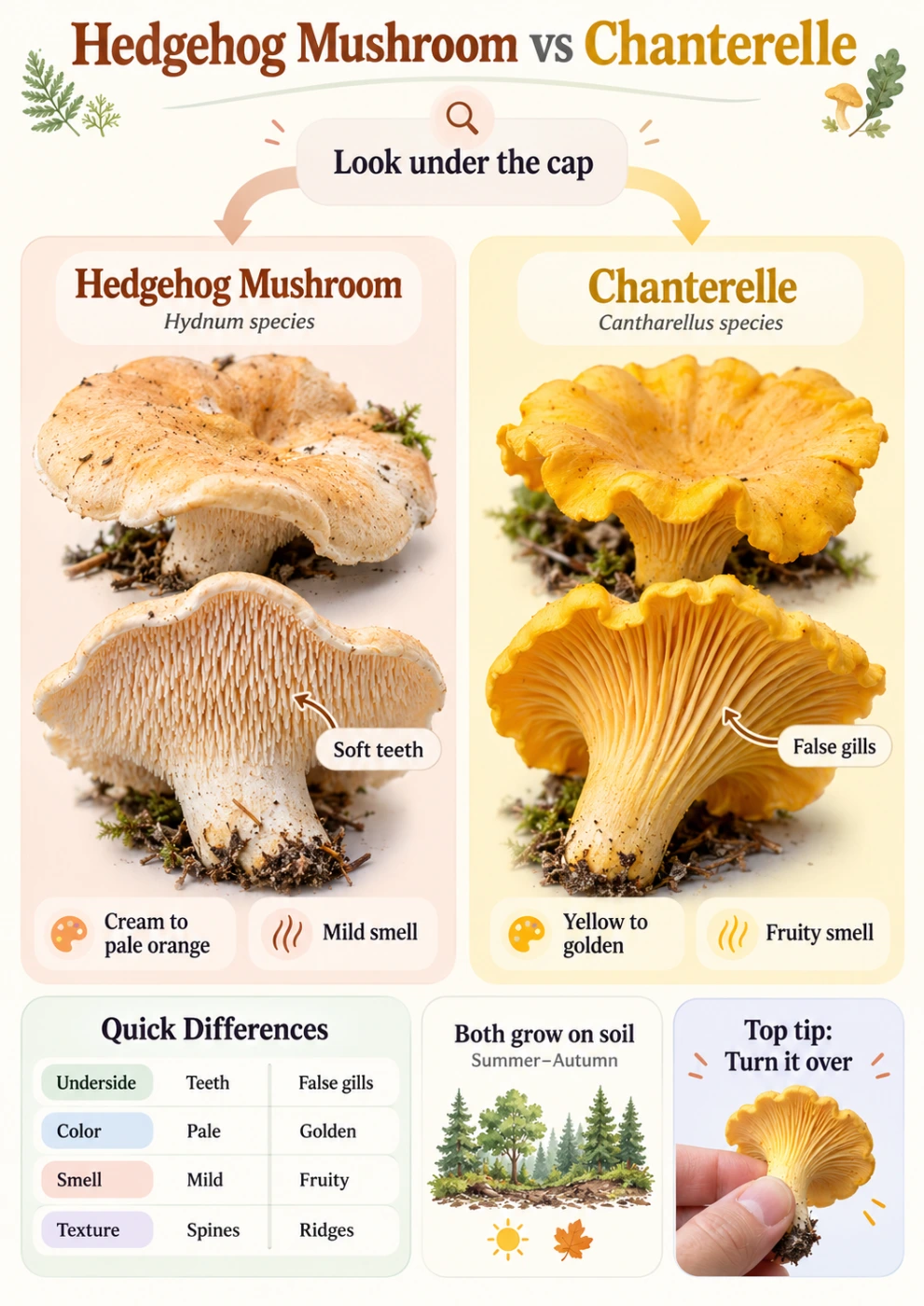
Hedgehog Mushrooms and Chanterelles can grow in similar woodland habitats, appear during the same season, and share yellow, cream, or orange tones. From above, an inexperienced mushroom hunter can easily confuse them.
The underside solves most of the problem. Hedgehog Mushrooms have soft downward-pointing teeth, while Chanterelles have thick blunt ridges known as false gills. Once you learn to compare these two structures, the mushrooms become much easier to separate.
⚠️ Important: This guide is for identification and education only. Never eat a wild mushroom based solely on photographs, AI identification, or one visible feature.
Quick Comparison
| Feature | Hedgehog Mushroom | Chanterelle |
|---|---|---|
| Main group | Hydnum species | Cantharellus species |
| Underside | Soft teeth or spines | Thick blunt false gills |
| Cap color | Cream, buff, pale orange | Yellow to golden-orange |
| Cap shape | Irregular, often wavy | Funnel-shaped or wavy |
| Stem | Pale, solid | Yellow to pale, solid |
| Flesh | Pale and firm | Pale and firm |
| Smell | Mild | Often fruity |
| Growth | On soil | On soil |
| Ecology | Mycorrhizal | Mycorrhizal |
| Season | Summer–autumn | Summer–autumn |
| Edibility | Edible when correctly identified | Edible when correctly identified |
The Fastest Way to Tell Them Apart
Turn the mushroom over.
A Hedgehog Mushroom has individual soft teeth hanging downward from the underside of the cap. These look like tiny pale spines and can often be brushed or broken off.
A Chanterelle does not have true gills. Instead, it has thick, blunt, forked ridges that run down the stem.
Hedgehog Mushroom — Hydnum Species
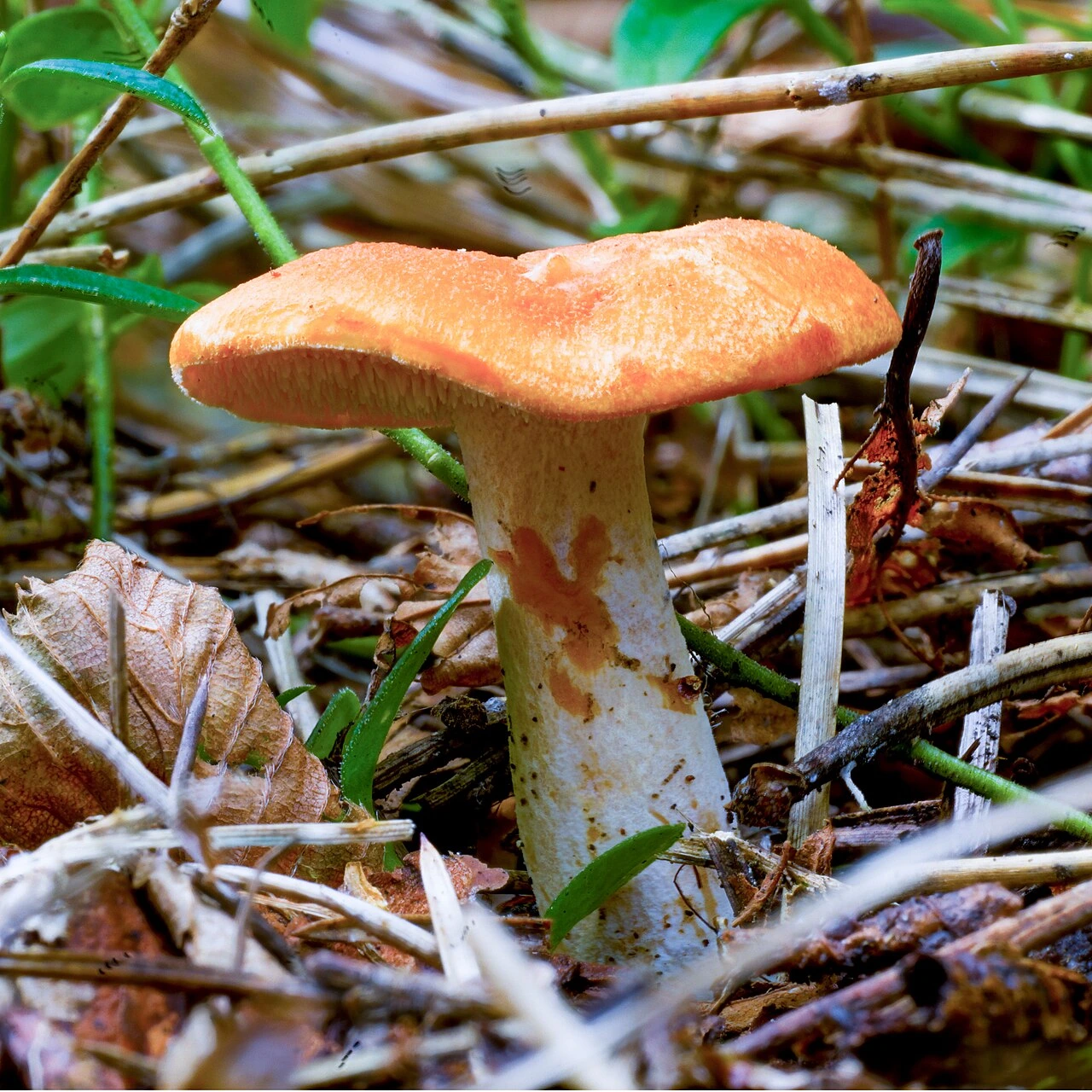
“Hedgehog Mushroom” usually refers to several closely related species in the genus Hydnum. The best-known European form is often called Hydnum repandum or the H. repandum group.
These mushrooms have pale cream to yellow-orange caps and a very distinctive toothed underside.
Cap
The cap is usually irregular rather than perfectly round. It may become wavy, lobed, or slightly depressed with age.
Colors range from cream and buff to pale apricot or light orange. Some specimens remain much paler than typical golden chanterelles.
Cap Surface
The surface is usually smooth and dry. It lacks scales and is not strongly slimy.
Older specimens can become cracked or uneven, especially in dry weather.
Teeth
The underside is covered with numerous soft, pale teeth. These hang vertically downward and may extend slightly onto the upper stem.
This is the defining feature of Hydnum. It immediately separates Hedgehog Mushrooms from chanterelles and most other common woodland mushrooms.
Tooth Texture
The teeth are relatively fragile and can break off if rubbed. They are not rigid like the spines of some tougher toothed fungi.
Young specimens usually have shorter, paler teeth, while mature mushrooms develop longer and more obvious ones.
Stem
The stem is usually pale cream, yellowish, or similar in color to the cap. It may be central or slightly off-center.
It is solid and fairly firm, without a ring or volva.
Flesh
The flesh is pale and firm. It does not show dramatic color changes when cut.
Older mushrooms may develop a slightly more bitter flavor, but taste should never be used as a beginner identification method.
Chanterelle — Cantharellus Species
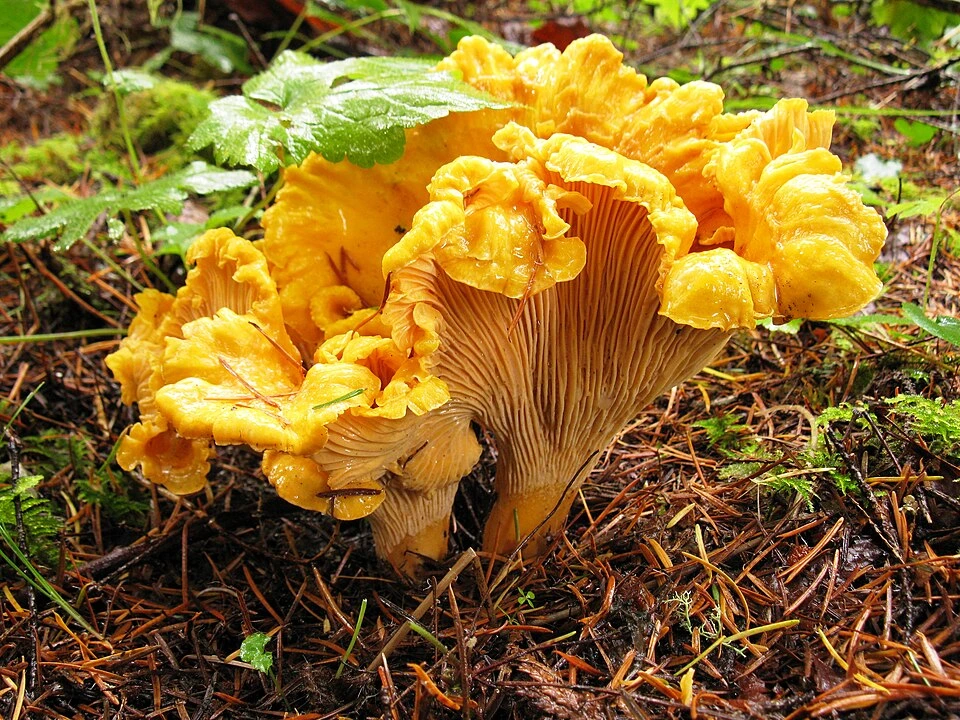
Chanterelles belong to the genus Cantharellus and related groups. They are famous for their yellow to golden color and thick false gills.
The exact species varies greatly by geography. In Europe, the Cantharellus cibarius group is common, while North America has several distinct regional species.
Cap
The cap is usually yellow to golden-orange and becomes more funnel-shaped with maturity. The margin often turns wavy or lobed.
Young chanterelles may be more convex and regular. Mature specimens can become strongly irregular.
Cap Surface
The surface is usually smooth and dry to slightly moist. It lacks obvious scales.
Color may fade to pale yellow in exposed or older specimens.
False Gills
The underside is the key feature. Instead of thin blade-like gills, chanterelles have thick blunt ridges.
These ridges usually fork, merge, and run down the stem.
False Gills vs True Gills
False gills are part of the mushroom tissue itself. They are thick, shallow, and difficult to separate cleanly from the cap.
True gills, by contrast, are thin plate-like structures. This distinction is especially important in chanterelle identification.
Stem
The stem is solid and usually similar in color to the cap or slightly paler. It often blends gradually into the cap.
There is no ring or volva.
Flesh
The flesh is pale white to cream inside, even when the surface is strongly yellow.
It is firm and not especially brittle.
Hedgehog Mushroom vs Chanterelle: Key Differences
The main difference is the underside. Teeth belong to Hydnum, while ridged false gills belong to Cantharellus.
Other clues support the identification, but the underside usually gives the answer quickly.
| Feature | Hedgehog Mushroom | Chanterelle |
|---|---|---|
| Underside | Soft teeth | Blunt ridges |
| Tooth/gill structure | Separate hanging spines | Fused ridges |
| Cap color | Cream to pale orange | Yellow to golden |
| Smell | Usually mild | Often fruity |
| Cap shape | Irregular, sometimes flattened | Often funnel-like |
| Growth substrate | Soil | Soil |
Teeth vs False Gills
This is the most important comparison in the entire article.
Hedgehog Mushroom Teeth
Hydnum teeth look like tiny downward-pointing icicles. They are distinct from each other and hang from the underside.
If you gently run a finger across them, they can bend or break.
Chanterelle False Gills
Chanterelle ridges are thick folds in the mushroom tissue. They fork and merge instead of hanging separately.
They usually continue down the stem, creating a wrinkled or veined appearance.
Can the Cap Color Cause Confusion?
Yes. Both groups can be yellowish, buff, orange, or pale cream.
Color overlap is significant, especially in old or weathered specimens.
This is why cap color should come after the underside, not before it.
Habitat
Both groups are mycorrhizal and grow from soil in association with living trees. Neither typically grows directly from dead wood.
Coniferous, mixed, and broadleaf forests can support both groups depending on region.
Tree Associations
Chanterelles may associate with oak, beech, pine, spruce, fir, and other trees depending on species. Hedgehog Mushrooms also occur with a range of broadleaf and conifer hosts.
The exact host relationship varies by geography, so habitat is a supporting rather than decisive feature.
Season
Both Hedgehog Mushrooms and Chanterelles are mainly found from summer into autumn.
Their seasons often overlap closely. This is one reason they are frequently compared.
Rainfall and local climate can shift the timing considerably.
Growth Pattern
Both can grow singly, scattered, or in small groups. Chanterelles often form loose patches or arcs.
Hedgehog Mushrooms can also appear in groups, especially in productive woodland.
Cluster shape alone is not useful enough to separate them.
Hedgehog Mushroom Look-Alikes
The main look-alikes include other toothed fungi and pale woodland mushrooms.
The underside usually prevents confusion with gilled species.
Sarcodon Species
Identification
Sarcodon species also have teeth underneath. However, they usually have darker, rougher, or scaly caps and often a more robust build.
Some are brown or gray rather than pale cream or orange.
Main Difference
A dark scaly cap points away from typical Hydnum. The overall texture is often coarser and more rugged.
Bankera and Other Toothed Fungi
Some other woodland fungi also have teeth. They may differ in cap texture, smell, color, or spore characters.
For difficult toothed mushrooms, exact genus-level identification may require closer study.
Chanterelle Look-Alikes
Chanterelles have several important look-alikes, including False Chanterelle and Jack-o’-Lantern mushrooms.
These have true gills rather than blunt false gills.
False Chanterelle — Hygrophoropsis aurantiaca
Identification
False Chanterelle is orange and often has numerous thin, forked true gills.
The gills are much more blade-like than chanterelle ridges.
Main Difference
Thin flexible gills indicate False Chanterelle. Thick blunt ridges indicate a true chanterelle.
Jack-o’-Lantern — Omphalotus Species
Identification
Jack-o’-Lantern mushrooms are bright orange and usually grow in dense clusters from wood or buried roots.
They have true gills.
Main Difference
Growth from wood and thin blade-like gills separate them from chanterelles.
Hedgehog Mushroom vs False Chanterelle
A Hedgehog Mushroom should be even easier to distinguish from False Chanterelle because one has teeth and the other has true gills.
Their cap colors can overlap, but the underside is completely different.
Hedgehog Mushroom vs Chanterelle Step by Step
A few structural checks usually solve the comparison.
Step 1: Turn the Mushroom Over
If you see teeth, think Hydnum. If you see thick ridges, think Cantharellus.
This step alone often provides the answer.
Step 2: Check Whether the Structures Are Separate
Individual hanging spines indicate Hedgehog Mushroom. Continuous ridges fused into the cap indicate Chanterelle.
This distinction is more reliable than color.
Step 3: Look at Cap Shape
A flatter irregular cap is more typical of Hedgehog Mushroom. A funnel-like golden cap is more typical of Chanterelle.
This is supportive rather than decisive.
Step 4: Check the Smell
Many chanterelles have a fruity smell often compared with apricot. Hedgehog Mushrooms are generally milder.
Smell is subjective, so use it only after structural characters.
Step 5: Confirm Soil Growth
Both should grow from soil in a mycorrhizal setting. Growth directly from logs or stumps should prompt reconsideration.
Habitat can also help eliminate unrelated look-alikes.
Can Hedgehog Mushrooms and Chanterelles Grow Together?
Yes. Because they can share similar woodland conditions and host trees, both may appear in the same forest.
They can even fruit during the same period.
This makes underside examination essential, especially when several yellowish mushrooms are mixed together.
Are Both Edible?
Both are generally considered edible when correctly identified and properly prepared.
However, edibility should only be considered after identification is secure.
A yellow mushroom in woodland should never be assumed edible simply because it resembles one of these groups.
How to Photograph Them for Identification
Take a side photo showing the complete mushroom and then a clear underside photo.
For Hedgehog Mushrooms, make sure the teeth are visible. For chanterelles, show how the ridges fork and run down the stem.
A habitat image can help establish soil growth and nearby host trees.
Can AI Tell Hedgehog Mushrooms From Chanterelles?
Yes, often quite reliably if the underside is visible.
The distinction between teeth and false gills is visually strong and easier for image recognition systems than many subtle mushroom comparisons.
Cap-only photographs are much less useful because color and shape can overlap.
Common Identification Mistakes
A common mistake is using yellow color as the main clue. Many unrelated woodland mushrooms are yellow or orange.
Another mistake is calling chanterelle ridges “gills” and then treating all forked gills as equivalent. True gills and false gills are structurally different.
A third mistake is never looking at the underside. In this comparison, the most important clue is hidden underneath the cap.
Interesting Facts About Hedgehog Mushrooms and Chanterelles
Both groups are mycorrhizal fungi, meaning much of the organism lives underground in association with tree roots. The visible mushroom is only the reproductive fruit body.
Hedgehog Mushrooms are especially unusual because their spore-bearing surface is arranged on teeth rather than gills or pores. This gives them one of the easiest underside structures to recognize in the field.
Chanterelles use a different solution: broad folded ridges that increase the spore-producing surface without forming true gills.
Both groups also illustrate how mushroom taxonomy can become regionally complex. A mushroom that looks like a familiar European species may belong to a different but closely related North American or Asian taxon.
Frequently Asked Questions
Can Hedgehog Mushroom teeth fall off with age?
Yes. Older teeth can become fragile and break during handling. Even then, remnants or short stubs are usually still visible.
Can chanterelle ridges look almost like true gills?
They can in some specimens, especially when strongly developed. Their thickness, blunt edges, and tendency to merge remain useful clues.
Why are some Hedgehog Mushrooms nearly white?
Color varies by species, age, moisture, and light exposure. Pale cream specimens are completely normal in several Hydnum groups.
Can chanterelles be pale instead of orange?
Yes. Some species and older specimens can be pale yellow or cream-yellow rather than deep golden.
Do both mushrooms grow after heavy rain?
Yes. Moisture strongly influences fruiting in both groups, although temperature and host tree conditions also matter.
Can the teeth of Hedgehog Mushrooms run onto the stem?
Yes. They may extend slightly down the stem, especially in mature fruit bodies.
Why do some chanterelles have a much stronger fruity smell than others?
Odor varies among species and individual specimens. Freshness and environmental conditions also affect how noticeable it is.
Can you identify either species from a top photo only?
Sometimes a probable group can be suggested, but reliable separation requires an underside view.
Final Identification Notes
Hedgehog Mushrooms and Chanterelles can share similar colors, habitats, and seasons, but their undersides are fundamentally different.
Hedgehog Mushrooms have soft individual teeth. Chanterelles have thick blunt false gills that fork and run down the stem.
Once that difference is clear, most of the confusion disappears. Use cap shape, smell, habitat, and geography as supporting clues, but let the underside lead the identification.
Upload a photo and get possible matches in seconds.