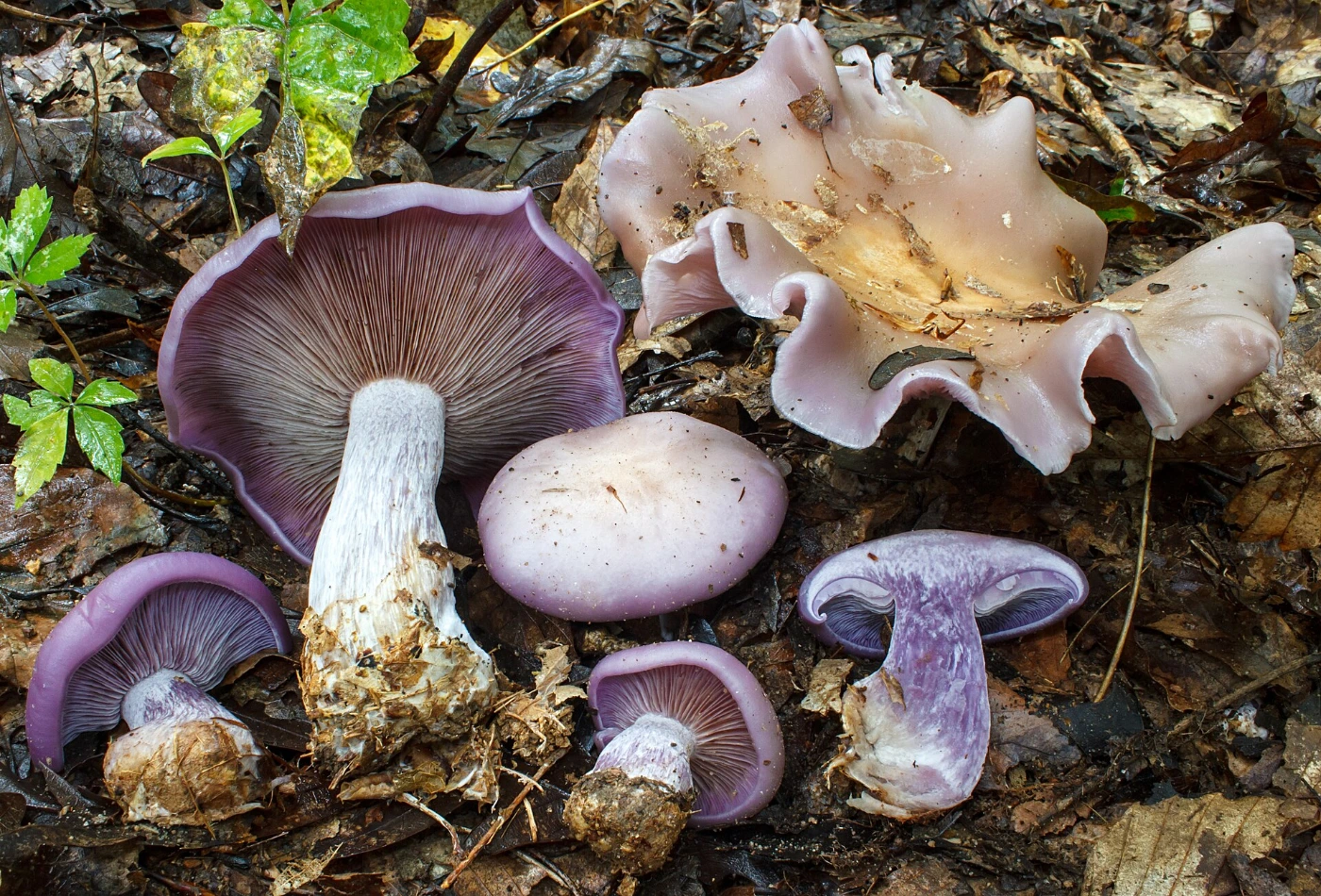
Collybia nuda, commonly known as the Wood Blewit, is a distinctive late-autumn mushroom with lilac to violet tones on the cap, gills, and stem. It often appears after the main autumn mushroom season has begun to fade and can continue fruiting into cold weather.
For many years the species was widely known as Lepista nuda, and that name is still common in older field guides. Modern taxonomy places it in the genus Collybia, so both names may still appear in mushroom literature.
⚠️ Important: Wood Blewit has several purple or violet look-alikes, including Cortinarius species. Correct identification should include gill color, spore print, stem structure, habitat, and the absence of a cobweb-like cortina.
Quick Identification
| Feature | Collybia nuda |
|---|---|
| Common name | Wood Blewit |
| Former name | Lepista nuda |
| Cap | Lilac, violet, purple-brown, fading with age |
| Gills | Lilac to violet, later paler |
| Stem | Lilac to violet, stout, fibrous |
| Ring | Absent |
| Volva | Absent |
| Spore print | Pale pinkish-buff |
| Flesh | Pale lilac to whitish |
| Smell | Sweet, fruity, floral, or perfumed |
| Habitat | Woodland litter, leaf litter, compost-rich soil |
| Growth | Solitary, grouped, rings or arcs |
| Season | Autumn to early winter |
| Edibility | Edible when correctly identified and thoroughly cooked |
| Main look-alikes | Purple Cortinarius, Field Blewit, Amethyst Deceiver |
What Does Collybia nuda Look Like?
Fresh Wood Blewits can be strikingly purple. Young mushrooms may show violet coloration across the cap, gills, stem, and even parts of the flesh.
That color becomes less reliable as the mushroom ages. Mature specimens often fade toward lavender-gray, beige, brownish, or buff, which is why older Wood Blewits can look surprisingly different from photographs of young ones.
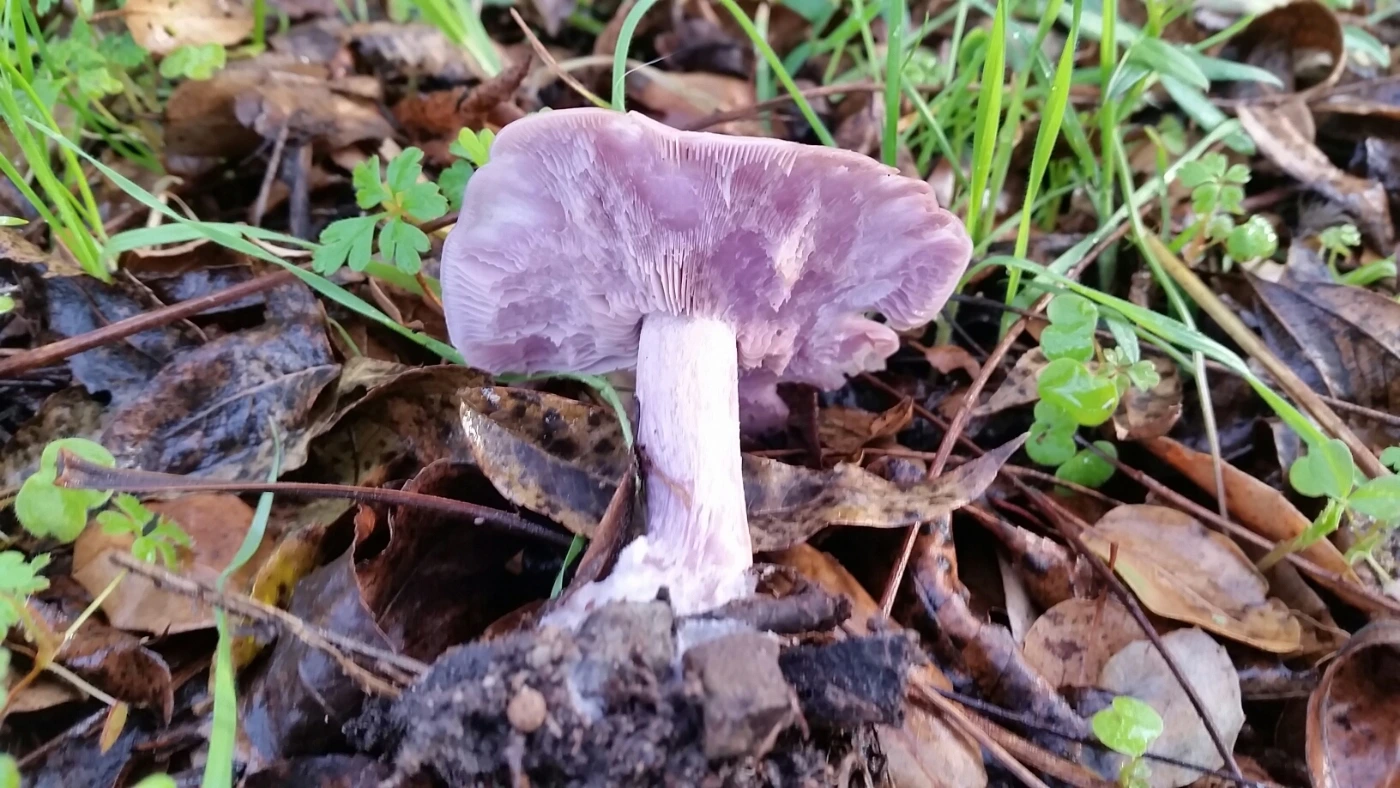
Cap
The cap begins convex and gradually expands toward flat or slightly depressed. The edge may remain curved inward when the mushroom is young.
Young caps are commonly violet, lilac, or purple-gray. With age and exposure to rain or sun, the cap can fade strongly and develop brown, tan, or buff tones.
Cap Surface
The surface is smooth and usually not strongly slimy. Damp specimens can appear slightly moist, but the cap is not normally covered with a thick gelatinous layer.
Color variation is one of the main reasons this species causes confusion. A faded Wood Blewit may retain almost no obvious purple on the center of the cap while still showing violet tones on the gills or stem.
Gills
The gills are crowded and usually lilac to violet when young. They gradually become paler, pinkish-buff, or duller as the mushroom matures.
They do not turn rusty brown with age. This is an important distinction from many purple Cortinarius species.
Stem
The stem is usually stout, cylindrical, and violet to pale lilac when fresh. It may become paler or browner with age, particularly toward the base.
There is no true ring and no volva. Fine fibrous texture and pale mycelium may be visible near the base.
Flesh
The flesh is relatively firm and may show pale lavender or whitish tones. It becomes softer as the mushroom ages.
The texture is fleshy rather than brittle. Unlike Russulas, the stem does not snap with a chalk-like break.
Smell
Wood Blewit often has a distinctive sweet, fruity, floral, or perfumed smell. Some people describe it as pleasantly aromatic, while others find the odor strong or unusual.
Smell is useful as supporting evidence but should not be used alone. Perception varies considerably between people and between individual mushrooms.
Spore Print
The spore print is pale pinkish-buff to pinkish cream. This is one of the most useful features for separating Wood Blewit from purple Cortinarius species.
Cortinarius produces rusty-brown spores instead. When the appearance is ambiguous, spore color can therefore resolve an otherwise difficult comparison.
Where Does Wood Blewit Grow?
Wood Blewit grows as a decomposer in organic-rich material. It is commonly found among fallen leaves, woodland litter, compost, old leaf piles, and rich humus.
Both deciduous and mixed woodland can support the species. It may also occur in gardens, parks, hedgerows, and other places where large amounts of organic debris accumulate.
Leaf Litter
Woodland floors covered with decomposing leaves are classic habitat. Oak, beech, and other deciduous woodland can produce substantial groups in late autumn.
The mushrooms may appear in loose clusters, lines, arcs, or broad fairy rings. Several fruit bodies at different stages often occur together.
Compost and Gardens
Wood Blewit is also well adapted to human-modified habitats rich in decomposing organic matter. Compost piles, leaf heaps, mulched areas, and gardens can all produce fruit bodies.
This habit helps distinguish it from many mycorrhizal purple mushrooms. Wood Blewit is feeding on decomposing material rather than forming an obligatory partnership with tree roots.
Season
Wood Blewit is particularly associated with late autumn. In much of Europe it becomes common from October into November and can continue into December during mild weather.
Light frost does not necessarily end the season. Fresh fruit bodies may appear again during warmer periods after cold nights.
Distribution
The species has traditionally been reported widely from Europe and other temperate regions. The name has also been used broadly in North America, although regional taxonomy should always be treated carefully when similar species are involved.
For an international field guide, habitat and morphology remain important even when the name appears familiar. Similar purple mushrooms can occur in several regions and may not always represent exactly the same taxonomic concept.
Is Collybia nuda Edible?
Wood Blewit is widely regarded as edible when correctly identified and thoroughly cooked. Raw or undercooked mushrooms should not be eaten.
Some people experience gastrointestinal upset even from cooked Wood Blewits. Correct identification is especially important because some purple Cortinarius species can look superficially similar.
Look-Alikes
Purple color is common in several unrelated mushroom groups. The most important comparison is with Cortinarius, but Field Blewit and several smaller violet mushrooms can also cause confusion.
Cortinarius Species
Identification
Many Cortinarius species have violet caps, gills, or stems. Young mushrooms may look remarkably similar to a Wood Blewit.
The main difference develops as the mushrooms mature. Cortinarius gills become rusty or cinnamon-brown from the spores, and young specimens often show a cobweb-like veil called a cortina between the cap and stem.
Main Difference
Wood Blewit has a pale pinkish-buff spore print and no rusty spore deposit. A rusty-brown print or visible cortina points strongly toward Cortinarius.
Collybia personata — Field Blewit
Identification
Field Blewit is closely related and shares lilac tones, particularly on the stem. However, the cap is usually beige, gray-brown, or buff rather than strongly purple.
Its habitat is also different. Field Blewit typically grows in grassland, lawns, pasture, and other open grassy areas rather than woodland litter.
Main Difference
Wood Blewit usually has more violet coloration across the cap and gills and favors woodland litter. Field Blewit has a paler cap and is much more strongly associated with grassland.
Laccaria amethystina — Amethyst Deceiver
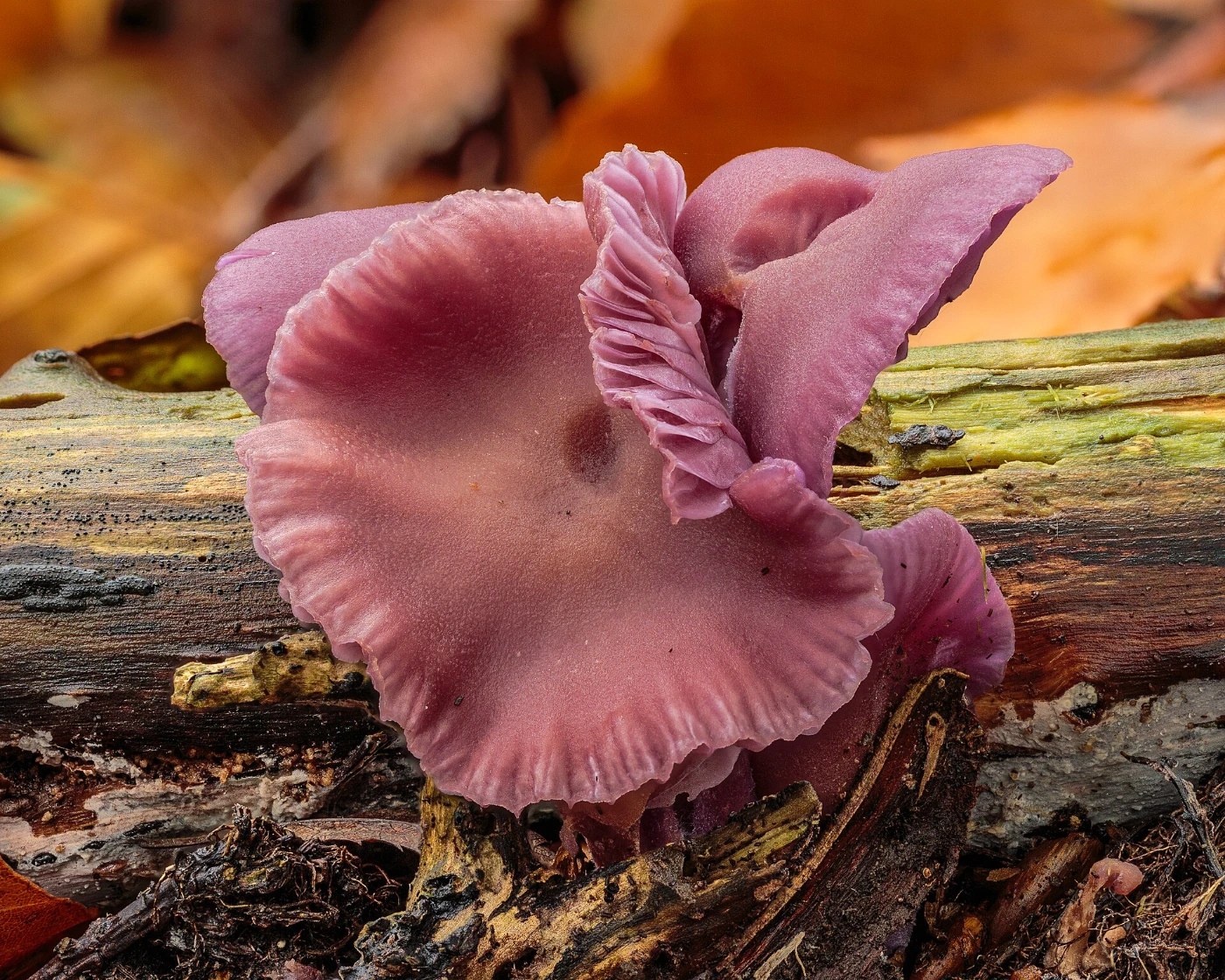
Identification
Amethyst Deceiver can be intensely purple and often grows in woodland. Young specimens can therefore attract attention for the same reason as Wood Blewit.
It is much smaller and more delicate, with widely spaced thick gills and a thin fibrous stem. Mature mushrooms often fade dramatically.
Main Difference
Size and proportions separate them easily in typical specimens. Wood Blewit is large and fleshy with crowded gills, while Amethyst Deceiver is small, slender, and has widely spaced gills.
Lepista sordida / Related Blewit-like Species
Identification
Several closely related violet mushrooms can resemble Wood Blewit in both color and habitat. Some are smaller, thinner, or associated with different ecological conditions.
Species-level separation can sometimes require microscopic or molecular characters. This is especially true with unusual specimens outside the typical size and color range.
Main Difference
A robust late-autumn mushroom with crowded lilac gills and classic Wood Blewit proportions strongly supports Collybia nuda. Very small or atypical fruit bodies deserve more cautious identification.
Wood Blewit vs Purple Cortinarius
| Feature | Collybia nuda | Cortinarius spp. |
|---|---|---|
| Young cap | Lilac to violet | Often violet or purple |
| Young gills | Lilac | Violet, lilac, gray |
| Mature gills | Pale lilac to buff | Rusty-brown |
| Spore print | Pinkish-buff | Rusty-brown |
| Cortina | Absent | Often present |
| Ring | No true ring | Cortina may leave rusty zone |
| Ecology | Saprotrophic | Usually mycorrhizal |
| Best clue | Pale spores | Rust-colored spores |
This is the most important safety comparison. Purple color alone cannot distinguish the two groups.
Wood Blewit vs Field Blewit
| Feature | Wood Blewit | Field Blewit |
|---|---|---|
| Scientific name | Collybia nuda | Collybia personata |
| Cap | Often lilac-purple | Usually buff or gray-brown |
| Gills | Lilac | Pale cream to lilac |
| Stem | Violet | Strong violet tones common |
| Habitat | Woodland litter | Grassland |
| Season | Late autumn | Late autumn |
| Best clue | Purple cap + woodland | Pale cap + grassy habitat |
The two are closely related and can overlap in general appearance. Habitat and distribution of violet color are the quickest practical differences.
How to Identify Wood Blewit
The most useful pattern is a fleshy late-autumn mushroom with lilac coloration, crowded gills, no ring, no volva, and a pale pinkish-buff spore print. Woodland litter or other organic-rich substrate provides additional support.
If the spores are rusty brown, the identification should move away from Wood Blewit toward Cortinarius. This distinction is more dependable than judging whether the cap looks “purple enough.”
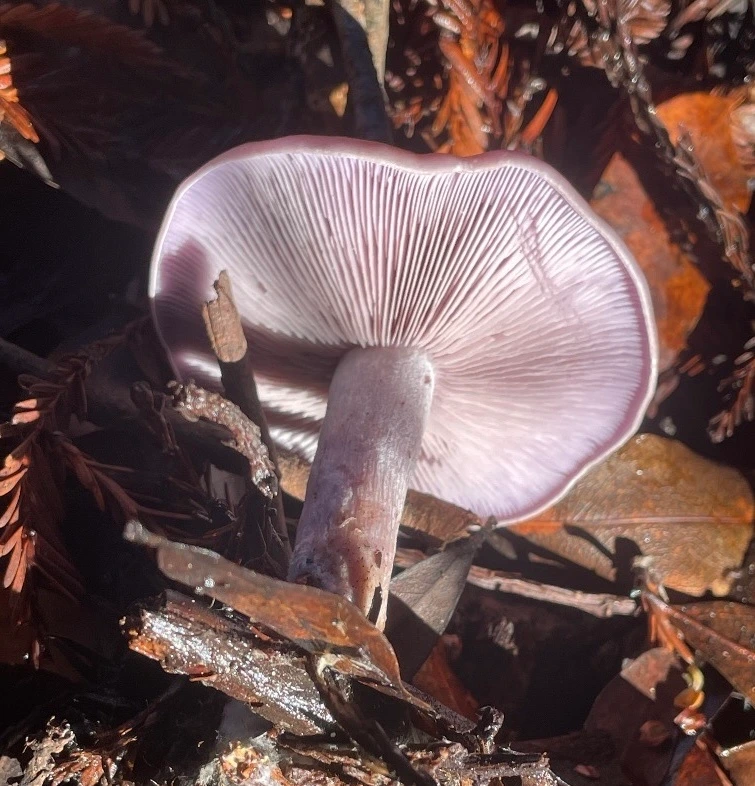
Young vs Mature Wood Blewits
Young specimens are usually much easier to recognize. Their violet color can be vivid across almost the entire mushroom.
Older specimens may fade until the cap is mostly brown or beige. The gills and upper stem often retain traces of lilac longer than the cap.
How Weather Changes the Color
Rain can wash out violet pigments, while dry weather can produce pale or brownish surfaces. Frost can make the flesh waterlogged and dull the colors even further.
This explains why late-season specimens sometimes look nothing like brightly colored reference photographs. Color is most useful when combined with gill development and spore print.
Common Identification Mistakes
A common mistake is assuming that every large purple woodland mushroom is a Wood Blewit. Purple Cortinarius species can share the same general colors and occur in similar forests.
Another mistake is expecting mature Wood Blewits to remain bright violet. Older mushrooms can become almost completely brownish and still belong to the same species.
A third error is treating a pale spore print as optional. When distinguishing a Blewit from a suspicious purple Cortinarius, spore color is one of the strongest available field characters.
How to Photograph Collybia nuda
Photograph both young and mature specimens if possible. This shows the characteristic color change from vivid violet to faded brownish tones.
Include the gills, full stem, stem base, and surrounding litter. A cap-only photograph removes several of the characters needed to separate Wood Blewit from other purple mushrooms.
Can AI Identify Wood Blewit?
AI can often recognize a typical fresh Wood Blewit when violet cap, crowded gills, stout stem, and woodland habitat are visible. Difficulties increase sharply with old faded specimens.
Spore print information is particularly valuable when Cortinarius is a possibility. Image-based identification alone cannot reveal spore color unless it has already accumulated visibly on nearby surfaces.
Interesting Facts
The name Wood Blewit has survived several major changes in scientific classification. Many people still know the species as Lepista nuda, although current taxonomic databases place it in Collybia.
Its late fruiting season makes it one of the mushrooms that can remain conspicuous after many classic autumn boletes and Russulas have disappeared. In mild weather, groups may continue appearing into early winter.
The violet color is also unusually variable. A single colony can contain intense purple young mushrooms beside mature specimens that are almost entirely brown.
Wood Blewits are decomposers rather than mycorrhizal fungi. They help break down leaf litter and other organic material, contributing to nutrient recycling in woodland soils.
Frequently Asked Questions
Why is Lepista nuda now called Collybia nuda?
Modern phylogenetic studies reorganized relationships within the Clitocybaceae and transferred the species into Collybia. Major taxonomic databases now list Collybia nuda as the current name and Lepista nuda as a synonym.
Does Wood Blewit always have a purple cap?
No. The cap can fade strongly with age and weather, becoming gray-brown, beige, or buff. Lilac tones may remain more obvious on the gills or stem.
Can Wood Blewits grow in gardens?
Yes. They can appear in compost-rich soil, old leaf piles, mulched areas, and gardens with plenty of decomposing organic material.
What color is the spore print?
It is pale pinkish-buff rather than rusty brown. This is especially important when separating the species from purple Cortinarius.
Does Wood Blewit have a ring?
No true ring is present. A strong ring or cobweb-like cortina suggests another group.
Can Wood Blewits survive frost?
They can continue fruiting during cold late-autumn weather and may reappear after light frost. Heavily frozen and thawed specimens can deteriorate quickly, however.
Can Wood Blewit grow in fairy rings?
Yes. Groups may form arcs, rings, or broad troops where suitable organic material is distributed through the soil.
Is the smell useful for identification?
It can be. Many fresh specimens have a noticeable sweet or perfumed odor, but smell varies between mushrooms and between observers.
Final Identification Notes
Collybia nuda is best recognized by its lilac to violet coloration, crowded pale-purple gills, stout stem without a ring, late-autumn fruiting, organic-rich habitat, and pale pinkish-buff spore print. Young mushrooms are usually much easier to recognize than faded mature specimens.
The most important look-alikes are purple Cortinarius species. The decisive practical difference is that Wood Blewit has pale pinkish spores, while Cortinarius develops rusty-brown spores and often shows remnants of a cobweb-like cortina.
The field pattern is: large fleshy violet mushroom + crowded lilac gills + no cortina + pale pinkish-buff spores = strong Collybia nuda candidate.
Upload a photo and get possible matches in seconds.