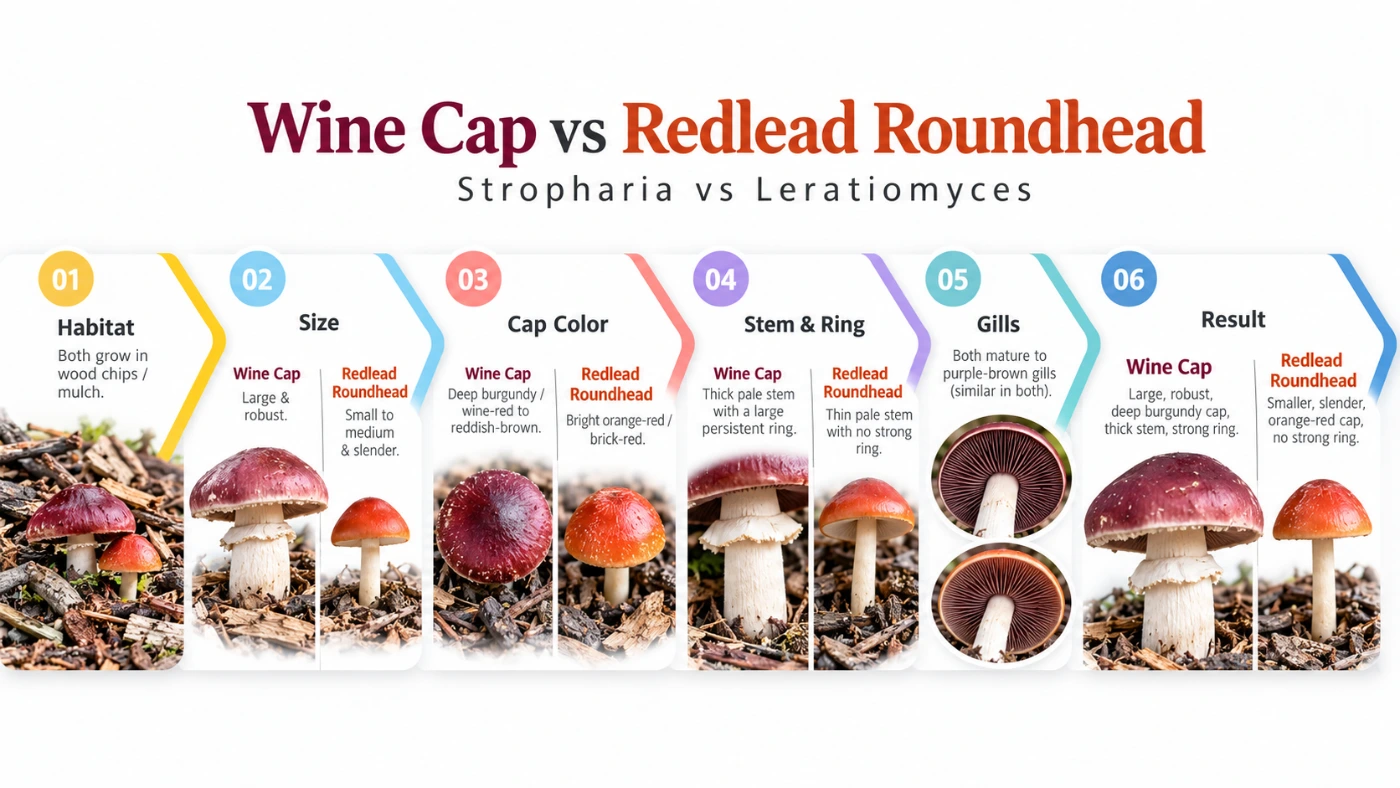
Wine Cap (Stropharia rugosoannulata) and Redlead Roundhead (Leratiomyces ceres) are two colorful mushrooms commonly found in wood chips, bark mulch, gardens, and landscaped areas. Because both can develop dark purple-brown gills and grow in the same artificial habitats, they may initially seem more similar than they really are.
The easiest distinction is usually size and stem structure. Wine Cap is a large, robust mushroom with a prominent persistent ring, while Redlead Roundhead is much smaller, more slender, and normally lacks a substantial ring.
⚠️ Important: Wood-chip beds can contain several dark-spored mushroom species at the same time. Do not identify either species from cap color or habitat alone, and do not use photo identification as the sole basis for deciding whether a wild mushroom is safe to eat.
Quick Comparison
| Feature | Wine Cap | Redlead Roundhead |
|---|---|---|
| Scientific name | Stropharia rugosoannulata | Leratiomyces ceres |
| Typical size | Large, robust | Small to medium |
| Cap color | Wine-red, burgundy, reddish-brown | Orange-red, brick-red |
| Cap with age | Often fades to tan or brown | Often remains orange-red to reddish |
| Young gills | Gray to gray-lilac | Pale gray to yellowish-gray |
| Mature gills | Dark purple-brown | Purple-brown |
| Stem | Thick, pale | Slender, pale to yellowish |
| Ring | Large, persistent | Absent or weak veil remnants |
| Cap margin | Usually fairly clean | Often with pale veil fragments when young |
| Spore print | Dark purple-brown | Dark purple-brown |
| Main habitat | Wood chips, mulch, gardens | Wood chips, mulch, landscaped beds |
| Growth | Solitary, scattered, or grouped | Often numerous and densely scattered |
| Edibility | Edible when correctly identified and cooked | Not recommended as an edible mushroom |
| Best clue | Large size + strong ring | Small orange-red mushroom + no strong ring |
Wine Cap — Stropharia rugosoannulata
Wine Cap is one of the largest mushrooms commonly encountered in wood-chip beds. Mature specimens can be substantial, with broad caps and thick stems that make them look much heavier than most other mulch mushrooms.
Fresh young caps are commonly burgundy, reddish-purple, wine-red, or reddish-brown. The color can fade dramatically, and mature specimens may become tan, ochre-brown, or pale brown.
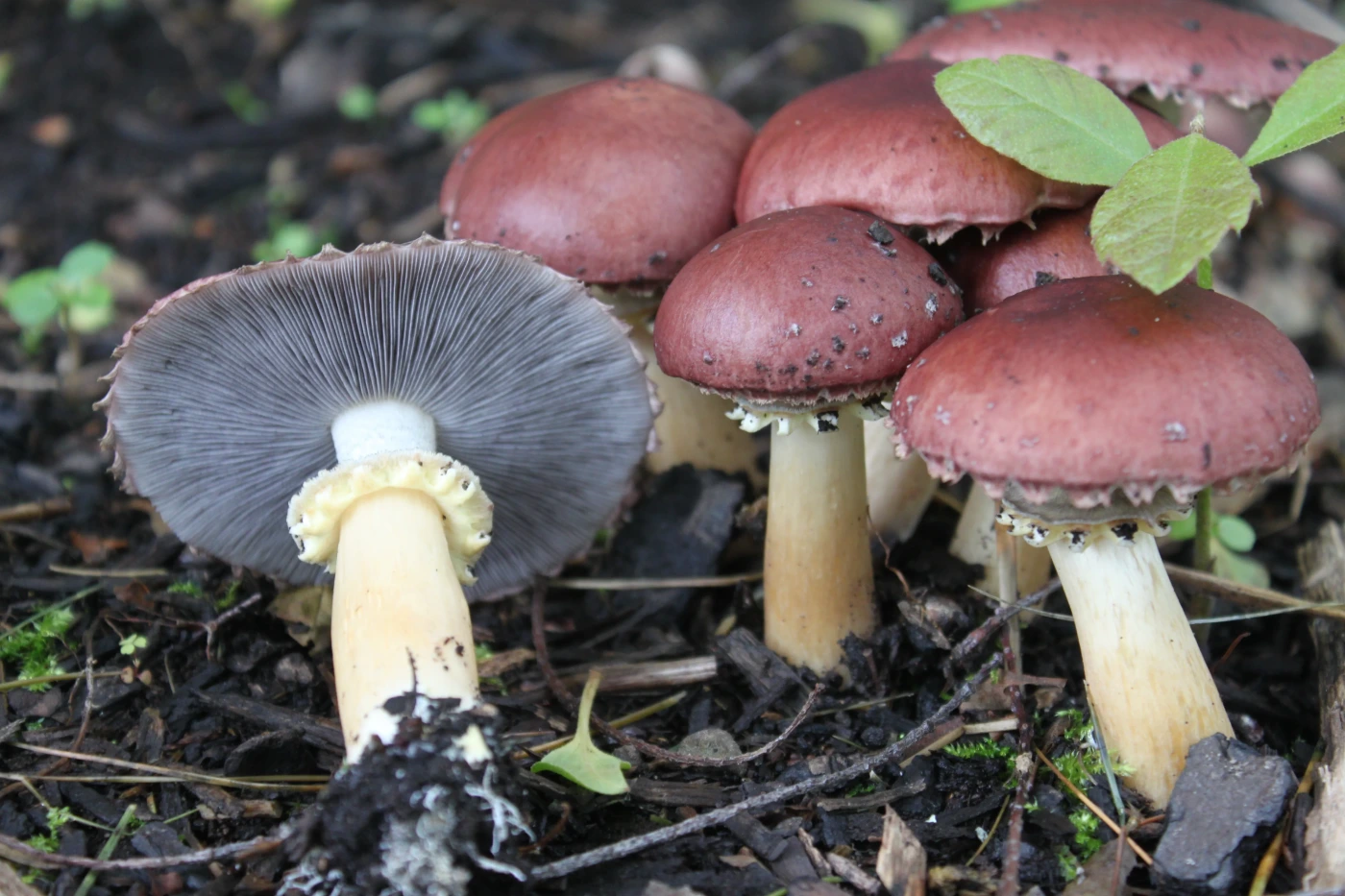
Wine Cap Cap
The cap begins rounded or convex and expands considerably with age. Its surface is generally smooth, although weather can produce cracks or other irregularities.
Color is strongest in young specimens. A faded mature Wine Cap may show little of the deep wine-red coloration suggested by its common name, so color alone is not dependable.
Wine Cap Gills
Young gills are pale gray, grayish-lilac, or similar muted shades. As spores mature, the gills become much darker purple-brown.
They are attached beneath a large fleshy cap and often contrast strongly with the pale stem. Mature spore deposits can also darken nearby surfaces.
Wine Cap Stem and Ring
The stem is thick, pale, and usually proportionate to the large cap. One of the most important characters is the conspicuous membranous ring left by the partial veil.
The upper surface of the ring may become darkened by falling spores. Even when the cap has faded almost completely, the combination of a substantial stem and well-developed ring can make Wine Cap recognizable.
Redlead Roundhead — Leratiomyces ceres
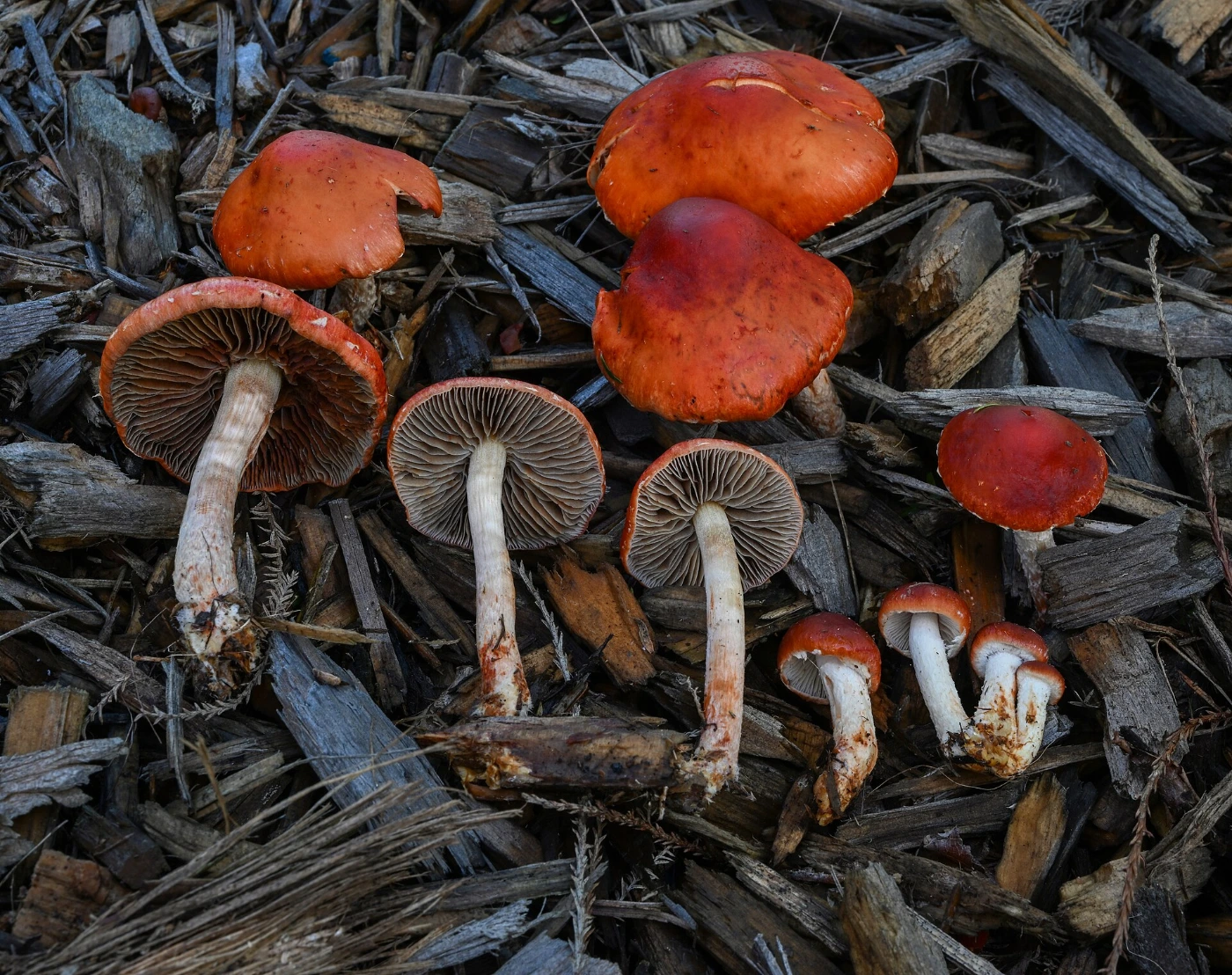
Redlead Roundhead is a smaller and more delicate mushroom that has become extremely common in landscaped wood-chip beds. Its vivid orange-red caps can appear in large numbers after rain.
The species was historically placed in Stropharia, which helps explain why Wine Cap and Redlead Roundhead share several features. Modern classification places it in Leratiomyces.
Redlead Roundhead Cap
The cap is commonly bright orange-red, red-orange, or brick-red. Unlike the deeper burgundy often seen in young Wine Caps, its colors tend to be warmer and brighter.
Young caps may have pale or whitish fragments of veil tissue around the edge. These remnants can disappear as the cap expands or after heavy rain.
Redlead Roundhead Gills
The gills begin relatively pale and become increasingly dark as spores mature. Fully mature specimens develop the purple-brown coloration typical of their dark spores.
This gill development can make the species resemble other dark-spored mulch mushrooms. The small size and absence of a substantial ring are therefore more useful than mature gill color.
Redlead Roundhead Stem
The stem is much thinner than the heavy stem of a typical Wine Cap. It is usually pale, sometimes with yellowish or reddish tones, and may show traces of veil material.
There is normally no broad persistent membranous ring comparable to that of Stropharia rugosoannulata. This difference is particularly useful when young specimens of both species are being compared.
The Fastest Way to Tell Them Apart
A typical mature Wine Cap looks like a substantial woodland-style mushroom that happens to be growing in mulch. It has a broad cap, thick stem, and obvious ring.
A Redlead Roundhead looks considerably lighter and more delicate. Its smaller orange-red cap, slender stem, and lack of a prominent ring create a very different overall profile.
Size Difference
Size is one of the easiest differences to see when representative specimens are available. Wine Caps can produce broad caps well over 10 cm across, and particularly large fruit bodies can become much bigger.
Redlead Roundheads usually remain considerably smaller. A group of them may contain many fruit bodies, but individual mushrooms rarely approach the massive proportions of a well-developed Wine Cap.
Burgundy vs Orange-Red Caps
Young Wine Caps frequently show deep burgundy or wine-red shades. Redlead Roundheads are more typically bright red-orange, orange-red, or brick-red.
There is still overlap, especially in weathered mushrooms. Sun, rain, age, and drying can alter both species enough that color should remain a supporting rather than decisive feature.
Ring vs No Ring
The ring is probably the most practical structural difference. Wine Cap normally develops a broad, persistent ring around the upper part of its stem.
Redlead Roundhead may show veil remains but does not normally have the same large durable ring. In mature mushrooms, this difference can often resolve the identification immediately.
Veil Remnants on the Cap
Young Redlead Roundheads commonly retain whitish fragments around the cap margin. These can produce a slightly ragged or fringed appearance.
Wine Cap also begins with a partial veil, but its most obvious remnant is usually the substantial ring left on the stem. The cap margin does not normally provide the characteristic pale fringe associated with young Leratiomyces ceres.
Habitat
Both species are strongly associated with wood chips and decomposing woody material. Gardens, playground borders, paths, parks, landscaped commercial areas, and freshly mulched beds can all support them.
Their habitats overlap so strongly that location alone has little value for distinguishing the two. In fact, different dark-spored mulch fungi may occur only a few meters apart.
When Do They Appear?
Both species can fruit following periods of rain when wood-chip beds remain moist. Exact timing varies substantially with climate and local conditions.
Redlead Roundhead can produce conspicuous flushes containing many relatively small mushrooms. Wine Cap may also fruit abundantly, but its much larger fruit bodies make even a smaller group visually impressive.
Spore Print
Both mushrooms produce dark spores with purple-brown tones. For this particular comparison, therefore, a spore print confirms the broader dark-spored group but does little to distinguish one species from the other.
This is a useful example of why spore color is not always a species-level character. Size, ring structure, and cap appearance provide much stronger separation here.
Wine Cap vs Redlead Roundhead at Different Ages
Young specimens can occasionally be more confusing than mature ones because their proportions and veil structures have not fully developed. A young Wine Cap may have a relatively small closed cap, while a young Redlead Roundhead can still show conspicuous veil material.
As they mature, the difference becomes clearer. Wine Cap develops into a heavy, broad mushroom with a substantial ring, while Redlead Roundhead remains comparatively small and slender.
Look-Alikes
Wood chips support many mushrooms with brown, reddish, yellow, or orange caps. Several other dark-spored fungi therefore enter the comparison when either Wine Cap or Redlead Roundhead is found.
Psilocybe cyanescens — Wavy Cap
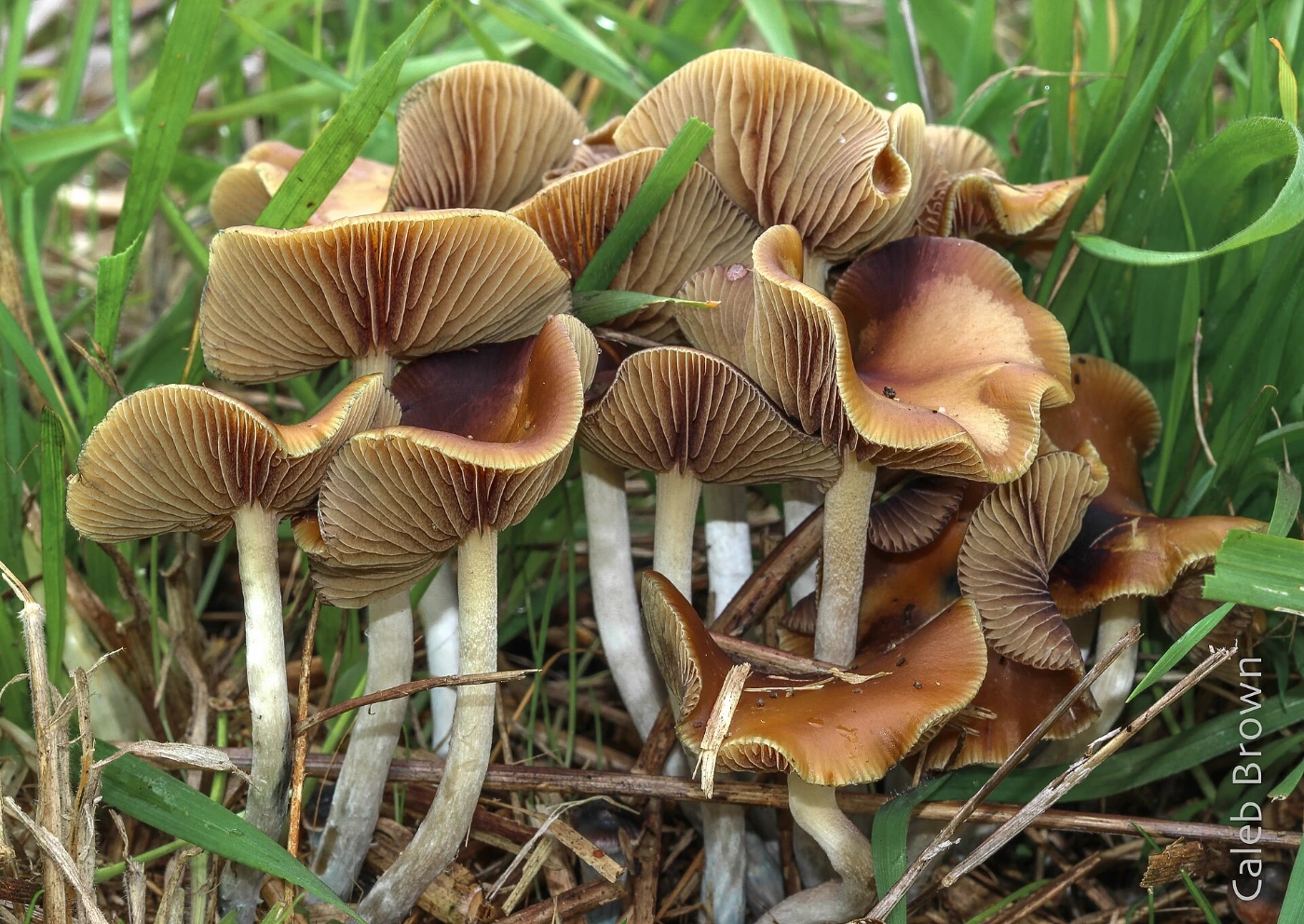
Identification
Psilocybe cyanescens is a smaller wood-chip mushroom with caramel-brown caps that often become distinctly wavy at maturity. Damaged tissue may show blue bruising.
It lacks the large persistent ring of Wine Cap and usually lacks the vivid orange-red coloration of Redlead Roundhead. Mature spores are also dark purple-brown.
Main Difference
A wavy caramel-colored cap and blue bruising point away from both species in the main comparison. Wine Cap is much larger, while Redlead Roundhead is usually brighter orange-red.
Hypholoma fasciculare — Sulphur Tuft
Identification
Sulphur Tuft forms dense yellow clusters on dead wood, including buried woody material. Young gills often have a noticeable greenish or olive-yellow tone before darkening with maturity.
It is poisonous and should not be confused with edible clustered wood-growing mushrooms. Its sulphur-yellow coloration is usually quite different from both Wine Cap and Redlead Roundhead.
Main Difference
Look for yellow caps and greenish young gills growing in tight clusters from wood. These characters fit Sulphur Tuft rather than either Stropharia rugosoannulata or Leratiomyces ceres.
Hypholoma lateritium — Brick Cap
Identification
Brick Cap has reddish to brick-colored caps and grows in groups from dead hardwood or buried wood. Its coloration can occasionally resemble Redlead Roundhead.
The mushrooms generally grow as obvious clusters connected to woody substrate. Their overall form and gill development fit Hypholoma rather than Leratiomyces.
Main Difference
Clustered growth directly from wood is an important clue. Redlead Roundhead more commonly appears scattered through wood-chip beds rather than forming the same tight stump-associated clusters.
Stropharia caerulea — Blue Roundhead
Identification
Blue Roundhead shares the dark purple-brown spores typical of Stropharia. Fresh caps can be blue-green or turquoise and often have a sticky surface.
As the cap ages, the bright coloration may fade substantially. Veil remnants can be present around the stem.
Main Difference
Fresh blue-green cap coloration separates typical specimens easily. Even faded examples normally lack the burgundy cap and massive build of Wine Cap.
Other Small Wood-Chip Mushrooms
Identification
Mulch beds can support numerous small brown, yellow, orange, and reddish mushrooms belonging to several genera. Some cannot be reliably separated to species level from a casual photograph.
This diversity is especially important when a mushroom lacks the distinctive ring of Wine Cap or the classic orange-red appearance of Redlead Roundhead. Habitat should narrow the search rather than determine the answer.
Main Difference
Do not force every orange mulch mushroom into Leratiomyces ceres. Ordinary gill structure, veil remnants, bruising, spore color, and overall proportions should all fit.
Wine Cap vs Redlead Roundhead: Side-by-Side Identification
The simplest field comparison starts with overall build. A large mushroom with a thick stem and strong ring strongly favors Wine Cap, especially when the young cap has burgundy coloration.
A small to medium orange-red mushroom with a slender stem and no substantial ring strongly favors Redlead Roundhead. Pale veil fragments around a young cap margin provide additional support.
Common Identification Mistakes
One mistake is relying too heavily on red cap color. Wine Cap can fade almost to tan, while Redlead Roundhead ranges from vivid orange-red to darker brick tones.
Another is treating purple-brown mature gills as diagnostic. Both species develop similar dark gill colors because both produce dark purplish-brown spores.
The third mistake is identifying every red mushroom in wood chips as Wine Cap. Leratiomyces ceres is frequently far more numerous in landscaped beds and differs dramatically in size and stem structure.
How to Photograph These Mushrooms
A useful photograph should show at least one entire mushroom from cap to stem base. Side views are particularly important because they reveal the size and structure of the ring.
Photograph young and mature specimens together when possible. A close-up of the cap margin can show veil remnants, while an underside photograph documents the developing gill color.
Can AI Tell Wine Cap From Redlead Roundhead?
These two species are often easier for image-based identification than many small brown mushrooms because their overall proportions differ substantially. A mature Wine Cap with its large ring and robust stem provides particularly strong visual information.
Difficulties arise with very young mushrooms, heavily faded caps, or photographs showing only the top of the cap. Including a side view and the complete stem greatly improves the comparison.
Interesting Facts
Redlead Roundhead was formerly known as Stropharia aurantiaca and has been moved between genera as fungal classification has changed. Its current placement in Leratiomyces illustrates how mushroom taxonomy can change even when the field appearance remains familiar.
Wine Cap has become popular in cultivated garden beds because it can grow on woody mulch and produce large fruit bodies. Its ability to thrive in human-made habitats explains why it often appears far from what people imagine as traditional mushroom woodland.
Both species benefit from the widespread use of decorative wood chips. Urban landscaping has effectively created enormous networks of new fungal habitat in parks, gardens, campuses, and residential developments.
Their shared purple-brown spores also demonstrate the limits of any single identification feature. Spore color places them in a useful broader context, but their very different size and veil structures are what make field separation straightforward.
Frequently Asked Questions
Can Wine Cap and Redlead Roundhead grow in the same wood-chip bed?
Yes. Their preferred habitats overlap strongly, and wood-chip beds can contain several mushroom species simultaneously. Each fruit body should therefore be examined individually rather than assuming an entire bed contains one species.
Does Wine Cap always have a wine-red cap?
No. Older caps can fade to brown, tan, or ochre. The thick stem and prominent ring remain more reliable than color in mature specimens.
Does Redlead Roundhead have a ring?
It can show remnants of its partial veil, especially when young, but it does not normally develop the broad persistent ring characteristic of Wine Cap. Pale veil fragments are often more obvious around the cap margin.
Are their gills different colors?
There can be differences when the mushrooms are young, but both eventually develop dark purple-brown gills. Mature gill color alone is therefore a poor way to separate them.
Which species is usually larger?
Wine Cap is substantially larger and more robust. A mature specimen can have a broad cap and thick stem that dwarf typical Redlead Roundheads.
Why are both species common in gardens?
Both can use decomposing woody material as a substrate. Modern mulched gardens and landscaped beds provide exactly this type of habitat in large quantities.
Can Redlead Roundhead be mistaken for a Wine Cap when young?
Yes, particularly if only the cap is visible. The difference becomes much clearer when the stem, veil structures, and overall size are examined.
Is every large burgundy mushroom in mulch a Wine Cap?
No. While the combination is strongly suggestive, complete structural features should still be checked. Mushroom identification should never depend on one color and one habitat clue.
Final Identification Notes
Wine Cap and Redlead Roundhead share wood-chip habitat and dark purple-brown mature spores, but their overall appearance is substantially different. Stropharia rugosoannulata is large and robust, usually with a thick pale stem and prominent persistent ring, while Leratiomyces ceres is smaller, more slender, orange-red, and lacks a comparable ring.
The most useful field distinction is therefore simple: large burgundy-to-brown mushroom + thick stem + strong ring = Wine Cap; smaller orange-red mushroom + slender stem + no strong ring = Redlead Roundhead.
Cap color can fade and mature gills are similar, so neither should dominate the identification. Size and veil structure provide the clearest separation.
Upload a photo and get possible matches in seconds.