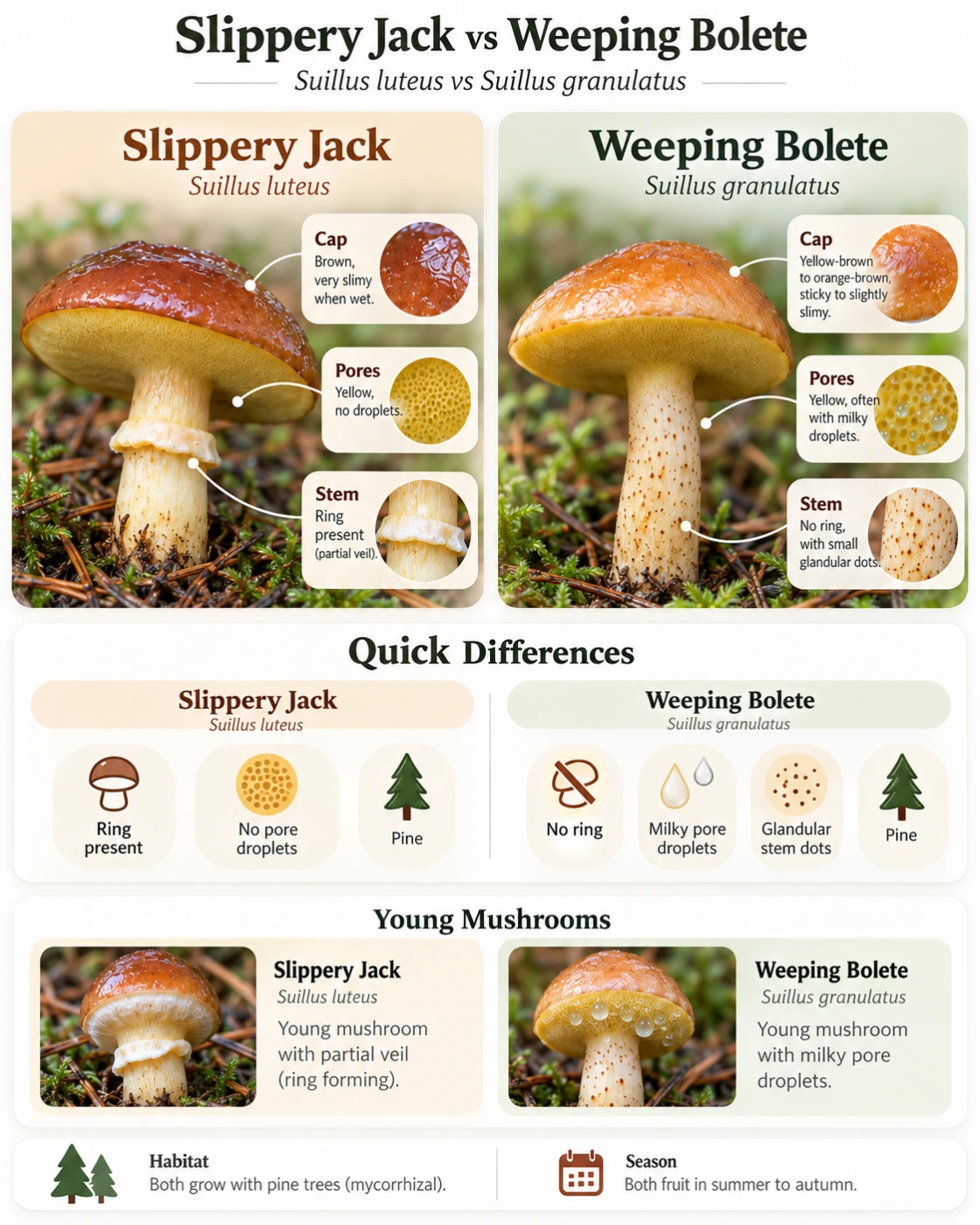
Suillus luteus, the Slippery Jack, and Suillus granulatus, the Weeping Bolete, are two common pine-associated boletes that can look remarkably similar. Both have brownish sticky caps, yellow pores, pale stems, and can grow in groups beneath pine trees.
Fortunately, there is one particularly useful difference: Slippery Jack normally has a distinct ring on the stem, while Weeping Bolete has no ring and instead develops small glandular dots on the upper stem. Young S. granulatus may also produce distinctive milky droplets from its pores.
⚠️ Important: This guide is for identification and education only. Never eat a wild mushroom based solely on photographs, AI identification, or an online comparison.
Quick Comparison
| Feature | Slippery Jack | Weeping Bolete |
|---|---|---|
| Scientific name | Suillus luteus | Suillus granulatus |
| Cap color | Brown to dark chestnut | Yellow-brown to orange-brown |
| Cap surface | Very slimy when wet | Sticky to slightly slimy |
| Pores | Yellow | Yellow |
| Young pore droplets | Not characteristic | Often present |
| Ring | Present | Absent |
| Glandular stem dots | Less characteristic | Usually present |
| Stem | Pale, ringed | Pale, dotted |
| Blue bruising | Usually weak or absent | Usually weak or absent |
| Main host | Pine | Pine |
| Season | Summer–autumn | Summer–autumn |
| Edibility | Edible when correctly identified | Edible when correctly identified |
The Fastest Way to Tell Them Apart
Look at the stem before concentrating on cap color. A mature Suillus luteus should normally show a ring or obvious remains of one, while Suillus granulatus is ringless.
Then examine the upper stem of the ringless mushroom. Small brownish or reddish glandular dots support S. granulatus.
Young specimens offer another clue. Weeping Bolete may release tiny pale droplets from its pore surface, something that gives the species its English common name.
Slippery Jack — Suillus luteus
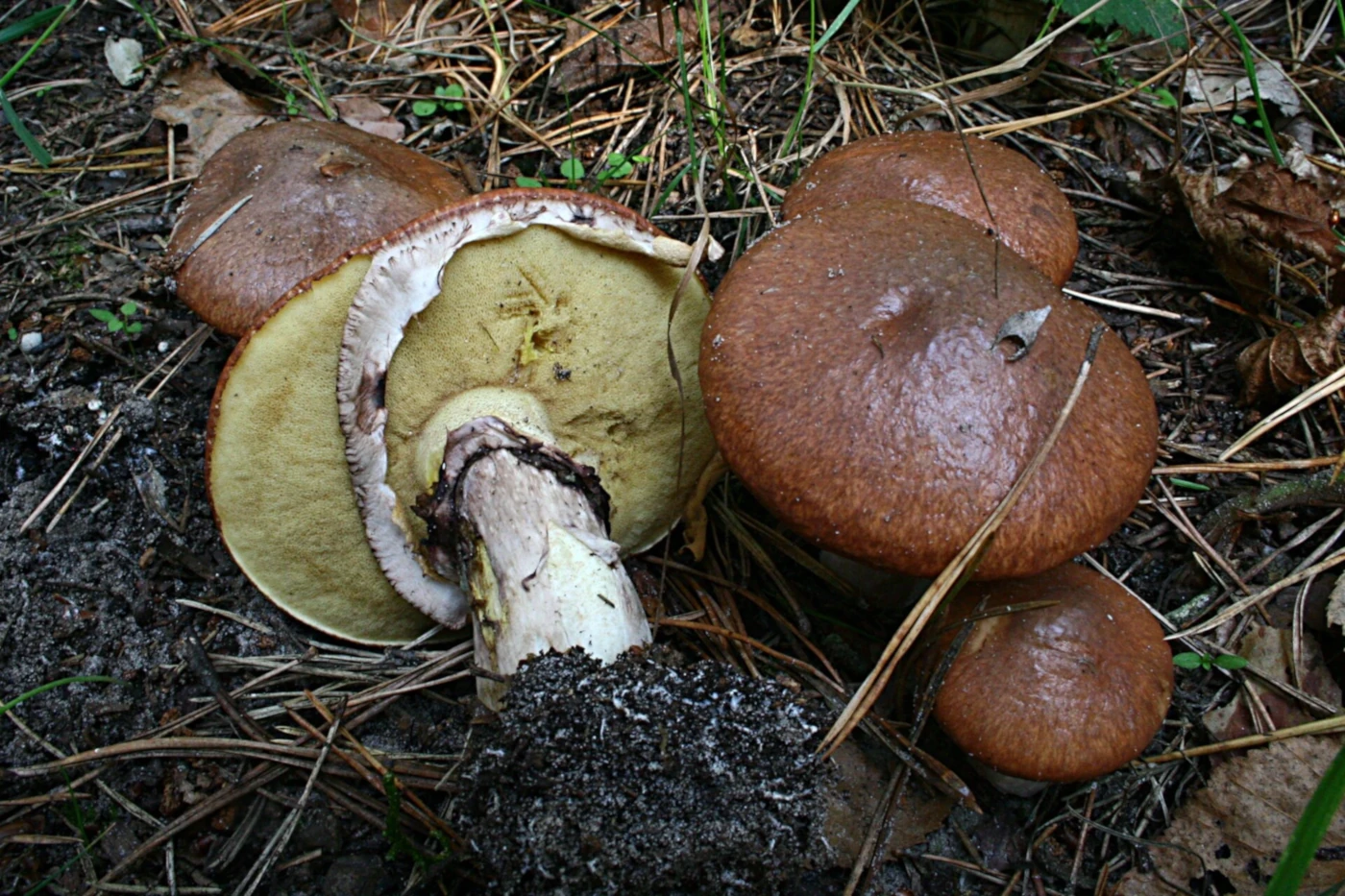
Suillus luteus is one of the best-known members of the genus. It has a brown cap that can become extremely slippery after rain, yellow pores, and a pale stem with a conspicuous partial-veil ring.
Young mushrooms can have the entire pore surface covered by a pale veil. As the cap expands, this membrane tears away from the cap margin and remains around the stem as a ring.
Cap
The cap ranges from medium brown to deep chestnut or chocolate-brown. Fresh wet fruit bodies can look polished because of the thick layer of slime covering the surface.
Dry conditions can make the cap look almost matte. This is why slipperiness alone should never be used to identify the species.
Pores
The pores begin pale yellow and become deeper yellow or olive-yellow with age. They are generally small and densely packed.
Strong blue bruising is not characteristic. Minor discoloration can occur, particularly in old or damaged tissue.
Stem and Ring
The stem is pale cream to yellowish and generally rather stout. A ring is the key structural feature.
On fresh specimens the ring can be broad and membranous. Older mushrooms may have a collapsed or damaged ring, but remnants are often still detectable.
Weeping Bolete — Suillus granulatus
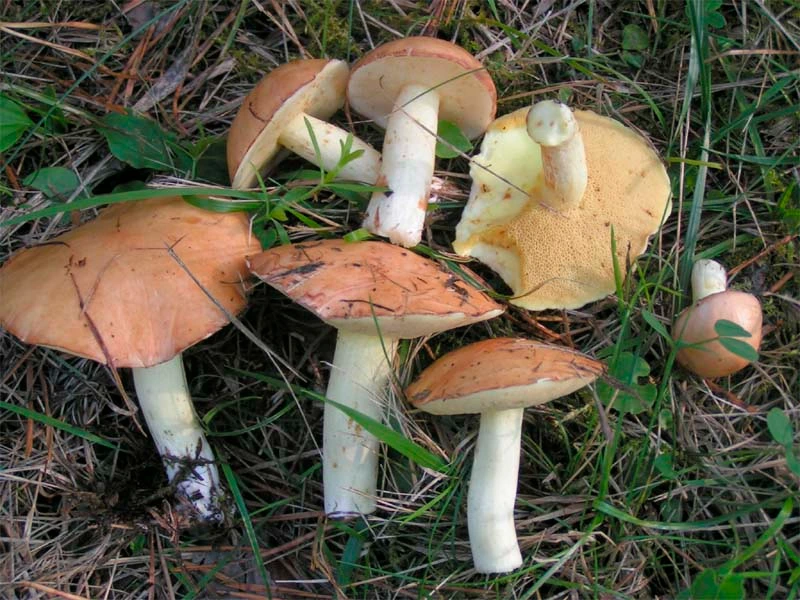
Suillus granulatus has a yellow-brown, tan, or orange-brown cap with yellow pores. It also grows with pine and can appear in the same type of habitat as Slippery Jack.
Unlike S. luteus, however, it has no ring. Instead, the stem typically carries numerous small glandular dots.
Cap
The cap can range from light yellow-brown to deeper orange-brown. When wet it may become sticky, although it often looks less dramatically slimy than a fresh Slippery Jack.
Cap color overlaps between the two species. A light S. luteus or dark S. granulatus can therefore be misleading.
Pores
The pore surface is yellow and may become deeper yellow or olive as the mushroom ages. Young specimens can exude small clear or milky droplets.
These droplets may later dry and leave brownish stains. Their absence does not exclude S. granulatus, especially in dry weather.
Stem and Glandular Dots
The stem is pale yellow to cream and lacks a partial-veil ring. Small glandular dots are often concentrated toward the upper stem.
The dots can become darker and more conspicuous with age. Very young or wet specimens may show them less clearly.
Ring vs No Ring
This is the most useful field comparison.
A fresh brown pine bolete with yellow pores and a clear membranous ring strongly suggests Suillus luteus. A similar mushroom with no ring and a dotted upper stem is much more consistent with Suillus granulatus.
What if the Ring Is Missing?
Old Slippery Jacks can lose much of their ring through rain, insects, or physical damage. Looking at only one old specimen can therefore lead to mistakes.
Search for younger mushrooms nearby. If several fruit bodies are growing from the same patch, young specimens may still have an intact veil or obvious ring.
The Partial Veil in Young Slippery Jacks
Young Suillus luteus has a membrane stretching from the stem to the cap margin. This partial veil covers the developing pore surface.
When the cap expands, the membrane breaks. The remaining tissue creates the characteristic stem ring.
Suillus granulatus lacks this developed partial veil. Its pores are therefore exposed even in relatively young specimens.
Pore Droplets in Suillus granulatus
The “weeping” feature is most noticeable on young fresh mushrooms during humid conditions. Tiny liquid droplets form across the yellow pore surface.
They may look white, translucent, or slightly milky. As they dry, they can produce small brown marks.
Are Droplets Always Present?
No. Dry weather, age, and environmental conditions can make them completely absent.
The lack of droplets should therefore not be used to reject an otherwise convincing S. granulatus. Ring absence and glandular stem dots are more dependable.
Glandular Dots
Small glandular structures on the stem are typical of several Suillus species. In S. granulatus, they are an important identification feature.
They often appear as tiny reddish-brown or brown dots against a yellowish stem. The upper portion of the stem usually shows them most clearly.
Slippery Jack may show some surface coloration or fine markings, but its ring is much more important diagnostically.
Cap Color: Useful but Unreliable
Slippery Jack often has the darker cap of the two species. Deep chocolate or chestnut tones are common.
Weeping Bolete frequently appears lighter, with ochre, yellow-brown, or orange-brown coloration. However, moisture and age create substantial overlap.
A wet mushroom becomes darker, while a dry exposed mushroom may fade considerably. Cap color should therefore be used after checking the stem rather than before it.
Which One Has the Slimier Cap?
Both species can have sticky caps, but Suillus luteus is famous for its strongly viscid surface. After rain, the cap can be covered by a conspicuous layer of slime.
Suillus granulatus may also become sticky or somewhat slimy. The difference is relative rather than absolute.
A dry Slippery Jack can easily look less sticky than a wet Weeping Bolete. This makes cap texture a supporting feature.
Do They Bruise Blue?
Neither species is known for the dramatic blue reactions found in many other boletes. The pores and flesh generally show little or no strong blueing.
If a brown mushroom with yellow pores rapidly turns deep blue when pressed or cut, other bolete groups should be considered.
This is particularly useful when comparing them with Bay Bolete and several Xerocomellus species.
Flesh
Both species have pale cream to yellowish flesh. Young fruit bodies are relatively firm, while mature specimens become increasingly soft and spongy.
Strong color changes after cutting are not expected. Older tissue may nevertheless show irregular brownish or dull discoloration.
Insect larvae are common in mature Suillus. A mushroom that looks intact from above may contain extensive tunnels inside.
Spore Print
Both species produce brown to olive-brown spores. Spore print therefore does little to separate them.
This is different from comparisons involving gilled mushrooms, where spore color may be decisive. Here, stem structure is much more informative.
Habitat: Both Grow With Pine
Both Suillus luteus and Suillus granulatus are mycorrhizal fungi associated with pine. They grow from soil connected to living pine roots rather than decomposing dead wood.
Natural pine forest, plantations, grassy woodland margins, roadside trees, and parks can all support them.
Why They Can Appear Far From the Trunk
Pine roots extend well beyond the visible trunk. The fungal mycelium associated with those roots also spreads through the surrounding soil.
A Suillus mushroom can consequently appear several meters from the tree. A grassy lawn with a pine nearby can be productive habitat.
Can Slippery Jack and Weeping Bolete Grow Together?
Yes. Suitable pine habitat can support several Suillus species simultaneously. One patch should therefore not be assumed to contain only one species. A ringed Slippery Jack can potentially occur close to a ringless Weeping Bolete. Each fruit body should be checked separately. This is especially important when several age groups are mixed together.
Slippery Jack vs Weeping Bolete Step by Step
The comparison can usually be resolved with a few structural checks. Start with the stem, then use pores and cap characteristics for confirmation. This approach is much more reliable than trying to decide which shade of brown the cap represents.
Step 1: Look for a Ring
A clear membranous ring strongly favors Suillus luteus. Also look for remnants if the mushroom is old. No ring leads toward S. granulatus or another ringless Suillus. Do not stop there if the specimen is weathered.
Step 2: Check for Glandular Dots
Examine the upper stem closely. Numerous small brownish dots strongly support S. granulatus. Use fresh intact tissue when possible. Dirt can sometimes imitate spots on old specimens.
Step 3: Look at Young Pores
Tiny milky droplets support Weeping Bolete. A partial veil covering the young pore surface supports Slippery Jack. These are particularly useful features when young mushrooms are available.
Step 4: Compare the Cap
A very dark, heavily slimy brown cap favors S. luteus. A lighter yellow-brown or orange-brown cap can favor S. granulatus. Because the colors overlap, this should only confirm the structural features.
Step 5: Confirm Pine Habitat
Both should have pine nearby. If no pine is present, reconsider the identification. A similar bolete growing with other trees may belong to another genus or Suillus species.
Slippery Jack vs Weeping Bolete vs Bay Bolete
Bay Bolete (Imleria badia) is another brown mushroom with yellow pores that can grow in conifer forests. Unlike these two Suillus, its pores commonly bruise blue.
Bay Bolete also lacks both the strong ring of S. luteus and the characteristic glandular pattern of S. granulatus. Its cap is generally less strongly slimy.
| Feature | Slippery Jack | Weeping Bolete | Bay Bolete |
|---|---|---|---|
| Ring | Present | Absent | Absent |
| Stem dots | Not key | Characteristic | Absent |
| Pore droplets | No | Often when young | No |
| Strong cap slime | Common | Moderate | Less typical |
| Blue pore bruising | Usually weak | Usually weak | Common |
| Main habitat | Pine | Pine | Conifer/mixed forest |
Are Slippery Jack and Weeping Bolete Edible?
Both are generally considered edible when correctly identified and properly prepared. Young firm mushrooms are usually preferred because older specimens become soft and spongy. Some people remove the slimy cap skin, especially from Slippery Jack. Members of Suillus can also cause gastrointestinal discomfort in some individuals. Edibility should never be inferred simply because a mushroom resembles one of these species. The identification should be established first.
How to Photograph Them for Identification
Take a side photograph showing the entire stem. For this comparison, a cap-only photograph removes the most important distinguishing feature.
Then photograph the pore surface and upper stem at close range. Young specimens should be documented before the veil breaks or pore droplets disappear.
A wider image showing pine needles, cones, or the host tree is also useful. Several specimens at different ages make the comparison much easier.
Can AI Tell Suillus luteus From Suillus granulatus?
AI can often separate them when the stem is clearly visible. A ring provides a strong signal for S. luteus, while glandular dots and pore droplets support S. granulatus. Accuracy falls dramatically with cap-only photographs. Both mushrooms share the same basic brown-cap, yellow-pore appearance. Photos of several age stages can significantly improve results. Young specimens may reveal features that are missing from older mushrooms.
Common Identification Mistakes
A common mistake is identifying every slimy brown pine bolete as Slippery Jack. Several Suillus species have sticky caps. Another is assuming that the absence of visible droplets rules out Weeping Bolete. The droplets are environmentally dependent and may disappear completely. The third is overlooking a damaged ring on an old Slippery Jack. Younger nearby fruit bodies can often resolve the uncertainty.
Interesting Facts About Slippery Jack and Weeping Bolete
Both fungi belong to Suillus, a genus whose members have particularly strong relationships with conifer roots. Many Suillus species specialize in pine, making the identity of the nearby tree unusually useful for mushroom identification.
These relationships have also helped some Suillus species travel with humans. When pine trees were planted outside their native ranges, compatible fungi were sometimes transported or established alongside them.
The “weeping” droplets of S. granulatus are not water simply sitting on the cap after rain. They are secreted through the young pore surface and can later leave characteristic brownish marks.
Slippery Jack demonstrates another unusual feature of boletes: a partial veil. Most familiar boletes have an exposed pore surface, while young S. luteus temporarily hides its pores beneath a membrane that later becomes the stem ring.
Frequently Asked Questions
Can a Slippery Jack have only a tiny ring?
Yes. Rain, age, insects, and handling can destroy most of the veil. A narrow ring zone or fragments may be all that remain on an old specimen.
Why do some Weeping Boletes have no visible glandular dots?
The dots can be pale in very young mushrooms and less obvious when the stem is wet or dirty. They often become darker as the fruit body matures.
Can the two species appear at exactly the same time?
Yes. Their seasons overlap strongly, and both respond to similar periods of warm weather and rainfall beneath compatible pines.
Why does one mushroom in a group have a much darker cap?
Age, hydration, sunlight, and individual variation affect cap color. Mushrooms from the same area can therefore differ substantially in shade.
Can frost make them impossible to distinguish?
Frost can damage rings, pore surfaces, and cap texture, making identification harder. Intact unfrozen specimens nearby provide better evidence.
Can young Weeping Boletes look as slimy as Slippery Jacks?
Yes. Moist conditions can make both species very sticky. The presence or absence of a veil and ring remains more useful than the amount of slime.
Do the pore droplets return after they disappear?
Not necessarily. They are most characteristic of actively developing young pore surfaces and may disappear permanently as a fruit body matures.
Can both species fruit in lawns?
Yes. If pine roots extend beneath the grass, both can appear in lawns, parks, or grassy roadside areas rather than obvious woodland.
Final Identification Notes
The easiest way to separate these two common pine boletes is to examine the stem. Slippery Jack (Suillus luteus) normally has a ring, while Weeping Bolete (Suillus granulatus) has no ring and instead shows glandular dots.
Young specimens provide even stronger clues. Slippery Jack may have a partial veil covering its pores, while Weeping Bolete may have small milky droplets emerging from the yellow pore surface.
Cap color and slipperiness are useful only as supporting evidence. When the ring, glandular dots, young pore features, and pine habitat all agree, distinguishing the two becomes much more reliable.
Upload a photo and get possible matches in seconds.