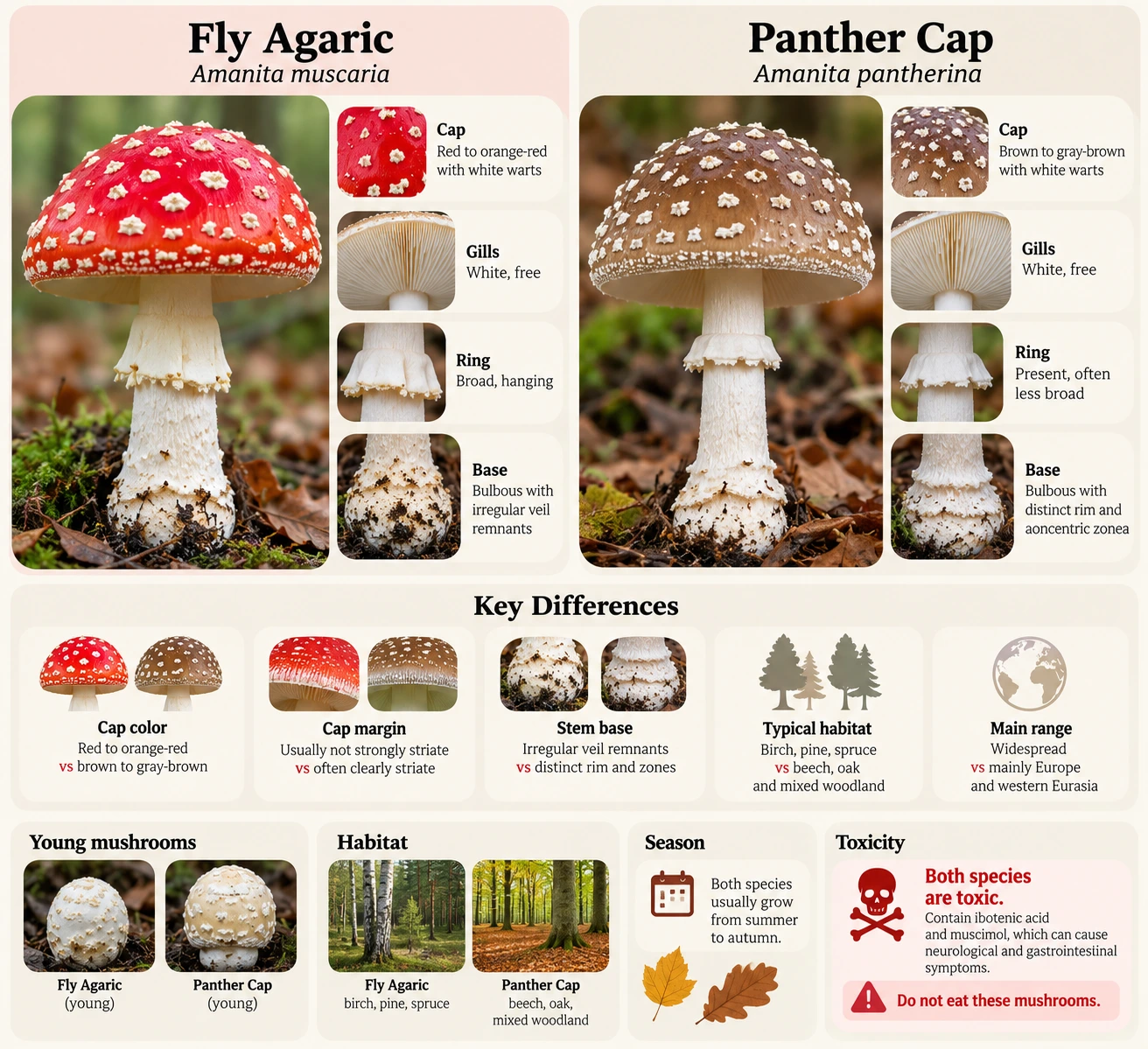
Аmanita muscaria, the Fly Agaric, and Amanita pantherina, the Panther Cap, are two striking toxic Amanita mushrooms that can look surprisingly similar. Both may have pale warts on the cap, white gills, a ring on the stem, and a bulbous base with veil remnants.
The easiest first clue is usually cap color: Fly Agaric is typically red to orange-red, while Panther Cap is brown to gray-brown. But faded, washed, damaged, or unusually colored specimens can make this comparison much harder, so cap color should never be used alone.
⚠️ Important: Both species are toxic. Their main toxic compounds are associated with ibotenic acid and muscimol, which can cause neurological and gastrointestinal symptoms. Do not confuse this poisoning pattern with the delayed amatoxin syndrome of deadly species such as Amanita phalloides.
Quick Comparison
| Feature | Fly Agaric | Panther Cap |
|---|---|---|
| Scientific name | Amanita muscaria | Amanita pantherina |
| Typical cap color | Red to orange-red | Brown to gray-brown |
| Cap warts | White to cream | White to cream |
| Gills | White | White |
| Ring | Present | Present |
| Stem | White | White |
| Base | Bulbous with veil remnants | Bulbous with distinct rim-like veil zones |
| Cap margin | Usually not strongly striate | Often more clearly striate |
| Main toxins | Ibotenic acid, muscimol | Ibotenic acid, muscimol |
| Toxicity | Toxic | Toxic |
| Main range | Widespread across Eurasia and introduced elsewhere | Mainly Europe and western Eurasia |
| Habitat | Birch, pine, spruce and other trees | Broadleaf and mixed woodland, often beech/oak |
The Fastest Way to Tell Them Apart
Start with the cap color, but immediately move to the cap margin and stem base. A vivid red cap with pale warts strongly favors Fly Agaric, while a brown cap with pale warts and a more visibly striate margin favors Panther Cap.
Then inspect the bulb at the base of the stem. Panther Cap often has more sharply defined veil remnants around the bulb, sometimes forming collar-like or concentric zones.
These differences are most useful when several features agree. Old or rain-washed Amanitas can lose warts and fade dramatically.
Fly Agaric — Amanita muscaria
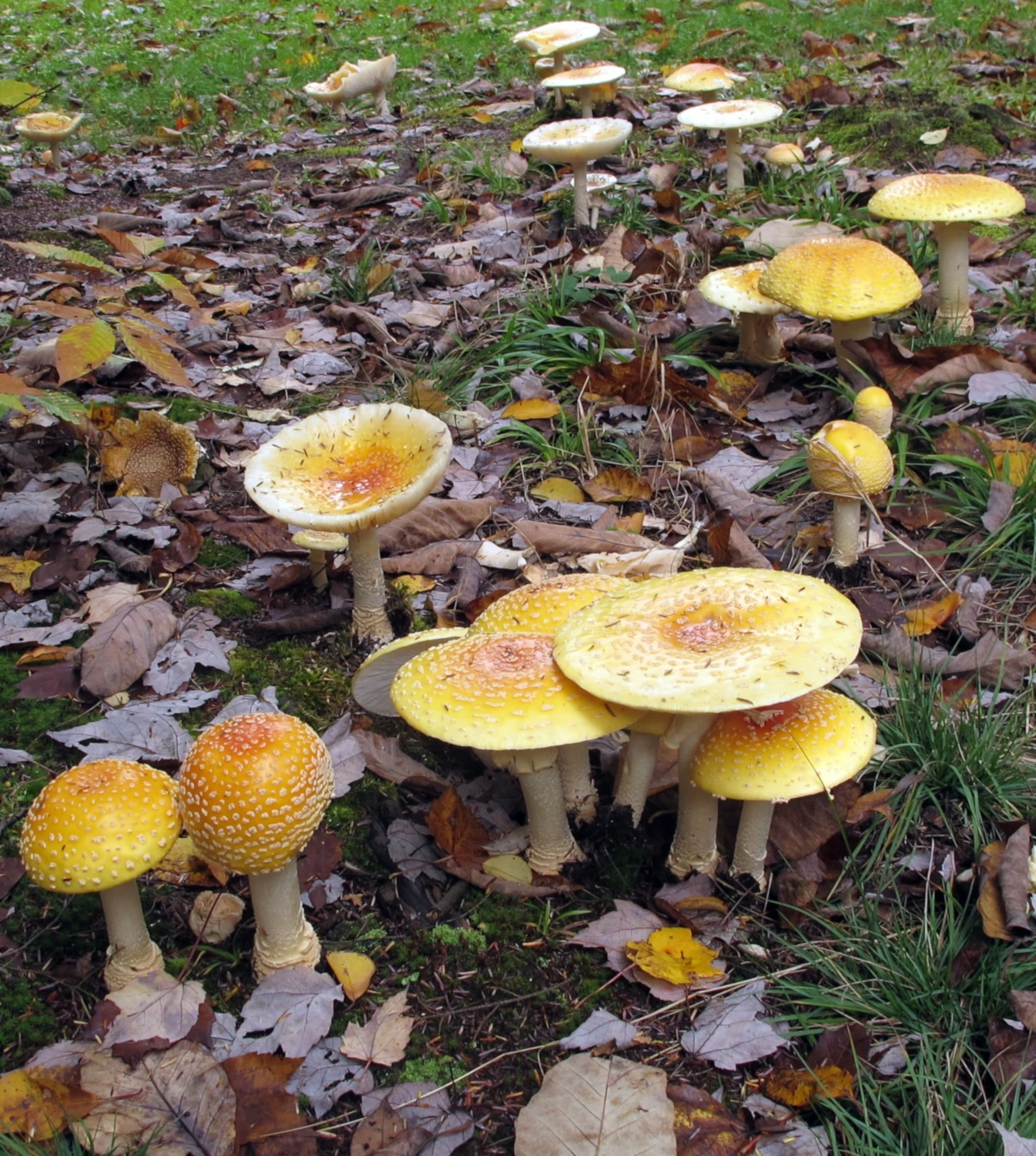
Amanita muscaria is one of the most recognizable mushrooms in the world. Its classic form has a bright red cap covered with white wart-like veil remnants, white gills, a white stem, and a broad hanging ring.
The species is highly variable, however. Caps may be orange-red, yellow-orange, or faded after rain, and the white warts can be partly or completely washed away.
Cap
The cap is usually bright red to orange-red and begins rounded before flattening with age. White or cream warts are scattered across the surface.
These warts are remnants of the universal veil that enclosed the young mushroom. Heavy rain can remove them, leaving a smooth-looking cap.
Cap Margin
The margin can become somewhat striate with age, but usually not as prominently as in typical Panther Cap. This difference is useful but not absolute.
Very mature Fly Agarics can still develop visible grooves. The base and overall coloration should be considered at the same time.
Gills
The gills are white, free or nearly free from the stem, and crowded. They remain pale as the mushroom matures.
This is a classic Amanita feature, but it does not separate these two species very well. Both have white gills.
Stem
The stem is white and often fairly tall. A broad, hanging ring is usually present on the upper stem.
The stem base is swollen and surrounded by irregular veil remnants. These remnants are often less sharply organized than in Panther Cap.
Stem Base
Fly Agaric typically has a bulbous base with shaggy or broken concentric patches of veil material. The appearance can be messy rather than neat.
This is one of the best places to look after the cap. Never cut an Amanita off at ground level when trying to identify it, because the basal structure is essential.
Panther Cap — Amanita pantherina
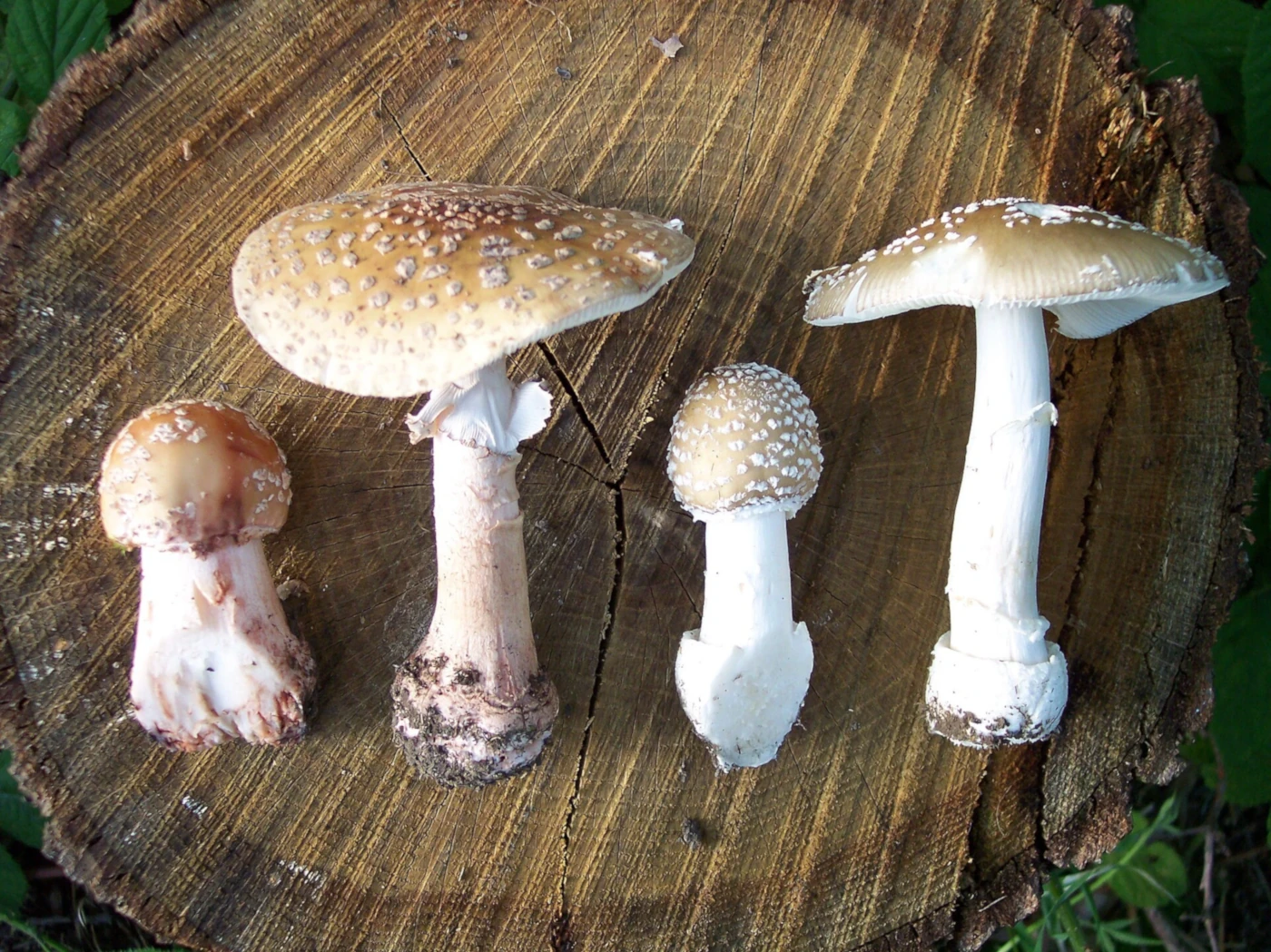
Аmanita pantherina typically has a brown to gray-brown cap covered with bright white veil patches. The contrast between dark cap and pale warts can be striking.
The species is toxic and belongs to the same broad muscimol-containing Amanita group as Fly Agaric. Its identification requires particular care because several related brown Amanitas can look similar.
Cap
The cap ranges from warm brown to olive-brown, gray-brown, or darker chocolate tones. White veil warts are commonly scattered across the surface.
Unlike many Fly Agarics, the brown background color usually remains a major feature. Rain may still wash away some of the pale veil patches.
Cap Margin
The cap margin is often distinctly striate, especially in mature specimens. These radial grooves can be easier to see than in typical Fly Agaric.
This feature becomes especially useful when warts are missing. A brown Amanita with white gills, pale warts, and a strongly striate margin should be examined carefully for Panther Cap features.
Gills
The gills are white and crowded. They are free or nearly free from the stem.
As with Fly Agaric, the gills confirm the Amanita structure but do not provide the decisive separation.
Stem
The stem is white, often slender to moderately robust, and has a ring. The ring may appear less broad or floppy than in some Fly Agarics.
The lower stem expands into a bulb. The veil structures around this bulb are particularly important.
Stem Base
Panther Cap often has a more distinct rim or collar around the upper part of the bulb. Below that, additional concentric veil zones may be visible.
This cleaner, more structured basal pattern can help separate it from Fly Agaric. It is one of the strongest non-color characters in the comparison.
Fly Agaric vs Panther Cap: Key Differences
The two species share many Amanita characters, so the comparison works best when several features are considered together.
The most useful combination is cap color + cap margin + structure of the bulbous base.
| Feature | Amanita muscaria | Amanita pantherina |
|---|---|---|
| Cap color | Red to orange-red | Brown to gray-brown |
| Warts | White/cream | White/cream |
| Cap margin | Weakly to moderately striate | Often clearly striate |
| Ring | Usually broad and hanging | Present, often less conspicuous |
| Basal veil | Irregular patches/zones | More distinct rim and concentric zones |
| Gills | White | White |
| Toxic compounds | Ibotenic acid, muscimol | Ibotenic acid, muscimol |
What Happens After Rain?
Rain can make both species much harder to identify. Pale veil warts may disappear, cap colors may darken or wash out, and surface texture can change.
A Fly Agaric that has lost its white warts may look surprisingly plain. A Panther Cap without obvious warts can also resemble other brown Amanitas.
Why Washed Caps Are Dangerous
People often rely too heavily on the white spots. Those spots are not permanent anatomical structures; they are veil remnants.
This means the absence of spots does not rule out either species. The gills, ring, margin, and especially the stem base become more important.
Fly Agaric vs Panther Cap by Stem Base
If cap color is confusing, the bulb is often the next best clue. Carefully excavate the entire base rather than pulling or cutting the mushroom carelessly.
Fly Agaric generally shows more irregular, broken veil remnants around the bulb. Panther Cap more often has a clearly defined upper rim and additional concentric bands lower down.
The distinction is not always perfect in damaged specimens. Several mushrooms from the same patch may provide a clearer pattern.
Toxicity
Both mushrooms are toxic and can produce a neurological intoxication syndrome. Symptoms may include nausea, vomiting, dizziness, confusion, agitation, drowsiness, altered perception, and impaired coordination.
The severity can vary considerably depending on the amount consumed, preparation, individual sensitivity, and chemical concentration in the mushroom.
Ibotenic Acid and Muscimol
The major toxicologically important compounds are ibotenic acid and muscimol. These affect the central nervous system in ways that differ from the amatoxins found in deadly Amanitas such as Death Cap.
Symptoms often begin much sooner than classic amatoxin poisoning. The syndrome is more neurological and gastrointestinal than delayed liver failure.
Not the Same as Amatoxin Poisoning
This distinction matters. Amanita muscaria and Amanita pantherina should not be described as causing the same poisoning mechanism as Amanita phalloides.
Death Cap and related deadly Amanitas contain amatoxins, which can cause delayed and severe liver damage. Fly Agaric and Panther Cap belong to a different toxicological pattern.
Which One Is More Toxic?
Panther Cap is often considered capable of producing severe muscimol/ibotenic-acid poisoning, and its effects can be intense. However, toxicity varies among individual mushrooms and regions.
It is therefore unhelpful to treat either species as “safe enough” based on relative toxicity. Both should be regarded as toxic mushrooms that should not be eaten.
Habitat
Both species form mycorrhizal relationships with trees and grow from soil. They do not grow as wood-decaying mushrooms directly from logs.
Fly Agaric is especially famous for its associations with birch, pine, spruce, and other trees. Panther Cap is also mycorrhizal and often occurs in broadleaf or mixed woodland.
Fly Agaric Habitat
Birch and conifer forests are classic habitat for Amanita muscaria. It can also appear in parks, woodland margins, and landscaped areas with suitable host trees.
In some parts of the world, Fly Agaric has spread outside its native range together with introduced trees. Its ecological relationship with host roots makes tree identification useful.
Panther Cap Habitat
Panther Cap is often associated with broadleaf trees such as beech and oak, although habitat varies regionally. Mixed woodland can also support it.
Soil conditions may influence distribution as well. Local ecology should be considered alongside morphology.
Geographic Range and Taxonomy
Аmanita muscaria is widespread across much of the Northern Hemisphere and has also been introduced in various regions elsewhere. Its broader species complex has significant geographic variation.
Аmanita pantherina in the strict sense is primarily associated with Europe and western Eurasia. Brown Amanitas in North America that resemble Panther Cap may represent other closely related taxa rather than true A. pantherina.
North American Caution
In North America, it is better not to force every panther-like brown Amanita into the name Amanita pantherina. Regional taxonomy contains several related species and species complexes.
For practical identification, describing a specimen as a panther-cap-like Amanita may sometimes be more accurate until the regional taxon is established.
Common Look-Alikes
Brown and red Amanitas can overlap with several related species. Missing veil remnants and variable cap color make some specimens especially difficult.
The whole mushroom must be examined, including the stem base. Amanita identification from a cap-only photo is particularly risky.
Amanita gemmata Group
Yellow-brown Amanitas in the Amanita gemmata complex can resemble pale Panther Caps. They may show white veil patches and a striate margin.
Color, basal structure, habitat, and regional taxonomy all need to be considered. This is a group where exact species identification can become difficult.
Amanita rubescens — Blusher
The Blusher often has a brownish cap with pale veil remnants. However, damaged flesh develops reddish or wine-colored staining.
That bruising is a major clue. Neither typical Fly Agaric nor Panther Cap shows the same characteristic reddening throughout damaged tissue.
Amanita regalis — Royal Fly Agaric
Royal Fly Agaric can look intermediate because it has a brown to dark brown cap but otherwise resembles Fly Agaric. Pale veil warts and similar Amanita structure can make it look Panther-like.
Geography and the overall veil pattern are important. In some regions, Amanita regalis is a major source of confusion.
How to Identify Them Step by Step
Start by confirming that the mushroom is an Amanita-like species with white gills, a ring, and a swollen stem base. Then compare the cap color and veil remnants.
After that, inspect the cap margin and excavate the entire base. These structural characters are more reliable than spots alone.
Step 1: Check the Cap Color
Red or orange-red strongly favors Fly Agaric. Brown or gray-brown strongly favors Panther Cap.
Do not stop here if the specimen is faded. Weather can alter both dramatically.
Step 2: Check the Cap Margin
A strongly grooved or striate margin supports Panther Cap. A weaker margin supports Fly Agaric.
Mature Fly Agarics can also become striate, so this remains a supporting feature rather than a final answer.
Step 3: Check the Ring
Both should have a ring. A broad floppy ring is often associated with Fly Agaric, while Panther Cap may have a more modest ring.
Missing rings can occur in damaged or old specimens. Their absence should trigger extra caution rather than an immediate exclusion.
Step 4: Excavate the Base
Do not cut the stem above ground. Carefully remove enough soil to expose the bulb and surrounding veil remnants.
A sharply defined rim and concentric basal zones favor Panther Cap. More irregular shaggy veil remnants favor Fly Agaric.
Step 5: Consider Geography
A classic Panther Cap identification makes much more sense in Europe or western Eurasia than in many parts of North America. Regional species concepts matter.
Fly Agaric also varies geographically and may belong to different regional lineages or related taxa. Location should therefore be part of the identification process.
How to Photograph Fly Agaric and Panther Cap
Take one image of the whole mushroom in habitat before touching it. Then photograph the cap from above so that veil remnants and margin structure are visible.
The most important additional image is the complete stem base. Carefully expose the bulb and photograph it from the side.
A close-up of the gills and ring is also useful. With Amanitas, four or five diagnostic views are far more valuable than one attractive cap photo.
Can AI Tell Fly Agaric From Panther Cap?
AI can usually separate a classic bright-red Fly Agaric from a classic brown Panther Cap. The task becomes much harder when specimens are faded, rain-washed, immature, or photographed without the stem base.
The best results come from multiple images showing the cap, gills, ring, full stem, and bulb. Habitat and geographic location further improve the comparison.
A cautious system should sometimes return an Amanita group or several possibilities instead of forcing a precise species identification. This is especially important with brown panther-like Amanitas outside Europe.
Common Identification Mistakes
A frequent mistake is believing that Fly Agaric must always have a red cap with perfect white spots. Rain can remove the veil remnants and fade the color.
Another is identifying every brown Amanita with white warts as Panther Cap. Several related Amanitas can produce a similar appearance.
The most serious mistake is ignoring the stem base. In Amanita identification, cutting the mushroom at soil level removes some of the most important evidence.
Interesting Facts About Fly Agaric and Panther Cap
Fly Agaric is one of the most culturally recognizable mushrooms in the world. Its red cap with white spots has become a standard visual symbol for mushrooms in illustrations, games, fairy tales, and popular culture.
The white “spots” are actually remnants of the universal veil that enclosed the young mushroom. They are not permanent decorations and can disappear after heavy rain.
Both species demonstrate how important developmental stages are in Amanita identification. Very young fruit bodies can initially look like pale eggs before the cap expands and exposes the gills.
Fly Agaric has also spread into regions where it was historically absent, often in association with introduced host trees. This reflects how closely mycorrhizal fungi can travel with forestry and horticulture.
Frequently Asked Questions
Can a Fly Agaric be brown?
Some Fly Agaric populations and related regional taxa can be much darker or more brownish than the classic red form. This is one reason exact Amanita identification should use more than cap color.
Can Panther Cap lose all its white warts?
Yes. Heavy rain can wash away most or all veil remnants, leaving a relatively smooth brown cap.
Why do young Amanitas sometimes look like white balls?
The universal veil encloses the developing mushroom when it is young. As the fruit body expands, the veil tears and leaves remnants on the cap and base.
Can the ring disappear completely?
Yes. Age, weather, insects, and handling can damage or remove the ring, especially on old specimens.
Why is the base so important?
The shape of the bulb and arrangement of universal-veil remnants are major Amanita characters. Cutting off the base removes information that may be essential for identification.
Can Fly Agaric and Panther Cap grow in the same forest?
Yes. Their ecological requirements can overlap in some regions, especially in mixed woodland with suitable host trees.
Do both species always have white gills?
Typical mature specimens do. Any unusual gill color should prompt reconsideration of the identification.
Is Panther Cap found throughout North America?
True Amanita pantherina should not automatically be assumed for North American finds. Several related panther-like taxa occur there, and regional taxonomy is more complicated.
Final Identification Notes
The simplest first distinction is obvious: Fly Agaric is typically red to orange-red, while Panther Cap is typically brown to gray-brown. But that difference becomes unreliable when caps fade, warts wash away, or unusual color forms appear.
The stronger comparison uses several characters together. Panther Cap often has a more clearly striate cap margin and a more structured bulb with rim-like or concentric veil remnants, while Fly Agaric tends to have a redder cap and more irregular basal veil patches.
Both species are toxic and are associated mainly with ibotenic acid and muscimol, not amatoxin liver poisoning. For difficult specimens, especially brown Amanitas outside Europe, a cautious group-level identification can be more accurate than forcing a species name.
Upload a photo and get possible matches in seconds.