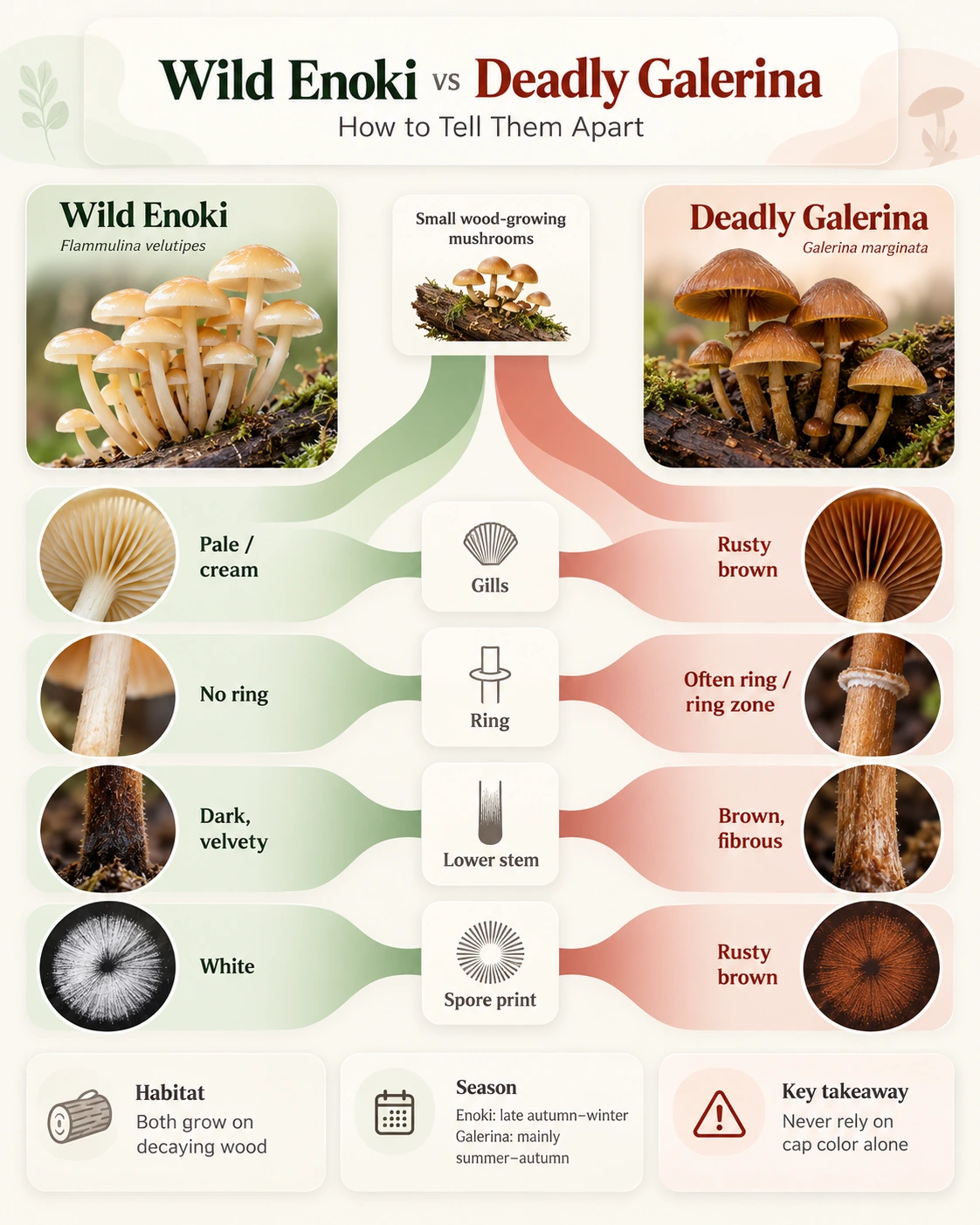
Wild Enoki and Deadly Galerina can grow on the same kind of decaying wood and may both have small brown or orange-brown caps. From above, especially in wet weather, the two can look similar enough to create a serious identification problem.
The difference matters because wild Enoki belongs to the Flammulina velutipes group and is considered edible when correctly identified and cooked, while Galerina marginata contains amatoxins capable of causing fatal liver poisoning. The safest comparison focuses on spore color, mature gill color, ring presence, and the texture of the lower stem rather than cap color alone.
⚠️ Important: Never eat a wild wood-growing mushroom based only on photographs, AI identification, or a single visual feature. Wild Enoki should be considered for food only after Deadly Galerina and other dangerous look-alikes have been confidently excluded.
Wild Enoki vs Deadly Galerina: Quick Comparison
| Feature | Wild Enoki | Deadly Galerina |
|---|---|---|
| Typical group | Flammulina velutipes complex | Galerina marginata |
| Cap color | Yellow, honey-orange, orange-brown | Yellow-brown to reddish brown |
| Cap surface | Smooth, often sticky when wet | Smooth, often moist or shiny |
| Mature gills | White to cream | Rusty brown to cinnamon-brown |
| Spore print | White | Rusty brown |
| Ring | Absent | Often present or visible as a ring zone |
| Lower stem | Dark brown to nearly black, velvety | Brown, fibrous, not velvet-black |
| Growth | Usually clustered | Single, grouped, or clustered |
| Substrate | Dead or weakened hardwood | Decaying wood |
| Main season | Late autumn through winter | Mainly summer through autumn, sometimes later |
| Safety | Edible when correctly identified and cooked | Deadly poisonous |
What Is Wild Enoki?
Wild Enoki refers to mushrooms in the Flammulina velutipes group, commonly known as Velvet Shank. They are cold-tolerant wood-growing mushrooms with smooth yellow-orange caps, pale gills, and a distinctive dark velvety lower stem.
Wild specimens look very different from the long white Enoki sold in supermarkets. Commercial Enoki is grown under artificial conditions that produce narrow pale stems and tiny caps, while wild mushrooms develop normal pigmentation and broader caps.
The Most Useful Wild Enoki Features
A typical wild Enoki cluster has pale gills, no ring, and a lower stem that becomes progressively darker and noticeably velvety. The cap may be shiny or sticky in damp weather, especially during cool autumn and winter conditions.
The spore print is white. This feature becomes particularly important because Deadly Galerina produces a completely different rusty-brown spore print.
What Is Deadly Galerina?
Galerina marginata, commonly called Deadly Galerina, is a small brown mushroom that grows on decaying wood. Its ordinary appearance makes it particularly dangerous because it can resemble several edible wood-growing mushrooms.
The species contains amatoxins, the same general class of toxins responsible for Death Cap poisoning. Symptoms may be delayed for hours, and severe liver damage can develop after the initial gastrointestinal phase.
Why Deadly Galerina Is Easy to Overlook
The cap may be honey-brown, yellow-brown, or reddish brown and often changes color as it dries. Wet specimens can appear smooth and shiny, which overlaps visually with Wild Enoki.
Its size also creates false reassurance. A small mushroom can still contain dangerous toxins, so size should never be used as a measure of safety.
The Most Important Difference: Spore Color
If there is one comparison worth remembering, it is the spore print. Wild Enoki produces white spores, while Deadly Galerina produces rusty-brown spores.
This difference is much more reliable than subtle variations in cap color. Brown and orange shades can overlap extensively, especially in poor light or wet conditions.
Wild Enoki Spore Print
A Wild Enoki spore print should appear white. Heavy spore deposits may occasionally be visible on mushrooms growing beneath other caps in a dense cluster.
White spores also explain why the mature gills remain pale. They should not become strongly rusty or cinnamon-brown.
Deadly Galerina Spore Print
Deadly Galerina produces rusty-brown spores. On mature mushrooms, this color can often be seen directly on the gills or deposited around the ring zone.
A clearly rusty spore print rules out Flammulina velutipes. Any supposed Wild Enoki producing brown spores should therefore be reconsidered immediately.
Gill Color: Pale vs Rusty Brown
Gill color is another highly useful distinction, especially when mature mushrooms are available. Wild Enoki gills stay white to pale cream, while Deadly Galerina gills darken as rusty spores mature.
Young Galerina specimens may still have relatively pale gills, which is why a single immature mushroom can be misleading. Looking at several fruit bodies of different ages provides a much clearer picture.
Wild Enoki Gills
The gills are pale and contrast with the orange-brown cap. They remain broadly cream or whitish even on developed specimens.
Their attachment can vary somewhat in appearance, but color is more useful than trying to judge subtle gill attachment in the field. The important point is that mature Wild Enoki should not develop rusty-brown gills.
Deadly Galerina Gills
Galerina gills begin lighter and gradually become ochre, cinnamon, or rusty brown. Mature specimens usually show the spore color much more clearly.
This age-related change means young mushrooms should never be judged alone. A mixed-age cluster often provides the most useful identification evidence.
The Stem: Velvet vs Fibrous
The lower stem is one of the best field clues for Wild Enoki. Mature specimens develop a dark brown to almost black base covered with a fine velvety texture.
Deadly Galerina lacks this characteristic velvet-black lower stem. Its stem is typically brown, fibrous, and may carry remnants of a partial veil.
Wild Enoki Stem
The upper part of the stem can be yellowish or pale brown, while the lower part darkens strongly with age. The transition may be gradual, creating a two-toned appearance.
The base often looks almost covered in dark felt. This is the feature behind the common name Velvet Shank.
Deadly Galerina Stem
The Galerina stem is usually more uniformly brown or yellow-brown and may show pale fibrils. A ring or ring zone can be present, particularly on younger or well-preserved specimens.
The lower stem does not normally develop the same dense dark velvety coating. This difference is especially useful when the caps look nearly identical.
Ring or No Ring
Wild Enoki does not have a persistent ring. A clean ring around the stem therefore points away from Flammulina.
Deadly Galerina often has a thin ring or visible ring zone, although the structure may disappear with age or weathering. The absence of a visible ring does not automatically make a brown wood-growing mushroom safe.
Why the Ring Can Be Misleading
Rain, handling, and maturity can damage fragile veil remnants. An old Galerina may appear almost ringless even though younger members of the same group show the structure clearly.
This is another reason to examine several mushrooms when possible. A cluster can reveal features that are missing from an individual fruit body.
Cap Comparison
Both mushrooms can have smooth brownish caps, which is why cap color is a weak primary feature. Wild Enoki tends to range from yellow through honey-orange to orange-brown, while Galerina commonly occupies yellow-brown to reddish-brown tones.
These ranges overlap enough that photographs can be deceptive. Moisture also changes appearance, making caps darker, shinier, and more saturated after rain.
Wild Enoki Cap
The cap is smooth and often noticeably sticky or viscid when wet. Young specimens are convex and gradually flatten as they mature.
The center may be darker than the margin. In dense clusters, overlapping caps can create an attractive golden-orange appearance.
Deadly Galerina Cap
Galerina caps are usually convex when young and become flatter with age. They are often hygrophanous, meaning their color changes as moisture is lost.
A wet cap can appear dark brown, while a drying mushroom may develop a much paler outer region. This changing color pattern can make the species look different within the same cluster.
Habitat: Unfortunately, Both Grow on Wood
Habitat does not separate these mushrooms very well because both can grow on decaying wood. Logs, stumps, fallen branches, and buried woody material can all produce small clustered mushrooms.
Wild Enoki is particularly associated with hardwoods, while Deadly Galerina can grow on a variety of decaying wood. The substrate can support an identification, but it cannot make the identification by itself.
Buried Wood Can Hide the Real Substrate
A mushroom may look as though it is growing directly from soil when it is actually connected to a buried root or decaying log. This is common enough that the apparent growth surface should always be checked carefully.
Gently following the stem downward can reveal woody material beneath leaf litter or soil. This is especially helpful when identifying clustered mushrooms around old tree bases.
Growth Pattern
Wild Enoki frequently forms tight clusters with many stems emerging from the same section of wood. Large fruitings can create dense groups of overlapping orange caps.
Deadly Galerina can also grow in groups or clusters, so clustered growth is not a reliable safety feature. A single stump may even support more than one mushroom species at the same time.
Mixed Clusters Are Possible
Never assume every mushroom on a stump belongs to the same species. Different fungi can fruit only centimeters apart and visually blend into one apparent cluster.
This is particularly important when collecting edible wood-growing mushrooms. Each group should be checked independently, and any mushroom with different gills, stem texture, or cap structure should be separated.
Season: Useful but Not Proof
Wild Enoki is strongly associated with cold weather and often appears in late autumn and winter. It can continue fruiting after frost and may resume growth during mild winter periods.
Deadly Galerina is more commonly encountered from summer through autumn, but it can persist later when conditions remain mild. A December mushroom is therefore more suggestive of Wild Enoki, but season alone cannot exclude Galerina.
Why Frost Does Not Guarantee Safety
A common shortcut is to assume that any fresh brown mushroom growing after frost must be Velvet Shank. That rule is too simple and should not be used for food identification.
Microclimates around logs and stumps can remain warmer than surrounding air. Several wood-growing fungi can therefore persist later than expected.
Wild Enoki vs Deadly Galerina Side by Side
The safest identification comes from a group of features rather than one “magic” difference. White spores, pale mature gills, no ring, and a velvet-black stem base together strongly support Wild Enoki.
Rusty spores, rusty mature gills, a ring or ring zone, and a non-velvety fibrous stem point toward Deadly Galerina. When the features conflict, the mushroom should remain unidentified.
How to Identify Wild Enoki Step by Step
Start with the lower stem rather than the cap. Look for the characteristic dark velvety base and check whether any ring or ring zone is present.
Then inspect mature gills and make a spore print when there is any uncertainty. Habitat and season should be used only after these stronger features have been evaluated.
Step 1: Examine the Lower Stem
Look closely at the bottom half of the stem. A mature Wild Enoki should develop a distinctly dark and velvety texture.
Do not judge only the youngest mushrooms because their stems may not yet show the feature strongly. Older specimens in the same cluster are often more informative.
Step 2: Look for a Ring
Check the upper stem from all sides. Wild Enoki should not have a persistent ring.
If a thin ring or obvious ring zone is present, Galerina or another wood-growing species should be considered. A missing ring does not end the investigation because Galerina rings can disappear.
Step 3: Check Mature Gill Color
Choose one of the more developed mushrooms and inspect the underside in natural light. Pale cream gills support Wild Enoki, while rusty or cinnamon tones point away from it.
Artificial warm lighting can make white gills look beige or brown. Daylight photographs are much more useful for judging subtle color differences.
Step 4: Make a Spore Print
When Wild Enoki and Deadly Galerina are both realistic possibilities, a spore print is especially valuable. White supports Flammulina, while rusty brown supports Galerina.
A spore print should still be combined with the stem and gill features. No identification test works best in isolation.
Wild Enoki vs Sheathed Woodtuft
Sheathed Woodtuft, Kuehneromyces mutabilis, is another clustered brown mushroom that grows on dead wood. It usually has a ring and develops brown spores, which separates it from Wild Enoki.
Its lower stem often has small scales rather than a dense dark velvety coating. The cap can also become distinctly two-toned as it dries.
Quick Comparison
| Feature | Wild Enoki | Sheathed Woodtuft |
|---|---|---|
| Spore print | White | Brown |
| Ring | Absent | Usually present |
| Lower stem | Dark and velvety | Darker and scaly |
| Mature gills | Pale | Brownish |
| Typical season | Late autumn to winter | Mainly spring to autumn |
Because both grow in clusters on wood, cap color alone is especially unhelpful. Spore color and stem structure provide much stronger evidence.
Wild Enoki vs Honey Mushrooms
Honey Mushrooms can also form large clusters on stumps and roots. Their caps are usually tan to honey-brown, and many species have a distinct ring on the stem.
Honey Mushrooms are generally larger and more robust than Wild Enoki. They also lack the characteristic dark velvet covering of the lower stem.
White Spores Are Not Enough
Both Wild Enoki and Honey Mushrooms can produce white spore prints. This demonstrates why even a useful feature like spore color cannot identify a mushroom by itself.
Growth form, ring presence, cap structure, stem texture, and overall size must also agree. Mushroom identification works best when several independent features point toward the same species.
Wild Enoki and Cultivated Enoki
The supermarket mushroom sold as Enoki can look almost unrelated to its wild form. Cultivated Enoki usually has extremely long white stems and tiny pale caps because it is grown in low-light, high-carbon-dioxide environments.
Wild mushrooms receive natural light and develop much broader golden to orange-brown caps. Their stems are shorter, and the lower portion becomes dark and velvety.
Why This Causes Identification Mistakes
Someone familiar only with supermarket Enoki may reject a genuine wild specimen because it is brown and robust. Conversely, knowing that wild Enoki is brown can lead to overconfidence around other brown wood-growing mushrooms.
The correct identification pattern is therefore more important than resemblance to a cultivated product. Pale gills, white spores, no ring, and the dark velvety stem remain the key features.
Is Wild Enoki Edible?
Wild Enoki is considered edible when correctly identified and cooked. The caps and upper stems are more suitable for food than the tough dark stem bases.
The serious risk comes from look-alikes rather than from ordinary culinary use of correctly identified Flammulina. Because Deadly Galerina shares its wood-growing habitat, uncertainty should always result in rejecting the collection for food.
Why Deadly Galerina Is So Dangerous
Galerina marginata contains amatoxins that interfere with essential cellular processes, particularly in the liver. Poisoning can progress to severe organ injury even when the initial symptoms appear to improve.
A delayed onset is especially dangerous because someone may not immediately connect illness with mushrooms eaten many hours earlier. Any suspected ingestion of Deadly Galerina requires urgent medical evaluation.
Can AI Tell Wild Enoki From Deadly Galerina?
AI can use visible differences such as stem texture, ring presence, cap shape, and gill color to suggest possible species. Results improve greatly when the mushroom is photographed from several angles rather than only from above.
The most decisive feature, spore-print color, may not be visible in ordinary photographs. A hidden or damaged ring can also make dangerous mushrooms look more similar than they really are.
AI should therefore be used to generate possibilities, not to make a food-safety decision. This is one of the mushroom comparisons where physical examination remains especially important.
How to Photograph Wild Enoki for Identification
Start with the whole cluster and the wood it is growing from. A wider image can show whether the mushrooms share one attachment point or are scattered across the substrate.
Next, photograph the gills in natural light and take a close-up of the lower stems. The dark velvety texture needs to be sharp enough that it can be distinguished from ordinary brown fibers.
If any ring or veil remains visible, photograph it separately. A photograph of several young and mature specimens together can also reveal changes in gill and stem color.
Common Identification Mistakes
The most dangerous mistake is identifying a small brown wood mushroom by season alone. Cold-weather fruiting supports Wild Enoki, but it cannot exclude all toxic look-alikes.
Another mistake is focusing only on the attractive sticky orange cap. Cap coloration overlaps significantly with Galerina, particularly when both species are wet.
A third mistake is examining only one specimen from a large cluster. Younger and older mushrooms reveal different features, and more than one species can occasionally share the same log.
Frequently Asked Questions
Can Wild Enoki and Deadly Galerina grow on the same log?
Yes, different fungal species can fruit on the same piece of wood, sometimes only a short distance apart. This means a correctly identified Enoki cluster does not automatically make every nearby brown mushroom safe.
Why can a Wild Enoki stem look less velvety when the mushroom is young?
The characteristic dark texture becomes more pronounced as the fruit body matures. Very young stems may still be relatively pale, so older specimens in the same cluster can provide better identification evidence.
Can rain wash away evidence of a Galerina ring?
Yes, fragile veil remnants can deteriorate through rain, age, or handling. This is why the absence of a visible ring should never be treated as proof that a mushroom is Wild Enoki.
What should I do if the spore print is too faint to read?
Try a mature fresh cap and leave it longer on a contrasting surface. If a clear result still cannot be obtained and Galerina remains a realistic possibility, the mushroom should be left unidentified rather than treated as food.
Can very old Wild Enoki become difficult to identify?
Yes. Aging can darken caps, damage gills, dry the stem, and make the entire fruit body less typical. Fresh specimens are generally much easier to identify than weathered mushrooms that have survived repeated freezing and thawing.
Why do some Wild Enoki clusters contain caps of very different colors?
Moisture and age can strongly affect cap color. Wet caps are often darker and glossier, while drying mushrooms may become lighter even within the same cluster.
Can animals eating a mushroom tell me that it is safe?
No. Different animals tolerate fungal toxins differently, and evidence of insect or animal feeding does not establish human edibility. A mushroom must still be identified independently.
Is it useful to keep one specimen separate when collecting a suspected Wild Enoki cluster?
Yes, keeping representative specimens intact can preserve diagnostic features such as the full stem and gills. Mixing unknown brown mushrooms together can make later verification much more difficult.
Final Identification Notes
The safest way to separate Wild Enoki from Deadly Galerina is to look for a combination of pale mature gills, a white spore print, no ring, and a dark velvety lower stem. These features together strongly support the Flammulina velutipes group.
Deadly Galerina points in the opposite direction: rusty-brown mature gills, a rusty spore print, a possible ring or ring zone, and a brown fibrous stem without the characteristic velvet-black base. Cap color and growth on wood overlap too much to carry much weight on their own.
This is a comparison where uncertainty matters. If the spore color, stem structure, or mature gills do not clearly fit Wild Enoki, the mushroom should remain unidentified rather than being assumed edible.
Upload a photo and get possible matches in seconds.