Category: Articles

  • Giftige Pilze in Deutschland: 15 Arten, die du kennen solltest

    Giftige Pilze in Deutschland: 15 Arten, die du kennen solltest

    Deutschland hat eine enorme Vielfalt an Wildpilzen, und darunter befinden sich einige Arten, die schwere oder sogar tödliche Vergiftungen verursachen können. Besonders gefährlich ist, dass viele Giftpilze weder ungewöhnlich riechen noch auffällig aussehen und teilweise essbaren Arten ähneln.

    Wer Pilze bestimmen möchte, sollte deshalb nicht nur beliebte Speisepilze kennen. Mindestens genauso wichtig ist es, typische Giftpilze und ihre wichtigsten Merkmale zu erkennen, denn schon wenige grundlegende Arten decken einen großen Teil der gefährlichen Verwechslungen ab.

    ⚠️ Wichtig: Diese Übersicht dient der Bestimmung und Information. Verzehre niemals einen Wildpilz nur aufgrund eines Fotos, einer KI-Bestimmung oder eines Online-Artikels.

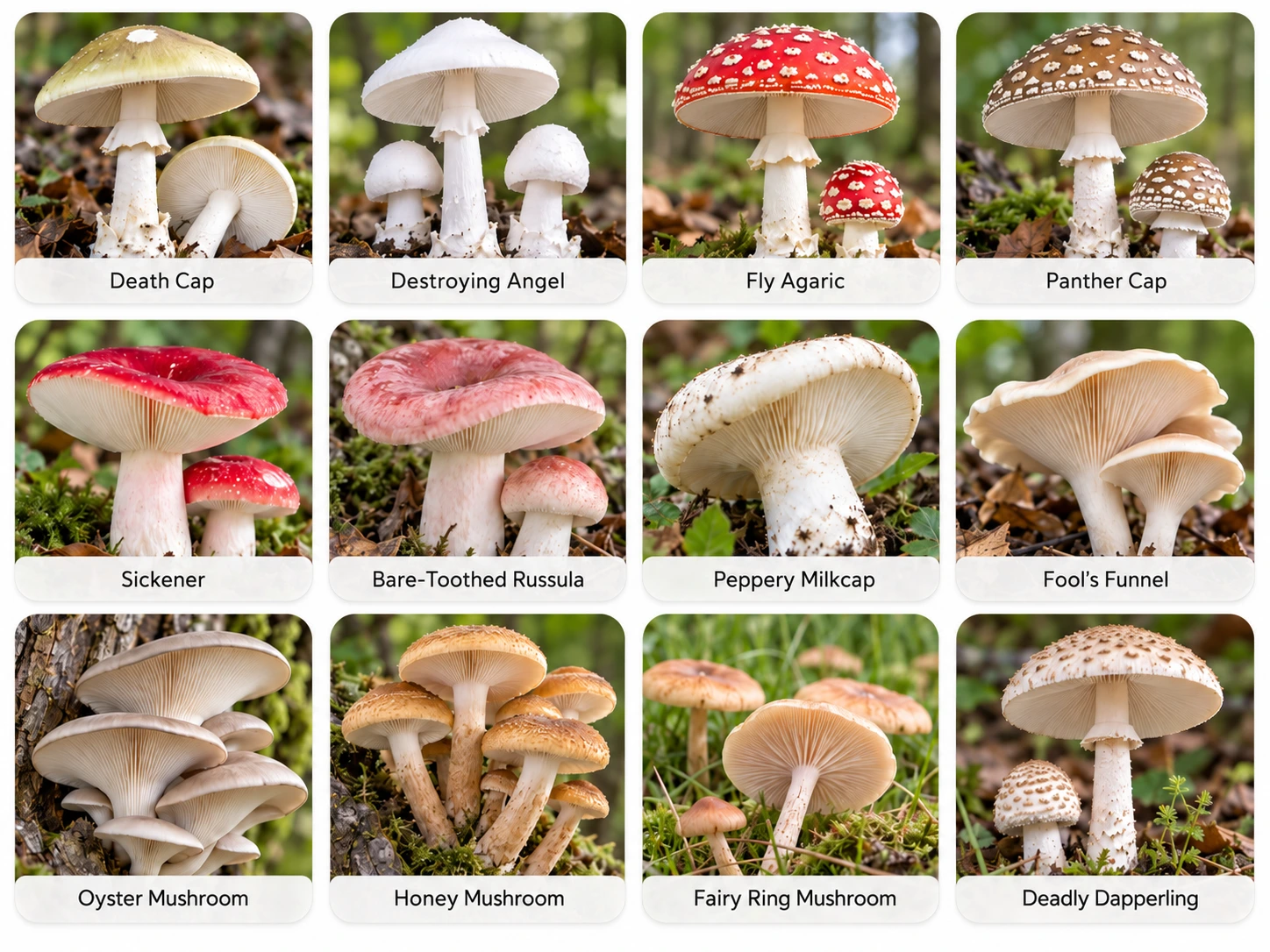
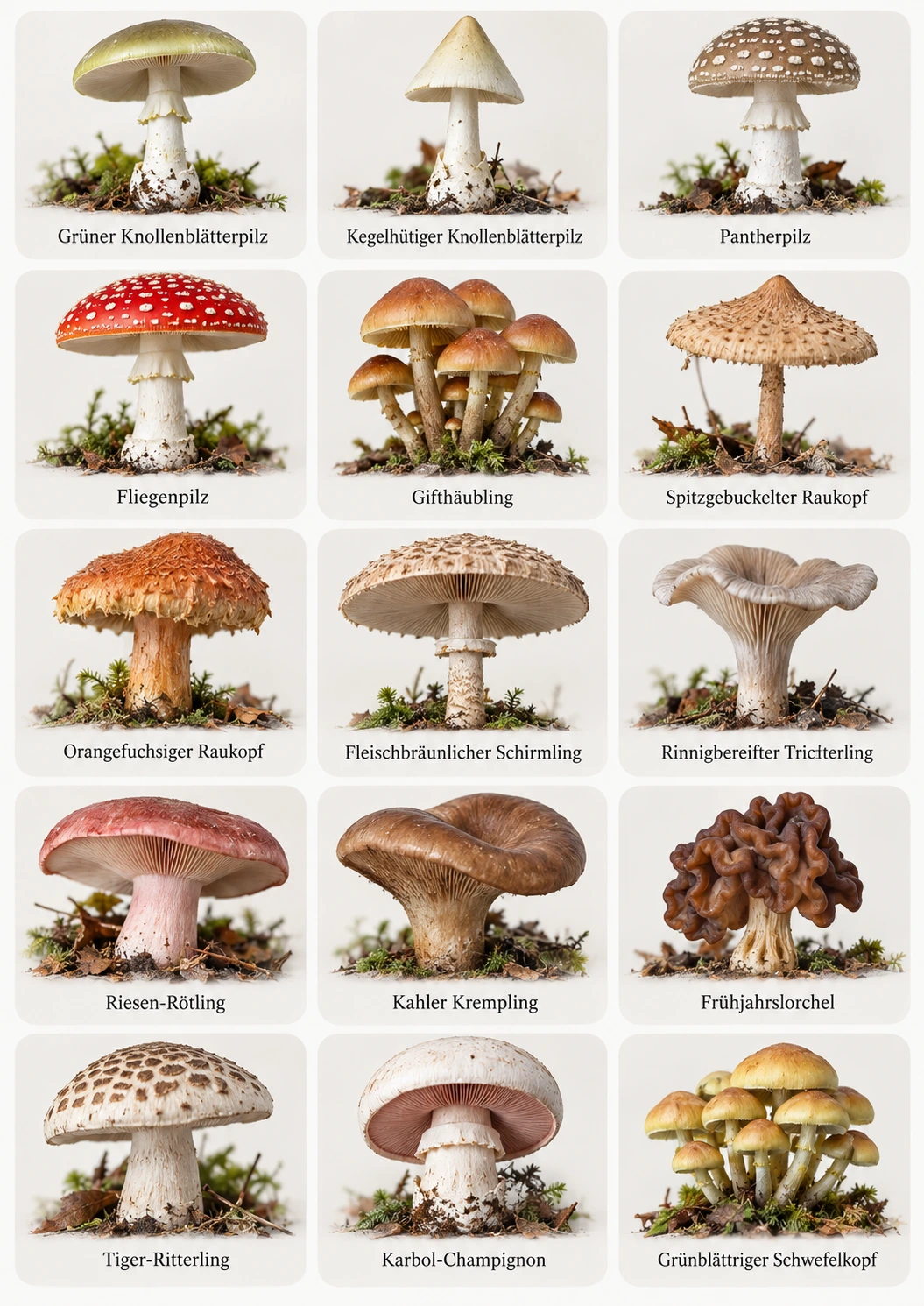
    15 wichtige Giftpilze in Deutschland im Überblick

    Art Deutscher Name Typischer Standort Gefahr
    Amanita phalloides Grüner Knollenblätterpilz Laubwald, Parks Tödlich giftig
    Amanita virosa Kegelhütiger Knollenblätterpilz Wald Tödlich giftig
    Amanita pantherina Pantherpilz Laub- und Nadelwald Stark giftig
    Amanita muscaria Fliegenpilz Wald bei Birke, Fichte, Kiefer Giftig
    Galerina marginata Gifthäubling Totholz Tödlich giftig
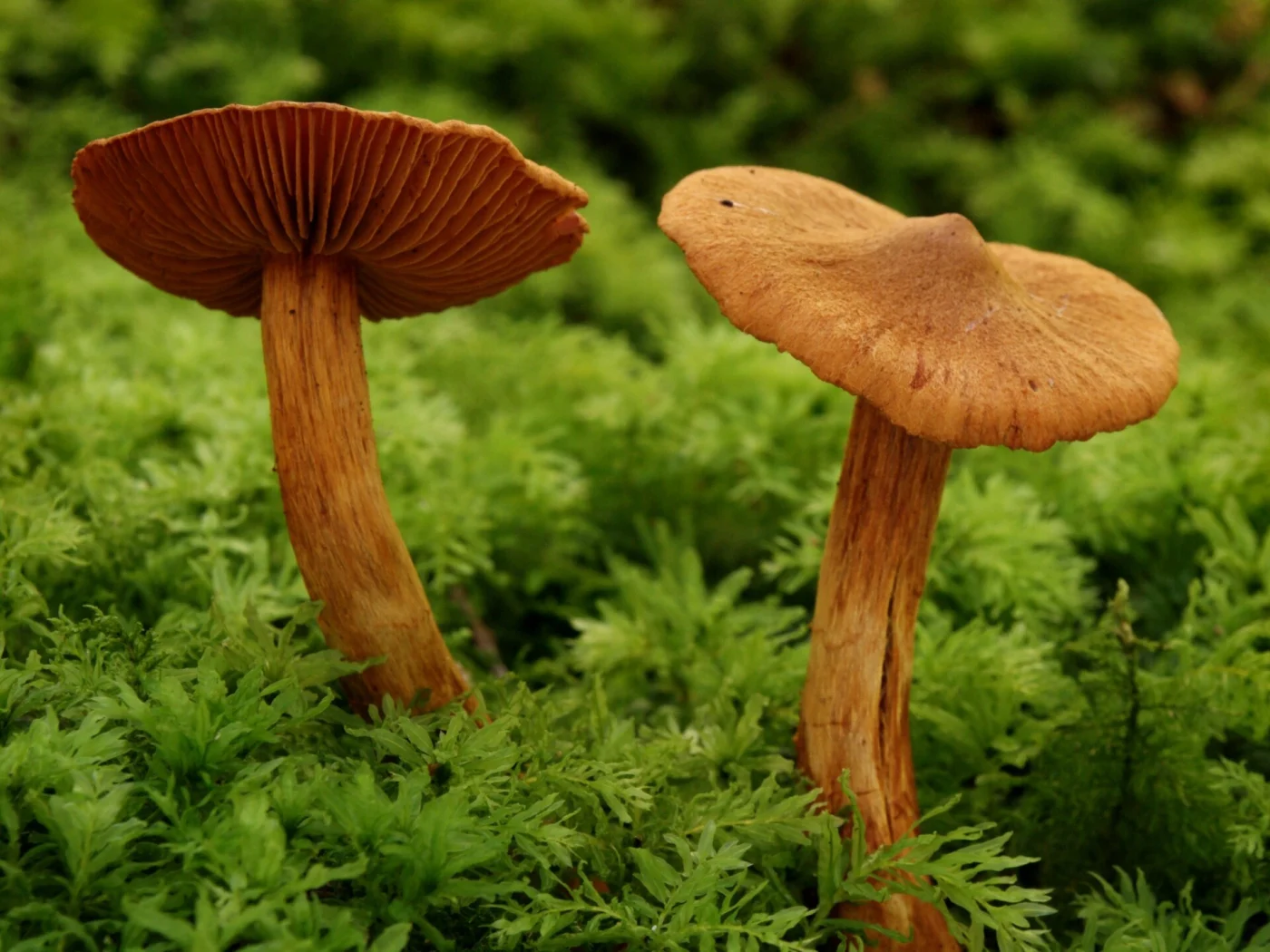
    Cortinarius rubellus Spitzgebuckelter Raukopf Nadel- und Mischwald Tödlich giftig
    Cortinarius orellanus Orangefuchsiger Raukopf Laubwald Tödlich giftig
    Lepiota brunneoincarnata Fleischbräunlicher Schirmling Gärten, Parks, Gras Tödlich giftig
    Clitocybe rivulosa Rinnigbereifter Trichterling Rasen, Wiesen Giftig
    Entoloma sinuatum Riesen-Rötling Laubwald Stark giftig
    Paxillus involutus Kahler Krempling Wald Giftig
    Gyromitra esculenta Frühjahrslorchel Sandige Nadelwälder Giftig
    Tricholoma pardinum Tiger-Ritterling Wald Stark giftig
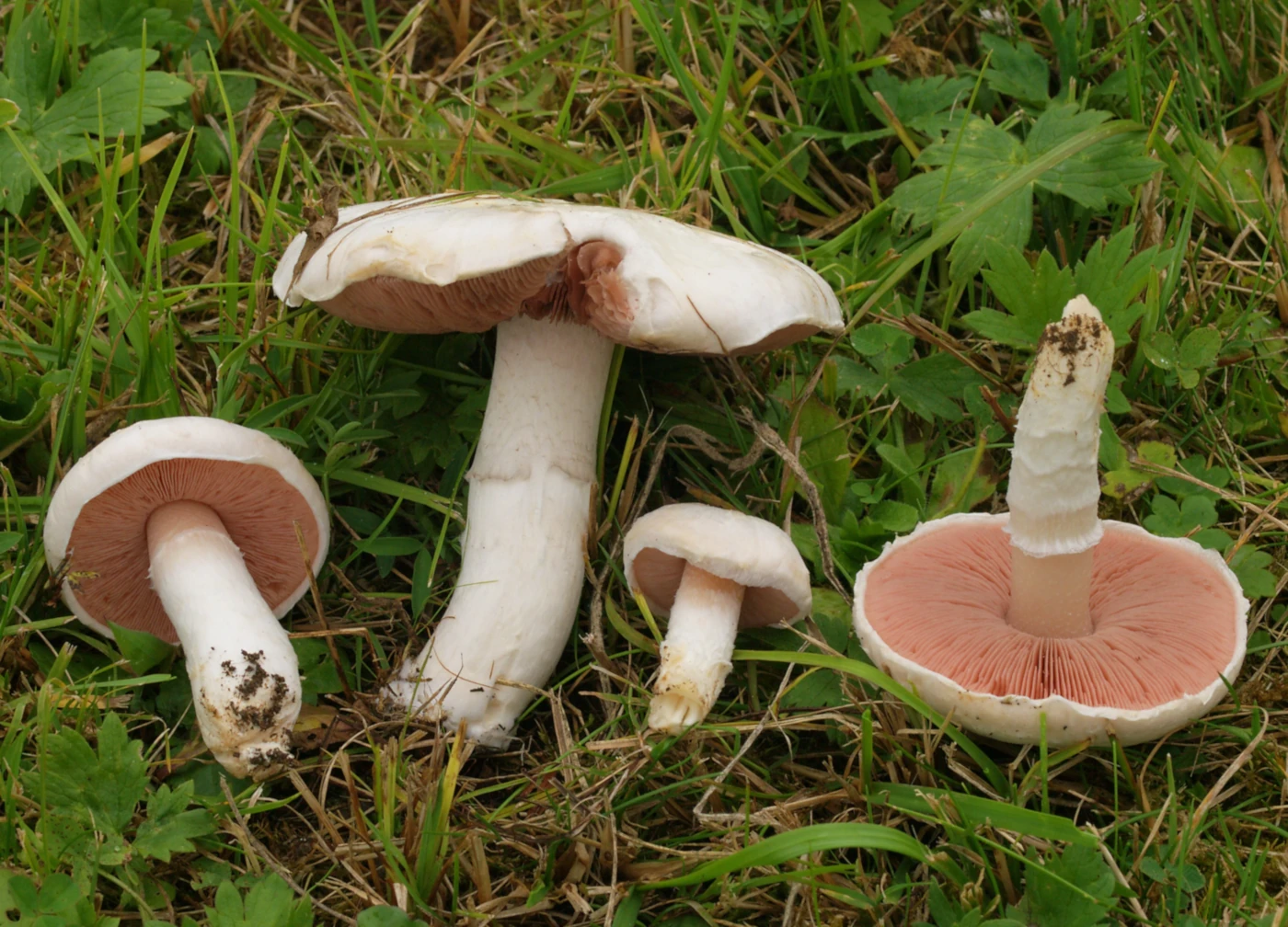
    Agaricus xanthodermus Karbol-Champignon Parks, Gärten, Wiesen Giftig
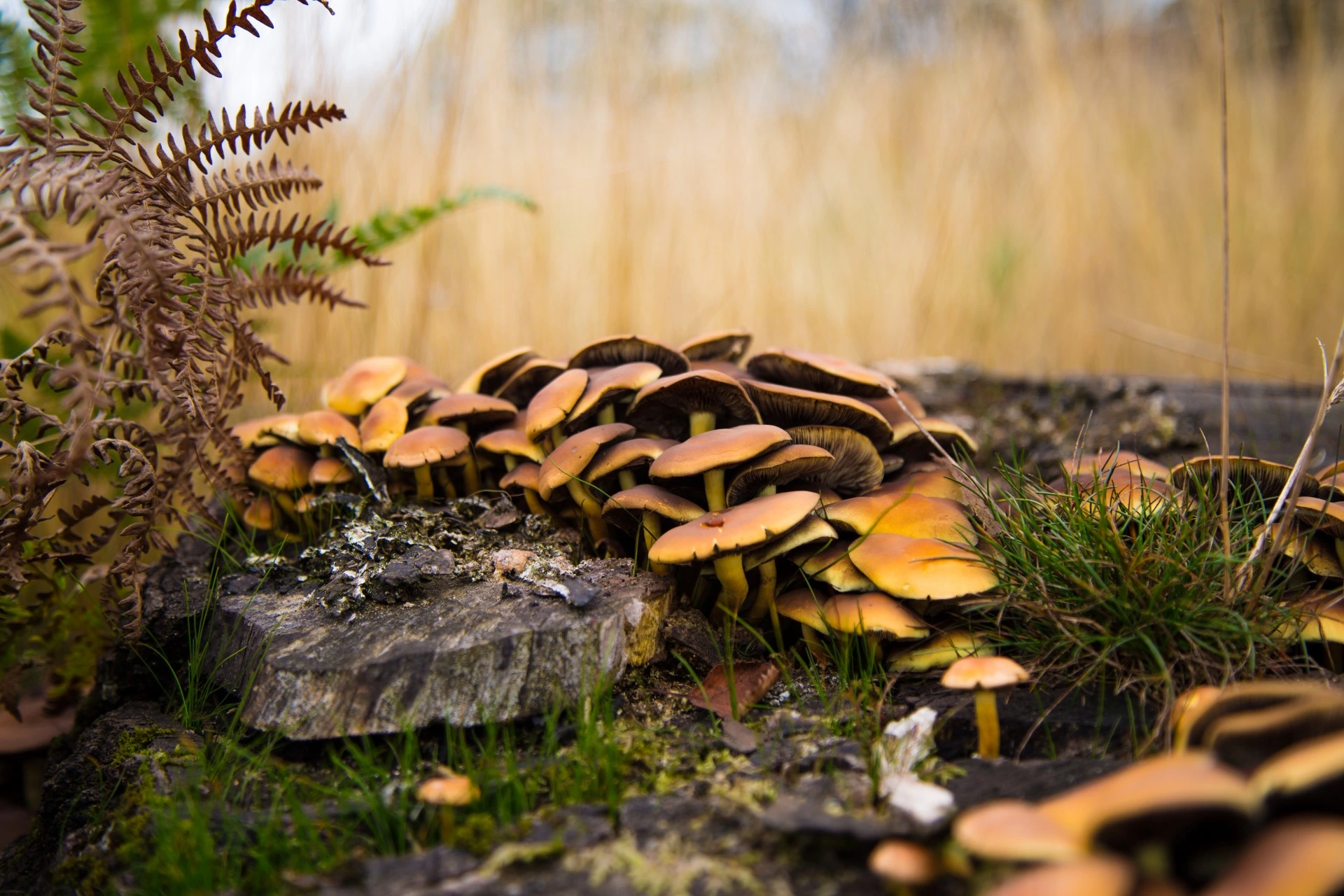
    Hypholoma fasciculare Grünblättriger Schwefelkopf Stümpfe und Totholz Giftig

    Warum Giftpilze oft schwer zu erkennen sind

    Viele Menschen erwarten, dass ein Giftpilz auffällig bunt, unangenehm riechend oder irgendwie „gefährlich“ aussieht. In Wirklichkeit gehören einige der problematischsten Arten zu den unscheinbarsten Pilzen im Wald.

    Der Grüne Knollenblätterpilz kann beispielsweise blass oliv oder fast weiß erscheinen, während der Gifthäubling wie ein gewöhnlicher kleiner brauner Holzpilz aussieht. Gerade diese unauffälligen Arten sind besonders wichtig zu lernen.

    1. Amanita phalloides — Grüner Knollenblätterpilz

    Erkennungsmerkmale

    Der Grüne Knollenblätterpilz besitzt meist einen olivgrünen, gelbgrünen, graugrünen oder bräunlichen Hut. Die Lamellen bleiben weiß, und am Stiel befindet sich gewöhnlich ein Ring.

    Das wichtigste Merkmal sitzt an der Stielbasis. Dort befindet sich eine sackartige Volva, die teilweise tief im Boden verborgen sein kann.

    Standort

    Die Art wächst bevorzugt bei Laubbäumen wie Eiche und Buche. Sie kann sowohl in Wäldern als auch in Parks, Gärten oder unter alten Straßenbäumen vorkommen.

    Die Fruchtkörper erscheinen vor allem vom Sommer bis in den Herbst. In milden Jahren kann die Saison relativ lange andauern.

    Gefahr

    Amanita phalloides enthält Amatoxine, die schwere Leberschäden verursachen können. Die ersten Symptome treten häufig erst viele Stunden nach dem Verzehr auf.

    Besonders gefährlich ist eine scheinbare Besserung nach der ersten Krankheitsphase. Währenddessen kann die Organschädigung bereits weiter fortschreiten.

    2. Amanita virosa — Kegelhütiger Knollenblätterpilz

    Erkennungsmerkmale

    Der Kegelhütige Knollenblätterpilz ist überwiegend weiß. Hut, Lamellen und Stiel wirken oft auffällig hell, wobei der Hut bei jungen Exemplaren kegelförmig sein kann.

    Wie beim Grünen Knollenblätterpilz finden sich ein Ring und eine sackartige Volva an der Stielbasis. Die vollständige Basis ist daher für die Bestimmung besonders wichtig.

    Standort

    Die Art wächst in feuchten Wäldern und ist an lebende Bäume gebunden. Je nach Region kann sie in Nadel-, Laub- oder Mischwäldern auftreten.

    Weiße Pilze im Wald sollten niemals automatisch als harmlose Champignons betrachtet werden. Die Kombination aus weißen Lamellen, Ring und Volva ist ein klares Warnsignal.

    Gefahr

    Auch diese Art enthält Amatoxine und kann tödliche Lebervergiftungen verursachen. Die helle, fast elegante Erscheinung macht sie besonders tückisch.

    3. Amanita pantherina — Pantherpilz

    Erkennungsmerkmale

    Der Pantherpilz hat einen braunen bis graubraunen Hut mit weißen Velumresten. Die Lamellen sind weiß, und der helle Stiel trägt meist einen Ring.

    An der knolligen Stielbasis sitzen typische ringartige Velumreste. Das Fleisch rötet bei Verletzung normalerweise nicht deutlich, was bei der Abgrenzung vom Perlpilz hilfreich sein kann.

    Standort

    Pantherpilze wachsen in Laub-, Nadel- und Mischwäldern. Sie bilden Mykorrhiza mit lebenden Bäumen und erscheinen besonders im Sommer und Herbst.

    Die weißen Hutflecken können durch starken Regen teilweise verschwinden. Deshalb sollte die Stielbasis immer mit untersucht werden.

    Gefahr

    Der Pantherpilz enthält unter anderem Ibotensäure und Muscimol. Vergiftungen können neurologische Symptome, Verwirrtheit, Koordinationsstörungen und veränderte Wahrnehmung verursachen.

    4. Amanita muscaria — Fliegenpilz

    Erkennungsmerkmale

    Der Fliegenpilz ist mit seinem roten bis orangefarbenen Hut und den weißen Velumresten einer der bekanntesten Pilze Europas. Seine Lamellen sind weiß, und der helle Stiel besitzt meist einen Ring.

    Die weißen Punkte auf dem Hut sind nicht immer vorhanden. Regen kann sie teilweise oder fast vollständig abwaschen.

    Standort

    Fliegenpilze wachsen häufig bei Birken, Fichten, Kiefern und anderen geeigneten Bäumen. Sie kommen sowohl im Wald als auch in Parks und auf Rasenflächen mit alten Bäumen vor.

    Im Herbst können große Gruppen auftreten. Besonders in feuchten Jahren ist die Art sehr auffällig.

    Gefahr

    Der Fliegenpilz verursacht eine andere Art von Vergiftung als der Knollenblätterpilz. Seine Wirkstoffe beeinflussen vor allem das Nervensystem und können zu starken neurologischen Symptomen führen.

    5. Galerina marginata — Gifthäubling

    Erkennungsmerkmale

    Der Gifthäubling ist ein kleiner brauner Pilz, der auf Totholz wächst. Der Hut kann gelbbraun, honigbraun oder rötlich braun sein und verändert seine Farbe beim Trocknen.

    Reife Lamellen werden rostbraun, und das Sporenpulver ist ebenfalls rostbraun. Am Stiel kann ein Ring oder zumindest eine Ringzone erkennbar sein.

    Standort

    Stümpfe, gefallene Stämme und stark vermorschtes Holz sind typische Fundorte. Die Art kann in Gruppen auftreten und mit anderen Holzpilzen direkt nebeneinander wachsen.

    Das macht sie besonders problematisch bei der Sammlung von Stockschwämmchen oder Samtfußrüblingen. Ein einziger falscher Pilz in einem Korb kann gefährlich werden.

    Gefahr

    Der Gifthäubling enthält Amatoxine. Seine unscheinbare Größe sagt nichts über die Schwere der möglichen Vergiftung aus.

    6. Cortinarius rubellus — Spitzgebuckelter Raukopf

    Erkennungsmerkmale

    Der Spitzgebuckelte Raukopf besitzt einen orangebraunen bis rotbraunen Hut mit einem deutlich ausgeprägten Buckel. Junge Exemplare können eine feine spinnwebenartige Cortina zwischen Hut und Stiel zeigen.

    Die Lamellen werden durch die reifen Sporen rostbraun. Insgesamt wirkt der Pilz oft trocken, faserig und relativ unscheinbar.

    Standort

    Er wächst besonders in sauren Nadel- und Mischwäldern. Fichtenreiche Standorte gehören zu den typischen Habitaten.

    Die Fruchtzeit liegt meist im Spätsommer und Herbst. Mehrere Raukopf-Arten können im gleichen Wald vorkommen und sich stark ähneln.

    Gefahr

    Die Art enthält Orellanin, ein Gift, das schwere Nierenschäden verursachen kann. Besonders gefährlich ist, dass Symptome erst mehrere Tage nach dem Verzehr auftreten können.

    7. Cortinarius orellanus — Orangefuchsiger Raukopf

    Erkennungsmerkmale

    Der Orangefuchsige Raukopf hat einen orangebraunen bis rostbraunen Hut und ebenfalls rostfarbene Sporen. Junge Pilze können Reste der typischen Cortina zeigen.

    Das Gesamtbild ist wenig spektakulär und kann an verschiedene harmlose braune Waldpilze erinnern. Die genaue Bestimmung innerhalb der Gattung Cortinarius ist oft schwierig.

    Standort

    Die Art bevorzugt warme Laubwälder und kann besonders bei Eichen und anderen Laubbäumen auftreten. Regional ist sie deutlich häufiger als in anderen Teilen Deutschlands.

    Wie bei anderen Rauköpfen spielt der Standort eine wichtige Rolle. Ein brauner Pilz mit rostbraunen Sporen im Wald sollte nie vorschnell als essbar angesehen werden.

    Gefahr

    Auch Cortinarius orellanus enthält Orellanin. Die verzögerten Symptome machen die Vergiftung besonders heimtückisch.

    8. Lepiota brunneoincarnata — Fleischbräunlicher Schirmling

    Erkennungsmerkmale

    Dieser kleine Schirmling besitzt einen hellen Hut mit braun- bis rötlichbraunen Schuppen. Die Lamellen sind weiß, und der schlanke Stiel kann einen Ring oder eine Ringzone zeigen.

    Der Pilz ist deutlich kleiner als der bekannte Parasol. Gerade diese geringe Größe kann dazu führen, dass er unterschätzt wird.

    Standort

    Die Art kann in Parks, Gärten, an Wegrändern und auf grasigen Flächen vorkommen. Sie ist also nicht auf abgelegene Wälder beschränkt.

    Warme Standorte können besonders geeignet sein. Einzelne Funde treten daher durchaus in direkter Nähe menschlicher Siedlungen auf.

    Gefahr

    Der Fleischbräunliche Schirmling enthält Amatoxine. Trotz seiner geringen Größe kann eine Vergiftung lebensbedrohlich sein.

    9. Clitocybe rivulosa — Rinnigbereifter Trichterling

    Erkennungsmerkmale

    Der Rinnigbereifte Trichterling ist klein, weißlich bis cremefarben und besitzt helle Lamellen, die etwas am Stiel herablaufen. Der Hut wird im Alter häufig flacher oder leicht trichterförmig.

    Das Aussehen ist sehr schlicht und unspektakulär. Gerade deshalb wird die Art auf Rasenflächen leicht übersehen.

    Standort

    Rasen, Parks, Wiesen und grasige Wegränder sind typische Fundorte. Die Pilze können in Bögen oder kleinen Hexenringen auftreten.

    Nach feuchten Wetterperioden erscheinen teilweise viele Fruchtkörper gleichzeitig. Dadurch können sie auch in regelmäßig genutzten Grünanlagen vorkommen.

    Gefahr

    Die Art enthält Muscarin. Eine Vergiftung kann unter anderem starkes Schwitzen, Speichelfluss, Übelkeit und Kreislaufprobleme verursachen.

    10. Entoloma sinuatum — Riesen-Rötling

    Erkennungsmerkmale

    Der Riesen-Rötling ist ein relativ großer Pilz mit weißlichem, cremefarbenem oder graubeigem Hut. Junge Lamellen sind blass und werden später durch die rosa Sporen deutlich rosafarben.

    Der kräftige Stiel und die fleischige Erscheinung können den Pilz auf den ersten Blick attraktiv wirken lassen. Gerade junge Exemplare können mit anderen hellen Waldpilzen verwechselt werden.

    Standort

    Die Art wächst vor allem in Laubwäldern, besonders auf nährstoffreichen und kalkhaltigen Böden. Buchen- und Eichenwälder sind typische Lebensräume.

    Die Fruchtzeit reicht meist vom Sommer bis in den Herbst. Sie kann einzeln oder in kleinen Gruppen auftreten.

    Gefahr

    Der Riesen-Rötling verursacht schwere Magen-Darm-Vergiftungen. Die Beschwerden können heftig sein und über längere Zeit anhalten.

    11. Paxillus involutus — Kahler Krempling

    Erkennungsmerkmale

    Der Kahle Krempling hat einen braunen bis olivbraunen Hut mit lange eingerolltem Rand. Die Lamellen laufen am Stiel herab und können bei Druck oder Verletzung bräunlich nachdunkeln.

    Ältere Exemplare werden oft flacher und unregelmäßiger. Der Pilz kann sehr variabel aussehen und kommt in unterschiedlichen Waldtypen vor.

    Standort

    Er wächst bei verschiedenen Laub- und Nadelbäumen. Birken, Fichten und andere Baumarten können als Partner dienen.

    Der Kahle Krempling war früher in manchen Regionen als Speisepilz bekannt. Diese frühere Nutzung gilt heute nicht als Beleg für seine Sicherheit.

    Gefahr

    Die Art kann schwere immunologisch bedingte Reaktionen auslösen. Wiederholter Verzehr kann besonders problematisch sein, weshalb der Pilz heute als giftig gilt.

    12. Gyromitra esculenta — Frühjahrslorchel

    Erkennungsmerkmale

    Die Frühjahrslorchel besitzt einen stark gefalteten, hirnartig wirkenden braunen Hut. Ihre Form unterscheidet sich deutlich von den regelmäßig wabenartigen Hüten echter Morcheln.

    Der Stiel ist meist blass und relativ unregelmäßig. Ein Längsschnitt zeigt ebenfalls Unterschiede zu echten Morcheln.

    Standort

    Die Art erscheint im Frühjahr, häufig in sandigen Nadelwäldern und an gestörten Stellen. Dadurch fällt sie in eine ganz andere Jahreszeit als viele typische Herbst-Giftpilze.

    Gerade weil im Frühjahr weniger Pilzarten sichtbar sind, kann sie für Sammler besonders interessant wirken. Die Ähnlichkeit mit Morcheln führt jedoch zu gefährlichen Verwechslungen.

    Gefahr

    Frühjahrslorcheln können Gyromitrin enthalten, aus dem im Körper giftige Verbindungen entstehen. Der Giftgehalt variiert, weshalb traditionelle Zubereitungsmethoden keine verlässliche Sicherheit garantieren.

    13. Tricholoma pardinum — Tiger-Ritterling

    Erkennungsmerkmale

    Der Tiger-Ritterling besitzt einen grauen Hut mit dunkleren schuppenartigen Flecken. Die Lamellen sind hell, und der Stiel wirkt kräftig und weißlich.

    Das attraktive, saubere Erscheinungsbild kann zu Verwechslungen mit anderen Ritterlingen führen. Die dunkle tigerartige Zeichnung auf dem Hut ist ein wichtiger Hinweis.

    Standort

    Die Art wächst in Wäldern und ist besonders aus kalkreichen Gebieten bekannt. Sowohl Nadel- als auch Mischwälder können geeignete Lebensräume bieten.

    In höheren Lagen kann sie regional häufiger sein. Der Fundort allein reicht jedoch nicht für eine sichere Bestimmung.

    Gefahr

    Der Tiger-Ritterling verursacht starke Magen-Darm-Vergiftungen. Auch kleine Mengen können zu erheblichen Beschwerden führen.

    14. Agaricus xanthodermus — Karbol-Champignon

    Erkennungsmerkmale

    Der Karbol-Champignon ähnelt essbaren Champignons und besitzt zunächst rosa, später braune Lamellen. Bei Druck oder Schnitt verfärbt sich besonders die Stielbasis oft auffällig chromgelb.

    Ein weiteres typisches Merkmal ist ein unangenehmer chemischer oder phenolartiger Geruch. Dieser wird beim Erhitzen häufig noch deutlicher.

    Standort

    Parks, Gärten, Straßenränder und nährstoffreiche Wiesen sind typische Fundorte. Die Art wächst häufig genau dort, wo auch essbare Champignons erwartet werden.

    Sie kann in größeren Gruppen oder Ringen auftreten. Stadtnahe Standorte sind durchaus typisch.

    Gefahr

    Der Karbol-Champignon verursacht Magen-Darm-Beschwerden. Gelbfärbung und Geruch sind besonders wichtige Merkmale, um ihn von essbaren Champignon-Arten zu unterscheiden.

    15. Hypholoma fasciculare — Grünblättriger Schwefelkopf

    Erkennungsmerkmale

    Der Grünblättrige Schwefelkopf bildet dichte Büschel aus kleinen gelben bis schwefelgelben Pilzen. Die Hutmitte ist oft orange- oder braungelb.

    Die Lamellen werden mit zunehmendem Alter gelbgrün bis olivgrün und schließlich dunkler. Diese ungewöhnliche Lamellenfarbe ist ein besonders hilfreiches Merkmal.

    Standort

    Die Art wächst auf Stümpfen, toten Wurzeln und anderem Totholz. Große Büschel können aus einem einzigen Holzstück hervorgehen.

    Sie erscheint über einen langen Zeitraum vom Frühjahr bis in den Spätherbst. In milden Wintern kann sie teilweise noch später gefunden werden.

    Gefahr

    Der Grünblättrige Schwefelkopf ist giftig und verursacht vor allem Magen-Darm-Beschwerden. Bei der Sammlung anderer büscheliger Holzpilze ist er deshalb eine wichtige Vergleichsart.

    Besonders gefährliche Giftpilz-Gruppen

    Nicht alle Giftpilze sind gleich gefährlich. Für die Praxis ist es sinnvoll, zuerst jene Gruppen zu lernen, bei denen Verwechslungen besonders schwere Folgen haben können.

    Amatoxin-haltige Arten und Rauköpfe gehören dabei zu den wichtigsten. Ihre Symptome können verzögert auftreten, sodass Betroffene den Zusammenhang mit einer Pilzmahlzeit zunächst unterschätzen.

    Knollenblätterpilze

    Weiße Lamellen, Ring und eine auffällige Stielbasis sind zentrale Merkmale vieler gefährlicher Amanita-Arten. Die Basis muss vollständig ausgegraben werden, weil wichtige Strukturen unter der Erde sitzen können.

    Die Hutfarbe allein ist unzuverlässig. Ein Grüner Knollenblätterpilz muss keineswegs kräftig grün aussehen.

    Kleine braune Holzpilze

    Kleine braune Pilze auf Holz gehören zu den schwierigsten Gruppen für Anfänger. Gifthäubling, Stockschwämmchen und andere Arten können im gleichen Habitat vorkommen.

    Sporenfarbe, Ringstruktur und Stieloberfläche sind besonders wichtig. Selbst auf demselben Baumstumpf können mehrere Arten gleichzeitig wachsen.

    Rauköpfe

    Viele Rauköpfe besitzen rostbraune Sporen und bei jungen Exemplaren eine spinnwebenartige Cortina. Die Gattung enthält eine große Zahl schwer bestimmbarer Arten.

    Einige davon sind stark giftig. Unbekannte Cortinarius-Arten sollten deshalb nicht als Speisepilze behandelt werden.

    Giftpilze im Wald

    Wälder beherbergen die größte Vielfalt der Arten in dieser Übersicht. Knollenblätterpilze, Rauköpfe, Pantherpilze, Fliegenpilze und Kremplinge leben in enger Verbindung mit Bäumen.

    Der Waldtyp liefert wertvolle Hinweise. Eichen-, Buchen-, Fichten- und Kiefernwälder unterstützen jeweils unterschiedliche Pilzgemeinschaften.

    Ein Fundort sollte jedoch niemals ein widersprechendes Merkmal überstimmen. Ein Pilz unter einer Buche ist nicht automatisch eine bestimmte Art, nur weil diese dort häufig vorkommt.

    Giftpilze auf Rasen und Wiesen

    Auch außerhalb des Waldes kommen problematische Arten vor. Rinnigbereifte Trichterlinge und Karbol-Champignons können auf Wiesen, Rasenflächen und in Parks wachsen.

    Kleine Schirmlinge können ebenfalls in Gärten und Grünanlagen erscheinen. Ein gepflegter Rasen ist deshalb kein Hinweis darauf, dass dort wachsende Pilze ungefährlich sind.

    Besondere Vorsicht ist sinnvoll, wenn kleine Kinder oder Haustiere Zugang zu solchen Flächen haben. Unbekannte Pilze sollten dort zumindest bestimmt oder entfernt werden, bevor sie versehentlich aufgenommen werden können.

    Giftpilze auf Holz

    Totholz wirkt bei der Pilzbestimmung oft übersichtlich, kann aber mehrere ähnliche Arten gleichzeitig beherbergen. Gifthäubling und Grünblättriger Schwefelkopf gehören zu den wichtigen giftigen Holzbewohnern.

    Essbare Arten wie Samtfußrübling oder Stockschwämmchen können in ähnlichen Habitaten auftreten. Deshalb sollte niemals ein ganzer Stamm pauschal als „essbarer Pilzfund“ betrachtet werden.

    Jede Gruppe und jedes ungewöhnlich aussehende Exemplar sollte separat geprüft werden. Schon eine leicht andere Stiel- oder Lamellenfarbe kann auf eine zweite Art hinweisen.

    Wie man gefährliche Verwechslungen vermeidet

    Der wichtigste Grundsatz ist, nicht nach einem einzigen Merkmal zu bestimmen. Eine sichere Bestimmung entsteht aus mehreren unabhängigen Eigenschaften, die alle zusammenpassen müssen.

    Unterseite, Stielbasis, Sporenfarbe, Verfärbungen, Substrat und Begleitbäume sind oft wichtiger als die Hutfarbe. Gerade bei gefährlichen Arten können diese Details den entscheidenden Unterschied machen.

    Die Stielbasis vollständig ansehen

    Bei Wulstlingen ist die Stielbasis unverzichtbar. Schneidet man einen Pilz oberhalb des Bodens ab, können Knolle und Volva vollständig zurückbleiben.

    Für die Bestimmung sollte ein einzelnes Exemplar vorsichtig mit der kompletten Basis entnommen werden. Erst dann lässt sich die Struktur zuverlässig beurteilen.

    Junge und alte Exemplare vergleichen

    Viele Merkmale verändern sich während der Entwicklung. Lamellen können ihre Farbe wechseln, Ringe verschwinden und Hüte ihre Form verlieren.

    Mehrere Altersstadien machen eine Bestimmung oft deutlich leichter. Besonders Sporenfarbe und Velumreste werden dadurch besser erkennbar.

    Nicht auf Geschmack testen

    Historische Pilzbücher beschreiben bei manchen Gruppen Geschmacksproben als Bestimmungsmerkmal. Für Anfänger und bei unbekannten Arten ist das keine sinnvolle Methode.

    Giftige Pilze müssen nicht bitter oder unangenehm schmecken. Geschmack sagt grundsätzlich nichts Verlässliches über Giftigkeit aus.

    Kann man Giftpilze per Foto erkennen?

    Ein gutes Foto kann viele wichtige Merkmale zeigen, besonders wenn Unterseite, Stiel und Stielbasis sichtbar sind. Auffällige Arten wie Fliegenpilz oder Pantherpilz lassen sich visuell häufig relativ gut eingrenzen.

    Schwieriger wird es bei kleinen braunen Pilzen, weißen Wulstlingen oder Rauköpfen. Hier können entscheidende Merkmale fehlen oder sich nur durch Sporenabdruck, Geruch oder mikroskopische Untersuchung klären lassen.

    Ein Foto von oben ist besonders wenig aussagekräftig. Für eine gute Bestimmung sollte immer eine kleine Serie aus mehreren Perspektiven erstellt werden.

    Kann KI Giftpilze zuverlässig bestimmen?

    KI kann helfen, mögliche Arten vorzuschlagen und besonders auffällige Gruppen zu erkennen. Die Qualität steigt deutlich, wenn mehrere scharfe Fotos und Informationen zu Standort und Begleitbäumen vorhanden sind.

    Sie kann jedoch keine im Boden versteckte Volva sehen und nicht zuverlässig feststellen, welche Sporenfarbe ein Pilz besitzt, wenn diese nicht dokumentiert wurde. Bei sehr ähnlichen Arten können selbst hochwertige Fotos nicht für eine sichere Artbestimmung ausreichen.

    Bei der Entscheidung über Essbarkeit sollte KI deshalb nie die einzige Grundlage sein. Bei gefährlichen Doppelgängern ist eine unabhängige Bestätigung besonders wichtig.

    Was tun bei Verdacht auf Pilzvergiftung?

    Bei Verdacht auf den Verzehr eines giftigen oder unbekannten Pilzes sollte nicht abgewartet werden, bis schwere Symptome auftreten. Besonders bei Amatoxin- und Orellanin-Vergiftungen können gefährliche Schäden bereits entstehen, bevor sich die betroffene Person sehr krank fühlt.

    Reste der Mahlzeit, ungeputzte Pilze oder Fotos des Fundes sollten aufbewahrt werden, wenn das möglich ist. Sie können später bei der Bestimmung helfen.

    Bei ernsthaftem Verdacht ist medizinische Hilfe beziehungsweise eine Giftinformationsstelle die richtige Anlaufstelle. Eigenbehandlung oder das Abwarten auf eindeutige Symptome kann bei bestimmten Pilzgiften gefährlich sein.

    Frequently Asked Questions

    Können Giftpilze durch Kochen oder Braten ungefährlich werden?

    Bei vielen Arten nein. Besonders Amatoxine und Orellanin lassen sich durch normales Kochen nicht zuverlässig zerstören, weshalb Zubereitung niemals eine unsichere Bestimmung ausgleichen kann.

    Sind angefressene Pilze ein Zeichen dafür, dass sie ungiftig sind?

    Nein. Schnecken, Insekten und andere Tiere können Stoffe vertragen, die für Menschen gefährlich sind. Fraßspuren sagen deshalb nichts über die menschliche Essbarkeit aus.

    Können giftige und essbare Pilze direkt nebeneinander wachsen?

    Ja, verschiedene Pilzarten können auf wenigen Zentimetern Fläche oder sogar auf demselben Baumstumpf erscheinen. Jeder einzelne Fund sollte deshalb anhand seiner eigenen Merkmale geprüft werden.

    Sind kleine Pilze grundsätzlich weniger gefährlich als große?

    Nein. Einige kleine Schirmlinge und Gifthäublinge enthalten sehr gefährliche Toxine. Die Größe eines Fruchtkörpers erlaubt keine Aussage über seine Giftigkeit.

    Warum kann eine Pilzvergiftung erst Tage später auffallen?

    Bestimmte Toxine wirken verzögert. Bei Orellanin-haltigen Rauköpfen können zwischen Verzehr und deutlichen Beschwerden mehrere Tage liegen, was die Ursachenfindung erschwert.

    Sollte man unbekannte Pilze im Garten anfassen dürfen?

    Normales Berühren intakter Pilze führt nicht automatisch zu einer Vergiftung. Nach dem Umgang mit unbekannten Pilzen ist Händewaschen trotzdem sinnvoll, und Kinder sollten sie nicht in den Mund nehmen.

    Können alte Pilzbücher bei der Einschätzung der Essbarkeit problematisch sein?

    Ja. Die Bewertung einiger Arten hat sich verändert, nachdem spätere Vergiftungsfälle oder neue toxikologische Erkenntnisse bekannt wurden. Der Kahle Krempling ist ein bekanntes Beispiel für eine Art, die früher teilweise gegessen wurde und heute als giftig gilt.

    Was hilft bei einem Fund, den niemand sicher bestimmen kann?

    Dann sollte der Pilz als unbestimmt gelten. Für Beobachtung und Fotografie ist das kein Problem, aber bei einer geplanten Verwendung als Lebensmittel ist Unsicherheit ein klarer Grund, ihn nicht zu essen.

    Final Identification Notes

    Die wichtigsten Giftpilze Deutschlands sehen sehr unterschiedlich aus. Einige sind auffällig wie der Fliegenpilz, andere wirken völlig unscheinbar wie der Gifthäubling, und besonders gefährliche Knollenblätterpilze können sogar fast vollständig weiß sein.

    Für die Praxis lohnt es sich, zuerst die gefährlichsten Muster zu lernen: weiße Lamellen mit Ring und Volva bei Wulstlingen, kleine braune Pilze auf Holz, rostbraune Rauköpfe und kleine weiße Trichterlinge auf Rasenflächen. Diese Gruppen decken mehrere wichtige Vergiftungsrisiken ab.

    Eine zuverlässige Pilzbestimmung entsteht immer aus mehreren Merkmalen gleichzeitig. Wenn Stielbasis, Lamellen, Sporenfarbe, Standort oder andere entscheidende Eigenschaften nicht eindeutig passen, sollte der Pilz unbestimmt bleiben.
  • Winter Mushrooms: 12 Species You Can Find in Cold Weather

    Winter Mushrooms: 12 Species You Can Find in Cold Weather

    Winter does not mean the end of mushroom season. In many temperate regions, cold-tolerant fungi continue to fruit on logs, stumps, fallen branches, and even frozen-looking woodland floors long after most autumn mushrooms have disappeared.

    Some winter species actually prefer cool weather, while others simply persist for months because their fruit bodies are tough and leathery. Learning to recognize these mushrooms makes winter walks far more interesting and can reveal fungi that are easy to overlook during the crowded autumn season.

    ⚠️ Important: This guide is for identification and education only. Never eat a wild mushroom based solely on photographs, AI identification, or an online comparison.

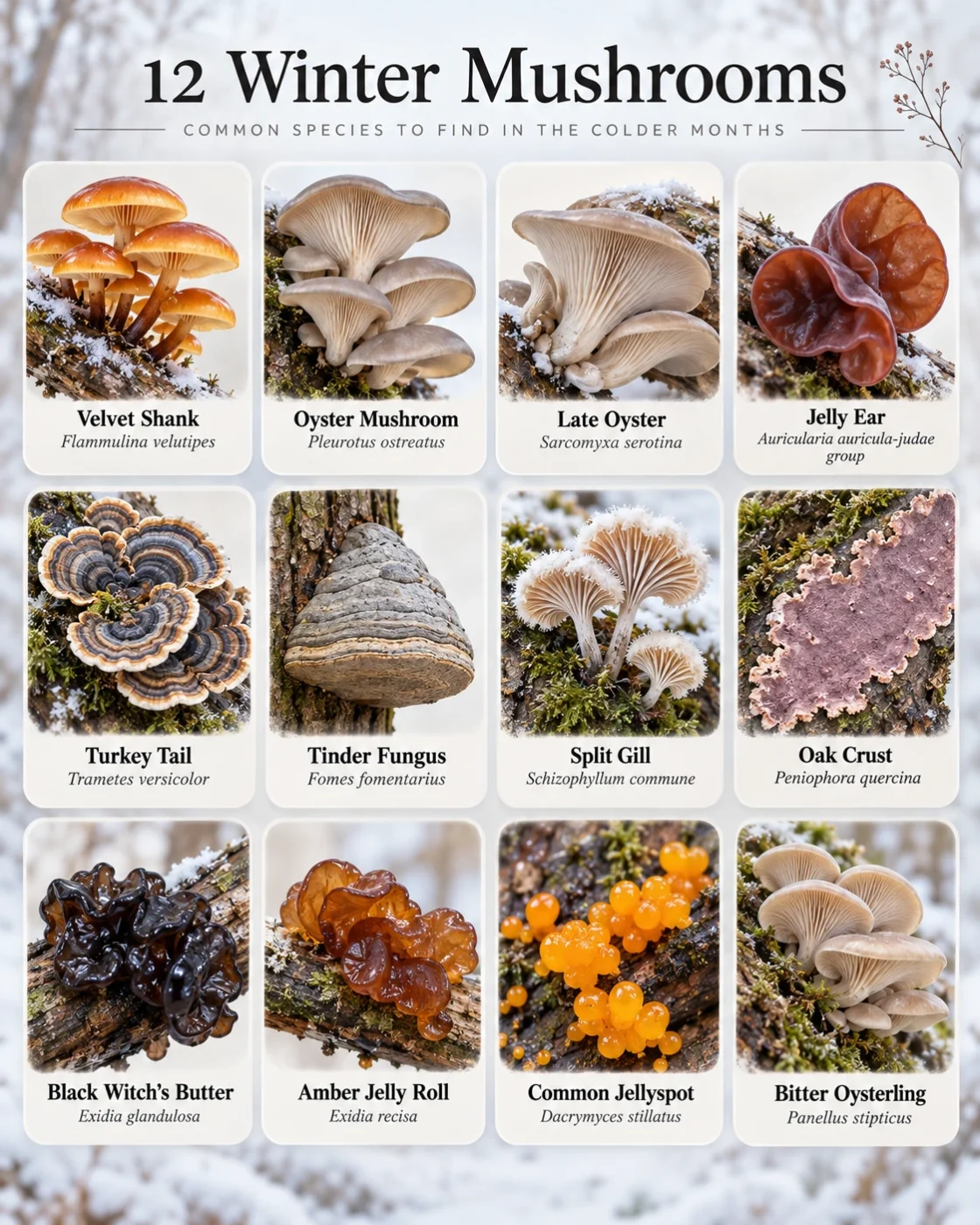
    Quick Guide to 12 Winter Mushrooms

    Species Common name Typical habitat Winter clue Safety
    Flammulina velutipes complex Velvet Shank Dead hardwood Fruits in cold weather Edible when correctly identified
    Pleurotus ostreatus Oyster Mushroom Dead hardwood Common after cool weather Edible when correctly identified
    Sarcomyxa serotina Late Oyster Dead hardwood Late autumn into winter Edibility debated
    Auricularia auricula-judae group Jelly Ear Dead or weakened hardwood Persists in damp winter weather Edible when correctly identified
    Trametes versicolor Turkey Tail Dead wood Persistent brackets Not a conventional food mushroom
    Fomes fomentarius Tinder Fungus Birch, beech and other trees Perennial conk Inedible
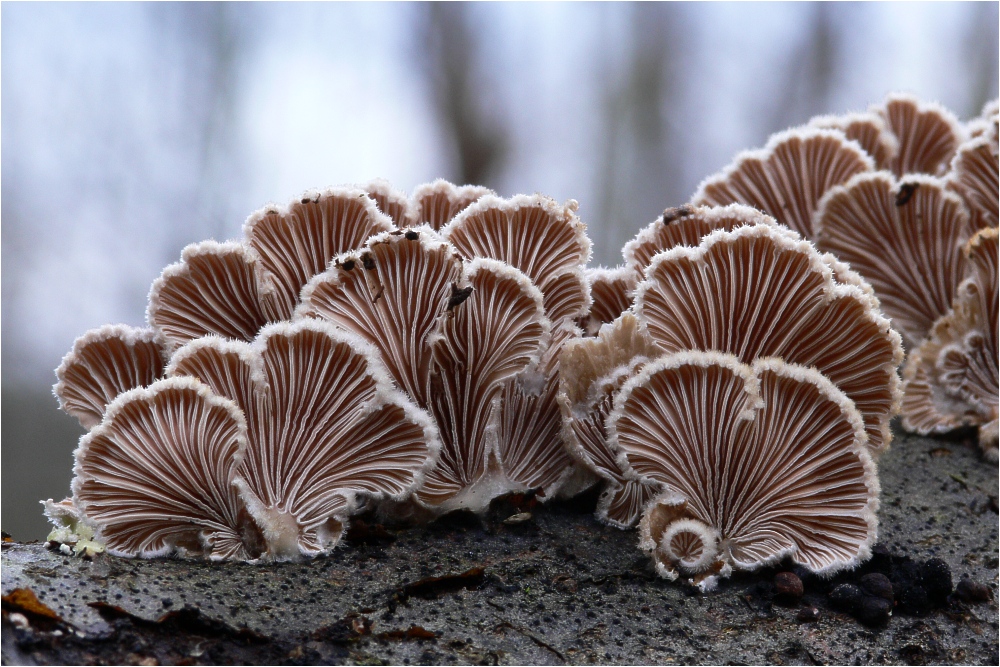
    Schizophyllum commune Split Gill Dead wood Tough and persistent Not generally eaten
    Peniophora quercina Oak Crust Dead oak branches Winter crust fungus Inedible
    Exidia glandulosa Black Witch’s Butter Dead hardwood Gelatinous in wet cold weather Not commonly eaten
    Exidia recisa Amber Jelly Roll Dead willow and other hardwood Amber gelatinous fruit bodies Not generally used as food
    Dacrymyces stillatus Common Jellyspot Dead wood Orange jelly spots in winter Not a food mushroom
    Panellus stipticus Bitter Oysterling Dead hardwood Small persistent clusters Inedible

    Why Mushrooms Can Grow in Winter

    Cold weather slows fungal activity, but it does not stop every species. Some fungi remain active at temperatures that suppress many typical autumn mushrooms, especially when daytime temperatures rise above freezing.

    Wood also creates a more stable environment than exposed soil. Logs and stumps retain moisture and can buffer temperature changes, which is why so many winter mushrooms are wood-growing species.

    Frost Does Not Always End Fruiting

    A light frost can damage delicate mushrooms, but several cold-tolerant species survive freezing surprisingly well. Some fruit bodies pause during cold periods and continue developing when temperatures rise again.

    This is especially true for Velvet Shank and Oyster Mushrooms. Both can appear during mild winter spells when snow has melted and wood remains moist.

    1. Flammulina velutipes — Velvet Shank

    Identification

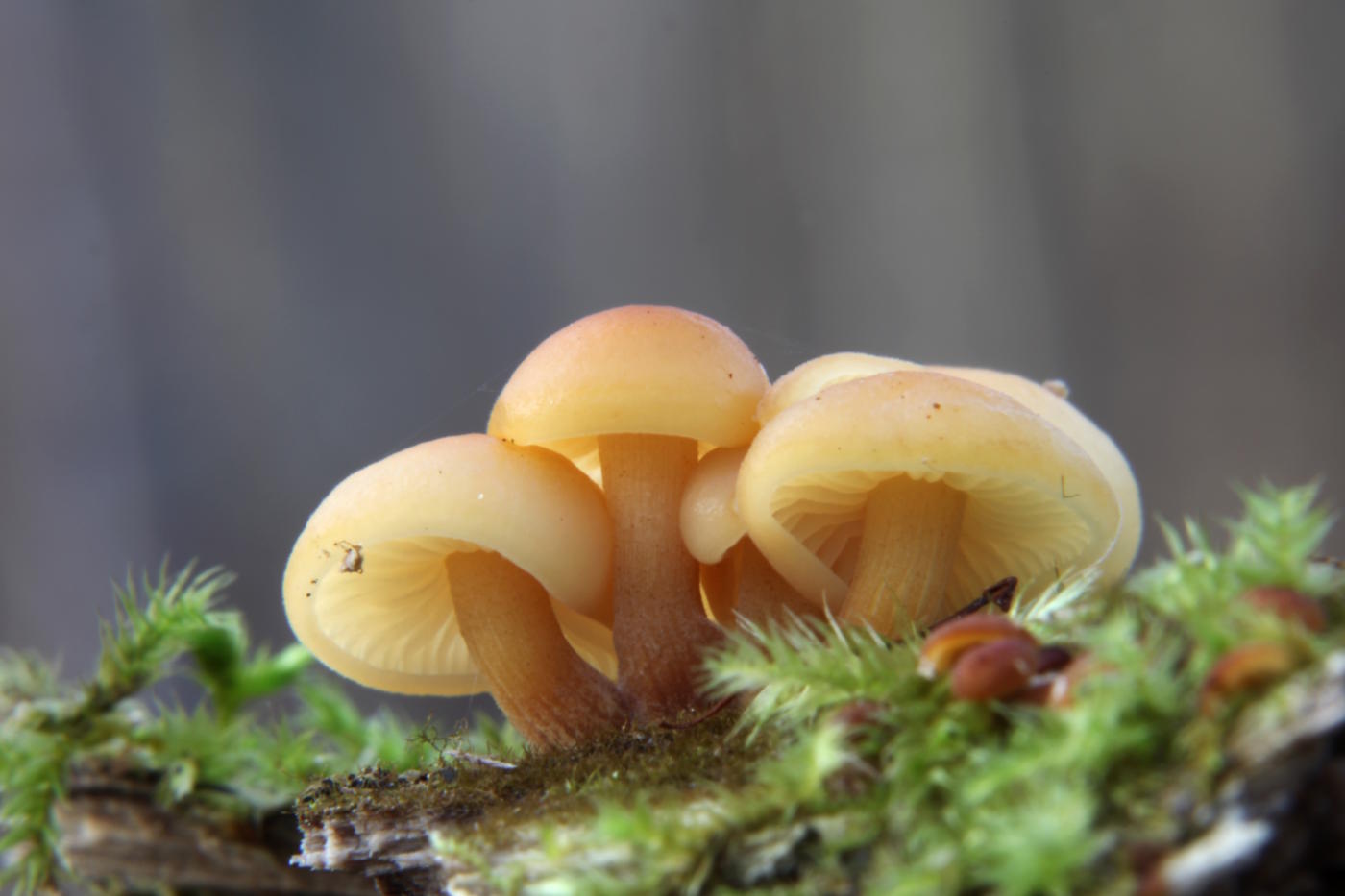
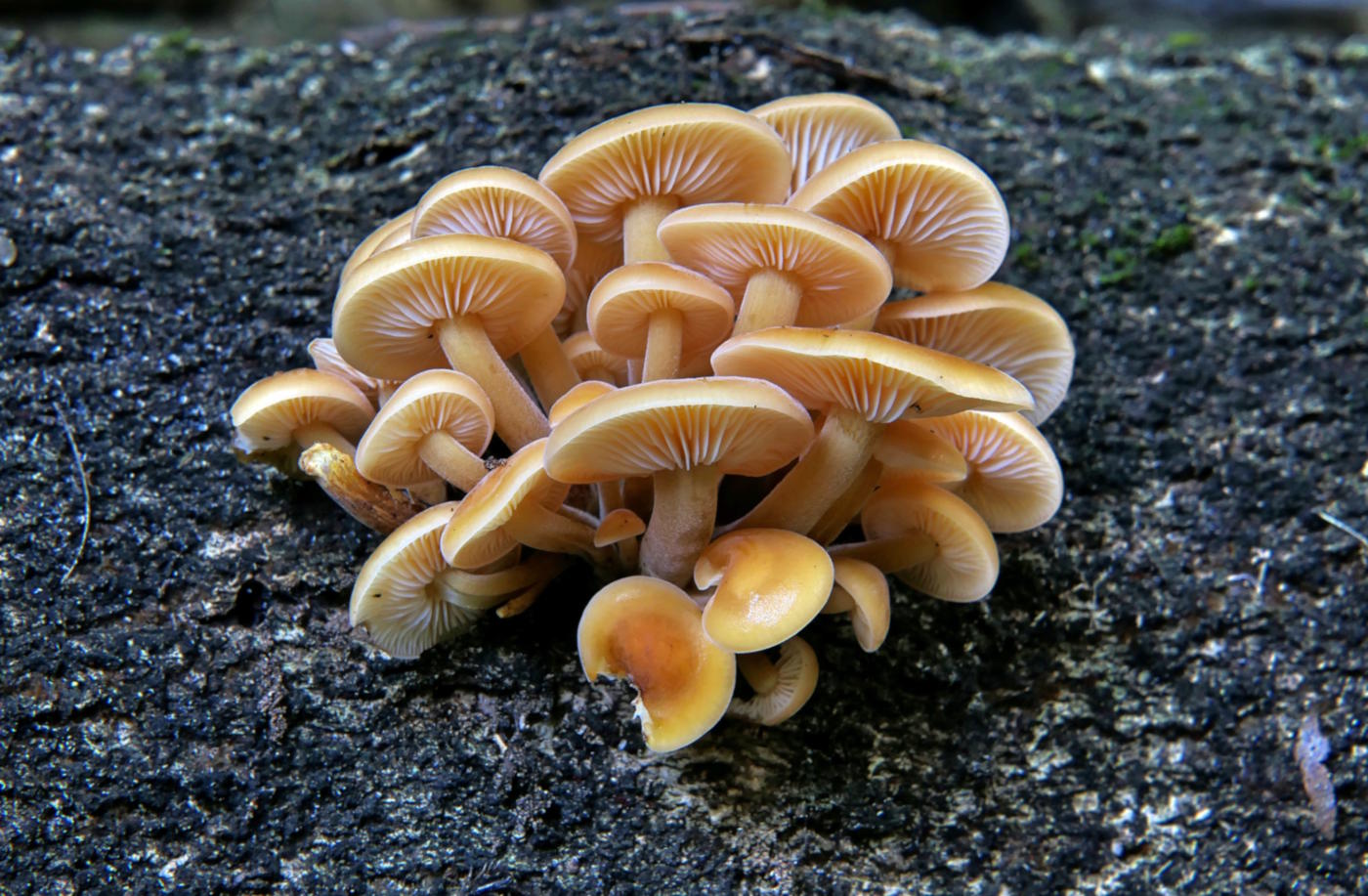
    Velvet Shank has smooth yellow to orange-brown caps, pale gills, and a distinctive dark velvety lower stem. It usually grows in clusters from dead or weakened hardwood.

    Fresh caps may look glossy or sticky in wet weather. Mature stems become increasingly dark toward the base, which is one of the strongest identification clues.

    Why It Is a Classic Winter Mushroom

    Velvet Shank is unusually cold tolerant and often fruits from late autumn through winter. It may continue growing after frost and can reappear during mild periods.

    This makes it one of the most reliable mushrooms to search for when many other gilled species have disappeared.

    Important Look-Alike

    Deadly Galerina can also grow on wood and may share similar brown-orange cap colors. Velvet Shank has a white spore print, pale mature gills, no ring, and a dark velvety stem base, while Galerina marginata produces rusty-brown spores and often has a ring zone.

    2. Pleurotus ostreatus — Oyster Mushroom

    Identification

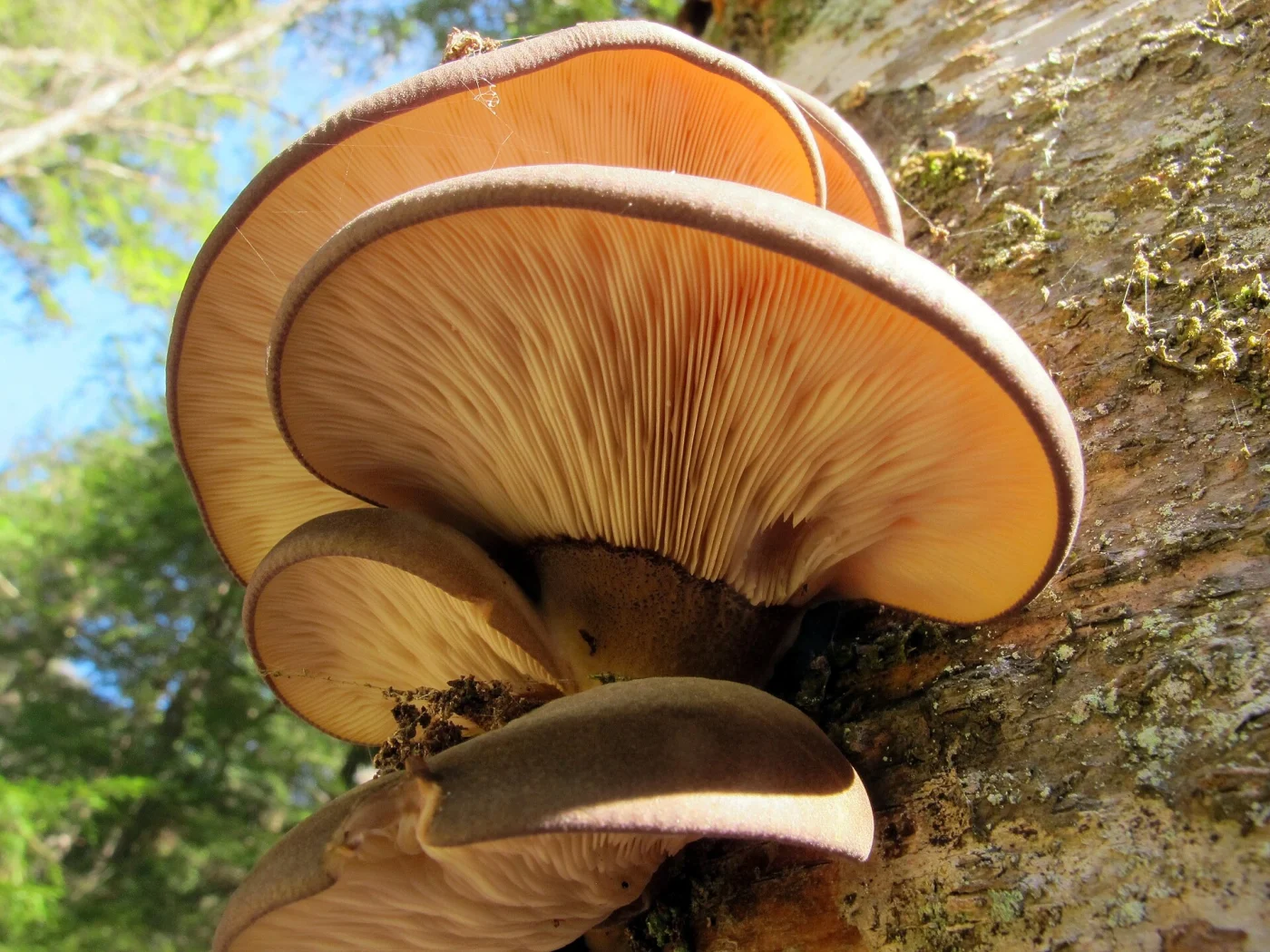
    Oyster Mushrooms form overlapping clusters of fan-shaped caps on dead or weakened hardwood. Their white to cream gills run down toward a short lateral stem or attachment point.

    Cap color varies from pale gray to darker brown depending on temperature and conditions. Cold-weather specimens can be particularly dark and thick.

    Winter Habitat

    Fallen logs, standing dead trees, and large hardwood branches are good places to search. Beech, poplar, willow, and other hardwoods can all support Oyster Mushrooms.

    Late autumn and winter fruiting is common in temperate regions. Mild periods after rain or snowmelt can trigger fresh clusters.

    3. Sarcomyxa serotina — Late Oyster

    Identification

    Late Oyster has olive, yellow-green, brownish, or gray-green caps with pale gills beneath. The caps are often fan-shaped and attach laterally to wood.

    The fruit body can look superficially similar to a true Oyster Mushroom. Its greener tones and different texture often become more obvious in mature specimens.

    Winter Season

    As the common name suggests, this species appears late in the year. It can fruit from late autumn into winter during cool damp weather.

    Dead hardwood logs are the main substrate. It often occurs when many summer and autumn mushrooms are already gone.

    Safety

    Its edibility has been treated inconsistently in different sources and regions. For practical purposes, it is better treated as a species for identification rather than as a target for food collection.

    4. Auricularia Species — Jelly Ear

    Identification

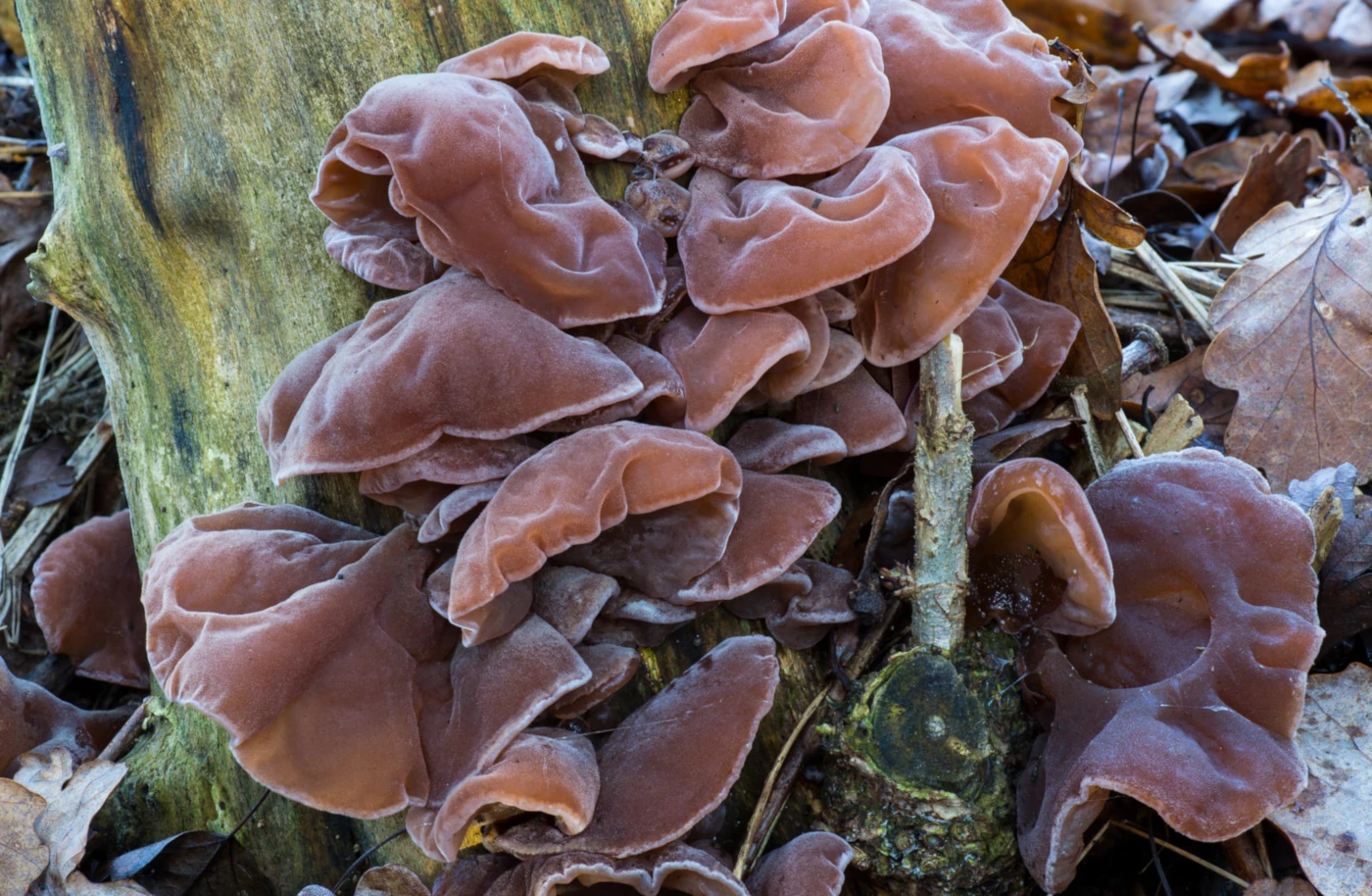
    Jelly Ear fungi produce brown to reddish-brown, ear-shaped fruit bodies with a rubbery or gelatinous texture. The surface may be smooth on one side and slightly hairy or textured on the other.

    The fruit bodies become softer and more translucent in wet weather. During dry periods, they can shrink dramatically and later rehydrate.

    Why It Is Easy to Find in Winter

    Jelly fungi tolerate repeated drying and rehydration better than many fleshy mushrooms. This allows them to remain visible through long stretches of cold weather.

    They are especially common on dead or weakened hardwood. Elder is a classic host in Europe, although related species occur on other trees and in other regions.

    5. Trametes versicolor — Turkey Tail

    Identification

    Turkey Tail forms thin fan-shaped brackets with strongly contrasting concentric zones. Brown, gray, cream, orange, blue-gray, and nearly black bands may all occur.

    The underside is pale and covered with numerous tiny round pores. This separates true Turkey Tail from smooth-bottomed False Turkey Tail fungi.

    Why It Persists Through Winter

    Turkey Tail fruit bodies are thin but leathery and durable. Unlike soft gilled mushrooms, they can remain attached to wood for many months.

    Fresh growth is more common during wet periods, but older fruit bodies stay visible through winter. This makes Turkey Tail one of the easiest bracket fungi to encounter in cold weather.

    6. Fomes fomentarius — Tinder Fungus

    Identification

    Tinder Fungus forms large hoof-shaped brackets with gray, brown, or almost black zoned surfaces. The fruit body is hard and woody rather than soft.

    The underside contains fine pores. Mature conks can remain attached to the tree for years.

    Winter Habitat

    Birch and beech are classic hosts, although other broadleaf trees can also support the fungus. Both dead and weakened living trees may carry fruit bodies.

    Because the conks are perennial, winter does not limit visibility. In leafless forests, they can actually be easier to spot from a distance.

    7. Schizophyllum commune — Split Gill

    Identification

    Split Gill forms small fan-shaped fruit bodies on dead wood. The upper surface is pale gray to white and often finely hairy.

    The underside contains distinctive gill-like folds that split lengthwise when dry. These structures can curl and close during dry weather, then reopen when humidity returns.

    Winter Survival

    The fruit bodies are remarkably resistant to drying. They can persist through cold and dry periods and reactivate when moisture increases.

    Dead branches, logs, and cut wood are typical habitats. The species is widespread and often overlooked because of its small size.

    8. Peniophora quercina — Oak Crust

    Identification

    Oak Crust is a thin crust fungus that spreads directly across the surface of dead oak branches. Fresh fruit bodies may appear pinkish, lilac, grayish, or flesh-colored.

    Unlike bracket fungi, it does not project far from the wood. The fungus looks more like a colored skin growing over the branch surface.

    Winter Habitat

    Dead oak twigs and branches are the best places to search. Fallen material on the forest floor can carry extensive patches.

    Winter is a good time to notice crust fungi because leaves no longer hide smaller branches. Their subtle colors also stand out more clearly against wet bark.

    9. Exidia glandulosa — Black Witch’s Butter

    Identification

    Black Witch’s Butter forms dark brown to black gelatinous lobes on dead wood. In wet weather, the fruit bodies become shiny, swollen, and rubbery.

    During dry or freezing conditions, they shrink and become much less conspicuous. Moisture can restore their jelly-like appearance quickly.

    Why It Appears in Winter

    Cool wet weather is ideal for many jelly fungi. Rain, fog, and snowmelt keep dead wood damp and allow the fruit bodies to remain hydrated.

    The black gelatinous texture makes this species easy to recognize once you know what to look for. It is particularly noticeable on pale or mossy wood.

    10. Exidia recisa — Amber Jelly Roll

    Identification

    Amber Jelly Roll produces small amber, yellow-brown, or reddish gelatinous fruit bodies. They often have a folded or irregular shape rather than forming smooth round blobs.

    The fruit bodies become translucent when wet. As they dry, they shrink and darken.

    Habitat

    Dead willow branches are a particularly typical substrate, although related jelly fungi can occur on other hardwoods. Damp woodland edges and riverbanks can be productive places to search.

    Winter moisture makes these small fungi easier to notice. Several fruit bodies may occur along the same branch.

    11. Dacrymyces stillatus — Common Jellyspot

    Identification

    Common Jellyspot forms tiny bright yellow to orange gelatinous spots on dead wood. Individual fruit bodies are small, but groups can create conspicuous colorful patches.

    They often look like tiny drops of orange jelly. The surface is smooth and shiny when wet.

    Winter Habitat

    The fungus grows on dead woody material, including cut timber and fallen branches. It can appear throughout much of the year when moisture is available.

    Winter rain and reduced evaporation often create good conditions. Its vivid color makes it one of the easiest tiny jelly fungi to notice.

    12. Panellus stipticus — Bitter Oysterling

    Identification

    Bitter Oysterling forms small fan-shaped caps in clusters on dead hardwood. Caps are usually tan, buff, or cinnamon-brown, with pale gills radiating from a lateral attachment point.

    The fruit bodies are much smaller than typical Oyster Mushrooms. Their clustered shelf-like growth can still create a similar overall impression from a distance.

    Cold-Weather Appearance

    The species can persist into cold weather because of its relatively tough fruit bodies. Dead logs and stumps provide the most likely habitat.

    North American populations are also famous because some strains can show bioluminescence in the gills. This glow is not universal and should not be expected in every specimen.

    Winter Mushrooms by Habitat

    Dead Hardwood

    Dead hardwood is the most productive winter substrate. Oyster Mushrooms, Velvet Shank, Jelly Ear, Turkey Tail, Split Gill, Bitter Oysterling, and various jelly fungi can all occur there.

    Logs retain moisture longer than exposed soil. This creates a relatively stable microclimate even when surrounding ground freezes.

    Standing Dead Trees

    Standing dead trunks and branches can support bracket fungi, Oyster Mushrooms, and persistent crust fungi. Leafless winter forests make these elevated fruit bodies easier to see.

    Always inspect damaged sections and old branch wounds. Dead tissue can host fungi even while another part of the tree remains alive.

    Fallen Branches

    Small fallen branches are particularly good for jelly fungi and crust fungi. Turning over damp sticks can reveal species that are almost invisible from above.

    Oak, willow, elder, beech, and other hardwoods each support different fungal communities. Tree identification can therefore help narrow the possibilities.

    Gilled Mushrooms in Winter

    Winter has fewer gilled mushrooms than autumn, but several important species remain. Velvet Shank and Oyster Mushrooms are among the best-known examples.

    The limited number of cold-tolerant gilled species can make winter identification feel easier. Dangerous look-alikes still exist, however, so season should never replace structural examination.

    Why Small Brown Winter Mushrooms Need Caution

    Small brown wood-growing mushrooms are especially difficult because many unrelated species share similar colors. Moisture can make caps darker and shinier, increasing the resemblance further.

    Deadly Galerina is the most important comparison for Velvet Shank. Mature gill color, ring presence, stem texture, and spore print should all be checked.

    Bracket Fungi in Winter

    Bracket fungi become especially noticeable after leaves fall from the trees. Turkey Tail, Tinder Fungus, and many other polypores remain visible when soft terrestrial mushrooms are gone.

    Some brackets are annual and gradually decay, while others are perennial. A hard woody conk may represent several years of growth.

    The underside remains important for identification. Tiny pores, smooth surfaces, teeth, and maze-like structures can separate superficially similar species.

    Jelly Fungi in Winter

    Winter is an excellent season for jelly fungi because cool wet conditions keep their fruit bodies hydrated. Black, amber, yellow, and orange gelatinous fungi can all appear on fallen wood.

    Many can dry almost completely and later expand again after rain. This ability allows them to survive weather changes that would destroy softer mushrooms.

    Their strange texture makes them easy to recognize as a group. Species-level identification still requires attention to color, shape, substrate, and microscopic features in difficult cases.

    Can Mushrooms Grow Under Snow?

    Yes, fungi can remain active beneath snow when temperatures close to the ground are relatively stable. Snow can actually insulate soil and wood from more extreme air temperatures.

    Visible mushroom growth is less common during continuous deep snow cover, but existing fruit bodies may survive underneath. Fresh growth can appear rapidly during thaw periods.

    Wood-growing species are especially likely to persist. A stump or fallen log can remain biologically active even when the surrounding landscape looks fully dormant.

    What Happens to Mushrooms When They Freeze?

    Freezing damages many soft fruit bodies because ice crystals disrupt their tissues. After thawing, these mushrooms may become watery, soft, or discolored.

    Cold-tolerant species cope better, especially when freezing is brief. Velvet Shank can sometimes survive repeated frost-and-thaw cycles surprisingly well.

    Persistent brackets and jelly fungi use very different strategies. Their tougher or gelatinous tissues allow them to remain present long after delicate autumn mushrooms have collapsed.

    Are Winter Mushrooms Easier to Identify?

    In one sense, yes, because fewer species are fruiting simultaneously. A cold-weather mushroom on a hardwood log has a smaller range of likely candidates than a random mushroom found during peak autumn season.

    However, many winter fungi are small crusts, brackets, or brown wood-growing mushrooms that can be difficult at species level. Reduced diversity does not automatically mean every identification is simple.

    The key advantage is that winter lets you focus on a smaller ecological set. Wood type, fruit-body structure, and cold tolerance become especially useful clues.

    How to Photograph Winter Mushrooms for Identification

    Photograph the whole fruiting group before moving anything. Winter species often have distinctive clustering patterns or attachment points that help with identification.

    Take close-ups of the underside, stem, or pore surface depending on the species. For jelly and crust fungi, include enough surrounding bark to show scale and growth pattern.

    A habitat photograph is particularly useful in winter because the host tree may be easier to identify without leaves if bark, buds, or fallen leaves are visible nearby.

    Can AI Identify Winter Mushrooms?

    AI can work well with distinctive winter fungi such as Turkey Tail, Oyster Mushroom, Velvet Shank, or Jelly Ear when multiple clear photographs are available. Their growth forms and substrates provide useful visual context.

    Small crust fungi and weathered brackets are much more difficult because many species look similar. Important microscopic features may not be visible in ordinary photographs.

    Winter images should therefore emphasize substrate and structure. A cap-only photograph is especially weak for wood-growing species.

    Common Winter Mushroom Identification Mistakes

    One common mistake is assuming any mushroom found after frost must be a cold-weather edible species. Season can narrow the possibilities, but it cannot confirm identity.

    Another mistake is ignoring old fruit bodies. Turkey Tail, Tinder Fungus, and other persistent fungi may have been present for months before being noticed in winter.

    A third mistake is treating all jelly fungi as one species. Black, amber, orange, and brown gelatinous fruit bodies belong to several different genera and should be examined separately.

    Frequently Asked Questions

    Why do some winter mushrooms look fresh after several freezing nights?

    Cold-tolerant fungi can withstand short freezing periods better than many soft autumn species. Their tissues may temporarily stop developing and then continue when temperatures rise above freezing again.

    Is snowmelt a good time to look for winter mushrooms?

    Yes, especially on logs and stumps. Melting snow provides moisture while mild temperatures can briefly reactivate cold-tolerant fungi and rehydrate jelly species.

    Why do jelly fungi disappear during dry winter weather?

    Many jelly fungi lose water and shrink dramatically when conditions become dry. They can look almost absent until rain or melting snow rehydrates the fruit bodies.

    Can the same log produce several different winter fungi?

    Yes. One piece of wood can support bracket fungi, jelly fungi, crusts, and gilled mushrooms at the same time or in different stages of decay.

    Are winter mushrooms more common in forests or parks?

    Both can be productive if enough dead wood is present. Old parks with mature trees, fallen branches, and untreated stumps can support surprisingly diverse winter fungi.

    Does a warm winter increase mushroom activity?

    Often it does, especially when mild temperatures are combined with frequent moisture. Long hard freezes reduce active fruiting, while repeated thaw periods can extend the season.

    Can winter mushrooms be damaged by road salt?

    Yes, salt and other environmental stressors can affect fungi growing near roads or treated paths. Mushrooms from heavily contaminated roadside areas are also poor candidates for food collection.

    Why are bracket fungi easier to see in winter?

    Leafless trees expose trunks and branches, while reduced ground vegetation makes dead wood more visible. Persistent brackets that were hidden during summer can become obvious from a considerable distance.

    Final Identification Notes

    Winter mushroom hunting is less about searching the forest floor for hundreds of soft species and more about examining logs, stumps, dead branches, damaged trees, and damp woody debris. Velvet Shank, Oyster Mushrooms, jelly fungi, Turkey Tail, and persistent brackets are among the most rewarding cold-weather finds.

    The most useful winter identification clues are substrate, fruit-body texture, underside structure, stem features, and tolerance of freezing conditions. Season helps narrow the possibilities, but morphology still determines the identification.

    Cold weather also offers a different way to learn fungi. With fewer distractions from peak autumn diversity, winter is an excellent time to become familiar with wood-decaying mushrooms, bracket fungi, jelly fungi, and the ecological role they play throughout the year.

  • Wild Enoki vs Deadly Galerina: How to Tell Them Apart

    Wild Enoki vs Deadly Galerina: How to Tell Them Apart

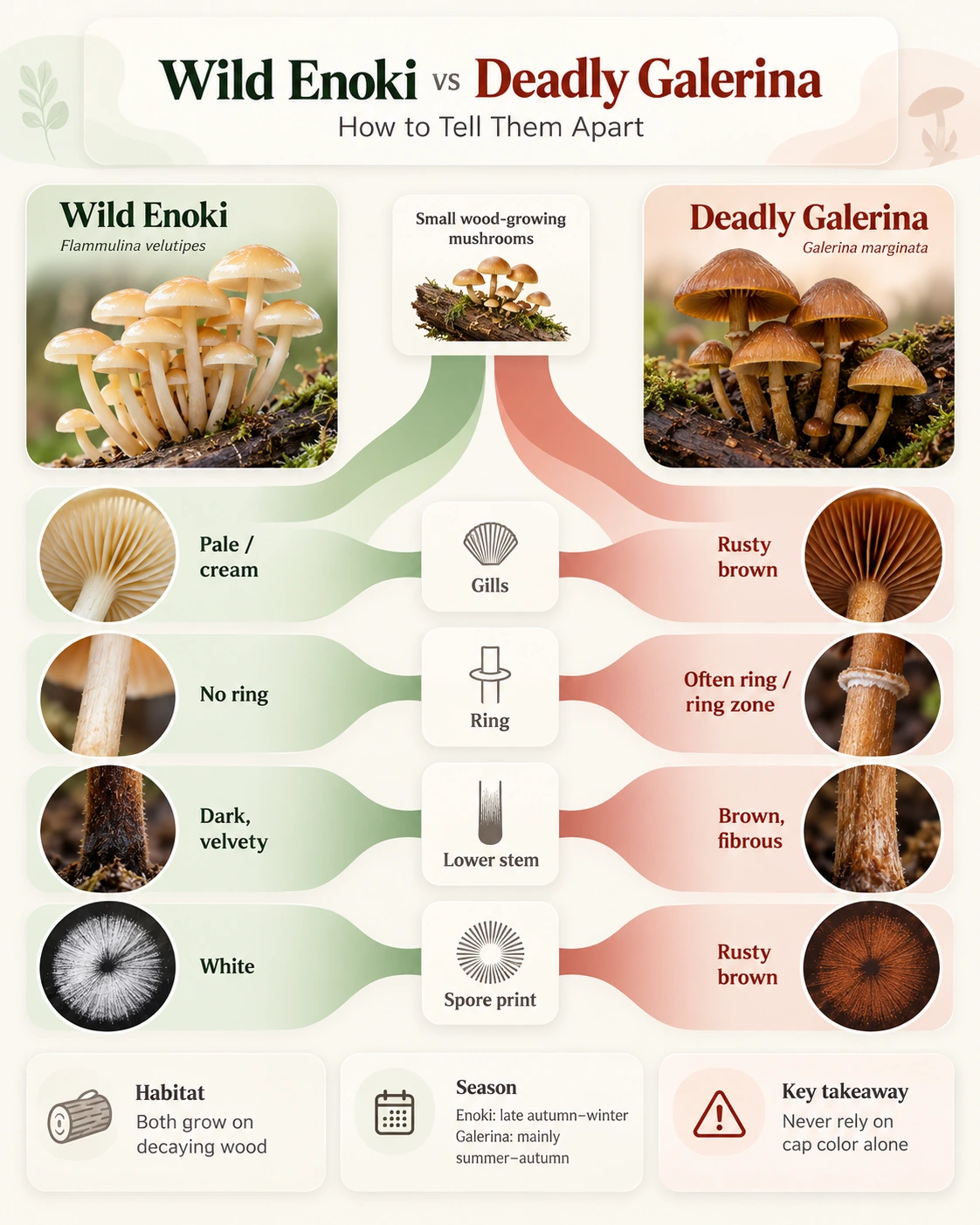
    Wild Enoki and Deadly Galerina can grow on the same kind of decaying wood and may both have small brown or orange-brown caps. From above, especially in wet weather, the two can look similar enough to create a serious identification problem.

    The difference matters because wild Enoki belongs to the Flammulina velutipes group and is considered edible when correctly identified and cooked, while Galerina marginata contains amatoxins capable of causing fatal liver poisoning. The safest comparison focuses on spore color, mature gill color, ring presence, and the texture of the lower stem rather than cap color alone.

    ⚠️ Important: Never eat a wild wood-growing mushroom based only on photographs, AI identification, or a single visual feature. Wild Enoki should be considered for food only after Deadly Galerina and other dangerous look-alikes have been confidently excluded.

    Wild Enoki vs Deadly Galerina: Quick Comparison

    Feature Wild Enoki Deadly Galerina
    Typical group Flammulina velutipes complex Galerina marginata
    Cap color Yellow, honey-orange, orange-brown Yellow-brown to reddish brown
    Cap surface Smooth, often sticky when wet Smooth, often moist or shiny
    Mature gills White to cream Rusty brown to cinnamon-brown
    Spore print White Rusty brown
    Ring Absent Often present or visible as a ring zone
    Lower stem Dark brown to nearly black, velvety Brown, fibrous, not velvet-black
    Growth Usually clustered Single, grouped, or clustered
    Substrate Dead or weakened hardwood Decaying wood
    Main season Late autumn through winter Mainly summer through autumn, sometimes later
    Safety Edible when correctly identified and cooked Deadly poisonous

    What Is Wild Enoki?

    Wild Enoki refers to mushrooms in the Flammulina velutipes group, commonly known as Velvet Shank. They are cold-tolerant wood-growing mushrooms with smooth yellow-orange caps, pale gills, and a distinctive dark velvety lower stem.

    Wild specimens look very different from the long white Enoki sold in supermarkets. Commercial Enoki is grown under artificial conditions that produce narrow pale stems and tiny caps, while wild mushrooms develop normal pigmentation and broader caps.

    The Most Useful Wild Enoki Features

    A typical wild Enoki cluster has pale gills, no ring, and a lower stem that becomes progressively darker and noticeably velvety. The cap may be shiny or sticky in damp weather, especially during cool autumn and winter conditions.

    The spore print is white. This feature becomes particularly important because Deadly Galerina produces a completely different rusty-brown spore print.

    What Is Deadly Galerina?

    Galerina marginata, commonly called Deadly Galerina, is a small brown mushroom that grows on decaying wood. Its ordinary appearance makes it particularly dangerous because it can resemble several edible wood-growing mushrooms.

    The species contains amatoxins, the same general class of toxins responsible for Death Cap poisoning. Symptoms may be delayed for hours, and severe liver damage can develop after the initial gastrointestinal phase.

    Why Deadly Galerina Is Easy to Overlook

    The cap may be honey-brown, yellow-brown, or reddish brown and often changes color as it dries. Wet specimens can appear smooth and shiny, which overlaps visually with Wild Enoki.

    Its size also creates false reassurance. A small mushroom can still contain dangerous toxins, so size should never be used as a measure of safety.

    The Most Important Difference: Spore Color

    If there is one comparison worth remembering, it is the spore print. Wild Enoki produces white spores, while Deadly Galerina produces rusty-brown spores.

    This difference is much more reliable than subtle variations in cap color. Brown and orange shades can overlap extensively, especially in poor light or wet conditions.

    Wild Enoki Spore Print

    A Wild Enoki spore print should appear white. Heavy spore deposits may occasionally be visible on mushrooms growing beneath other caps in a dense cluster.

    White spores also explain why the mature gills remain pale. They should not become strongly rusty or cinnamon-brown.

    Deadly Galerina Spore Print

    Deadly Galerina produces rusty-brown spores. On mature mushrooms, this color can often be seen directly on the gills or deposited around the ring zone.

    A clearly rusty spore print rules out Flammulina velutipes. Any supposed Wild Enoki producing brown spores should therefore be reconsidered immediately.

    Gill Color: Pale vs Rusty Brown

    Gill color is another highly useful distinction, especially when mature mushrooms are available. Wild Enoki gills stay white to pale cream, while Deadly Galerina gills darken as rusty spores mature.

    Young Galerina specimens may still have relatively pale gills, which is why a single immature mushroom can be misleading. Looking at several fruit bodies of different ages provides a much clearer picture.

    Wild Enoki Gills

    The gills are pale and contrast with the orange-brown cap. They remain broadly cream or whitish even on developed specimens.

    Their attachment can vary somewhat in appearance, but color is more useful than trying to judge subtle gill attachment in the field. The important point is that mature Wild Enoki should not develop rusty-brown gills.

    Deadly Galerina Gills

    Galerina gills begin lighter and gradually become ochre, cinnamon, or rusty brown. Mature specimens usually show the spore color much more clearly.

    This age-related change means young mushrooms should never be judged alone. A mixed-age cluster often provides the most useful identification evidence.

    The Stem: Velvet vs Fibrous

    The lower stem is one of the best field clues for Wild Enoki. Mature specimens develop a dark brown to almost black base covered with a fine velvety texture.

    Deadly Galerina lacks this characteristic velvet-black lower stem. Its stem is typically brown, fibrous, and may carry remnants of a partial veil.

    Wild Enoki Stem

    The upper part of the stem can be yellowish or pale brown, while the lower part darkens strongly with age. The transition may be gradual, creating a two-toned appearance.

    The base often looks almost covered in dark felt. This is the feature behind the common name Velvet Shank.

    Deadly Galerina Stem

    The Galerina stem is usually more uniformly brown or yellow-brown and may show pale fibrils. A ring or ring zone can be present, particularly on younger or well-preserved specimens.

    The lower stem does not normally develop the same dense dark velvety coating. This difference is especially useful when the caps look nearly identical.

    Ring or No Ring

    Wild Enoki does not have a persistent ring. A clean ring around the stem therefore points away from Flammulina.

    Deadly Galerina often has a thin ring or visible ring zone, although the structure may disappear with age or weathering. The absence of a visible ring does not automatically make a brown wood-growing mushroom safe.

    Why the Ring Can Be Misleading

    Rain, handling, and maturity can damage fragile veil remnants. An old Galerina may appear almost ringless even though younger members of the same group show the structure clearly.

    This is another reason to examine several mushrooms when possible. A cluster can reveal features that are missing from an individual fruit body.

    Cap Comparison

    Both mushrooms can have smooth brownish caps, which is why cap color is a weak primary feature. Wild Enoki tends to range from yellow through honey-orange to orange-brown, while Galerina commonly occupies yellow-brown to reddish-brown tones.

    These ranges overlap enough that photographs can be deceptive. Moisture also changes appearance, making caps darker, shinier, and more saturated after rain.

    Wild Enoki Cap

    The cap is smooth and often noticeably sticky or viscid when wet. Young specimens are convex and gradually flatten as they mature.

    The center may be darker than the margin. In dense clusters, overlapping caps can create an attractive golden-orange appearance.

    Deadly Galerina Cap

    Galerina caps are usually convex when young and become flatter with age. They are often hygrophanous, meaning their color changes as moisture is lost.

    A wet cap can appear dark brown, while a drying mushroom may develop a much paler outer region. This changing color pattern can make the species look different within the same cluster.

    Habitat: Unfortunately, Both Grow on Wood

    Habitat does not separate these mushrooms very well because both can grow on decaying wood. Logs, stumps, fallen branches, and buried woody material can all produce small clustered mushrooms.

    Wild Enoki is particularly associated with hardwoods, while Deadly Galerina can grow on a variety of decaying wood. The substrate can support an identification, but it cannot make the identification by itself.

    Buried Wood Can Hide the Real Substrate

    A mushroom may look as though it is growing directly from soil when it is actually connected to a buried root or decaying log. This is common enough that the apparent growth surface should always be checked carefully.

    Gently following the stem downward can reveal woody material beneath leaf litter or soil. This is especially helpful when identifying clustered mushrooms around old tree bases.

    Growth Pattern

    Wild Enoki frequently forms tight clusters with many stems emerging from the same section of wood. Large fruitings can create dense groups of overlapping orange caps.

    Deadly Galerina can also grow in groups or clusters, so clustered growth is not a reliable safety feature. A single stump may even support more than one mushroom species at the same time.

    Mixed Clusters Are Possible

    Never assume every mushroom on a stump belongs to the same species. Different fungi can fruit only centimeters apart and visually blend into one apparent cluster.

    This is particularly important when collecting edible wood-growing mushrooms. Each group should be checked independently, and any mushroom with different gills, stem texture, or cap structure should be separated.

    Season: Useful but Not Proof

    Wild Enoki is strongly associated with cold weather and often appears in late autumn and winter. It can continue fruiting after frost and may resume growth during mild winter periods.

    Deadly Galerina is more commonly encountered from summer through autumn, but it can persist later when conditions remain mild. A December mushroom is therefore more suggestive of Wild Enoki, but season alone cannot exclude Galerina.

    Why Frost Does Not Guarantee Safety

    A common shortcut is to assume that any fresh brown mushroom growing after frost must be Velvet Shank. That rule is too simple and should not be used for food identification.

    Microclimates around logs and stumps can remain warmer than surrounding air. Several wood-growing fungi can therefore persist later than expected.

    Wild Enoki vs Deadly Galerina Side by Side

    The safest identification comes from a group of features rather than one “magic” difference. White spores, pale mature gills, no ring, and a velvet-black stem base together strongly support Wild Enoki.

    Rusty spores, rusty mature gills, a ring or ring zone, and a non-velvety fibrous stem point toward Deadly Galerina. When the features conflict, the mushroom should remain unidentified.

    How to Identify Wild Enoki Step by Step

    Start with the lower stem rather than the cap. Look for the characteristic dark velvety base and check whether any ring or ring zone is present.

    Then inspect mature gills and make a spore print when there is any uncertainty. Habitat and season should be used only after these stronger features have been evaluated.

    Step 1: Examine the Lower Stem

    Look closely at the bottom half of the stem. A mature Wild Enoki should develop a distinctly dark and velvety texture.

    Do not judge only the youngest mushrooms because their stems may not yet show the feature strongly. Older specimens in the same cluster are often more informative.

    Step 2: Look for a Ring

    Check the upper stem from all sides. Wild Enoki should not have a persistent ring.

    If a thin ring or obvious ring zone is present, Galerina or another wood-growing species should be considered. A missing ring does not end the investigation because Galerina rings can disappear.

    Step 3: Check Mature Gill Color

    Choose one of the more developed mushrooms and inspect the underside in natural light. Pale cream gills support Wild Enoki, while rusty or cinnamon tones point away from it.

    Artificial warm lighting can make white gills look beige or brown. Daylight photographs are much more useful for judging subtle color differences.

    Step 4: Make a Spore Print

    When Wild Enoki and Deadly Galerina are both realistic possibilities, a spore print is especially valuable. White supports Flammulina, while rusty brown supports Galerina.

    A spore print should still be combined with the stem and gill features. No identification test works best in isolation.

    Wild Enoki vs Sheathed Woodtuft

    Sheathed Woodtuft, Kuehneromyces mutabilis, is another clustered brown mushroom that grows on dead wood. It usually has a ring and develops brown spores, which separates it from Wild Enoki.

    Its lower stem often has small scales rather than a dense dark velvety coating. The cap can also become distinctly two-toned as it dries.

    Quick Comparison

    Feature Wild Enoki Sheathed Woodtuft
    Spore print White Brown
    Ring Absent Usually present
    Lower stem Dark and velvety Darker and scaly
    Mature gills Pale Brownish
    Typical season Late autumn to winter Mainly spring to autumn

    Because both grow in clusters on wood, cap color alone is especially unhelpful. Spore color and stem structure provide much stronger evidence.

    Wild Enoki vs Honey Mushrooms

    Honey Mushrooms can also form large clusters on stumps and roots. Their caps are usually tan to honey-brown, and many species have a distinct ring on the stem.

    Honey Mushrooms are generally larger and more robust than Wild Enoki. They also lack the characteristic dark velvet covering of the lower stem.

    White Spores Are Not Enough

    Both Wild Enoki and Honey Mushrooms can produce white spore prints. This demonstrates why even a useful feature like spore color cannot identify a mushroom by itself.

    Growth form, ring presence, cap structure, stem texture, and overall size must also agree. Mushroom identification works best when several independent features point toward the same species.

    Wild Enoki and Cultivated Enoki

    The supermarket mushroom sold as Enoki can look almost unrelated to its wild form. Cultivated Enoki usually has extremely long white stems and tiny pale caps because it is grown in low-light, high-carbon-dioxide environments.

    Wild mushrooms receive natural light and develop much broader golden to orange-brown caps. Their stems are shorter, and the lower portion becomes dark and velvety.

    Why This Causes Identification Mistakes

    Someone familiar only with supermarket Enoki may reject a genuine wild specimen because it is brown and robust. Conversely, knowing that wild Enoki is brown can lead to overconfidence around other brown wood-growing mushrooms.

    The correct identification pattern is therefore more important than resemblance to a cultivated product. Pale gills, white spores, no ring, and the dark velvety stem remain the key features.

    Is Wild Enoki Edible?

    Wild Enoki is considered edible when correctly identified and cooked. The caps and upper stems are more suitable for food than the tough dark stem bases.

    The serious risk comes from look-alikes rather than from ordinary culinary use of correctly identified Flammulina. Because Deadly Galerina shares its wood-growing habitat, uncertainty should always result in rejecting the collection for food.

    Why Deadly Galerina Is So Dangerous

    Galerina marginata contains amatoxins that interfere with essential cellular processes, particularly in the liver. Poisoning can progress to severe organ injury even when the initial symptoms appear to improve.

    A delayed onset is especially dangerous because someone may not immediately connect illness with mushrooms eaten many hours earlier. Any suspected ingestion of Deadly Galerina requires urgent medical evaluation.

    Can AI Tell Wild Enoki From Deadly Galerina?

    AI can use visible differences such as stem texture, ring presence, cap shape, and gill color to suggest possible species. Results improve greatly when the mushroom is photographed from several angles rather than only from above.

    The most decisive feature, spore-print color, may not be visible in ordinary photographs. A hidden or damaged ring can also make dangerous mushrooms look more similar than they really are.

    AI should therefore be used to generate possibilities, not to make a food-safety decision. This is one of the mushroom comparisons where physical examination remains especially important.

    How to Photograph Wild Enoki for Identification

    Start with the whole cluster and the wood it is growing from. A wider image can show whether the mushrooms share one attachment point or are scattered across the substrate.

    Next, photograph the gills in natural light and take a close-up of the lower stems. The dark velvety texture needs to be sharp enough that it can be distinguished from ordinary brown fibers.

    If any ring or veil remains visible, photograph it separately. A photograph of several young and mature specimens together can also reveal changes in gill and stem color.

    Common Identification Mistakes

    The most dangerous mistake is identifying a small brown wood mushroom by season alone. Cold-weather fruiting supports Wild Enoki, but it cannot exclude all toxic look-alikes.

    Another mistake is focusing only on the attractive sticky orange cap. Cap coloration overlaps significantly with Galerina, particularly when both species are wet.

    A third mistake is examining only one specimen from a large cluster. Younger and older mushrooms reveal different features, and more than one species can occasionally share the same log.

    Frequently Asked Questions

    Can Wild Enoki and Deadly Galerina grow on the same log?

    Yes, different fungal species can fruit on the same piece of wood, sometimes only a short distance apart. This means a correctly identified Enoki cluster does not automatically make every nearby brown mushroom safe.

    Why can a Wild Enoki stem look less velvety when the mushroom is young?

    The characteristic dark texture becomes more pronounced as the fruit body matures. Very young stems may still be relatively pale, so older specimens in the same cluster can provide better identification evidence.

    Can rain wash away evidence of a Galerina ring?

    Yes, fragile veil remnants can deteriorate through rain, age, or handling. This is why the absence of a visible ring should never be treated as proof that a mushroom is Wild Enoki.

    What should I do if the spore print is too faint to read?

    Try a mature fresh cap and leave it longer on a contrasting surface. If a clear result still cannot be obtained and Galerina remains a realistic possibility, the mushroom should be left unidentified rather than treated as food.

    Can very old Wild Enoki become difficult to identify?

    Yes. Aging can darken caps, damage gills, dry the stem, and make the entire fruit body less typical. Fresh specimens are generally much easier to identify than weathered mushrooms that have survived repeated freezing and thawing.

    Why do some Wild Enoki clusters contain caps of very different colors?

    Moisture and age can strongly affect cap color. Wet caps are often darker and glossier, while drying mushrooms may become lighter even within the same cluster.

    Can animals eating a mushroom tell me that it is safe?

    No. Different animals tolerate fungal toxins differently, and evidence of insect or animal feeding does not establish human edibility. A mushroom must still be identified independently.

    Is it useful to keep one specimen separate when collecting a suspected Wild Enoki cluster?

    Yes, keeping representative specimens intact can preserve diagnostic features such as the full stem and gills. Mixing unknown brown mushrooms together can make later verification much more difficult.

    Final Identification Notes

    The safest way to separate Wild Enoki from Deadly Galerina is to look for a combination of pale mature gills, a white spore print, no ring, and a dark velvety lower stem. These features together strongly support the Flammulina velutipes group.

    Deadly Galerina points in the opposite direction: rusty-brown mature gills, a rusty spore print, a possible ring or ring zone, and a brown fibrous stem without the characteristic velvet-black base. Cap color and growth on wood overlap too much to carry much weight on their own.

    This is a comparison where uncertainty matters. If the spore color, stem structure, or mature gills do not clearly fit Wild Enoki, the mushroom should remain unidentified rather than being assumed edible.

  • Pilze bestimmen: So erkennst du Pilzarten richtig

    Pilze bestimmen: So erkennst du Pilzarten richtig

    Wer einen unbekannten Pilz findet, schaut meist zuerst auf die Farbe des Hutes. Das ist verständlich, aber für eine zuverlässige Bestimmung reicht die Hutfarbe fast nie aus, denn sehr unterschiedliche Pilzarten können sich auf den ersten Blick erstaunlich ähnlich sehen.

    Besser ist es, einen Pilz Schritt für Schritt zu untersuchen. Hut, Unterseite, Stiel, Stielbasis, Geruch, Verfärbungen, Standort und Begleitbäume ergeben zusammen ein deutlich sichereres Bild als ein einzelnes auffälliges Merkmal.

    ⚠️ Wichtig: Diese Anleitung dient der Pilzbestimmung und Information. Verzehre niemals einen Wildpilz nur aufgrund eines Fotos, einer KI-Bestimmung oder eines Online-Artikels.

    Pilze bestimmen: Die wichtigsten Merkmale im Überblick

    Merkmal Worauf du achten solltest
    Hut Farbe, Form, Oberfläche, Schuppen, Schleim
    Unterseite Lamellen, Röhren, Poren, Leisten oder Stacheln
    Stiel Farbe, Ring, Netzzeichnung, Schuppen, Velumreste
    Stielbasis Knolle, Scheide, Volva oder verdickter Fuß
    Fleisch Farbe, Struktur, Verfärbung beim Anschneiden
    Sporenpulver Weiß, creme, rosa, braun, rostbraun, schwarz
    Geruch Mild, fruchtig, rettichartig, mehlig, unangenehm
    Standort Wald, Wiese, Baumstumpf, Totholz, Rasen
    Begleitbäume Buche, Eiche, Birke, Fichte, Kiefer und andere
    Jahreszeit Frühling, Sommer, Herbst oder Winter

    Warum Pilzbestimmung mehr als Hutfarbe ist

    Viele Pilze ändern ihre Farbe mit Alter, Feuchtigkeit und Sonneneinstrahlung. Ein leuchtend roter Hut kann nach starkem Regen deutlich blasser wirken, während ein brauner Pilz bei Trockenheit heller erscheint als bei feuchtem Wetter.

    Auch Kameras können Farben verfälschen. Warmes Licht, Schatten oder automatische Bildbearbeitung können einen Pilz auf einem Foto gelber, rötlicher oder dunkler wirken lassen, als er tatsächlich ist.

    Deshalb sollte Farbe immer nur ein Teil der Bestimmung sein. Struktur und Ökologie sind oft wesentlich zuverlässiger.

    Schritt 1: Schau unter den Hut

    Die Unterseite des Hutes ist eines der wichtigsten Merkmale überhaupt. Schon die Frage, ob ein Pilz Lamellen, Röhren, Poren, Leisten oder Stacheln besitzt, kann die Zahl möglicher Arten stark reduzieren.

    Ein Blick von oben reicht daher fast nie aus. Drehe den Pilz vorsichtig um oder fotografiere die Unterseite deutlich.

    Lamellen

    Lamellen sind dünne, blattartige Strukturen unter dem Hut. Sie kommen bei sehr vielen Pilzgruppen vor, darunter Champignons, Wulstlinge, Täublinge, Milchlinge und viele kleine Waldpilze.

    Achte nicht nur auf die Farbe der Lamellen. Entscheidend sind auch ihre Dichte, Dicke und die Art, wie sie am Stiel ansetzen.

    Lamellenfarbe

    Lamellen können weiß, creme, rosa, braun, rostbraun, violettbraun oder fast schwarz sein. Bei manchen Pilzen verändert sich die Farbe deutlich mit dem Alter.

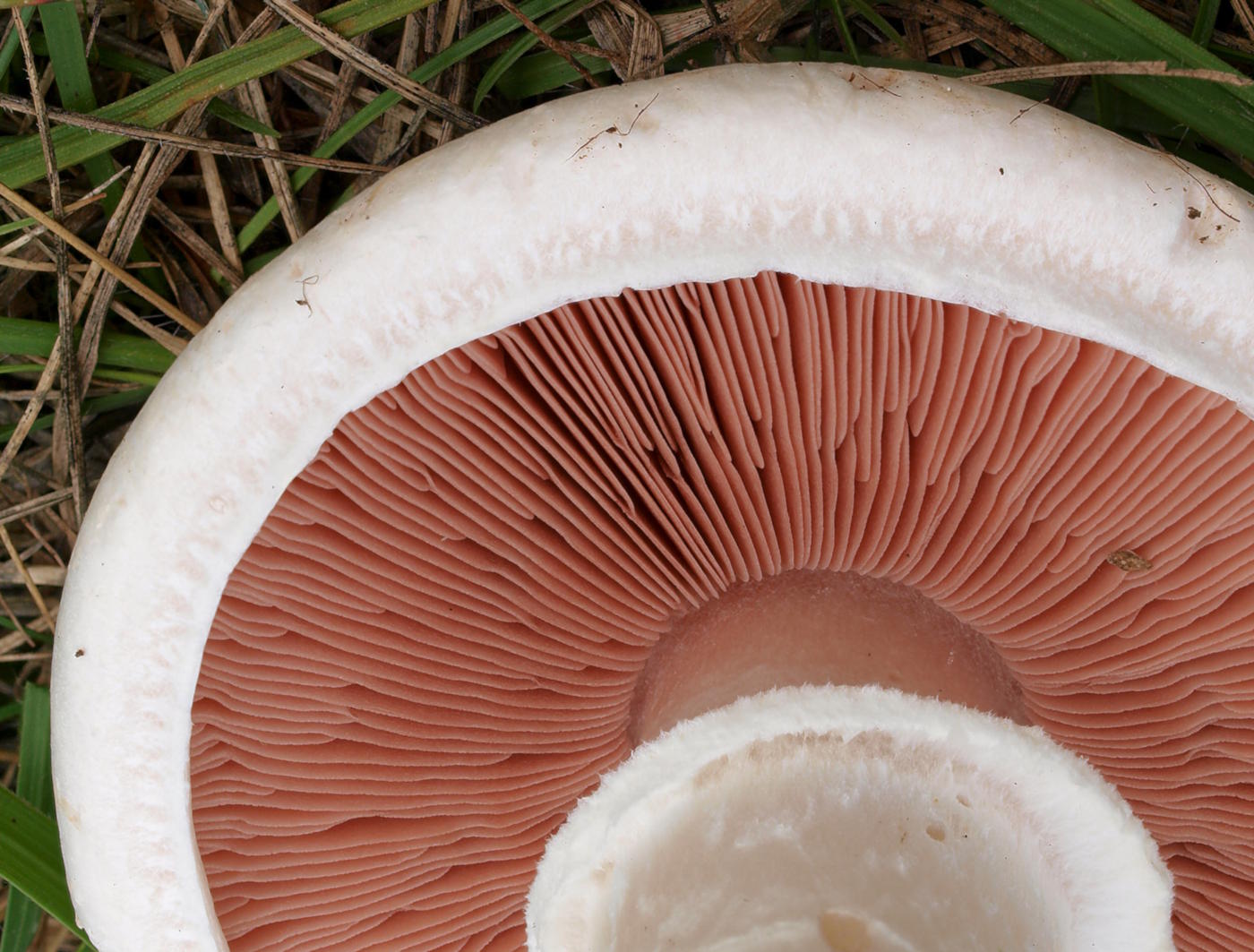
    Champignons haben beispielsweise junge rosa Lamellen, die später dunkel schokoladenbraun werden. Viele Wulstlinge behalten dagegen weiße oder sehr helle Lamellen.

    Leisten statt Lamellen

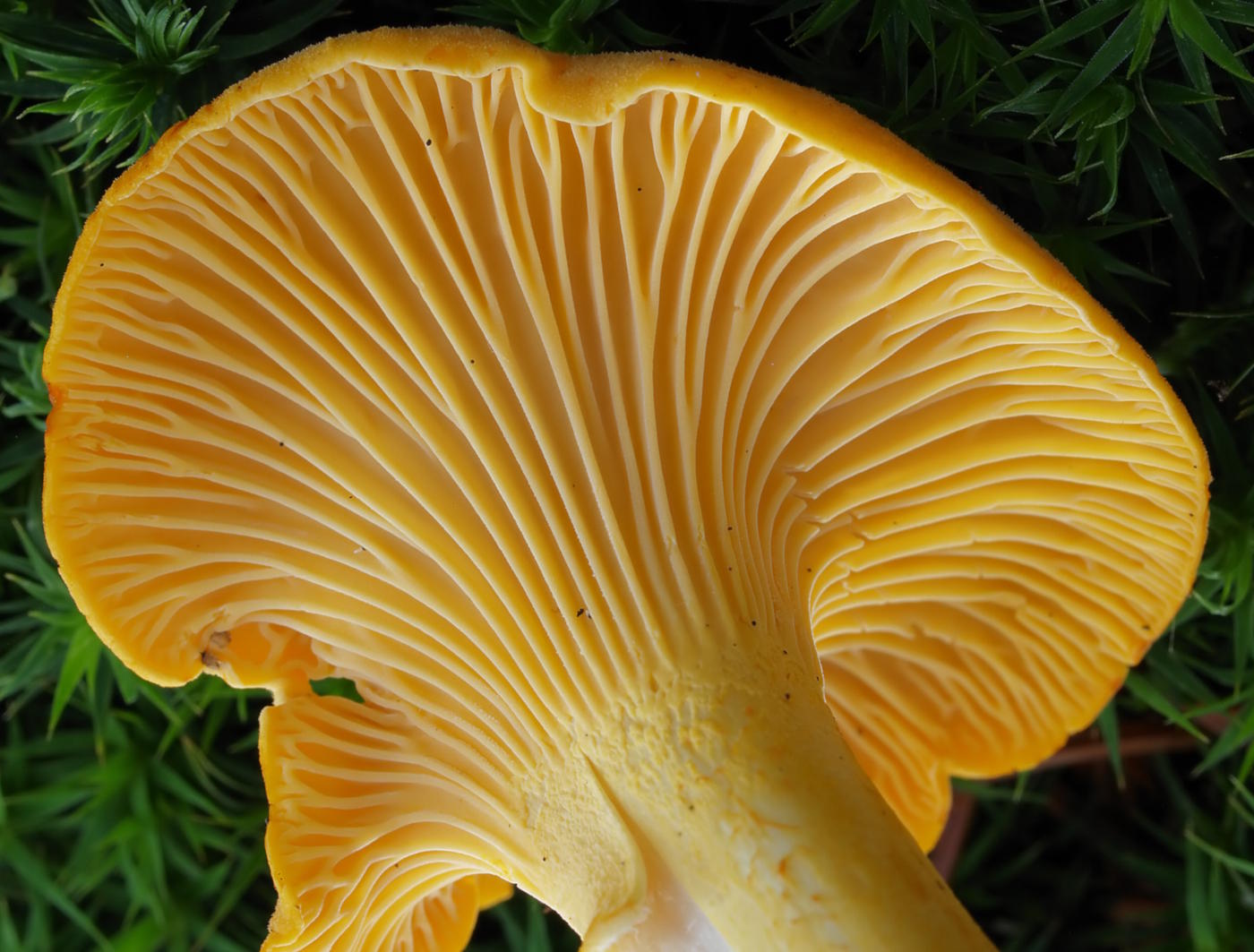
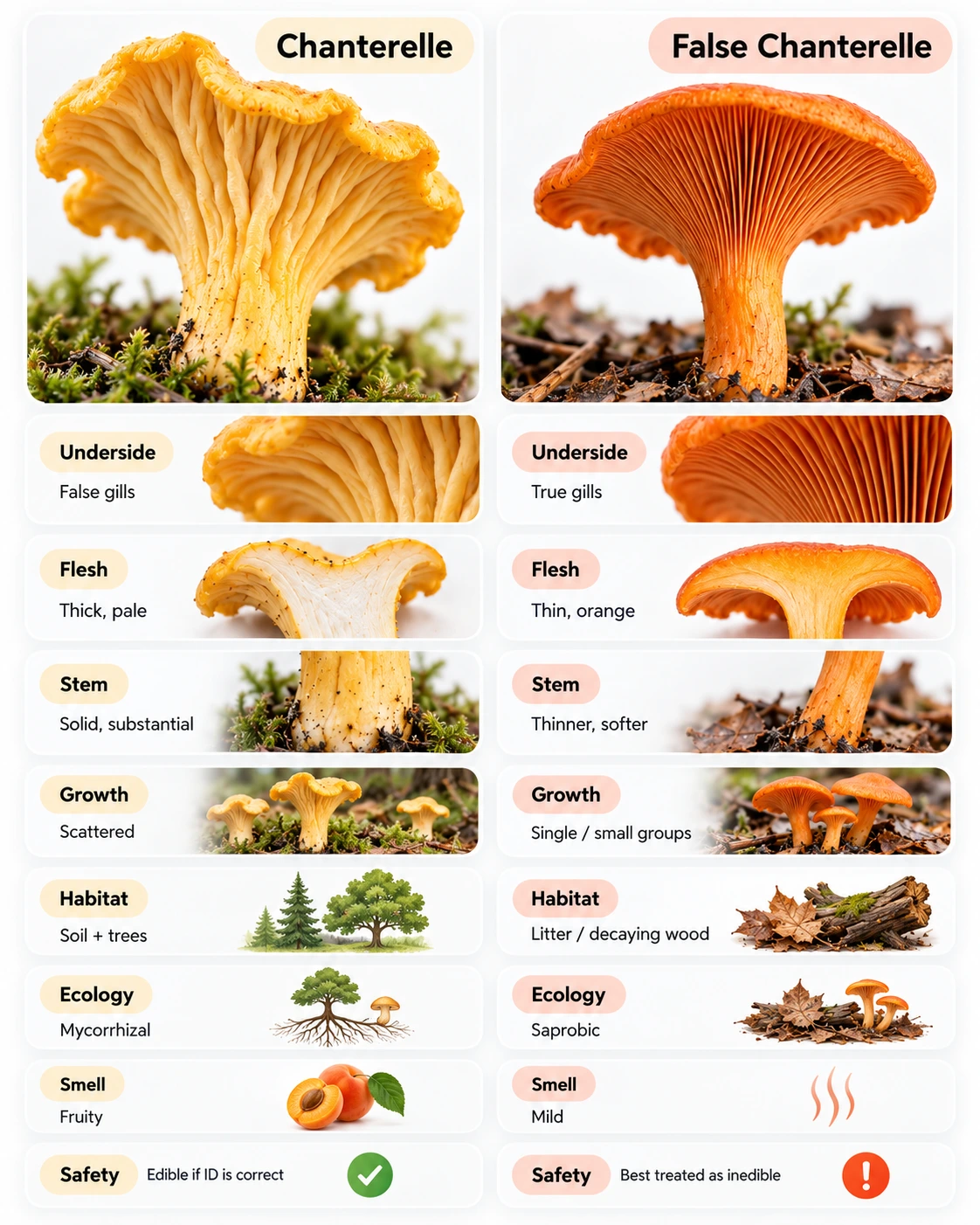
    Pfifferlinge haben keine echten Lamellen. Ihre Unterseite besteht aus dicken, stumpfen Leisten, die häufig gegabelt sind und am Stiel herablaufen.

    Diese Leisten sehen eher wie Falten oder Adern aus. Das ist ein wichtiges Merkmal, um echte Pfifferlinge von ähnlichen orangefarbenen Pilzen mit echten Lamellen zu unterscheiden.

    Röhren und Poren

    Steinpilze, Maronen-Röhrlinge und viele andere Röhrlinge haben keine Lamellen. Ihre Unterseite wirkt schwammartig und besteht aus vielen winzigen Röhrenöffnungen.

    Bei Baumpilzen können die Poren sehr fein sein. Ein Beispiel ist die Schmetterlingstramete, deren Unterseite aus zahlreichen kleinen Poren besteht.

    Stacheln

    Semmelstoppelpilze besitzen unter dem Hut zahlreiche kleine Stacheln. Diese Struktur ist ungewöhnlich und macht die Gruppe vergleichsweise leicht erkennbar.

    Auch einige Holzpilze bilden Stacheln. Der Igel-Stachelbart ist dafür ein besonders auffälliges Beispiel.

    Schritt 2: Untersuche den Stiel

    Der Stiel liefert oft mehr Informationen als der Hut. Farbe, Oberfläche, Ring, Netzzeichnung und die Struktur des unteren Stielteils können entscheidend sein.

    Ein Pilz mit braunem Hut kann beispielsweise völlig harmlos oder stark giftig sein. Der Stiel hilft dabei, ähnliche Arten voneinander zu trennen.

    Hat der Pilz einen Ring?

    Ein Ring am Stiel ist ein Rest des Teilvelums, das die jungen Lamellen geschützt hat. Wulstlinge, Schirmlinge, einige Hallimasch-Arten und viele andere Pilze können einen Ring besitzen.

    Die Form des Rings ist ebenfalls interessant. Manche Ringe sind dick und beweglich, andere dünn, häutig oder nur noch als schwache Zone sichtbar.

    Hat der Stiel eine Netzzeichnung?

    Beim Steinpilz ist häufig eine helle Netzzeichnung am oberen Stiel erkennbar. Dieses Muster sieht aus wie ein feines weißes Netz auf der Oberfläche.

    Andere Röhrlinge können ein dunkleres oder anders gefärbtes Netz haben. Die Farbe und Position dieses Musters hilft bei der Abgrenzung ähnlicher Arten.

    Ist der Stiel glatt, faserig oder schuppig?

    Einige Pilze besitzen einen glatten Stiel, andere haben Fasern, Flocken oder Schuppen. Rotkappen und Birkenpilze zeigen beispielsweise charakteristische dunkle Schüppchen am Stiel.

    Solche Merkmale sind oft stabiler als die Hutfarbe. Deshalb lohnt sich eine Nahaufnahme des Stiels immer.

    Schritt 3: Prüfe unbedingt die Stielbasis

    Die Stielbasis wird bei der Pilzbestimmung besonders häufig vergessen. Das ist problematisch, weil sie gerade bei gefährlichen Wulstlingen eines der wichtigsten Merkmale sein kann.

    Schneide den Pilz deshalb nicht direkt über dem Boden ab, wenn du ihn bestimmen möchtest. Hebe ihn vorsichtig komplett aus dem Boden, sodass die Basis erhalten bleibt.

    Knolle

    Viele Wulstlinge haben eine deutlich verdickte oder knollige Stielbasis. Form und Struktur dieser Knolle unterscheiden sich je nach Art.

    Beim Pantherpilz können beispielsweise charakteristische Velumreste um die Knolle sitzen. Solche Details sind auf einem abgeschnittenen Stiel nicht mehr zu erkennen.

    Volva oder Scheide

    Der Grüne Knollenblätterpilz besitzt an der Stielbasis typischerweise eine sackartige Hülle, die sogenannte Volva. Sie kann teilweise im Boden verborgen sein.

    Ein weißlamelliger Pilz mit Ring und Volva sollte immer sehr vorsichtig behandelt werden. Mehrere tödlich giftige Amanita-Arten zeigen diese Merkmalskombination.

    Schritt 4: Schneide den Pilz auf

    Ein Längsschnitt kann viele zusätzliche Informationen liefern. Du erkennst, ob der Stiel hohl oder voll ist, welche Farbe das Fleisch hat und ob sich das Gewebe nach Verletzung verändert.

    Das Innere kann außerdem anders gefärbt sein als die Oberfläche. Bei echten Pfifferlingen ist das Fleisch beispielsweise meist deutlich heller als die gelbe Außenseite.

    Farbveränderungen

    Einige Pilze verfärben sich beim Anschneiden oder Drücken. Röhrlinge können blau werden, Reizker grünlich und andere Arten rot, grau oder schwarz.

    Die Geschwindigkeit der Reaktion kann ebenfalls wichtig sein. Manche Pilze verfärben sich innerhalb weniger Sekunden, andere erst nach einigen Minuten.

    Brüchiges oder faseriges Fleisch

    Täublinge und Milchlinge haben oft auffallend sprödes Fleisch. Der Stiel bricht eher wie Kreide, anstatt sich faserig auseinanderziehen zu lassen.

    Andere Pilze besitzen deutlich faserigeres Gewebe. Diese einfache Texturprüfung hilft, große Pilzgruppen voneinander zu unterscheiden.

    Schritt 5: Achte auf austretende Milch

    Milchlinge können beim Verletzen der Lamellen oder des Fleisches eine Flüssigkeit absondern. Diese sogenannte Milch kann weiß, orange, wässrig oder anders gefärbt sein.

    Beim Edel-Reizker ist die orangefarbene Milch eines der wichtigsten Merkmale. Zusammen mit grünlicher Verfärbung und dem Wachstum bei Kiefern ergibt sich ein sehr charakteristisches Bild.

    Milch kann ihre Farbe verändern

    Nicht nur die ursprüngliche Farbe ist interessant. Bei manchen Arten verändert sich die Milch nach Kontakt mit Luft.

    Deshalb lohnt es sich, nach einigen Minuten erneut auf die beschädigte Stelle zu schauen. Eine verzögerte Farbänderung kann bei ähnlichen Milchlingen den entscheidenden Hinweis liefern.

    Schritt 6: Bestimme den Standort

    Ein Pilz wächst nicht zufällig an einem bestimmten Ort. Waldtyp, Boden, Totholz und Begleitbäume gehören deshalb zur Bestimmung dazu.

    Ein orangefarbener Pilz auf einem Baumstumpf gehört wahrscheinlich in eine andere Gruppe als ein ähnlich gefärbter Pilz, der zwischen Moos unter Kiefern wächst.

    Pilze auf dem Boden

    Viele Mykorrhizapilze wachsen scheinbar direkt aus dem Boden. Dazu gehören Steinpilze, Pfifferlinge, Wulstlinge, Täublinge und Milchlinge.

    Sie leben in Partnerschaft mit den Wurzeln bestimmter Bäume. Der Baum in der Nähe kann deshalb genauso wichtig sein wie der Pilz selbst.

    Pilze auf Holz

    Austernseitlinge, Hallimasch, Stockschwämmchen, Gifthäublinge und viele Porlinge wachsen an Holz. Das Holz kann sichtbar sein oder vollständig unter dem Boden liegen.

    Ein Pilz, der scheinbar aus Erde wächst, kann also trotzdem ein Holzbewohner sein. Achte deshalb auf alte Baumstümpfe und Wurzeln in der Umgebung.

    Pilze im Rasen

    Rasenflächen beherbergen ebenfalls zahlreiche Pilze. Schopftintlinge, Nelkenschwindlinge und verschiedene Trichterlinge gehören zu den häufigeren Beispielen.

    Auch Wulstlinge können auf Rasenflächen erscheinen, wenn Baumwurzeln unter der Grasnarbe verlaufen. Ein Standort im Rasen bedeutet daher nicht automatisch, dass der Pilz harmlos ist.

    Schritt 7: Schau auf die Bäume

    Viele Pilze sind eng an bestimmte Baumarten gebunden. Wer den Baum erkennt, kann die mögliche Pilzart oft deutlich schneller eingrenzen.

    Kiefer, Fichte, Birke, Buche und Eiche sind besonders nützliche Begleitbäume. Selbst wenn der Pilz mehrere Meter vom Stamm entfernt steht, kann er noch mit dessen Wurzeln verbunden sein.

    Pilze bei Kiefern

    Unter Kiefern findet man unter anderem Reizker, Butterpilze, verschiedene Röhrlinge und einige Wulstlinge. Kiefernnadeln und Zapfen in der Umgebung sind deshalb wertvolle Hinweise.

    Nicht alle orangefarbenen Milchlinge wachsen bei denselben Nadelbäumen. Die Unterscheidung zwischen Kiefer, Fichte und Tanne kann sogar bei sehr ähnlichen Arten entscheidend sein.

    Pilze bei Birken

    Birken begleiten viele typische Pilzarten. Birkenpilze, Fliegenpilze und verschiedene Milchlinge können in ihrer Nähe wachsen.

    Ein Pilz unter einer Birke muss natürlich nicht zwangsläufig direkt mit diesem Baum verbunden sein. In Mischwäldern sollten deshalb alle Bäume im näheren Umkreis betrachtet werden.

    Pilze bei Eichen und Buchen

    Eichen- und Buchenwälder sind besonders artenreich. Steinpilze, Wulstlinge, Täublinge und viele andere Mykorrhizapilze können dort vorkommen.

    Auch der tödlich giftige Grüne Knollenblätterpilz ist häufig an Laubbäume gebunden. Deshalb ist die Baumart nicht nur für die Artbestimmung, sondern auch für die Sicherheit relevant.

    Schritt 8: Beobachte Geruch und Oberfläche

    Geruch kann ein überraschend gutes Zusatzmerkmal sein. Manche Pilze riechen fruchtig, mehlig, nach Rettich, Anis, Kokos oder deutlich unangenehm.

    Die Wahrnehmung von Gerüchen ist allerdings subjektiv. Deshalb sollte Geruch nie das einzige Argument für eine Bestimmung sein.

    Schleimige Hüte

    Einige Pilze haben bei Feuchtigkeit eine deutlich schleimige oder klebrige Hutoberfläche. Butterpilze und Samtfußrüblinge sind typische Beispiele.

    Bei trockenem Wetter kann dieser Effekt fast verschwinden. Deshalb solltest du auch berücksichtigen, ob der Pilz frisch oder bereits ausgetrocknet ist.

    Schuppen und Velumreste

    Schuppen können echte Bestandteile der Hutoberfläche sein oder aus Resten einer Hülle entstehen. Beim Fliegenpilz sind die bekannten weißen Punkte beispielsweise Reste des Universalvelums.

    Starker Regen kann solche Velumreste abwaschen. Ein fast glatter roter oder orangefarbener Fliegenpilz ist deshalb durchaus möglich.

    Schritt 9: Erstelle einen Sporenabdruck

    Ein Sporenabdruck zeigt die Farbe der reifen Sporen. Dieses Merkmal ist besonders nützlich, wenn mehrere äußerlich ähnliche Pilze infrage kommen.

    Die Sporenfarbe kann weiß, creme, rosa, rostbraun, schokoladenbraun, violettbraun oder schwarz sein. Zwischen manchen gefährlichen und essbaren Doppelgängern ist dieser Unterschied besonders wichtig.

    So machst du einen Sporenabdruck

    Entferne den Stiel und lege den Hut mit der Unterseite nach unten auf eine geeignete Oberfläche. Eine Kombination aus hellem und dunklem Papier macht sowohl helle als auch dunkle Sporen sichtbar.

    Decke den Hut ab und lasse ihn mehrere Stunden liegen. Danach kann ein sichtbares Sporenmuster unter dem Hut zurückbleiben.

    Warum Sporenfarbe wichtig ist

    Hallimasch produziert beispielsweise helles Sporenpulver. Der gefährliche Gifthäubling besitzt dagegen rostbraune Sporen.

    Bei kleinen braunen Holzpilzen kann dieser Unterschied sehr wichtig sein. Trotzdem ersetzt ein Sporenabdruck nicht die komplette Bestimmung.

    Schritt 10: Berücksichtige Jahreszeit und Region

    Pilzarten haben typische Fruchtzeiten, auch wenn das Wetter diese verschieben kann. Morcheln sind klassische Frühlingspilze, während viele Röhrlinge, Wulstlinge und Hallimasch-Arten besonders häufig im Sommer und Herbst erscheinen.

    Kältetolerante Arten können dagegen bis in den Winter hinein wachsen. Der Samtfußrübling ist ein gutes Beispiel für einen Pilz, der sogar nach Frostperioden auftreten kann.

    Regionale Unterschiede

    Nicht jede Art kommt überall vor. Ein Pilzführer für Mitteleuropa kann deshalb nicht ohne Weiteres auf Nordamerika oder den Mittelmeerraum übertragen werden.

    Auch innerhalb Deutschlands unterscheiden sich Pilzgemeinschaften zwischen Küstenregionen, Mittelgebirgen und den Alpen. Höhenlage, Niederschlag und Baumarten beeinflussen das Vorkommen erheblich.

    Die wichtigsten Pilzgruppen schnell erkennen

    Eine perfekte Artbestimmung beginnt oft damit, den Pilz zunächst einer größeren Gruppe zuzuordnen. Dadurch wird aus Hunderten möglichen Arten eine deutlich kleinere Auswahl.

    Die Unterseite und der Stiel liefern dafür meist die schnellsten Hinweise. Danach können feinere Merkmale genutzt werden.

    Röhrlinge

    Röhrlinge besitzen unter dem Hut eine schwammartige Porenschicht. Steinpilz, Maronen-Röhrling und Rotfußröhrlinge gehören zu dieser Gruppe.

    Verfärbungen, Netzzeichnung und Porenfarbe helfen anschließend bei der genaueren Bestimmung. Nicht jeder Röhrling mit braunem Hut ist ein Steinpilz.

    Wulstlinge

    Wulstlinge besitzen echte Lamellen und häufig Velumreste, Ring oder eine besondere Stielbasis. Zur Gattung gehören sowohl bekannte Arten wie der Fliegenpilz als auch extrem gefährliche Arten wie der Grüne Knollenblätterpilz.

    Die vollständige Stielbasis ist bei dieser Gruppe besonders wichtig. Ein abgeschnittener Wulstling ist oft deutlich schwerer sicher zu bestimmen.

    Täublinge

    Täublinge haben sprödes Fleisch und brechen leicht. Ihre Hüte kommen in fast allen möglichen Farben vor, wodurch die Gruppe für Anfänger verwirrend wirken kann.

    Viele Arten ähneln sich stark. Für die genaue Artbestimmung können Geschmack, Sporenfarbe, chemische Reaktionen und mikroskopische Merkmale nötig sein.

    Milchlinge

    Milchlinge gehören wie Täublinge zu den Russulaceae und besitzen ebenfalls brüchiges Fleisch. Bei Verletzung tritt jedoch häufig eine charakteristische Milch aus.

    Farbe und Veränderungen dieser Flüssigkeit helfen bei der Bestimmung. Begleitbäume sind ebenfalls besonders nützlich.

    Porlinge

    Viele Porlinge wachsen direkt auf Holz und bilden Konsolen oder flache Fruchtkörper. Ihre Unterseite besitzt meist Poren.

    Schmetterlingstramete, Zunderschwamm und Schwefelporling gehören zu bekannten Beispielen. Einige Arten sind weich und einjährig, andere entwickeln harte mehrjährige Fruchtkörper.

    Essbare und giftige Doppelgänger

    Eine der größten Herausforderungen bei der Pilzbestimmung ist die Ähnlichkeit zwischen essbaren und giftigen Arten. Ein einzelnes oberflächliches Merkmal reicht deshalb nicht aus.

    Besonders wichtig sind Gruppen, bei denen ein Fehler ernsthafte Folgen haben kann. Dazu gehören weiße Wulstlinge, kleine braune Holzpilze und verschiedene orangefarbene Lamellenpilze.

    Pfifferling und ähnliche orange Pilze

    Pfifferlinge besitzen stumpfe Leisten, helles festes Fleisch und wachsen in Verbindung mit lebenden Bäumen. Ähnliche orange Pilze können dagegen echte Lamellen besitzen.

    Die Unterseite ist deshalb wichtiger als die gelbe Farbe. Wer Pfifferlinge bestimmen möchte, sollte den Unterschied zwischen Leisten und Lamellen sicher erkennen können.

    Hallimasch und Gifthäubling

    Beide können auf Holz wachsen und bräunliche Hüte besitzen. Der Hallimasch hat jedoch helles Sporenpulver, während der Gifthäubling rostbraune Sporen produziert.

    Der Gifthäubling enthält Amatoxine und gehört zu den gefährlichen Doppelgängern. Kleine braune Pilze auf Holz sollten deshalb besonders sorgfältig geprüft werden.

    Wiesenchampignon und weiße Wulstlinge

    Champignons entwickeln rosa bis braune Lamellen. Tödlich giftige weiße Wulstlinge behalten dagegen helle Lamellen und besitzen zusätzliche Merkmale an der Stielbasis.

    Vor allem bei sehr jungen Pilzen können die Unterschiede weniger deutlich sein. Ein komplett geschlossener weißer Pilz sollte deshalb nicht vorschnell als Champignon angesehen werden.

    Kann man Pilze per Foto bestimmen?

    Fotos können die Bestimmung stark erleichtern, wenn die richtigen Merkmale sichtbar sind. Ein einzelnes Bild des Hutes von oben enthält jedoch oft zu wenig Information.

    Eine gute Fotoserie zeigt den Pilz von mehreren Seiten. Unterseite, kompletter Stiel, Stielbasis, Schnittfläche und Umgebung sind besonders wichtig.

    Welche Fotos sind am hilfreichsten?

    Fotografiere zuerst den vollständigen Pilz in seiner natürlichen Umgebung. Danach sollte ein scharfes Bild der Unterseite folgen.

    Ein drittes Foto kann den kompletten Stiel einschließlich Basis zeigen. Bei Arten mit Verfärbungen oder Milch ist zusätzlich eine Aufnahme nach dem Anschneiden besonders hilfreich.

    Was sollte im Umgebungsfoto sichtbar sein?

    Versuche, nahe Bäume, Moos, Gras, Totholz oder Baumstümpfe mit einzubeziehen. Diese Details helfen dabei, die Ökologie des Pilzes zu verstehen.

    Auch mehrere Pilze unterschiedlichen Alters sind nützlich. Junge und alte Exemplare können erstaunlich verschieden aussehen.

    Kann KI Pilze zuverlässig erkennen?

    KI kann anhand guter Fotos schnell mögliche Arten vorschlagen und bei der Einordnung helfen. Besonders auffällige Arten oder Gruppen lassen sich häufig gut erkennen, wenn mehrere Merkmale sichtbar sind.

    Schwieriger wird es bei sehr ähnlichen Arten, kleinen braunen Pilzen oder Gruppen mit komplizierter Taxonomie. Verdeckte Merkmale wie eine im Boden sitzende Volva können auf einem Foto vollständig fehlen.

    KI ist deshalb besonders hilfreich als Werkzeug zur Eingrenzung. Für eine Entscheidung über Essbarkeit sollte sie niemals die einzige Grundlage sein.

    Häufige Fehler beim Pilzbestimmen

    Ein typischer Fehler ist die Suche nach genau einem “magischen” Merkmal. In Wirklichkeit entstehen zuverlässige Bestimmungen fast immer aus mehreren Merkmalen, die gemeinsam passen.

    Ein weiterer Fehler ist, nur perfekte Bilder aus Pilzbüchern zu erwarten. Pilze verändern sich durch Regen, Trockenheit, Alter, Insekten und mechanische Schäden oft deutlich.

    Besonders riskant ist das Abschneiden der Stielbasis vor der Bestimmung. Damit kann genau das Merkmal verloren gehen, das einen harmlosen Pilz von einem gefährlichen Wulstling unterscheidet.

    Eine einfache Reihenfolge für Anfänger

    Wenn du einen unbekannten Pilz findest, beginne immer mit der Unterseite. Entscheide zuerst, ob du Lamellen, Röhren, Leisten oder Stacheln siehst.

    Prüfe anschließend Stiel, Basis und Substrat. Erst danach sollten Farbe, Geruch, Verfärbungen und Sporenpulver zur weiteren Eingrenzung verwendet werden.

    Diese Reihenfolge verhindert, dass auffällige, aber wenig zuverlässige Eigenschaften wie die Hutfarbe zu stark gewichtet werden.

    Frequently Asked Questions

    Warum sehen Pilze derselben Art manchmal völlig unterschiedlich aus?

    Feuchtigkeit, Alter, Licht, Bodenbedingungen und mechanische Schäden können das Aussehen eines Fruchtkörpers stark verändern. Besonders Hutfarbe und Oberflächenstruktur können innerhalb derselben Art überraschend variabel sein.

    Kann ein Pilz nach starkem Regen wichtige Merkmale verlieren?

    Ja. Regen kann Velumreste abwaschen, Farben aufhellen und schleimige Oberflächen verändern. Deshalb lohnt es sich, mehrere Exemplare einer Gruppe zu untersuchen, wenn diese vorhanden sind.

    Warum finde ich manchmal jedes Jahr Pilze an derselben Stelle?

    Der sichtbare Fruchtkörper ist nur ein kleiner Teil des Pilzes, während das Myzel im Boden oder Holz über viele Jahre bestehen kann. Wenn Wetter und Nährstoffbedingungen wieder passen, kann dasselbe Myzel erneut Fruchtkörper bilden.

    Kann ein Pilz auf einem Foto größer oder kleiner wirken als in Wirklichkeit?

    Ja, besonders Nahaufnahmen ohne Vergleichsobjekt können die Größe stark verfälschen. Eine Münze, ein Lineal oder ein zweites Foto aus größerer Entfernung kann deshalb bei der Bestimmung hilfreich sein.

    Sollte man zur Bestimmung immer mehrere Exemplare untersuchen?

    Wenn mehrere Pilze am selben Fundort vorhanden sind, ist das sehr hilfreich. Junge und ältere Exemplare können unterschiedliche Merkmale zeigen, wodurch Ring, Lamellenfarbe oder Hutform besser beurteilt werden können.

    Kann man Pilze bestimmen, ohne sie zu pflücken?

    Bei vielen Arten ist eine grobe Bestimmung möglich, ohne sie zu entfernen. Für schwierige Gruppen kann jedoch die vollständige Stielbasis, ein Schnittbild oder ein Sporenabdruck notwendig sein, sodass ein einzelnes Exemplar vorsichtig entnommen werden muss.

    Warum widersprechen sich Pilzbücher manchmal bei Artnamen?

    Die Pilztaxonomie verändert sich laufend, besonders durch genetische Untersuchungen. Arten, die früher unter einem Namen zusammengefasst wurden, können heute in mehrere getrennte Arten aufgeteilt sein.

    Was tun, wenn nur ein Teil der Merkmale passt?

    Dann ist die Bestimmung noch nicht sicher. Ein zuverlässiger Name sollte nur vergeben werden, wenn die wichtigen Merkmale gemeinsam zu Art, Standort und Region passen.

    Final Identification Notes

    Pilze sicher zu bestimmen bedeutet nicht, sich möglichst viele Hutfarben zu merken. Viel wichtiger ist eine feste Reihenfolge: Unterseite prüfen, Stiel und Stielbasis ansehen, Fleisch untersuchen, Standort und Begleitbäume beachten und anschließend zusätzliche Merkmale wie Sporenfarbe oder Verfärbungen nutzen.

    Mit etwas Übung lassen sich dadurch viele Funde zunächst einer größeren Pilzgruppe zuordnen. Erst danach sollte versucht werden, eine genaue Art zu bestimmen, denn gerade bei Täublingen, Milchlingen, Wulstlingen und kleinen braunen Pilzen können mehrere Arten sehr ähnlich aussehen.

    Die beste Bestimmung entsteht aus mehreren unabhängigen Hinweisen, die zusammenpassen. Wenn wichtige Merkmale fehlen oder widersprüchlich sind, ist “noch nicht sicher bestimmt” die bessere Antwort als ein erzwungener Artname.

  • Mushrooms With White Gills: 12 Common Species to Know

    Mushrooms With White Gills: 12 Common Species to Know

    White gills are common in many completely unrelated mushroom groups, which makes them useful as a starting clue but dangerous as a final identification feature. A mushroom with white gills could be an edible Oyster Mushroom, a brittle Russula, a clustered Honey Mushroom, or a deadly Amanita.

    The most useful next step is to look beyond gill color. Stem rings, volvas, latex, growth on wood, cap texture, spore color, habitat, and changes with age can quickly separate mushrooms that initially look very similar.

    ⚠️ Important: White gills do not indicate whether a mushroom is edible or poisonous. Several of the world’s most dangerous mushrooms have white gills, so identification should always use the complete fruit body.

    Quick Guide to 12 Mushrooms With White Gills

    Species or group Common name Typical habitat Important clue Safety
    Amanita phalloides Death Cap Soil near broadleaf trees Volva + ring Deadly poisonous
    Amanita virosa group Destroying Angel Woodland soil Entirely pale, sack-like volva Deadly poisonous
    Amanita muscaria Fly Agaric Woodland near trees Red/orange cap, veil spots Poisonous
    Amanita pantherina Panther Cap Woodland Brown cap, white veil patches Poisonous
    Russula emetica group Sickener Woodland soil Red cap, brittle flesh Poisonous / causes GI illness
    Russula vesca Bare-Toothed Russula Woodland soil Brittle stem and pale gills Edible when correctly identified
    Lactarius piperatus Peppery Milkcap Broadleaf woodland White latex Generally not considered a choice edible
    Clitocybe rivulosa Fool’s Funnel Lawns and grassland Small pale funnel Poisonous
    Pleurotus ostreatus Oyster Mushroom Dead hardwood Decurrent gills, lateral growth Edible when correctly identified
    Armillaria species Honey Mushrooms Wood, roots and stumps Clustered growth, white spores Edibility varies
    Marasmius oreades Fairy Ring Mushroom Lawns and grassland Widely spaced pale gills Edible when correctly identified
    Lepiota brunneoincarnata Deadly Dapperling Grass, gardens, disturbed ground Small scaly cap, ring Deadly poisonous

    What Does “White Gills” Actually Mean?

    Gills described as white are not always pure bright white. Depending on age, moisture, lighting, and species, they may appear ivory, cream, pale beige, or slightly yellowish.

    The important question is whether they remain broadly pale as the mushroom matures. In some genera, young gills start pale but become pink, brown, rusty, or black as spores develop.

    Gill Color Can Change With Age

    This is particularly important with genera such as Agaricus. Young Agaricus gills can initially look pale, but they soon become pink and eventually chocolate brown.

    Amanita gills, by contrast, usually remain white or pale throughout development. Observing mature specimens can therefore prevent a common identification mistake.

    1. Amanita phalloides — Death Cap

    Identification

    The Death Cap usually has a smooth cap that ranges from olive-green and yellow-green to brownish, grayish, or very pale. The gills are white and remain white as the mushroom matures.

    The stem normally has a ring, while the base sits inside a sack-like volva. That basal structure may be hidden beneath soil or leaf litter, so the entire mushroom should be carefully exposed during identification.

    Habitat

    Death Caps grow from soil in association with living trees. Oaks, beeches, chestnuts, and several other broadleaf species can act as hosts depending on region.

    They can occur in forests, parks, roadside plantings, and gardens with mature trees. Their appearance in landscaped areas sometimes surprises people who associate dangerous mushrooms only with wild forest.

    Safety

    Amanita phalloides contains amatoxins capable of causing severe liver failure and death. Symptoms are often delayed for many hours, which makes suspected ingestion a medical emergency even if the person initially feels well.

    The combination of white gills, a ring, and a volva should always make an Amanita identification a serious possibility.

    2. Amanita virosa Group — Destroying Angels

    Identification

    Destroying Angels are among the classic white mushrooms with white gills. The cap, stem, and gills are usually predominantly white, giving the entire fruit body a deceptively clean appearance.

    A ring is commonly present on the stem, and a sack-like volva surrounds the base. Some related North American species, such as members of the Amanita bisporigera group, can look very similar.

    Habitat

    These mushrooms grow from soil near living trees in woodland. They are mycorrhizal rather than decomposers, so they do not normally grow directly from dead logs.

    Forest type varies by species and region. Broadleaf and mixed woods are common habitats.

    Safety

    Destroying Angels contain amatoxins and can cause fatal poisoning. Their plain white appearance makes them particularly important to recognize because they do not look obviously threatening.

    Any unknown white-gilled mushroom with a volva should be treated with extreme caution.

    3. Amanita muscaria — Fly Agaric

    Identification

    Fly Agaric usually has a red or orange-red cap covered with white universal veil remnants. The gills are white, and the pale stem typically carries a ring.

    The base is enlarged and often has additional veil remnants. Rain can wash many of the white cap spots away, making old specimens less immediately recognizable.

    Habitat

    Amanita muscaria grows from soil near trees such as birch, pine, spruce, and other suitable hosts. It is common in forests but can also appear in parks and lawns near mature trees.

    Autumn is one of its main seasons in temperate regions. Large groups may appear after prolonged rain.

    Safety

    Fly Agaric is poisonous and contains ibotenic acid and muscimol. The poisoning syndrome is mainly neurological rather than the delayed liver failure associated with Death Caps.

    White gills therefore occur in Amanita species with very different toxins, reinforcing why gill color alone is insufficient.

    4. Amanita pantherina — Panther Cap

    Identification

    Panther Cap has a brown to gray-brown cap decorated with white veil patches. Its gills are white, and the stem is pale with a ring.

    The stem base is bulbous and carries characteristic veil remnants. The flesh generally does not develop the strong reddish staining typical of the Blusher.

    Habitat

    The mushroom grows from soil in deciduous, coniferous, and mixed woodland. Like other Amanitas, it forms relationships with living tree roots.

    Autumn is a major fruiting period. Heavy rain can remove cap patches, so the stem base becomes especially important for identification.

    Safety

    Panther Cap contains ibotenic acid and muscimol and can cause serious neurological poisoning. It should not be confused with amatoxin-containing Amanitas, although both groups require caution.

    5. Russula emetica Group — Sickener

    Identification

    Sickener-type Russulas usually have bright red caps, white to cream gills, and white brittle stems. The entire fruit body has the characteristic brittle texture of Russula, often breaking almost like chalk.

    The cap skin may peel from the margin to some degree. Gill color remains pale rather than becoming brown or rusty.

    Habitat

    These mushrooms grow from soil in association with trees. Depending on the exact species, coniferous, mixed, and wet woodland can all provide habitat.

    Modern taxonomy has shown that several red-capped Russulas can resemble one another closely. Species-level identification from appearance alone may therefore be difficult.

    Safety

    Some red Russulas cause strong gastrointestinal irritation and have an intensely acrid taste. They should not be treated as edible simply because other members of the genus are eaten.

    6. Russula vesca — Bare-Toothed Russula

    Identification

    Russula vesca usually has a pinkish, reddish brown, or flesh-colored cap with white to cream gills. The cap skin often fails to reach the outer margin completely, exposing a narrow pale edge that gives rise to the “bare-toothed” common name.

    The stem is pale and brittle. Like other Russulas, it lacks a ring and volva.

    Habitat

    It grows from soil in woodland and forms mycorrhizal relationships with living trees. Broadleaf and mixed forests can both provide suitable habitat.

    Fruiting usually occurs from summer into autumn. It may appear singly or in scattered groups.

    Safety

    The species is regarded as edible when correctly identified. However, beginners should be cautious with Russulas because many species look similar and some cause gastrointestinal illness.

    7. Lactarius piperatus — Peppery Milkcap

    Identification

    Peppery Milkcap is a large white to cream mushroom with crowded pale gills. When the gills or flesh are damaged, they release white latex or “milk.”

    The cap becomes funnel-shaped with age, and the stem is relatively short and sturdy. The combination of crowded white gills and white latex is far more diagnostic than the cap color alone.

    Habitat

    It grows from soil in broadleaf and mixed woodland, often near beech, oak, and other suitable trees. Fruit bodies may appear singly or in groups.

    Summer and autumn are the main fruiting periods. The pale color can make the mushrooms difficult to see among dry leaves.

    Safety

    The flesh and latex have a very strong peppery or acrid taste. Its culinary use varies by region and preparation tradition, but it should not be treated as a straightforward edible mushroom for beginners.

    8. Clitocybe rivulosa — Fool’s Funnel

    Identification

    Fool’s Funnel is a small white to cream mushroom with pale gills that run slightly down the stem. Mature caps often become shallowly depressed or funnel-shaped.

    The overall appearance is plain, and individual mushrooms can be easy to overlook in grass. They may occur in arcs, rings, or scattered groups.

    Habitat

    Lawns, parks, meadows, grassy roadsides, and other open habitats are typical. Autumn rain often triggers large fruitings.

    The species can grow in places where children or pets have easy access, making recognition especially useful around homes and parks.

    Safety

    Clitocybe rivulosa contains muscarine and is poisonous. Symptoms can include heavy sweating, salivation, nausea, abdominal symptoms, and cardiovascular effects.

    Its unremarkable pale appearance demonstrates why white lawn mushrooms should never be assumed harmless.

    9. Pleurotus ostreatus — Oyster Mushroom

    Identification

    Oyster Mushrooms have broad fan-shaped caps with white to cream gills running down toward a short lateral stem or attachment point. The caps often grow in overlapping shelves.

    Color varies from nearly white to gray or brown depending on conditions. The gills generally remain pale and contrast with darker caps.

    Habitat

    Pleurotus ostreatus grows directly from dead or weakened hardwood. Fallen logs, standing dead trees, trunks, and large branches are common substrates.

    Cool autumn and winter weather can produce excellent fruiting. Several clusters may appear along the same tree.

    Safety

    Oyster Mushrooms are considered edible when correctly identified and cooked. Pale gills combined with shelf-like growth directly from wood are useful clues, but other oyster-shaped fungi should still be ruled out.

    10. Armillaria Species — Honey Mushrooms

    Identification

    Honey Mushrooms usually have honey-yellow, tan, or brown caps with white to cream gills. Many species have a ring on the stem, although some members of the group are ringless.

    They often grow in dense clusters from tree bases, roots, stumps, and buried wood. Their spore print is white, and heavy spore deposits may sometimes coat nearby caps.

    Habitat

    Armillaria species can act as parasites, decomposers, or both depending on circumstances. They are strongly associated with woody material even when fruit bodies appear to emerge from soil.

    Autumn is a major season for large Honey Mushroom flushes. A single stump may produce dozens of mushrooms.

    Safety

    Edibility varies by species and preparation, and gastrointestinal reactions can occur. The more important safety issue is confusion with brown wood-growing species such as Deadly Galerina, which produces rusty-brown spores rather than white.

    11. Marasmius oreades — Fairy Ring Mushroom

    Identification

    Fairy Ring Mushrooms have tan to buff caps and pale cream to whitish gills. The gills are relatively widely spaced compared with many other small lawn mushrooms.

    The stem is thin but surprisingly tough and flexible. Caps often become flatter or develop a small central bump as they mature.

    Habitat

    They grow in lawns, meadows, parks, and other grassy areas. Fruiting frequently forms arcs or complete rings that may expand gradually over many years.

    Rain after dry weather can trigger sudden flushes. Several generations may appear during the growing season.

    Safety

    Marasmius oreades is considered edible when correctly identified. Small pale lawn mushrooms are difficult for beginners, however, and poisonous species can occur in similar habitats.

    12. Lepiota brunneoincarnata — Deadly Dapperling

    Identification

    Deadly Dapperling is a relatively small mushroom with a pale cap covered in brown to reddish-brown scales. The gills are white and remain pale, while the slender stem usually carries a ring or ring zone.

    Its modest size can make it look less threatening than large Amanitas. Unfortunately, size has little relationship to toxicity.

    Habitat

    The species can occur in gardens, parks, grassy areas, paths, and disturbed ground. It is not restricted to remote woodland and may appear relatively close to human habitation.

    Warm temperate regions can support fruiting during summer and autumn. Its inconspicuous appearance makes careful identification important.

    Safety

    Lepiota brunneoincarnata contains amatoxins and can cause fatal liver poisoning. Small white-gilled mushrooms in the Lepiota group should therefore never be assumed edible.

    White-Gilled Mushrooms With a Ring

    A ring on the stem immediately narrows the possibilities, but it does not indicate safety. Death Cap, Destroying Angels, Fly Agaric, Panther Cap, many Honey Mushrooms, and Deadly Dapperling can all have rings. The stem base then becomes particularly important. A ring combined with a sack-like volva or other universal veil remnants strongly suggests an Amanita and deserves immediate caution.

    Ring Plus Volva

    The combination of a stem ring and a volva is one of the classic Amanita patterns. The volva may be a loose sack, a rim around a bulb, or fragmented material depending on species. Because much of the structure can remain underground, simply cutting a mushroom at soil level destroys valuable evidence. The entire stem base should be exposed whenever an Amanita is possible.

    White-Gilled Mushrooms Without a Ring

    Many white-gilled mushrooms lack a ring entirely. Russulas, Peppery Milkcap, Fool’s Funnel, Fairy Ring Mushroom, and Oyster Mushroom are among the examples in this guide. Absence of a ring eliminates some possibilities but does not establish edibility. Small pale funnel-shaped mushrooms without rings can still be poisonous.

    White-Gilled Mushrooms Growing on Wood

    Oyster Mushrooms and Honey Mushrooms are common white- or pale-gilled fungi associated with wood. Their growth patterns are very different, with oysters forming shelf-like clusters and Honey Mushrooms producing more conventional cap-and-stem fruit bodies. Substrate is useful but can be misleading when roots or logs are buried. A mushroom that appears to grow from soil may actually be attached to hidden wood.

    White-Gilled Mushrooms Growing in Lawns

    Fool’s Funnel and Fairy Ring Mushroom are two important examples of pale-gilled lawn fungi. One is poisonous, while the other is considered edible when correctly identified. This is a good example of why habitat and gill color cannot determine safety. Cap structure, gill spacing, stem texture, spore characteristics, and overall morphology must also agree.

    White-Gilled Mushrooms in Forests

    Woodland contains an enormous variety of mushrooms with pale gills. Amanitas, Russulas, milkcaps, Honey Mushrooms, and numerous smaller genera may all occur within a relatively small area. Nearby tree species can provide useful clues because many forest mushrooms are mycorrhizal. Oak, pine, birch, spruce, beech, and other trees support different fungal communities.

    How to Identify a Mushroom With White Gills

    Start by checking whether the mushroom actually has true gills. Chanterelles have false gills, while boletes have pores and Hedgehog Mushrooms have teeth. If the mushroom has true white gills, inspect the complete stem next. Look for a ring, volva, bulbous base, latex, brittle texture, lateral attachment, or clustered growth.

    Step 1: Check the Stem Base

    This is especially important for white-gilled Amanitas. A volva may remain hidden below the surface even when the rest of the mushroom looks ordinary.

    Carefully expose the complete base instead of cutting the stem. A buried structure may completely change the identification.

    Step 2: Look for a Ring

    A ring can help separate broad groups. Its size, texture, position, and persistence may all provide useful information.

    A missing ring should not be treated as definitive because fragile rings can disappear. Check several specimens if they are available.

    Step 3: Check the Substrate

    Determine whether the mushroom grows from soil, grass, dead wood, or buried roots. Oyster Mushrooms and Honey Mushrooms are strongly associated with wood, while Amanitas and Russulas normally grow from soil near living trees.

    Substrate should support the physical identification rather than override it. Buried wood can make a wood-growing fungus appear terrestrial.

    Step 4: Look at Gill Attachment

    Gills may be free from the stem, directly attached, notched, or decurrent down the stem. This is useful for separating mushrooms that otherwise share similar colors.

    Oyster Mushroom gills run down the attachment point, while Amanita gills are typically free or nearly free. Learning these basic attachment patterns makes pale-gilled mushrooms easier to sort into groups.

    White Gills vs White Spore Print

    Gill color and spore color are not the same thing. A mushroom with white gills may produce white, cream, pink, brown, or other colored spores depending on species and maturity.

    This distinction becomes particularly useful with young mushrooms. Gill color may initially be pale even when the eventual spore print is dark.

    A spore print should therefore be treated as an additional identification feature rather than simply inferred from the gills.

    Are White Gills a Sign of a Poisonous Mushroom?

    No. White gills occur in edible, inedible, and deadly poisonous mushrooms. Oyster Mushrooms and some Russulas have pale gills, while Death Caps and Destroying Angels also have white gills. Toxicity has to be determined from species identification rather than gill color. The association between white gills and danger exists mainly because several important Amanitas have this feature. It is a useful reason for caution, not a universal rule.

    Dangerous White-Gilled Mushrooms to Learn First

    Beginners should become familiar with Death Cap and Destroying Angels before collecting pale-gilled mushrooms for food. Their combination of white gills, pale stems, rings, and volvas is particularly important. Small amatoxin-containing Lepiotas are also worth learning because they demonstrate that deadly mushrooms are not always large or dramatic. Fool’s Funnel adds another useful pattern: a small ordinary-looking pale lawn mushroom can also be poisonous. Recognizing dangerous groups is often more useful than trying to memorize dozens of edible species immediately.

    White Gills vs Pale Gills

    Field guides often use terms such as white, cream, ivory, buff, or pale yellow. The boundary between these colors can be subjective, especially under warm artificial light or in photographs.

    It is often better to think in broader categories. A mushroom with consistently pale gills belongs in a very different identification pathway from one whose mature gills become chocolate brown, rusty, purple-black, or black.

    Why Mature Mushrooms Are Useful

    Young mushrooms may hide important features. Veils can cover the gills, cap shape may be undeveloped, and mature spore color may not yet be visible.

    Older specimens reveal how the gills change, whether a ring persists, and what the fully expanded cap looks like. A group containing both young and mature mushrooms is often much easier to identify than a single perfect-looking specimen.

    How to Photograph White Gills for Identification

    Take a clear underside photograph in neutral natural light. Avoid strong yellow indoor lighting because it can make genuinely white gills look cream or brown.

    Photograph the complete stem and base in a separate image. For mushrooms growing on wood, include the exact attachment point so the substrate is unambiguous.

    A side view can also show whether the gills are free, attached, or decurrent. This often provides more useful information than another photograph of the cap.

    Can AI Identify White-Gilled Mushrooms?

    AI can help narrow possibilities when photographs include the underside, stem, stem base, and habitat. Distinctive mushrooms such as Oyster Mushroom or Fly Agaric may be relatively easy to recognize from good images.

    White Amanitas and small pale mushrooms are much more challenging because critical features can be subtle or hidden underground. An image showing only a white cap and white gills may fit many unrelated species.

    For white-gilled mushrooms, complete photographic documentation is especially important. AI should never be used to decide whether an uncertain wild mushroom is safe to eat.

    Common Identification Mistakes

    One common mistake is assuming that every white-gilled mushroom is an Amanita. White gills occur across many fungal families, so the stem base, substrate, texture, and other features must also be considered.

    The opposite mistake is more dangerous: assuming that an ordinary-looking white mushroom cannot be poisonous. Destroying Angels and Deadly Dapperlings show why appearance alone is unreliable.

    Another frequent error is ignoring mushroom age. Gills that look pale in a young specimen may become dark later, completely changing the likely identification.

    Frequently Asked Questions

    What mushrooms have white gills?

    Many groups have white or pale gills, including Amanitas, Russulas, milkcaps, Oyster Mushrooms, Honey Mushrooms, Fairy Ring Mushrooms, and numerous smaller genera. White gills should therefore be treated as a broad identification clue rather than a species-level feature.

    Are mushrooms with white gills poisonous?

    Some are, but many are not. Death Caps and Destroying Angels are deadly poisonous, while correctly identified Oyster Mushrooms and several other white-gilled species are edible.

    What deadly mushrooms have white gills?

    Death Cap, Destroying Angels, and some small Lepiota species are important examples. These mushrooms can contain amatoxins capable of causing severe liver failure.

    Do Amanitas always have white gills?

    Many well-known Amanita species have white or pale gills, including Death Cap, Fly Agaric, Panther Cap, and Destroying Angels. The genus is diverse, however, so identification should also use the stem base, veil structures, cap, and habitat.

    Do Oyster Mushrooms have white gills?

    Yes. Oyster Mushrooms usually have white to cream gills that run down toward their short lateral stem or attachment point, and they grow directly from wood.

    Do Honey Mushrooms have white gills?

    Honey Mushrooms generally have pale or whitish gills, although they may develop cream or slightly darker tones with age. Their white spore print and clustered growth on wood are additional useful clues.

    Can a white-gilled mushroom have a dark spore print?

    Yes. Gill color and spore-print color are separate characteristics, and young gills may not show mature spore coloration. This is why checking both features can improve identification.

    What should I check after noticing white gills?

    Check the complete stem base, ring or absence of a ring, substrate, cap texture, gill attachment, spore color, and nearby trees. These features usually narrow the possibilities much more effectively than gill color alone.

    Are white mushrooms with white gills dangerous?

    Some are extremely dangerous, particularly Destroying Angels. A completely white mushroom with white gills, a ring, and a volva should be treated as a possible deadly Amanita until confidently identified otherwise.

    Can I identify a mushroom from gill color alone?

    No. Many unrelated species share the same gill color, and some mushrooms change dramatically as they mature. Reliable identification requires several independent features to agree.

    Final Identification Notes

    White gills are a useful first observation, but they open a large identification category rather than provide an answer. The same pale underside occurs in deadly Amanitas, poisonous lawn mushrooms, edible Oyster Mushrooms, brittle Russulas, milkcaps, Honey Mushrooms, and many other groups.

    The next features to check are the complete stem base, ring, substrate, gill attachment, flesh texture, latex, spore color, and habitat. A white-gilled mushroom with a volva leads toward a very different identification than a white-gilled shelf growing from a dead tree.

    Most importantly, never interpret white gills as evidence of edibility. Several of the most dangerous mushrooms to learn first are white-gilled species, which makes careful structural identification especially important.

  • Mushroom Gills vs False Gills: How to Tell the Difference

    Mushroom Gills vs False Gills: How to Tell the Difference

    The underside of a mushroom is often more useful for identification than the color of its cap. One of the first things to check is whether the mushroom has true gills, false gills, pores, teeth, or another type of fertile surface.

    True gills are thin, blade-like structures attached beneath the cap, while false gills are thicker folds or ridges that are part of the mushroom’s flesh. Learning this difference is especially important when identifying chanterelles and separating them from orange look-alikes such as False Chanterelles and Jack-o’-Lantern mushrooms.

    ⚠️ Important: This guide is for identification and education only. Gill structure can help narrow an identification, but no mushroom should be eaten based on a single feature, photograph, or AI result.

    Quick Comparison: True Gills vs False Gills

    Feature True Gills False Gills
    Structure Thin blade-like plates Thick folds or ridges
    Edge Usually sharp and distinct Rounded or blunt
    Attachment Separate structures attached beneath cap Integrated into cap flesh
    Spacing Often regular and repeated More irregular
    Forking May fork in some species Often fork and merge
    Cross-veins Sometimes present Common in chanterelles
    Texture Delicate or brittle in many species Thick and fleshy
    Main examples Amanita, Agaricus, Galerina, Omphalotus Cantharellus
    Best field clue Looks like separate blades Looks like wrinkles molded from flesh

    What Are Mushroom Gills?

    Mushroom gills are thin plates of tissue arranged beneath the cap. Their main role is to provide a large surface area where microscopic spores are produced and released.

    The scientific term for gills is lamellae. They are found in many familiar mushroom groups, including Amanita, Agaricus, Galerina, Mycena, Russula, and countless others.

    What Do True Gills Look Like?

    True gills resemble many thin blades radiating outward from the stem toward the cap margin. They usually have clearly defined edges and can often be seen individually from the side.

    Depending on the species, the gills may be closely packed or widely spaced. They can also vary dramatically in color, from white and pink to brown, purple, black, or rusty orange.

    Are True Gills Separate From the Cap?

    Structurally, true gills project downward from the cap as distinct plates. If you look at a cut section from the side, each gill appears as a separate blade rather than a simple fold in the cap surface.

    In some mushrooms, the gills may break away from the cap flesh relatively easily. In others, they are more firmly attached, so this should not be used as the only test.

    What Are False Gills?

    False gills are raised folds or ridges rather than true blade-like gills. They are most famously associated with chanterelles in the genus Cantharellus.

    These ridges are part of the mushroom’s outer surface and blend smoothly into the cap and stem. They often fork, merge, and form cross-connections, creating a network-like pattern.

    What Do False Gills Look Like?

    False gills usually look thicker and more rounded than true gills. Their edges are blunt rather than sharp, and the folds often appear uneven in height and spacing.

    Instead of looking like hundreds of separate plates, they resemble wrinkles or veins running down the underside of the cap. This difference becomes much easier to recognize after comparing several mushrooms side by side.

    Why Are They Called False Gills?

    The term “false gills” is used because the structures look superficially similar to gills but are anatomically different. They still form part of the spore-producing surface, but they are folds rather than separate lamellae.

    The name is especially useful in field identification because it immediately distinguishes chanterelles from many orange gilled mushrooms. It is not meant to suggest that the structures are unimportant or nonfunctional.

    The Fastest Way to Tell True Gills From False Gills

    Turn the mushroom over and look at the underside from an angle rather than straight on. True gills should appear as thin plates with clearly separated edges, while false gills should look like thick ridges molded into the mushroom.

    Then examine how the structures branch. False gills often fork irregularly and reconnect, while true gills usually retain a more blade-like appearance even when they branch.

    Check the Edge

    The edge of a true gill is usually thin and sharp. It may look almost like the edge of a sheet of paper, especially in delicate mushrooms.

    A false gill is more rounded and blunt. Instead of ending in a thin edge, it rises gradually from the flesh and blends back into it.

    Check the Thickness

    True gills are generally much thinner than the surrounding cap flesh. Even thick-gilled species still show clearly separate plates.

    False gills are broader and less sharply defined. Their thickness makes them look more like low ridges than conventional mushroom gills.

    Check Whether They Merge

    False gills frequently fork, split, rejoin, and form short cross-veins between neighboring ridges. This irregular network is particularly common in chanterelles.

    True gills can also fork in some species, so forking alone does not prove that a mushroom has false gills. The thickness and blade-like structure remain more important.

    True Gills in Common Mushrooms

    Many mushroom groups have true gills, so recognizing them is only the first step. Gill color, attachment, spacing, and changes with age can then help narrow the identification further.

    A white-gilled mushroom may belong to a completely different group from a pink- or rusty-gilled species. This is why the underside can provide several identification features at once.

    Amanita Gills

    Amanita species usually have pale or white true gills. In many species, the gills do not attach directly to the stem and are described as free.

    Other important Amanita features include a ring, volva, bulbous stem base, or universal veil remnants depending on species. Gill structure should therefore be combined with stem-base examination.

    Agaricus Gills

    Agaricus mushrooms have true gills that change color as the mushroom matures. Young gills are often pink and gradually become chocolate brown as the spores develop.

    This age-related change is a useful identification feature. It also helps distinguish Agaricus from white-gilled Amanitas, which keep pale gills as they mature.

    Galerina Gills

    Galerina marginata, the Deadly Galerina, has true gills that become rusty brown with age. The mature spore print is also rusty brown.

    This is important when comparing it with wood-growing mushrooms such as Velvet Shank, which has pale gills and a white spore print. Gill color can therefore have direct safety value.

    Jack-o’-Lantern Gills

    Jack-o’-Lantern mushrooms in the genus Omphalotus have true, well-developed orange gills. These gills run down the stem and can look superficially similar to chanterelle ridges from a distance.

    The difference becomes obvious on close inspection. Jack-o’-Lantern gills are thin blades, while chanterelle false gills are thick, blunt folds.

    False Gills in Chanterelles

    Chanterelles are the best-known example of mushrooms with false gills. Their ridges are thick, irregular, often forked, and usually run from the underside of the cap onto the stem.

    The folds may be shallow in some species and strongly developed in others. This variation is one reason beginners sometimes mistake chanterelle ridges for true gills.

    Cantharellus Species

    Golden chanterelles in the genus Cantharellus typically have obvious false gills. These structures are often the most reliable feature for separating them from orange gilled look-alikes.

    Different chanterelle species vary in ridge depth, color, and branching pattern. Some show very prominent ridges, while others have a much smoother underside.

    Cantharellus lateritius

    The Smooth Chanterelle, Cantharellus lateritius, may have an underside that is almost smooth when young. Older specimens can develop shallow wrinkles, but the structures remain much less prominent than those of many golden chanterelles.

    This demonstrates that not all chanterelles have strongly developed false gills. Geography and overall morphology remain important when the underside is unusually smooth.

    True Gills vs False Gills in Chanterelle Identification

    Chanterelles are a perfect example of why the distinction matters. From above, a true chanterelle, False Chanterelle, and Jack-o’-Lantern can all appear yellow or orange and funnel-shaped.

    The underside separates them much more effectively. True chanterelles have blunt false gills, while the other two have actual blade-like gills.

    Chanterelle vs False Chanterelle

    False Chanterelle, Hygrophoropsis aurantiaca, has many thin, forked true gills. Because these gills branch extensively, they may initially look similar to chanterelle ridges.

    The key difference is structure rather than branching. False Chanterelle gills remain thin plates, while chanterelle folds are thicker and integrated into the flesh.

    Quick Comparison

    Feature Chanterelle False Chanterelle
    Underside False gills True gills
    Structure Thick ridges Thin blades
    Edge Blunt Sharp
    Flesh Firm and pale Thinner, often more orange
    Ecology Mycorrhizal Saprobic
    Safety Edible when correctly identified Best treated as inedible

    The underside provides the fastest distinction. Habitat and flesh texture can then support the identification.

    Chanterelle vs Jack-o’-Lantern

    Jack-o’-Lantern mushrooms have true orange gills and often grow in dense clusters associated with wood. Chanterelles grow from soil in partnership with living trees and are usually more scattered.

    This difference is particularly important because Jack-o’-Lantern mushrooms are poisonous. A bright orange mushroom with conventional blade-like gills should not be treated as a chanterelle.

    Are Forked Gills Always False Gills?

    No. This is one of the most common identification mistakes.

    True gills can fork, branch, or develop cross-connections in several mushroom groups. False Chanterelle is a good example because its true gills can branch repeatedly.

    The correct question is not “Do the gills fork?” but “Are these structures thin blades or thick folds?” Shape and thickness matter more than branching alone.

    Are Decurrent Gills the Same as False Gills?

    No. “Decurrent” describes how true gills attach to the stem, not whether they are real or false.

    Decurrent gills run down the stem rather than stopping abruptly beneath the cap. Oyster Mushrooms, Jack-o’-Lantern mushrooms, and many other species have true decurrent gills.

    Chanterelle false gills also run down the stem, which is why the two structures can be confused. The difference remains blade-like versus ridge-like anatomy.

    Other Types of Mushroom Undersides

    Not every mushroom has gills or false gills. Learning the main underside types makes identification much faster because it immediately narrows the number of possible groups.

    Pores, teeth, smooth surfaces, and maze-like structures are all common. They can often be recognized without any special equipment.

    Pores

    Boletes and many bracket fungi have pores instead of gills. The underside may look like a sponge or like a smooth surface covered with thousands of tiny holes.

    Porcini, Bay Bolete, Turkey Tail, and Chicken of the Woods are familiar examples. Pore size, color, and bruising reactions can provide further identification clues.

    Teeth

    Hedgehog Mushrooms and several wood-growing fungi have downward-pointing teeth or spines. These can range from tiny bristles to long hanging structures.

    Hydnum species are particularly easy to recognize because their cap undersides are covered with soft teeth. Lion’s Mane and related Hericium species also produce spores on tooth-like structures.

    Smooth Undersides

    Some fungi have fertile surfaces that look almost completely smooth. False Turkey Tail fungi in Stereum are a good example.

    A smooth underside can be an important diagnostic feature when comparing them with true Turkey Tail, which has numerous tiny pores.

    Maze-Like or Gill-Like Pores

    Some bracket fungi have elongated pores that form maze-like patterns. These can look surprisingly similar to gills at first glance.

    Birch Mazegill is a good example because its underside forms long slots rather than conventional round pores. Looking closely at how the structures connect reveals that they are not typical gills.

    Why Gill Color Matters

    Once you have established that a mushroom has true gills, color becomes one of the next useful features. Gill color may remain constant or change dramatically as spores mature.

    White, pink, rusty brown, chocolate brown, purple-brown, gray-green, and black gills can all point toward different groups. Always check mature mushrooms because very young specimens may not yet show their final gill color.

    Why Gill Attachment Matters

    True gills can attach to the stem in several different ways. They may be free, attached directly, notched, or decurrent down the stem.

    These attachment patterns are useful for narrowing identification. For example, Agaricus typically has free gills, while Oyster Mushrooms have strongly decurrent gills.

    Gill attachment can be subtle, so it is most useful once the mushroom has already been placed into a general group.

    Why Gill Spacing Matters

    Some mushrooms have extremely crowded gills, while others have large gaps between them. This can be useful when comparing similar species.

    Spacing should not be judged from a single damaged specimen because age can change the apparent distance between gills. Comparing several fruit bodies provides a more reliable impression.

    How to Examine Mushroom Gills Correctly

    Hold the mushroom sideways in good natural light and look across the underside rather than directly at it. This viewing angle makes the thickness of the structures much easier to judge.

    A hand lens can help with very small mushrooms, but it is usually unnecessary for distinguishing chanterelle false gills from conventional true gills. Good lighting and a clear side view are often enough.

    Do Not Remove the Stem Base Too Early

    The underside is important, but it should not distract from the rest of the mushroom. Pulling or cutting the fruit body carelessly can destroy important stem-base features.

    This is particularly dangerous with Amanitas because a buried volva may be essential for identification. Examine the entire mushroom, not just the gills.

    How to Photograph Gills for Identification

    A photograph taken directly upward beneath the cap can show color but often hides thickness. A slightly angled side view is usually better because individual gills or ridges become easier to distinguish.

    Take one wider image showing the complete underside and one close-up of a small section. For chanterelles, try to capture the points where the ridges fork and run down the stem.

    A third photograph of the cut mushroom can reveal whether the underside structures are thin blades or folds continuous with the flesh.

    Can AI Tell True Gills From False Gills?

    AI can often recognize obvious false gills when photographs are sharp and taken from the correct angle. The task becomes much harder when the image shows only the cap or when the underside is blurred.

    False Chanterelles are particularly challenging because their forked gills can visually imitate chanterelle ridges. Multiple close-up photographs usually improve the result considerably.

    AI should therefore help narrow possibilities rather than replace structural examination. Gill type is a useful feature precisely because it can be inspected directly by the person holding the mushroom.

    Common Mistakes When Identifying Gills

    One common mistake is assuming that anything running down the stem must be a false gill. Many mushrooms have true decurrent gills, including Oyster Mushrooms and Jack-o’-Lanterns.

    Another mistake is using forking as the deciding feature. Both true and false gills can branch, so thickness and structure must also be examined.

    A third mistake is ignoring age. Young, damaged, or weathered mushrooms may have structures that look different from mature textbook examples, which is why several specimens are helpful whenever possible.

    Frequently Asked Questions

    What is the difference between true gills and false gills?

    True gills are thin blade-like plates attached beneath the cap, while false gills are thicker ridges or folds integrated into the mushroom flesh. False gills usually have more rounded edges and a less regular structure.

    Do chanterelles have real gills?

    No. True chanterelles have false gills or ridges rather than conventional blade-like gills. These folds often fork and run down the stem.

    Does a False Chanterelle have false gills?

    No. Despite its name, Hygrophoropsis aurantiaca has true gills. They are thin, crowded, and strongly forked, which is why they can resemble chanterelle ridges.

    Do Jack-o’-Lantern mushrooms have true gills?

    Yes. Jack-o’-Lantern mushrooms have thin orange true gills that usually run down the stem. This is one of the easiest ways to distinguish them from true chanterelles.

    Can true gills fork?

    Yes. Forking does not automatically mean a mushroom has false gills. Several species with genuine blade-like gills show branching or cross-connections.

    Are decurrent gills false gills?

    No. Decurrent simply means the gills run down the stem. Both true gills and false gills can appear to descend along the stem.

    What is the easiest way to recognize false gills?

    Look at their thickness and edge. False gills are broad, blunt ridges that blend into the cap, while true gills look like separate thin plates.

    Why are mushroom gills important for identification?

    Gill structure, color, attachment, spacing, and changes with age can all narrow the number of possible species. In some comparisons, such as Chanterelle versus Jack-o’-Lantern, the underside provides one of the most important safety clues.

    Do all mushrooms have gills?

    No. Many mushrooms have pores, teeth, smooth fertile surfaces, or other structures instead. Checking the underside type is one of the fastest ways to divide mushrooms into broad groups.

    Can I identify a mushroom from its gills alone?

    Usually not. Gills are highly useful, but reliable identification should also consider the cap, stem, stem base, substrate, spore color, habitat, season, and geographic region.

    Final Identification Notes

    The simplest distinction is that true gills look like thin blades, while false gills look like thick folds or wrinkles. This difference is particularly important when identifying chanterelles, because False Chanterelles and poisonous Jack-o’-Lantern mushrooms both have genuine gills.

    Do not rely on forking, color, or whether the structures run down the stem. True gills can fork and can also be decurrent, so thickness, edge shape, and how the structure connects to the cap are much more useful.

    Once you learn to recognize the underside, mushroom identification becomes much easier. Gills versus false gills is only the beginning, but it is one of the most practical structural features to learn in the field.

  • Chanterelle vs False Chanterelle: How to Tell Them Apart

    Chanterelle vs False Chanterelle: How to Tell Them Apart

    Chanterelles and False Chanterelles can look surprisingly similar when viewed from above. Both may have yellow-orange caps, funnel-shaped fruit bodies, and forked structures running down the stem, so color alone is a poor way to tell them apart.

    The easiest difference is underneath the cap. True chanterelles have thick, blunt folds known as false gills, while False Chanterelles have thin, crowded, blade-like gills that can usually be separated from the cap flesh much more easily.

    False Chanterelle, Hygrophoropsis aurantiaca, should also not be confused with the poisonous Jack-o’-Lantern mushroom. Jack-o’-Lantern is another orange chanterelle look-alike, but it belongs to a completely different group and usually grows in dense clusters from wood or buried roots.

    ⚠️ Important: This guide is for identification and education only. Never eat a wild mushroom based solely on photographs, AI identification, or a comparison with an online guide.

    Chanterelle vs False Chanterelle: Quick Comparison

    Feature True Chanterelle False Chanterelle
    Typical group Cantharellus species Hygrophoropsis aurantiaca
    Cap color Yellow to golden-orange Yellow-orange to deep orange
    Underside Thick false gills / ridges Thin true gills
    Gill structure Blunt, shallow, integrated with flesh Narrow, crowded, blade-like
    Forking Often forked with connecting veins Frequently and repeatedly forked
    Flesh Firm, thick, pale inside Softer, thinner, often more orange
    Stem Solid and usually substantial Often thinner and more flexible
    Growth From soil Usually from soil or litter rich in decaying wood
    Ecology Mycorrhizal with living trees Saprobic
    Smell Often fruity or apricot-like Mild, mushroom-like
    Spore print Pale cream to yellowish White
    Edibility Edible when correctly identified Best treated as inedible
    Main danger Confusion with poisonous orange mushrooms Confusion with true chanterelles

    What Is a True Chanterelle?

    “Chanterelle” refers to several species in the genus Cantharellus. Golden chanterelles usually have yellow to orange fruit bodies, firm flesh, and a cap that becomes increasingly irregular or funnel-shaped as it matures.

    Different chanterelle species occur in different parts of Europe, North America, Asia, and other regions. The familiar European Cantharellus cibarius is only one member of a much larger group, and North America contains numerous separate golden chanterelle species.

    The Most Important Chanterelle Feature

    The underside of a true chanterelle does not have conventional mushroom gills. Instead, it has thick wrinkles, folds, or ridges that are commonly called false gills.

    These ridges are part of the cap itself rather than separate thin blades attached beneath it. They often fork, merge, and form cross-connections as they run down the stem.

    What Chanterelle Flesh Looks Like

    True chanterelles usually have thick, firm flesh that is noticeably paler inside than the outer surface. Cutting one vertically often reveals a pale cream or whitish interior beneath the yellow or orange exterior.

    The flesh should feel substantial rather than thin and fragile. This contrast between colorful exterior and pale interior can provide another useful clue when comparing similar orange mushrooms.

    What Is a False Chanterelle?

    The False Chanterelle, Hygrophoropsis aurantiaca, is an orange woodland mushroom that can resemble a true chanterelle at first glance. Its funnel-like cap and decurrent orange gills make the resemblance especially convincing when the mushroom is photographed from a distance.

    Despite its common name, it is not a true chanterelle and does not belong to the family Cantharellaceae. Its biology, underside structure, and texture are different enough that a close inspection usually separates the two.

    What Does a False Chanterelle Look Like?

    The cap is generally yellow-orange, orange, or orange-brown and often becomes darker toward the center. Mature mushrooms commonly develop a funnel-shaped form with a slightly rolled or wavy margin.

    The fruit body is usually thinner and softer than a robust true chanterelle. Color can vary considerably, so some specimens may look pale while others are intensely orange.

    The Gills of a False Chanterelle

    The underside is covered with thin, narrow gills that run down the stem. These gills fork repeatedly, sometimes creating such an intricate pattern that they can initially resemble chanterelle ridges.

    The important difference is their structure. False Chanterelle gills remain distinct blade-like structures, while true chanterelle ridges look like raised wrinkles molded directly from the mushroom flesh.

    False Gills vs True Gills

    This is the most useful comparison to learn because it works better than color, smell, or cap shape. Once the difference becomes familiar, many chanterelle identifications become much easier.

    True chanterelle ridges are thick and blunt. False Chanterelle gills are much thinner, more numerous, and more sharply defined.

    What Chanterelle False Gills Look Like

    False gills look like low ridges running down the underside of the cap and onto the stem. They are often irregular, with forks, cross-veins, and sections that merge into one another.

    If you cut through a ridge, it does not look like a separate blade attached to the cap. The ridge and the flesh beneath it form one continuous structure.

    What False Chanterelle Gills Look Like

    False Chanterelle gills are thin and densely packed. They branch repeatedly and may produce an elaborate orange pattern beneath the cap.

    Viewed from the side, individual gills project clearly from the cap surface. Their edges are sharper than the rounded folds of a true chanterelle.

    Chanterelle vs False Chanterelle Cap

    Cap color is usually the first feature people notice, but it is not a reliable deciding factor. Both mushrooms can range through shades of yellow, orange, and orange-brown.

    True chanterelle caps are often thick and fleshy with an irregular wavy margin. False Chanterelle caps tend to be thinner and may show stronger orange coloration toward the center.

    Cap Shape

    Young true chanterelles may begin convex or almost flat before developing a depressed center. Mature specimens frequently become strongly irregular, with twisted or lobed edges.

    False Chanterelles also become funnel-shaped, so the overall silhouette can overlap considerably. Cap shape should therefore support an identification rather than determine it.

    Cap Color

    A bright golden mushroom is not automatically a chanterelle. Some true chanterelles are relatively pale, while False Chanterelles can range from yellow-orange to deep reddish orange.

    Weather also changes appearance. Rain, sunlight, age, and dryness can make the same species appear quite different from one day to another.

    Chanterelle vs False Chanterelle Flesh

    Cutting a mushroom vertically can provide useful additional evidence. True chanterelles tend to have firm pale flesh that contrasts with the yellow or orange surface.

    False Chanterelles are generally thinner and softer. Their flesh may show more orange coloration and does not usually have the same dense, substantial texture.

    Is the Stem Hollow?

    True golden chanterelles are generally solid rather than hollow. The stem blends gradually into the cap and feels like a continuation of the same firm fruit body.

    False Chanterelles can feel less substantial and more flexible. Stem texture should still be combined with underside structure because condition and age can change how firm a mushroom feels.

    Chanterelle vs False Chanterelle Smell

    Many true chanterelles have a pleasant fruity aroma that people often compare with apricots. The smell may be obvious in a fresh group of mushrooms but very weak in individual specimens.

    False Chanterelles usually have a more ordinary mushroom-like smell without the characteristic fruity quality. Because human perception of scent varies greatly, smell should never be used as the main identification feature.

    Where Do True Chanterelles Grow?

    True chanterelles are mycorrhizal fungi, meaning they form partnerships with living tree roots. They therefore grow from soil in forests rather than obtaining their nutrients by decomposing a log.

    Different species associate with different trees. Oak, beech, birch, pine, spruce, Douglas-fir, hemlock, and other hosts can all be important depending on the chanterelle species and region.

    Growth Pattern

    Chanterelles often appear singly, scattered across an area, or in loose groups. Several may emerge close together because the underground fungal network can extend across a large section of forest floor.

    They do not normally form tightly packed clusters emerging directly from a stump. Dense orange clusters attached to wood should immediately suggest another mushroom.

    Where Do False Chanterelles Grow?

    False Chanterelles are associated with forest litter and decomposing organic material, particularly in coniferous woodland. They may occur where buried woody debris, needles, and other decaying material have accumulated.

    This ecological difference is useful, but it is not always obvious in the field. A mushroom growing among needles can appear to be simply growing from soil even when decomposing organic material is present underneath.

    Can False Chanterelles Grow Near True Chanterelles?

    Yes, similar-looking mushrooms can occur in the same general forest environment. Finding genuine chanterelles nearby does not prove that every orange mushroom in the area is also a chanterelle.

    Each fruit body should be checked independently. The underside remains more reliable than assumptions based on the surrounding mushrooms.

    Chanterelle vs False Chanterelle Spore Print

    True chanterelle spore prints are generally pale and may appear cream, pale yellow, or slightly pinkish depending on species. False Chanterelle produces a white spore print.

    The colors are close enough that spore printing is not the easiest way to separate these two mushrooms. The false-gill-versus-true-gill distinction is much more useful in most field situations.

    Spore prints become more important when comparing chanterelles with other look-alikes. They should be considered one clue among several rather than a standalone test.

    Is False Chanterelle Poisonous?

    The edibility of Hygrophoropsis aurantiaca has been described inconsistently in mushroom literature. It is not generally placed in the same severe toxicity category as Jack-o’-Lantern mushrooms or deadly Amanitas, but reports of adverse reactions and its limited culinary value make it a poor choice for consumption.

    For practical identification purposes, False Chanterelle is best treated as inedible. More importantly, believing that an orange mushroom is “probably just a False Chanterelle” can be risky because other orange look-alikes include clearly poisonous species.

    Is True Chanterelle Edible?

    True chanterelles are widely collected edible mushrooms when correctly identified. Their firm texture and distinctive aroma make them among the most sought-after wild mushrooms in many regions.

    The word “chanterelle,” however, covers multiple species, and a yellow-orange cap alone does not establish that a mushroom belongs to Cantharellus. The complete fruit body should be checked before considering edibility.

    False Chanterelle vs Jack-o’-Lantern

    False Chanterelle and Jack-o’-Lantern are sometimes treated as though they were the same mushroom, but they are completely different look-alikes. Hygrophoropsis aurantiaca is the False Chanterelle, while Jack-o’-Lantern mushrooms belong to the genus Omphalotus.

    Jack-o’-Lantern mushrooms are poisonous and typically produce more substantial orange fruit bodies in dense clusters on wood or buried roots. They have true gills that run down the stem and can cause severe gastrointestinal illness.

    The Three-Way Comparison

    Feature True Chanterelle False Chanterelle Jack-o’-Lantern
    Underside Blunt false gills Thin forked true gills Thin true gills
    Flesh Thick and pale Thinner, often orange Orange-yellow
    Growth Usually scattered Single or small groups Often dense clusters
    Substrate Soil near living trees Forest litter / decaying material Wood or buried roots
    Ecology Mycorrhizal Saprobic Wood decomposer
    Safety Edible when correctly identified Best treated as inedible Poisonous

    The underside separates true chanterelles from both look-alikes. Habitat and growth pattern then become particularly useful for distinguishing False Chanterelle from Jack-o’-Lantern.

    Chanterelle vs Jack-o’-Lantern

    Jack-o’-Lantern mushrooms typically have numerous sharp, closely spaced true gills. These gills are much more similar to conventional mushroom gills than the thick wrinkles of a chanterelle.

    Growth pattern is another major clue because Omphalotus often forms conspicuous clusters from tree bases, stumps, or buried roots. True chanterelles grow from soil in association with living trees and are usually more scattered.

    Why Buried Wood Can Be Misleading

    A Jack-o’-Lantern cluster may sometimes appear to grow from the ground. Buried roots or decaying wood can hide the actual substrate beneath the soil.

    For this reason, “growing from soil” should not override obvious true gills or dense clustered growth. Multiple features should always agree before an identification is considered reliable.

    Chanterelle vs False Chanterelle by Texture

    Texture can be surprisingly useful after you have handled both types. True chanterelles tend to feel dense, firm, and almost sculpted from a single piece of flesh.

    False Chanterelles are often thinner and more flexible, especially around the cap. Their crowded gills also give the underside a much more delicate appearance.

    Texture is difficult to judge from photographs, so it works best as an additional field characteristic rather than an online identification feature.

    Chanterelle vs False Chanterelle by Color

    True chanterelles often appear yellow or golden, while False Chanterelles can be more strongly orange. This difference is common enough to be useful but far too variable to function as a reliable rule.

    Some chanterelle species are deeply orange, and some False Chanterelles are surprisingly pale. Lighting and camera processing can exaggerate these differences even further in photographs.

    Color should therefore be one of the last features considered rather than the first.

    How to Identify a Chanterelle Step by Step

    The best approach is to begin underneath the mushroom. Thick blunt ridges that fork and merge strongly support a true chanterelle, while thin individual blades point toward a gilled look-alike.

    Next, inspect the flesh and stem. A true chanterelle should generally feel firm and solid, with pale interior flesh and no ring or volva.

    Finally, consider habitat and growth pattern. A mushroom growing from forest soil near living trees fits chanterelle ecology, while dense clusters attached to wood strongly suggest another species.

    Step 1: Check the Underside

    Look closely enough to decide whether you are seeing folds or actual gills. Do not simply ask whether the structures are forked because both chanterelles and False Chanterelles can show branching.

    Instead, examine thickness and attachment. Chanterelle folds are blunt parts of the fruit body, while False Chanterelle gills are thin separate blades.

    Step 2: Cut the Mushroom

    A longitudinal cut reveals the internal structure. True chanterelles generally have solid pale flesh from the cap through the stem.

    This also provides a chance to check for insect damage and hidden structures. The interior should support what you observed on the outside rather than contradict it.

    Step 3: Examine the Habitat

    Determine whether the mushroom is growing from soil, woody debris, or directly from wood. Then identify the nearby trees whenever possible.

    Habitat is especially helpful once the mushroom has already been narrowed to a few possibilities. It should not be used to dismiss obvious structural differences.

    Step 4: Look at the Entire Group

    Observe whether mushrooms are scattered individually through the forest or packed tightly together. Chanterelles often occur across an area without forming one dense bouquet.

    A large tightly connected orange cluster deserves additional attention. That pattern is much more typical of Jack-o’-Lantern mushrooms than true chanterelles.

    The Fastest Field Check

    If you have only a few seconds, turn the mushroom over. A chanterelle should show thick wrinkles or ridges rather than thin conventional gills.

    Then check whether it is growing directly from wood. The combination of true gills and clustered growth from wood should immediately move the identification away from chanterelles.

    This rapid check is useful for narrowing possibilities, but it is not a substitute for examining the entire mushroom.

    Common Chanterelle Identification Mistakes

    The most common mistake is identifying by color alone. An orange mushroom is no more automatically a chanterelle than a brown mushroom is automatically a Porcini.

    Another mistake is assuming that anything with forked structures underneath must be a chanterelle. False Chanterelle gills can branch repeatedly, so the important question is whether they are thick folds or thin blades.

    A third mistake is ignoring the substrate. Jack-o’-Lantern mushrooms can imitate chanterelle color extremely well, but their clustered wood-associated growth provides an important warning.

    Can You Identify Chanterelles From a Photo?

    A good set of photographs can often distinguish a likely chanterelle from False Chanterelle. The underside must be visible clearly enough to judge whether the structures are ridges or true gills.

    A photograph showing only the cap is much less useful. Orange cap color, wavy edges, and funnel shape occur in several unrelated mushrooms.

    Images of the cut interior, complete stem, habitat, and nearby trees can improve identification further. Species-level identification within Cantharellus may still require geographic and ecological information.

    How to Photograph a Chanterelle for Identification

    Start with a photograph of the entire mushroom in its original habitat. This preserves information about growth pattern, substrate, surrounding vegetation, and nearby trees.

    Next, take a sharp close-up of the underside. Position the camera so the thickness and shape of the ridges or gills can be judged rather than simply photographing them straight on.

    A third image should show a mushroom cut vertically through the cap and stem. The pale solid interior provides useful additional evidence when distinguishing true chanterelles from several orange look-alikes.

    Chanterelle Identification in Europe and North America

    European golden chanterelles are often discussed using Cantharellus cibarius, but even Europe contains multiple related species. Geography, habitat, and subtle morphology can matter when moving beyond the basic genus-level identification.

    North American taxonomy is even more important to treat carefully because numerous distinct golden chanterelle species occur across the continent. Pacific Golden Chanterelle, Cantharellus formosus, is an important western species, while different taxa occur across eastern forests.

    For practical field identification, recognizing a mushroom confidently as a true Cantharellus is usually more important than forcing an uncertain species name from appearance alone.

    Frequently Asked Questions

    What is the main difference between a Chanterelle and a False Chanterelle?

    The easiest difference is the underside. True chanterelles have thick blunt false gills or ridges, while False Chanterelles have thin, crowded, forked true gills.

    Does a False Chanterelle have true gills?

    Yes. Its underside consists of narrow blade-like structures that fork repeatedly and run down the stem. Their complex branching can resemble chanterelle ridges until they are examined closely.

    Do true chanterelles have gills?

    No, not in the conventional sense. They have thick folds or ridges that are part of the mushroom flesh and are commonly called false gills.

    Are False Chanterelles poisonous?

    Hygrophoropsis aurantiaca is not generally treated like a deadly poisonous mushroom, but its edibility is disputed and adverse reactions have been reported. The safest practical approach is to regard it as inedible and avoid consuming uncertain specimens.

    Is False Chanterelle the same as Jack-o’-Lantern?

    No. False Chanterelle is Hygrophoropsis aurantiaca, while Jack-o’-Lantern mushrooms belong to Omphalotus. Jack-o’-Lantern mushrooms are poisonous and commonly grow in dense clusters associated with wood.

    What does a real Chanterelle look like inside?

    A true chanterelle usually has firm, solid flesh that is pale cream or whitish inside. The colorful outer surface therefore contrasts with the paler interior.

    Do False Chanterelles smell like apricots?

    They generally lack the characteristic fruity aroma often associated with true chanterelles. Smell varies between individual mushrooms, however, so it should be used only as a supporting feature.

    Do Chanterelles grow on wood?

    True chanterelles are mycorrhizal and grow from soil in association with living tree roots. An orange mushroom visibly growing directly from a stump or log should suggest another species.

    Can Chanterelles grow in clusters?

    Several chanterelles can occur close together, and their bases may occasionally be near one another. Dense bouquets emerging from one woody point are much more characteristic of mushrooms such as Jack-o’-Lantern.

    What is the safest way to tell Chanterelles apart from look-alikes?

    Use several features together rather than relying on a single trick. Check for false gills, pale solid flesh, growth from soil near living trees, and an appropriate scattered growth pattern before considering a mushroom a chanterelle.

    Final Identification Notes

    The fastest way to separate Chanterelle from False Chanterelle is to examine the underside. True chanterelles have thick, blunt folds integrated into the mushroom flesh, while Hygrophoropsis aurantiaca has thin, crowded, repeatedly forked true gills.

    Color is much less useful because both mushrooms can be yellow or orange, and cap shape overlaps considerably. Flesh texture, ecology, smell, substrate, and growth pattern provide additional evidence once the underside has been checked.

    Jack-o’-Lantern should also remain part of the comparison whenever an orange mushroom has true gills. Its dense clustered growth on wood or buried roots, combined with its true gills and poisonous nature, makes it the more important dangerous chanterelle look-alike to rule out.

  • What Mushrooms Grow in North America in October?

    What Mushrooms Grow in North America in October?

    October is one of the most fascinating months for mushroom identification, both in Europe and across much of North America. Autumn rain, cooler nights, moist forest floors, and still-active tree roots can bring out chanterelles, boletes, Honey Mushrooms, Oyster Mushrooms, Lion’s Mane, puffballs, Amanitas, and many other fungi within the same few weeks.

    There is no single October mushroom season for the entire continent, however. October in coastal Oregon can be the beginning of a major chanterelle season, while farther north or at higher elevations frost may already be ending the season, and warm parts of the southeastern United States can continue producing mushrooms well beyond October.

    ⚠️ Important: This guide is for identification and education. Mushroom seasons vary greatly by region and weather, and no wild mushroom should be eaten based only on a photograph, AI result, or online comparison.

    Quick Guide to 20 Common October Mushrooms in North America

    Species or group Common name Typical habitat Safety
    Cantharellus formosus Pacific Golden Chanterelle Pacific Northwest conifer forests Edible when correctly identified
    Cantharellus species Eastern Chanterelles Hardwood and mixed forests Edible when correctly identified
    Grifola frondosa Hen of the Woods Base of hardwoods, especially oak Edible when correctly identified
    Hericium erinaceus Lion’s Mane Hardwood trunks and logs Edible when correctly identified
    Hydnum species Hedgehog Mushrooms Woodland soil Edible when correctly identified
    Boletus edulis group King Boletes / Porcini Forest soil near trees Edible when correctly identified
    Armillaria species Honey Mushrooms Stumps, trunks and roots Edibility varies
    Pleurotus ostreatus group Oyster Mushrooms Dead hardwood Edible when correctly identified
    Coprinus comatus Shaggy Mane Lawns and disturbed soil Edible when young and correctly identified
    Calvatia gigantea Giant Puffball Lawns, fields and woodland edges Edible only when correctly identified and immature
    Hypomyces lactifluorum Lobster Mushroom Forest soil Edibility depends on correct identification
    Tricholoma murrillianum and relatives Matsutake Conifer forests Edible when correctly identified
    Amanita muscaria complex Fly Agaric Forest soil near trees Poisonous
    Amanita phalloides Death Cap Woodland and parks Deadly poisonous
    Galerina marginata Deadly Galerina Decaying wood Deadly poisonous
    Chlorophyllum molybdites Green-Spored Parasol Lawns and grassland Poisonous
    Omphalotus species Jack-o’-Lantern Wood and buried roots Poisonous
    Cortinarius species Webcaps Forest soil Some dangerously poisonous
    Flammulina velutipes complex Velvet Shank Dead hardwood Identification requires caution
    Trametes versicolor Turkey Tail Dead wood Not a conventional food mushroom

    Why October Is Such a Good Mushroom Month

    October often brings exactly the combination fungi need to produce visible fruit bodies. Summer heat has faded, evaporation slows, and repeated rain can keep soil, moss, leaf litter, logs, and buried wood moist for days at a time.

    The effect can be dramatic because the fungus itself was already present before the mushrooms appeared. Underground mycelium and fungi living inside wood can respond quickly once moisture and temperature reach suitable levels, so an apparently empty forest can look completely different after a week of autumn rain.

    October Is Not the Same Everywhere

    North America covers an enormous range of climates, from Alaska and northern Canada to subtropical Florida and from Atlantic hardwood forests to the rain-soaked Pacific coast. The calendar therefore matters less than the combination of recent rainfall, temperature, elevation, and local vegetation.

    In the Pacific Northwest, October is often one of the richest periods of the year and can bring chanterelles, matsutake, boletes, hedgehogs, and many wood-growing fungi. In parts of the Northeast and Midwest, October can also be excellent, although an early hard freeze may shorten the season considerably.

    1. Cantharellus formosus — Pacific Golden Chanterelle

    Identification

    The Pacific Golden Chanterelle is one of the characteristic fall mushrooms of the Pacific Northwest. It has a yellow to orange cap, firm pale flesh, and blunt false gills that fork and run down the stem.

    The structures underneath are folds rather than thin blade-like true gills. This is one of the most important features separating chanterelles from several orange look-alikes.

    Where to Find It in October

    Cantharellus formosus grows from soil in association with conifers, particularly in the forests of Oregon, Washington, British Columbia, and nearby western regions. Moist forests with Douglas-fir and other conifers are classic habitat.

    October can be especially productive after autumn rains begin. In mild coastal forests, chanterelle season may continue through November and sometimes considerably later.

    Look-Alikes

    Jack-o’-Lantern mushrooms have true gills and are poisonous, while False Chanterelles also have thin gill-like structures. A cap-only photograph is therefore not enough for a reliable chanterelle identification.

    2. Eastern North American Chanterelles

    Identification

    Eastern North America contains numerous Cantharellus species rather than a single universal “golden chanterelle.” Many have yellow to orange caps, solid flesh, and blunt ridges underneath.

    Species-level identification can be complicated because appearance overlaps considerably. Geographic location, host trees, size, coloration, and microscopic features may all matter.

    Where to Find Them in October

    Hardwood and mixed forests can still produce chanterelles in October, particularly in relatively mild or southern regions. Farther north, their season may already be declining by mid- or late October.

    They grow from soil rather than directly from logs or stumps. Scattered groups beneath hardwoods are more typical than dense clusters emerging from wood.

    3. Grifola frondosa — Hen of the Woods

    Identification

    Hen of the Woods, also known as Maitake, forms large rosettes made from many overlapping gray-brown or brownish fan-shaped caps. A mature cluster can become very large and may look like a mass of layered feathers at the base of a tree.

    The undersides have pores rather than gills. The branching central structure often connects dozens of individual caps into one fruit body.

    Where to Find It in October

    October is a classic month for Hen of the Woods in eastern North America. It is especially associated with mature oaks and often appears at or near the base of the same tree in successive years.

    The fruit body may emerge directly beside the trunk or several feet away where large roots run beneath the soil. Searching around old oaks can therefore be particularly productive.

    4. Hericium erinaceus — Lion’s Mane

    Identification

    Lion’s Mane looks completely different from a conventional cap-and-stem mushroom. It forms a white rounded mass covered with long hanging teeth that may resemble icicles or a shaggy white pom-pom.

    Young specimens are bright white, while older ones become cream, yellowish, or brown. The long unbranched teeth distinguish Lion’s Mane from more coral-like Hericium species.

    Where to Find It in October

    Lion’s Mane grows from hardwood, including living but damaged trees, standing dead trees, and fallen logs. Beech, maple, and other hardwoods can support the fungus depending on region.

    Autumn is a productive season across much of its North American range. October can be especially good because cool, moist weather allows the soft fruit bodies to develop without drying rapidly.

    5. Hydnum Species — Hedgehog Mushrooms

    Identification

    Hedgehog Mushrooms have one of the easiest undersides to recognize. Instead of gills or pores, the cap is covered underneath with numerous soft downward-pointing teeth.

    Cap colors range from pale cream to yellow, buff, or orange depending on species. The flesh is generally firm, and the mushrooms grow from soil rather than directly from wood.

    Where to Find Them in October

    Several Hydnum species occur in North America, and the exact species differs by region. They can be found in both conifer and hardwood forests.

    October is particularly productive in western regions where wet autumn weather arrives early enough to trigger substantial fruiting. Some Pacific Northwest species can continue even later into autumn.

    6. Boletus edulis Group — King Boletes

    Identification

    King Boletes have brown caps, thick stems, and a sponge-like layer of pores underneath rather than gills. Many show a fine net-like pattern on the upper stem, although exact appearance varies among members of the broader group.

    Young pore surfaces are typically pale and become yellowish or olive as the mushroom matures. The dense white flesh is another characteristic feature of many king boletes.

    Where to Find Them in October

    Boletes form partnerships with living trees, so forest type matters. Conifer forests of western North America and various northern forests can produce autumn king boletes and related species.

    October timing varies greatly with elevation. High-elevation fruiting may end earlier, while lower and coastal forests can remain productive after substantial fall rain.

    7. Armillaria Species — Honey Mushrooms

    Identification

    Honey Mushrooms typically form clusters of yellow-brown to honey-colored caps with pale gills. Many species have a ring on the stem, although North America also contains ringless members of the group.

    The stems are generally tougher and more fibrous than the caps. White spore deposits can sometimes accumulate on mushrooms growing beneath other caps in a dense cluster.

    Where to Find Them in October

    Honey Mushrooms fruit from trunks, stumps, tree bases, and buried roots. A cluster can appear to emerge from ordinary soil even though woody material lies underneath.

    October is a major Honey Mushroom period across many northern and eastern regions. Large fruitings can contain dozens of mushrooms packed around the same tree base.

    Dangerous Look-Alike

    Deadly Galerina can share the same general habitat and brown coloration. Galerina marginata produces rusty-brown spores rather than the white spores typical of Armillaria, and it contains deadly amatoxins.

    8. Pleurotus ostreatus Group — Oyster Mushrooms

    Identification

    Oyster Mushrooms form layered clusters of fan-shaped caps on wood. Their pale gills run down toward the short lateral stem or attachment point.

    Cap colors can be white, cream, gray, or brownish. Cool-weather specimens can look substantially darker than mushrooms of the same group growing under different conditions.

    Where to Find Them in October

    Oysters grow mainly on dead or weakened hardwood. Fallen trunks, standing dead trees, and large branches are useful places to search.

    October often marks the beginning of excellent Oyster Mushroom conditions in cooler parts of North America. Fruiting may continue into November and winter whenever temperatures remain suitable.

    9. Coprinus comatus — Shaggy Mane

    Identification

    Young Shaggy Manes have tall white caps covered with shaggy scales. As they mature, the gills turn from white to pink and finally black while the cap begins dissolving into an ink-like liquid.

    This rapid transformation makes the species particularly memorable. A colony can look fresh in the morning and be heavily blackened later in the day.

    Where to Find It in October

    Lawns, roadsides, parks, compacted soil, and other disturbed areas are typical habitats. It often appears in large groups after cool autumn rain.

    October can be an excellent month across much of the northern United States and southern Canada. The species is much more associated with open ground than with deep forest.

    10. Calvatia gigantea — Giant Puffball

    Identification

    Giant Puffballs can become enormous white spheres growing directly from the ground. Young fruit bodies are uniformly white inside when cut through the center.

    As spores mature, the interior changes from white to yellowish, olive, and eventually brown. Only the solid white immature stage has the classic fresh appearance.

    Where to Find It in October

    Fields, lawns, woodland margins, and nutrient-rich open ground can support Giant Puffballs. The species is particularly conspicuous because mature specimens may become larger than a basketball.

    Depending on region and weather, October can still produce fresh specimens. Earlier frost in northern areas may end fruiting sooner.

    Important Safety Check

    Young Amanitas can initially look like small puffballs from outside. Cutting a suspected puffball completely in half should reveal uniform interior flesh rather than a developing cap, gills, and stem.

    11. Hypomyces lactifluorum — Lobster Mushroom

    Identification

    Lobster Mushroom is unusual because it is not simply one mushroom species producing its own conventional fruit body. A parasitic fungus transforms certain host mushrooms, covering them in a firm orange-red crust and distorting their original shape.

    The resulting mushroom often resembles a bright orange piece of cooked lobster shell. The original gills become reduced or almost completely obscured.

    Where to Find It in October

    Lobster Mushrooms are especially familiar in western North American forests, although they occur elsewhere on the continent. They grow from soil where suitable host fungi are present.

    October can remain productive in the Pacific Northwest after fall rains. In other regions, peak fruiting may occur earlier.

    12. Matsutake — Tricholoma murrillianum and Related Species

    Identification

    Western matsutake are pale, robust mushrooms with firm white flesh and a distinctive spicy aromatic odor. Young caps may remain partly buried beneath forest litter.

    The stem is substantial, and a veil can leave a ring-like structure. Species and naming vary across North America, so regional identification is important.

    Where to Find It in October

    Matsutake are associated with particular conifer forests and often grow in well-drained soils with deep organic layers. The Pacific Northwest is especially famous for autumn matsutake fruiting.

    October can be an important month, although elevation and local climate strongly affect timing. Experienced collectors often learn specific habitats rather than searching randomly across the forest.

    13. Amanita muscaria Complex — Fly Agaric

    Identification

    Fly Agaric and its North American relatives typically have red, orange, or yellowish caps with pale veil remnants. The gills are white, and the pale stem usually carries a ring and an enlarged base.

    Heavy rain can remove much of the classic white spotting. Mature or weathered mushrooms may therefore look very different from the familiar storybook form.

    Where to Find It in October

    Fly Agaric-type Amanitas grow from soil near conifers and broadleaf trees. They can appear in natural forests, parks, lawns near mature trees, and planted landscapes.

    October is well within the season across many parts of North America. In some mild western areas, fruiting can continue substantially later.

    Safety

    These mushrooms are poisonous and contain compounds including ibotenic acid and muscimol. They should not be treated as edible because of traditional or recreational uses.

    14. Amanita phalloides — Death Cap

    Identification

    Death Cap has white gills, a pale stem with a ring, and a sack-like volva at the base. The cap can be olive, yellow-green, grayish, brownish, or surprisingly pale.

    The complete stem base is essential for identification because the volva may be hidden beneath soil or leaf litter. Cutting the mushroom off at ground level can remove one of the most important diagnostic features.

    Where to Find It in October

    Death Cap is especially important in parts of western North America, although its distribution is broader than many people realize. It forms associations with living trees and can appear in parks and landscaped environments as well as forests.

    Late summer, autumn, and even winter can be part of its season depending on region. October therefore falls squarely within an important fruiting period in several areas.

    Safety

    Amanita phalloides contains amatoxins capable of causing fatal liver failure. Early symptoms may be delayed, so suspected ingestion requires urgent medical attention even if the person initially feels well.

    15. Galerina marginata — Deadly Galerina

    Identification

    Deadly Galerina is a relatively small brown mushroom that grows from decaying wood. The cap can be yellow-brown, honey-brown, or reddish brown, while mature gills and spores become rusty brown.

    The stem is slender and may have a fragile ring or only a faint ring zone. Moisture can change the color of the cap considerably.

    Where to Find It in October

    Logs, stumps, buried wood, and heavily decayed woody material can support Galerina marginata. It occurs widely across North America.

    Summer and autumn are important fruiting periods, so October is a key month for recognizing it. This is especially relevant when collecting other brown mushrooms from wood.

    Safety

    Deadly Galerina contains amatoxins similar to those responsible for Death Cap poisoning. Its small size should never be interpreted as meaning that it is harmless.

    16. Chlorophyllum molybdites — Green-Spored Parasol

    Identification

    Green-Spored Parasol is a large pale lawn mushroom with brown scales and a ring on the stem. Young gills are pale, but mature spores give them an increasingly gray-green appearance.

    The spore print is distinctly green, which is a major identification feature. Large mature caps can look impressively similar to edible parasol mushrooms.

    Where to Find It in October

    Lawns, golf courses, parks, gardens, and grassy areas are typical habitats. It can form large fairy rings containing many mushrooms.

    Warm regions may continue producing it well into autumn. October occurrences are therefore particularly relevant across large parts of the United States.

    Safety

    The species causes severe gastrointestinal poisoning. It is one of the most important poisonous lawn mushrooms in North America.

    17. Omphalotus Species — Jack-o’-Lantern Mushrooms

    Identification

    Jack-o’-Lantern mushrooms are bright orange and possess true thin gills that run down the stem. They often grow in dense clusters from wood, stumps, tree bases, or buried roots.

    The orange coloration can lead to confusion with chanterelles. Chanterelles, however, have blunt ridges rather than true blade-like gills.

    Where to Find Them in October

    Different Omphalotus species occur in different parts of North America. Eastern and western regions therefore have different species even though the general appearance can be similar.

    Autumn is a typical season, and October is an important month in many regions. Hidden buried wood can make a cluster appear to grow directly from soil.

    Safety

    Jack-o’-Lantern mushrooms are poisonous and can cause severe gastrointestinal symptoms. The gills and clustered wood-associated growth are the most important differences from true chanterelles.

    18. Cortinarius Species — Webcaps

    Identification

    Cortinarius is an enormous genus containing mushrooms in shades of brown, orange, red, purple, and gray. Young specimens often possess a fine cobweb-like veil called a cortina between the cap and stem.

    The spores typically mature to rusty brown. Rust-colored deposits may eventually become visible on the gills and upper stem.

    Where to Find Them in October

    Webcaps are common components of autumn forests because they form mycorrhizal relationships with trees. Both hardwood and conifer forests can support large numbers of species.

    October is an excellent month to encounter them across northern temperate North America. Species-level identification can be extremely difficult even for experienced observers.

    Safety

    Some Cortinarius species contain dangerous toxins capable of causing delayed kidney injury. Unknown webcaps should therefore never be assumed edible simply because similar-looking species exist.

    19. Flammulina velutipes Complex — Velvet Shank

    Identification

    Velvet Shank has yellow to orange-brown caps, pale gills, and a lower stem that becomes dark and distinctly velvety. Caps can look shiny or sticky when wet.

    The mushrooms usually grow in small clusters directly from wood. The dark stem base becomes particularly obvious in mature specimens.

    Where to Find It in October

    Velvet Shank is a cold-tolerant wood-growing mushroom and can begin appearing as many other species decline. Dead or weakened hardwoods are common substrates.

    October may mark the beginning of its main season in cooler regions, while fruiting can continue through winter. The timing makes it a useful transition species between autumn and winter mushroom seasons.

    Dangerous Look-Alike

    Small brown wood-growing mushrooms always deserve caution because Deadly Galerina can occupy similar substrates. Spore color, stem texture, and complete morphology should all be checked.

    20. Trametes versicolor — Turkey Tail

    Identification

    Turkey Tail forms thin semicircular brackets covered with contrasting concentric bands of gray, brown, cream, orange, blue-gray, and darker colors. Several brackets often overlap across fallen logs or dead branches.

    The underside is pale and covered with numerous tiny pores. This is an important distinction from False Turkey Tail, which has a smooth underside.

    Where to Find It in October

    Turkey Tail grows primarily on dead wood and can be found during much of the year. Autumn moisture encourages fresh growth and makes existing colonies easier to notice.

    Because the fruit bodies are leathery and persistent, October specimens can include both fresh and older brackets on the same log. Fresher fruit bodies usually have cleaner white pore surfaces.

    October Mushrooms by Region

    Pacific Northwest

    October is often one of the most diverse mushroom months in Washington, Oregon, coastal British Columbia, and nearby areas. Pacific Golden Chanterelles, matsutake, hedgehogs, Oyster Mushrooms, boletes, lobster mushrooms, Amanitas, and many other groups can overlap.

    Autumn rainfall is especially important because summers can be comparatively dry in many western forests. Once sustained rain returns, fungal activity can increase dramatically.

    Northeast

    The Northeast can still be highly productive in October, particularly early and mid-month. Hen of the Woods, Honey Mushrooms, Oyster Mushrooms, puffballs, Lion’s Mane, boletes, and numerous woodland fungi may be present.

    The main limiting factor is frost. A prolonged hard freeze can quickly reduce terrestrial mushroom diversity, although several wood-growing species continue later.

    Midwest

    October can bring Honey Mushrooms, puffballs, Oyster Mushrooms, Shaggy Manes, Hen of the Woods, and many other fungi across the Midwest. Oak-rich forests and mature parklands can be particularly productive for some autumn species.

    Conditions can change quickly from year to year because early cold weather may shorten the season. In a mild wet October, fruiting can remain impressive until late in the month.

    Southeastern United States

    The Southeast often retains warmer temperatures much later than northern regions. This allows various lawn, woodland, and wood-growing species to continue fruiting through October and beyond.

    Chanterelles may persist in some areas, while Oyster Mushrooms, Green-Spored Parasols, Amanitas, and numerous boletes or gilled fungi can remain active. Local rainfall can matter more than the calendar itself.

    Rocky Mountains and High Elevations

    Elevation can compress autumn mushroom season dramatically. A site that remains productive in September may experience snow or frozen soil by October.

    Lower elevations and sheltered forests can still produce mushrooms after higher slopes have shut down. When identifying by season, elevation should therefore always be considered.

    Southern Canada

    Southern British Columbia, Ontario, Quebec, and the Maritime provinces can all have productive October periods, but the species mix varies enormously. Coastal British Columbia often remains active later than inland or northern regions.

    Early frost is the biggest variable in colder areas. Wood-growing mushrooms generally continue longer than delicate terrestrial species.

    Mushrooms Growing Under Conifers in October

    Conifer forests can produce chanterelles, matsutake, boletes, Hedgehog Mushrooms, Amanitas, and large numbers of webcaps. Which species occur depends on whether the forest is dominated by Douglas-fir, pine, spruce, hemlock, or other trees.

    The tree itself is therefore part of the identification process. A mushroom’s host association can eliminate species that look almost identical in photographs.

    Mushrooms Growing Under Oak Trees in October

    Oaks support a particularly rich fungal community. Hen of the Woods may grow around the base, while various boletes, Amanitas, milkcaps, russulas, and other mycorrhizal fungi can emerge from surrounding soil.

    A mushroom several yards from the trunk can still be associated with the tree because large roots extend well beyond the visible canopy. Habitat should therefore be interpreted on a broader scale than the immediate spot where the fruit body appears.

    Mushrooms Growing on Wood in October

    Dead and weakened wood can support Oyster Mushrooms, Honey Mushrooms, Deadly Galerina, Turkey Tail, Velvet Shank, Lion’s Mane, and many other fungi. Logs become particularly productive after weeks of cool wet weather because wood absorbs and retains substantial moisture.

    Several species can grow on the same stump or fallen tree at once. Each cluster should be examined separately rather than assuming every mushroom on the wood belongs to one species.

    Lawn Mushrooms in October

    Lawns can still produce Shaggy Manes, Green-Spored Parasols, puffballs, and numerous smaller species. Warm southern lawns may remain active much later than grasslands in northern Canada.

    Nearby trees complicate the picture because their roots can support mycorrhizal Amanitas or boletes beneath the grass. A mushroom growing in a lawn is therefore not necessarily a grassland decomposer.

    Edible Mushrooms Found in October

    October can produce some of North America’s best-known edible mushrooms, including chanterelles, Hen of the Woods, Lion’s Mane, Hedgehog Mushrooms, king boletes, Oyster Mushrooms, and several others. Regional differences are substantial, so no single edible list applies equally everywhere.

    The same season also produces deadly and poisonous species. An excellent edible mushroom may grow only a few feet from a dangerous Amanita or Galerina, which is why every specimen must be identified independently.

    Poisonous Mushrooms Found in October

    October is an important month for learning poisonous species because several major groups can be active simultaneously. Death Caps, Fly Agarics, Deadly Galerina, poisonous webcaps, Jack-o’-Lanterns, and Green-Spored Parasols are among the possibilities.

    They do not share a universal warning appearance. Some are brightly colored, while others look like ordinary white or brown mushrooms, so toxicity cannot be judged from color.

    How to Identify an October Mushroom

    Start with structure rather than color. Determine whether the underside has true gills, pores, blunt ridges, teeth, or another type of fertile surface.

    Next, examine the complete stem and stem base, then determine whether the mushroom is growing from soil, grass, wood, or buried roots. Nearby trees, bruising reactions, smell, spore color, and geographic region can then narrow the possibilities further.

    Season should be used only as supporting evidence. October may make a species plausible, but it cannot prove an identification.

    How to Photograph October Mushrooms for Identification

    Take a clear top view, but do not stop there. The underside, full stem, stem base, and attachment to the substrate are usually more important than an attractive cap photograph.

    A wider habitat image should show nearby trees and whether the mushroom is growing from woodland soil, lawn, stump, or log. When several specimens are available, including both young and mature examples can reveal changes in gill color, veil structures, and cap shape.

    Good identification photography records evidence rather than simply making the mushroom look attractive.

    Can AI Identify October Mushrooms?

    AI can help narrow a large list of possibilities, particularly when the mushroom has distinctive features such as the teeth of Lion’s Mane, the layered form of Hen of the Woods, or the shaggy cap of Coprinus comatus. Results become much more useful when several photographs and habitat information are available.

    Small brown mushrooms, boletes, Amanitas, and large genera such as Cortinarius can be much harder. Important characteristics may be hidden underground, require a spore print, or be too subtle to judge reliably from a photograph.

    AI should therefore be treated as one part of the identification process rather than as proof that a mushroom is safe to eat.

    Frequently Asked Questions

    Is October a good month for mushrooms in North America?

    Yes, October is one of the most productive months across many temperate parts of North America. The Pacific Northwest, Northeast, Midwest, southern Canada, and other regions can all have strong fruiting, although the timing and species differ substantially.

    What are the most common mushrooms in North America in October?

    Common groups include chanterelles, Honey Mushrooms, Oyster Mushrooms, puffballs, Hen of the Woods, boletes, Amanitas, webcaps, and many wood-growing fungi. Which ones dominate depends on forest type, climate, rainfall, and latitude.

    What edible mushrooms can be found in October?

    Depending on region, October can produce Pacific Golden Chanterelles, Hen of the Woods, Lion’s Mane, Hedgehog Mushrooms, king boletes, Oyster Mushrooms, Shaggy Manes, and matsutake. Every specimen still requires accurate identification because poisonous look-alikes can occur in the same habitats.

    What poisonous mushrooms appear in October?

    Important examples include Death Cap, Fly Agaric, Deadly Galerina, Jack-o’-Lantern mushrooms, Green-Spored Parasol, and poisonous Cortinarius species. Some cause rapid illness, while others can produce delayed liver or kidney injury.

    Are chanterelles still growing in October?

    Yes, especially in the Pacific Northwest, where October can be an important part of chanterelle season. In parts of eastern North America the season may be nearing its end, particularly after frost.

    Do porcini grow in North America in October?

    King boletes and related species can fruit in October in suitable regions, especially in western and northern forests. Elevation and rainfall can shift their season substantially.

    What mushrooms grow under oak trees in October?

    Hen of the Woods is a famous autumn oak-associated mushroom, while boletes, Amanitas, russulas, milkcaps, and many other mycorrhizal species can occur in the surrounding soil. The exact community differs by region.

    What mushrooms grow on logs in October?

    Oyster Mushrooms, Deadly Galerina, Turkey Tail, Lion’s Mane, Velvet Shank, and various other decomposers can occur on logs. A single log may support several species simultaneously.

    Does the first frost end mushroom season?

    A hard freeze can end or greatly reduce fruiting for many soft terrestrial mushrooms, but it does not stop every fungus. Oyster Mushrooms, Velvet Shank, Turkey Tail, and other wood-growing species can continue into colder weather.

    Is October the best mushroom month in the Pacific Northwest?

    October is often among the richest periods because autumn rains trigger widespread fruiting in conifer forests. Chanterelles, matsutake, boletes, hedgehogs, lobster mushrooms, and many other groups can overlap during this period.

    Final Identification Notes

    October can be one of North America’s most diverse mushroom months, but it does not look the same everywhere. Pacific Northwest conifer forests may be entering their prime autumn season while northern inland regions are already approaching frost, and the Southeast may remain productive long after northern forests quiet down.

    The most useful way to identify an October mushroom is to combine underside structure, stem features, substrate, nearby trees, growth pattern, bruising, spore color, region, and recent weather. The month tells you what is plausible, but the physical features of the mushroom determine what it actually is.

    October also brings edible and poisonous species into the same habitats at the same time. Treat each mushroom as a separate identification problem, and never let a familiar autumn location substitute for checking the complete fruit body.

  • What Mushrooms Grow in Europe in October?

    What Mushrooms Grow in Europe in October?

    October is one of the richest months for mushroom diversity across much of Europe. Cooler temperatures, wetter soils, falling leaves, and still-warm ground create ideal conditions for many woodland, grassland, and wood-decaying fungi to produce fruit bodies.

    Depending on region, October can bring boletes, chanterelles, milkcaps, Amanitas, Honey Mushrooms, waxcaps, puffballs, brackets, and many other species. The exact mix changes between Scandinavia, Central Europe, the British Isles, the Alps, and Mediterranean regions, but autumn is generally one of the most productive periods for mushroom identification.

    ⚠️ Important: This guide is for identification and education only. Never eat a wild mushroom based solely on a photograph, AI result, or comparison with an online guide.

    Quick Guide to Common October Mushrooms in Europe

    Species Common name Typical habitat Safety
    Boletus edulis Porcini / Penny Bun Woodland near trees Edible when correctly identified
    Cantharellus cibarius group Chanterelles Forest soil Edible when correctly identified
    Craterellus cornucopioides Black Trumpet Hardwood forest Edible when correctly identified
    Hydnum repandum Hedgehog Mushroom Woodland soil Edible when correctly identified
    Lactarius deliciosus group Saffron Milk Cap Near pines Edible when correctly identified
    Amanita muscaria Fly Agaric Woodland Poisonous
    Amanita phalloides Death Cap Broadleaf woodland Deadly poisonous
    Amanita pantherina Panther Cap Woodland Poisonous
    Armillaria species Honey Mushrooms Stumps and roots Edibility varies
    Galerina marginata Deadly Galerina Dead wood Deadly poisonous
    Coprinus comatus Shaggy Mane Lawns and disturbed ground Edible when young and correctly identified
    Pleurotus ostreatus Oyster Mushroom Dead hardwood Edible when correctly identified
    Flammulina velutipes Velvet Shank Dead wood Edible when correctly identified
    Trametes versicolor Turkey Tail Dead hardwood Not a typical food mushroom
    Fomes fomentarius Tinder Fungus Birch, beech and other trees Inedible
    Cortinarius rubellus Deadly Webcap Woodland Deadly poisonous
    Clitocybe rivulosa Fool’s Funnel Lawns and grassland Poisonous
    Agaricus campestris Field Mushroom Grassland Edible when correctly identified
    Agaricus arvensis Horse Mushroom Meadows and fields Edible when correctly identified
    Hericium coralloides Coral Tooth Fungus Dead hardwood Rare; identification interest

    Why October Is Such a Good Mushroom Month

    October often combines frequent rainfall with moderate temperatures. Summer heat has usually passed, but the soil has not yet cooled enough to stop fungal activity.

    This allows many mycorrhizal fungi to continue fruiting around living trees while decomposers thrive in wet logs, stumps, and leaf litter. In many parts of Europe, October is therefore a point where several fungal communities overlap.

    Regional Differences Matter

    Northern Europe may already be moving toward the end of its main mushroom season by October, while Central and Western Europe can still be extremely productive. In southern Europe, cooler and wetter autumn weather may actually mark the beginning of the strongest fruiting period.

    Altitude also changes timing significantly. Mountain forests can behave more like northern regions, with earlier peaks and faster decline after hard frosts.

    1. Boletus edulis — Porcini

    Identification

    Boletus edulis has a brown cap, thick pale to brownish stem, and a sponge-like pore surface underneath instead of gills. A fine pale net-like pattern is often visible on the upper stem.

    Young pores are whitish and gradually become yellowish or olive. The flesh is firm and generally remains pale when cut.

    Where to Find It in October

    Porcini grows in association with trees such as spruce, pine, birch, beech, and oak. It is found in both coniferous and deciduous woodland across much of Europe.

    October is often near the end of its main season in cooler regions, but productive flushes can still occur after rainfall. In milder climates, fruiting may continue well into the month.

    2. Cantharellus Species — Chanterelles

    Identification

    Chanterelles are yellow to golden-orange mushrooms with blunt ridges or folds underneath the cap rather than true blade-like gills. The fruit body is usually thick, solid, and irregularly funnel-shaped when mature.

    Their interior flesh is generally pale. This helps separate them from some orange look-alikes that are more uniformly colored inside.

    Where to Find Them in October

    Different chanterelle species occur under both hardwoods and conifers. Mossy forest floors, shaded slopes, and moist woodland are particularly productive habitats.

    By October, chanterelle numbers may be declining in colder parts of Europe, while milder western and southern regions can still produce good fruitings.

    3. Craterellus cornucopioides — Black Trumpet

    Identification

    Black Trumpets are dark gray to nearly black and have thin hollow funnel-shaped fruit bodies. They lack true gills and usually have a smooth or lightly wrinkled outer surface.

    Their dark coloration makes them easy to overlook among wet fallen leaves. Once one is found, several more are often nearby.

    Where to Find Them in October

    They are commonly associated with hardwood forests, especially mature deciduous woodland. Damp leaf litter and shaded slopes can be productive.

    October is an excellent month for Black Trumpets in many European regions. Cooler wet weather often favors large flushes.

    4. Hydnum repandum — Hedgehog Mushroom

    Identification

    The Hedgehog Mushroom has a cream, pale yellow, or light orange cap. The underside is covered with soft downward-pointing teeth instead of gills or pores.

    The stem is solid and pale, while the flesh is relatively thick and brittle. This toothed underside makes the species group easy to recognize.

    Where to Find It in October

    Hydnum repandum grows from woodland soil under both deciduous and coniferous trees. Mossy ground and moist leaf litter are common habitats.

    October is one of the best months to find it in temperate Europe. It often continues after some summer mushrooms have disappeared.

    5. Lactarius deliciosus Group — Saffron Milk Caps

    Identification

    Saffron Milk Caps are orange mushrooms with zoned caps and orange latex released from damaged gills or flesh. Green staining commonly develops with age or injury.

    The combination of orange milk and pine habitat is particularly useful. Several closely related species occur across Europe.

    Where to Find Them in October

    These mushrooms are strongly associated with pines. Pine woodland, plantations, and forest edges are among the best places to search.

    October is often a peak month in many regions. Mild wet conditions can produce large numbers around suitable host trees.

    6. Amanita muscaria — Fly Agaric

    Identification

    Fly Agaric usually has a red or orange-red cap with white veil remnants, white gills, and a pale ringed stem. Its base is enlarged and carries additional universal veil remnants.

    Heavy rain can remove many of the white cap spots. Older mushrooms may therefore look much less like the classic red-and-white image.

    Where to Find It in October

    It is especially common near birch, pine, spruce, and other host trees. Woodland edges, parks, and mixed forests can all support it.

    October is one of the classic months for Fly Agaric in Europe. Large groups can appear after sustained autumn rain.

    Safety

    Fly Agaric is poisonous and contains compounds that affect the central nervous system. It should not be consumed based on appearance or traditional preparation claims.

    7. Amanita phalloides — Death Cap

    Identification

    The Death Cap may be olive, greenish, brownish, grayish, or very pale. It has persistent white gills, a pale stem with a ring, and a sack-like volva at the base.

    The volva may be buried in soil. This is why removing the complete stem base is essential during identification.

    Where to Find It in October

    It is associated mainly with broadleaf trees such as oak, beech, chestnut, and other suitable hosts. Parks and landscaped areas can also support it.

    October is an important fruiting month across much of Europe. Mild wet autumns can produce substantial numbers.

    Safety

    Amanita phalloides contains amatoxins and can cause fatal liver failure. Symptoms can be delayed for many hours, so suspected ingestion requires urgent medical attention.

    8. Amanita pantherina — Panther Cap

    Identification

    Panther Cap has a brown to gray-brown cap with white veil patches, white gills, and a pale stem with a ring. The stem base is bulbous and has characteristic universal veil remnants.

    The flesh usually does not develop the strong reddish staining seen in the Blusher. Rain can wash veil patches from the cap, which makes the stem base even more important.

    Where to Find It in October

    It grows from soil near suitable deciduous and coniferous trees. Mixed woodland can be particularly productive.

    Autumn is the main fruiting period, and October remains important in many parts of Europe.

    Safety

    Panther Cap is poisonous and contains ibotenic acid and muscimol. Neurological symptoms can be significant.

    9. Armillaria Species — Honey Mushrooms

    Identification

    Honey Mushrooms typically have honey-yellow to brown caps, pale gills, and fibrous stems. Many species have a ring, although not all members of the group do.

    They frequently appear in dense clusters around tree bases, stumps, and buried roots.

    Where to Find Them in October

    October is one of the classic months for Honey Mushrooms. Cool wet weather can trigger very large clustered fruitings.

    They may grow on living trees, dead wood, roots, or apparently from soil where woody material is buried.

    Important Look-Alike

    Deadly Galerina can also grow on wood and may appear nearby. Honey Mushrooms generally have pale gills and white spores, while Galerina marginata develops rusty-brown gills and spores.

    10. Galerina marginata — Deadly Galerina

    Identification

    Deadly Galerina is a small yellow-brown to reddish-brown mushroom with a slender stem. Mature gills become rusty brown, and a fragile ring or ring zone may be present.

    Its cap often changes color as it dries. This can make the same species look different depending on moisture conditions.

    Where to Find It in October

    It grows on dead and decaying wood, including stumps, logs, and buried woody debris. October conditions are often ideal.

    Small brown mushrooms on wood should always be examined carefully because several edible and poisonous species share this habitat.

    Safety

    Galerina marginata contains amatoxins and can cause severe liver failure. It is one of the most important poisonous autumn mushrooms to recognize.

    11. Coprinus comatus — Shaggy Mane

    Identification

    Young Shaggy Manes have tall white cylindrical caps covered with shaggy scales. As they mature, the gills become pink and then black before the cap dissolves into dark liquid.

    This self-dissolving process is called deliquescence. It can happen quickly once the mushroom reaches maturity.

    Where to Find It in October

    Lawns, parks, roadsides, paths, and disturbed ground are typical habitats. The species often appears in groups after rain.

    October is one of the best months to find fresh Shaggy Manes in much of Europe.

    12. Pleurotus ostreatus — Oyster Mushroom

    Identification

    Oyster Mushrooms have fan-shaped caps growing in overlapping layers. The pale gills run down the short stem or attachment point.

    Caps vary from cream to gray or brown. Their soft layered structure is characteristic when young.

    Where to Find Them in October

    They grow directly from dead or weakened hardwood. Fallen trunks, logs, and standing dead trees are common substrates.

    October often marks the beginning of stronger cool-weather fruiting. Some populations continue into winter.

    13. Flammulina velutipes — Velvet Shank

    Identification

    Velvet Shank has yellow to orange-brown caps, pale gills, and a distinctive dark velvety lower stem. The cap can become shiny or sticky in wet weather.

    The mushrooms usually grow in small clusters on wood. Their winter tolerance makes them unusual among many gilled species.

    Where to Find It in October

    It grows on dead or weakened broadleaf trees and stumps. Late October can mark the beginning of its main season.

    The species may remain active after other autumn mushrooms decline, sometimes continuing through winter.

    14. Trametes versicolor — Turkey Tail

    Identification

    Turkey Tail forms thin semicircular brackets with concentric bands of gray, brown, cream, rust, and other shades. The underside is pale and covered in very fine pores.

    Many brackets may overlap into broad layered colonies. The fruit bodies remain relatively thin and flexible when fresh.

    Where to Find It in October

    Dead hardwood is the main substrate. Fallen branches and logs are especially common locations.

    Turkey Tail can be found much of the year, but wet autumn weather often makes fresh growth more conspicuous.

    15. Fomes fomentarius — Tinder Fungus

    Identification

    Tinder Fungus forms hard gray to brown hoof-shaped brackets. Unlike soft annual mushrooms, the fruit body is perennial and develops additional growth layers.

    The underside has a pale pore surface. Mature fruit bodies can remain attached to the tree for years.

    Where to Find It in October

    Birch and beech are common hosts, although other broadleaf trees can support it. Both living and dead trees may carry fruit bodies.

    Because it is perennial, October does not define its entire season. However, autumn woodland walks make these large brackets especially easy to notice.

    16. Cortinarius rubellus — Deadly Webcap

    Identification

    Deadly Webcap is orange-brown to reddish-brown and grows from soil. Young specimens may show a cobweb-like cortina between the cap and stem.

    Mature spores are rusty brown and can stain the gills and stem. Several other Cortinarius species have a similar overall appearance.

    Where to Find It in October

    It occurs in woodland in association with trees. Autumn is the main fruiting period, making October an important month.

    Species-level identification within Cortinarius can be difficult. Unknown rusty-spored woodland mushrooms should be approached cautiously.

    Safety

    The species contains orellanine and can cause severe kidney damage. Symptoms may be delayed for several days.

    17. Clitocybe rivulosa — Fool’s Funnel

    Identification

    Fool’s Funnel is a small pale mushroom with a white to cream cap. As it matures, the cap often becomes shallowly funnel-shaped.

    The pale gills run somewhat down the stem. Its plain appearance can make it easy to overlook.

    Where to Find It in October

    Lawns, meadows, parks, and grassy verges are typical habitats. It can grow in arcs, rings, or scattered groups.

    October rainfall frequently triggers fruiting.

    Safety

    The species contains muscarine and can cause sweating, salivation, gastrointestinal distress, and cardiovascular symptoms.

    18. Agaricus campestris — Field Mushroom

    Identification

    Field Mushroom has a pale cap and gills that begin pink and become dark brown as the spores mature. The stem is white and usually has a relatively simple ring.

    The darkening gills are one of the most useful features. White-gilled Amanitas should never be confused with mature Agaricus.

    Where to Find It in October

    Grasslands, meadows, lawns, and pastures are typical habitats. It grows from soil rather than directly from wood.

    October can still produce strong fruiting in mild conditions. In colder regions, the season may already be ending.

    19. Agaricus arvensis — Horse Mushroom

    Identification

    Horse Mushroom is usually larger than Field Mushroom and has a white to cream cap that may yellow with age or handling. The gills progress from pale pink to dark brown.

    The stem has a substantial ring. Its general size and structure make mature specimens impressive.

    Where to Find It in October

    Meadows, fields, roadsides, and open grassy places are common habitats. Rich soils can support large groups.

    October remains within the normal fruiting period in many parts of Europe.

    20. Hericium coralloides — Coral Tooth Fungus

    Identification

    Coral Tooth Fungus forms a white branching structure covered with numerous downward-pointing teeth. It looks more like underwater coral than a conventional mushroom.

    Older specimens become cream or yellowish. The highly branched structure distinguishes it from the more compact Lion’s Mane.

    Where to Find It in October

    It grows on dead or dying broadleaf wood, especially mature hardwood. Suitable old woodland is an important habitat.

    October is within the normal fruiting period, although the species is much less common than many mushrooms in this guide.

    October Mushrooms by Habitat

    Deciduous Woodland

    Oak, beech, birch, and other broadleaf forests can support Death Caps, Porcini, Black Trumpets, Hedgehog Mushrooms, Amanitas, and numerous Cortinarius species. Moist leaf litter also creates favorable conditions for many smaller fungi.

    The exact species depend on tree composition and local climate. Mature woodland generally supports greater diversity than isolated trees.

    Coniferous Forest

    Pine and spruce forests can produce Saffron Milk Caps, Porcini, Bay Boletes, Slippery Jacks, Fly Agarics, and many other mycorrhizal mushrooms. Mossy ground can remain especially productive in wet October weather.

    Host-tree identification is extremely useful here. Many species have strong preferences for pine, spruce, or other conifers.

    Lawns and Meadows

    Shaggy Mane, Field Mushroom, Horse Mushroom, Fool’s Funnel, and numerous small grassland fungi can appear in October. Well-watered parks and old grasslands may become highly productive.

    Trees growing nearby can also introduce mycorrhizal species into apparently open lawns. A mushroom in grass is therefore not necessarily a true grassland species.

    Logs, Stumps and Dead Wood

    Oyster Mushrooms, Deadly Galerina, Velvet Shank, Turkey Tail, Honey Mushrooms, and many bracket fungi can occur on wood in October. Prolonged wet weather makes dead wood especially favorable.

    Several fungal species can share the same log. Each cluster should therefore be identified independently.

    Edible Mushrooms Found in Europe in October

    October can produce many prized edible mushrooms, including Porcini, chanterelles, Black Trumpets, Hedgehog Mushrooms, Saffron Milk Caps, Oyster Mushrooms, Field Mushrooms, and several others. Their availability depends heavily on local weather and habitat.

    The presence of edible species does not make a site generally safe for collecting. Deadly Amanitas, Galerina, and Cortinarius may fruit only a short distance away.

    Poisonous Mushrooms Found in Europe in October

    October is also a major season for several of Europe’s most important poisonous mushrooms. Death Cap, Fly Agaric, Panther Cap, Deadly Galerina, Deadly Webcap, and Fool’s Funnel can all be encountered.

    Some produce rapid neurological or gastrointestinal symptoms, while amatoxin and orellanine poisoning can be dangerously delayed. Identifying poisonous groups is therefore just as important as recognizing edible ones.

    How to Identify an October Mushroom

    Begin with the underside. Determine whether the mushroom has true gills, pores, blunt ridges, teeth, or another fertile surface.

    Then check the stem, complete stem base, substrate, nearby trees, bruising reactions, and growth pattern. These features are usually more informative than cap color alone.

    Season can support an identification but should never determine it. Dozens of unrelated species can fruit in October.

    How to Photograph October Mushrooms for Identification

    Take at least one photograph from above and one from underneath. Include the complete stem and stem base whenever possible, especially for Amanitas.

    A wider habitat photo is also valuable because it can reveal host trees, dead wood, grassland, or other ecological clues. If several ages are present, photograph young and mature specimens together.

    Good identification photographs should document structure rather than simply produce an attractive top view.

    Frequently Asked Questions

    Is October a good month for mushrooms in Europe?

    Yes. October is one of the richest mushroom months across much of temperate Europe because rainfall is often frequent while soil temperatures remain suitable for fungal activity. The exact peak varies by latitude, altitude, and local weather.

    What edible mushrooms grow in Europe in October?

    Common possibilities include Porcini, chanterelles, Black Trumpets, Hedgehog Mushrooms, Saffron Milk Caps, Oyster Mushrooms, and various Agaricus species. Availability differs substantially between northern, central, western, and southern Europe.

    What poisonous mushrooms grow in October?

    Death Cap, Panther Cap, Fly Agaric, Deadly Galerina, Deadly Webcap, and Fool’s Funnel are important examples. October is therefore not only productive for edible mushrooms but also a critical month for learning dangerous species.

    Can Porcini still grow in October?

    Yes. October remains within the normal Porcini season in many parts of Europe, although colder northern areas may be approaching the end of fruiting. Mild and wet conditions can extend the season.

    Do chanterelles still grow in October?

    They can. Chanterelles often continue into October in mild regions, while their season may end earlier farther north or at higher elevations.

    What mushrooms grow under pine trees in October?

    Saffron Milk Caps, Porcini, Slippery Jacks, Fly Agarics, and several other species can occur near pine. The exact species depends on region and soil conditions.

    What mushrooms grow on wood in October?

    Honey Mushrooms, Oyster Mushrooms, Deadly Galerina, Turkey Tail, Velvet Shank, and numerous bracket fungi are common possibilities. Some grow on dead wood, while others can also occur on living or weakened trees.

    What lawn mushrooms appear in October?

    Shaggy Mane, Field Mushroom, Horse Mushroom, Fool’s Funnel, and many smaller grassland fungi can appear. In warmer European regions, lawn fruiting may remain strong throughout the month.

    Does frost stop October mushrooms?

    A light frost does not necessarily end the season. Cold-tolerant species such as Oyster Mushroom and Velvet Shank can continue fruiting after temperatures become too low for many other mushrooms.

    Does mushroom season end after October?

    No. November and even winter can remain productive, particularly in milder regions and for wood-growing species. The diversity usually declines, but mushroom season does not end everywhere at the same time.

    Final Identification Notes

    October is one of the best months to explore mushroom diversity in Europe because woodland, grassland, and wood-decaying species all overlap. Porcini, chanterelles, Hedgehog Mushrooms, milkcaps, Amanitas, Honey Mushrooms, Oyster Mushrooms, and many other fungi may all be visible during the same week.

    The best way to identify an October mushroom is to combine underside structure, stem features, substrate, nearby trees, growth pattern, bruising, spore color, and geographic region. The calendar provides useful context, but morphology remains the basis of reliable identification.

    October also brings some of Europe’s most dangerous poisonous mushrooms, including Death Cap and Deadly Galerina. When a mushroom is being considered for food, uncertainty should always be treated as a reason to continue identifying rather than a reason to guess.

  • Why Autumn Is Peak Mushroom Season

    Why Autumn Is Peak Mushroom Season

    Autumn is often the most productive time of year for mushroom growth in temperate regions. Forest floors that looked almost empty during summer can suddenly fill with boletes, chanterelles, Amanitas, milkcaps, webcaps, puffballs, and dozens of other fungi after only a few days of cool, wet weather.

    The reason is not simply that “mushrooms like rain.” Autumn combines several environmental conditions at once: moist soil, moderate temperatures, accumulated summer warmth, abundant organic material, and changing tree activity. Together, these conditions create an ideal window for many fungi to produce visible fruit bodies.

    ⚠️ Important: Mushroom fruiting varies by region, altitude, rainfall, and species. Autumn is a major season in many temperate areas, but some mushrooms fruit mainly in spring, summer, or winter.

    Mushrooms Are Only the Visible Part of a Fungus

    The mushroom you see above ground is only the reproductive structure of a much larger organism. Most of the fungus exists as a network of microscopic threads called mycelium, which grows through soil, wood, leaf litter, or other organic material.

    This underground or hidden network may remain active for months or years without producing a visible mushroom. When environmental conditions become suitable, the mycelium redirects resources toward producing fruit bodies that release spores.

    Autumn often provides exactly the combination of temperature and moisture needed to trigger this transition.

    Autumn Brings More Reliable Moisture

    Moisture is one of the most important factors controlling mushroom fruiting. Fungal fruit bodies contain a large amount of water, and developing mushrooms can dry out quickly if humidity is too low.

    Summer rainfall may be followed by heat and rapid evaporation, preventing the soil surface from staying moist for long. In autumn, lower temperatures reduce evaporation, so rain remains available in the upper soil layers for a longer period.

    This creates a much more stable environment for mushrooms to form and mature.

    Why Repeated Rain Matters More Than One Storm

    A single heavy rain does not always produce a major mushroom flush. What often matters more is repeated rainfall over several days or weeks.

    This gradually rehydrates soil, wood, moss, and leaf litter. Once deeper layers become moist enough, fungal mycelium can remain active long enough to invest energy in fruiting.

    That is why mushroom numbers can increase dramatically after a sequence of wet autumn days rather than immediately after the first rain.

    Cooler Temperatures Reduce Water Loss

    Autumn temperatures are generally cooler than summer temperatures, but the soil often remains relatively warm. This creates favorable conditions for many temperate fungi.

    Cooler air reduces evaporation from both soil and mushroom surfaces. At the same time, residual summer warmth keeps fungal metabolism active.

    This balance is especially useful for mushrooms that require moist conditions but do not tolerate extreme cold.

    Soil Stays Warm After Summer

    Air temperatures can fall quickly in autumn, but soil cools more slowly. The ground stores heat accumulated during summer and releases it gradually.

    This means the soil can remain biologically active even when nights become much cooler. Tree roots, microorganisms, and fungal mycelium continue functioning below the surface.

    For many mycorrhizal mushrooms, this period offers the moisture of autumn without the inactive frozen soil conditions of winter.

    Trees Influence Autumn Mushroom Growth

    Many familiar forest mushrooms are mycorrhizal, meaning they form partnerships with living tree roots. Boletes, chanterelles, Amanitas, milkcaps, russulas, and many Cortinarius species belong to this group.

    Trees provide fungi with carbohydrates created through photosynthesis. In return, fungal networks help trees obtain water and mineral nutrients from the soil.

    Seasonal changes in tree activity can influence how much energy is available to the fungus and when fruit bodies appear.

    Mycorrhizal Mushrooms in Autumn

    By late summer and early autumn, trees have spent months producing sugars through photosynthesis. Mycorrhizal fungi may have access to substantial energy reserves accumulated during this growing period.

    If moisture and temperature are also favorable, the fungus can invest some of these resources into producing mushrooms.

    This helps explain why forests can suddenly produce large numbers of boletes, Amanitas, chanterelles, and milkcaps during autumn.

    Falling Leaves Change the Forest Floor

    Autumn adds a fresh layer of leaves, twigs, bark, and other organic material to the forest floor.

    Much of this material will eventually be decomposed by fungi and other organisms. Leaf litter also helps retain moisture by shading the soil and reducing direct evaporation.

    The result is a cooler, damper microclimate close to the ground, exactly where many mushrooms develop.

    Dead Wood Holds More Moisture in Autumn

    Wood-decaying fungi also benefit from autumn conditions. Fallen logs, stumps, dead branches, and buried roots absorb moisture during prolonged wet weather.

    This can trigger fruiting in species such as Oyster Mushrooms, Honey Mushrooms, Velvet Shank, Deadly Galerina, and many bracket fungi.

    A log that remains too dry during summer may become an excellent fungal substrate after several weeks of autumn rain.

    Why Mushroom Flushes Can Appear Overnight

    People often describe mushrooms as appearing overnight, and this can be surprisingly close to the truth.

    The fungal organism was already present long before the mushroom became visible. Once conditions are suitable, some fruit bodies can expand extremely quickly because much of their growth involves rapid water uptake and cell expansion rather than slow construction of entirely new tissue.

    A lawn or forest path can therefore look empty one day and contain dozens of mushrooms shortly afterward.

    Humidity Is as Important as Rainfall

    Rainfall is easy to notice, but humidity also plays an important role.

    High relative humidity slows water loss from developing fruit bodies. Autumn mornings often have fog, dew, and cool damp air that allow mushrooms to remain hydrated.

    This is one reason shaded forests and mossy areas can produce mushrooms even when recent rainfall has not been especially heavy.

    Shorter Days Can Also Matter

    Day length itself is not a universal trigger for all mushroom species, but seasonal light changes often occur alongside temperature and moisture changes.

    Some fungi respond to environmental cues associated with autumn, including cooling, humidity shifts, and changing soil conditions.

    Because each species has its own fruiting strategy, no single autumn signal explains every mushroom.

    Why Different Mushrooms Appear at Different Times

    Autumn mushroom season does not happen all at once. Different species respond to different combinations of temperature, moisture, host tree activity, and soil conditions.

    Some species appear in late summer and disappear by early autumn. Others peak in September or October, while cold-tolerant fungi may continue into November or even winter.

    A forest can therefore change dramatically from week to week.

    Early Autumn Mushrooms

    Early autumn often produces species that still benefit from relatively warm soil.

    Depending on region, this can include Porcini, chanterelles, Saffron Milk Caps, various russulas, boletes, and Amanitas.

    Warm days combined with cooler nights and periodic rain can create excellent conditions for these groups.

    Mid-Autumn Mushrooms

    Mid-autumn is often the richest period for mushroom diversity.

    Soil moisture is usually more consistent, leaf litter has begun accumulating, and temperatures remain moderate enough for many species.

    Honey Mushrooms, Hedgehog Mushrooms, Oyster Mushrooms, boletes, milkcaps, Amanitas, webcaps, and many other fungi can all overlap during this period.

    Late Autumn Mushrooms

    As temperatures continue to fall, some warm-season fungi decline while cold-tolerant species become more prominent.

    Oyster Mushrooms and Velvet Shank are classic examples of fungi that can continue fruiting after many other species have disappeared.

    In mild climates, mushroom season may extend well into winter.

    Why Autumn Mushroom Season Varies by Region

    There is no universal autumn mushroom calendar.

    Northern regions may experience peak fruiting in August or September, while warmer regions may not reach their best conditions until October or November. Mountain areas can shift even earlier because temperatures fall more rapidly with elevation.

    Local rainfall can also override normal seasonal patterns. A dry autumn may produce fewer mushrooms than a wet late summer.

    Autumn Mushrooms in Europe

    In much of temperate Europe, late summer through autumn is one of the richest periods for woodland fungi. Common groups include boletes, chanterelles, milkcaps, russulas, Amanitas, Honey Mushrooms, Hedgehog Mushrooms, and numerous Cortinarius species. The exact timing differs between northern Scandinavia, central Europe, the Mediterranean region, and higher elevations.

    Autumn Mushrooms in North America

    North America contains enormous climatic variation, so autumn mushroom season differs greatly between regions. The Pacific Northwest can produce abundant forest mushrooms during cool rainy autumn weather, while eastern hardwood forests have their own waves of boletes, Amanitas, chanterelles, Honey Mushrooms, and wood-growing fungi. Warmer southern regions may continue producing mushrooms much later in the year.

    Why Some Years Have More Mushrooms Than Others

    Mushroom abundance can vary dramatically from year to year even at the same location.

    Rainfall timing is one of the biggest factors. A wet autumn following a suitable growing season may produce large flushes, while prolonged drought can suppress fruiting even if temperatures are otherwise ideal.

    Previous weather can matter too because the underground fungal network responds to conditions over longer periods than the few days when mushrooms are visible.

    Does a Wet Summer Mean a Good Autumn Mushroom Season?

    Not necessarily, but it can help.

    Adequate summer moisture can support fungal growth and keep soil from becoming severely dry. However, heavy autumn rainfall is often still required to trigger fruiting.

    A dry summer followed by consistent autumn rain can sometimes produce an excellent season, while a wet summer followed by dry autumn weather may produce fewer mushrooms than expected.

    Does Warm Autumn Weather Help Mushrooms?

    Moderately warm autumn weather can extend the fruiting season.

    If temperatures remain mild and moisture is available, many species continue producing fruit bodies. Extremely warm and dry weather, however, may reduce mushroom activity by increasing evaporation.

    The best conditions are usually moist rather than simply warm.

    What Happens After the First Frost?

    The first frost does not necessarily end mushroom season.

    Some delicate species decline quickly, but others tolerate cold conditions surprisingly well. Oyster Mushrooms, Velvet Shank, and several wood-growing fungi can continue fruiting after light frost.

    Repeated hard freezes eventually reduce activity in many terrestrial species because frozen soil limits biological processes and water availability.

    Why Forests Produce More Mushrooms Than Dry Open Areas

    Forests create stable microclimates. Tree canopies reduce direct sunlight and wind, while leaf litter, moss, and woody debris help retain moisture. These conditions prevent rapid drying after rain. Forests also contain abundant tree roots and dead organic material, supporting both mycorrhizal and decomposer fungi.

    Why Lawns Also Produce Autumn Mushrooms

    Lawns can become highly productive after autumn rain because grass roots, organic matter, and compact moist soil provide suitable habitat for many fungi. Shaggy Mane, Green-Spored Parasol, Fairy Ring Mushrooms, and numerous small grassland species may appear. Trees around lawns can also support mycorrhizal fungi whose underground roots extend far beyond the visible canopy.

    Why Mushrooms Often Return to the Same Place

    The visible mushroom disappears, but the mycelium usually remains. If the underground fungus continues to have access to suitable soil, wood, or host trees, it can produce new fruit bodies when seasonal conditions return. This is why productive mushroom locations may fruit repeatedly over many years.

    Does Picking Mushrooms Stop Them From Growing Again?

    Picking a fruit body does not usually remove the entire fungus because most of the organism remains in soil or wood. Future fruiting depends more on the health of the mycelium, habitat, moisture, and environmental conditions. However, repeated disturbance of soil or damage to the surrounding habitat can affect fungal communities over time.

    How Quickly Do Mushrooms Grow After Rain?

    There is no single answer because species differ greatly. Some mushrooms can become visible within a few days of favorable rainfall, while others respond more slowly or require a longer period of soil moisture. Temperature also matters, so the same amount of rain can produce different results in August, October, or December.

    Best Places to Look for Mushrooms in Autumn

    Woodlands are usually the most diverse places to search because they combine moist soil, tree roots, leaf litter, and dead wood.

    Forest edges, mossy paths, old stumps, lawns near mature trees, pine plantations, and damp parks can also be productive.

    Instead of looking only for mushrooms, look for the environmental conditions that fungi need: moisture, organic material, shade, and suitable host trees.

    How Weather Helps With Mushroom Identification

    Weather can provide useful context but should not be treated as a species-level identification feature.

    Knowing that a mushroom appeared after several cool wet days in October can help explain why many autumn species are fruiting simultaneously.

    Morphology still matters more. Cap shape, underside structure, stem features, substrate, spore color, and bruising reactions remain the main identification tools.

    Can Climate Change Affect Mushroom Season?

    Long-term changes in temperature and rainfall can alter fungal fruiting patterns. Warmer autumns may extend the season for some species, while drought can suppress fruiting even when temperatures remain suitable. Changes in tree distribution can also affect mycorrhizal mushrooms that depend on particular hosts. Because fungi respond to several environmental variables at once, changes are unlikely to be identical across all species or regions.

    How to Photograph Autumn Mushrooms for Identification

    Photograph the entire mushroom from several angles rather than only the cap.

    Include the underside, stem, complete stem base, substrate, and nearby trees. These features often reveal far more than color.

    If several mushrooms of different ages are present, photograph them together. Young and mature specimens can show changes in gill color, veil remnants, cap shape, or bruising that improve identification.

    Frequently Asked Questions

    Why do mushrooms grow more in autumn?

    Autumn often provides the ideal combination of moisture, moderate temperatures, high humidity, and warm soil. These conditions allow fungal mycelium to produce and maintain fruit bodies more successfully than during hot dry summer weather.

    Does rain make mushrooms grow?

    Rain is an important trigger for many species, but one shower is not always enough. Repeated rainfall that keeps soil and wood consistently moist is usually more favorable.

    How long after rain do mushrooms appear?

    Some species can appear within a few days, while others take longer. The response depends on species, soil temperature, previous moisture levels, and local climate.

    Why are there fewer mushrooms during summer?

    Summer heat can dry soil and fruit bodies quickly, especially in exposed habitats. Some mushrooms still fruit in summer, but autumn conditions are generally more stable for moisture-loving species.

    Can mushrooms grow in cold weather?

    Yes. Several species tolerate low temperatures, and mushrooms such as Oyster Mushroom and Velvet Shank can continue fruiting into late autumn or winter.

    Does the first frost end mushroom season?

    Not always. A light frost may stop some species but have little effect on cold-tolerant fungi, especially wood-growing mushrooms.

    Why do mushrooms grow near trees in autumn?

    Many forest mushrooms form mycorrhizal partnerships with tree roots. Autumn moisture and accumulated energy from the growing season can favor fruiting of these fungi.

    Why do mushrooms return to the same location every year?

    The underground mycelium can survive for many years. When suitable conditions return, it may produce new fruit bodies in the same general area.

    Is October the best month for mushrooms?

    October is often excellent in temperate regions, but the peak month varies with latitude, altitude, rainfall, and local climate. Northern regions may peak earlier, while warmer regions may peak later.

    What weather is best for mushroom hunting?

    Several days of rain followed by cool to mild temperatures often create favorable conditions. Moist forests with high humidity are usually more productive than hot, dry, exposed areas.

    Final Identification Notes

    Autumn is peak mushroom season because several favorable conditions overlap at once. Soil is still relatively warm, rainfall becomes more frequent, humidity rises, and cooler temperatures slow evaporation.

    At the same time, forests provide abundant tree roots, leaf litter, and dead wood for both mycorrhizal and decomposer fungi. These conditions allow many unrelated mushroom species to fruit simultaneously, producing the dramatic autumn flushes seen in temperate forests.

    The exact timing changes from year to year and from one region to another. Instead of relying only on the calendar, watch for the combination of consistent rainfall, moist soil, moderate temperatures, high humidity, and suitable habitat that signals the beginning of a productive mushroom season.