Category: Articles

  • Mushrooms Growing on Wood Chips: 12 Common Species

    Mushrooms Growing on Wood Chips: 12 Common Species

    Wood chips and bark mulch can produce an impressive variety of mushrooms. After rain, landscaped beds, garden paths, playgrounds, parks, and recently mulched areas may suddenly fill with brown, orange, white, or reddish fruit bodies.

    Many of these fungi are decomposers feeding on woody material, but identification can be difficult because several unrelated species share the same habitat. Some are edible when correctly identified, others are inedible or poisonous, and a few wood-chip mushrooms can be dangerously toxic.

    ⚠️ Important: Never eat a mushroom simply because it is growing in wood chips or resembles a familiar species. Mulch beds can contain both harmless mushrooms and dangerous look-alikes, including amatoxin-containing species.

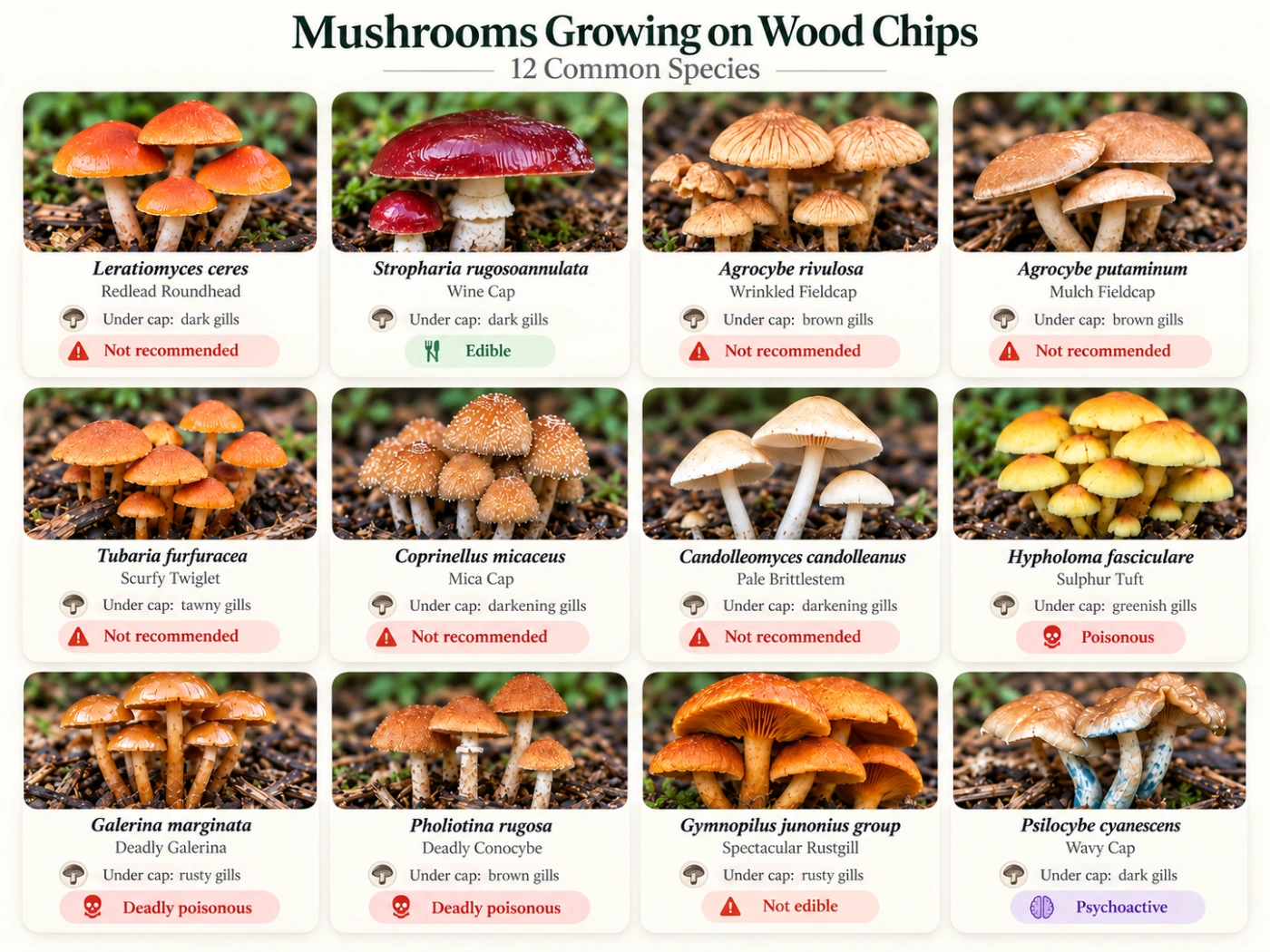
    12 Common Mushrooms Found in Wood Chips

    Species Common name Main clue Safety
    Leratiomyces ceres Redlead Roundhead Orange-red cap, dark gills Not recommended
    Stropharia rugosoannulata Wine Cap Wine-red cap, large ring Edible when correctly identified
    Agrocybe rivulosa Wrinkled Fieldcap Pale brown cap, darkening gills Not recommended
    Agrocybe putaminum Mulch Fieldcap Brown cap, robust stem Not recommended
    Tubaria furfuracea group Scurfy Twiglet Small tawny-brown mushroom Not recommended
    Coprinellus micaceus Mica Cap Clustered brown caps with glitter-like granules Edibility not recommended for beginners
    Candolleomyces candolleanus Pale Brittlestem Pale cap, fragile stem Not recommended
    Hypholoma fasciculare Sulphur Tuft Yellow clusters, greenish gills Poisonous
    Galerina marginata Deadly Galerina Small brown mushroom, rusty spores Deadly poisonous
    Pholiotina rugosa Deadly Conocybe Small brown cap, ringed stem Deadly poisonous
    Gymnopilus junonius group Spectacular Rustgill Orange-brown clusters, rusty gills Not edible
    Psilocybe cyanescens Wavy Cap Wavy caramel cap, blue bruising Psychoactive; not a food mushroom

    Why Do Mushrooms Grow So Well in Wood Chips?

    Wood chips provide fungi with a concentrated source of cellulose, hemicellulose, and lignin. Once moisture enters the mulch layer, fungal mycelium can spread through the chips and gradually break them down.

    Fresh landscaping can therefore create ideal habitat almost overnight from a fungal perspective. A bed that looked empty in summer may produce dozens or hundreds of mushrooms after autumn rain.

    Mulch Is an Artificial Fungal Habitat

    Natural forests contain fallen branches, leaves, and decaying trunks, but landscaped mulch concentrates woody material into a shallow moist layer. This can favor species that spread rapidly through disturbed environments.

    Some wood-chip fungi are now common far outside their original ranges because mulch, nursery plants, and landscaping materials help move fungal mycelium from place to place.

    1. Leratiomyces ceres — Redlead Roundhead
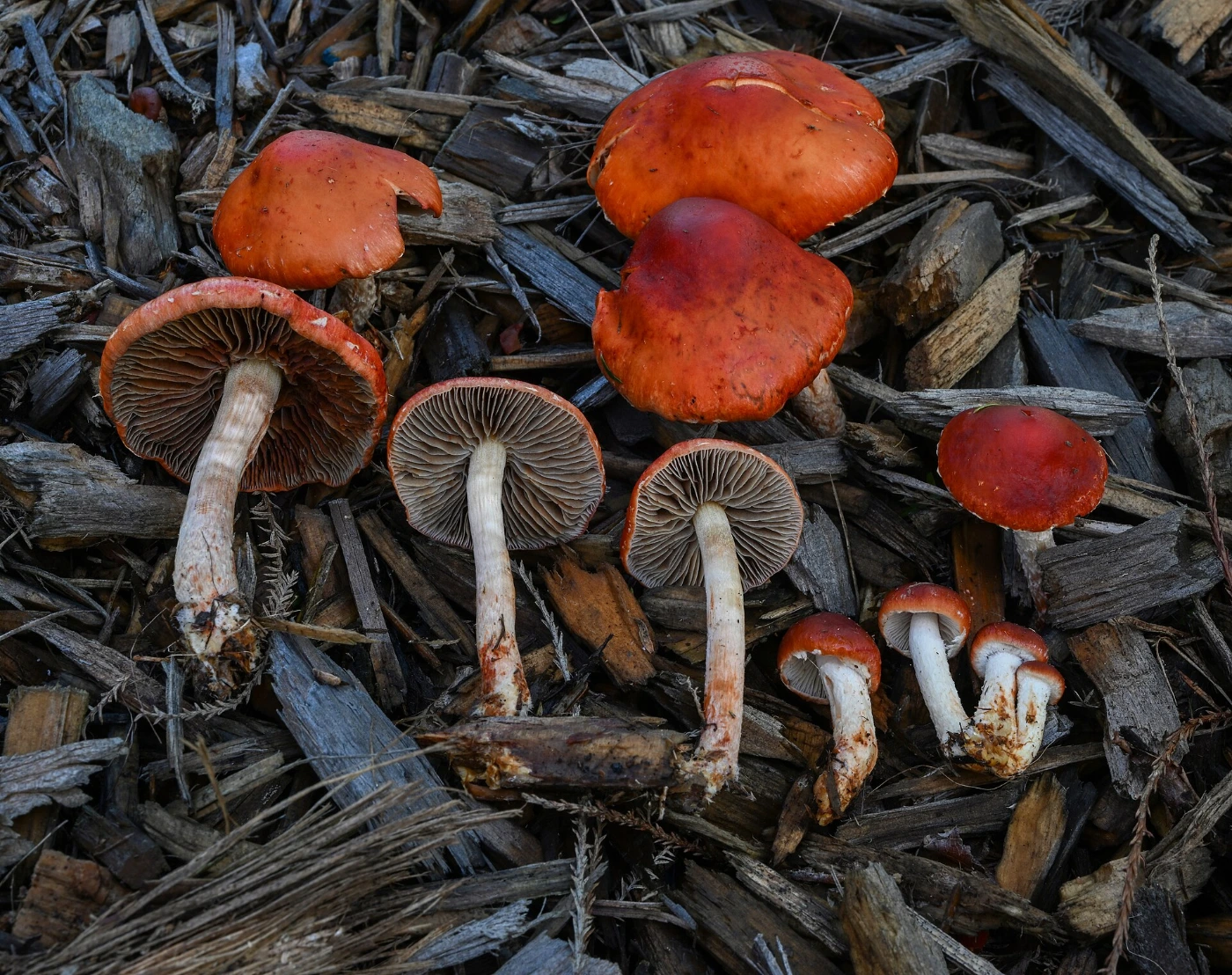
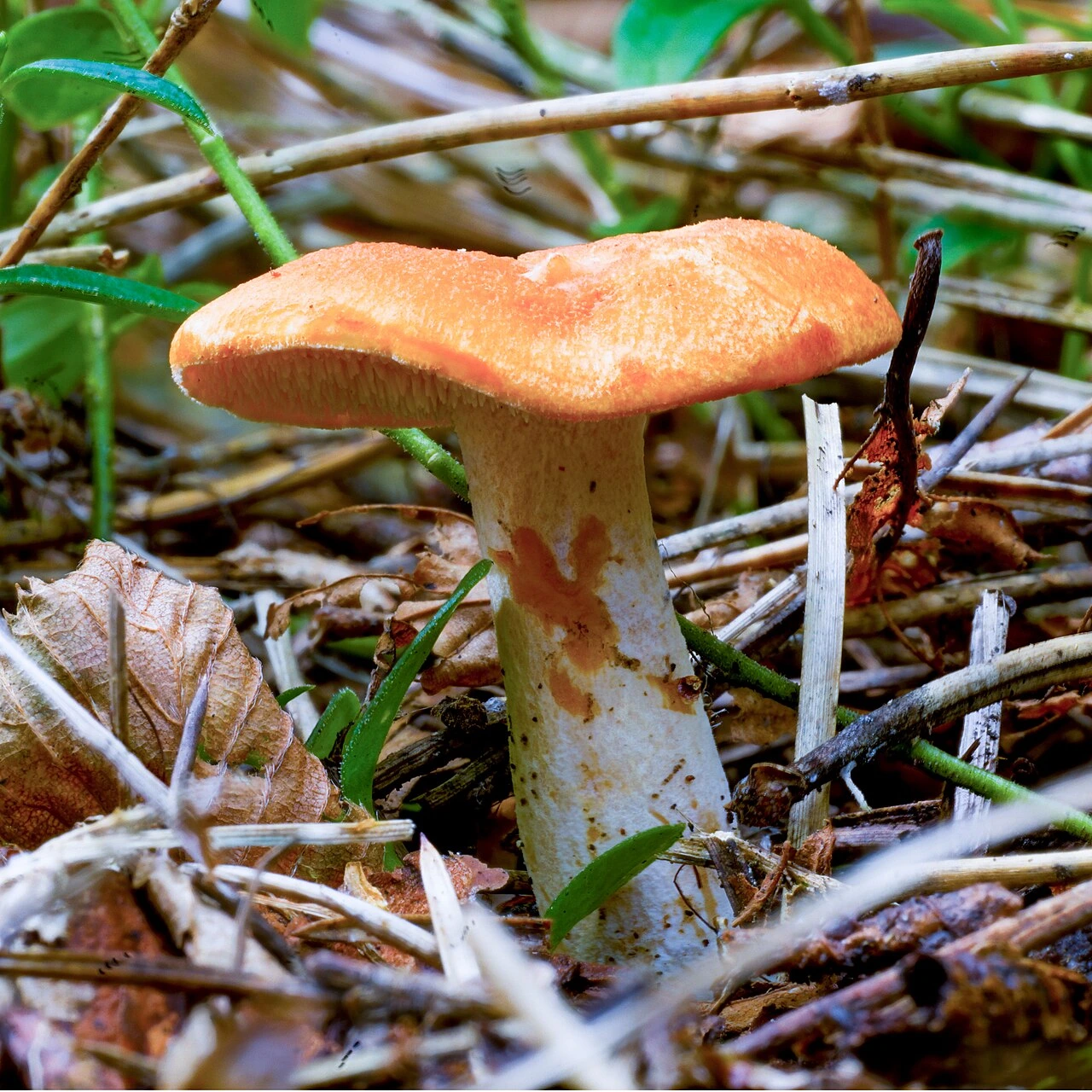
    Leratiomyces ceres is one of the most characteristic mushrooms of urban wood-chip beds. It has a bright orange-red to brick-red cap and usually appears in loose groups or clusters.

    The gills begin pale and become grayish to dark purple-brown as the spores mature. The stem is pale and may retain fragments of veil tissue.

    Habitat

    Wood chips, bark mulch, landscaped garden beds, and park plantings are classic habitats.

    This species is particularly common in disturbed urban environments.

    Main Identification Clue

    The vivid red-orange cap against pale wood chips is often the first clue. Mature dark gills help separate it from many other orange mulch mushrooms.

    2. Stropharia rugosoannulata — Wine Cap

    Wine Cap is a large, robust mushroom with a reddish-purple, wine-red, or brownish cap. Older specimens may fade substantially.

    The stem is pale and usually carries a thick, prominent ring. Mature gills become dark purple-brown.

    Habitat

    It thrives in wood chips, straw, compost-rich beds, and garden mulch.

    It is sometimes intentionally cultivated because it grows readily in woody garden substrates.

    Main Identification Clue

    A large burgundy to brown mushroom with a substantial ring and dark mature gills is a strong Wine Cap candidate.

    Very young pale specimens should still be identified carefully because cap color can fade.

    3. Agrocybe rivulosa — Wrinkled Fieldcap

    This mushroom typically has a pale buff to brown cap that may develop wrinkles or cracks. The gills darken toward brown as spores mature.

    It can appear in large numbers in freshly mulched areas.

    Habitat

    Recently installed wood-chip beds are especially characteristic.

    Urban parks, gardens, and roadside landscaping can produce extensive fruitings.

    Main Identification Clue

    A pale brown mushroom growing abundantly from fresh mulch, with darkening gills and a somewhat wrinkled cap, fits this species well.

    4. Agrocybe putaminum — Mulch Fieldcap

    Agrocybe putaminum is another brown wood-chip mushroom associated with landscaped environments.

    It tends to be more robust than many tiny mulch species, with a brown cap and a substantial stem.

    Habitat

    Wood chips and garden mulch are typical substrates.

    It is especially associated with disturbed ground and landscaped areas.

    Main Identification Clue

    The relatively sturdy build and mulch habitat help separate it from smaller, more fragile brown mushrooms.

    Exact separation from related Agrocybe species can still require closer examination.

    5. Tubaria furfuracea Group — Scurfy Twiglets

    These are small tawny, cinnamon, or orange-brown mushrooms that commonly appear among wood chips, twigs, and leaf litter.

    The caps are often hygrophanous, meaning they change color noticeably as they dry.

    Habitat

    Mulch, small woody debris, garden beds, and woodland litter can all support them.

    They often fruit in cooler, damp weather.

    Main Identification Clue

    Small size, tawny-brown coloration, and strong color change during drying are useful clues.

    Species-level identification within the group can be difficult from photographs alone.

    6. Coprinellus micaceus — Mica Cap

    Mica Caps form clusters of tan to honey-brown mushrooms, often around buried wood or roots.

    Fresh caps may carry tiny glitter-like granules that resemble mica, although rain can wash them away.

    Habitat

    They may appear to grow directly from soil or mulch while actually emerging from buried roots or pieces of wood.

    Stumps, old tree roots, and wood-chip beds can all support them.

    Main Identification Clue

    Clustered growth plus delicate bell-shaped brown caps strongly suggests the group.

    Older mushrooms may darken and begin to collapse as the gills mature.

    7. Candolleomyces candolleanus — Pale Brittlestem

    This mushroom has a pale cream to tan cap and a thin, fragile stem.

    Young caps may retain small white veil fragments around the margin, while mature gills become darker.

    Habitat

    It grows from buried wood, stumps, roots, and woody mulch.

    Groups can appear in gardens, parks, and woodland margins.

    Main Identification Clue

    The very fragile stem and pale cap with veil remnants are useful clues.

    Because many small brown mushrooms look similar, cap-only identification is unreliable.

    8. Hypholoma fasciculare — Sulphur Tuft

    Sulphur Tuft forms dense clusters of bright yellow to sulfur-yellow mushrooms.

    The gills can become greenish-yellow before darkening toward gray-purple as spores mature.

    Habitat

    It usually grows from decaying wood, including stumps and buried roots.

    In mulch beds it may appear to grow from chips or soil when hidden woody material is underneath.

    Safety

    This species is poisonous and can cause gastrointestinal illness.

    Its clustered growth and bright color do not make it safe.

    9. Galerina marginata — Deadly Galerina
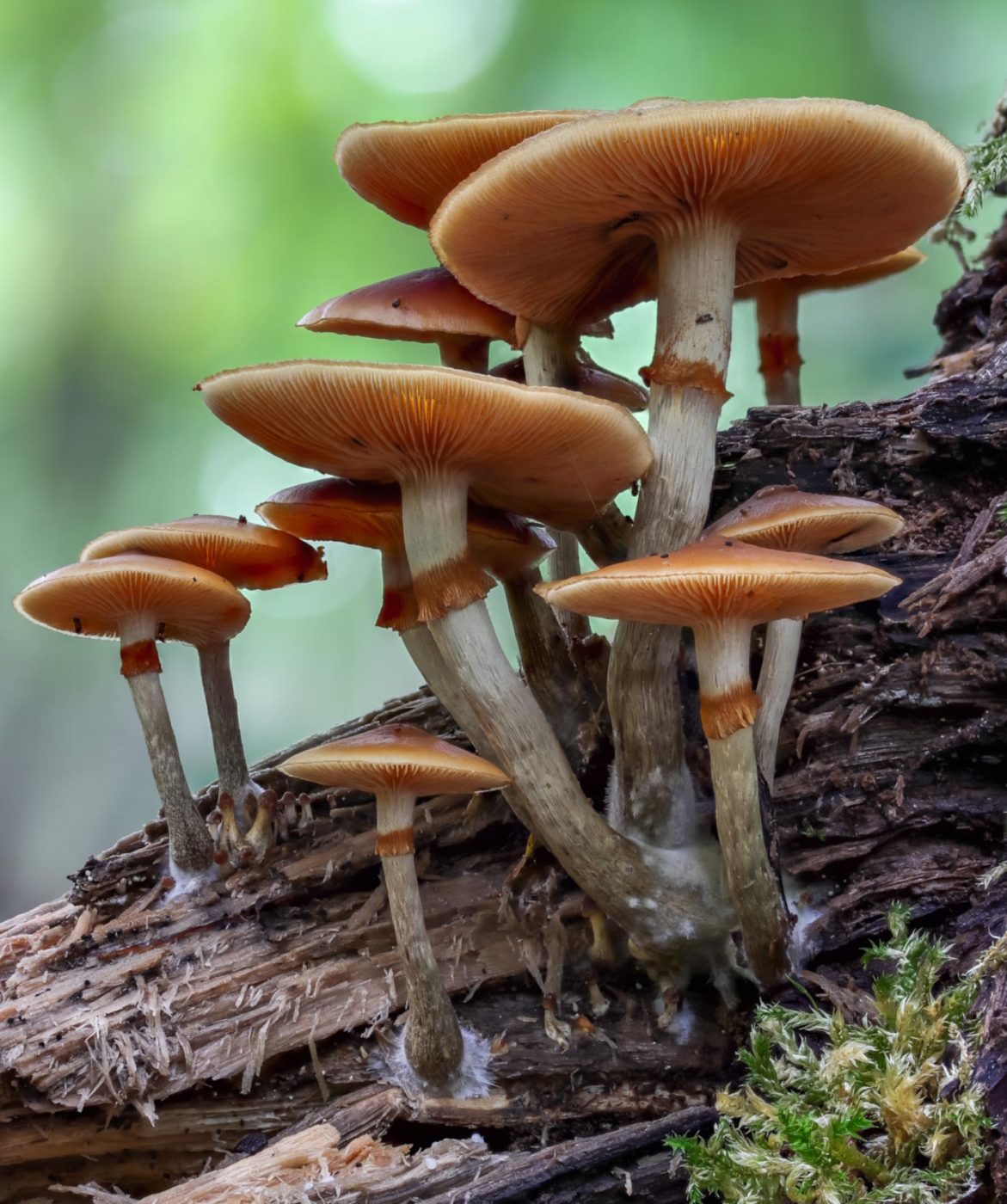
    Galerina marginata is one of the most important dangerous small brown mushrooms to recognize.

    It has a brown to honey-brown cap, rusty-brown mature gills, and often a ring or ring zone on the stem.

    Habitat

    It is usually associated with decaying wood and can occur on buried woody material.

    Wood-chip environments can therefore provide suitable conditions.

    Why It Is Dangerous

    Deadly Galerina contains amatoxins, the same major toxin class associated with Death Cap.

    These toxins can cause severe liver damage and potentially fatal poisoning.

    Main Identification Clue

    Rusty-brown spores are an important feature.

    Any small brown mushroom growing from wood should be treated cautiously until dangerous species have been excluded.

    10. Pholiotina rugosa — Deadly Conocybe

    This is another small brown mushroom capable of containing amatoxins.

    It usually has a smooth brown cap, relatively slender stem, and a distinct ring.

    Habitat

    Mulch, wood chips, gardens, and other disturbed organic substrates are known habitats.

    Its small size makes it easy to overlook.

    Why It Is Dangerous

    Pholiotina rugosa can contain amatoxins and therefore belongs among the most important dangerous mulch mushrooms.

    A tiny brown ringed mushroom should never be judged safe from appearance alone.

    11. Gymnopilus junonius Group — Spectacular Rustgill

    These mushrooms form large yellow-orange to rusty-orange clusters.

    The gills become rusty as the spores mature, and the stems are comparatively robust.

    Habitat

    They normally grow from wood, especially stumps and buried roots.

    Wood-chip beds near old trees can therefore produce apparently soil-growing fruit bodies.

    Main Identification Clue

    Large clustered orange-brown mushrooms with rusty mature gills strongly suggest Gymnopilus.

    The overall size usually separates them from tiny Galerina and Tubaria species.

    12. Psilocybe cyanescens — Wavy Cap

    Psilocybe cyanescens is strongly associated with wood chips in some temperate regions. Mature specimens typically have caramel-brown caps that develop a distinctly wavy margin.

    Damaged areas may stain blue, especially along the cap margin or stem.

    Habitat

    Mulched beds, woody debris, and landscaped environments can provide suitable habitat.

    Its geographic abundance varies considerably.

    Main Identification Clue

    A caramel-colored wavy cap combined with blue bruising and wood-chip habitat is characteristic.

    However, similar small brown mushrooms include dangerous species, so a superficial visual match is not sufficient.

    Small Brown Mushrooms in Wood Chips

    Brown mushrooms are probably the hardest mulch fungi to identify safely. Tubaria, Agrocybe, Candolleomyces, Galerina, Pholiotina, and several other genera can all produce relatively small brown fruit bodies.

    This is a classic example of why “little brown mushroom” is not a useful final identification.

    Check the Gills and Spores

    Gill color changes can narrow the possibilities significantly.

    Rusty-brown spores suggest groups such as Galerina or Gymnopilus, while purple-brown spores point toward other groups such as Stropharia.

    The distinction matters because these genera can differ dramatically in toxicity.

    Orange and Red Mushrooms in Wood Chips

    Brightly colored mulch mushrooms are often easier to notice than brown ones.

    Leratiomyces ceres is one of the most typical examples, with a strong orange-red cap.

    Other orange mushrooms may actually be growing from buried roots rather than from the chips themselves.

    The substrate should therefore be checked carefully.

    Yellow Mushrooms in Wood Chips

    Dense yellow clusters may indicate Sulphur Tuft when buried wood or stumps are present.

    Color alone is not enough, though, because several unrelated fungi can be yellow.

    The gills, growth pattern, and hidden woody substrate provide much more useful information.

    Why Mushrooms Sometimes Appear to Grow From Soil

    Mulch beds often cover old roots, tree stumps, branches, or previous layers of woody material.

    A mushroom may therefore look like a soil-growing species even though its mycelium is actually decomposing buried wood.

    Expose the Base Carefully

    You do not need to dig extensively, but gently examining the base can sometimes reveal attached wood fibers or buried chips.

    This can help distinguish wood-decaying fungi from soil-associated species.

    Are Mushrooms in Wood Chips Edible?

    Some are, but wood-chip habitat is not a safety indicator.

    Wine Cap is a well-known edible species when correctly identified, while the same general environment can support poisonous Sulphur Tuft and deadly amatoxin-containing fungi.

    The correct sequence is always identify the species first, consider edibility second.

    Dangerous Wood-Chip Mushrooms

    The most important safety concern is not usually large brightly colored mushrooms but small brown species that look unremarkable.

    Galerina marginata and Pholiotina rugosa deserve particular attention because both can contain amatoxins.

    Why Amatoxin Mushrooms Are Especially Dangerous

    Symptoms may be delayed for many hours after consumption.

    By the time severe gastrointestinal symptoms begin, toxins may already be damaging the liver.

    This is why uncertain small brown mushrooms should never be used for food.

    How to Identify a Mushroom Growing in Wood Chips

    Start with size and growth pattern, then examine the underside.

    A single robust mushroom, a dense cluster, and dozens of tiny scattered mushrooms each suggest different groups.

    Step 1: Confirm the Substrate

    Determine whether the mushroom is actually growing from loose chips, buried wood, roots, or underlying soil.

    The substrate can immediately narrow the ecological possibilities.

    Step 2: Check the Gills

    Record whether the gills are pale, yellow, greenish, rusty, purple-brown, or nearly black at maturity.

    Mature gill color often reflects spore color and can be extremely informative.

    Step 3: Look for a Ring

    A ring can separate closely related possibilities.

    Wine Cap has a substantial ring, while Pholiotina rugosa may have a much smaller ring on a delicate stem.

    Step 4: Check for Bruising

    Some species show characteristic bruising reactions.

    Blue staining is especially notable in certain wood-chip species, but bruising should never be used as a toxicity test.

    Step 5: Compare Young and Mature Mushrooms

    Young specimens often hide important mature characters.

    If a patch contains many fruit bodies, compare different ages before making an identification.

    How to Photograph Wood-Chip Mushrooms

    Take one wide image showing the entire patch and the mulch surface.

    Then photograph a complete mushroom from the side, including the stem base and any ring.

    An underside image should show mature gills clearly. If mushrooms of different ages are present, photograph them together because color changes can be highly informative.

    Can AI Identify Mushrooms Growing in Wood Chips?

    AI can use mulch habitat as a useful clue and may identify distinctive species such as Wine Cap or Redlead Roundhead reasonably well from good photographs.

    Small brown species remain much more difficult because many genera overlap visually.

    A cautious system should sometimes return several possibilities rather than force an exact species, especially when Galerina or other dangerous look-alikes cannot be excluded.

    Common Identification Mistakes

    A common mistake is assuming every mushroom in mulch is feeding directly on the visible chips. Buried roots or old wood can support completely different species.

    Another mistake is identifying small brown mushrooms from cap shape alone. Mature gill and spore colors are often far more informative.

    The most serious mistake is assuming a familiar-looking wood-chip mushroom is safe because the same patch produced an edible species before. Multiple species can fruit together in the same mulch bed.

    Interesting Facts About Wood-Chip Mushrooms

    Urban landscaping has created enormous new habitats for wood-decaying fungi. A species that once depended mainly on natural woody debris can now encounter suitable substrate in gardens, parks, parking lots, and roadside plantings.

    Wood chips can also help fungi travel. Mycelium may be moved with nursery plants, compost, bark, and landscaping materials, allowing species to establish in new regions.

    Some mulch fungi appear remarkably quickly after wood chips are installed. Their mycelium may already be present in the material before it reaches the garden.

    A wood-chip bed is also a miniature ecosystem rather than a habitat for one fungus. Different species may dominate as the mulch ages and the chemistry of the decomposing wood changes.

    Frequently Asked Questions

    Why did hundreds of mushrooms suddenly appear after rain?

    The fungal mycelium was already growing through the mulch. Moisture and suitable temperatures triggered many fruit bodies to develop at approximately the same time.

    Will wood-chip mushrooms damage garden plants?

    Most mulch decomposers feed on dead organic material rather than healthy plants. They are usually participating in decomposition rather than attacking garden vegetation.

    Why do different mushrooms appear in the same mulch bed in different years?

    As wood chips decompose, moisture, nutrient levels, and structure change. Different fungal species can become favored at different stages.

    Can replacing the mulch introduce new mushroom species?

    Yes. New wood chips may contain fungal mycelium or spores and can also create a different substrate from the previous mulch.

    Why are some mushrooms only around old trees?

    Buried roots and decaying wood can provide additional food sources beneath the mulch. The mushrooms may actually be associated with those hidden materials.

    Can mushroom mycelium remain after the fruit bodies disappear?

    Yes. The visible mushrooms may last only days, while the underlying mycelium can remain active for months or years.

    Does removing the mushrooms eliminate the fungus?

    No. Picking fruit bodies removes only the reproductive structures. Most of the organism remains within the chips or buried wood.

    Can several dangerous and harmless species grow together?

    Yes. A single mulch bed can support multiple species at exactly the same time, so each type must be identified separately.

    Final Identification Notes

    Wood chips support a surprisingly diverse fungal community, including Redlead Roundhead, Wine Cap, fieldcaps, Mica Caps, Sulphur Tuft, Deadly Galerina, Deadly Conocybe, Rustgills, and many small brown mushrooms.

    The safest identification strategy begins with the substrate and mature gills. Ring structure, growth pattern, bruising, and spore color can then narrow the possibilities.

    Most importantly, never treat “growing in wood chips” as evidence that a mushroom is edible. The same mulch bed can contain both edible species and dangerously toxic ones.
  • Small Orange Mushrooms: 12 Common Species and How to Identify Them

    Small Orange Mushrooms: 12 Common Species and How to Identify Them

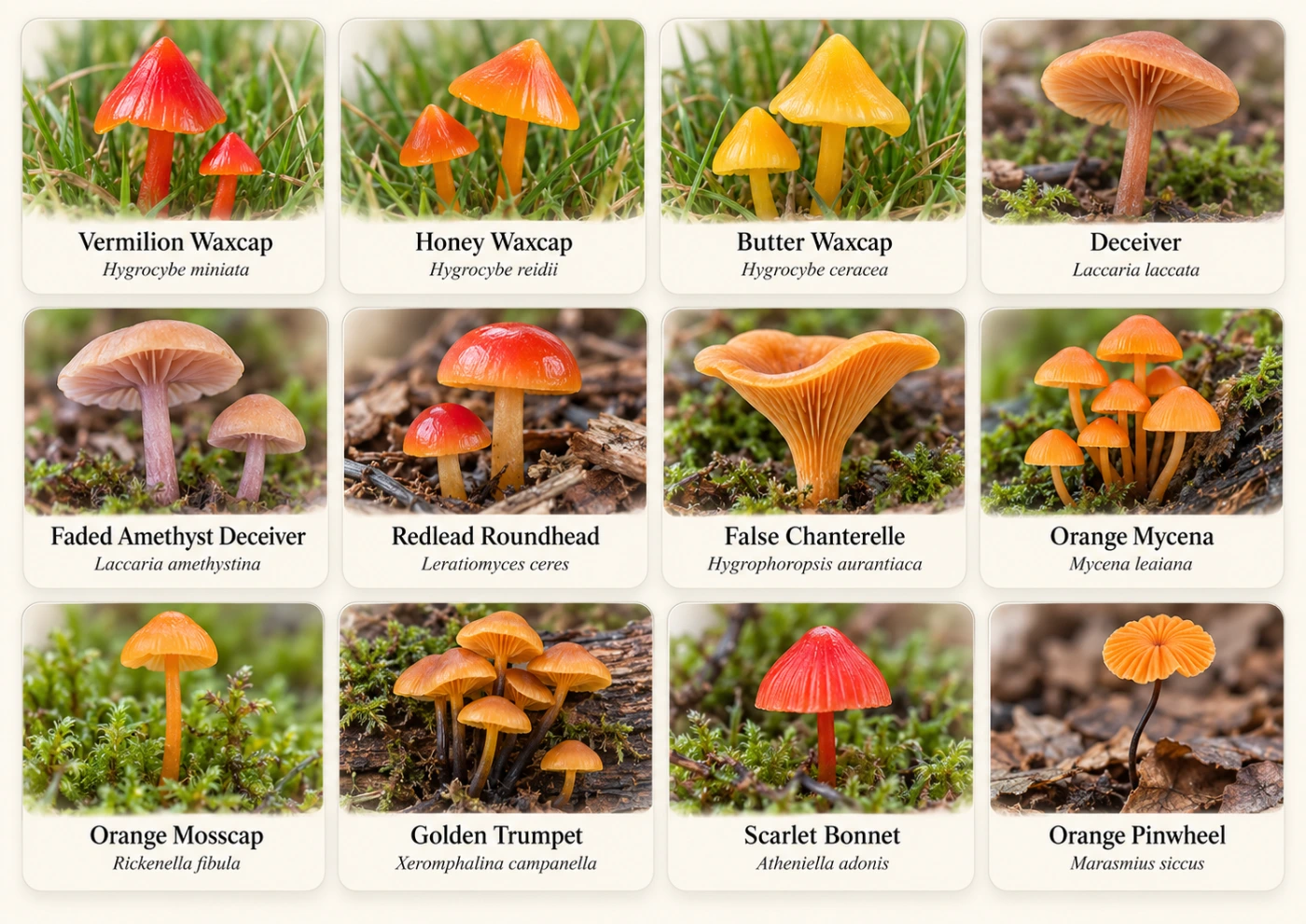
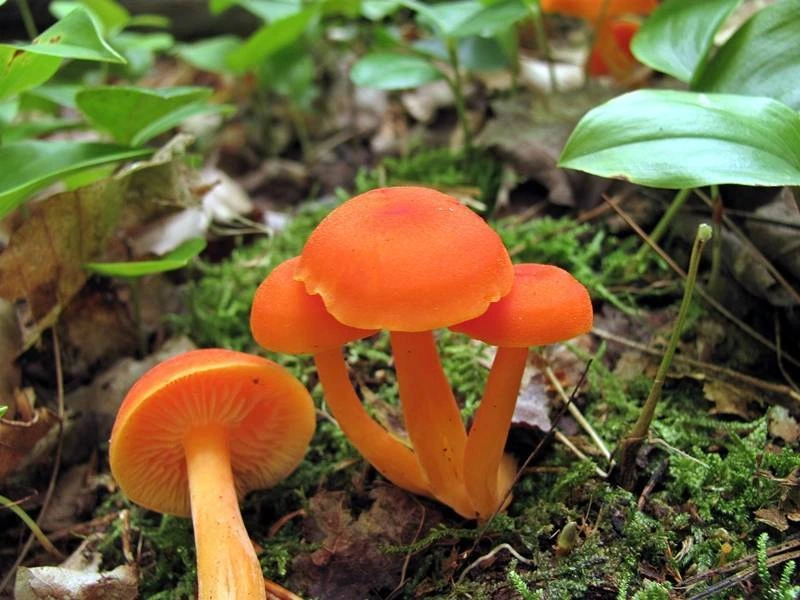
    Small orange mushrooms can appear in lawns, forests, wood-chip beds, moss, and even on decaying wood. Some are tiny waxcaps with vivid orange caps, others are small gilled mushrooms, false chanterelles, or clustered species growing from mulch and buried wood.

    Because many unrelated fungi can be orange, color alone is not enough for identification. The safest approach is to check the underside, stem, substrate, growth pattern, bruising, and nearby trees.

    If the mushroom you found is larger or does not fit the small species in this guide, see our broader guide to Orange Mushroom Identification: Common Species, Edible and Poisonous.

    ⚠️ Important: Orange color does not indicate edibility. Never eat a wild mushroom based solely on appearance, a photograph, AI identification, or an online comparison.

    12 Small Orange Mushrooms at a Glance

    Species Common name Edibility / Toxicity Safety note
    Hygrocybe miniata Vermilion Waxcap Not recommended Very small; waxcap edibility is poorly documented and not a good target for foraging
    Hygrocybe reidii Honey Waxcap Not recommended Edibility is not well established; best treated as non-food
    Hygrocybe ceracea Butter Waxcap Not recommended Small waxcap with little food value; identification can be difficult
    Laccaria laccata Deceiver Edible when correctly identified and cooked Similar-looking Laccaria species and variable coloration can cause confusion
    Laccaria amethystina Amethyst Deceiver Edible when correctly identified and cooked Best eaten only in moderation; can accumulate trace elements from soil
    Leratiomyces ceres Redlead Roundhead Inedible / not recommended Not considered a food mushroom; avoid consumption
    Hygrophoropsis aurantiaca False Chanterelle Not recommended Can cause gastrointestinal upset in some people
    Mycena leaiana Orange Mycena Inedible / not recommended Small and not regarded as a food species
    Rickenella fibula Orange Mosscap Inedible / not recommended Tiny species with no practical food value
    Xeromphalina campanella Golden Trumpet Inedible / not recommended Tough and not regarded as a food mushroom
    Atheniella adonis Scarlet Bonnet Inedible / not recommended Tiny bonnet mushroom; edibility not considered useful or reliable
    Marasmius siccus Orange Pinwheel Inedible / not recommended Very small, wiry mushroom with no practical food value

    Why Are So Many Small Mushrooms Orange?

    Orange coloration appears in many unrelated mushroom groups. In some species it comes from carotenoid-like pigments, while in others it is produced by completely different compounds.

    This means two tiny orange mushrooms growing only a few meters apart may belong to entirely different genera. One may grow from grass, another from moss, and another from buried wood.

    Color Changes With Age

    Young fruit bodies often show the strongest orange tones. As mushrooms age, sun exposure and drying can shift the cap toward yellow, tan, brown, or faded peach.

    Rain can also make caps appear darker and more saturated. This is why a single color description should never be treated as decisive.

    1. Hygrocybe miniata — Vermilion Waxcap

    Hygrocybe miniata is a small waxcap with a vivid orange-red to scarlet cap. The cap is usually only a few centimeters across and may become slightly depressed with age.

    The gills are pale yellow to orange and have the thick, waxy texture typical of many waxcaps.

    Habitat

    Vermilion Waxcap is usually found in unimproved grassland, lawns, meadows, and other low-nutrient habitats.

    It is especially associated with older grasslands that have not been heavily fertilized.

    Main Identification Clue

    The combination of a very small size, vivid orange-red cap, waxy gills, and grassland habitat strongly suggests a waxcap.

    2. Hygrocybe reidii — Honey Waxcap

    Honey Waxcap is another small orange grassland mushroom. It usually has an orange to reddish-orange cap with pale yellow-orange gills.

    One of its most distinctive characters is a sweet smell sometimes compared with honey.

    Habitat

    It grows in grassland rather than directly from wood. As with other waxcaps, nutrient-poor lawns and old meadows are typical habitats.

    Main Identification Clue

    A small orange waxcap with a distinctly sweet smell can point toward Hygrocybe reidii.

    Odor should still be used as a supporting rather than primary feature.

    3. Hygrocybe ceracea — Butter Waxcap

    Butter Waxcap is yellow to orange-yellow and often looks slightly greasy or waxy. It is usually small and delicate.

    The gills are pale and thick compared with many ordinary gilled mushrooms.

    Habitat

    This species also prefers grassland. It can occur in lawns, meadows, and grassy woodland margins.

    Main Identification Clue

    Its butter-yellow to orange coloration and waxy texture distinguish it from many drier small orange mushrooms.

    4. Laccaria laccata — Deceiver

    The Deceiver is famous for changing appearance dramatically as it dries. Fresh caps can be orange-brown, reddish-brown, or cinnamon, while dry specimens may become much paler.

    The gills are thick and widely spaced, often pale pinkish or flesh-colored.

    Habitat

    It grows from soil in woodland and is mycorrhizal with a variety of trees.

    It is common in both coniferous and broadleaf forests.

    Main Identification Clue

    Widely spaced thick gills are more useful than cap color.

    The mushroom’s variable appearance explains the common name “Deceiver.”

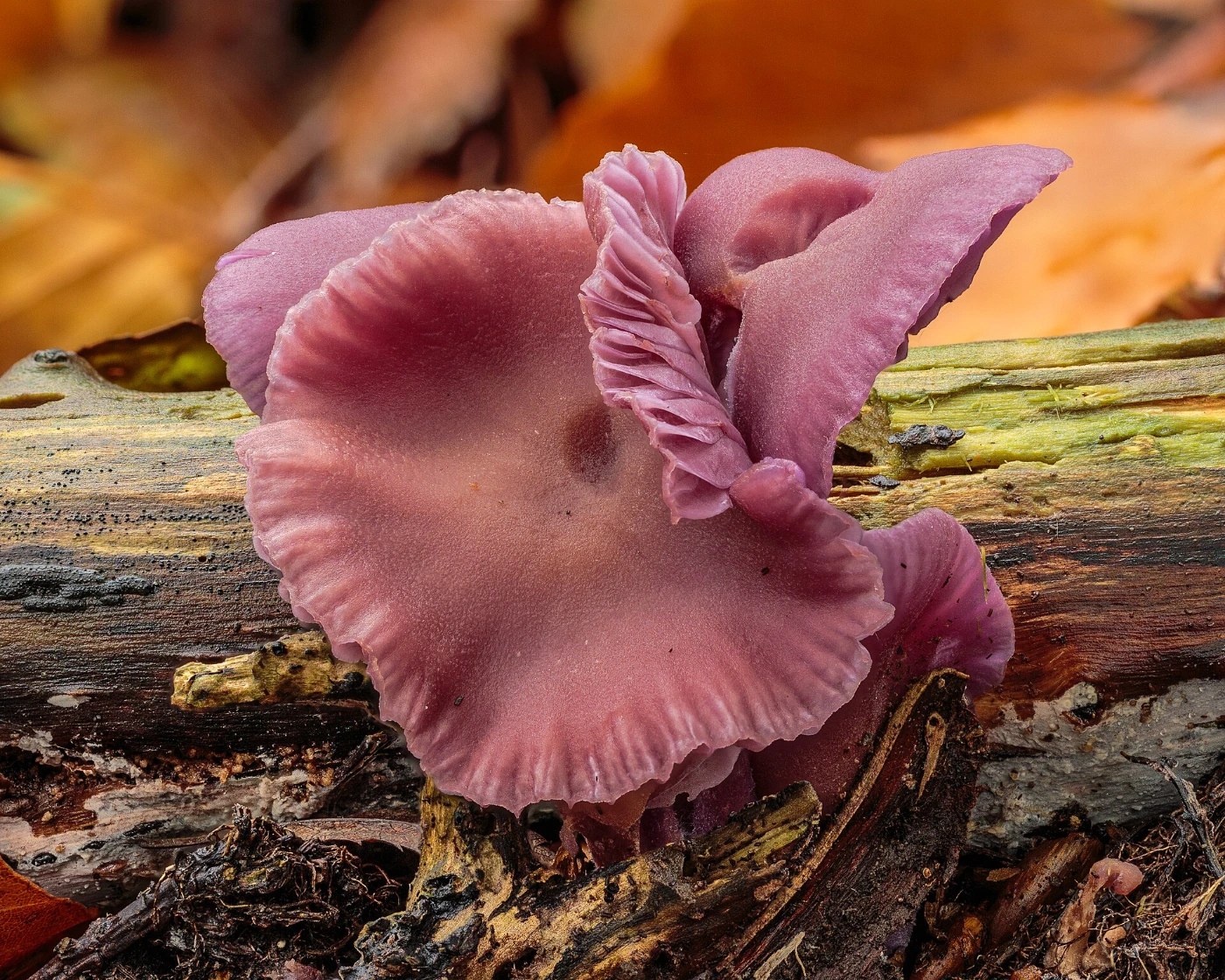
    5. Laccaria amethystina — Faded Amethyst Deceiver

    Fresh Laccaria amethystina is normally purple, but old or heavily faded specimens can lose much of that color.

    They may become pale brown, tan, or occasionally warm orange-brown, especially on the cap.

    Habitat

    It grows in woodland, often with beech and other trees.

    Main Identification Clue

    Look for remaining violet tones in the gills or protected areas of the stem.

    A truly orange mushroom with no trace of purple is more likely to be another species.

    6. Leratiomyces ceres — Redlead Roundhead

    Leratiomyces ceres is a small to medium orange-red mushroom commonly found in wood-chip beds and landscaped areas.

    The cap can range from bright orange-red to brick-red, while the gills darken as the spores mature.

    Habitat

    Wood chips, mulch, garden beds, and landscaped urban areas are classic habitats.

    It can occur in large groups after rain.

    Main Identification Clue

    The combination of an orange-red cap and growth from wood chips is highly characteristic.

    7. Hygrophoropsis aurantiaca — False Chanterelle

    False Chanterelle is often orange to deep orange and can be smaller than many true chanterelles.

    The underside has thin, crowded, strongly forked true gills, unlike the thick blunt ridges of real chanterelles.

    Habitat

    It often grows in coniferous woodland, especially among needles or decaying woody debris.

    Main Identification Clue

    Thin forked gills are the key feature.

    A true chanterelle has thick blunt false gills instead.

    8. Mycena leaiana — Orange Mycena

    Mycena leaiana forms small bright orange to yellow-orange mushrooms, often in dense clusters.

    The caps are small and delicate, while the gills are pale yellowish to orange.

    Habitat

    This species grows directly from decaying hardwood.

    Logs, fallen branches, and stumps are typical substrates.

    Main Identification Clue

    Bright orange clusters growing directly from hardwood strongly suggest this species.

    9. Rickenella fibula — Orange Mosscap

    Orange Mosscap is extremely small. The cap may be only a few millimeters to around a centimeter across.

    It has a bright orange to orange-yellow cap and a thin stem.

    Habitat

    The species is closely associated with moss and commonly appears in mossy lawns, woodland, gardens, and damp grassy places.

    Main Identification Clue

    If the mushroom is truly tiny and growing directly among moss, Rickenella fibula is a strong possibility.

    10. Xeromphalina campanella — Golden Trumpet

    Golden Trumpet produces small orange-brown mushrooms in dense clusters.

    The caps often become depressed or funnel-shaped, and the stems are thin and dark toward the base.

    Habitat

    This species grows from decaying conifer wood, especially old stumps and logs.

    Large colonies can cover a section of rotten wood.

    Main Identification Clue

    A cluster of tiny orange-brown mushrooms on conifer wood with darker slender stems is characteristic.

    11. Atheniella adonis — Scarlet Bonnet

    Scarlet Bonnet is a tiny woodland mushroom with a vivid orange-red to pink-red cap.

    Its slender pale stem gives the mushroom a delicate appearance.

    Habitat

    It is usually found among moss, litter, and damp woodland debris.

    Main Identification Clue

    The very small size and brilliant reddish-orange cap make it stand out, even though the mushroom itself is delicate.

    12. Marasmius siccus — Orange Pinwheel

    Orange Pinwheel is a tiny mushroom with a strongly pleated orange to reddish-orange cap.

    The stem is extremely thin, wiry, and dark brown to almost black.

    Habitat

    It grows from leaf litter and small pieces of organic debris in deciduous woodland.

    Main Identification Clue

    The contrast between the bright orange pleated cap and the dark hair-like stem is highly distinctive.

    Small Orange Mushrooms in Grass

    Small orange mushrooms in grass are often waxcaps. Hygrocybe miniata, Hygrocybe reidii, and Hygrocybe ceracea are all good examples.

    The cap may be brightly colored, but the thick waxy gills are a more useful identification feature.

    Why Grassland Matters

    Waxcaps are strongly associated with certain types of established grassland. A tiny orange mushroom growing from an old lawn is therefore more likely to be a waxcap than a wood-decaying Mycena.

    The same-looking mushroom emerging directly from a stump should be identified along a completely different path.

    Small Orange Mushrooms in Moss

    Moss supports some exceptionally tiny mushrooms. Rickenella fibula is one of the most characteristic orange examples.

    Small bonnet-like species can also occur among moss and damp litter.

    The exact substrate matters. Check whether the mushroom is emerging from moss itself, underlying soil, or hidden wood.

    Small Orange Mushrooms on Wood

    If a tiny orange mushroom grows directly from a log or stump, species such as Mycena leaiana or Xeromphalina campanella become much more likely.

    Wood type can help narrow the identification further. Xeromphalina campanella is particularly associated with conifer wood, while Mycena leaiana is commonly found on hardwood.

    Small Orange Mushrooms in Wood Chips

    Wood-chip beds have their own fungal community. Leratiomyces ceres is one of the most conspicuous orange-red species in landscaped areas.

    Mulch can also support many brown, yellow, and reddish mushrooms, so the substrate alone does not prove the species.

    The color of mature gills and spore deposit can become useful when separating similar wood-chip mushrooms.

    Small Orange Mushrooms With Gills

    Most species in this guide have true gills, but those gills can look very different.

    Waxcaps have thick waxy gills, Laccaria has broad widely spaced gills, and False Chanterelle has many thin forked gills.

    Examining the underside is therefore much more informative than simply noting “orange cap.”

    Small Orange Mushrooms That Look Like Chanterelles

    False Chanterelle is probably the most important example. It can have a funnel-shaped orange cap and grow in woodland, making the resemblance convincing from above.

    The underside resolves the comparison.

    True Chanterelle vs False Chanterelle

    True chanterelles have thick blunt ridges that are part of the cap tissue. False Chanterelle has thin flexible true gills.

    True chanterelles are also generally more substantial than the small delicate orange mushrooms covered by this article.

    Are Small Orange Mushrooms Poisonous?

    There is no general answer. Orange pigmentation occurs in edible, inedible, toxic, and poorly studied mushroom groups.

    Some tiny mushrooms are also difficult to identify to species without microscopy. This makes them especially unsuitable for identification based only on appearance.

    Small Does Not Mean Safe

    A common misconception is that very small mushrooms cannot contain significant toxins. Size has no reliable relationship with toxicity.

    Some dangerous mushroom genera contain species with relatively small fruit bodies.

    How to Identify a Small Orange Mushroom Step by Step

    The first step is to determine what the mushroom is growing from. Grass, moss, soil, hardwood, conifer wood, and mulch each point toward different groups.

    Then examine the underside and stem.

    Step 1: Check the Substrate

    Grass suggests waxcaps. Moss strongly supports species such as Orange Mosscap, while direct wood growth points toward wood-decaying species.

    Mulch and wood-chip beds strongly suggest a different group again.

    Step 2: Check the Gills

    Look at their thickness, spacing, color, and attachment to the stem.

    Waxy thick gills, widely spaced gills, and thin crowded forked gills are very different structures.

    Step 3: Look at the Stem

    Check whether the stem is pale, orange, fibrous, dark, or almost hair-like.

    Orange Pinwheel, for example, has a dark wiry stem that is very different from a waxcap stem.

    Step 4: Check the Growth Pattern

    A single tiny mushroom in moss suggests different possibilities from hundreds of orange mushrooms carpeting a log.

    Clustered growth is especially useful with wood-decaying species.

    Step 5: Consider Size

    Measure the cap rather than relying on visual impression.

    A cap only 5–10 mm wide belongs to a very different size class from a mushroom 4–5 cm across, even if both appear “small” in a photograph.

    How to Photograph Small Orange Mushrooms

    Small mushrooms are difficult to identify from distant images. Move close enough to show the gills, stem, and cap surface clearly.

    Include at least one image showing the substrate. A macro photograph without any habitat context can remove one of the most valuable identification clues.

    If the mushrooms are clustered, photograph the whole group before taking individual close-ups.

    Can AI Identify Tiny Orange Mushrooms?

    AI can often narrow the mushroom to a likely group when both structure and habitat are visible.

    Tiny species are more challenging because the decisive characters may be very small, and many closely related mushrooms look nearly identical in ordinary photographs.

    The best result may therefore be a genus or group rather than an exact species. In small orange mushrooms, that level of caution is often appropriate.

    Common Identification Mistakes

    One common mistake is assuming all small orange mushrooms are baby chanterelles. Many are unrelated gilled fungi.

    Another is ignoring the substrate. The same orange color can appear in a grassland waxcap, a moss-associated Rickenella, and a wood-decaying Mycena.

    A third mistake is using cap color more precisely than the mushroom allows. Orange, yellow-orange, red-orange, and brown-orange can shift dramatically with age and moisture.

    Interesting Facts About Small Orange Mushrooms

    Some of the smallest mushrooms can be ecologically very specialized. Orange Mosscap, for example, is closely associated with mossy habitats, while other tiny species specialize in particular types of decaying wood.

    Waxcaps are also useful indicators of long-established low-nutrient grassland. Areas containing diverse waxcap communities can have considerable ecological value.

    The Deceiver illustrates another challenge in mushroom identification: a single species can change color so dramatically while drying that young and old specimens may look like different mushrooms.

    Tiny fungi are also easy to overlook in biodiversity surveys. A patch of moss or leaf litter that appears empty from standing height can contain numerous miniature mushroom species.

    Frequently Asked Questions

    Why do tiny orange mushrooms sometimes appear overnight?

    Small fruit bodies can develop quickly once moisture and temperature become favorable. The fungal mycelium was already present in the substrate before the mushrooms appeared.

    Why do some disappear after only one sunny day?

    Tiny mushrooms have little water stored in their tissues. Dry, warm weather can dehydrate them very rapidly.

    Can mowing cause orange mushrooms to appear in a lawn?

    Mowing does not create them, but short grass can make existing fruit bodies easier to notice. Changes in moisture and grass management can also affect fruiting.

    Why do mushrooms on the same log have different shades of orange?

    They may be different ages or even different species. Hydration and light exposure also change the intensity of cap color.

    Can small orange mushrooms grow indoors?

    Occasionally, fungi associated with damp wood, potting material, or organic debris can fruit indoors. Indoor appearance does not make the species easier to identify.

    Do all orange waxcaps feel waxy to the touch?

    Not necessarily in an obvious way. “Waxy” often describes the texture and structure of the gills as much as the feel of the cap.

    Are orange mushrooms more common in autumn?

    Many are, because cool wet conditions favor fruiting. However, timing varies by species and climate.

    Can one patch contain several different small orange species?

    Yes. Woodland litter, moss, and grassland can support multiple species simultaneously, so each type should be examined separately.

    Final Identification Notes

    “Small orange mushroom” describes an appearance, not a biological group. Waxcaps, bonnets, wood-decaying mushrooms, false chanterelles, and tiny moss-associated fungi can all fit that description.

    The most useful first question is therefore not “which orange mushroom is this?” but “what is this orange mushroom growing from?” Once the substrate is known, check the gills, stem, size, and growth pattern.

  • Jedovaté houby v Česku: 15 druhů, které byste měli znát

    Jedovaté houby v Česku: 15 druhů, které byste měli znát

    České lesy patří k nejbohatším houbařským oblastem Evropy, ale vedle hřibů, lišek a dalších oblíbených jedlých druhů v nich rostou také houby způsobující vážné otravy. Některé vyvolávají především zažívací obtíže, jiné působí na nervový systém a několik druhů může způsobit selhání jater nebo ledvin.

    Největší nebezpečí představují houby, které se podobají známým jedlým druhům. Při určování proto nestačí barva klobouku nebo místo nálezu; je nutné hodnotit lupeny, třeň, bázi třeně, výtrusy, změny barvy a další znaky. Základní postup najdete také v našem průvodci Určování hub: Jak správně poznat druh houby.

    ⚠️ Důležité: Nikdy nekonzumujte divokou houbu pouze na základě fotografie nebo výsledku AI. U jedovatých druhů může být chyba v určení velmi nebezpečná a u některých otrav se první příznaky objeví až po mnoha hodinách.

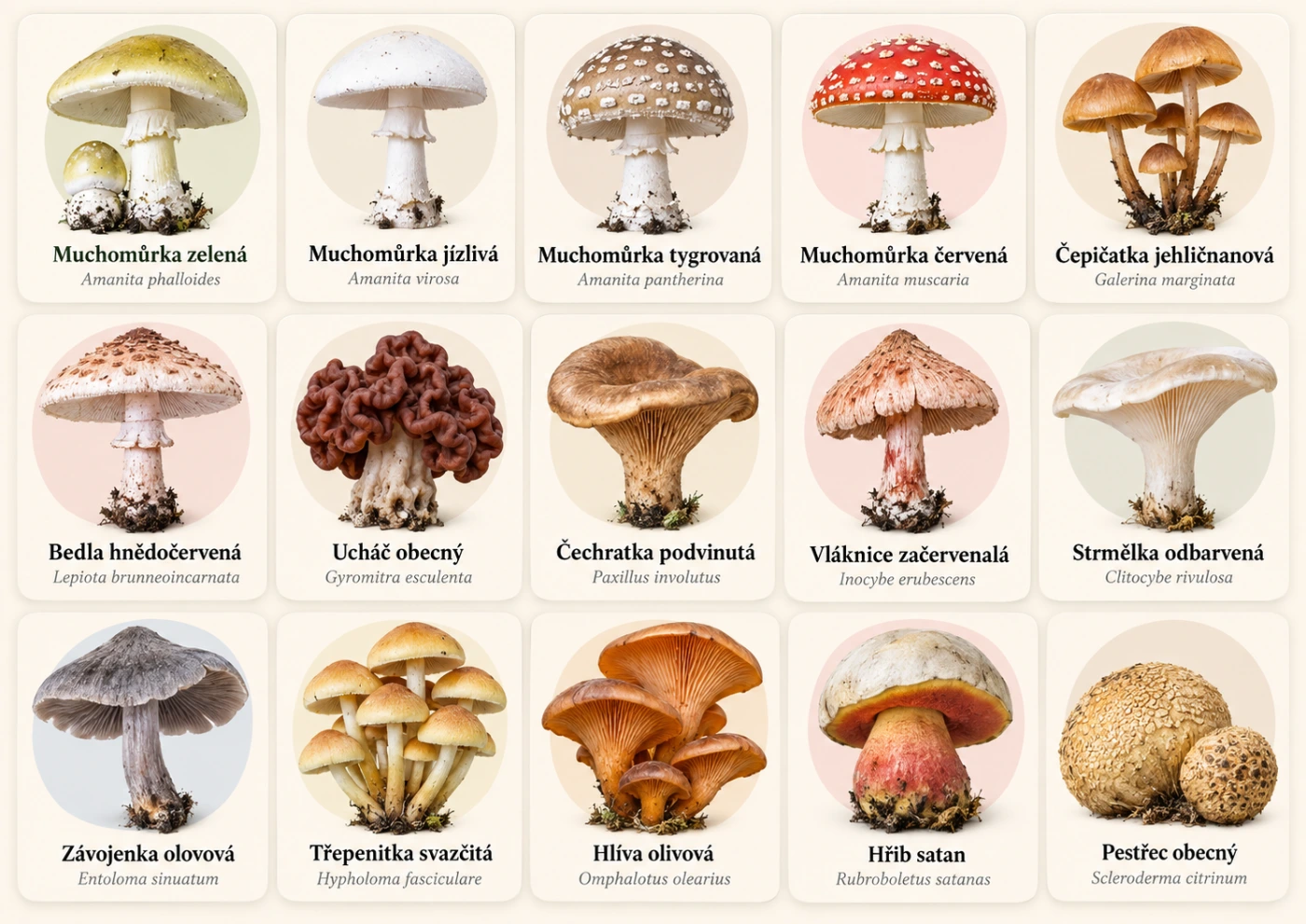
    15 jedovatých hub, které můžete potkat v Česku

    Druh Český název Hlavní znak Riziko
    Amanita phalloides Muchomůrka zelená Bílá pochva, bílé lupeny Smrtelně jedovatá
    Amanita virosa Muchomůrka jízlivá Celá bílá, pochva Smrtelně jedovatá
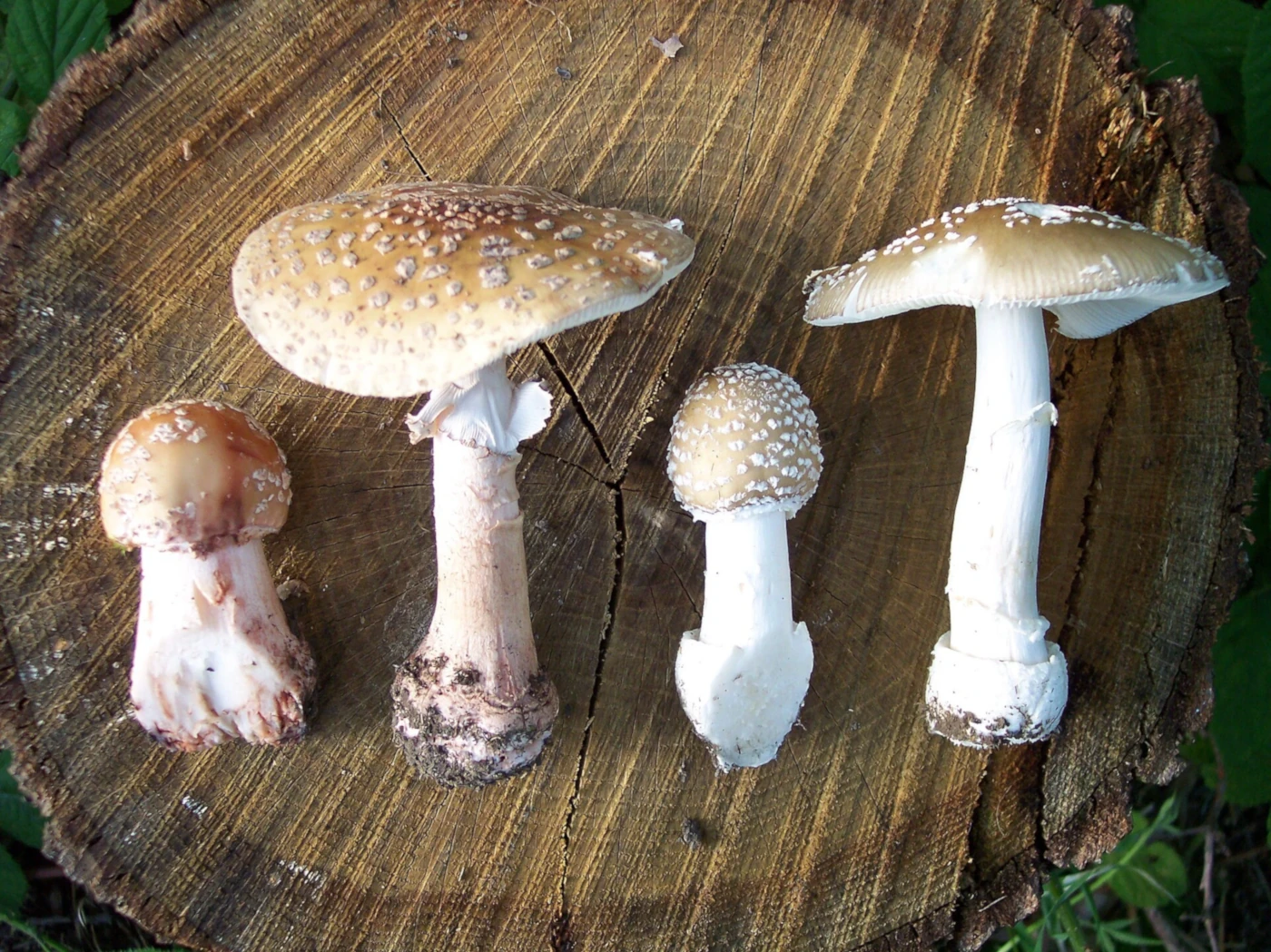
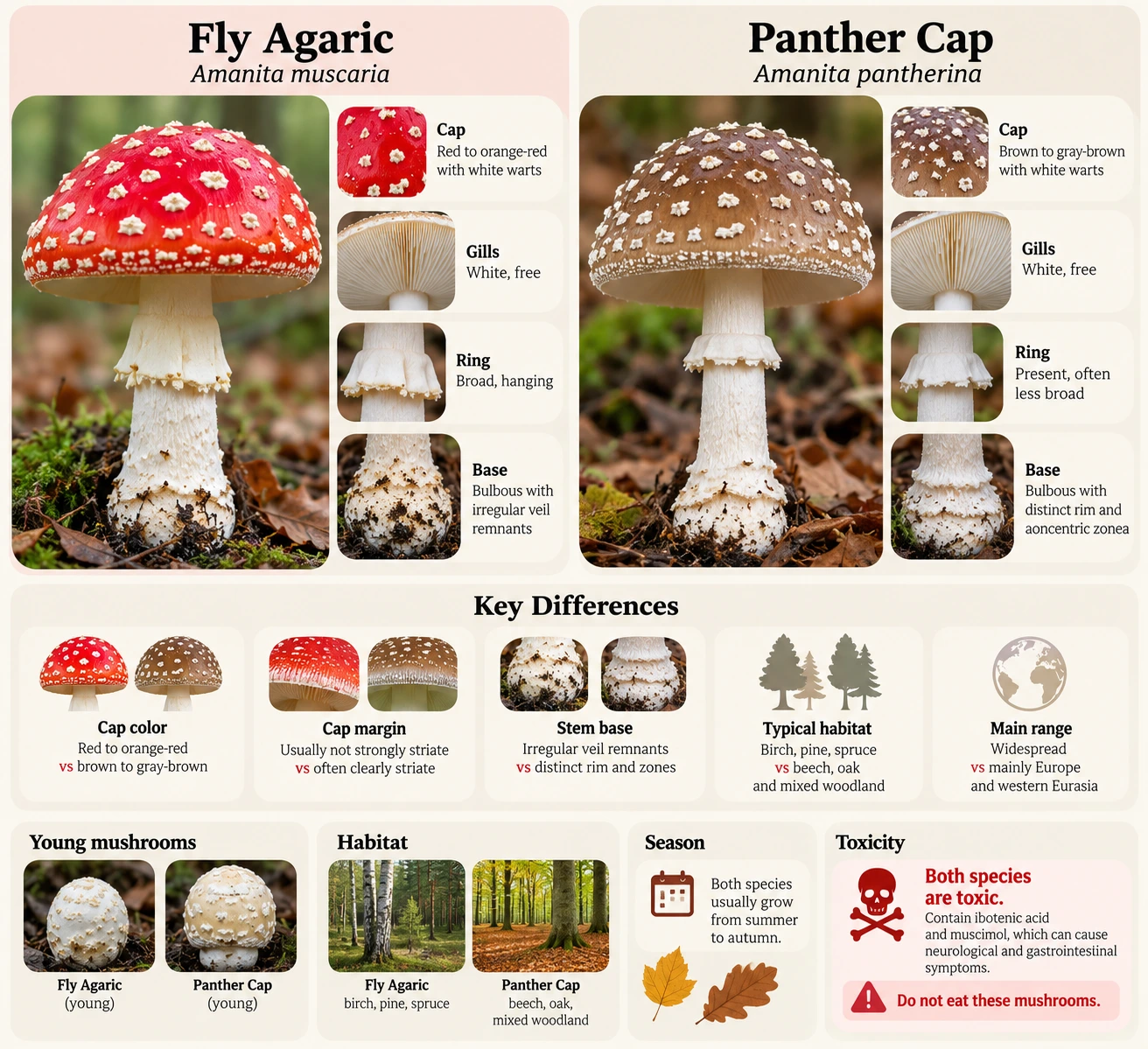
    Amanita pantherina Muchomůrka tygrovaná Hnědý klobouk, bílé bradavky Silně jedovatá
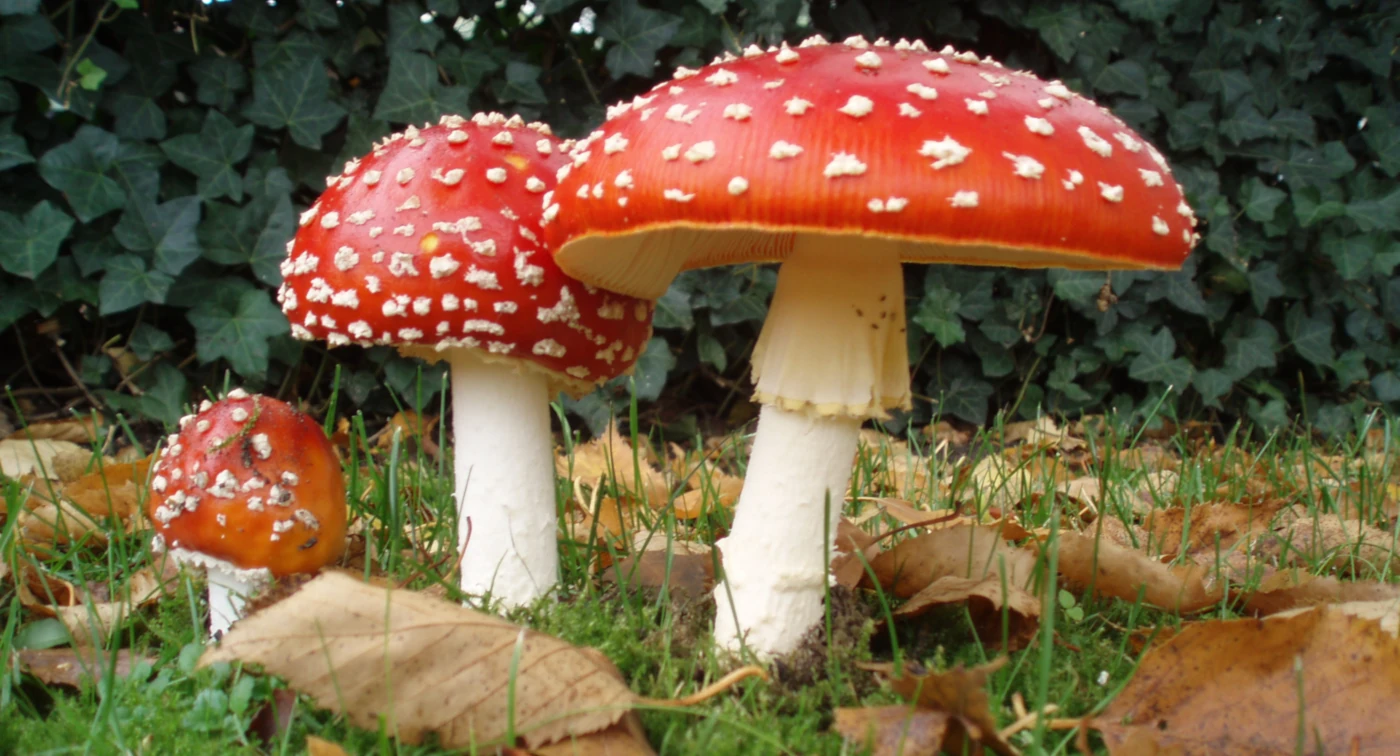
    Amanita muscaria Muchomůrka červená Červený klobouk, bílé bradavky Jedovatá
    Galerina marginata Čepičatka jehličnanová Malá hnědá houba na dřevě Smrtelně jedovatá
    Lepiota brunneoincarnata Bedla hnědočervená Malá šupinatá bedla Smrtelně jedovatá
    Gyromitra esculenta Ucháč obecný Mozkovitý klobouk Silně jedovatý
    Paxillus involutus Čechratka podvinutá Podvinutý okraj klobouku Jedovatá
    Inocybe erubescens Vláknice začervenalá Dužnina červená po poškození Silně jedovatá
    Clitocybe rivulosa Strmělka odbarvená Malá bělavá houba v trávě Silně jedovatá
    Entoloma sinuatum Závojenka olovová Mohutná, později růžové lupeny Jedovatá
    Hypholoma fasciculare Třepenitka svazčitá Žluté trsy na dřevě Jedovatá
    Omphalotus olearius Hlíva olivová Oranžová, roste ze dřeva Jedovatá
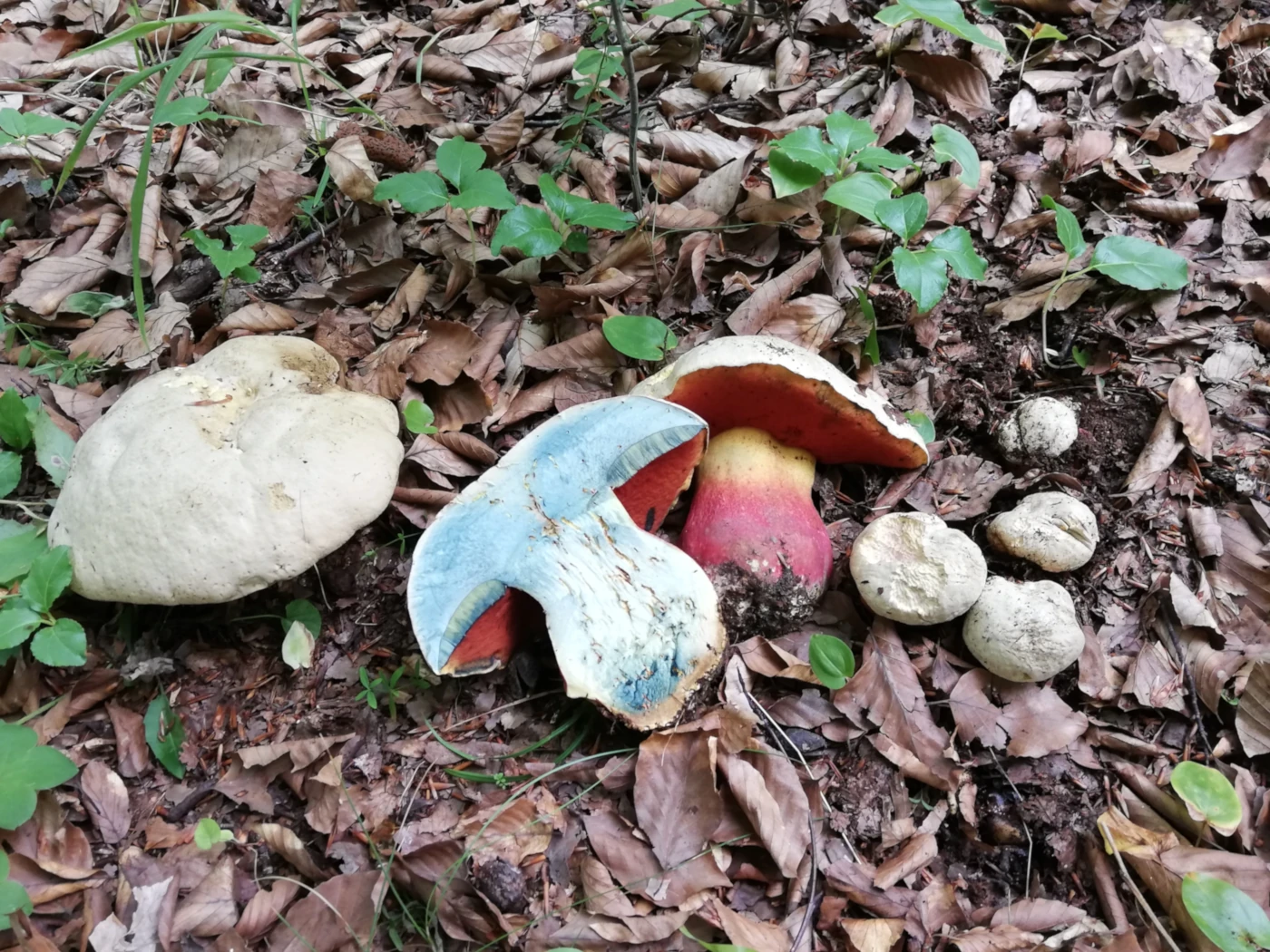
    Rubroboletus satanas Hřib satan Světlý klobouk, červené póry Jedovatý
    Scleroderma citrinum Pestřec obecný Tvrdá kulovitá plodnice Jedovatý

    1. Amanita phalloides — Muchomůrka zelená

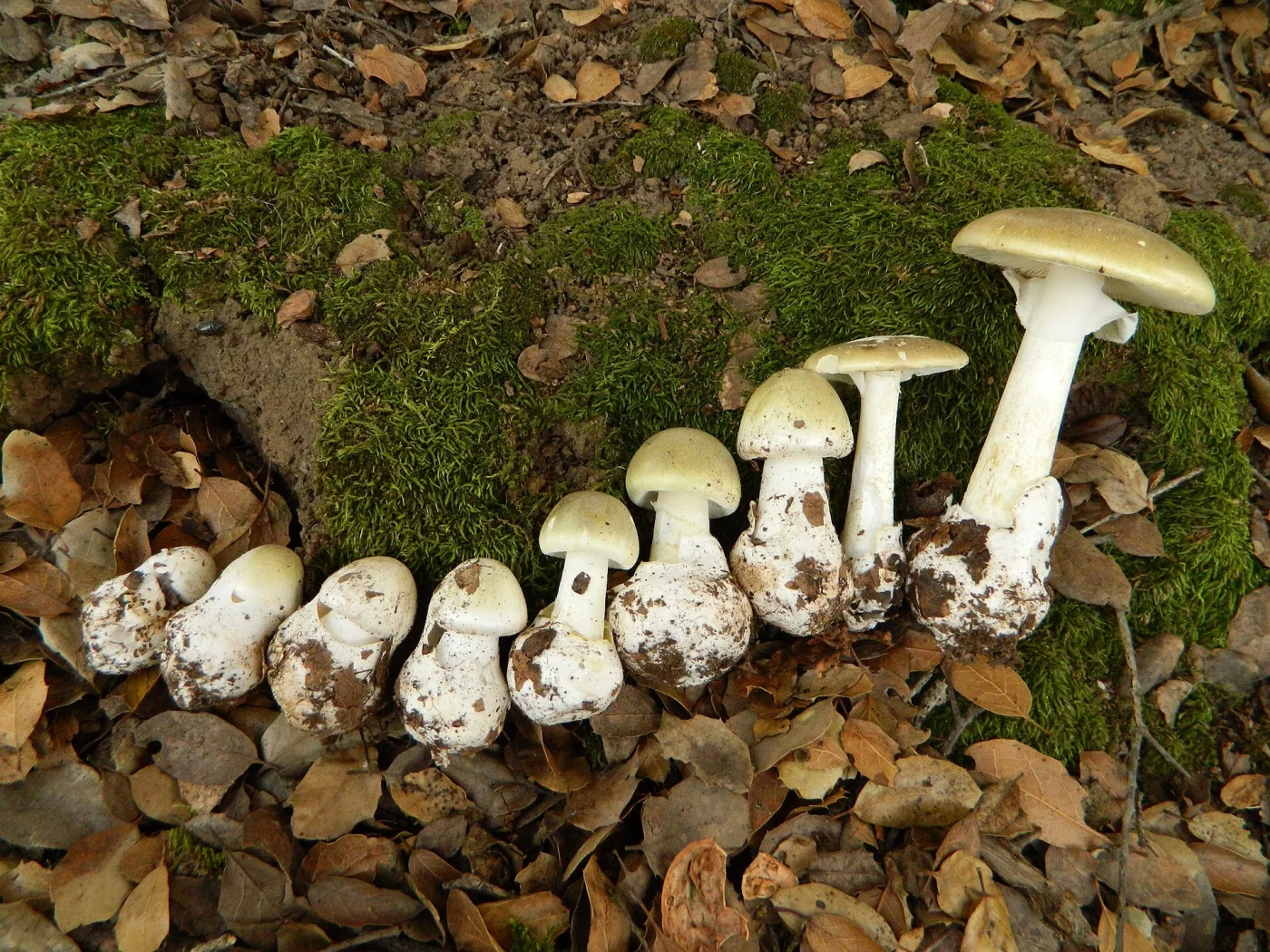
    Muchomůrka zelená patří k nejnebezpečnějším houbám Evropy. Klobouk může být zelenoolivový, žlutavý, hnědavý nebo téměř bělavý, takže barva sama o sobě není spolehlivým znakem.

    Lupeny zůstávají bílé a na třeni bývá prsten. Nejdůležitější je však velká pochva obklopující spodní část hlízovité báze.

    Proč je tak nebezpečná?

    Obsahuje amatoxiny, které mohou vážně poškodit játra. Zvlášť nebezpečné je to, že první příznaky se často objeví až několik hodin po jídle.

    V době, kdy začne zvracení nebo průjem, již mohou toxiny působit uvnitř organismu.

    S čím se může splést?

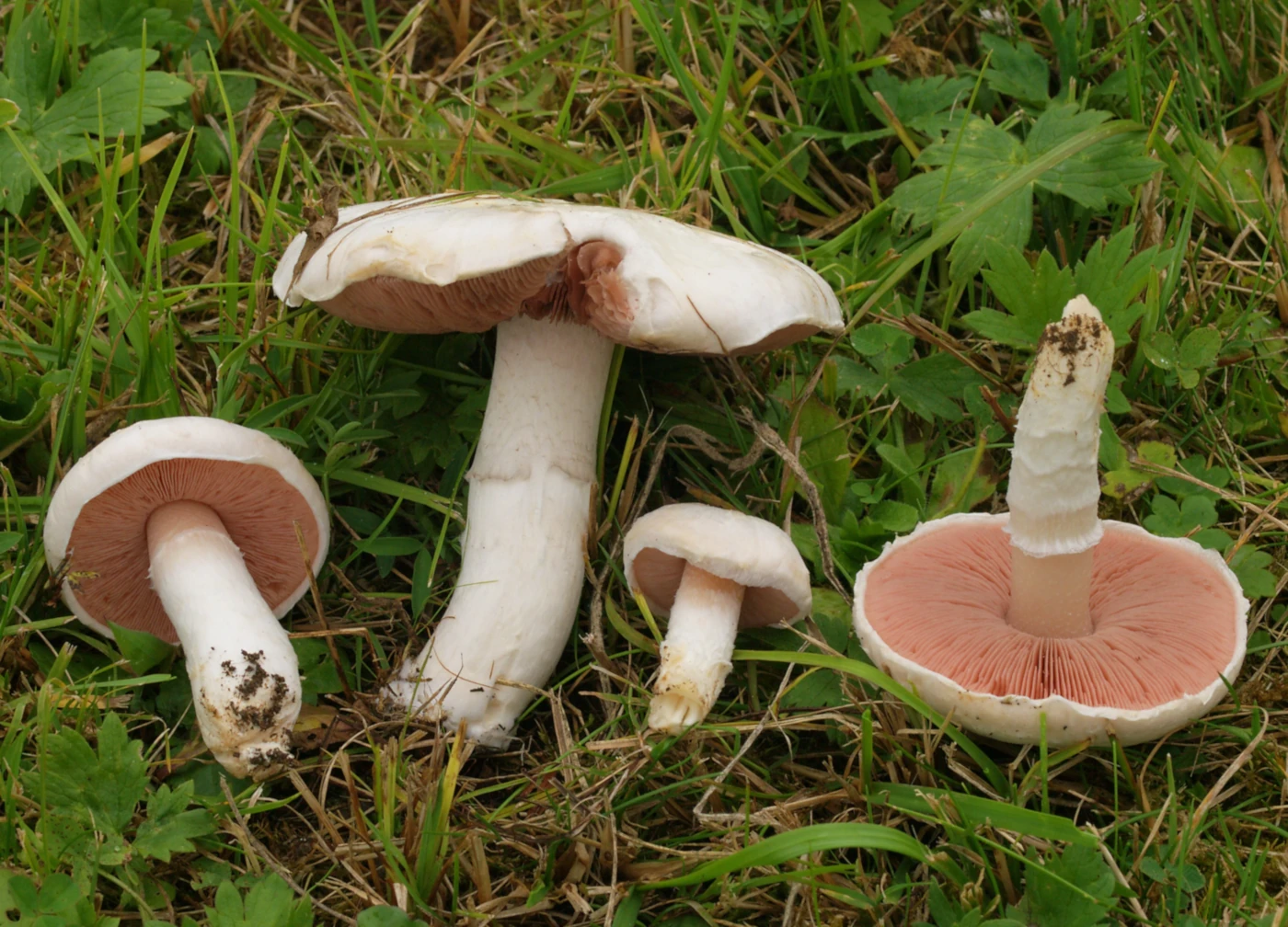
    Mladé bílé nebo světlé plodnice lze zaměnit za některé pečárky nebo jiné světlé houby. Pečárky však během dozrávání vytvářejí růžové až čokoládově hnědé lupeny a nemají pochvu.

    2. Amanita virosa — Muchomůrka jízlivá

    Muchomůrka jízlivá je téměř celá bílá. Má bílé lupeny, bílý třeň s prstenem a výraznou pochvu u báze.

    Její nenápadná barva může působit méně nebezpečně než výrazné muchomůrky, ale obsahuje stejné typy smrtelně nebezpečných amatoxinů jako muchomůrka zelená.

    Nejdůležitější znak

    Při určování je zásadní zachovat celý spodek třeně. Pokud houbu odříznete nad zemí, můžete odstranit pochvu a tím ztratit klíčový určovací znak.

    Bílou houbu s bílými lupeny proto nikdy neurčujte pouze podle klobouku.

    3. Amanita pantherina — Muchomůrka tygrovaná

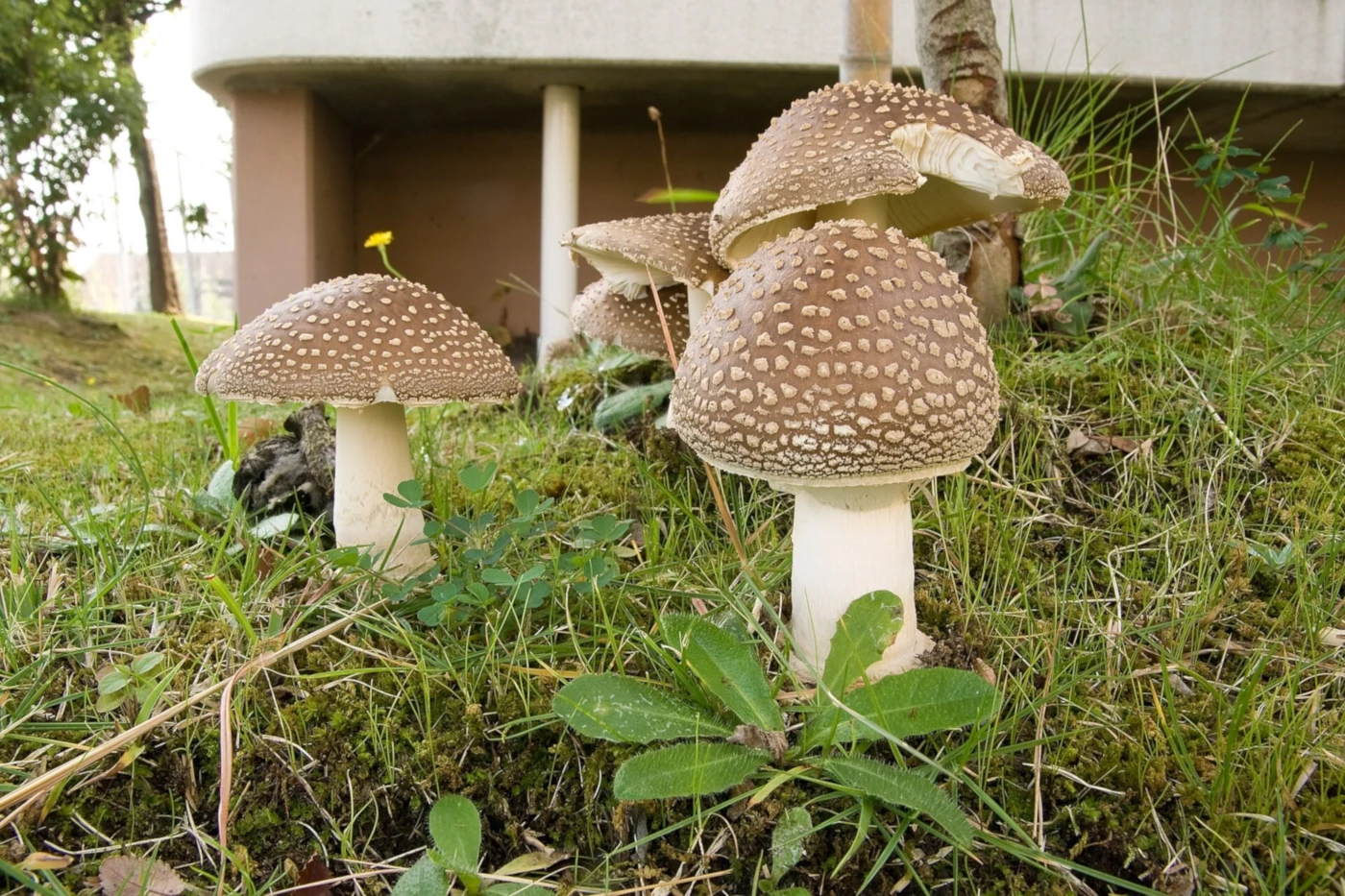
    Muchomůrka tygrovaná má hnědý až šedohnědý klobouk pokrytý bílými zbytky plachet. Lupeny i třeň jsou bílé a na třeni se nachází prsten.

    Okraj klobouku bývá výrazně rýhovaný. Báze třeně má hlízu s charakteristickými zónami zbytků plachet.

    Typ otravy

    Obsahuje především ibotenovou kyselinu a muscimol. Tyto látky působí na nervový systém a mohou vyvolat zmatenost, poruchy koordinace, nevolnost, ospalost nebo změny vnímání.

    Nejde o stejný typ otravy jako u muchomůrky zelené. Muchomůrka tygrovaná nezpůsobuje typický amatoxinový syndrom s primárním poškozením jater.

    4. Amanita muscaria — Muchomůrka červená

    Muchomůrka červená je jednou z nejznámějších hub na světě. Typická plodnice má červený až oranžově červený klobouk s bílými bradavkami.

    Déšť však může bílé zbytky plachet smýt a starší klobouky mohou výrazně vyblednout.

    Typ otravy

    Stejně jako muchomůrka tygrovaná obsahuje ibotenovou kyselinu a muscimol. Otrava má proto převážně neurologický a gastrointestinální charakter.

    Přestože je snadno rozpoznatelná v typické podobě, vybledlé nebo omyté plodnice mohou být mnohem méně nápadné.

    5. Galerina marginata — Čepičatka jehličnanová

    Tato drobná hnědá houba roste na mrtvém dřevě a může se objevit ve skupinách. Má hnědavý klobouk, lupeny, které s dozráváním rezavějí, a často také prsten nebo jeho zbytky.

    Je mimořádně nebezpečná, protože obsahuje amatoxiny.

    Nebezpečná záměna

    Může se zaměnit za některé jedlé houby rostoucí na dřevě. Jedním z nejdůležitějších rozdílů je barva výtrusů.

    Čepičatka vytváří rezavě hnědý výtrusný prach, zatímco například václavky mají výtrusy světlé.

    6. Lepiota brunneoincarnata — Bedla hnědočervená

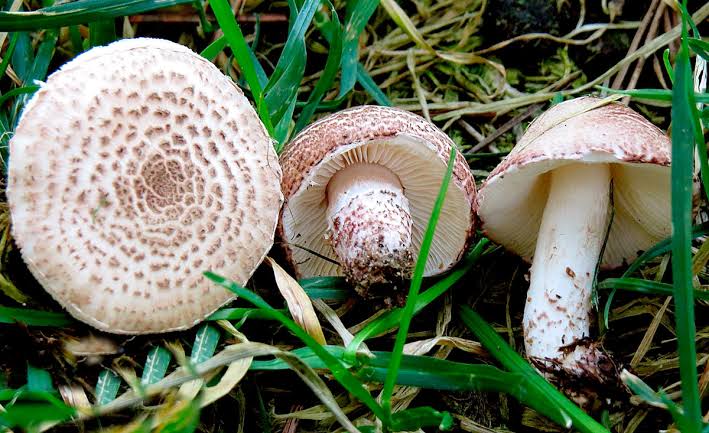
    Tato malá bedla může mít bělavý klobouk s hnědými až červenohnědými šupinami. Na třeni se může nacházet prsten nebo prstenová zóna.

    Na rozdíl od velkého jedlého parasolu je výrazně menší.

    Proč je nebezpečná?

    Některé malé bedly obsahují amatoxiny a mohou způsobit smrtelnou otravu.

    Praktickým pravidlem proto je, že neznámé malé bedlovité houby nejsou vhodné k experimentování.

    7. Gyromitra esculenta — Ucháč obecný

    Ucháč obecný má nepravidelný hnědý klobouk, který připomíná mozek. Objevuje se hlavně na jaře, často v jehličnatých lesích nebo na narušené půdě.

    Na první pohled může připomínat některé smrže, ale jeho stavba je výrazně odlišná.

    Toxicita

    Obsahuje látky související s gyromitrinem, které mohou způsobit závažnou otravu.

    Množství toxinů se může mezi jednotlivými plodnicemi lišit, takže bezpečnost nelze odhadnout podle vzhledu.

    8. Paxillus involutus — Čechratka podvinutá

    Čechratka podvinutá má hnědý klobouk s výrazně podvinutým okrajem, zejména u mladých plodnic. Lupeny sbíhají po třeni a při poškození mohou hnědnout.

    V minulosti byla v některých oblastech považována za jedlou, dnes se však považuje za jedovatou.

    Proč ji nesbírat?

    Opakovaná konzumace může u citlivých osob vyvolat závažnou imunitní reakci spojenou s rozpadem červených krvinek.

    To ukazuje, proč historické údaje o poživatelnosti nemusí vždy odpovídat současným poznatkům.

    9. Inocybe erubescens — Vláknice začervenalá

    Vláknice začervenalá má nejprve světlý klobouk, který může být vláknitý nebo popraskaný. Po poškození nebo s věkem se na plodnici objevují načervenalé odstíny.

    Může růst v listnatých lesích, parcích a dalších místech s vhodnými stromy.

    Toxicita

    Obsahuje muskarin, který působí na autonomní nervový systém.

    Otrava může způsobit silné slinění, pocení, zúžení zornic, zvracení a další výrazné příznaky.

    10. Clitocybe rivulosa — Strmělka odbarvená

    Tato malá bělavá houba často roste v trávě, na loukách, v parcích nebo při okrajích cest.

    Klobouk může být bělavý až krémový a poměrně nenápadný.

    Proč je problematická?

    Také obsahuje muskarin. Malé světlé houby v trávě proto nelze automaticky považovat za neškodné.

    Její nenápadný vzhled je dobrým příkladem toho, že nebezpečné houby nemusí mít výrazné varovné barvy.

    11. Entoloma sinuatum — Závojenka olovová

    Závojenka olovová je poměrně mohutná houba se světlým až šedavým kloboukem.

    Lupeny jsou zpočátku světlé a později získávají růžový odstín díky barvě výtrusů.

    S čím se může splést?

    Může připomínat některé jedlé světlé houby, zejména pokud není zkontrolována barva zralých lupenů.

    Požití může způsobit silné gastrointestinální obtíže.

    12. Hypholoma fasciculare — Třepenitka svazčitá

    Třepenitka svazčitá vytváří husté trsy na pařezech, kořenech a mrtvém dřevě.

    Klobouky jsou žluté až sírově žluté a lupeny postupně získávají zelenavé až tmavé tóny.

    S čím se může splést?

    Růst v trsech může připomenout jiné houby na dřevě, včetně některých sbíraných druhů.

    Barva lupenů, chuť a výtrusný prach jsou důležité rozlišovací znaky.

    13. Omphalotus olearius — Hlíva olivová

    Tato nápadně oranžová houba roste ze dřeva nebo z podzemních kořenů a často vytváří husté trsy.

    Má skutečné, tenké lupeny, které sbíhají po třeni.

    Záměna s liškou

    Na první pohled může připomínat velké oranžové lišky. Pravé lišky však mají silné tupé lišty místo tenkých lupenů a obvykle nerostou v hustých trsech přímo ze dřeva.

    Rozdíl na spodní straně klobouku je v tomto případě zásadní.

    14. Rubroboletus satanas — Hřib satan

    Hřib satan má obvykle světlý bělavý až šedavý klobouk a nápadnou spodní stranu s oranžovými až červenými póry.

    Mohutný třeň bývá žlutý a červený a dužnina může po rozříznutí modrat.

    Je modrání důkaz jedovatosti?

    Ne. Modrání je pouze chemická reakce po poškození.

    Existují modrající jedlé i jedovaté hřiby. U hřibu satana je důležitá kombinace světlého klobouku, červených pórů, mohutného třeně a stanoviště.

    15. Scleroderma citrinum — Pestřec obecný

    Pestřec obecný netvoří klasický klobouk a třeň. Má kulovitou až nepravidelnou plodnici se silnou žlutohnědou pokožkou.

    Uvnitř se během dozrávání vytváří tmavá výtrusná hmota.

    Proč může být zaměněn?

    Mladé plodnice mohou být zaměněny za některé jedlé podzemní nebo kulovité houby.

    Řez plodnicí je velmi užitečný, protože vnitřní struktura se výrazně liší od pravých pýchavek.

    Které jedovaté houby jsou nejnebezpečnější?

    Ne všechny jedovaté houby představují stejný typ rizika. Některé způsobí několik hodin nevolnosti, zatímco jiné mohou poškodit životně důležité orgány.

    Z praktického hlediska jsou nejnebezpečnější druhy s amatoxiny, protože mezi požitím a prvními příznaky může být dlouhá prodleva.

    Amatoxiny

    Muchomůrka zelená, muchomůrka jízlivá a některé malé druhy z jiných rodů mohou obsahovat amatoxiny.

    Tyto toxiny blokují důležité buněčné procesy a mohou vést k těžkému poškození jater.

    Muscimol a ibotenová kyselina

    Muchomůrka červená a tygrovaná mají jiný typ toxinů.

    Jejich otrava je typicky spojena se změnami vědomí, zmateností, ospalostí, nevolností a poruchami koordinace.

    Muskarin

    Muskarin se vyskytuje například u některých vláknic a strmělek.

    Typickými projevy mohou být nadměrné slinění, pocení a další příznaky související s parasympatickým nervovým systémem.

    Proč nelze jedovaté houby poznat podle jednoho pravidla?

    Neexistuje žádný spolehlivý znak, který by měly všechny jedovaté houby společný. Některé jsou barevné, jiné bílé nebo hnědé.

    Stejně tak neplatí, že houba okousaná slimáky musí být jedlá nebo že modrající hřib musí být jedovatý.

    Bezpečné určování musí vždy směřovat ke konkrétnímu druhu.

    Jak fotografovat neznámou houbu pro určení?

    Vyfotografujte plodnici nejprve na místě nálezu. Fotografie okolního lesa, trávy nebo dřeva může poskytnout důležitý ekologický kontext.

    Potom zachyťte klobouk, spodní stranu, celý třeň a jeho bázi. U muchomůrek je zvlášť důležité nechat bázi neporušenou.

    Užitečná je také fotografie řezu

    U hřibů a některých dalších skupin může řez ukázat změny barvy.

    Fotografie bezprostředně po rozříznutí a po několika minutách může být mnohem informativnější než další snímek klobouku.

    Může AI rozpoznat jedovatou houbu?

    AI může pomoci navrhnout možné druhy a upozornit na podobné jedovaté houby. Její přesnost ale závisí na tom, zda jsou na fotografii vidět skutečně diagnostické znaky.

    U muchomůrky vyfotografované pouze shora může například chybět pochva, prsten nebo barva lupenů.

    Proto by se AI měla používat jako pomocník při určování, nikoli jako potvrzení, že je houba bezpečná k jídlu.

    Nejčastější chyby při určování jedovatých hub

    Jednou z nejnebezpečnějších chyb je odříznout muchomůrku nad zemí. Tím se ztratí báze s pochvou, která může být zásadní pro správné určení.

    Další chybou je hodnotit houby podle toho, zda je požírají slimáci nebo hmyz. Jejich citlivost na toxiny je od lidské velmi odlišná.

    Problematické je také slepé používání lidových pravidel. Stříbro, cibule, barva klobouku ani modrání nejsou univerzálními testy jedovatosti.

    Zajímavosti o jedovatých houbách

    Některé z nejnebezpečnějších hub vypadají velmi nenápadně. Malá hnědá čepičatka může obsahovat podobně nebezpečné amatoxiny jako mnohem známější muchomůrka zelená.

    Toxiny mohou být mezi jednotlivými skupinami hub chemicky zcela odlišné. Dvě jedovaté houby proto mohou způsobovat naprosto rozdílné příznaky a vyžadovat jiný lékařský postup.

    Zajímavé je také to, že evoluční příbuznost a typ otravy spolu nemusí jednoduše souviset. Stejné nebo podobné toxické látky se mohou objevit v různých houbových skupinách.

    Jedovaté houby navíc hrají v přírodě stejně důležitou roli jako jedlé druhy. Mykorhizní muchomůrky pomáhají stromům získávat živiny a dřevní houby se podílejí na rozkladu organického materiálu.

    Často kladené otázky

    Může jedovatá houba růst přímo vedle jedlé?

    Ano. Několik druhů může růst na velmi malé ploše nebo dokonce u stejného stromu. Každou plodnici je proto potřeba určit samostatně.

    Zničí sušení všechny houbové jedy?

    Ne. Některé toxiny mohou po usušení zůstat aktivní. Sušení proto není univerzální způsob detoxikace neznámé houby.

    Může stará jedovatá houba vypadat úplně jinak než mladá?

    Ano. Klobouk může vyblednout, zbytky plachet mohou zmizet a třeň nebo lupeny mohou být poškozené. Staré plodnice bývají pro určování výrazně obtížnější.

    Je každá houba s pochvou jedovatá?

    Ne. Pochva je určovací znak některých skupin, nikoli univerzální znak jedovatosti. U muchomůrek ale její přítomnost zásadně zužuje možnosti.

    Proč se příznaky některých otrav objeví tak pozdě?

    Záleží na toxinu a mechanismu jeho účinku. U amatoxinů mohou být orgány poškozovány ještě předtím, než člověk začne pociťovat výrazné potíže.

    Může vaření odstranit jedovatost neznámé houby?

    Na takové pravidlo se nelze spoléhat. Některé toxiny jsou tepelně stabilní a běžné vaření je nezničí.

    Jsou malé houby méně nebezpečné než velké?

    Ne. Velikost vůbec neurčuje toxicitu a některé malé druhy mohou obsahovat velmi nebezpečné látky.

    Může jedovatá houba vonět příjemně?

    Ano. Vůně není spolehlivý test bezpečnosti. Některé nebezpečné druhy mají mírnou nebo dokonce příjemnou vůni.

    Závěrečné zásady určování

    Mezi nejdůležitější jedovaté houby, které by měli houbaři v Česku znát, patří muchomůrka zelená, muchomůrka jízlivá, muchomůrka tygrovaná, muchomůrka červená, čepičatka jehličnanová, ucháč obecný a čechratka podvinutá.

    Nejbezpečnější přístup není hledat univerzální znaky jedovatosti, ale určit konkrétní druh podle celé soustavy znaků. Zvláštní pozornost věnujte spodní straně klobouku, prstenu, pochvě, bázi třeně, substrátu a změnám po poranění.

    Pokud si nejste jistí základním postupem, začněte průvodcem Určování hub: Jak správně poznat druh houby. U hub určených ke konzumaci by měl být výsledek vždy nezávisle potvrzen.

  • Určování hub: Jak správně poznat druh houby

    Určování hub: Jak správně poznat druh houby

    Určování hub není jen porovnávání barvy klobouku s fotografií v atlase. Dva velmi podobné druhy mohou mít odlišnou poživatelnost, růst pod jinými stromy nebo se lišit znakem, který na první pohled téměř není vidět.

    Při určování je proto nejlepší postupovat systematicky. Sledujte nejen klobouk, ale také spodní stranu, třeň, bázi třeně, změny barvy po poranění, vůni, prostředí a stromy rostoucí v okolí.

    ⚠️ Důležité: Výsledek určení podle fotografie nebo pomocí AI nelze používat jako jediný podklad pro rozhodnutí, zda je houba jedlá. Před konzumací je nutné určení nezávisle ověřit.

    Jaké znaky jsou při určování hub nejdůležitější?

    Neexistuje jeden univerzální znak, podle kterého lze bezpečně určit všechny houby. U některých druhů je rozhodující spodní strana klobouku, u jiných báze třeně, mléko vytékající z lupenů nebo například strom, pod kterým houba roste.

    Nejlepší výsledky přináší kombinace několika nezávislých znaků. Pokud všechny ukazují stejným směrem, je určení mnohem spolehlivější.

    1. Podívejte se pod klobouk

    Spodní strana klobouku je často důležitější než jeho barva. Houby zde mohou mít lupeny, rourky, lišty, ostny nebo téměř hladký povrch.

    Tento jediný krok dokáže výrazně zúžit počet možných druhů.

    Lupeny

    Lupeny jsou tenké destičky vycházející ze spodní části klobouku. Najdeme je například u muchomůrek, holubinek, ryzců, pečárek a celé řady dalších skupin.

    Při jejich hodnocení sledujte barvu, hustotu a způsob napojení na třeň. Důležité také je, zda se jejich barva během dozrávání mění.

    Rourky a póry

    Hřibovité houby mají místo lupenů vrstvu drobných rourek zakončených póry. Spodní strana proto působí jako houba nebo jemná pěna.

    Barva pórů může být bílá, žlutá, olivová, oranžová nebo červená. U některých druhů se po dotyku rychle zbarvuje do modra.

    Lišty

    Lišky nemají klasické tenké lupeny. Na spodní straně mají silné, tupé a často větvené lišty, které přecházejí na třeň.

    Tento znak je velmi důležitý při odlišování pravých lišek od podobných druhů s pravými lupeny.

    Ostny

    Lošáky a příbuzné houby mají spodní stranu pokrytou množstvím měkkých ostnů směřujících dolů. Tento znak je nápadný a v terénu velmi užitečný.

    Pokud vidíte skutečné jednotlivé ostny, výrazně se tím zúží okruh možných druhů.

    2. Prohlédněte celý třeň

    Třeň může obsahovat některé z nejdůležitějších určovacích znaků. Nestačí se podívat pouze na jeho barvu.

    Sledujte prsten, síťku, šupinky, tečky, pásy a především úplnou bázi třeně.

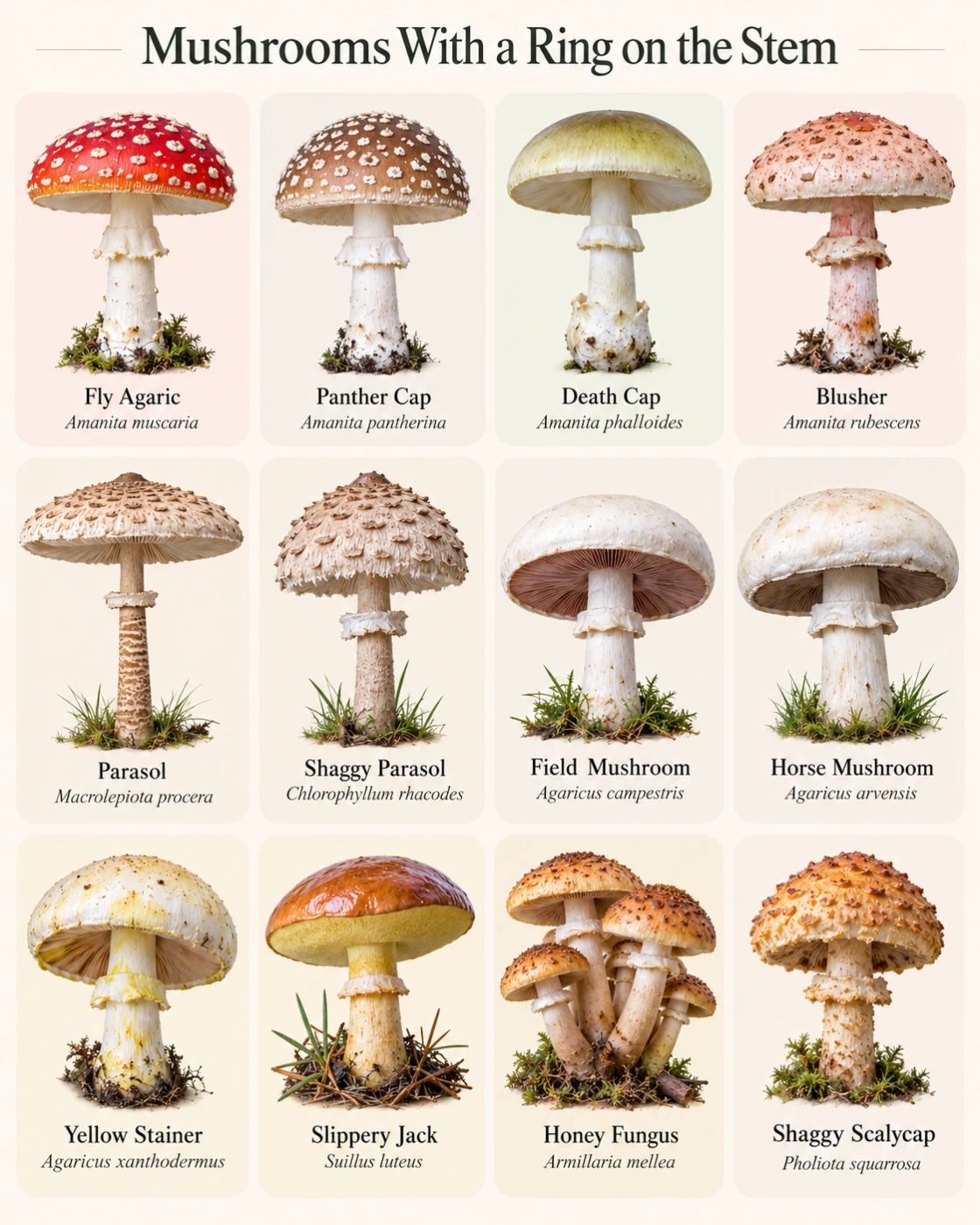
    Prsten

    Prsten vzniká ze zbytku částečného závoje, který u mladé houby chránil lupeny nebo póry. Může být široký a převislý, tenký nebo u starších plodnic téměř zmizet.

    Prsten se vyskytuje u jedlých i prudce jedovatých druhů. Sám o sobě tedy nikdy neznamená, že je houba bezpečná ke konzumaci.

    Pochva a hlízovitá báze

    U muchomůrek je mimořádně důležitá spodní část třeně. Některé druhy mají pochvu obklopující bázi, jiné mají hlízu se zbytky plachet.

    Proto by se neznámá muchomůrka neměla při určování odřezávat těsně nad zemí. Odstranili byste tím jeden z nejdůležitějších znaků.

    Síťka a šupinky

    Některé hřiby mají na třeni jemnou síťovitou kresbu. Jiné druhy, například kozáci, mají na světlém třeni tmavé drsné šupinky.

    Rozdíl mezi síťkou a jednotlivými šupinkami může být při určování zásadní.

    3. Sledujte změny barvy

    Některé houby po dotyku, rozříznutí nebo jiném poranění mění barvu. U hřibů je známé především modrání, ale možné je také červenání, zelenání, žloutnutí nebo černání.

    Rychlost reakce je někdy stejně důležitá jako výsledná barva.

    Modrání neznamená jedovatost

    Jedním z častých omylů je pravidlo, že hřib modrající po poranění musí být jedovatý. To není pravda.

    Modrá barva je výsledkem chemické oxidace látek v dužnině. Modrají jedlé, nejedlé i jedovaté druhy.

    4. Zkontrolujte dužninu

    Řez plodnicí může odhalit znaky, které zvenku nejsou patrné. Všímejte si barvy, změny po řezu, struktury a případně toho, zda je třeň dutý nebo plný.

    U některých druhů může být reakce v klobouku odlišná od reakce v třeni.

    Křehká nebo vláknitá?

    Holubinky mají typicky velmi křehkou dužninu, která se láme podobně jako křída. Mnoho jiných hub se naopak trhá podél vláken.

    Tento jednoduchý rozdíl může pomoci určit celou skupinu ještě před hledáním přesného druhu.

    5. Zjistěte, zda houba roní mléko

    Ryzce a příbuzné druhy při poranění lupenů často uvolňují tekutinu označovanou jako latex nebo mléko.

    Jeho barva může být bílá, oranžová, červená nebo dokonce modrá. U některých druhů se barva po několika minutách mění.

    Barva mléka patří mezi velmi cenné určovací znaky. Mnohem užitečnější je čerstvá poraněná plodnice než stará houba, která už téměř žádné mléko nevytváří.

    6. Všímejte si stromů v okolí

    Mnoho lesních hub vytváří mykorhizu se stromy. Houba a kořeny stromu si navzájem vyměňují živiny a voda.

    Proto může mít druh stromu při určování překvapivě velkou hodnotu.

    Pod břízou

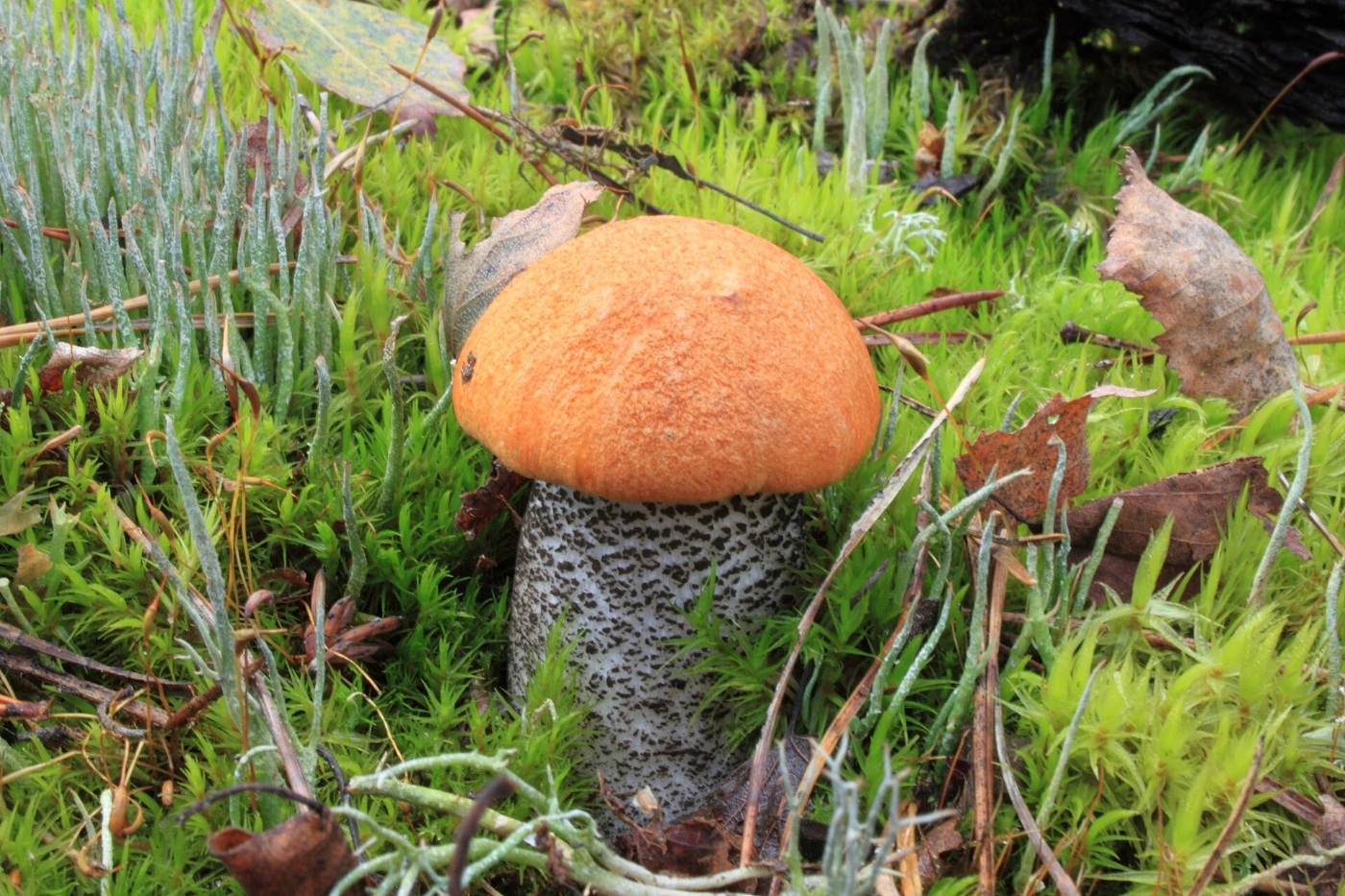
    Bříza je spojena například s několika druhy kozáků, ryzců a holubinek. Typickým příkladem je kozák březový, Leccinum scabrum.

    Samotná přítomnost břízy ale nestačí. Pod jedním stromem může růst několik různých druhů hub současně.

    Pod borovicí

    Pod borovicemi jsou časté klouzky, ryzce a některé hřiby. Přítomnost borovice může pomoci rozlišit jinak velmi podobné druhy.

    Vždy je však potřeba zkontrolovat i další stromy v okolí, protože podzemní kořeny sahají daleko od kmene.

    Pod dubem a bukem

    Listnaté lesy s duby a buky hostí mnoho hřibů, holubinek, muchomůrek, lišek a dalších mykorhizních hub.

    U některých vzácnějších druhů může být kombinace vzhledu houby a hostitelského stromu velmi silným vodítkem.

    7. Zjistěte, z čeho houba skutečně vyrůstá

    Houba rostoucí přímo ze dřeva patří často do jiné ekologické skupiny než podobná houba rostoucí z půdy.

    Dřevo navíc nemusí být vždy viditelné. Pod povrchem mohou být kořeny, pařezy nebo staré zakopané větve.

    Houby na mrtvém dřevě

    Hlíva, václavky, některé třepenitky a mnoho chorošů využívají dřevo jako zdroj živin.

    Druh stromu, stav dřeva a způsob růstu mohou být při jejich určování velmi důležité.

    Houby na půdě

    Mnoho hřibů, muchomůrek, holubinek a lišek roste ze země díky spojení s živými kořeny stromů.

    To, že plodnice vyrůstá ze země, tedy neznamená, že strom v okolí není důležitý.

    8. Sledujte způsob růstu

    Některé druhy rostou jednotlivě, jiné tvoří velké trsy nebo husté skupiny. Tento znak může pomoci rozlišit podobně zbarvené houby.

    Například houby rostoucí v hustém trsu ze dřeva by měly být určovány jinak než samostatná mykorhizní houba rostoucí na lesní půdě.

    Růstový vzor ale není absolutní. Stejný druh může podle podmínek vytvářet jednotlivé i vícečetné plodnice.

    9. Zohledněte roční období

    Sezóna dokáže některé možnosti výrazně omezit. Smrže jsou typické především pro jaro, zatímco velká část běžných lesních hub vrcholí od léta do podzimu.

    Některé dřevní druhy se objevují i v zimě. Datum nálezu je proto užitečnou součástí každého určování.

    Počasí je stejně důležité jako kalendář

    Houby nereagují pouze na měsíc v roce. Význam má déšť, teplota půdy a délka předchozího suchého období.

    Proto může stejný druh v jednom roce plodit v září a v jiném téměř vůbec.

    10. Vůně může pomoci, ale není spolehlivá sama o sobě

    Některé houby mají velmi charakteristickou vůni. Lišky jsou často popisovány jako ovocné, zatímco některé pečárky mohou vonět po anýzu nebo naopak nepříjemně chemicky.

    Vnímání vůně je však subjektivní. Jeden člověk ji může cítit velmi výrazně a jiný téměř vůbec.

    Vůně proto funguje nejlépe jako potvrzení už předpokládaného určení.

    Barva klobouku není dostatečný určovací znak

    Barva patří mezi první vlastnosti, kterých si všimneme, ale zároveň mezi nejproměnlivější. Déšť, sucho, stáří a sluneční záření mohou vzhled klobouku výrazně změnit.

    „Hnědá houba“ nebo „červená houba“ proto představuje pouze začátek určování.

    Proč stejný druh vypadá různě?

    Mladé plodnice mají často sytější barvu a kompaktnější tvar. Staré houby mohou blednout, praskat a měnit proporce.

    Také mokrý klobouk bývá tmavší než suchý. Fotografie stejného druhu po dešti a během sucha proto mohou vypadat překvapivě odlišně.

    Jak rozpoznat jedovatou houbu?

    Neexistuje jednoduché univerzální pravidlo, které by rozlišilo jedlé a jedovaté houby. Barva, reakce na stříbro, napadení hmyzem ani modrání nejsou testem bezpečnosti.

    Jedinou spolehlivou cestou je správně určit konkrétní druh a teprve poté hodnotit jeho poživatelnost.

    Proč jsou muchomůrky zvlášť důležité?

    Rod Amanita obsahuje jak jedlé, tak jedovaté a smrtelně jedovaté druhy. Rozhodující znaky se často nacházejí na třeni a jeho bázi.

    U bílé nebo světlé houby s bílými lupeny je proto obzvlášť důležité zkontrolovat prsten, pochvu a celou spodní část třeně.

    Jak správně vyfotografovat houbu pro určení?

    Jedna fotografie klobouku shora často nestačí. Pro dobré určení je potřeba zachytit více částí plodnice.

    Ideální je nejprve vyfotografovat houbu na místě nálezu a poté přidat snímek spodní strany, celého třeně a jeho báze.

    Co by mělo být na fotografiích?

    Fotografie by měly ukazovat původní barvu bez silných filtrů. Pomáhá také zachytit listí, jehličí, dřevo nebo stromy v okolí.

    Pokud houba mění barvu po poranění, vyfotografujte místo před poraněním a znovu po několika minutách.

    Lze určit houbu podle fotografie pomocí AI?

    Rozpoznávání obrazu může rychle navrhnout možné druhy a pomoci porovnat viditelné znaky. Nejlépe funguje u hub s charakteristickým tvarem a dobře zachycenými detaily.

    Obtížnější jsou skupiny, ve kterých se jednotlivé druhy liší vůní, mikroskopickými znaky, hostitelským stromem nebo reakcí, která na fotografii není vidět.

    AI je proto vhodná jako pomoc při určování, nikoli jako samostatné rozhodnutí o poživatelnosti.

    Nejčastější chyby při určování hub

    Velmi častou chybou je zaměřit se pouze na klobouk. U mnoha skupin se přitom nejdůležitější znaky nacházejí na spodní straně nebo na bázi třeně.

    Další chybou je použití jednoho „pravidla“, například že všechny modrající hřiby jsou jedovaté. Houby se musí určovat podle kombinace znaků.

    Problémem je také snaha určit starou, rozmočenou nebo silně poškozenou plodnici za každou cenu. Někdy je správnější zůstat u širší skupiny než vynutit přesný druh.

    Zajímavosti o určování hub

    Barva výtrusů může být úplně jiná než barva plodnice. Například intenzivně modrá houba může vytvářet světlý výtrusný prach, zatímco nenápadná hnědá houba může mít výtrusy rezavé nebo růžové.

    Mnoho znaků, které používáme při určování, jsou ve skutečnosti pozůstatky vývoje mladé houby. Prsten a pochva muchomůrek například vznikají z ochranných obalů, které obklopovaly mladou plodnici.

    Také barvení po poranění není pouhá změna pigmentu. Často jde o chemickou reakci spuštěnou poškozením buněk a kontaktem jejich obsahu se vzduchem.

    Mykorhizní vazby navíc vysvětlují, proč lze stejný druh nacházet opakovaně pod stejnými stromy. Plodnice zmizí během několika dní, ale většina houby zůstává jako podzemní mycelium.

    Často kladené otázky

    Proč někdy houba nevypadá jako fotografie v atlase?

    Vzhled se mění se stářím, počasím a prostředím. Proto je lepší porovnávat soubor znaků než očekávat přesnou shodu s jedinou fotografií.

    Je mladá houba vždy snadněji určitelná?

    Ne. U velmi mladých plodnic ještě nemusí být některé důležité znaky vyvinuté. Často je nejlepší porovnat několik různě starých exemplářů.

    Může jedna lokalita obsahovat několik velmi podobných druhů?

    Ano. Pod stejným stromem nebo na stejném pařezu může růst několik druhů současně. Každou plodnici je proto potřeba kontrolovat zvlášť.

    Proč je důležité nechat na houbě bázi třeně?

    U některých skupin může obsahovat pochvu, hlízu nebo jiné klíčové znaky. Bez ní se bezpečné určení může stát nemožným.

    Může déšť změnit barvu houby?

    Ano. Mokré povrchy bývají tmavší a déšť může také smýt zbytky závoje nebo změnit strukturu klobouku.

    Je místo nálezu opravdu tak důležité?

    Ano. Stromy, půda, vlhkost a substrát mohou zásadně zúžit možné druhy. Ekologie je často stejně hodnotná jako vzhled.

    Proč některé houby rostou každý rok na stejném místě?

    Podzemní mycelium může na vhodném stanovišti přežívat řadu let. Za příznivých podmínek pak opakovaně vytváří nové plodnice.

    Je možné určit každou houbu pouze podle vzhledu?

    Ne. U některých skupin jsou pro přesné určení potřeba mikroskopické znaky, chemické reakce nebo podrobnější ekologické informace.

    Závěrečné zásady určování

    Při určování hub začněte strukturou, nikoli barvou. Nejprve se podívejte pod klobouk, potom prohlédněte celý třeň a jeho bázi a teprve následně použijte barvu, vůni a další jemnější znaky.

    Důležité je také prostředí. Stromy, půda, dřevo, sezóna a způsob růstu mohou změnit pravděpodobnost jednotlivých druhů velmi výrazně.

    Nejúčinnější postup je jednoduchý: spodní strana → třeň → báze → reakce po poranění → habitat → porovnání podobných druhů. Fotografie nebo AI mohou tento proces urychlit, ale neměly by nahrazovat nezávislé ověření, pokud jde o bezpečnost a poživatelnost.

  • Hedgehog Mushroom vs Chanterelle: How to Tell Them Apart

    Hedgehog Mushroom vs Chanterelle: How to Tell Them Apart

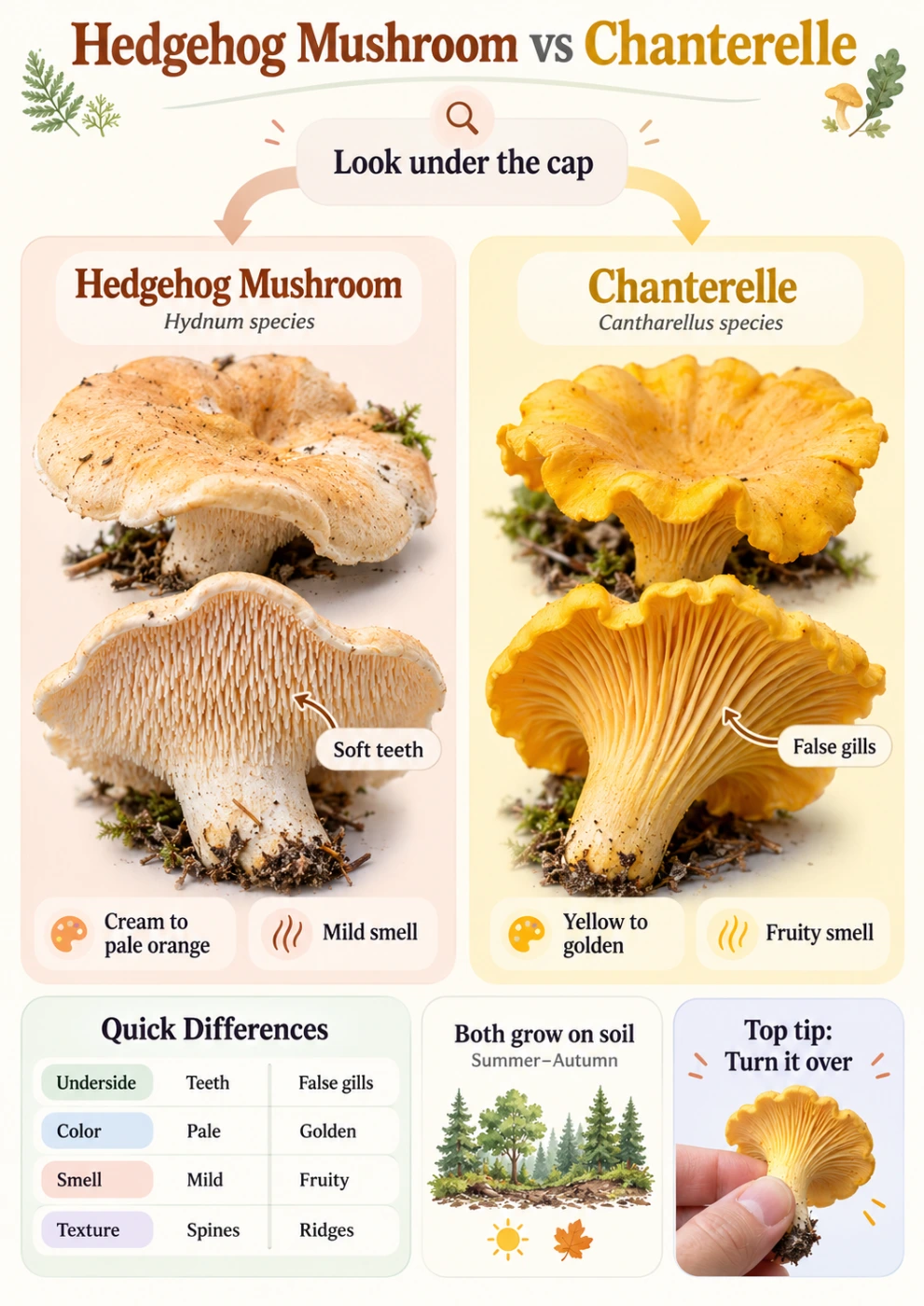
    Hedgehog Mushrooms and Chanterelles can grow in similar woodland habitats, appear during the same season, and share yellow, cream, or orange tones. From above, an inexperienced mushroom hunter can easily confuse them.

    The underside solves most of the problem. Hedgehog Mushrooms have soft downward-pointing teeth, while Chanterelles have thick blunt ridges known as false gills. Once you learn to compare these two structures, the mushrooms become much easier to separate.

    ⚠️ Important: This guide is for identification and education only. Never eat a wild mushroom based solely on photographs, AI identification, or one visible feature.

    Quick Comparison

    Feature Hedgehog Mushroom Chanterelle
    Main group Hydnum species Cantharellus species
    Underside Soft teeth or spines Thick blunt false gills
    Cap color Cream, buff, pale orange Yellow to golden-orange
    Cap shape Irregular, often wavy Funnel-shaped or wavy
    Stem Pale, solid Yellow to pale, solid
    Flesh Pale and firm Pale and firm
    Smell Mild Often fruity
    Growth On soil On soil
    Ecology Mycorrhizal Mycorrhizal
    Season Summer–autumn Summer–autumn
    Edibility Edible when correctly identified Edible when correctly identified

    The Fastest Way to Tell Them Apart

    Turn the mushroom over.

    A Hedgehog Mushroom has individual soft teeth hanging downward from the underside of the cap. These look like tiny pale spines and can often be brushed or broken off.

    A Chanterelle does not have true gills. Instead, it has thick, blunt, forked ridges that run down the stem.

    Hedgehog Mushroom — Hydnum Species

    “Hedgehog Mushroom” usually refers to several closely related species in the genus Hydnum. The best-known European form is often called Hydnum repandum or the H. repandum group.

    These mushrooms have pale cream to yellow-orange caps and a very distinctive toothed underside.

    Cap

    The cap is usually irregular rather than perfectly round. It may become wavy, lobed, or slightly depressed with age.

    Colors range from cream and buff to pale apricot or light orange. Some specimens remain much paler than typical golden chanterelles.

    Cap Surface

    The surface is usually smooth and dry. It lacks scales and is not strongly slimy.

    Older specimens can become cracked or uneven, especially in dry weather.

    Teeth

    The underside is covered with numerous soft, pale teeth. These hang vertically downward and may extend slightly onto the upper stem.

    This is the defining feature of Hydnum. It immediately separates Hedgehog Mushrooms from chanterelles and most other common woodland mushrooms.

    Tooth Texture

    The teeth are relatively fragile and can break off if rubbed. They are not rigid like the spines of some tougher toothed fungi.

    Young specimens usually have shorter, paler teeth, while mature mushrooms develop longer and more obvious ones.
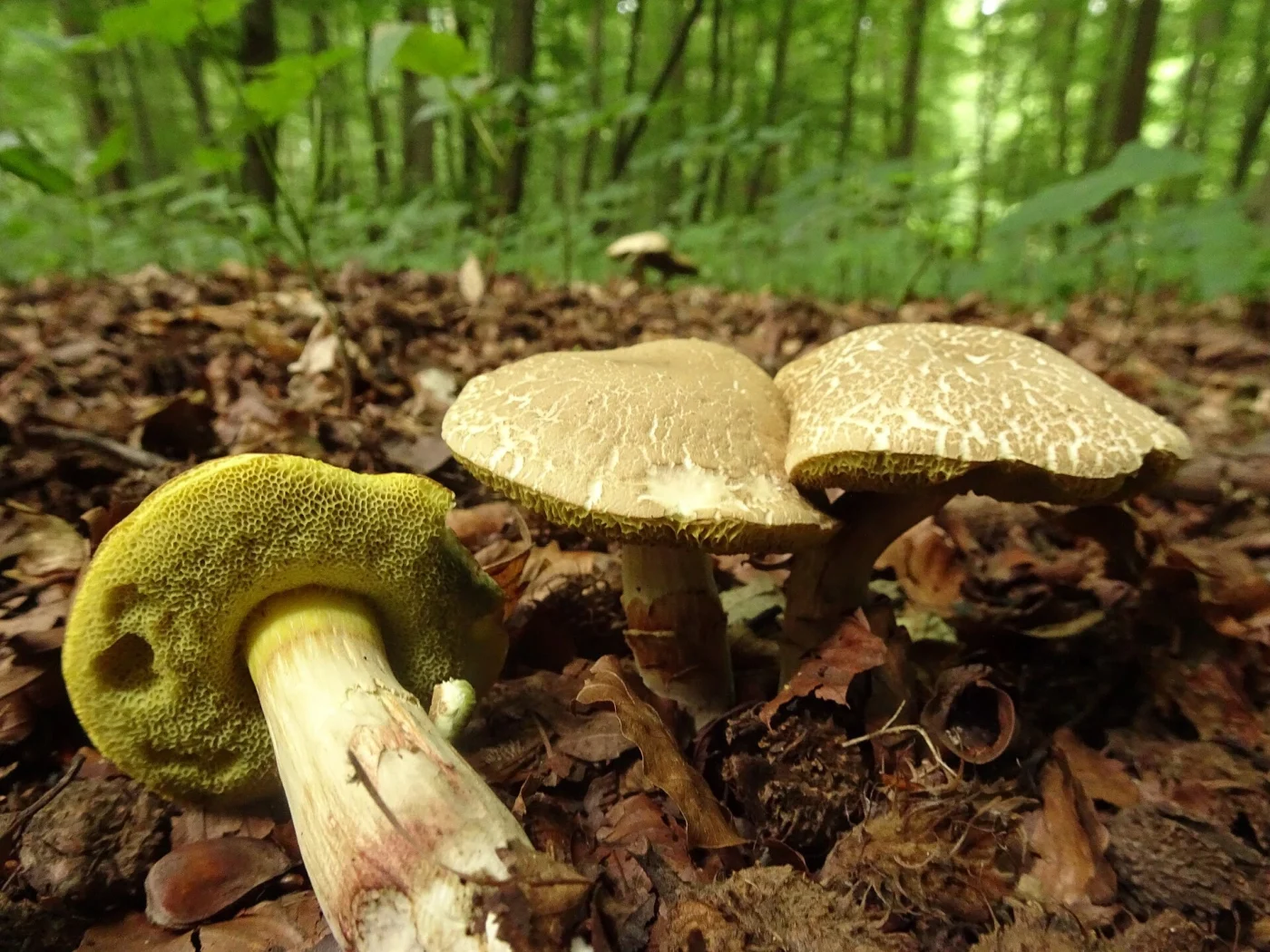
    Stem

    The stem is usually pale cream, yellowish, or similar in color to the cap. It may be central or slightly off-center.

    It is solid and fairly firm, without a ring or volva.

    Flesh

    The flesh is pale and firm. It does not show dramatic color changes when cut.

    Older mushrooms may develop a slightly more bitter flavor, but taste should never be used as a beginner identification method.

    Chanterelle — Cantharellus Species

    Chanterelles belong to the genus Cantharellus and related groups. They are famous for their yellow to golden color and thick false gills.

    The exact species varies greatly by geography. In Europe, the Cantharellus cibarius group is common, while North America has several distinct regional species.

    Cap

    The cap is usually yellow to golden-orange and becomes more funnel-shaped with maturity. The margin often turns wavy or lobed.

    Young chanterelles may be more convex and regular. Mature specimens can become strongly irregular.

    Cap Surface

    The surface is usually smooth and dry to slightly moist. It lacks obvious scales.

    Color may fade to pale yellow in exposed or older specimens.

    False Gills

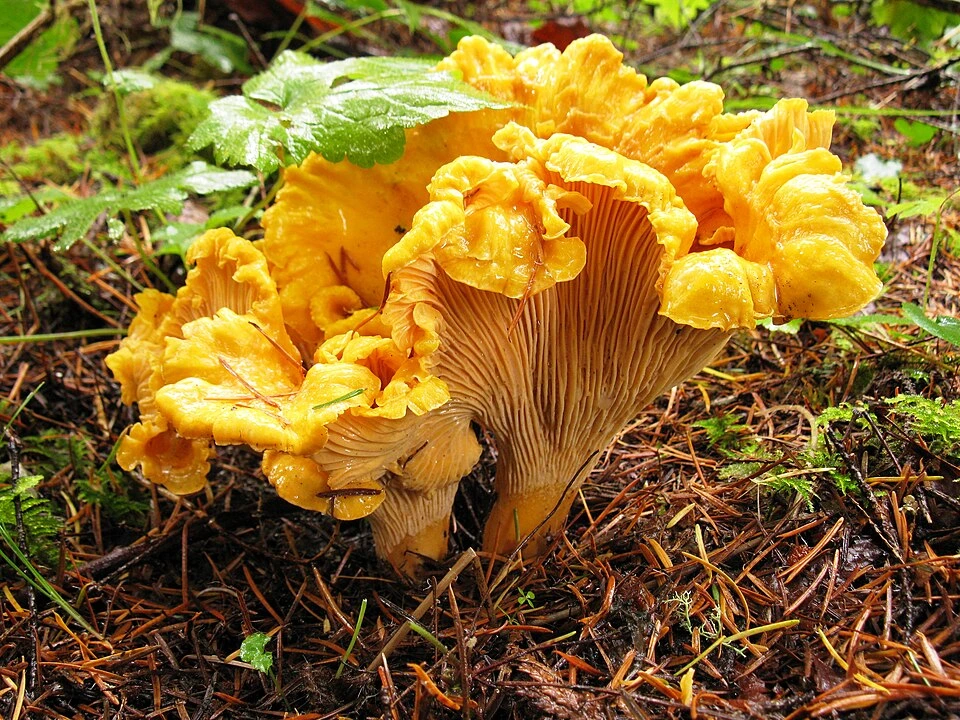
    The underside is the key feature. Instead of thin blade-like gills, chanterelles have thick blunt ridges.

    These ridges usually fork, merge, and run down the stem.

    False Gills vs True Gills

    False gills are part of the mushroom tissue itself. They are thick, shallow, and difficult to separate cleanly from the cap.

    True gills, by contrast, are thin plate-like structures. This distinction is especially important in chanterelle identification.

    Stem

    The stem is solid and usually similar in color to the cap or slightly paler. It often blends gradually into the cap.

    There is no ring or volva.

    Flesh

    The flesh is pale white to cream inside, even when the surface is strongly yellow.

    It is firm and not especially brittle.

    Hedgehog Mushroom vs Chanterelle: Key Differences

    The main difference is the underside. Teeth belong to Hydnum, while ridged false gills belong to Cantharellus.

    Other clues support the identification, but the underside usually gives the answer quickly.

    Feature Hedgehog Mushroom Chanterelle
    Underside Soft teeth Blunt ridges
    Tooth/gill structure Separate hanging spines Fused ridges
    Cap color Cream to pale orange Yellow to golden
    Smell Usually mild Often fruity
    Cap shape Irregular, sometimes flattened Often funnel-like
    Growth substrate Soil Soil

    Teeth vs False Gills

    This is the most important comparison in the entire article.

    Hedgehog Mushroom Teeth

    Hydnum teeth look like tiny downward-pointing icicles. They are distinct from each other and hang from the underside.

    If you gently run a finger across them, they can bend or break.

    Chanterelle False Gills

    Chanterelle ridges are thick folds in the mushroom tissue. They fork and merge instead of hanging separately.

    They usually continue down the stem, creating a wrinkled or veined appearance.

    Can the Cap Color Cause Confusion?

    Yes. Both groups can be yellowish, buff, orange, or pale cream.

    Color overlap is significant, especially in old or weathered specimens.

    This is why cap color should come after the underside, not before it.

    Habitat

    Both groups are mycorrhizal and grow from soil in association with living trees. Neither typically grows directly from dead wood.

    Coniferous, mixed, and broadleaf forests can support both groups depending on region.

    Tree Associations

    Chanterelles may associate with oak, beech, pine, spruce, fir, and other trees depending on species. Hedgehog Mushrooms also occur with a range of broadleaf and conifer hosts.

    The exact host relationship varies by geography, so habitat is a supporting rather than decisive feature.

    Season

    Both Hedgehog Mushrooms and Chanterelles are mainly found from summer into autumn.

    Their seasons often overlap closely. This is one reason they are frequently compared.

    Rainfall and local climate can shift the timing considerably.

    Growth Pattern

    Both can grow singly, scattered, or in small groups. Chanterelles often form loose patches or arcs.

    Hedgehog Mushrooms can also appear in groups, especially in productive woodland.

    Cluster shape alone is not useful enough to separate them.

    Hedgehog Mushroom Look-Alikes

    The main look-alikes include other toothed fungi and pale woodland mushrooms.

    The underside usually prevents confusion with gilled species.

    Sarcodon Species

    Identification

    Sarcodon species also have teeth underneath. However, they usually have darker, rougher, or scaly caps and often a more robust build.

    Some are brown or gray rather than pale cream or orange.

    Main Difference

    A dark scaly cap points away from typical Hydnum. The overall texture is often coarser and more rugged.

    Bankera and Other Toothed Fungi

    Some other woodland fungi also have teeth. They may differ in cap texture, smell, color, or spore characters.

    For difficult toothed mushrooms, exact genus-level identification may require closer study.

    Chanterelle Look-Alikes

    Chanterelles have several important look-alikes, including False Chanterelle and Jack-o’-Lantern mushrooms.

    These have true gills rather than blunt false gills.

    False Chanterelle — Hygrophoropsis aurantiaca

    Identification

    False Chanterelle is orange and often has numerous thin, forked true gills.

    The gills are much more blade-like than chanterelle ridges.

    Main Difference

    Thin flexible gills indicate False Chanterelle. Thick blunt ridges indicate a true chanterelle.

    Jack-o’-Lantern — Omphalotus Species

    Identification

    Jack-o’-Lantern mushrooms are bright orange and usually grow in dense clusters from wood or buried roots.

    They have true gills.

    Main Difference

    Growth from wood and thin blade-like gills separate them from chanterelles.

    Hedgehog Mushroom vs False Chanterelle

    A Hedgehog Mushroom should be even easier to distinguish from False Chanterelle because one has teeth and the other has true gills.

    Their cap colors can overlap, but the underside is completely different.

    Hedgehog Mushroom vs Chanterelle Step by Step

    A few structural checks usually solve the comparison.

    Step 1: Turn the Mushroom Over

    If you see teeth, think Hydnum. If you see thick ridges, think Cantharellus.

    This step alone often provides the answer.

    Step 2: Check Whether the Structures Are Separate

    Individual hanging spines indicate Hedgehog Mushroom. Continuous ridges fused into the cap indicate Chanterelle.

    This distinction is more reliable than color.

    Step 3: Look at Cap Shape

    A flatter irregular cap is more typical of Hedgehog Mushroom. A funnel-like golden cap is more typical of Chanterelle.

    This is supportive rather than decisive.

    Step 4: Check the Smell

    Many chanterelles have a fruity smell often compared with apricot. Hedgehog Mushrooms are generally milder.

    Smell is subjective, so use it only after structural characters.

    Step 5: Confirm Soil Growth

    Both should grow from soil in a mycorrhizal setting. Growth directly from logs or stumps should prompt reconsideration.

    Habitat can also help eliminate unrelated look-alikes.

    Can Hedgehog Mushrooms and Chanterelles Grow Together?

    Yes. Because they can share similar woodland conditions and host trees, both may appear in the same forest.

    They can even fruit during the same period.

    This makes underside examination essential, especially when several yellowish mushrooms are mixed together.

    Are Both Edible?

    Both are generally considered edible when correctly identified and properly prepared.

    However, edibility should only be considered after identification is secure.

    A yellow mushroom in woodland should never be assumed edible simply because it resembles one of these groups.

    How to Photograph Them for Identification

    Take a side photo showing the complete mushroom and then a clear underside photo.

    For Hedgehog Mushrooms, make sure the teeth are visible. For chanterelles, show how the ridges fork and run down the stem.

    A habitat image can help establish soil growth and nearby host trees.

    Can AI Tell Hedgehog Mushrooms From Chanterelles?

    Yes, often quite reliably if the underside is visible.

    The distinction between teeth and false gills is visually strong and easier for image recognition systems than many subtle mushroom comparisons.

    Cap-only photographs are much less useful because color and shape can overlap.

    Common Identification Mistakes

    A common mistake is using yellow color as the main clue. Many unrelated woodland mushrooms are yellow or orange.

    Another mistake is calling chanterelle ridges “gills” and then treating all forked gills as equivalent. True gills and false gills are structurally different.

    A third mistake is never looking at the underside. In this comparison, the most important clue is hidden underneath the cap.

    Interesting Facts About Hedgehog Mushrooms and Chanterelles

    Both groups are mycorrhizal fungi, meaning much of the organism lives underground in association with tree roots. The visible mushroom is only the reproductive fruit body.

    Hedgehog Mushrooms are especially unusual because their spore-bearing surface is arranged on teeth rather than gills or pores. This gives them one of the easiest underside structures to recognize in the field.

    Chanterelles use a different solution: broad folded ridges that increase the spore-producing surface without forming true gills.

    Both groups also illustrate how mushroom taxonomy can become regionally complex. A mushroom that looks like a familiar European species may belong to a different but closely related North American or Asian taxon.

    Frequently Asked Questions

    Can Hedgehog Mushroom teeth fall off with age?

    Yes. Older teeth can become fragile and break during handling. Even then, remnants or short stubs are usually still visible.

    Can chanterelle ridges look almost like true gills?

    They can in some specimens, especially when strongly developed. Their thickness, blunt edges, and tendency to merge remain useful clues.

    Why are some Hedgehog Mushrooms nearly white?

    Color varies by species, age, moisture, and light exposure. Pale cream specimens are completely normal in several Hydnum groups.

    Can chanterelles be pale instead of orange?

    Yes. Some species and older specimens can be pale yellow or cream-yellow rather than deep golden.

    Do both mushrooms grow after heavy rain?

    Yes. Moisture strongly influences fruiting in both groups, although temperature and host tree conditions also matter.

    Can the teeth of Hedgehog Mushrooms run onto the stem?

    Yes. They may extend slightly down the stem, especially in mature fruit bodies.

    Why do some chanterelles have a much stronger fruity smell than others?

    Odor varies among species and individual specimens. Freshness and environmental conditions also affect how noticeable it is.

    Can you identify either species from a top photo only?

    Sometimes a probable group can be suggested, but reliable separation requires an underside view.

    Final Identification Notes

    Hedgehog Mushrooms and Chanterelles can share similar colors, habitats, and seasons, but their undersides are fundamentally different.

    Hedgehog Mushrooms have soft individual teeth. Chanterelles have thick blunt false gills that fork and run down the stem.

    Once that difference is clear, most of the confusion disappears. Use cap shape, smell, habitat, and geography as supporting clues, but let the underside lead the identification.

  • Mushrooms With a Ring on the Stem: What It Means for Identification

    Mushrooms With a Ring on the Stem: What It Means for Identification

    A ring on a mushroom stem can be one of the most useful identification clues in the field. It may indicate that the mushroom once had a partial veil covering the gills or pores while it was young, and the remains of that veil stayed behind as a ring when the cap expanded.

    But a ring is not a species by itself, and it is not a sign that a mushroom is edible. Ringed stems occur in edible mushrooms, poisonous mushrooms, and some deadly species, so the ring should always be treated as one structural clue among several.

    ⚠️ Important: Never eat a wild mushroom simply because it has a familiar-looking ring. Always identify the whole mushroom, including the cap, underside, stem base, habitat, and other key features.

    What Is a Ring on a Mushroom Stem?

    The ring is also called an annulus. It forms when a partial veil that protected the young gills or pores tears as the mushroom expands.

    The remaining veil tissue may stay attached to the stem as a skirt, collar, band, or fragile zone. In some species the ring is thick and persistent, while in others it disappears quickly.

    Why the Ring Matters

    A ring can immediately narrow down the possible groups. For example, many Amanita, Agaricus, Macrolepiota, and some Suillus species have obvious rings.

    At the same time, related species may differ mainly in whether a ring is present or absent. This makes the ring especially useful in comparisons.

    Different Types of Mushroom Rings

    Not all rings look alike. Their shape and texture can be just as important as their presence.

    Some rings hang downward like a skirt, some sit upright like a collar, and others are reduced to a thin band.

    Hanging Skirt-Like Ring

    This type is common in several Amanita species and in Parasol Mushroom. It often looks broad, membranous, and easy to see.

    A large hanging ring can be very distinctive, but its exact structure should be combined with the stem base and cap features.

    Movable Ring

    Parasol Mushroom, Macrolepiota procera, is famous for having a ring that can often slide up and down the stem.

    This feature helps distinguish it from many smaller lepiotoid mushrooms. However, it should not be used alone because ring mobility can vary with age and damage.

    Fragile Ring

    Some species have rings that tear or disappear quickly. Old specimens may retain only a faint ring zone or scattered veil fragments.

    This is why a mushroom that appears ringless is not always truly ringless.

    Ring Zone

    In some mushrooms, the ring is not a distinct membrane but a colored band or roughened zone on the stem.

    These subtle remnants can still be useful if other features support the identification.

    12 Common Mushrooms With a Ring on the Stem

    Species Common name Ring type Key clue
    Amanita muscaria Fly Agaric Broad hanging ring Red cap, white warts
    Amanita pantherina Panther Cap Membranous ring Brown cap, white warts
    Amanita phalloides Death Cap Hanging ring Volva at base, white gills
    Amanita rubescens Blusher Hanging ring Flesh reddens when damaged
    Macrolepiota procera Parasol Large movable ring Tall patterned stem
    Chlorophyllum rhacodes group Shaggy Parasol Thick ring Shaggy cap, reddening flesh
    Agaricus campestris Field Mushroom Thin ring Pink to brown gills
    Agaricus arvensis Horse Mushroom Large ring Yellowing, anise-like smell
    Agaricus xanthodermus Yellow Stainer Ring present Bright yellow bruising, unpleasant odor
    Suillus luteus Slippery Jack Membranous ring Slimy brown cap, yellow pores
    Armillaria mellea group Honey Fungus Ring on many species Clusters on roots or wood
    Pholiota squarrosa Shaggy Scalycap Ring zone Dense scales, wood habitat

    Amanita muscaria — Fly Agaric

    Fly Agaric has a white ring on the stem, usually broad and skirt-like. The cap is red to orange-red and often covered with pale veil remnants.

    The stem base is bulbous and may carry additional veil remnants. This combination of ring plus bulb plus white gills points strongly toward Amanita.

    Why the Ring Matters

    The ring helps confirm that this is not simply a red-capped mushroom. It is part of a larger Amanita structure.

    The base should always be examined because Amanita identification depends heavily on both ring and basal features.

    Amanita pantherina — Panther Cap

    Panther Cap also has a ring, but the cap is brown to gray-brown with white veil patches. The margin is often clearly striate.

    Its stem base usually has more defined veil remnants than Fly Agaric.

    Why the Ring Matters

    The ring helps separate the mushroom from ringless grisettes. However, the cap and bulb are more important for distinguishing exact Amanita species.

    Amanita phalloides — Death Cap

    Death Cap has a pale to olive, yellowish, or greenish cap, white gills, a pale hanging ring, and a large sack-like volva at the base.

    The volva is one of the most important features because the ring alone is shared with many harmless and edible mushrooms.

    Safety Significance

    This is one of the clearest examples of why a ring does not imply edibility. Death Cap is deadly poisonous.

    Any pale ringed mushroom with white gills and a volva deserves extreme caution.

    Amanita rubescens — Blusher

    The Blusher has a ring and often a brownish or reddish-brown cap with pale veil patches. Damaged flesh develops reddish or wine-colored staining.

    This bruising is one of its most useful identifying features.

    Why the Ring Matters

    The ring places it within the ringed Amanita group, but the reddening reaction separates it from several similar species.

    Stem base structure should still be checked carefully.

    Macrolepiota procera — Parasol

    Parasol Mushroom has a large cap with brown scales, a tall stem with a snakeskin-like pattern, and a thick ring that can often move up and down.

    It is one of the most recognizable ringed mushrooms when mature.

    Movable Ring

    The movable ring is a famous field feature. It is especially useful when combined with the patterned stem and very large size.

    Small ringed lepiotoid mushrooms should not be assumed to be young Parasols.

    Chlorophyllum rhacodes Group — Shaggy Parasol

    Shaggy Parasols have large scaly caps and a prominent ring. The flesh often reddens or becomes orange after cutting.

    The stem lacks the classic snakeskin pattern of Macrolepiota procera.

    Main Difference From Parasol

    A plain stem and stronger reddish bruising point toward Chlorophyllum. The cap scales are also often more coarse and shaggy.

    Ring structure can help, but stem pattern and bruising are stronger clues.

    Agaricus campestris — Field Mushroom

    Field Mushroom has a white cap, pink young gills that become chocolate-brown, and a relatively modest ring.

    It usually grows in grassy areas rather than deep woodland.

    Why the Ring Matters

    The ring supports identification as an Agaricus, but the gill color is more important. Amanitas usually keep white gills, while Agaricus gills darken with age.

    This difference is critical in pale ringed mushrooms.

    Agaricus arvensis — Horse Mushroom

    Horse Mushroom is a large pale Agaricus with a substantial ring. It often develops some yellow staining and may have a sweet anise-like smell.

    The gills begin pale pinkish and darken as spores mature.

    Main Identification Clue

    The combination of a large ring, darkening gills, yellowing tendency, and characteristic smell helps narrow the identification.

    Agaricus xanthodermus — Yellow Stainer

    Yellow Stainer has a white cap and a ring but bruises bright yellow, especially near the stem base. It often has an unpleasant chemical or phenolic odor.

    It can cause gastrointestinal illness.

    Why the Ring Can Mislead

    At first glance, it can resemble edible Agaricus species. The ring does nothing to prove edibility.

    Bruising and smell are much more important in this comparison.

    Suillus luteus — Slippery Jack

    Slippery Jack is unusual among boletes because it has a ring. The cap is brown and very slimy when wet, while the underside has yellow pores instead of gills.

    The ring forms from a partial veil covering the young pore surface.

    Why the Ring Matters

    This is one of the best examples of a ring being useful within a bolete group. Suillus luteus is easily separated from several similar ringless Suillus species by this feature.

    Armillaria mellea Group — Honey Fungus

    Many Honey Fungus species have a ring on the stem and grow in clusters around roots, stumps, or buried wood.

    The cap is often honey-brown and may have darker scales.

    Ring Variability

    Not every honey mushroom relative is ringed. Some formerly grouped species are now placed in Desarmillaria and lack a ring.

    This makes ring presence useful for narrowing the group, but not for identifying all honey mushrooms.

    Pholiota squarrosa — Shaggy Scalycap

    Shaggy Scalycap grows in dense clusters on or near wood and has prominent scales on the cap and stem.

    A ring or ring zone may be visible on the upper stem.

    Main Identification Clue

    The combination of dense coarse scales, wood habitat, and clustered growth is more useful than the ring alone.

    Ringed Mushrooms With White Gills

    White gills plus a ring immediately bring several Amanita species to mind. This combination becomes especially important when the stem also has a swollen base or volva.

    However, other mushrooms can also have pale gills and a ring. The base and gill attachment must still be checked.

    Ring Plus Volva

    A ring together with a sack-like volva is a major warning combination. It is especially important in species such as Death Cap.

    The base should never be cut off and discarded during identification.

    Ringed Mushrooms With Brown Gills

    Many Agaricus species have a ring and gills that change from pink to dark brown as the mushroom matures.

    This is very different from Amanitas, which usually retain white gills.

    Why Gill Color Matters

    A pale cap plus ring can look similar across genera. Mature gill color can quickly separate major groups.

    This is one of the most practical examples of using multiple features together.

    Ringed Mushrooms With Pores

    Most ringed mushrooms people notice have gills, but some boletes also have rings. Suillus luteus is the classic example.

    The underside immediately changes the identification pathway. Yellow pores plus a ring under pine suggest something very different from white gills plus a ring.

    Ringed Mushrooms Growing on Wood

    Honey mushrooms and some Pholiota species can have rings and grow in clusters from wood or buried roots.

    This habitat can quickly narrow the possibilities. A ringed mushroom fruiting from a stump should not be approached the same way as a ringed mushroom growing alone from soil.

    Why Rings Disappear

    Rings can be fragile. Rain, insects, age, abrasion, and handling can all destroy them.

    A mushroom that “has no ring” may actually have had one earlier in development.

    Check Younger Specimens

    If several mushrooms are growing together, compare different ages. Young fruit bodies often retain veil structures more clearly.

    This can be especially helpful with Slippery Jack and some Amanitas.

    How to Identify a Ringed Mushroom Step by Step

    Start by confirming whether the mushroom has gills, pores, or another underside. This immediately narrows the major groups.

    Then inspect the ring itself, the stem base, gill or pore color, habitat, and any bruising reactions.

    Step 1: Check the Underside

    White gills suggest one path, darkening gills another, and pores another entirely.

    This should be the first major split in the identification.

    Step 2: Examine the Ring

    Ask whether it is broad, thin, hanging, movable, fragile, or only visible as a zone.

    Ring structure can separate closely related groups.

    Step 3: Check the Stem Base

    Look for a volva, bulb, rooting base, or normal cylindrical stem.

    This step is especially important in Amanitas.

    Step 4: Look for Bruising

    Yellowing, reddening, or other color changes can narrow identification dramatically.

    This is useful in Agaricus, Chlorophyllum, and several Amanitas.

    Step 5: Check Habitat

    Soil, grass, pine roots, stumps, and buried wood all point toward different groups.

    Habitat should confirm the structural identification rather than replace it.

    How to Photograph a Ringed Mushroom

    Take one side photograph showing the full stem and ring. Make sure the ring is not hidden behind the cap.

    Then photograph the underside and the complete stem base. For Amanitas, gently expose the bulb and volva without cutting them off.

    A close-up of the ring can also help show its thickness and texture. Habitat photos are useful for separating woodland, grassland, and wood-growing species.

    Can AI Identify Mushrooms by the Ring?

    AI can use ring presence as a strong structural clue, but it should never treat it as decisive. Many unrelated groups share this feature.

    Accuracy improves significantly when the ring is shown together with gills or pores, stem base, bruising, and habitat.

    A cap-only photo often misses the ring entirely. Side views are therefore especially important.

    Common Identification Mistakes

    One common mistake is assuming a ring means the mushroom is edible. Some of the most dangerous mushrooms in the world have rings.

    Another mistake is failing to check whether the ring is actually part of the mushroom or just torn cap tissue or debris. A true ring should be structurally connected to the stem.

    A third mistake is overlooking an old damaged ring and wrongly concluding the mushroom belongs to a ringless species.

    Interesting Facts About Mushroom Rings

    The ring is a remnant of a temporary protective structure. In young mushrooms, the partial veil shields developing gills or pores before the cap opens.

    Some species retain a dramatic ring for most of their life, while others lose it within hours or days. This makes ring persistence itself an identification feature.

    The ring can also reveal developmental history. A mushroom with a movable ring, for example, shows that the veil separated in a very different way from one with a fragile ring zone.

    In evolutionary terms, rings have appeared in many unrelated mushroom groups. This is why the same feature can occur in boletes, Amanitas, Agaricus, parasols, and wood-growing species.

    Frequently Asked Questions

    Can a mushroom have two rings?

    Some species can appear to have multiple ring zones or stacked veil remnants. This is usually caused by complex veil structures rather than two completely separate rings.

    Can rain remove a ring completely?

    Yes. Thin rings can tear, collapse, or wash away, especially in older specimens.

    Why are rings sometimes darker than the stem?

    Spores, dirt, and moisture can collect on the upper surface of the ring. In dark-spored species this can make the ring look brown or rusty.

    Can a ring change color with age?

    Yes. White rings can become cream, brown, stained, or translucent as they age.

    Are young mushrooms easier to identify by the ring?

    Often yes, because veil structures are fresher and less damaged. However, very young mushrooms may still have the veil closed and not yet show a mature ring.

    Can a ring be hidden under the cap?

    Yes. In small or young specimens, the ring may sit very close to the gills and be difficult to see from above.

    Do all Amanitas have rings?

    No. Several Amanita groups, such as many grisettes, lack a ring entirely.

    Do all Suillus species have rings?

    No. Some, such as Suillus luteus, are ringed, while others such as Suillus granulatus are ringless.

    Final Identification Notes

    A ring on the stem is an important clue, but it only tells part of the story. Ringed mushrooms include edible species, poisonous species, and deadly species, so the ring should always be interpreted together with the underside, stem base, bruising, habitat, and spore characteristics.

    The most useful question is not simply “does it have a ring?” but “what kind of ring, on what kind of mushroom?”

    White gills plus a ring and volva suggest Amanita, darkening gills plus a ring suggest Agaricus, and yellow pores plus a ring may suggest Suillus. Structure first, ring second, species last.

  • Mushrooms Growing Under Birch Trees: 15 Common Species

    Mushrooms Growing Under Birch Trees: 15 Common Species

    Birch trees support a surprisingly rich community of fungi. Some mushrooms form close mycorrhizal partnerships with birch roots, while others grow nearby because they prefer the same acidic soils, mossy ground, cool climates, or woodland conditions.

    Finding a mushroom under birch does not identify it by itself, but tree association can be an extremely useful clue. In some groups, especially boletes and milkcaps, the host tree can narrow the possibilities dramatically.

    ⚠️ Important: Habitat is only one part of mushroom identification. Never eat a wild mushroom based solely on the tree it grows under, photographs, AI identification, or a single visible feature.

    15 Common Mushrooms Found Under Birch Trees

    Species Common name Main clue Relationship with birch
    Leccinum scabrum Brown Birch Bolete Brown cap, scabrous stem Strongly associated
    Leccinum versipelle group Orange Birch Bolete Orange cap, dark stem scales Strongly associated
    Leccinum holopus Ghost Bolete Pale cap, wet birch habitat Strongly associated
    Lactarius pubescens Bearded Milkcap Pale pink woolly cap, white latex Strongly associated
    Lactarius torminosus Woolly Milkcap Pink zoned cap, woolly margin Strongly associated
    Russula betularum Birch Brittlegill Pale pink cap, brittle flesh Strongly associated
    Russula claroflava Yellow Swamp Brittlegill Bright yellow cap Birch, wet soils
    Amanita muscaria Fly Agaric Red cap, white warts Common with birch
    Amanita fulva Tawny Grisette Tawny cap, volva, no ring Often with birch
    Amanita crocea Orange Grisette Orange cap, volva, no ring Can occur with birch
    Cortinarius armillatus Red-Banded Webcap Red bands on stem Often birch-associated
    Paxillus involutus Brown Roll-Rim Rolled cap margin, decurrent gills Often with birch
    Cantharellus cibarius group Chanterelle False gills, yellow body Can grow with birch
    Hydnum repandum group Hedgehog Mushroom Teeth under cap Can grow with birch
    Imleria badia Bay Bolete Yellow pores, blue bruising Can occur near birch

    Why Birch Trees Have So Many Mushrooms

    Birch forms ectomycorrhizal relationships with many fungi. In these partnerships, fungal hyphae wrap around or grow among the outer parts of tree roots and exchange minerals and water for sugars produced by the tree.

    This relationship is especially important in nutrient-poor, acidic, or cool soils where birch often thrives. The fungi help the tree access resources that would otherwise be difficult to obtain.

    Birch as a Mycorrhizal Host

    Some fungi are strongly specialized on birch, while others can associate with birch and several other tree species. This difference matters when using habitat as an identification feature.

    A mushroom that is strongly birch-associated becomes much more likely when several mature birches are present. A generalist mycorrhizal species, by contrast, may simply be sharing the same woodland.

    1. Leccinum scabrum — Brown Birch Bolete

    Brown Birch Bolete is one of the classic mushrooms associated with birch. It usually has a brown to gray-brown cap and a pale stem covered with numerous dark rough scales known as scabers.

    The pore surface begins pale and may become grayish or duller with age. Strong blue bruising is generally absent.

    Main Identification Clue

    The stem is especially important. The dark scabers distinguish Leccinum from many other brown boletes.

    If a brown-capped bolete with a scabrous stem is growing directly beneath birch, Leccinum scabrum becomes a strong possibility.

    2. Leccinum versipelle Group — Orange Birch Bolete

    Orange Birch Boletes have orange to orange-brown caps and pale stems covered with dark scabers. Their appearance is often more vivid than that of Brown Birch Bolete.

    Several closely related taxa may be involved depending on region, so group-level identification is sometimes more accurate than forcing an exact species name.

    Main Identification Clue

    The combination of an orange cap, scabrous stem, and birch association is highly characteristic. Flesh may darken or gray after cutting in some members of the group.

    Host tree and geography are important for narrowing the exact taxon.

    3. Leccinum holopus — Ghost Bolete

    This pale bolete is usually whitish, cream, or very pale gray. It has the same scabrous stem structure typical of Leccinum.

    It is especially associated with wet birch habitats and can occur in boggy or mossy ground.

    Main Identification Clue

    The pale coloration is the most striking feature. In wet birch woodland, a ghostly pale bolete with stem scabers is a strong clue toward Leccinum holopus.

    Its habitat helps separate it from paler forms of other Leccinum species.

    4. Lactarius pubescens — Bearded Milkcap

    Bearded Milkcap has a pale pinkish to cream-pink cap with a woolly or hairy margin. The gills are pale, and damaged tissue releases white latex.

    It is strongly associated with birch and often appears in grass, moss, or leaf litter near birch roots.

    Main Identification Clue

    Look for the pale hairy cap margin and white milk. The cap is usually less strongly zoned and less vivid than that of Lactarius torminosus.

    The birch association makes this species much easier to interpret.

    5. Lactarius torminosus — Woolly Milkcap

    Woolly Milkcap is one of the most distinctive birch-associated milkcaps. The cap is pink to salmon-pink, often with concentric darker zones and a strongly woolly margin.

    The gills are pale and release white latex when damaged.

    Main Identification Clue

    A pink zoned cap with a thick woolly edge beneath birch is highly characteristic. Young mushrooms often have particularly obvious rolled-in hairy margins.

    This species should not be confused with edible orange milkcaps simply because both produce latex.

    6. Russula betularum — Birch Brittlegill

    As the name suggests, this small pale russula is closely associated with birch. The cap is usually pinkish, pale red, or faded almost white.

    The gills and stem are pale, and the flesh is brittle in the classic Russula manner.

    Main Identification Clue

    The small size, pale pink cap, brittle structure, and birch habitat are the best field clues. Exact identification among pale russulas can still be difficult.

    Acrid taste is often mentioned in specialist descriptions, but beginners should not rely on taste testing.

    7. Russula claroflava — Yellow Swamp Brittlegill

    This species has a bright yellow cap, pale gills, and a white stem. It often grows with birch in damp or boggy ground.

    The color can be striking, especially against dark moss and wet soil.

    Main Identification Clue

    The combination of a vivid yellow cap and wet birch habitat is particularly useful. The flesh and gills may darken somewhat with age or damage.

    It is one of the more visually distinctive birch-associated russulas.

    8. Amanita muscaria — Fly Agaric

    Fly Agaric is strongly associated with birch in many regions. Its classic red cap with white veil warts makes it one of the easiest mushrooms to recognize when fresh.

    It also has white gills, a white ringed stem, and a bulbous base with veil remnants.

    Main Identification Clue

    The red cap and white warts are obvious, but the full Amanita structure should still be checked. Rain can wash the warts away.

    Birch woodland is one of the classic habitats for this toxic species.

    9. Amanita fulva — Tawny Grisette

    Tawny Grisette has a tawny to orange-brown cap with a clearly striate margin. The stem is pale and lacks a ring.

    At the base is a distinct sack-like volva, which is one of the key features of the grisette group.

    Main Identification Clue

    The absence of a ring plus a volva and strongly striate cap margin is important. This separates it from many ringed Amanitas.

    It is often associated with birch and can occur in damp woodland.

    10. Amanita crocea — Orange Grisette

    Orange Grisette resembles Tawny Grisette but usually has a brighter orange or saffron-colored cap. Like other grisettes, it has a striate margin, no ring, and a basal volva.

    The stem may show orange or yellowish fibrous markings.

    Main Identification Clue

    A bright orange Amanita with no ring and a volva should suggest the grisette group. Birch can be one of several associated trees.

    Exact separation from related grisettes may require regional knowledge.

    11. Cortinarius armillatus — Red-Banded Webcap

    This webcap has a brown to orange-brown cap and a pale to brownish stem marked with conspicuous red or reddish bands. Young specimens may also show remnants of the cobweb-like cortina typical of Cortinarius.

    It is frequently associated with birch.

    Main Identification Clue

    The red bands around the stem are particularly useful. Few common birch-associated mushrooms combine this feature with a brown cap and rusty spores.

    As with many Cortinarius, exact identification should be cautious.

    12. Paxillus involutus — Brown Roll-Rim

    Brown Roll-Rim has a brown cap with an inrolled margin, especially when young. The gills run down the stem and can bruise brown when handled.

    It often grows with birch and other trees and can appear in large numbers.

    Main Identification Clue

    The rolled cap margin and strongly decurrent gills are important. The gills can also be peeled or separated unusually easily from the cap flesh.

    This species is poisonous and should not be eaten.

    13. Cantharellus cibarius Group — Chanterelles

    Yellow chanterelles can occur in birch woodland, although they are not restricted to birch. Their thick blunt false gills run down the stem and are very different from thin blade-like true gills.

    The cap and stem are usually yellow to golden.

    Main Identification Clue

    The false gills are the best character. They appear as thick ridges rather than delicate plates.

    Host tree helps support the identification but is less decisive here than in birch-specialist boletes or milkcaps.

    14. Hydnum repandum Group — Hedgehog Mushrooms

    Hedgehog Mushrooms are easy to recognize because the underside of the cap is covered with soft downward-pointing teeth instead of gills or pores.

    The cap is usually cream, pale ochre, or light orange.

    Main Identification Clue

    The teeth are decisive. Very few common woodland mushrooms with this overall shape share the same underside.

    They can occur with several broadleaf and conifer trees, including birch in suitable habitats.

    15. Imleria badia — Bay Bolete

    Bay Bolete has a chestnut-brown cap and yellow pores that often turn blue when pressed. The stem is brownish and lacks the strong pale reticulation of Porcini.

    It is most strongly associated with coniferous and mixed woodland, but birch can be present in mixed stands where the species fruits.

    Main Identification Clue

    Yellow pores that bruise blue are one of the fastest clues. The smooth chestnut cap and relatively plain stem help support the identification.

    Because it is not a birch specialist, nearby conifers should also be checked.

    Birch Specialists vs General Woodland Species

    Not every mushroom beneath birch is actually partnered with birch. Some species are tightly associated with the tree, while others simply occur in mixed woodland where birch happens to be present.

    This distinction is important when using habitat as an identification feature.

    Strong Birch Associates

    Species such as Leccinum scabrum, Lactarius torminosus, Lactarius pubescens, and several birch-associated russulas are especially informative when birch is nearby.

    Their ecology can be one of the strongest clues in the entire identification.

    Broader Woodland Species

    Fly Agaric, chanterelles, Hedgehog Mushrooms, and Bay Bolete can occur with multiple tree species. In mixed woodland, it may be unclear which tree is the actual mycorrhizal partner.

    Always look around the entire area rather than assuming the nearest trunk is responsible.

    Mushrooms Under Birch in Wet Ground

    Birch often grows in damp, acidic soils, and several characteristic fungi share this preference. Leccinum holopus, Russula claroflava, and Russula emetica-like brittlegills are especially associated with wet or boggy environments.

    Moss and sphagnum can therefore become useful ecological clues. A mushroom growing in a dry ornamental birch planting may belong to a very different community.

    Mushrooms Under Birch in Dry Woodland

    Drier birch woodland can support Brown Birch Bolete, Orange Birch Boletes, Fly Agaric, chanterelles, and several Cortinarius species.

    The exact community depends on soil type, climate, elevation, and the presence of other trees.

    Mixed birch-pine or birch-spruce woodland can be especially species-rich because fungi associated with several host trees may overlap.

    Which Birch Mushrooms Have Pores?

    The best-known pore-bearing birch mushrooms are boletes, especially species of Leccinum. Their underside looks sponge-like rather than gilled.

    Brown Birch Bolete and Orange Birch Boletes are among the most typical examples. Bay Bolete may also appear in mixed birch woodland.

    Why the Stem Matters in Leccinum

    Leccinum stems are covered with small rough projections known as scabers. These may be brown, gray, or nearly black.

    This feature is far more useful than cap color alone. Several Leccinum species can have overlapping brown or orange caps.

    Which Birch Mushrooms Have Gills?

    Milkcap, russula, Amanita, webcap, and Brown Roll-Rim species all have gills. Their structures, however, are very different.

    Milkcaps produce latex, russulas are brittle, Amanitas may have rings or volvas, and webcaps often develop rusty spores.

    This is why “gilled mushroom under birch” remains a very broad description.

    How to Identify Mushrooms Under Birch Step by Step

    Start with the underside rather than cap color. Determine whether the mushroom has pores, true gills, false gills, or teeth.

    Then inspect the stem for scabers, rings, volvas, bands, or latex-producing tissue. Finally, consider whether the mushroom appears to be a birch specialist or a broader woodland species.

    Step 1: Check the Underside

    Pores suggest boletes such as Leccinum. Teeth suggest Hydnum, while false gills suggest chanterelles.

    True gills lead toward a much wider set of groups.

    Step 2: Inspect the Stem

    Dark scabers strongly suggest Leccinum. A ring and bulb may indicate Amanita, while red bands may suggest Cortinarius armillatus.

    A sack-like volva without a ring points toward a grisette.

    Step 3: Test for Latex

    If damaged gills release white or colored milk, consider Lactarius or related milkcaps. This is especially useful with the pink birch-associated milkcaps.

    No latex points toward russulas or other gilled groups.

    Step 4: Check Habitat Moisture

    Wet boggy birch ground favors a different set of species than dry woodland. Moisture level is especially useful with russulas and some Leccinum.

    Sphagnum moss can be an important clue for wet-habitat specialists.

    Step 5: Look for Other Trees

    Pine, spruce, oak, and beech may be present close enough to form mycorrhizal relationships with the mushroom you found.

    This is especially important before assigning a generalist species to birch.

    How to Photograph Birch-Associated Mushrooms

    Take a photograph showing the complete mushroom and surrounding ground. Include birch leaves, bark, roots, or nearby trunks if possible.

    Then photograph the underside, full stem, and stem base. For milkcaps, include a damaged gill showing latex; for boletes, photograph pore bruising; for Amanitas, expose the entire bulb and volva.

    A wider habitat image is especially valuable for mycorrhizal species. It can reveal other nearby host trees that are easy to miss in a close-up.

    Can AI Identify Mushrooms Growing Under Birch?

    AI can use birch habitat as a valuable contextual clue, especially for recognizable species such as Brown Birch Bolete or Woolly Milkcap. It becomes much more useful when combined with detailed images of the underside and stem.

    The main risk is overvaluing the nearest tree. A mushroom growing beneath birch may actually be associated with nearby pine, spruce, oak, or another host.

    The best AI identification therefore combines morphology with habitat rather than treating “under birch” as the answer by itself.

    Common Identification Mistakes

    A common mistake is calling every scabrous-stem bolete Brown Birch Bolete. Orange-capped and pale wetland Leccinum species can occur under the same tree genus.

    Another mistake is assuming every pink woolly milkcap is the same species. Lactarius pubescens and Lactarius torminosus overlap strongly but differ in color intensity, zoning, and other details.

    A third mistake is ignoring mixed woodland. Several fungi found “under birch” may actually be partnered with another nearby tree.

    Interesting Facts About Birch-Associated Mushrooms

    Birch is a pioneer tree that quickly colonizes disturbed ground, abandoned land, burned areas, and young woodland. Mycorrhizal fungi help birch survive in these nutrient-poor environments, which is one reason the tree supports such a rich fungal community.

    Some Leccinum species are so closely tied to particular tree groups that host identification becomes central to naming them. Birch, aspen, and other trees can support visibly similar boletes that differ mainly in ecology and subtle morphology.

    Fly Agaric is also famously associated with birch in northern Eurasia. The repeated appearance of red-and-white Fly Agarics beneath white-barked birches has become one of the most recognizable woodland scenes in mushroom photography.

    Birch fungi can also reveal hidden root systems. A mushroom several meters from a trunk may still be connected to that tree underground, showing how much larger a mycorrhizal partnership is than the visible fruit body.

    Frequently Asked Questions

    Why do mushrooms sometimes appear under a birch that was planted only a few years ago?

    Mycorrhizal fungi can establish quickly if suitable fungal partners are already present in the soil or arrive with the tree’s root system. Young birches can therefore develop fungal partners surprisingly early.

    Can mushrooms under ornamental birch trees be different from those in natural woodland?

    Yes. Soil, irrigation, mulch, nearby introduced trees, and nursery fungi can all change the fungal community around planted birches.

    Why are there more mushrooms under some birches than others?

    Tree age, root health, soil moisture, acidity, and fungal colonization all matter. Two birches growing close together can support noticeably different visible fruiting patterns.

    Can birch mushrooms grow after the tree has been cut down?

    Mycorrhizal species depend on living roots, so they eventually decline after the host dies. Fruiting may continue briefly while parts of the root system remain alive, but long-term persistence is unlikely without another compatible host.

    Do fallen birch leaves help identify the host tree reliably?

    They are useful, but leaves can blow considerable distances. Bark, live branches, and multiple nearby trunks provide better confirmation.

    Can the same birch support several mushroom species at once?

    Yes. A single tree can have relationships with multiple mycorrhizal fungi simultaneously, and visible fruit bodies from several species may appear during the same season.

    Why do some birch-associated mushrooms appear only in wet years?

    The mycelium can remain underground for long periods without producing mushrooms. Fruiting depends strongly on soil moisture, temperature, and seasonal weather patterns.

    Are mushrooms growing directly from birch wood also mycorrhizal?

    Usually not. A mushroom emerging directly from dead birch wood is more likely to be a decomposer, while the species in this guide mostly grow from soil in association with living roots.

    Final Identification Notes

    Birch trees support many distinctive fungi, including Brown Birch Bolete, Orange Birch Boletes, Woolly Milkcap, Bearded Milkcap, Birch Brittlegill, Fly Agaric, grisettes, and several wetland russulas.

    The strongest birch specialists are particularly useful for field identification, but not every mushroom beneath a birch belongs to the tree. Mixed woodland can contain fungi associated with several overlapping hosts.

    Start with the underside, examine the full stem, note latex or bruising, and then use the birch association to narrow the possibilities. Tree identification is a powerful clue, but it works best after the mushroom’s structure has already been established.

  • Fly Agaric vs Panther Cap: Amanita muscaria vs Amanita pantherina

    Fly Agaric vs Panther Cap: Amanita muscaria vs Amanita pantherina

    Аmanita muscaria, the Fly Agaric, and Amanita pantherina, the Panther Cap, are two striking toxic Amanita mushrooms that can look surprisingly similar. Both may have pale warts on the cap, white gills, a ring on the stem, and a bulbous base with veil remnants.

    The easiest first clue is usually cap color: Fly Agaric is typically red to orange-red, while Panther Cap is brown to gray-brown. But faded, washed, damaged, or unusually colored specimens can make this comparison much harder, so cap color should never be used alone.

    ⚠️ Important: Both species are toxic. Their main toxic compounds are associated with ibotenic acid and muscimol, which can cause neurological and gastrointestinal symptoms. Do not confuse this poisoning pattern with the delayed amatoxin syndrome of deadly species such as Amanita phalloides.

    Quick Comparison

    Feature Fly Agaric Panther Cap
    Scientific name Amanita muscaria Amanita pantherina
    Typical cap color Red to orange-red Brown to gray-brown
    Cap warts White to cream White to cream
    Gills White White
    Ring Present Present
    Stem White White
    Base Bulbous with veil remnants Bulbous with distinct rim-like veil zones
    Cap margin Usually not strongly striate Often more clearly striate
    Main toxins Ibotenic acid, muscimol Ibotenic acid, muscimol
    Toxicity Toxic Toxic
    Main range Widespread across Eurasia and introduced elsewhere Mainly Europe and western Eurasia
    Habitat Birch, pine, spruce and other trees Broadleaf and mixed woodland, often beech/oak

    The Fastest Way to Tell Them Apart

    Start with the cap color, but immediately move to the cap margin and stem base. A vivid red cap with pale warts strongly favors Fly Agaric, while a brown cap with pale warts and a more visibly striate margin favors Panther Cap.

    Then inspect the bulb at the base of the stem. Panther Cap often has more sharply defined veil remnants around the bulb, sometimes forming collar-like or concentric zones.

    These differences are most useful when several features agree. Old or rain-washed Amanitas can lose warts and fade dramatically.

    Fly Agaric — Amanita muscaria

    Amanita muscaria is one of the most recognizable mushrooms in the world. Its classic form has a bright red cap covered with white wart-like veil remnants, white gills, a white stem, and a broad hanging ring.

    The species is highly variable, however. Caps may be orange-red, yellow-orange, or faded after rain, and the white warts can be partly or completely washed away.

    Cap

    The cap is usually bright red to orange-red and begins rounded before flattening with age. White or cream warts are scattered across the surface.

    These warts are remnants of the universal veil that enclosed the young mushroom. Heavy rain can remove them, leaving a smooth-looking cap.

    Cap Margin

    The margin can become somewhat striate with age, but usually not as prominently as in typical Panther Cap. This difference is useful but not absolute.

    Very mature Fly Agarics can still develop visible grooves. The base and overall coloration should be considered at the same time.

    Gills

    The gills are white, free or nearly free from the stem, and crowded. They remain pale as the mushroom matures.

    This is a classic Amanita feature, but it does not separate these two species very well. Both have white gills.

    Stem

    The stem is white and often fairly tall. A broad, hanging ring is usually present on the upper stem.

    The stem base is swollen and surrounded by irregular veil remnants. These remnants are often less sharply organized than in Panther Cap.

    Stem Base

    Fly Agaric typically has a bulbous base with shaggy or broken concentric patches of veil material. The appearance can be messy rather than neat.

    This is one of the best places to look after the cap. Never cut an Amanita off at ground level when trying to identify it, because the basal structure is essential.

    Panther Cap — Amanita pantherina

    Аmanita pantherina typically has a brown to gray-brown cap covered with bright white veil patches. The contrast between dark cap and pale warts can be striking.

    The species is toxic and belongs to the same broad muscimol-containing Amanita group as Fly Agaric. Its identification requires particular care because several related brown Amanitas can look similar.

    Cap

    The cap ranges from warm brown to olive-brown, gray-brown, or darker chocolate tones. White veil warts are commonly scattered across the surface.

    Unlike many Fly Agarics, the brown background color usually remains a major feature. Rain may still wash away some of the pale veil patches.

    Cap Margin

    The cap margin is often distinctly striate, especially in mature specimens. These radial grooves can be easier to see than in typical Fly Agaric.

    This feature becomes especially useful when warts are missing. A brown Amanita with white gills, pale warts, and a strongly striate margin should be examined carefully for Panther Cap features.

    Gills

    The gills are white and crowded. They are free or nearly free from the stem.

    As with Fly Agaric, the gills confirm the Amanita structure but do not provide the decisive separation.

    Stem

    The stem is white, often slender to moderately robust, and has a ring. The ring may appear less broad or floppy than in some Fly Agarics.

    The lower stem expands into a bulb. The veil structures around this bulb are particularly important.

    Stem Base

    Panther Cap often has a more distinct rim or collar around the upper part of the bulb. Below that, additional concentric veil zones may be visible.

    This cleaner, more structured basal pattern can help separate it from Fly Agaric. It is one of the strongest non-color characters in the comparison.

    Fly Agaric vs Panther Cap: Key Differences

    The two species share many Amanita characters, so the comparison works best when several features are considered together.

    The most useful combination is cap color + cap margin + structure of the bulbous base.

    Feature Amanita muscaria Amanita pantherina
    Cap color Red to orange-red Brown to gray-brown
    Warts White/cream White/cream
    Cap margin Weakly to moderately striate Often clearly striate
    Ring Usually broad and hanging Present, often less conspicuous
    Basal veil Irregular patches/zones More distinct rim and concentric zones
    Gills White White
    Toxic compounds Ibotenic acid, muscimol Ibotenic acid, muscimol

    What Happens After Rain?

    Rain can make both species much harder to identify. Pale veil warts may disappear, cap colors may darken or wash out, and surface texture can change.

    A Fly Agaric that has lost its white warts may look surprisingly plain. A Panther Cap without obvious warts can also resemble other brown Amanitas.

    Why Washed Caps Are Dangerous

    People often rely too heavily on the white spots. Those spots are not permanent anatomical structures; they are veil remnants.

    This means the absence of spots does not rule out either species. The gills, ring, margin, and especially the stem base become more important.

    Fly Agaric vs Panther Cap by Stem Base

    If cap color is confusing, the bulb is often the next best clue. Carefully excavate the entire base rather than pulling or cutting the mushroom carelessly.

    Fly Agaric generally shows more irregular, broken veil remnants around the bulb. Panther Cap more often has a clearly defined upper rim and additional concentric bands lower down.

    The distinction is not always perfect in damaged specimens. Several mushrooms from the same patch may provide a clearer pattern.

    Toxicity

    Both mushrooms are toxic and can produce a neurological intoxication syndrome. Symptoms may include nausea, vomiting, dizziness, confusion, agitation, drowsiness, altered perception, and impaired coordination.

    The severity can vary considerably depending on the amount consumed, preparation, individual sensitivity, and chemical concentration in the mushroom.

    Ibotenic Acid and Muscimol

    The major toxicologically important compounds are ibotenic acid and muscimol. These affect the central nervous system in ways that differ from the amatoxins found in deadly Amanitas such as Death Cap.

    Symptoms often begin much sooner than classic amatoxin poisoning. The syndrome is more neurological and gastrointestinal than delayed liver failure.

    Not the Same as Amatoxin Poisoning

    This distinction matters. Amanita muscaria and Amanita pantherina should not be described as causing the same poisoning mechanism as Amanita phalloides.

    Death Cap and related deadly Amanitas contain amatoxins, which can cause delayed and severe liver damage. Fly Agaric and Panther Cap belong to a different toxicological pattern.

    Which One Is More Toxic?

    Panther Cap is often considered capable of producing severe muscimol/ibotenic-acid poisoning, and its effects can be intense. However, toxicity varies among individual mushrooms and regions.

    It is therefore unhelpful to treat either species as “safe enough” based on relative toxicity. Both should be regarded as toxic mushrooms that should not be eaten.

    Habitat

    Both species form mycorrhizal relationships with trees and grow from soil. They do not grow as wood-decaying mushrooms directly from logs.

    Fly Agaric is especially famous for its associations with birch, pine, spruce, and other trees. Panther Cap is also mycorrhizal and often occurs in broadleaf or mixed woodland.

    Fly Agaric Habitat

    Birch and conifer forests are classic habitat for Amanita muscaria. It can also appear in parks, woodland margins, and landscaped areas with suitable host trees.

    In some parts of the world, Fly Agaric has spread outside its native range together with introduced trees. Its ecological relationship with host roots makes tree identification useful.

    Panther Cap Habitat

    Panther Cap is often associated with broadleaf trees such as beech and oak, although habitat varies regionally. Mixed woodland can also support it.

    Soil conditions may influence distribution as well. Local ecology should be considered alongside morphology.

    Geographic Range and Taxonomy

    Аmanita muscaria is widespread across much of the Northern Hemisphere and has also been introduced in various regions elsewhere. Its broader species complex has significant geographic variation.

    Аmanita pantherina in the strict sense is primarily associated with Europe and western Eurasia. Brown Amanitas in North America that resemble Panther Cap may represent other closely related taxa rather than true A. pantherina.

    North American Caution

    In North America, it is better not to force every panther-like brown Amanita into the name Amanita pantherina. Regional taxonomy contains several related species and species complexes.

    For practical identification, describing a specimen as a panther-cap-like Amanita may sometimes be more accurate until the regional taxon is established.

    Common Look-Alikes

    Brown and red Amanitas can overlap with several related species. Missing veil remnants and variable cap color make some specimens especially difficult.

    The whole mushroom must be examined, including the stem base. Amanita identification from a cap-only photo is particularly risky.

    Amanita gemmata Group

    Yellow-brown Amanitas in the Amanita gemmata complex can resemble pale Panther Caps. They may show white veil patches and a striate margin.

    Color, basal structure, habitat, and regional taxonomy all need to be considered. This is a group where exact species identification can become difficult.

    Amanita rubescens — Blusher

    The Blusher often has a brownish cap with pale veil remnants. However, damaged flesh develops reddish or wine-colored staining.

    That bruising is a major clue. Neither typical Fly Agaric nor Panther Cap shows the same characteristic reddening throughout damaged tissue.

    Amanita regalis — Royal Fly Agaric

    Royal Fly Agaric can look intermediate because it has a brown to dark brown cap but otherwise resembles Fly Agaric. Pale veil warts and similar Amanita structure can make it look Panther-like.

    Geography and the overall veil pattern are important. In some regions, Amanita regalis is a major source of confusion.

    How to Identify Them Step by Step

    Start by confirming that the mushroom is an Amanita-like species with white gills, a ring, and a swollen stem base. Then compare the cap color and veil remnants.

    After that, inspect the cap margin and excavate the entire base. These structural characters are more reliable than spots alone.

    Step 1: Check the Cap Color

    Red or orange-red strongly favors Fly Agaric. Brown or gray-brown strongly favors Panther Cap.

    Do not stop here if the specimen is faded. Weather can alter both dramatically.

    Step 2: Check the Cap Margin

    A strongly grooved or striate margin supports Panther Cap. A weaker margin supports Fly Agaric.

    Mature Fly Agarics can also become striate, so this remains a supporting feature rather than a final answer.

    Step 3: Check the Ring

    Both should have a ring. A broad floppy ring is often associated with Fly Agaric, while Panther Cap may have a more modest ring.

    Missing rings can occur in damaged or old specimens. Their absence should trigger extra caution rather than an immediate exclusion.

    Step 4: Excavate the Base

    Do not cut the stem above ground. Carefully remove enough soil to expose the bulb and surrounding veil remnants.

    A sharply defined rim and concentric basal zones favor Panther Cap. More irregular shaggy veil remnants favor Fly Agaric.

    Step 5: Consider Geography

    A classic Panther Cap identification makes much more sense in Europe or western Eurasia than in many parts of North America. Regional species concepts matter.

    Fly Agaric also varies geographically and may belong to different regional lineages or related taxa. Location should therefore be part of the identification process.

    How to Photograph Fly Agaric and Panther Cap

    Take one image of the whole mushroom in habitat before touching it. Then photograph the cap from above so that veil remnants and margin structure are visible.

    The most important additional image is the complete stem base. Carefully expose the bulb and photograph it from the side.

    A close-up of the gills and ring is also useful. With Amanitas, four or five diagnostic views are far more valuable than one attractive cap photo.

    Can AI Tell Fly Agaric From Panther Cap?

    AI can usually separate a classic bright-red Fly Agaric from a classic brown Panther Cap. The task becomes much harder when specimens are faded, rain-washed, immature, or photographed without the stem base.

    The best results come from multiple images showing the cap, gills, ring, full stem, and bulb. Habitat and geographic location further improve the comparison.

    A cautious system should sometimes return an Amanita group or several possibilities instead of forcing a precise species identification. This is especially important with brown panther-like Amanitas outside Europe.

    Common Identification Mistakes

    A frequent mistake is believing that Fly Agaric must always have a red cap with perfect white spots. Rain can remove the veil remnants and fade the color.

    Another is identifying every brown Amanita with white warts as Panther Cap. Several related Amanitas can produce a similar appearance.

    The most serious mistake is ignoring the stem base. In Amanita identification, cutting the mushroom at soil level removes some of the most important evidence.

    Interesting Facts About Fly Agaric and Panther Cap

    Fly Agaric is one of the most culturally recognizable mushrooms in the world. Its red cap with white spots has become a standard visual symbol for mushrooms in illustrations, games, fairy tales, and popular culture.

    The white “spots” are actually remnants of the universal veil that enclosed the young mushroom. They are not permanent decorations and can disappear after heavy rain.

    Both species demonstrate how important developmental stages are in Amanita identification. Very young fruit bodies can initially look like pale eggs before the cap expands and exposes the gills.

    Fly Agaric has also spread into regions where it was historically absent, often in association with introduced host trees. This reflects how closely mycorrhizal fungi can travel with forestry and horticulture.

    Frequently Asked Questions

    Can a Fly Agaric be brown?

    Some Fly Agaric populations and related regional taxa can be much darker or more brownish than the classic red form. This is one reason exact Amanita identification should use more than cap color.

    Can Panther Cap lose all its white warts?

    Yes. Heavy rain can wash away most or all veil remnants, leaving a relatively smooth brown cap.

    Why do young Amanitas sometimes look like white balls?

    The universal veil encloses the developing mushroom when it is young. As the fruit body expands, the veil tears and leaves remnants on the cap and base.

    Can the ring disappear completely?

    Yes. Age, weather, insects, and handling can damage or remove the ring, especially on old specimens.

    Why is the base so important?

    The shape of the bulb and arrangement of universal-veil remnants are major Amanita characters. Cutting off the base removes information that may be essential for identification.

    Can Fly Agaric and Panther Cap grow in the same forest?

    Yes. Their ecological requirements can overlap in some regions, especially in mixed woodland with suitable host trees.

    Do both species always have white gills?

    Typical mature specimens do. Any unusual gill color should prompt reconsideration of the identification.

    Is Panther Cap found throughout North America?

    True Amanita pantherina should not automatically be assumed for North American finds. Several related panther-like taxa occur there, and regional taxonomy is more complicated.

    Final Identification Notes

    The simplest first distinction is obvious: Fly Agaric is typically red to orange-red, while Panther Cap is typically brown to gray-brown. But that difference becomes unreliable when caps fade, warts wash away, or unusual color forms appear.

    The stronger comparison uses several characters together. Panther Cap often has a more clearly striate cap margin and a more structured bulb with rim-like or concentric veil remnants, while Fly Agaric tends to have a redder cap and more irregular basal veil patches.

    Both species are toxic and are associated mainly with ibotenic acid and muscimol, not amatoxin liver poisoning. For difficult specimens, especially brown Amanitas outside Europe, a cautious group-level identification can be more accurate than forcing a species name.

  • Slippery Jack vs Weeping Bolete: Suillus luteus vs Suillus granulatus

    Slippery Jack vs Weeping Bolete: Suillus luteus vs Suillus granulatus

    Suillus luteus, the Slippery Jack, and Suillus granulatus, the Weeping Bolete, are two common pine-associated boletes that can look remarkably similar. Both have brownish sticky caps, yellow pores, pale stems, and can grow in groups beneath pine trees.

    Fortunately, there is one particularly useful difference: Slippery Jack normally has a distinct ring on the stem, while Weeping Bolete has no ring and instead develops small glandular dots on the upper stem. Young S. granulatus may also produce distinctive milky droplets from its pores.

    ⚠️ Important: This guide is for identification and education only. Never eat a wild mushroom based solely on photographs, AI identification, or an online comparison.

    Quick Comparison

    Feature Slippery Jack Weeping Bolete
    Scientific name Suillus luteus Suillus granulatus
    Cap color Brown to dark chestnut Yellow-brown to orange-brown
    Cap surface Very slimy when wet Sticky to slightly slimy
    Pores Yellow Yellow
    Young pore droplets Not characteristic Often present
    Ring Present Absent
    Glandular stem dots Less characteristic Usually present
    Stem Pale, ringed Pale, dotted
    Blue bruising Usually weak or absent Usually weak or absent
    Main host Pine Pine
    Season Summer–autumn Summer–autumn
    Edibility Edible when correctly identified Edible when correctly identified

    The Fastest Way to Tell Them Apart

    Look at the stem before concentrating on cap color. A mature Suillus luteus should normally show a ring or obvious remains of one, while Suillus granulatus is ringless.

    Then examine the upper stem of the ringless mushroom. Small brownish or reddish glandular dots support S. granulatus.

    Young specimens offer another clue. Weeping Bolete may release tiny pale droplets from its pore surface, something that gives the species its English common name.

    Slippery Jack — Suillus luteus

    Suillus luteus is one of the best-known members of the genus. It has a brown cap that can become extremely slippery after rain, yellow pores, and a pale stem with a conspicuous partial-veil ring.

    Young mushrooms can have the entire pore surface covered by a pale veil. As the cap expands, this membrane tears away from the cap margin and remains around the stem as a ring.

    Cap

    The cap ranges from medium brown to deep chestnut or chocolate-brown. Fresh wet fruit bodies can look polished because of the thick layer of slime covering the surface.

    Dry conditions can make the cap look almost matte. This is why slipperiness alone should never be used to identify the species.

    Pores

    The pores begin pale yellow and become deeper yellow or olive-yellow with age. They are generally small and densely packed.

    Strong blue bruising is not characteristic. Minor discoloration can occur, particularly in old or damaged tissue.

    Stem and Ring

    The stem is pale cream to yellowish and generally rather stout. A ring is the key structural feature.

    On fresh specimens the ring can be broad and membranous. Older mushrooms may have a collapsed or damaged ring, but remnants are often still detectable.

    Weeping Bolete — Suillus granulatus

    Suillus granulatus has a yellow-brown, tan, or orange-brown cap with yellow pores. It also grows with pine and can appear in the same type of habitat as Slippery Jack.

    Unlike S. luteus, however, it has no ring. Instead, the stem typically carries numerous small glandular dots.

    Cap

    The cap can range from light yellow-brown to deeper orange-brown. When wet it may become sticky, although it often looks less dramatically slimy than a fresh Slippery Jack.

    Cap color overlaps between the two species. A light S. luteus or dark S. granulatus can therefore be misleading.

    Pores

    The pore surface is yellow and may become deeper yellow or olive as the mushroom ages. Young specimens can exude small clear or milky droplets.

    These droplets may later dry and leave brownish stains. Their absence does not exclude S. granulatus, especially in dry weather.

    Stem and Glandular Dots

    The stem is pale yellow to cream and lacks a partial-veil ring. Small glandular dots are often concentrated toward the upper stem.

    The dots can become darker and more conspicuous with age. Very young or wet specimens may show them less clearly.

    Ring vs No Ring

    This is the most useful field comparison.

    A fresh brown pine bolete with yellow pores and a clear membranous ring strongly suggests Suillus luteus. A similar mushroom with no ring and a dotted upper stem is much more consistent with Suillus granulatus.

    What if the Ring Is Missing?

    Old Slippery Jacks can lose much of their ring through rain, insects, or physical damage. Looking at only one old specimen can therefore lead to mistakes.

    Search for younger mushrooms nearby. If several fruit bodies are growing from the same patch, young specimens may still have an intact veil or obvious ring.

    The Partial Veil in Young Slippery Jacks

    Young Suillus luteus has a membrane stretching from the stem to the cap margin. This partial veil covers the developing pore surface.

    When the cap expands, the membrane breaks. The remaining tissue creates the characteristic stem ring.

    Suillus granulatus lacks this developed partial veil. Its pores are therefore exposed even in relatively young specimens.

    Pore Droplets in Suillus granulatus

    The “weeping” feature is most noticeable on young fresh mushrooms during humid conditions. Tiny liquid droplets form across the yellow pore surface.

    They may look white, translucent, or slightly milky. As they dry, they can produce small brown marks.

    Are Droplets Always Present?

    No. Dry weather, age, and environmental conditions can make them completely absent.

    The lack of droplets should therefore not be used to reject an otherwise convincing S. granulatus. Ring absence and glandular stem dots are more dependable.

    Glandular Dots

    Small glandular structures on the stem are typical of several Suillus species. In S. granulatus, they are an important identification feature.

    They often appear as tiny reddish-brown or brown dots against a yellowish stem. The upper portion of the stem usually shows them most clearly.

    Slippery Jack may show some surface coloration or fine markings, but its ring is much more important diagnostically.

    Cap Color: Useful but Unreliable

    Slippery Jack often has the darker cap of the two species. Deep chocolate or chestnut tones are common.

    Weeping Bolete frequently appears lighter, with ochre, yellow-brown, or orange-brown coloration. However, moisture and age create substantial overlap.

    A wet mushroom becomes darker, while a dry exposed mushroom may fade considerably. Cap color should therefore be used after checking the stem rather than before it.

    Which One Has the Slimier Cap?

    Both species can have sticky caps, but Suillus luteus is famous for its strongly viscid surface. After rain, the cap can be covered by a conspicuous layer of slime.

    Suillus granulatus may also become sticky or somewhat slimy. The difference is relative rather than absolute.

    A dry Slippery Jack can easily look less sticky than a wet Weeping Bolete. This makes cap texture a supporting feature.

    Do They Bruise Blue?

    Neither species is known for the dramatic blue reactions found in many other boletes. The pores and flesh generally show little or no strong blueing.

    If a brown mushroom with yellow pores rapidly turns deep blue when pressed or cut, other bolete groups should be considered.

    This is particularly useful when comparing them with Bay Bolete and several Xerocomellus species.

    Flesh

    Both species have pale cream to yellowish flesh. Young fruit bodies are relatively firm, while mature specimens become increasingly soft and spongy.

    Strong color changes after cutting are not expected. Older tissue may nevertheless show irregular brownish or dull discoloration.

    Insect larvae are common in mature Suillus. A mushroom that looks intact from above may contain extensive tunnels inside.

    Spore Print

    Both species produce brown to olive-brown spores. Spore print therefore does little to separate them.

    This is different from comparisons involving gilled mushrooms, where spore color may be decisive. Here, stem structure is much more informative.

    Habitat: Both Grow With Pine

    Both Suillus luteus and Suillus granulatus are mycorrhizal fungi associated with pine. They grow from soil connected to living pine roots rather than decomposing dead wood.

    Natural pine forest, plantations, grassy woodland margins, roadside trees, and parks can all support them.

    Why They Can Appear Far From the Trunk

    Pine roots extend well beyond the visible trunk. The fungal mycelium associated with those roots also spreads through the surrounding soil.

    A Suillus mushroom can consequently appear several meters from the tree. A grassy lawn with a pine nearby can be productive habitat.

    Can Slippery Jack and Weeping Bolete Grow Together?

    Yes. Suitable pine habitat can support several Suillus species simultaneously. One patch should therefore not be assumed to contain only one species. A ringed Slippery Jack can potentially occur close to a ringless Weeping Bolete. Each fruit body should be checked separately. This is especially important when several age groups are mixed together.

    Slippery Jack vs Weeping Bolete Step by Step

    The comparison can usually be resolved with a few structural checks. Start with the stem, then use pores and cap characteristics for confirmation. This approach is much more reliable than trying to decide which shade of brown the cap represents.

    Step 1: Look for a Ring

    A clear membranous ring strongly favors Suillus luteus. Also look for remnants if the mushroom is old. No ring leads toward S. granulatus or another ringless Suillus. Do not stop there if the specimen is weathered.

    Step 2: Check for Glandular Dots

    Examine the upper stem closely. Numerous small brownish dots strongly support S. granulatus. Use fresh intact tissue when possible. Dirt can sometimes imitate spots on old specimens.

    Step 3: Look at Young Pores

    Tiny milky droplets support Weeping Bolete. A partial veil covering the young pore surface supports Slippery Jack. These are particularly useful features when young mushrooms are available.

    Step 4: Compare the Cap

    A very dark, heavily slimy brown cap favors S. luteus. A lighter yellow-brown or orange-brown cap can favor S. granulatus. Because the colors overlap, this should only confirm the structural features.

    Step 5: Confirm Pine Habitat

    Both should have pine nearby. If no pine is present, reconsider the identification. A similar bolete growing with other trees may belong to another genus or Suillus species.

    Slippery Jack vs Weeping Bolete vs Bay Bolete

    Bay Bolete (Imleria badia) is another brown mushroom with yellow pores that can grow in conifer forests. Unlike these two Suillus, its pores commonly bruise blue.

    Bay Bolete also lacks both the strong ring of S. luteus and the characteristic glandular pattern of S. granulatus. Its cap is generally less strongly slimy.

    Feature Slippery Jack Weeping Bolete Bay Bolete
    Ring Present Absent Absent
    Stem dots Not key Characteristic Absent
    Pore droplets No Often when young No
    Strong cap slime Common Moderate Less typical
    Blue pore bruising Usually weak Usually weak Common
    Main habitat Pine Pine Conifer/mixed forest

    Are Slippery Jack and Weeping Bolete Edible?

    Both are generally considered edible when correctly identified and properly prepared. Young firm mushrooms are usually preferred because older specimens become soft and spongy. Some people remove the slimy cap skin, especially from Slippery Jack. Members of Suillus can also cause gastrointestinal discomfort in some individuals. Edibility should never be inferred simply because a mushroom resembles one of these species. The identification should be established first.

    How to Photograph Them for Identification

    Take a side photograph showing the entire stem. For this comparison, a cap-only photograph removes the most important distinguishing feature.

    Then photograph the pore surface and upper stem at close range. Young specimens should be documented before the veil breaks or pore droplets disappear.

    A wider image showing pine needles, cones, or the host tree is also useful. Several specimens at different ages make the comparison much easier.

    Can AI Tell Suillus luteus From Suillus granulatus?

    AI can often separate them when the stem is clearly visible. A ring provides a strong signal for S. luteus, while glandular dots and pore droplets support S. granulatus. Accuracy falls dramatically with cap-only photographs. Both mushrooms share the same basic brown-cap, yellow-pore appearance. Photos of several age stages can significantly improve results. Young specimens may reveal features that are missing from older mushrooms.

    Common Identification Mistakes

    A common mistake is identifying every slimy brown pine bolete as Slippery Jack. Several Suillus species have sticky caps. Another is assuming that the absence of visible droplets rules out Weeping Bolete. The droplets are environmentally dependent and may disappear completely. The third is overlooking a damaged ring on an old Slippery Jack. Younger nearby fruit bodies can often resolve the uncertainty.

    Interesting Facts About Slippery Jack and Weeping Bolete

    Both fungi belong to Suillus, a genus whose members have particularly strong relationships with conifer roots. Many Suillus species specialize in pine, making the identity of the nearby tree unusually useful for mushroom identification.

    These relationships have also helped some Suillus species travel with humans. When pine trees were planted outside their native ranges, compatible fungi were sometimes transported or established alongside them.

    The “weeping” droplets of S. granulatus are not water simply sitting on the cap after rain. They are secreted through the young pore surface and can later leave characteristic brownish marks.

    Slippery Jack demonstrates another unusual feature of boletes: a partial veil. Most familiar boletes have an exposed pore surface, while young S. luteus temporarily hides its pores beneath a membrane that later becomes the stem ring.

    Frequently Asked Questions

    Can a Slippery Jack have only a tiny ring?

    Yes. Rain, age, insects, and handling can destroy most of the veil. A narrow ring zone or fragments may be all that remain on an old specimen.

    Why do some Weeping Boletes have no visible glandular dots?

    The dots can be pale in very young mushrooms and less obvious when the stem is wet or dirty. They often become darker as the fruit body matures.

    Can the two species appear at exactly the same time?

    Yes. Their seasons overlap strongly, and both respond to similar periods of warm weather and rainfall beneath compatible pines.

    Why does one mushroom in a group have a much darker cap?

    Age, hydration, sunlight, and individual variation affect cap color. Mushrooms from the same area can therefore differ substantially in shade.

    Can frost make them impossible to distinguish?

    Frost can damage rings, pore surfaces, and cap texture, making identification harder. Intact unfrozen specimens nearby provide better evidence.

    Can young Weeping Boletes look as slimy as Slippery Jacks?

    Yes. Moist conditions can make both species very sticky. The presence or absence of a veil and ring remains more useful than the amount of slime.

    Do the pore droplets return after they disappear?

    Not necessarily. They are most characteristic of actively developing young pore surfaces and may disappear permanently as a fruit body matures.

    Can both species fruit in lawns?

    Yes. If pine roots extend beneath the grass, both can appear in lawns, parks, or grassy roadside areas rather than obvious woodland.

    Final Identification Notes

    The easiest way to separate these two common pine boletes is to examine the stem. Slippery Jack (Suillus luteus) normally has a ring, while Weeping Bolete (Suillus granulatus) has no ring and instead shows glandular dots.

    Young specimens provide even stronger clues. Slippery Jack may have a partial veil covering its pores, while Weeping Bolete may have small milky droplets emerging from the yellow pore surface.

    Cap color and slipperiness are useful only as supporting evidence. When the ring, glandular dots, young pore features, and pine habitat all agree, distinguishing the two becomes much more reliable.

  • Mushrooms With Yellow Pores: 12 Common Bolete Species

    Mushrooms With Yellow Pores: 12 Common Bolete Species

    Yellow pores are one of the most useful clues when identifying boletes. Instead of gills, these mushrooms have a sponge-like layer of tubes beneath the cap, and in many species the pore surface becomes yellow as the fruit body develops.

    But yellow pores do not identify a mushroom by themselves. Some yellow-pored boletes are excellent edible species, others are bitter or unsuitable for food, and several turn dramatically blue when bruised. The stem pattern, cap surface, bruising reaction, host trees, and geography all matter.

    ⚠️ Important: Yellow pores are not a sign of edibility. Never eat a wild bolete based solely on pore color, photographs, AI identification, or an online comparison.

    Quick Guide to 12 Yellow-Pored Boletes

    Species Common name Pores Bruising Safety
    Boletus edulis Porcini White → yellow → olive Little or none Edible when correctly identified
    Boletus pinophilus Pine Bolete White → yellow → olive Little or none Edible when correctly identified
    Boletus reticulatus Summer Cep White → yellow → olive Little or none Edible when correctly identified
    Imleria badia Bay Bolete Yellow to olive Often blue Edible when correctly identified
    Suillus luteus Slippery Jack Yellow Little or none Edible when correctly identified
    Suillus granulatus Weeping Bolete Yellow Little or none Edible when correctly identified
    Suillus bovinus Bovine Bolete Yellow to olive Usually weak Edibility varies in quality
    Suillus variegatus Velvet Bolete Yellow to olive Sometimes blue Edible when correctly identified
    Xerocomellus chrysenteron Red Cracking Bolete Yellow Often blue Edibility varies
    Butyriboletus appendiculatus group Butter Bolete Yellow Mild to moderate blueing Edible when correctly identified
    Caloboletus calopus Bitter Beech Bolete Yellow Blue Inedible due to bitterness
    Cyanoboletus pulverulentus Ink-Stain Bolete Yellow Very rapid dark blue Not recommended for beginners

    Why Do Bolete Pores Turn Yellow?

    The pore surface of many boletes changes color as the mushroom matures. In king boletes such as Boletus edulis, the pores usually begin white, become yellow, and eventually turn olive-green as spores mature. Other species are already yellow when relatively young. In these mushrooms, the exact shade may range from lemon-yellow to golden, mustard, or olive-yellow.

    Pore Color Changes With Age

    Young mushrooms may look completely different from mature ones underneath. A Porcini with almost white pores can later develop a strongly yellow or olive pore surface. This is why age should always be considered during identification. Several specimens at different stages are often more informative than one isolated fruit body.

    Yellow Pores vs Yellow Gills

    Boletes do not have conventional gills. Their underside consists of thousands of tiny tubes that open as pores. From a distance, the surface can look smooth or sponge-like. A close view reveals many small round or angular openings rather than thin blade-like gills. This distinction immediately separates boletes from most ordinary gilled mushrooms. It is one of the first features worth checking in the field.

    1. Boletus edulis — Porcini

    Identification

    Porcini has a brown to chestnut cap, a thick pale stem, and a fine pore surface. Young pores are white before turning yellow and eventually olive-green.

    The stem often has pale reticulation, particularly near the upper portion. The flesh is white and normally does not turn blue when cut.

    Habitat

    Boletus edulis forms mycorrhizal relationships with both coniferous and broadleaf trees. Spruce, pine, birch, beech, and oak can all be important hosts.

    It grows from soil rather than directly from wood. Summer through autumn is the main season in temperate regions.

    Main Clue

    Yellow-to-olive mature pores combined with pale reticulation and non-blueing white flesh strongly support the king bolete group.

    2. Boletus pinophilus — Pine Bolete

    Identification

    Pine Bolete resembles Porcini but usually has a darker reddish-brown or wine-brown cap. The stem is thick and commonly shows pale reticulation.

    Its pores follow the familiar king bolete progression from white to yellow and finally olive. The flesh generally remains white when cut.

    Habitat

    It is strongly associated with pine and other conifers. Mossy conifer forests are classic habitat.

    Compared with Boletus edulis, the cap often looks darker and redder. Host trees provide useful supporting evidence.

    3. Boletus reticulatus — Summer Cep

    Identification

    Summer Cep typically has a warm tan to brown cap and a strongly reticulated pale stem. The cap is often dry or slightly velvety.

    The pores begin pale and become yellow to olive with age. The flesh normally remains white without strong blue staining.

    Habitat

    Oak and beech are especially important hosts. The species often appears earlier in the year than classic autumn Porcini.

    Warm broadleaf woodland is particularly suitable. Dry summer weather may cause the cap surface to crack.

    4. Imleria badia — Bay Bolete

    Identification

    Bay Bolete has a smooth chestnut-brown cap and yellow pores. The pore surface commonly turns blue when pressed.

    The stem is usually brownish and lacks the strong pale reticulation of Porcini. The flesh may also show some blueing after cutting.

    Habitat

    Conifer and mixed forests are typical. Pine and spruce can both be associated with the species.

    It often grows among moss, needles, and forest litter. Autumn can produce large numbers.

    Main Clue

    A brown cap plus yellow pores that bruise blue is a classic Bay Bolete combination.

    5. Suillus luteus — Slippery Jack

    Identification

    Slippery Jack has a brown cap that becomes extremely slimy in wet weather. Beneath it is a yellow pore surface.

    The stem carries a distinct ring, which is one of its most useful features. Strong blue bruising is usually absent.

    Habitat

    The species is strongly associated with pine. It can appear in natural forests, plantations, parks, and grassy areas around planted pines.

    Large groups are common after rain. The same site can fruit repeatedly.

    Main Clue

    The combination of yellow pores + slimy brown cap + ring + pine is highly characteristic.

    6. Suillus granulatus — Weeping Bolete

    Identification

    Weeping Bolete has a yellow-brown to orange-brown cap and yellow pores. Young specimens may produce tiny milky droplets from the pore surface.

    The stem has small glandular dots but no ring. This immediately helps separate it from Suillus luteus.

    Habitat

    It is closely associated with pine and is common in plantations and grassy pine habitats. Young stands can be especially productive.

    The pores usually do not show dramatic blue bruising.

    Main Clue

    Look for a ringless stem with glandular dots beneath a sticky brown cap.

    7. Suillus bovinus — Bovine Bolete

    Identification

    Bovine Bolete has a yellow-brown to orange-brown cap and relatively large, irregular pores. The pore surface becomes yellow to olive.

    The stem is usually slender compared with many other boletes. A ring is absent.

    Habitat

    It grows with pine, often in acidic soil. Mossy pine forests can produce large groups.

    The species frequently appears together with other Suillus species, so each fruit body should be checked separately.

    Main Clue

    The large irregular pores are particularly useful. They are much coarser than those of Slippery Jack.

    8. Suillus variegatus — Velvet Bolete

    Identification

    Velvet Bolete has a yellow-brown to ochre cap with a dry, finely textured surface. Unlike many Suillus species, the cap is not strongly slimy.

    The pores are yellow to olive and may show some blue staining. The stem lacks a ring.

    Habitat

    It is associated mainly with pine and is particularly characteristic of acidic conifer habitats. Sandy soils and heath-like forests can be suitable.

    Its dry cap makes it stand out within a genus famous for sticky mushrooms.

    Main Clue

    A dry textured cap plus yellow pores and pine habitat points toward this species.

    9. Xerocomellus chrysenteron — Red Cracking Bolete

    Identification

    Red Cracking Bolete usually has a brown to olive-brown cap that develops cracks with age. Reddish tissue can become visible beneath those cracks.

    The pores are yellow and often turn blue when bruised. The stem commonly shows yellow and reddish tones.

    Habitat

    It occurs in both broadleaf and coniferous woodland. Oaks, beeches, and other trees can be associated with it.

    It is widespread and often appears in parks as well as forests.

    Main Clue

    Cracked brown cap exposing reddish tissue beneath, together with yellow blue-bruising pores, is a useful combination.

    10. Butyriboletus appendiculatus Group — Butter Boletes

    Identification

    Butter Boletes are typically robust mushrooms with brown caps, bright yellow pores, and thick yellowish stems. Fine reticulation may be visible toward the upper stem.

    The pale yellow flesh can show mild to moderate blueing, particularly near the cap or pore layer.

    Habitat

    Broadleaf woodland is typical, especially with oak and beech. Warm regions tend to be more favorable.

    Several related species can look similar, so species-level identification may require careful geographic and ecological context.

    Main Clue

    The combination of a robust king-bolete-like shape with strongly yellow pores and yellow stem separates this group from classic Porcini.

    11. Caloboletus calopus — Bitter Beech Bolete

    Identification

    Bitter Beech Bolete has a pale gray-brown cap and vivid yellow pores. The thick stem is often yellow near the top and red lower down.

    The flesh can turn blue when cut. The mushroom is also famously bitter.

    Habitat

    Beech and other broadleaf trees are common hosts. It can also occur in mixed woodland depending on region.

    The combination of yellow pores, red-yellow stem, and blue bruising can be dramatic.

    Safety

    The species is considered inedible because of its extreme bitterness. Yellow pores therefore clearly do not indicate edibility.

    12. Cyanoboletus pulverulentus — Ink-Stain Bolete

    Identification

    Ink-Stain Bolete has a brown cap, yellow pores, and a yellowish stem that may show reddish tones. Almost every damaged surface can turn blue very rapidly.

    The blue reaction may become so dark that bruised tissue appears nearly black. Few boletes show such an intense color change.

    Habitat

    It occurs in broadleaf and mixed woodland. Oak and beech can be associated with it in Europe.

    The species can be smaller and more slender than massive king boletes.

    Main Clue

    Very rapid dark blue staining across the pore surface, stem, and flesh is the defining visual feature.

    Yellow Pores That Turn Blue

    Blue bruising is common among several yellow-pored boletes. Bay Bolete, Red Cracking Bolete, Butter Boletes, Bitter Beech Bolete, and Ink-Stain Bolete can all show some degree of blue staining.

    The speed and intensity vary dramatically. Some species develop only a faint blue tone, while others change within seconds.

    Blue Does Not Mean Poisonous

    Blue bruising is a chemical oxidation reaction. It does not provide a direct test for toxicity.

    Edible, inedible, and poisonous boletes can all turn blue. The reaction should therefore be treated as an identification feature rather than a safety test.

    Yellow Pores That Do Not Turn Blue

    Classic king boletes such as Boletus edulis, B. pinophilus, and B. reticulatus usually retain white flesh and show little or no strong blue staining.

    Several Suillus species also show weak or absent blue bruising. This makes them easier to separate from strongly reactive boletes when other features agree.

    The lack of blueing is still not proof of edibility. Bitter and otherwise unsuitable species may also show little reaction.

    Yellow Pores and Stem Patterns

    The stem often provides the next major clue after pore color. Reticulation, glandular dots, red dots, a ring, or a smooth surface can all point toward different groups.

    A pale network suggests one identification path, while a red-yellow stem without reticulation suggests another.

    Reticulation

    King boletes often have a net-like pattern on the stem. In edible Porcini-type species, the network is usually pale.

    Dark or strongly contrasting reticulation may suggest a look-alike such as Bitter Bolete, although that species often develops pink rather than yellow mature pores.

    Glandular Dots

    Tiny dots are particularly useful in Suillus. Suillus granulatus is a classic example.

    Combined with pine habitat and a lack of ring, these dots can be more informative than the cap color.

    Yellow Pores Under Pine Trees

    Pine forests are especially rich in yellow-pored boletes. Suillus luteus, Suillus granulatus, Suillus bovinus, Suillus variegatus, Pine Bolete, and Bay Bolete can all occur in pine habitats.

    This makes host-tree identification extremely useful. Several similar brown boletes may grow within only a few meters of one another.

    A mushroom under pine should still be identified structurally first. Habitat narrows the possibilities but does not determine the species.

    Yellow Pores Under Oak and Beech

    Broadleaf woodland supports another major set of yellow-pored boletes. Summer Cep, Butter Boletes, Bitter Beech Bolete, and Ink-Stain Bolete can all occur around oak or beech.

    Warm broadleaf forests can contain several bolete species fruiting simultaneously. Pore color must therefore be combined with bruising and stem characters.

    The same oak may even support more than one mycorrhizal bolete species during the same season.

    How to Identify a Yellow-Pored Bolete Step by Step

    Start by confirming that the underside really consists of pores rather than gills. Then note whether the pores are lemon-yellow, golden, olive-yellow, or changing from white with age.

    Next, test a small area for bruising and examine the stem closely. Finally, identify nearby trees and consider geography and season.

    Step 1: Check the Pores

    Look at pore size as well as color. Fine round pores and large angular pores can point toward different genera.

    Also compare younger and older specimens. Mature pore color is often much more informative.

    Step 2: Test Bruising

    Press a small area of the pore surface and watch for several minutes. Record whether it remains yellow, turns pale blue, or rapidly becomes dark navy.

    A cut through the cap and stem can reveal a different reaction inside. Some boletes blue only in selected areas.

    Step 3: Examine the Stem

    Look for a ring, reticulation, glandular dots, red coloration, or a completely smooth surface. Stem ornamentation is often essential.

    Photograph the upper and lower stem separately if necessary. Small details may be difficult to see in a full-body image.

    Step 4: Identify the Host Trees

    Pine, spruce, oak, beech, and birch support different bolete communities. A correct host identification can significantly narrow the possibilities.

    In mixed forest, check all nearby trees. Mycorrhizal roots can extend several meters from the trunk.

    How to Photograph Yellow-Pored Boletes

    Take one photograph showing the entire mushroom before handling it. Include the surrounding habitat and nearby trees if possible.

    Then photograph the pore surface in natural light. Artificial warm lighting can make yellow pores look orange or brown.

    A close-up of the stem should record reticulation, dots, rings, or color zones. Finally, photograph bruising before and several minutes after damage.

    Can AI Identify Yellow-Pored Boletes?

    AI can often narrow a mushroom to the correct bolete group when the pore surface and stem are visible. Yellow pores are a useful visual clue, but they are shared by many species.

    The hardest distinctions involve similar brown-capped boletes with nearly identical pore colors. Bruising speed, stem ornamentation, host tree, and geography can significantly improve accuracy.

    A cautious AI system should sometimes return several possible species rather than force one exact identification. This is especially important in taxonomically difficult bolete groups.

    Common Identification Mistakes

    One common mistake is calling every yellow-pored brown mushroom Porcini. Many Suillus, Xerocomellus, Imleria, Caloboletus, and related boletes share similar colors.

    Another mistake is treating blue bruising as a toxicity test. The reaction occurs across edible and inedible species.

    A third mistake is ignoring age. White young pores, bright yellow mature pores, and olive old pores can all belong to the same species.

    Interesting Facts About Yellow-Pored Boletes

    Boletes are unusually useful for visual identification because their chemistry can produce dramatic color reactions. In some species, damaged yellow tissue becomes blue almost instantly as compounds oxidize after exposure to air.

    The king bolete group shows a completely different strategy. Their flesh generally stays white, while the pore layer slowly changes from white through yellow to olive as spores mature.

    Many Suillus species are exceptionally closely tied to pine roots. Humans have unintentionally helped spread some of these fungi around the world by planting compatible pine species far outside their native ranges.

    Pore shape itself can also change as a mushroom grows. Small round openings may become stretched and irregular as the cap expands, meaning one species can look noticeably different at different ages.

    Frequently Asked Questions

    Why are the pores brighter yellow on some mushrooms after rain?

    Hydrated tissue often appears more saturated and vivid. As the mushroom dries, the same pores may look duller, paler, or more olive.

    Can yellow pores become brown without passing through olive?

    Yes. Aging, drying, handling, and spore deposits can alter the appearance of old pore surfaces. Fresh undamaged sections are best for judging the original color.

    Why do some boletes have yellow pores but white flesh?

    Pore tissue and cap flesh can contain different concentrations of pigments and reactive compounds. Their colors therefore do not need to match.

    Can insects change the color of the pore layer?

    Yes. Larvae and slugs damage tissue and can cause brown, blue, or darkened patches. Intact areas provide more reliable identification clues.

    Why can the same species bruise strongly one day and weakly another?

    Moisture, temperature, age, and tissue condition all affect oxidation reactions. Fresh hydrated mushrooms usually show the clearest response.

    Can the pore layer be removed from a bolete?

    In many mature boletes, the tubular layer separates fairly easily from the cap flesh. This is a structural feature of boletes but is not enough to identify the species.

    Why do very young boletes sometimes seem to have no visible pores?

    The openings can be extremely small when the mushroom is young. From a distance, the underside may look almost like a smooth pale surface.

    Are yellow pores useful if the mushroom is already very old?

    Less so. Old pores can become olive, brown, stained, or damaged, so stem features, habitat, and younger nearby specimens become more important.

    Final Identification Notes

    Yellow pores are an excellent starting point for bolete identification, but they are not a final answer. Porcini, Bay Bolete, Slippery Jack, Weeping Bolete, Butter Boletes, Bitter Beech Bolete, and Ink-Stain Bolete can all show yellow pore surfaces while differing greatly in bruising, ecology, and edibility.

    After checking pore color, examine the stem and watch for bruising. Reticulation, glandular dots, rings, red coloration, and host trees are often what separate one species from another.

    The most useful rule is simple: yellow pores tell you where to start; the stem, bruising reaction, and habitat tell you where to finish.