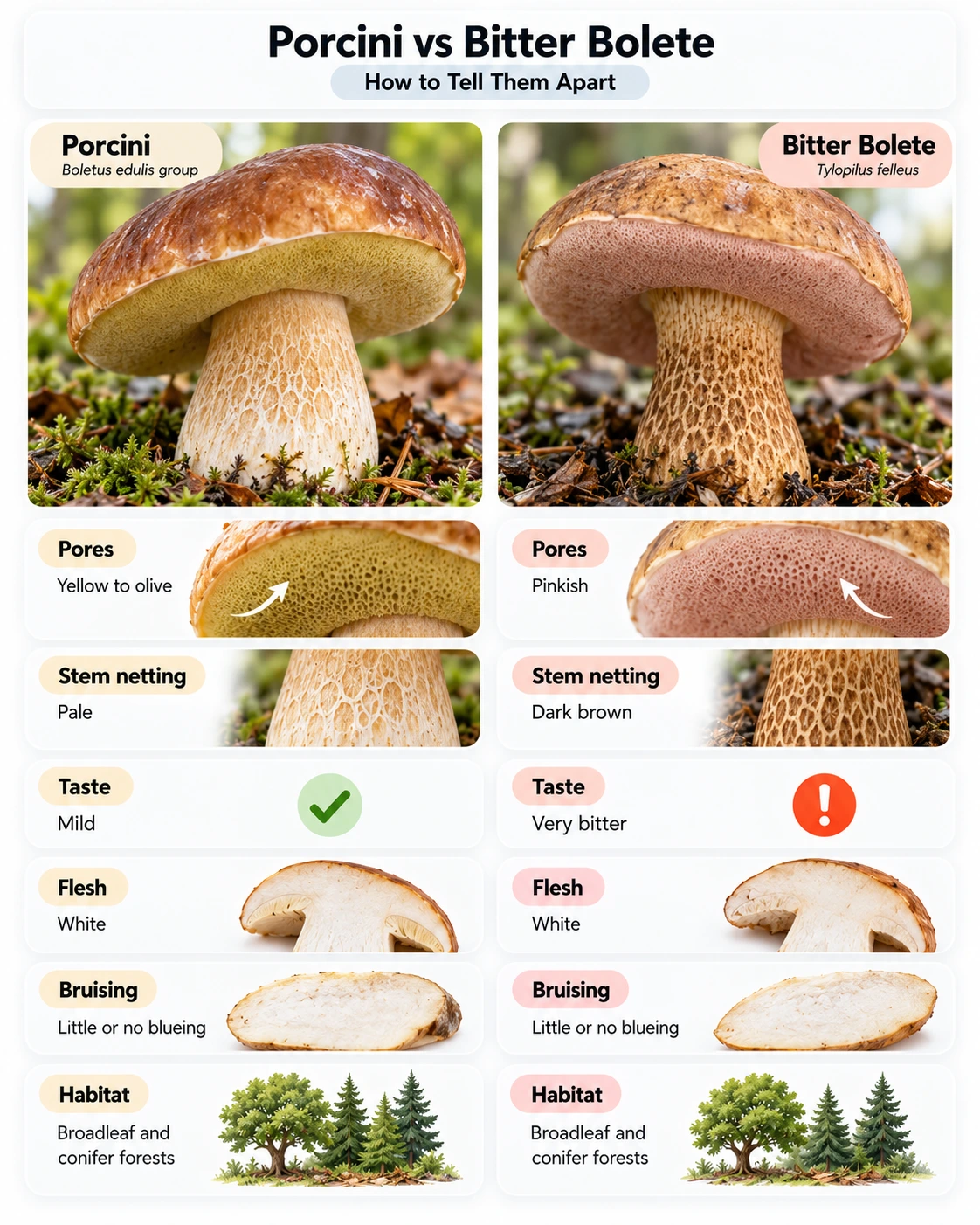
Porcini and Bitter Bolete can look surprisingly similar at first glance. Both can have brown caps, thick stems, pale pore surfaces when young, and a classic bolete shape that makes them easy to confuse from above.
The key differences are found underneath the cap and on the stem. Porcini develops yellow to olive pores and usually has pale reticulation, while Bitter Bolete develops pinkish pores and often has a darker brown network on the stem.
⚠️ Important: This guide is for identification and education only. Never eat a wild mushroom based solely on photographs, AI identification, or an online comparison.
Quick Comparison
| Feature | Porcini | Bitter Bolete |
|---|---|---|
| Typical species | Boletus edulis group | Tylopilus felleus |
| Cap | Brown to chestnut | Brown to gray-brown |
| Young pores | White to cream | White to pale |
| Mature pores | Yellow to olive | Pink to pinkish-brown |
| Stem reticulation | Pale or whitish | Dark brown |
| Flesh | White | White |
| Blue bruising | Usually absent | Usually absent |
| Taste | Mild | Extremely bitter |
| Spore print | Olive-brown | Pinkish-brown |
| Habitat | Broadleaf and conifer forests | Broadleaf and conifer forests |
| Edibility | Edible when correctly identified | Inedible due to extreme bitterness |
What Is Porcini?
Porcini usually refers to Boletus edulis and closely related king boletes. These mushrooms are robust, fleshy, and famous for their firm white flesh and excellent culinary reputation.
The cap is usually brown to chestnut, while the stem is thick and pale with a fine net-like pattern. The underside has pores rather than gills.
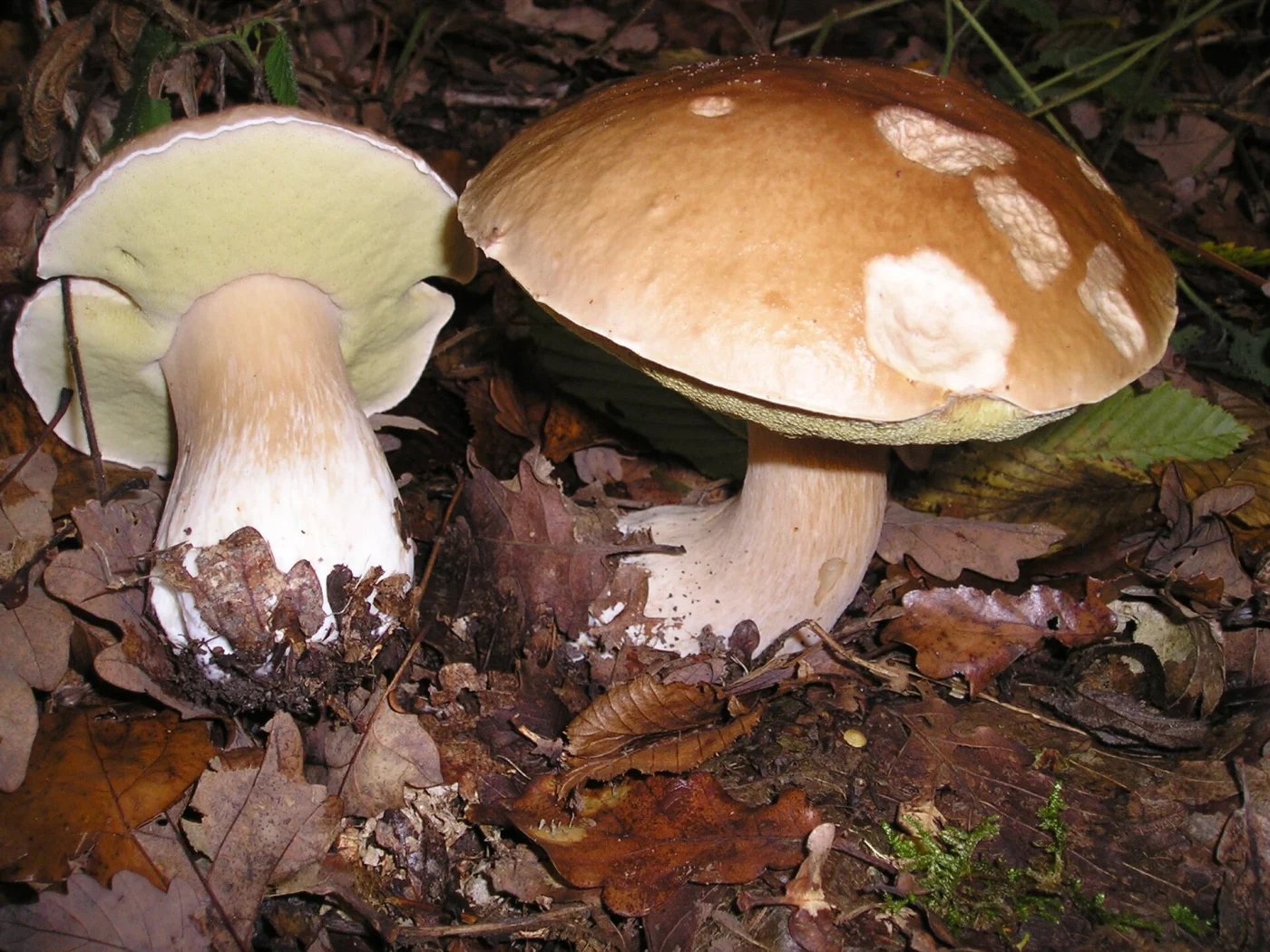
Porcini Pores
Young Porcini has white pores. As the mushroom matures, the pore surface becomes yellow and later olive-green.
This color progression is one of the most useful features. Pink pores are not typical of true Porcini.
Porcini Stem
The stem is thick, often bulbous when young, and usually shows pale reticulation. The net-like pattern is often easiest to see near the top of the stem.
In some specimens the network extends farther down. It usually remains lighter than the stem background.
What Is Bitter Bolete?
Tylopilus felleus, commonly known as the Bitter Bolete, is a brown-capped bolete that can closely resemble Porcini. It has white flesh, a thick stem, and pale pores when young.
The problem becomes clearer as the mushroom matures. The pores develop a pinkish tint, while the stem network often becomes dark and strongly contrasting.
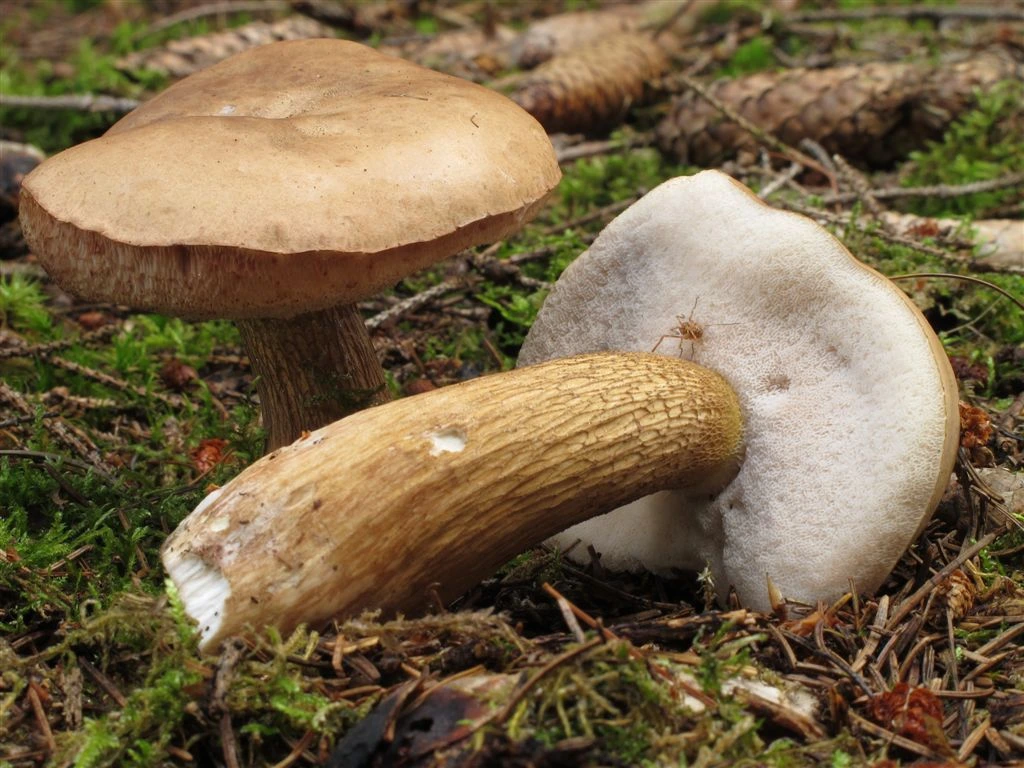
Bitter Bolete Pores
Young pore surfaces can look almost white, which creates the strongest confusion with Porcini. As spores mature, the pores become distinctly pink or flesh-colored.
This pinking is one of the best field clues. Mature Porcini pores should move toward yellow and olive instead.
Bitter Bolete Stem
The stem often shows a dark brown reticulation. This pattern may look bold and coarse compared with the pale network of a king bolete.
The dark net can extend over much of the stem. In many specimens, it is visible even from a distance.
Porcini vs Bitter Bolete: The Pore Color
The pore surface is the fastest and most reliable first comparison. Young mushrooms can be difficult because both species may begin with pale pores.
The difference becomes clearer with age. Porcini turns yellow to olive, while Bitter Bolete turns pinkish.
Young Specimens
Young Bitter Boletes may still have pale pores and can look very convincing. This is why identification from a single immature mushroom can be risky.
If possible, compare several fruit bodies at different ages. Mature specimens often reveal the answer immediately.
Porcini vs Bitter Bolete: The Stem Pattern
Both mushrooms can have reticulation, but the color and character of the netting differ.
Porcini usually has pale cream or whitish reticulation, especially on the upper stem. Bitter Bolete usually has dark brown reticulation that contrasts strongly with the stem.
Pale Netting
A pale network on a thick light-colored stem supports a king bolete identification. This is particularly useful when the pores are still young and white.
It should still be combined with pore development and habitat. One feature alone is never enough.
Dark Netting
A dark brown network strongly suggests Tylopilus felleus. The pattern can look almost embossed on the stem.
If dark reticulation and pinkish mature pores occur together, Bitter Bolete becomes very likely.
Cap Differences
Porcini usually has a warm brown to chestnut cap. Depending on weather and species within the king bolete group, it can be pale brown, dark brown, or even reddish-brown.
Bitter Bolete often has a duller brown to gray-brown cap. Exact cap color overlaps too much to be used as the main distinction.
Cap Texture
Porcini caps may be smooth and slightly tacky when wet. Bitter Bolete caps can also be smooth or dry.
This feature is much less useful than pore color or stem reticulation. Cap-only photographs are therefore especially weak for this comparison.
Flesh
Both mushrooms have pale or white flesh. Neither normally shows strong blue bruising after cutting.
This similarity is one reason the two can be confusing. The absence of blueing does not separate them effectively.
Why Cutting Still Helps
A vertical cut can reveal insect damage, stem structure, and whether the flesh stays white. It also confirms that you are not dealing with a strongly blue-staining bolete.
The cut surface is supporting evidence rather than the main distinction.
Spore Print
Porcini produces an olive-brown spore print. Bitter Bolete produces a pinkish-brown spore print.
In practice, mature pore color often reveals the same distinction before a full spore print is needed. The print can still be useful when the specimen is ambiguous.
Habitat
Both species can grow in broadleaf and coniferous forests. They may appear under oak, beech, pine, spruce, and other compatible trees.
Habitat therefore does not separate them reliably. It helps confirm that both are mycorrhizal woodland boletes, but morphology matters more.
Can They Grow in the Same Forest?
Yes. Porcini and Bitter Bolete can occur in similar habitats and even in the same woodland.
This makes assumptions based on location especially risky. Each mushroom should be checked individually.
Season
Both species commonly fruit from summer through autumn. Exact timing depends on region, rainfall, and temperature.
Season overlap is substantial. It is not a useful primary separator.
Is Bitter Bolete Poisonous?
Bitter Bolete is not usually considered dangerously poisonous, but it is regarded as inedible because of its extreme bitterness. Even a small amount can ruin an entire dish.
The bitter compounds can remain strong after cooking. This is why correct identification matters even when the confusion is not medically dangerous.
Why Bitter Bolete Is So Often Mistaken for Porcini
The overall silhouette is extremely similar. Both can have a thick stem, brown cap, pale young pores, and white flesh.
The mistake usually happens when people identify from above. Once the underside and stem network are examined carefully, the differences become much clearer.
Porcini vs Bitter Bolete Step by Step
Start with the pore surface. If the mushroom is mature, decide whether the pores are yellow-olive or pinkish.
Then inspect the stem reticulation. Pale netting supports Porcini, while dark brown netting strongly favors Bitter Bolete.
Step 1: Check Mature Pore Color
Look at the underside in natural light. Yellow or olive tones favor Porcini.
Pink or flesh-colored pores favor Bitter Bolete. This is the single most useful field difference.
Step 2: Examine the Stem Network
Look for the color of the reticulation. Pale cream netting supports a king bolete.
Dark brown netting strongly suggests Tylopilus felleus. The more contrasting the network, the stronger the clue.
Step 3: Check for Blue Bruising
Neither species should show dramatic rapid blueing. If the mushroom turns strongly blue, another bolete group becomes more likely.
This step is mainly useful for excluding alternatives rather than separating Porcini from Bitter Bolete.
Step 4: Consider the Whole Mushroom
Check cap color, stem proportions, pore age, habitat, and season together. Identification becomes strongest when all features agree.
Do not force a species name from one ambiguous young specimen. Mixed-age groups are much easier to evaluate.
Porcini vs Bitter Bolete in Young Mushrooms
Young specimens are the hardest to separate because the pores of both can be white or cream. The pink tones of Bitter Bolete may not have developed yet.
In these cases, stem reticulation becomes especially valuable. Dark network lines are an early warning sign.
Why Young Mushrooms Cause Mistakes
People often harvest king boletes when they are young because they are firm and less damaged by insects. Unfortunately, this is also when look-alikes can be least distinctive.
A careful stem inspection is therefore essential. Mature nearby specimens can provide context.
Porcini vs Bitter Bolete in Older Mushrooms
Older mushrooms are usually easier. Porcini pores become olive, while Bitter Bolete pores become pinkish.
The stem network also tends to become more obvious with age. This makes mature fruit bodies excellent comparison specimens.
Old mushrooms may still be too damaged for culinary use. They can nevertheless be very useful for identification.
Other Porcini Look-Alikes
Bitter Bolete is one of the most common confusing species, but it is not the only one. Other king boletes and several brown-capped boletes can resemble Porcini.
The broader identification should always check pore color, bruising, stem pattern, and host trees. Red pores or strong blue bruising point away from the classic Porcini group.
Boletus pinophilus — Pine Bolete
Pine Bolete is a true king bolete and closely related to Boletus edulis. It usually has a darker reddish-brown cap and strong conifer association.
Its pores mature toward olive, not pink. The stem reticulation is pale.
Boletus reticulatus — Summer Cep
Summer Cep often has a paler, drier cap and more extensive pale reticulation. It is especially associated with oak and beech.
Like Porcini, the pores mature from white to yellow or olive. Pink mature pores would point away from this group.
Imleria badia — Bay Bolete
Bay Bolete has a chestnut-brown cap and yellow pores that often bruise blue. The stem lacks the classic thick pale reticulation of Porcini.
The blue reaction is especially useful. Porcini generally remains white when cut.
How to Photograph Porcini and Bitter Bolete for Identification
Take a full side image showing the cap and complete stem. The reticulation should be sharp enough to judge its color.
Then photograph the pore surface in natural light. Avoid warm indoor lighting because it can make yellow pores look pinkish or brown.
A cut section can document flesh color and bruising. If multiple ages are present, photograph young and mature specimens together.
Can AI Tell Porcini From Bitter Bolete?
AI can often separate mature specimens when the pore surface and stem are clearly visible. Pink pores plus dark reticulation are strong visual signals for Bitter Bolete.
Young mushrooms are harder because pore color may still overlap. Cap-only images can easily produce a false Porcini identification.
For better results, include the underside, close-up of the stem network, complete fruit body, and habitat. Multiple specimens of different ages are particularly useful.
Common Identification Mistakes
One common mistake is identifying every thick brown bolete as Porcini. The overall shape is not specific enough.
Another mistake is checking only young pores. Bitter Bolete may still look pale underneath before the pink color develops.
A third mistake is ignoring stem reticulation. The contrast between pale and dark netting is one of the best clues available.
Frequently Asked Questions
Can Bitter Bolete pores look almost white after heavy rain?
Yes. Moisture, age, and lighting can make the pink tint less obvious. Look at several areas of the pore surface and compare with mature specimens if available.
Can dirt make Porcini reticulation look dark?
Yes. Soil and handling can stain a pale stem network. A gently cleaned section can help reveal the original color.
Why can Bitter Bolete look more robust than Porcini?
Individual fruit bodies vary greatly in size and proportion. Overall bulk is not a reliable separator.
Can insect damage change pore color?
Yes. Damaged areas may darken or discolor. Fresh undamaged pores provide the best evidence.
Can the same patch produce both species in one season?
Yes. Similar host trees and soil conditions can support multiple mycorrhizal boletes in the same area.
Why do old Porcini pores sometimes look brownish instead of olive?
Age, drying, and spore deposits can darken the pore surface. Fresh inner areas may still show the underlying olive tone.
Can Bitter Bolete grow under pine?
Yes. It can occur with conifers as well as broadleaf trees, so pine habitat does not automatically indicate Porcini.
Should cap color be trusted if the pores are hidden?
No. Cap color overlaps too strongly between the two. If the underside cannot be examined, the identification should remain uncertain.
Final Identification Notes
Porcini and Bitter Bolete are best separated by mature pore color and stem reticulation. Porcini develops yellow-to-olive pores and usually has pale netting, while Bitter Bolete develops pinkish pores and often has dark brown reticulation.
Both can have brown caps, white flesh, and little or no blue bruising. This is why cap shape and general appearance are not enough.
The most useful rule is simple: olive pores + pale netting favor Porcini; pink pores + dark netting favor Bitter Bolete.
Upload a photo and get possible matches in seconds.