Category: Mushrooms

  • Auricularia auricula-judae: Jelly Ear Identification and Look-Alikes

    Auricularia auricula-judae: Jelly Ear Identification and Look-Alikes

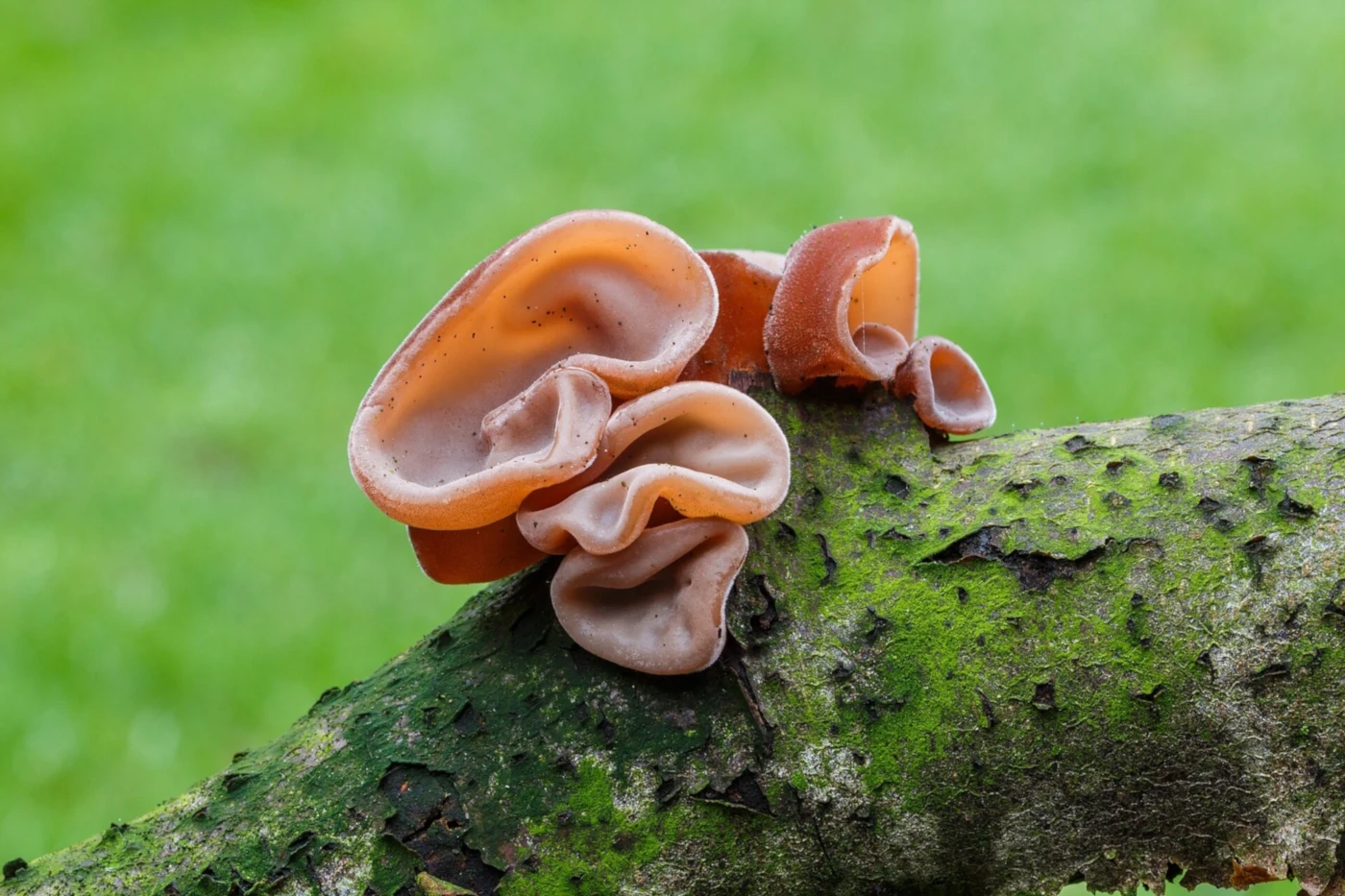
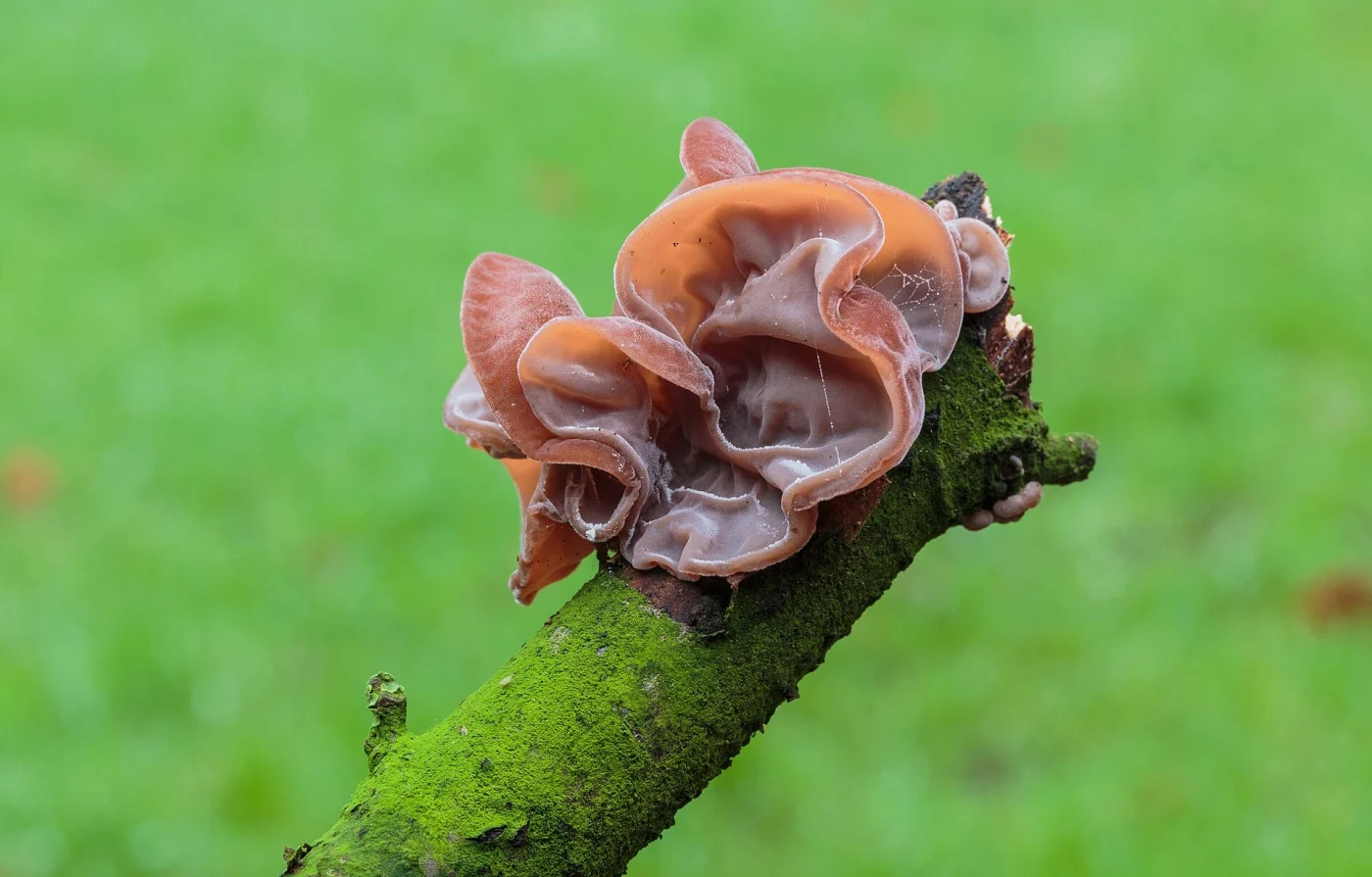
    Auricularia auricula-judae, commonly known as Jelly Ear or Wood Ear, is a soft, rubbery, ear-shaped fungus that grows directly from dead or weakened hardwood. Its brown translucent fruit bodies, smooth inner surface, and gelatinous texture make it very different from gilled mushrooms, boletes, and most bracket fungi.

    It is especially well known from elder in Europe, although related Auricularia species occur on many hardwoods around the world. Exact naming can therefore depend on geography, because mushrooms casually called “Jelly Ear” or “Wood Ear” do not all belong to the same species.

    ⚠️ Important: This guide is for identification and education only. Never eat a wild mushroom based solely on photographs, AI identification, or an online comparison.

    Quick Identification

    Feature Auricularia auricula-judae
    Scientific name Auricularia auricula-judae
    Common names Jelly Ear, Wood Ear
    Family Auriculariaceae
    Shape Ear-shaped, cup-like, folded
    Color Reddish-brown to dark brown
    Texture Rubbery, gelatinous when fresh
    Upper surface Velvety to finely hairy
    Inner surface Smooth to slightly wrinkled
    Stem Usually absent or very short
    Gills Absent
    Pores Absent
    Spore print White
    Substrate Hardwood
    Common host Elder especially important in Europe
    Season Year-round in mild wet weather
    Edibility Edible when correctly identified
    Main look-alikes Other Auricularia, Exidia species, other jelly fungi

    What Does Jelly Ear Look Like?

    Jelly Ear usually forms irregular ear-shaped or cup-like fruit bodies attached directly to wood. Fresh specimens are reddish-brown, cinnamon-brown, or dark brown and often slightly translucent around the edges.

    The shape can be surprisingly realistic, with folds and curves that resemble a human ear. Other specimens are more cup-shaped or irregular, especially when several fruit bodies grow close together.

    The texture is one of the strongest clues. Fresh Jelly Ear is flexible, rubbery, and gelatinous rather than fleshy, brittle, or woody.
    Shape

    Young fruit bodies may begin as small rounded discs or shallow cups. As they expand, they develop lobes, folds, and ear-like curves.

    Mature specimens often become several centimeters across. Crowded growth can distort the shape and produce overlapping clusters.

    Why Shape Can Vary So Much

    Orientation on the branch influences how the fungus develops. A fruit body growing from the side of a vertical stem may hang differently from one growing on a horizontal branch.

    Moisture also changes appearance. Fully hydrated specimens are broader and smoother, while drying causes them to shrink and curl.

    Color

    Fresh Jelly Ear ranges from pale reddish-brown to deep chocolate brown. The edges are often lighter and more translucent.

    Drying usually makes the fungus darker, thinner, and less obviously gelatinous. Rehydration after rain can restore much of the original shape.

    Color Is Not Enough

    Many jelly fungi are brown, amber, or nearly black. Exact shade is therefore much less useful than surface texture, growth form, and host wood.

    A dark brown gelatinous fungus on a branch is not automatically Auricularia auricula-judae. Several unrelated jelly fungi share that appearance.

    Outer Surface

    The outer surface is often finely velvety or hairy. This texture may be subtle and easier to see when the fruit body is dry.

    Fine hairs distinguish Auricularia from some smoother jelly fungi. A close-up or hand lens can be useful.

    Inner Surface

    The inner side is smoother and may show wrinkles or vein-like folds. It does not have gills or pores.

    This smooth fertile surface is an important structural clue. The difference between the hairy outer surface and smoother inner surface can be especially useful.

    Texture

    Fresh Jelly Ear is rubbery and flexible. It bends easily without breaking and springs back somewhat after pressure.

    This consistency changes dramatically as the mushroom dries. A dry fruit body becomes thin, hard, and shriveled.

    Rehydration

    One remarkable feature is its ability to absorb water and expand again. A dried specimen can become soft and gelatinous after prolonged rain.

    This allows the fruit body to persist through alternating wet and dry periods. It may appear “dead” in dry weather and then become conspicuous again after rain.

    Flesh

    The flesh is thin, gelatinous, and brownish. It does not have a thick white interior like Oyster Mushroom or a woody interior like Tinder Fungus.

    There is usually no obvious distinction between cap flesh and stem because the fruit body lacks a conventional cap-and-stem structure.

    Does Jelly Ear Have a Stem?

    Usually not. The fruit body attaches directly or through a very short narrowed base.

    Some specimens may appear slightly stalked, especially when growing from narrow twigs. A substantial conventional stem would be unusual.

    Spore Print

    The spore print is white. Spores are produced from the smoother inner fertile surface rather than from gills or pores.

    Spore color can support identification but is rarely necessary for recognizing the group. Shape, texture, and substrate are much more practical.

    Where Does Auricularia auricula-judae Grow?

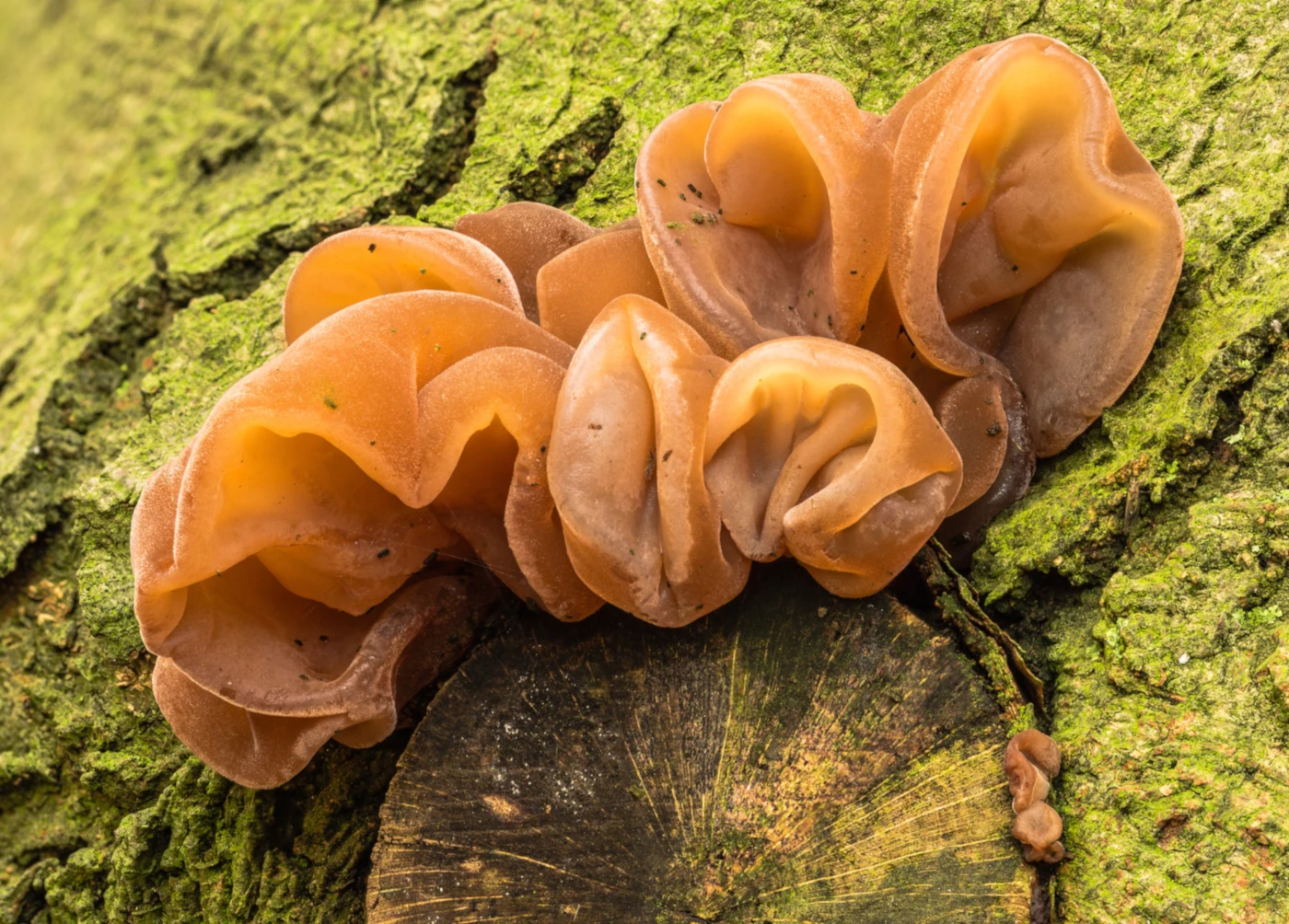
    The fungus grows directly from hardwood. Dead branches, fallen limbs, old trunks, and weakened living wood can all support it.

    In Europe, elder is especially strongly associated with Auricularia auricula-judae. This tree association is one of the most useful ecological clues.

    Elder Trees

    Jelly Ear is famous for growing on elder, especially dead or dying branches. Large colonies can develop after prolonged wet weather.

    It may occur on both standing and fallen wood. Even relatively small elder branches can support several fruit bodies.

    Other Hardwood Hosts

    The fungus is not absolutely restricted to elder. Other broadleaf trees may occasionally support it.

    Host preference can vary geographically. This is one reason why exact species-level identification should consider location as well as appearance.
    When Does Jelly Ear Grow?

    Jelly Ear can appear almost any time of year when conditions are wet and mild. Autumn and winter are particularly productive in many parts of Europe.

    Unlike many soft mushrooms, it tolerates cool weather well. Fruiting can continue during periods when few conventional gilled mushrooms are present.

    Rainfall Matters More Than Calendar Date

    Extended damp weather is the main trigger. Dry spells cause fruit bodies to shrink rather than disappear completely.

    After rain, old dried specimens can rehydrate while new ones also develop. This can make a dead branch suddenly look covered in fresh fungi.

    Distribution

    Auricularia auricula-judae is primarily associated with Europe and nearby regions under the modern species concept. Similar-looking wood ears elsewhere may belong to different Auricularia species.

    Older field guides often used the same name much more broadly. Modern taxonomy has shown that the worldwide “Wood Ear” group contains multiple species.

    Why Geography Matters

    A wood ear in Britain or continental Europe may reasonably fit A. auricula-judae, especially on elder. A nearly identical mushroom in North America or East Asia may need a different name.

    For photo identification, “Auricularia species” can sometimes be more accurate than forcing a European species name onto a mushroom from another continent.

    Is Jelly Ear Edible?

    Jelly Ear is considered edible when correctly identified. Its value is mainly textural rather than strongly flavored. The fungus has a crisp, elastic consistency after cooking. Similar wood ears are widely used in Asian cuisine. Regional species identification still matters. The culinary “wood ear” category contains several Auricularia species, not only A. auricula-judae.

    Jelly Ear Look-Alikes

    Most look-alikes are other jelly fungi rather than conventional mushrooms. Texture, surface hairs, shape, and substrate are the most useful distinctions. Several look-alikes are not particularly dangerous, but correct identification is still important. Jelly fungi can be surprisingly difficult to separate from photographs alone.

    Other Auricularia Species

    Identification

    Other Auricularia species can look almost identical, with brown gelatinous ear-shaped fruit bodies and finely hairy outer surfaces. Some differ mainly in microscopic characters, hair length, host tree, and geography.

    This is especially important outside Europe. A wood ear should not automatically be called A. auricula-judae worldwide.

    Main Difference

    Geography is often the first clue. Host tree and microscopic features may be needed for exact identification.

    At genus level, the combination of ear-like shape and hairy outer surface remains useful.

    Exidia glandulosa — Black Witch’s Butter

    Identification

    Exidia glandulosa forms black to very dark brown gelatinous blobs or irregular cushions on dead hardwood. The fruit bodies can merge into broad wrinkled patches.

    It usually lacks the clear ear-shaped structure of Jelly Ear. The surface is more lobed and brain-like.

    Main Difference

    Jelly Ear tends to form distinct thin ears or cups. Exidia glandulosa is darker, thicker, and more irregularly blob-like.

    Both can shrink when dry and rehydrate after rain. Growth form is therefore especially useful.

    Exidia recisa — Amber Jelly Roll

    Identification

    Amber Jelly Roll produces amber-brown to reddish-brown gelatinous fruit bodies, often on willow. They can be cup-like or lobed and may superficially resemble small Jelly Ears.

    The fruit bodies are generally more translucent and less hairy. Their shape often looks folded rather than distinctly ear-like.

    Main Difference

    Host tree and surface texture help. Jelly Ear usually has a more obvious velvety outer surface.

    Tremella Species

    Identification

    Many Tremella species form gelatinous lobed masses rather than individual ear-shaped fruit bodies. Colors range from yellow and orange to brown or translucent.

    They often grow in association with other fungi inside wood. The overall shape is usually much more brain-like or frilly.

    Main Difference

    A clearly defined ear-like fruit body favors Auricularia. A tangled gelatinous mass suggests another jelly fungus.

    Jelly Ear vs Black Witch’s Butter

    Feature Jelly Ear Black Witch’s Butter
    Shape Ear-like, cup-like Blob-like, lobed
    Color Brown to reddish-brown Dark brown to black
    Outer surface Finely hairy Usually smoother
    Texture Rubbery gelatinous Soft gelatinous
    Growth Separate ears, sometimes clustered Merged irregular masses
    Substrate Hardwood, especially elder Dead hardwood

    The shape is usually the fastest distinction. Surface texture provides a second strong clue.

    Jelly Ear vs Oyster Mushroom

    These species may grow on the same hardwood, but they are structurally completely different. Oyster Mushroom has a thick fleshy cap and obvious gills.

    Jelly Ear has no gills, pores, or conventional cap structure. Its gelatinous texture immediately separates it from Oyster Mushroom.

    How to Identify Jelly Ear Step by Step

    Start by confirming that the fungus grows directly from hardwood. Then check for a brown ear-like body with a flexible gelatinous texture.

    Next, examine the outer surface for fine hairs and the inner surface for a smoother texture. Finally, consider host tree and geographic region.

    Step 1: Check the Texture

    Gently flex the fruit body. Fresh Jelly Ear should feel rubbery and gelatinous rather than fleshy or woody.

    A hard bracket fungus belongs to another group. A fragile brittle cap also points elsewhere.

    Step 2: Look at the Shape

    Look for cups, lobes, or recognizable ear-like folds. Individual fruit bodies should usually remain relatively thin.

    Large amorphous blobs suggest Exidia or another jelly fungus. Shape becomes especially clear when the fungus is fully hydrated.

    Step 3: Examine Both Surfaces

    Look for fine hairs or velvet on the outer side. The inner fertile surface should be smoother.

    This two-surface contrast is highly useful. Photographing both sides can dramatically improve identification.

    Step 4: Check the Host

    In Europe, elder strongly supports A. auricula-judae. Other hardwood hosts are possible but may require extra caution.

    Outside Europe, consider other Auricularia species first. Geography can be as important as host wood.

    Why Jelly Ear Changes So Much When Dry

    Much of the fruit body consists of water held within gelatinous tissue. During dry weather, it loses water and collapses into a thin shriveled structure.

    This transformation can make the same colony look like two completely different fungi. After rain, the dried ears swell again and regain their flexible texture.

    Because of this, photographs taken during wet and dry weather may appear surprisingly different. The underlying species can still be the same.

    How to Photograph Jelly Ear for Identification

    Take a wide image showing how the fungus is attached to the branch or trunk. Include bark and enough surrounding wood to help identify the host tree.

    Then photograph the fruit body from both sides. A close-up of the outer surface can reveal the fine hairs that distinguish Auricularia from smoother jelly fungi.

    A side view is also useful for showing thickness and ear-like folding. If both hydrated and dried fruit bodies occur together, photograph both states.

    Can AI Identify Jelly Ear?

    AI can often recognize the Auricularia group because the ear-like shape and gelatinous brown texture are visually distinctive. Species-level identification becomes harder when geography is unknown.

    The biggest risk is overgeneralizing the name Auricularia auricula-judae to similar wood ears worldwide. A good system should use location and host tree rather than relying only on appearance.

    Clear photographs of both surfaces, attachment, and substrate improve results considerably. A single dark brown close-up can be confused with other jelly fungi.

    Common Identification Mistakes

    One common mistake is calling every brown jelly fungus Jelly Ear. Exidia species and other jelly fungi can look similar when wet.

    Another mistake is applying the European name A. auricula-judae to every wood ear worldwide. Modern taxonomy recognizes multiple regional species.

    A third mistake is identifying dried material without considering how dramatically jelly fungi change after losing water. Rehydrated specimens often reveal the true growth form much more clearly.

    Frequently Asked Questions

    Why do some Jelly Ears look almost black?

    Drying, age, cold damage, and prolonged exposure can darken the fruit bodies considerably. Rehydrated younger tissue often reveals warmer reddish-brown tones.

    Can the same fruit body dry out and rehydrate several times?

    Yes. Jelly fungi can tolerate repeated cycles of drying and rehydration. This ability helps them remain visible for much longer than many soft mushrooms.

    Why do several ears sometimes fuse together?

    Crowded fruit bodies can expand into one another as they grow. Their edges may overlap or partially merge, creating an irregular mass.

    Can frost damage Jelly Ear?

    Yes, but cool temperatures do not necessarily destroy it immediately. Mild winter weather can allow existing fruit bodies to persist and continue rehydrating.

    Do insects commonly live inside Jelly Ear?

    Small invertebrates may feed on or shelter around the fruit bodies, especially older specimens. Because the tissue is thin, major internal tunneling is less obvious than in thick boletes.

    Can dried Jelly Ear remain attached for months?

    Yes. Dry fruit bodies can persist as small dark shriveled structures and expand again when wet conditions return.

    Why are some specimens much thicker than others?

    Age, hydration, genetics, and exact species all influence thickness. Very wet young fruit bodies may look substantially thicker than partially dried ones.

    Can Jelly Ear grow on branches that are still attached to a living tree?

    Yes. It can colonize dead or weakened portions of otherwise living hardwoods. The branch itself may already be dead even when the rest of the tree remains healthy.

    Final Identification Notes

    Auricularia auricula-judae is best recognized by the combination of brown ear-shaped fruit bodies, rubbery gelatinous texture, a finely velvety outer surface, a smoother inner surface, and growth directly from hardwood.

    In Europe, elder is an especially strong ecological clue. Elsewhere, similar wood ears may belong to other Auricularia species, so geography should always be considered before assigning the exact name.

    The most useful distinction is structural rather than color-based. If a brown jelly fungus forms thin flexible ears rather than dark amorphous blobs, Auricularia becomes a strong possibility.
  • Boletus pinophilus: Pine Bolete Identification and Look-Alikes

    Boletus pinophilus: Pine Bolete Identification and Look-Alikes

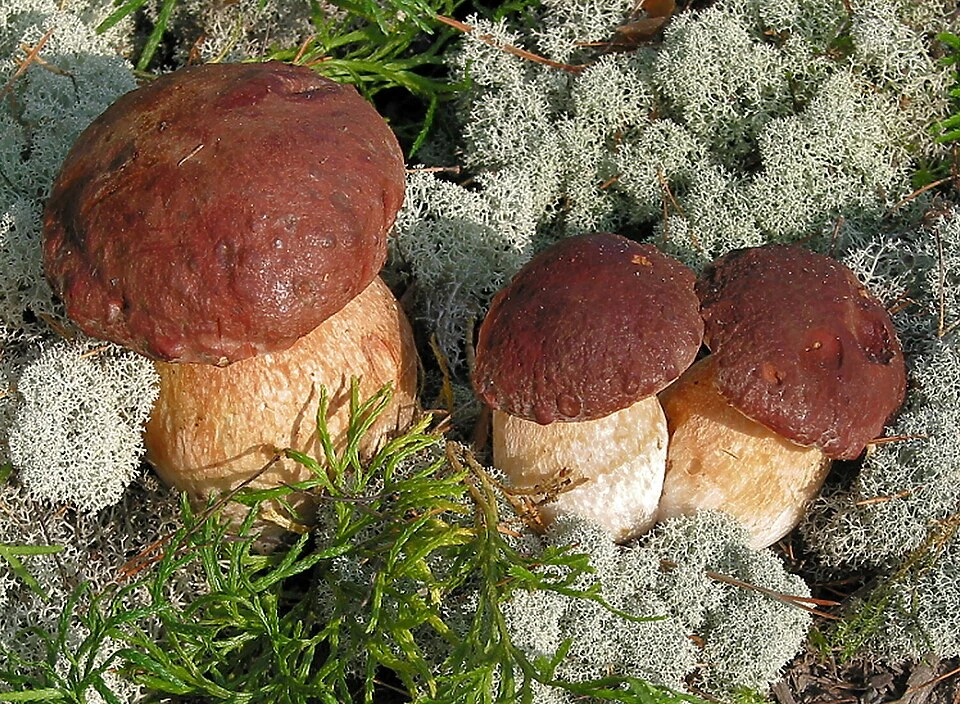
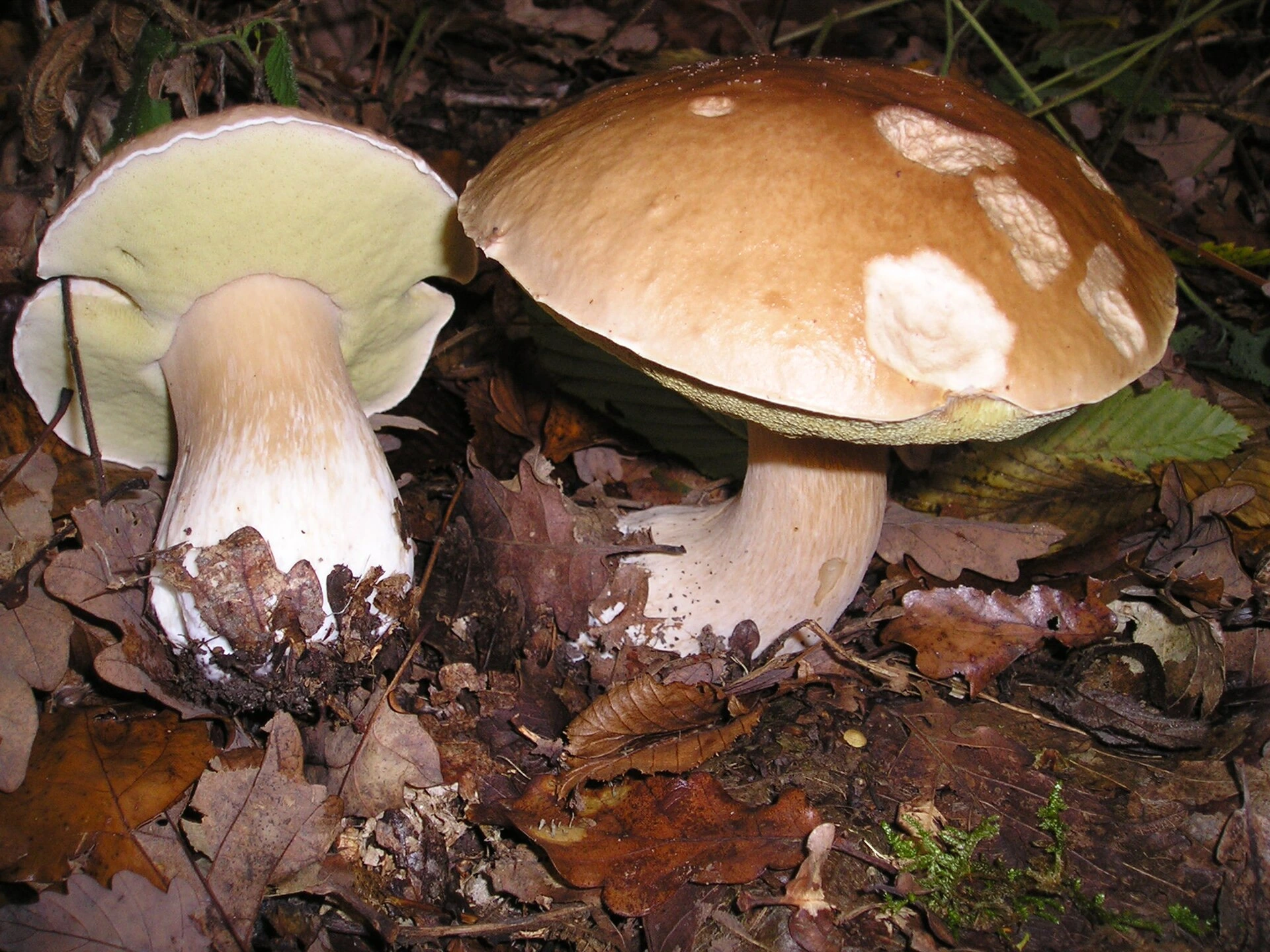
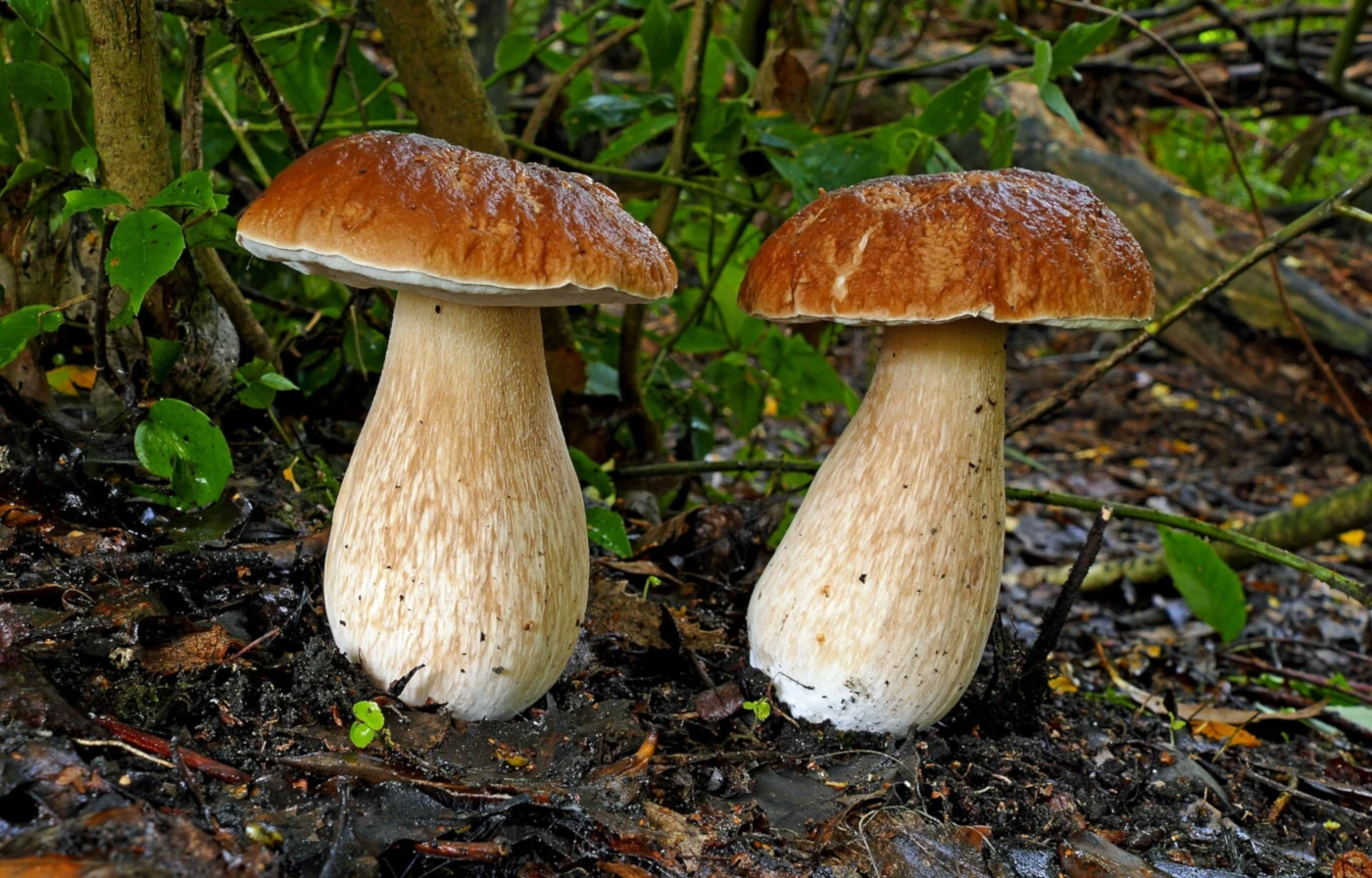
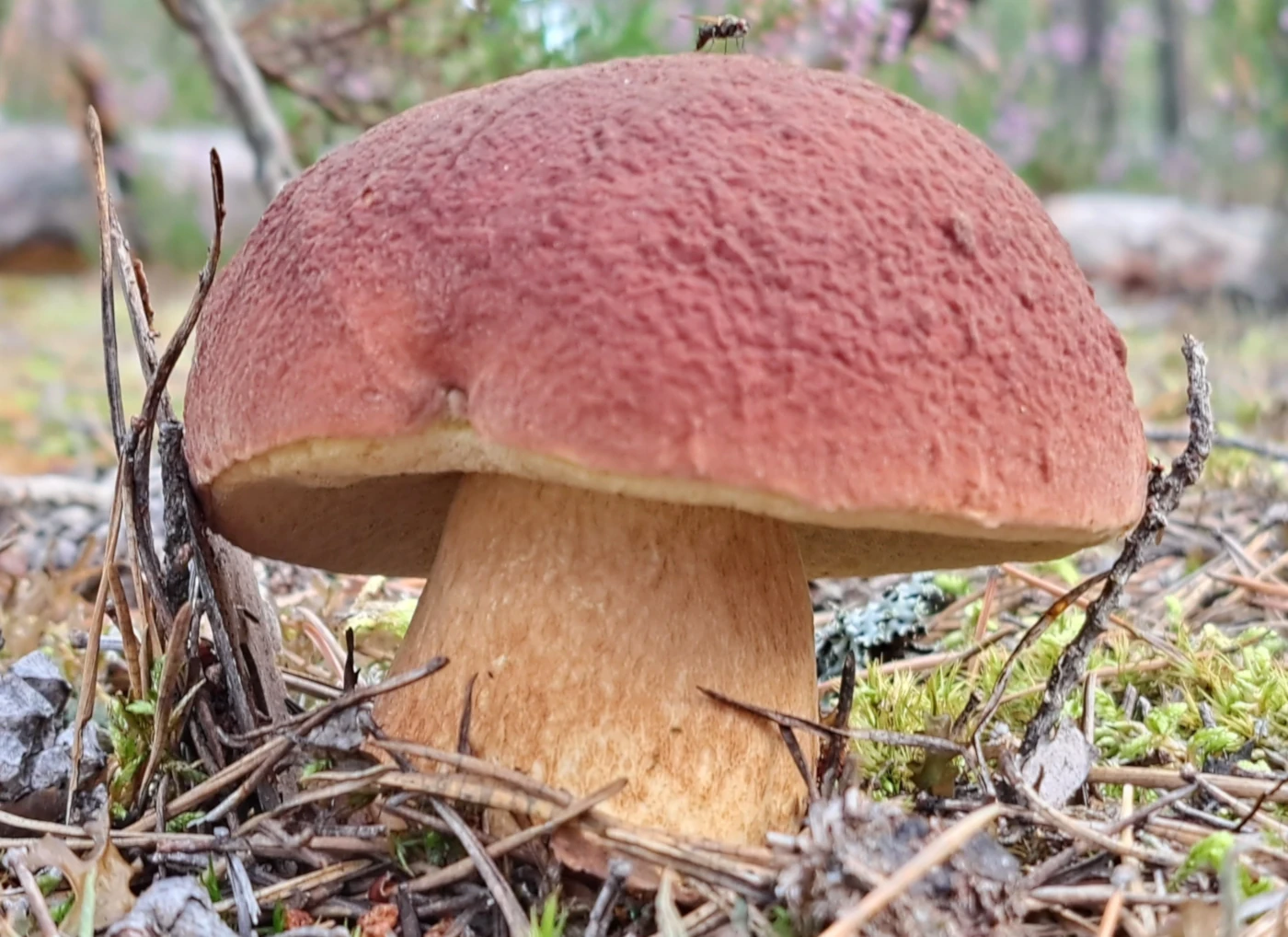
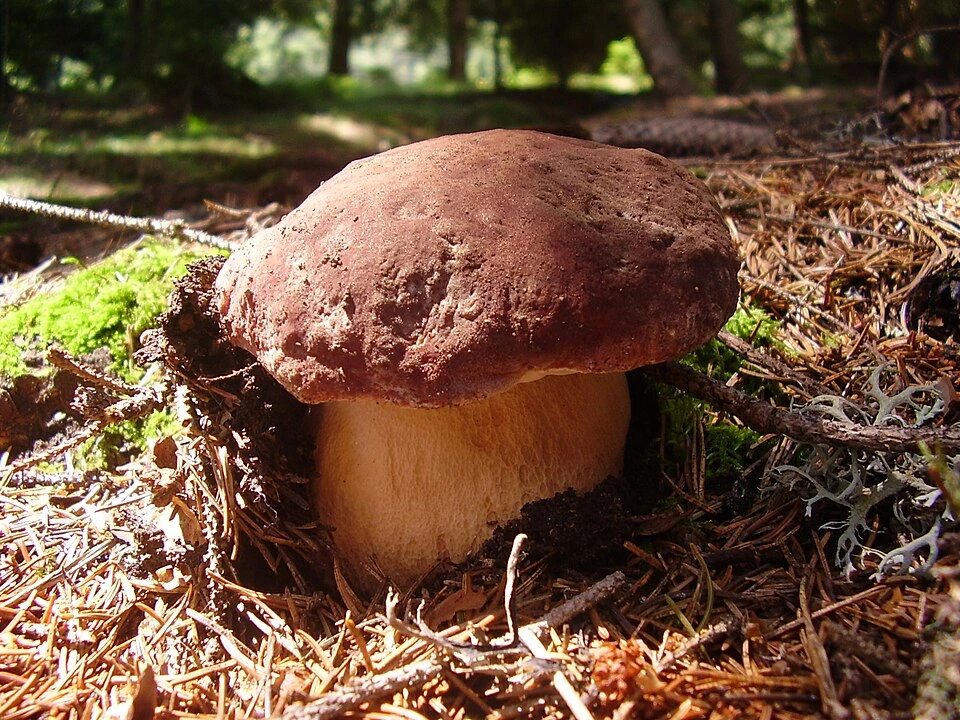
    Boletus pinophilus, commonly known as the Pine Bolete, Pine Cep, or Pine Porcini, is a robust member of the king bolete group. It is especially associated with pine and other conifers and is recognized by its dark reddish-brown to wine-brown cap, thick pale stem, white-to-olive pores, and firm flesh that usually does not turn blue when cut.

    It is closely related to Boletus edulis and can look very similar, especially in mixed forests where both may occur. The best identification comes from combining cap color, pale stem reticulation, pore development, lack of strong blue bruising, and conifer habitat.

    ⚠️ Important: This guide is for identification and education only. Never eat a wild mushroom based solely on photographs, AI identification, or an online comparison.

    Quick Identification

    Feature Boletus pinophilus
    Scientific name Boletus pinophilus
    Common names Pine Bolete, Pine Cep, Pine Porcini
    Family Boletaceae
    Cap color Dark reddish-brown, wine-brown, chestnut
    Cap surface Smooth to slightly uneven
    Underside Pores, not gills
    Young pores White to cream
    Mature pores Yellow to olive
    Stem Thick, pale, often bulbous when young
    Stem pattern Pale reticulation, especially near the top
    Flesh White, firm
    Bruising Usually little or no blueing
    Spore print Olive-brown
    Ecology Mycorrhizal
    Main hosts Pine and other conifers
    Season Summer through autumn
    Edibility Edible when correctly identified
    Main look-alikes Boletus edulis, Boletus reticulatus, Tylopilus felleus, other king boletes

    What Does Boletus pinophilus Look Like?

    Pine Bolete has the classic heavy-set appearance of a king bolete. Young mushrooms often have a thick swollen stem and a rounded cap, giving them a compact, almost bun-like shape.

    The cap is usually darker and redder than that of classic Boletus edulis. Shades can include reddish brown, chestnut, wine-brown, and deep mahogany, especially in fresh specimens.

    The underside has a sponge-like pore layer rather than gills. Young pores are white, then gradually turn yellow and finally olive as the mushroom matures.

    Cap

    The cap is initially hemispherical and expands with age. Mature specimens can become broad and slightly flattened while retaining a thick fleshy appearance.

    The color is often one of the best visual clues. Pine Bolete tends to show richer reddish or wine-brown tones than many other king boletes.

    Cap Surface

    The surface is usually smooth and dry to slightly tacky. After rain, it can appear darker and more glossy.

    Dry weather may make the cap paler or slightly cracked. Color alone should therefore never be used as the only identification feature.

    Pores

    The underside begins white to cream in young specimens. As spores mature, the pore surface turns yellow and then olive-yellow or olive-green.

    The pores are fine and tightly packed. They do not begin bright red or orange.

    Bruising of the Pores

    Strong blue bruising is not typical of Boletus pinophilus. Slight discoloration may occur with age or handling, but dramatic rapid blueing should suggest another bolete group.

    This makes bruising useful when separating Pine Bolete from strongly blue-staining species. It should still be interpreted together with pore color and stem structure.

    Stem

    The stem is thick, solid, and often strongly swollen when young. Older specimens can become more cylindrical, though they usually remain robust.

    Color is pale cream to light brown. A fine pale network, known as reticulation, is often visible on the upper part of the stem.

    Stem Reticulation

    The reticulation is usually light-colored rather than dark. It may be especially clear just below the pore surface.

    This feature helps separate Pine Bolete from Bitter Bolete, which often has stronger and darker netting. The exact visibility of the reticulation can vary between individual mushrooms.

    Flesh

    The flesh is white, thick, and firm in fresh specimens. It generally remains white after cutting and does not show strong blue oxidation.

    This stable white flesh is one of the characteristic features of the king bolete group. Older specimens may become softer, especially near the pores.

    Texture

    Young fruit bodies are dense and heavy for their size. The stem can feel especially compact and solid.

    As the mushroom ages, the pore layer becomes increasingly soft and spongy. Insect damage also becomes more common in older specimens.

    Smell

    The smell is usually pleasant and mushroom-like. Some people describe it as nutty or slightly earthy.

    Odor is not distinctive enough to confirm the species. Cap color, pore development, host tree, and stem pattern are much more useful.

    Spore Print

    The spore print is olive-brown. This is typical of many boletes and confirms the broader group rather than the exact species.

    Spore color is therefore less useful than morphology for separating Boletus pinophilus from Boletus edulis. Host association and cap tone are more practical.

    Where Does Boletus pinophilus Grow?

    Boletus pinophilus is mycorrhizal and grows from soil in association with living trees. It is especially associated with pine and other conifers.

    Mature pine forests, mixed conifer woodland, mossy slopes, and areas with deep needle litter can all provide suitable habitat. The mushroom may appear several meters from the trunk because tree roots extend far through the soil.

    Pine Association

    Pine is one of the strongest ecological clues. The species is particularly well known from forests dominated by Pinus. It can also associate with other conifers depending on region. This is why exact host identification can improve confidence when separating similar king boletes.

    When Does Boletus pinophilus Grow?

    The main season is summer through autumn. Fruiting often follows sustained rainfall during warm or mild weather. In mountain or northern regions, the season can begin earlier and end quickly after frost. In milder areas, fruiting may continue well into autumn.

    Early Fruiting

    Pine Bolete can sometimes appear relatively early compared with other autumn boletes. This varies strongly with region and weather. Season is therefore helpful but never decisive. The mushroom should still match the structural features of the species.

    Distribution

    Boletus pinophilus is widespread in Europe and parts of Eurasia. It is especially familiar in northern, central, and montane conifer forests. Closely related king boletes occur in North America, but not every pine-associated porcini-like mushroom there should automatically be called B. pinophilus. Regional taxonomy matters.

    Is Boletus pinophilus Edible?

    Yes, Pine Bolete is widely regarded as edible when correctly identified and properly prepared. It is valued similarly to other king boletes. Its flesh is firm when young and suitable for fresh or dried use. Older specimens are usually less desirable because the pore layer becomes soft and insect damage increases. Accurate identification remains essential because Bitter Bolete and other brown-pored look-alikes can occur in similar habitats.

    Boletus pinophilus Look-Alikes

    The most likely look-alikes are other king boletes. These mushrooms share thick stems, pale pores when young, and white flesh. The main differences involve cap color, host trees, season, and stem pattern. Bitter Bolete deserves special attention because it can imitate the same overall shape.

    Boletus edulis — Porcini

    Identification

    Boletus edulis usually has a lighter brown to chestnut cap. The stem is thick and often shows pale reticulation near the top.

    Like Pine Bolete, it has white young pores, olive mature pores, and white non-blueing flesh. The two can be extremely similar.

    Main Difference

    Pine Bolete generally has a darker, redder, more wine-brown cap and is strongly associated with conifers. Boletus edulis can occur with a wider range of coniferous and deciduous hosts.

    The distinction can sometimes be subtle. Habitat and overall cap tone are often more useful than one isolated feature.

    Boletus pinophilus vs Boletus edulis

    Feature Boletus pinophilus Boletus edulis
    Cap Dark reddish-brown to wine-brown Brown to chestnut
    Main host Pine and other conifers Conifers and broadleaf trees
    Stem Thick, pale, reticulated Thick, pale, reticulated
    Young pores White White
    Mature pores Yellow to olive Yellow to olive
    Bruising Usually little or none Usually little or none

    These species overlap heavily in morphology. The combination of cap tone and tree association is especially useful.

    Boletus reticulatus — Summer Cep

    Identification

    Boletus reticulatus generally has a paler, warmer brown cap and often a more extensive net-like pattern on the stem. It is frequently associated with oak and beech.

    Its cap can also look drier or more velvety. Fruiting often begins relatively early in summer.

    Main Difference

    Broadleaf habitat is one of the strongest clues. A pale reticulated bolete under oak or beech is more consistent with B. reticulatus than Pine Bolete.

    Pine Bolete usually has a darker reddish cap and stronger conifer association.

    Boletus aereus — Bronze Bolete

    Identification

    Bronze Bolete has a very dark brown to almost blackish cap. It is especially characteristic of warmer broadleaf forests.

    The stem is pale to brownish and reticulated. The flesh remains white and firm.

    Main Difference

    Boletus aereus is more strongly associated with warm oak and other broadleaf habitats. Its cap is often darker and more bronze-black than that of Pine Bolete.

    Climate and host trees are particularly useful in this comparison.

    Tylopilus felleus — Bitter Bolete

    Identification

    Bitter Bolete can look deceptively similar, with a brown cap and thick stem. Mature pores often develop a pinkish tint rather than yellow or olive.

    The stem usually has a more pronounced dark brown reticulation. The mushroom is famous for its extremely bitter flesh.

    Main Difference

    Pinkish pores and dark netting point toward Tylopilus felleus. Pine Bolete has pale netting and pores that mature toward olive rather than pink.

    This is one of the most important practical look-alike comparisons.

    Boletus pinophilus vs Bitter Bolete

    Feature Pine Bolete Bitter Bolete
    Young pores White White to pale
    Mature pores Yellow to olive Pinkish
    Stem netting Pale Dark brown
    Flesh Mild Extremely bitter
    Bruising Little or none Little dramatic blueing
    Safety Edible when correctly identified Inedible due to bitterness

    The mature pore color is especially useful. Strong pink tones should make you reconsider a Porcini identification.

    Pine Bolete vs Red-Pored Boletes

    Red-pored boletes belong to a different visual group. Their pore surfaces become orange-red to deep red, and many show strong blue bruising.

    Pine Bolete should have white young pores that age to yellow or olive. Bright red pores are inconsistent with Boletus pinophilus.

    This distinction is important because some red-pored boletes are poisonous. Underside color should always be checked before identifying a brown-capped bolete as edible.

    How to Identify Boletus pinophilus Step by Step

    Begin with the underside and confirm that the mushroom has pale pores rather than gills. Then examine the thick stem for pale reticulation.

    Next, cut the flesh and check that it remains white without strong blueing. Finally, look at the dark reddish-brown cap and confirm a pine or other conifer habitat.

    Step 1: Check the Cap

    Look for a dark chestnut, reddish-brown, or wine-brown cap. The color is often deeper than that of classic Boletus edulis.

    Do not rely on shade alone, because moisture can dramatically alter cap appearance. Wet mushrooms often look darker.

    Step 2: Check the Pores

    Young pores should be white to cream. Mature pores should become yellow or olive.

    Pink pores suggest Bitter Bolete, while red pores suggest a different bolete group. This makes underside color one of the fastest exclusion tests.

    Step 3: Examine the Stem

    Look for a thick solid stem with pale netting, especially near the top. Dark reticulation should raise suspicion for another species.

    The stem may be especially bulbous in young specimens. Older mushrooms often become more elongated.

    Step 4: Cut the Flesh

    The flesh should remain broadly white. Strong immediate blue bruising is not characteristic.

    A clean vertical cut through cap and stem is useful. It also reveals insect tunnels and internal deterioration.

    Step 5: Confirm the Trees

    Look for pine needles, cones, and bark around the site. In mixed woodland, identify all nearby conifers rather than assuming the nearest tree is the host.

    Ecology should support the physical identification. It should not override contradictory pore or stem features.

    Why Pine Bolete Can Look Different With Age

    Young fruit bodies are often extremely stout, with thick stems and rounded caps. Mature specimens become broader and sometimes much less compact. The cap can also change from reddish-brown to darker chestnut as moisture conditions vary. Old specimens may fade, crack, or become irregular. Pore color changes are especially important. The shift from white to yellow and olive is a normal part of maturation.

    How to Photograph Boletus pinophilus for Identification

    Take a side photograph showing the full cap and stem proportions. This helps document the robust king-bolete shape. Then photograph the pore surface in natural light. A close-up of the upper stem should show the reticulation clearly. A cut section is also useful for confirming white non-blueing flesh. Finally, include the surrounding pine needles, cones, or host trees.

    Can AI Identify Boletus pinophilus?

    AI can often recognize a king bolete from its brown cap, thick stem, and pale pores. Distinguishing Boletus pinophilus from Boletus edulis is much harder because the species overlap strongly in appearance. Cap tone, host trees, location, and season can improve the result. Multiple views are far more useful than a single top-down image. AI should therefore be especially cautious about exact species naming within the king bolete group. A confident group-level identification may be more accurate than an overconfident species label.

    Common Identification Mistakes

    One common mistake is calling every dark Porcini-like mushroom Boletus edulis. Pine Bolete can have a distinctly redder cap and stronger conifer association.

    Another mistake is ignoring the mature pore color. Pink tones suggest Bitter Bolete rather than a king bolete.

    A third mistake is assuming pine habitat alone proves Boletus pinophilus. Several other boletes grow beneath pine and can share brown caps.

    Frequently Asked Questions

    Why do some Pine Boletes have almost black-brown caps?

    Wet weather, age, and natural individual variation can produce very dark caps. The mushroom may still belong to the same species if pores, stem, flesh, and habitat all agree.

    Can Pine Bolete grow far from the nearest pine trunk?

    Yes. Tree roots and fungal mycelium extend far through the soil, so fruit bodies can appear several meters from the visible trunk.

    Why are some specimens heavily eaten by insects?

    King boletes are particularly attractive to insect larvae. Older mushrooms in warm weather are usually more affected than young compact specimens.

    Can several king bolete species occur in the same forest?

    Yes, especially in mixed woodland containing both conifers and broadleaf trees. Each fruit body should therefore be examined independently rather than identified from the general location alone.

    Does frost immediately end the Pine Bolete season?

    A hard prolonged freeze can end fruiting, but light early frost may not destroy all existing mushrooms. Local microclimates can keep sheltered forest patches productive for longer.

    Why can the stem reticulation be hard to see?

    Dirt, moisture, age, and insect damage can obscure the fine network. Cleaning a small section gently may make the pattern easier to examine.

    Can young pore surfaces look almost completely solid?

    Yes. The pores are extremely fine when the mushroom is young and may look like a smooth white layer from a distance. They become more obvious as the fruit body expands.

    Can Pine Boletes appear in planted pine forests?

    Yes. Compatible mycorrhizal fungi can occur in managed or planted conifer forests as well as natural woodland, provided suitable host trees and soil conditions are present.

    Final Identification Notes

    Boletus pinophilus is best recognized by the combination of a dark reddish- to wine-brown cap, thick pale reticulated stem, white young pores becoming olive with age, firm white flesh, little or no blue bruising, and strong association with pine and other conifers.

    The closest comparison is usually Boletus edulis, which shares nearly all major structural features. Pine Bolete tends to be darker and redder and is more strongly tied to conifer habitats.

    For reliable identification, use the entire pattern rather than cap color alone. Pore development, stem reticulation, bruising, host trees, geography, and age together provide a much stronger result.

  • Fomes fomentarius: Tinder Fungus Identification and Look-Alikes

    Fomes fomentarius: Tinder Fungus Identification and Look-Alikes

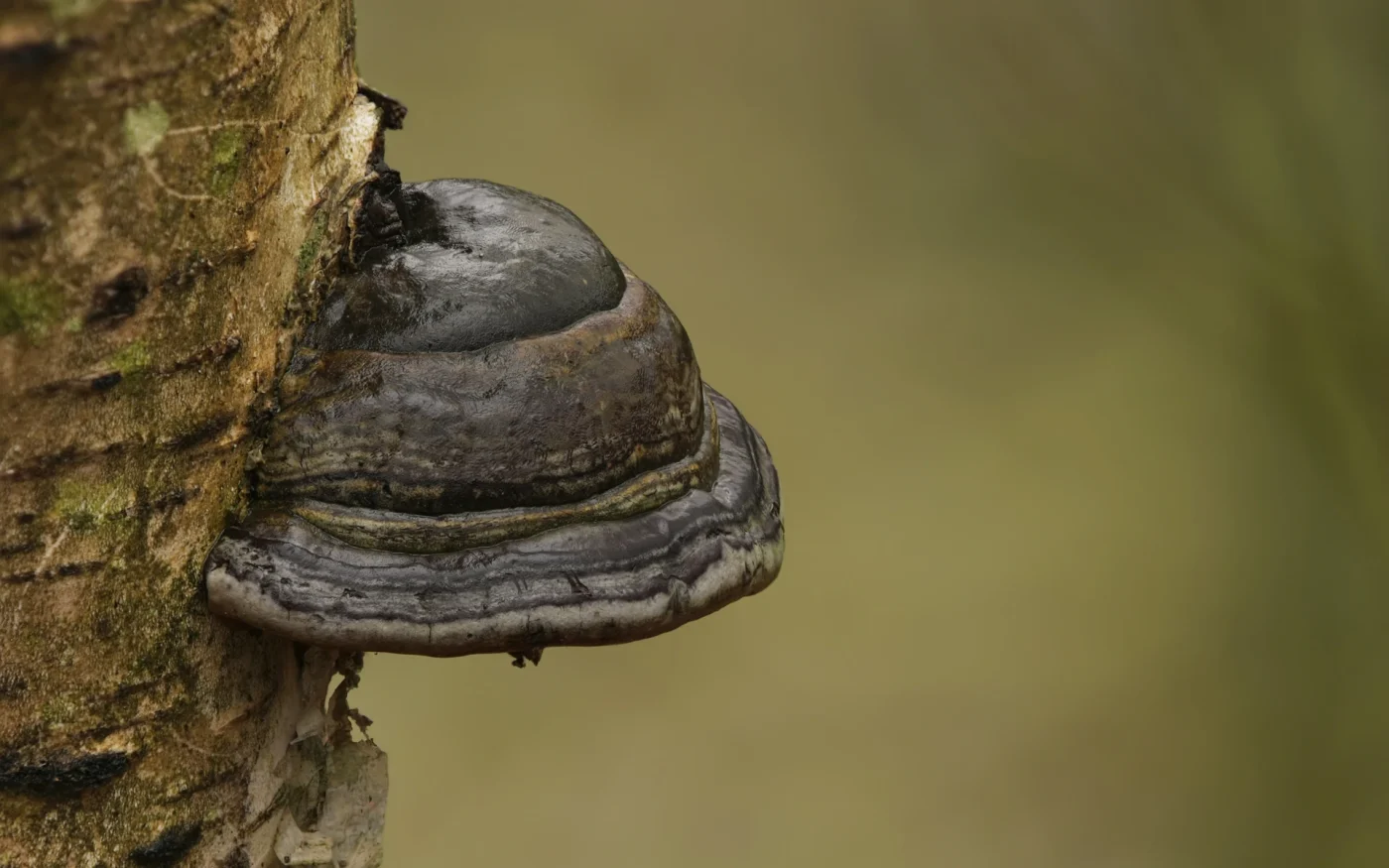
    Fomes fomentarius, commonly known as Tinder Fungus, Tinder Conk, or Hoof Fungus, is a tough perennial bracket fungus that grows on broadleaf trees. Its gray to brown hoof-shaped fruit body can remain attached for years, adding new growth layers as the fungus continues to develop.

    The species is especially associated with birch and beech, although it can occur on other hardwoods. Its hard woody texture, zoned upper surface, pale pore layer, and perennial growth make it very different from softer annual bracket fungi.

    ⚠️ Important: This guide is for identification and education only. Fomes fomentarius is not a conventional edible mushroom and should not be consumed based on photographs, AI identification, or online comparisons.

    Quick Identification

    Feature Fomes fomentarius
    Scientific name Fomes fomentarius
    Common names Tinder Fungus, Hoof Fungus, Tinder Conk
    Family Polyporaceae
    Shape Hoof-shaped to bracket-like
    Cap color Gray, brown, gray-brown, nearly black
    Surface Hard, zoned, often cracked with age
    Underside Pale pore surface
    Pores Very small and round
    Stem Absent
    Flesh Tough, fibrous, corky
    Growth Perennial
    Substrate Living or dead hardwood
    Common hosts Birch, beech, poplar and other broadleaf trees
    Rot type White rot
    Spore print Pale to white
    Edibility Inedible
    Main look-alikes Phellinus igniarius group, Ganoderma applanatum, other perennial polypores

    What Does Fomes fomentarius Look Like?

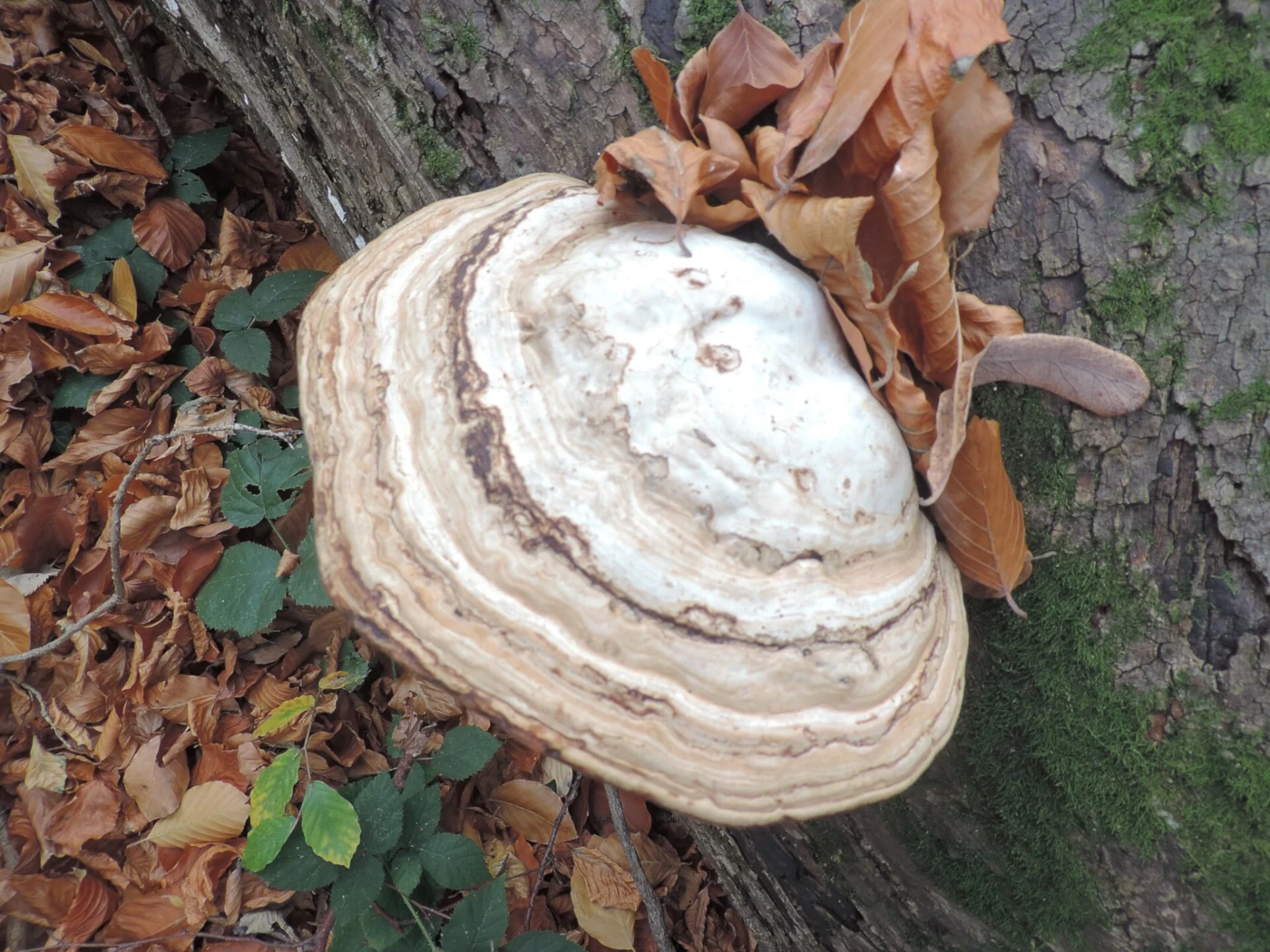
    Tinder Fungus usually forms a thick hoof-shaped conk projecting from the side of a tree. Young fruit bodies may be more rounded, while older ones become broader, heavier, and distinctly layered.

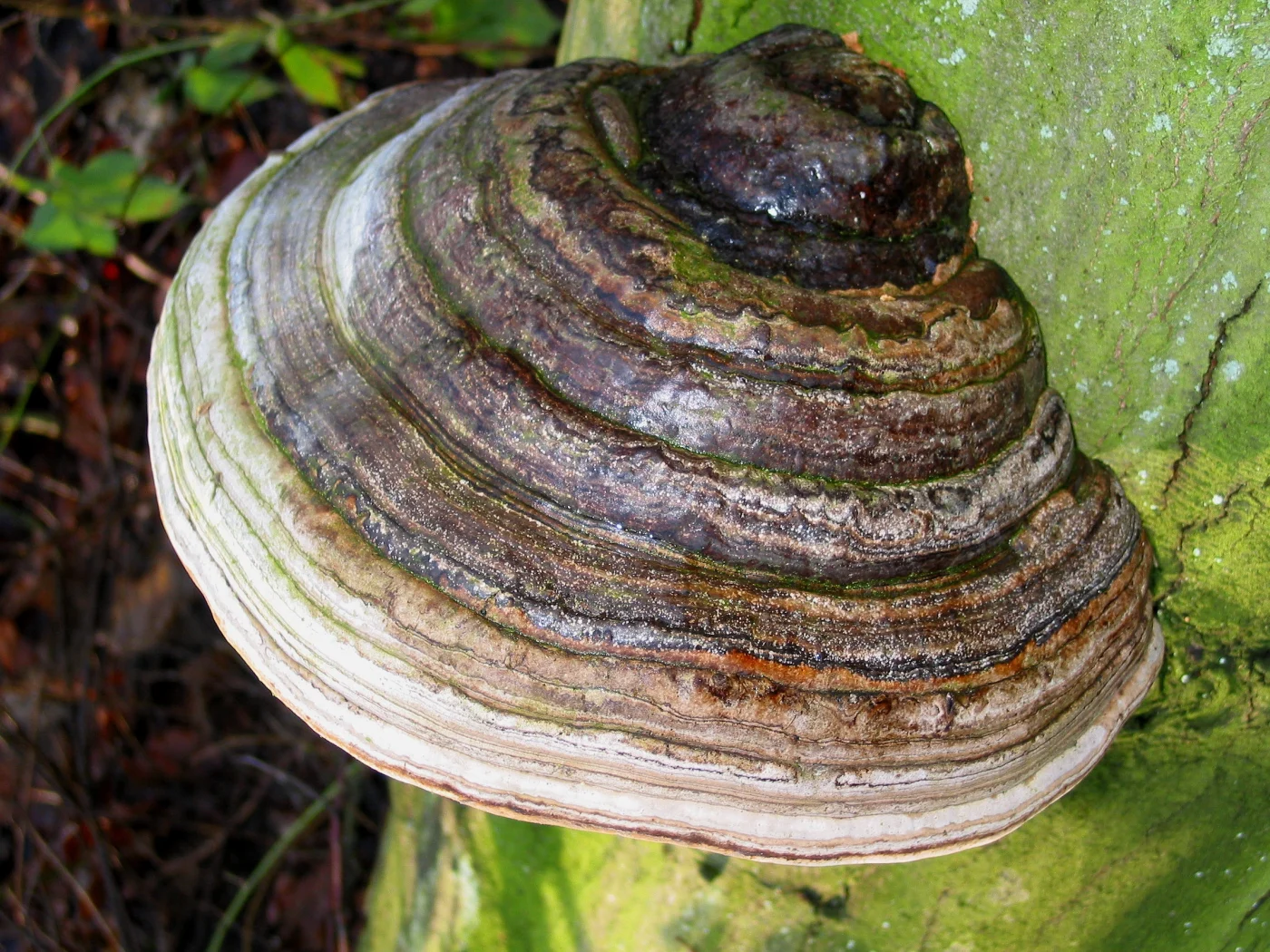
    The upper surface is gray, gray-brown, or dark brown and often shows visible concentric growth zones. Older specimens may become cracked or almost black in places, especially after years of exposure to rain, sun, and frost.

    The underside is much paler and covered with tiny pores. Each year, a new layer of tubes can develop beneath the older tissue, making the fruit body gradually thicker.

    Shape

    The classic shape resembles the hoof of a horse, with a rounded upper surface and a flatter underside. Some fruit bodies are more shelf-like, especially when they grow from sloping trunks or fallen wood.

    Shape depends partly on the orientation of the host tree. A fungus growing on a vertical trunk develops differently from one on a horizontal log.

    Growth Layers

    Visible bands on the upper surface can reflect repeated growth over several seasons. These zones often become easier to see as the conk ages.

    The fruit body may persist for many years. This perennial habit separates it from many bracket fungi that appear, release spores, and decay within a single season.

    Upper Surface

    The outer surface is hard and dry, with colors ranging from pale gray to dark gray-brown. Fresh growth near the margin can be lighter than older central areas.

    Weathering may create cracks, moss, algae, or surface discoloration. Very old conks can become rough enough that the original zoning is less obvious.

    Texture

    The surface feels woody rather than leathery or fleshy. It cannot be bent easily like Turkey Tail or cut effortlessly like a young Oyster Mushroom.

    This hardness is one of the fastest ways to recognize a mature perennial conk. Even relatively young fruit bodies are much tougher than ordinary mushrooms.

    Underside

    The underside is pale gray, cream, or light brown and covered with very fine pores. The pores are small enough that the surface may appear almost smooth from a distance.

    Unlike gilled mushrooms, spores are released through these pores. The fertile surface usually faces downward regardless of the angle of the host.

    Pore Surface

    Fresh pore surfaces tend to be relatively pale. Older areas can become grayish, brownish, or stained.

    The pores are much finer than those of Dryad’s Saddle. This difference helps separate Fomes fomentarius from large annual polypores with visibly coarse pore openings.

    Flesh and Internal Structure

    The internal tissue is tough, fibrous, and cork-like. It is usually brownish, cinnamon, or tan rather than white and fleshy.

    The structure can be divided into hard outer crust, dense internal tissue, and repeated tube layers underneath. Cutting a large old conk requires much more force than cutting a soft seasonal mushroom.

    Tinder Layer

    Part of the internal tissue can be processed into a felt-like material known historically as amadou. This material has been used as tinder because it can catch and hold a spark when properly prepared.

    The same fibrous tissue has also been used traditionally for other purposes. These historical uses are part of why Fomes fomentarius is one of the best-known bracket fungi in Europe.

    Does Fomes fomentarius Have a Stem?

    No. The fruit body attaches directly to the tree.

    The attachment is broad and strong enough to support a heavy conk for years. There is no conventional central or lateral stem.

    If a hoof-shaped bracket has a clear fleshy stem, another species should be considered.

    Where Does Fomes fomentarius Grow?

    Tinder Fungus grows on broadleaf trees, especially birch and beech. It can occur on both living trees and dead wood.

    On living trees, it often enters through wounds or damaged tissue. Once established, the fungus causes internal wood decay that can persist for years.

    Common Host Trees

    Birch is one of the most familiar hosts, particularly in northern and eastern parts of Europe. Beech is also extremely important in many regions.

    Poplar, maple, willow, and other hardwoods may also support the fungus. Exact host frequency varies with geography and forest type.

    Living Trees

    A fruit body on a living tree usually indicates significant internal colonization. The fungus causes white rot by breaking down lignin and other components of wood.

    A tree can remain standing for years while carrying several conks. However, advanced decay may weaken the trunk structurally.

    Dead Trees

    The fungus can continue growing after the host tree dies. Standing dead trunks and fallen logs may carry old or still-active fruit bodies.

    This persistence makes Tinder Fungus visible throughout the year. Winter is often an especially good time to spot it because foliage no longer hides trunks.

    Distribution

    Fomes fomentarius is widespread across Europe, Asia, and parts of North America. It is most common in temperate and boreal regions with abundant broadleaf forests. Its distribution is strongly tied to suitable host trees. Birch- and beech-rich forests are especially favorable.

    When Can You Find Tinder Fungus?

    Because the fruit bodies are perennial, they can be found in every season. Unlike soft gilled mushrooms, they do not disappear after a short fruiting period.

    Fresh growth tends to occur during favorable moist conditions. Older layers remain attached through frost, snow, heat, and dry weather.

    Why Winter Is a Good Time to Look

    Leafless forests expose trunks and dead branches, making bracket fungi much easier to see. Large hoof-shaped conks can stand out from considerable distance. Winter also reduces competition from thousands of soft seasonal mushrooms. This makes perennial brackets easier to study carefully.

    Is Fomes fomentarius Edible?

    No. The fruit body is far too hard, woody, and fibrous to be eaten as a conventional mushroom. Historical uses involve processed internal tissue rather than normal culinary preparation. Those uses should not be confused with edibility. The species is much more important ecologically and historically than as food.

    Fomes fomentarius Look-Alikes

    Several perennial bracket fungi produce hard gray or brown conks on broadleaf trees. The most useful differences involve shape, pore surface, internal color, host tree, and reactions to scratching or bruising. Large old brackets can be difficult to identify from a single photograph. Underside and host information are especially helpful.

    Phellinus igniarius Group — Willow Bracket and Related Species

    Identification

    Species in the Phellinus igniarius group form hard dark conks on living hardwoods. Mature fruit bodies can be blackish, cracked, and hoof-shaped.

    The underside is brownish rather than clean pale cream, and the internal tissue is typically darker. Host tree can also provide valuable clues.

    Main Difference

    Tinder Fungus tends to have a paler pore surface and a more gray-toned zoned upper surface. Phellinus species often look darker and more heavily charred or blackened.

    Older specimens can still overlap considerably. A cut section and host tree may be needed for better confidence.

    Ganoderma applanatum — Artist’s Conk

    Identification

    Artist’s Conk forms broad flattened brackets rather than classic hoof-shaped fruit bodies. The upper surface is brown to gray-brown, while the underside is pale.

    One famous feature is that the pore surface bruises brown when scratched. This allows lines or drawings to remain visible on the underside.

    Main Difference

    Artist’s Conk is usually flatter and broader. Fomes fomentarius is generally more hoof-shaped and vertically thick.

    The strong scratch reaction of Ganoderma applanatum is another useful clue.

    Fomitopsis betulina — Birch Polypore

    Identification

    Birch Polypore grows almost exclusively on birch and can occur beside Tinder Fungus on the same tree. It has a smoother, paler, more rounded fruit body with a softer texture when young.

    The underside is white with small pores. Older specimens become tougher but usually remain less hoof-like than Fomes fomentarius.

    Main Difference

    Birch Polypore has a smoother pale cap and typically looks more like a thick rounded shelf. Tinder Fungus is harder, darker, and strongly zoned.

    Both can occur on birch, so host tree alone does not separate them.

    Fomes fomentarius vs Birch Polypore

    Feature Fomes fomentarius Birch Polypore
    Shape Hoof-shaped Rounded shelf
    Upper surface Gray-brown, zoned Pale brown to gray, smoother
    Texture Very hard and woody Softer when young
    Growth Perennial Usually annual
    Main host Birch, beech, others Mainly birch
    Pores Fine Fine
    Edibility Inedible Not a conventional edible

    Growth habit and surface texture are particularly useful. A thick conk adding layers over multiple years strongly supports Fomes fomentarius.

    Fomes fomentarius vs Artist’s Conk

    Feature Fomes fomentarius Ganoderma applanatum
    Shape Hoof-like Broad and flattened
    Surface Gray and zoned Brown-gray, flatter
    Underside Pale fine pores Pale, bruises brown when scratched
    Growth Perennial Perennial
    Stem None None
    Main clue Hoof shape Scratch-sensitive pore surface

    Both can become large and woody. Shape and underside reaction provide the fastest distinction.

    How to Identify Fomes fomentarius Step by Step

    Start with shape and texture. Look for a hard perennial hoof-shaped conk attached directly to broadleaf wood.

    Then examine the upper surface for gray-brown concentric zones and the underside for very fine pale pores. Finally, identify the host tree and consider whether the fruit body shows multiple years of growth.

    Step 1: Check the Shape

    A classic fruit body is thick vertically and projects outward like a hoof. The upper surface is rounded while the lower fertile surface is flatter.

    Very young specimens can be less distinctive. Older mature conks show the characteristic shape best.

    Step 2: Check the Surface

    Look for hard gray to brown zoning rather than a soft or brightly colored cap. Large cracks can appear with age.

    A thin flexible bracket belongs to another group. Tinder Fungus should feel dense and woody.

    Step 3: Look at the Pores

    The underside should contain numerous tiny pale pores. They should not be large, maze-like, toothed, or gilled.

    Fresh pore layers are usually paler than older tissue. Fine pores help separate the species from coarser annual polypores.

    Step 4: Identify the Host

    Birch and beech strongly support the identification. Other broadleaf trees are also possible.

    If the fungus grows on a conifer, Fomes fomentarius becomes less likely. Host tree should always support morphology rather than override it.

    White Rot and Tree Decay

    Tinder Fungus is a white-rot fungus. It breaks down lignin and leaves the remaining wood pale, fibrous, and progressively weaker.

    This decomposition is a normal and important part of forest nutrient cycling. Dead and weakened trees are gradually returned to the ecosystem.

    What It Means for a Living Tree

    Visible conks usually indicate that internal decay is already established. Removing the fruit body does not remove the fungus from inside the tree.

    For large trees near buildings, roads, or frequently used areas, repeated conks may justify professional structural assessment. The concern is the condition of the tree, not the mushroom itself.

    Historical Use as Tinder

    The species has been associated with fire-making for thousands of years. Processed inner tissue can catch sparks and smolder slowly.

    This material is commonly called amadou. Producing it requires preparation rather than simply breaking off a fresh conk and trying to burn it.

    Other Traditional Uses

    Amadou has also been made into soft felt-like material. Historically, it was used for various practical applications in parts of Europe.

    These uses made Fomes fomentarius culturally significant long before modern mushroom identification guides existed.

    How to Photograph Tinder Fungus for Identification

    Take a side view showing the entire hoof-shaped profile and the way it attaches to the tree. This is more informative than a close-up of the upper surface alone.

    Then photograph the underside so pore color and texture are visible. A third image should show the host tree, bark, and surrounding trunk.

    If an old fallen conk can be examined without damaging living habitat, a cut surface can also reveal internal tissue and tube layers. Several angles make comparisons with other perennial polypores much easier.

    Can AI Identify Fomes fomentarius?

    AI can often recognize mature Tinder Fungus because the hoof-like shape and zoned gray surface are distinctive. Accuracy improves when the host tree and underside are visible.

    The hardest cases are old dark conks that resemble Phellinus or other perennial polypores. A single side photo may not show enough detail for species-level confidence.

    Host information is especially valuable. Birch or beech plus a classic hoof-shaped gray conk makes the identification much stronger.

    Common Identification Mistakes

    One common mistake is calling every hard hoof-shaped bracket Tinder Fungus. Several perennial polypores can develop similar forms.

    Another mistake is relying only on birch habitat. Birch Polypore and other fungi can occupy the same tree.

    A third mistake is ignoring the underside. Pore color and pore structure provide useful clues that the upper surface alone cannot supply.

    Frequently Asked Questions

    Can an old Tinder Fungus remain on a tree after the fungus is no longer active?

    Yes. The hard fruit body can persist for a long time after active growth has slowed or stopped. An old conk therefore does not necessarily indicate that the visible surface is currently producing spores.

    Why do some conks grow at strange angles on fallen trees?

    The fruiting body tries to orient the pore surface downward so spores can fall effectively. If a tree falls while a conk is growing, later growth can change direction and create unusual shapes.

    Can moss or algae grow on Tinder Fungus?

    Yes. Old conks can remain exposed for years, providing enough time for algae, moss, and other organisms to colonize the surface. Heavy growth can hide the original gray zoning.

    Can two different bracket fungi grow on the same tree?

    Yes. One trunk can support several fungal species simultaneously or at different stages of decay. Each conk should therefore be identified independently rather than assuming all brackets belong to one species.

    Why do some fruit bodies have very dark lower edges?

    Age, weathering, frost, and previous growth layers can darken parts of the conk. The newest pore surface is usually more useful for identification than heavily weathered tissue.

    Can removing the conk save an infected tree?

    No. The visible fruit body is only the reproductive structure, while the main fungus already occupies wood inside the trunk. Removing the conk does not eliminate the internal mycelium.

    Do woodpeckers or insects damage Tinder Fungus?

    Yes. Hard conks can still be attacked by insects, and birds may damage them while searching for larvae. Old fruit bodies often contain holes or irregular broken areas.

    Why can one tree have conks of several different sizes?

    They may have started growing in different years or from separate infected areas within the trunk. Some remain small while others continue adding layers and become much larger.

    Final Identification Notes

    Fomes fomentarius is best recognized by the combination of a hard perennial hoof-shaped fruit body, gray to brown concentric zoning, tiny pale pores, no stem, fibrous internal tissue, and growth on broadleaf trees such as birch and beech.

    Its closest look-alikes are usually other perennial polypores rather than soft seasonal mushrooms. Shape, pore surface, host tree, and internal structure are therefore more useful than color alone.

    Because the fruit body may remain visible for years, Tinder Fungus is one of the easiest mushrooms to study outside the normal mushroom season. Winter forests in particular offer an excellent opportunity to see its classic hoof-shaped conks clearly on exposed trunks.

  • Suillus granulatus: Weeping Bolete Identification & Look-Alikes

    Suillus granulatus: Weeping Bolete Identification & Look-Alikes

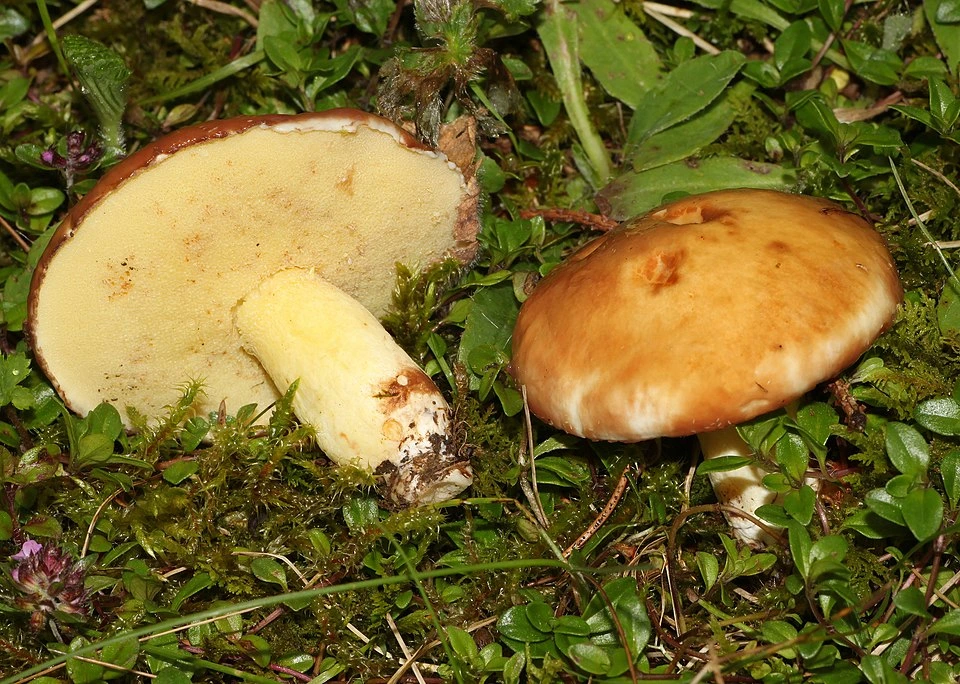
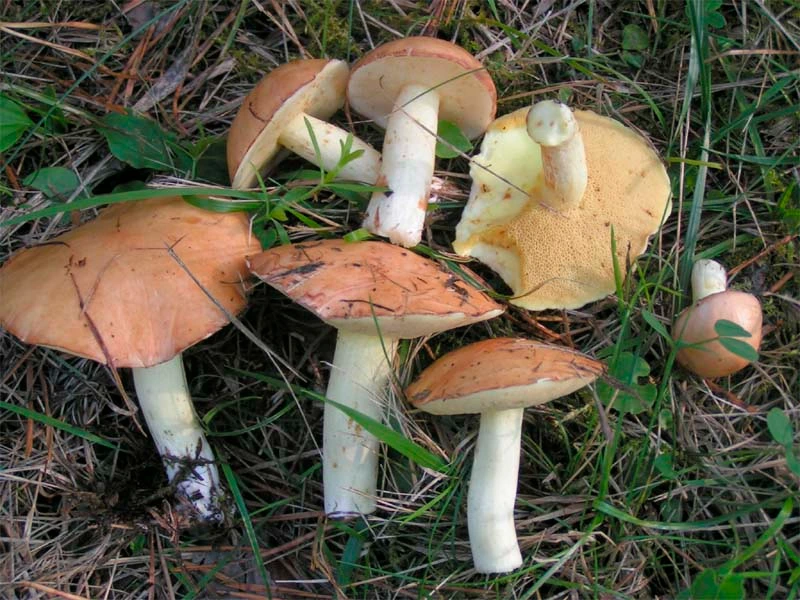
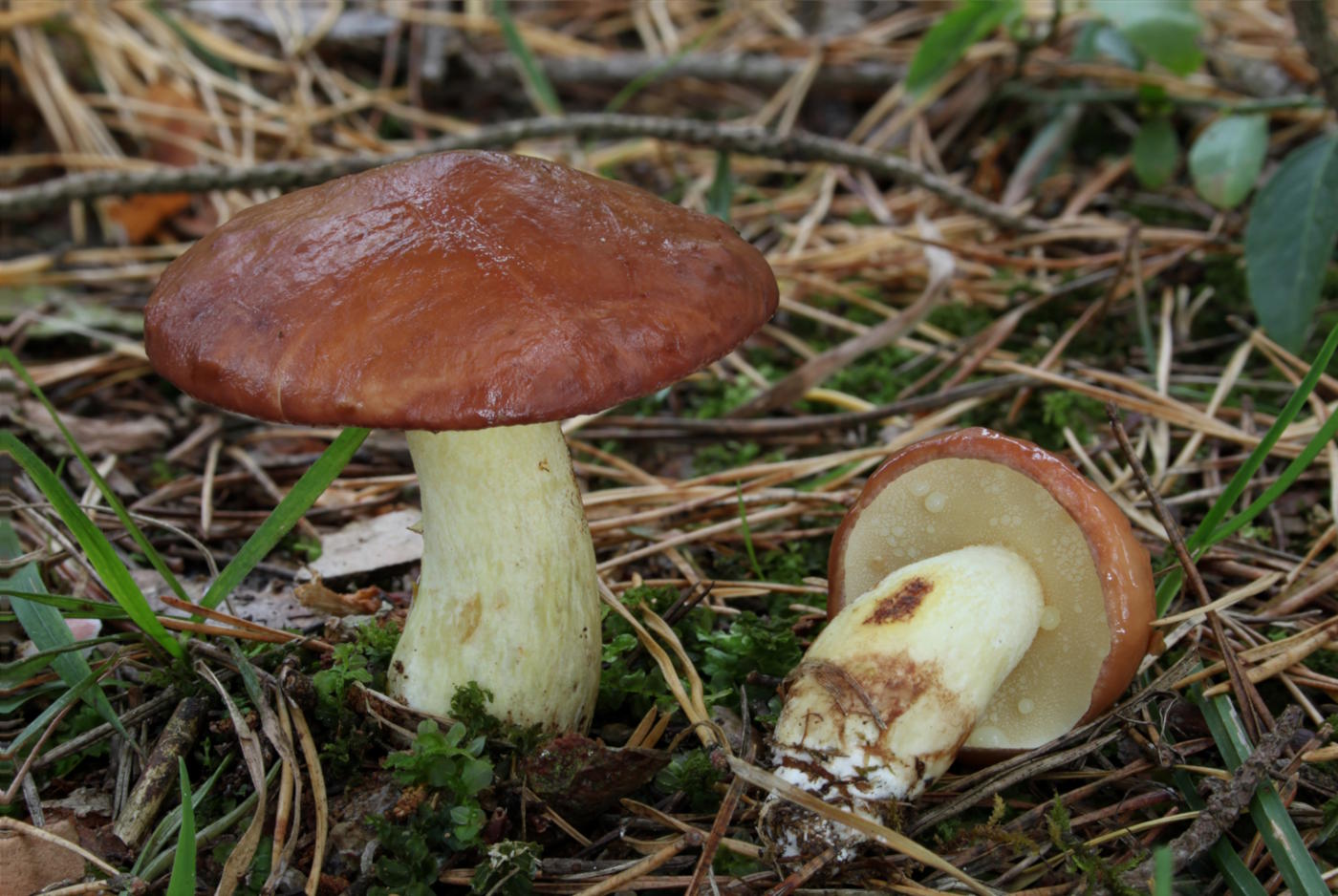
    Suillus granulatus, commonly known as the Weeping Bolete or Granulated Bolete, is a pine-associated mushroom with a smooth yellow-brown cap, yellow pores, and a pale stem covered with small glandular dots. Young specimens may produce tiny milky droplets from the pore surface, which is one of the features behind the common name “Weeping Bolete.”

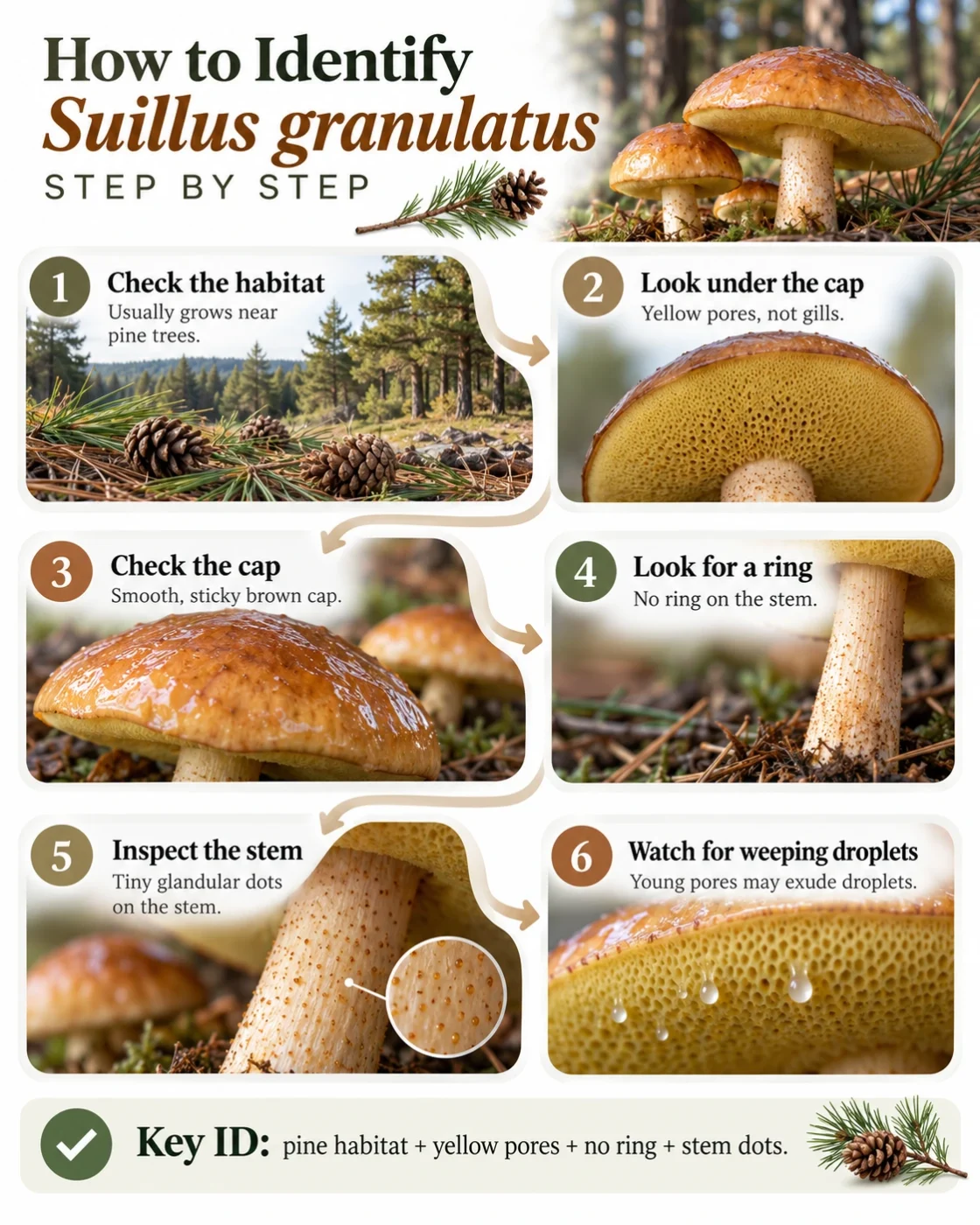
    It is especially common in pine forests, plantations, grassy areas beneath pines, and other places where compatible pine roots are present. Identification is usually straightforward when you combine the lack of a ring, glandular dots on the stem, yellow pores, sticky cap, and strong association with pine.

    Important: This guide is for identification and education only. Never eat a wild mushroom based solely on photographs, AI identification, or an online comparison.

    Quick Identification

    Feature Suillus granulatus
    Scientific name Suillus granulatus
    Common names Weeping Bolete, Granulated Bolete
    Family Suillaceae
    Cap color Yellow-brown, ochre, orange-brown
    Cap surface Smooth, often sticky when wet
    Underside Yellow pores
    Young pore reaction May exude milky droplets
    Stem Pale yellow to cream
    Stem pattern Small glandular dots
    Ring Absent
    Flesh Pale yellow, soft with age
    Bruising Usually little dramatic blueing
    Spore print Brown to olive-brown
    Ecology Mycorrhizal
    Main host Pine
    Season Summer through autumn
    Edibility Edible when correctly identified
    Main look-alikes Suillus luteus, Suillus collinitus, other ringless Suillus species

    What Does Suillus granulatus Look Like?

    The Weeping Bolete has the classic Suillus appearance: a smooth brownish cap, yellow sponge-like pores underneath, and a pale stem. Young mushrooms are usually compact, while mature specimens become broader and softer.

    The cap is often glossy or sticky after rain. The stem lacks a ring and develops many tiny brownish or reddish glandular dots, particularly toward the upper half.

    Young pore surfaces may produce small pale droplets. These droplets can leave darker spots as they dry, making mature specimens look more speckled underneath.

    Cap

    The cap usually begins rounded and convex, then gradually flattens with age. Color ranges from pale ochre and yellow-brown to orange-brown or chestnut.

    The surface is smooth and can become noticeably sticky when wet. In dry weather, it may appear much more matte and slightly paler.

    Cap Margin

    Young caps often have a smooth, slightly curved margin. Unlike Suillus luteus, there is no partial veil creating a ring on the stem.

    The margin can become somewhat irregular in older specimens. Weathering and insect damage may also change the appearance considerably.

    Pores

    The underside has pores rather than gills. Young pores are pale yellow and gradually become deeper yellow or olive-yellow as the mushroom matures.

    The pores are relatively small but become more visible with age. Pressing them usually does not produce the strong blue staining seen in some other boletes.

    The “Weeping” Droplets

    Young specimens may exude tiny milky or clear droplets from the pore surface. These are especially noticeable in humid weather.

    The droplets can dry into small brownish marks. This feature is useful but not always present, so it should be treated as supporting evidence rather than a requirement.

    Stem

    The stem is pale cream to yellowish and usually fairly cylindrical. It lacks a ring, which is one of the easiest ways to separate it from Suillus luteus.

    Small glandular dots often cover the upper stem. These can be yellowish at first and become brownish or reddish with age.

    Glandular Dots

    The dots are tiny and can look like pinpricks or speckles. They are produced by glandular structures and are a classic feature in several Suillus species.

    In Suillus granulatus, these dots are usually especially noticeable near the pore surface. They help distinguish the species from boletes with smooth or strongly reticulated stems.

    Flesh

    The flesh is pale yellow to cream and relatively soft. Young mushrooms are firmer, while older fruit bodies become increasingly spongy.

    Strong blue bruising is not a typical feature. A bolete that turns deep blue rapidly after cutting should lead you toward another group.

    Texture

    The cap flesh can become watery or soft in wet weather. The pore layer also becomes increasingly spongy as the mushroom matures.

    Older specimens are often heavily attacked by insects. Young firm fruit bodies provide the clearest identification features.

    Smell

    The smell is mild and mushroom-like. It is not usually strong enough to function as a primary identification feature.

    Odor can vary with age and freshness. Cap texture, stem dots, pore color, and pine association are much more useful.

    Spore Print

    The spore print is brown to olive-brown. This is typical of many boletes and helps confirm the broader group.

    Spore color is not especially useful for separating Suillus granulatus from close relatives. Ecology and stem structure are more practical in the field.

    Where Does Suillus granulatus Grow?

    Suillus granulatus forms mycorrhizal relationships with pine roots. It therefore grows from soil rather than directly from wood.

    Pine forests, young plantations, woodland edges, grassy parks beneath pines, and roadside pine plantings can all support the species. The mushroom may appear several meters from the nearest trunk because pine roots extend far through the soil.

    Pine Association

    Pine is one of the strongest identification clues. Suillus granulatus is especially associated with two-needled pines and other compatible Pinus species. This relationship can make the species very common in planted pine forests outside its original range. Where pines have been introduced, their fungal partners may follow.

    Pine Plantations

    Young pine plantations can produce large numbers of Suillus mushrooms. The fungi often colonize relatively disturbed or grassy soil around the trees. This makes Weeping Bolete easier to encounter than many old-forest fungi. It can appear in places that do not look like traditional woodland at all.

    When Does Suillus granulatus Grow?

    The main season is summer through autumn in temperate regions. Fruiting often increases after sustained rainfall. Warm conditions combined with moist soil are particularly favorable. In mild climates, the season can continue well into late autumn.

    Weather and Fruiting

    A dry summer can suppress fruiting even when healthy mycelium remains underground. Once rainfall returns, large groups may appear quickly. Several fruit bodies often develop in the same patch. Productive sites can return in later years when weather conditions are suitable.

    Distribution

    Suillus granulatus is widespread across Europe and parts of Asia and has also been introduced to other regions together with planted pines. It can now be found in many temperate areas where compatible pine species grow.

    The exact distribution is strongly influenced by forestry and tree planting. This makes it a good example of how fungi can expand their range alongside their host trees.

    Is Suillus granulatus Edible?

    The Weeping Bolete is generally considered edible when correctly identified and properly prepared. It is not usually rated as highly as Porcini because the texture can become soft and the cap surface may be slimy.

    Some people remove the cap skin before cooking. Older specimens are usually less desirable because they become spongy and frequently contain insect damage.

    Like other Suillus species, it can cause gastrointestinal discomfort in some people. Proper identification and sensible preparation remain important.

    Suillus granulatus Look-Alikes

    Most look-alikes are other Suillus species associated with pine. These mushrooms can share sticky caps, yellow pores, and glandular dots, so the ring, cap pattern, and stem structure become especially useful. Exact species identification can also depend on pine species and geography. In some regions, several similar ringless Suillus species occur together.

    Suillus luteus — Slippery Jack

    Identification

    Suillus luteus has a brown sticky cap and yellow pores, making it one of the most obvious look-alikes. The key difference is that Slippery Jack has a distinct ring on the stem.

    Young specimens may also show a partial veil covering the pores. As the mushroom expands, the veil tears and leaves the ring behind.

    Main Difference

    Weeping Bolete lacks a ring. Slippery Jack usually has a clear persistent ring or ring zone.

    This is one of the easiest comparisons within the genus. If a brown sticky pine bolete has a substantial ring, S. luteus becomes much more likely.

    Suillus granulatus vs Suillus luteus

    Feature Suillus granulatus Suillus luteus
    Cap Yellow-brown to orange-brown Darker brown
    Surface Sticky when wet Very slimy when wet
    Ring Absent Present
    Pores Yellow Yellow
    Young pore droplets Often present Usually not characteristic
    Stem Glandular dots Ring plus pale lower stem
    Host Pine Pine

    The ring is the fastest field feature. Pore droplets and stem dots provide additional support for S. granulatus.

    Suillus collinitus

    Identification

    Suillus collinitus is another ringless pine-associated species with a sticky brown cap and yellow pores. It can look extremely similar to S. granulatus.

    The stem base may show pinkish mycelium, and the cap often has more obvious radial fibers or streaks. These details can be subtle.

    Main Difference

    Pinkish basal mycelium is one of the most useful clues for S. collinitus. The cap can also look more radially streaked than the smoother cap of S. granulatus.

    This comparison can be difficult from photographs alone. Examining the stem base and habitat carefully helps.

    Suillus bovinus — Bovine Bolete

    Identification

    Bovine Bolete has an orange-brown to yellow-brown cap and large irregular pores. The pore openings are usually more elongated and less compact than those of S. granulatus.

    The stem is relatively slender and lacks the obvious glandular dots seen in Weeping Bolete. The overall mushroom often looks less robust.

    Main Difference

    The large irregular pore openings are the easiest clue. Suillus granulatus generally has smaller, more regular yellow pores.

    Both may occur under pine, so habitat alone cannot separate them.

    Suillus variegatus — Velvet Bolete

    Identification

    Velvet Bolete usually has a dry or finely textured yellow-brown cap rather than a strongly sticky one. The surface can look velvety or granular.

    The pores are yellow to olive, and the flesh may show some blueing. Pine forests are a common habitat.

    Main Difference

    A dry textured cap points away from Suillus granulatus. Weeping Bolete is normally smoother and more slippery when wet.

    The stem also lacks the same obvious pattern of glandular dots.

    Weeping Bolete vs Bay Bolete

    Bay Bolete, Imleria badia, has a brown cap and yellow pores but usually lacks the glandular-dot pattern of Suillus granulatus. It also commonly bruises blue on the pore surface.

    The cap of Bay Bolete can be smooth and slightly sticky, which creates some overlap. Blue bruising and stem appearance are therefore especially useful.

    Quick Comparison

    Feature Weeping Bolete Bay Bolete
    Host Strongly pine-associated Conifer and mixed forests
    Stem Glandular dots Smooth to fibrous
    Blue bruising Usually weak or absent Common on pores
    Ring None None
    Cap Sticky yellow-brown Chestnut-brown
    Pores Yellow Yellow

    The glandular dots are one of the best clues. Bay Bolete also tends to have a darker, more chestnut-colored cap.

    How to Identify Suillus granulatus Step by Step

    Start by confirming that the mushroom has pores rather than gills. Then check for a smooth sticky cap and yellow pore surface. Next, examine the stem carefully for glandular dots and make sure there is no ring. Finally, confirm that the mushroom is growing near pine.

    Step 1: Check for a Ring

    This is the fastest first test among common pine Suillus. A true Suillus granulatus should not have a persistent ring.

    If a clear ring is present, compare the mushroom with Suillus luteus. Damaged old specimens can be less obvious, so check multiple fruit bodies if possible.

    Step 2: Look at the Stem Dots

    Inspect the upper stem in good light. Small dark or reddish glandular dots strongly support the Suillus granulatus group.

    These dots can become more obvious with age. Young stems may initially look cleaner and paler.

    Step 3: Check the Pore Surface

    Young pores should be yellow and may produce small droplets. Mature pores become darker yellow or olive.

    Strong blue bruising is not expected. A rapid blue reaction should lead toward another bolete.

    Step 4: Confirm the Host Tree

    Look for pine needles, cones, and bark. In mixed woodland, make sure the nearby conifer is actually pine rather than spruce or fir.

    Host identification is particularly useful with Suillus. Many species have strong preferences for specific conifers.

    Why Suillus Species Can Be Difficult to Separate

    Several Suillus species share brown sticky caps, yellow pores, and pine habitat. This makes quick cap-only identification unreliable.

    Ring presence, glandular dots, cap texture, pore shape, basal mycelium, and host species all become important. Some difficult specimens may remain best identified to genus or species group.

    Modern taxonomy has also clarified relationships that older field guides treated more broadly. Regional identification therefore matters.

    How to Photograph Suillus granulatus for Identification

    Take a photo of the whole mushroom in its pine habitat. Include needles or cones when possible so the host tree is clear.

    Then photograph the pore surface and the upper stem in close-up. The glandular dots should be sharp enough to distinguish them from ordinary dirt or discoloration.

    A final image of the stem base can help separate close relatives. If young pore droplets are visible, photograph them before handling the mushroom too much.

    Can AI Identify Suillus granulatus?

    AI can often recognize a Suillus-type mushroom from its sticky brown cap, yellow pores, and pine habitat. Species-level identification becomes much stronger when the stem dots and lack of a ring are clearly visible.

    Close relatives remain difficult because many share the same basic shape and color. A cap-only photograph may be enough for genus-level recognition but not for a confident species name.

    Host-tree information can substantially improve the result. Photos showing pine needles, cones, and the complete stem are especially useful.

    Common Identification Mistakes

    One common mistake is calling every sticky brown pine bolete Slippery Jack. Several ringless Suillus species look similar but differ in stem structure and pore features.

    Another mistake is ignoring the ring. The presence or absence of a ring immediately separates some of the most common species.

    A third mistake is treating young pore droplets as mandatory. They can be absent in dry weather or older specimens, so the rest of the identification should still be checked.

    Frequently Asked Questions

    Why do some Weeping Boletes have no visible droplets at all?

    Humidity, age, and freshness strongly affect the droplets. Dry or mature specimens may show none even when all other features fit Suillus granulatus.

    Can the glandular dots rub off when the mushroom is handled?

    They can become less obvious after repeated handling, rain, or surface damage. Fresh specimens usually show the pattern more clearly than old weathered ones.

    Why are some caps much darker than others in the same patch?

    Moisture, age, and exposure to sunlight can all affect cap color. Wet caps often look darker and glossier than dry specimens growing only a short distance away.

    Can Suillus granulatus grow in lawns?

    Yes, if pine roots are present beneath the grass. It can appear in parks, gardens, and roadside lawns even when the nearest pine trunk is several meters away.

    Do young pine trees support this mushroom?

    Yes. Suillus species are often especially successful with young pines and can appear in plantations relatively early after planting.

    Why do older specimens become so soft underneath?

    The pore layer expands and absorbs moisture as the mushroom matures. This creates the increasingly spongy texture typical of old boletes.

    Can several Suillus species grow under the same pine trees?

    Yes. A single pine stand can support multiple Suillus species, sometimes fruiting at the same time. Each mushroom should therefore be checked individually.

    Can insect damage hide important identification features?

    Yes. Larvae and slugs can damage pores, stems, and cap surfaces enough to obscure useful details. Fresher intact specimens are much better for identification.

    Final Identification Notes

    Suillus granulatus is best recognized by the combination of a smooth sticky yellow-brown cap, yellow pores, no ring, small glandular dots on the stem, occasional young pore droplets, and strong association with pine.

    The most important look-alike is Suillus luteus, which normally has a distinct ring. Other ringless Suillus species require closer attention to pore shape, cap texture, basal mycelium, and stem markings.

    For a strong identification, do not rely only on the “weeping” droplets. The complete combination of stem, pores, cap, and host tree is far more reliable.

  • Cerioporus squamosus: Dryad’s Saddle Identification and Look-Alikes

    Cerioporus squamosus: Dryad’s Saddle Identification and Look-Alikes

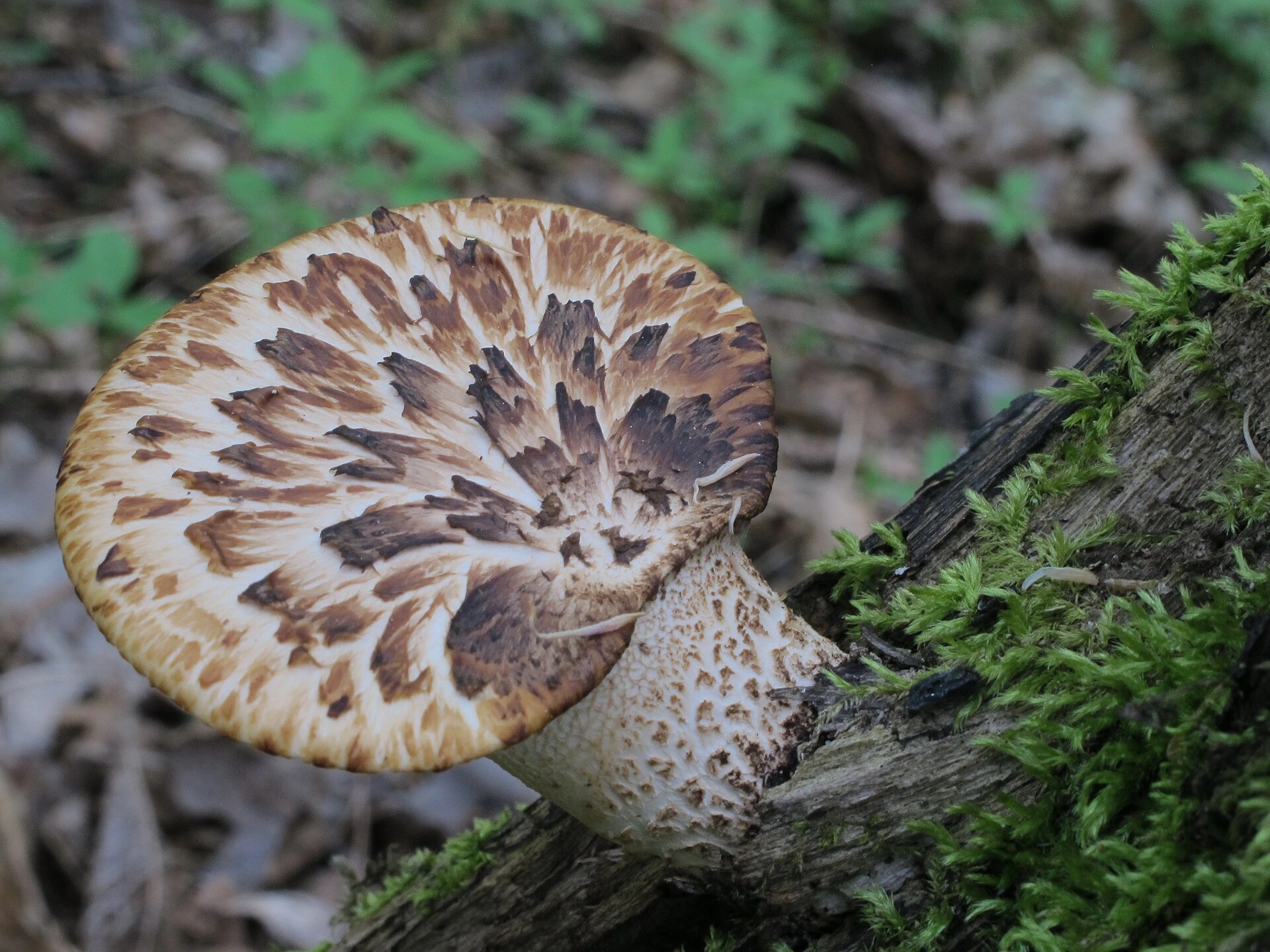
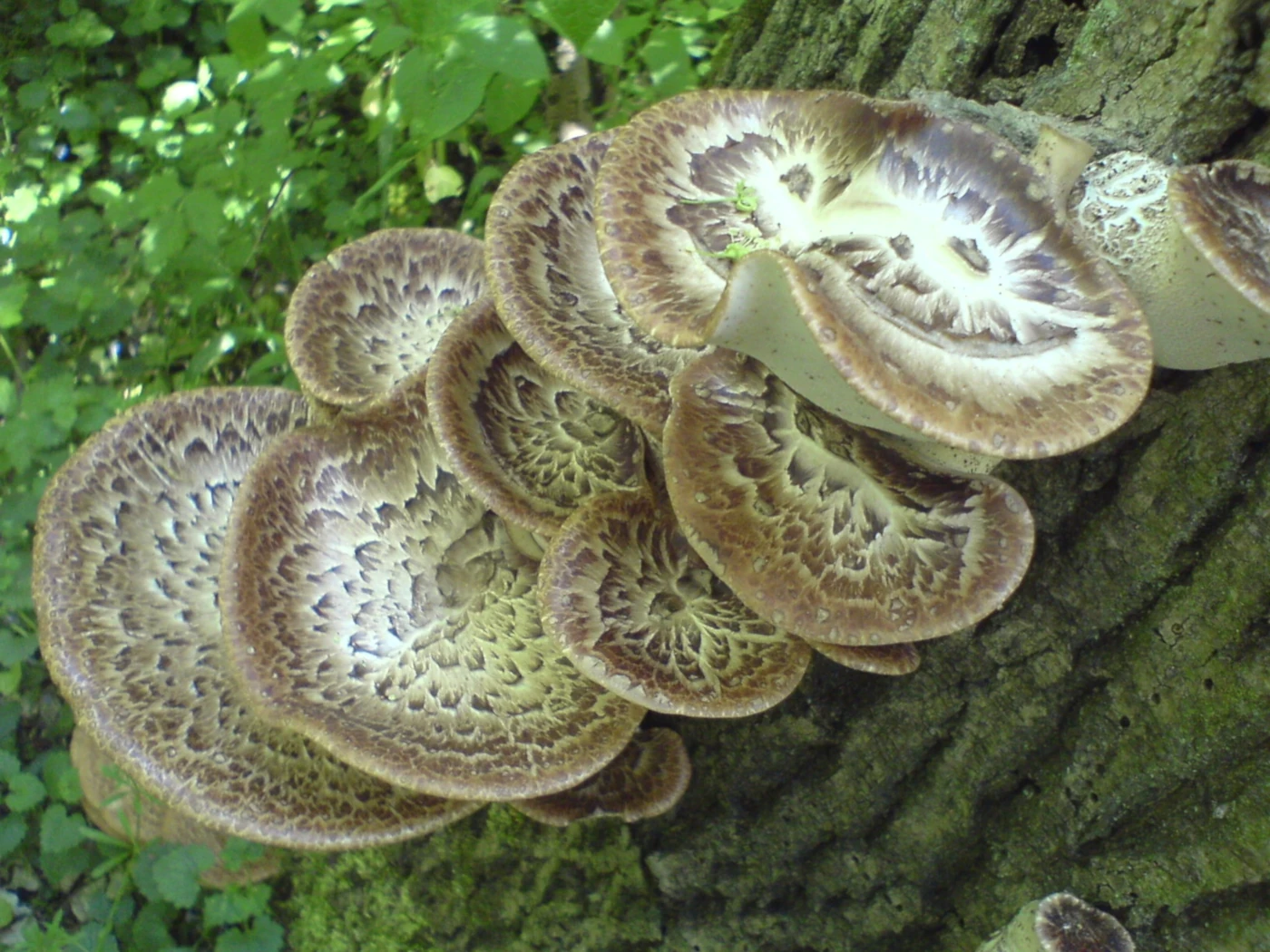
    Cerioporus squamosus, commonly known as Dryad’s Saddle or Pheasant Back, is a large bracket fungus that grows on hardwood trees, stumps, and fallen logs. Its broad cream-to-brown cap is covered with dark flattened scales arranged in a distinctive pattern, while the underside has large angular pores instead of gills.

    The species is especially common in spring and early summer, although fruiting can continue later depending on climate and rainfall. It is usually easy to recognize once you learn the combination of scaly cap, large pores, lateral stem, and growth directly from hardwood.

    ⚠️ Important: This guide is for identification and education only. Never eat a wild mushroom based solely on photographs, AI identification, or an online comparison.

    Quick Identification

    Feature Cerioporus squamosus
    Scientific name Cerioporus squamosus
    Common names Dryad’s Saddle, Pheasant Back
    Family Polyporaceae
    Cap color Cream, tan, ochre, light brown
    Cap pattern Dark brown flattened scales
    Cap shape Fan-shaped to kidney-shaped
    Underside Large angular pores
    Gills Absent
    Stem Short, lateral or off-center
    Flesh White to cream, firm when young
    Smell Often cucumber- or watermelon-rind-like
    Spore print White
    Substrate Hardwood
    Ecology Saprobic and sometimes parasitic
    Season Mainly spring to early summer
    Edibility Young specimens edible when correctly identified
    Main look-alikes Other large polypores and bracket fungi

    What Does Dryad’s Saddle Look Like?

    Dryad’s Saddle forms broad fan-shaped or semicircular caps growing directly from wood. The upper surface is usually pale cream, tan, or ochre and covered with darker brown scales that radiate outward from the center.

    Large specimens can become impressive in size and may grow in overlapping shelves. The fruit bodies are often attached by a short lateral stem, which gives them a shape somewhere between a conventional mushroom and a bracket fungus.

    The underside is equally distinctive. Instead of gills, it has large angular or elongated pores that are easy to see without magnification.

    Cap

    The cap is typically broad and fan-shaped, sometimes resembling a saddle attached to the side of a tree. Young specimens are more rounded and fleshy, while mature caps can become wide, flattened, and slightly wavy along the margin.

    The background color is pale cream to yellow-brown. Dark brown scales form repeated patterns across the upper surface and are usually densest toward the center.

    Cap Scales

    The scales are flat rather than sharply raised. They often form concentric or radiating rows that create the pheasant-feather appearance behind the common name Pheasant Back.

    Weathering can make the contrast weaker. Old specimens may lose some of the darker pattern and become more uniformly tan or brown.

    Underside

    The underside has pores rather than gills. These pores are relatively large, irregular, and often angular or elongated.

    This surface can look almost honeycomb-like in mature specimens. The pore openings are usually much coarser than those on many other polypores.

    Pore Shape

    Young fruit bodies may have smaller, more regular pores. As the mushroom expands, the pores become larger and more stretched.

    Near the stem, the pores can become especially elongated. This feature is useful when separating Dryad’s Saddle from polypores with tiny round pores.

    Stem

    The stem is usually short and attached to the side or lower portion of the cap. It can be pale cream to brown and may darken toward the base.

    Some fruit bodies appear almost stemless because the attachment is broad. Others have a more obvious lateral stalk.

    Stem Position

    The off-center stem is characteristic of many wood-growing polypores. It reflects the way the mushroom projects outward from a vertical trunk or horizontal log.

    A perfectly central stem would be less typical. Growth angle usually depends on the orientation of the wood.

    Flesh

    Young Dryad’s Saddle has white to cream flesh that is relatively soft and firm. As the fruit body matures, the flesh becomes tougher, more fibrous, and eventually leathery.

    This age-related change is important because it affects both identification and texture. Very old specimens can become too tough to handle easily.

    Flesh Thickness

    The cap flesh can be several centimeters thick near the attachment point. It becomes thinner toward the outer margin.

    Young margins are usually the softest part of the mushroom. The center and stem toughen first as the fruit body ages.

    Smell

    Fresh Dryad’s Saddle is famous for a distinctive smell often compared with cucumber, watermelon rind, or fresh flour. Some people notice it immediately, while others find the scent much weaker.

    Smell is useful as supporting evidence but should not replace structural identification. The cap scales, pores, and substrate remain more reliable.

    Spore Print

    The spore print is white. Like many polypores, Dryad’s Saddle releases spores from the pore surface underneath the cap.

    Spore color supports identification but is not especially distinctive. Several related bracket fungi also produce white spores.

    Where Does Dryad’s Saddle Grow?

    Cerioporus squamosus grows on hardwood. It can appear on dead logs and stumps but may also fruit from weakened or damaged living trees.

    Elm, maple, willow, poplar, beech, and various other broadleaf trees can serve as hosts. The exact tree association varies by region.

    Living Trees

    Dryad’s Saddle can act as a parasite on weakened trees. Fruiting bodies may emerge from wounds, old branch scars, cavities, or damaged sections of the trunk.

    Its presence on a living tree can indicate internal decay. The fungus contributes to white rot in wood and may weaken structural integrity over time.

    Dead Wood

    Fallen trunks, large branches, and old stumps are also common substrates. On dead wood, the fungus acts as a decomposer.

    Several large fruit bodies may develop along the same log. Repeated fruiting from the same piece of wood can occur over multiple seasons.

    When Does Cerioporus squamosus Grow?

    Dryad’s Saddle is primarily a spring and early summer mushroom. In many temperate regions, fruiting begins after mild weather and spring rainfall.

    A second flush can sometimes occur later in the year. Rainfall and local temperatures influence timing significantly.

    Why Spring Fruiting Is Useful

    Many large polypores are more noticeable in summer or autumn. Dryad’s Saddle often appears earlier, making it one of the first large bracket fungi of the year.

    This timing can help narrow identification when a fresh scaly polypore appears on hardwood in spring. Season should still be used only as supporting evidence.

    Distribution

    Cerioporus squamosus is widespread across Europe, North America, and parts of Asia. It is especially common in temperate regions with abundant broadleaf trees.

    The species has historically been known as Polyporus squamosus, and that older scientific name still appears in many field guides. Modern classifications commonly place it in the genus Cerioporus.

    Is Dryad’s Saddle Edible?

    Young Dryad’s Saddle is considered edible when correctly identified and still tender. Older specimens quickly become fibrous and tough. The outer margin of a young cap is usually the most tender portion. The thicker central area can become chewy even while the edge remains relatively soft. Proper identification is important because several large bracket fungi can look superficially similar. Texture alone should never be used to decide whether a specimen is suitable for food.

    Dryad’s Saddle Look-Alikes

    Most look-alikes are other large wood-growing polypores. Some share the fan-shaped form, while others overlap in color or growth pattern.

    The combination of large angular pores and dark flattened cap scales is particularly helpful. Few common polypores show both features so strongly.

    Meripilus giganteus — Giant Polypore

    Identification

    Giant Polypore forms large clusters of overlapping fan-shaped caps, often at the base of mature trees. The caps are usually pale brown to darker brown and lack the distinct pheasant-like scale pattern of Dryad’s Saddle.

    The pore surface can bruise dark brown or black. Large rosettes may become enormous.

    Main Difference

    Dryad’s Saddle has conspicuous dark scales on a pale cap and usually more obvious large angular pores. Giant Polypore is more likely to form huge layered rosettes and develop dark bruising.

    The two also differ in overall texture and cap pattern. From above, the scale arrangement is usually the easiest distinction.

    Laetiporus sulphureus — Chicken of the Woods

    Identification

    Chicken of the Woods forms bright orange to yellow shelves on trunks and stumps. Young fruit bodies are thick, fleshy, and vividly colored.

    The underside has pores rather than gills, but the cap surface lacks the brown scale pattern of Dryad’s Saddle.

    Main Difference

    Color separates them quickly in most cases. Chicken of the Woods is bright yellow-orange, while Dryad’s Saddle is cream to brown with dark scales.

    Older Chicken of the Woods can fade considerably, so underside structure and cap pattern should still be checked.

    Trametes versicolor — Turkey Tail

    Identification

    Turkey Tail forms thin multicolored brackets with concentric zones of gray, brown, cream, and sometimes bluish tones. The fruit bodies are much thinner than Dryad’s Saddle.

    Its underside has tiny pores rather than the large angular openings typical of Cerioporus squamosus. Turkey Tail also lacks a substantial lateral stem.

    Main Difference

    Size and pore structure separate them easily. Dryad’s Saddle is thick, fleshy, and large-pored, while Turkey Tail is thin, leathery, and finely porous.

    Fomes fomentarius — Tinder Fungus

    Identification

    Tinder Fungus produces thick gray to brown hoof-shaped conks. These fruit bodies are perennial and become extremely hard.

    The surface is zoned but not covered with the flat dark scales characteristic of Dryad’s Saddle. Its pores are also much finer.

    Main Difference

    Tinder Fungus is hard, woody, and hoof-shaped. Dryad’s Saddle is flatter, more fan-shaped, and relatively soft when young.

    Polyporus tuberaster — Tuberous Polypore

    Identification

    Tuberous Polypore is related and can resemble a smaller Dryad’s Saddle. It often has a pale cap with brown scales and a central or off-center stem.

    The fruit body is generally smaller, and the cap pattern may be less strongly developed. It is often associated with buried wood or woody debris.

    Main Difference

    Overall size and growth habit are useful clues. Dryad’s Saddle usually becomes much larger and more robust.

    Closely related polypores can still be difficult to separate from a photograph alone. Substrate, size, and detailed pore structure may all help.

    Dryad’s Saddle vs Giant Polypore

    Feature Dryad’s Saddle Giant Polypore
    Cap pattern Dark flattened scales Brown zones, little obvious scaling
    Growth Individual or overlapping fans Large rosettes
    Pores Large and angular Finer
    Bruising Usually little dramatic darkening Often dark brown to black
    Stem Short and lateral Usually little obvious stem
    Season Mainly spring–early summer Mainly summer–autumn

    The cap surface is the fastest field clue. Dryad’s Saddle usually looks patterned, while Giant Polypore looks more broadly zoned.

    Dryad’s Saddle vs Chicken of the Woods

    Feature Dryad’s Saddle Chicken of the Woods
    Cap color Cream to brown Bright orange-yellow
    Cap surface Dark scales Smooth to slightly wrinkled
    Underside Large pores Fine pores
    Flesh White to cream Yellowish to white
    Growth Fan-shaped caps Overlapping shelves
    Main season Spring Summer into autumn

    Both are large hardwood polypores, but their color and pore structure differ substantially. Mature faded specimens may require a closer look.

    How to Identify Dryad’s Saddle Step by Step

    Begin with the substrate and confirm that the fungus is growing from hardwood. Then look for broad fan-shaped caps with dark flattened scales.

    Turn the cap over and check for large angular pores. Finally, note the lateral stem and, when possible, smell a fresh specimen.

    Step 1: Check the Cap Pattern

    Look for repeating brown scales arranged across a pale background. The scales should appear flattened rather than hairy or strongly raised.

    This pheasant-feather pattern is one of the most characteristic visual features. It remains useful even when the mushroom has grown quite large.

    Step 2: Check the Pores

    Turn the mushroom over and inspect the underside. The pores should be clearly visible and relatively large.

    If the surface has extremely tiny pores, gills, or teeth, another species should be considered. Pore size is one of the best structural clues.

    Step 3: Check the Stem Position

    Look for a short off-center or lateral stem. It may be more obvious on fruit bodies growing from vertical trunks.

    On horizontal logs, the attachment can appear less stem-like. The important point is that the mushroom emerges directly from wood.

    Step 4: Check the Texture

    Press the outer cap margin gently. A young specimen should feel firm but still somewhat tender.

    An old specimen becomes tough and leathery. Texture helps estimate age but should not be used as a species-level feature by itself.

    Why Dryad’s Saddle Can Look So Different With Age

    Young fruit bodies are thick, pale, and compact. Their scales are often sharply defined and the pore surface looks clean.

    As they expand, the cap becomes wider and flatter. The pores stretch, the margin thins, and the flesh becomes progressively tougher.

    Very old specimens may fade, crack, or become damaged by insects. The scale pattern may still be visible even after other features become less clear.

    How to Photograph Dryad’s Saddle for Identification

    Take a wide photograph showing how the mushroom attaches to the tree or log. This gives useful context about substrate and growth pattern.

    Then photograph the cap from above so the scale pattern is clear. A third image should show the pore surface in enough detail to reveal the large angular openings.

    A side view can show the lateral stem and cap thickness. If several age stages are present, photograph young and mature fruit bodies together.

    Can AI Identify Dryad’s Saddle?

    AI can often recognize Cerioporus squamosus from good photographs because the scale pattern and large fan-shaped cap are distinctive. Accuracy improves when the underside and attachment to wood are also visible.

    Old weathered specimens can be more difficult because the scales fade and the cap becomes less typical. Closely related polypores may also require additional ecological information.

    AI is most useful when several views are available. A single top-down image can miss the large pores and lateral stem that make the identification much stronger.

    Common Identification Mistakes

    One common mistake is identifying every large bracket fungus as Dryad’s Saddle. Giant Polypore, Chicken of the Woods, and several other species can reach similar sizes.

    Another mistake is ignoring the pore surface. Large angular pores provide stronger evidence than general cap color.

    A third mistake is assuming old specimens should look exactly like young field-guide examples. Dryad’s Saddle changes dramatically in shape, texture, and color as it matures.

    Frequently Asked Questions

    Why are some Dryad’s Saddle fruit bodies almost round while others are strongly fan-shaped?

    Growth direction depends on how the fungus emerges from the wood. A fruit body growing from the side of a vertical trunk tends to develop a stronger fan shape, while one growing from a horizontal log may appear broader or more rounded.

    Can Dryad’s Saddle grow very high on a tree?

    Yes. Fruiting bodies can emerge from wounds, branch scars, or decayed sections well above ground level. Their position depends on where suitable colonized wood is present inside the tree.

    Why do some specimens have much darker scales than others?

    Age, moisture, lighting, and genetics all influence contrast. Young fresh specimens often show the strongest difference between the pale background and dark scales.

    Can the same tree produce Dryad’s Saddle for several years?

    Yes. The fungus can remain inside colonized wood and produce new fruit bodies in later seasons. Repeated fruiting from the same trunk or stump is therefore possible.

    Do insects commonly damage Dryad’s Saddle?

    Yes. Older fruit bodies frequently develop tunnels and soft damaged areas. Young firm specimens are usually less affected, but cutting through the cap can reveal hidden insect activity.

    Can rain make the pore surface look different?

    Yes. Prolonged moisture can darken or stain the pores and make old specimens look less clean than fresh ones. Pore shape is usually more reliable than exact pore color.

    Why do some caps split near the margin?

    Rapid growth followed by dry weather can cause the surface to crack or split. Large older fruit bodies are particularly likely to show this kind of weather damage.

    Can Dryad’s Saddle appear on a tree that still looks healthy?

    Yes. The fungus can colonize internal dead or weakened wood before the tree shows obvious external decline. Fruiting bodies may therefore be an early visible sign of internal decay.

    Final Identification Notes

    Cerioporus squamosus is best recognized by the combination of large fan-shaped caps, dark flattened scales, large angular pores, a short lateral stem, and growth directly from hardwood. The spring fruiting season provides additional support.

    The cap pattern is striking, but the underside is just as important. Large stretched pores separate Dryad’s Saddle from many fine-pored brackets and help confirm the identification.

    Most confusion involves other large polypores rather than gilled mushrooms. If the cap scales, pore structure, substrate, and growth form all agree, Dryad’s Saddle is usually one of the easier large bracket fungi to recognize.

  • Amanita ocreata: Western Destroying Angel Identification and Look-Alikes

    Amanita ocreata: Western Destroying Angel Identification and Look-Alikes

    Amanita ocreata, commonly known as the Western Destroying Angel, is one of the most dangerous mushrooms in western North America. It is a pale to white Amanita with white gills, a ring on the stem, and a sack-like volva at the base, and it contains amatoxins capable of causing severe liver failure.

    Its appearance can seem deceptively simple, especially when the cap is nearly white. The most reliable identification comes from checking the complete stem base, persistent pale gills, ring, habitat, and overall Amanita structure rather than relying on cap color alone.

    ⚠️ Important: This guide is for identification and education only. Never eat a wild mushroom based solely on photographs, AI identification, or an online comparison.

    Quick Identification

    Feature Amanita ocreata
    Scientific name Amanita ocreata
    Common name Western Destroying Angel
    Family Amanitaceae
    Cap color White to cream, tan, or pale ochre
    Cap shape Convex to broadly expanded
    Gills White, free or nearly free
    Stem White to pale
    Ring Usually present
    Volva Large, sack-like, at stem base
    Flesh White
    Spore print White
    Ecology Mycorrhizal
    Main region Western North America
    Typical habitat Oak woodland, mixed woodland, parks
    Season Mainly winter through spring in Mediterranean-climate regions
    Toxicity Deadly poisonous
    Main look-alikes White Agaricus, Volvopluteus, other pale Amanitas

    What Does Amanita ocreata Look Like?

    The Western Destroying Angel is typically pale, elegant, and relatively large. Young specimens may be almost entirely white, while older caps can develop cream, tan, or pale ochre tones.

    The mushroom has the classic Amanita structure: white gills, a pale stem, a ring, and a volva at the base. The complete stem base is therefore essential for identification.

    Unlike some Amanitas, the cap usually lacks obvious persistent warts or large patches. This smooth appearance can make mature specimens look less obviously like a dangerous Amanita.

    Cap

    The cap begins rounded or convex and gradually expands with age. Mature caps can become broadly convex to nearly flat.

    Color ranges from white to cream, pale tan, or ochre. Weather and age can create more noticeable brownish or yellowish tones.

    Cap Surface

    The surface is generally smooth and may become slightly sticky when wet. Obvious universal veil patches are usually absent or much less prominent than on species such as Fly Agaric or Panther Cap.

    The margin may become slightly lined in older specimens, but this is not the main identification feature. The stem base and gills are far more important.

    Gills

    The gills are white and remain pale as the mushroom matures. They are crowded and typically free or nearly free from the stem.

    This persistent white color is a major clue when comparing A. ocreata with Agaricus species. Agaricus gills become pink and later chocolate brown.

    Why Mature Gill Color Matters

    Young mushrooms can be misleading because several unrelated genera begin with pale gills. Mature specimens reveal whether the gills stay white or darken with spore development.

    A large mature mushroom with persistent white gills, a ring, and a volva should immediately suggest Amanita. This combination deserves serious caution.

    Stem

    The stem is white to pale cream and usually fairly tall and slender. It may widen toward the base.

    A ring is commonly present on the upper stem. This ring can be membranous but may become damaged or less obvious with age.

    Ring

    The partial veil leaves a ring beneath the cap. Young mushrooms may show the structure especially clearly.

    Weathering can tear or collapse the ring. Its absence in an old mushroom does not rule out Amanita ocreata.

    The Volva: The Most Important Feature

    The base of the stem sits in a prominent sack-like volva. This is one of the strongest features for identifying Amanita ocreata and separating it from many pale gilled mushrooms.

    The volva may be partly or completely buried. A mushroom cut off at ground level can therefore lose the very feature needed for safe identification.

    How to Check the Stem Base

    Carefully remove the mushroom with the entire base intact. Do not simply slice through the stem above the soil.

    Look for a loose cup or sack surrounding the bulbous or widened base. If the base is missing, the identification should remain incomplete.

    Flesh

    The flesh is white and does not show dramatic bruising when cut. It is relatively firm in fresh specimens.

    Color change is not a key feature for this species. The Amanita structures around the stem and gills are much more informative.

    Smell

    Odor can be mild in young specimens and become more noticeable with age. Older fruit bodies may develop a stronger or unpleasant smell.

    Smell is too subjective to function as a primary identification feature. It should never outweigh the structural clues.

    Spore Print

    The spore print is white. This supports identification as an Amanita-type mushroom but is not unique to Amanita ocreata.

    Many pale Amanitas also have white spores. Geography, volva shape, cap appearance, and habitat remain necessary for species-level identification.

    Where Does Amanita ocreata Grow?

    Amanita ocreata is a mycorrhizal fungus that grows from soil near living trees. It does not grow directly from dead wood.

    It is especially associated with western North American oak habitats and other compatible hardwoods. Woodland edges, parks, and landscaped areas with mature trees can also support it.

    Distribution

    The species is characteristic of western North America, especially regions with Mediterranean-type climates. California is particularly well known for it.

    Its range and ecology differ from the classic European Destroying Angels. This is why geography is essential when identifying pale Amanitas.

    Why Regional Names Matter

    “Destroying Angel” is a common name used for several deadly white Amanitas. In eastern North America, other species are more typical, while Amanita ocreata is especially important in the West.

    A white deadly Amanita in California is therefore a different identification problem from a similar mushroom in Europe or eastern North America.

    When Does Amanita ocreata Grow?

    In much of its range, Amanita ocreata fruits during the cool wet season. Winter through spring is especially important in Mediterranean-climate areas.

    Rainfall strongly influences fruiting. A wet winter can produce many mushrooms around suitable host trees.

    Why Its Season Can Surprise Mushroom Hunters

    Many people associate dangerous Amanitas mainly with autumn. In California and nearby regions, A. ocreata can be especially relevant in winter and spring.

    This seasonal difference is important because it means serious Amanita risk continues long after the classic autumn mushroom season ends.

    How Toxic Is Amanita ocreata?

    Amanita ocreata contains amatoxins and is considered deadly poisonous. These toxins primarily damage the liver and can also affect other organs.

    The poisoning pattern is especially dangerous because symptoms may not begin for many hours after ingestion. By the time severe illness becomes obvious, significant internal damage may already have occurred.

    Amanita ocreata Poisoning

    The first phase often involves severe gastrointestinal symptoms. Nausea, vomiting, abdominal pain, and diarrhea may appear after a long symptom-free delay.

    A temporary improvement can follow, creating the false impression that the danger has passed. Liver injury can then become severe during the following phase.

    Why Delayed Symptoms Matter

    Fast symptom onset is not required for a mushroom to be dangerous. Amatoxin poisoning is famous precisely because of its delayed beginning.

    Any suspected ingestion of Amanita ocreata or another deadly Amanita requires urgent medical evaluation. Waiting for symptoms can be dangerous.

    Amanita ocreata Look-Alikes

    The most concerning look-alikes are other white or pale mushrooms growing from soil. Young Agaricus species, Volvopluteus, and other Amanitas can all create confusion.

    The safest distinction comes from checking gill color, ring presence, volva, spore print, and habitat together. White cap color alone is almost useless.

    White Agaricus Species

    Identification

    Some young Agaricus mushrooms can be white and have a ring, creating a superficial resemblance. Their gills, however, do not remain white.

    Young gills typically become pink and then dark chocolate brown as the spores mature. Agaricus also lacks the sack-like volva of Amanita ocreata.

    Main Difference

    Persistent white gills plus a volva strongly favor Amanita. Pink to brown mature gills without a volva favor Agaricus.

    This distinction becomes much easier when mature specimens are available.

    Amanita ocreata vs Agaricus

    Feature Amanita ocreata Agaricus species
    Mature gills White Pink to chocolate brown
    Spore print White Brown
    Ring Usually present Usually present
    Volva Present Absent
    Stem base Enclosed in sack-like volva No volva
    Safety Deadly poisonous Varies by species

    The volva is the most important structural clue. Mature gill color provides another strong distinction.

    Volvopluteus Species

    Identification

    Volvopluteus species can have a pale cap and a prominent volva at the stem base. This makes them one of the more convincing structural look-alikes.

    The key difference is in the gills and spores. Mature Volvopluteus develops pink gills and a pinkish spore print.

    Main Difference

    A volva does not automatically mean Amanita. Mature gill and spore colors are therefore critical when comparing these groups.

    White gills and white spores point toward Amanita, while pink maturation points toward Volvopluteus.

    Other Pale Amanitas

    Several other Amanita species can look similar to A. ocreata. Some may also be deadly, while others differ in ecology, cap color, volva shape, or microscopic features.

    This is why exact species identification can be difficult from photographs alone. Recognizing a mushroom as a dangerous pale Amanita is often more important than forcing an uncertain species name.

    Amanita ocreata vs Amanita phalloides

    Both species can contain amatoxins and share white gills, a ring, and a volva. Amanita phalloides usually has a more olive, greenish, or brownish cap, although pale forms exist.

    Amanita ocreata is generally paler and is particularly associated with western North America. Geography and season are therefore useful supporting clues.

    Quick Comparison

    Feature Amanita ocreata Amanita phalloides
    Typical cap White to cream or ochre Olive, greenish, brownish, sometimes pale
    Gills White White
    Ring Usually present Usually present
    Volva Sack-like Sack-like
    Main region Western North America Europe; introduced in other regions
    Toxicity Deadly Deadly

    Both should be treated as medical emergencies if ingested. Separating them exactly is less important than recognizing the deadly Amanita pattern.

    How to Identify Amanita ocreata Step by Step

    Begin with the complete mushroom rather than the cap. Confirm persistent white gills, a pale stem, and the presence of a ring.

    Then expose the entire base and look for a sack-like volva. Finally, consider western North American geography, host trees, and cool-season fruiting.

    Step 1: Check Mature Gill Color

    Look for a mature specimen and confirm that the gills remain white. Pink or brown gills point away from Amanita ocreata.

    Young mushrooms alone can be misleading. Mixed-age groups are much easier to evaluate.

    Step 2: Find the Volva

    Expose the base carefully and look for the loose sack around the stem. Missing this structure is one of the most dangerous identification errors.

    Do not assume the volva is absent simply because it is not visible above ground. It may be completely buried.

    Step 3: Check for a Ring

    Look beneath the cap for a membranous ring or remnants of one. The ring supports Amanita identification but may be damaged.

    A ring without a volva is not enough. Both structures should be considered together.

    Step 4: Consider Region and Season

    A pale deadly Amanita appearing in western North America during winter or spring is consistent with Amanita ocreata. The same-looking mushroom in another region may belong to a different Amanita species.

    Geography narrows the possibilities but should never override morphology. The complete structure still matters most.

    How to Photograph Amanita ocreata for Identification

    Take the first photo before disturbing the mushroom so the habitat and growth pattern remain visible. Include nearby trees whenever possible.

    Then photograph the underside, complete stem, ring, and especially the full stem base. A close-up of the volva is one of the most valuable images.

    A vertical cut can document the white flesh, but the stem base should be photographed intact first. Cutting before documenting the volva can destroy useful evidence.

    Can AI Identify Amanita ocreata?

    AI can often recognize a pale Amanita-like mushroom when the ring, gills, and volva are clearly visible. Species-level identification becomes more difficult because several deadly white Amanitas share nearly identical structures.

    Geography and season can improve the result significantly. A photograph from California in winter carries different context from an identical-looking specimen found in Europe in autumn.

    AI should therefore help flag a possible deadly Amanita rather than provide reassurance about edibility. Any uncertain pale Amanita should be treated conservatively.

    Common Identification Mistakes

    One common mistake is photographing only the cap. A smooth white or cream cap contains very little diagnostic information by itself.

    Another mistake is leaving the volva underground. This removes one of the most important structural clues before identification even begins.

    A third mistake is assuming that “Destroying Angel” refers to one universal species. Several deadly white Amanitas share that common name in different regions.

    Frequently Asked Questions

    Can Amanita ocreata appear darker than expected after dry weather?

    Yes. Older or weathered caps can develop cream, tan, or ochre coloration, so not every specimen looks pure white. The structural Amanita features remain more reliable than exact cap color.

    Can heavy rain damage the ring or volva?

    Yes. Veil structures can tear, collapse, or become less obvious after rain and physical damage. This is why several specimens at different ages are especially useful when available.

    Why are young button-stage Amanitas particularly risky?

    Young Amanitas may still be enclosed in veil tissue and can look like small white balls or other immature mushrooms. Cutting one vertically can reveal a developing cap, gills, and stem inside rather than the uniform interior of a true puffball.

    Can Amanita ocreata fruit in landscaped urban areas?

    Yes. Mycorrhizal fungi can follow the roots of planted trees into parks, gardens, and roadside landscapes. A suburban setting does not make a pale Amanita harmless.

    Can animals eat Amanita ocreata without becoming ill?

    Animal feeding does not establish human safety. Different species tolerate toxins differently, and visible bite marks should never be treated as evidence of edibility.

    Why can one patch produce mushrooms again in later years?

    The underground mycelium can persist in association with the same host-tree roots for many years. Fruiting depends on suitable rainfall, temperature, and tree health rather than the fungus being newly introduced each season.

    What if the volva was accidentally left in the ground?

    The mushroom should be treated as incompletely documented. If the identification matters, return to the exact spot if possible and inspect the remaining stem base or nearby intact specimens.

    Can a nearly white Death Cap be mistaken for Amanita ocreata?

    Yes, especially in areas where both taxa or introduced populations may be relevant. If the mushroom clearly fits the deadly Amanita pattern, exact species naming is less important than recognizing the poisoning risk.

    Final Identification Notes

    Amanita ocreata is best recognized by the combination of persistent white gills, a pale cap and stem, a ring, a large sack-like volva, white spores, and growth near living trees in western North America.

    The volva is the most important feature to preserve during collection for identification. A pale mushroom cut off above ground can become much harder to distinguish from Agaricus and other look-alikes.

    Most importantly, the Western Destroying Angel should be recognized as part of the deadly Amanita pattern. When white gills, a ring, and a volva occur together, the mushroom should be treated with extreme caution regardless of how plain or harmless it appears.

  • Boletus edulis: Porcini Identification and Look-Alikes

    Boletus edulis: Porcini Identification and Look-Alikes

    Boletus edulis, commonly known as Porcini, Penny Bun, or King Bolete, is one of the most famous wild mushrooms in Europe and parts of North America. Its thick pale stem, brown cap, and sponge-like pore surface make it easier to recognize than many gilled mushrooms, but several other boletes can look similar at first glance.

    The safest identification comes from combining cap color, pore color, stem pattern, bruising reaction, flesh, habitat, and host trees. Porcini identification becomes especially reliable when the upper stem shows a fine pale net-like pattern and the flesh remains white after cutting.

    ⚠️ Important: This guide is for identification and education only. Never eat a wild mushroom based solely on photographs, AI identification, or an online comparison.

    Quick Identification

    Feature Boletus edulis
    Scientific name Boletus edulis
    Common names Porcini, Penny Bun, King Bolete
    Family Boletaceae
    Cap color Light brown to dark chestnut-brown
    Cap surface Smooth, sometimes slightly sticky when wet
    Underside Pores, not gills
    Young pores White
    Mature pores Yellow to olive-yellow
    Stem Thick, pale to brownish
    Stem pattern Fine pale reticulation, especially near the top
    Flesh White, firm, usually not blueing
    Spore print Olive-brown
    Ecology Mycorrhizal
    Habitat Woodland near living trees
    Season Summer through autumn
    Edibility Edible when correctly identified
    Main look-alikes Tylopilus felleus, other king boletes, toxic red-pored boletes

    What Does Boletus edulis Look Like?

    Porcini has the classic bolete shape: a thick stem supporting a rounded brown cap with a sponge-like underside. Young specimens can look compact and almost bun-shaped, which explains the common name Penny Bun.

    As the mushroom matures, the cap expands and the pore layer underneath becomes more visible. The overall fruit body usually remains solid and substantial, especially compared with more slender boletes.

    The combination of brown cap, pale pores in young mushrooms, and a thick reticulated stem is highly characteristic. However, each of these features should be checked together rather than used alone.

    Cap

    The cap ranges from pale tan and hazelnut-brown to deep chestnut or dark brown. Young mushrooms often have a rounded hemispherical cap that becomes broader and flatter with age.

    The surface is generally smooth and can feel slightly greasy or sticky after rain. Dry weather can make it more matte and sometimes slightly cracked.

    Cap Margin

    The margin is often paler than the center, particularly in young fruit bodies. This contrast can create a subtle two-tone appearance.

    With age, the margin usually becomes less strongly curved. Very old specimens may have irregular edges or damage from insects and slugs.

    Pores Instead of Gills

    Porcini does not have gills. The underside of the cap is made up of thousands of tiny pores leading into vertical tubes.

    This sponge-like surface is one of the easiest ways to place the mushroom in the bolete group. The pore color changes noticeably as the mushroom ages.

    Young Pores

    Young Boletus edulis usually has white to cream pores. The surface can look almost solid from a distance because the pores are so small.

    This pale pore layer is an important clue when comparing fresh Porcini with several darker or red-pored boletes.

    Mature Pores

    As spores mature, the pores gradually become yellow and then olive-yellow or olive-green. This is a normal age-related change.

    Older pore layers may become soft and spongy. Very mature specimens often show insect damage and can deteriorate quickly.

    Stem

    The stem is thick, solid, and often broader toward the base. Young specimens can have an almost bulbous shape, while older stems may become more cylindrical.

    Color ranges from white or cream to pale brown. One of the best identification features is the fine net-like pattern on the surface.

    Stem Reticulation

    The reticulation looks like a delicate raised mesh or network. In Boletus edulis, it is usually pale and especially noticeable on the upper part of the stem.

    This feature is extremely useful when separating Porcini from superficially similar boletes. Some look-alikes also have netting, but the color and extent of the pattern can differ.

    Flesh

    The flesh is white, thick, and firm in fresh specimens. It generally remains white when cut rather than rapidly turning blue.

    This lack of dramatic blue bruising is useful because many other boletes change color when damaged. The flesh may become slightly softer and more yellowish with age, but strong blueing would point away from classic B. edulis.

    Texture

    Young Porcini is dense and compact. The cap flesh is substantial, while the stem can be especially firm and heavy.

    Older mushrooms become softer, particularly in the pore layer. This age difference matters both for identification and for judging freshness.

    Smell

    Fresh Porcini usually has a mild, pleasant mushroom aroma. Some people describe it as nutty or earthy.

    Smell is useful as supporting evidence but is not distinctive enough to confirm the species. Several edible and inedible boletes can smell similar.

    Spore Print

    The spore print is olive-brown. This color is typical of many boletes and helps confirm the broader group.

    A spore print is less useful for separating Porcini from closely related king boletes. Stem pattern, pore color, bruising, and host tree are usually more practical in the field.

    Where Does Boletus edulis Grow?

    Boletus edulis is a mycorrhizal fungus, which means it forms partnerships with living tree roots. It grows from soil rather than directly from dead wood.

    Forests with spruce, pine, birch, beech, oak, and other suitable host trees can support the species. Which host dominates depends on region.

    Coniferous Forests

    Spruce and pine forests are classic Porcini habitats. Mossy ground, forest edges, and areas with a thick organic layer can all be productive.

    Rain after warm weather often triggers large flushes. Several fruit bodies may appear scattered across the same patch.

    Deciduous Forests

    Porcini can also occur under beech, oak, birch, and other broadleaf trees. In mixed woodland, several host species may be present at the same site.

    This makes tree identification useful but not always decisive. The mushroom may be associated with a tree several meters away rather than the nearest visible trunk.

    When Does Boletus edulis Grow?

    Summer through autumn is the main fruiting period in temperate regions. Peak season often follows periods of sustained rainfall combined with moderate temperatures.

    In northern or high-elevation areas, fruiting may begin earlier and end quickly after frost. In milder climates, the season can continue well into autumn.

    Why Weather Matters

    Porcini fruiting can vary dramatically from year to year. A productive forest one autumn may appear almost empty the next if rainfall timing is poor.

    The underground mycelium remains present even when no mushrooms appear. Fruiting depends on moisture, temperature, and the condition of host trees.

    Distribution

    Boletus edulis is widely distributed across Europe and northern parts of Eurasia. Closely related king boletes also occur in North America and other regions.

    Modern taxonomy has shown that not every “Porcini” worldwide is exactly Boletus edulis. Several regional species belong to a broader king bolete complex and can look extremely similar.

    For practical identification, geography matters. A European Porcini-like bolete and a western North American king bolete may belong to different species despite nearly identical appearance.

    Is Boletus edulis Edible?

    Yes, Porcini is widely regarded as edible when correctly identified and properly prepared. It is one of the most valued wild mushrooms in European cuisine.

    Both fresh and dried Porcini are used because the aroma becomes especially concentrated during drying. Identification should still come before culinary use because several bitter or toxic boletes can resemble it.

    Boletus edulis Look-Alikes

    The main look-alikes fall into two groups: harmless but unpleasant bitter boletes and potentially toxic boletes with stronger color reactions. Stem pattern, pore color, bruising, and flesh color are the most useful comparison features.

    The most famous Porcini look-alike is the Bitter Bolete, Tylopilus felleus. Several red-pored boletes also deserve attention because some can cause serious gastrointestinal poisoning.

    Tylopilus felleus — Bitter Bolete

    Identification

    Bitter Bolete has a brown cap and a stout stem, making it superficially similar to Porcini. The pores begin pale but often develop a pinkish tone as the mushroom matures.

    The stem usually has a prominent dark brown net-like pattern. This dark reticulation contrasts with the paler mesh typical of Boletus edulis.

    Main Difference

    The easiest visual clues are the pinkish mature pores and dark stem reticulation. Porcini usually has white-to-yellow pores and pale netting.

    Bitter Bolete is famous for its intensely bitter taste. A small amount can ruin an entire dish, even though it is not generally considered a deadly poisonous species.

    Boletus edulis vs Bitter Bolete

    Feature Boletus edulis Tylopilus felleus
    Cap Brown Brown
    Young pores White White to pale
    Mature pores Yellow to olive Pinkish
    Stem reticulation Fine and pale Strong and dark
    Flesh White, mild White, extremely bitter
    Bruising Usually little change Usually little dramatic blueing
    Safety Edible when correctly identified Inedible due to intense bitterness

    The stem and mature pores are usually more useful than cap color. Both mushrooms can grow in similar woodland habitats.

    Red-Pored Boletes

    Several boletes have red, orange-red, or reddish pore surfaces and can look somewhat similar from above. Some also have thick stems and brownish caps.

    Many of these species bruise blue rapidly when cut or pressed. This strong reaction, combined with red pores, points away from classic Boletus edulis.

    Why Red Pores Matter

    Porcini should not have bright red pores. Young pores are white and later become yellow to olive.

    A bolete with red pores deserves separate identification. Some red-pored species are toxic, while others have different edibility traditions depending on region and preparation.

    Rubroboletus satanas — Satan’s Bolete

    Identification

    Satan’s Bolete can have a pale cap, thick stem, and red pore surface. The stem often shows red or yellow coloration and may have reticulation.

    The flesh can turn blue after cutting. Overall coloration is much more dramatic than typical Porcini.

    Main Difference

    Bright red pores, red stem coloration, and blue bruising strongly separate it from Boletus edulis. Porcini has pale-to-olive pores and lacks strong blue staining.

    This is an important example of why the underside and bruising reaction should always be checked before identifying a bolete for food.

    Other King Boletes

    Several species closely related to Boletus edulis can look almost identical. Differences may involve cap color, host tree, geography, stem pattern, or microscopic features.

    In North America, multiple regional king boletes have historically been called “Porcini.” Exact species-level identification can therefore require more than appearance alone.

    For most field observations, recognizing the king bolete group may be more realistic than forcing a precise species name from a photograph.

    Porcini vs Bay Bolete

    Bay Bolete, Imleria badia, also has a brown cap and yellow pores. It is usually more slender, lacks the strong pale stem reticulation, and often develops blue staining on the pore surface when pressed.

    The stem is typically smoother and more uniformly brown. Porcini is generally more robust and has firmer white flesh.

    Quick Comparison

    Feature Porcini Bay Bolete
    Stem Thick, reticulated More slender, usually smooth
    Pores White to yellow-olive Yellow, often blueing
    Bruising Little or none Blueing common
    Flesh Thick and white Paler, may react slightly
    Cap Brown Chestnut-brown

    Both are common woodland boletes, so this comparison is useful in mixed and coniferous forests.

    How to Identify Boletus edulis Step by Step

    Start with the underside and confirm that the mushroom has pores rather than gills. Young pores should be white, becoming yellow to olive as the mushroom matures.

    Next, inspect the stem for fine pale reticulation. Then cut the mushroom and watch whether the flesh remains white rather than rapidly turning blue.

    Finally, consider the habitat and nearby trees. A robust brown bolete with pale netting, non-blueing white flesh, and suitable mycorrhizal habitat strongly supports Porcini.

    Step 1: Check the Pores

    Look at pore color and condition. White or pale pores in a young specimen are a strong starting clue.

    Older yellow or olive pores are also normal. Pink, red, or strongly blue-staining pores should lead toward other species.

    Step 2: Check the Stem Pattern

    Look closely at the upper stem. Fine pale netting is one of the most characteristic features.

    Dark coarse reticulation suggests Bitter Bolete. A completely smooth stem may indicate another bolete.

    Step 3: Cut the Flesh

    Make a clean vertical cut through the cap and stem. Porcini flesh should remain broadly white.

    Rapid strong blueing points away from Boletus edulis. Slight age-related discoloration is different from an immediate intense blue reaction.

    Step 4: Check the Trees

    Identify nearby conifers and broadleaf trees if possible. Spruce, pine, beech, birch, and oak can all be relevant depending on region.

    Tree association should support the morphological identification rather than replace it. A Porcini-like mushroom under a suitable host still needs the correct pores, stem, and flesh.

    Why Porcini Sometimes Looks Different

    Porcini appearance varies with age, moisture, and habitat. Young mushrooms can have almost spherical caps and very thick stems, while mature specimens may look broad and much less compact.

    Wet weather can darken the cap and make it slightly sticky. Dry conditions can make the surface paler and occasionally cracked.

    This variability explains why one perfect photograph is not enough to represent every Boletus edulis. The structural features remain more dependable than exact color.

    How to Photograph Porcini for Identification

    Start with the complete mushroom from the side. This shows the proportions of cap and stem and makes the reticulation easier to see.

    Next, photograph the underside clearly so pore color is visible. A third image should show the upper stem in close-up, including the net-like pattern.

    A cut section can document flesh color and any bruising reaction. Finally, include a habitat image showing nearby trees and forest type.

    Can AI Identify Boletus edulis?

    AI can often recognize a king bolete-like mushroom from good photographs because the thick stem, brown cap, and pore surface are distinctive. Accuracy improves significantly when the underside and upper-stem reticulation are visible.

    The main challenge is separating Boletus edulis from closely related king boletes and other similar brown boletes. Geography, host trees, and subtle stem features can matter more than a single photograph can show.

    AI is useful for narrowing possibilities. It should not be the only basis for deciding whether a wild bolete is suitable for food.

    Common Porcini Identification Mistakes

    One common mistake is assuming every brown bolete with a thick stem is Porcini. Bitter Bolete and several other species can imitate the same overall shape.

    Another mistake is ignoring mature pore color. Pinkish pores point toward Tylopilus felleus, while red pores lead toward a different group entirely.

    A third mistake is overlooking bruising reactions. Strong blue staining can immediately eliminate classic Boletus edulis from consideration.

    Frequently Asked Questions

    Why are some Porcini full of insect tunnels while others nearby are clean?

    Insect damage can vary dramatically even within the same patch. Older fruit bodies and warmer conditions usually increase the chance of larvae, while very young firm mushrooms are often less affected.

    Can Porcini appear in the same place every year?

    Yes. The underground mycelium can remain associated with the same host trees for many years and produce fruit bodies when moisture and temperature conditions are favorable.

    Why do some Porcini have very thick stems and others look much slimmer?

    Age, soil depth, moisture, and growing conditions all influence proportions. Young mushrooms often have especially swollen stems, while older specimens can become taller and less compact.

    Can the pore layer be removed from an old Porcini?

    The mature sponge layer can become soft and may separate easily from the cap flesh. From an identification perspective, this softness usually reflects age rather than a different species.

    Does heavy rain affect Porcini appearance?

    Yes. Rain can darken the cap, soften the pore layer, and make the surface feel slightly sticky. Prolonged wet weather also accelerates insect and slug damage.

    Can Porcini grow far away from the nearest visible tree?

    Yes. Tree roots and fungal mycelium can extend well beyond the visible trunk or canopy edge. A mushroom several meters away may still be associated with a nearby host tree.

    Why are some Porcini caps almost black-brown?

    Cap color naturally varies between individuals and can become very dark in wet conditions. Dark color alone does not indicate a different species if the other identification features match.

    Is a very large Porcini automatically too old to identify reliably?

    Not necessarily, but older specimens often lose some useful features and become damaged. If available, younger and mature mushrooms from the same patch are best examined together.

    Final Identification Notes

    Boletus edulis is best recognized by the combination of a brown cap, white-to-olive pore surface, thick pale stem with fine pale reticulation, firm white flesh, and little or no blue bruising. Habitat near suitable living trees supports the identification.

    The most useful look-alike comparison is the Bitter Bolete, which tends to develop pinkish pores and darker stem netting. Red-pored, strongly blueing boletes should also be treated as a separate identification path rather than assumed to be Porcini.

    For reliable identification, do not rely on the classic “brown cap and fat stem” appearance alone. Pores, reticulation, bruising, flesh color, geography, and host trees together provide a much stronger identification.

  • Lactarius deliciosus: Saffron Milk Cap Identification and Look-Alikes

    Lactarius deliciosus: Saffron Milk Cap Identification and Look-Alikes

    Lactarius deliciosus, commonly known as the Saffron Milk Cap, is one of the most recognizable orange woodland mushrooms. It is known for its carrot-orange cap, orange latex, concentric zones, and the greenish staining that often appears after bruising or with age.

    Despite its distinctive appearance, several related milkcaps can look very similar, and exact species identification may depend on geography and host tree. The safest approach is to focus on latex color, staining, gill structure, cap pattern, and habitat rather than relying on orange coloration alone.

    ⚠️ Important: This guide is for identification and education only. Never eat a wild mushroom based solely on photographs, AI identification, or an online comparison.

    Quick Identification

    Feature Lactarius deliciosus
    Scientific name Lactarius deliciosus
    Common name Saffron Milk Cap
    Family Russulaceae
    Cap color Orange to carrot-orange
    Cap pattern Often concentric darker zones
    Gills Orange to pale orange, decurrent
    Latex Orange
    Bruising Green to blue-green staining
    Stem Orange, often with darker pits
    Flesh Firm, brittle, pale orange
    Spore print Cream to pale ochre
    Ecology Mycorrhizal
    Main host Pine
    Habitat Pine forests and plantations
    Season Late summer through autumn
    Edibility Edible when correctly identified
    Main look-alikes Other orange milkcaps, Woolly Milkcap, False Saffron Milk Cap

    What Does Lactarius deliciosus Look Like?

    The Saffron Milk Cap is usually orange from cap to stem, with darker concentric rings visible across the cap surface. Mature mushrooms often develop a depressed or funnel-shaped center while the margin becomes increasingly irregular.

    Fresh specimens can look extremely bright, while older fruit bodies often develop green patches. This green staining is one of the most characteristic features of the species group and commonly appears where the mushroom has been handled, damaged, or aged.

    The whole mushroom has a firm but brittle texture typical of the Russulaceae. If the gills or flesh are damaged, orange latex appears and provides one of the most valuable identification clues.

    Cap

    Young caps are convex with the margin rolled inward. As the mushroom matures, the center becomes depressed and may eventually form a broad shallow funnel.

    Color ranges from pale orange to intense carrot-orange. Darker circular bands often create a zoned pattern radiating outward from the center.

    Cap Surface

    The cap is generally smooth and may become slightly sticky in wet weather. It lacks the shaggy or strongly woolly surface found in some related milkcaps.

    Green staining may appear spontaneously with age or after handling. In older mushrooms, the green coloration can become extensive enough to obscure the original orange tones.

    Gills

    The gills are crowded and run down the stem, a pattern described as decurrent. Their color is orange to pale orange and generally matches the rest of the mushroom.

    Damage to the gills releases orange latex. Green staining can then develop along the bruised areas, especially as the latex oxidizes.

    Gill Structure

    The gills are true blade-like structures rather than the false ridges found on chanterelles. This makes the mushroom easy to separate from golden chanterelles once the underside is examined carefully.

    The gills are also relatively brittle. Pressing or scratching them can easily expose the latex response.

    Latex

    Latex is one of the defining characteristics of milkcaps. In Lactarius deliciosus, the liquid is orange when freshly released.

    The latex may darken or contribute to greenish discoloration as the mushroom is exposed to air. This reaction, combined with the orange body and pine habitat, creates a strong identification pattern.

    Why Latex Color Matters

    Different milkcap species produce latex in different colors. White, watery, yellowing, orange, and other latex reactions can help separate closely related species.

    For orange milkcaps, latex behavior is often more useful than cap color. Several species can share a nearly identical orange appearance but differ in how their latex changes after exposure.

    Green Staining

    Green staining is one of the most memorable features of the Saffron Milk Cap group. It can develop on the cap, gills, stem, and damaged flesh.

    The reaction may appear as small blue-green marks at first and become darker with age. Old mushrooms sometimes look heavily mottled with green despite having started out almost entirely orange.

    Is Green Staining a Sign of Spoilage?

    Not necessarily. Green staining is a normal chemical reaction in this mushroom group and does not automatically indicate decay.

    Rotten areas usually have a different texture, smell, or discoloration. Normal green bruising remains one of the expected characteristics of correctly identified specimens.

    Stem

    The stem is orange to pale orange and usually fairly short and sturdy. Small darker depressions or pits may appear on the surface.

    It is generally solid when young but may become more hollow or internally irregular with age. The stem lacks both a ring and a volva.

    Stem Pits

    Small darker orange spots or shallow pits on the stem are a useful supporting feature. They can be obvious in fresh specimens but may be less visible on weathered mushrooms.

    These markings should not be confused with scales. They look more like darker dots or shallow depressions within the orange surface.

    Flesh

    The flesh is pale orange to cream-orange and has the brittle texture typical of milkcaps and Russulas. It breaks rather than bending when enough pressure is applied.

    Freshly cut flesh may release orange latex and later develop green discoloration. The interior should not show the fibrous texture typical of many unrelated gilled mushrooms.

    Smell

    The smell is usually mild and mushroom-like. Some specimens may have a slightly fruity or resinous note, but aroma is not one of the strongest identification features.

    Smell varies between specimens and regions. It is better used as supporting information after latex, staining, gills, and habitat have already been examined.

    Spore Print

    The spore print is generally cream to pale ochre. This is typical of many milkcaps and Russulas.

    Spore color is useful for confirming the broader group but does not usually separate Lactarius deliciosus from close relatives. Latex and ecological association are much more practical in the field.

    Where Does Saffron Milk Cap Grow?

    Lactarius deliciosus forms mycorrhizal relationships with living pine roots. It therefore grows from soil rather than directly from dead wood.

    Pine forests, plantations, woodland edges, and grassy areas beneath mature pines can all provide suitable habitat. The mushroom may appear surprisingly far from a visible trunk because pine roots extend well beyond the tree base.

    Pine Association

    Pine association is one of the most important ecological clues. True Lactarius deliciosus is closely linked with Pinus species.

    Different orange milkcaps may prefer spruce, fir, or other conifers instead. Knowing the nearby host tree can therefore help distinguish species that look almost identical.

    When Does Lactarius deliciosus Grow?

    Late summer through autumn is the main fruiting period in temperate climates. Rainfall after warm weather often triggers large flushes.

    In milder regions, fruiting can continue late into autumn or early winter. Timing varies substantially with latitude, elevation, and annual rainfall.

    Distribution

    Lactarius deliciosus is native to Europe and parts of Eurasia and is strongly associated with pine forests. It has also become established in other parts of the world where compatible pines have been planted.

    Outside its native range, closely related orange milkcaps may also occur. Because several species are visually similar, exact species-level identification should take geography into account.

    Is Lactarius deliciosus Edible?

    Saffron Milk Cap is widely regarded as edible when correctly identified and properly cooked. It is collected traditionally in many European countries and is especially well known in Mediterranean cuisine.

    Its texture is firmer than many soft gilled mushrooms, and the orange color often deepens during cooking. Correct identification is still essential because several similar milkcaps differ in taste and edibility.

    Saffron Milk Cap Look-Alikes

    Orange milkcaps are one of the clearest examples of a mushroom group where closely related species can look nearly identical. The most useful differences involve host tree, latex color, staining reaction, cap texture, and taste.

    Not every similar orange milkcap is dangerous, but exact identification matters when mushrooms are being collected for food.

    Lactarius deterrimus — False Saffron Milk Cap

    Identification

    Lactarius deterrimus is extremely similar in color and overall structure. It has orange gills, orange latex, and often develops strong green staining.

    The cap can be less strongly zoned, and green discoloration may develop rapidly. The species is especially associated with spruce rather than pine.

    Main Difference

    Host tree is one of the strongest practical clues. A similar orange milkcap fruiting beneath spruce is more consistent with Lactarius deterrimus than classic L. deliciosus.

    Green staining can also be more extensive. Because both species overlap in appearance, ecology becomes especially important.

    Lactarius salmonicolor — Salmon Milkcap

    Identification

    Lactarius salmonicolor is another orange milkcap with salmon-colored fruit bodies. It often appears brighter and more uniformly colored than L. deliciosus.

    Green staining is usually absent or much weaker. The species is mainly associated with fir trees.

    Main Difference

    A fir association combined with weak or absent green staining points toward Lactarius salmonicolor. Classic L. deliciosus is more strongly linked with pine and commonly develops green bruising.

    Lactarius quieticolor

    Identification

    Lactarius quieticolor can resemble a darker, duller version of Saffron Milk Cap. Caps may be gray-orange, brownish orange, or muted carrot-colored rather than vividly orange.

    The mushroom also produces orange latex and can develop green staining. Pine association creates considerable ecological overlap with L. deliciosus.

    Main Difference

    Overall color tends to be duller and more gray-brown. Close relatives in this group can be difficult to separate confidently without detailed regional knowledge.

    Lactarius torminosus — Woolly Milkcap

    Identification

    Woolly Milkcap has a pink to salmon cap with conspicuous woolly or hairy margins. It often displays concentric zones similar to those of Saffron Milk Cap.

    The latex is white rather than orange. The species is commonly associated with birch.

    Main Difference

    The hairy cap margin and white latex immediately separate it from Lactarius deliciosus. Habitat also differs because Woolly Milkcap is strongly linked with birch rather than pine.

    Lactarius deliciosus vs Lactarius deterrimus

    Feature Lactarius deliciosus Lactarius deterrimus
    Cap Orange, often clearly zoned Orange, often less strongly zoned
    Latex Orange Orange
    Green staining Common Often strong
    Main host Pine Spruce
    Stem Often orange with pits Often more uniformly orange
    Edibility Edible when correctly identified Generally considered edible but lower quality

    The host tree is often the simplest useful distinction in the field. Appearance alone may not be sufficient because individual mushrooms can overlap greatly.

    Lactarius deliciosus vs Woolly Milkcap

    Feature Saffron Milk Cap Woolly Milkcap
    Cap color Orange Pink to salmon
    Margin Smooth to slightly rolled Strongly woolly
    Latex Orange White
    Bruising Greenish Not characteristic green bruising
    Main host Pine Birch
    Safety Edible when correctly identified Not generally treated as a choice edible

    This comparison is easier than separating closely related orange milkcaps. Latex color and cap texture usually provide an immediate distinction.

    Saffron Milk Cap vs Chanterelle

    These mushrooms can both appear orange or golden and share similar woodland habitats, but their undersides are completely different. Saffron Milk Cap has true blade-like gills, while chanterelles have blunt false gills or ridges.

    Damaging the gills provides another obvious difference because Saffron Milk Cap releases orange latex. Chanterelles do not produce milk.

    Feature Saffron Milk Cap Chanterelle
    Underside True gills False gills
    Latex Orange None
    Green staining Common Not typical
    Flesh Brittle Firm and fibrous
    Main ecology Mycorrhizal, especially pine Mycorrhizal with various trees
    Cap Orange, often zoned Yellow to orange, usually not concentrically zoned

    From above, a distant specimen may create confusion. Once the underside is visible, the distinction becomes straightforward.

    How to Identify Saffron Milk Cap Step by Step

    Begin by confirming that the mushroom has true orange gills. Scratch or cut the gills and look for orange latex.

    Next, check for green bruising and examine the cap for darker concentric zones. Then look at the stem for orange coloration and small darker pits.

    Finally, identify the nearby trees. A convincing orange milkcap beneath pine strongly supports the Lactarius deliciosus group.

    Step 1: Check for Milk

    Damage one gill gently and observe whether liquid appears. Fresh Saffron Milk Caps should release orange latex.

    Very dry or old mushrooms may produce less visible liquid. A fresh specimen is therefore preferable when using latex as an identification feature.

    Step 2: Watch for Green Staining

    Check places where the mushroom has been handled or damaged. Green or blue-green patches may become visible on the cap, gills, or stem.

    Staining can take time to intensify. It may already be present naturally on older fruit bodies.

    Step 3: Identify the Host Tree

    Look above and around the mushroom rather than only at the immediate ground. Pine needles, cones, bark, and nearby mature trees can help confirm the host.

    Tree association becomes especially important when separating several orange milkcaps. A visually identical mushroom beneath spruce or fir may belong to another species.

    Why Orange Milkcaps Can Be Difficult to Identify

    Several species share orange caps, orange gills, orange latex, and green staining. This means that even a very good photograph may be sufficient only for identification to a species group.

    Modern taxonomy has also separated some mushrooms that older field guides treated more broadly. Regional information and host trees are therefore increasingly important.

    For practical field use, it is better to recognize uncertainty than to force an exact species name. This is especially true when the specimen occurs outside the classic European pine habitat.

    How to Photograph Saffron Milk Cap for Identification

    Start with a clear top view showing the concentric cap zones. Then photograph the underside so the orange decurrent gills are visible.

    A useful third image should show freshly damaged gills with latex. Photographing the same area again after green staining develops can provide valuable additional evidence.

    The final photo should show the surrounding habitat and nearby trees. A pine cone or visible pine needles in the frame can provide useful ecological context without needing a written description.

    Can AI Identify Saffron Milk Cap?

    AI can often recognize an orange milkcap group when multiple clear images are available. Cap zoning, orange gills, green bruising, and the overall shape are all visually useful features.

    Species-level accuracy is more difficult because several Lactarius species look very similar. Latex color and host tree may not be visible in a photograph unless the user deliberately documents them.

    The best AI identification set therefore includes the cap, gills, stem, fresh latex, bruising, and surrounding trees. A single cap photograph is much less informative.

    Common Identification Mistakes

    One common mistake is identifying every orange milkcap as Lactarius deliciosus. Similar species associated with spruce, fir, or pine can look almost identical.

    Another mistake is ignoring latex. Milk color is one of the strongest features in the genus and can immediately eliminate many possibilities.

    A third mistake is treating green staining as evidence that a mushroom has gone bad. In the Saffron Milk Cap group, green bruising is often a normal identification feature rather than decay.

    Frequently Asked Questions

    Can insects damage Saffron Milk Caps quickly?

    Yes. Older specimens are often attacked by insect larvae, especially in warm wet weather. Cutting the mushroom lengthwise can reveal internal tunnels or soft damaged areas that are not visible from the cap.

    Why do some Saffron Milk Caps look much greener than others?

    Age, handling, weather, and physical damage all affect the amount of green discoloration. A mushroom that has been bruised repeatedly or exposed for several days can become dramatically greener than a fresh specimen from the same patch.

    Can you find Saffron Milk Caps in pine plantations rather than natural forest?

    Yes. They can fruit abundantly in planted pine stands because the fungus depends on compatible pine roots rather than on an untouched natural forest. This is also one reason the species group has become established in some regions outside its original range.

    Do Saffron Milk Caps come back in the same place every year?

    They often can because the underground mycelium remains associated with the host tree roots. Fruiting intensity changes from year to year depending on rainfall, temperature, and the condition of the host trees.

    Can frost damage Saffron Milk Caps?

    Light frost may not immediately destroy a firm fresh mushroom, but repeated freezing and thawing can make fruit bodies soft and deteriorated. Late-season specimens should therefore be checked carefully for texture and freshness.

    Why does the latex sometimes seem weak or almost absent?

    Dry weather, old age, and damaged tissue can reduce the amount of visible latex. Fresh younger specimens usually provide a clearer reaction than dry or weathered mushrooms.

    Can Saffron Milk Caps stain a basket or hands?

    Yes. Orange latex and green oxidation marks can transfer to fingers, paper, or other mushrooms in a basket. This staining is normal and can become more noticeable after the mushrooms have been handled.

    Should very old green Saffron Milk Caps still be used for food?

    Identification and freshness are separate questions. Heavy green staining may be normal, but mushrooms that are soft, waterlogged, moldy, heavily insect-damaged, or decomposing should not be treated as good food specimens.

    Final Identification Notes

    Lactarius deliciosus is best recognized by the combination of orange zoned cap, orange decurrent gills, orange latex, green bruising, orange pitted stem, and association with pine trees. Any one of these features alone is less useful than the complete pattern.

    The hardest identifications usually involve other orange milkcaps rather than completely unrelated mushrooms. Host tree becomes particularly valuable when distinguishing pine-associated Saffron Milk Caps from similar species linked with spruce or fir.

    For a strong identification, document both morphology and ecology. A clear photograph of the gills and latex together with the nearby host tree is far more informative than a beautiful cap-only image.

  • Flammulina velutipes: Velvet Shank Identification and Look-Alikes

    Flammulina velutipes: Velvet Shank Identification and Look-Alikes

    Flammulina velutipes, commonly known as Velvet Shank, is a cold-tolerant wood-growing mushroom that often appears when many other autumn species have already disappeared. Its orange-brown caps, pale gills, clustered growth, and dark velvety lower stem make it one of the more distinctive mushrooms of late autumn and winter.

    Despite that distinctive appearance, Velvet Shank should be identified carefully because several small brown or orange mushrooms grow on the same kinds of wood. The most important dangerous comparison is Galerina marginata, the Deadly Galerina, which can share the same habitat and contains amatoxins.

    ⚠️ Important: This guide is for identification and education only. Never eat a wild mushroom based solely on photographs, AI identification, or an online comparison.

    Quick Identification

    Feature Flammulina velutipes
    Scientific name Flammulina velutipes
    Common name Velvet Shank
    Family Physalacriaceae
    Cap color Honey-yellow to orange-brown
    Cap surface Smooth, often sticky when wet
    Gills White to pale cream
    Stem Dark brown to blackish and velvety toward the base
    Ring Absent
    Flesh Pale and relatively thin
    Spore print White
    Growth Usually in clusters
    Substrate Dead or weakened hardwood
    Ecology Saprobic, sometimes associated with weakened trees
    Season Late autumn through winter
    Edibility Edible when correctly identified and cooked
    Main look-alikes Deadly Galerina, Sheathed Woodtuft, Funeral Bell relatives, other small wood-growing mushrooms

    What Does Velvet Shank Look Like?

    Velvet Shank usually forms clusters of small to medium-sized mushrooms with smooth yellow, orange, or orange-brown caps. Fresh caps can look glossy or sticky, especially in wet weather, while older or drier specimens may become more matte.

    The pale gills contrast strongly with the darker cap and stem. The lower stem becomes progressively darker and develops a distinctive velvety texture, which gives the mushroom its common name.

    This combination of a bright cap, pale gills, and a dark fuzzy stem is one of the best visual clues. However, each feature should still be checked because dangerous brown wood-growing mushrooms can overlap in color and size.

    Cap

    The cap is usually convex when young and gradually becomes flatter with age. Mature caps may develop a slightly depressed center, although they generally remain smoother and less irregular than many woodland mushrooms.

    Color ranges from golden yellow to honey-orange or reddish brown. The center is often darker than the margin, especially in older specimens.

    Cap Surface

    Fresh caps often feel sticky or slightly slimy. This is particularly noticeable after rain or during humid winter weather.

    The surface is smooth and lacks scales or obvious warts. A dry specimen may lose much of the sticky texture, so cap feel should not be used as the only identification feature.

    Gills

    The gills are white to cream and remain relatively pale as the mushroom matures. They are attached to the stem and may be slightly notched or broadly attached depending on the specimen.

    The pale gills are important because Deadly Galerina develops rusty-brown gills as its spores mature. This contrast becomes especially useful when comparing mature specimens.

    Gill Color With Age

    Velvet Shank does not develop the strongly rusty gill coloration typical of many brown-spored wood-growing mushrooms. Older gills may become cream or slightly yellowish but should remain broadly pale.

    A mushroom with strongly rusty, cinnamon, or brown mature gills should therefore raise suspicion for another genus.

    Stem

    The stem is one of the most diagnostic features of Flammulina velutipes. The upper stem may begin pale or yellowish, but the lower portion becomes dark brown to blackish and develops a dense velvety coating.

    This texture is most obvious near the base. Mature specimens can look as though the lower half of the stem has been covered in dark brown felt.

    Does Velvet Shank Have a Ring?

    No. Flammulina velutipes does not have a persistent ring.

    This is important because several look-alikes, including Deadly Galerina and Sheathed Woodtuft, may show a ring or ring zone on the stem. The absence of a ring supports Velvet Shank, although a missing ring alone cannot prove the identification.

    Flesh

    The flesh is pale and relatively thin, especially in the cap. It is softer than the tough stem base and does not usually show dramatic color changes when cut.

    The lower stem becomes progressively more fibrous and tough. This contrast between softer cap flesh and darker, tougher stem tissue is typical.

    Smell

    Velvet Shank usually has a mild mushroom-like smell. It does not have the strong fruity scent associated with chanterelles or the intense spicy odor of some Tricholoma species.

    Smell is not a major identification feature for this species. It is better used as supporting information after the cap, gills, stem, and substrate have already been checked.

    Spore Print

    The spore print is white. This is one of the most useful confirmation features when separating Velvet Shank from Deadly Galerina.

    Galerina marginata produces a rusty-brown spore print. The contrast between white and rusty brown is far more useful than subtle differences in cap color.

    Where Does Velvet Shank Grow?

    Velvet Shank grows from dead or weakened wood. Stumps, fallen branches, buried roots, and standing dead hardwood can all support fruiting. It is particularly associated with deciduous trees. Willows, elms, poplars, maples, and other hardwoods can all provide suitable substrate depending on region. The mushroom may appear to grow from soil when it is actually attached to buried wood. This is why checking the base of the cluster is important.

    Does Velvet Shank Grow on Living Trees?

    It can appear on weakened or damaged living trees, especially where dead tissue is already present. In many cases, however, the fungus is primarily exploiting dead wood. A cluster emerging from a damaged trunk or dead branch is therefore consistent with the species. Healthy intact wood without obvious dead tissue would be less typical.

    When Does Velvet Shank Grow?

    Velvet Shank is famous for fruiting in cold weather. Late autumn, winter, and mild periods between frosts are especially productive. It can continue growing when many other mushrooms have disappeared. This makes it one of the classic fungi of the transition from autumn into winter.

    Can Velvet Shank Survive Frost?

    Yes. The fruit bodies tolerate cold temperatures surprisingly well and may resume growth after freezing periods. Repeated severe frost eventually damages older fruit bodies, but new growth can appear during milder weather. This cold tolerance is one of the species’ most recognizable ecological traits.

    Distribution

    Flammulina velutipes and closely related species occur widely across temperate parts of Europe, Asia, and North America. Modern taxonomy has shown that some populations once grouped under the same name represent distinct but closely related species.

    For practical field identification, the Velvet Shank group remains recognizable by its pale gills, white spores, clustered wood growth, and dark velvety stem base. Exact species-level identification can sometimes require more detailed examination.

    Velvet Shank Look-Alikes

    Several brown or orange mushrooms grow on wood in autumn and winter. The most important dangerous look-alike is Galerina marginata, but other species can also create confusion. The best identification strategy is to combine gill color, spore print, ring presence, stem texture, and substrate. No single feature should be trusted in isolation.

    Galerina marginata — Deadly Galerina

    Identification

    Deadly Galerina is a small brown mushroom that grows on decaying wood. The cap can be honey-brown, yellow-brown, or reddish brown and may appear shiny when wet.

    Its mature gills become rusty brown, and the stem often carries a fragile ring or ring zone. The spore print is rusty brown rather than white.

    Main Difference

    Velvet Shank has pale gills, no ring, a white spore print, and a dark velvety stem base. Deadly Galerina has rusty spores and often shows a ring or ring zone.

    This is the most important safety comparison because Galerina marginata contains amatoxins and can cause fatal liver failure.

    Velvet Shank vs Deadly Galerina

    Feature Velvet Shank Deadly Galerina
    Gills White to cream Becoming rusty brown
    Spore print White Rusty brown
    Ring Absent Often present or visible as ring zone
    Stem base Dark and velvety Fibrous, not strongly velvet-black
    Growth Clusters on wood Clusters or groups on wood
    Season Late autumn and winter Summer through autumn, sometimes later
    Safety Edible when correctly identified Deadly poisonous

    The spore print and mature gill color are especially useful. If uncertainty remains, the mushroom should not be considered suitable for consumption.

    Kuehneromyces mutabilis — Sheathed Woodtuft

    Identification

    Sheathed Woodtuft is another clustered brown mushroom that grows on dead wood. Its cap is often hygrophanous, meaning the color changes noticeably as it dries. The stem usually has a ring, with a paler area above and darker scaly tissue below. The gills become brownish as spores mature.

    Main Difference

    Velvet Shank lacks a ring and has a dark velvety stem base rather than a scaly lower stem. Its spore print is also white instead of brown. Both can occur in clusters on stumps, so the stem and spore color deserve careful attention.

    Velvet Shank vs Sheathed Woodtuft

    Feature Velvet Shank Sheathed Woodtuft
    Ring None Usually present
    Spore print White Brown
    Stem base Dark and velvety Darker and scaly
    Gills Pale Brownish with age
    Cap Smooth, often sticky Hygrophanous, often two-toned
    Season Cold season Mainly spring through autumn

    The ring is often the fastest field clue, but it should not be used alone. Old or damaged mushrooms can lose fragile veil structures.

    Armillaria Species — Honey Mushrooms

    Identification

    Honey Mushrooms form clusters on trunks, stumps, and buried roots. Their caps are usually tan to brown and may show small scales. Many Armillaria species have a ring, pale gills, and a white spore print. This combination can create some overlap with Velvet Shank.

    Main Difference

    Honey Mushrooms usually have more robust stems and thicker caps. The dark velvety lower stem characteristic of Velvet Shank is absent. Their fruiting season also tends to peak earlier in autumn, although seasonal overlap can occur.

    Other Small Brown Wood-Growing Mushrooms

    Many unrelated small mushrooms grow from dead wood. Species in Psathyrella, Hypholoma, Mycena, and other genera may share similar size or clustered growth. This is why Velvet Shank should never be identified simply as “a small orange mushroom on a stump.” The dark velvety stem base and white spore print are much more useful.

    How to Identify Velvet Shank Step by Step

    Start with the substrate. Confirm that the mushrooms are growing from wood, buried roots, or a damaged woody base rather than ordinary forest soil. Then inspect the gills and stem. Pale gills combined with a dark velvety lower stem strongly support Velvet Shank. Finally, check for a ring and, when needed, make a spore print. No ring plus white spores is a strong combination when dangerous brown-spored look-alikes are being ruled out.

    Step 1: Check the Stem Base

    The lower stem should become dark brown to nearly black and feel distinctly velvety. This feature is much more useful than cap color because many wood-growing mushrooms share similar orange-brown caps.

    If the stem is uniformly pale or strongly scaly, another species should be considered. A ring or ring zone should also prompt additional caution.

    Step 2: Check the Gills

    Look at mature specimens rather than only very young mushrooms. Velvet Shank gills remain pale, while Deadly Galerina develops rusty-brown tones.

    This difference is often visible even before a spore print is made. Several specimens at different ages can make the comparison much easier.

    Step 3: Make a Spore Print

    A white spore print strongly supports Velvet Shank. A rusty-brown print points away from Flammulina and toward dangerous possibilities such as Galerina.

    Spore printing is particularly valuable when fruit bodies are old or weathered. It provides evidence that cap color alone cannot.

    Why Winter Habitat Helps With Identification

    Season can provide useful supporting evidence because Velvet Shank is unusually cold tolerant. A fresh cluster appearing during a mild spell in late November, December, or even later is more consistent with Flammulina than with many warm-season wood mushrooms.

    Season is not proof, however. Deadly or inedible look-alikes can persist later than expected, especially during mild weather.

    Cold-season fruiting should therefore be treated as one clue among several.

    Wild Velvet Shank and Enoki

    Velvet Shank is closely related to the cultivated mushroom commonly sold as enoki. Commercial enoki looks dramatically different because it is grown under controlled conditions with low light and high carbon dioxide levels. Cultivated enoki develops long thin white stems and tiny pale caps. Wild Velvet Shank is shorter, sturdier, orange-brown, and has a dark velvety lower stem.

    Why Do They Look So Different?

    Light and growing conditions strongly influence morphology. Wild mushrooms develop normal pigmentation and broader caps, while cultivated enoki is intentionally grown in conditions that produce elongated pale fruit bodies. This difference is a good reminder that appearance can change dramatically depending on environment. The cultivated supermarket form should not be used as the visual model for identifying wild specimens.

    Is Velvet Shank Edible?

    Velvet Shank is considered edible when correctly identified and properly cooked. The tough lower stem is usually less desirable than the cap and upper stem. The major safety issue is not the species itself but confusion with toxic wood-growing mushrooms. Deadly Galerina is dangerous enough that uncertain specimens should never be used as food.

    Correct identification should therefore include the stem base, gills, ring status, and spore color.

    Can AI Identify Velvet Shank?

    AI can often recognize a Velvet Shank-like mushroom when clear photographs show the cap, pale gills, and dark stem base. Multiple views are much more useful than a single image from above.

    The challenge is that dangerous look-alikes can share cap color and clustered growth. AI cannot reliably replace a spore print or reveal a missing ring when the stem is hidden.

    For this species, underside and stem photographs are essential. A cap-only image is not sufficient for safe identification.

    How to Photograph Velvet Shank for Identification

    Start with a photograph of the entire cluster and the wood it is growing from. This shows growth pattern, substrate, and whether the mushrooms emerge directly from a stump, branch, or buried root.

    Next, photograph the underside so the gill color is clearly visible. A third close-up should focus on the lower stem and show the dark velvety texture.

    If a ring-like structure is visible, photograph it carefully. This can be extremely important when separating Velvet Shank from Deadly Galerina or Sheathed Woodtuft.

    Common Identification Mistakes

    One common mistake is identifying Velvet Shank by its orange cap alone. Many small wood-growing mushrooms share the same basic color palette.

    Another mistake is ignoring mature gill color. Young Deadly Galerina can look less obviously rusty than older specimens, so checking mushrooms of several ages is useful.

    A third mistake is assuming that winter automatically makes a mushroom safe. Season narrows possibilities, but morphology and spore color remain more important.

    Frequently Asked Questions

    What does Velvet Shank look like?

    Velvet Shank has smooth yellow to orange-brown caps, pale gills, and a stem that becomes dark brown to blackish and velvety toward the base. It usually grows in clusters from dead or weakened hardwood.

    Why is it called Velvet Shank?

    The name refers to the dark velvety texture on the lower part of the stem. This feature becomes especially obvious in mature specimens and is one of the best identification clues.

    Does Velvet Shank have a ring?

    No. A typical Flammulina velutipes does not have a persistent ring on the stem. A clear ring or ring zone should prompt comparison with other wood-growing mushrooms.

    What color is the Velvet Shank spore print?

    The spore print is white. This is particularly useful for separating it from Deadly Galerina, which produces rusty-brown spores.

    Where does Velvet Shank grow?

    It grows on dead or weakened hardwood, including stumps, logs, trunks, and buried roots. A cluster may sometimes appear to grow from soil when wood is hidden below the surface.

    When does Velvet Shank grow?

    The species is most characteristic of late autumn and winter. It can fruit during mild periods after frost and may continue when many other mushrooms have stopped appearing.

    Is Velvet Shank the same as enoki?

    Wild Velvet Shank is closely related to the cultivated enoki sold in supermarkets. The cultivated form is pale and elongated because of artificial growing conditions, while wild mushrooms are shorter, orange-brown, and dark-stemmed.

    What is the most dangerous Velvet Shank look-alike?

    Deadly Galerina is the most important dangerous comparison. It grows on wood, can have a similar brown cap, and contains amatoxins capable of causing fatal liver failure.

    How can I tell Velvet Shank from Deadly Galerina?

    Velvet Shank has pale gills, a white spore print, no ring, and a dark velvety lower stem. Deadly Galerina develops rusty-brown gills and spores and often has a ring or ring zone.

    Can Velvet Shank grow after frost?

    Yes. It is unusually tolerant of cold weather and may continue fruiting during mild winter periods. This cold tolerance is one of the species’ characteristic ecological traits.

    Final Identification Notes

    Flammulina velutipes is best recognized by a combination of smooth orange-brown caps, pale gills, clustered growth on hardwood, absence of a ring, a white spore print, and a dark velvety lower stem.

    The dark stem base is the fastest field clue, but the spore print is one of the most important safety checks. Deadly Galerina can grow on the same type of wood and may look similar from above, yet it produces rusty-brown spores and often shows a ring or ring zone.

    Season provides useful supporting evidence because Velvet Shank is strongly associated with late autumn and winter. Even so, cold weather should never replace a full identification based on morphology, substrate, stem structure, and spore color.

  • Trametes versicolor: Turkey Tail Identification and Look-Alikes

    Trametes versicolor: Turkey Tail Identification and Look-Alikes

    Trametes versicolor, commonly known as Turkey Tail, is one of the most recognizable bracket fungi found on dead wood. Its thin fan-shaped fruit bodies are covered with contrasting concentric bands of brown, gray, cream, orange, blue-gray, and almost black, creating a pattern reminiscent of a wild turkey’s tail.

    Color alone is not enough for reliable identification because several other bracket and crust fungi have similar bands. The most important feature is underneath the cap: true Turkey Tail has a pale surface covered with numerous tiny round pores rather than a smooth surface, teeth, or gill-like structures.

    ⚠️ Important: This guide is for identification and education only. Turkey Tail is tough and leathery and is not usually treated as a conventional edible mushroom. Never use a wild mushroom as food or for medicinal purposes based solely on a photograph or online comparison.

    Quick Identification

    Feature Trametes versicolor
    Scientific name Trametes versicolor
    Common name Turkey Tail
    Family Polyporaceae
    Shape Thin semicircular or fan-shaped brackets
    Upper surface Strongly zoned, velvety
    Colors Brown, gray, cream, orange, blue-gray, black
    Underside White to cream
    Fertile surface Tiny round pores
    Pores Usually about 3–6 per mm
    Thickness Very thin, usually only a few millimeters
    Texture Tough, flexible, leathery
    Stem Absent
    Spore print White
    Substrate Mainly dead hardwood
    Ecology Saprobic wood decomposer
    Rot type White rot
    Main look-alikes False Turkey Tail, Trametes ochracea, Trametes hirsuta, Violet-toothed Polypore

    What Does Turkey Tail Look Like?

    Turkey Tail forms thin brackets that project horizontally from logs, fallen branches, stumps, and other dead wood. Individual fruit bodies are usually semicircular or fan-shaped, but many often grow together in overlapping rows or rosettes.

    The upper surface is divided into concentric bands of contrasting colors. These zones may include cream, tan, reddish brown, dark brown, gray, blue-gray, or black, and the exact pattern can vary considerably between individual colonies.

    A typical fresh Turkey Tail feels thin, flexible, and leathery rather than thick or woody. Its surface also has a fine velvety texture that becomes easier to see when the mushroom is dry.

    The Concentric Color Bands

    The multicolored rings are the feature most people notice first. They are usually narrow, numerous, and sharply differentiated from one another, producing the characteristic striped appearance.

    Some bands are more densely covered with fine hairs than others, which changes how they reflect light. This can give fresh specimens a subtle silky or satin-like appearance.

    Older fruit bodies may fade, become dirty, or develop green algae on the surface. For this reason, the color pattern should always be checked together with the underside.

    Upper Surface Texture

    The upper surface is finely hairy or velvety rather than completely smooth. Running a finger gently across a fresh dry specimen may reveal subtle changes in texture between the concentric bands.

    This feature can help separate Trametes versicolor from similar bracket fungi with smoother upper surfaces. However, rain, age, and weathering can flatten or remove the fine hairs, so texture is not always obvious.

    A hand lens can make the fine surface hairs much easier to see.

    The Underside: The Most Important Feature

    The underside of Turkey Tail is white to cream and covered with very small pores. These pores are often difficult to distinguish individually without looking closely.

    A true Turkey Tail should not have a completely smooth underside. It should also not have obvious teeth, maze-like slots, or conventional mushroom gills.

    This single feature eliminates several of the most common look-alikes.

    What Do Turkey Tail Pores Look Like?

    The pores are tiny, round to slightly angular, and densely packed. A typical specimen has roughly several pores per millimeter, often around 3–6 depending on the individual and how the pores are measured.

    From a distance, the underside may look nearly smooth because the pores are so small. Looking closely with a hand lens usually reveals the fine honeycomb-like surface.

    The pore surface normally remains pale rather than becoming strongly gray, purple, or brown.

    Shape and Size

    Individual brackets are usually only a few millimeters thick but may spread several centimeters across. Their outer edge is thin, flexible, and often lighter than the older inner zones.

    Several fruit bodies frequently overlap like roof tiles. Large colonies can cover a substantial section of a fallen log even though each individual bracket remains relatively small.

    The thinness of the fruit body is an important clue because several similar polypores are noticeably thicker and more rigid.

    Does Turkey Tail Have a Stem?

    No. Turkey Tail attaches directly to wood.

    The attachment is usually broad along the rear edge of the fan-shaped fruit body. There is no conventional central or lateral stem.

    A small multicolored mushroom with a distinct stem should therefore suggest another species.

    Flesh and Texture

    The flesh is thin, pale, and leathery. It is much tougher than the flesh of typical gilled mushrooms and cannot easily be broken apart like a soft cap.

    Fresh fruit bodies remain somewhat flexible, while older specimens become drier and more rigid. Even then, they are generally much thinner than perennial conks such as Ganoderma or Fomes.

    The combination of thin flesh and a flexible bracket shape is characteristic.

    Spore Print

    Turkey Tail produces a white spore print. Obtaining a clear print from a bracket fungus can be less straightforward than making one from a gilled mushroom because the spores fall from thousands of tiny pores.

    Spore color supports identification but is not particularly distinctive because many polypores also produce pale or white spores. The pore structure and upper surface are usually more useful in the field.

    Where Does Turkey Tail Grow?

    Trametes versicolor grows mainly on dead wood and acts as a decomposer. Fallen hardwood logs, dead branches, stumps, and standing dead trees are typical substrates.

    It is especially common on deciduous wood, although it can occasionally occur on other woody material. Colonies often persist for months, so Turkey Tail can be found outside the main autumn mushroom season.

    The fungus contributes to the breakdown of lignin and produces white rot in the wood.

    Does Turkey Tail Grow on Living Trees?

    Turkey Tail is primarily associated with dead wood, but fruit bodies may occasionally appear on dead portions of damaged or declining trees. A branch can be biologically dead even while the rest of the tree remains alive.

    The exact condition of the substrate is therefore useful when assessing an identification. Healthy intact bark with no dead tissue would be less typical than a dead branch, stump, or decaying trunk.

    When Does Turkey Tail Grow?

    Fresh fruit bodies can develop during much of the year when moisture is sufficient. Autumn is especially favorable because dead wood remains damp for long periods and cooler temperatures reduce drying.

    Unlike many soft mushrooms, the tough brackets can persist after active growth has stopped. Old specimens may therefore remain visible through winter and into the following season.

    When identifying them, fresher growth with a pale clean pore surface is usually easier to interpret.

    Distribution

    Turkey Tail is widespread across temperate regions and is commonly encountered in Europe, North America, and many other parts of the world. Its broad distribution helps explain why it is one of the best-known bracket fungi. The species grows wherever suitable dead wood and adequate moisture are available. Forests, parks, woodland edges, gardens, and piles of fallen branches can all provide habitat. Local abundance can be extremely high where dead hardwood is plentiful.

    Turkey Tail Look-Alikes

    Several fungi can resemble Turkey Tail from above. Some have almost identical concentric bands, which makes examination of the underside essential. The most useful rule is simple: true Turkey Tail has a pale underside covered with tiny pores. A smooth, toothed, gray, or gill-like underside points toward another fungus.

    False Turkey Tail — Stereum Species

    Identification

    Several Stereum species are commonly called False Turkey Tail because their upper surfaces can show attractive concentric bands very similar to Trametes versicolor. They also form thin fan-shaped brackets on dead wood.

    The crucial difference is the underside. Stereum species have a smooth fertile surface without true pores.

    Turkey Tail vs False Turkey Tail

    Feature Turkey Tail False Turkey Tail
    Upper surface Multicolored concentric zones Multicolored concentric zones
    Underside Tiny pores Smooth
    Texture Thin and leathery Thin and leathery
    Growth Dead wood Dead wood
    Main clue Porous underside No pores

    Looking underneath is usually enough to separate the two groups. From above alone, photographs can be surprisingly misleading.

    Trametes ochracea — Ochre Bracket

    Identification

    Trametes ochracea is another thin zoned bracket fungus that can resemble Turkey Tail. Its colors tend to be warmer and more uniform, often dominated by cream, ochre, tan, and brown.

    The bands usually have less dramatic contrast than the varied gray, black, blue-gray, and brown zones commonly seen in Turkey Tail. The fruit body can also feel somewhat thicker and more rigid.

    Main Difference

    Both species have pores, so simply checking the underside is not enough. Turkey Tail generally has finer pores, stronger multicolored zoning, and a thinner, more flexible fruit body.

    Difficult specimens may require closer examination because natural variation creates considerable overlap.

    Trametes hirsuta — Hairy Bracket

    Identification

    Hairy Bracket is pale gray, white, or brownish and has a noticeably hairy upper surface. It can also develop concentric zones and grow in overlapping tiers.

    The fruit bodies tend to be thicker than Turkey Tail, and the color palette is usually much less varied.

    Main Difference

    Turkey Tail generally shows numerous narrow, strongly contrasting colored bands. Hairy Bracket tends to look coarser, paler, and more heavily hairy.

    The pore surface underneath can also differ in pore size and coloration.

    Trametes pubescens — Downy Bracket

    Identification

    Downy Bracket forms pale cream to buff brackets with a soft finely hairy surface. It grows on dead hardwood and can occur in layered groups much like Turkey Tail.

    Its zones are usually subtle rather than dramatically multicolored. Many specimens appear almost uniformly cream or pale tan.

    Main Difference

    Strong contrasting rings favor Turkey Tail, while a much paler and more uniform bracket suggests Trametes pubescens. Both have pores, so upper-surface pattern and texture become important.

    Trichaptum Species — Violet-Toothed Polypores

    Identification

    Several Trichaptum species form thin brackets with zoned gray, brown, or greenish upper surfaces. From above, weathered specimens can resemble Turkey Tail.

    The underside provides the strongest clue. Fresh fruit bodies often show violet or purple coloration, and the fertile surface can become tooth-like or irregular rather than having the fine round pores of Turkey Tail.

    Main Difference

    A purple, violet, or distinctly toothed underside is inconsistent with Trametes versicolor. Turkey Tail should have a white to cream finely porous lower surface.

    Lenzites betulina — Birch Mazegill

    Identification

    Birch Mazegill is another fan-shaped bracket with a zoned upper surface. The top can be pale gray, brown, or buff and may look surprisingly similar to Turkey Tail in photographs.

    The underside, however, contains elongated gill-like structures rather than tiny round pores.

    Main Difference

    Turn the bracket over. Turkey Tail has numerous minute pores, while Birch Mazegill has obvious elongated slots that resemble gills.

    This makes underside photography particularly useful when identifying bracket fungi.

    Bjerkandera adusta — Smoky Bracket

    Identification

    Smoky Bracket forms thin gray-brown brackets on dead hardwood. The upper surface may have concentric zones, creating another superficial resemblance.

    Its fertile surface is typically gray to smoky rather than clean white or cream. This difference becomes especially clear on mature fruit bodies.

    Main Difference

    A distinctly gray underside points away from Turkey Tail. True T. versicolor normally has a pale white to cream pore surface.

    Turkey Tail vs False Turkey Tail

    The most common identification problem deserves special emphasis because the two fungi may appear almost identical from above. Both can have thin multicolored fans, concentric zones, and overlapping growth on hardwood.

    The underside resolves the problem in most cases. Turkey Tail has tiny visible pores, while False Turkey Tail has a smooth or slightly textured surface without pore openings.

    Never identify Turkey Tail from the colorful upper surface alone.

    Turkey Tail vs Violet-Toothed Polypore

    Both fungi can produce thin overlapping brackets and develop greenish areas as algae colonize older fruit bodies. This makes weathered colonies difficult to separate from a distance.

    Turkey Tail should have a pale finely porous underside. Violet-toothed polypores usually develop violet, purple, or tooth-like structures underneath, particularly when fresh.

    Checking several fruit bodies of different ages can make the distinction easier.

    How to Identify Turkey Tail Step by Step

    Start with the overall form. Look for thin semicircular brackets growing directly from dead wood, usually in overlapping rows or clusters.

    Next, inspect the upper surface for numerous narrow concentric bands and a fine velvety texture. A wide range of contrasting colors strongly supports Turkey Tail, although color alone is not conclusive.

    Finally, turn the bracket over. A white to cream underside covered with many tiny round pores is the key confirmation feature.

    A Simple Three-Feature Check

    1. Thin and Flexible

    A typical Turkey Tail bracket should be thin and relatively flexible rather than thick, fleshy, or heavily woody. Thick rigid conks belong to different groups.

    2. Strong Concentric Zoning

    The upper surface should show several clearly defined zones of different colors and textures. Uniformly colored brackets are less typical.

    3. Tiny Pores Underneath

    The underside should have numerous minute round pores. If it is smooth, toothed, gray, or gill-like, reconsider the identification.

    These three features together provide a much stronger identification than any one characteristic alone.

    Can Turkey Tail Be Identified From a Photo?

    Turkey Tail can often be recognized from good photographs, but an upper-surface image alone is not sufficient. False Turkey Tail and several other bracket fungi can produce nearly identical banded patterns.

    A useful photo set should always include the underside. Close-up images showing the pore surface, upper texture, edge thickness, and attachment to wood greatly improve identification.

    AI identification also benefits from multiple views because the pore surface contains some of the most diagnostic visual information.

    How to Photograph Turkey Tail for Identification

    Photograph the entire colony first to show the overlapping growth pattern. Then take a close-up of a single fresh bracket from above so the concentric bands and surface texture are visible.

    The next image should show the underside in sharp focus. If possible, include a ruler or another scale reference because fruit-body thickness and pore size can help separate similar species.

    A final habitat photo showing the type of wood can provide additional context.

    Why Does Turkey Tail Sometimes Turn Green?

    Older Turkey Tail fruit bodies can become green because algae grow on their upper surfaces. The fungus itself does not normally produce a bright green cap.

    Moist shaded environments encourage algal growth, particularly on persistent brackets that remain attached to wood for long periods. Green areas therefore do not rule out Turkey Tail.

    The original concentric pattern can often still be seen beneath or between the algal patches.

    Is Turkey Tail Edible?

    Turkey Tail is too thin and leathery to be eaten like Oyster Mushrooms, Porcini, or chanterelles. It is therefore not normally treated as a conventional culinary mushroom.

    The species has a history of use in preparations such as extracts and teas, but identifying a wild specimen correctly is still essential. Claims about health effects should not be used as a reason to consume an uncertain mushroom.

    From an identification perspective, its ecological and visual characteristics are more useful than classifying it simply as edible or inedible.

    Is Turkey Tail the Same as a Bracket Fungus?

    Turkey Tail is one type of bracket fungus, but “bracket fungus” is a broad descriptive term covering many unrelated or distantly related species that grow in shelf-like forms.

    Some brackets are thin and annual, while others form thick woody conks that remain for many years. Their undersides may have pores, teeth, gill-like structures, or other surfaces.

    This is why bracket shape alone is never enough for species identification.

    What Kind of Rot Does Turkey Tail Cause?

    Turkey Tail causes white rot in wood. White-rot fungi break down lignin along with other components of the wood, leaving the decayed material pale and fibrous.

    This ecological role makes Trametes versicolor an important decomposer in forests. By breaking down dead trees and branches, it helps return nutrients to the ecosystem.

    The presence of Turkey Tail is therefore a normal part of woodland decomposition.

    Common Turkey Tail Identification Mistakes

    One of the most common mistakes is identifying any striped bracket as Turkey Tail. Several unrelated fungi have concentric rings that look convincing from above.

    Another mistake is failing to examine the pore surface closely. Tiny pores can initially look smooth, especially in photographs with poor focus.

    A third mistake is using color too strictly. Turkey Tail is extremely variable, and individual colonies may be dominated by brown, gray, orange, or blue-gray rather than displaying every possible color.

    Frequently Asked Questions

    What does Turkey Tail mushroom look like?

    Turkey Tail forms thin fan-shaped brackets covered with numerous concentric bands of contrasting colors. The underside is white to cream and has many tiny round pores.

    How can I tell if Turkey Tail is real?

    Check the underside first. True Turkey Tail has a porous lower surface, while the commonly called False Turkey Tail has a smooth underside without pores.

    Does Turkey Tail have gills?

    No. It is a polypore and releases spores through tiny pores on the underside. A bracket with obvious conventional gills or long gill-like slots should be identified as something else.

    Where does Turkey Tail grow?

    It grows mainly on dead wood, especially hardwood logs, fallen branches, and stumps. Large overlapping colonies can cover substantial sections of decaying timber.

    What color is Turkey Tail?

    The upper surface can contain combinations of brown, cream, gray, reddish brown, orange, blue-gray, and nearly black. The pattern of sharply contrasting concentric zones is generally more useful than any single color.

    What is False Turkey Tail?

    The name is commonly applied to several Stereum species that have banded fan-shaped fruit bodies resembling Turkey Tail. Their undersides are smooth rather than covered with tiny pores.

    What is the easiest way to distinguish Turkey Tail from look-alikes?

    Turn the mushroom over and examine the fertile surface. A thin zoned bracket with a pale surface containing tiny round pores strongly supports Trametes versicolor.

    Can Turkey Tail grow on living trees?

    It is mainly a decomposer of dead wood, although fruit bodies may appear on dead portions of damaged or declining trees. A dead branch can support Turkey Tail while the rest of the tree remains alive.

    Can Turkey Tail be green?

    Older specimens can develop green coloration when algae colonize the upper surface. The underlying bracket usually still shows some of the characteristic zoned pattern.

    What color is the Turkey Tail spore print?

    The spore print is white. Because many polypores also produce pale spores, this characteristic is less useful than the tiny pores and multicolored upper surface.

    Final Identification Notes

    Trametes versicolor is best recognized by the combination of thin flexible brackets, strongly contrasting concentric color zones, a finely velvety upper surface, growth on dead wood, and a white to cream underside covered with tiny round pores.

    The underside is the most important confirmation feature. False Turkey Tail lacks pores, Birch Mazegill has gill-like slots, Violet-toothed Polypores develop a toothed or purple fertile surface, and Smoky Bracket typically has a gray underside.

    When identifying Turkey Tail from photographs, never rely only on its attractive striped upper surface. A clear underside image can turn a difficult bracket-fungus identification into a much more reliable one.