Category: Mushrooms

  • Amanita muscaria: Fly Agaric Identification, Habitat and Toxicity

    Amanita muscaria: Fly Agaric Identification, Habitat and Toxicity

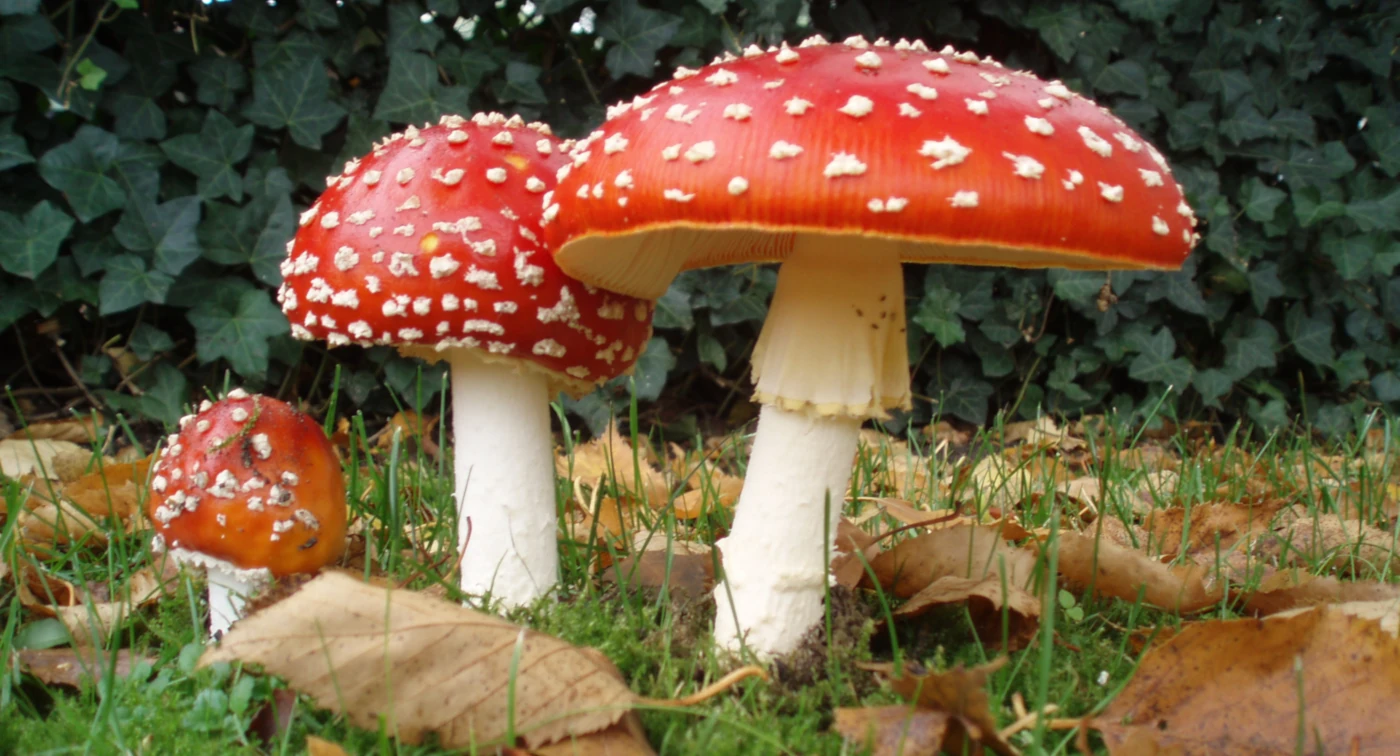
    Amanita muscaria, commonly known as the Fly Agaric, is one of the most recognizable mushrooms in the world. Its bright red cap with white spots appears in fairy tales, games, illustrations and popular culture, but real specimens are much more variable than the classic image suggests. Rain can wash away the white veil remnants, cap color can fade from deep red to orange, and young mushrooms may look almost completely different from mature ones.

    Fly Agaric is a poisonous and psychoactive mushroom. It contains compounds such as ibotenic acid and muscimol, which affect the central nervous system and can cause nausea, confusion, loss of coordination, agitation and altered perception. Although poisoning from Fly Agaric is different from the deadly amatoxin syndrome associated with species such as Amanita phalloides, the mushroom should still be treated as unsafe to eat.

    ⚠️ Important: Mushroom appearance can vary considerably. Never decide whether a wild mushroom is safe to eat from a photograph, AI identification or a single visible feature.

    Quick Identification

    Feature Amanita muscaria
    Scientific name Amanita muscaria
    Common name Fly Agaric
    Family Amanitaceae
    Cap Usually red to orange-red with white veil remnants
    Gills White, crowded and free from the stem
    Stem White with a hanging ring
    Stem base Swollen, with veil remnants
    Spore print White
    Habitat Woodland and areas near host trees
    Ecology Ectomycorrhizal
    Common tree partners Birch, pine, spruce and other trees
    Main season Usually late summer through autumn
    Toxicity Poisonous and psychoactive
    Main toxins Ibotenic acid and muscimol

    What Does Amanita muscaria Look Like?

    The classic Fly Agaric has a red or orange-red cap scattered with white warts. These white patches are remnants of the universal veil that enclosed the young mushroom before it emerged. As the mushroom matures, the cap expands from a rounded shape to convex and eventually almost flat, sometimes becoming slightly depressed in the center.

    Mature caps are often around 10–20 cm across, although size varies depending on growing conditions. Color can range from bright scarlet to orange-red, and in some forms it may become noticeably paler. The cap surface can also look quite different after rain, because the white veil remnants may be partly or completely washed away.

    Can Fly Agaric Lose Its White Spots?

    Yes. The white spots are not permanent structures, so rain, age and physical contact can remove them. A mature Fly Agaric may therefore have a nearly smooth orange or red cap, which makes identification more difficult if the observer relies only on the familiar fairy-tale appearance.

    For this reason, the mushroom should always be examined as a whole. The gills, stem, ring and stem base are just as important as the cap color and surface pattern.

    Gills

    The gills of Amanita muscaria are typically white to pale cream, crowded and free from the stem. “Free” means that the gills stop before reaching the stem rather than attaching directly to it.

    As the mushroom ages, the gills may become slightly cream-colored, but they remain pale. They do not develop the pink-to-brown progression seen in many Agaricus species, which can be an important distinction when comparing white-gilled mushrooms.

    Stem

    The stem is usually white, fairly tall and often 10–25 cm long. One of its most noticeable features is the broad hanging ring around the upper part of the stem, which is a remnant of the partial veil that protected the gills while the mushroom was developing.

    The ring is usually easy to see on fresh mature specimens, but it may become torn, damaged or partly disappear with age. This is another reason why absence of a perfect ring should not be used to rule out the species.

    Stem Base and Volva

    The stem base is one of the most important parts of any Amanita identification. In Amanita muscaria, the base is usually swollen or bulbous and surrounded by white remnants of the universal veil, often forming irregular rings, scales or patches.

    Unlike some other Amanita species, Fly Agaric does not usually have a large loose sack-like volva. Nevertheless, veil remnants around the bulb are a major identification feature, so the entire stem base should be exposed and photographed rather than cut off at soil level.

    Spore Print

    The spore print of Amanita muscaria is white. This can help confirm that the mushroom belongs to a white-spored group, but it is not enough to identify the species on its own because many Amanitas also produce white spores.

    Spore-print color should therefore be treated as supporting evidence together with the cap, gills, stem, veil remnants and habitat.

    Young Amanita muscaria

    Very young Fly Agarics can look surprisingly unlike mature specimens. The developing mushroom begins inside a white universal veil and may appear as a rounded or egg-like structure emerging from the soil.

    As it expands, the veil breaks apart and remains as white warts on the cap and as material around the swollen stem base. Before the red cap becomes visible, a young specimen can resemble a puffball, which is why suspected puffballs should be cut completely in half before any consideration of edibility. A true young puffball should be uniformly white inside, while a young Amanita may reveal the developing cap, gills and stem.

    Where Does Amanita muscaria Grow?

    Fly Agaric is an ectomycorrhizal mushroom, which means it lives in a mutually beneficial association with tree roots. The fungus helps the tree obtain water and minerals, while the tree supplies sugars produced through photosynthesis.

    Because of this relationship, Fly Agaric usually appears in forests, at woodland edges, in parks and along tree-lined paths where suitable host trees are present. Birch, pine and spruce are among its most common partners, although it can associate with other hardwood and conifer species as well.

    Distribution

    Amanita muscaria is widespread across much of the Northern Hemisphere and occurs throughout large parts of Europe, Asia and North America. It has also been introduced to parts of the Southern Hemisphere, including Australia, Tasmania and New Zealand.

    Its appearance can vary between regions, and the broader Amanita muscaria complex includes geographically variable forms. This is one reason why local mushroom guides remain useful even for such a famous and recognizable species.

    When Does Fly Agaric Grow?

    In temperate climates, Fly Agaric is mainly a late-summer and autumn mushroom. Fruiting often begins after periods of rain when soil moisture rises and temperatures start to fall.

    The exact season depends on climate, altitude and location, but in much of Europe the mushroom is commonly seen from August into November. Because the underground mycelium remains in place, fruit bodies can return to the same locations year after year.

    Is Amanita muscaria Poisonous?

    Yes. Amanita muscaria should be regarded as a poisonous mushroom because it contains psychoactive compounds, mainly ibotenic acid and muscimol. These chemicals affect the nervous system and can produce both gastrointestinal and neurological symptoms.

    The concentration of active compounds varies from mushroom to mushroom, which makes the effects difficult to predict. This variability is one of the main reasons why deliberate consumption is unsafe.

    What Happens if Amanita muscaria Is Eaten?

    Symptoms may include nausea, vomiting, abdominal discomfort, dizziness, confusion, drowsiness, agitation, poor coordination and altered perception. In stronger poisonings, a person may become severely disoriented or experience delirium.

    Fly Agaric poisoning is not the same as Death Cap poisoning. It does not usually produce the classic delayed liver-failure syndrome associated with amatoxins, but that distinction does not make it safe. Anyone who has eaten an unidentified wild mushroom and develops neurological or gastrointestinal symptoms should seek medical help promptly.

    Is Fly Agaric Deadly?

    Fatal poisoning from Amanita muscaria appears to be uncommon compared with poisoning caused by deadly amatoxin-containing Amanitas. However, uncommon does not mean harmless, and significant poisoning can still occur.

    Severity depends on the amount consumed, individual sensitivity and toxin concentration in the mushroom. Because none of these factors can be predicted reliably in advance, Fly Agaric should not be treated as a safe wild food.

    Why Is It Called Fly Agaric?

    The common name “Fly Agaric” is linked to an old practice of using pieces of the mushroom as a fly poison. The mushroom was sometimes placed in milk or water to attract insects, which were then affected by its compounds.

    The scientific name also reflects this association. The Latin word musca means “fly,” which is the origin of the species name muscaria.

    Amanita muscaria Look-Alikes

    Although the classic red-and-white form is distinctive, faded, rain-washed or unusually colored specimens can resemble several other mushrooms. The most important comparisons are with other Amanitas and with a few red-capped species from unrelated genera.

    Amanita caesarea — Caesar’s Mushroom

    Amanita caesarea is an edible species found mainly in warmer parts of Europe and the Mediterranean region. Both species can have orange to red-orange caps, especially when Fly Agaric has lost its white warts.

    Caesar’s Mushroom typically has yellow gills, a yellow stem and a yellow ring, while Fly Agaric usually has white gills, a white stem and a white ring. Caesar’s Mushroom also has a more obvious white sack-like volva at the stem base, whereas Fly Agaric usually has a swollen base with rings or patches of veil material.

    Amanita rubescens — Blusher

    The Blusher can have a reddish, brownish-red or orange-brown cap with pale veil remnants. Its most useful characteristic is the tendency of the flesh to develop pinkish or wine-red staining when damaged.

    Fly Agaric does not show the same typical reddening reaction. However, cap color alone is too variable to safely separate the two species.

    Amanita regalis — Royal Fly Agaric

    Amanita regalis looks somewhat like a brown version of Fly Agaric. Its cap is usually brown to dark yellow-brown and covered with pale veil remnants.

    In northern Europe, where the two species can occur in similar habitats, dark or unusual specimens may cause confusion. The entire structure of the mushroom should be examined rather than relying on cap color.

    Amanita pantherina — Panther Cap

    The Panther Cap has a brown cap with white veil remnants, white gills, a white stem and a ring. Structurally, it can resemble Fly Agaric quite closely.

    It is also poisonous and contains related psychoactive compounds. The main visual difference is usually the brown cap rather than the red or orange coloration typical of Fly Agaric.

    Red Russula Species

    Several Russula species have red caps and white gills, and a rain-washed Fly Agaric may superficially resemble them. Russulas, however, lack a ring, volva and universal-veil remnants.

    Their flesh is also characteristically brittle and snaps rather than tearing into fibrous strands. This texture difference can be useful when comparing mature specimens.

    Fly Agaric vs Caesar’s Mushroom

    Feature Amanita muscaria Amanita caesarea
    Common name Fly Agaric Caesar’s Mushroom
    Cap Red or orange, often with white warts Orange-red, usually smooth
    Gills White Yellow
    Stem White Yellow
    Ring White Yellow
    Stem base Bulbous with veil remnants Large sack-like white volva
    Toxicity Poisonous Edible when correctly identified

    This comparison is useful, but no wild Amanita should be identified for food using a table alone. The genus contains several dangerously poisonous species, so complete identification is essential.

    Fly Agaric vs Panther Cap

    Feature Amanita muscaria Amanita pantherina
    Cap color Usually red to orange-red Usually brown
    Veil remnants White warts White warts
    Gills White White
    Stem White White
    Spore print White White
    Toxicity Poisonous Poisonous

    These two species show clearly why white spots are not unique to Fly Agaric. Structural details and cap color together are more useful than any single feature.

    How to Photograph Amanita muscaria for Identification

    A useful identification photo should show the cap from above, the gills beneath it, the entire stem, the ring and the complete stem base. It is also helpful to photograph several specimens at different ages because young and mature mushrooms can look very different.

    The surrounding habitat matters as well. Including nearby trees and showing whether the mushroom is growing directly from soil can provide useful ecological information.

    Can Amanita muscaria Be Identified From a Photo?

    A typical mature specimen can often be recognized visually with relatively high confidence because the combination of a red cap, white veil remnants, white gills, a ring and a swollen stem base is distinctive. Problems arise when rain removes the cap warts, the mushroom is unusually pale, or the base of the stem is hidden.

    Photo-identification tools can therefore be useful for suggesting Amanita muscaria, but they should not be treated as final proof. Any decision involving consumption requires independent confirmation from an experienced local mushroom expert.

    Interesting Facts About Amanita muscaria

    Fly Agaric is the type species of the genus Amanita, which makes it important from a taxonomic perspective as well as a cultural one. Its red cap and white spots have become one of the most widely recognized symbols of mushrooms in the world.

    The species also has a long history of folklore and traditional use in parts of northern Eurasia. Its distinctive appearance has made it far more famous than most other poisonous mushrooms, even though some less colorful Amanitas are considerably more dangerous.

    Frequently Asked Questions

    Is Amanita muscaria poisonous?

    Yes. Fly Agaric contains psychoactive compounds including ibotenic acid and muscimol, and it should be treated as a poisonous mushroom.

    Is Amanita muscaria deadly?

    Fatal poisoning is uncommon compared with Death Cap poisoning, but serious illness can still occur. The mushroom should not be considered safe to eat.

    Where does Fly Agaric grow?

    It usually grows on soil near host trees, especially birch, pine and spruce. It is mycorrhizal rather than a wood-decaying species.

    Can Fly Agaric lose its white spots?

    Yes. Rain, age and physical contact can remove the white veil remnants and leave the cap almost smooth.

    What color are Fly Agaric gills?

    The gills are usually white to pale cream and remain pale as the mushroom matures.

    What color is the Fly Agaric spore print?

    The spore print is white.

    When does Fly Agaric appear?

    In temperate regions it is mainly a late-summer and autumn mushroom, often appearing from August into November.

    What mushrooms look like Amanita muscaria?

    Possible look-alikes include Amanita caesarea, Amanita rubescens, Amanita regalis, Amanita pantherina and several red-capped Russula species.

    Final Identification Notes

    The typical Fly Agaric combines a red or orange-red cap, white veil remnants, white free gills, a white stem with a ring, a swollen stem base with veil remnants and a white spore print. It also usually grows on soil near suitable host trees rather than on dead wood.

    No single feature is enough for a safe identification because the cap can fade, the white warts can disappear and young mushrooms can look very different from mature ones. The most reliable approach is to examine the whole fruit body together with its habitat and to treat any uncertain Amanita with particular caution.

    Found a red or orange mushroom? Photo identification can help narrow down the possibilities, but any decision involving consumption should be independently confirmed by an experienced local mushroom expert.
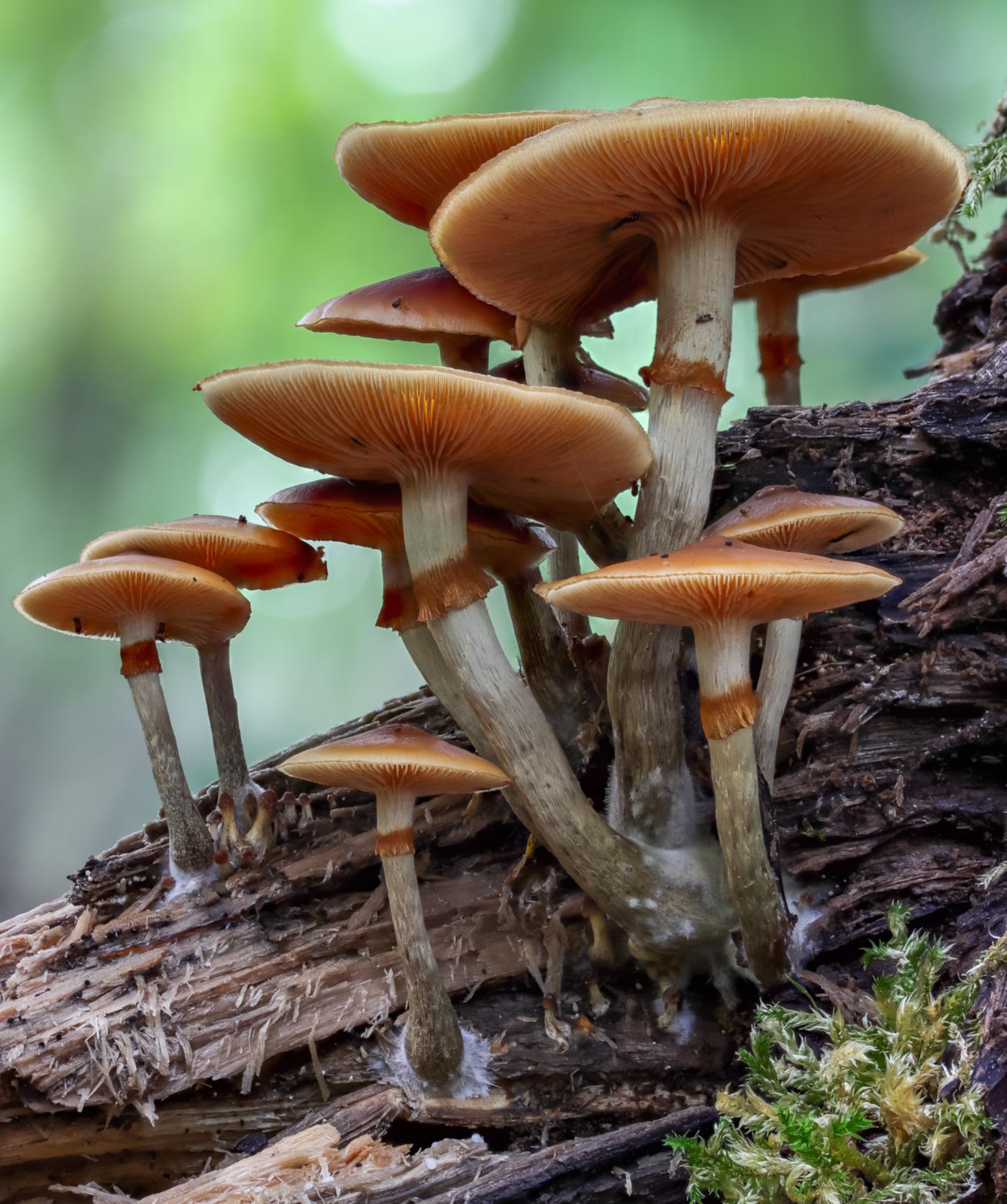
  • Galerina marginata: Deadly Galerina Identification, Habitat and Look-Alikes

    Galerina marginata: Deadly Galerina Identification, Habitat and Look-Alikes

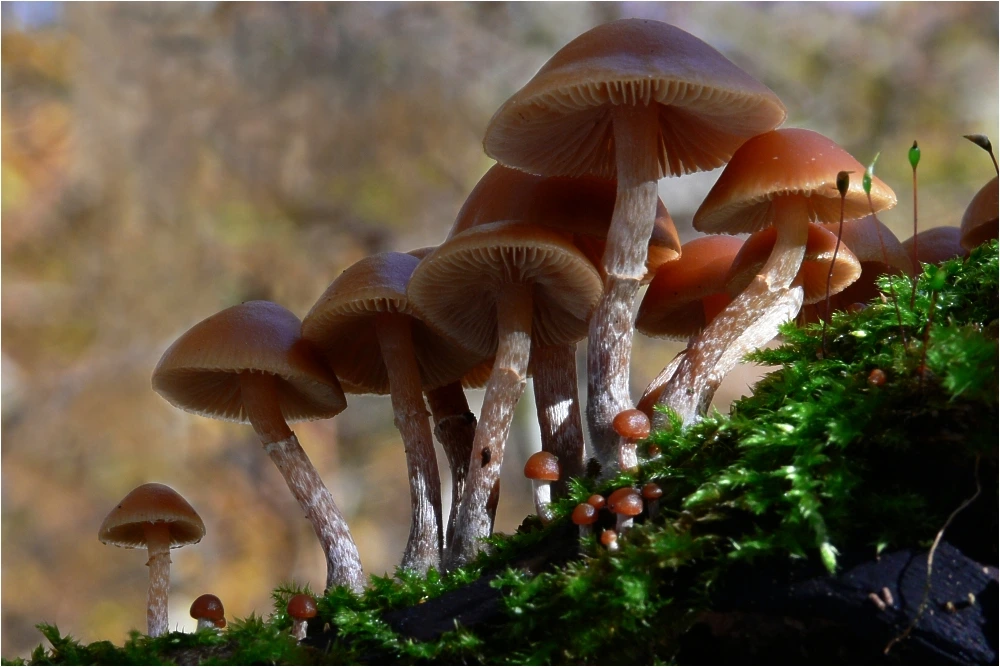
    Galerina marginata, commonly known as the Deadly Galerina, Funeral Bell, or Deadly Skullcap, is a small brown mushroom that deserves special attention because it contains amatoxins — the same group of toxins responsible for many severe and fatal Amanita poisonings. The North American Mycological Association lists Galerina marginata among amatoxin-containing mushrooms and classifies this poisoning syndrome as extremely serious.

    The danger is increased by its ordinary appearance. Galerina marginata is a relatively small brown mushroom growing on dead wood, exactly the sort of habitat where several edible species may also occur.

    For this reason, any small brown mushroom growing on wood should be identified very carefully before it is even considered for consumption.

    Important: Never use this guide, a photograph, or an AI identification alone to decide whether a wild mushroom is safe to eat.

    Quick Identification

    Feature Galerina marginata
    Common names Deadly Galerina, Funeral Bell
    Scientific name Galerina marginata
    Toxicity Deadly poisonous
    Cap Yellow-brown to reddish-brown, often darker when wet
    Cap size Usually about 1–7 cm
    Gills Pale at first, becoming rusty or brownish
    Stem Slender, fibrous, often with a fragile ring or ring zone
    Spore print Rusty to brown
    Habitat Dead and decaying wood
    Typical substrate Logs, stumps, fallen branches
    Season Mainly summer through autumn, varying by region
    Main danger Can be confused with edible wood-growing mushrooms

    What Does Galerina marginata Look Like?

    The Deadly Galerina belongs to the difficult group often informally called LBMs — “little brown mushrooms.” Many unrelated species share the same basic appearance, which means color and cap shape alone are not reliable identification features.

    Cap

    The cap generally begins rounded or bell-shaped and becomes broadly convex or nearly flat with age.

    Typical colors include:

    • honey brown;
    • yellow-brown;
    • cinnamon brown;
    • reddish brown.

    The cap is hygrophanous, meaning its appearance changes as it loses moisture. Wet mushrooms are commonly darker, while drying caps become paler, especially toward the edges.

    Mature caps are generally small, often around 1–7 cm across.

    This color variation is one reason the species can resemble several harmless or edible brown mushrooms.

    Gills

    The gills are attached to the stem and are relatively close together.

    They may initially appear pale cream, yellowish, or light brown and become increasingly rusty brown as the spores mature.

    Rust-colored mature gills are useful evidence but should never be used as the only identification feature.

    Stem

    The stem is usually slender and fragile compared with many robust edible wood-growing mushrooms.

    It may be:

    • pale near the top;
    • darker brown toward the base;
    • covered with fine longitudinal fibers.

    A pale ring can sometimes be visible around the upper portion of the stem. However, this ring may be weak, damaged, or disappear as the mushroom ages.

    That is particularly important because beginners sometimes assume that the absence of an obvious ring rules out Galerina. It does not.

    Spore Print

    The spore print is brown to rusty brown.

    Spore-print color can be particularly helpful when separating Galerina marginata from superficially similar mushrooms producing white spores.

    However, it is one feature among many and should not be treated as a standalone safety test.

    Where Does Galerina marginata Grow?

    Galerina marginata is a saprobic fungus, meaning it obtains nutrients by decomposing dead organic material.

    It primarily grows on:

    • dead logs;
    • fallen branches;
    • decaying tree trunks;
    • old stumps;
    • buried woody material.

    It is frequently associated with conifer wood but can also occur on hardwoods.

    Individual mushrooms may appear alone, scattered, or in groups.

    The fact that it grows directly from wood is one of the most important things to record when photographing an unknown brown mushroom.

    A log may sometimes be almost completely buried beneath moss or soil, making the mushrooms appear to be growing from the ground. Always inspect the substrate carefully.

    Distribution

    Galerina marginata has a broad distribution. It has been recorded across:

    • Europe;
    • North America;
    • parts of Asia.

    In Europe it occurs across many central and northern regions and is also recorded in Britain and Ireland.

    Because closely related Galerina species also occur across wide geographic areas, identification should always take local fungal diversity into account.

    When Does Galerina marginata Grow?

    Fruit bodies are most frequently reported during summer and autumn, although exact timing depends strongly on geography, rainfall, temperature, and local climate. In milder climates, fruiting can continue later into the year whenever conditions remain cool and moist. Dead wood retains moisture well, so mushrooms can appear after sustained rainfall even when surrounding ground begins to dry.

    Is Galerina marginata Poisonous?

    ☠️ Yes. Galerina marginata is potentially deadly.

    It contains amatoxins, including compounds in the same toxin group associated with Death Cap and Destroying Angel poisoning. NAMA specifically includes Galerina marginata among mushrooms responsible for amatoxin syndrome.

    Documented poisoning reports have included severe human illness and fatalities attributed to Galerina. A NAMA toxicology report for 2011 recorded three poisoning cases involving Galerina, including one death.

    Why Amatoxin Poisoning Is Particularly Dangerous

    One of the most dangerous characteristics is the delay before symptoms appear.

    According to NAMA, symptoms of amatoxin poisoning may not begin until approximately 6–24 hours after ingestion. By that stage, significant toxin absorption has already occurred.

    Early symptoms can include:

    • severe vomiting;
    • diarrhea;
    • abdominal pain;
    • dehydration.

    A patient may then appear to improve temporarily even while liver damage continues.

    Severe poisoning can progress to:

    • liver failure;
    • kidney injury;
    • multi-organ failure;
    • death.

    Suspected ingestion of Galerina marginata is therefore a medical emergency.

    What Should You Do After Suspected Galerina Ingestion?

    Do not wait for symptoms. Contact your local poison center or emergency medical service immediately and tell them that an amatoxin-containing mushroom may have been consumed.

    Whenever possible, preserve:

    • uncooked mushrooms;
    • remaining cooked mushrooms;
    • photographs from the collecting site;
    • scraps and stem bases;
    • information about when the mushrooms were eaten.

    These materials can help professional mushroom identifiers and medical teams determine the likely species.

    Galerina marginata Look-Alikes

    The greatest practical danger is that Galerina marginata can resemble several other small brown mushrooms growing on wood.

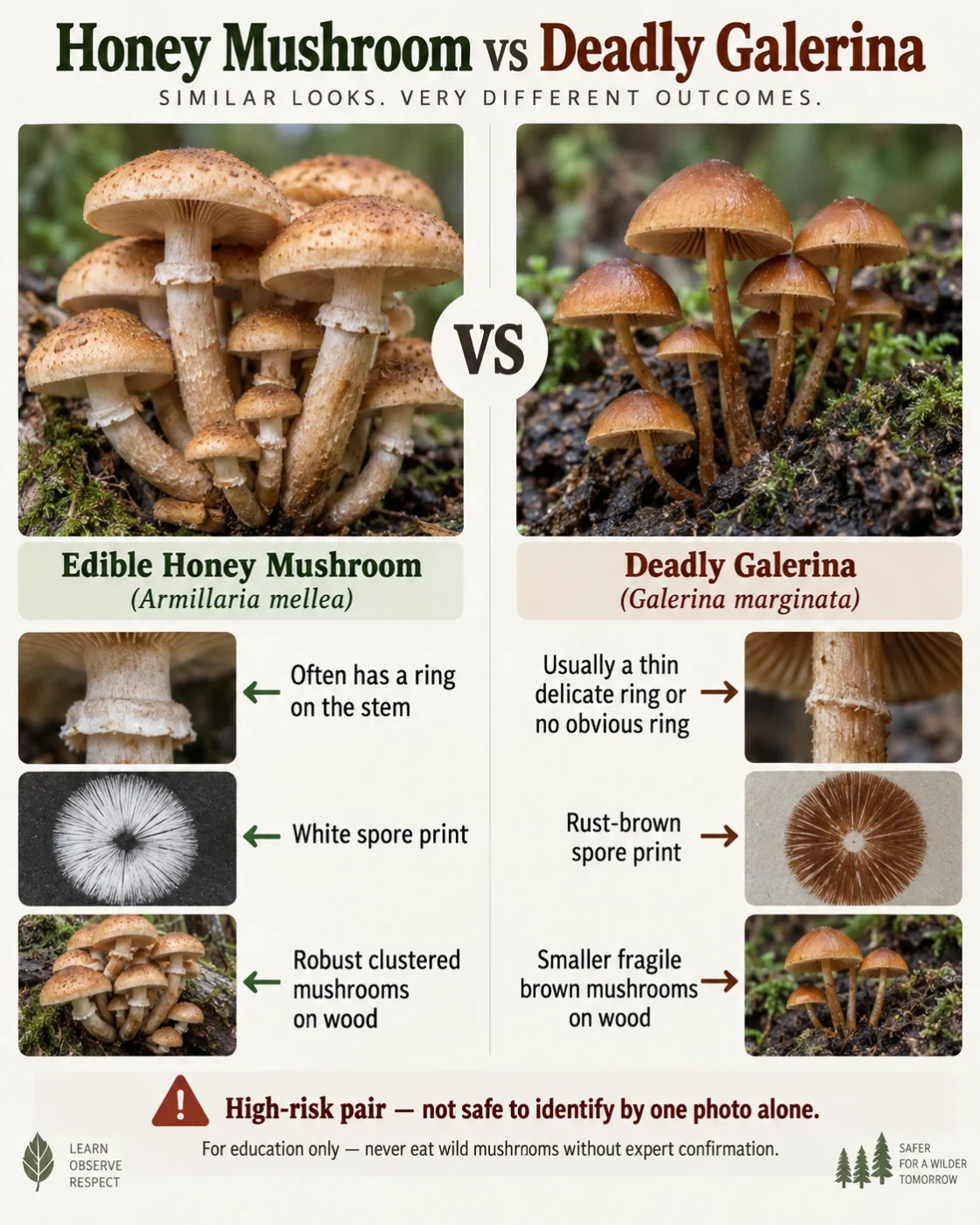
    1. Honey Mushrooms — Armillaria species

    Honey mushrooms are collected as food in many regions, but brown specimens growing around dead or dying trees can superficially resemble Galerina.

    Honey mushrooms are generally more robust and frequently grow in substantial clusters. Many have pale spores rather than the rusty-brown spore print characteristic of Galerina marginata.

    However, growth in clusters and the presence of a stem ring are not enough to make an identification.

    A single log or stump can also support more than one mushroom species, so mushrooms collected from the same location should not automatically be assumed to be identical.

    2. Kuehneromyces mutabilis

    Kuehneromyces mutabilis is an edible wood-growing mushroom and one of the more concerning look-alikes.

    It forms clusters on dead wood and may have similarly colored brown caps and a ring on the stem.

    First Nature specifically lists Kuehneromyces mutabilis as a similar edible species and notes the close resemblance between it and the poisonous Funeral Bell.

    Because of this similarity, beginners should not collect Kuehneromyces for food without expert confirmation.

    3. Flammulina velutipes — Velvet Shank

    Wild enoki or velvet shank can also occur on dead wood.

    A useful feature of mature Flammulina velutipes is the dark, velvety lower stem. It also produces a white spore print, in contrast with the rusty-brown spores of Galerina.

    Nevertheless, old, wet, or damaged specimens may lose their textbook appearance.

    4. Hypholoma Species

    Several Hypholoma species grow in dense clusters on stumps and dead wood.

    They often differ in gill color, cap coloration, and spore-print characteristics, but inexperienced collectors can easily group all small brown or yellow-brown wood-growing mushrooms together.

    Some Hypholoma species are themselves toxic.

    5. Gymnopilus Species

    Species of Gymnopilus may also grow on wood and produce rusty-colored spores.

    They can sometimes share yellow-orange or brown coloration with Galerina, and small specimens may be difficult to separate without considering multiple features.

    This highlights why spore color alone does not provide a definitive identification.

    Galerina marginata vs Honey Mushroom

    Because this is one of the more important comparisons, it is worth examining separately.

    Feature Galerina marginata Honey Mushroom
    Toxicity Deadly poisonous Some species traditionally eaten after proper identification/preparation
    Size Usually small Often larger and more robust
    Spore print Rusty brown Usually white
    Growth Single, scattered or grouped Often dense clusters
    Stem Slender, fibrous Usually more substantial
    Ring Can be fragile or disappear Often more obvious in ringed species
    Habitat Dead wood Wood, roots, stumps and infected trees

    The spore-print difference is useful, but never rely on this table alone before eating a mushroom.

    Galerina marginata vs Kuehneromyces mutabilis

    This is a particularly risky pair because both species can grow in groups on wood and share similar brown coloration.

    Kuehneromyces mutabilis often has a distinctly two-toned hygrophanous cap, with color changing as the surface dries, and a more conspicuously scaly lower stem below the ring.

    But these characteristics vary depending on weather and mushroom age.

    If there is any uncertainty between Kuehneromyces and Galerina, the mushrooms should not be eaten.

    Can Galerina marginata Grow With Edible Mushrooms?

    Yes. This is one of the most useful safety lessons involving wood-growing fungi. Different mushroom species can fruit on the same stump, log, or patch of woody debris.

    Finding several correctly identified edible mushrooms does not mean every mushroom in the cluster or nearby is the same species. Each specimen should be checked individually.

    This is particularly important when gathering small brown mushrooms.

    How to Photograph Galerina for Identification

    When photographing an unknown Galerina-like mushroom, take several images rather than only photographing the cap.

    Include:

    1. the cap from above;
    2. the underside and gills;
    3. the entire stem;
    4. any ring or ring zone;
    5. the stem base;
    6. several mushrooms at different ages;
    7. the wood or substrate they are growing from;
    8. the surrounding habitat.

    If practical, a spore print can provide additional identification information.

    Avoid changing colors with strong filters or artificial image enhancement.

    Can Galerina marginata Be Identified From a Photo?

    Sometimes a photograph can strongly suggest Galerina, but a photo should not be used to confirm edibility or rule out an amatoxin-containing mushroom. Small brown mushrooms are one of the more difficult groups to identify visually because many unrelated species share similar:

    • cap colors;
    • sizes;
    • gill arrangements;
    • rings;
    • habitats.

    Professional identification may require microscopic examination of spores and other structures.

    Photo-identification tools are best used to generate possible species for further investigation rather than as permission to eat a mushroom.

    Interesting Facts About Galerina marginata

    The ominous common name Funeral Bell reflects the mushroom’s serious toxicity.

    Several names once treated as separate species — including Galerina autumnalis — have historically been associated with the broader Galerina marginata complex. NAMA lists G. autumnalis and G. venenata as synonyms associated with Galerina marginata in its amatoxin guidance.

    Unlike dramatic poisonous mushrooms such as Amanita muscaria, the Deadly Galerina has no spectacular warning coloration. Its appearance is ordinary, which makes it a particularly useful example of why the visual idea that “dangerous mushrooms look dangerous” is false.

    Frequently Asked Questions

    Is Galerina marginata deadly?

    Yes. It contains amatoxins and has been associated with fatal mushroom poisoning.

    Where does Galerina marginata grow?

    It grows primarily on decaying wood such as stumps, fallen trunks, logs and branches, particularly conifer wood but also hardwood.

    What color is Galerina marginata?

    It is generally yellow-brown, honey-brown, cinnamon, or reddish-brown. Wet caps tend to be darker and become paler as they dry.

    What color is its spore print?

    The spore print is brown to rusty brown.

    Can Galerina marginata grow in clusters?

    Yes. It can occur singly, scattered, or in groups on dead wood.

    Does Galerina marginata always have a ring?

    No. A fragile ring may be present, but it can become inconspicuous or disappear as the mushroom matures.

    What edible mushroom looks like Galerina marginata?

    Several wood-growing mushrooms may resemble it, particularly Kuehneromyces mutabilis. This similarity is one reason small brown mushrooms growing on wood require especially careful identification.

    Final Identification Notes

    Galerina marginata is one of the most important poisonous mushrooms for foragers to recognize, not because it looks unusual, but because it looks so ordinary.

    Remember the general combination: small brown mushroom + rusty-brown spores + decaying wood + possible fragile ring.

    But never treat this combination as a complete identification key.

    Numerous small brown mushrooms share overlapping characteristics, and the consequences of a mistake with Galerina marginata can be extremely serious.

    If a wood-growing mushroom could potentially belong to Galerina, do not eat it unless its identity has been independently confirmed by an experienced mushroom expert.

    Found an unknown mushroom? A photo-identification tool can help narrow down possible species, but always verify the result independently before making any decision about edibility.

  • Deadly Dapperling (Lepiota brunneoincarnata): Identification, Habitat, Season, and Look-Alikes

    Deadly Dapperling (Lepiota brunneoincarnata): Identification, Habitat, Season, and Look-Alikes

    The deadly dapperling (Lepiota brunneoincarnata) is a small but extremely poisonous mushroom in the family Agaricaceae. Despite its attractive brown-scaled cap and harmless appearance, it contains amatoxins — the same group of toxins responsible for many fatal poisonings caused by the death cap (Amanita phalloides).

    The species is known in English as the deadly dapperling. It occurs in Europe and parts of Asia and is particularly dangerous because it may grow in parks, gardens, lawns, and other places close to human habitation. Cooking, boiling, drying, or freezing does not make this mushroom safe to eat.

    1. Characteristic Features

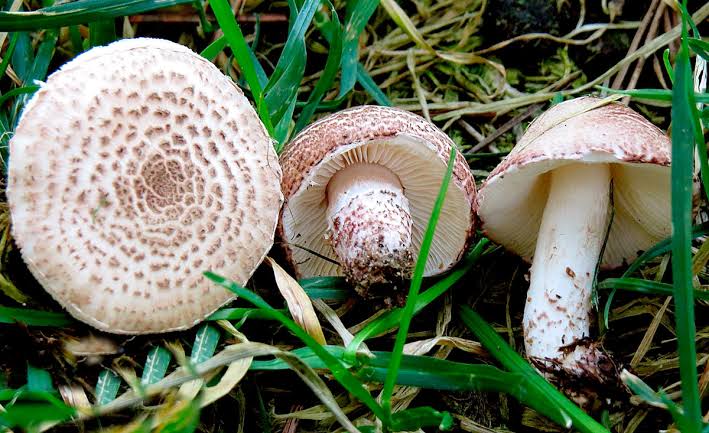
    The cap is relatively small, generally around 2–6 cm across. In young specimens it is hemispherical or bell-shaped, later becoming convex and eventually almost flat. A low central bump may remain in mature mushrooms.

    The background of the cap is usually whitish, cream, or pale pinkish-brown. Its most noticeable feature is the covering of reddish-brown, chestnut, or dark brown scales. These scales tend to be especially dense near the center, where they can form an almost continuous dark patch. Toward the edge of the cap they become more widely separated.

    The gills are free from the stem, crowded, and initially white. They generally remain whitish or cream as the mushroom matures. The spore print is white.

    The stem is slender and usually measures approximately 3–6 cm in height. Above the ring zone it is relatively pale and smooth. Below it, the surface often develops brownish scales or bands and may have pinkish, reddish-brown, or wine-colored tones.

    A small ring may be present on the stem, but it is fragile and can disappear as the mushroom ages. Consequently, the absence of an obvious ring does not rule out Lepiota brunneoincarnata.

    The flesh is whitish and relatively thin. Damaged areas, particularly toward the lower stem, may develop pinkish or reddish-brown tones. The odor is sometimes described as fruity or slightly unpleasant, but smell alone is not a reliable identification feature. The mushroom should never be tasted.

    Feature Lepiota brunneoincarnata
    Cap Small, usually 2–6 cm; cream to pinkish-brown with reddish-brown scales
    Cap center Usually darker, with densely packed brown scales
    Gills Crowded, white to cream, free from the stem
    Stem Slender, pale above; brownish or wine-colored below
    Ring Small and fragile; may disappear with age
    Spore print White
    Flesh Whitish; may become pinkish or reddish-brown when damaged
    Habitat Parks, gardens, lawns, paths, woodland edges, deciduous woodland
    Season Mainly summer to autumn
    Key warning Small parasol-like mushroom; deadly poisonous and contains amatoxins

    2. What Species Are There?

    The genus Lepiota contains hundreds of species worldwide. Many are small mushrooms with pale caps covered in darker scales. Identification can be difficult, and separating closely related species may require microscopic examination.

    Some notable European species include:

    • Lepiota brunneoincarnata — deadly dapperling, a highly poisonous amatoxin-containing species.
    • Lepiota subincarnata — another dangerously poisonous species containing amatoxins.
    • Lepiota castanea — chestnut dapperling, a small brown-scaled species that should not be eaten.
    • Lepiota cristata — stinking dapperling, a widespread small species with brownish scales.
    • Lepiota clypeolaria — shield dapperling, usually somewhat larger and characterized by a shaggy stem.
    • Numerous other small Lepiota species that can be difficult to identify reliably in the field.

    For mushroom pickers, the most important point is that small Lepiota species should not be treated as miniature versions of edible parasol mushrooms. Some members of the genus are dangerously poisonous.

    3. When Does It Grow?

    The deadly dapperling must never be collected for food. However, knowing its fruiting season is useful because it can appear in the same places and at the same time as edible mushrooms.

    In Europe, Lepiota brunneoincarnata mainly fruits from summer through autumn. Depending on local climate, mushrooms can begin appearing around June or July, with most records occurring from late summer into autumn. In warmer regions, fruiting may continue into October or November.

    Warm, moist conditions favor the production of fruiting bodies. The mushrooms can appear relatively quickly after periods of rain.

    Because the species often occurs outside forests, people may encounter it unexpectedly while walking through a park, garden, or grassy area.

    4. Where Does It Grow?

    Unlike many familiar wild mushrooms, Lepiota brunneoincarnata is not restricted to woodland. It is a saprotrophic species that obtains nutrients by decomposing organic material in soil and plant litter.

    Typical habitats include:

    • parks and gardens;
    • lawns and grassy areas;
    • woodland edges;
    • deciduous woodland;
    • roadsides and paths;
    • disturbed or nutrient-rich soils.

    It can grow singly, scattered across an area, or in small groups.

    The species is primarily known from Europe and temperate parts of Asia, although its documented distribution has expanded as mycologists and poison-control specialists have become more familiar with it.

    Its ability to grow close to houses is one reason it deserves particular attention. A deadly poisonous mushroom does not necessarily have to come from a remote forest.

    5. What Can It Be Confused With?

    One of the greatest risks is confusing the deadly dapperling with small edible parasol-like mushrooms. Its pale cap with brown scales, white gills, slender stem, and ring can give it the general appearance of a miniature parasol.

    The true parasol mushroom (Macrolepiota procera) is normally much larger, with a broad cap that can exceed 20 cm and a long stem carrying a substantial movable ring. Nevertheless, size alone should never be used to decide whether a mushroom is edible.

    Young mushrooms may also be mistaken for some species of Agaricus. A useful distinction is the color of the gills. Agaricus species generally develop pink and eventually chocolate-brown gills, whereas Lepiota brunneoincarnata retains pale gills.

    The mushroom can also be confused with other small Lepiota species. This is particularly problematic because several members of the genus are themselves poisonous, and field identification may be extremely difficult.

    A small mushroom with white gills, a scaly cap, and a ring or ring zone should therefore never be assumed edible simply because it resembles a parasol.

    6. Interesting Facts and References in Literature

    Lepiota brunneoincarnata was scientifically described in 1889 by the Swiss botanists Robert Hippolyte Chodat and Charles-Édouard Martin. The specific name combines words referring to its brown and flesh-colored or pinkish appearance.

    The English common name “deadly dapperling” is unusually accurate. “Dapperling” is applied to various small Lepiota species, while “deadly” reflects the presence of amatoxins.

    These toxins include compounds such as alpha-amanitin. They interfere with RNA polymerase II, an enzyme essential for normal cellular function. The liver is particularly vulnerable, and severe poisoning can result in acute liver failure.

    One of the most dangerous aspects of amatoxin poisoning is the delay before symptoms appear. A person may initially feel well for several hours after eating the mushrooms. Severe vomiting, diarrhea, and abdominal pain can then develop. This may be followed by an apparent improvement even while liver damage continues. Without appropriate medical treatment, the condition can become life-threatening.

    Medical literature contains documented cases of severe and fatal poisoning caused by Lepiota brunneoincarnata. Such reports have helped establish small Lepiota species as an important group in clinical mushroom toxicology.

    The deadly dapperling is also a good example of why traditional rules for recognizing poisonous mushrooms do not work. It does not necessarily have a frightening appearance, unpleasant color, or obvious warning sign. It is simply a small, attractive brown-and-white mushroom that can contain extremely powerful toxins.

    Another unusual feature is its preference for human-modified habitats. While many famous poisonous mushrooms are associated with forests and particular trees, L. brunneoincarnata may appear in landscaped parks, gardens, lawns, and along paths.

    Conclusion

    The deadly dapperling (Lepiota brunneoincarnata) is a small, dangerously poisonous mushroom characterized by a pale cap covered with reddish-brown scales, white free gills, a slender stem, and a fragile ring or ring zone. It commonly appears from summer through autumn and can grow in gardens, parks, grassy areas, woodland edges, and deciduous forests.

    Its greatest danger is its resemblance to small parasol-like mushrooms and other seemingly harmless species. Because Lepiota brunneoincarnata contains amatoxins capable of causing severe or fatal liver damage, it must never be eaten. Unknown small Lepiota-like mushrooms are best left untouched, and suspected ingestion requires urgent medical attention even if no symptoms have appeared yet.

  • Porcini Mushrooms: Identification, Species, Season, Habitat, and Look-Alikes

    Porcini Mushrooms: Identification, Species, Season, Habitat, and Look-Alikes

    Porcini are among the most prized wild edible mushrooms in Europe. The name usually refers to Boletus edulis and several closely related species in the porcini group. They are valued for their firm texture, rich nutty aroma, and ability to develop an especially intense flavor when dried.

    In English, Boletus edulis is commonly called porcini, penny bun, cep, or king bolete. The Italian word porcini literally means “little pigs” and is widely used internationally, particularly in cooking.

    1. Characteristic Features

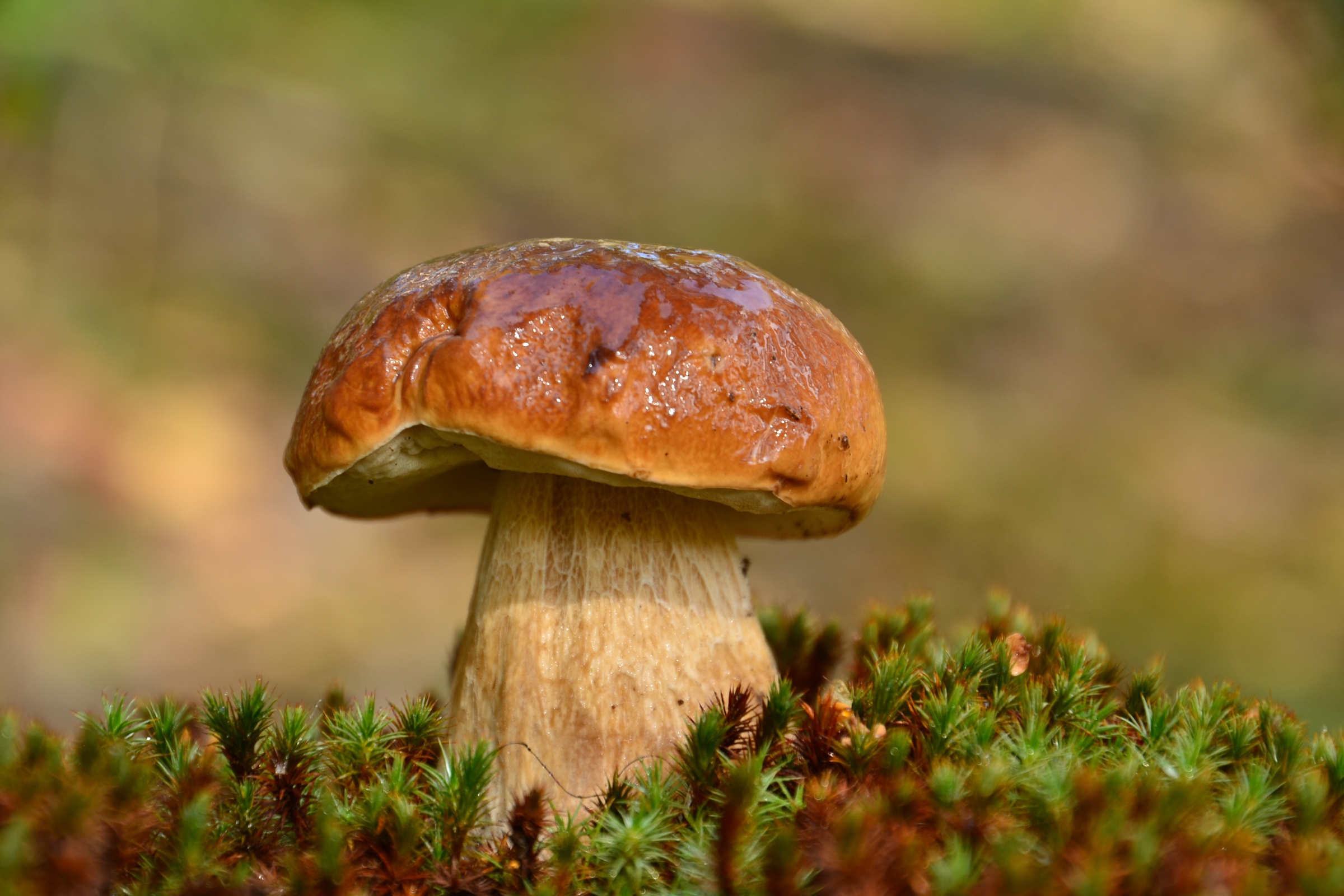
    A typical porcini is a robust mushroom with a thick stem and a large brown cap. The cap of Boletus edulis usually measures about 7–25 cm across, although exceptionally large specimens can be considerably bigger. Young mushrooms have rounded, almost hemispherical caps that gradually become broadly convex as they mature.

    Cap color varies from pale tan and hazelnut brown to dark chestnut brown. A paler margin is often visible, particularly in B. edulis. The surface may become slightly sticky in wet weather.

    One of the most important features is the underside of the cap. Porcini do not have gills. Instead, they have a sponge-like layer consisting of thousands of tiny tubes. The pores are white in young specimens, gradually becoming cream, yellowish, and finally olive-yellow or greenish as the mushroom ages.

    The stem is thick, solid, and frequently swollen or barrel-shaped when young. Its color ranges from whitish to pale brown. A fine raised network known as reticulation is usually visible, especially toward the upper part of the stem.

    The flesh is white, dense, and firm in young mushrooms. Unlike many other boletes, the flesh of true porcini normally does not turn blue when cut or bruised.

    Their smell is mild but pleasantly mushroom-like, becoming considerably stronger after drying. The flavor is mild and nutty.

    2. What Species of Porcini Are There?

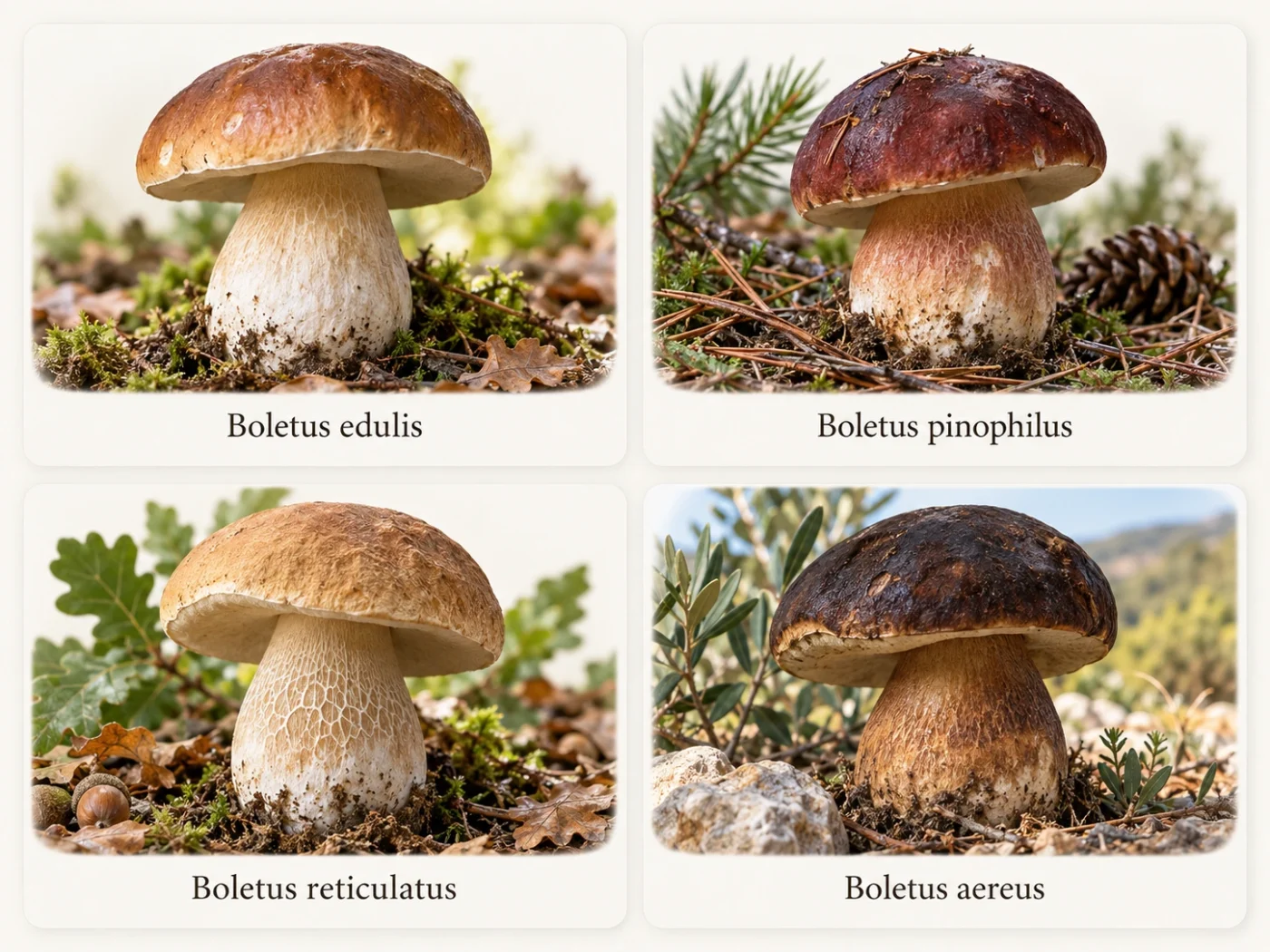
    The word “porcini” is used for several closely related edible species rather than for only one mushroom. Four of the most important European species are:

    • Boletus edulis — the classic porcini, cep, penny bun, or king bolete; widespread in both coniferous and deciduous forests.
    • Boletus pinophilus — pine bolete; usually has a darker reddish-brown or wine-brown cap and is strongly associated with pine and other conifers.
    • Boletus reticulatus — summer cep; often appears earlier in the season and is particularly associated with oak and beech.
    • Boletus aereus — bronze bolete; a warm-climate species with a very dark brown or almost blackish cap, especially characteristic of southern Europe.

    Although these mushrooms were historically treated as forms or varieties of Boletus edulis, modern taxonomic and genetic research recognizes them as distinct species.

    There are additional related porcini-like species outside Europe, particularly in North America and Asia, so the exact species encountered depends strongly on geographic location.

    3. When to Pick Porcini

    Porcini season varies considerably according to climate, altitude, rainfall, and species.

    In much of Europe, porcini can begin appearing in early summer. Boletus reticulatus is particularly notable for early fruiting and may appear from late spring or June in warmer regions.

    The main porcini season generally extends from July through October, with August and September often providing particularly productive conditions. In southern Europe and during mild autumns, fruiting can continue into November.

    Porcini frequently appear in distinct flushes. Warm weather followed by substantial rainfall can trigger large numbers of fruiting bodies within a relatively short period.

    Young, firm mushrooms are generally preferred for cooking. Older specimens often have a soft greenish pore layer and are more likely to contain insect larvae.

    When harvesting porcini, avoid collecting very young specimens unless their identity is completely clear. Important identification features may not yet be fully developed.

    4. Where to Find Porcini

    Porcini are mycorrhizal fungi. Their underground mycelium forms a mutually beneficial relationship with the roots of living trees. The fungus helps the tree obtain water and minerals, while receiving carbohydrates produced by the tree through photosynthesis.

    Good places to search include:

    • mature spruce, pine and fir forests;
    • oak, beech, birch and chestnut woodland;
    • mixed forests containing both deciduous trees and conifers;
    • mossy forest floors and grassy woodland edges;
    • established woodland with relatively undisturbed soil.

    Different porcini species have different preferences. Boletus pinophilus is particularly associated with pine, while B. reticulatus and B. aereus are strongly associated with deciduous trees such as oak and beech. B. edulis has a broader range of mycorrhizal partners.

    Porcini occur across much of Europe and parts of Asia and have also been introduced to some regions outside their original range together with European trees.

    Finding one porcini is a good reason to search the surrounding area carefully. Several fruiting bodies can emerge from the same general area of mycelium, sometimes appearing over a period of several days.

    5. What Can Porcini Be Confused With?

    Several boletes resemble porcini. Fortunately, many European look-alikes are not dangerously poisonous, but some are extremely bitter or can cause gastrointestinal illness.

    One of the classic look-alikes is the bitter bolete, Tylopilus felleus. Young specimens can closely resemble porcini. As they mature, however, their pores usually become pinkish rather than yellow or olive. The stem often carries a prominent dark brown net-like pattern. Even a small amount can make an entire dish intensely bitter.

    Some species of Leccinum can also resemble porcini from above. Their stems, however, are generally covered with characteristic dark or pale scab-like scales rather than the fine raised network typical of porcini.

    Other boletes may have reddish pores or flesh that rapidly turns blue when damaged. These characteristics are not typical of the main European porcini species and should prompt a more careful identification.

    The rule that “a bolete that does not turn blue is edible” is unsafe. Mushroom identification should always be based on a combination of features rather than a single characteristic.

    6. Interesting Facts and References in Literature

    Boletus edulis was scientifically described by the French botanist Pierre Bulliard in 1782. The name edulis comes from Latin and means “edible”, reflecting the mushroom’s long-established reputation as a food species.

    Its many common names reveal its cultural importance. Italians call these mushrooms porcini, while in France they are generally known as cèpes. The German Steinpilz translates approximately as “stone mushroom”, referring to the remarkably firm flesh of young specimens. In Britain, Boletus edulis is traditionally known as the penny bun because its rounded brown cap was thought to resemble a bread roll.

    Porcini have a long history in European cuisine. They are especially important in Italian, French, Central European, Balkan, and Eastern European cooking. Fresh mushrooms are fried, grilled, added to soups and sauces, or combined with pasta and risotto.

    Drying is one of the most interesting characteristics of porcini from a culinary perspective. Unlike many foods that simply lose aroma when dried, porcini develop an exceptionally concentrated and distinctive fragrance. Dried porcini have therefore been traded as a valuable ingredient far beyond regions where the mushrooms naturally grow.

    The underground organism can survive for many years even though individual mushrooms last only a short time. The porcini that a mushroom picker sees is merely the temporary fruiting body of a much larger fungal organism living in the soil and around tree roots.

    Porcini also illustrate why forests are biological partnerships rather than simply collections of trees. A porcini cannot normally be cultivated like the common button mushroom because it depends on a functioning mycorrhizal relationship with a living host tree. This is one reason why commercial porcini are still overwhelmingly collected from the wild.

    The mushroom has appeared repeatedly in European natural-history books, mushroom guides, cookbooks, and regional traditions. Its combination of large size, distinctive appearance, culinary value, and association with mature forests has made Boletus edulis one of the best-known wild mushrooms in the world.

    Conclusion

    Porcini are a group of highly valued edible boletes, with Boletus edulis being the best-known representative. Their characteristic combination of a brown cap, sponge-like white-to-olive pores, thick reticulated stem, and firm white flesh that normally does not turn blue makes mature specimens relatively distinctive.

    The main European porcini season runs from summer through autumn, particularly after periods of rain. They should be searched for beneath suitable trees such as spruce, pine, oak, beech, and birch because the fungi depend on mycorrhizal relationships with their hosts.

    Although porcini are among Europe’s most recognizable edible mushrooms, identification should never rely solely on cap color or the absence of blue staining. Checking the pores, stem pattern, flesh, habitat, and other features is essential before any wild mushroom is eaten.

  • Slippery Jack or Sticky Bun

    Slippery Jack or Sticky Bun

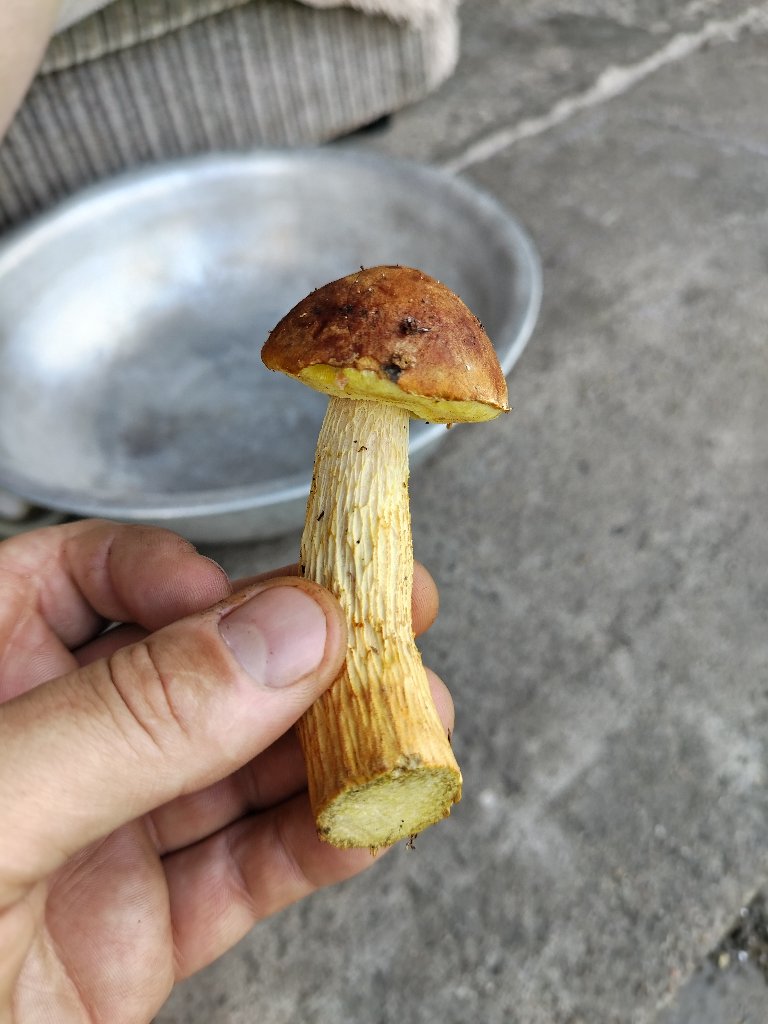
    This mushroom strongly resembles a species from the Suillus genus.

    Name: Slippery Jack or Sticky Bun (likely Yellow-brown Suillus or similar species) [Suillus luteus] or [Suillus collinitus]

    Edibility: Edible (though the cap cuticle is often removed due to its slimy texture and potential to cause mild digestive upset in some)

    Distinguishing features:

    Cap: Viscid (slimy) when wet, typically convex to broadly convex, reddish-brown to yellowish-brown, often with darker streaks or patches.

    Pore surface: Yellow, becoming olive-yellow with age, composed of small, angular pores.

    Stem: Pale yellow to yellowish-white, often with a ring (annulus) which can be membranous and purplish-brown on the underside (though not clearly visible in this image). The stem surface below the ring can be glandular-dotted.

    Flesh: Pale yellow, unchanging or very slightly staining pinkish when cut.

    Confusions

    Other Suillus species: Many Suillus species look similar. For example, [Suillus granulatus] (Granulated Bolete) lacks a ring and has granular dots on the stem, while [Suillus collinitus] often has pinkish mycelium at the base of the stem. Distinguishing between them often requires examining the presence/absence of a ring, stem ornamentation, and sometimes microscopic features. All commonly encountered Suillus species are generally considered edible.

    Bitter Bolete [Tylopilus felleus]: While it has pores and a brownish cap, the Bitter Bolete has pinkish pores when mature and typically a reticulated (net-like pattern) stem, and its flesh is extremely bitter. The pores in the photo are yellow, not pinkish.