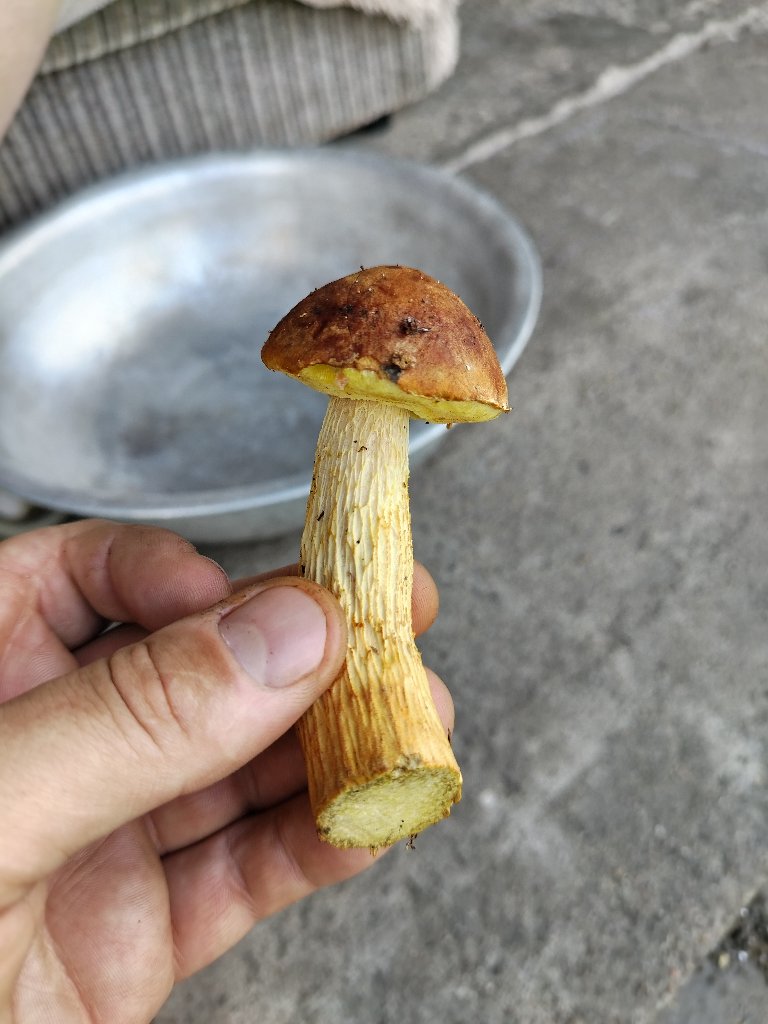
This mushroom strongly resembles a species from the Suillus genus.
Name: Slippery Jack or Sticky Bun (likely Yellow-brown Suillus or similar species) [Suillus luteus] or [Suillus collinitus]
Edibility: Edible (though the cap cuticle is often removed due to its slimy texture and potential to cause mild digestive upset in some)
Distinguishing features:
Cap: Viscid (slimy) when wet, typically convex to broadly convex, reddish-brown to yellowish-brown, often with darker streaks or patches.
Pore surface: Yellow, becoming olive-yellow with age, composed of small, angular pores.
Stem: Pale yellow to yellowish-white, often with a ring (annulus) which can be membranous and purplish-brown on the underside (though not clearly visible in this image). The stem surface below the ring can be glandular-dotted.
Flesh: Pale yellow, unchanging or very slightly staining pinkish when cut.
Confusions
Other Suillus species: Many Suillus species look similar. For example, [Suillus granulatus] (Granulated Bolete) lacks a ring and has granular dots on the stem, while [Suillus collinitus] often has pinkish mycelium at the base of the stem. Distinguishing between them often requires examining the presence/absence of a ring, stem ornamentation, and sometimes microscopic features. All commonly encountered Suillus species are generally considered edible.
Bitter Bolete [Tylopilus felleus]: While it has pores and a brownish cap, the Bitter Bolete has pinkish pores when mature and typically a reticulated (net-like pattern) stem, and its flesh is extremely bitter. The pores in the photo are yellow, not pinkish.
Upload a photo and get possible matches in seconds.