Category: Mushrooms

  • Cantharellus formosus: Pacific Golden Chanterelle Identification and Look-Alikes

    Cantharellus formosus: Pacific Golden Chanterelle Identification and Look-Alikes

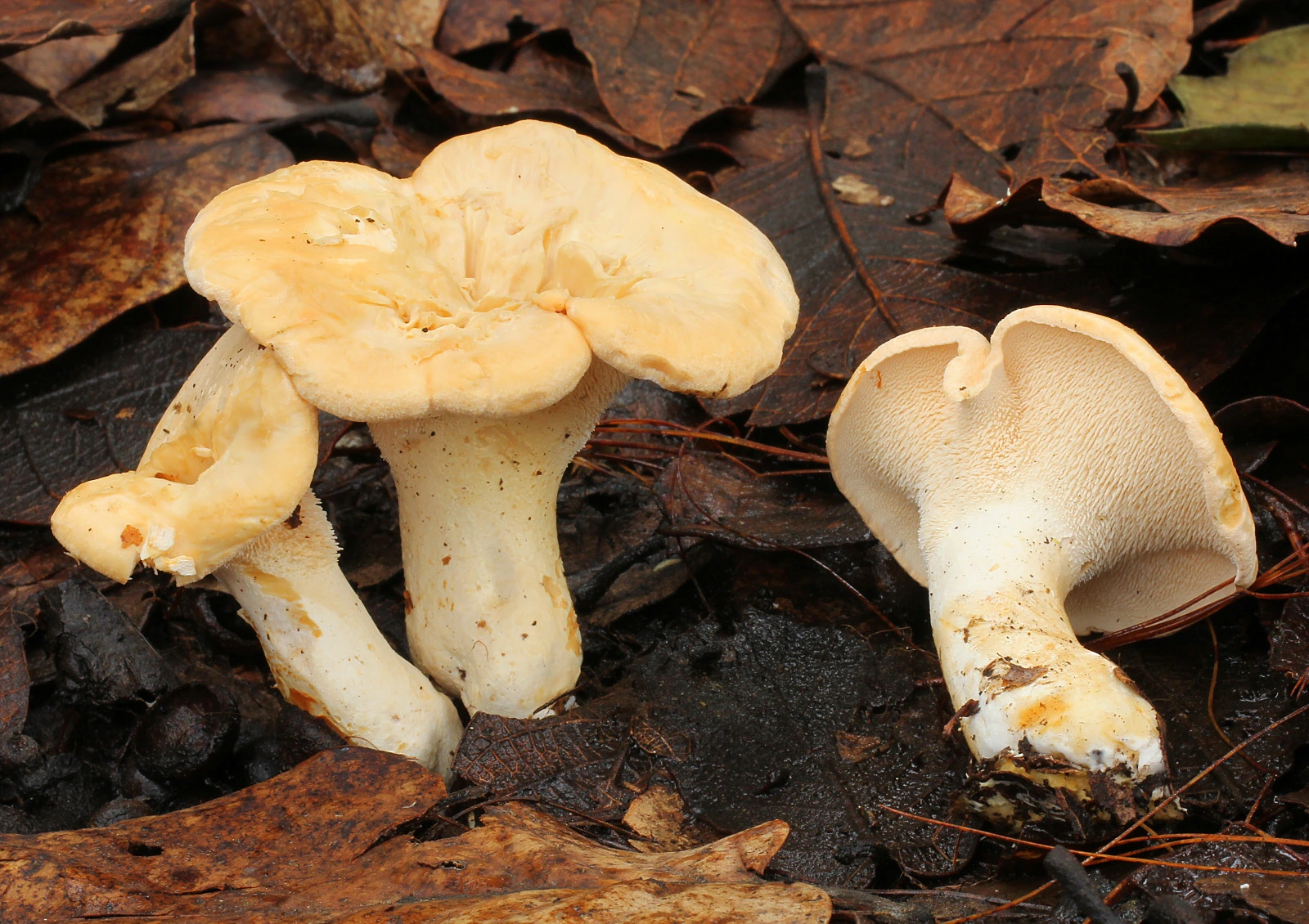
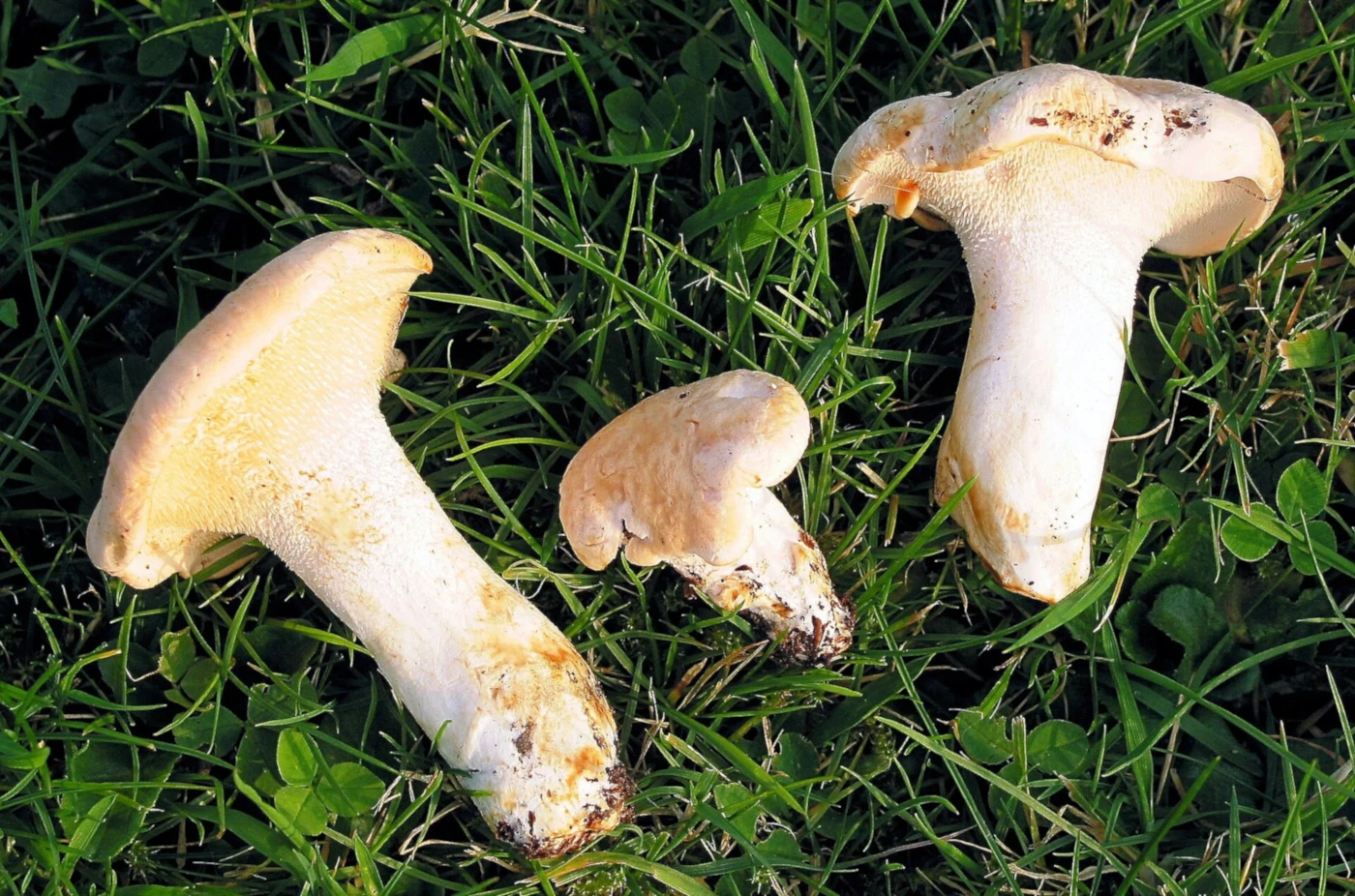
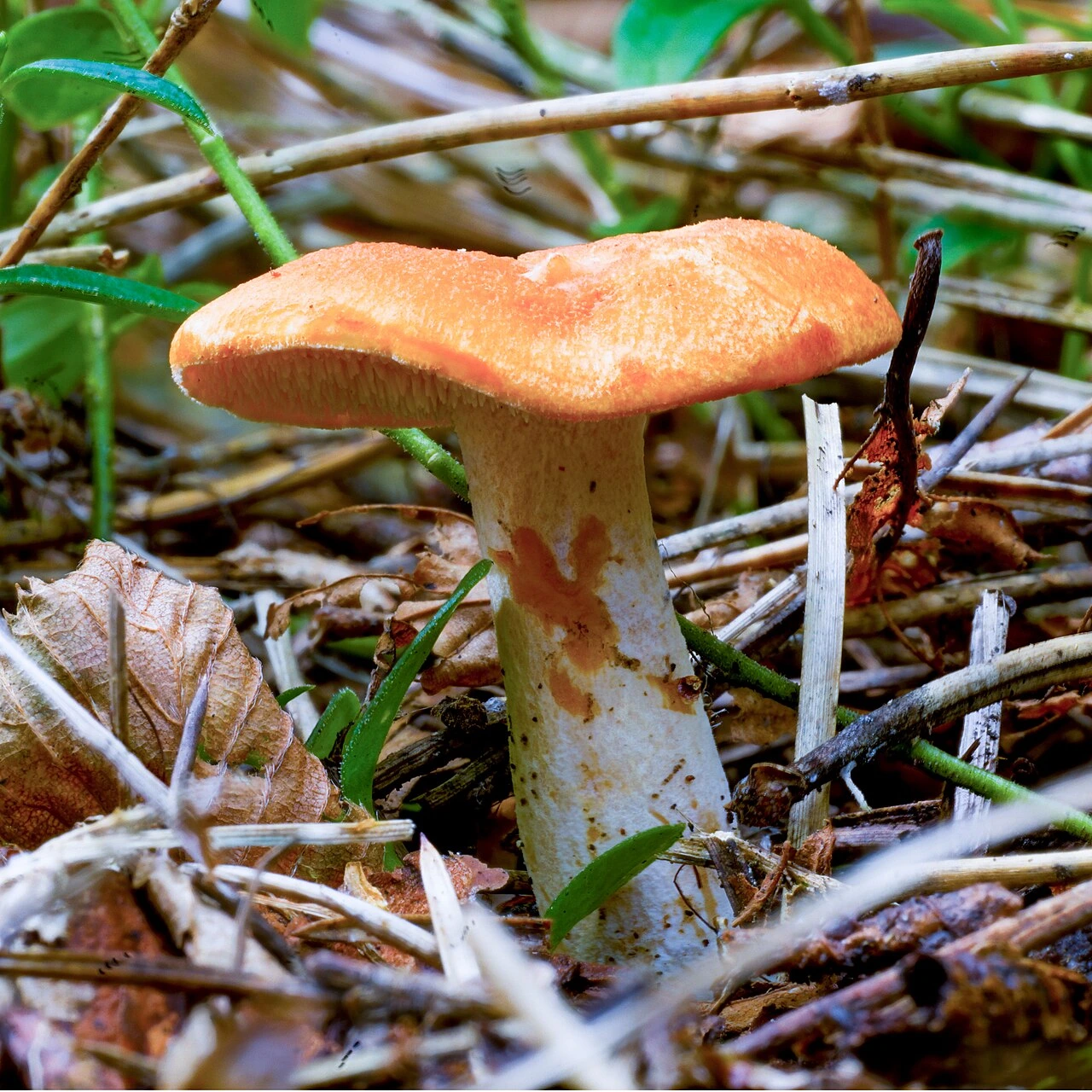
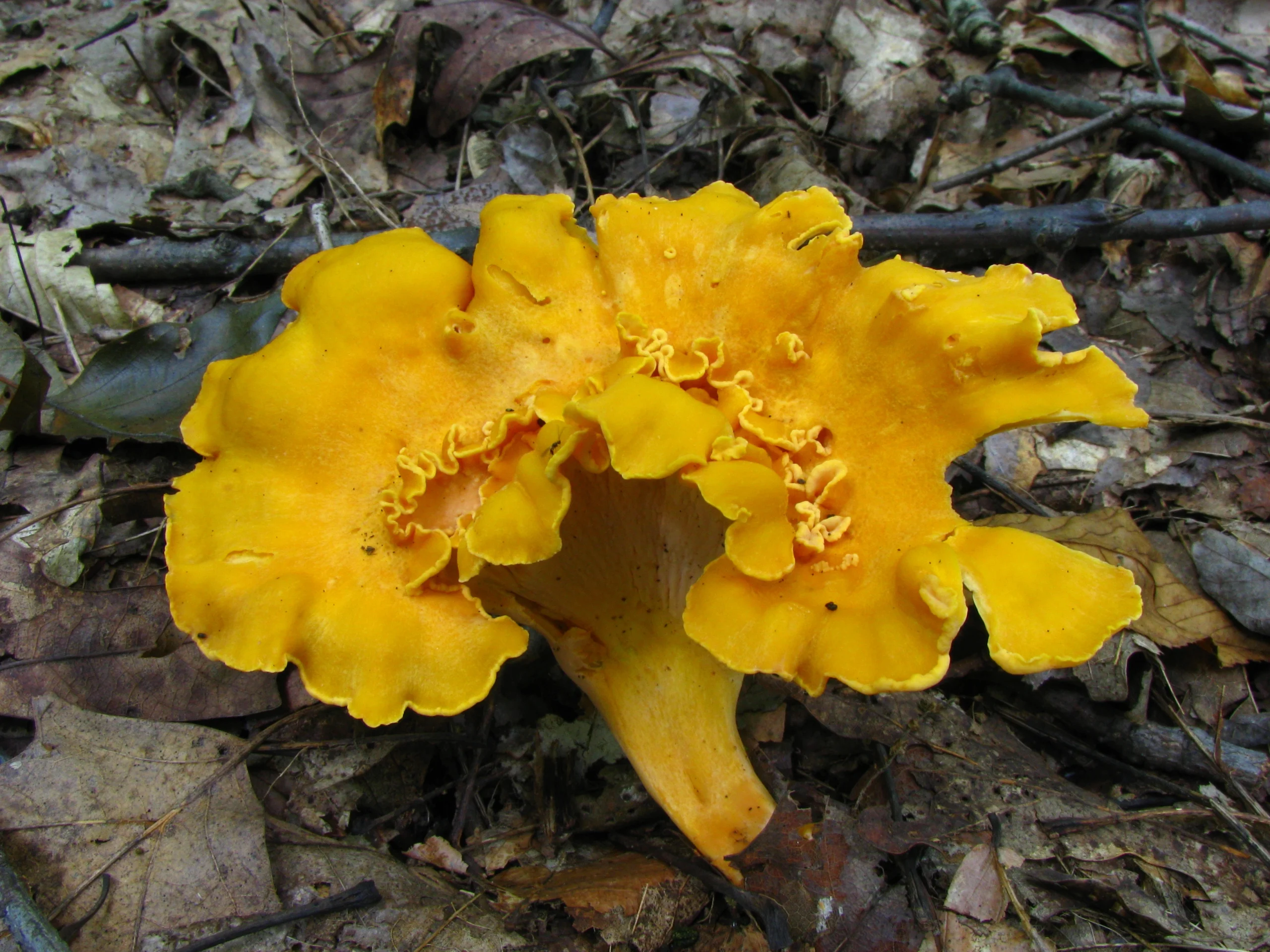
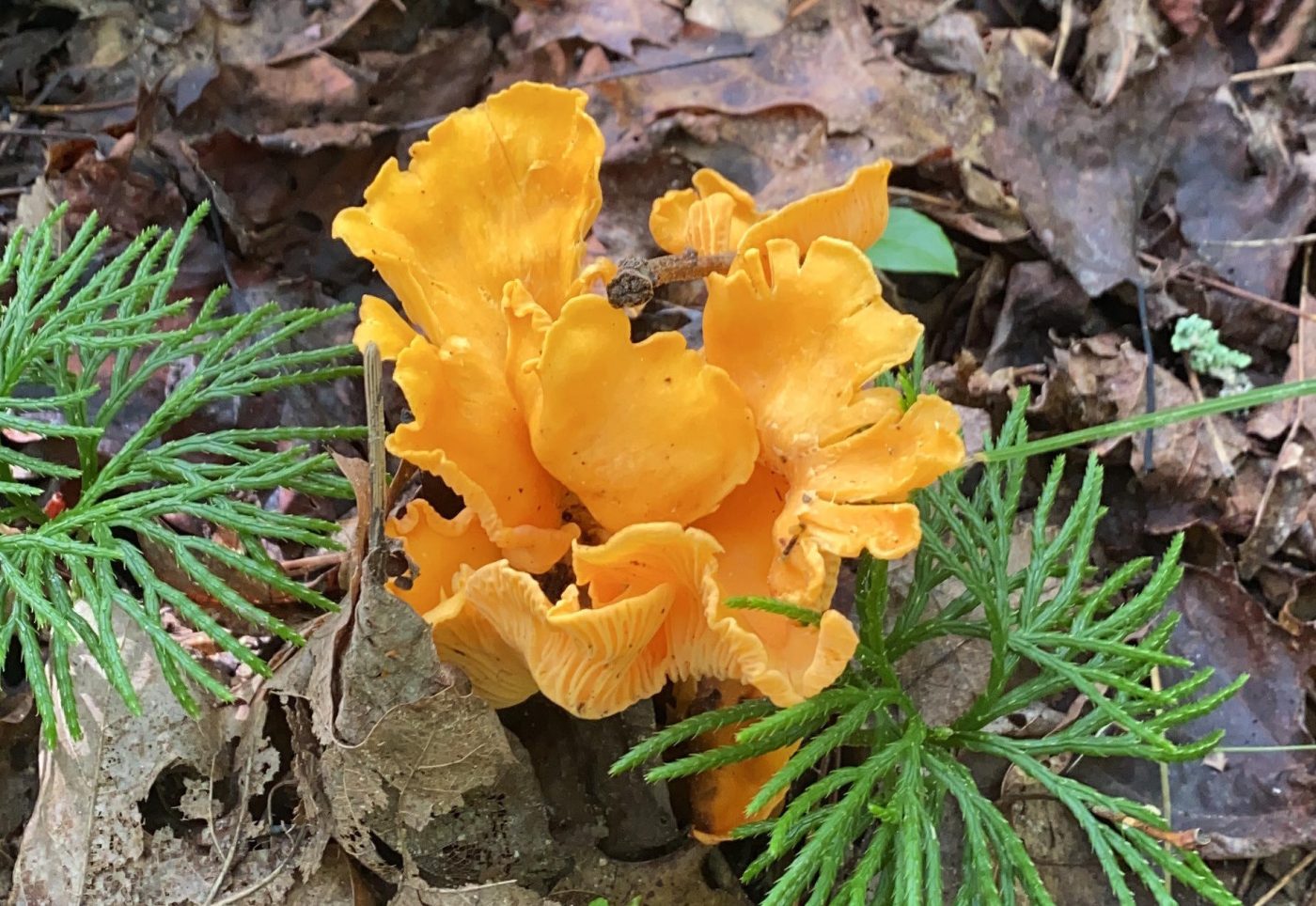
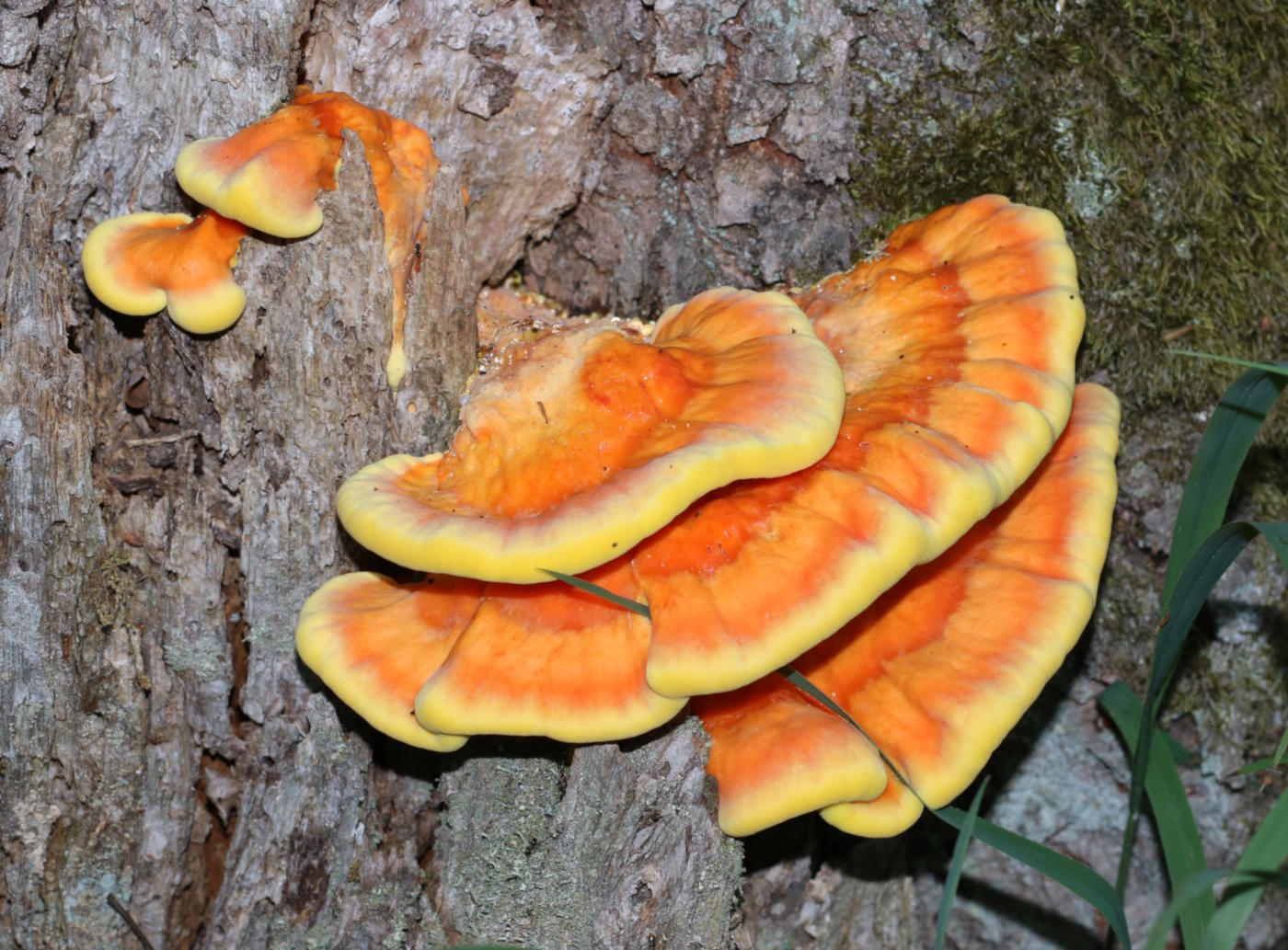
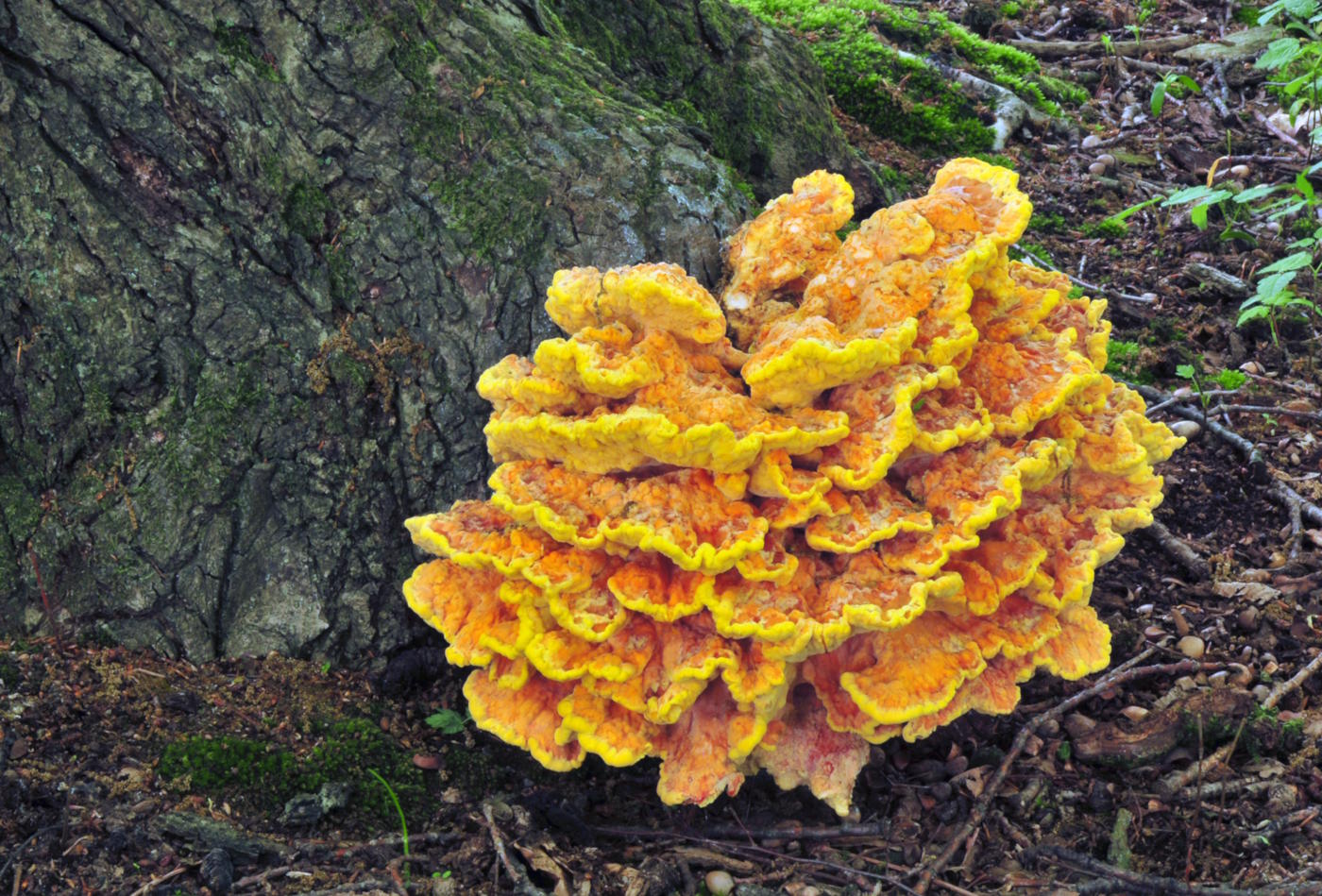
    Cantharellus formosus, commonly known as the Pacific Golden Chanterelle, is one of the characteristic chanterelles of the Pacific Northwest. It is a yellow to orange woodland mushroom with thick flesh, a funnel-shaped cap, and blunt false gills that run down the stem.

    This species is closely associated with conifer forests and is especially important in western North America. It can be confused with other chanterelles, False Chanterelles, and poisonous Jack-o’-Lantern mushrooms, so identification should focus on the underside, flesh, habitat, and growth pattern rather than cap color alone.

    ⚠️ Important: This guide is for identification and education only. Never eat a wild mushroom based solely on a photograph, AI result, or comparison with an online guide.

    Quick Identification

    Feature Cantharellus formosus
    Scientific name Cantharellus formosus
    Common name Pacific Golden Chanterelle
    Family Cantharellaceae
    Cap color Yellow-orange to orange-brown
    Cap shape Convex when young, becoming irregular or funnel-shaped
    Underside Blunt false gills or ridges
    True gills Absent
    Stem Solid, pale yellow to orange
    Flesh Pale, firm, solid
    Spore print Pale cream to yellowish
    Ecology Mycorrhizal
    Habitat Conifer and mixed forests
    Main region Pacific Northwest
    Season Late summer through autumn
    Edibility Edible when correctly identified
    Main look-alikes False Chanterelle, Jack-o’-Lantern mushrooms, other golden chanterelles

    What Does Cantharellus formosus Look Like?

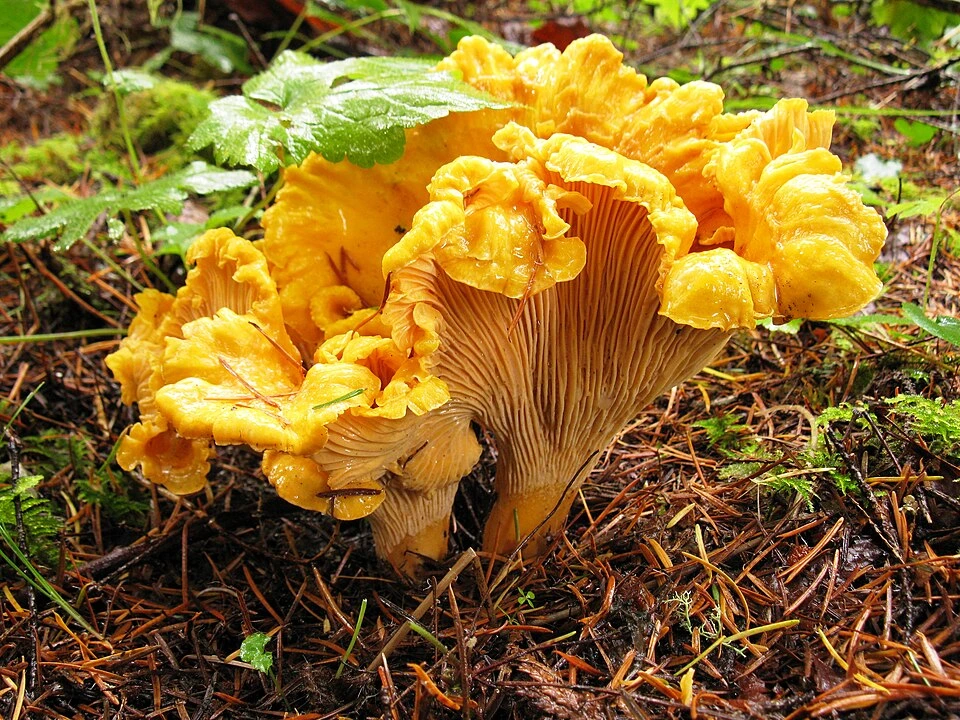
    The Pacific Golden Chanterelle has a thick fleshy cap that ranges from yellow-orange to deeper orange or orange-brown. Young specimens are usually convex, while mature caps often become irregular, lobed, or funnel-shaped.

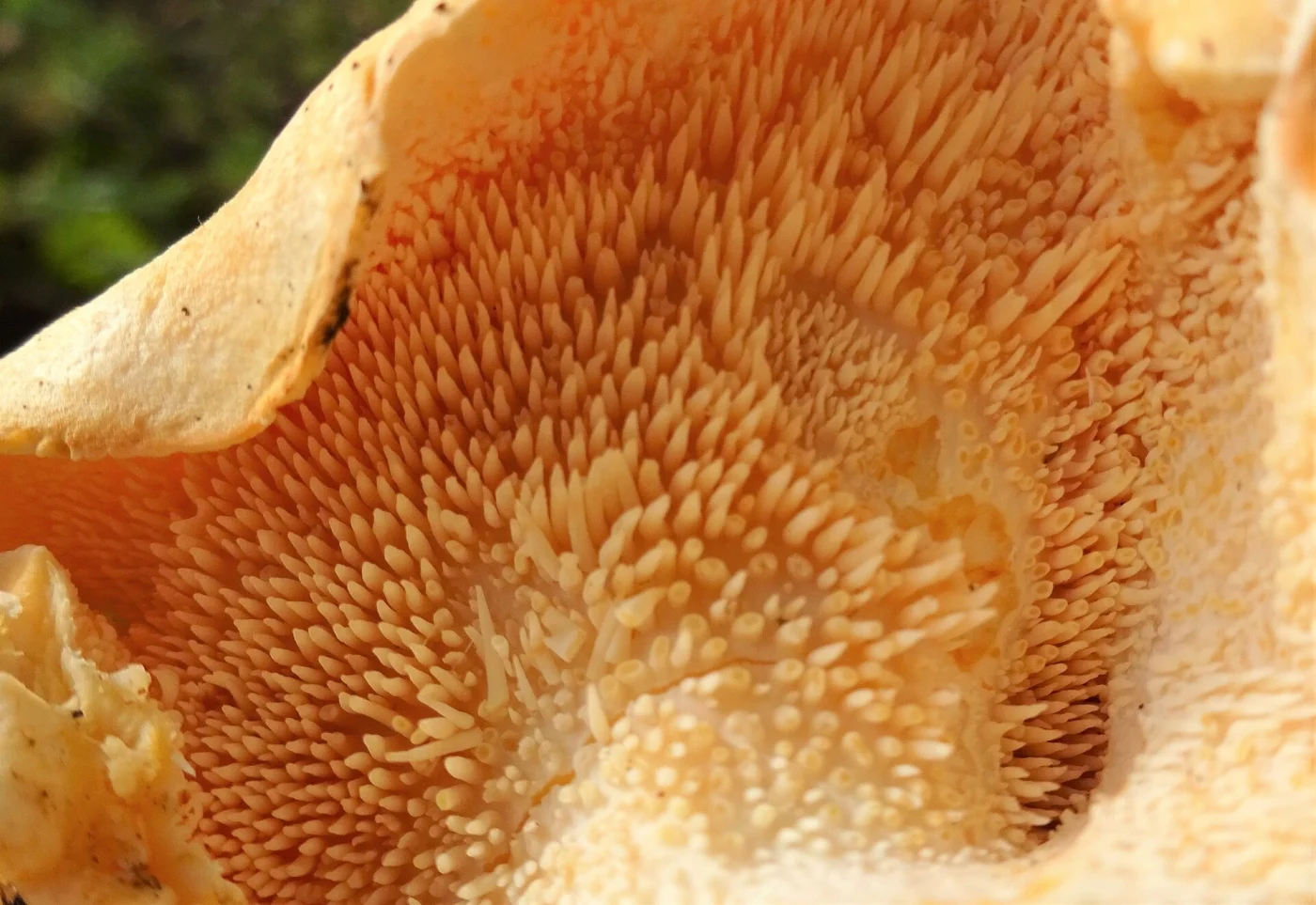
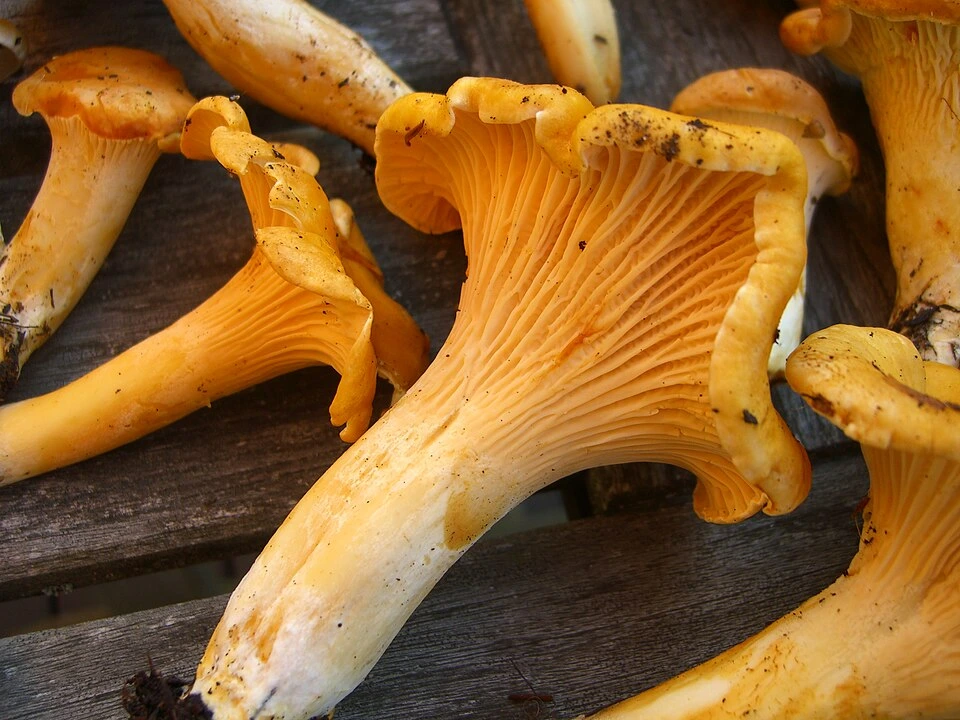
    The underside is one of the most important features. Instead of thin true gills, the mushroom has thick, blunt ridges that fork and run down the stem.

    The overall texture is firm and substantial. This helps separate true chanterelles from thinner orange mushrooms that may look similar from above.
    Cap

    The cap can become fairly broad and is often irregular rather than perfectly round. The margin may become wavy or lobed with age. Color varies with age, moisture, and lighting. Some specimens are bright yellow-orange, while others show deeper orange-brown or slightly pinkish tones. The cap surface is generally smooth to slightly uneven and lacks the prominent scales found in some unrelated orange mushrooms.

    False Gills

    The underside has thick ridges often called false gills. These are not separate blade-like structures but folds of the mushroom’s surface. They often fork, branch, and connect with neighboring ridges. The edges are blunt rather than sharp. This is one of the strongest features for distinguishing Pacific Golden Chanterelles from poisonous orange mushrooms with true gills.

    Does Cantharellus formosus Have True Gills?

    No. Like other chanterelles, C. formosus has false gills. True gills are thin and blade-like, while chanterelle ridges are thicker, rounded, and integrated into the flesh of the cap. If the underside shows many sharp, separate blades, another genus should be considered.

    Stem

    The stem is solid and relatively thick. It usually matches the cap color or is slightly paler. The stem often blends gradually into the cap rather than meeting it at a sharply defined angle. There is no ring or volva. When cut lengthwise, the interior should remain solid rather than hollow.

    Flesh

    The flesh is pale cream to whitish inside and relatively firm. This pale interior is useful because some orange look-alikes remain strongly orange throughout the flesh. The texture is usually denser than that of many thin-gilled mushrooms.

    Smell

    Pacific Golden Chanterelles are often described as having a mild fruity aroma, sometimes compared with apricots. The strength of the odor varies, and dry or older mushrooms may smell much less strongly. Smell should be used only as supporting evidence because it is subjective.

    Spore Print

    The spore print is pale, usually cream to yellowish. This supports identification as a chanterelle-like fungus but is not enough to distinguish C. formosus from related species. Underside structure and geography are usually more useful.

    Where Does Cantharellus formosus Grow?

    The Pacific Golden Chanterelle grows from soil in forest rather than directly from wood. It forms mycorrhizal relationships with living tree roots. It is strongly associated with coniferous and mixed forests of the Pacific Northwest. Douglas-fir and other conifers are especially important habitat components. Because the fungal network is underground, mushrooms may appear some distance from the nearest visible trunk.

    Distribution

    Cantharellus formosus is characteristic of western North America, particularly the Pacific Northwest. It is strongly associated with coastal and montane forest regions from northern California through Oregon and Washington into British Columbia. Geography is an important identification clue because eastern North America contains different chanterelle species.

    When Does the Pacific Golden Chanterelle Grow?

    The main season usually runs from late summer through autumn. Fruiting often increases after sustained rainfall and cooler temperatures. In wetter coastal areas, the season can continue well into late autumn. The exact timing varies with elevation, latitude, and yearly weather.

    Is Cantharellus formosus Edible?

    Yes. The Pacific Golden Chanterelle is regarded as edible when correctly identified. Like other chanterelles, it is valued for its firm texture and mild fruity aroma. The main safety concern is confusion with poisonous orange mushrooms rather than toxicity of the chanterelle itself. Accurate identification should therefore focus on the underside and substrate.

    Pacific Golden Chanterelle Look-Alikes

    Several orange woodland mushrooms can resemble C. formosus. The most important comparisons are False Chanterelle and Jack-o’-Lantern mushrooms.

    Other western chanterelle species can also be very similar and may require geography or microscopic features for confident separation.

    Hygrophoropsis aurantiaca — False Chanterelle

    Identification

    False Chanterelle usually has an orange to brownish-orange cap and many thin forked true gills underneath.

    The cap is often darker in the center and thinner than that of a true chanterelle. The overall mushroom usually feels less substantial.

    Main Difference

    Pacific Golden Chanterelles have thick blunt ridges, while False Chanterelles have thin blade-like gills.

    This underside difference is more reliable than color.

    Omphalotus Species — Jack-o’-Lantern Mushrooms

    Identification

    Jack-o’-Lantern mushrooms are bright orange and commonly form dense clusters from wood, stumps, or buried roots.

    Their underside has true gills that run down the stem. The flesh is often more uniformly orange.

    Safety

    Jack-o’-Lantern mushrooms are poisonous and can cause severe gastrointestinal symptoms.

    They are one of the most important dangerous look-alikes for chanterelles.

    Pacific Golden Chanterelle vs Jack-o’-Lantern

    Feature Pacific Golden Chanterelle Jack-o’-Lantern
    Underside Blunt false gills True blade-like gills
    Growth Usually scattered Often dense clusters
    Substrate Soil Wood or buried roots
    Flesh Pale inside Often orange-yellow
    Texture Thick and firm More fibrous
    Safety Edible when correctly identified Poisonous

    The combination of false gills, soil growth, and pale flesh strongly supports chanterelle identification.

    Pacific Golden Chanterelle vs False Chanterelle

    Feature Pacific Golden Chanterelle False Chanterelle
    Underside Thick blunt ridges Thin forked gills
    Cap Thick and fleshy Thinner
    Flesh Firm and pale Softer, more orange
    Growth Mycorrhizal, from soil Often near decaying wood
    Edibility Edible when correctly identified Generally not considered a choice edible

    The underside remains the most important feature in this comparison.

    Cantharellus formosus vs Cantharellus lateritius

    Cantharellus lateritius, the Smooth Chanterelle, is more characteristic of eastern North America.

    Its underside can be almost smooth or only lightly wrinkled, while C. formosus typically develops much more obvious false gills.

    Geography provides an important clue because these species occupy different parts of the continent.

    Cantharellus formosus vs Cantharellus cibarius

    The name Cantharellus cibarius was historically applied very broadly to golden chanterelles in North America.

    Modern taxonomy recognizes that many North American chanterelles belong to distinct species, including C. formosus in the Pacific Northwest.

    This is why older field guides may use C. cibarius for mushrooms now identified differently.

    How to Identify Cantharellus formosus Step by Step

    Start with the underside. Look for thick, blunt, forked ridges rather than true gills.

    Next, check the habitat. The mushroom should be growing from soil in western conifer or mixed forest.

    Then examine the flesh and stem. Both should be solid and substantial, with pale interior flesh.

    Finally, consider geography. A golden chanterelle in the Pacific Northwest is far more likely to be C. formosus or another western chanterelle than an eastern species.

    Why Geography Matters

    Chanterelles are a good example of why mushroom identification cannot rely on appearance alone.

    Several species look extremely similar but occupy different regions and associate with different trees.

    A mushroom that looks identical in Oregon and Ohio may belong to completely different species.

    How to Photograph Pacific Golden Chanterelles

    Photograph the cap from above, then take a clear image of the underside.

    The ridges should be visible in enough detail to show that they are blunt and forked rather than true gills.

    Also photograph the full stem and surrounding forest. Nearby conifers, moss, and soil conditions can provide useful identification context.

    Can AI Identify Cantharellus formosus?

    AI can often recognize a chanterelle-like mushroom when the underside is visible. Species-level identification is harder because several North American chanterelles look very similar. Geographic location and nearby tree species can significantly improve accuracy. A cap-only photograph is much less reliable than a full set showing the underside and habitat.

    Common Identification Mistakes

    One common mistake is calling every golden chanterelle Cantharellus cibarius. North American chanterelle taxonomy is more complex than older field guides suggested.

    Another is identifying chanterelles only by color. Bright orange mushrooms from completely different genera can look similar from above.

    The most dangerous mistake is ignoring the underside. False gills versus true gills is the feature that should be checked first.

    Frequently Asked Questions

    What is Cantharellus formosus?

    Cantharellus formosus is the Pacific Golden Chanterelle, a golden chanterelle native to western North America. It is especially associated with conifer forests of the Pacific Northwest.

    Where does the Pacific Golden Chanterelle grow?

    It grows from soil in coniferous and mixed forests, particularly in the Pacific Northwest. Douglas-fir and other western conifers are common components of its habitat.

    When does Cantharellus formosus grow?

    The main season is late summer through autumn. Fruiting often increases after cool wet weather and may continue into late autumn in mild coastal regions.

    Does Cantharellus formosus have true gills?

    No. It has blunt false gills or ridges that are thicker and more integrated into the cap than true blade-like gills.

    Is the Pacific Golden Chanterelle edible?

    Yes. It is regarded as edible when correctly identified, but poisonous orange look-alikes must be ruled out first.

    What is the most dangerous look-alike?

    Jack-o’-Lantern mushrooms are among the most important poisonous comparisons. They have true gills and commonly grow from wood or buried roots.

    How can I tell it from False Chanterelle?

    False Chanterelle has thin forked true gills, while C. formosus has thick blunt ridges. The true chanterelle is also usually firmer and more substantial.

    Is Cantharellus formosus the same as Cantharellus cibarius?

    No. They are separate species. The name C. cibarius was historically used too broadly for North American golden chanterelles.

    What color is the spore print?

    The spore print is pale cream to yellowish. This is useful as supporting evidence but does not identify the species by itself.

    Can Pacific Golden Chanterelles grow on wood?

    No. They grow from soil in association with living tree roots. A bright orange mushroom growing directly from wood should suggest another species.

    Final Identification Notes

    Cantharellus formosus is best recognized by a combination of golden-orange coloration, thick blunt false gills, solid pale flesh, growth from soil, and western conifer forest habitat.

    The underside is the most important feature. Thin true gills point away from chanterelles and toward look-alikes such as False Chanterelle or Jack-o’-Lantern mushrooms.

    Geography also matters because North America contains several distinct golden chanterelle species. In the Pacific Northwest, C. formosus is one of the key species to consider when identifying a golden chanterelle.
  • Amanita pantherina: Panther Cap Identification, Toxicity and Look-Alikes

    Amanita pantherina: Panther Cap Identification, Toxicity and Look-Alikes

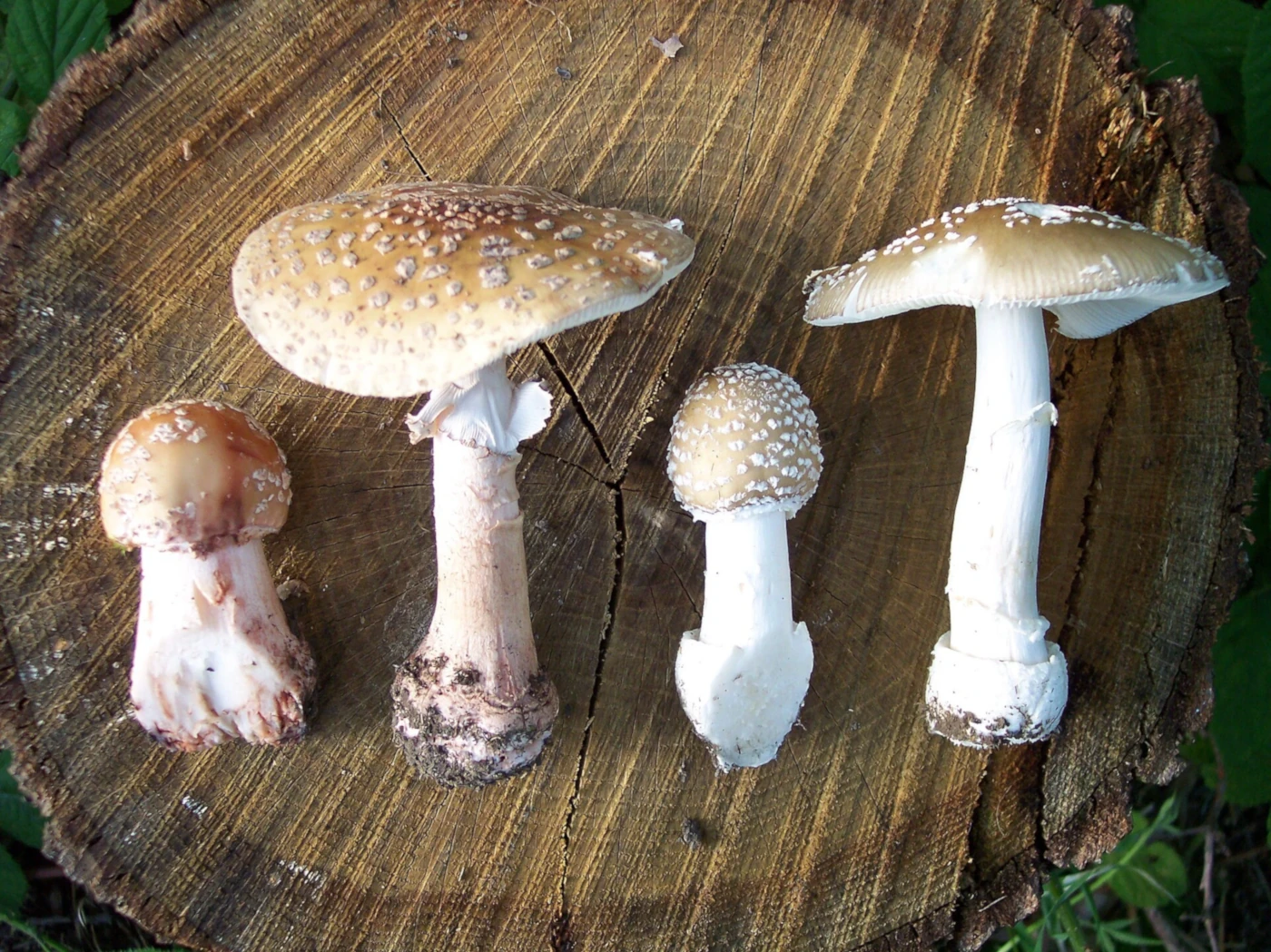
    Amanita pantherina, commonly known as the Panther Cap, is a poisonous woodland mushroom recognized by its brown cap, white veil patches, white gills, and a pale stem with a ring and enlarged base. It is closely related to Amanita muscaria, the Fly Agaric, and contains similar psychoactive and neurotoxic compounds.

    The species can be confused with other brown Amanitas, including the edible Blusher in regions where that mushroom is collected. Because some look-alikes are difficult to separate from photographs alone, identification should always include the complete stem base, bruising reactions, cap surface, gills, ring, habitat, and geographic region.

    ⚠️ Important: This guide is for identification and education only. Never eat a wild mushroom based solely on a photograph, AI result, or comparison with an online guide.

    Quick Identification

    Feature Amanita pantherina
    Scientific name Amanita pantherina
    Common name Panther Cap
    Family Amanitaceae
    Cap color Brown to gray-brown
    Cap surface Usually covered with white veil patches
    Gills White, crowded, free
    Stem White to cream
    Ring Usually present
    Stem base Bulbous with distinct veil remnants
    Spore print White
    Habitat Woodland near host trees
    Ecology Mycorrhizal
    Main season Summer through autumn
    Toxicity Poisonous
    Main compounds Ibotenic acid and muscimol
    Main look-alikes Amanita rubescens, Amanita excelsa, Amanita muscaria

    What Does Amanita pantherina Look Like?

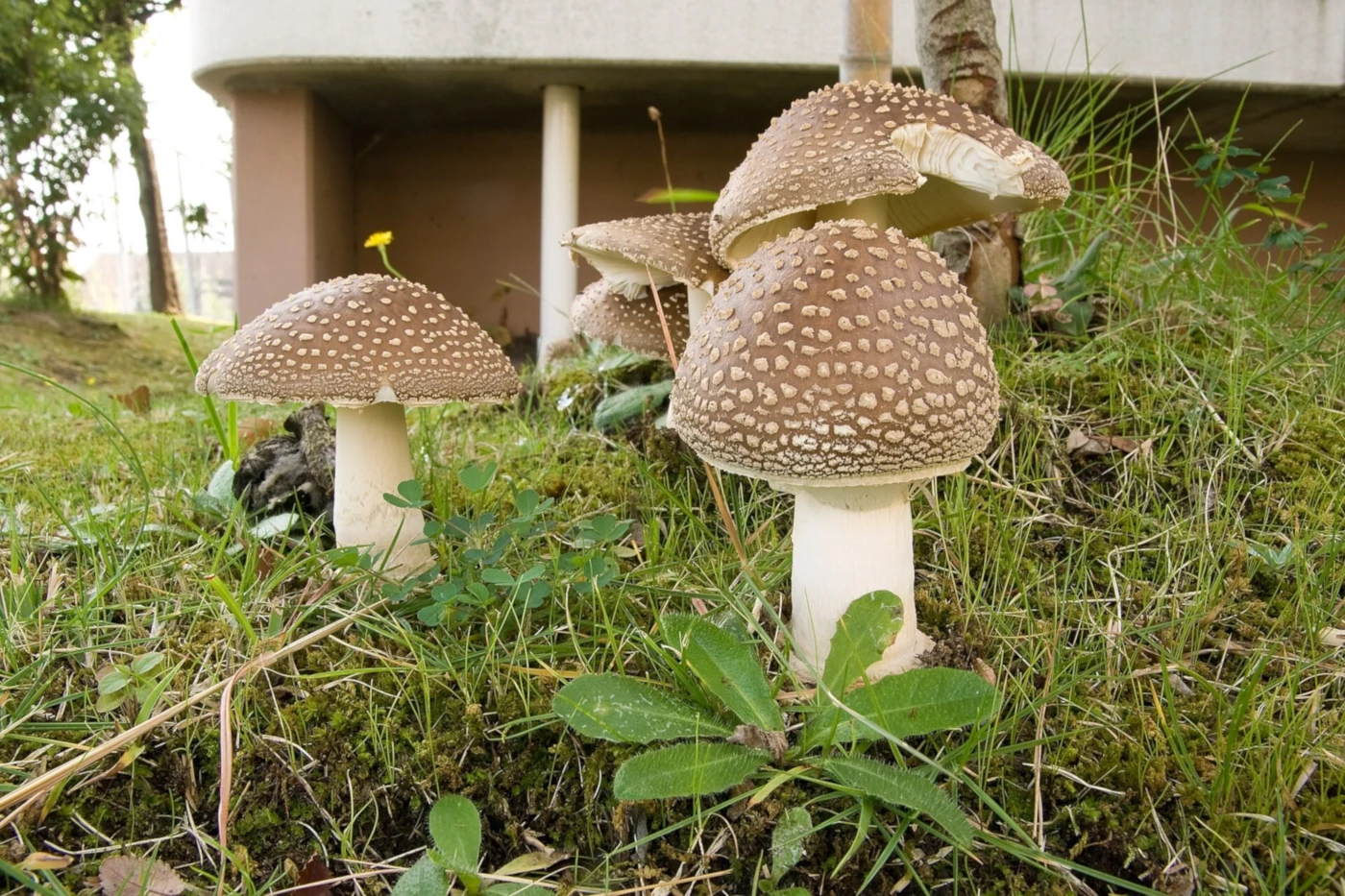
    The Panther Cap has a classic Amanita appearance. Mature specimens usually have a broad brown cap dotted with white patches, white gills, a pale stem with a ring, and a distinctly enlarged stem base.

    The cap may be dark chocolate-brown, medium brown, gray-brown, or lighter depending on age and weather. White patches are usually scattered across the surface and represent remnants of the universal veil that enclosed the young mushroom.

    Rain can wash some or all of these patches away, so a smooth brown cap does not completely rule out the species.

    Cap

    The cap begins rounded or hemispherical and becomes convex, then flatter with age. Mature caps can become fairly broad.

    Its surface is usually smooth beneath the veil remnants and can become slightly sticky in wet weather. White patches are often relatively small, distinct, and evenly distributed.

    The cap margin may become visibly striated in mature specimens. These fine radial lines near the edge can provide another useful identification clue.

    White Veil Patches

    The white spots on the cap are remnants of the universal veil.

    Unlike true scales that grow as part of the cap surface, these patches sit on top and may be removed by rain, handling, or age.

    This means that relying on “brown cap with white spots” alone is unsafe. Other Amanitas can also have white veil remnants, and Panther Caps sometimes lose them.

    Gills

    The gills are white to cream and remain pale as the mushroom matures.

    They are usually crowded and free from the stem, meaning they stop just before reaching it.

    Persistent white gills are typical of many Amanitas, so gill color helps identify the genus but does not separate Panther Cap from every look-alike.

    Stem

    The stem is white to cream, cylindrical, and usually has a prominent ring on the upper half.

    It may appear relatively smooth above the ring and more textured below. The stem is often somewhat hollow in mature specimens.

    The base is one of the most important features and should always be exposed completely during identification.

    Ring

    The ring is usually white and membranous.

    It may be fairly smooth and skirt-like, though it can become damaged or partly disappear in older specimens.

    The presence of a ring is useful, but many Amanita species also have one, so it should never be used by itself.

    Stem Base and Volva

    The stem base is typically bulbous and surrounded by distinct remnants of the universal veil.

    In Panther Cap, these remnants often form one or more collar-like or rim-like zones around the bulb rather than a deep sack-shaped volva like that of the Death Cap.

    This basal structure is one of the most important differences between Amanita species.

    Always remove the mushroom carefully from the soil rather than cutting it off at ground level if identification is required.

    Spore Print

    The spore print is white.

    This is consistent with many Amanita species and can support genus-level identification.

    However, white spores do not distinguish Panther Cap from other white-spored Amanitas.

    Flesh

    The flesh is white and generally does not develop strong reddish staining when cut or bruised.

    This is especially important when comparing Panther Cap with Amanita rubescens, the Blusher, which characteristically develops reddish or pinkish discoloration after injury.

    The absence of reddening is therefore a useful clue.

    Smell

    The odor is usually mild and not especially distinctive.

    Some people describe mature specimens as having a slightly earthy or radish-like smell, but odor is subjective and variable.

    It should be treated only as supporting information.

    Where Does Amanita pantherina Grow?

    The Panther Cap grows from soil in woodland because it forms mycorrhizal relationships with living trees.

    It can occur in deciduous, coniferous, and mixed forests depending on region. Common associations include beech, oak, pine, spruce, and other suitable hosts.

    The mushroom does not normally grow directly from logs or dead wood.

    Distribution

    Amanita pantherina is widely associated with Europe and parts of western Eurasia.

    Reports from other regions sometimes involve related species that closely resemble true A. pantherina. This is especially important in North America, where several similar Amanitas may historically have been given the same name.

    Geographic location should therefore be considered when making a species-level identification.

    When Does Panther Cap Grow?

    The main fruiting period is typically summer through autumn.

    Fruiting often increases after periods of rain and moderate temperatures. In milder climates, the season can extend later.

    The same woodland area may produce fruit bodies repeatedly in favorable years.

    Is Amanita pantherina Poisonous?

    Yes. The Panther Cap is poisonous. It contains ibotenic acid and muscimol, compounds that affect the central nervous system. These are also associated with Amanita muscaria. Effects can include confusion, agitation, altered perception, loss of coordination, drowsiness, delirium, nausea, vomiting, and changes in consciousness.

    Panther Cap Poisoning

    Symptoms can vary substantially depending on the amount eaten, individual sensitivity, and toxin concentration in the mushroom.

    Neurological effects may alternate between agitation and sedation. Disorientation, unusual behavior, muscle movements, and impaired coordination can occur.

    Severe poisoning can require medical observation and supportive treatment.

    The mushroom should not be treated as safe because its toxins differ from the amatoxins found in Death Caps.

    Is Amanita pantherina Deadly?

    Fatal poisoning is less characteristic than with amatoxin-containing Amanitas such as Amanita phalloides, but severe intoxication is possible. The main syndrome is neurological rather than delayed liver failure. Because toxin levels and individual responses vary, suspected ingestion should be treated seriously.

    Amanita pantherina Look-Alikes

    Several brown Amanitas can resemble Panther Cap closely. The most important comparison is Amanita rubescens, especially in Europe, because it can share a brown cap with pale veil patches.

    Amanita rubescens — The Blusher

    • Scientific name: Amanita rubescens
    • Common name: The Blusher

    The Blusher can have a brown, reddish-brown, or gray-brown cap covered with pale veil patches. The key difference is the bruising reaction. Amanita rubescens typically develops pink, reddish, or wine-colored staining where damaged, especially in the flesh and around insect tunnels. Panther Cap generally remains white or pale when cut.

    Panther Cap vs Blusher

    Feature Amanita pantherina Amanita rubescens
    Cap Brown with white patches Brown to reddish with pale patches
    Flesh after damage Usually remains pale Reddens or pinks
    Stem base Bulb with distinct collar-like veil zones Bulbous, usually without same sharp rim
    Cap margin Often striated Usually less distinctly striated
    Toxicity Poisonous Edibility differs after preparation, but requires expert identification

    The staining reaction is one of the most useful distinctions, but it should still be combined with the stem base and cap margin.

    Amanita excelsa — Grey Spotted Amanita

    Amanita excelsa can also have a gray-brown or brown cap with pale veil remnants. It often looks less sharply patterned than Panther Cap and usually has different basal veil structures. The cap margin is generally less strongly striated. Species-level separation can be difficult, particularly with weathered specimens.

    Amanita muscaria — Fly Agaric

    Fly Agaric is closely related and shares many structural features. Typical Amanita muscaria has a red to orange-red cap with white patches, but faded specimens can become orange-brown or yellowish. The basal veil structure also differs, and color usually separates fresh specimens easily.

    Panther Cap vs Fly Agaric

    Feature Panther Cap Fly Agaric
    Cap color Brown to gray-brown Red to orange-red
    Veil patches White White
    Gills White White
    Stem White White
    Toxins Ibotenic acid, muscimol Ibotenic acid, muscimol
    Toxicity Poisonous Poisonous

    Both species should be treated as toxic.

    Amanita phalloides — Death Cap

    The Death Cap may occasionally have a brownish or olive-brown cap and can superficially resemble a Panther Cap when veil patches are missing. However, Amanita phalloides usually lacks the characteristic white wart-like cap remnants of Panther Cap and has a sack-like volva at the base. The toxicology is also very different. Death Cap contains amatoxins capable of causing fatal liver failure.

    How to Identify Amanita pantherina Step by Step

    Begin with the cap. A brown cap with white universal veil patches is consistent with Panther Cap, especially when the margin shows fine striations.

    Next, examine the underside and stem. The gills should be white, the stem pale, and a ring should usually be present.

    Then expose the entire stem base. Look for a bulb with distinct collar-like veil remnants.

    Finally, cut or bruise the mushroom. The absence of reddish staining helps separate Panther Cap from the Blusher.

    Why the Stem Base Matters

    Amanita identification often depends heavily on structures at or below soil level. If the mushroom is cut off above the ground, the bulb and volva remnants may be left behind. This can remove some of the strongest evidence needed to distinguish Panther Cap from related species.

    How to Photograph Panther Cap for Identification

    Photograph the cap from above so the color, white patches, and margin are visible. Take another image of the gills and ring. Then photograph the complete stem base after gently removing surrounding soil. A close-up of damaged flesh can also help document whether reddish staining develops.

    Can Panther Cap Be Identified From a Photo?

    Typical specimens can often be recognized from a good series of photographs. A single image from above is much less reliable because white veil patches may be washed away and several Amanitas share brown caps. The strongest photo set includes the cap, gills, ring, complete stem base, and a cut or bruised area.

    Common Identification Mistakes

    One common mistake is assuming every brown Amanita with white spots is Panther Cap.

    Another is ignoring bruising reactions. Reddish staining can strongly suggest the Blusher rather than Panther Cap.

    A third mistake is failing to dig out the complete stem base, which removes one of the most useful identification structures.

    Panther Cap vs Brown Mushrooms Without a Volva

    Many ordinary brown woodland mushrooms can superficially resemble a Panther Cap from above.

    However, mushrooms outside Amanita may lack the combination of white free gills, stem ring, universal veil remnants, and bulbous base.

    The complete structure is therefore far more important than cap color.

    Are Panther Caps Always Covered With White Spots?

    No.

    Rain can wash the veil remnants away, while older mushrooms may retain only a few patches.

    A smooth brown cap can therefore still potentially belong to a Panther Cap or another Amanita.

    Can Panther Caps Grow in Parks?

    Yes, if suitable host trees are present.

    Like other mycorrhizal Amanitas, they can grow in woodland edges, parks, landscaped areas, and grassy areas beneath established trees.

    They do not require untouched forest.

    Frequently Asked Questions

    What does Amanita pantherina look like?

    It usually has a brown cap with white veil patches, white gills, a pale stem with a ring, and a bulbous base with veil remnants.

    Is Amanita pantherina poisonous?

    Yes. It contains ibotenic acid and muscimol and can cause significant neurological poisoning.

    Does Panther Cap contain amatoxins?

    Its characteristic poisoning is associated with ibotenic acid and muscimol rather than the amatoxin syndrome of Death Cap.

    What color are Panther Cap gills?

    The gills are white to cream.

    What color is the spore print?

    The spore print is white.

    Where does Amanita pantherina grow?

    It grows from soil near suitable trees in deciduous, coniferous, and mixed woodland.

    When does Panther Cap appear?

    It most commonly fruits from summer through autumn.

    What is the main Panther Cap look-alike?

    Amanita rubescens, the Blusher, is one of the most important look-alikes in Europe.

    How can I tell Panther Cap from the Blusher?

    The Blusher develops reddish or pinkish staining when damaged, while Panther Cap typically does not.

    Can Panther Cap lose its white spots?

    Yes. Rain and age can remove veil remnants from the cap.

    Final Identification Notes

    Amanita pantherina is best recognized by a combination of a brown cap with white veil remnants, white gills, a pale ringed stem, a bulbous base with collar-like veil zones, and flesh that does not redden strongly when damaged.

    The most important look-alike is the Blusher, Amanita rubescens, which develops characteristic reddish staining. Fly Agaric and other brown Amanitas can also create confusion.

    Never identify a Panther Cap from cap color or white spots alone. The complete stem base, bruising reaction, gills, ring, habitat, and geographic region should all be considered together.

  • Hydnum repandum: Hedgehog Mushroom Identification and Look-Alikes

    Hydnum repandum: Hedgehog Mushroom Identification and Look-Alikes

    Hydnum repandum, commonly known as the Hedgehog Mushroom or Wood Hedgehog, is one of the easiest woodland mushrooms to recognize once you know what to look for. Instead of gills or pores, the underside of the cap is covered with soft, downward-pointing teeth.

    The cap is usually cream, pale yellow, buff, or light orange, and the flesh is thick and brittle. Hedgehog Mushrooms grow from soil in forests, often in association with broadleaf trees and conifers.

    ⚠️ Important: This guide is for identification and education only. Never eat a wild mushroom based solely on a photograph, AI result, or comparison with an online guide.

    Quick Identification

    Feature Hydnum repandum
    Scientific name Hydnum repandum
    Common names Hedgehog Mushroom, Wood Hedgehog
    Family Hydnaceae
    Cap color Cream, pale yellow, buff, light orange
    Cap shape Convex to irregular, often wavy
    Underside Soft hanging teeth
    Gills Absent
    Stem Solid, pale, often off-center
    Flesh White to pale, firm and brittle
    Spore print White to cream
    Ecology Mycorrhizal
    Habitat Woodland soil
    Season Summer through autumn
    Edibility Edible when correctly identified
    Main look-alikes Other Hydnum species, some toothed fungi

    What Does Hydnum repandum Look Like?

    The Hedgehog Mushroom usually has a thick, irregular cap with a smooth or slightly uneven surface. The color ranges from cream and buff to pale apricot or light orange.

    The cap may begin rounded or convex, but older specimens often become flatter, lobed, or uneven around the edges. The margin can become wavy with age.

    The most important feature is underneath. Instead of gills, the mushroom has numerous soft teeth that hang downward from the cap.

    The Teeth Under the Cap

    The underside of Hydnum repandum is covered with hundreds of short, pale spines or teeth.

    These teeth are soft and brittle rather than hard or woody. They are usually white, cream, or pale yellow and can break off easily when rubbed.

    This feature makes the Hedgehog Mushroom much easier to distinguish from gilled mushrooms.

    Does Hydnum repandum Have Gills?

    No. It has teeth rather than gills.

    This is the single most useful identification feature. If the underside has thin blade-like gills, the mushroom is not Hydnum repandum.

    The teeth are part of the spore-producing surface and function in a similar way to gills or pores in other mushroom groups.

    Cap

    The cap is usually several centimeters across and can become relatively broad in mature specimens.

    Its surface is typically dry and smooth to slightly uneven. The color may be pale cream in shaded conditions or more yellow-orange in older or sun-exposed mushrooms.

    The cap is often asymmetrical, especially when several fruit bodies grow close together.

    Stem

    The stem is thick, solid, and usually similar in color to the cap or slightly paler.

    It may be central or somewhat off-center, particularly in irregular mature specimens.

    There is no ring or volva. The stem usually blends gradually into the cap rather than forming a sharply defined junction.

    Flesh

    The flesh is white to pale cream and relatively firm.

    It has a brittle texture and can break cleanly rather than bending extensively. Older specimens may become softer or develop a more pronounced bitter taste.

    Fresh flesh generally does not show dramatic bruising reactions.

    Smell and Taste

    The smell is usually mild and pleasant, sometimes slightly fruity or nutty.

    Taste can be mild in young specimens but may become more bitter with age. This bitterness is one reason younger fruit bodies are generally preferred for culinary use.

    Taste should never be used as a primary identification method.

    Spore Print

    The spore print is white to cream.

    Because the spores are pale, the print is easiest to see on dark paper or glass placed over a dark background.

    Spore color can support identification but is less distinctive than the toothed underside.

    Where Does Hydnum repandum Grow?

    Hedgehog Mushrooms grow from soil in woodland rather than directly from wood.

    They form mycorrhizal associations with living trees and may occur in both deciduous and coniferous forests.

    Common habitats include mossy forest floors, woodland edges, and areas with deep leaf litter.

    What Trees Are Associated With Hedgehog Mushrooms?

    Hydnum repandum can occur with several tree species, including beech, oak, birch, pine, spruce, and other suitable hosts.

    The exact associations vary by region.

    Because the fungus is connected to tree roots underground, mushrooms may appear some distance from the nearest trunk.

    When Does Hydnum repandum Grow?

    The main fruiting season is usually summer through autumn.

    In temperate regions, it often becomes more common after periods of regular rainfall.

    Fruiting can continue late into the season in mild weather.

    Is Hydnum repandum Edible?

    Yes. The Hedgehog Mushroom is widely regarded as edible when correctly identified.

    Young specimens are generally preferred because older fruit bodies can become tougher or develop a stronger bitter flavor.

    The teeth can sometimes collect soil or debris, so careful cleaning may be needed before cooking.

    Hedgehog Mushroom Look-Alikes

    The Hedgehog Mushroom has relatively few dangerous look-alikes because the toothed underside is so distinctive.

    Most confusion occurs with other species in the genus Hydnum or unrelated toothed fungi.

    Hydnum rufescens — Terracotta Hedgehog

    • Scientific name: Hydnum rufescens
    • Common name: Terracotta Hedgehog

    Hydnum rufescens is smaller and usually more orange or reddish than H. repandum.

    Its cap is generally thinner, more regular, and more strongly colored. The teeth are similar in structure.

    Main Difference

    H. repandum is usually larger, paler, and more robust, while H. rufescens tends to be smaller and more orange.

    Geography can also help because modern taxonomy recognizes several regional Hydnum species that were once grouped together.

    Other Hydnum Species

    The genus Hydnum includes numerous species with pale caps and toothed undersides.

    Many are difficult to distinguish from photographs alone because they share the same basic structure.

    Size, cap color, host trees, spore dimensions, and geographic range may all be needed for species-level identification.

    Sarcodon Species

    Some Sarcodon species also have teeth underneath the cap.

    However, they usually have darker brown caps, rougher surfaces, thicker flesh, and more robust overall appearances.

    Some species also have strongly bitter tastes or darker scales.

    Bankera and Related Toothed Fungi

    Other toothed fungi can grow on soil and may superficially resemble Hedgehog Mushrooms.

    Many are grayer, browner, more fibrous, or more strongly scented.

    Their caps often look less smooth and more textured than Hydnum repandum.

    Hedgehog Mushroom vs Chanterelle

    Feature Hedgehog Mushroom Chanterelle
    Underside Soft teeth Blunt ridges or folds
    Cap color Cream to pale orange Yellow to golden-orange
    Texture Thick and brittle Firm and fleshy
    Habitat Woodland soil Woodland soil
    Ecology Mycorrhizal Mycorrhizal
    Edibility Edible when correctly identified Edible when correctly identified

    The underside is the easiest way to separate them.

    A chanterelle has ridges, while a Hedgehog Mushroom has clearly defined hanging teeth.

    Hedgehog Mushroom vs Tooth Fungi on Wood

    Several tooth fungi grow directly from logs or trunks.

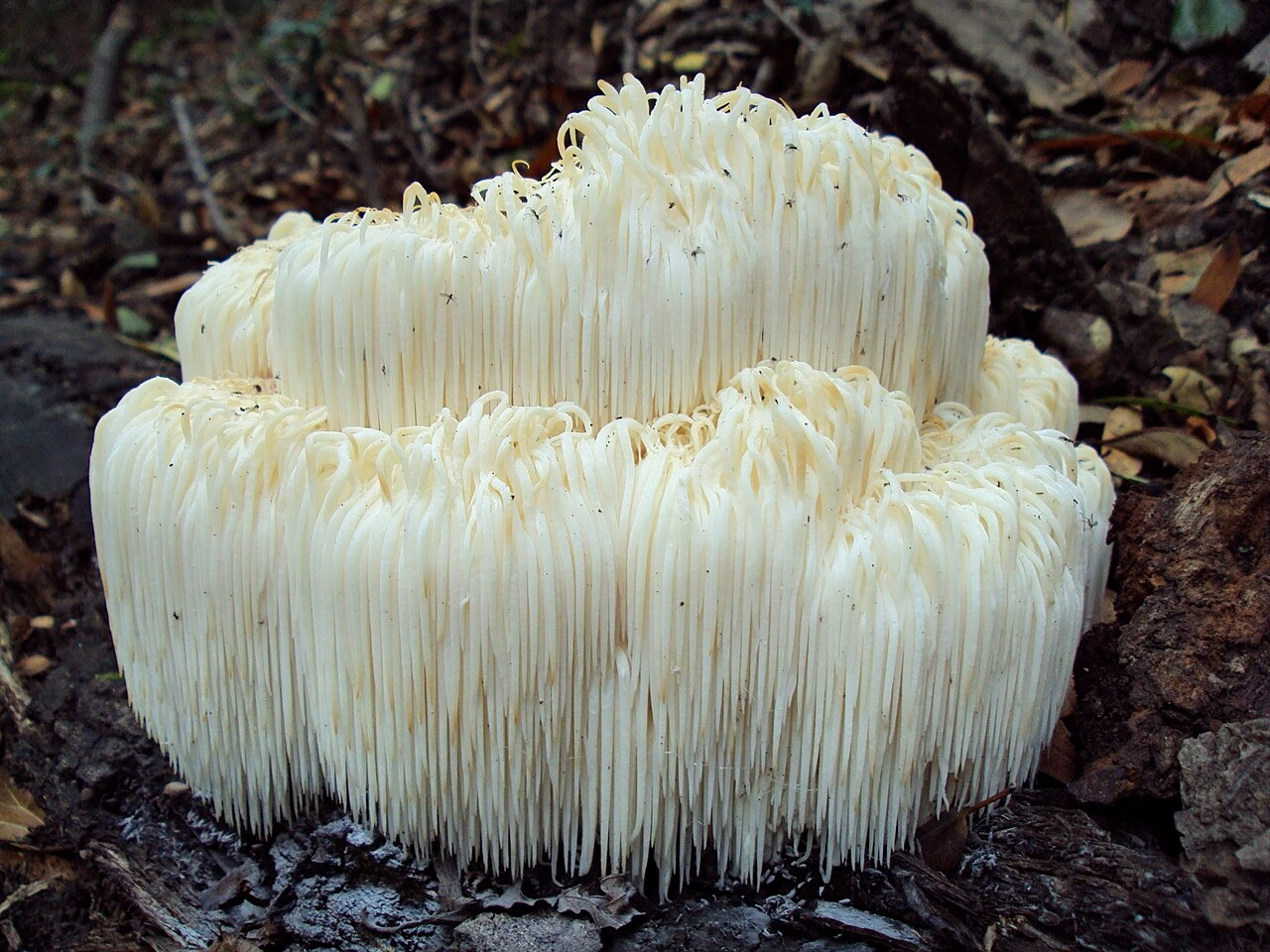
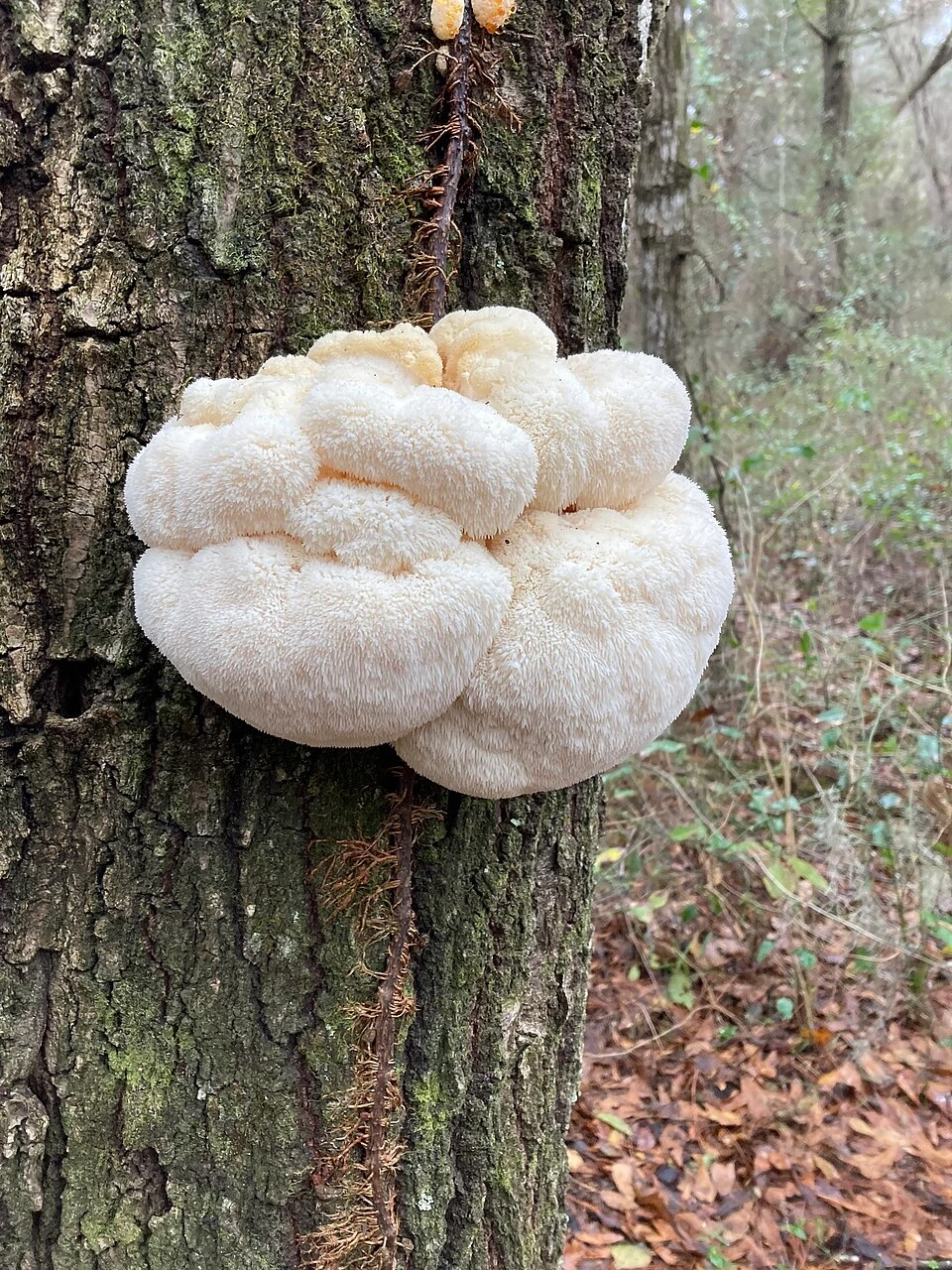
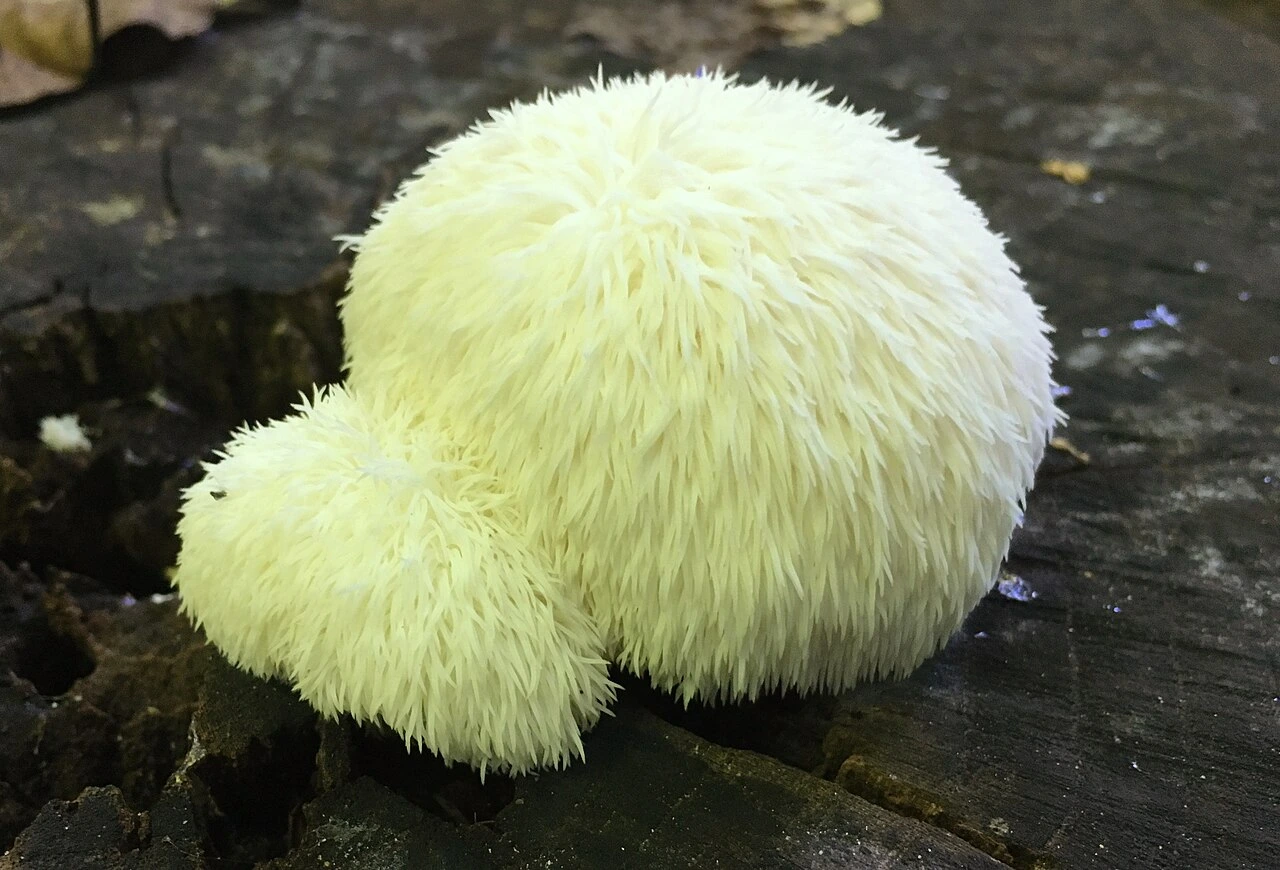
    These include species such as Lion’s Mane and Coral Tooth Fungus.

    The habitat separates them quickly. Hydnum repandum grows from soil, while wood-inhabiting tooth fungi grow directly from woody substrates.

    How to Identify Hydnum repandum Step by Step

    Start by checking the underside.

    If the cap has soft, downward-pointing teeth instead of gills or pores, Hydnum becomes a strong possibility.

    Then examine the cap color and texture. A pale cream to yellow-orange cap with thick flesh and a solid stem fits Hydnum repandum well.

    Finally, check the habitat. The mushroom should be growing from soil in woodland rather than from wood.

    How to Photograph Hedgehog Mushrooms for Identification

    Photograph the cap from above, then turn the mushroom carefully to show the teeth underneath.

    Include the entire stem and the point where it enters the soil.

    A wider photograph showing nearby trees, moss, and leaf litter can help with habitat-based identification.

    Can Hedgehog Mushrooms Be Identified From a Photo?

    Typical specimens can often be recognized from photographs because the toothed underside is so distinctive.

    Species-level identification within Hydnum may be harder, especially in regions with several closely related species.

    Clear underside photos combined with geographic and habitat information improve accuracy significantly.

    Why Are the Teeth Important?

    The teeth are not merely decorative.

    They form the spore-producing surface of the mushroom, increasing the area available for spore development.

    This type of structure appears in several unrelated fungal groups, so the presence of teeth does not automatically mean every toothed fungus is closely related.

    Are Hedgehog Mushrooms Common?

    They can be locally common in suitable forests, especially during wet periods.

    In some years they may appear in large numbers, while in dry seasons they can be scarce.

    Because they are mycorrhizal, their distribution depends heavily on suitable trees and soil conditions.

    Common Identification Mistakes

    One common mistake is confusing shallow ridges with true teeth. Another is assuming every toothed mushroom growing on wood is a Hedgehog Mushroom. Hydnum repandum grows from soil. A third mistake is identifying every pale Hydnum as H. repandum. Modern taxonomy recognizes several closely related species that can be difficult to separate visually.

    Frequently Asked Questions

    What does a Hedgehog Mushroom look like?

    It has a pale cream to orange cap and soft hanging teeth underneath instead of gills.

    Does Hydnum repandum have gills?

    No. The underside is covered with short teeth.

    Where does Hydnum repandum grow?

    It grows from soil in deciduous and coniferous forests.

    When do Hedgehog Mushrooms appear?

    They usually fruit from summer through autumn.

    Is Hydnum repandum edible?

    Yes, it is widely regarded as edible when correctly identified.

    What is the main Hedgehog Mushroom look-alike?

    Other Hydnum species are the most common look-alikes.

    Can Hedgehog Mushrooms grow on wood?

    Hydnum repandum normally grows from soil, not directly from logs or trunks.

    What color is the spore print?

    White to cream.

    Why is it called a Hedgehog Mushroom?

    The name refers to the many short spines or teeth hanging from the underside of the cap.

    Can Hedgehog Mushrooms be confused with poisonous species?

    Dangerous confusion is less common than with many gilled mushrooms, but accurate identification is still essential.

    Final Identification Notes

    Hydnum repandum is one of the more distinctive edible woodland mushrooms because of its unusual underside.

    The strongest combination of features is a pale cream to orange cap, soft downward-pointing teeth, thick brittle flesh, a solid pale stem, and growth from woodland soil.

    Most confusion occurs with other closely related Hydnum species rather than dangerous gilled mushrooms. For practical identification, always check the underside first, then combine tooth structure with cap color, habitat, host trees, and geographic location.

  • Cantharellus lateritius: Smooth Chanterelle Identification, Habitat and Look-Alikes

    Cantharellus lateritius: Smooth Chanterelle Identification, Habitat and Look-Alikes

    Cantharellus lateritius, commonly known as the Smooth Chanterelle, is a widespread chanterelle of eastern North America. It is a bright yellow to orange mushroom found on the forest floor, particularly in association with hardwood trees such as oaks.

    Unlike many familiar golden chanterelles, the Smooth Chanterelle may have an almost completely smooth underside rather than prominent false gills. This unusual feature gives the species its common name and makes it especially interesting for mushroom identification.

    ⚠️ Important: This guide is for identification and education only. Never eat a wild mushroom based solely on a photograph, AI result, or comparison with an online guide.

    Quick Identification

    Feature Cantharellus lateritius
    Scientific name Cantharellus lateritius
    Common name Smooth Chanterelle
    Family Cantharellaceae
    Cap color Yellow to orange-yellow
    Cap shape Convex when young, becoming flat or funnel-shaped
    Underside Smooth to shallowly wrinkled
    True gills Absent
    Stem Solid, yellow to orange
    Flesh Pale, firm and solid
    Spore print Pale cream to yellowish
    Ecology Mycorrhizal
    Habitat Hardwood forests
    Common tree association Especially oaks
    Distribution Eastern North America
    Main season Summer into early autumn
    Edibility Edible when correctly identified
    Major look-alikes Jack-o’-Lantern mushrooms, other chanterelles, False Chanterelle

    What Does Cantharellus lateritius Look Like?

    The Smooth Chanterelle is typically yellow, golden-yellow or orange-yellow throughout. Young mushrooms begin with rounded or convex caps, but the center gradually becomes depressed as the fruit body expands.

    Older specimens may develop the broad funnel shape associated with many chanterelles. The cap margin often becomes irregular or wavy rather than remaining perfectly circular.

    The most distinctive feature is found underneath the cap. Instead of thin blade-like gills, the fertile surface may be almost smooth or covered only with shallow wrinkles.

    Cap

    The cap is usually several centimeters across and can become relatively large under favorable conditions. Its surface is generally smooth rather than scaly or fibrous.

    Color varies from pale yellow to rich egg-yolk yellow and orange-yellow. Older specimens can fade, particularly after prolonged rain or exposure to sunlight.

    The cap margin often starts curved downward. As the mushroom matures, it expands and may become lobed, uneven or strongly wavy.

    Smooth Underside

    The underside is the feature that separates Cantharellus lateritius most clearly from many other chanterelles.

    In typical specimens, the fertile surface is almost smooth. Other fruit bodies may develop shallow wrinkles or low ridges running partly down the stem.

    These structures are not true gills. They are part of the mushroom’s continuous surface rather than separate blade-like plates.

    This distinction is extremely important because poisonous orange mushrooms such as Jack-o’-Lanterns have genuine, thin gills.

    Does the Smooth Chanterelle Have Gills?

    No. Cantharellus lateritius does not have true gills.

    Depending on the specimen, the underside can range from nearly smooth to shallowly wrinkled. Some individuals develop more pronounced folds and may become difficult to separate visually from related chanterelles.

    True gills have thin edges and can usually be distinguished as individual blade-like structures. Chanterelle folds are thicker, blunter and integrated into the flesh of the cap.

    Stem

    The stem is usually solid and relatively thick. Its color is generally similar to the cap or slightly paler.

    The stem blends gradually into the cap rather than meeting it at a sharply defined boundary. There is no ring or volva.

    When cut lengthwise, the mushroom should have firm solid flesh rather than a hollow stem.

    Flesh

    The flesh is firm and pale, often whitish to pale yellow inside. Unlike many fragile gilled mushrooms, chanterelles have a relatively substantial texture.

    The flesh does not normally show dramatic color changes when damaged. Some specimens may develop subtle discoloration with age or handling.

    Texture can be useful when separating true chanterelles from thinner, more fragile look-alikes.

    Smell

    Chanterelles are often described as having a pleasant fruity smell, sometimes compared with apricots. The intensity varies considerably among individual mushrooms.

    Smell is useful as supporting evidence but should not be treated as a required identification feature. Some specimens have only a faint odor, particularly when dry.

    Structural characteristics are far more reliable than aroma alone.

    Spore Print

    The spore print is pale, usually cream to yellowish or slightly pinkish-cream.

    This differs from the rusty, brown or dark spore prints produced by many unrelated mushrooms. However, several chanterelle species have similarly pale spores.

    A spore print can support identification but is usually less useful than the underside structure and habitat.

    Where Does Cantharellus lateritius Grow?

    The Smooth Chanterelle grows from soil in forests rather than from logs or stumps. It forms mycorrhizal relationships with living trees, exchanging nutrients with their roots.

    It is strongly associated with hardwood forests in eastern North America and is frequently found near oaks. Other hardwood associations can also occur.

    Because the fungus is connected to underground roots, mushrooms may appear several meters from the visible trunk of the host tree.

    Distribution in North America

    Cantharellus lateritius is primarily an eastern North American species. It is widespread across suitable hardwood forests in the eastern United States and neighboring regions.

    This geographic pattern is important because North America contains many different golden chanterelles. The species encountered in the Pacific Northwest are generally different from those found in eastern hardwood forests.

    Older field guides often used the European name Cantharellus cibarius broadly for yellow chanterelles. Modern taxonomy recognizes considerably more North American species.

    When Does the Smooth Chanterelle Grow?

    Smooth Chanterelles are primarily summer mushrooms. Fruiting often begins after warm periods of substantial rainfall.

    In many areas, mushrooms appear from June or July through late summer, sometimes continuing into early autumn depending on local climate.

    Several flushes can occur during a wet season. Dry weather can dramatically reduce fruiting even when underground mycelium remains healthy.

    How Do Chanterelles Grow?

    Smooth Chanterelles may grow singly, scattered across the forest floor or in loose groups. Several mushrooms can appear in the same general area because they are associated with the same tree root systems.

    They do not normally form dense fused clusters growing directly from a stump.

    Finding numerous yellow mushrooms packed tightly onto visible wood should therefore suggest another identification.

    Is Cantharellus lateritius Edible?

    The Smooth Chanterelle is regarded as an edible chanterelle when correctly identified. Like other chanterelles, it is collected as a wild food in regions where it occurs.

    The primary safety issue is not the mushroom itself but confusion with poisonous orange species, especially Jack-o’-Lantern mushrooms.

    Correct identification should therefore focus on the underside structure, growth substrate and complete fruit body rather than simply recognizing a yellow-orange cap.

    Smooth Chanterelle Look-Alikes

    Several yellow and orange mushrooms can resemble Cantharellus lateritius. Some are closely related edible chanterelles, while others are poisonous.

    The most important distinction is between chanterelle folds or a smooth fertile surface and true blade-like gills.

    Jack-o’-Lantern Mushrooms — Omphalotus Species

    Jack-o’-Lantern mushrooms are the most important poisonous comparison for orange chanterelles in North America.

    They are orange to deep orange and often grow in large clusters from stumps, roots or buried wood. The underside contains numerous thin, sharp true gills that run down the stem.

    Smooth Chanterelles grow from soil in association with living trees and have a smooth or shallowly wrinkled underside.

    Smooth Chanterelle vs Jack-o’-Lantern

    Feature Smooth Chanterelle Jack-o’-Lantern
    Underside Smooth or shallow folds True blade-like gills
    Growth Forest soil Wood or buried roots
    Pattern Single or scattered Often dense clusters
    Flesh Pale inside Often orange-yellow
    Ecology Mycorrhizal Wood decomposer
    Edibility Edible when correctly identified Poisonous

    The underside is usually the fastest way to separate these mushrooms.

    False Chanterelle — Hygrophoropsis aurantiaca

    The False Chanterelle is an orange woodland mushroom that can resemble true chanterelles from above.

    Its cap is usually orange to brownish-orange and often darker toward the center. The underside has numerous thin, forked true gills rather than the smooth surface or blunt folds of Cantharellus.

    False Chanterelles are also generally thinner and less substantial in texture.

    Main Difference

    A Smooth Chanterelle has a solid fleshy body and a smooth to wrinkled underside. A False Chanterelle has obvious thin gills that can be distinguished individually.

    Pacific Golden Chanterelle — Cantharellus formosus

    Cantharellus formosus is one of the principal golden chanterelles of the Pacific Northwest.

    It usually has much more developed false gills than C. lateritius. The cap may show orange, yellow-brown and subtle pinkish tones.

    Geography is extremely useful here. C. formosus is associated with western conifer forests, while C. lateritius is characteristic of eastern hardwood forests.

    Other Golden Chanterelles

    Eastern North America contains numerous species of yellow and orange Cantharellus. Some are visually very similar and cannot always be separated confidently from photographs alone.

    The situation is complicated by older identification guides that grouped many North American chanterelles under the European name Cantharellus cibarius.

    For practical identification, recognizing the chanterelle group can be easier than determining the exact species. Geography, host trees and underside structure become increasingly important when moving to species-level identification.

    Is Cantharellus cibarius Found in North America?

    The name Cantharellus cibarius was historically applied to many golden chanterelles across North America.

    Modern molecular research has shown that the classic C. cibarius is European and that North America contains numerous distinct chanterelle species that resemble it.

    For this reason, old North American records labeled C. cibarius should not automatically be interpreted as the European species.

    This taxonomic change explains why many modern mushroom guides use names that were absent from older books.

    Smooth Chanterelle vs Golden Chanterelle

    The term “Golden Chanterelle” is a common name rather than a reliable species identification in North America. Several species can produce the familiar yellow-orange chanterelle appearance.

    Cantharellus lateritius stands out because its underside is unusually smooth. Many other golden chanterelles develop much stronger false gills or ridges.

    Regional distribution is also valuable. A golden chanterelle in Oregon may belong to a completely different species from an apparently identical mushroom in Ohio.

    How to Identify Cantharellus lateritius Step by Step

    Begin with the underside. Look for a smooth to shallowly wrinkled surface rather than true blade-like gills.

    Next, check the mushroom’s structure. It should have firm solid flesh, a substantial stem and a yellow to orange cap that often becomes depressed or funnel-shaped.

    Then examine the habitat. A Smooth Chanterelle should be growing from soil in eastern hardwood forest, often near oak.

    Finally, consider nearby mushrooms and geography. If the specimen has strong true gills, grows directly from wood or occurs outside the expected range, another species should be considered.

    How to Photograph a Smooth Chanterelle for Identification

    Take one photograph from above to show the cap color and shape, then photograph the entire underside. The smooth fertile surface is essential for identifying this species.

    Include the full stem and the point where it enters the soil. A wider image showing nearby trees can provide important information about possible mycorrhizal partners.

    If several specimens are available, photograph both young and mature mushrooms. The underside can become more wrinkled as the fruit body develops.

    Can Chanterelles Be Identified From a Photo?

    Chanterelles can often be recognized as a group from good photographs, particularly when the underside is clearly visible.

    Species-level identification can be harder. Several North American chanterelles are extremely similar, and geographic range and tree association may be necessary to distinguish them.

    AI identification is therefore more reliable when photographs are accompanied by location, habitat and nearby tree information.

    Common Chanterelle Identification Mistakes

    One of the most common mistakes is assuming every yellow-orange forest mushroom is a chanterelle. Color alone is not enough.

    Another is calling every North American golden chanterelle Cantharellus cibarius. Modern taxonomy has shown that North American chanterelle diversity is much greater than previously recognized.

    A third mistake is calling the ridges underneath chanterelles “gills.” Understanding the difference between false gills and true gills is one of the most useful skills for chanterelle identification.

    Why Are Chanterelles Associated With Trees?

    Chanterelles are mycorrhizal fungi. Their underground fungal threads form close associations with living tree roots.

    The tree supplies the fungus with carbohydrates produced through photosynthesis, while the fungal network helps the tree obtain water and mineral nutrients from the soil.

    This relationship is one reason chanterelles are closely tied to particular forest habitats and are difficult to cultivate commercially like ordinary button or oyster mushrooms.

    Interesting Facts About Cantharellus lateritius

    The word “smooth” in Smooth Chanterelle describes the fertile underside rather than the upper cap. Some specimens are so smooth underneath that they appear almost featureless.

    Other individuals develop shallow wrinkles, creating intermediate forms that can make field identification less obvious.

    The species is also a good illustration of the diversity hidden behind the word “chanterelle.” Mushrooms that once might all have been casually called Golden Chanterelles can represent several biologically distinct species.

    Frequently Asked Questions

    What is the Smooth Chanterelle?

    The Smooth Chanterelle is Cantharellus lateritius, a yellow to orange chanterelle widespread in eastern North America.

    Why is it called a Smooth Chanterelle?

    Its underside is usually smooth or only shallowly wrinkled rather than covered with prominent false gills.

    Does Cantharellus lateritius have true gills?

    No. It has a smooth to folded fertile surface rather than separate blade-like gills.

    Where does Cantharellus lateritius grow?

    It grows from soil in hardwood forests of eastern North America, particularly in association with oak.

    When do Smooth Chanterelles appear?

    They usually fruit during summer and may continue into early autumn depending on rainfall and climate.

    Is the Smooth Chanterelle edible?

    Yes, it is regarded as edible when correctly identified.

    What is the most dangerous Smooth Chanterelle look-alike?

    Jack-o’-Lantern mushrooms are an important poisonous comparison. They have true gills and commonly grow from wood or buried roots.

    How can I tell a chanterelle from a Jack-o’-Lantern?

    Check the underside and substrate. Chanterelles have smooth surfaces or blunt folds and grow from soil, while Jack-o’-Lanterns have true blade-like gills and usually grow from woody material.

    Is Cantharellus lateritius the same as Cantharellus cibarius?

    No. They are separate species. The name C. cibarius was historically used too broadly for North American golden chanterelles.

    What is the most common chanterelle in North America?

    There is no single species that dominates the entire continent. C. lateritius is common and widespread in eastern North America, while species such as C. formosus are important and common in the Pacific Northwest.

    Final Identification Notes

    Cantharellus lateritius is a distinctive eastern North American chanterelle with a yellow to orange cap, solid flesh and an unusually smooth or shallowly wrinkled underside.

    The most important identification feature is the absence of true gills. Combined with growth from soil in hardwood forest, a firm solid body and association with trees such as oak, this strongly supports Smooth Chanterelle identification.

    The main safety comparison is with orange mushrooms that possess real gills, especially poisonous Jack-o’-Lantern mushrooms. Always examine the underside and substrate before considering any orange woodland mushroom identified.

  • Coprinus comatus: Shaggy Mane Identification, Habitat and Look-Alikes

    Coprinus comatus: Shaggy Mane Identification, Habitat and Look-Alikes

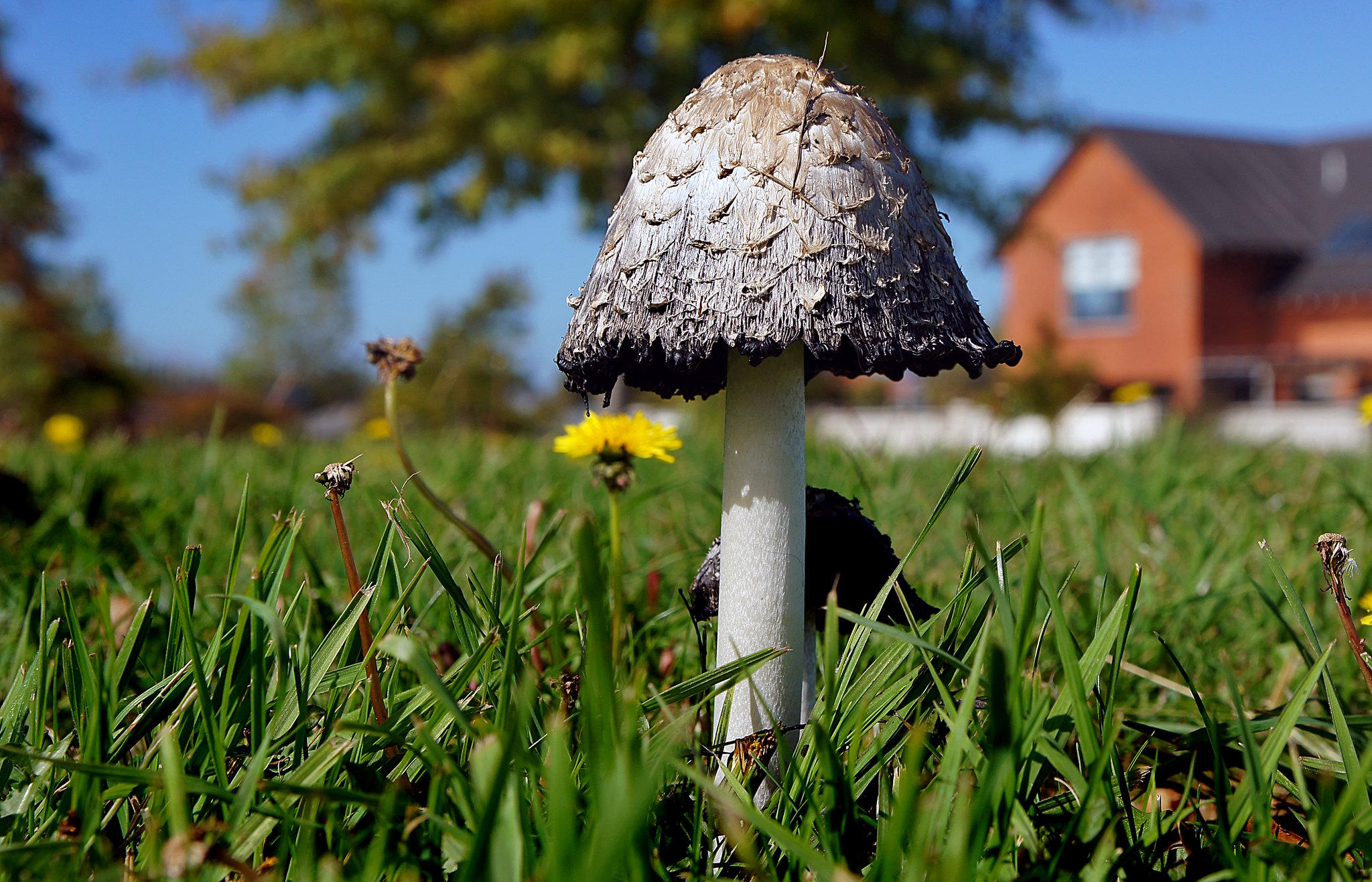
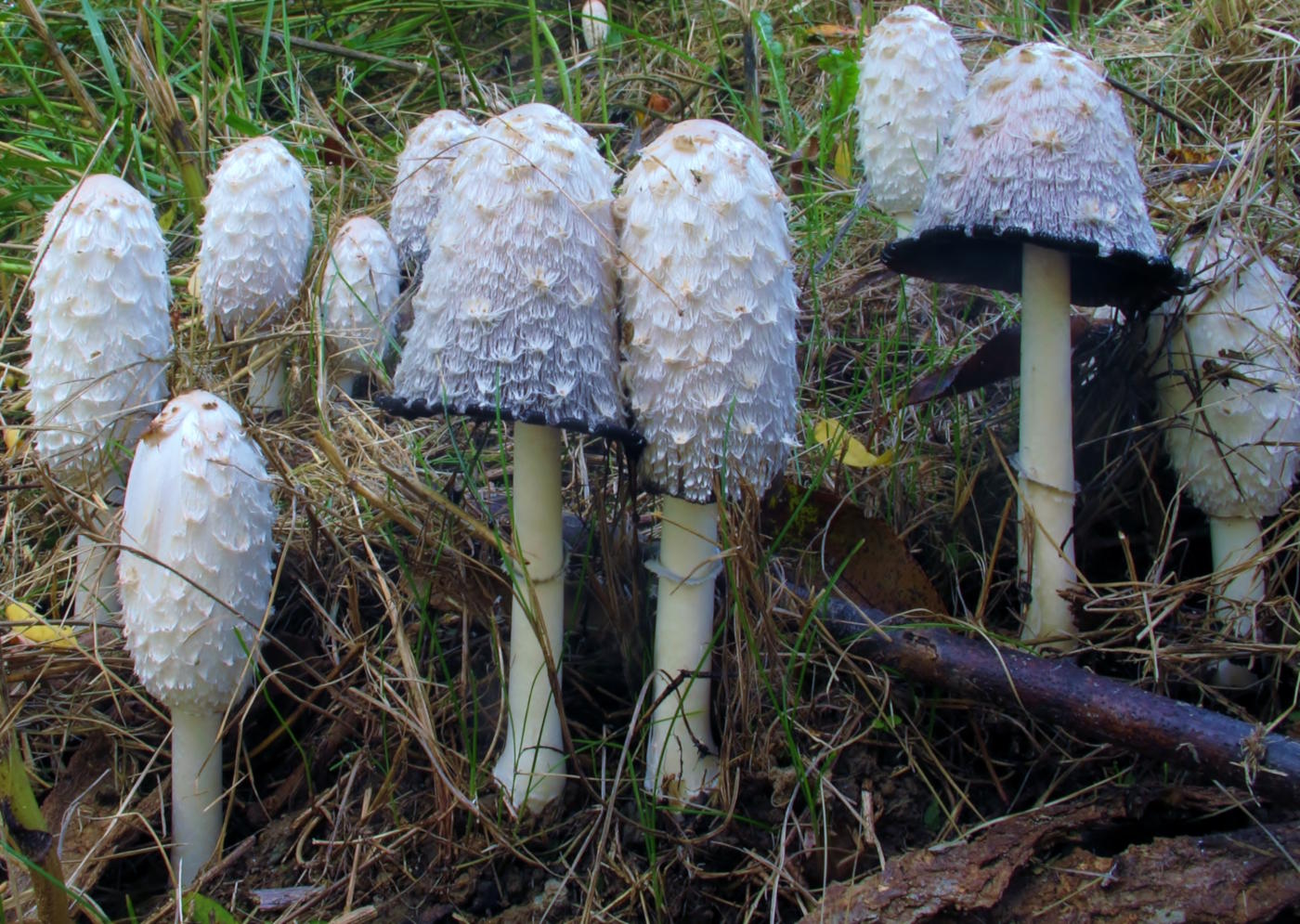
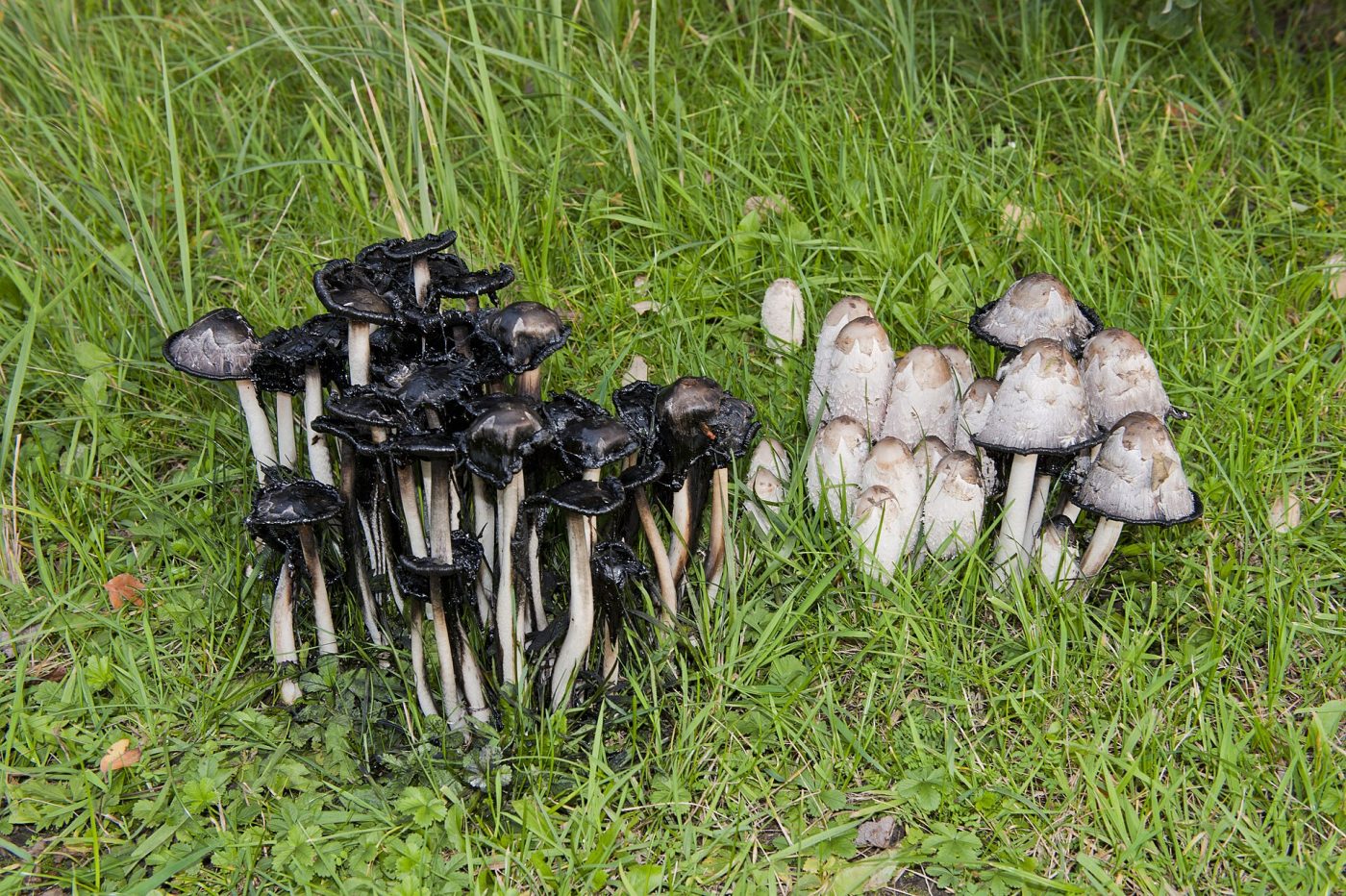
    Coprinus comatus, commonly known as the Shaggy Mane or Lawyer’s Wig, is one of the most distinctive mushrooms found in lawns, parks, roadsides and disturbed ground. Young specimens have tall white cylindrical caps covered with shaggy scales, but the mushroom changes dramatically as it matures.

    Within a short period, the cap opens, the gills turn from white to pink and then black, and the mushroom begins to dissolve into a dark ink-like liquid. This process, known as deliquescence, makes mature Shaggy Manes almost unrecognizable compared with young fruit bodies.

    ⚠️ Important: This guide is for identification and education only. Never eat a wild mushroom based solely on a photograph, AI result, or comparison with an online guide.

    Quick Identification

    Feature Coprinus comatus
    Scientific name Coprinus comatus
    Common names Shaggy Mane, Shaggy Ink Cap, Lawyer’s Wig
    Family Agaricaceae
    Young cap Tall, cylindrical, white and shaggy
    Mature cap Bell-shaped, darkening from the edge
    Gills White, then pink, then black
    Stem Tall, white, hollow
    Ring Thin and movable or easily detached
    Spore print Black
    Habitat Lawns, roadsides, parks and disturbed ground
    Growth Solitary, scattered or in groups
    Main season Usually spring through autumn
    Edibility Edible when young and correctly identified
    Main look-alikes Common Ink Cap, Magpie Inkcap, other inkcaps

    What Does Coprinus comatus Look Like?

    A young Shaggy Mane has a distinctive elongated cap that resembles a closed umbrella, white cylinder or narrow egg. The cap is covered with loose white scales, often with a tan or light brown patch at the top.

    As the mushroom grows, the lower edge begins to separate from the stem and darken. The cap gradually becomes bell-shaped while the outer edge turns pinkish, gray and eventually black.

    The transformation can happen quickly, particularly during warm or wet weather. A fresh mushroom in the morning may already be partly liquefied by later the same day.

    Cap

    The cap is usually around 5–15 cm tall when fully developed, although size varies. Young specimens are much taller than they are wide and often completely surround the upper section of the stem.

    The shaggy scales are one of the species’ most recognizable features. They create a rough, torn or feathery surface rather than the smooth cap seen in many other lawn mushrooms.

    The center of the cap may remain pale brown or tan even while the rest is bright white. As deliquescence begins, the margin darkens first and the blackened area gradually moves upward.

    Gills

    The gills are initially white and tightly packed. As spores mature, they become pale pink, then deeper gray or purple-black, and finally black.

    This color progression occurs rapidly. Once the gills darken, the surrounding cap tissue begins to break down and release spores in a dark liquid.

    The changing gill color is an important identification feature, but mature blackened specimens can be difficult to distinguish from other inkcaps.

    Stem

    The stem is tall, slender, white and usually hollow. It often becomes exposed as the cap expands upward.

    A thin ring may occur around the lower or middle portion of the stem. Unlike the substantial fixed rings of many Amanitas, the Shaggy Mane ring is delicate and may move or disappear.

    The stem is usually smooth or only slightly fibrous, contrasting with the strongly shaggy cap.

    Spore Print

    The spore print is black. Obtaining a conventional spore print can be difficult from very mature fruit bodies because the cap may begin dissolving before the process is complete.

    A fresh specimen with partially opened gills is more suitable. Black spore color helps distinguish Shaggy Mane from many pale lawn mushrooms, although other inkcaps also produce dark spores.

    Spore print should therefore support, rather than replace, the characteristic cap structure and developmental changes.

    What Is Deliquescence?

    Deliquescence is the self-dissolving process that gives many inkcaps their common name. As the mushroom matures, enzymes break down the gills and cap tissue into a black liquid.

    This process helps expose and release mature spores. It also means that Shaggy Manes have a very short window between fresh maturity and complete collapse.

    Not all related inkcaps dissolve to the same degree, but Coprinus comatus is a classic example of the phenomenon.

    Where Does Shaggy Mane Grow?

    Shaggy Manes usually grow from soil rather than wood. They prefer nutrient-rich, disturbed environments and often appear in places strongly influenced by human activity.

    Common habitats include lawns, parks, roadside verges, garden edges, paths, playing fields and recently disturbed soil. They can also appear in meadows and open woodland edges.

    This preference for disturbed ground means they are frequently encountered in towns and suburban areas rather than only in wild forests.

    Does Coprinus comatus Grow in Lawns?

    Yes. Lawns are one of the classic habitats for Shaggy Mane.

    The mushrooms often appear after rain and can emerge rapidly from apparently ordinary grass. Sometimes they occur in large groups, while at other times only a few fruit bodies appear.

    Because lawns also support poisonous species, habitat alone is never enough for identification. The tall shaggy cap and distinctive deliquescence remain much more useful.

    When Does Shaggy Mane Grow?

    Shaggy Manes can appear from spring through autumn, with fruiting often increasing after periods of rain and cooler weather.

    In temperate regions, large flushes are especially common during autumn. Mild climates may support additional fruiting periods outside this main season.

    The same location can produce mushrooms repeatedly because the underground mycelium remains in the soil after the visible fruit bodies disappear.

    Is Coprinus comatus Edible?

    Yes. Young Shaggy Manes are widely regarded as edible when correctly identified.

    Only specimens with white or very pale gills are normally considered suitable for food. Once the gills begin turning pink or black, the mushroom deteriorates quickly and should no longer be treated as a fresh edible specimen.

    Because the mushroom changes so rapidly after harvesting, it is usually cooked soon after collection.

    Shaggy Mane and Alcohol

    Shaggy Mane is often confused with the Common Ink Cap, Coprinopsis atramentaria, which contains coprine and can cause unpleasant reactions when consumed with alcohol.

    Coprinus comatus is not generally considered to cause the classic coprine-alcohol reaction associated with the Common Ink Cap. This distinction is important because older mushroom guides sometimes create confusion by grouping many inkcaps together.

    Even so, accurate identification remains essential before consumption because similar-looking species may have different properties.

    Coprinus comatus Look-Alikes

    The Shaggy Mane is fairly distinctive when young, but confusion becomes more likely with older specimens or other tall inkcaps. The most useful differences involve cap texture, growth form, color and how the mushroom changes with age.

    Coprinopsis atramentaria — Common Ink Cap

    • Scientific name: Coprinopsis atramentaria
    • Common names: Common Ink Cap, Tippler’s Bane

    The Common Ink Cap often grows in dense clusters around buried wood, old stumps and tree roots. Its cap is smooth to slightly grooved and gray or gray-brown rather than strongly shaggy and white.

    Both species eventually darken and deliquesce, but the young forms look quite different. Shaggy Mane has a tall white scaly cap, while Common Ink Cap is usually smoother and more bell-shaped.

    The Common Ink Cap contains coprine, which can interfere with alcohol metabolism and cause flushing, nausea, headache and other unpleasant symptoms if alcohol is consumed around the same time.

    Shaggy Mane vs Common Ink Cap

    Feature Coprinus comatus Coprinopsis atramentaria
    Young cap Tall, white and shaggy Gray to gray-brown, smoother
    Scales Prominent Weak or absent
    Growth Solitary or grouped Often dense clusters
    Substrate Soil Often buried wood or roots
    Deliquescence Strong Strong
    Alcohol interaction Not typical Coprine reaction possible
    Edibility Edible when young and correctly identified Complicated by alcohol interaction

    This comparison is most useful with young mushrooms. Once both species have begun dissolving into black liquid, many of their distinguishing features are lost.

    Coprinopsis picacea — Magpie Inkcap

    • Scientific name: Coprinopsis picacea
    • Common names: Magpie Inkcap, Magpie Fungus

    The Magpie Inkcap is a striking species with a dark brown to almost black cap decorated with large white patches. It often grows in deciduous woodland rather than open lawns.

    Young specimens can have a tall shape somewhat reminiscent of Shaggy Mane, but the dark background color under the white patches quickly separates the two.

    The overall appearance resembles the black-and-white plumage of a magpie, which explains the common name.

    Coprinellus micaceus — Mica Cap

    • Scientific name: Coprinellus micaceus
    • Common name: Mica Cap

    Mica Caps are much smaller than typical Shaggy Manes and grow in clusters from buried wood, tree bases and decaying roots.

    Their caps are honey-brown to amber and may be covered in tiny reflective granules when young. These granules can wash away after rain.

    They also darken with age, but their size, color and clustered growth pattern make them quite different from the tall white Shaggy Mane.

    Leucocoprinus Species

    Some pale Leucocoprinus species have white scaly caps and can superficially resemble young Shaggy Manes.

    However, they usually have a more conventional umbrella-shaped cap rather than the elongated cylindrical form of Coprinus comatus. They also do not undergo the dramatic black deliquescence characteristic of inkcaps.

    The gills generally remain pale rather than passing rapidly through pink to black.

    How to Identify Shaggy Mane Step by Step

    Begin with the cap shape. A young Shaggy Mane should be tall, cylindrical or elongated and covered with conspicuous shaggy white scales.

    Next, examine the gills. Fresh specimens begin with white gills that gradually become pink and then black as the mushroom matures.

    Finally, consider habitat and aging behavior. Growth from disturbed soil combined with rapid black deliquescence strongly supports Coprinus comatus.

    If the mushroom has a smooth gray cap or is growing in a dense cluster around buried wood, another inkcap species may be more likely.

    How to Photograph Shaggy Mane for Identification

    Photograph young specimens before they begin to dissolve. The complete cap shape and shaggy scales are easiest to evaluate at this stage.

    Take an additional image of the gills if the cap has opened enough to expose them. A wider photograph showing the lawn, roadside or other substrate can provide useful habitat information.

    If several mushrooms at different ages are present, include them in the same series. The transition from white cylindrical cap to black deliquescing fruit body is highly characteristic.

    Can Shaggy Mane Be Identified From a Photo?

    Young typical specimens are among the easier lawn mushrooms to recognize from photographs because the tall white shaggy cap is distinctive.

    Confidence decreases as the mushroom matures. Once most of the cap has turned black and dissolved, structural differences between inkcap species become much harder to see.

    AI identification can therefore work well on fresh specimens but should still be checked against habitat, cap texture and gill development.

    Why Does Shaggy Mane Turn Black?

    The black color comes from mature spores and the breakdown of cap tissue during deliquescence.

    The process starts at the edge of the cap and gradually moves upward. Pinkish gills indicate the beginning of maturation, followed by dark gray and eventually black tissue.

    This rapid change is normal and does not mean the mushroom has been attacked by mold or disease.

    Why Does Shaggy Mane Appear So Quickly?

    The underground fungus can remain hidden in soil for long periods. When moisture and temperature become favorable, fruit bodies can develop very rapidly.

    After rain, a cluster may seem to appear almost overnight. Because the mushrooms also mature and dissolve quickly, their entire visible life cycle can be remarkably short.

    This makes timing important for both observation and photography.

    Does Shaggy Mane Grow on Wood?

    It normally appears terrestrial, growing from soil rather than directly from visible wood.

    However, disturbed ground can contain buried organic material, and other inkcap species commonly grow from buried roots and timber. If a mushroom is tightly clustered around an old stump or tree base, Coprinopsis or Coprinellus species should also be considered.

    Substrate is therefore useful for distinguishing look-alikes.

    Interesting Facts About Coprinus comatus

    The species name comatus means “hairy” or “shaggy,” referring to the scales covering the cap. The common name Lawyer’s Wig compares the young white cap with the traditional curled wigs once worn in legal courts.

    Shaggy Mane was historically grouped with many other inkcaps in the genus Coprinus. Modern classification has moved numerous former members into genera such as Coprinopsis and Coprinellus, while Coprinus comatus remains in Coprinus.

    This means mushrooms commonly called “inkcaps” are not necessarily each other’s closest relatives, despite sharing similar deliquescing behavior.

    Frequently Asked Questions

    What does a Shaggy Mane mushroom look like?

    A young Shaggy Mane has a tall cylindrical white cap covered with shaggy scales. As it matures, the cap opens and the gills progress from white to pink and then black.

    Where does Coprinus comatus grow?

    It commonly grows in lawns, parks, roadsides, paths and other disturbed soils.

    Is Shaggy Mane edible?

    Yes, young correctly identified specimens with white gills are widely regarded as edible. Mature darkening mushrooms deteriorate rapidly and are not suitable as fresh edible specimens.

    Why does Shaggy Mane turn into black liquid?

    The mushroom undergoes deliquescence, an enzymatic process that breaks down the cap and gills while spores mature.

    Does Shaggy Mane react with alcohol?

    The classic alcohol reaction is associated with Coprinopsis atramentaria, the Common Ink Cap, rather than Coprinus comatus.

    What is the main Shaggy Mane look-alike?

    The Common Ink Cap is an important comparison, especially because both eventually dissolve into black liquid. Young specimens are easier to separate by cap texture and color.

    What color is the Shaggy Mane spore print?

    The spore print is black.

    Do Shaggy Manes grow in groups?

    Yes. They may appear singly, scattered or in groups, sometimes with many fruit bodies emerging from the same area.

    When do Shaggy Manes grow?

    They can fruit from spring through autumn, with especially large flushes often occurring after rain.

    Can you identify Shaggy Mane after it turns black?

    Identification becomes much harder once the cap has largely deliquesced. Young specimens preserve the most useful characteristics.

    Final Identification Notes

    A typical Coprinus comatus combines a tall cylindrical white cap covered in shaggy scales, a slender white stem, gills that change from white to pink and then black, and growth from lawns or other disturbed soil.

    Its rapid transformation is just as characteristic as its initial appearance. The cap gradually opens and dissolves into black liquid, sometimes within hours of reaching maturity.

    The most important look-alike is the Common Ink Cap, which is generally smoother, grayer and more strongly associated with buried wood and dense clusters. For the strongest identification, combine cap texture, gill development, substrate, growth pattern and the characteristic deliquescence.

  • Amanita phalloides: Death Cap Identification, Habitat and Look-Alikes

    Amanita phalloides: Death Cap Identification, Habitat and Look-Alikes

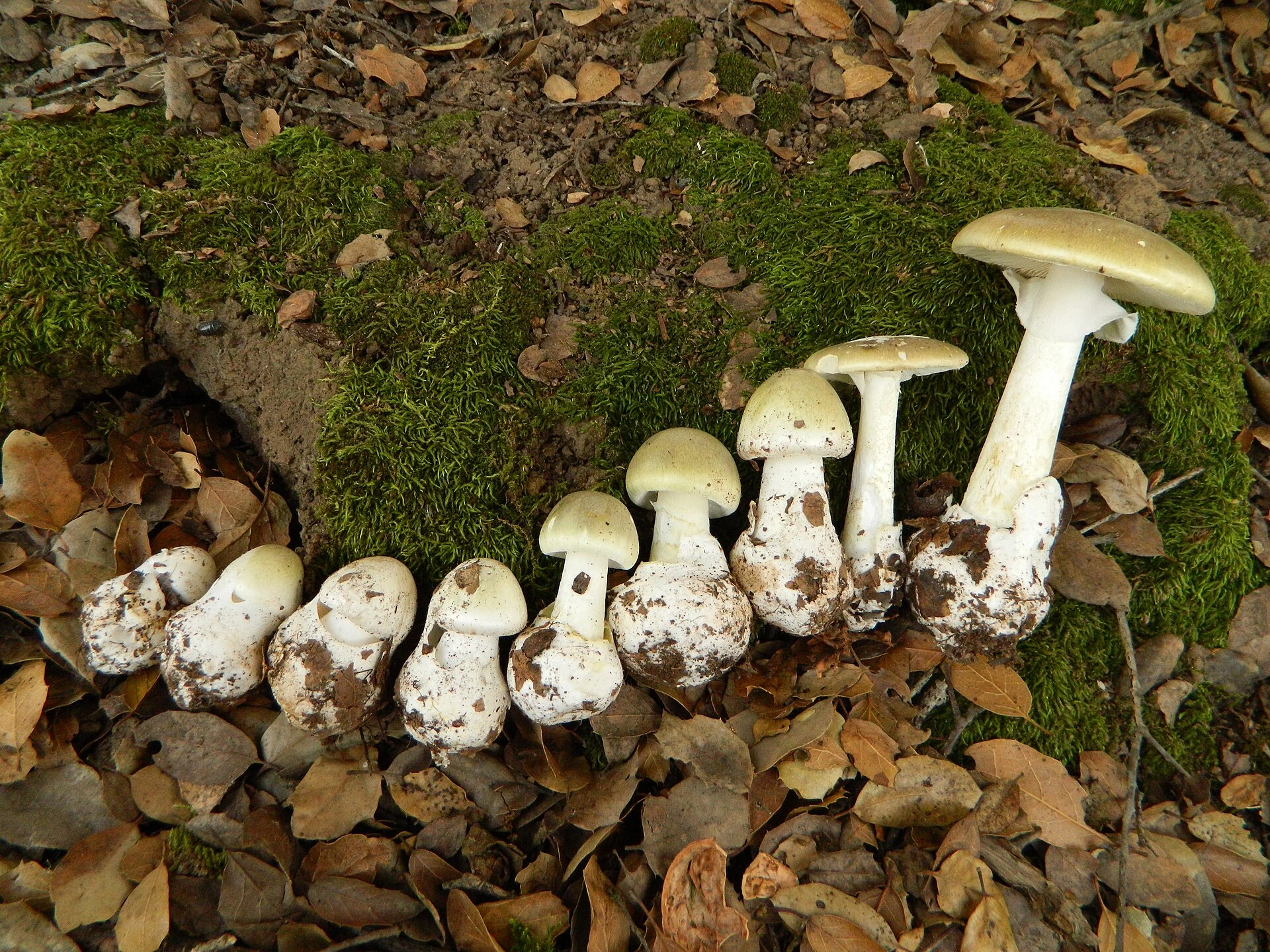
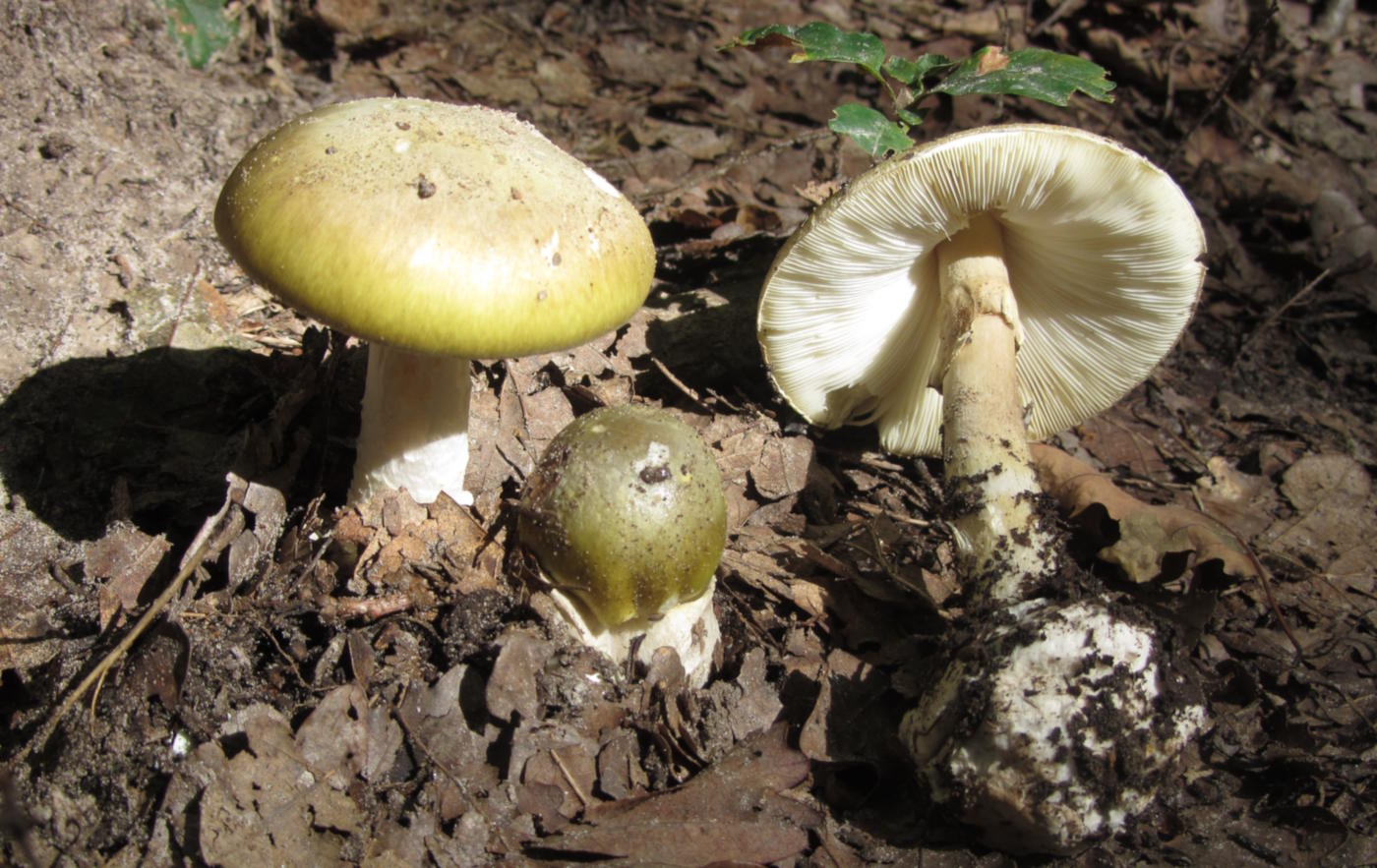
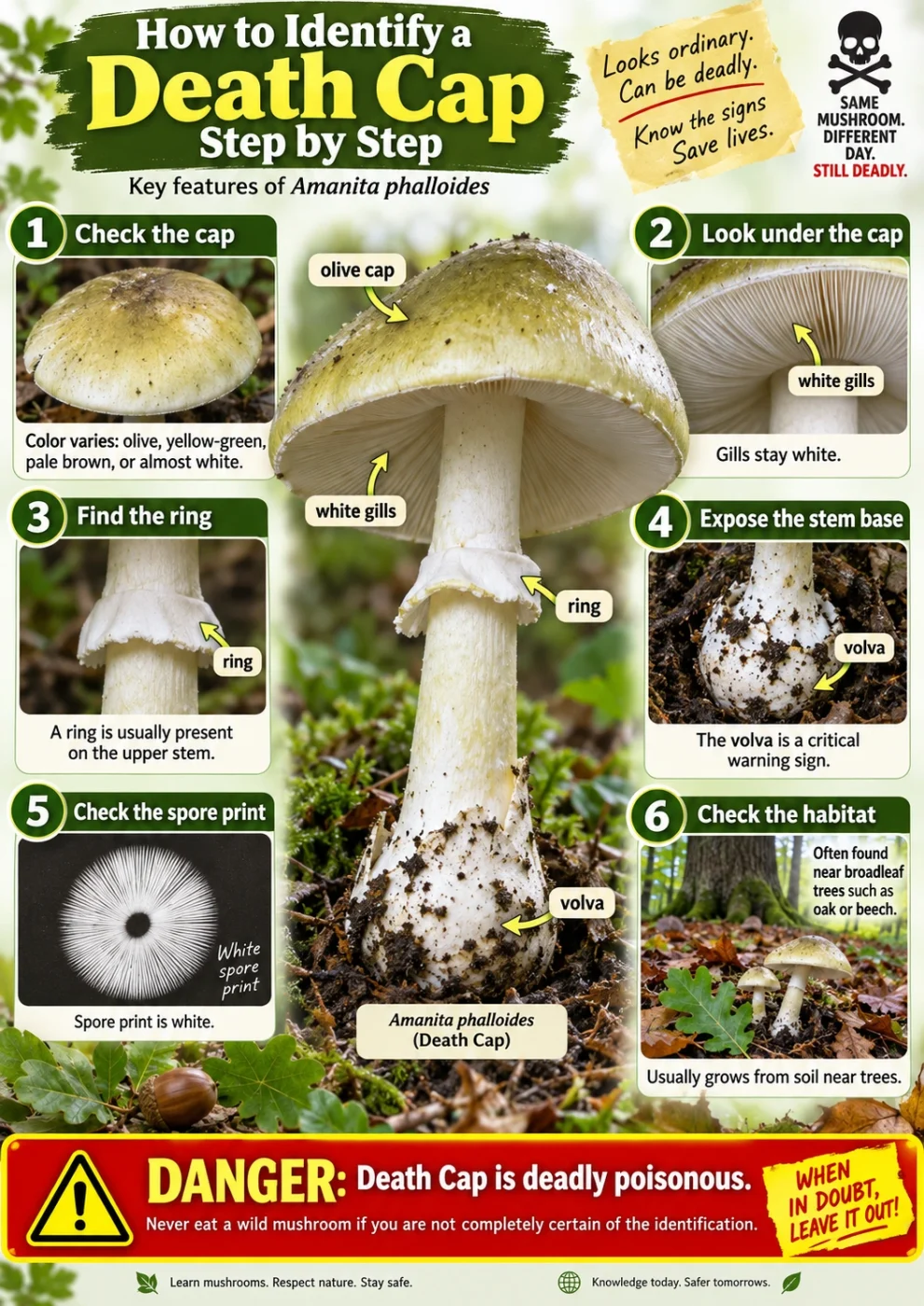
    Amanita phalloides, commonly known as the Death Cap, is one of the most dangerous poisonous mushrooms in the world. It contains amatoxins that can cause severe liver failure, and poisoning may initially appear deceptively mild because symptoms are often delayed for many hours.

    The species is especially dangerous because it does not look dramatic or obviously toxic. Its cap can be olive green, yellow-green, pale brown, grayish, or almost white, and inexperienced collectors may confuse it with edible mushrooms such as Agaricus, some Russula, or young puffball-like fungi.

    ⚠️ Important: This guide is for identification and education only. Never eat a wild mushroom based solely on a photograph, AI result, or comparison with an online guide.

    Quick Identification

    Feature Amanita phalloides
    Scientific name Amanita phalloides
    Common name Death Cap
    Family Amanitaceae
    Cap Olive green, yellow-green, brownish, grayish, or pale
    Gills White, crowded, free from the stem
    Stem Pale, often with a ring
    Stem base Distinct sack-like volva
    Spore print White
    Habitat Woodland, parks, areas near host trees
    Ecology Ectomycorrhizal
    Common hosts Oak, beech, chestnut, hazel and other broadleaf trees
    Main season Usually late summer through autumn
    Toxicity Deadly poisonous
    Main toxins Amatoxins

    What Does Amanita phalloides Look Like?

    The Death Cap has the classic Amanita structure: a smooth cap, pale gills, a central stem, a ring, and a volva surrounding the stem base. The overall appearance is elegant and often quite ordinary, which is one reason the species is so dangerous.

    Cap color is highly variable. Many specimens are olive green or yellow-green, but some can be pale brown, grayish, cream, or nearly white. This means that the absence of a green cap does not rule out Amanita phalloides.

    Cap

    The cap begins rounded or hemispherical and gradually becomes convex, then almost flat as the mushroom matures. Mature caps are often around 5–15 cm across.

    The surface is usually smooth and may become slightly sticky when wet. White veil remnants are generally absent or sparse, unlike the prominent white warts commonly seen on Amanita muscaria.

    The margin is usually smooth rather than strongly striated. Color can be darker toward the center and paler toward the edge, but this pattern varies considerably.

    Gills

    The gills remain white to cream throughout development. They are crowded and usually free from the stem, meaning they stop just before reaching it.

    This persistent white gill color is an important distinction from many Agaricus species, whose gills typically begin pink and become brown with age.

    Young specimens can still be difficult to interpret, so gill color should always be combined with the stem base and other Amanita features.

    Stem

    The stem is pale, usually white to cream, and may show faint greenish or grayish tones. A ring is normally present around the upper portion of the stem, though it can become damaged or disappear in older specimens.

    The stem may have a slightly fibrous or patterned surface rather than being completely smooth. Its base widens into a bulb enclosed by the volva.

    The ring alone is not enough for identification because many edible and poisonous mushrooms also have rings.

    The Volva

    The volva is one of the most important features of the Death Cap. It forms a white, sack-like cup around the swollen base of the stem.

    This structure can be partly or completely buried in soil or leaf litter. If the mushroom is cut off at ground level, the volva may be left behind and one of the strongest warning signs can be missed.

    For this reason, unknown pale mushrooms should be removed intact when identification is necessary. The whole stem base should be visible before an Amanita can be evaluated properly.

    Spore Print

    The spore print of Amanita phalloides is white. This supports identification as an Amanita but is not enough to separate it from other white-spored species.

    Spore color is most useful when combined with white gills, a ring, a volva, and the overall structure of the mushroom.

    Flesh

    The flesh is white and does not usually show dramatic bruising reactions. It may have a mild or slightly sweet odor when young, becoming more unpleasant in older specimens.

    Smell is too subjective to use as a primary identification feature. Different people may describe the same mushroom differently, and age can change the odor.

    The lack of vivid staining can make the mushroom seem less suspicious, but toxicity has no reliable relationship with visible color changes.

    Where Does the Death Cap Grow?

    Amanita phalloides is ectomycorrhizal, meaning it forms a symbiotic relationship with tree roots. It typically grows from soil near suitable broadleaf trees rather than directly from dead wood.

    Common host trees include oak, beech, chestnut, hazel, and other deciduous species. In some regions, the mushroom can also occur with introduced trees in parks, urban plantings, and residential areas.

    This ability to grow in landscaped environments is important because Death Caps are not restricted to remote forests.

    Distribution

    The Death Cap is native to Europe and is widespread across many temperate regions there. It has also been introduced to other parts of the world, including North America, Australia, and other regions where suitable host trees were planted.

    In introduced areas, the species can spread with host trees and establish new populations. This is why local identification knowledge matters even outside Europe.

    The mushroom may be common in one region and absent or rare in another.

    When Does Amanita phalloides Grow?

    The main fruiting season is usually late summer through autumn, especially after periods of rain. Exact timing depends on climate, rainfall, altitude, and geographic region.

    In mild climates, fruiting can continue later into the year. The same site may produce Death Caps repeatedly across multiple seasons if the underground mycelium remains active.

    Season is useful as supporting information, but it should never override structural identification.

    Why Is Amanita phalloides So Dangerous?

    The Death Cap contains amatoxins, which inhibit essential cellular processes and can cause catastrophic liver damage. The kidneys and other organs may also be affected.

    One of the most dangerous features of amatoxin poisoning is the delay before symptoms appear. A person may feel normal for many hours after eating the mushroom.

    When symptoms begin, they often include severe vomiting, diarrhea, abdominal pain, and dehydration. This can be followed by a temporary period of apparent improvement even while liver injury continues.

    Severe cases may progress to liver failure, multi-organ failure, and death.

    What Happens After Death Cap Poisoning?

    The poisoning pattern often develops in stages. The first stage may be symptom-free, followed by severe gastrointestinal illness several hours later.

    After this, the patient may seem to recover temporarily. This apparent improvement is dangerous because internal organ damage can continue during the quiet phase.

    Later, signs of liver failure can appear, including jaundice, bleeding problems, confusion, and severe metabolic disturbances.

    Suspected Death Cap ingestion is a medical emergency, even if the person feels well.

    Amanita phalloides Look-Alikes

    The Death Cap can resemble several edible or harmless mushrooms, especially when the cap is unusually pale. The most dangerous errors usually involve young or incomplete specimens.

    The best identification approach is to compare the complete mushroom, including the stem base.

    Agaricus Species

    Young Agaricus mushrooms can have pale caps and rings and may appear superficially similar from above. The important difference is in the gills.

    Agaricus gills typically begin pink and become dark brown as spores mature. Death Cap gills remain white.

    Another major difference is the volva. Agaricus species do not have the sack-like volva found at the base of Amanita phalloides.

    Russula Species

    Some pale or greenish Russula species can resemble a Death Cap when only the cap is visible. However, Russulas typically lack both a ring and a volva.

    Their flesh is also brittle and snaps rather than tearing into fibrous strands. This texture can be useful once the specimen is handled.

    From above alone, though, confusion is possible.

    Amanita caesarea and Related Edible Amanitas

    Edible Amanitas can also create identification problems, particularly in regions where collectors seek Caesar’s Mushroom or related species.

    Because the genus contains both edible and deadly species, identification within Amanita requires particular caution. Cap color alone is never enough.

    The gills, stem color, ring, volva, and regional species all need to be considered together.

    Young Puffballs

    Very young Amanitas are enclosed in a universal veil and can appear like white eggs or rounded balls before the cap expands.

    This can lead to confusion with edible puffballs. The safest check is to cut the specimen vertically through the center.

    A true young puffball should be uniformly white inside. A young Amanita may reveal a developing cap, gills, and stem within the outer tissue.

    Death Cap vs Field Mushroom

    Feature Amanita phalloides Agaricus campestris
    Cap Olive, pale, brownish, or nearly white White to cream
    Young gills White Pink
    Mature gills White Dark brown
    Spore print White Dark brown
    Ring Usually present Usually present
    Volva Present Absent
    Habitat Near trees Lawns and grassland
    Toxicity Deadly poisonous Edible when correctly identified

    The gill-color progression and presence of a volva are among the most useful differences. Neither should be used completely alone.

    Death Cap vs Russula

    Feature Amanita phalloides Russula species
    Cap Olive, pale, greenish, or brownish Variable
    Gills White Usually white to cream
    Ring Usually present Absent
    Volva Present Absent
    Flesh More fibrous Brittle, chalk-like
    Toxicity Deadly poisonous Varies by species

    This comparison shows why viewing only the cap and gills can still be misleading. The stem base and ring provide important additional information.

    How to Identify a Death Cap Step by Step

    Start with the overall structure. A suspected Death Cap should have pale free gills, a stem with a ring, and a sack-like volva at the base.

    Then consider cap color, habitat, and nearby trees. Olive or greenish tones are common, but pale specimens are possible.

    Finally, check the spore print and whether the mushroom fits the expected Amanita structure. If the volva is missing because the stem base was cut away, the identification becomes less reliable.

    How to Photograph Amanita phalloides for Identification

    A useful photo set should show the cap, underside, complete stem, ring, and entire stem base. The volva should be clearly visible if present.

    A wider image should include nearby trees and the exact place where the mushroom is growing. This helps determine whether the habitat fits a mycorrhizal Amanita.

    If several specimens are present, photograph both young and mature mushrooms because the cap shape and ring can change significantly with age.

    Can a Death Cap Be Identified From a Photo?

    A mature Death Cap can often be strongly suspected from good photographs, especially when the volva, ring, white gills, and cap are all visible.

    However, a single cap photo is not enough. Pale specimens can resemble edible mushrooms, while missing stem-base details can hide the most important Amanita feature.

    AI identification can help narrow the possibilities, but it should never be used as a final safety decision.

    Are Death Caps Always Green?

    No. Olive green is a classic color, but real specimens can be yellow-green, gray-green, pale brown, cream, or almost white.

    This variation is one of the main reasons cap color should never be used as the deciding feature.

    The Amanita structure is more important than the exact shade of the cap.

    Can Death Caps Grow in Parks and Gardens?

    Yes. Because the fungus grows in association with tree roots, it can appear wherever suitable host trees are present.

    Parks, residential streets, landscaped gardens, and university campuses can all provide suitable habitat. A manicured setting does not make a wild mushroom safe.

    Urban Death Caps are especially important because they may appear in places where children and pets have easy access.

    Can Animals Eat Death Caps?

    Wildlife feeding behavior is not a reliable guide to mushroom safety. Some animals can tolerate compounds that are highly toxic to humans.

    The presence of insect damage, slug bites, or animal feeding does not make a mushroom edible.

    This is another common folklore rule that should be ignored.

    Interesting Facts About Amanita phalloides

    The name “Death Cap” reflects the severe toxicity of the species, but the mushroom itself often looks surprisingly ordinary. Its understated appearance contrasts with the bright warning colors people often imagine when they think of poisonous fungi.

    The species has also become a notable invasive fungus in some parts of the world. Where suitable host trees were introduced, Amanita phalloides was able to establish outside its native European range.

    Its success as both a symbiotic fungus and an invasive species makes it important from ecological as well as medical perspectives.

    Frequently Asked Questions

    Is Amanita phalloides deadly?

    Yes. It contains amatoxins and can cause fatal liver failure.

    What does a Death Cap look like?

    It typically has a smooth olive to pale cap, white gills, a pale stem with a ring, and a sack-like volva at the base.

    Are all Death Caps green?

    No. Some specimens are pale brown, grayish, cream, or nearly white.

    What color are Death Cap gills?

    The gills remain white to cream throughout development.

    What color is the spore print?

    The spore print is white.

    Where do Death Caps grow?

    They grow from soil near host trees, especially broadleaf trees such as oak, beech, chestnut, and hazel.

    When do Death Caps appear?

    They are most common from late summer through autumn, especially after rain.

    Can Death Caps grow in lawns?

    Yes, if suitable host tree roots extend beneath the grass.

    What edible mushrooms look like Death Caps?

    Possible look-alikes include Agaricus, some Russula, and edible Amanitas. Young specimens can also be confused with puffballs.

    What should I do if someone ate a suspected Death Cap?

    Seek emergency medical or poison-control help immediately. Do not wait for symptoms, because amatoxin poisoning may have a long delay.

    Final Identification Notes

    A typical Amanita phalloides combines a smooth olive to pale cap, white free gills, a pale stem with a ring, and a sack-like volva around the base. The cap color is variable, so the Amanita structure is far more important than the exact shade.

    The most critical practical rule is to never discard the stem base before identification. A buried volva can be the feature that separates a deadly Amanita from an edible look-alike.

    When a mushroom has white gills, a ring, and a volva, it should be treated with extreme caution. If there is any uncertainty, do not eat it and seek expert identification.

  • Laetiporus sulphureus: Chicken of the Woods Identification Guide

    Laetiporus sulphureus: Chicken of the Woods Identification Guide

    Laetiporus sulphureus, commonly known as Chicken of the Woods, is one of the most striking bracket fungi found on trees. Its bright yellow to orange shelves often form large overlapping clusters, making mature specimens easy to notice from a distance.

    The species is widely known as an edible mushroom when young and correctly identified, but several similar shelf fungi can cause confusion. Accurate identification should consider color, pore structure, texture, host tree, age and the exact way the fruit body grows from wood.

    ⚠️ Important: This guide is for identification and education only. Never eat a wild mushroom based solely on a photograph, AI result, or comparison with an online guide.

    Quick Identification

    Feature Laetiporus sulphureus
    Scientific name Laetiporus sulphureus
    Common names Chicken of the Woods, Sulphur Polypore
    Family Fomitopsidaceae
    Shape Overlapping shelf-like brackets
    Cap color Bright orange to yellow-orange
    Underside Yellow pores, no gills
    Stem Usually absent
    Flesh Soft and moist when young, tougher with age
    Spore print White
    Substrate Living or dead wood
    Common hosts Mainly deciduous trees
    Growth pattern Dense overlapping clusters
    Main season Usually summer through autumn
    Edibility Edible when young and correctly identified
    Main look-alikes Other Laetiporus, Meripilus, Bondarzewia, some orange polypores

    What Does Laetiporus sulphureus Look Like?

    Chicken of the Woods typically forms large shelves that grow directly from trunks, stumps or large branches. The caps are usually fan-shaped or semicircular and overlap in tiers, creating a layered mass that can become very large.

    Fresh young specimens are vivid yellow and orange, often with a brighter yellow margin. As they age, the colors fade toward pale orange, cream or dirty yellow, and the flesh becomes much tougher.

    This color transition is useful because the best identification features are usually strongest in young, healthy fruit bodies.

    Cap

    The upper surface is usually smooth to slightly wrinkled and lacks the scales seen in many other bracket fungi. Color is most intense when the mushroom is young, ranging from sulphur yellow at the edges to orange or reddish orange toward the center.

    Individual shelves can become broad and thick, and several may fuse together into a large cluster. The margin is usually rounded when young and becomes thinner, wavier and less regular with age.

    Cap color alone is not enough for identification, but the combination of bright orange-yellow shelves and a yellow pore surface is highly characteristic.

    Underside and Pores

    The underside of Laetiporus sulphureus has pores rather than gills. These pores are small, closely packed and usually yellow in fresh specimens.

    This is one of the most important features to check. A mushroom with true gills is not Chicken of the Woods, even if the cap is orange and shelf-like.

    As the fruit body ages, the pore surface may become paler. Older specimens can lose much of the vivid yellow coloration that makes younger clusters so distinctive.

    Stem and Attachment

    Chicken of the Woods usually has no obvious stem. The brackets attach directly to the wood along a broad base.

    Some fruit bodies develop a narrowed attachment area, but they do not normally form the classic cap-and-central-stem structure seen in many ground-growing mushrooms.

    The attachment point can help distinguish Laetiporus from other orange mushrooms that merely grow near wood rather than directly from it.

    Flesh and Texture

    Young flesh is soft, moist and tender, often with a texture that has inspired the common name “Chicken of the Woods.” The inside is usually pale yellow to cream.

    As the mushroom matures, the flesh becomes fibrous, dry and eventually corky. Older brackets can remain attached to the tree long after they are no longer suitable as food.

    Texture is therefore useful both for identification and for judging age.

    Spore Print

    The spore print is white. This can support identification, although spore color is less distinctive here than in many gilled mushrooms.

    Because several bracket fungi also produce pale spores, the spore print should be considered together with color, pores, host tree and growth form.

    Where Does Chicken of the Woods Grow?

    Laetiporus sulphureus grows directly from wood. It may occur on living trees, dead standing trunks, stumps and large fallen logs.

    It is mainly associated with deciduous trees and can be found on oak, willow, poplar, beech, cherry and other broadleaf hosts. Exact preferences vary by region.

    The fungus causes brown rot in wood, breaking down structural components and weakening the host. On living trees, fruiting can indicate significant internal decay.

    Does It Grow on Living Trees?

    Yes. Chicken of the Woods can fruit on trees that are still alive because the fungus may be decomposing heartwood inside the trunk.

    A tree can therefore produce a large cluster of fruit bodies while still carrying green leaves. The visible brackets may be the first obvious sign that internal decay is present.

    From an identification perspective, growth on a living tree is entirely consistent with Laetiporus sulphureus.

    When Does Chicken of the Woods Grow?

    The main fruiting period is usually summer through autumn, although timing varies with climate, rainfall and latitude.

    Fresh clusters often appear after warm, wet periods. Once established on a suitable host, the fungus may fruit again from the same tree in later years.

    Season is a useful supporting clue, but it should never override structural features.

    Is Chicken of the Woods Edible?

    Yes. Young Laetiporus sulphureus is widely regarded as edible when correctly identified and properly cooked.

    The best fruit bodies are usually young, soft and brightly colored. Older shelves become tougher and less pleasant in texture.

    Some people experience gastrointestinal discomfort after eating Laetiporus, so even correctly identified specimens may not suit everyone. Thorough cooking and trying only a small amount initially are commonly recommended practices.

    Chicken of the Woods Look-Alikes

    The main look-alikes are other large bracket fungi growing on wood. Most are easier to separate once the underside, texture and color are examined carefully.

    The most useful combination for Chicken of the Woods is bright orange-yellow shelves + yellow pore surface + no gills + growth directly from wood.

    Other Laetiporus Species

    Several closely related Laetiporus species can resemble L. sulphureus very closely. In North America especially, different species may prefer different host trees or produce slightly different color patterns.

    Some have pale or whitish pore surfaces rather than the bright yellow underside typical of classic L. sulphureus. Because the genus is regionally complex, species-level identification may require more than appearance alone.

    For practical field identification, recognizing the Laetiporus group correctly is often easier than determining the exact species from photographs.

    Meripilus giganteus — Giant Polypore

    • Scientific name: Meripilus giganteus
    • Common name: Giant Polypore

    Giant Polypore can form large overlapping clusters at the base of trees and may initially resemble Chicken of the Woods from a distance. However, its colors are generally brown, cream and gray rather than vivid orange-yellow.

    A particularly useful clue is that Meripilus flesh and pore surfaces often darken strongly when bruised or damaged. The fruit bodies are also usually more subdued in color and can become enormous.

    Main Difference

    Chicken of the Woods is bright orange-yellow and usually does not show the same dramatic blackening reaction. Giant Polypore is duller and commonly darkens after handling.

    Bondarzewia berkeleyi — Berkeley’s Polypore

    • Scientific name: Bondarzewia berkeleyi
    • Common name: Berkeley’s Polypore

    This large bracket fungus grows at the base of hardwood trees and can form massive overlapping clusters. Its caps are typically cream, tan or pale brown rather than orange.

    The fruit bodies are thicker and more muted in color, while the underside has pores. From above, a pale old Chicken of the Woods could superficially resemble it, but fresh specimens are usually easy to separate by color.

    Orange Polypores and Other Bracket Fungi

    Several unrelated bracket fungi can show orange, rust or reddish tones. Most differ in pore color, flesh texture, cap surface or host preference.

    Some are woody and hard from the beginning, unlike the soft fleshy texture of young Laetiporus. Others form thinner crusts or small shelves rather than large fleshy brackets.

    This is why checking texture and underside structure is as important as looking at cap color.

    Chicken of the Woods vs Giant Polypore

    Feature Laetiporus sulphureus Meripilus giganteus
    Cap color Bright orange to yellow Cream to brown-gray
    Underside Yellow pores Pale pores
    Bruising Usually little dramatic darkening Often darkens strongly
    Flesh Soft and tender when young Firmer and more fibrous
    Growth Overlapping shelves Massive rosette-like clusters
    Host Mainly hardwood Usually broadleaf trees
    Edibility Edible when young and correctly identified Not usually collected as a choice edible

    The color difference is usually obvious in fresh specimens, but older Chicken of the Woods can fade considerably.

    How to Identify Chicken of the Woods Step by Step

    Start with the growth form. A likely specimen should be growing directly from wood and forming several overlapping shelves rather than a single cap with a central stem.

    Next, inspect the underside. It should have tiny yellow pores rather than gills, teeth or a smooth surface.

    Then check the texture and color. Young fruit bodies should be soft, fleshy and brightly orange-yellow. Finally, consider the host tree and season as supporting evidence.

    How to Photograph Chicken of the Woods for Identification

    Photograph the entire cluster from the side so the layered growth pattern is visible. A second image should show the pore surface underneath.

    Include a close-up of the flesh and attachment point if possible. A wider photo of the tree or log can help determine whether the fungus is growing on hardwood or another substrate.

    Multiple angles are more useful than one close-up because the overall architecture is a major identification feature.

    Can Chicken of the Woods Be Identified From a Photo?

    Typical young specimens are among the easier bracket fungi to recognize from good photographs. Their bright colors, overlapping shelves and yellow pore surface form a distinctive combination.

    Problems arise with old faded fruit bodies or unusual regional Laetiporus species. A photo of the upper surface alone can also hide the pore structure and make confusion more likely.

    AI identification can help narrow the possibilities, but the underside, texture and host wood should still be checked manually.

    Why Does Chicken of the Woods Change Color?

    Fresh growth is usually the brightest. As the mushroom ages, sunlight, drying and weathering gradually reduce the orange and yellow tones.

    Older shelves may become pale cream, chalky yellow or almost white at the edges. Once the colors fade, the fruit body can look much less distinctive.

    This is why very old specimens are more difficult to identify from color alone.

    Can Chicken of the Woods Grow on Conifers?

    The classic Laetiporus sulphureus is mainly associated with deciduous trees, but other Laetiporus species can occur on different hosts, including conifers in some regions.

    Host tree is therefore useful but not absolute. A bright orange bracket on conifer wood may still belong to Laetiporus, but species-level identification becomes more important.

    Regional field guides can be especially helpful in areas where several Laetiporus species overlap.

    Is Chicken of the Woods Always Bright Orange?

    No. Young specimens are usually vivid, but mature fruit bodies can fade considerably.

    Some related Laetiporus species are naturally paler, and environmental conditions also influence color. The safest identification uses color together with pore structure, texture, substrate and growth form.

    A pale bracket should never be identified as Chicken of the Woods based on shape alone.

    Interesting Facts About Laetiporus sulphureus

    The common name comes from the texture of young fruit bodies, which many people compare with cooked chicken. The species has been collected as a wild food for generations in many regions.

    Its scientific name is also descriptive. The word sulphureus refers to the vivid sulphur-yellow coloration found on fresh fruit bodies.

    Ecologically, the fungus is an important wood decomposer. By breaking down the internal structure of trees, it plays a role in nutrient cycling while also contributing to structural decay in infected hosts.

    Frequently Asked Questions

    What does Chicken of the Woods look like?

    It forms bright orange and yellow shelves growing in overlapping clusters from wood. The underside has tiny yellow pores rather than gills.

    Where does Chicken of the Woods grow?

    It grows directly from living or dead wood, mainly on broadleaf trees such as oak, willow, poplar and beech.

    Does Chicken of the Woods have gills?

    No. The underside has a pore surface.

    What color is the underside?

    Fresh specimens usually have a yellow pore surface. Older fruit bodies may become paler.

    Is Chicken of the Woods edible?

    Young specimens are considered edible when correctly identified and thoroughly cooked. Older brackets become tough and fibrous.

    What mushrooms look like Chicken of the Woods?

    Important comparisons include other Laetiporus species, Giant Polypore, Berkeley’s Polypore and several orange or pale bracket fungi.

    Does Chicken of the Woods grow from the ground?

    It grows from wood. If it appears terrestrial, buried roots or woody material may be present underneath.

    When does Chicken of the Woods appear?

    It most commonly fruits from summer through autumn, although exact timing varies by region and weather.

    Can it grow on living trees?

    Yes. Fruiting on a living tree often indicates internal wood decay.

    How can I tell Chicken of the Woods from Giant Polypore?

    Chicken of the Woods is usually bright orange-yellow, while Giant Polypore is more brown or gray and often darkens strongly when bruised.

    Final Identification Notes

    A typical Laetiporus sulphureus combines bright orange-yellow overlapping shelves, a yellow pore surface, soft fleshy texture when young, and growth directly from wood.

    The most important checks are the underside and substrate. A mushroom with true gills is not Chicken of the Woods, and a cluster not attached to wood should be reconsidered carefully.

    Older specimens can fade and become difficult to recognize, while regional Laetiporus species may differ subtly in color and host preference. For the strongest identification, combine cap color, pores, texture, host tree, growth pattern and season.

    Found a bright orange bracket fungus? Photo identification can help narrow the possibilities, but inspect the pore surface, texture and host wood before reaching a final identification.

  • Pleurotus ostreatus: Oyster Mushroom Identification and Look-Alikes

    Pleurotus ostreatus: Oyster Mushroom Identification and Look-Alikes

    Pleurotus ostreatus, commonly known as the Oyster Mushroom, is one of the most recognizable edible mushrooms growing on wood. Its broad fan-shaped cap, pale gills running down the attachment point, and tendency to form overlapping clusters on dead or weakened trees give it a characteristic appearance.

    Oyster Mushrooms are also widely cultivated and sold commercially, but wild specimens require careful identification. Several unrelated fungi grow in a similar shelf-like form, and some can look surprisingly similar when young or photographed from only one angle. One particularly important look-alike is Pleurocybella porrigens, known as Angel Wings, which has been associated with serious and fatal poisonings.

    ⚠️ Important: This guide is intended for identification and education. Never eat a wild mushroom solely because it resembles a photograph, matches an AI result, or appears similar to cultivated Oyster Mushrooms.

    Quick Identification

    Feature Pleurotus ostreatus
    Scientific name Pleurotus ostreatus
    Common names Oyster Mushroom, Tree Oyster, Grey Oyster
    Family Pleurotaceae
    Cap Fan-shaped, shell-shaped or semicircular
    Cap color Gray, gray-brown, brown, sometimes pale
    Gills White to cream, running down the stem or attachment point
    Stem Short, lateral, eccentric, or almost absent
    Flesh Thick, white and soft-fleshy
    Spore print White to pale grayish or lilac-gray
    Substrate Dead or weakened wood
    Common hosts Mainly decididuous hardwoods
    Growth Usually overlapping clusters
    Main season Often autumn through cool weather
    Edibility Edible when correctly identified
    Important look-alikes Angel Wings, other Pleurotus, Crepidotus, Hohenbuehelia, late oyster-like fungi

    What Does Pleurotus ostreatus Look Like?

    The Oyster Mushroom typically grows sideways from wood rather than standing upright on a central stem. Its cap resembles a fan, shell or oyster, which is the origin of both the scientific name ostreatus and the common name Oyster Mushroom.

    Several fruit bodies frequently grow together in overlapping tiers. A cluster may contain small young mushrooms beside large mature caps, producing the layered appearance often seen on logs and tree trunks.

    Cap shape varies with the position of the mushroom on the wood. Specimens growing from the side of a vertical trunk may be strongly fan-shaped, while those developing on the upper surface of a fallen log can form more rounded caps with a better-developed stem.

    Cap

    The cap is usually smooth and can range from gray and bluish gray to gray-brown, tan or darker brown. Young mushrooms often have a curved margin that gradually becomes flatter or slightly wavy as the cap expands.

    Size is highly variable. Small specimens may measure only a few centimeters across, while well-developed fruit bodies can exceed 15 cm under favorable conditions.

    Color is influenced by genetics, temperature, age and environmental conditions. Because cultivated Oyster Mushrooms are often pale, people sometimes expect wild Pleurotus ostreatus to be white, but wild forms can be considerably darker.

    Gills

    The gills are one of the most useful identification features. They are usually white to cream and run noticeably down toward the attachment point, a pattern known as decurrent gills.

    When a short stem is present, the gills continue down its surface rather than ending sharply where the cap meets the stem. On nearly stemless mushrooms, the gills converge toward the point where the fruit body attaches to the wood.

    The gills are relatively crowded and may occasionally fork or connect near the base. Their pale color contrasts with the dark brown or rusty gills found in many other wood-growing mushroom groups.

    Stem

    The stem of Pleurotus ostreatus is usually short and positioned to one side rather than in the center. Some fruit bodies appear almost completely stemless and attach directly to the wood.

    When a stem is present, it is typically white, firm and continuous with the flesh of the cap. Fine white hairs or mycelial material may be visible close to the attachment point.

    Stem length alone is not a reliable identification feature. Oyster Mushrooms can develop different shapes depending on available space, orientation and growing conditions.

    Flesh

    Fresh Oyster Mushroom flesh is white, relatively thick and fleshy. Mature caps remain much more substantial than the very thin fruit bodies of some important look-alikes.

    When cut, the flesh does not usually display dramatic blue, red or yellow staining reactions. Older mushrooms can become tougher around the attachment point while remaining softer near the cap margin.

    Flesh thickness is particularly helpful when comparing Oyster Mushrooms with Angel Wings, which generally produce thinner and more delicate fruit bodies.

    Spore Print

    The spore print of Pleurotus ostreatus is pale, typically appearing white to slightly grayish or faintly lilac-gray. Because several oyster-shaped fungi also have pale spores, spore color alone cannot confirm the species.

    It is more useful when eliminating mushrooms that produce distinctly brown, rusty, pink or dark spore prints. Identification should still include the cap structure, gills, substrate, flesh and growth pattern.

    Where Do Oyster Mushrooms Grow?

    Wild Oyster Mushrooms grow from wood or woody material rather than ordinary soil. They are decomposers that break down wood and contribute to nutrient recycling in forests.

    They are most commonly associated with deciduous trees and can occur on fallen trunks, logs, stumps and standing dead trees. They may also fruit from weakened or damaged living trees where suitable dead wood is available internally.

    If an Oyster-like mushroom appears to grow directly from the ground, inspect the area carefully. Buried roots, logs or other woody debris may be hidden beneath the soil.

    Which Trees Do Oyster Mushrooms Grow On?

    Oyster Mushrooms are primarily associated with hardwoods. Depending on region, they may be found on beech, poplar, willow, maple and numerous other broadleaf trees.

    Host tree can help with identification but should not be treated as absolute proof. Closely related Pleurotus species overlap in appearance and ecology, while several unrelated oyster-shaped fungi also grow on wood.

    When photographing a suspected Oyster Mushroom, include part of the log or trunk and, when possible, leaves, bark or other features that help identify the tree.

    Do Oyster Mushrooms Grow on Living Trees?

    Yes. Oyster Mushrooms can fruit from living trees when suitable weakened or dead wood is present. A tree can still carry green leaves while internal sections of its trunk or branches are being decomposed by fungi.

    The appearance of large fungal fruit bodies on a living tree can indicate decay within the wood. From a tree-health perspective, this can be important because internal structural damage may be much greater than the external appearance suggests.

    From a mushroom-identification perspective, the essential point is that growth on a living trunk does not rule out Pleurotus ostreatus.

    When Do Oyster Mushrooms Grow?

    Pleurotus ostreatus is strongly associated with cooler conditions and is commonly found in autumn and into colder weather. In many temperate regions, fruiting becomes particularly noticeable after cool rainy periods.

    This distinguishes it somewhat from certain closely related Oyster Mushroom species that favor warmer seasons. However, climate varies greatly, and seasonal timing overlaps between species.

    Mild winters can allow Oyster Mushrooms to continue fruiting unusually late. The same log may also produce several flushes when moisture and temperature become favorable again.

    Are Oyster Mushrooms Edible?

    Yes. Pleurotus ostreatus is a widely eaten edible mushroom and one of the major cultivated mushrooms worldwide. Young caps have tender flesh and a mild flavor, while older fruit bodies can become progressively tougher.

    Wild specimens should still be identified carefully because “oyster-shaped mushroom growing on wood” is not sufficient for species-level identification. The condition of the mushroom also matters, and old, decaying or heavily insect-damaged fruit bodies should not be treated like fresh cultivated mushrooms.

    Another consideration is the substrate. Fungi can accumulate substances from their environment, so mushrooms growing on chemically treated timber or heavily contaminated sites are poor choices for food even when the species itself is edible.

    Oyster Mushroom Look-Alikes

    Most confusion involves other shelf-like mushrooms growing from wood. Some are closely related edible Pleurotus species, while others belong to completely different genera.

    The most useful combination for recognizing a typical Oyster Mushroom is a soft fleshy fruit body, pale decurrent gills, lateral attachment and growth directly from wood. Even this combination should be checked carefully because Angel Wings can share several of these characteristics.

    Pleurocybella porrigens — Angel Wings

    • Scientific name: Pleurocybella porrigens
    • Common name: Angel Wings

    Angel Wings is one of the most important Oyster Mushroom look-alikes. It forms white to ivory shelf-like mushrooms with pale gills and may grow in overlapping groups on decaying wood.

    The fruit bodies are generally thinner and more delicate than those of Pleurotus ostreatus. They are often nearly pure white and can form spoon-shaped, tongue-shaped or irregularly lobed caps with almost no stem.

    Substrate is particularly useful. Angel Wings is strongly associated with well-decayed conifer wood, while classic Pleurotus ostreatus is much more commonly encountered on deciduous hardwoods.

    Angel Wings has historically been listed as edible in some older literature, but it has been associated with serious and fatal poisoning episodes. It should therefore not be treated as an edible Oyster Mushroom substitute.

    Oyster Mushroom vs Angel Wings

    Feature Pleurotus ostreatus Pleurocybella porrigens
    Common name Oyster Mushroom Angel Wings
    Cap Gray to brown or pale Usually white to ivory
    Flesh Relatively thick and fleshy Thin and delicate
    Stem Short, lateral or absent Usually essentially absent
    Gills Pale and decurrent Pale and decurrent
    Typical wood Mainly hardwood Strongly associated with conifers
    Growth Overlapping clusters Overlapping thin shelves
    Edibility Edible when correctly identified Should not be eaten

    Color alone should not be used for this comparison because pale Oyster Mushrooms exist. Flesh thickness, substrate, overall structure and other characteristics need to be considered together.

    Pleurotus pulmonarius — Phoenix Oyster

    • Scientific name: Pleurotus pulmonarius
    • Common names: Phoenix Oyster, Indian Oyster

    This is a close relative of Pleurotus ostreatus and can be difficult to distinguish from it. It is often paler, with white, cream or light tan caps, and tends to fruit during warmer weather.

    Both species grow from wood, possess decurrent pale gills and have an oyster-like cap. The distinction can become difficult enough that photographs alone may not provide confident species-level identification.

    For ordinary identification, recognizing that a mushroom belongs to the Pleurotus group may be easier than determining exactly which closely related Oyster Mushroom species is present.

    Pleurotus eryngii — King Oyster

    • Scientific name: Pleurotus eryngii
    • Common name: King Oyster Mushroom

    King Oyster is familiar as a cultivated mushroom with a very thick central stem and relatively small cap. Wild forms also differ ecologically from the classic Oyster Mushroom and are associated with the roots of certain herbaceous plants rather than typical dead hardwood logs.

    Its substantial stem makes mature specimens quite different from the laterally attached form of Pleurotus ostreatus. However, younger or unusual specimens illustrate how variable the genus can be.

    This is another reason why one simplified rule such as “all Oyster Mushrooms have no stem” is inaccurate.

    Sarcomyxa serotina — Late Oyster

    • Scientific name: Sarcomyxa serotina
    • Common names: Late Oyster, Olive Oysterling

    The Late Oyster forms shelf-like caps on wood and can superficially resemble Oyster Mushrooms. It tends to have yellowish, olive, greenish or brownish tones and usually possesses yellowish rather than clean white flesh around the attachment area.

    Like Pleurotus ostreatus, it can appear during cool seasons. Its combination of coloration, texture and structural differences helps separate the two when specimens are well developed.

    Cap color should still be treated carefully because lighting, moisture and age can substantially alter the appearance of wood-growing fungi.

    Crepidotus Species

    Species of Crepidotus are small, laterally attached mushrooms that frequently grow from dead wood. Their fan-shaped caps can resemble miniature Oyster Mushrooms, particularly in photographs that provide no sense of scale.

    Many Crepidotus species are considerably smaller and thinner than typical mature Pleurotus ostreatus. An especially useful difference is their spore color, which tends toward brown rather than the pale spores characteristic of Oyster Mushrooms.

    Species-level identification within Crepidotus can be difficult. Small oyster-shaped mushrooms should therefore not automatically be assumed to be young Pleurotus.

    Hohenbuehelia Species

    Hohenbuehelia species can have oyster-shaped caps, lateral attachment and pale gills, making some members of the genus genuinely similar to Pleurotus.

    Several have a distinctive gelatinous layer beneath the cap skin, although this feature may not be obvious without examining a section of the fruit body. Microscopic characters can also become important when separating difficult specimens.

    This group demonstrates why even a mushroom with the correct general shape and pale gills is not automatically Pleurotus ostreatus.

    Omphalotus Species — Jack-o’-Lantern Mushrooms

    Jack-o’-Lantern mushrooms are not especially convincing Oyster Mushroom look-alikes once the underside and coloration are examined, but beginners sometimes confuse them because both can form large clusters from wood.

    Omphalotus species are usually orange to orange-brown and possess strongly colored true gills. Oyster Mushrooms are typically gray, brown or pale with white to cream gills.

    Jack-o’-Lantern mushrooms are poisonous and can cause significant gastrointestinal symptoms. Their presence emphasizes the importance of examining gills rather than judging a cluster only from its general shape.

    Oyster Mushroom vs Other Pleurotus Species

    Species-level identification within Pleurotus is more difficult than many beginner guides suggest. Cap color, stem position and fruiting season overlap, while environmental conditions can substantially alter appearance.

    A pale summer Oyster Mushroom might belong to Pleurotus pulmonarius, while a gray cool-season specimen may fit P. ostreatus better. In some regions, additional closely related species complicate the picture further.

    For this reason, distinguishing a genuine Pleurotus from a potentially dangerous unrelated look-alike is often more important for practical identification than forcing every specimen into a precise species based only on photographs.

    How to Identify an Oyster Mushroom

    Begin with the substrate. A typical Oyster Mushroom should be growing directly from wood or from buried woody material, not simply from ordinary lawn soil.

    Next, examine the entire fruit body. Look for a fan-shaped or shell-like cap, lateral attachment, soft fleshy texture and pale gills that run downward toward the attachment point.

    Finally, consider cap thickness, host wood, season and spore color. If the fruit body is extremely thin, nearly pure white and growing on decaying conifer wood, Angel Wings should be considered carefully rather than assuming the mushroom is Pleurotus ostreatus.

    Why Wood Type Matters

    Knowing whether a mushroom is growing on hardwood or conifer wood can dramatically improve identification. Classic Oyster Mushrooms are especially associated with broadleaf trees, while Angel Wings characteristically occur on decaying conifer wood.

    Wood identification is not always easy once a log has lost its bark and leaves. In those cases, examine nearby trees, remaining bark patterns, branching structure and any visible needles or leaves.

    The substrate should be treated as one diagnostic feature among several. No mushroom should be identified solely because it grows from the “correct” kind of tree.

    How to Photograph Oyster Mushrooms for Identification

    A top-down photograph of a cluster is useful for showing cap color and growth pattern, but it is not enough. At least one image should clearly show the pale gills and how they run toward the point of attachment.

    Photograph the side of the cluster as well so that cap thickness and stem development are visible. A wider image showing the log, stump or trunk can provide essential information about the substrate and growth pattern.

    If several fruit bodies are available, photograph both young and mature specimens. The combination often reveals characteristics that are difficult to see in a single mushroom.

    Can Oyster Mushrooms Be Identified From a Photo?

    Typical mature Oyster Mushrooms can often be recognized reasonably well from a good series of photographs. Their growth on wood, overlapping caps, lateral attachment and decurrent pale gills form a useful combination of features.

    Problems arise when only the upper surface is photographed or when the mushrooms are unusually pale, small or thin. Several look-alikes share the same general profile, and distinctions between closely related Pleurotus species may be impossible from photographs alone.

    AI identification can help narrow the possibilities, but the result should always be checked against substrate, gill structure, flesh thickness and other physical characteristics.

    Why Are Some Oyster Mushrooms Gray and Others White?

    Oyster Mushroom color is naturally variable. Genetics, age, temperature, exposure and growing conditions can all influence the cap.

    Wild Pleurotus ostreatus is frequently gray or gray-brown, while cultivated strains may be considerably paler. Closely related Oyster Mushroom species can also produce cream, beige or almost white fruit bodies.

    Color is therefore useful only when combined with other features. A white mushroom is not automatically Angel Wings, just as a gray fan-shaped mushroom is not automatically Pleurotus ostreatus.

    Do Oyster Mushrooms Always Grow in Clusters?

    They commonly form dense overlapping clusters, but not every fruiting produces a spectacular group. A few caps may grow together, and occasional fruit bodies can appear relatively isolated.

    Available space influences growth form. A fungus fruiting from a narrow crack may produce a different shape from one growing freely from the side of a broad log.

    Clustered growth is therefore characteristic but not mandatory for identification.

    Interesting Facts About Pleurotus ostreatus

    The name Pleurotus refers to the characteristic sideways or lateral position of the stem, while ostreatus refers to the oyster-like shape of the cap. This makes the scientific name unusually descriptive of the mushroom’s appearance.

    Oyster Mushrooms are efficient wood decomposers and produce enzymes capable of breaking down lignin, one of the major structural components of wood. This ability has also made species of Pleurotus interesting in research involving decomposition and environmental applications.

    The mushroom is now cultivated around the world on many plant-based substrates. Commercial production demonstrates the fungus’s ability to use cellulose-rich materials far beyond the logs on which wild fruit bodies are normally encountered.

    Frequently Asked Questions

    What does an Oyster Mushroom look like?

    A typical Oyster Mushroom has a gray, gray-brown or pale fan-shaped cap with white to cream gills running down toward a short lateral stem or direct attachment point. The flesh should be relatively thick and soft rather than thin and papery.

    Where do Oyster Mushrooms grow?

    They grow directly from woody material, particularly dead or weakened hardwood trees. Fallen logs, stumps and standing dead trunks are common habitats.

    Do Oyster Mushrooms grow from the ground?

    They normally require wood. A cluster apparently growing from soil may actually be attached to buried roots, a buried stump or another hidden woody substrate.

    What color are Oyster Mushroom gills?

    The gills are usually white to cream and run down toward the attachment point. They remain considerably paler than the brown or rusty gills of many other wood-growing mushrooms.

    What color is an Oyster Mushroom spore print?

    The spore print is pale and can appear white, grayish or faintly lilac-gray. Spore color alone is not sufficient for species identification.

    Are Oyster Mushrooms edible?

    Pleurotus ostreatus is an edible species and is widely cultivated commercially. Wild specimens should still be confidently identified and collected from an appropriate uncontaminated substrate.

    What is the most important Oyster Mushroom look-alike?

    Angel Wings, Pleurocybella porrigens, is one of the most important species to know. It usually has thinner white fruit bodies and is particularly associated with decaying conifer wood.

    How can you tell Oyster Mushrooms from Angel Wings?

    Typical Oyster Mushrooms are thicker and fleshier and commonly grow on hardwood. Angel Wings tend to be thinner, almost stemless, predominantly white, and strongly associated with decaying conifer wood.

    Do Oyster Mushrooms grow on conifers?

    The classic habitat of Pleurotus ostreatus is primarily hardwood, although fungi do not always follow simplified field-guide rules perfectly. An extremely thin white oyster-like mushroom growing on decaying conifer wood should prompt careful consideration of Angel Wings.

    When do Oyster Mushrooms grow?

    They commonly fruit during cooler periods, particularly autumn and early winter in temperate regions. Timing varies according to climate, rainfall and local conditions.

    Final Identification Notes

    A typical Pleurotus ostreatus combines a fan-shaped or oyster-shaped cap, pale decurrent gills, thick white flesh, lateral attachment and growth directly from wood. Gray to brown cap coloration and overlapping clusters are common, but both features can vary.

    The most important mistake to avoid is identifying every pale shelf-like mushroom as an Oyster Mushroom. Angel Wings can share pale gills, lateral growth and overlapping clusters, while other genera produce smaller oyster-shaped fungi on the same kinds of substrates.

    For a stronger identification, combine cap shape, gills, flesh thickness, stem position, spore color, host wood, growth pattern and season. A clear photograph of the underside and the substrate is usually much more useful than another photograph of the cap from above.

    Found an oyster-shaped mushroom on a tree? Photo identification can help narrow the possibilities, but inspect the gills, flesh, attachment point and type of wood before reaching a final identification.

  • Agaricus campestris: Field Mushroom Identification, Habitat and Look-Alikes

    Agaricus campestris: Field Mushroom Identification, Habitat and Look-Alikes

    Agaricus campestris, commonly known as the Field Mushroom, is one of the classic edible mushrooms of meadows, pastures and lawns. It is closely related to the cultivated button mushroom, but unlike supermarket mushrooms, it grows naturally in open grassy habitats.

    The species is usually recognized by its pale cap, pink young gills that mature to chocolate brown, and its preference for grassland rather than woodland. However, white wild mushrooms can be difficult to identify safely, and some poisonous species may look similar when viewed only from above.

    ⚠️ Important: This guide is for identification and education only. Never eat a wild mushroom based solely on a photograph, AI result, or comparison with an online guide.

    Agaricus Campestris Quick Identification

    Feature Agaricus campestris
    Scientific name Agaricus campestris
    Common names Field Mushroom, Meadow Mushroom
    Family Agaricaceae
    Cap White to cream, sometimes slightly scaly
    Gills Pink when young, becoming dark brown
    Stem White, fairly short, with a delicate ring
    Stem base No volva
    Spore print Dark brown
    Habitat Lawns, meadows, pastures and grassy fields
    Growth pattern Solitary, scattered, grouped, or in fairy rings
    Main season Usually late summer through autumn
    Edibility Edible when correctly identified
    Main look-alikes White Amanitas, Yellow Stainer, Horse Mushroom and other Agaricus species

    What Does Agaricus Campestris Look Like?

    The Field Mushroom has the familiar shape people associate with a typical mushroom: a rounded pale cap, a central stem and closely packed gills underneath. Young specimens often resemble small cultivated button mushrooms.

    The cap starts hemispherical and gradually expands to become convex or almost flat. Its surface is usually white to cream, although older specimens can develop grayish, tan or light brown tones.

    The cap may remain smooth or show small scales, especially toward the center. Weather and age can alter the appearance considerably, so cap color and texture alone are not enough for identification.

    Cap

    The cap commonly grows to around 3–10 cm across, though larger specimens can occur under favorable conditions. Young mushrooms often have a clean white appearance, while mature caps may show slight discoloration or cracking.

    The margin begins curved inward and opens gradually as the mushroom matures. Remnants of the partial veil may briefly remain attached to the edge in very young specimens, but these usually disappear quickly.

    One useful clue is that Agaricus campestris generally lacks the large, coarse brown scales seen in some parasol-like lawn mushrooms.

    Gills

    The gills are among the most important characteristics of the Field Mushroom.

    In very young specimens they are pale pink or flesh-colored. As the mushroom matures, the gills become deeper pink, then reddish brown, and finally dark chocolate brown as the spores develop.

    They are free from the stem, meaning the gills stop just before reaching it rather than attaching directly.

    This progression from pink to brown is particularly useful when distinguishing Agaricus campestris from dangerous white Amanitas, whose gills remain white.

    Stem

    The stem is usually white, solid when young and relatively short compared with the width of the cap. It is often slightly thicker toward the base but should not have a large bulb or sack-like structure.

    A thin, delicate ring may be present around the upper part of the stem. This ring is a remnant of the partial veil that originally covered the developing gills.

    The ring can disappear with age, so its absence does not automatically rule out the species.

    Stem Base

    The base of the stem is a critical identification feature.

    Agaricus campestris does not have a volva. A volva is a cup-like or sack-like structure surrounding the stem base and is characteristic of many Amanita species.

    When identifying any wild white mushroom, remove the entire specimen carefully from the soil rather than cutting the stem at ground level. A hidden volva can remain buried below the surface and may be one of the most important warnings that the mushroom is not an Agaricus.

    Spore Print

    The spore print of Agaricus campestris is dark brown to chocolate brown.

    This matches the color of the mature gills and helps confirm placement in the genus Agaricus. However, many related species produce similarly colored spores, so the spore print cannot identify A. campestris on its own.

    It is most useful when combined with habitat, gill development, staining reactions and stem-base structure.

    Flesh

    The flesh is white and relatively firm in fresh mushrooms. Cutting or bruising may produce little color change or sometimes a slight pinkish reaction.

    Strong bright yellow staining, particularly around the stem base, suggests that another Agaricus species may be present. This is important because several yellow-staining species can cause gastrointestinal illness.

    Odor also matters. The Field Mushroom usually has a mild, pleasant mushroom smell rather than a strong chemical or phenolic odor.

    Where Does Agaricus Campestris Grow?

    Field Mushrooms are grassland fungi.

    They commonly appear in meadows, pastures, lawns, parks and other open grassy places. They are especially associated with nutrient-rich soils and may appear where livestock have grazed.

    Unlike many woodland mushrooms, Agaricus campestris is not dependent on forming mycorrhizal relationships with trees. It feeds on organic material in the soil.

    This explains why it can occur in open fields far away from woodland.

    Does Agaricus Campestris Grow in Fairy Rings?

    Yes. Field Mushrooms can grow in arcs or full fairy rings.

    The underground fungal colony expands outward through the soil, and fruit bodies may appear around the active edge. Over time this can produce a circular pattern in the grass.

    Fairy rings are not unique to this species, however. Many unrelated fungi can create the same pattern, so the growth shape should be treated as supporting ecological information rather than proof of identity.

    Distribution

    Agaricus campestris is widespread across temperate regions and is reported from Europe, North America and many other parts of the world.

    It has long been associated with agricultural landscapes and traditional grasslands. The species may be particularly noticeable in old meadows and pastures that have not been heavily treated with fungicides or disturbed.

    Closely related Agaricus species occur in similar habitats, which can make identification more difficult in regions with high species diversity.

    When Does the Field Mushroom Grow?

    Field Mushrooms usually appear from late summer through autumn, especially after rain.

    The exact season varies by climate. In mild regions, fruiting can continue later into the year if soil remains moist and temperatures stay suitable.

    A period of warm weather followed by substantial rain often triggers a sudden flush of mushrooms in grassland.

    Is Agaricus campestris Edible?

    Yes. The Field Mushroom is a well-known edible species when correctly identified and collected in good condition.

    Its flavor is mild and similar to cultivated Agaricus mushrooms. Young, firm specimens are generally preferred because older mushrooms can become soft and insect-damaged.

    The main challenge is not edibility but accurate identification. Several white mushrooms growing in grass can look similar, and some are poisonous.

    Agaricus campestris Look-Alikes

    The most important look-alikes include both related Agaricus species and unrelated white mushrooms.

    The safest approach is to compare several characteristics at once, especially gill color, staining, smell and the complete stem base.

    1. Amanita Species — Dangerous White Look-Alikes

    Some white Amanitas can superficially resemble young Field Mushrooms.

    The most important difference is the gills. Agaricus campestris develops pink and then brown gills, while Amanita gills typically remain white.

    The stem base is equally important. Dangerous Amanitas may have a volva, which can be hidden underground.

    Main difference

    Field Mushroom: pink to chocolate-brown gills and no volva.
    White Amanita: white gills and may have a volva at the base.

    Never identify a white mushroom from the cap alone.

    2. Agaricus xanthodermus — Yellow Stainer

    • Scientific name: Agaricus xanthodermus
    • Common name: Yellow Stainer

    The Yellow Stainer is one of the most important poisonous Agaricus species to recognize.

    It can look very similar to edible Field Mushrooms, especially when young. The key clue is the strong yellow staining that appears when the flesh or stem base is bruised or cut.

    The yellow coloration is often most intense at the base of the stem. The mushroom may also produce a strong chemical, phenolic or ink-like odor, especially when heated.

    The Yellow Stainer can cause significant gastrointestinal symptoms.

    Main difference

    Field Mushroom: little or no yellow staining, mild mushroom odor.
    Yellow Stainer: strong yellow staining and often an unpleasant chemical smell.

    3. Agaricus arvensis — Horse Mushroom

    • Scientific name: Agaricus arvensis
    • Common name: Horse Mushroom

    Horse Mushrooms are larger than typical Field Mushrooms and also grow in grassland.

    Their caps are usually white to cream, and the gills follow the same basic Agaricus progression from pale to pink and eventually brown.

    Horse Mushrooms often develop yellow tones when handled and typically have a more substantial ring than Agaricus campestris. They may also smell slightly of anise or almonds.

    The two edible species can look similar, especially in younger stages.

    4. Agaricus bisporus — Cultivated Mushroom

    • Scientific name: Agaricus bisporus
    • Common names: Button Mushroom, Portobello, Common Mushroom

    This is the familiar cultivated mushroom sold in supermarkets.

    Wild or escaped populations can sometimes occur outdoors and resemble Field Mushrooms. The two are closely related and share the characteristic pink-to-brown gill development.

    Habitat and microscopic features may be needed for confident separation in unusual cases.

    5. Leucoagaricus leucothites — White Dapperling

    • Scientific name: Leucoagaricus leucothites
    • Common names: White Dapperling, Smooth Parasol

    White Dapperlings often grow in lawns and grassy places, making habitat alone unhelpful.

    They have white caps and pale gills, but unlike Agaricus, the gills remain light rather than becoming dark chocolate brown.

    Because the species can resemble young Amanitas as well as pale Agaricus, it is not a mushroom that should be identified casually for food.

    Field Mushroom vs Destroying Angel

    Feature Agaricus campestris Destroying Angel
    Cap White to cream White
    Young gills Pink White
    Mature gills Chocolate brown White
    Spore print Dark brown White
    Ring Small or delicate Usually present
    Volva Absent Present
    Habitat Grassland Usually woodland or near trees
    Risk Edible when correctly identified Deadly poisonous

    The gill color difference is highly useful, but the entire stem base should still be checked because young mushrooms can be difficult to interpret.

    Field Mushroom vs Yellow Stainer

    Feature Agaricus campestris Agaricus xanthodermus
    Cap White to cream White to cream
    Gills Pink to brown Pink to brown
    Yellow staining Weak or absent Strong, especially at stem base
    Odor Mild mushroom smell Often chemical or phenolic
    Habitat Lawns and pastures Lawns, parks, gardens
    Edibility Edible when correctly identified Poisonous

    This comparison shows why gill color alone cannot distinguish edible and poisonous Agaricus species.

    How to Identify Agaricus campestris Step by Step

    Begin with habitat. A Field Mushroom should normally be growing in grassland rather than directly from wood or deep woodland litter.

    Then examine the gills. Pink gills on a young specimen that gradually turn chocolate brown strongly support Agaricus.

    Next, remove the mushroom intact and inspect the stem base. There should be no volva. Finally, check for staining and odor. Strong yellow staining and a chemical smell suggest a different species.

    How to Photograph a Field Mushroom for Identification

    Photograph the cap from above, but do not stop there. The underside should be clearly visible so that gill color can be judged.

    Also photograph the whole stem, the complete stem base and several mushrooms at different ages if possible. A group containing young and mature specimens can show the progression from pink to brown gills.

    Include enough of the surrounding area to show whether the mushroom is growing in grass, near trees, or from hidden woody material.

    Can Agaricus campestris Be Identified From a Photo?

    Good photographs can often strongly suggest the species, especially when the habitat and gill colors are visible.

    However, safe identification may require additional features that a photograph cannot capture well, such as smell, staining reactions and subtle stem characteristics.

    AI or photo-identification tools can help narrow down possible species, but they should not be used as the sole basis for deciding whether a white wild mushroom is edible.

    Why Do the Gills Change Color?

    The color change reflects spore development.

    Young Field Mushrooms have pale pink gills because the spores are not yet fully mature. As they develop, the gills become deeper brown and eventually almost chocolate-colored.

    This transition is one of the defining visual characteristics of many Agaricus species.

    Can Field Mushrooms Grow in Lawns?

    Yes. Lawns are one of the classic habitats for Agaricus campestris, especially when the soil contains plenty of organic material.

    They may appear suddenly after rain and can grow alone, in small groups, or in broad rings.

    Because other white lawn mushrooms can be poisonous, location should never be used as the only identification feature.

    Interesting Facts About Agaricus campestris

    The Field Mushroom is closely related to the cultivated species used for button mushrooms, cremini and portobellos. This relationship explains why its overall form and flavor feel familiar to many people.

    The species has a long history as a wild food in Europe and elsewhere, particularly in agricultural landscapes where open pastures provide suitable habitat.

    Its Latin name reflects this association. The word campestris refers to fields or open countryside.

    Frequently Asked Questions

    Is Agaricus campestris edible?

    Yes, it is considered an edible species when correctly identified. Confusion with poisonous Agaricus species and dangerous white mushrooms is the main risk.

    Where does Agaricus campestris grow?

    It grows mainly in lawns, meadows, pastures and other grassy habitats.

    What color are Field Mushroom gills?

    They are pink when young, become reddish brown and finally mature to dark chocolate brown.

    Does Agaricus campestris have a volva?

    No. A sack-like volva at the stem base strongly suggests that the mushroom belongs to another group, potentially Amanita.

    What color is the spore print?

    The spore print is dark brown.

    Does Agaricus campestris turn yellow?

    It may show little or mild discoloration, but strong immediate yellow staining, especially at the stem base, suggests another Agaricus species such as the Yellow Stainer.

    What mushrooms look like Field Mushrooms?

    Important look-alikes include white Amanitas, Yellow Stainers, Horse Mushrooms and White Dapperlings.

    When do Field Mushrooms appear?

    They most commonly fruit from late summer through autumn, often following periods of rain.

    Can Field Mushrooms grow in fairy rings?

    Yes. They may grow in arcs or complete rings in lawns and pastures.

    How can I tell a Field Mushroom from a white Amanita?

    Check the gills and stem base. Field Mushrooms develop pink to brown gills and lack a volva, while white Amanitas usually retain white gills and may have a volva around the stem base.

    Final Identification Notes

    A typical Agaricus campestris combines a white to cream cap, pink young gills that mature to dark brown, a dark brown spore print, a relatively delicate ring and no volva at the stem base.

    Its grassland habitat is helpful, but no single characteristic is enough on its own. White Amanitas can be dangerous, while poisonous Agaricus species such as the Yellow Stainer may share the same pink-to-brown gill development.

    The most reliable approach is to combine gill color, complete stem base, staining reaction, odor and habitat before reaching an identification.

    Found a white mushroom in grass? Photo identification can help narrow down possible species, but any decision involving consumption should be independently confirmed by an experienced local mushroom expert.

  • Hericium erinaceus: Lion’s Mane Identification, Habitat and Look-Alikes

    Hericium erinaceus: Lion’s Mane Identification, Habitat and Look-Alikes

    Hericium erinaceus, commonly known as Lion’s Mane, is one of the most distinctive edible mushrooms in temperate forests. Instead of a conventional cap with gills or pores, it forms a rounded mass covered with long white spines that hang downward like teeth, giving the fungus its characteristic shaggy appearance.

    Because of this unusual structure, mature Lion’s Mane is easier to recognize than many other edible mushrooms. The main identification challenge is usually not distinguishing it from a deadly species, but separating it from other closely related Hericium mushrooms that also produce white hanging spines.

    ⚠️ Important: This guide is for identification and education only. Never eat a wild mushroom based solely on a photograph, AI result, or comparison with an online guide.

    Quick Identification

    Feature Hericium erinaceus
    Scientific name Hericium erinaceus
    Common names Lion’s Mane, Bearded Tooth Fungus
    Family Hericiaceae
    Shape Rounded or irregular white mass
    Spines Long, hanging, usually unbranched
    Color White when young, yellowish or cream with age
    Stem Usually absent or very short
    Spore print White
    Habitat Living or dead hardwood
    Common hosts Beech, oak, maple and other broadleaf trees
    Season Usually late summer through autumn
    Edibility Edible when young and correctly identified
    Main look-alikes Hericium coralloides, Hericium americanum and other tooth fungi

    What Does Hericium erinaceus Look Like?

    Lion’s Mane does not resemble the classic mushroom shape. It generally forms a single compact or lobed mass covered with hundreds of downward-pointing spines.

    Young specimens are bright white and can look like a ball of soft icicles or shaggy fur attached to a tree. As the mushroom ages, the surface often becomes cream, pale yellow or slightly brownish, particularly around the tips of the spines.

    The fruit body can become quite large. Well-developed specimens may reach 10–30 cm across, although size varies considerably depending on age, host tree and growing conditions.

    Spines

    The hanging spines are the most important identification feature. In mature Hericium erinaceus, they are usually long, relatively straight and arise from a compact, mostly unbranched body.

    They may grow several centimeters long and hang vertically under gravity. This distinguishes Lion’s Mane from some related Hericium species in which the spines grow from numerous branching structures rather than from one dense central mass.

    Very young specimens may not yet have long obvious spines, which can make early identification less certain.

    Color and Aging

    Fresh young Lion’s Mane is usually pure white. As the fungus ages, it gradually shifts toward cream, ivory or yellowish tones and may eventually develop brownish areas.

    Older mushrooms often become softer, wetter or discolored and are generally less desirable for culinary use. Extensive yellowing or browning usually indicates that the fruit body is past its best condition.

    Color alone is not sufficient for identification, but a mature fruit body that is strongly orange, gray, black or dark brown is unlikely to be fresh Hericium erinaceus.

    Stem and Attachment

    Lion’s Mane usually has no obvious central stem. Instead, it grows directly from wood and attaches to the trunk, branch or exposed internal wood through a relatively broad base.

    This attachment can sometimes be hidden from view when the fruit body is large. The fungus may appear almost spherical when growing from the side of a trunk.

    The absence of a typical cap-and-stem structure is one of the reasons Lion’s Mane is comparatively easy to recognize.

    Spore Print

    The spore print of Hericium erinaceus is white. Spores are released from the surface of the downward-hanging teeth rather than from gills or pores.

    Because several related tooth fungi also produce pale or white spores, spore color is generally less useful for distinguishing between Hericium species than the overall branching structure and shape of the fruit body.

    Where Does Lion’s Mane Grow?

    Lion’s Mane grows on hardwood trees. It may occur on living trees, wounded trees, standing dead trunks, fallen logs and exposed sections of old wood.

    Common hosts include beech, oak, maple and other broadleaf trees. Exact host preference varies by region.

    The fungus causes white rot in wood. In living trees, its presence may indicate internal decay, although the fruit body itself can appear on trees that still look healthy externally.

    Does Lion’s Mane Grow From the Ground?

    Normally, Lion’s Mane grows directly from wood rather than from ordinary soil. If a white tooth fungus appears to be growing from the ground, there may be buried wood or roots underneath.

    This ecological feature is useful during identification because a similar-looking white fungus sitting directly on grass with no woody substrate would require closer examination.

    Always check the attachment point and surrounding habitat rather than relying only on a close-up photograph.

    Habitat

    Lion’s Mane is primarily associated with mature deciduous woodland, old trees, parks and other areas where large hardwood trees are present.

    It may occur relatively high on a standing trunk, inside a damaged section of wood, or close to ground level on a fallen log. This means specimens are not always easy to spot during casual mushroom hunting.

    Old forests and long-established trees can provide especially suitable habitat because the fungus benefits from large amounts of mature or decaying hardwood.

    Distribution

    Hericium erinaceus occurs across parts of Europe, Asia and North America. Its abundance varies considerably by region.

    In some European countries it is uncommon or legally protected because of habitat loss and the decline of old broadleaf forests. Collecting wild specimens may therefore be restricted or discouraged in certain locations.

    Before harvesting a wild Lion’s Mane, it is sensible to check local conservation rules rather than assuming the species can be collected everywhere.

    When Does Lion’s Mane Grow?

    Lion’s Mane most often fruits during late summer and autumn in temperate climates. Fruiting usually becomes more likely after wetter weather and when temperatures begin to cool.

    The exact season depends on latitude, altitude and regional climate. In mild regions, fruit bodies may persist relatively late into the year.

    The fungus can return to the same tree in subsequent seasons if suitable conditions remain.

    Is Lion’s Mane Edible?

    Yes. Hericium erinaceus is considered an edible mushroom when correctly identified and harvested while young and fresh.

    The texture is firm but tender, and many people describe the flavor as mildly seafood-like. It is commonly cultivated commercially, which provides a much safer alternative to collecting wild specimens.

    Wild mushrooms should still be inspected carefully for insects, decay and contamination before use. Specimens growing on polluted wood, treated timber or contaminated urban substrates should not be collected for food.

    Cultivated vs Wild Lion’s Mane

    Cultivated Lion’s Mane often forms cleaner, more rounded white clusters than wild specimens. Commercial fruit bodies are usually grown on sterilized hardwood-based substrates under controlled conditions.

    Wild specimens may be more irregular because they develop around bark, cavities and uneven tree surfaces. They are also more likely to show insect damage, debris, yellowing or weather exposure.

    Shape differences between wild and cultivated mushrooms do not necessarily indicate a different species.

    Hericium erinaceus Look-Alikes

    The main look-alikes are other members of the genus Hericium. These mushrooms are generally easier to separate from dangerous fungi than many other edible mushroom groups because the long white teeth are so distinctive.

    The most useful feature is the way the spines are arranged. Lion’s Mane forms a dense compact mass, while related species are usually more obviously branched.

    1. Hericium coralloides — Coral Tooth Fungus

    • Scientific name: Hericium coralloides
    • Common names: Coral Tooth Fungus, Coral Hedgehog

    This species has numerous white hanging spines, but they grow from a highly branched structure resembling underwater coral.

    Instead of one dense rounded body, the mushroom consists of many branching arms covered in short teeth.

    The overall appearance is much more open and delicate than Lion’s Mane.

    Main difference

    Lion’s Mane: compact, rounded and largely unbranched.
    Coral Tooth: strongly branched, open and coral-like.

    2. Hericium americanum — Bear’s Head Tooth

    • Scientific name: Hericium americanum
    • Common name: Bear’s Head Tooth

    This North American species can resemble Lion’s Mane quite closely. It forms white masses with hanging teeth but has a more branched internal structure.

    Clusters may appear as several connected lobes rather than one single rounded mass.

    The distinction can be subtle in some specimens, especially when the mushroom is young or photographed from only one angle.

    Main difference

    Bear’s Head Tooth usually shows more obvious branching behind the spines, while Hericium erinaceus tends to form a more compact solid-looking body.

    3. Hericium abietis — Conifer Coral Hericium

    • Scientific name: Hericium abietis
    • Common name: Conifer Coral Hericium

    This species occurs mainly in western North America and grows on conifer wood rather than hardwood.

    Its fruit body is branched and coral-like, with hanging white teeth along the branches.

    The substrate is therefore an important clue. Lion’s Mane is primarily a hardwood species, while H. abietis is associated with conifers.

    4. Other Tooth Fungi

    Several unrelated fungi also produce teeth or spines rather than gills. However, most do not form the large white hanging masses characteristic of Hericium species.

    Some hydnoid fungi grow from soil and have a conventional cap with teeth underneath, while others form crusts or shelves on wood. Observing the overall structure quickly narrows the possibilities.

    A white tooth fungus forming a large suspended mass on hardwood strongly suggests the genus Hericium.

    Lion’s Mane vs Coral Tooth Fungus

    Feature Hericium erinaceus Hericium coralloides
    Common name Lion’s Mane Coral Tooth Fungus
    Overall shape Compact rounded mass Strongly branched
    Spines Long and hanging Shorter teeth along branches
    Branching Minimal Extensive
    Substrate Hardwood Hardwood
    Color White to cream White to cream

    The difference in architecture is much more useful than color because both species can have nearly identical white coloration when fresh.

    Lion’s Mane vs Bear’s Head Tooth

    Feature Hericium erinaceus Hericium americanum
    Shape Dense compact mass Branched lobed mass
    Spines Long, hanging from one main body Hanging from several branches
    Habitat Hardwood Hardwood
    Distribution Europe, Asia, North America Mainly North America
    Spore print White White

    These species can be difficult to separate from photographs if the internal branching is hidden, so multiple viewing angles are helpful.

    How to Identify Lion’s Mane Step by Step

    Begin with the overall body shape. A likely Lion’s Mane should be a white or cream tooth fungus growing directly from wood and forming a relatively compact mass rather than a conventional cap.

    Then look at the spines. They should hang downward and become long on mature specimens. Finally, examine the substrate and branching structure. Hardwood habitat and minimal branching strongly support Hericium erinaceus.

    No single feature should be considered completely definitive, especially with young fruit bodies.

    How to Photograph Lion’s Mane for Identification

    Photograph the entire fruit body from the side so that the hanging spines are visible. A second image from underneath can help show spine length and attachment.

    Also photograph the tree or log and the exact attachment point. If possible, include enough of the trunk to help identify whether it is hardwood or conifer.

    Close-ups are useful, but a macro photograph of the spines alone removes some of the most important structural information.

    Can Lion’s Mane Be Identified From a Photo?

    Mature Lion’s Mane is one of the more photo-friendly wild mushrooms because its structure is highly distinctive. Good photographs showing a dense white body with long hanging spines on hardwood can often narrow identification considerably.

    The main uncertainty is usually between different Hericium species rather than between edible and deadly mushrooms. Young or poorly developed specimens can still be difficult to distinguish, particularly when branching is hidden.

    AI identification can therefore be useful, but habitat and complete structure should still be checked manually.

    Does Lion’s Mane Have Poisonous Look-Alikes?

    Lion’s Mane does not have a famous deadly look-alike comparable to the dangerous doubles associated with morels, honey mushrooms or white Amanitas.

    Its closest visual matches are other Hericium species, several of which are also considered edible when correctly identified. This makes the group relatively beginner-friendly from a toxicity perspective, but identification still matters because conservation rules, regional species and habitat can differ.

    Unusual specimens that do not clearly match the Hericium structure should not be assumed safe.

    Why Is Lion’s Mane Sometimes Yellow?

    A fresh fruit body is normally white, but yellowing is common as the mushroom matures. Heat, dryness, sunlight and physical damage can accelerate discoloration.

    A small amount of cream or pale yellow does not necessarily indicate another species. Strong browning, softness, unpleasant odor or extensive deterioration usually suggests that the mushroom is old.

    Commercial Lion’s Mane can also yellow slightly during storage.

    Can Lion’s Mane Grow on a Living Tree?

    Yes. Lion’s Mane can fruit from both living and dead hardwood.

    On a living tree, the fungus may be associated with internal decay, wounds or cavities. The visible mushroom can therefore emerge from a section of trunk that appears relatively intact from the outside.

    Finding Lion’s Mane on a tree does not automatically mean the tree is about to fall, but fungal fruiting can be evidence of internal wood decomposition.

    Is Lion’s Mane Rare?

    Its abundance varies significantly by region. In some parts of North America it can be locally common, while in several European regions it is considered uncommon or threatened.

    The decline of old broadleaf woodland and removal of aging trees reduce suitable habitat. This is why wild collection may be restricted or discouraged in some countries.

    Cultivated Lion’s Mane is widely available and removes the need to harvest rare wild populations.

    Interesting Facts About Hericium erinaceus

    Lion’s Mane belongs to a group of fungi that produce spores on hanging teeth rather than gills or pores. This structure makes the genus immediately recognizable once a person becomes familiar with it.

    The mushroom is also widely cultivated as both a food and a commercial functional-mushroom product. Its unusual appearance has helped it become one of the most recognizable cultivated gourmet mushrooms alongside oyster mushrooms and shiitake.

    Despite the name, the “mane” consists entirely of fungal tissue rather than fibers or hairs. Each spine is part of the reproductive surface of the mushroom.

    Frequently Asked Questions

    What does Lion’s Mane mushroom look like?

    It forms a white rounded or irregular mass covered with long hanging spines. Mature specimens often resemble a white pom-pom, beard or cluster of icicles.

    Where does Lion’s Mane grow?

    It grows directly from hardwood trees and logs. Common hosts include beech, oak, maple and other broadleaf trees.

    Does Lion’s Mane grow from soil?

    Normally no. If it appears to be growing from the ground, buried wood or tree roots may be present underneath.

    Is Lion’s Mane edible?

    Yes, when correctly identified and fresh. Cultivated specimens are widely sold as food.

    What mushrooms look like Lion’s Mane?

    The closest look-alikes are other Hericium species, especially Hericium coralloides and Hericium americanum.

    Does Lion’s Mane have poisonous look-alikes?

    There are no well-known deadly mushrooms that closely match the classic mature Lion’s Mane structure. Most confusion occurs with related tooth fungi.

    What is the difference between Lion’s Mane and Coral Tooth Fungus?

    Lion’s Mane forms a compact mass with long hanging spines, while Coral Tooth Fungus has a highly branched coral-like structure.

    Why is my Lion’s Mane turning yellow?

    Yellowing usually occurs as the mushroom ages or dries. Strong discoloration and soft texture can indicate deterioration.

    What color is the Lion’s Mane spore print?

    The spore print is white.

    When does Lion’s Mane grow?

    In temperate climates it typically fruits from late summer through autumn, although exact timing varies by region.

    Final Identification Notes

    A typical Hericium erinaceus combines several distinctive features: a white to cream fruit body, long downward-hanging spines, a compact largely unbranched shape and growth directly from hardwood.

    The main identification challenge is distinguishing Lion’s Mane from other Hericium species. Branching structure is usually the most useful clue. Lion’s Mane forms one dense shaggy body, while Coral Tooth and Bear’s Head Tooth tend to develop obvious branches or multiple lobes.

    Because mature Lion’s Mane has such a distinctive structure, it is one of the easier wild mushrooms to recognize visually. Even so, habitat and complete morphology should always be checked rather than relying on one photograph alone.

    Found a white tooth fungus on a tree? Photo identification can help narrow the species, but examine the branching pattern, spine length and host wood before making a final identification.