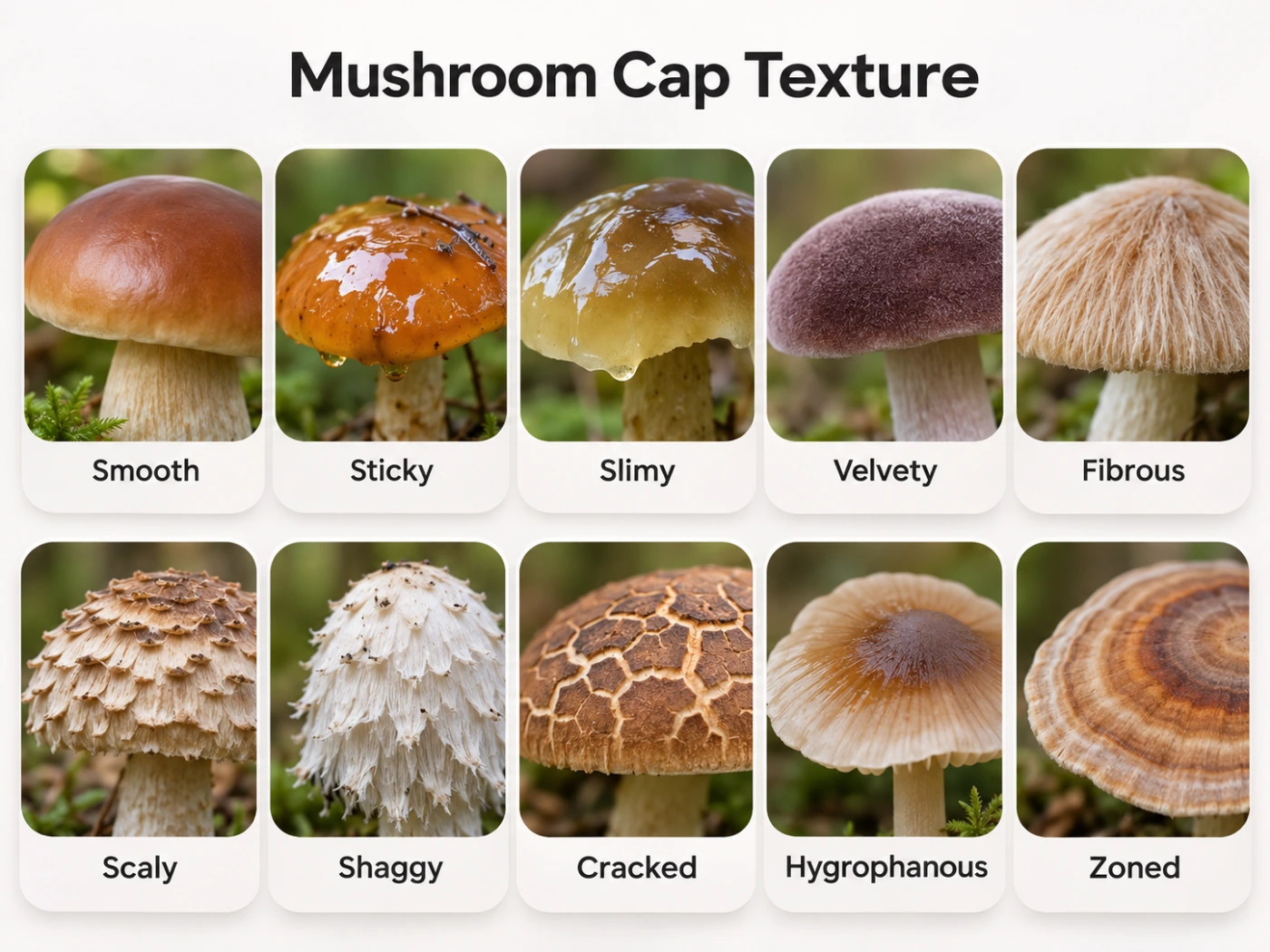
Mushroom cap texture is one of the most useful visual clues in mushroom identification. A cap can be smooth, sticky, slimy, velvety, fibrous, scaly, cracked, shaggy, granular, or strongly hygrophanous, and these differences can help narrow a mushroom to a genus or species group.
Texture should never be used alone, however. Rain can wash away veil remnants, dry weather can remove stickiness, old caps may crack or fade, and young mushrooms may look completely different from mature ones.
The best approach is to combine cap texture with the underside, stem, spore color, bruising reactions, habitat, nearby trees, and growth pattern.
⚠️ Important: Cap texture is an identification feature, not an edibility test. Smooth, sticky, scaly, or velvety caps can occur in both edible and poisonous mushrooms.
Quick Mushroom Cap Texture Guide
| Cap texture | What it looks or feels like | Common examples |
|---|---|---|
| Smooth / glabrous | Even surface without obvious hairs or scales | Many Agaricus, Pluteus |
| Viscid | Sticky or slippery when moist | Many Suillus, waxcaps |
| Glutinous | Covered with a thick gelatinous slime layer | Some Hygrophorus, Gomphidius |
| Velvety / tomentose | Covered in fine soft hairs | Some boletes, Phyllotopsis |
| Fibrillose | Fine radial fibers across cap | Inocybe, Tricholoma |
| Scaly / squamose | Obvious raised scales | Macrolepiota, Pholiota |
| Finely scaly / squamulose | Tiny scales | Many small agarics |
| Shaggy | Large loose fibrous scales | Coprinus comatus |
| Granular | Tiny grain-like particles | Coprinellus micaceus when young |
| Cracked / rimose | Surface split into cracks | Some Inocybe, boletes |
| Hygrophanous | Darker when wet, paler when dry | Many Psathyrellaceae, Panaeolina |
| Striate | Fine radial lines at cap margin | Many Amanita, Mycena |
| Zoned | Concentric bands of color or texture | Some Lactarius |
Why Cap Texture Matters
Cap color is often less reliable than texture. A brown mushroom can belong to hundreds of unrelated species, but a brown cap that is strongly fibrillose, slimy, velvety, or covered in coarse scales provides much more useful information.
Texture can also reflect the microscopic structure of the pileipellis, the outer cap surface. Radially arranged hyphae may create fibrous streaks, upright cells can produce a velvety surface, and gelatinized tissue can make the cap sticky or slimy.
This is why field guides often describe cap texture with specific technical terms. Learning a small number of these terms can make mushroom descriptions much easier to understand.
Smooth or Glabrous Caps
A smooth or glabrous cap lacks obvious scales, hairs, fibers, or granules. The surface may still be dry, greasy, or slightly sticky, but visually it appears relatively even.
Smooth caps are common across many mushroom groups. Some Agaricus, Pluteus, Entoloma, and numerous other genera can have caps that look almost polished when fresh.
The difficulty is that “smooth” is a broad description rather than a strong diagnostic feature. A smooth cap should therefore be followed immediately by other questions: Is it dry or greasy? Does it change color when wet? Is the margin striate? Does it bruise?
Sticky or Viscid Caps
A viscid cap feels sticky or slippery when moist. First Nature defines viscid as a surface that is slimy or sticky, at least when wet.
This feature is particularly common in groups such as Suillus, Hygrophorus, and some waxcaps. A fresh wet cap may be distinctly tacky to the touch, while the same mushroom can feel almost dry after several hours without rain.
For identification, note whether the stickiness appears to be a thin tacky layer or a thick gelatinous coating. This distinction can separate merely viscid mushrooms from strongly glutinous ones.
Slimy or Glutinous Caps
A glutinous cap has a thicker, more gelatinous slime layer than a merely viscid cap. First Nature defines glutinous as a cap surface covered with a slimy gelatinous layer.
Some mushrooms can become so slimy in wet weather that the cap feels coated in mucus. In certain species, the slimy layer can even be peeled away as a distinct skin.
This texture is particularly useful when fresh. Once the mushroom dries, much of the diagnostic slime can disappear, leaving a surface that looks deceptively ordinary.
Waxy and Slippery Caps
Waxcaps often have surfaces that appear smooth and saturated with moisture. Some are greasy, while others are distinctly slippery or viscid.
For example, Hygrocybe aurantiosplendens has a cap described as viscid and very slippery, while Hygrocybe insipida can be greasy, viscid, or somewhat glutinous when fresh.
These textures can change quickly as the fruit body dries. A waxcap collected after several dry hours may no longer feel slippery even though the same species was strongly viscid when fresh.
Velvety or Tomentose Caps
A tomentose surface is densely woolly or covered with soft hairs. First Nature also uses subtomentose for a surface that is only somewhat or finely woolly.
To the eye, a tomentose cap may look matte rather than shiny. Under magnification, the surface consists of numerous short hairs or projecting hyphae.
Some boletes, wood-growing mushrooms, and bracket fungi develop this kind of texture. A velvety surface can be especially obvious in young specimens and become smoother as the cap expands.
Fibrillose Caps
A fibrillose cap is covered with fine fibers, often arranged radially from the center toward the margin. These fibers may lie flat against the surface or become slightly raised with age.
This texture is especially important in genera such as Inocybe and Tricholoma. Inocybe sindonia, for example, is described as finely fibrillose when young and later becoming finely scaly.
The fibers can be subtle and are easy to miss in poor lighting. Side lighting or a close-up photograph often reveals them much more clearly than a top-down image taken in flat light.
Silky Caps
A silky cap is usually smooth but covered with very fine, closely pressed fibers that reflect light. The effect can resemble satin or brushed fabric rather than obvious hairs.
Entoloma sericeum is a good example, with a smooth surface marked by silky radial fibrils. Its cap is also hygrophanous, becoming darker when wet and paler as it dries.
Silky texture is more subtle than coarse fibrillation. It often becomes most visible when the cap is tilted toward the light.
Scaly or Squamose Caps
A squamose cap is covered with obvious scales. These scales can be broad and flat, raised, dark against a pale background, or arranged concentrically.
First Nature defines squamose as a cap or stem surface covered with scales.
Strongly scaly caps occur in mushrooms such as Macrolepiota procera, Pholiota squarrosa, and various other genera. Scale size, color, attachment, and arrangement can all provide identification clues.
A crucial question is whether the scales are part of the cap surface itself or remnants of a universal veil. In Amanita muscaria, for example, the white patches on the cap are veil remnants rather than true cap scales.
Finely Scaly or Squamulose Caps
Squamulose means covered with small scales rather than large ones. First Nature distinguishes this term from squamose by scale size.
Fine scales can be difficult to see without a hand lens or macro photograph. They may appear as tiny rough patches, especially around the center of the cap.
Some fibrillose mushrooms become squamulose as the surface fibers break into small patches. This means texture can change during development even within the same individual mushroom.
Shaggy Caps
A shaggy cap has large loose fibers or scales that project conspicuously from the surface. Shaggy Mane, Coprinus comatus, is the classic example.
Its elongated white cap is covered in coarse upturned scales, giving it a woolly or torn appearance. This is much more dramatic than the fine scales of a squamulose cap.
Shaggy texture is often highly diagnostic when fresh. As the mushroom matures and deliquesces, however, the cap blackens and loses much of its original structure.
Granular Caps
A granular cap is covered with tiny particles or grain-like structures. These may be part of the mushroom surface or remnants of a veil.
Mica Cap, Coprinellus micaceus, is a good example. Young caps often carry tiny glistening granules, but wet weather can wash them away and leave mature caps almost completely smooth.
This illustrates an important identification rule: the presence of granules can be highly useful, while their absence on an old or rain-washed specimen may mean very little.
Furfuraceous Caps
Furfuraceous describes a surface covered in fine particles resembling grains of sand or bran. First Nature uses this term for finely granular surfaces.
The effect can be subtle and may overlap visually with very fine scales. Under magnification, however, the individual particles are often easier to distinguish.
This texture is more common in formal species descriptions than in beginner field guides. It is still useful to recognize when reading technical identification keys.
Cracked or Rimose Caps
A rimose cap develops narrow cracks in the surface. These often radiate outward from the center and may expose paler flesh underneath.
Cracking can be a normal species feature, especially in some fibrecaps and boletes. It can also result from dry weather, rapid expansion, or aging, which makes interpretation more complicated.
A mushroom with naturally rimose texture often develops a relatively regular pattern. Weather cracking tends to be more irregular and may affect several otherwise unrelated species growing in the same dry conditions.
Areolate Caps
An areolate surface breaks into polygonal or tile-like patches separated by cracks. The pattern resembles dried mud or reptile skin.
Some boletes develop strongly areolate caps during dry weather. This feature can be useful, but it is often influenced by environmental conditions.
Because drought can make normally smoother caps crack, areolation should be combined with pore color, bruising, stem structure, and host trees.
Hygrophanous Caps
A hygrophanous mushroom changes color dramatically as it gains or loses moisture. First Nature defines hygrophanous as appearing more translucent when wet and paler and more opaque when dry.
This is common in many small brown mushrooms. Panaeolina foenisecii, for example, can range from dark brown when moist to pale beige or almost whitish as the cap dries.
The drying process often starts in one region of the cap and spreads outward or inward, producing distinct bands. A single fruit body may therefore display two or three apparent colors at the same time.
Why Hygrophanous Mushrooms Are Easy to Misidentify
A wet mushroom and a dry mushroom of the same species can look like entirely different taxa. This is particularly problematic in genera containing many small brown or gray species.
Photography can make the problem worse because camera exposure exaggerates differences between dark wet areas and pale dry areas. Always record whether the cap is wet, partly dry, or completely dry.
If several fruit bodies are available, compare them at different moisture levels. A group showing the same dark-to-pale drying pattern is often more informative than a single mushroom.
Striate Cap Margins
A striate cap has fine radial lines or grooves, usually most visible around the margin. First Nature defines striate as having fine radiating lines or furrows around the edge of the cap.
These lines can be structural grooves or simply the gills showing through a thin translucent cap. Many Mycena, Amanita, and small thin-fleshed mushrooms develop striate margins.
Striation often becomes more obvious when the cap is wet. As the surface dries and becomes opaque, the same lines can become much harder to see.
Translucently Striate Caps
A translucently striate margin occurs when the cap flesh is thin enough that the underlying gills show through. It is particularly common in delicate mushrooms.
Some waxcaps develop translucent striations near maturity, including Hygrocybe aurantiosplendens.
This should not be confused with deep physical grooves. Viewing the cap against light can help distinguish translucent gill shadows from actual furrows.
Sulcate or Deeply Grooved Caps
Sulcate means deeply furrowed rather than merely lined. First Nature distinguishes sulcate caps from simple striation by the greater depth of the grooves.
Ink caps often become strongly grooved as their caps expand. The lines can extend well toward the center and create a pleated appearance.
Deep grooves are usually easier to recognize than translucent striations. Their extent and depth can provide useful species-level clues in some genera.
Zoned Caps
A zonate cap displays concentric bands of color or texture. First Nature defines zonate as marked with concentric color bands.
This feature is particularly useful among milkcaps. Lactarius deliciosus and related species often display orange concentric zones across the cap.
Zonation can fade with age or become obscured by weathering and staining. As with other cap features, its presence is usually more informative than its absence.
Veil Remnants on the Cap
Not every spot, patch, or scale is actually part of the cap surface. Some mushrooms begin enclosed by a universal veil, and fragments remain on the cap after the fruit body expands.
Fly Agaric is the best-known example, with white patches scattered across a red or orange cap. These patches can wash off in rain, leaving an almost completely smooth cap.
This matters because texture produced by veil remnants is temporary. A smooth rain-washed Amanita muscaria can look very different from the stereotypical white-spotted mushroom.
Cap Texture in Amanita
Amanita caps can be smooth, striate, covered with patches, warts, or powdery veil remnants depending on the species. The texture of those remnants can be useful but should never replace examination of the stem base, ring, gills, and volva.
Rain is especially important. Universal-veil remnants can partially or completely disappear after heavy weather, so a lack of cap warts does not reliably exclude an Amanita species.
This is why cap texture should be considered temporary in many veil-bearing mushrooms. Basal structures are often more persistent and therefore safer identification characters.
Cap Texture in Boletes
Bolete caps can be smooth, velvety, sticky, cracked, fibrillose, or finely tomentose. Surface texture is particularly useful when distinguishing Suillus, Xerocomellus, Boletus, and other bolete groups.
Many Suillus are characteristically sticky or viscid, especially in wet weather. Some Xerocomellus species develop dry cracked caps that expose reddish or pale flesh beneath the surface.
Other boletes begin finely velvety and become smoother with age. The same specimen can therefore move from one texture category toward another as it develops.
Cap Texture in Suillus
Sticky caps are one of the classic field clues for Suillus. Species such as Suillus luteus often have strongly viscid caps, particularly after rainfall.
The skin can sometimes peel relatively easily, another feature used in descriptions of the genus. However, dry weather can make a typical Suillus cap appear surprisingly non-sticky.
Always check for other characters such as glandular dots, ring presence, pore size, and host tree. Larch, pine, and other conifer associations can be highly informative.
Cap Texture in Tricholoma
Many Tricholoma species have fibrous, scaly, or finely tomentose caps. Grey Knight, Tricholoma terreum, is characterized by a fine gray fibrillose surface.
Other species have much coarser scales. Tricholoma pardinum, for example, is distinguished partly by its stronger tiger-like cap scaling.
This makes texture especially valuable within a group where cap color can overlap strongly. Fine fibers and coarse scales can separate species that are otherwise similarly gray.
Cap Texture in Inocybe and Related Genera
Fibrecaps are named for their cap surface. Many Inocybe, Inosperma, and related genera have strongly radial fibrils, silky fibers, or caps that split into small scales and cracks with age.
The texture can become progressively more obvious as the cap expands. Inocybe sindonia is one example that begins finely fibrillose and later becomes finely scaly.
Because several fibrecaps contain muscarine, an unfamiliar small fibrous brown mushroom should never be considered edible from appearance alone.
Cap Texture in Russula
Many Russula caps appear smooth or slightly greasy and can sometimes have peelable cap skin. Texture is usually less important than brittle flesh, gill structure, spore color, taste, host trees, and cap color pattern.
Some species become cracked or velvety with age, while others remain polished. Weather can substantially alter the surface.
For Russula, cap texture is best used as a supporting clue rather than the first identification step.
Cap Texture in Lactarius
Milkcaps can be smooth, zoned, sticky, velvety, or slightly tomentose. Some species also develop distinctive hairy margins.
Texture is especially useful when combined with latex color. A zoned orange cap releasing orange milk is a completely different pattern from a white woolly cap releasing white latex.
Host tree adds another layer of identification. Similar milkcaps can look almost identical but associate with pine, spruce, fir, birch, or other trees.
How Rain Changes Mushroom Cap Texture
Rain can transform a cap within minutes. Dry fibers flatten, sticky surfaces become obvious, veil particles wash away, and thin caps become translucent.
Mica Cap illustrates this particularly well: its characteristic granules may disappear completely after rain.
A freshly rained-on mushroom should therefore be described together with the weather conditions. Saying “smooth cap” without noting heavy rainfall can be misleading.
How Dry Weather Changes Cap Texture
Dry weather removes slime and stickiness, lightens hygrophanous caps, and can cause cracking. A species described as viscid may feel completely dry after prolonged sunshine.
Caps may also shrink unevenly and expose radial fibers that were less visible when moist. This can make a mature dry specimen look more fibrillose than a young wet one.
When possible, examine several specimens from the same patch. Different ages and moisture levels reveal which texture features are stable and which are temporary.
How Age Changes Cap Texture
Young mushrooms frequently show the most diagnostic surface features. Veil remnants, hairs, granules, and fine scales may disappear as the cap expands.
Conversely, cracking, scaling, and radial fibers may become more pronounced with age. Some caps that begin almost smooth eventually split into distinct patches.
This means identification should ideally use both young and mature fruit bodies. A single old specimen may have already lost the feature that best defines the species.
Touch vs Visual Inspection
Some textures are difficult to identify visually. A cap can look smooth yet feel distinctly sticky or greasy.
Very light contact can distinguish dry, tacky, slippery, velvety, or granular surfaces. However, unnecessary handling should be avoided when documenting delicate mushrooms, especially if the surface structures are easily rubbed off.
Photography before touching is ideal. This preserves the original arrangement of scales, granules, slime, and veil remnants.
How to Photograph Cap Texture
Use diffuse side lighting rather than direct overhead light. Shadows reveal fibers, scales, hairs, and cracks much more clearly.
Take one photograph from above and another at a shallow angle across the surface. Macro mode or a close-focus lens is particularly useful for fibrillose, granular, or velvety caps.
Include a wet and dry specimen if both are available. For hygrophanous species, this can document the entire color and texture transition.
Common Cap Texture Terms
Glabrous means smooth or bald. Viscid means sticky or slimy when moist, while glutinous usually implies a thicker gelatinous slime layer.
Fibrillose refers to visible fibers, tomentose to a woolly or velvety covering, squamose to obvious scales, and squamulose to small scales.
Hygrophanous describes a cap that becomes darker or more translucent when wet and paler when dry. Striate means marked with fine radial lines, while sulcate refers to deeper grooves.
Learning these terms makes technical mushroom descriptions much easier to interpret.
Can Cap Texture Identify a Mushroom by Itself?
Usually not. Texture can strongly narrow possibilities, but many unrelated mushrooms independently develop similar surfaces.
A sticky cap might suggest Suillus, Hygrophorus, a waxcap, or another genus. A fibrous cap could indicate Tricholoma, Inocybe, Entoloma, or many other groups.
The real value of texture comes from combination. Sticky cap + pores + glandular stem dots + pine habitat is far more informative than “sticky cap” alone.
Best Identification Sequence
Start with the underside because gills, pores, ridges, and teeth separate mushrooms into major structural groups. Then check cap texture, stem features, substrate, bruising, spore color, and nearby trees.
For the cap itself, use a consistent sequence: dry or sticky → smooth or textured → fibers or scales → cracks or zones → margin striation → moisture-related color change.
This prevents vague descriptions such as “brown rough cap.” A structured observation gives much more useful identification data.
Common Mistakes
One common mistake is describing every non-smooth surface as “scaly.” Fibers, granules, hairs, veil fragments, cracks, and true scales are different structures and may point toward different groups.
Another mistake is ignoring weather. A dry viscid mushroom may look smooth, while a rain-washed granular mushroom may lose its most useful feature.
A third mistake is treating hygrophanous color change as ordinary pigmentation. Wet and dry areas of the same cap can differ so strongly that they appear to belong to different species.
A fourth mistake is relying on cap texture without looking underneath. Gill or pore structure is usually a much stronger first identification split.
Can AI Recognize Mushroom Cap Texture?
AI can often distinguish strong features such as shaggy scales, coarse cracking, obvious slime, concentric zoning, or dense veil patches. Fine fibrils and subtle velvety surfaces are more difficult, especially under flat lighting.
Image quality matters greatly. A sharp oblique photograph can reveal texture that disappears completely in an overhead smartphone image.
AI should therefore use texture as one feature among many. It should not turn “sticky brown cap” into a high-confidence species identification without underside, stem, substrate, and ecological information.
Interesting Facts
Some cap textures are temporary structures rather than permanent parts of the cap. Mica Cap granules and Amanita veil remnants, for example, may disappear after rain or handling.
Hygrophanous mushrooms can change appearance without changing pigment chemically. Much of the color difference results from how water inside the cap affects light transmission and reflection.
Surface texture can also reveal microscopic anatomy. Fine radial fibers seen by eye may correspond directly to pigmented surface hyphae arranged in the same direction, as demonstrated in detailed taxonomic studies of agarics.
Frequently Asked Questions
What does a smooth mushroom cap mean?
A smooth or glabrous cap has no obvious hairs, scales, or granules. It is a broad descriptive feature and does not identify a mushroom by itself.
What does viscid mean in mushroom identification?
Viscid means sticky or slimy, particularly when the cap is moist. A cap can be strongly viscid after rain and almost dry later the same day.
What is a glutinous mushroom cap?
A glutinous cap has a conspicuous gelatinous slime layer. It is generally more heavily slimy than a merely viscid surface.
What does fibrillose mean?
Fibrillose means covered with fine fibers, often running radially from the cap center toward the edge. Many Inocybe and Tricholoma species show this pattern.
What does squamose mean?
Squamose means covered with visible scales. Squamulose refers to a similar surface with much smaller scales.
What does tomentose mean?
Tomentose describes a densely woolly or velvety surface covered with soft hairs. A subtomentose surface is only lightly or finely woolly.
What is a hygrophanous cap?
A hygrophanous cap changes appearance as moisture content changes. It is usually darker or more translucent when wet and becomes lighter and more opaque as it dries.
Why does a mushroom cap crack?
Cracking can be a normal species feature or a response to dry weather and rapid expansion. A cracked cap should therefore be interpreted together with the species, age, and environmental conditions.
Why do mushroom scales disappear after rain?
Some apparent scales are actually loose veil remnants or granules. Rain can wash these away, as commonly happens with the granules on Coprinellus micaceus.
Is a slimy mushroom poisonous?
Not necessarily. Slimy or sticky caps occur in both edible and non-edible mushrooms, so texture does not indicate toxicity.
Final Notes
Mushroom cap texture is a valuable identification feature because it adds information that cap color alone cannot provide. Smooth, sticky, glutinous, velvety, fibrillose, scaly, shaggy, granular, cracked, hygrophanous, striate, and zoned surfaces each point toward different groups and should be described precisely.
The most important limitation is that texture changes. Rain can remove granules and veil remnants, dry weather can eliminate stickiness and create cracks, and aging can transform fine fibers into scales or make a once-textured cap appear smooth.
The practical identification sequence is: check the underside first → determine whether the cap is dry or sticky → inspect fibers, scales, hairs, granules, cracks, or zones → check the margin → note wet-versus-dry color changes → combine everything with stem, habitat, spores, and host trees. Cap texture becomes most powerful when it is treated as one part of a complete identification rather than as a standalone clue.
Upload a photo and get possible matches in seconds.