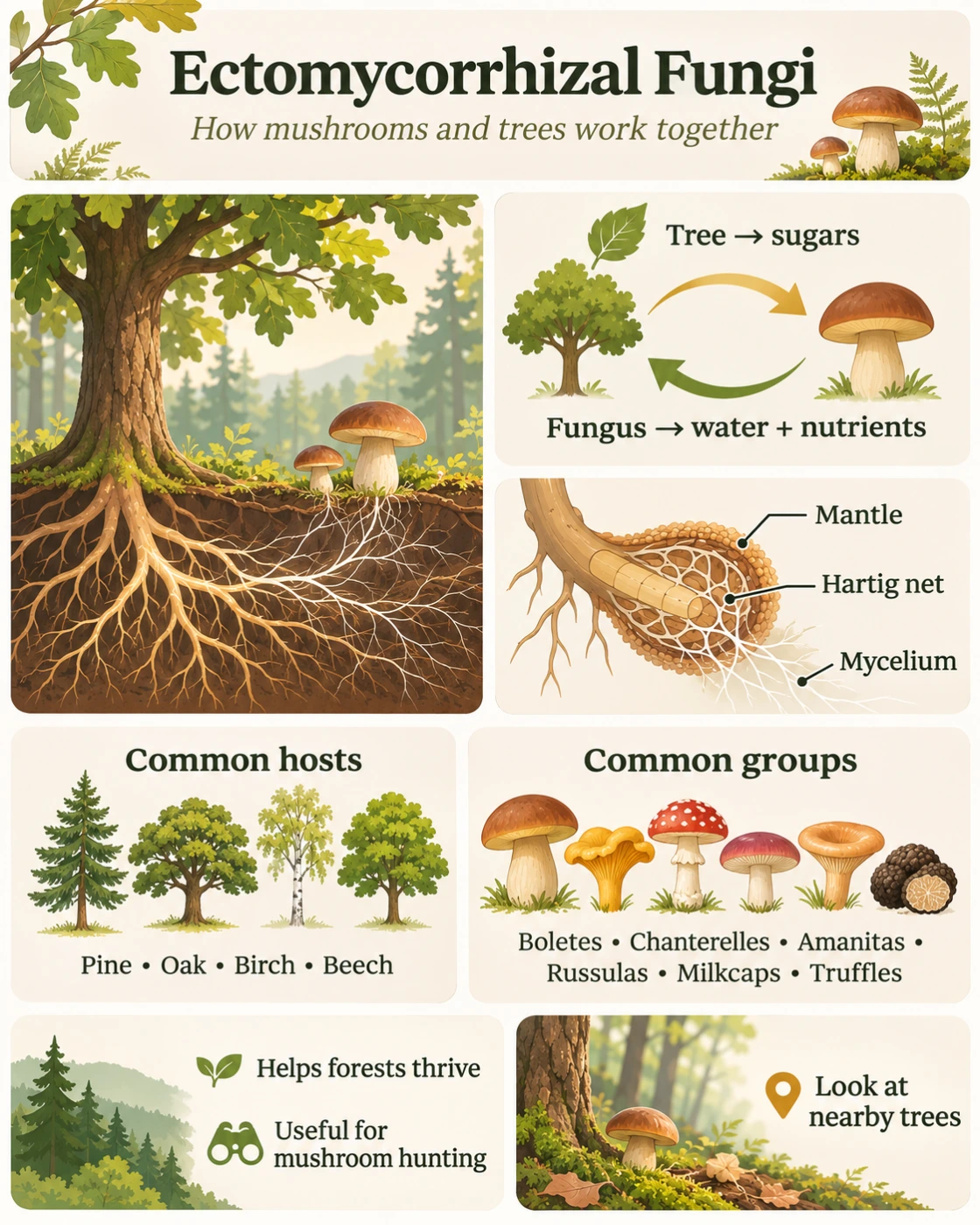
Walk through a pine, oak, birch, or beech forest and much of what keeps the trees alive is happening underground. Fine roots are surrounded by microscopic fungal threads that extend far beyond the reach of the roots themselves, connecting trees with water and nutrients in the surrounding soil.
This partnership is called ectomycorrhiza, and the fungi involved are known as ectomycorrhizal fungi, often shortened to ECM or EcM fungi. Many familiar forest mushrooms — including boletes, chanterelles, milkcaps, brittlegills, and numerous Amanita species — belong to this ecological group.
Understanding ectomycorrhizal fungi is useful not only for understanding forest ecology. It can also make you a better mushroom hunter, because many mushrooms appear only where their preferred host trees are growing.
What Are Ectomycorrhizal Fungi?
Ectomycorrhizal fungi are fungi that form a close symbiotic relationship with the roots of certain plants, particularly forest trees. The fungus receives carbon compounds produced by the tree through photosynthesis, while the tree gains improved access to nutrients and water collected by the fungus.
The word itself explains the relationship. Mycorrhiza comes from words meaning “fungus” and “root,” while the prefix ecto- refers to the fact that the fungal tissue mainly develops around and between root cells rather than growing deeply inside them.
The partnership is especially important in temperate and boreal forests, where nutrients such as nitrogen can be difficult for trees to obtain directly from the soil. Ectomycorrhizal fungi dramatically increase the effective area from which a tree can collect resources.
How Ectomycorrhiza Works
What we see as a mushroom is only a reproductive structure. The much larger organism normally exists underground as mycelium, a network of microscopic fungal filaments called hyphae.
When an ectomycorrhizal fungus encounters a compatible tree root, it can form several characteristic structures.
The Fungal Mantle
The fungus creates a dense sheath of fungal tissue around the tree’s fine root tips. This layer is called the mantle or fungal sheath.
Instead of functioning as a completely independent root, the colonized root becomes part of a combined tree–fungus system. The fungal mantle can alter how the root interacts with the surrounding soil.
The Hartig Net
Some fungal hyphae grow inward between the outer cells of the root. They normally do not penetrate the cells themselves.
This network between the root cells is known as the Hartig net. It creates a large contact area where nutrients, water, and carbon compounds can be exchanged between the fungus and its plant partner.
The Underground Mycelium
Other fungal hyphae extend outward into the surrounding soil. Because these threads are much finer than tree roots, they can explore tiny spaces and soil volumes that roots cannot efficiently reach.
The resulting network can extend well beyond the immediate root zone. Through it, the fungus can acquire nitrogen, phosphorus and other nutrients and make some of them available to its host.
What Does the Tree Give the Fungus?
Trees manufacture carbohydrates through photosynthesis. Ectomycorrhizal fungi depend heavily on this plant-derived carbon and receive part of the products produced by their host.
This is one reason many ectomycorrhizal mushrooms cannot simply be cultivated in the same way as common button mushrooms or oyster mushrooms. Their biology is closely connected to living trees, and reproducing that relationship commercially can be extremely difficult.
The exchange is not best imagined as a fixed price where a tree gives a certain amount of sugar in return for a certain amount of nitrogen. Modern research shows that carbon and nutrient exchange is influenced by the fungal species, host tree, soil chemistry and environmental conditions, and scientists are still investigating exactly how the partnership is regulated.
What Does the Fungus Give the Tree?
The most important advantage is increased access to soil resources. Fungal hyphae greatly expand the zone from which the root system can obtain nutrients and water.
Ectomycorrhizal fungi can help their hosts obtain nitrogen and phosphorus that would otherwise be difficult to access. Different fungi have different biochemical abilities, and some can release nutrients from relatively complex organic materials in forest soil.
Research also suggests that ectomycorrhizal associations can influence a tree’s response to drought, salinity, pathogens and other environmental stresses. The effects vary among species and environmental conditions, so ectomycorrhiza should not be thought of as a universal protective shield, but it can substantially affect tree health and forest resilience.
Which Trees Form Ectomycorrhiza?
Ectomycorrhizal relationships are particularly common among major forest trees of temperate and boreal regions. Pines, spruces, firs, oaks, beeches and birches are among the best-known examples.
Other ectomycorrhizal hosts include various species of poplar, willow, alder, hazel, hornbeam and eucalyptus. The exact relationship depends on both geography and species, and not every tree in a forest forms the same type of mycorrhiza.
Some important groups of ECM-associated trees include:
- Pines, spruces and firs — hosts for many boletes, milkcaps, brittlegills and Amanita species.
- Oaks and beeches — associated with an exceptionally diverse range of ectomycorrhizal fungi.
- Birches and aspens — hosts for several characteristic boletes and other fungi.
- Willows and poplars — important partners in riverbanks, wetlands and young woodland.
- Eucalyptus — forms ectomycorrhizal associations with numerous fungi in Australia and elsewhere.
The USDA Forest Service lists pine, fir, spruce, hemlock, oak, hickory, alder and beech among forest trees that commonly form ectomycorrhizae.
Common Ectomycorrhizal Mushrooms
A remarkable number of well-known woodland mushrooms belong to ectomycorrhizal lineages. Their dependence on trees explains why some species consistently appear beneath particular kinds of forest.
Boletes
Many boletes are ectomycorrhizal. The famous porcini or penny bun [Boletus edulis], for example, forms partnerships with several tree species, including spruce, pine, beech, birch and oak.
Other boletes can be considerably more selective. Knowing whether you are standing beneath birch, pine, larch or oak can therefore provide an important identification clue.
Chanterelles
True chanterelles in the genus [Cantharellus] are also ectomycorrhizal. They occur in association with trees rather than obtaining their nutrition by decomposing dead wood.
This ecological requirement is one reason commercial cultivation of chanterelles is much more difficult than growing saprotrophic mushrooms such as oyster mushrooms.
Amanitas
Many species of [Amanita] form ectomycorrhizae with trees. This includes well-known species such as the fly agaric [Amanita muscaria], death cap [Amanita phalloides] and panther cap [Amanita pantherina].
Their association with trees can help explain where they appear, but habitat alone is never enough to identify an Amanita. Several members of the genus are dangerously poisonous.
Russulas and Milkcaps
Brittlegills [Russula] and milkcaps [Lactarius and Lactifluus] are major components of ectomycorrhizal fungal communities. In some forests they can be among the most frequently encountered mushrooms.
Different species prefer different hosts and soils, which is why identifying nearby trees can greatly narrow the possibilities when trying to identify a russula or milkcap.
Truffles
True truffles in the genus [Tuber] are ectomycorrhizal as well. Their underground fruiting bodies develop in association with the roots of suitable trees, particularly oaks and hazels in European truffle cultivation.
Commercial truffle orchards therefore do not simply plant truffle spores into ordinary soil. Young trees are deliberately inoculated with the appropriate fungus so that the required mycorrhizal partnership can develop.
Ectomycorrhizal vs Saprotrophic Fungi
Not every forest mushroom depends on a living tree. One of the most useful ecological distinctions in mushroom identification is the difference between ectomycorrhizal fungi and saprotrophic fungi.
Saprotrophic fungi obtain nutrients by decomposing dead organic material. Oyster mushrooms [Pleurotus], for example, commonly grow directly from dead or weakened wood, while many other decomposers grow in leaf litter, compost, wood chips or buried woody debris.
An ectomycorrhizal mushroom behaves differently. Its mycelium is associated with living roots, so the mushroom may appear to grow directly from soil even though the fungus is biologically connected to a nearby tree.
This explains an important field observation: where a mushroom grows can be just as informative as what the mushroom looks like.
Ectomycorrhizal vs Arbuscular Mycorrhizal Fungi
Ectomycorrhiza is only one type of mycorrhizal relationship. Another widespread form is arbuscular mycorrhiza, often abbreviated AM.
In ectomycorrhiza, fungal tissue usually forms a mantle around fine roots and develops the Hartig net between root cells. In arbuscular mycorrhiza, fungal structures extend into the root cortex and form specialized exchange structures associated with individual plant cells.
The two systems also occur among different groups of plants. Ectomycorrhiza is especially important among many dominant forest trees, while arbuscular mycorrhiza is enormously widespread among grasses, crops and other herbaceous plants.
Why Tree Identification Helps You Find Mushrooms
Learning trees may be one of the most useful skills a mushroom hunter can develop. Once you understand ectomycorrhiza, a forest is no longer simply a collection of places where mushrooms might appear.
Instead, each tree species becomes a clue.
A birch woodland offers a different set of likely mushrooms from a spruce plantation. A mature oak forest creates different opportunities from a larch grove, and mixed woodland can support a particularly diverse fungal community because several potential host trees occur together.
For some species, the connection is so useful that the host becomes part of the identification process. If a mushroom supposedly associated only with larch is growing in a forest where no larch occurs, that discrepancy deserves attention.
This does not mean that every mushroom growing beneath a tree is mycorrhizal with that tree. Roots can extend surprisingly far, multiple tree species may occur nearby, and saprotrophic fungi can fruit from buried wood that is invisible from the surface.
Can One Fungus Associate With More Than One Tree Species?
Yes. Some ectomycorrhizal fungi have relatively broad host ranges and can associate with several genera of trees, while others show much stronger host preferences.
Likewise, a single tree can simultaneously host a large community of different ectomycorrhizal fungi on different parts of its root system. Forest mycorrhizal communities are therefore far more complex than simple one-tree–one-fungus partnerships.
Host preference can also vary geographically. A fungal species may associate with one group of trees in one part of its range and with other compatible hosts elsewhere, making local ecological knowledge especially valuable.
Do Ectomycorrhizal Fungi Form a “Wood Wide Web”?
Fungal mycelia can connect with the roots of more than one plant, and researchers have documented common mycorrhizal networks in which plants share fungal connections. These networks are scientifically real and are an active area of ecological research.
However, popular descriptions sometimes go much further, portraying forests as if trees deliberately communicate, feed their offspring or operate through a coordinated underground internet. Such claims are more controversial than the basic existence of shared fungal networks.
The safest interpretation is that mycorrhizal networks can influence the movement of resources and interactions among plants, fungi and soil organisms. Exactly how important particular transfers are under natural forest conditions remains an active research question.
Why Ectomycorrhizal Fungi Matter to Forests
Ectomycorrhizal fungi do much more than produce mushrooms. Their underground activity influences nutrient cycling, soil processes, tree nutrition and the storage and movement of carbon through forest ecosystems.
These effects occur on enormous scales because ectomycorrhizal trees dominate vast areas of temperate and boreal forest. Changes in nitrogen availability, climate, forestry and tree species composition can therefore alter ECM fungal communities and potentially affect broader ecosystem processes.
The familiar mushroom appearing beneath an oak or pine is only the visible part of this system. Beneath the soil may be an extensive fungal organism participating in a partnership that has been shaping forest ecosystems for millions of years.
What This Means for Mushroom Identification
Ecology should always be considered alongside physical characteristics when identifying wild mushrooms. Cap shape, gills, pores, stem structure, bruising, odor and spore characteristics remain important, but habitat can substantially narrow the possibilities.
When photographing an unknown mushroom, it is useful to include the surrounding habitat as well. Record nearby trees, whether the mushroom is growing from soil or wood, whether several fruiting bodies occur around the same tree, and what kind of forest surrounds the site.
A mushroom identification tool can analyze visible characteristics from a photograph, but ecological information can make an identification much stronger.
⚠️ Important: Never use tree association alone to decide whether a wild mushroom is edible. Poisonous and edible species can occur beneath the same trees, and closely related mushrooms may share very similar habitats.
FAQ
Are all mushrooms growing under trees ectomycorrhizal?
No. Many decomposer fungi also grow beneath trees because forests contain abundant dead roots, buried branches, leaf litter and other organic material. A mushroom may therefore appear to grow from soil while actually decomposing wood hidden underneath it.
Can ectomycorrhizal fungi live without trees?
Their life cycles are strongly dependent on compatible plant hosts, although spores and some fungal structures may survive for periods without an active partnership. This dependence is one reason many famous ectomycorrhizal edible mushrooms remain difficult to cultivate commercially.
Why do mushrooms sometimes appear far away from the trunk?
Tree roots extend considerably beyond the base of the trunk, and fungal mycelium can extend still farther into surrounding soil. A fruiting body several metres from a tree may therefore still belong to a fungus associated with that tree’s roots.
Does every ectomycorrhizal fungus produce visible mushrooms?
No. Some produce fruiting bodies below ground, while others may fruit rarely or under specific environmental conditions. The absence of mushrooms above ground does not mean that ectomycorrhizal fungi are absent from the roots below.
Can mushroom locations reveal underground tree roots?
Sometimes they provide clues. Repeated fruiting of a host-associated fungus can indicate that compatible roots occur nearby, but fungal mycelium can travel through soil and several potential host trees may be present, so the relationship cannot usually be mapped precisely from mushrooms alone.
Upload a photo and get possible matches in seconds.