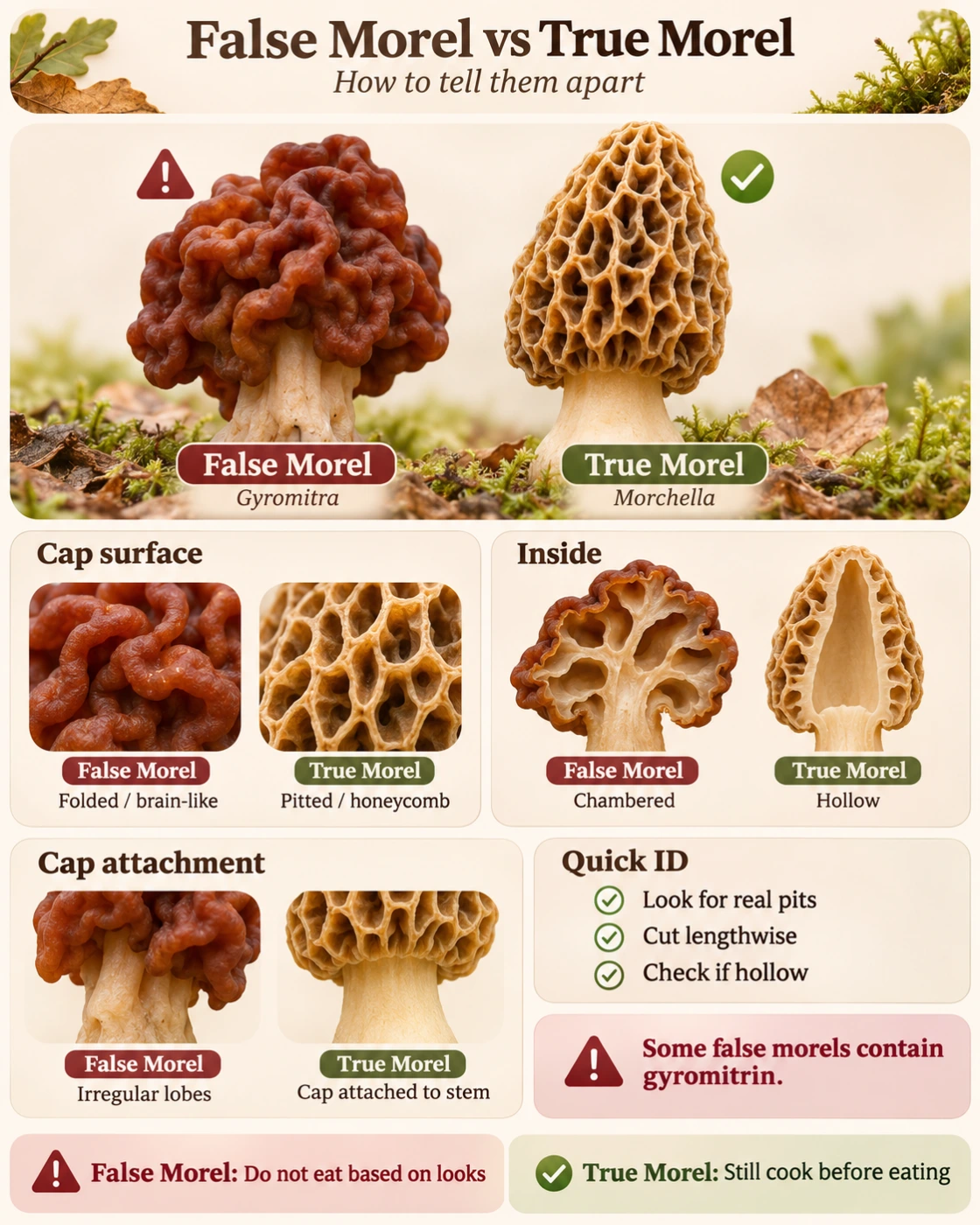
False morels are a group of spring mushrooms that can resemble true morels but differ in important structural details. The name is most often applied to species of Gyromitra, although Verpa and sometimes other wrinkled or saddle-shaped cup fungi are also described as false morels in field guides.
The distinction matters because some false morels contain gyromitrin, a toxin that can cause severe gastrointestinal, neurological, and liver-related poisoning. True morels [Morchella] have a regular honeycomb of pits and ridges and are hollow inside, while typical Gyromitra have folded, lobed, brain-like caps and irregularly chambered interiors.
⚠️ Important: Do not eat a mushroom simply because it resembles a morel. Several false morels have caused serious poisoning, and cooking, drying, or traditional preparation methods should not be treated as proof that an unidentified mushroom is safe.
Quick False Morel Identification
The fastest way to separate a typical false morel from a true morel is to examine both the outside and the inside. A true morel should have genuine pits separated by raised ridges, rather than a cap made primarily of folds and lobes.
| Feature | True Morel — Morchella | Typical False Morel — Gyromitra |
|---|---|---|
| Cap surface | Deep pits and raised ridges | Wrinkled, folded, lobed or brain-like |
| Overall pattern | Honeycomb-like | Irregular convolutions |
| Interior | Hollow from top through stem | Often chambered or irregular inside |
| Cap attachment | Attached to stem; half-free species partly free | Variable |
| Typical colors | Tan, yellow-brown, gray-brown, dark brown | Brown, reddish brown, chestnut, sometimes darker |
| Season | Mainly spring | Many species appear in spring; others may fruit later |
| Safety | Edible species require proper cooking | Some species are poisonous; group should not be assumed edible |
Missouri Department of Conservation describes true morels as completely hollow and covered with definite pits and ridges. By contrast, false morels typically have outward-bulging folds, wrinkles or lobes and a chambered interior.
What Is a False Morel?
“False morel” is a common name rather than a single taxonomic group. Different mushrooms can receive the name because their upright stalk and wrinkled cap create a superficial resemblance to true morels.
The most important false morels belong to the genus [Gyromitra]. Species such as Gyromitra esculenta, G. brunnea and G. caroliniana can produce large, conspicuous fruiting bodies with strongly folded caps, and some occur at the same time of year as true morels.
[Verpa bohemica] is also commonly called the early false morel or wrinkled thimble-cap. Unlike Gyromitra, Verpa is actually a member of the family Morchellaceae, the same family that contains Morchella, illustrating why “false morel” should not be treated as a scientific classification.
False Morel vs True Morel
At a distance, both mushrooms can look like an irregular brown cap standing on a pale stalk. Once the fruiting body is examined closely, however, several differences become much more useful than color alone.
1. Look for Real Pits
True morels have a cap composed of pits surrounded by raised ridges. The depressions go inward, producing the familiar honeycomb or sponge-like appearance.
A typical Gyromitra instead has tissue that folds outward into lobes, wrinkles and convolutions. The surface can resemble a brain, loosely crumpled fabric or a cluster of rounded folds rather than a geometric network of pits.
This distinction is more reliable than asking whether the mushroom is brown, red or yellow. Both true and false morels can vary considerably in color.
2. Cut the Mushroom Lengthwise
A longitudinal section is one of the most useful checks when distinguishing Morchella from typical Gyromitra. Slice the mushroom vertically from the top of the cap through the base of the stem.
True morels are essentially hollow through the cap and stalk, creating a continuous open interior. Gyromitra fruiting bodies are commonly irregularly chambered, folded or divided internally rather than forming the same clean hollow cavity.
This test should not be used by itself. Other morel-like fungi, especially Verpa, have different internal structures, so the cap surface and cap attachment also need to be checked.
3. Check How the Cap Meets the Stem
In most true morels, the cap is attached directly to the stalk along its lower edge. Half-free morels are the important exception: in species such as [Morchella punctipes], the upper part of the cap is attached while the lower portion hangs free.
[Verpa bohemica] differs more dramatically. Its cap is attached only near the top of the stalk and hangs around it like a thimble placed over a finger. This feature can make Verpa particularly confusing for someone who knows only the simple rule that “a free cap means false morel.”
What Does a False Morel Look Like?
The classic false morel has a broad, irregular cap with deep folds rather than true pits. Depending on the species, these folds can form rounded brain-like lobes, broad saddle-shaped sections or several large irregular peaks.
The stalk is usually pale cream, buff or whitish and can be noticeably thicker toward the base. In many Gyromitra, cutting the stalk reveals chambers and internal folds instead of the simple hollow tube expected in a true morel.
False morels can also become surprisingly large. Gyromitra caroliniana, for example, can produce large reddish-brown, heavily convoluted fruiting bodies with a pale chambered stem.
Common Types of False Morels
Several very different mushrooms may be encountered under this name, so identifying something only as “a false morel” is not enough for a reliable species-level determination.
Gyromitra esculenta — False Morel / Brain Mushroom
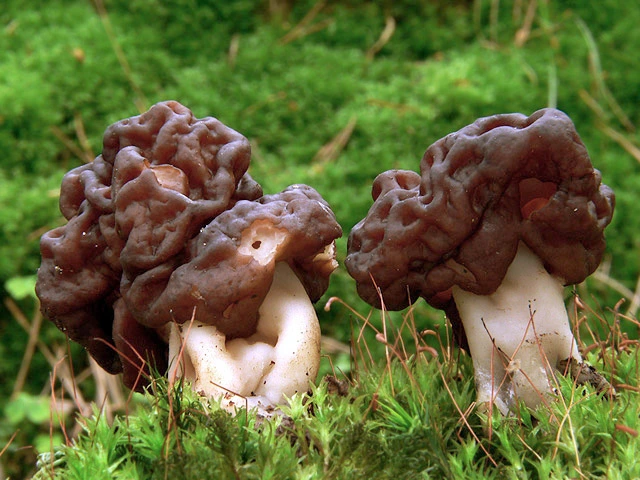
[Gyromitra esculenta] is perhaps the best-known false morel. It usually produces a reddish-brown to dark brown cap composed of irregular rounded folds that often give it a distinctly brain-like appearance.
This species is especially important because it is associated with the toxin gyromitrin. Despite a history of consumption in parts of Europe, toxicological literature documents gastrointestinal and neurological poisoning from G. esculenta, and its variable toxin content and variable human susceptibility make historical consumption a poor indicator of safety.
Gyromitra brunnea — Gabled False Morel
[Gyromitra brunnea], sometimes called the gabled false morel, often has larger saddle-like or angular lobes rather than the tightly convoluted brain-like surface of some other Gyromitra. Its cap is reddish brown, while the stalk is usually whitish and chambered internally.
It fruits in woodland during spring and can therefore overlap with morel season. The Missouri Department of Conservation classifies it as poisonous and not recommended for eating.
Gyromitra caroliniana — Big Red False Morel
The big red false morel [Gyromitra caroliniana] can produce massive reddish-brown caps composed of deep convolutions. Its pale stalk is chambered inside, which provides an immediate contrast with the continuous hollow interior of a true morel.
The toxicology of different Gyromitra species is not identical, and toxin concentrations can vary substantially across the genus. That variability is another reason not to transfer edibility claims from one named species to another simply because both are called false morels.
Verpa bohemica — Early False Morel / Wrinkled Thimble-Cap
[Verpa bohemica] looks different from most Gyromitra. Its elongated, wrinkled cap sits over the stalk like a thimble and is attached only near the top.
This structure can resemble a half-free true morel, particularly [Morchella punctipes] in North America or related half-free Morchella. Reports of gastrointestinal and neurological reactions have been associated with V. bohemica, and its edible status has historically varied among regions and field guides.
For practical mushroom identification, it is better to treat Verpa separately rather than assuming every rule used for Gyromitra also applies to it.
Are False Morels Poisonous?
Some false morels are clearly capable of causing serious poisoning. The greatest concern is associated with gyromitrin-producing Gyromitra, particularly members of the Gyromitra esculenta group.
Gyromitrin is converted in the body to compounds including monomethylhydrazine (MMH). MMH interferes with vitamin B6-dependent biochemical pathways and reduces production of the inhibitory neurotransmitter GABA, which helps explain why severe poisoning can include neurological effects and seizures.
Symptoms may initially include nausea, vomiting, abdominal pain and diarrhea. More severe poisoning can progress to dizziness, weakness, confusion, seizures, liver injury or other systemic complications.
The severity is not predictable from the mushroom’s appearance. Toxin concentrations, quantity consumed, preparation and individual metabolism can all influence the outcome.
Why Do Some People Eat Gyromitra?
False morels have a complicated culinary history. Gyromitra esculenta in particular has traditionally been collected and eaten in parts of northern and eastern Europe after specific processing methods intended to reduce its toxin content.
Gyromitrin is volatile, water-soluble and heat-sensitive, so boiling and drying can reduce its concentration. However, toxicological reviews also note variation in toxin levels, incomplete removal and large differences in individual susceptibility.
That creates an important distinction between reducing a toxin and demonstrating that a mushroom is reliably safe. MushroomID does not recommend using traditional preparation methods as a way to turn an uncertain Gyromitra identification into an edible mushroom.
The fumes produced during processing can also contain volatile hydrazine compounds. Cooking a toxic mushroom is therefore not merely an identification issue and should not be presented as a routine household safety technique.
Can Cooking Make False Morels Safe?
Cooking can reduce gyromitrin levels in some mushrooms, but this should not be turned into the rule “false morels are safe if boiled.” Different Gyromitra species can contain different quantities of toxin, identification may itself be wrong, and preparation methods do not provide a reliable visual confirmation that enough toxin has been removed.
Historical culinary use also creates survivor bias: the fact that one person has eaten a particular mushroom repeatedly without obvious illness does not demonstrate that every specimen, every batch or every consumer will respond the same way.
For an unknown morel-like mushroom, the correct first question is therefore what species is it?, not how should it be cooked?
False Morel Poisoning Symptoms
Gyromitrin poisoning may begin with gastrointestinal symptoms several hours after ingestion. Nausea, vomiting and abdominal discomfort can be followed in more serious cases by neurological abnormalities such as vertigo, confusion, tremors, seizures, stupor or coma.
The underlying mechanism differs from amatoxin poisoning caused by death caps and some other deadly mushrooms. Gyromitrin is metabolized to MMH, which interferes with pyridoxine-dependent GABA production; severe cases can therefore require specific medical management in addition to supportive treatment.
If a false morel or other unidentified wild mushroom has been eaten and symptoms develop, contact a poison center or medical service promptly. Keep leftover mushrooms, food and photographs if they are available, because expert identification can help guide treatment.
Do not induce vomiting unless a medical professional specifically instructs you to do so.
Where Do False Morels Grow?
Many false morels grow on the ground in woodland, which is another reason they can be mistaken for true morels. Depending on species and region, they may occur in coniferous forest, mixed woodland, disturbed soil, old woody debris or areas associated with decaying wood.
Season also overlaps with Morchella. In temperate North America, several Gyromitra species fruit from March through May, exactly when mushroom hunters are actively searching for true morels.
Season alone therefore cannot separate the two groups. Finding a wrinkled brown mushroom in April is not evidence that it is a true morel.
Are All Brain-Like Mushrooms False Morels?
A strongly brain-like cap is a useful warning sign for Gyromitra, but “brain mushroom” is not a precise identification. Different cup fungi can form folded, saddle-shaped or irregular fruiting bodies, and mature specimens may become more distorted as they expand.
The important question is whether the mushroom possesses the structural combination expected for Morchella: organized pits and ridges, the appropriate cap attachment, and a hollow interior. If these features are absent or unclear, the mushroom should not be identified as an edible true morel from appearance alone.
What About Helvella?
Species of [Helvella], often called elfin saddles, can occasionally enter the false-morel conversation because they are also unusual Ascomycete mushrooms with folded or saddle-like caps. They generally look less like classic true morels than Gyromitra or Verpa, but inexperienced collectors may still confuse unusual specimens.
Field guides therefore sometimes use “false morel” broadly enough to encompass several morel-like cup fungi. Missouri’s conservation guidance, for example, specifically lists Helvella among morel look-alikes while distinguishing their folded or saddle-shaped surfaces from the true pits and ridges of Morchella.
For identification purposes, it is better to use the genus name once the mushroom can be narrowed down rather than treating “false morel” as the final identification.
The Hollow Test: Useful but Not Enough
You may frequently hear that “true morels are hollow and false morels are solid.” The first half is useful, but the second oversimplifies what you may actually see after cutting a mushroom.
Many Gyromitra are not simply solid. Their interiors can contain multiple chambers, folds and cavities, while Verpa has its own internal structure and cap attachment.
A better field rule is:
True Morchella = honeycomb pits + appropriate cap attachment + continuous hollow interior.
If one part of that combination does not fit, stop and investigate further.
False Morel or Half-Free Morel?
Half-free morels are among the more confusing legitimate Morchella. In [Morchella punctipes], only the upper portion of the cap is attached to the stalk, while the lower portion hangs free.
Despite this unusual attachment, a half-free morel retains the characteristic pitted-and-ridged cap and hollow interior of Morchella. The cap of Verpa bohemica, by contrast, is attached only at its apex and has a wrinkled rather than strongly honeycombed surface.
This is a good example of why no single identification shortcut should be used in isolation.
Common False Morel Identification Mistakes
One frequent mistake is relying on color. A brown, tan or reddish mushroom can belong to either the true-morel or false-morel side of the comparison, so color should come after structural characters rather than before them.
Another mistake is examining only the outside. Cutting the mushroom lengthwise can reveal internal chambers that were invisible from the exterior and is particularly useful when comparing Gyromitra with Morchella.
Collectors can also assume that every mushroom in one patch is the same species. When several spring cup fungi fruit in similar woodland habitats, each specimen should be checked rather than using the first mushroom as proof for the entire basket.
How to Photograph a False Morel for Identification
A photograph of only the cap from above misses several of the most important diagnostic features. For a stronger identification, photograph the whole mushroom from the side, the cap surface close up and the connection between the cap and stalk.
After documenting the intact fruiting body, a vertical cross-section is especially valuable. A photograph showing the interior of both cap and stalk can immediately reveal whether the mushroom is continuously hollow or irregularly chambered.
Also photograph the surrounding habitat. Nearby trees, exposed or buried wood, soil conditions and the growth pattern can all provide additional clues that are impossible to recover from a mushroom photographed later in a kitchen.
Can AI Identify a False Morel from a Photo?
AI image recognition can often recognize the broad visual difference between a classic honeycombed Morchella and a heavily folded Gyromitra. A clear side view showing a brain-like cap may therefore produce a useful candidate identification.
However, a single exterior photograph may not show the internal structure, cap attachment or subtle characteristics needed to separate difficult specimens. Similar-looking Gyromitra, Verpa, Helvella and Morchella can also require closer examination than a photograph provides.
Use photo identification as a way to generate and compare possible identifications, not as proof that a morel-like mushroom is edible.
FAQ
Are false morels the same as Gyromitra?
Not exactly. Gyromitra contains the best-known mushrooms called false morels, but the common name is also applied to Verpa and sometimes more broadly to other morel-like fungi. “False morel” is therefore an identification category used in ordinary language rather than a formal taxonomic group.
What is the easiest way to tell a false morel from a true morel?
Start with the cap: a true morel has genuine inward pits divided by raised ridges, while a typical Gyromitra has irregular folds and outward-bulging lobes. Then cut the mushroom lengthwise and confirm that a true Morchella has the expected continuous hollow interior.
Are false morels hollow?
Typical Gyromitra are not hollow in the same clean, continuous way as true morels. They often contain chambers and irregular internal folds, while other mushrooms called false morels can have different internal structures.
Are false morels poisonous to touch?
Normal handling of an intact false morel is not the same exposure as eating it. The major poisoning risk discussed in the medical literature comes from ingestion, but hands should still be washed after handling wild mushrooms and unknown specimens should be kept away from children and pets.
Can you eat a false morel after boiling it?
Boiling can reduce gyromitrin concentrations in some Gyromitra, which explains historical preparation traditions, but reduction is not the same as guaranteed safety. MushroomID does not recommend using boiling as a method for making an unidentified or gyromitrin-containing false morel safe to eat.
Can false morels grow beside true morels?
Their fruiting seasons and woodland habitats can overlap, so finding true morels in an area does not prove that every morel-like mushroom nearby is also Morchella. Each specimen should be checked independently.
Are true morels safe to eat raw?
No. True morels themselves should not be eaten raw or inadequately cooked, and poisonings have been reported after poorly cooked morels as well as after unusually large amounts. This is a separate issue from gyromitrin poisoning caused by certain false morels.
Final Identification Notes
The most useful distinction between true and false morels is structural rather than based on color. True [Morchella] have a recognizable network of pits and ridges and are hollow internally, while typical [Gyromitra] have folded or brain-like caps and irregularly chambered interiors.
The common name “false morel” covers more than one type of fungus, however, so the identification should not stop there. Gyromitra, Verpa, Helvella and unusual true Morchella can require different checks, and species-level identification matters when toxicity is involved.
Because some Gyromitra contain gyromitrin and have caused serious poisoning, do not use historical consumption, boiling traditions or a photo match as evidence that a mushroom is safe to eat. Structure, habitat, internal anatomy and expert confirmation are much more useful than any single shortcut.
Sources
- Missouri Department of Conservation — Morels and field guides for Gyromitra brunnea, Gyromitra caroliniana, black morels and half-free morels. The guides describe the key distinction between the pitted, hollow structure of Morchella and the folded, chambered structure of typical false morels.
- Lagrange et al. — Warning on False or True Morels and Button Mushrooms with Potential Toxicity Linked to Hydrazinic Toxins: An Update. Review of Gyromitra, Verpa, gyromitrin toxicity and morel-associated poisoning.
- Human Poisoning from Poisonous Higher Fungi — toxicology review describing conversion of gyromitrin to monomethylhydrazine and the toxicological characteristics of Gyromitra.
- Spencer et al., 2024 — study examining species in the Gyromitra esculenta group, gyromitrin concentrations and neurological concerns associated with exposure.
- Mushroom Poisoning: An Updated Review, 2025 — clinical review covering gyromitrin-associated neurotoxicity and mushroom poisoning syndromes.
Upload a photo and get possible matches in seconds.