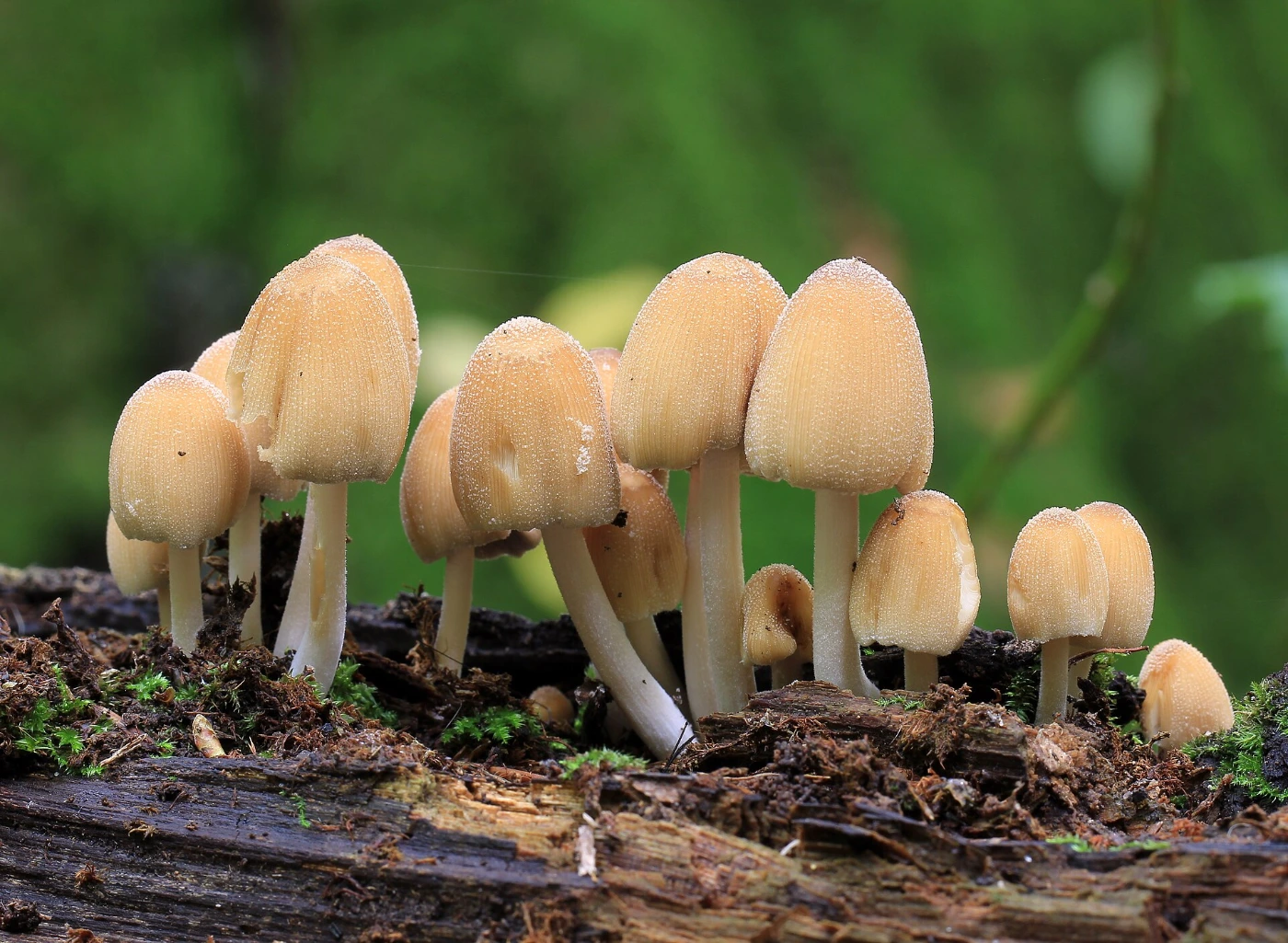
Coprinellus micaceus, commonly known as the Mica Cap or Glistening Inkcap, is a small tan-to-caramel inkcap that typically grows in dense clusters on decaying wood. Fresh young mushrooms are often sprinkled with tiny reflective granules that look like grains of mica, giving the species both its scientific name and one of its common English names.
It is particularly common around old stumps, dead roots, buried wood, and the bases of damaged or dying deciduous trees. As the mushrooms mature, the pale gills darken toward black and the cap margins may begin to dissolve, producing the characteristic “inky” appearance associated with many coprinoid fungi.
Correct identification can nevertheless be difficult. The glittering veil granules are easily washed away by rain, and Coprinellus truncorum can be so similar that microscopy may be needed to separate the two reliably.
⚠️ Important: Do not use a photo identification of Coprinellus micaceus as evidence that a mushroom is safe to eat. Small inkcaps can be difficult to distinguish, published edibility guidance for this species is inconsistent, and some similar species have important alcohol interactions.
Quick Identification
Look first for clusters of small caramel-brown mushrooms growing from wood or apparently from soil near a tree. Young caps often carry tiny pale or whitish sparkling granules, while older caps become strongly radially striate and lose much or all of this coating.
| Feature | Coprinellus micaceus |
|---|---|
| Common names | Mica Cap, Glistening Inkcap |
| Cap | Ovoid to bell-shaped, strongly striate |
| Cap color | Tawny, ochre-brown, caramel to reddish brown |
| Young cap surface | Tiny glistening mica-like granules |
| Gills | White → gray → dark brown/black |
| Stem | White, slender, hollow, no persistent ring |
| Spore print | Very dark brown to black |
| Growth | Usually dense clusters |
| Substrate | Stumps, roots, buried or decaying wood |
| Ecology | Saprotrophic |
| Season | Mainly spring through autumn; sometimes longer in mild climates |
| Edibility | Conflicting guidance; not recommended for casual collection |
One especially useful combination is mica-like cap granules + strongly lined cap + clustered growth on wood. No single feature is sufficient, however, because the granules can disappear and several related inkcaps grow in very similar habitats.
How to Identify Coprinellus micaceus
Cap
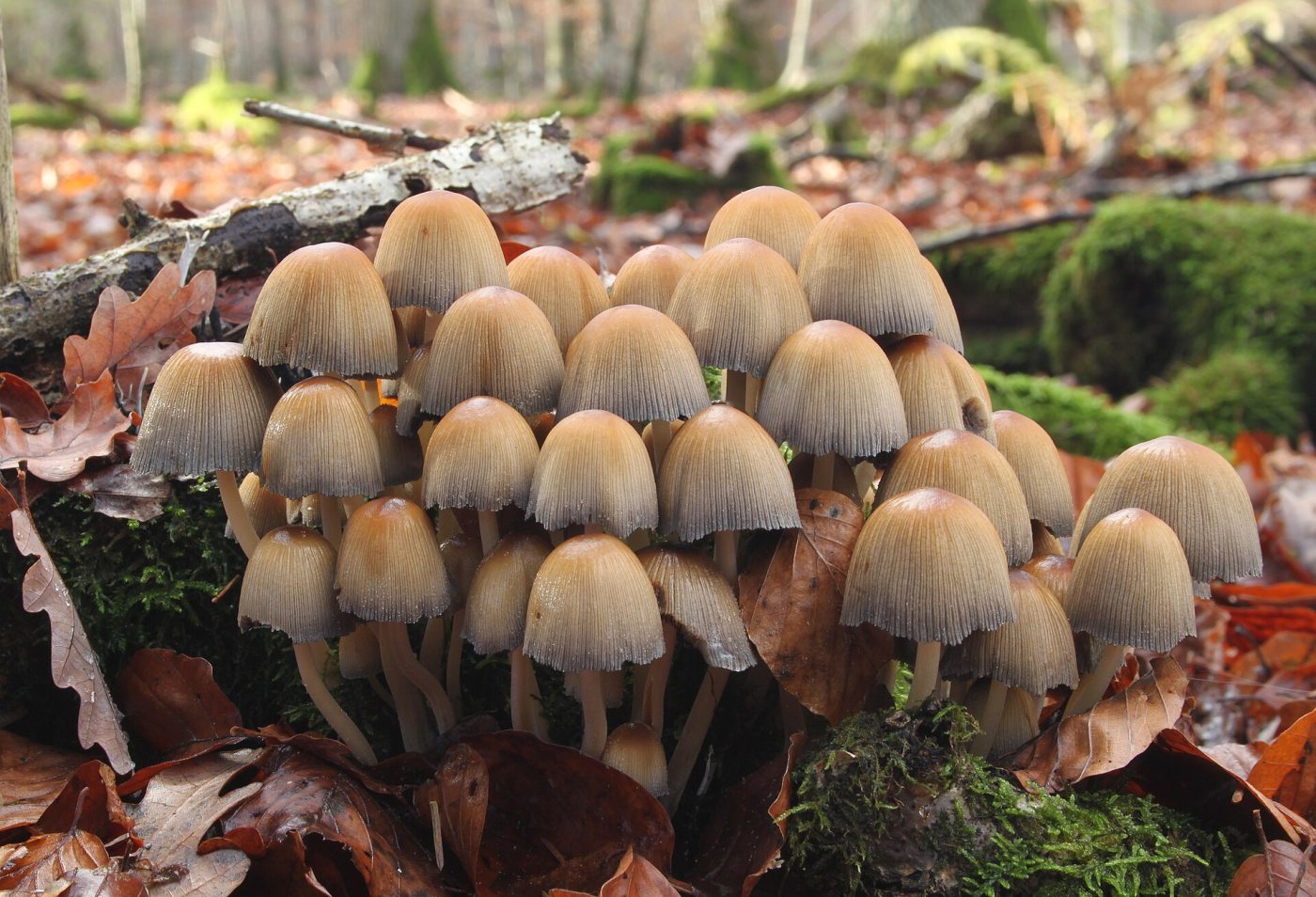
Young caps are initially ovoid or rounded and then expand into a conical or bell-shaped form. They are usually around 2–5 cm across and commonly show warm tawny, ochre, amber, or reddish-brown colors, with the center often darker than the margins.
The cap becomes deeply radially lined or grooved, particularly toward the margin. These striations can eventually extend almost to the center and become one of the most obvious features of mature specimens.
The Mica-Like Granules
Fresh young specimens are often covered with tiny whitish or translucent particles left by the universal veil. In suitable light they sparkle like small crystals or grains of mica, which explains the epithet micaceus, meaning mica-like or glistening.
This is an excellent field clue when present but a poor feature to use as an absolute requirement. Rain can wash the particles away surprisingly quickly, while handling and age can also leave an otherwise typical Mica Cap almost completely smooth.
A cluster containing mushrooms of several ages is therefore especially useful. The youngest protected caps may still show obvious glittering particles even when larger mushrooms beside them have already lost the coating.
Gills
The gills are crowded and begin pale or white. As spores mature, they become grayish, brownish, and eventually very dark brown to black.
Older fruiting bodies may begin deliquescing, meaning portions of the cap and gills autodigest into a dark liquid. C. micaceus can become visibly inky, although the process is not always as complete or dramatic as in some larger inkcaps.
Stem
The stem is slender, white, fragile, and usually hollow. It is generally several centimeters tall but only a few millimeters thick, producing the delicate appearance typical of the species.
There is no persistent ring and no volva at the base. The stem may look smooth to the naked eye, although microscopic features of its surface can matter when separating C. micaceus from extremely similar relatives.
Spore Print
The spore print is very dark brown to black, consistent with the progressively darkening gills. This can help confirm that the mushroom belongs among the dark-spored inkcap-like fungi, but it does little by itself to separate C. micaceus from close relatives.
Microscopically, C. micaceus is typically described as having smooth, mitriform or somewhat shield-shaped spores with a germ pore. Those microscopic characters become particularly relevant when distinguishing it from Coprinellus truncorum.
Where Does Coprinellus micaceus Grow?
Mica Caps are saprotrophic, obtaining nutrients by decomposing dead woody material. They commonly fruit around hardwood stumps, dead roots, buried branches, decaying logs, and the bases of dead or declining deciduous trees.
A cluster can appear to be growing directly from a lawn or bare soil because the actual wood is buried underground. If dozens of small inkcaps suddenly appear around an old tree site, a buried root system or forgotten stump may explain their presence.
The species is also common in human-modified habitats. Parks, gardens, paths, lawns, old tree pits, roadside verges, and other places containing buried woody debris can all support fruiting.
Why Do Mica Caps Grow in Clusters?
Dense clustered growth is one of the most useful field characters. Several stems may emerge very close together from a common mass of decaying wood, sometimes producing dozens of fruiting bodies around a single stump or root.
This differs from small lawn mushrooms that happen to occur near one another but arise independently from soil. With C. micaceus, close inspection often reveals that the fruiting bodies follow a stump, root, log, or buried woody structure.
Season
In temperate regions, Mica Caps commonly appear from spring through autumn. British sources report a main season from May to November, while North American descriptions include spring, summer, and fall and occasionally winter fruiting under favorable conditions.
Rain and temperature strongly influence individual flushes. A large cluster may appear quickly after suitable moisture and then collapse or deliquesce within a short period, so the same site can look completely different a few days later.
Distribution
Coprinellus micaceus is very widely distributed. It is recorded across Europe and North America and has also been reported from large parts of Asia, South America, Australia, and other regions.
Because similar species can be difficult to separate macroscopically, however, not every historical record identified purely from appearance should be assumed to represent genetically confirmed C. micaceus. The name is best treated carefully when unusually precise distribution conclusions depend on it.
Taxonomy
The current accepted name is Coprinellus micaceus (Bull.) Vilgalys, Hopple & Jacq. Johnson in the family Psathyrellaceae. Species Fungorum and Index Fungorum both list Coprinellus micaceus as the current accepted name.
Older field guides frequently call it Coprinus micaceus. Molecular work led to the breakup of the old broad genus Coprinus, and the species was transferred to Coprinellus in 2001.
The older name remains worth knowing because photographs, regional fungal records, and older identification books may still use it.
Is Coprinellus micaceus Edible?
Published guidance is inconsistent. Several modern field-oriented sources describe young Coprinellus micaceus as edible but of limited culinary value, while other sources classify it as inedible or advise against consumption.
There is an additional complication involving alcohol. Coprinopsis atramentaria — the Common Ink Cap or Alcohol Inky — is the classic coprine-containing mushroom associated with an Antabuse-like reaction when alcohol is consumed. French public-health guidance also includes Coprinellus micaceus among mushrooms associated with coprine syndrome, while other mycological sources continue to list Mica Caps as edible.
For MushroomID, the practical recommendation is therefore conservative.
⚠️ Important: Do not use a photo identification of Coprinellus micaceus as evidence that a mushroom is safe to eat. Small inkcaps can be difficult to distinguish, published edibility guidance for this species is inconsistent, and some similar species have important alcohol interactions.
Urban habitat creates another reason for caution. Mica Caps commonly grow beside roads, landscaped areas, old industrial ground, and other places where substrate contamination may be an additional concern.
Does Coprinellus micaceus React With Alcohol?
The well-established classic alcohol-interaction mushroom is Common Ink Cap [Coprinopsis atramentaria], not Coprinellus micaceus. C. atramentaria contains coprine and can cause flushing, nausea, cardiovascular symptoms, and other unpleasant effects when alcohol is consumed around the time of the meal.
For C. micaceus, guidance is less consistent, as some health materials include it within the coprine-syndrome group while other sources list it as edible. This disagreement, combined with identification difficulty, is a good reason not to use the absence of a known alcohol warning as justification for eating a wild Mica Cap.
Look-Alikes
Coprinellus truncorum
[Coprinellus truncorum] is arguably the most difficult look-alike because it can be nearly indistinguishable from C. micaceus in the field. There is no widely established English common name for this species, so the scientific name is generally the clearest way to refer to it.
Identification
Both species can have tawny bell-shaped caps, darkening gills, clustered growth on decaying wood, and mica-like veil remnants. Microscopic examination focuses partly on stem cystidia and spore shape, but even those differences can be challenging and published molecular work has raised questions about how sharply some collections can be separated.
Main Difference
Do not expect a reliable field-only distinction from every specimen. A mushroom that looks exactly like C. micaceus but lacks obvious glittering granules may simply have lost them to rain, and microscopy may be required to distinguish close members of the group.
Coprinellus disseminatus — Fairy Inkcap
The Fairy Inkcap [Coprinellus disseminatus] also grows in dense groups around stumps and decaying wood. It often produces much larger troops than Mica Caps, sometimes covering a stump or tree base with dozens or even hundreds of small mushrooms.
Identification
Fairy Inkcaps are usually smaller and paler, with delicate grayish, beige, or buff caps. They lack the conspicuous mica-like coating characteristic of young C. micaceus, and members of this group are also notable for not undergoing the same strong deliquescence typical of many other inkcaps.
Main Difference
Mica Cap = larger, warmer brown, usually glittering when young. Fairy Inkcap = smaller, paler, often forming enormous troops.
Coprinellus domesticus — Firerug Inkcap
The Firerug Inkcap [Coprinellus domesticus] is another wood-associated member of Coprinellus. It can produce pale brown to ochre caps and may occur around stumps, logs, and damp structural wood.
Identification
An important clue is the presence of an ozonium, a conspicuous mat of orange-brown fungal fibers that can spread over the wood beneath or around the fruiting bodies. The cap also differs in veil characteristics, although worn or rain-damaged specimens can still be difficult.
Main Difference
Look beneath the mushrooms as well as at the caps. A strong orange-brown ozonium favors C. domesticus, whereas the sparkling granular veil of fresh young caps favors C. micaceus.
Coprinopsis atramentaria — Common Ink Cap / Alcohol Inky
The Common Ink Cap, also called Alcohol Inky or Tippler’s Bane [Coprinopsis atramentaria], frequently grows in clusters around buried wood and old roots. Its habitat can therefore be almost identical to that of Mica Caps.
Identification
Common Ink Caps are generally larger and more robust. Their caps tend to be smoother, grayer or gray-brown rather than warm caramel-colored, and they lack the distinctive glistening veil granules of fresh C. micaceus.
Main Difference
Mica Cap = smaller + tawny/caramel + sparkling granules. Common Ink Cap = larger + gray + relatively smooth.
This distinction matters because C. atramentaria has a well-established interaction with alcohol. Do not assume that every clustered inkcap around buried wood is the smaller Mica Cap.
Mica Cap vs Common Ink Cap
These two species are particularly easy to confuse after rain has removed the mica-like granules. Both grow in clusters, both may emerge from buried roots, and both develop dark gills before deteriorating.
The overall build is useful. Coprinopsis atramentaria is typically taller, thicker, smoother, and more gray, while Coprinellus micaceus usually has smaller warm-brown caps with strong radial striations and — when young enough — the characteristic reflective granules.
Because the alcohol warning for C. atramentaria is medically important, uncertain specimens should not be identified as edible Mica Caps simply because they seem somewhat smaller or browner.
Why Are the Glittering Specks Sometimes Missing?
The “mica” is not an intrinsic permanent texture of the cap. The particles are remnants of a veil and are loosely attached to the surface, which makes them vulnerable to rain and physical contact.
This explains why photographs of the same species can look surprisingly different. A protected young cluster may appear dusted with sparkling crystals, while mushrooms collected after heavy rain can be smooth and much harder to recognize.
When the granules are absent, place more weight on growth pattern, substrate, cap striations, gill development, size, and microscopic characters if necessary.
Does Coprinellus micaceus Harm Trees?
Mica Cap is primarily a decomposer of dead wood, so fruiting around an old stump does not indicate a problem. Around a living tree, however, the fungus may be decomposing already dead roots or dead internal wood rather than attacking healthy tissue directly.
The presence of mushrooms at the base of a tree can therefore indicate that woody material is decomposing below the surface. It should not, by itself, be used to diagnose the health or structural stability of the tree.
Common Identification Mistakes
The most common mistake is assuming that the mushroom must have visible glittering granules. Because those particles disappear easily, a mature rain-washed C. micaceus may lack the feature that gave the mushroom its name.
Another mistake is assuming that mushrooms growing from a lawn cannot be wood decomposers. Mica Caps frequently fruit from buried roots or timber, so apparently terrestrial growth can still be directly associated with decaying wood.
A third problem is pushing identification too far. C. micaceus and C. truncorum can be extremely similar, and some collections cannot be separated confidently from photographs alone.
How to Photograph a Mica Cap for Identification
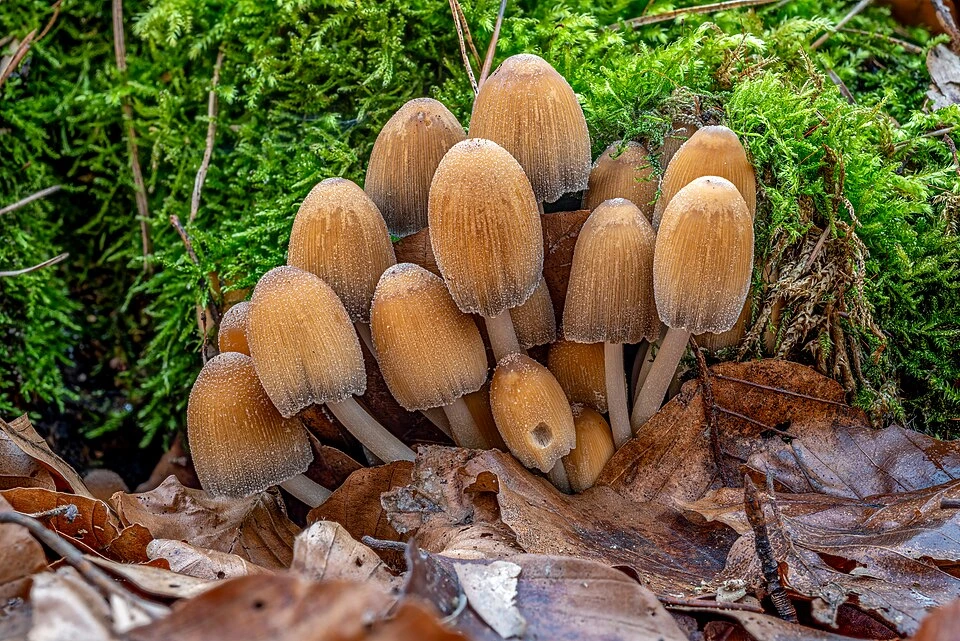
Photograph the youngest mushrooms in the cluster first, preferably before touching them. A close-up taken in side lighting can reveal mica-like veil particles that may disappear during handling.
Also photograph mature caps, the gills, stems, and the entire growth pattern. Include the stump, root, tree base, or apparent soil substrate so it is possible to judge whether buried wood is likely.
If species-level confirmation matters, a spore print and microscopy can provide information that no exterior photograph can recover.
Can AI Identify Coprinellus micaceus?
AI identification can often recognize a typical fresh cluster when the mushrooms show warm brown striate caps, sparkling veil granules, and growth around a stump. Those features together create a fairly characteristic visual pattern.
The difficult cases are older or rain-washed specimens and mushrooms from the C. micaceus–truncorum complex. When the defining surface particles have disappeared, an image may support identification as a Mica Cap-type Coprinellus without reliably proving the exact species.
Photo identification should therefore be treated as a shortlist rather than an edibility decision.
FAQ
What is the common name of Coprinellus micaceus?
The two common English names you are most likely to encounter are Mica Cap and Glistening Inkcap. Both refer to the tiny reflective veil particles that cover fresh young caps.
Why is it called the Mica Cap?
The cap of a young mushroom is often sprinkled with tiny pale granules that glisten in the light like mica. These particles are veil remnants and can wash away, so an older specimen may no longer look “micaceous.”
Does Coprinellus micaceus grow on the ground?
It can appear to do so, but there is often buried wood underneath. Old roots, buried stumps, branches, or other woody debris can allow clusters to emerge through soil or grass several centimeters away from visible wood.
Does the Mica Cap turn into ink?
Its gills darken substantially and mature fruiting bodies can undergo deliquescence, causing the margins to become dark and partially liquefied. The process may be less complete than in some other classic inkcaps, so not every specimen will turn into a puddle of black liquid.
Is Coprinellus micaceus edible?
Sources disagree, with some describing young specimens as edible and others recommending against consumption or including the species in coprine-syndrome guidance. Because it also has difficult look-alikes, MushroomID does not recommend relying on a photo identification to decide whether to eat it.
Can you drink alcohol after eating Mica Caps?
The classic and clearly established alcohol-interaction species is Coprinopsis atramentaria, but some public-health guidance also includes C. micaceus among fungi associated with coprine syndrome. Given the inconsistent guidance and identification difficulty, alcohol tolerance should not be used as evidence that a collected inkcap is safe.
How can I distinguish Coprinellus micaceus from Coprinellus truncorum?
The two can be extremely similar macroscopically, and there is no simple field feature that separates every specimen. Microscopic examination of spores and stem surface structures may be needed, and some taxonomic work has highlighted just how close the two are.
Final Identification Notes
[Coprinellus micaceus] — the Mica Cap or Glistening Inkcap — is best recognized as a small, warm-brown inkcap growing in clusters from decaying or buried wood. Fresh young caps often carry distinctive mica-like particles, while older caps become strongly striate and their gills progress from pale to almost black.
The strongest field combination is clustered wood-associated growth + tawny bell-shaped caps + mica-like veil granules + blackening gills. Missing granules do not rule the species out because rain can remove them, and Coprinellus truncorum may require microscopy to distinguish reliably.
Published advice about eating Mica Caps is inconsistent, and similar inkcaps include species with clinically important alcohol interactions. For that reason, do not use appearance or AI identification alone to determine whether a wild Coprinellus is safe to eat.
Sources
- Species Fungorum — accepted name, classification, and synonymy for Coprinellus micaceus.
- Index Fungorum — nomenclatural record confirming Coprinellus micaceus as the current name.
- MushroomExpert — morphology, ecology, season, substrate, and the difficult relationship between C. micaceus and C. truncorum.
- First Nature — Glistening Inkcap identification, veil granules, spores, habitat, season, distribution, and culinary notes.
- Missouri Department of Conservation — Coprinopsis atramentaria identification and its established alcohol interaction, useful for comparison with Mica Caps.
- French regional health authority guidance — coprinoid mushrooms and coprine-syndrome safety guidance.
Upload a photo and get possible matches in seconds.