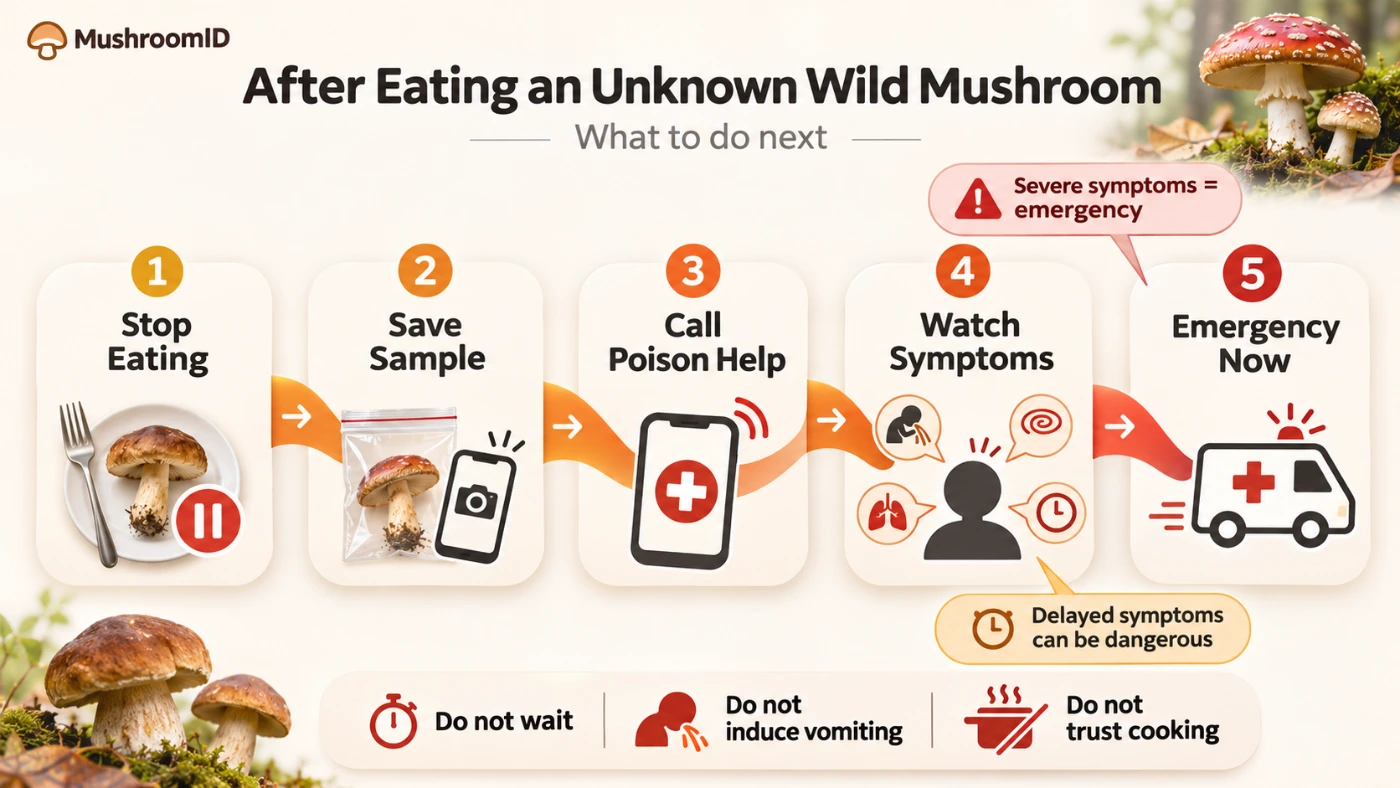
Eating an unidentified wild mushroom should be treated as a potential poisoning even if you feel completely well. Many mushroom toxins cause symptoms quickly, but some of the most dangerous species produce no obvious effects for six hours or longer.
The safest response is to contact a poison center or medical professional promptly, preserve any remaining mushrooms, document what was eaten, and avoid home remedies. Do not wait until the mushroom has been identified before asking for medical advice.
⚠️ Important: If the person collapses, has a seizure, has difficulty breathing, becomes severely confused, or cannot be awakened, call emergency medical services immediately.
Quick Action Guide
| Situation | What to do |
|---|---|
| Unknown wild mushroom eaten | Contact poison center or medical service |
| No symptoms yet | Still seek advice |
| Mushroom sample available | Keep it for identification |
| Photos available | Save cap, underside, stem, base, habitat images |
| Vomiting already occurred | Preserve mushroom pieces if possible |
| Severe symptoms | Call emergency services |
| Delayed vomiting or diarrhea after 6+ hours | Treat as particularly concerning |
| Thinking about inducing vomiting | Do not do it unless specifically instructed |
| Mushroom has been cooked | Do not assume toxins were destroyed |
| Exact species unknown | Do not delay medical care while identifying it |
The exact response depends on who ate the mushroom, how much was eaten, when it happened, and which species may be involved. A poison specialist can assess those details much more safely than an online identification alone.
1. Contact a Poison Center or Medical Professional
Do this as soon as you realize an unidentified wild mushroom has been eaten. Poison Control specifically recommends contacting a poison center immediately rather than waiting to see whether symptoms appear.
In the United States, Poison Control can be reached through the national poison center system. In other countries, use the local poison information service, emergency medical service, or hospital.
The important principle is universal: unknown wild mushroom ingestion should be assessed promptly.
Do Not Wait for Symptoms
Feeling well immediately after eating a mushroom does not prove that it was safe. Some mushroom toxins produce symptoms within minutes, while others have a long symptom-free period.
Amatoxin-containing mushrooms such as Death Caps and some destroying angels commonly cause gastrointestinal symptoms only after more than six hours. By then, toxin absorption has already occurred and liver injury may be developing.
2. Keep the Mushroom
If any of the mushroom remains, save it. A complete specimen can be extremely valuable for identification.
Ideally, keep the cap, underside, full stem, and stem base together. The stem base matters because structures such as an Amanita volva may be critical for recognizing a deadly species.
Do not throw away all the mushrooms before speaking with a poison specialist. Identification can influence monitoring and treatment decisions.
Keep Cooked Leftovers Too
If the mushroom was cooked as part of a meal, preserve any leftovers. Even cooked material may contain recognizable fragments.
Keep scraps from preparation as well if available. Stems, cap pieces, or discarded bases may contain features missing from the cooked dish.
Preserve Vomited Mushroom Material
If vomiting has already occurred and mushroom pieces are visible, they can sometimes help with identification. Handle this material carefully and keep it separate.
Do not intentionally induce vomiting simply to obtain a sample. Poison Control specifically advises against inducing vomiting after swallowed poisons unless a professional directs otherwise.
3. Take Clear Photographs
If mushrooms are still growing where they were collected, photograph them before removing the remaining specimens. Habitat photographs can provide information that a kitchen-table photo cannot.
Take images of the cap, underside, complete stem, stem base, growth pattern, and surrounding substrate. Include nearby trees whenever possible because host association can help identify mycorrhizal species.
A photograph showing only the top of the cap is much less useful than a complete photographic set.
Photograph the Growing Location
Record whether the mushroom was growing from soil, grass, a stump, a log, wood chips, buried roots, or another substrate. This can quickly eliminate many possible species.
Also note whether the mushrooms were solitary, clustered, or growing in a ring. These details may become impossible to reconstruct later.
4. Record When and How Much Was Eaten
Write down the approximate time the mushroom was eaten. Timing is one of the most useful clinical clues in mushroom poisoning.
Also estimate how many mushrooms or what portion of the meal was consumed. Exact weights are rarely available, but even rough information can help medical professionals evaluate exposure.
If several people ate the same meal, record who ate what and whether anyone has developed symptoms.
Why Timing Matters
Different mushroom toxins have characteristic latency periods. Gastrointestinal irritants may cause illness within a few hours, while amatoxins and some kidney-damaging toxins can produce much longer delays.
A latency of more than about six hours after wild mushroom ingestion is particularly concerning because it can occur with serious organ-damaging syndromes.
Timing does not identify the species by itself. Mixed meals or several mushroom species can also complicate the pattern.
5. Do Not Induce Vomiting Yourself
Do not attempt to make someone vomit unless a poison specialist or medical professional specifically instructs you to do so. Poison Control no longer recommends routine induced vomiting for swallowed poisons.
Home methods involving salt water, mustard, fingers in the throat, or other techniques can cause additional harm. They can also delay appropriate medical treatment.
Treatment decisions depend on the toxin, elapsed time, symptoms, and medical condition of the person involved.
Do Not Use Home “Detox” Remedies
Milk, alcohol, vinegar, activated charcoal bought for home use, herbal products, or large amounts of water should not be used as improvised antidotes. Mushroom toxins differ too much for a universal home treatment.
Activated charcoal may be used medically in selected poisonings, but its use depends on timing, airway safety, toxin type, and clinical circumstances. The decision belongs with medical professionals rather than home experimentation.
6. Do Not Assume Cooking Made the Mushroom Safe
Cooking does not reliably destroy mushroom toxins. Poison Control explicitly warns that poisonous mushrooms can remain dangerous after cooking.
This is especially important with amatoxins. The CDC notes that these toxins are not denatured by cooking or normal food preparation.
Drying, freezing, boiling, frying, or reheating should therefore never be used as evidence that an unidentified mushroom was safe.
Symptoms That Can Appear Quickly
Some mushroom poisonings begin within minutes to a few hours. Symptoms can include nausea, vomiting, abdominal cramps, diarrhea, sweating, excessive saliva, confusion, hallucinations, tremors, or seizures.
Rapid symptoms are often associated with gastrointestinal irritants or neurological toxins. They can still become severe, particularly when vomiting and diarrhea cause dehydration.
Any severe neurological or respiratory symptom requires urgent medical attention.
Symptoms That Appear After 6 Hours
Delayed vomiting, diarrhea, and abdominal pain are particularly important warning signs after wild mushroom ingestion. Amatoxin poisoning often begins only after a long symptom-free period.
The first phase can look like severe food poisoning. This similarity can lead people to underestimate the danger.
Do not assume that delayed gastrointestinal symptoms are simply a stomach infection if wild mushrooms were eaten earlier.
Why Amatoxin Poisoning Is Especially Dangerous
Amatoxins are found in mushrooms including Amanita phalloides, destroying angels, some Galerina, and some Lepiota. They interfere with protein synthesis and can cause extensive liver-cell death.
The first symptoms are often abdominal pain, vomiting, and severe diarrhea after a delay of more than six hours. Laboratory evidence of liver injury may develop later even if the initial gastrointestinal symptoms begin to improve.
In severe cases, poisoning can progress to liver and kidney failure and may require liver transplantation.
Feeling Better Does Not Always Mean Recovery
Amatoxin poisoning can include a deceptive period when vomiting and diarrhea improve. The person may believe the illness is ending.
At the same time, liver injury can continue progressing. Earlier CDC reports describe this apparent recovery phase before severe hepatic and multiorgan failure develops.
This is why medical follow-up matters even when symptoms temporarily disappear.
Kidney-Damaging Mushrooms Can Be Even More Delayed
Some mushroom toxins primarily damage the kidneys and may produce symptoms several days after ingestion. Orellanine-containing Cortinarius mushrooms are a classic example.
A person may have forgotten about the mushroom meal by the time thirst, weakness, abdominal discomfort, or changes in urination develop.
Always mention recent wild mushroom consumption to a doctor even if several days have passed.
Neurological Symptoms
Some mushrooms affect the central or peripheral nervous system. Confusion, unusual behavior, hallucinations, poor coordination, tremors, excessive sleepiness, or seizures can occur depending on the toxin.
Muscarine-containing mushrooms can instead produce marked sweating, tearing, salivation, abdominal cramps, small pupils, and cardiovascular effects.
Neurological symptoms after unknown mushroom ingestion should not be interpreted at home based only on which mushroom seems most likely.
When to Call Emergency Services Immediately
Collapse, severe breathing difficulty, seizures, profound confusion, or inability to wake the person require immediate emergency care. Poison Control gives the same advice for severe poison exposures generally.
Severe dehydration, repeated uncontrollable vomiting, jaundice, markedly reduced urination, or worsening weakness also require urgent medical assessment.
Do not drive yourself if severe neurological symptoms or loss of consciousness are developing.
What Information to Give the Poison Specialist
Be ready to explain the person’s age and approximate weight, the time of ingestion, the estimated amount eaten, whether the mushrooms were raw or cooked, and any symptoms that have appeared.
Also describe where the mushrooms came from and whether they grew on soil, lawn, wood, or beneath particular trees. Provide photographs or a physical specimen when requested.
This information may be more useful initially than guessing the species name.
Do Not Rely on a Mushroom App to Decide Whether to Seek Help
Identification apps and AI can generate useful possibilities, but they should not be used to determine that an ingested mushroom was harmless.
Critical identification characters may be absent from a photograph, and several deadly mushrooms closely resemble edible species. Poison Control emphasizes that expert identification uses the cap, underside, spores, stem, stem base, growth habit, and substrate together.
Use image identification to help provide information to professionals, not to delay contacting them.
What if You Know the Mushroom Was Edible?
Even normally edible mushrooms can cause gastrointestinal reactions in some people. Undercooked, spoiled, contaminated, or individually poorly tolerated mushrooms can also produce symptoms.
If symptoms are significant, professional medical advice is still appropriate. The fact that a species is normally edible does not exclude every possible problem.
The risk is much higher if species identification itself is uncertain.
What if Only a Tiny Piece Was Eaten?
Do not assume that a small amount means no risk. Toxicity depends on the species, concentration of toxin, amount consumed, and the person’s size and health.
A poison specialist can evaluate whether the reported amount is likely to require observation or treatment.
This is particularly important with potentially deadly mushroom groups, where casual dose estimates should not replace medical assessment.
What if Several Mushroom Species Were in the Meal?
Mixed mushroom meals make poisoning assessment more difficult. One edible species does not prove that every mushroom in the dish was edible.
A single toxic specimen mixed among many edible mushrooms can change the risk substantially. Preserve all remaining mushroom types rather than selecting only the one you think caused the problem.
Mixed meals can also produce overlapping symptom timelines.
What if Someone Else Ate the Same Mushrooms and Feels Fine?
One person remaining well does not prove the meal was safe. Different people may have eaten different quantities or even different individual mushrooms.
Body weight, age, underlying health, medications, and individual sensitivity can also influence symptoms.
Everyone who consumed the unknown mushrooms should mention the shared exposure when seeking poison advice.
Wild Mushroom Poisoning in Children
Children can become seriously ill from smaller absolute amounts because of their lower body weight. Unknown mushroom ingestion in a child therefore deserves prompt poison-center assessment.
Do not wait for a child to become visibly sick before asking for advice. Preserve the mushroom and record the approximate amount that may have been swallowed.
If the child develops severe vomiting, confusion, seizures, breathing problems, or reduced responsiveness, seek emergency care immediately.
What if a Dog Ate the Mushroom?
Dogs should be assessed by a veterinarian or veterinary poison service rather than a human poison center. Pet Poison Helpline advises treating unknown wild mushroom ingestion as potentially toxic until a specialist can identify the mushroom as non-toxic.
Symptoms in dogs can include vomiting, diarrhea, tremors, seizures, disorientation, liver injury, and kidney injury. Some toxins act within 15–30 minutes while others produce no signs for many hours.
Do not induce vomiting at home unless a veterinarian specifically advises it. Veterinary sources warn that inappropriate induced vomiting can cause additional harm.
How Mushroom Identification Helps Doctors
Treatment usually begins based on exposure history, symptoms, and timing rather than waiting for a perfect species identification. However, a reliable identification can reveal which organs are at risk.
Recognizing an amatoxin-containing mushroom may prompt close monitoring of liver function, while a suspected orellanine-containing mushroom raises concern about delayed kidney injury.
Professional mycologists sometimes work with poison centers to identify specimens from photographs or physical samples. Poison Control specifically notes that poison specialists may involve mushroom identification experts when handling exposures.
Common Mistakes After Eating an Unknown Mushroom
One common mistake is waiting until symptoms appear. This is especially dangerous with amatoxins because the symptom-free period can last more than six hours.
Another mistake is throwing away all remaining mushrooms before identification. Keeping a specimen can make expert assessment much easier.
A third mistake is inducing vomiting or trying home antidotes. These actions can cause additional problems and delay appropriate treatment.
A fourth mistake is assuming that cooking, freezing, or drying eliminated the toxin. Some of the most dangerous mushroom toxins survive ordinary food preparation.
Frequently Asked Questions
What should I do first after eating an unknown wild mushroom?
Contact a poison center or medical professional promptly. Do not wait for symptoms or for someone online to identify the mushroom.
Should I make myself vomit?
No. Do not induce vomiting unless a poison specialist or doctor specifically instructs you to do so.
Should I keep the mushroom?
Yes. Save whole specimens, scraps, cooked leftovers, and clear photographs whenever possible because they may help with identification.
What if I feel completely fine?
You should still seek advice if the mushroom is unknown. Dangerous amatoxin poisoning can remain symptom-free for more than six hours.
Are symptoms after six hours more dangerous?
They can be. Delayed gastrointestinal symptoms are associated with potentially serious toxin groups, including amatoxins, although timing alone cannot identify the exact poisoning.
Can cooking destroy mushroom poison?
Not reliably. Amatoxins remain active after normal cooking and food preparation.
What should I photograph for identification?
Photograph the cap, underside, entire stem, stem base, substrate, surrounding habitat, and other mushrooms from the same patch. Several views are much more useful than a single cap image.
Should I wait until the mushroom is identified before going to hospital?
No. Medical treatment should not be delayed while waiting for a species name, particularly when symptoms are severe or the mushroom could belong to a dangerous group.
Final Notes
After eating an unknown wild mushroom, the safest response is to act before symptoms develop. Contact a poison center or medical professional, preserve mushrooms and photographs, record when and how much was eaten, and avoid home treatments.
Delayed poisoning deserves particular attention. Amatoxin-containing mushrooms can cause no symptoms for more than six hours before severe vomiting and diarrhea begin, followed later by liver and kidney injury.
The practical safety sequence is: stop eating → preserve the mushroom → record the time and amount → contact poison experts → do not induce vomiting → do not wait for identification or symptoms → seek emergency care immediately for severe symptoms.
Upload a photo and get possible matches in seconds.