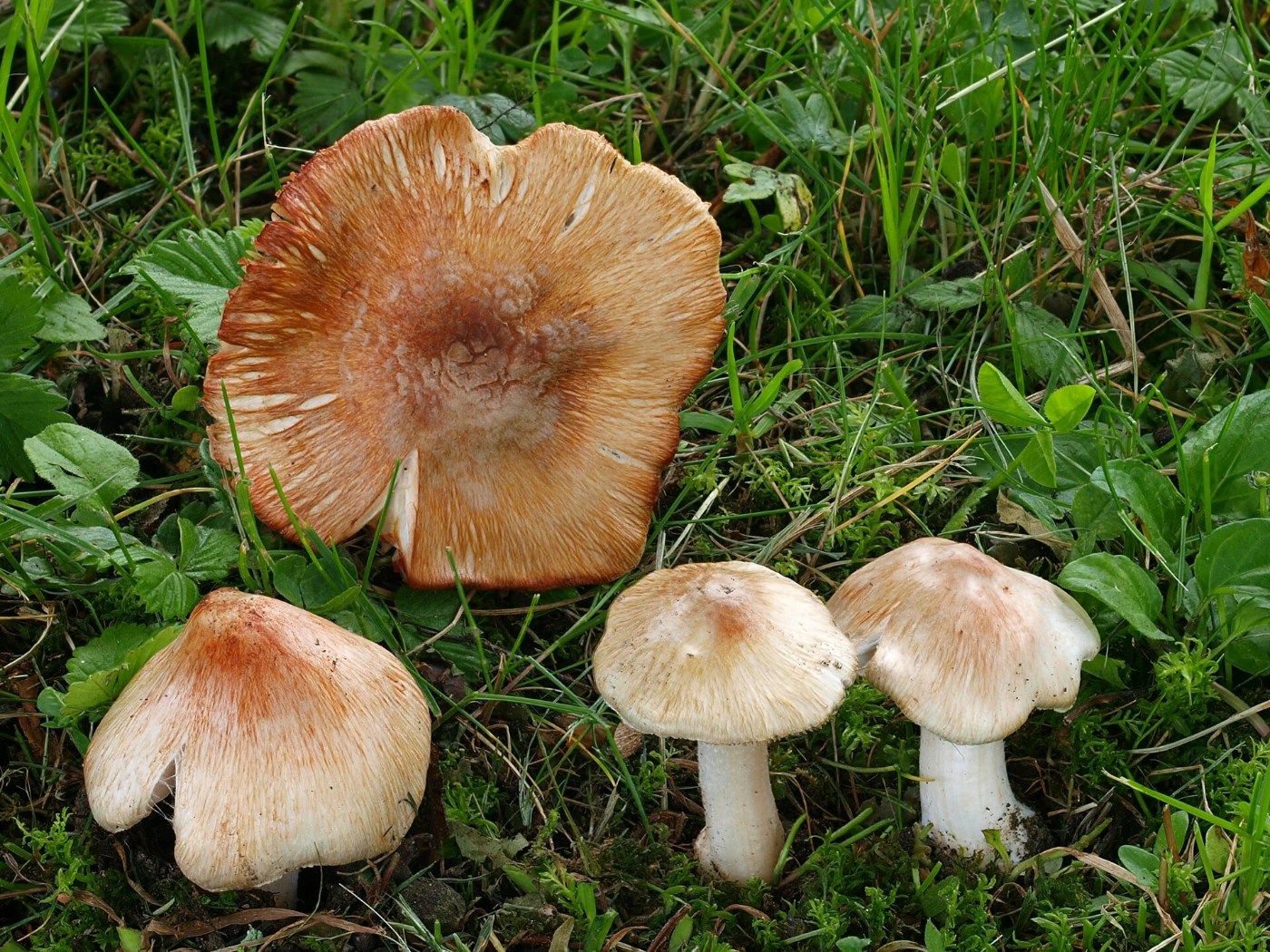
Inosperma erubescens, commonly known as the Deadly Fibrecap, is a highly poisonous pale mushroom that gradually develops pink, brick-red, or reddish-brown staining. It grows mainly in deciduous woodland, parks, and other places with suitable trees, often on calcareous soils.
The most useful field pattern is pale fibrous cap + reddish staining with age or handling + gills that darken from pale cream to gray-brown or olive-brown + brown spores + no stem ring. It can appear during the same spring and early-summer period as edible St George’s Mushroom, which makes the comparison particularly important.
⚠️ Important: Inosperma erubescens contains muscarine and can cause severe poisoning. Symptoms can begin rapidly, often within about 15 minutes to two hours, and may include profuse sweating, salivation, tearing, vomiting, diarrhea, constricted pupils, slow heart rate, low blood pressure, and breathing difficulties.
Quick Identification
| Feature | Inosperma erubescens |
|---|---|
| Common name | Deadly Fibrecap |
| Older names | Inocybe erubescens, Inocybe patouillardii |
| Cap | Cream to beige, later reddish-brown |
| Cap surface | Radially fibrous, silky, often splitting |
| Cap shape | Bell-shaped to convex, usually with an umbo |
| Young gills | Whitish, cream, sometimes pinkish |
| Mature gills | Gray-brown to olive-brown |
| Stem | White to pale, robust |
| Bruising | Pink to brick-red |
| Ring | Absent |
| Volva | Absent |
| Spore print | Brown |
| Ecology | Mycorrhizal |
| Habitat | Deciduous woodland, parks, pathsides |
| Soil | Often calcareous |
| Season | Late spring through summer and autumn |
| Main toxin | Muscarine |
| Main look-alikes | St George’s Mushroom, other fibrecaps, pale Agaricus |
What Does Deadly Fibrecap Look Like?
Deadly Fibrecap is unusually large and robust for a fibrecap. Many members of the broader Inocybe-type group are small, slender brown mushrooms, while I. erubescens can develop a cap approaching 8–10 cm across.
Young specimens can be deceptively pale. They may begin ivory, cream, or beige and only later develop the reddish staining that gives the species its scientific name.
Cap
The cap begins bell-shaped or broadly conical and later expands while usually retaining a raised central umbo. Its surface is dry, finely silky, and covered with radial fibers.
As the cap expands, the margin may split or crack along these fibers. Pale young caps gradually develop pinkish, reddish, or brick-red areas, particularly after handling or with age.
Fibrous Cap Surface
The fibrous surface is one of the reasons these mushrooms are called fibrecaps. Fine radial fibers run from the center toward the margin and can give the cap a streaked or silky appearance.
Older caps may become increasingly rough or split around the edge. This texture separates the mushroom from many smooth, fleshy spring mushrooms.
Red Staining
The tendency to turn reddish is one of the most useful field characters. Cap, stem, gills, and damaged tissues can all develop pink, red, or reddish-brown coloration.
The reaction is not always immediate or equally strong in every specimen. A very young mushroom may still look predominantly pale, so lack of obvious red staining at first glance does not exclude the species.
Gills
Young gills are pale cream, dirty white, or sometimes faintly pinkish. As spores mature, they become gray-brown, olive-brown, or dull brown.
The gills are attached to the stem rather than running strongly down it. Mature brownish gills are an important difference from St George’s Mushroom, which retains pale gills and produces a white spore print.
Stem
The stem is pale, fairly robust, and usually cylindrical, sometimes with slight thickening toward the base. It lacks a true ring.
Handling can produce reddish staining similar to that seen on the cap. Older specimens may become more strongly red-brown toward the lower stem.
Ring and Volva
Deadly Fibrecap has neither a conventional membranous ring nor an Amanita-style volva. This helps separate it from ringed mushrooms such as many Agaricus.
Absence of a ring does not by itself identify the species. Numerous edible and poisonous woodland mushrooms are also ringless.
Flesh
The flesh begins white to pale and may redden gradually after exposure or handling. The mushroom is relatively thick-fleshed compared with many smaller fibrecaps.
Bruising should be treated as supporting evidence rather than a complete identification test. Several related Inosperma and Inocybe-type mushrooms can also show reddish changes.
Smell
The odor is variable and not a dependable primary character. It has been described as faintly sweet, honey-like, unusual, or increasingly unpleasant in older specimens.
Smell should never be used to decide whether a mushroom is safe. With a muscarine-containing species, tasting is completely inappropriate.
Spore Print
The spore print is brown. This immediately separates Deadly Fibrecap from several pale edible mushrooms with white spores.
A brown print alone does not identify Inosperma erubescens, because many unrelated mushrooms also produce brown spores. It is most useful when combined with the fibrous cap and red staining.
Where Does Inosperma erubescens Grow?
Deadly Fibrecap grows from soil in association with living trees. It occurs in deciduous woodland, parks, roadside tree plantings, and woodland paths, particularly where the soil is calcareous.
Beech and other broadleaf trees are frequently associated with records. The original Inocybe erubescens material was described from soil associated with spruce and alder in Norway, which also shows that host associations should not be reduced to a single tree species.
Calcareous Soils
Limestone and chalk-rich habitats are particularly characteristic in many European records. Woodland paths, parks, and grassy areas around broadleaf trees on alkaline soils can all be suitable habitat.
Soil preference can be useful when several superficially similar mushrooms occur nearby. It should still support morphological identification rather than replace it.
Season
Deadly Fibrecap can appear from late spring through summer and into autumn. Early-season fruiting is particularly important because it overlaps with St George’s Mushroom.
This seasonal overlap has contributed to poisoning risk. A pale spring mushroom should therefore never be identified as St George’s Mushroom on season alone.
Distribution
The species is primarily a European mushroom and is recorded from many parts of the continent. It is considered uncommon in some regions but locally more frequent where suitable calcareous woodland habitat occurs.
The genus Inosperma has undergone substantial taxonomic revision. Similar-looking mushrooms outside Europe should not automatically be assigned this species name without regional evidence.
Why the Name Changed From Inocybe to Inosperma
For many years the species was known as Inocybe erubescens, and even earlier literature frequently used Inocybe patouillardii. Modern phylogenetic work separated several lineages formerly grouped within Inocybe, leading to placement of this species in Inosperma.
Index Fungorum currently accepts Inosperma erubescens as the current name. The older combinations remain important because they appear widely in field guides, toxicology papers, and older mushroom records.
Why Is Deadly Fibrecap Poisonous?
Deadly Fibrecap contains muscarine, a toxin that stimulates muscarinic acetylcholine receptors in the peripheral nervous system. The result is an exaggerated parasympathetic response often described as muscarinic or cholinergic mushroom poisoning.
Unlike amatoxin poisoning from Death Caps, muscarine poisoning usually begins quickly. The short latency can make the connection with the mushroom meal obvious.
Symptoms of Muscarine Poisoning
The classic symptom pattern includes sweating, excessive saliva, and tearing. These are often accompanied by nausea, vomiting, abdominal cramps, watery diarrhea, constricted pupils, and blurred vision.
More severe cases can cause slow heart rate, low blood pressure, bronchial secretions, bronchospasm, and breathing difficulty. Severe poisoning is uncommon with prompt treatment but can become medically serious, particularly after substantial ingestion or in vulnerable patients.
How Quickly Do Symptoms Begin?
Symptoms often begin within 15 minutes to two hours after eating a muscarine-containing mushroom. This is much faster than the delayed gastrointestinal phase typical of amatoxin poisoning.
A very rapid onset can be associated with more substantial exposure. Anyone developing sweating, drooling, vomiting, breathing problems, or cardiovascular symptoms after eating a wild mushroom should receive prompt medical assessment.
Does Muscarine Cause Hallucinations?
No. Muscarine poisoning is fundamentally different from the muscimol and ibotenic-acid syndrome caused by Amanita muscaria and related mushrooms.
Muscarine primarily affects peripheral cholinergic receptors. The characteristic picture is excessive secretions, gastrointestinal symptoms, pupil constriction, and cardiovascular or respiratory effects rather than a hallucinogenic experience.
Is There a Treatment?
Medical treatment is based on supportive care and management of the cholinergic syndrome. Atropine can be used in hospital for significant muscarinic symptoms because it blocks muscarinic receptors.
This is not a home-treatment recommendation. If ingestion is suspected, contact an appropriate poison service or medical professional rather than attempting self-treatment.
Does Cooking Destroy Muscarine?
Deadly Fibrecap should never be treated as a mushroom that can be detoxified by cooking. Frying, boiling, drying, or freezing should not be used as a way to make it edible.
The correct safety approach is complete avoidance. A mushroom identified as Inosperma erubescens is not food.
Look-Alikes
The most important look-alikes are pale spring mushrooms and other fibrecaps. Red staining, spore color, cap texture, gill development, and ring presence are especially useful.
Calocybe gambosa — St George’s Mushroom
Identification
St George’s Mushroom is a pale edible spring mushroom that can occur around woodland edges, grassy areas, and paths. It has a thick white-to-cream cap, crowded pale gills, and a strong mealy or flour-like smell.
Its flesh remains pale rather than developing the characteristic reddish staining of Deadly Fibrecap. It also produces a white spore print rather than a brown one.
Main Difference
Red staining + fibrous cap + brown spores favor Deadly Fibrecap. Pale flesh that does not redden + mealy smell + white spores favor St George’s Mushroom.
Inocybe godeyi — Godey’s Fibrecap
Identification
Godey’s Fibrecap is another poisonous fibrecap that can develop strong reddish coloration. It is generally smaller and may have a more distinct bulbous stem base.
The two belong to a difficult group in which field identification can be challenging. Neither should be considered edible.
Main Difference
A larger, more robust fruit body favors I. erubescens, while a smaller mushroom with a more obvious bulbous base can suggest Godey’s Fibrecap. Exact identification may require microscopy.
Agaricus Species
Identification
Pale Agaricus can have substantial white caps and brown mature gills. This can create superficial similarity once Deadly Fibrecap has aged.
Agaricus normally has a clear stem ring, while Inosperma erubescens does not. Agaricus gills also commonly begin pink and mature toward chocolate brown.
Main Difference
True stem ring + pink-to-chocolate gills favor Agaricus. Ringless fibrous cap + red staining favor Deadly Fibrecap.
Clitopilus prunulus — The Miller
Identification
The Miller is a pale woodland mushroom with a strong mealy smell. Its gills run noticeably down the stem and mature toward pink as the spores develop.
Deadly Fibrecap has attached rather than strongly decurrent gills and produces a brown spore print. It also develops the characteristic reddish staining absent from typical Miller specimens.
Main Difference
Pink spores + decurrent gills + floury smell favor The Miller. Brown spores + fibrous cap + red staining favor Deadly Fibrecap.
Deadly Fibrecap vs St George’s Mushroom
| Feature | Deadly Fibrecap | St George’s Mushroom |
|---|---|---|
| Cap | Pale, fibrous | White to cream, smoother |
| Cap shape | Bell-shaped / umbonate | Broad and fleshy |
| Red staining | Yes | No |
| Young gills | Pale | Pale |
| Mature gills | Gray-brown / olive-brown | Remain pale |
| Spore print | Brown | White |
| Ring | Absent | Absent |
| Smell | Variable | Strongly mealy |
| Toxicity | Highly poisonous | Edible when correctly identified |
| Best clue | Red staining + brown spores | No red staining + white spores |
This is the comparison most worth learning if collecting pale spring mushrooms.
Deadly Fibrecap vs Agaricus
| Feature | Inosperma erubescens | Agaricus |
|---|---|---|
| Young cap | Cream to pale beige | Often white or brown |
| Mature gills | Gray-brown / olive-brown | Chocolate brown |
| Ring | Absent | Usually present |
| Red staining | Often develops | Species-dependent |
| Spore print | Brown | Dark brown |
| Cap texture | Radially fibrous | Usually less fibrous |
| Best clue | No ring + reddening | Ring + characteristic Agaricus gills |
The complete stem should always be checked because a ring can be missed if the stem is broken.
Why Red Staining Matters
The specific epithet erubescens refers to reddening. This reaction is one of the species’ most memorable field characters.
However, red staining is not unique to Deadly Fibrecap. It works best when combined with the pale fibrous cap, brown spores, attached gills, robust form, and appropriate habitat.
Why Cap Fibers Matter
The radial fibers distinguish the mushroom from many smoother pale spring species. As the cap expands, these fibers may separate and cause the margin to crack or split.
The pattern is often easier to see in dry mature mushrooms. Wet or very young specimens may appear smoother.
Young vs Mature Deadly Fibrecap
Young specimens can be almost entirely cream-colored and may show little red staining. Their gills are also still pale, making them potentially more confusing with edible spring mushrooms.
With age, the cap expands, reddish areas become more obvious, and the gills darken toward gray-brown or olive-brown. The mushroom therefore becomes easier to recognize as it matures.
Common Identification Mistakes
One common mistake is assuming that every pale spring mushroom with crowded gills is St George’s Mushroom. Deadly Fibrecap can occur during the same part of the year.
Another mistake is overlooking slow red staining. A specimen may need handling or time before reddish discoloration becomes obvious.
A third mistake is relying only on smell. Both smell perception and odor intensity vary greatly between people and specimens.
A fourth mistake is treating all small fibrecaps as insignificant. The broader fibrecap group contains numerous muscarine-producing mushrooms and is a poor target for casual edible identification.
Should Fibrecaps Be Collected for Food?
No. Fibrecaps are a difficult group containing many poisonous species, and they offer little reason for culinary experimentation.
Foragers who encounter an Inocybe– or Inosperma-type mushroom should treat identification as a mycological exercise rather than an edibility question.
How to Photograph Inosperma erubescens
Photograph the mushroom before touching it and include nearby trees and the surrounding habitat. A wider image showing woodland edge, parkland, or calcareous grass beneath trees can be useful.
Then photograph the cap surface, gills, entire stem, and stem base. Take another photograph after handling or cutting to document any developing red staining.
Can AI Identify Deadly Fibrecap?
AI may recognize a typical mature specimen with obvious red staining and a fibrous pale cap. Young specimens are much more difficult because they can lack the strongest color changes.
Species-level identification within the fibrecap group can require microscopy. A photo result should therefore never be used to declare a suspected fibrecap safe to eat.
Interesting Facts
Deadly Fibrecap was long placed in the enormous genus Inocybe. DNA-based reclassification moved it to Inosperma, although the old name Inocybe erubescens remains extremely common in older books and toxicology references.
The older synonym Inocybe patouillardii is also still encountered frequently. Catalogue of Life and GBIF list it as a synonym of the currently accepted Inosperma erubescens.
Despite the dramatic common name, the modern clinical picture of muscarine poisoning is usually rapidly recognizable and treatable when medical care is obtained promptly. Severe poisoning is possible, but fatal outcomes are described as rare in contemporary toxicology guidance.
The species is unusual among fibrecaps because of its relatively large size. A cap approaching 8–10 cm can make it resemble more familiar edible woodland mushrooms rather than the small brown fibrecaps many foragers expect.
Frequently Asked Questions
What is the current scientific name of Deadly Fibrecap?
The accepted name is Inosperma erubescens. Inocybe erubescens and Inocybe patouillardii are older names that remain common in field guides.
Is Deadly Fibrecap poisonous?
Yes. It contains muscarine and can produce severe cholinergic poisoning.
How quickly do symptoms begin?
Muscarine symptoms commonly begin within roughly 15 minutes to two hours. Rapid sweating, salivation, tearing, vomiting, and diarrhea are particularly characteristic.
Does Deadly Fibrecap turn red?
Yes. The cap, stem, gills, and damaged tissues can gradually develop pinkish or brick-red staining.
What color is the spore print?
The spore print is brown. This helps separate it from St George’s Mushroom, which has white spores.
Does Deadly Fibrecap have a ring?
No. A true stem ring is absent.
How is it different from St George’s Mushroom?
Deadly Fibrecap has a fibrous cap, develops red staining, and produces brown spores. St George’s Mushroom remains pale, smells strongly mealy, and produces a white spore print.
Can cooking make Deadly Fibrecap safe?
No. It should never be eaten or treated as a mushroom that can be detoxified by cooking.
Final Identification Notes
Inosperma erubescens is best recognized by the combination of a pale radially fibrous cap, gradual pink-to-brick-red staining, gills that mature gray-brown or olive-brown, brown spores, robust ringless stem, and woodland or park habitat often on calcareous soil.
The most important practical comparison is St George’s Mushroom. A white spore print, strong mealy odor, and absence of red staining favor Calocybe gambosa, while brown spores and progressive reddening strongly point away from it.
The practical safety pattern is: pale spring or summer mushroom + fibrous cap + red staining + brown spores + no ring = consider a poisonous fibrecap and do not eat it. If muscarinic symptoms such as sweating, salivation, tearing, vomiting, or breathing difficulty occur after wild mushroom ingestion, seek professional medical advice promptly.
Upload a photo and get possible matches in seconds.