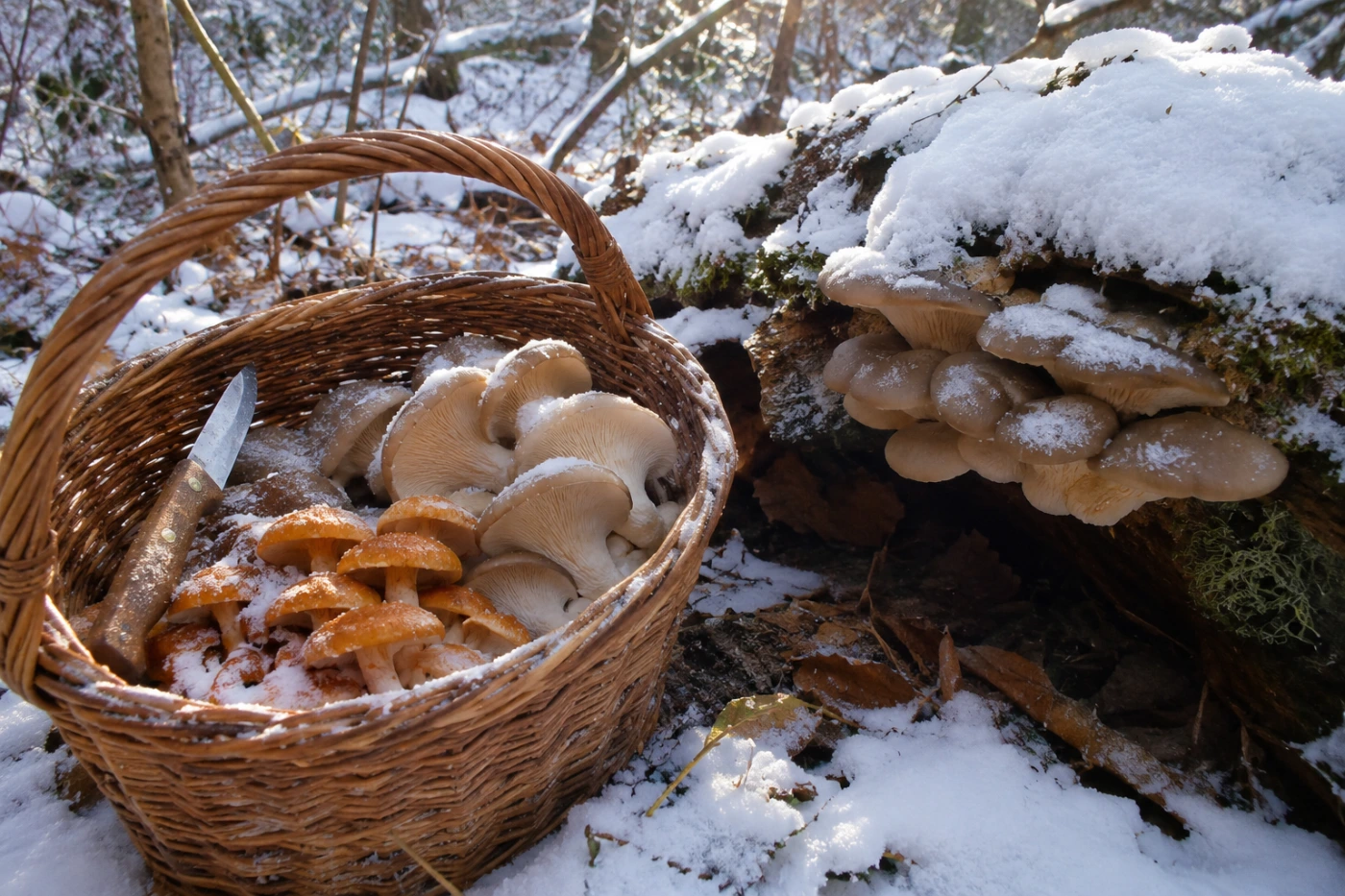
Winter mushroom hunting is different from autumn foraging. Instead of searching broadly across the forest floor, it is usually more productive to focus on a few specific habitats where cold-tolerant fungi continue fruiting after most autumn species have disappeared.
The best places to look are dead hardwood, mossy conifer forests, elder branches, sheltered woodland edges, stream corridors, buried roots, and damp places that thaw quickly after rain or mild weather. Species such as Velvet Shank, Oyster Mushrooms, Jelly Ears, and Winter Chanterelles each favor different winter microhabitats.
⚠️ Important: Winter does not eliminate poisonous mushrooms. Dangerous species such as Galerina marginata can still appear during mild weather, so every mushroom should be identified from its full set of features rather than season alone.
Where Are Winter Mushrooms Most Likely to Grow?
Winter fungi are concentrated where moisture remains available and temperatures fluctuate around freezing rather than staying deeply frozen for long periods. Dead wood is particularly important because it retains moisture and provides a stable substrate.
Mossy woodland also remains productive because thick moss moderates temperature and humidity near the soil. Sheltered valleys, stream margins, woodland edges, and south-facing slopes can warm enough during brief thaws to trigger or maintain fruiting.
The most productive winter search often involves moving from one likely microhabitat to another instead of walking randomly through open forest.
1. Dead Hardwood Logs and Stumps
Dead hardwood is one of the best winter mushroom habitats. Beech, elm, willow, ash, oak, poplar, and other broadleaf trees can support several cold-season fungi.
Velvet Shank, Flammulina velutipes, is a classic example. It fruits from late autumn through winter and into early spring, often in dense clusters on dead or dying broadleaf wood. Woodland Trust notes that it is particularly associated with decaying broadleaved trees and can continue fruiting through frost and snow.
Look carefully at old stumps, fallen trunks, standing deadwood, and the bases of weakened trees. Bright orange-brown clusters are much easier to spot against dark bark during winter than they are during leafy autumn conditions.
2. Fallen Branches
Small fallen branches can be surprisingly productive. Jelly fungi and small clustered mushrooms often fruit on branches too thin to attract attention during the main mushroom season.
Elder branches are especially worth checking for Jelly Ear. Auricularia auricula-judae is strongly associated with elder in Europe and can fruit throughout the year, with wet winter weather often making the gelatinous fruit bodies especially conspicuous.
Branches lying close to damp ground often retain more moisture than exposed wood. Check both the upper and lower sides because small fruit bodies may be hidden underneath.
3. Mossy Conifer Forests
Mossy conifer forest is one of the most productive places to search for Winter Chanterelles. Craterellus tubaeformis favors damp mossy woodland, often on acidic soils under spruce and other conifers.
The mushrooms can appear in large scattered colonies and are easy to overlook because their brown caps blend into moss and needle litter. The yellow stems are often much easier to see once your eyes adjust to the habitat.
Search slowly around moss-covered slopes, shallow depressions, forest tracks, and areas where moisture accumulates without becoming waterlogged.
4. Decaying Broadleaf Trees
Standing dead or dying broadleaf trees can support Oyster Mushrooms during cold weather. Pleurotus ostreatus often fruits on beech, oak, and other hardwoods and can persist into early winter.
In milder parts of Europe, Oyster Mushrooms may continue appearing into January or February. They often form overlapping shelves on trunks, fallen logs, and large branches.
Look higher than ground level as well. Large Oyster clusters may fruit several feet above the forest floor and can easily be missed if you only inspect logs.
5. Woodland Edges
Woodland edges warm more quickly during sunny winter days and often remain slightly milder than dense forest interiors. They can also combine dead wood, shrubs, leaf litter, and living trees in a relatively small area.
Jelly Ears, late Wood Blewits, Oyster Mushrooms, and other winter-tolerant fungi can all occur around woodland margins. Hedge lines with elder are particularly useful because they provide abundant woody substrate.
Edges beside fields or paths are also easier to search during short winter daylight. The increased light makes small fruit bodies more visible.
6. Hedges and Elder Thickets
If your goal is Jelly Ear, elder is one of the first plants to check. Old elder trunks and dead branches frequently support brown, gelatinous Auricularia fruit bodies during wet winter weather.
The fungus may dry into thin, dark patches during cold or dry periods and expand again after rain. This means a seemingly unproductive elder patch can suddenly become covered with visible fruit bodies after mild wet weather.
Hedgerows can also remain relatively sheltered from wind, helping retain moisture and moderate temperature.
7. Stream Banks and Floodplain Woodland
Stream corridors often remain humid during winter. Fallen willow, poplar, alder, ash, and other moisture-loving trees provide abundant dead wood for saprotrophic fungi.
Velvet Shank is especially worth searching for in these environments. Some guides note its frequent occurrence on willow, poplar, ash, elder, and other broadleaf wood near floodplain forests and streams.
Running water can also reduce the severity of local frost. Even when nearby open ground is frozen, wood beside a stream may remain moist enough for fungi to continue fruiting.
8. Buried Wood and Old Roots
Some winter mushrooms appear to grow directly from soil even though they are actually attached to buried wood. Old roots, decayed stumps, and pieces of buried timber can remain productive long after the original tree disappears.
Velvet Shank can sometimes fruit from buried wood or roots and appear terrestrial at first glance. This is one reason substrate should be checked before assuming a mushroom is growing from soil.
Gently clear moss or leaf litter around the base when needed. Finding wood beneath the mushroom can completely change the identification.
9. Old Stumps in Parks and Gardens
Winter mushroom hunting does not require remote forest. Urban parks, gardens, old cemeteries, and tree-lined paths can contain productive stumps and deadwood.
Velvet Shank is regularly recorded from towns and gardens as well as woodland. Jelly fungi can also appear wherever suitable dead branches remain.
Urban sites should be treated cautiously for culinary collecting because of pollution, pesticide use, dog activity, and uncertain substrate history. They can still be excellent places for observation and photography.
10. South-Facing Slopes
South-facing slopes receive more winter sunlight and often thaw sooner than shaded north-facing ground. This creates small pockets where fungi can remain active during otherwise cold periods.
The benefit is especially noticeable after light snow. Exposed soil, moss, and deadwood may thaw for several hours in the afternoon while surrounding areas remain frozen.
These microclimates can extend late-autumn fruiting into winter. They are particularly worth checking during periods of alternating frost and mild days.
11. Sheltered Valleys
Valleys protected from strong wind can maintain higher humidity than exposed ridges. Dense moss, fallen timber, and slow evaporation create useful winter fungal habitat.
Temperature patterns in valleys can be complicated because cold air can also collect overnight. The best sites are often sheltered but not permanently frozen.
Look for places where moss remains soft and wet rather than frozen solid. These conditions usually indicate a more favorable microclimate.
12. Places That Thaw First
A winter forest is rarely uniformly frozen. Tree bases, mossy banks, stream edges, rotten logs, and dark exposed soil often thaw before open ground.
These small thaw zones are excellent places to search after a mild spell. Fungi already present in the substrate may resume growth surprisingly quickly.
A few days above freezing can be more important than the calendar month. Winter mushroom availability follows weather more closely than a strict seasonal schedule.
The Best Weather for Winter Mushrooms
The most productive winter conditions are generally mild, damp, and frost-interrupted rather than continuously frozen. Rain followed by several days above freezing can trigger new fruit bodies or rehydrate existing ones.
Some species tolerate frost extremely well. Velvet Shank can survive freezing and continue developing after thawing, which helps explain its strong association with winter fruiting.
Jelly fungi behave differently but are equally well adapted to winter. They can shrink during dry or frozen conditions and become conspicuous again when moisture returns.
Look After a Thaw
A thaw following several cold days is one of the best times to search. Snowmelt supplies moisture while temperatures become warm enough for fungi to resume metabolic activity.
Existing Velvet Shank clusters may become soft and glossy again, while Jelly Ears expand dramatically. Late Oyster Mushrooms can also appear during extended mild periods.
Fresh growth is usually preferable to old mushrooms that have been repeatedly frozen and thawed. Condition matters just as much as species identification.
Look After Winter Rain
Rain during a mild winter period can be highly productive. Wood absorbs water, moss becomes saturated, and humidity rises near the forest floor.
This is particularly favorable for Jelly Ears and other wood-growing fungi. Winter Chanterelles can also remain productive when mossy woodland stays consistently moist.
Heavy rain followed immediately by a hard freeze is less useful because fruit bodies may become damaged before they mature.
What Happens After Snow?
Snow does not necessarily end the mushroom season. A light snow layer can actually insulate the ground and deadwood from more extreme temperature swings.
Winter fungi may continue beneath snow or reappear rapidly after it melts. Velvet Shank is particularly well known for fruiting through snowy periods.
When searching after snow, inspect exposed logs, tree bases, and south-facing slopes first. These areas usually thaw before the surrounding forest floor.
Where to Find Velvet Shank
Search dead or weakened broadleaf trees, especially stumps, logs, and trunks. Elm, beech, ash, oak, willow, elder, and poplar are all useful trees to check.
The mushrooms often form dense clusters of orange to golden-brown caps. Fruiting can continue from late autumn through winter and into early spring.
Always check the complete stem and spore print when identification is uncertain because deadly Galerina marginata can occur during mild winter weather.
Where to Find Oyster Mushrooms
Look on dead or dying hardwood, especially large fallen logs and standing trunks. Beech and oak are particularly productive hosts in many European habitats.
Oyster Mushrooms often appear after cold weather and can form large overlapping clusters. In mild regions, fruiting may continue well into winter.
Search both low and high on trunks. Some of the best clusters are well above eye level.
Where to Find Jelly Ears
In Europe, old elder trees are one of the first places to check. Search dead and dying branches, especially in damp hedgerows and woodland edges.
Fruit bodies are easiest to spot during wet weather when they are fully expanded and gelatinous. During dry or frozen conditions, they may shrink into dark leathery patches.
In North America and other regions, similar Jelly Ears may belong to different Auricularia species, so regional taxonomy should be considered.
Where to Find Winter Chanterelles
Search damp mossy conifer woodland, particularly acidic forest floors with spruce and other conifers. Large colonies can be scattered across moss-covered banks and shallow depressions.
The brown caps are well camouflaged, so look for thin yellow stems and grayish ridges underneath. The species can tolerate light frost and often persists into late autumn or early winter.
Once you find one, slow down. Winter Chanterelles frequently occur in groups, and many more may be hidden nearby.
Persistent Bracket Fungi
Winter is also an excellent season for studying bracket fungi because foliage no longer hides trunks and branches. Turkey Tail, Artist’s Conk, and other tough polypores can remain visible year-round.
These are not necessarily fresh winter fruitings. Many tough brackets persist for months or years.
They are still useful for identification practice because winter exposes bark, host trees, and fruit-body structures particularly well.
Forest Type Matters
Broadleaf woodland generally offers more opportunities for Velvet Shank, Oyster Mushrooms, and Jelly Ears. Conifer woodland is often more productive for Winter Chanterelles and certain late mycorrhizal species.
Mixed woodland provides both types of habitat and can therefore be particularly rewarding. Search by substrate rather than treating the entire forest as one habitat.
Knowing the dominant tree species makes winter searching faster because you can prioritize the places most likely to support your target mushrooms.
Europe
In much of temperate Europe, classic winter targets include Velvet Shank, Oyster Mushroom, Jelly Ear, and Winter Chanterelle. Mild Atlantic climates can support fruiting throughout much of December and January.
Northern and continental regions may have a shorter active period once prolonged hard frost begins. Even there, thaws can briefly restore productive conditions.
Weather matters more than a fixed monthly calendar.
North America
North American winter foraging varies dramatically by latitude and coast. The Pacific Northwest and milder coastal areas can support considerable winter fungal activity, while deeply frozen northern continental regions may offer mostly persistent brackets.
Eastern and southern regions can continue producing Oyster Mushrooms and cold-tolerant wood fungi during mild spells. Guides for eastern North America commonly emphasize decaying hardwood as one of the best winter substrates.
Regional taxonomy should always be checked because some North American mushrooms differ from similarly named European species.
What About Deep Snow?
Once deep snow and prolonged hard frost cover the ground, searching for terrestrial mushrooms becomes much less productive. Wood-growing species remain easier to find because trunks and standing deadwood can remain exposed.
Persistent brackets also become relatively more important. Their tough fruit bodies survive conditions that destroy softer mushrooms.
During these periods, winter foraging becomes more about deadwood fungi than fresh soil mushrooms.
How to Search Efficiently
Start by identifying the most promising habitat before looking for individual mushrooms. In broadleaf woodland, scan stumps and fallen trunks; in conifer forest, inspect mossy ground and damp depressions.
Then slow down around any productive patch. One Velvet Shank cluster often indicates other suitable deadwood nearby, while one Winter Chanterelle may be part of a much larger colony.
Changing your search pattern this way is much more efficient than covering large distances quickly.
Use Host Trees as a Map
Trees help predict where fungi are likely to occur. Elder points toward Jelly Ear, decaying hardwood toward Velvet Shank and Oyster Mushrooms, while spruce-dominated mossy forest is promising for Winter Chanterelle.
Host trees are not absolute rules, but they provide a useful habitat filter. Winter visibility makes bark and tree structure easier to study because leaves are absent.
Learning trees therefore improves mushroom finding as well as mushroom identification.
Do Not Ignore Apparently Empty Logs
A fallen log may look unproductive from one side while supporting mushrooms underneath or on the far end. Walk around large trunks whenever possible.
Rotten cavities and protected underside surfaces stay moist longer than exposed bark. Small winter clusters can remain hidden there even during dry weather.
Pay particular attention to cracks, cut surfaces, and places where bark has loosened.
Winter Mushroom Safety
Fewer visible species do not mean easier identification. Old, frozen, or damaged mushrooms can lose important characters.
Avoid specimens that are badly decomposed, repeatedly frozen and thawed, or incomplete. If snow hides the stem base or substrate, expose it before identifying the mushroom.
Deadly Galerina marginata is particularly important around wood-growing winter mushrooms. Velvet Shank should be confirmed by its white spores, dark velvety lower stem, and lack of the rusty-spored Galerina pattern.
Common Winter Search Mistakes
One common mistake is searching only the forest floor. Winter shifts the balance strongly toward trunks, stumps, logs, and dead branches.
Another mistake is ignoring microclimate. A sunny stream bank and a frozen exposed ridge may have completely different fungal activity even when they are only a short distance apart.
A third mistake is assuming snow or frost means the season is finished. Several winter fungi survive freezing and resume growth during thaws.
How to Photograph Winter Mushrooms
Photograph the mushroom in place before removing snow or debris. This preserves information about substrate, surrounding trees, and how the fruit body is attached.
Then clear only enough material to expose the stem, underside, and base. Photograph these features separately.
Winter identification often relies heavily on habitat because colors and textures can change after frost. A good environmental photograph is therefore especially valuable.
Can AI Help Find Winter Mushroom Habitat?
AI can help interpret habitat photographs and suggest likely mushroom groups based on substrate, host trees, and visible morphology. It works best when you provide both close-ups and wider habitat views.
It cannot determine that an area is safe for culinary collecting or guarantee that a photographed specimen is edible. Winter-damaged mushrooms are particularly difficult for image-only identification.
Frequently Asked Questions
Where is the best place to find mushrooms in winter?
Dead hardwood, mossy conifer forests, elder branches, sheltered woodland edges, stream banks, and areas that thaw quickly are among the most productive habitats.
What mushrooms grow on wood in winter?
Velvet Shank, Oyster Mushrooms, Jelly Ears, and several bracket fungi are common examples. Exact species vary by region.
Where should I look for Winter Chanterelles?
Search damp mossy conifer woodland, especially acidic areas under spruce and related trees.
Where can I find Velvet Shank?
Look on dead or dying broadleaf wood, including stumps, fallen trunks, and standing dead trees.
Where can I find Jelly Ear?
In Europe, elder branches and trunks are particularly productive. Wet winter weather makes the gelatinous fruit bodies easier to see.
Do mushrooms grow after snow?
Yes. Some winter species tolerate freezing and continue fruiting after thawing, while others remain hidden beneath light snow.
Is a winter thaw a good time to look for mushrooms?
Yes. Several days of mild, wet weather after frost can be one of the most productive winter periods.
Are winter mushrooms easier to identify?
Not necessarily. Fewer species may be fruiting, but frost and aging can remove important diagnostic features.
Final Notes
The best winter mushroom locations are places where moisture, dead wood, moss, and mild microclimates overlap. Instead of searching the forest evenly, focus on dead hardwood, elder, mossy conifer ground, stream corridors, buried roots, sheltered woodland edges, and areas that thaw first.
Different species point toward different habitats. Velvet Shank favors dead broadleaf wood, Oyster Mushrooms favor large hardwood trunks, Jelly Ears are especially associated with elder in Europe, and Winter Chanterelles favor damp mossy conifer woodland.
The practical search pattern is: check the weather → find the warmest damp microhabitats → search dead wood and moss → identify host trees → inspect sheltered areas after rain or thaw → confirm every mushroom before considering edibility.
Upload a photo and get possible matches in seconds.