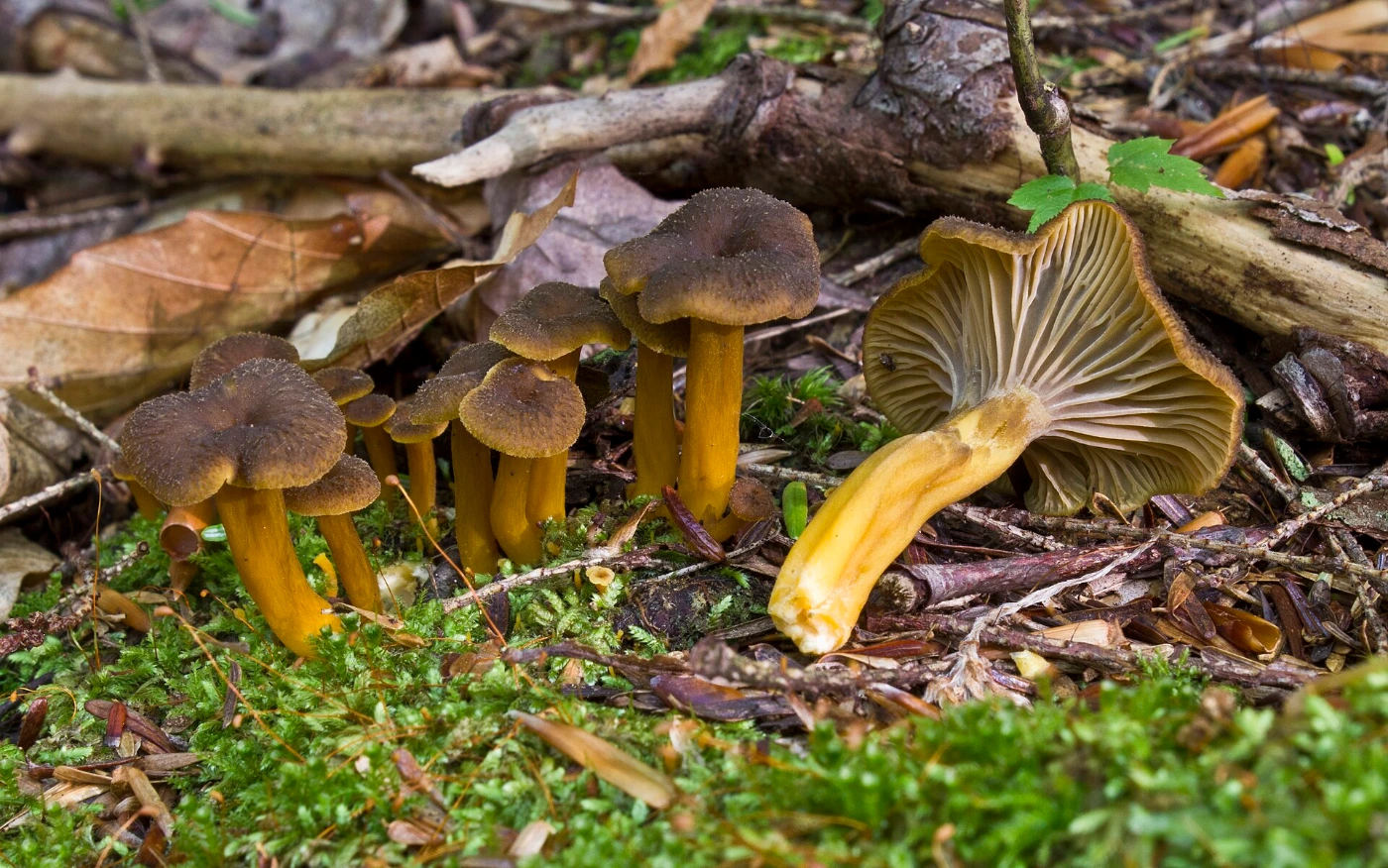
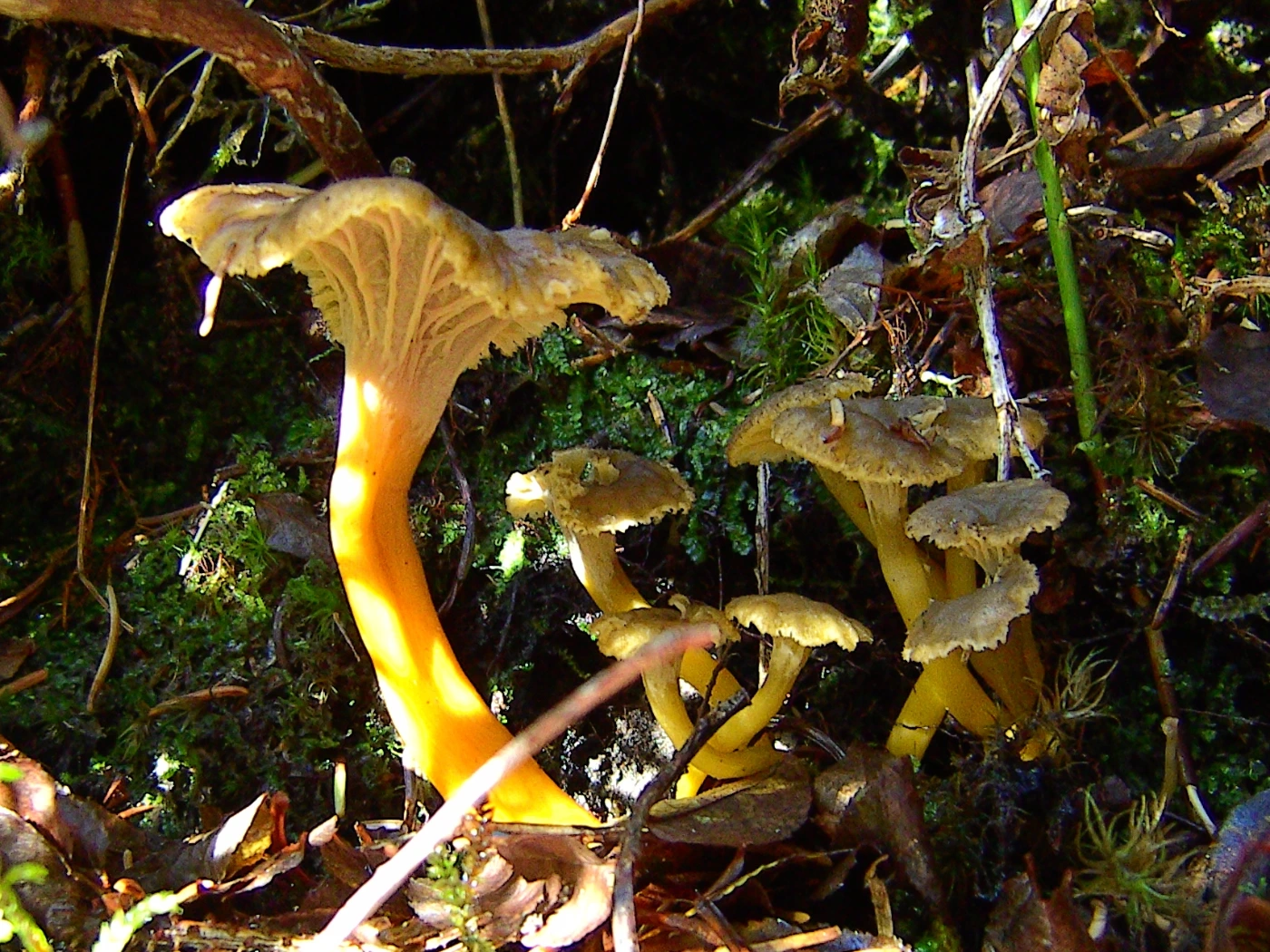
Craterellus tubaeformis, commonly known as the Winter Chanterelle, Yellowfoot, or Yellowlegs, is a small late-season chanterelle relative with a brown funnel-shaped cap, grayish forked ridges, and a hollow yellow stem. It often fruits in large groups in damp mossy woodland during autumn and early winter.
The most useful field pattern is brown funnel cap + blunt forked ridges instead of true gills + hollow yellow stem + late-season woodland habitat. Unlike the larger golden chanterelles, Winter Chanterelle is thin-fleshed, hollow, and usually much more delicate.
⚠️ Important: Do not identify a Winter Chanterelle from cap color alone. Confirm the blunt decurrent ridges, hollow stem, woodland habitat, and complete fruit body before considering edibility.
Quick Identification
| Feature | Craterellus tubaeformis |
|---|---|
| Common names | Winter Chanterelle, Yellowfoot, Yellowlegs, Trumpet Chanterelle |
| Cap | Brown to yellow-brown |
| Cap shape | Funnel-shaped, often perforated in center |
| Underside | Blunt false gills / ridges |
| Ridge color | Gray, gray-yellow, lilac-gray |
| Stem | Yellow to yellow-orange |
| Stem interior | Hollow |
| Flesh | Thin, pale |
| Ring | Absent |
| Volva | Absent |
| Spore print | White to pale cream |
| Ecology | Mycorrhizal |
| Habitat | Damp mossy woodland, especially conifers |
| Season | Autumn to early winter |
| Growth | Often large troops or colonies |
| Edibility | Edible when correctly identified |
| Main look-alikes | Other Craterellus, Cantharellus, small funnel-shaped mushrooms |
What Does Craterellus tubaeformis Look Like?
Winter Chanterelle is a small, slender mushroom built around a hollow funnel. The brown cap narrows into a hollow stem, often creating one continuous tube from the cap center down through the stem.
The underside has shallow, blunt ridges rather than thin true gills. These ridges are usually grayish or yellow-gray and contrast strongly with the brighter yellow stem.
Cap
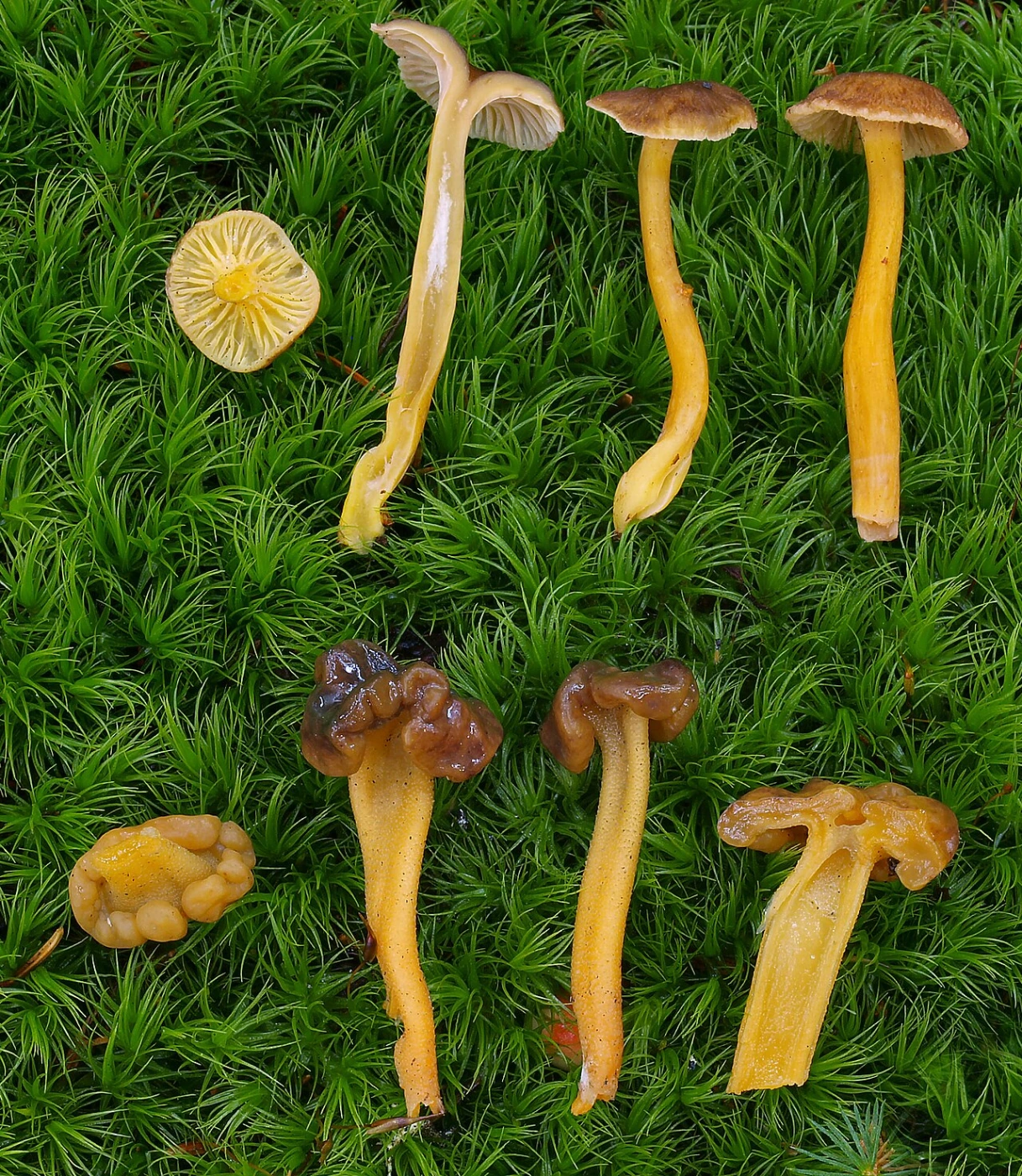
The cap is usually about 2–6 cm across and starts convex or shallowly depressed. It soon develops a funnel-shaped center and often becomes perforated so the hollow stem opens directly through the cap.
The margin is thin, wavy, and irregular. Colors range from yellow-brown and tan to gray-brown or dark brown, particularly in wet weather.
Funnel-Shaped Center
The central depression is more than a shallow dimple. In mature specimens it often opens into the hollow stem below.
This continuous tube is one of the characteristics that helps distinguish Craterellus from more solid-fleshed golden chanterelles.
False Gills
Winter Chanterelle does not have true gills. Instead, the underside carries low, blunt, wrinkled ridges that run down the stem.
These ridges often fork and reconnect through cross-veins. They are usually much less prominent than the thick folds of Cantharellus cibarius.
Why the Underside Is Important
From above, a brown Winter Chanterelle can resemble numerous small woodland mushrooms. The underside provides far better identification information.
Thin blade-like gills point away from Craterellus tubaeformis. Broad, shallow, blunt folds support a chanterelle-type fungus.
Stem
The stem is one of the strongest visual clues. It is usually yellow, yellow-orange, or dull ochre-yellow and often noticeably brighter than the cap.
It is slender, sometimes flattened or grooved, and hollow throughout. This hollow yellow stem gives rise to common names such as Yellowfoot and Yellowlegs.
Hollow Interior
Cutting the stem lengthwise reveals a clear hollow cavity. This differs from the solid stems of many golden chanterelles.
The hollow can extend all the way into the central opening of the cap. In mature mushrooms, the entire fruit body can resemble a miniature trumpet.
Flesh
The flesh is thin and relatively delicate. It is pale yellowish or grayish and much less substantial than the flesh of Cantharellus cibarius.
Because the cap is thin, older mushrooms can dry quickly around the margins. Nevertheless, fresh specimens often remain pleasantly firm.
Smell
The smell is mild and sometimes slightly fruity or mushroom-like. It is generally less strongly apricot-scented than classic golden chanterelles.
Odor should be treated as supporting evidence only. Underside structure and stem characteristics are much more useful.
Spore Print
The spore print is white to very pale cream or yellowish. This fits the general chanterelle group.
A spore print is rarely necessary for a typical specimen but can help exclude darker-spored gilled mushrooms.
Where Does Craterellus tubaeformis Grow?
Winter Chanterelle is mainly associated with damp woodland. It is particularly common in mossy coniferous forests and can occur among spruce, pine, and other conifers.
It often fruits in moss, needle litter, and around heavily decomposed woody material. Unlike saprotrophic wood mushrooms, however, it is mycorrhizal and associated with living tree roots.
Mossy Conifer Forests
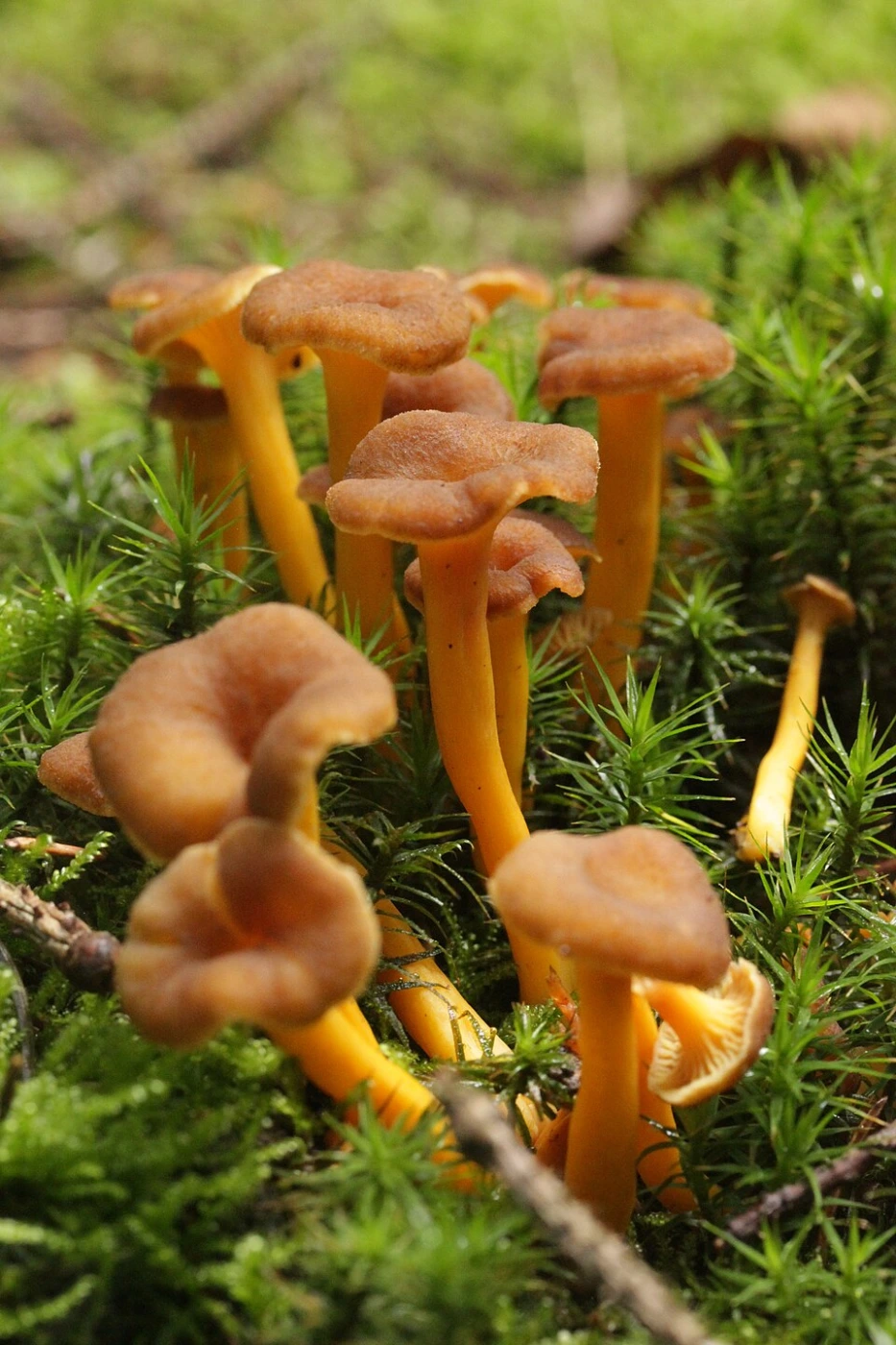
Moss is one of the most characteristic microhabitats. Large colonies can appear through carpets of moss in cool, moist woodland.
The mushrooms can be easy to miss because their brown caps blend into leaf litter and forest debris. Their yellow stems often become the most visible feature once you know what to look for.
Can It Grow on Rotten Wood?
Winter Chanterelles can appear to grow from heavily decayed wood or moss covering rotten logs. This can create the impression that they are wood-decaying mushrooms.
The ecological relationship is still mycorrhizal. The actual fungal network is associated with tree roots in the surrounding woodland.
Season
This is one of the latest common chanterelle relatives of the year. Fruiting usually begins in autumn and may continue into early winter.
In Britain and Ireland, September through November is typical, while parts of the Pacific Northwest can see fruiting into mid-winter.
Why It Is Called Winter Chanterelle
The name reflects its unusually late season. It can continue appearing after many classic summer and autumn mushrooms have stopped fruiting.
Mild temperatures and persistent moisture are especially favorable. In some areas the species can survive light frost and reappear after snow.
Distribution
Craterellus tubaeformis is widely known from Europe and parts of North America. However, the North American situation is taxonomically more complicated than older guides suggest.
Burke Herbarium notes that molecular work indicates some Pacific Northwest mushrooms historically called C. tubaeformis may represent a different species. This means western North American collections should be identified regionally rather than automatically assigned the European name.
European Winter Chanterelle
In Europe, Craterellus tubaeformis is widespread, especially in northern and montane regions. Scandinavia is particularly well known for abundant fruitings.
It can form very large colonies, sometimes with hundreds or thousands of fruit bodies in suitable forest.
North American Yellowfoot
North American mushrooms called Yellowfoot or Winter Chanterelle can look extremely similar. Western populations in particular require attention to modern regional taxonomy.
For a practical field guide, the safest wording is to identify the Craterellus tubaeformis group first and use species-level names only when regional evidence supports them.
Is Craterellus tubaeformis Edible?
Yes. Winter Chanterelle is widely considered edible when correctly identified.
Its flavor is mild and its texture is pleasantly firm despite the thin flesh. It is popular in northern Europe and is often collected in large quantities because the mushrooms tend to fruit gregariously.
Cleaning Winter Chanterelles
These mushrooms can collect moss, pine needles, and soil inside the hollow stem and funnel-shaped cap. Cleaning them soon after collecting makes the job easier.
Split larger specimens lengthwise if necessary and brush away debris. A brief rinse is acceptable when grit remains, but dry them thoroughly afterward.
Drying Winter Chanterelles
Winter Chanterelles dry very well because their flesh is thin. They can be dehydrated much faster than thick porcini or fleshy Oyster Mushrooms.
Once fully dried, they can be stored airtight and later rehydrated for soups, sauces, and stews. The hollow structure makes them particularly convenient for drying.
Freezing Winter Chanterelles
They can also be frozen, preferably after brief cooking. Sautéing first removes moisture and usually gives better texture than raw freezing.
Because the mushrooms are thin, they cook quickly. Avoid overcooking before freezing.
Look-Alikes
The most important comparisons are other chanterelle-like fungi and small funnel-shaped woodland mushrooms. Underside structure and stem anatomy usually provide the strongest differences.
Cantharellus cibarius — Golden Chanterelle
Identification
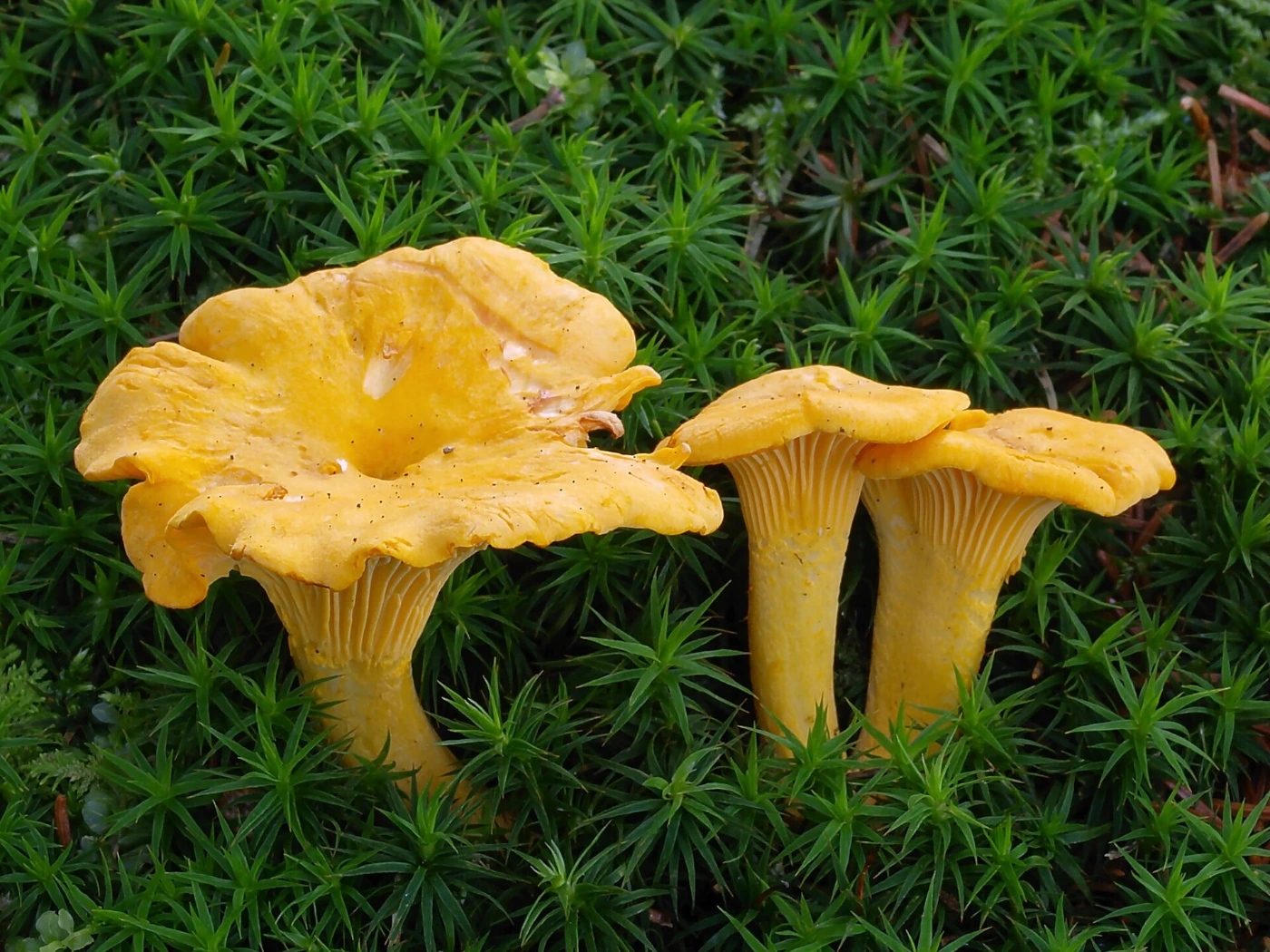
Golden Chanterelle is larger, thicker, and much more intensely yellow. Its cap and stem are fleshy, and the stem is solid rather than hollow.
The underside has well-developed blunt false gills. The mushroom often has a noticeable apricot-like aroma.
Main Difference
Thin brown cap + hollow yellow stem = Winter Chanterelle. Thick golden cap + solid stem = Cantharellus cibarius.
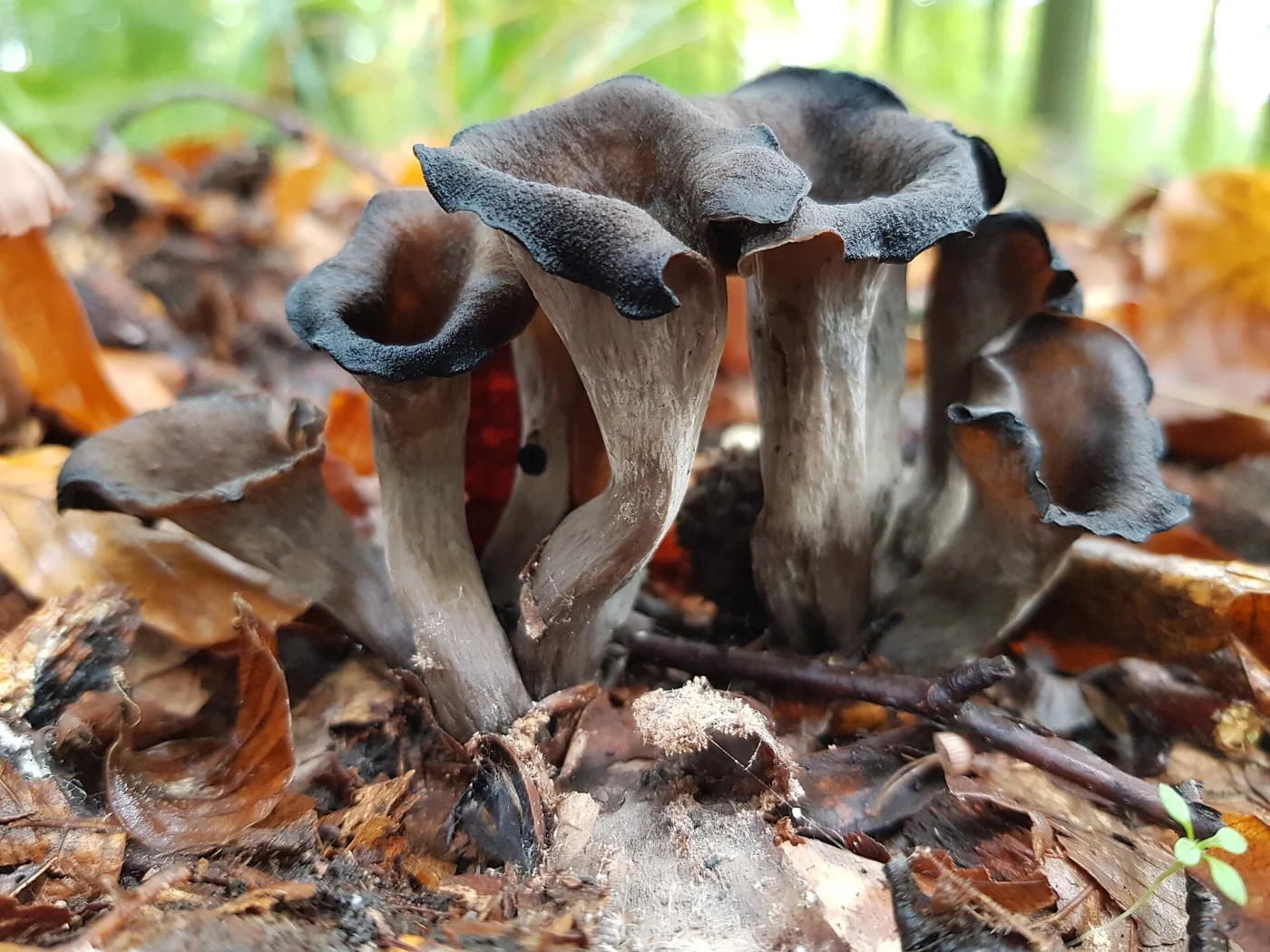
Craterellus cornucopioides — Black Trumpet
Identification
Black Trumpet is also hollow and funnel-shaped but is gray, charcoal, or black rather than brown with a yellow stem. Its underside is much smoother and lacks the well-developed branching ridges typical of Winter Chanterelle.
Main Difference
Yellow stem + gray ridges = C. tubaeformis. Dark gray-black body + nearly smooth underside = C. cornucopioides.
Craterellus lutescens
Identification
Craterellus lutescens can also have a brownish cap and yellow-orange stem. The two species are closely related and can occur in similar habitats.
The underside of C. lutescens is usually much smoother or only weakly wrinkled rather than having well-developed forked ridges.
Main Difference
Strong branching ridges favor C. tubaeformis. A smoother underside favors C. lutescens.
Small Brown Funnel Mushrooms
Identification
Several small brown mushrooms in genera such as Clitocybe and related groups can have funnel-shaped caps. Many have true blade-like gills.
These mushrooms may grow in similar woodland habitats and can be confusing when viewed only from above.
Main Difference
Blunt folds = Craterellus. Thin true gills = another genus.
Winter Chanterelle vs Golden Chanterelle
| Feature | Craterellus tubaeformis | Cantharellus cibarius |
|---|---|---|
| Cap | Brown, thin | Golden-yellow, thick |
| Shape | Funnel / trumpet | Funnel-shaped but fleshy |
| Underside | Shallow gray ridges | Thick yellow false gills |
| Stem | Yellow, hollow | Yellow, solid |
| Flesh | Thin | Thick |
| Season | Late autumn–winter | Summer–autumn |
| Best clue | Hollow yellow stem | Solid golden stem |
The hollow stem is one of the fastest ways to separate the two.
Winter Chanterelle vs Black Trumpet
| Feature | Winter Chanterelle | Black Trumpet |
|---|---|---|
| Cap | Brown | Gray to black |
| Stem | Yellow | Dark / continuous with cap |
| Underside | Forked ridges | Smooth to slightly wrinkled |
| Interior | Hollow | Hollow |
| Season | Late autumn | Summer–autumn depending on region |
| Best clue | Yellow stem | Entire fruit body dark |
Both are thin, hollow members of the chanterelle group but look quite different in typical condition.
How to Identify Craterellus tubaeformis
First look for a small brown funnel-shaped mushroom in damp woodland. Then check the underside for blunt, shallow, forked ridges rather than true gills.
Next examine the stem. A yellow to yellow-orange hollow stem strongly supports the identification.
Finally, consider season and habitat. Large groups in mossy conifer forest during late autumn or early winter fit the classic pattern very well.
Young vs Mature Winter Chanterelles
Young specimens have small rounded caps with shallow centers. The yellow stem can already be conspicuous.
As they mature, the cap becomes more deeply funnel-shaped and the central hole enlarges. The margin becomes increasingly thin, irregular, and wavy.
How Rain Changes the Appearance
Wet weather can make the cap considerably darker. Brown caps may become almost gray-brown or olive-brown after prolonged rain.
The ridges also darken and can appear more gray or lilac. The yellow stem usually remains the strongest contrasting feature.
How Frost Changes the Mushroom
Light frost does not necessarily destroy Winter Chanterelles. They are among the more cold-tolerant late-season mushrooms.
Repeated freeze-thaw cycles can still make them watery or soft. Collect only fresh specimens that retain normal texture and recognizable features.
Why Winter Chanterelles Grow in Large Groups
The underground fungal network can extend through a large area of suitable forest. When conditions become favorable, many fruit bodies may emerge simultaneously.
This can create dense patches or broad scattered colonies. Once a productive area is found, it may fruit repeatedly in later years.
Common Identification Mistakes
One common mistake is calling Winter Chanterelle a species of Cantharellus. The older name Cantharellus tubaeformis remains widespread in older guides, but current taxonomic databases accept Craterellus tubaeformis.
Another mistake is assuming any forked underside means chanterelle. Thin true gills can also fork, so ridge thickness and structure matter.
A third mistake is ignoring the hollow stem. A solid-stemmed mushroom is a poor match for typical C. tubaeformis.
A fourth mistake is applying the name automatically to every North American Yellowfoot. Some regional populations may represent different taxa.
How to Photograph Craterellus tubaeformis
Take a habitat photo showing the mushrooms in moss and forest litter. Include nearby conifers or other trees whenever possible.
Then photograph the underside and full stem. A vertical cross-section showing the hollow interior provides especially useful evidence.
Can AI Identify Winter Chanterelle?
AI can often recognize the characteristic brown cap, gray ridges, and yellow stem when all are visible. A photograph of the top of the cap alone is much less useful.
Species-level identification becomes more difficult in North America because similar regional taxa may occur. Geographic information therefore improves the result substantially.
Interesting Facts
Winter Chanterelle can fruit in enormous numbers. Some suitable northern European forests produce colonies containing hundreds or even thousands of mushrooms.
Its hollow anatomy explains the scientific epithet tubaeformis, meaning tube-shaped. The central opening of the cap often continues directly through the stem.
The species has also moved between the genera Cantharellus and Craterellus during its taxonomic history. Modern fungal databases currently accept Craterellus tubaeformis.
The thin fruit bodies are especially well suited to drying. Unlike thick boletes, they can lose moisture rapidly and store compactly.
Frequently Asked Questions
What is Craterellus tubaeformis commonly called?
The most useful common name is Winter Chanterelle. Yellowfoot, Yellowlegs, Funnel Chanterelle, and Trumpet Chanterelle are also widely used.
Is Craterellus tubaeformis the same as Cantharellus tubaeformis?
Cantharellus tubaeformis is an older combination still found in many field guides. Current Index Fungorum and Species Fungorum records accept Craterellus tubaeformis.
Does Winter Chanterelle have true gills?
No. It has blunt, branching ridges or false gills that run down the stem.
Is the stem hollow?
Yes. The hollow yellow stem is one of the most useful identification features.
When does Winter Chanterelle grow?
It fruits mainly in autumn and early winter. In mild climates it can continue into mid-winter.
Where does it grow?
It is especially associated with damp mossy woodland, often under conifers.
Is Winter Chanterelle edible?
Yes, it is widely considered edible when correctly identified. It is particularly popular in northern Europe.
Can it survive frost?
Fresh specimens can tolerate cold weather and light frost. Repeated freezing and thawing can still damage texture and quality.
Final Identification Notes
Craterellus tubaeformis is best recognized by the combination of a thin brown funnel-shaped cap, blunt grayish forked ridges, hollow yellow stem, and late-season growth in damp mossy woodland.
The most useful comparisons are Golden Chanterelle, Black Trumpet, Craterellus lutescens, and small brown funnel-shaped gilled mushrooms. The hollow yellow stem and false-gill structure usually separate typical specimens quickly.
The practical field pattern is: brown funnel + gray forked ridges + hollow yellow stem + mossy late-season woodland = strong Craterellus tubaeformis candidate. In North America, regional taxonomy should be checked before assigning the species name with confidence.
Upload a photo and get possible matches in seconds.