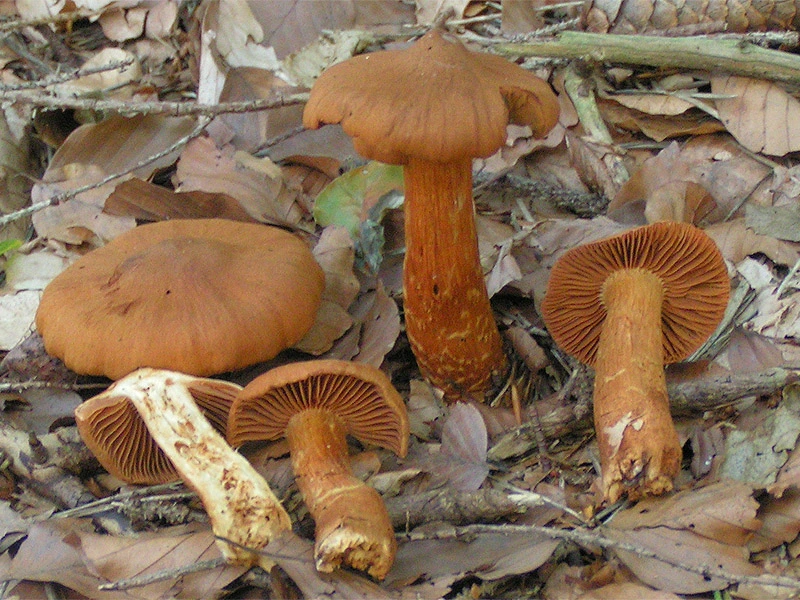
Cortinarius rubellus, commonly known as the Deadly Webcap, is a highly poisonous reddish-brown mushroom found mainly in coniferous forests of northern and central Europe. It contains the nephrotoxin orellanine, which can cause severe and sometimes irreversible kidney failure.
The most useful field pattern is reddish-brown pointed cap + rusty-brown mature gills + cobweb-like cortina + patterned yellow-brown stem + conifer woodland. Young mushrooms can look quite different from mature specimens because the gills start pale and only become rusty as the spores develop.
⚠️ Important: Cortinarius rubellus is deadly poisonous. Orellanine poisoning can have a long symptom-free period, and serious kidney injury may develop several days after the mushroom is eaten.
Quick Identification
| Feature | Cortinarius rubellus |
|---|---|
| Common name | Deadly Webcap |
| Cap color | Orange-brown, reddish brown, cinnamon |
| Cap shape | Conical to convex, often with pointed umbo |
| Cap surface | Dry, finely fibrous |
| Young gills | Pale ochre to yellow-brown |
| Mature gills | Rusty brown |
| Stem | Yellowish to orange-brown |
| Stem pattern | Yellowish zigzag / snakeskin-like bands |
| Cortina | Present when young |
| Ring | No true membranous ring |
| Spore print | Rusty reddish-brown |
| Ecology | Mycorrhizal |
| Main hosts | Spruce, pine and other conifers |
| Soil | Often damp, acidic |
| Season | Late summer to autumn |
| Toxicity | Deadly poisonous |
| Main toxin | Orellanine |
| Main look-alikes | Other Cortinarius, Winter Chanterelle, Chanterelle |
What Does Cortinarius rubellus Look Like?
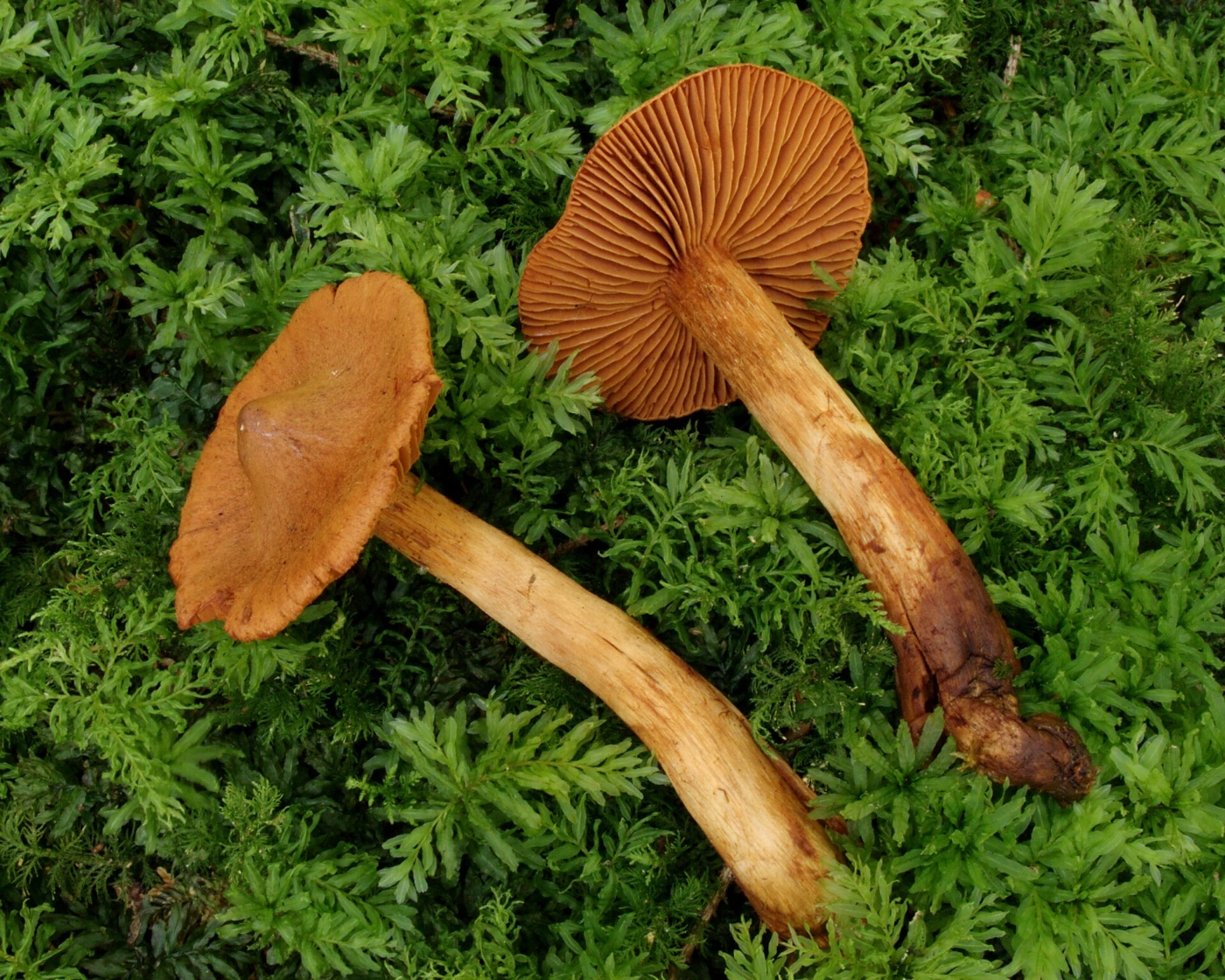
Deadly Webcap is usually a slender reddish-brown mushroom with a distinctly conical or pointed cap. The overall coloration ranges from cinnamon and orange-brown to deeper rusty brown.
The gills and stem change significantly as the mushroom ages. Young fruit bodies may show pale ochre gills behind a fine cobweb-like cortina, while mature specimens become increasingly rusty from the developing spores.
Cap
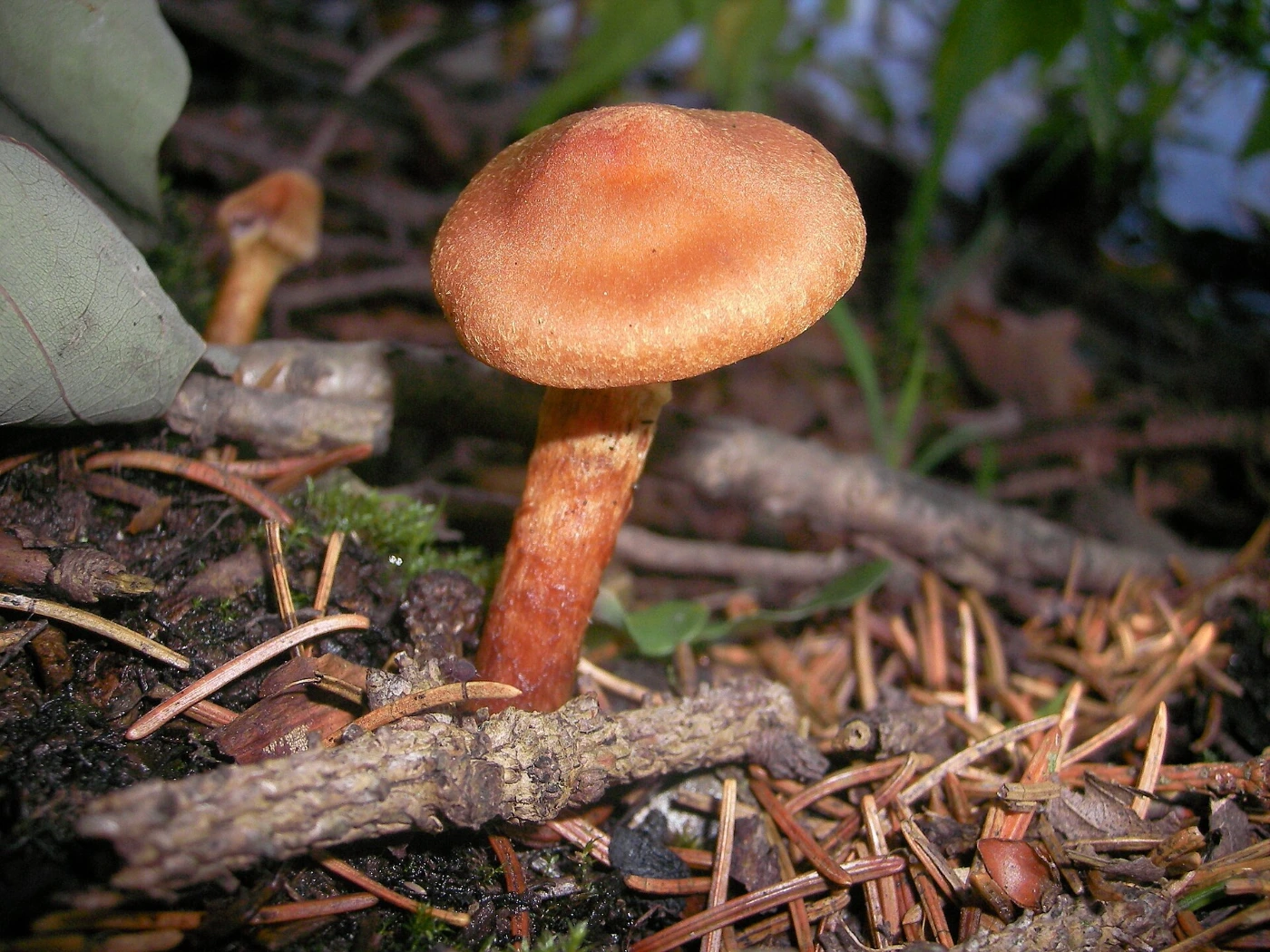
The cap is usually around 3–8 cm across and starts conical or bell-shaped. It later becomes convex or flatter but often retains a noticeable pointed or raised center.
The surface is dry and finely fibrous rather than slimy. Colors range from orange-brown and cinnamon to red-brown, often with a darker central area.
Pointed Umbo
A prominent central bump, or umbo, is a useful feature in typical specimens. It can give the cap an almost pointed appearance when viewed from the side.
The feature is not equally obvious in every fruit body. Old or flattened specimens may show only a broad central rise.
Gills
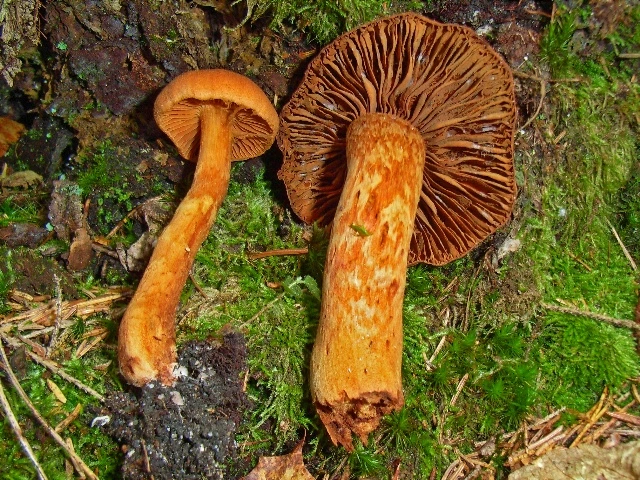
Young gills are pale ochre, yellow-brown, or cinnamon. As the spores mature, they become increasingly rusty reddish-brown.
This color change is characteristic of Cortinarius. A mature mushroom with strongly rust-colored gills should immediately suggest a brown-spored group rather than a chanterelle.
Cortina
Young Deadly Webcaps have a cortina, the fine cobweb-like partial veil characteristic of the genus Cortinarius. It stretches from the cap margin to the stem and partially covers the gills.
As the mushroom opens, the cortina breaks. Mature specimens may retain only delicate fibers around the upper stem.
Rusty Cortina Remnants
Rust-colored spores often fall onto the broken cortina fibers. This can create a rusty band or streaked zone around the upper stem.
The absence of an obvious web in a mature specimen does not rule out Cortinarius. Looking for rusty fibers is often more useful once the mushroom has fully opened.
Stem
The stem is relatively slender and often somewhat curved. It usually has a yellowish or orange-brown ground color.
One of the more distinctive features is a series of paler yellowish bands or irregular zigzag markings. These are sometimes described as a snakeskin-like pattern.
Stem Base
The stem usually narrows somewhat toward the base rather than ending in a large sack-like volva. There is no Amanita-style volva.
There is also no solid membranous ring. Any ring-like zone usually consists of cortina fibers and rusty spores.
Flesh
The flesh is yellowish to orange-brown, particularly in the stem. It does not have the white flesh typical of many familiar edible mushrooms.
There is no dramatic blue bruising reaction. Color change is therefore much less useful than gills, cortina, spore color, and stem pattern.
Smell
The odor is generally weak and may be described as slightly radish-like. It is not a reliable field character.
Odor should never be used to make a safety decision with this species. The mushroom is dangerous enough that tasting it is completely inappropriate.
Spore Print
The spore print is rusty reddish-brown. This is one of the strongest characters separating Deadly Webcap from several edible mushrooms it may superficially resemble.
A rusty print strongly supports Cortinarius or another brown-spored group. Winter Chanterelles and true chanterelles produce pale spores instead.
Where Does Deadly Webcap Grow?
Cortinarius rubellus is mycorrhizal and grows in association with living trees. It is particularly associated with spruce and pine in cool coniferous woodland.
Damp, mossy, acidic forest soils are typical habitat. Mushrooms may occur singly or in small groups among moss and needle litter.
Distribution
The species is especially important in northern Europe and Scandinavia. It is also reported from other parts of Europe and parts of North America.
Regional taxonomy matters because the genus Cortinarius is extremely diverse. A reddish webcap elsewhere should not automatically be assigned the name C. rubellus without supporting evidence.
Season
Deadly Webcap usually fruits from late summer through autumn. In Britain, records are concentrated roughly from August to November.
Cool northern forests can remain productive late into the season. Because Winter Chanterelles can also fruit during this period, seasonal overlap can contribute to confusion.
Why Is Cortinarius rubellus So Dangerous?
The mushroom contains orellanine, a toxin that selectively damages the kidneys. Orellanine poisoning is particularly dangerous because there may be little or no immediate illness after ingestion.
Clinical studies of Deadly Webcap poisoning have documented acute kidney injury severe enough to require dialysis, and some patients have eventually required kidney transplantation.
Orellanine Poisoning
Orellanine is a highly nephrotoxic compound associated with several Cortinarius species. Deadly Webcap and Fool’s Webcap are among the best-known examples.
The toxin primarily damages the renal tubular system. This can eventually reduce the kidneys’ ability to filter blood and regulate fluid and electrolyte balance.
Why Symptoms Are Delayed
Unlike many gastrointestinal mushroom poisonings, orellanine poisoning often has a very long latency period. A person may feel normal for several days after eating the mushroom.
Published cases describe patients seeking medical care around three days to a week after ingestion, although longer delays have also been reported.
This delay makes the poisoning particularly deceptive. The connection between a mushroom meal and later kidney symptoms may not be obvious.
Symptoms of Deadly Webcap Poisoning
Early symptoms can include nausea, fatigue, thirst, headache, or gastrointestinal discomfort. These may occur only after a substantial delay.
As kidney injury develops, excessive urination can occur initially, followed later by reduced urine output. Severe cases progress to acute kidney failure.
Can Kidney Damage Be Permanent?
Yes. Orellanine poisoning can cause permanent loss of kidney function.
In one long-term clinical series, many patients with severe Deadly Webcap poisoning required dialysis, and a substantial number eventually underwent kidney transplantation.
Does Cooking Destroy Orellanine?
No reliable culinary method should be used to make Deadly Webcap safe. Cooking, drying, freezing, or other ordinary processing is not an acceptable detoxification method.
The correct safety rule is simple: Cortinarius rubellus should never be eaten.
Look-Alikes
The most important look-alikes include other brown Cortinarius and several edible mushrooms gathered in the same forests. Spore color, gill structure, and cortina remnants are especially important.
Cortinarius orellanus — Fool’s Webcap
Identification
Cortinarius orellanus is another deadly orellanine-containing webcap. It has orange-brown to reddish-brown colors and rusty spores.
The cap is often broader and less sharply pointed than typical C. rubellus. Habitat also differs, with C. orellanus more often associated with deciduous woodland.
Main Difference
Conifer habitat and pointed cap favor C. rubellus. Deciduous habitat and a broader cap favor C. orellanus.
Both are deadly, so distinguishing them is unnecessary for a safety decision.
Craterellus tubaeformis — Winter Chanterelle
Identification
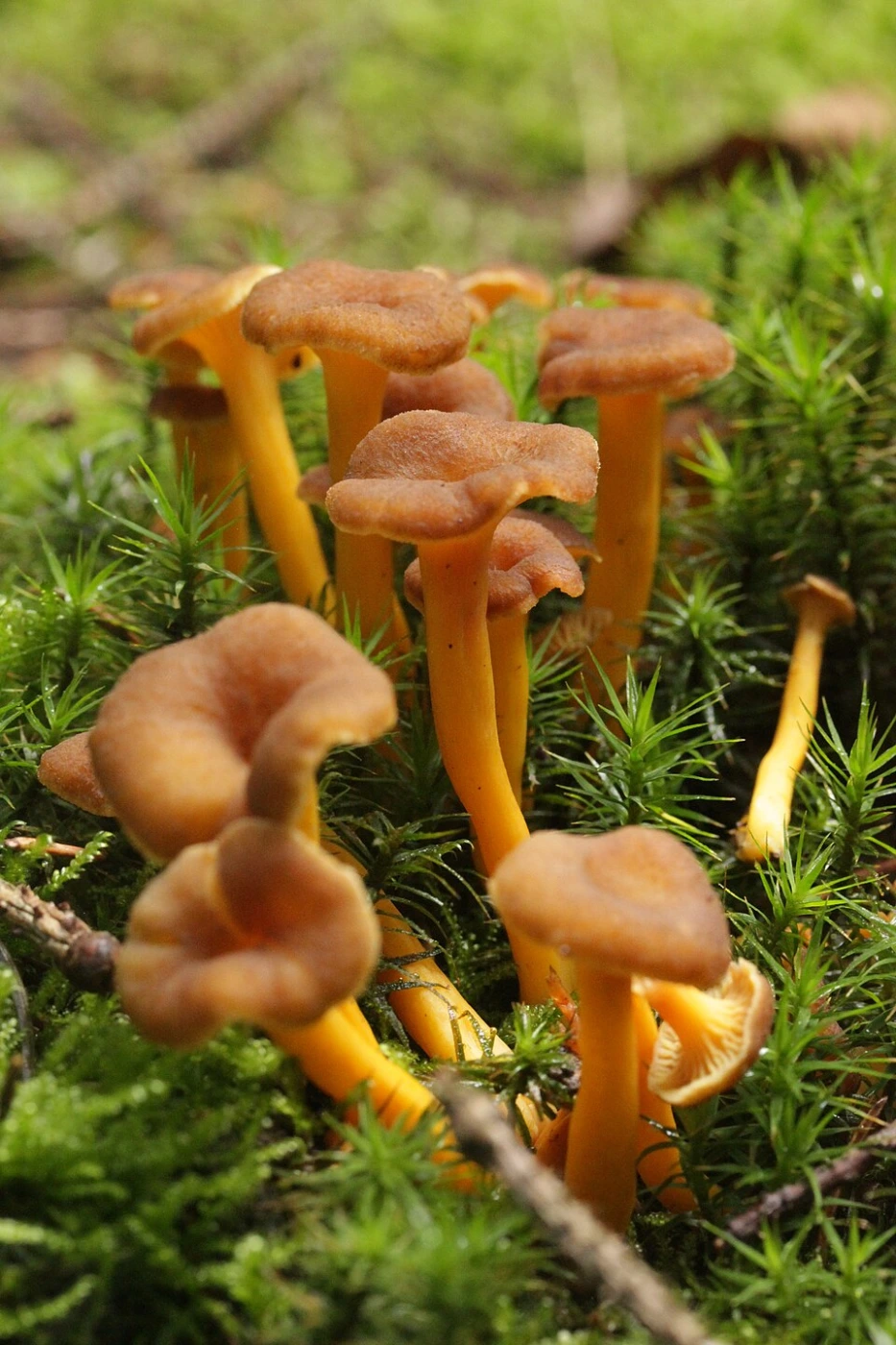
Winter Chanterelle can occur in the same mossy conifer forests and during the same late season. Its brown cap can look similar when viewed from above.
The underside is completely different. Craterellus tubaeformis has blunt grayish ridges rather than true gills, a hollow yellow stem, and a pale spore print.
Main Difference
Blunt ridges + hollow yellow stem + pale spores = Winter Chanterelle. True rusty gills + cortina + rusty spores = Deadly Webcap.
This is one of the most important practical comparisons.
Cantharellus cibarius — Golden Chanterelle
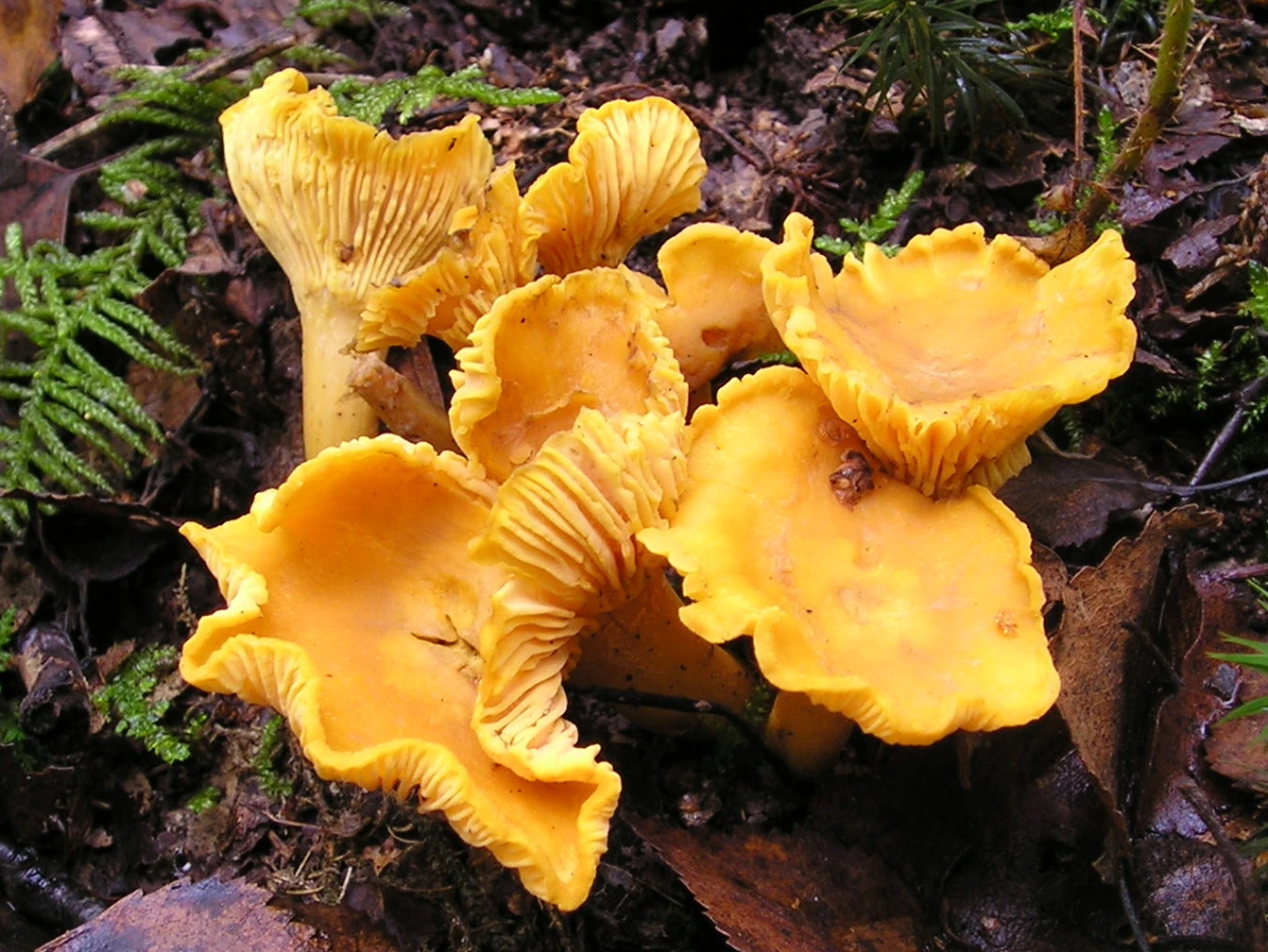
Identification
Golden Chanterelle is normally more yellow overall and has thick blunt false gills. Its stem is solid and its spores are pale.
Deadly Webcap has thin true gills that mature rusty brown and a fibrous stem with cortina remnants.
Main Difference
False gills and pale spores favor Chanterelle. True rusty gills and cortina favor Cortinarius.
Other Brown Cortinarius
Identification
The genus contains many brown, orange, reddish, and yellow species. Several can appear very similar without microscopy.
Rusty spores and a cortina may identify the genus but often cannot determine the exact species. Ecology, microscopic spores, chemical reactions, and modern taxonomy may all be required.
Main Difference
Because some Cortinarius contain serious toxins, an uncertain brown webcap should never be treated as edible.
Deadly Webcap vs Winter Chanterelle
| Feature | Cortinarius rubellus | Craterellus tubaeformis |
|---|---|---|
| Cap | Reddish-brown, pointed | Brown, funnel-shaped |
| Underside | True gills | Blunt ridges |
| Mature underside | Rusty brown | Gray-yellow |
| Stem | Solid, patterned | Hollow, yellow |
| Cortina | Present when young | Absent |
| Spore print | Rusty brown | Pale |
| Ecology | Mycorrhizal | Mycorrhizal |
| Toxicity | Deadly | Edible when correctly identified |
| Best clue | Rusty gills + cortina | Hollow yellow stem + ridges |
The underside should always be examined. A top-down photograph alone can hide the most important differences.
Deadly Webcap vs Fool’s Webcap
| Feature | C. rubellus | C. orellanus |
|---|---|---|
| Cap | Often pointed | Usually broader |
| Color | Orange-red to rusty brown | Orange-brown |
| Main habitat | Conifer woodland | More often deciduous woodland |
| Cortina | Present | Present |
| Spores | Rusty brown | Rusty brown |
| Main toxin | Orellanine | Orellanine |
| Toxicity | Deadly | Deadly |
From a foraging perspective, the difference has little safety value. Both should be completely avoided.
How to Identify Cortinarius rubellus
Start with the habitat. A reddish-brown mushroom growing in damp moss under spruce or pine is compatible with Deadly Webcap.
Then inspect the cap for a pointed or raised center and examine the gills. Mature gills should be rusty brown.
Look at the upper stem for cortina remnants and rusty deposits. Finally, check for the characteristic yellowish zigzag or snakeskin-like stem markings.
Young vs Mature Deadly Webcaps
Young specimens can have pale gills and a very obvious cobweb-like veil. The cap is often more sharply conical at this stage.
As the mushroom matures, the gills become rusty brown and the cortina breaks. Rusty spores accumulate on the stem fibers, while the cap expands and becomes less pointed.
Why Young Mushrooms Are Especially Difficult
Before the spores mature, the gills may not yet show the classic rusty coloration. A young webcap can therefore appear much paler than expected.
This is exactly when the cortina is most useful. Fine threads between the stem and cap margin are a strong clue that the mushroom belongs to Cortinarius.
Common Identification Mistakes
One common mistake is identifying Deadly Webcap only from its reddish-brown cap. Many harmless and poisonous mushrooms share similar colors.
Another mistake is ignoring the underside. Winter Chanterelle and Deadly Webcap can grow in the same forests, but ridges versus true gills separate them quickly.
A third mistake is expecting a mature mushroom to retain an obvious cobweb veil. The cortina often breaks and becomes difficult to see.
A fourth mistake is assuming that delayed symptoms mean the mushroom could not have caused the illness. Orellanine poisoning is specifically characterized by a long latency period.
How to Photograph Cortinarius rubellus
Take a habitat photograph showing moss, surrounding trees, and the mushroom in place. Spruce and pine association can be useful supporting evidence.
Then photograph the cap, mature gills, full stem, and upper-stem cortina remnants. A close-up of the rusty fibers and stem pattern is especially valuable.
Do not taste the mushroom for identification. Visual, ecological, microscopic, and regional evidence should be used instead.
Can AI Identify Deadly Webcap?
AI can suggest Cortinarius when true rusty gills, cortina remnants, and a reddish-brown fibrous cap are visible. Species-level identification is much more difficult because the genus contains many similar taxa.
A single cap photograph is insufficient for a high-risk identification. Images of the gills, stem, habitat, and young veil structures provide much stronger evidence.
Interesting Facts
The older name Cortinarius speciosissimus remains common in medical literature and older mushroom guides. Current taxonomic databases treat it as a synonym of Cortinarius rubellus.
The common name “webcap” refers to the cortina rather than the cap itself. This delicate spiderweb-like veil is one of the defining field characteristics of Cortinarius.
Orellanine is unusual among major mushroom toxins because its effects are strongly concentrated on the kidneys. The long delay between ingestion and illness makes it especially dangerous.
Deadly Webcap has repeatedly been mistaken for edible mushrooms, including chanterelles and Winter Chanterelles. This is why underside structure and spore color matter much more than general cap resemblance.
Frequently Asked Questions
What is the scientific name of Deadly Webcap?
The accepted name is Cortinarius rubellus. Cortinarius speciosissimus is an older synonym still frequently encountered in medical and field-guide literature.
Why is Deadly Webcap poisonous?
It contains orellanine, a toxin that can cause severe kidney damage.
How quickly do symptoms appear?
Symptoms can be delayed for several days. Some documented cases have presented around three days to a week after ingestion.
Does Deadly Webcap have a cortina?
Yes. Young specimens have a fine cobweb-like veil between the cap and stem.
What color is the spore print?
The spore print is rusty reddish-brown.
How can you distinguish it from Winter Chanterelle?
Winter Chanterelle has blunt ridges, a hollow yellow stem, and pale spores. Deadly Webcap has true gills, cortina remnants, and rusty-brown spores.
Can cooking make Deadly Webcap safe?
No. It should never be eaten, regardless of cooking or preservation method.
Can Deadly Webcap poisoning cause permanent kidney failure?
Yes. Severe orellanine poisoning can lead to irreversible kidney damage requiring long-term dialysis or kidney transplantation.
Final Identification Notes
Cortinarius rubellus is best recognized by the combination of a reddish-brown pointed cap, true gills that mature rusty brown, cobweb-like cortina, rusty spore print, patterned yellow-brown stem, and growth in damp conifer woodland.
The most important practical comparison is Winter Chanterelle. A hollow yellow stem and blunt ridges support Craterellus tubaeformis, while rusty true gills and cortina remnants strongly point toward Cortinarius.
The practical safety pattern is: reddish-brown woodland mushroom + true rusty gills + cortina + rusty spore print = treat as a potentially dangerous Cortinarius. Because orellanine poisoning can remain silent for days before kidney injury becomes obvious, Deadly Webcap should never be tasted or eaten.
Upload a photo and get possible matches in seconds.