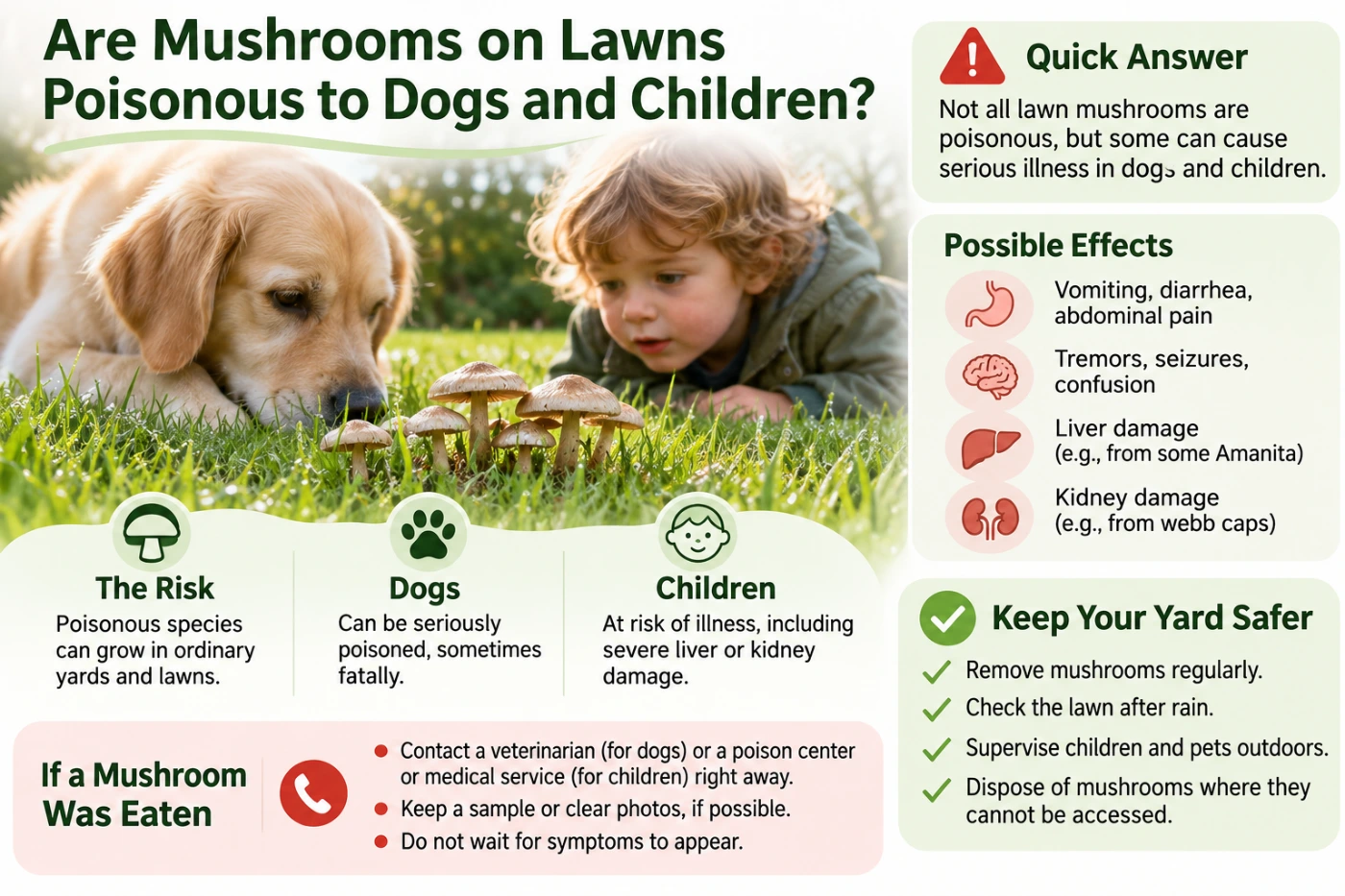
Mushrooms growing on lawns are not automatically poisonous, but an unidentified lawn mushroom should never be assumed safe for a dog or child to eat. Most wild mushrooms cause little or no toxicity, yet a small number can cause severe gastrointestinal illness, neurological symptoms, liver failure, kidney damage, or death.
The difficulty is that poisonous and harmless lawn mushrooms can look very similar. Some dangerous species can also appear in gardens, parks, under trees, or in apparently ordinary grass, so location alone does not tell you whether a mushroom is safe.
⚠️ Important: If a dog or child eats an unidentified wild mushroom, do not wait for symptoms before seeking professional advice. Contact a veterinarian, poison center, or medical service promptly, especially when the mushroom cannot be identified confidently.
Quick Answer
Mushrooms growing in a lawn can be harmless, mildly toxic, or seriously poisonous. The safest household rule is to remove unknown mushrooms from areas where young children or pets may eat them.
For dogs, veterinary toxicology services recommend treating ingestion of an unidentified wild mushroom as potentially toxic until an expert can identify it. For children, poison-control guidance similarly emphasizes that poisonous species can occur in yards and that visual identification by an inexperienced person is unreliable.
Why Mushrooms Grow in Lawns
Lawn mushrooms usually appear because fungi are decomposing organic matter below the grass. Buried roots, old stumps, wood chips, thatch, and dead plant material can all provide food for fungal mycelium.
Rain and irrigation often trigger fruiting. Mushrooms can therefore appear suddenly after wet weather even when no mushrooms were visible the day before.
Their presence does not necessarily mean the lawn is unhealthy. In many cases, they are simply part of normal decomposition in the soil.
Are Lawn Mushrooms Dangerous to Dogs?
Some are, and dogs are at particular risk because they may investigate or eat mushrooms before an owner notices them. Pet Poison Helpline notes that wild mushrooms can affect the gastrointestinal tract, nervous system, liver, or kidneys depending on the species.
Most wild mushrooms are not fatal, but the dangerous exceptions matter. Confirmed fatal mushroom poisonings in pets are particularly associated with groups including Amanita, Galerina, and Lepiota.
Are Lawn Mushrooms Dangerous to Children?
Children are also vulnerable because small mushrooms can look interesting, edible, or toy-like. Poison Control specifically advises supervising children outdoors so they do not eat wild mushrooms, including those growing in yards.
A few bites of a dangerous Amanita can be enough to cause severe poisoning. Recent human outbreaks have shown that amatoxin-containing mushrooms can cause liver failure, transplantation, and death after accidental ingestion.
Dangerous Mushrooms Can Grow in Ordinary Yards
Poisonous mushrooms are not restricted to remote forests. They can appear in lawns, landscaped areas, parks, gardens, and beneath ornamental trees.
Death Cap and destroying-angel-type Amanitas are especially important because they can grow near trees in urban or suburban environments. Poison Control specifically warns that highly toxic Amanitas may occur in residential yards.
Which Lawn Mushrooms Are Most Concerning?
The highest-risk mushrooms are those containing toxins that can affect the liver, kidneys, or nervous system. These include some Amanita, Galerina, Lepiota, Inocybe, and related groups.
Large parasol-like lawn mushrooms can also cause gastrointestinal poisoning. Chlorophyllum molybdites, the Green-Spored Parasol, is a classic example in warm regions and frequently grows in grass.
Small brown mushrooms deserve caution as well. Some dangerous genera contain inconspicuous brown species that can be difficult for non-specialists to distinguish from harmless lawn fungi.
Death Caps and Destroying Angels
Amatoxin-containing Amanitas are among the most dangerous mushrooms for humans and pets. They may initially cause vomiting, diarrhea, and abdominal pain, followed later by severe liver injury.
The particularly dangerous feature is delayed onset. In a recent California outbreak, affected patients commonly developed gastrointestinal symptoms around 8–12 hours after eating Amanita mushrooms, and some later suffered liver failure or died.
Galerina and Lepiota
Some Galerina and small Lepiota species also contain amatoxins. These mushrooms may be small and visually unremarkable, making accidental ingestion harder to recognize.
Pet toxicology references identify both genera among the groups associated with the most serious mushroom poisonings in animals.
Green-Spored Parasol
Chlorophyllum molybdites is a large white or pale lawn mushroom with brownish scales. Mature specimens develop greenish gills and an olive-green spore print.
It primarily causes severe gastrointestinal poisoning rather than delayed liver failure. Vomiting, diarrhea, and abdominal pain can nevertheless be intense, especially in children or small animals.
Symptoms in Dogs
Symptoms depend on the mushroom and may begin within minutes or be delayed for many hours. Pet Poison Helpline lists possible effects including vomiting, diarrhea, tremors, seizures, disorientation, liver injury, kidney injury, abnormal thirst, and changes in urination.
Some toxins act very quickly, while others may not produce signs for up to 24 hours. A dog appearing normal shortly after eating a mushroom is therefore not proof that the mushroom was harmless.
Symptoms in Children
Common early symptoms include nausea, vomiting, abdominal pain, and diarrhea. Neurological toxins can also cause confusion, unusual behavior, dizziness, sweating, hallucinations, or seizures.
Delayed gastrointestinal symptoms are particularly concerning because amatoxin poisoning can initially resemble ordinary food poisoning before progressing to liver injury. The CDC documented delayed gastrointestinal illness and hepatotoxicity in a large recent Amanita poisoning outbreak.
Why Delayed Symptoms Are Dangerous
A long symptom-free period can create false reassurance. With amatoxin poisoning, serious internal injury can begin before obvious symptoms appear.
This is why waiting to “see what happens” is risky after ingestion of an unknown wild mushroom. Early professional assessment matters even when the person or animal still feels well.
What to Do if a Dog Eats a Lawn Mushroom
Contact your veterinarian or a veterinary poison service immediately. Do not wait for vomiting, tremors, or other symptoms to appear.
If possible, collect another specimen of the same mushroom and take clear photographs of the cap, underside, complete stem, stem base, and habitat. Keep the sample separate and do not let other animals access it.
Do not induce vomiting or give home remedies unless a veterinary professional specifically instructs you to do so. Treatment depends on the suspected toxin and how much time has passed since ingestion.
What to Do if a Child Eats a Lawn Mushroom
Contact a poison center or medical professional promptly. The exact advice depends on the child’s age, symptoms, amount eaten, and mushroom identity.
Preserve any remaining mushroom and take photographs before disposing of the rest. Identification can help medical teams determine whether delayed liver or kidney injury is possible.
Do not rely on online image matching or an identification app to decide that the mushroom was harmless. Expert identification is much more appropriate in a suspected poisoning.
Keep a Mushroom Sample
A physical specimen can be extremely useful. Ideally, preserve one whole mushroom showing the cap, underside, stem, and base.
Place it in a paper bag or suitable container rather than crushing it. If several mushroom types were present, keep representative samples separately.
Photographs of the growing location are also valuable. Substrate, nearby trees, growth pattern, and buried wood can all help with identification.
Do Not Rely on Common Mushroom Myths
There is no reliable household test for determining whether a lawn mushroom is poisonous. Silver spoons, onions, insects eating the mushroom, cap color, or whether the mushroom smells pleasant provide no dependable safety information.
Cooking also does not make an unidentified poisonous mushroom safe. Amatoxins, for example, are not destroyed by normal cooking or food preparation.
Can Touching Lawn Mushrooms Poison a Child?
Simply touching most mushrooms is not the same as eating them. Mushroom poisoning overwhelmingly occurs through ingestion.
Normal hand washing after handling unknown mushrooms is sensible, especially before eating. The major concern for young children is putting the mushroom or pieces of it into the mouth.
Can Dogs Be Poisoned Just by Sniffing Mushrooms?
Sniffing alone is not the main concern. Poisoning generally requires ingestion.
The practical problem is that dogs often sniff and eat objects in one quick motion. Supervision and removal of mushrooms are therefore much more reliable than trying to judge whether a dog is “only smelling” them.
Should You Remove Mushrooms From the Lawn?
Yes, if dogs or young children use the area. Regular removal reduces the chance of accidental ingestion.
ASPCA recommends checking yards frequently because mushrooms can appear quickly, sometimes overnight. Pet Poison Helpline similarly recommends pulling mushrooms and disposing of them where pets cannot access them.
How to Remove Lawn Mushrooms Safely
Pull or pick the visible fruit bodies rather than applying harsh household chemicals. Wear gloves if preferred and collect mushrooms before mowing so pieces are not scattered through the grass.
Dispose of them in a closed bin or another location that children and animals cannot reach. Recheck the lawn after rain because new mushrooms may appear from the same underground mycelium.
Removing the mushrooms does not necessarily remove the fungus itself. The goal in a household safety context is to eliminate accessible fruit bodies.
Why Fungicides Are Usually Not the Answer
Most lawn mushrooms are produced by fungi living on buried organic matter. Fungicides may not eliminate the underground mycelium and are generally unnecessary simply because mushrooms are visible.
Improving drainage, reducing excessive irrigation, aerating compacted soil, and removing buried decaying wood can reduce repeated fruiting. Physical mushroom removal is still the most direct way to reduce immediate exposure risk.
Check the Yard After Rain
Wet weather often triggers mushroom growth. A lawn that was clear yesterday can contain numerous mushrooms the following morning.
ASPCA specifically recommends inspecting yards regularly before allowing pets outside when mushrooms are likely to appear.
This is particularly useful after several days of rain or heavy irrigation.
Parks and Shared Lawns
Public lawns can be harder to manage because you cannot remove every mushroom. Dogs should be supervised closely around mushroom patches, especially after wet weather.
Children should also be discouraged from picking or tasting wild mushrooms in parks. Even experienced foragers can confuse poisonous species with edible look-alikes, so casual visual judgments are not sufficient.
Does Mushroom Size Tell You Whether It Is Dangerous?
No. Both small and large mushrooms can be poisonous.
Some deadly Lepiota and Galerina are small, while dangerous Amanitas can be much larger. Size is useful for identification but has no simple relationship with toxicity.
Does Bright Color Mean Poisonous?
No. Toxic mushrooms can be white, brown, green, yellow, or brightly colored.
Likewise, many colorful mushrooms are not highly toxic. Color is one identification character among many and should never be used as a safety rule.
Can a Dog or Child Eat a Mushroom Once and Be Fine?
Possibly, if the species was harmless or the dose was small. However, absence of symptoms after a previous exposure does not prove that future mushrooms in the same lawn are safe.
Different species may appear in the same location at different times. Even mushrooms from the same patch can be difficult to identify from appearance alone.
Can Lawn Mushrooms Cause Only Stomach Upset?
Many do, but some can cause far more serious illness. Depending on the species, toxins may affect the nervous system, liver, kidneys, or other organs.
Veterinary toxicology sources specifically warn that wild mushroom ingestion can lead to severe stomach upset, breathing problems, seizures, liver or kidney damage, and death.
Can AI Identify a Lawn Mushroom After It Was Eaten?
AI can help generate possible identifications from good photographs, but it should not be used to determine whether medical or veterinary care is needed. Poisoning management should begin based on the exposure and symptoms rather than waiting for a perfect species name.
For identification, photographs of the underside, complete stem, stem base, and growing habitat are far more useful than a single top-down cap image.
Common Mistakes
One common mistake is assuming that mushrooms in a well-maintained lawn must be harmless. Dangerous mushrooms can grow in ordinary residential areas, especially near trees.
Another mistake is waiting until symptoms develop. Some of the most serious mushroom toxins have delayed effects, so early advice is preferable.
A third mistake is throwing away every mushroom before taking photographs or preserving a sample. Identification may become much more difficult once the evidence is gone.
Frequently Asked Questions
Are most lawn mushrooms poisonous to dogs?
No, most wild mushrooms are not severely toxic. However, the dangerous minority can cause serious illness, and unidentified mushrooms should be treated cautiously.
What should I do if my dog ate a mushroom from the yard?
Contact a veterinarian or veterinary poison service immediately. Save a sample and photographs if possible.
What should I do if my child ate a lawn mushroom?
Contact a poison center or medical professional promptly. Do not wait for symptoms if the mushroom is unidentified.
Can poisonous mushrooms grow in a normal backyard?
Yes. Toxic species can occur in lawns, landscaped areas, parks, and beneath trees.
How quickly do symptoms appear in dogs?
Some mushroom toxins cause symptoms within 15–30 minutes, while others may take many hours.
Can a child touch a poisonous mushroom safely?
Touching is much less dangerous than eating it. Wash the hands afterward and prevent the child from putting mushrooms or mushroom-covered fingers in the mouth.
Should I remove mushrooms from my lawn if I have pets?
Yes. Remove visible mushrooms and check the lawn regularly, especially after wet weather.
Does cooking or freezing make a poisonous mushroom safe?
No. Important toxins such as amatoxins remain dangerous after ordinary food preparation.
Final Notes
Mushrooms growing on lawns are not automatically poisonous, but there is no safe way to assume an unidentified one is harmless to a dog or child. The most serious species can cause neurological illness, liver or kidney damage, or death, and some symptoms are delayed.
The safest approach is prevention: remove unknown mushrooms from accessible areas, inspect lawns after rain, supervise young children and pets, and preserve a specimen if an accidental ingestion occurs.
The practical safety rule is: unknown lawn mushroom eaten by a dog or child = seek professional advice promptly rather than waiting for symptoms or relying on an app-based identification.
Upload a photo and get possible matches in seconds.