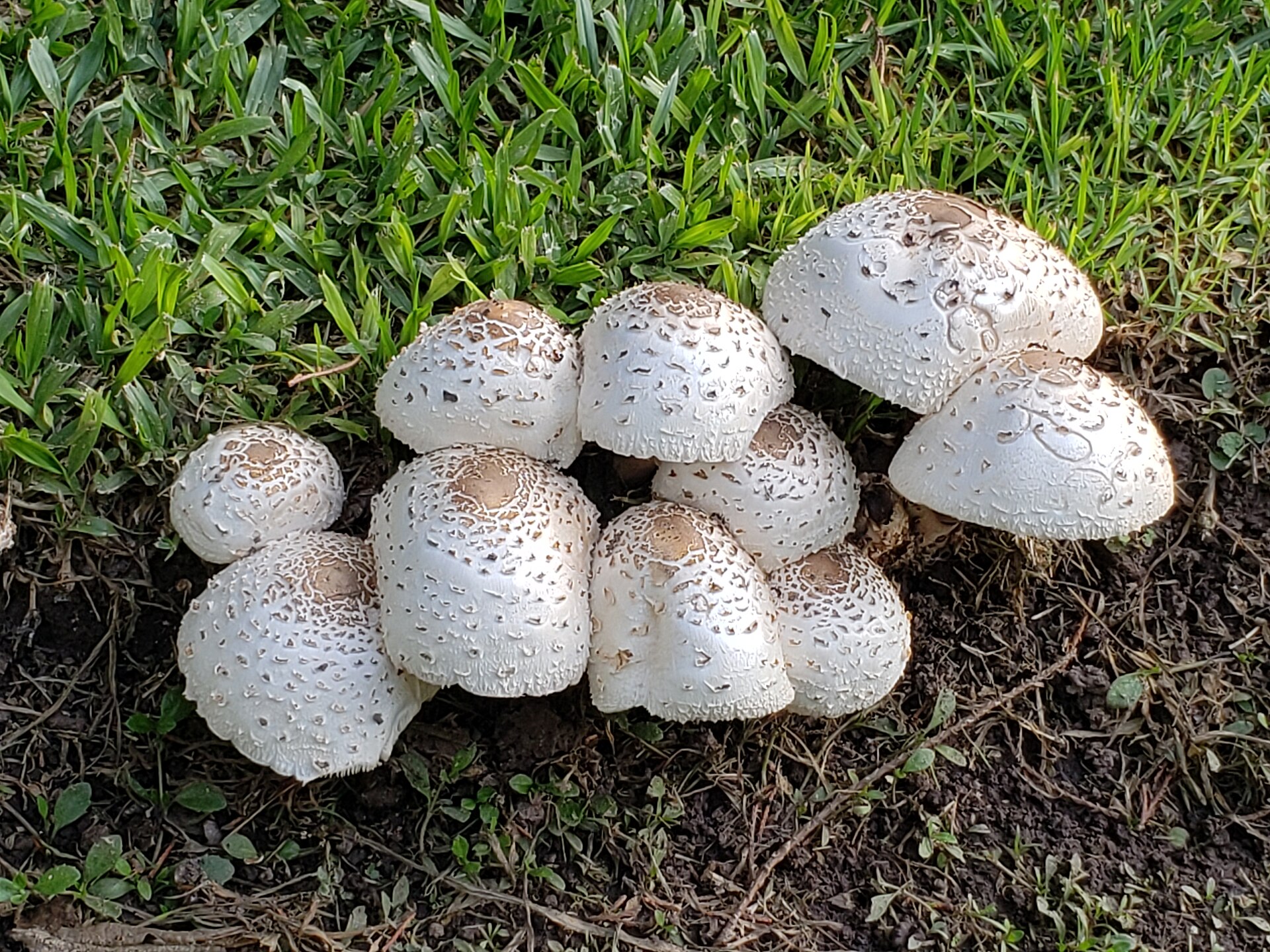
Chlorophyllum molybdites, commonly known as the Green-Spored Parasol or False Parasol, is a large poisonous mushroom that commonly appears in lawns, parks, gardens, pastures, and other grassy areas. It can look strikingly similar to edible parasol mushrooms, especially when young.
The most useful field pattern is large pale parasol-like mushroom + brown cap scales + movable or persistent ring + free gills that become greenish with age + olive-green spore print. The green spore color is the single most important classic identification clue.
⚠️ Important: Chlorophyllum molybdites is poisonous and can cause severe gastrointestinal illness. Do not identify it as edible from cap shape, size, or the presence of a ring alone.
Quick Identification
| Feature | Chlorophyllum molybdites |
|---|---|
| Common names | Green-Spored Parasol, False Parasol |
| Cap | White to cream with brown scales |
| Cap shape | Convex, later broad and parasol-like |
| Gills | Free, crowded |
| Young gills | White to cream |
| Mature gills | Gray-green to greenish |
| Stem | Tall, pale, smooth to lightly textured |
| Ring | Present, often thick |
| Stem base | Often swollen |
| Flesh | White, may discolor slightly |
| Spore print | Olive-green to gray-green |
| Ecology | Saprotrophic |
| Habitat | Lawns, parks, gardens, pastures |
| Growth | Single, scattered, groups, fairy rings |
| Season | Warm weather, often after rain |
| Toxicity | Poisonous |
| Main symptoms | Vomiting, diarrhea, abdominal pain |
| Main look-alikes | Macrolepiota procera, other Chlorophyllum |
What Does Chlorophyllum molybdites Look Like?
Green-Spored Parasol is a large, conspicuous mushroom with a pale cap covered in brownish scales. Mature fruit bodies can resemble classic edible parasols closely enough that accidental poisoning is common.
Young specimens are particularly deceptive because the gills may still be white. The characteristic greenish color often appears only as the spores mature.
Cap
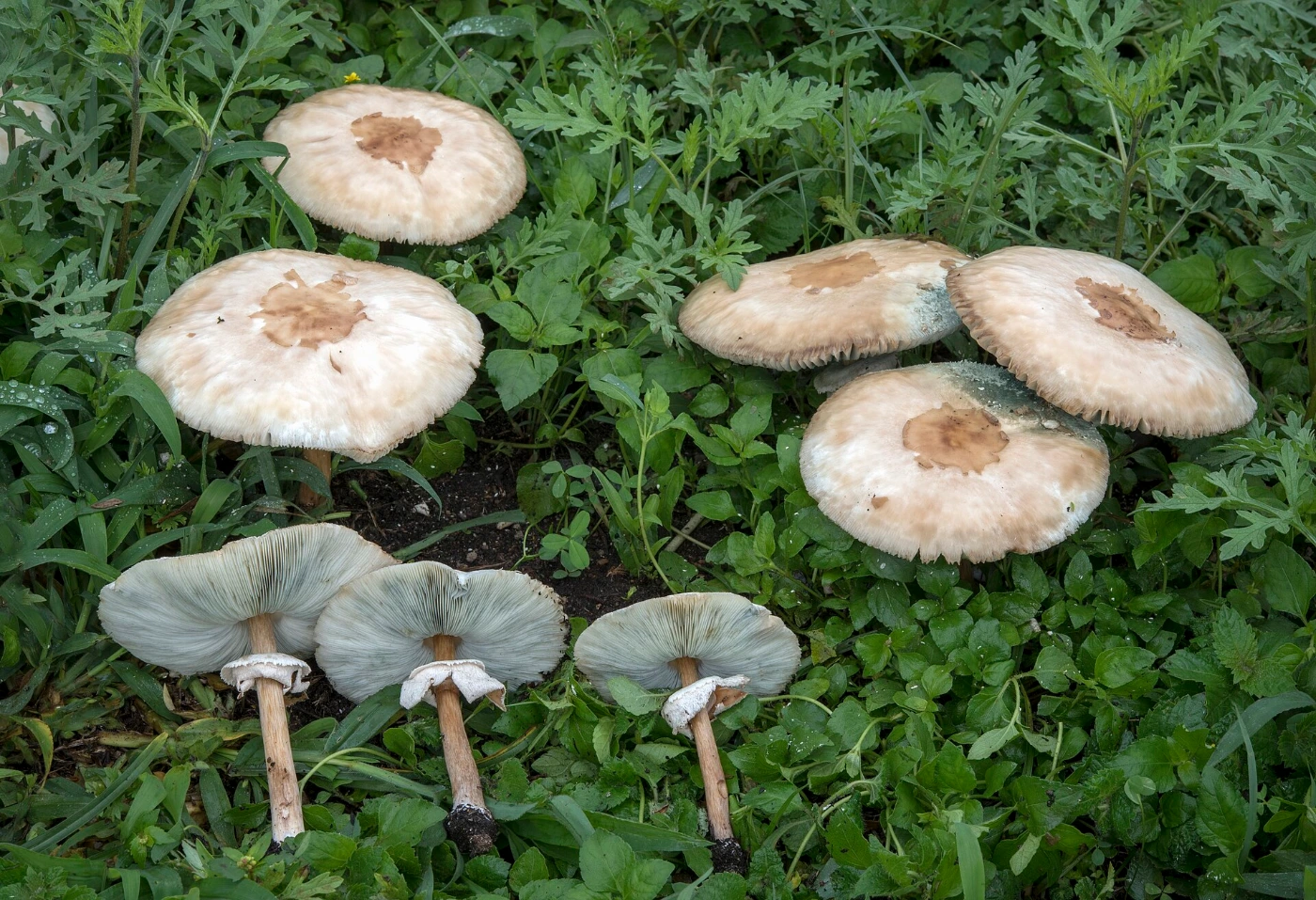
The cap begins rounded or convex and expands into a broad parasol shape. Mature caps can become nearly flat, often with a slightly raised center.
The background is white to cream, while brown to tan scales are scattered across the surface. The central disc is often darker and more solidly brown.
Cap Scales
The scales are usually most obvious toward the center. They can become more widely separated toward the cap margin.
Rain and age can alter the pattern considerably. A weathered specimen may appear less scaly than a fresh one, so cap texture should not be used alone.
Gills
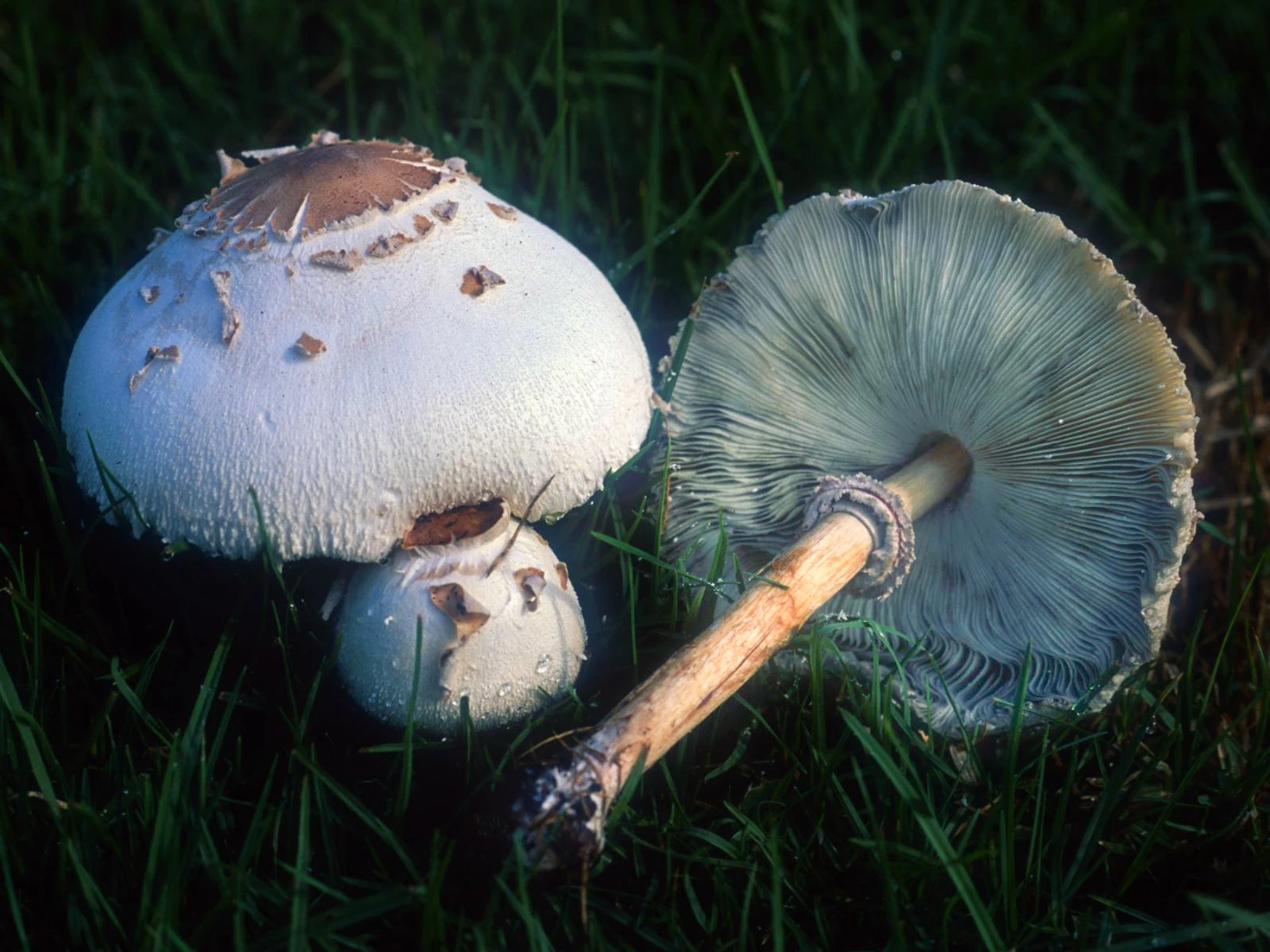
The gills are free from the stem and crowded. In young mushrooms they are usually white or creamy white.
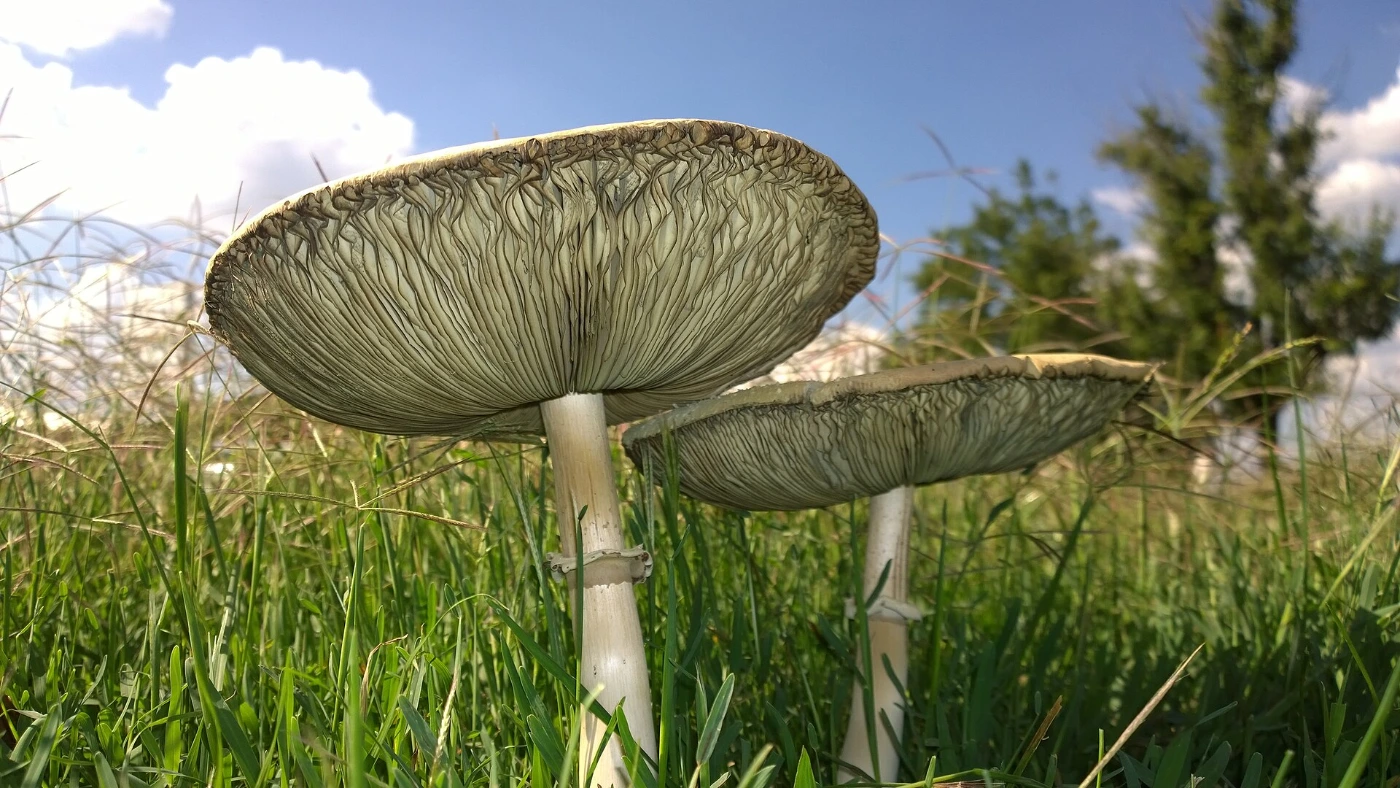
As spores mature, the gills gradually become gray-green, olive-green, or distinctly greenish. This color change is one of the strongest identification features.
Why Young Specimens Are Dangerous
A young Green-Spored Parasol may not yet show any obvious green coloration. The gills can still look white, making the mushroom resemble several edible parasols.
This is why mature gill color and spore print are so important. A white-gilled immature mushroom should not be declared edible before the species is established by other characters.
Spore Print
The spore print is olive-green to gray-green. This feature gives the mushroom its common name.
A green spore print is highly distinctive among large parasol-like lawn mushrooms. Edible Macrolepiota procera, by comparison, produces a white spore print.
Stem
The stem is tall, pale, and relatively smooth. It often becomes slightly brownish toward the base.
The base may be enlarged or bulbous but does not have an Amanita-style sack-like volva.
Ring
A substantial ring is usually present on the upper stem. It may be movable or somewhat double-edged.
The presence of a ring does not make the mushroom safe. Both edible and poisonous parasol-like mushrooms can have prominent rings.
Flesh
The flesh is white and fairly thick in the cap. Some specimens may show slight reddish, brownish, or dull discoloration when cut or bruised.
Bruising reactions vary and are less useful than spore color. A mushroom with green spores should be treated as C. molybdites or a close relative regardless of weak flesh staining.
Smell
The odor is usually mild and mushroom-like. It is not reliable for separating the species from edible parasols.
A pleasant smell should never be interpreted as evidence of edibility. Toxic mushrooms can smell completely ordinary.
Where Does Chlorophyllum molybdites Grow?
Green-Spored Parasol strongly favors grassy, disturbed, and managed habitats. Lawns, golf courses, gardens, school grounds, parks, pastures, and roadside grass are all typical.
It is especially common in warm climates and often appears rapidly after rain. Large flushes may form arcs or complete fairy rings.
Why It Appears on Lawns
The fungus decomposes organic material in the soil. Rich lawns provide both moisture and organic debris, creating ideal fruiting conditions.
Irrigation can extend the season beyond natural rainfall. This is one reason the species frequently appears in suburban environments where children and pets may encounter it.
Fairy Rings
Chlorophyllum molybdites often forms striking fairy rings. Dozens of large fruit bodies may appear in a circle after warm wet weather.
The ring itself does not identify the species. Many unrelated lawn mushrooms can grow in fairy rings, but large pale parasols with green spores are highly suggestive.
Distribution
The species is widespread in tropical, subtropical, and warm-temperate regions. It is especially well known from North America but also occurs in South America, Asia, Africa, Australia, and warmer parts of Europe.
Recent research continues to document new or expanding regional records, and poisoning series have been reported from places such as Réunion and Sicily.
Is Chlorophyllum molybdites Poisonous?
Yes. It is a gastrointestinal toxic mushroom and is widely recognized as a major cause of accidental mushroom poisoning.
Poisoning typically produces nausea, repeated vomiting, severe diarrhea, and abdominal cramps. In more severe cases, dehydration, profuse sweating, bloody stool, and shock can occur.
How Quickly Do Symptoms Begin?
Symptoms often begin relatively quickly, usually within a few hours after eating the mushroom. A Réunion poisoning series reported gastrointestinal syndrome with latency between about 30 minutes and three hours.
This relatively short latency differs from classic amatoxin poisoning, where severe symptoms are often delayed for six hours or more. However, timing alone should never be used to identify the mushroom.
Can Poisoning Be Severe?
Yes. Although the syndrome is primarily gastrointestinal, fluid loss can be substantial.
A published pediatric case described hypovolemic shock after Chlorophyllum molybdites poisoning. Children and other vulnerable patients can deteriorate more quickly from severe vomiting and diarrhea.
What Toxin Does It Contain?
The exact toxicology has been investigated for decades and is more complicated than a single simple toxin label. A toxic protein called molybdophyllysin has been isolated from C. molybdites and has been studied as one contributor to its gastrointestinal toxicity.
For practical identification, the key point is much simpler: the species is poisonous and should not be eaten.
Does Cooking Make It Safe?
No reliable culinary method should be used to make Chlorophyllum molybdites edible. Reports of variable reactions after cooking do not make the mushroom a safe food.
Individual sensitivity and preparation can influence symptom severity, but deliberate consumption remains inappropriate. A mushroom known to cause significant poisoning should simply be avoided.
Look-Alikes
The most important look-alikes are edible or conditionally edible parasol mushrooms. Spore print color, stem ornamentation, and cap structure are especially useful.
Macrolepiota procera — Parasol Mushroom
Identification
Macrolepiota procera is a large edible parasol with a broad scaly cap and a tall slender stem. It can look remarkably similar from above.
The stem usually has a distinctive brown snakeskin-like pattern, and the spore print is white.
Main Difference
Green spore print = Chlorophyllum molybdites. White spore print + snakeskin stem = Macrolepiota procera.
Chlorophyllum rhacodes — Shaggy Parasol
Identification
Shaggy Parasol has coarse brown scales on a pale cap and a thick ring. The flesh often bruises orange to reddish.
Its spore print is white rather than green. The cap scales are also usually larger and shaggier.
Main Difference
Green spores favor C. molybdites. White spores plus strong reddish-orange bruising favor the Shaggy Parasol group.
Chlorophyllum brunneum — Brown Parasol
Identification
Chlorophyllum brunneum is another robust parasol-like mushroom with brown cap scales. It may have a bulbous stem base and a thick ring.
Its spores are white, not green. Species-level separation within Chlorophyllum can sometimes be difficult without microscopic or molecular evidence.
Main Difference
Green mature gills and a green spore print strongly favor C. molybdites.
Amanita Species
Identification
Large pale Amanitas can also have white caps, white gills, and a ring. Some are dangerously poisonous.
Amanitas typically have a volva, bulb, or universal-veil structures at the stem base and produce white spores.
Main Difference
Volva or clear Amanita-style basal structures = Amanita. Green spores = Chlorophyllum molybdites.
Green-Spored Parasol vs Parasol Mushroom
| Feature | Chlorophyllum molybdites | Macrolepiota procera |
|---|---|---|
| Cap | Pale with brown scales | Pale with brown scales |
| Gills young | White | White |
| Gills mature | Greenish | Remain pale |
| Spore print | Olive-green | White |
| Stem | Relatively smooth | Snakeskin pattern |
| Ring | Present | Present, often movable |
| Habitat | Lawns, parks | Grassland, woodland edges |
| Toxicity | Poisonous | Edible when correctly identified |
| Best clue | Green spores | White spores + patterned stem |
The spore print is one of the best home-level tests for this comparison.
Green-Spored Parasol vs Shaggy Parasol
| Feature | C. molybdites | Shaggy Parasol |
|---|---|---|
| Spore print | Green | White |
| Gills mature | Greenish | Pale |
| Cap scales | Brown, often flatter | Coarser and shaggy |
| Bruising | Variable | Often orange-red |
| Habitat | Often lawns | Woodland edges, gardens, rich soil |
| Main risk | Poisonous | Complex edibility depending on species |
Because young specimens of both groups can have white gills, mature spores remain especially valuable.
How to Make a Spore Print
Remove the stem and place the cap gill-side down on white and dark paper or another clean surface. Cover it to reduce air movement and allow spores to fall.
A mature C. molybdites should leave an olive-green or gray-green deposit. If the mushroom is very young or sterile, the print may be weak or absent, so lack of a green print does not automatically prove another species.
Can Sterile Specimens Occur?
Yes. Older literature notes that occasional specimens may fail to produce the expected green spores normally used for identification.
This is another reason to use several characters together. Habitat, cap structure, stem, ring, mature gill color, and spore print should all be considered.
Why It Is Often Mistaken for Edible Parasols
The overall silhouette is nearly perfect for a mushroom people expect to be edible: tall stem, broad scaled cap, prominent ring, and substantial flesh.
The dangerous difference is largely hidden underneath. Until the green spores mature, the mushroom may look very similar to edible parasol species.
Lawn Safety for Dogs and Children
Because C. molybdites commonly grows in lawns, it is particularly relevant to homes with dogs and young children. Large mushrooms can appear rapidly after rain and may be within easy reach.
Remove fruit bodies from frequently used areas before pets or children investigate them. If accidental ingestion occurs, preserve a mushroom sample or take clear photographs for professional identification.
What to Do After Suspected Poisoning
If someone develops vomiting, severe diarrhea, abdominal pain, weakness, or other symptoms after eating a wild parasol-like mushroom, seek medical or poison-center advice promptly.
Keep remaining mushrooms or cooked leftovers if possible. Severe fluid loss can require intravenous fluids and electrolyte replacement.
How to Identify Chlorophyllum molybdites
Start with habitat. A very large pale parasol appearing on a warm lawn after rain is a strong reason to consider this species.
Then examine the cap for brown scales and check the free gills. Mature gills becoming gray-green or greenish are highly characteristic.
Finally, make a spore print when needed. Olive-green spores are the strongest classic confirmation.
Young vs Mature Green-Spored Parasols
Young mushrooms may have rounded caps and completely white gills. A partial veil covers the gills before breaking to form the ring.
As the mushroom matures, the cap expands and the gills gradually take on a green-gray cast. The spore print becomes distinctly olive-green.
How Rain Changes the Appearance
Rain can wash or flatten cap scales and make the mushroom look smoother than usual. Wet specimens may also appear darker.
After drying, the pale background and brown-scaled pattern often become more obvious again. Structural characters remain more dependable than exact coloration.
Common Identification Mistakes
One common mistake is identifying a young specimen as an edible parasol before the spores have matured. White gills in a young mushroom do not rule out C. molybdites.
Another mistake is relying only on the broad parasol-shaped cap. Several genera can produce similar silhouettes.
A third mistake is ignoring habitat. A large parasol-like mushroom growing repeatedly in a warm irrigated lawn deserves particular suspicion.
A fourth mistake is assuming that severe gastrointestinal poisoning cannot be dangerous. Dehydration and fluid loss can become medically serious, especially in children.
How to Photograph Chlorophyllum molybdites
Photograph the entire mushroom in the lawn before removing it. Include surrounding grass and any fairy-ring growth pattern.
Then photograph the cap, mature gills, ring, entire stem, and stem base. An image of the green spore print can provide some of the strongest identification evidence.
Can AI Identify Green-Spored Parasol?
AI can often suggest Chlorophyllum molybdites from a typical mature specimen in a lawn. Large size, brown cap scales, ring, and greenish gills create a distinctive combination.
Young white-gilled specimens are much harder. A spore print and mature specimens from the same patch can substantially improve confidence.
Interesting Facts
The species is sometimes described as one of the most frequently ingested poisonous mushrooms because it grows in exactly the places where people are likely to encounter it: lawns, gardens, parks, and recreation areas. Reviews have identified it as a particularly common cause of mushroom poisoning in North America.
Its scientific name refers to the greenish or molybdenum-colored spores that distinguish it from many similar parasols. The spores may not be obvious until the mushroom reaches maturity.
The species can also form enormous fairy rings. A single lawn may suddenly produce dozens of large fruit bodies after warm rain.
Recent poisoning surveillance in China likewise found C. molybdites responsible for the greatest number of recorded poisoning incidents there in 2024, illustrating how widespread its public-health significance can be.
Frequently Asked Questions
Is Chlorophyllum molybdites poisonous?
Yes. It can cause severe gastrointestinal poisoning with vomiting, diarrhea, and abdominal cramps.
What is the common name of Chlorophyllum molybdites?
The most common names are Green-Spored Parasol and False Parasol.
What color is the spore print?
It is olive-green to gray-green, which is one of the most important identification features.
Are the gills always green?
No. Young gills can be white or cream and only become greenish as spores mature.
Where does Green-Spored Parasol grow?
It commonly grows in lawns, parks, gardens, pastures, golf courses, and other grassy areas.
How is it different from Parasol Mushroom?
Macrolepiota procera has a white spore print and a patterned snakeskin-like stem. C. molybdites produces green spores.
Can cooking make Chlorophyllum molybdites safe?
It should not be treated as an edible mushroom. Cooking is not a reliable safety method.
What should I do if a child or dog eats one?
Contact a medical poison service or veterinarian promptly and preserve a specimen or clear photographs for identification.
Final Identification Notes
Chlorophyllum molybdites is best recognized by the combination of a large white-to-cream parasol-shaped cap with brown scales, free gills that become greenish with maturity, a prominent stem ring, lawn habitat, and an olive-green spore print.
The main danger is confusion with edible parasol mushrooms. Young fruit bodies are especially deceptive because their gills may still be completely white.
The practical field pattern is: large scaled lawn parasol + ring + mature greenish gills + green spore print = strong Chlorophyllum molybdites identification. Because the species can cause severe gastrointestinal poisoning, it should never be eaten.
Upload a photo and get possible matches in seconds.