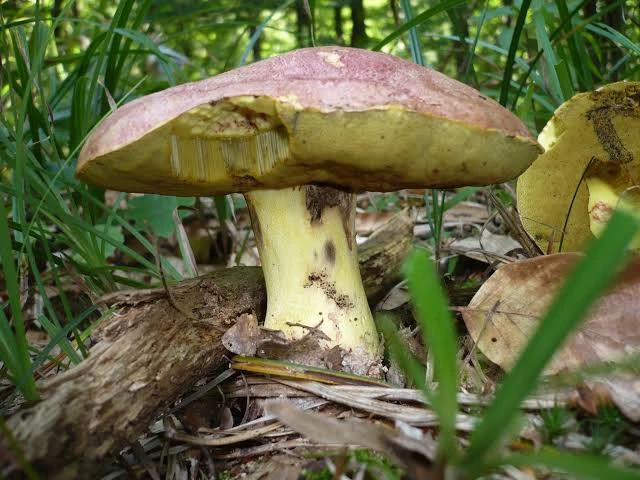
Butyriboletus regius, commonly known as the Royal Bolete, is a large and striking bolete with a rose-red to carmine cap, bright yellow pores, and a yellow stem covered with a fine yellow reticulum. Unlike many red-colored boletes, it has yellow rather than red pores and usually shows little or no blue staining when damaged.
The most useful field pattern is pink-red cap + yellow pores + yellow netted stem + weak or absent blueing + broadleaf woodland. This combination makes Royal Bolete relatively distinctive when several characters are considered together.
The species is also rare and conservation-sensitive in parts of Europe. In some countries it is protected or red-listed, so identification should often end with photography rather than collection.
⚠️ Important: Red cap color does not indicate toxicity. Royal Bolete has a vivid red cap but yellow pores, while several toxic boletes have pale caps with red pores.
Quick Identification
| Feature | Butyriboletus regius |
|---|---|
| Common name | Royal Bolete |
| Cap | Rose-pink, carmine, red to reddish-purple |
| Cap size | About 5–20 cm |
| Cap surface | Velvety when young, smoother with age |
| Pores | Bright yellow, later olive-yellow |
| Pore bruising | None to faint blue |
| Stem | Yellow, sometimes reddish near base |
| Stem ornamentation | Fine yellow reticulation |
| Flesh | Yellow |
| Flesh staining | None to weak pale blue |
| Spore print | Olive-brown |
| Ecology | Ectomycorrhizal |
| Main hosts | Oak, beech, sweet chestnut |
| Soil | Often calcareous |
| Season | Summer to autumn |
| Main look-alikes | Butyriboletus fechtneri, Hortiboletus rubellus, red-pored boletes |
| Edibility | Traditionally considered edible, but rare and often protected |
What Does Royal Bolete Look Like?
Royal Bolete is a robust mushroom with unusually vivid colors. The cap can be pink, wine-red, carmine, or reddish-purple, while the pores and much of the stem remain strongly yellow.
Young specimens are often especially striking because the contrast between the red cap and yellow underside is strongest. Older fruit bodies can fade toward dull pink, ochre, or reddish-brown, especially after prolonged sun exposure.
Cap
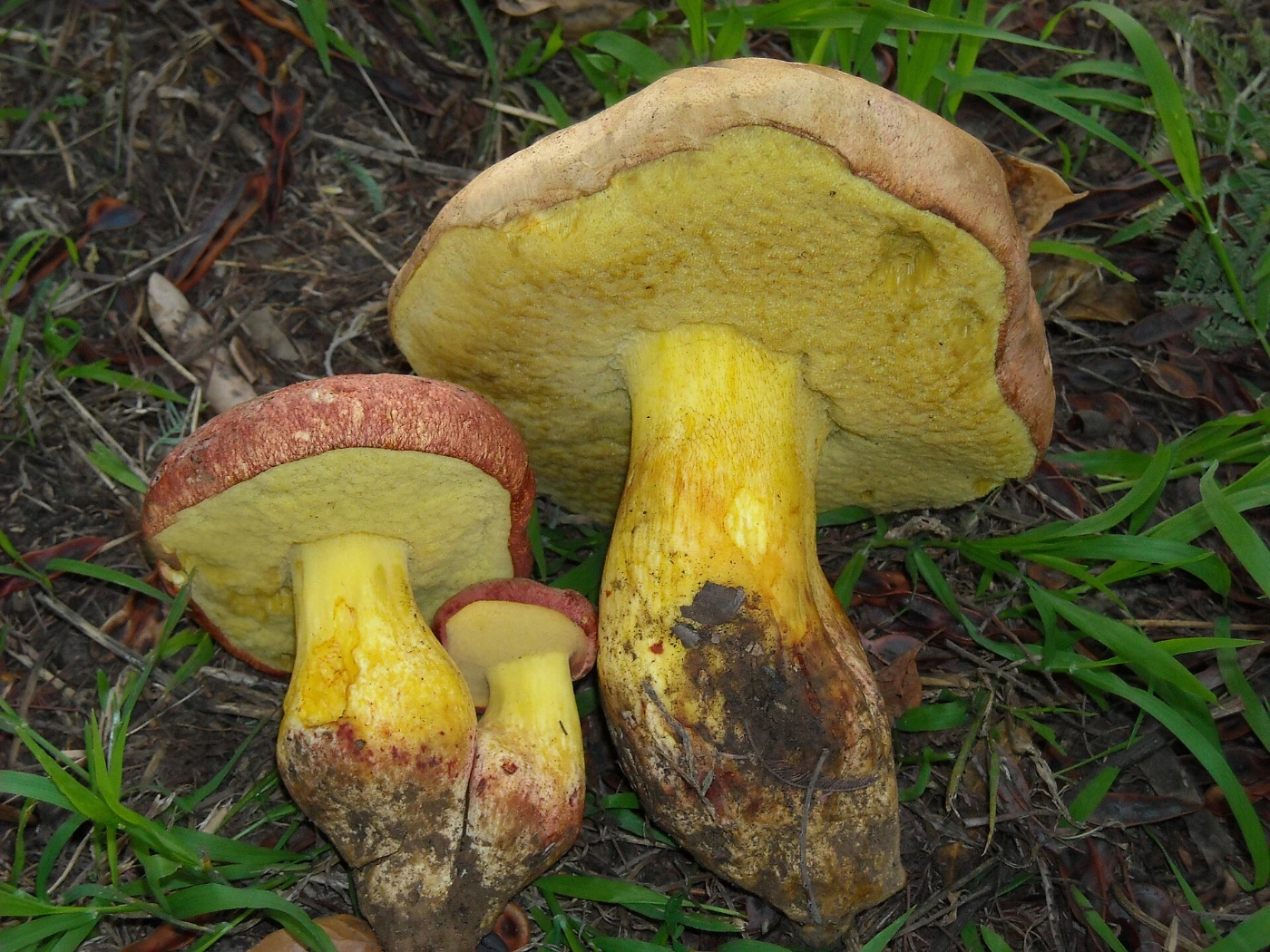
The cap usually measures about 5–20 cm across. Young caps are hemispherical and velvety, later becoming broadly convex or cushion-shaped.
The surface is typically dark pink to red, although yellowish or brownish tones may appear near the margin. Dry weather can produce fine cracking or wrinkling on mature fruit bodies, and the margin may become slightly irregular with age.
Pores
The pores are yellow, not red. This is one of the most important identification features because several toxic or problematic boletes develop orange-red or blood-red pores.
In Royal Bolete, the pore surface remains yellow and becomes more olive-yellow with age. Bruising is usually absent or weak, and some specimens show only a faint greenish or pale blue discoloration.
Tubes
The tubes are yellow when young and gradually become more olive-yellow as the mushroom matures. They are relatively deep and connect to the stem without the dramatic color changes seen in some strongly blue-staining boletes.
Their color usually matches the pore surface closely. Strong blue staining of the tubes would make the identification less convincing and should encourage comparison with other species.
Stem
The stem is thick, solid, and predominantly yellow. Young fruit bodies often have a barrel-shaped or swollen stem that becomes more elongated as the mushroom matures.
A fine yellow reticulum covers much of the stem surface. Because the raised network is often yellow on a yellow background, it can be subtle and is best examined closely.
Reticulation
Reticulation is a raised network of interconnected lines rather than separate dots or fibers. In Royal Bolete, this fine yellow net is one of the strongest structural features.
It helps separate the species from smaller red-capped boletes such as Hortiboletus rubellus. Those mushrooms may have reddish fibers or dots on the stem but lack the same true reticulate pattern.
Flesh
The flesh is yellow rather than white. When cut, it usually remains yellow or develops only weak pale-blue staining.
Strong, immediate dark-blue discoloration is not typical of Royal Bolete. This weak reaction is therefore useful when comparing the species with several other yellow-fleshed boletes.
Why Weak Blueing Matters
Many bolete species undergo dramatic oxidation when their tissues are exposed to air. Royal Bolete usually shows little of this reaction, although faint blue or greenish tones can occasionally develop.
This character is particularly useful when comparing it with Caloboletus radicans, which typically blues much more strongly. Blueing should still be treated only as an identification feature and never as an edibility test.
Spore Print
The spore print is olive-brown, which is typical for many boletes. The spores are smooth and narrowly ellipsoid to fusiform.
Spore-print color can help confirm that the mushroom belongs to a bolete-type group. It does not, however, separate Royal Bolete from its closest look-alikes by itself.
Where Does Butyriboletus regius Grow?
Royal Bolete is ectomycorrhizal and grows on the ground in association with living broadleaf trees. Important hosts include oak, beech, and sweet chestnut.
It is especially associated with warm deciduous woodland on calcareous or otherwise base-rich soils. The mushroom may appear singly or in very small groups beneath mature trees.
Oak Association
Oak woodland is one of the most characteristic habitats for Royal Bolete. Warm, open oak forests with calcareous soils are particularly suitable.
These habitats can also contain several other rare boletes with overlapping colors and structures. Host tree alone therefore does not provide a complete identification, but it strongly supports the ecological pattern.
Beech and Sweet Chestnut
Royal Bolete also occurs beneath beech and sweet chestnut. These broadleaf associations distinguish it ecologically from many conifer-associated red-capped boletes.
The surrounding forest should always be documented when photographing a suspected specimen. Tree identification can provide an important clue when cap color is ambiguous.
Season
Royal Bolete fruits mainly during summer and early autumn in warmer parts of Europe. Fruiting time varies with rainfall, altitude, latitude, and local temperature.
In suitable climates, specimens may appear from midsummer into early autumn. Warm weather combined with sufficient soil moisture often produces the best conditions.
Distribution
Butyriboletus regius is primarily associated with Europe and parts of Eurasia. It is rare or very rare in many regions and has become an important conservation species in some countries.
Older North American reports should be interpreted cautiously. Molecular work has shown that several North American boletes once given European names actually represent distinct regional taxa.
Taxonomy
The species was long known as Boletus regius. Modern phylogenetic studies moved it into the genus Butyriboletus together with several other robust, yellow-fleshed boletes.
The old name remains common in older field guides and herbarium records. For current identification work, Butyriboletus regius is the preferred name.
Why It Is Called Royal Bolete
The specific epithet regius means “royal” or “regal.” The name fits the mushroom’s striking combination of a rose-red cap, yellow pores, and yellow reticulate stem.
Among European boletes, it is one of the most visually distinctive large species. Fresh young fruit bodies can look especially vivid in warm broadleaf woodland.
Is Butyriboletus regius Edible?
Royal Bolete has traditionally been regarded as edible and is considered a good culinary species in some parts of Europe. Its flesh is firm and generally mild.
However, rarity changes the practical recommendation. A mushroom can be edible and still be unsuitable or illegal to collect because of conservation concerns.
Conservation Is More Important Than Edibility
Royal Bolete is rare in several European countries and is protected or red-listed in some regions. In such places, collecting fruit bodies may be prohibited or discouraged.
For MushroomID, the safest practical message is simple: identify and photograph Royal Bolete, but check local conservation rules before collecting it. Edibility should not override the conservation status of a rare species.
Look-Alikes
The most important look-alikes are other robust boletes with red, pink, or pale caps and yellow pores. Pore color, stem reticulation, blueing intensity, and cap color provide the strongest distinctions.
Butyriboletus fechtneri — Pale Bolete
Identification
Butyriboletus fechtneri has a pale grayish, silvery, or cream cap rather than the vivid rose-red cap of Royal Bolete. It also has yellow pores and a yellow stem, often with reddish coloration in the lower section.
The two species can occur in similar warm broadleaf habitats. Mild blue staining may also be present in B. fechtneri.
Main Difference
Rose-red cap strongly favors Butyriboletus regius, while a pale gray or whitish cap favors Butyriboletus fechtneri. Stem structure and habitat should still be checked because faded specimens can be less obvious.
Hortiboletus rubellus — Ruby Bolete
Identification
Ruby Bolete also has a vivid red cap and yellow pores. It is much smaller and more slender than Royal Bolete, and the stem is yellow with red fibers or dots.
The species often occurs in parks, grassy places, and broadleaf woodland edges. Its overall proportions are usually much more delicate.
Main Difference
Large robust bolete + yellow reticulate stem = Royal Bolete. Small slender bolete + red-and-yellow fibrillose stem = Ruby Bolete.
Caloboletus radicans — Rooting Bolete
Identification
Caloboletus radicans is another robust yellow-pored bolete from warm broadleaf habitats. Its cap is pale gray, whitish, or straw-colored rather than rose-red.
The flesh and pores usually turn blue more strongly when damaged. It also often has a pronounced rooting stem base.
Main Difference
Red cap + weak blueing favor Royal Bolete, while pale cap + strong blueing + rooting base favor Caloboletus radicans. The two can share similar woodland habitats, so color and bruising are especially useful.
Rubroboletus satanas — Satan’s Bolete
Identification
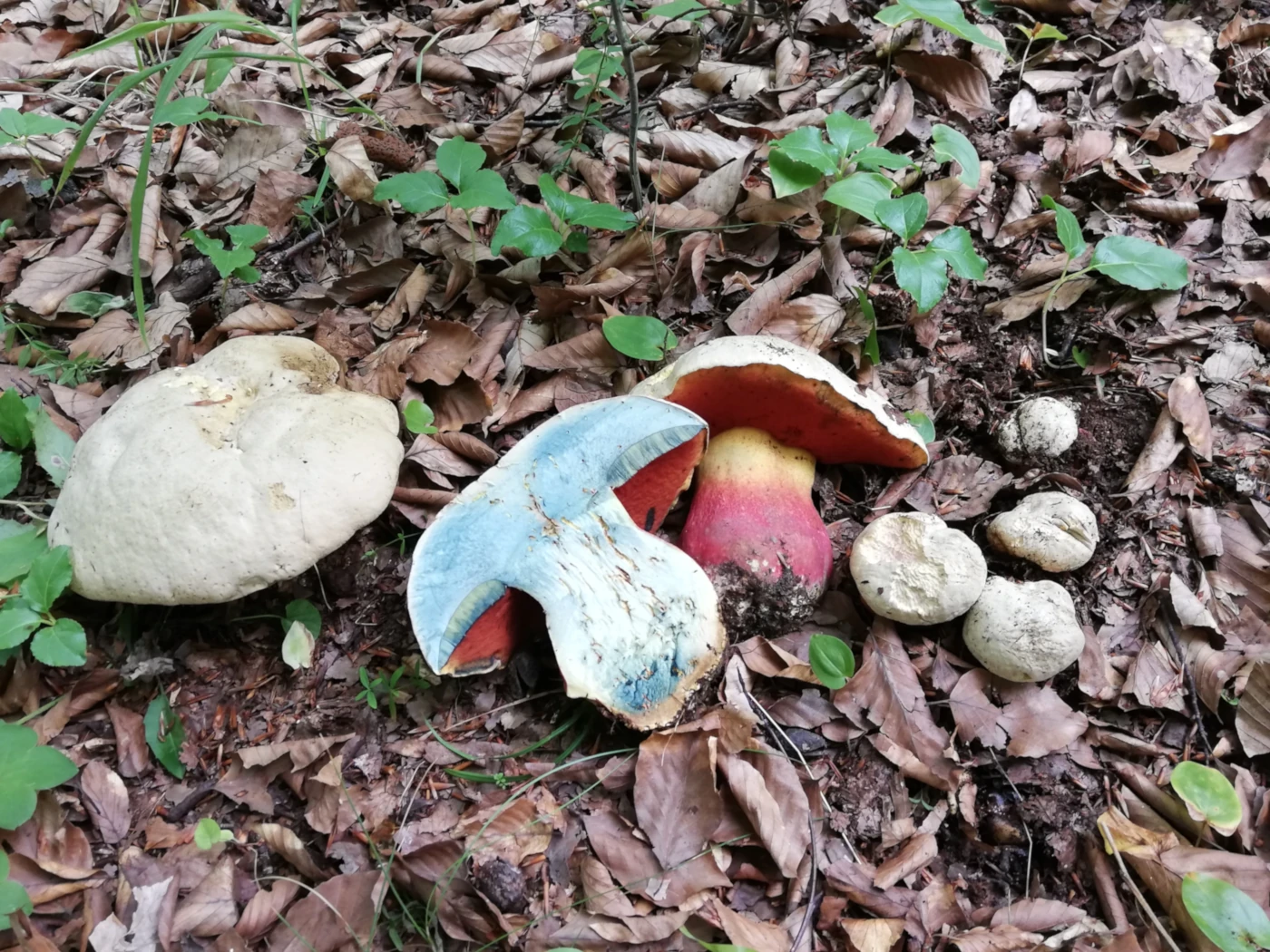
Satanas-type boletes can occur in similar warm calcareous broadleaf woodland. The cap is usually pale gray, cream, or whitish, while the pores become orange-red to blood-red.
The stem also develops conspicuous red coloration or reticulation. The overall color pattern is therefore almost the reverse of Royal Bolete.
Main Difference
Royal Bolete has yellow pores, while Rubroboletus satanas has red pores. This underside difference is far more useful than cap color.
Royal Bolete vs Ruby Bolete
| Feature | Royal Bolete | Ruby Bolete |
|---|---|---|
| Scientific name | Butyriboletus regius | Hortiboletus rubellus |
| Cap | Rose-red / carmine | Scarlet / ruby-red |
| Size | Large and robust | Small to medium |
| Pores | Yellow | Yellow |
| Stem | Thick, yellow | Slender, yellow-red |
| Reticulation | Present | Absent |
| Blueing | Weak / absent | Often clearer |
| Habitat | Warm broadleaf woodland | Parks, lawns, broadleaf woodland |
| Best clue | Robust + yellow net | Small + red-fibrillose stem |
Cap color alone is not enough to separate them. Stem structure and overall size are much more reliable.
Royal Bolete vs Satan’s Bolete
| Feature | Royal Bolete | Satan’s Bolete |
|---|---|---|
| Cap | Pink-red | Pale gray / cream |
| Pores | Yellow | Orange-red to blood-red |
| Stem | Yellow with fine net | Yellow-red with red net |
| Flesh | Yellow | Pale yellow |
| Blueing | Weak | Usually more distinct |
| Edibility | Traditionally edible | Poisonous |
| Best clue | Yellow pores | Red pores |
The pore surface is the fastest practical distinction. A pale cap does not mean a bolete is safer than a red-capped one.
Royal Bolete vs Rooting Bolete
| Feature | Royal Bolete | Rooting Bolete |
|---|---|---|
| Cap | Rose-red | Pale gray / whitish |
| Pores | Yellow | Yellow |
| Stem | Yellow, reticulate | Yellow, often rooting |
| Blueing | Weak | Strong |
| Taste | Mild | Extremely bitter |
| Main habitat | Broadleaf woodland | Broadleaf woodland |
| Best clue | Red cap | Pale cap + strong blueing |
The two may occur in similar habitats, which makes bruising and cap color particularly important. Do not taste an uncertain bolete solely to separate species.
Why Red Cap Does Not Mean Toxic
Royal Bolete is a useful example of why mushroom color cannot be treated as a toxicity signal. Its red cap is visually dramatic, yet the species has traditionally been regarded as edible.
Several toxic boletes, in contrast, have pale gray or cream caps. The more useful features are pore color, stem ornamentation, bruising reaction, ecology, and overall morphology.
Why Yellow Pores Matter
Yellow pores place Royal Bolete in a very different visual category from the classic red-pored toxic boletes. The contrast between the red cap and yellow underside is one of its strongest field clues.
With age, the pores may become olive-yellow. They should not develop the strong blood-red coloration characteristic of Rubroboletus satanas and similar species.
Why the Stem Net Matters
Reticulation is a raised network of interconnected lines on the stem. In Royal Bolete, this network is fine and yellow, often on a similarly yellow background.
Because the net can be subtle, it is worth photographing the stem closely. A true reticulum helps separate the species from red-capped boletes with dots, fibers, or longitudinal streaks.
Young vs Mature Specimens
Young Royal Boletes have strongly convex caps and vivid colors. The yellow stem may be particularly swollen, and the fine reticulation can be easier to see.
Mature caps flatten and may fade substantially. Sun-exposed fruit bodies can become pinkish-brown or ochre, while older pores turn more olive-yellow.
Examining several ages from the same patch can therefore make identification easier. A single faded old specimen may be much harder to recognize.
Common Identification Mistakes
One common mistake is assuming that any red-capped bolete with yellow pores is Royal Bolete. Several smaller genera produce similar color combinations and must be separated by stem structure, size, and ecology.
Another mistake is ignoring the stem surface. The fine yellow reticulum is one of the most useful structural features of B. regius.
A third mistake is expecting strong blue bruising. Royal Bolete typically shows little or no blueing, so an intense reaction should prompt comparison with other species.
A fourth mistake is collecting the mushroom simply because a field guide describes it as edible. Conservation status may make collection inappropriate or illegal.
How to Photograph Butyriboletus regius
Photograph the mushroom in place before handling it. Include surrounding oak, beech, or chestnut trees and enough habitat to show the type of woodland.
Take close-ups of the cap, pore surface, and complete stem. A detailed photograph of the stem should show the fine yellow reticulation.
If collection is legal and conservation status allows examination, a cut surface can document the yellow flesh and weak staining reaction. Where the species is protected, rely on non-destructive photography.
Can AI Identify Royal Bolete?
AI can often recognize the strong combination of a red cap and yellow pores. Species-level accuracy improves significantly when the yellow reticulate stem, weak blueing, broadleaf habitat, and geographic region are also provided.
A top-down photograph of the red cap alone is insufficient. Several unrelated boletes can share similar pigmentation.
AI identification should also never override local conservation rules. A correct identification does not automatically mean collection is permitted.
Interesting Facts
Royal Bolete was historically known as Boletus regius before being transferred to Butyriboletus. The genus name reflects the buttery-yellow coloration characteristic of several members of the group.
The species is also a useful example of how rarity and edibility are separate questions. A mushroom can have a long culinary history while still being too uncommon to collect responsibly.
Its combination of rose-red and bright yellow colors makes it one of the most recognizable European boletes. Fresh specimens often stand out dramatically against brown leaf litter.
Frequently Asked Questions
What is the common name of Butyriboletus regius?
The standard English common name is Royal Bolete. It refers to the striking and almost regal appearance of the mushroom.
What color are Royal Bolete pores?
They are bright yellow when young and become more olive-yellow with age. They are not normally red.
Does Royal Bolete turn blue when cut?
Usually very little. The flesh may remain yellow or develop only faint pale-blue staining.
What trees does Royal Bolete grow with?
It is associated mainly with broadleaf trees, especially oak, beech, and sweet chestnut. Warm calcareous woodland is particularly characteristic.
Is Royal Bolete edible?
It has traditionally been considered edible and highly regarded. However, the species is rare and protected in some areas, so conservation status should be checked before collection.
How is Royal Bolete different from Ruby Bolete?
Royal Bolete is much larger and has a thick yellow stem with a fine reticulum. Ruby Bolete is smaller and has a more slender red-and-yellow stem without a true net.
How is it different from Satan’s Bolete?
Royal Bolete has yellow pores, while Satan’s Bolete develops orange-red to blood-red pores. Cap color also differs strongly, but pore color is the more useful field clue.
Does a red cap mean a bolete is poisonous?
No. Royal Bolete is a clear example of why cap color alone is not a toxicity test.
Final Identification Notes
Butyriboletus regius, the Royal Bolete, is best recognized by the combination of a rose-red to carmine cap, bright yellow pores, thick yellow stem with a fine yellow reticulum, yellow flesh, and little or no blue staining. These features should be considered together because several other boletes share individual parts of the same color pattern.
The most important look-alikes include Butyriboletus fechtneri, Hortiboletus rubellus, Caloboletus radicans, and red-pored Rubroboletus species. Pore color, stem reticulation, cap color, blueing intensity, and broadleaf habitat usually provide the strongest distinctions.
The practical identification pattern is: rose-red cap + yellow pores + yellow netted stem + weak blueing + warm broadleaf woodland = strong Butyriboletus regius candidate. Because Royal Bolete is rare and protected in some regions, identification should often end with photography rather than collection.
Upload a photo and get possible matches in seconds.