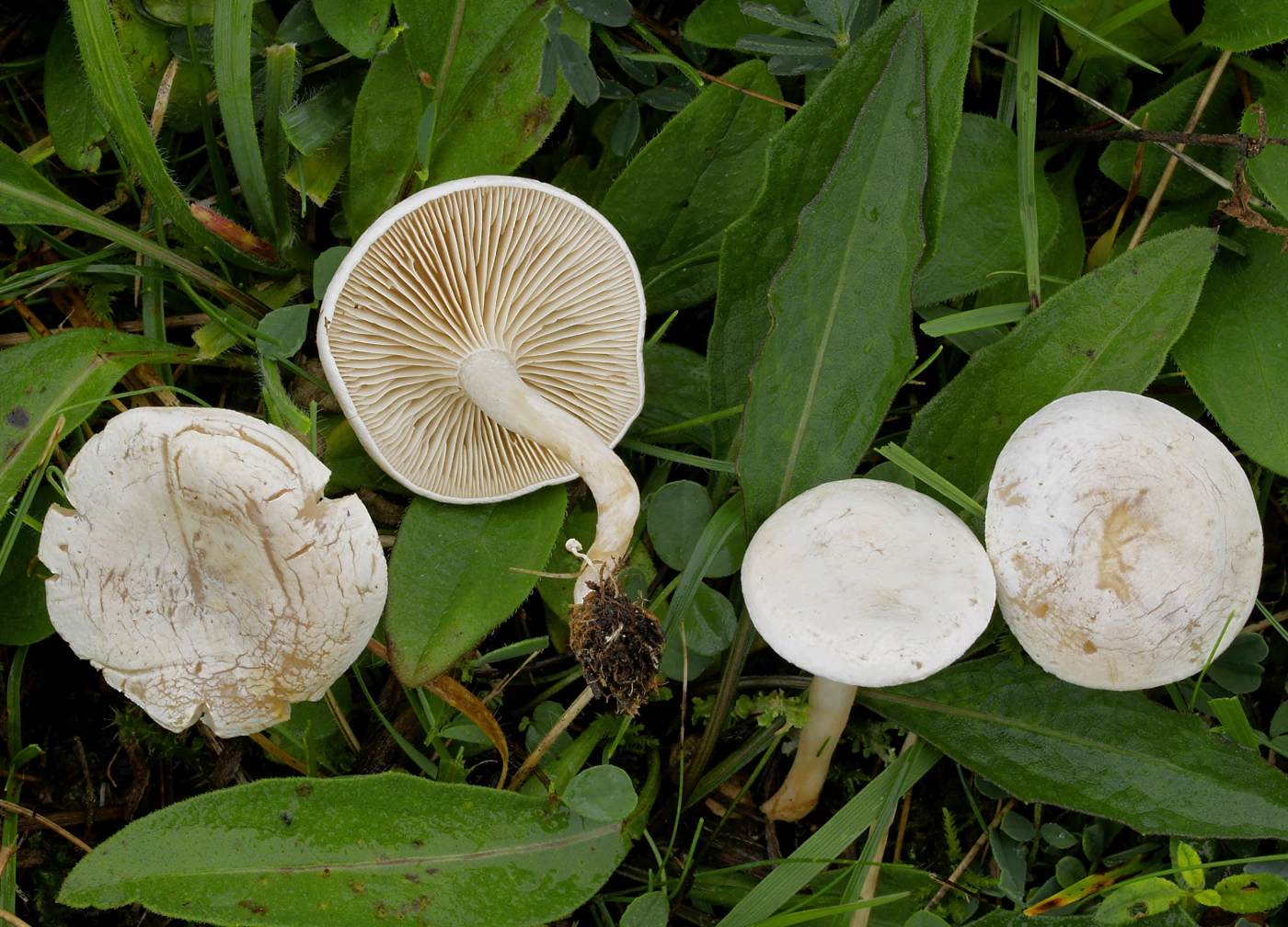
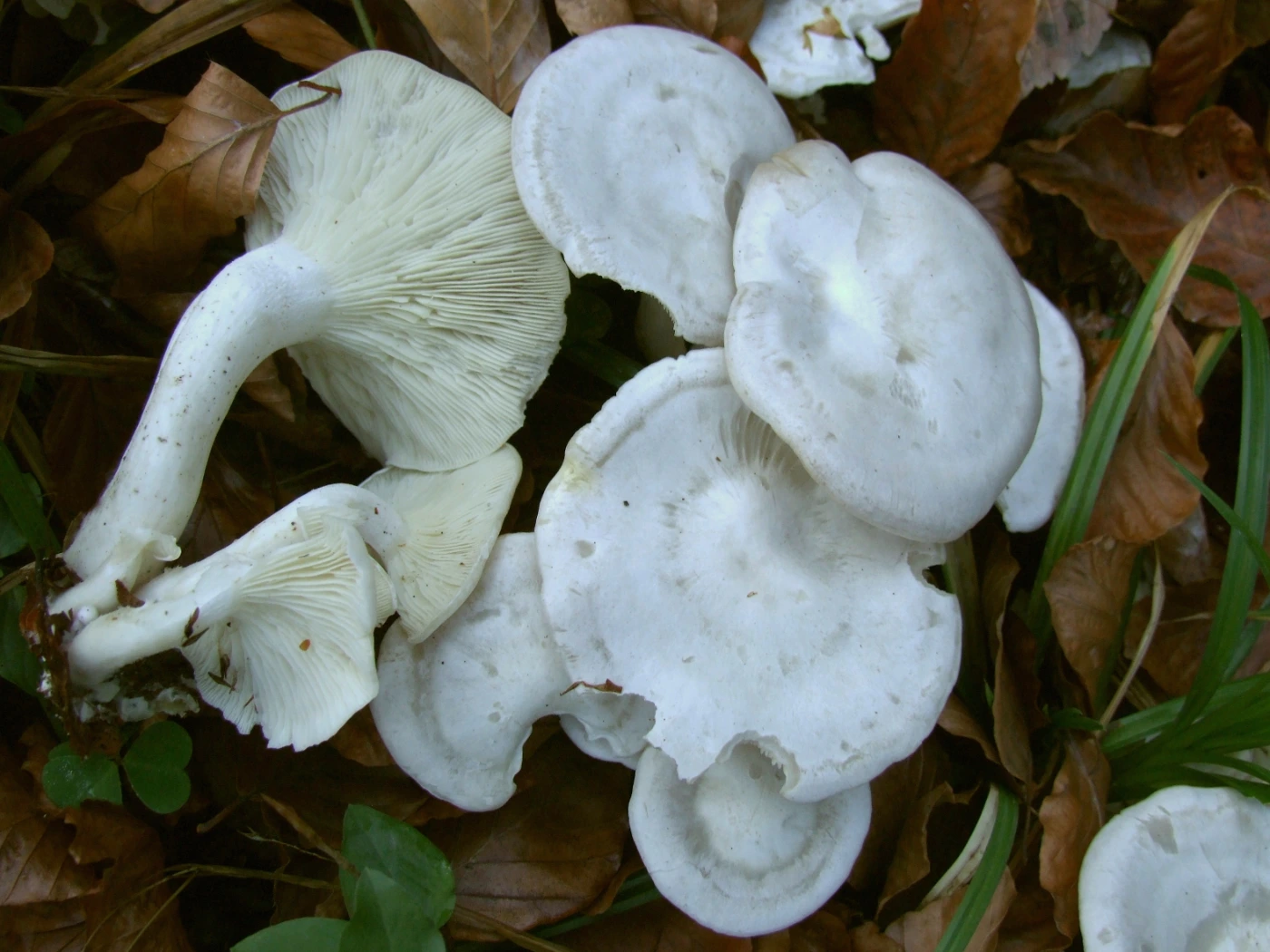
Clitocybe rivulosa, commonly known as the Fool’s Funnel, is a small poisonous white mushroom that grows mainly in grasslands, lawns, parks, roadside verges, and dune systems. It contains muscarine, a toxin that can cause heavy sweating, salivation, vomiting, diarrhea, slowed heart rate, low blood pressure, and breathing difficulties.
The mushroom is deceptively plain. It usually has a small whitish cap, crowded pale gills that run slightly down the stem, a short white stem without a ring, and a tendency to grow in grassy places where edible mushrooms may also occur.
The most useful field pattern is small white to cream funnel-shaped mushroom + crowded slightly decurrent gills + ringless white stem + grassland habitat. Because several edible grassland mushrooms can occur nearby, Fool’s Funnel should never be identified by cap color alone.
Modern taxonomy has changed the scientific name. Species Fungorum currently treats Collybia rivulosa as the accepted name, with Clitocybe rivulosa as a synonym, although the older name remains extremely common in field guides and mushroom-poisoning literature.
⚠️ Important: Fool’s Funnel contains muscarine and should never be tasted. Traditional “taste tests” used for some mushroom groups are inappropriate for a suspected Clitocybe rivulosa.
Quick Identification
| Feature | Clitocybe rivulosa |
|---|---|
| Common name | Fool’s Funnel |
| Current accepted name in Species Fungorum | Collybia rivulosa |
| Familiar scientific name | Clitocybe rivulosa |
| Cap | White to cream, sometimes buffish |
| Cap size | About 1–6 cm |
| Cap shape | Convex, later flat to shallow funnel |
| Surface | Smooth, floury or silky |
| Gills | Crowded, white to grayish-pink |
| Gill attachment | Adnate to slightly decurrent |
| Stem | White, short, ringless |
| Spore print | White |
| Habitat | Grasslands, lawns, verges, parks, dunes |
| Season | Summer to late autumn |
| Main toxin | Muscarine |
| Main syndrome | Muscarinic poisoning |
| Main look-alikes | Calocybe gambosa, pale grassland fungi, related white funnels |
What Does Fool’s Funnel Look Like?
Fool’s Funnel is a small, pale mushroom that can appear almost featureless at first glance. The cap is usually white or cream, while older specimens may become slightly buff or develop faint concentric zoning.
The cap starts convex and gradually flattens. Mature mushrooms often develop a shallow central depression, giving them the funnel-like shape reflected in the common name.
Because it is small and pale, it can disappear visually among dry grass or pale leaf litter.
Cap
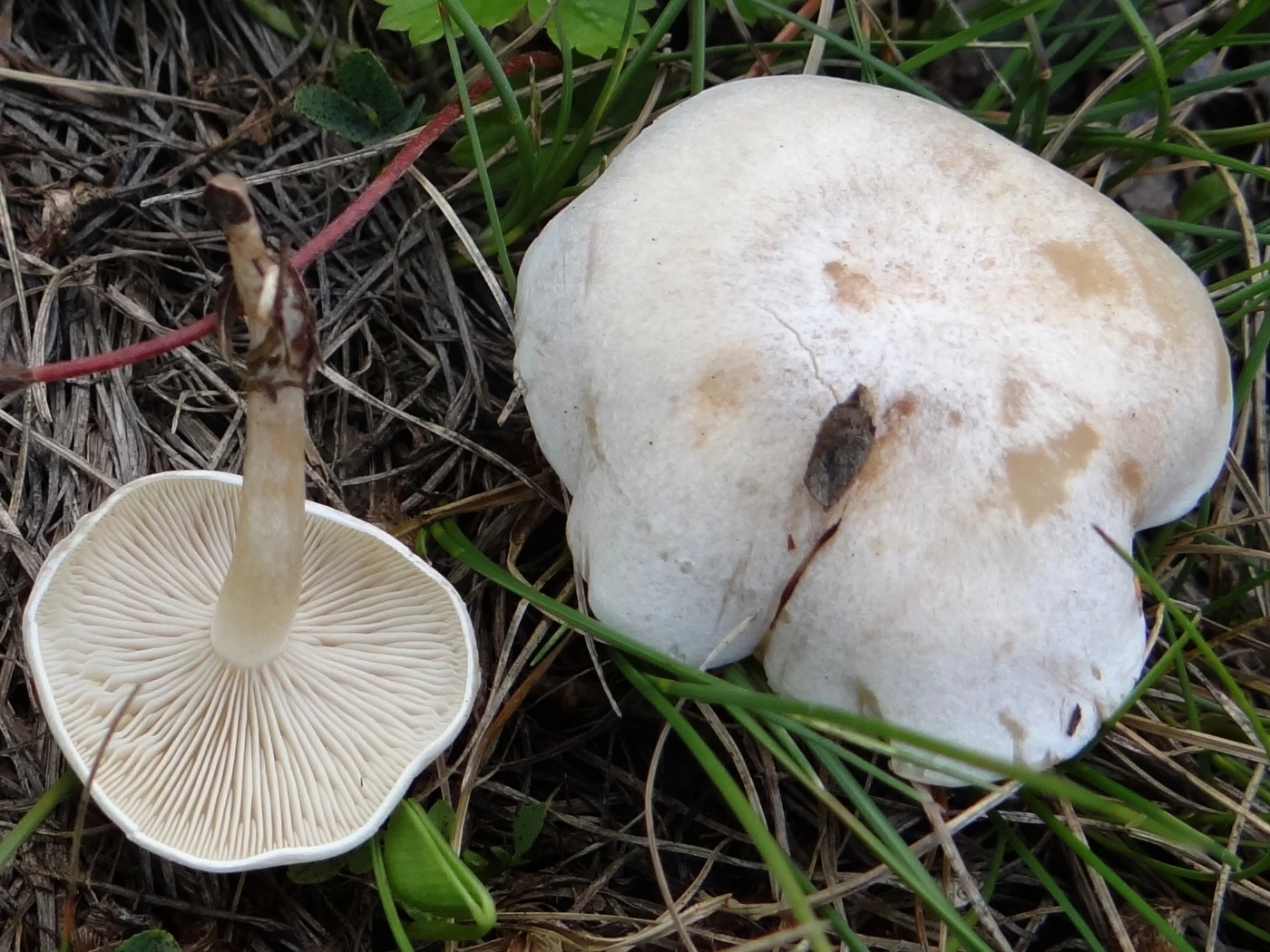
The cap is generally 1–6 cm across. Young specimens are convex with a slightly inrolled margin, while mature caps become flat or shallowly funnel-shaped.
The surface is smooth but may look finely powdery, silky, or frosted when dry. With age, subtle concentric bands can sometimes appear.
Very dry weather can cause the surface to crack. These cracks are not a reliable species-level character by themselves, but they help explain the older common name Cracking Clitocybe.
Gills
The gills are crowded and pale, usually white when young. They can develop a faint grayish or pinkish tone with age.
They are adnate to slightly decurrent, meaning they attach broadly to the stem and may run a short distance downward.
This slightly descending gill attachment is an important part of the classic Clitocybe-type appearance.
Stem
The stem is short, slender, and white. It is usually around 3–4 cm long and less than 1 cm thick.
There is no ring or volva. The base may appear slightly downy or covered with fine white mycelium.
The lack of a ring is useful when separating Fool’s Funnel from some larger white mushrooms, but many unrelated grassland fungi are also ringless.
Flesh
The flesh is thin, white, and relatively fragile. There is no dramatic bruising reaction.
The odor may be slightly sweet or otherwise indistinct. Odor is too variable to be used as a primary identification feature.
Because the mushroom is poisonous, tasting should not be used as an identification method.
Spore Print
The spore print is white.
The spores are smooth and ellipsoid, typically around 4–5.5 × 2–4.5 µm.
A white spore print helps confirm that the mushroom belongs among pale-spored agarics, but many look-alikes also produce pale spores.
Where Does Fool’s Funnel Grow?
Fool’s Funnel is primarily a mushroom of open grassy habitats rather than dense woodland.
It occurs in unimproved grassland, lawns, parks, roadside verges, and similar areas. Coastal dune systems can also support it.
This ecology is important because it brings the species into places where people, children, and pets frequently encounter mushrooms.
Lawns and Parks
The species can appear in mown grass, especially where the soil is relatively undisturbed and fungal communities are well established.
Fruit bodies may occur singly, scattered, in loose groups, or sometimes in arcs.
Its occurrence in recreational grassland makes accidental collection possible when people are looking for edible lawn mushrooms.
Roadside Verges
Roadside grasslands are another typical habitat. These sites may provide relatively stable soil conditions and persistent grassland fungal communities.
Collectors should be especially cautious with small white funnels in these habitats because several species can appear superficially similar.
Coastal Dunes
Fool’s Funnel is also recorded from coastal sand-dune systems. In these environments, it may occur among sparse grass and other low vegetation.
The pale cap can blend surprisingly well with dry sand and vegetation.
Season
In Britain and Ireland, Fool’s Funnel is typically found from July into early December.
The exact season varies with climate, rainfall, and latitude. Fruiting often increases after moist weather during late summer and autumn.
Distribution
Fool’s Funnel is well known from Europe and has also been reported from other temperate regions.
Older distribution records must be interpreted carefully because pale Clitocybe-like mushrooms have historically been difficult to separate, and modern molecular taxonomy has changed the boundaries of several genera.
For identification purposes, regional field guides remain important.
Taxonomy
The traditional name is Clitocybe rivulosa (Pers.) P. Kumm.
However, Species Fungorum currently lists Collybia rivulosa (Pers.) Z.M. He & Zhu L. Yang as the accepted current name, following a 2023 reclassification. Clitocybe rivulosa is retained as a synonym.
This means modern databases may display Collybia rivulosa, while older field guides, poison-center literature, and many identification websites continue to use Clitocybe rivulosa.
For MushroomID, retaining Clitocybe rivulosa in the page title is useful because that is still the name most users are likely to search.
Clitocybe rivulosa vs Clitocybe dealbata
These two names have a long history of confusion.
Some older field guides treated Clitocybe rivulosa and Clitocybe dealbata as separate but extremely similar species, while others combined them or used one name broadly.
British Natural History Museum records currently associate Fool’s Funnel with C. rivulosa, while Ivory Funnel is used for C. dealbata. This distinction is still reflected in British recording systems.
Species Fungorum, however, currently places C. rivulosa in Collybia while retaining Clitocybe dealbata separately, illustrating that this complex remains nomenclaturally confusing.
Is Clitocybe rivulosa Poisonous?
Yes. Fool’s Funnel is poisonous.
The major toxin is muscarine, which acts on muscarinic acetylcholine receptors in the autonomic nervous system.
This produces a characteristic cluster of symptoms dominated by excessive secretions and gastrointestinal effects.
What Is Muscarine?
Muscarine is a naturally occurring mushroom toxin found in several Clitocybe-type mushrooms and many fibrecaps.
It stimulates muscarinic receptors, producing effects similar to excessive parasympathetic nervous-system activity.
The toxin is unrelated to muscimol, the psychoactive compound associated with Amanita muscaria. Despite the similar names, muscarine and muscimol cause very different syndromes.
Symptoms of Fool’s Funnel Poisoning
Muscarine poisoning can begin rapidly, often within 15–30 minutes after ingestion.
Typical symptoms include excessive sweating, salivation, tearing, vomiting, diarrhea, abdominal cramps, visual disturbance, slow or irregular pulse, low blood pressure, and breathing difficulty.
The combination of sweating, saliva, tears, and gastrointestinal symptoms is particularly characteristic.
Why Breathing Problems Can Occur
Muscarine increases secretions in the respiratory tract and can also constrict the airways.
In severe poisoning, this can interfere with breathing.
Although many patients recover with appropriate medical treatment, severe muscarinic poisoning can become dangerous, particularly in vulnerable individuals.
Is There an Antidote?
Yes. Atropine is the specific medical antidote for severe muscarinic poisoning.
However, atropine must be administered by medical professionals because dosage and monitoring depend on the severity of symptoms and the patient’s condition.
It should never be used as a self-treatment after mushroom ingestion.
What to Do After Suspected Ingestion
Seek medical or poison-center advice promptly after eating a suspected Fool’s Funnel.
Preserve remaining mushrooms, cooked food, and photographs. Record approximately how much was eaten and when symptoms began.
Do not induce vomiting unless a healthcare professional specifically instructs you to do so.
Look-Alikes
The greatest practical danger comes from small pale mushrooms growing in grass. Habitat alone does not distinguish poisonous and edible species.
Calocybe gambosa — St George’s Mushroom
Identification
Calocybe gambosa is a pale edible mushroom that can grow in grassy places and woodland edges.
It is typically larger and more robust than Fool’s Funnel, with thick flesh and crowded pale gills. One of its strongest characters is a distinct mealy or flour-like odor.
It also fruits much earlier in the year, commonly in spring.
Main Difference
Spring fruiting + thick flesh + strong mealy smell favor Calocybe gambosa. Small thin mushroom fruiting from summer into autumn favors Fool’s Funnel.
The seasonal difference is particularly useful.
Marasmius oreades — Fairy Ring Mushroom
Identification
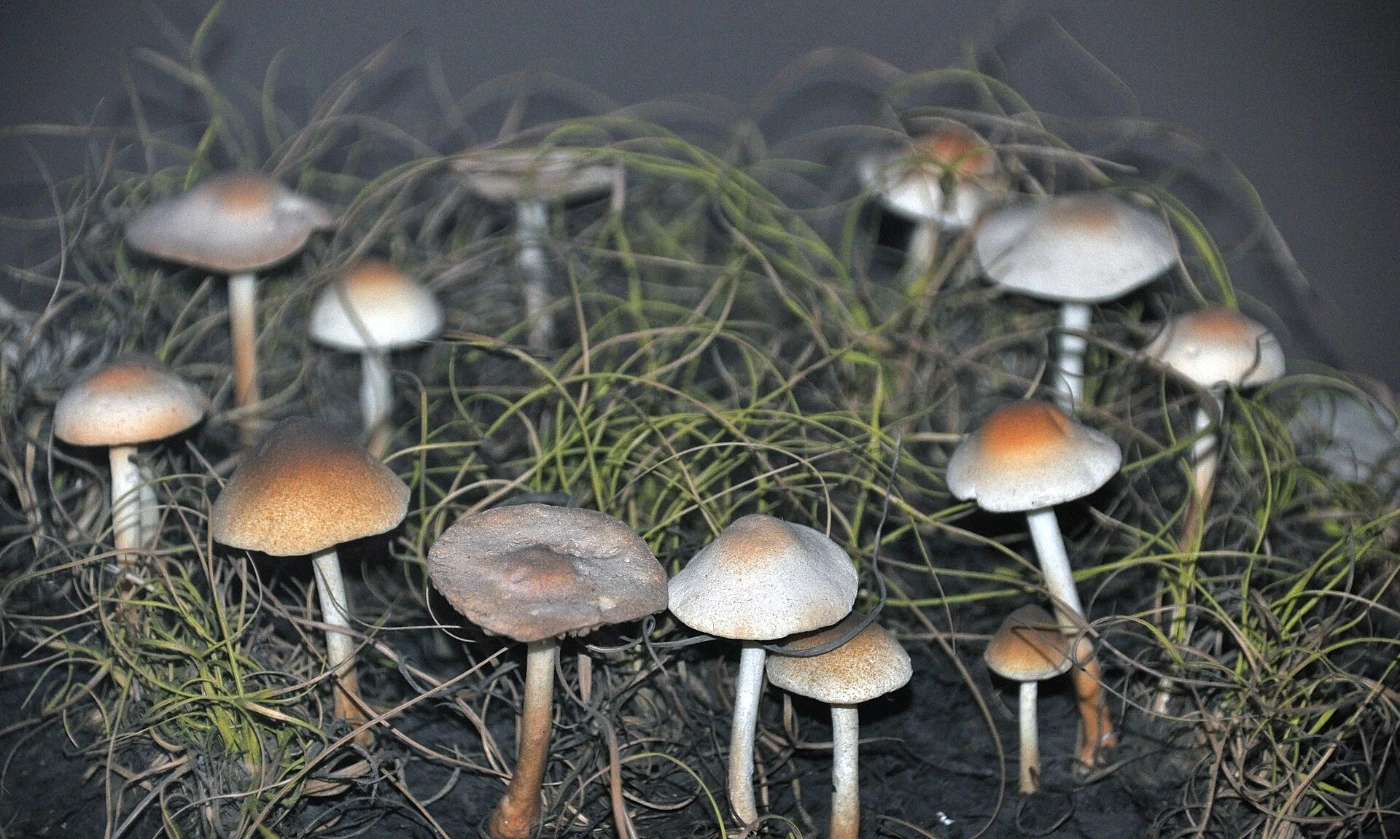
Marasmius oreades commonly grows in lawns, parks, and grassy fields and often forms fairy rings.
The cap is tan to buff rather than chalky white, and the gills are relatively widely spaced rather than crowded.
Its stem is tough and flexible compared with the more fragile construction of Fool’s Funnel.
Main Difference
Widely spaced gills + tough flexible stem + tan cap favor Marasmius oreades. Crowded pale gills + softer white stem favor Fool’s Funnel.
This is an important grassland comparison because both species can occur in the same general habitats.
Clitocybe dealbata — Ivory Funnel
Identification
Clitocybe dealbata, commonly called the Ivory Funnel, is extremely similar in appearance and has also been associated with muscarine poisoning.
It typically has a pale ivory or white cap and grows in grassland.
Main Difference
The distinction is difficult and has historically been interpreted differently by different authors.
From a safety perspective, this distinction is not important because both should be treated as poisonous white funnel mushrooms.
Other Pale Funnel Mushrooms
Identification
Several small pale mushrooms can produce funnel-shaped caps and decurrent gills.
Differences may involve cap texture, odor, habitat, spore dimensions, and microscopic features.
Main Difference
There is no universal visual shortcut. Small pale funnel mushrooms should not be collected for food unless the species is confidently identified.
Fool’s Funnel vs St George’s Mushroom
| Feature | Fool’s Funnel | St George’s Mushroom |
|---|---|---|
| Scientific name | Clitocybe rivulosa | Calocybe gambosa |
| Cap | White to cream | Cream to buff-white |
| Size | Small | Usually larger and sturdier |
| Gills | Crowded, slightly decurrent | Crowded |
| Flesh | Thin | Thick |
| Odor | Weak / sweetish | Strongly mealy |
| Main season | Summer–autumn | Spring |
| Toxicity | Poisonous | Edible when correctly identified |
| Best clue | Small summer/autumn funnel | Robust spring mushroom |
Season is one of the strongest practical differences.
Fool’s Funnel vs Fairy Ring Mushroom
| Feature | Fool’s Funnel | Fairy Ring Mushroom |
|---|---|---|
| Scientific name | Clitocybe rivulosa | Marasmius oreades |
| Cap | White / cream | Buff / tan |
| Gills | Crowded | Widely spaced |
| Stem | Softer | Tough and flexible |
| Habitat | Grassland | Grassland |
| Fairy rings | Possible | Very common |
| Spore print | White | White |
| Edibility | Poisonous | Edible when correctly identified |
| Best clue | Crowded pale gills | Tough stem + distant gills |
Do not rely on ring formation alone because several grassland fungi can grow in arcs or circles.
Why Grassland Identification Is Difficult
Grasslands can contain many unrelated mushrooms fruiting in close proximity.
A collector searching for one edible species may accidentally pick a small white mushroom growing only a few centimeters away.
This is particularly dangerous with Fool’s Funnel because it does not have an obvious warning color or unusual odor.
Fairy Rings Are Not an Edibility Test
The presence of a fairy ring does not indicate that a mushroom is edible.
Many fungal species can produce expanding rings or arcs as underground mycelium grows outward through soil.
Fool’s Funnel and other poisonous mushrooms can occur in patterns that resemble those of edible grassland species.
White Mushrooms Are Not Automatically Dangerous
White coloration alone also does not establish toxicity.
Many edible mushrooms are pale, and many dangerous mushrooms are brown, orange, red, or other colors.
The useful safety rule is not “avoid all white mushrooms” but rather do not eat an unidentified pale grassland mushroom.
Young vs Mature Specimens
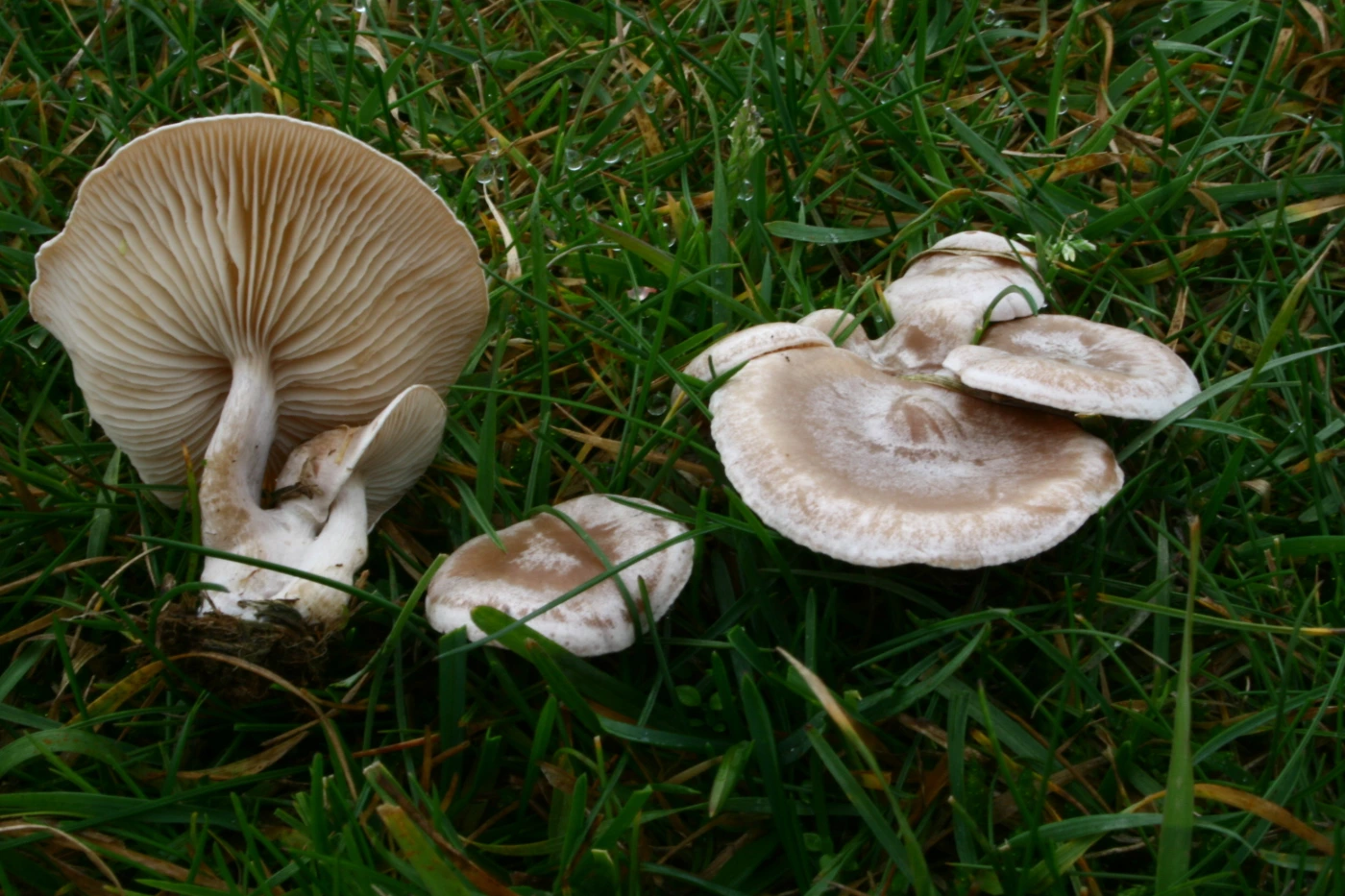
Young Fool’s Funnels are usually convex and can look less funnel-shaped than the name suggests.
As they mature, the cap flattens and develops a shallow central depression. The margin can become irregular or wavy.
Older specimens may also become buff-colored and less obviously white.
This age-related change can make the species harder to recognize from a single photograph.
Common Identification Mistakes
One common mistake is expecting Fool’s Funnel always to have a deep funnel-shaped cap. Young specimens can be almost flat or convex.
Another mistake is assuming a mushroom growing in a fairy ring must be Marasmius oreades. Growth pattern alone is not diagnostic.
A third mistake is using spring Calocybe gambosa characteristics on autumn mushrooms without considering season.
A fourth mistake is treating C. rivulosa and C. dealbata as completely safe to separate visually. Their taxonomy and morphology are sufficiently confusing that uncertainty should be handled conservatively.
How to Photograph Fool’s Funnel
Start with a habitat photograph showing the mushroom in grass. Include the surrounding growth pattern if several fruit bodies are present.
Then photograph the cap from above, the gills from below, and the complete stem including the base.
A side view is especially useful because it shows whether the gills run down the stem and whether the cap has developed a central depression.
Can AI Identify Clitocybe rivulosa?
AI can often recognize a small white grassland funnel as belonging to a Clitocybe-type group.
Species-level identification is much more difficult because several pale grassland mushrooms overlap strongly in appearance.
An AI result should therefore never be used to decide that a small pale lawn mushroom is edible.
When toxicity is possible, identification should be treated conservatively.
Taxonomic Update: Collybia rivulosa
Recent molecular work has reorganized parts of the traditional genus Clitocybe.
Species Fungorum currently lists Collybia rivulosa as the accepted name for this species and treats Clitocybe rivulosa as a synonym.
This change may take years to become standard in field guides and public-health literature.
For now, both names are useful:
Clitocybe rivulosa — traditional and widely recognized name
Collybia rivulosa — current Species Fungorum treatment
Interesting Facts
The common name Fool’s Funnel reflects both the mushroom’s funnel-like shape and its dangerous potential to deceive collectors.
Another historical English name is Cracking Clitocybe, referring to the cap surface, which can crack under dry conditions.
The species is also a useful example of why mushroom common names and scientific names do not always change at the same speed. While the accepted genus has recently shifted to Collybia in Species Fungorum, Fool’s Funnel remains the familiar English name.
Muscarine was originally discovered in Amanita muscaria, but that mushroom actually contains relatively little compared with some Clitocybe and Inocybe species. The toxin’s name therefore does not indicate which mushrooms pose the greatest muscarine risk.
Frequently Asked Questions
What is the common name of Clitocybe rivulosa?
The accepted English common name is Fool’s Funnel. Cracking Clitocybe is another historical name.
Is Clitocybe rivulosa poisonous?
Yes. It contains muscarine and can cause significant autonomic and gastrointestinal poisoning.
What is the current scientific name?
Species Fungorum currently accepts Collybia rivulosa and treats Clitocybe rivulosa as a synonym.
Where does Fool’s Funnel grow?
It commonly grows in grasslands, lawns, parks, roadside verges, and coastal dune systems.
Does Fool’s Funnel grow in fairy rings?
It can occur in groups or arcs, and ring-like growth is possible. Fairy-ring formation is not an edibility test.
What color is the spore print?
The spore print is white.
How quickly can poisoning symptoms begin?
Muscarine symptoms may begin rapidly, often within about 15–30 minutes after ingestion.
What are the main symptoms?
Sweating, salivation, tearing, vomiting, diarrhea, abdominal cramps, low blood pressure, slow or irregular pulse, and breathing difficulty can occur.
Is there an antidote?
Atropine is the specific medical antidote for severe muscarinic poisoning, but it must be administered by healthcare professionals.
Can Fool’s Funnel be confused with edible mushrooms?
Yes. Pale grassland mushrooms such as St George’s Mushroom and Fairy Ring Mushroom can occur in similar habitats, although their structure and season differ.
Final Identification Notes
Clitocybe rivulosa, the Fool’s Funnel, is best recognized by the combination of a small white to cream cap, shallow funnel shape, crowded pale slightly decurrent gills, short ringless stem, white spore print, and grassland habitat.
Its major safety significance is muscarine poisoning, which can begin quickly and produce sweating, excessive salivation, vomiting, diarrhea, cardiovascular changes, and breathing problems.
The most useful practical identification pattern is: small pale grassland mushroom + crowded slightly descending gills + no ring + summer/autumn fruiting = consider Fool’s Funnel and do not eat it.
Under current Species Fungorum taxonomy, the species is treated as Collybia rivulosa, but Clitocybe rivulosa remains the most familiar name in field guides and poisoning literature.
Upload a photo and get possible matches in seconds.