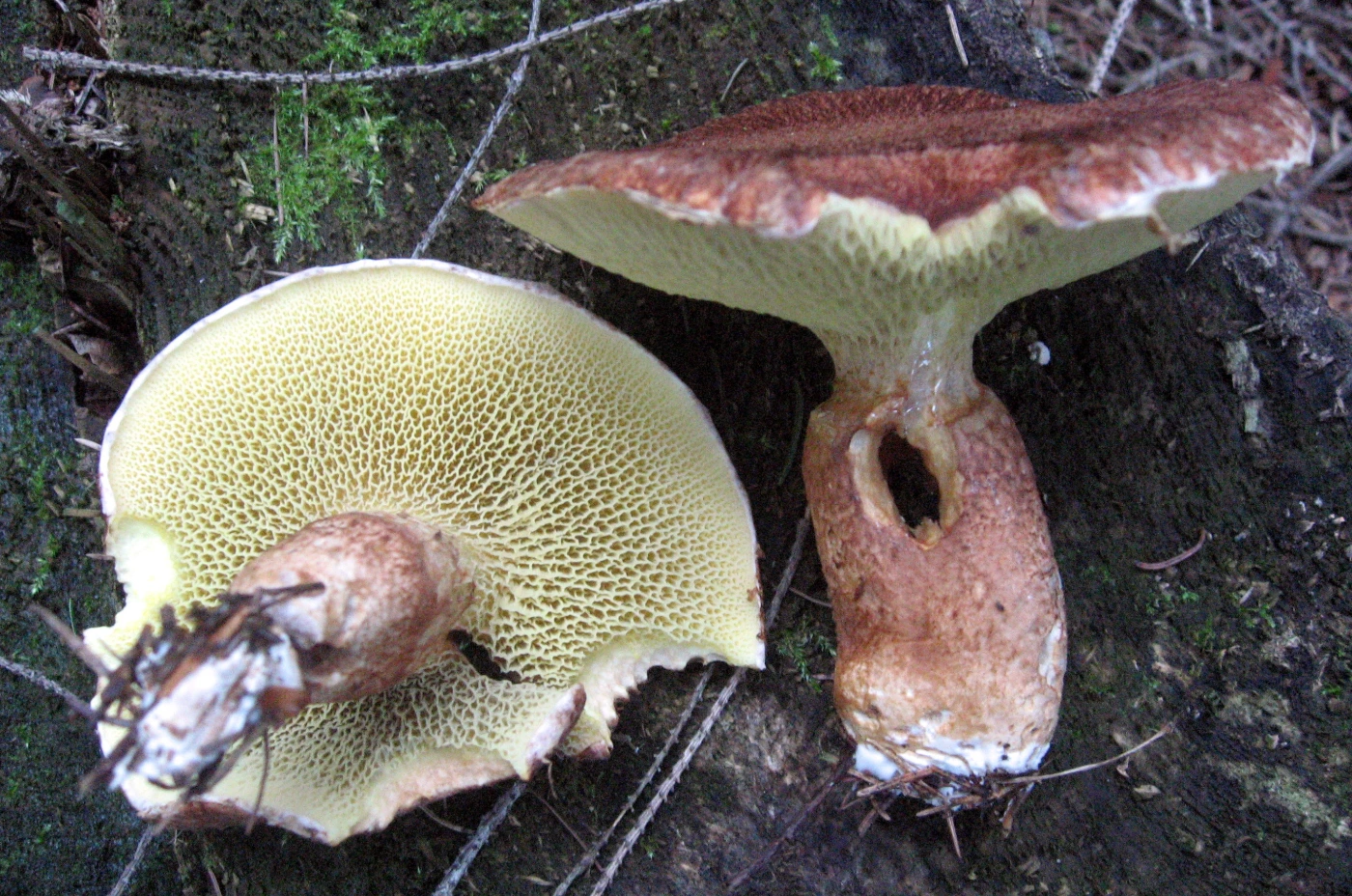
Suillus cavipes, commonly known as the Hollow Bolete or Hollow-Stalked Larch Suillus, is an unusual member of the genus Suillus associated with larch trees. Unlike the typically slimy species in this genus, it has a dry, fibrous to scaly cap and a stem that becomes hollow, especially in the lower half.
The most useful field pattern is dry reddish-brown scaly cap + large angular yellow pores + hollow stem + larch habitat. This combination makes S. cavipes distinctive once the mushroom is examined carefully.
Modern taxonomy adds an important geographic caution. The name Suillus cavipes is best applied to the Eurasian lineage, while similar North American mushrooms previously called S. cavipes are now generally treated as Suillus ampliporus.
⚠️ Important: Do not identify this mushroom from the hollow stem alone. Several larch-associated Suillus species can look similar, and geography is especially important because North American material historically called S. cavipes may actually be S. ampliporus.
Quick Identification
| Feature | Suillus cavipes |
|---|---|
| Common name | Hollow Bolete |
| Alternative common name | Hollow-Stalked Larch Suillus |
| Cap | Dry, fibrillose-scaly, rusty brown to reddish-brown |
| Cap size | Usually about 5–8 cm |
| Pores | Yellow, large, angular, sometimes compound |
| Tubes | Short, yellow, often decurrent |
| Stem | Pale above, darker below |
| Stem interior | Hollow or chambered |
| Ring | Fibrillose ring or ring zone |
| Flesh | Pale to yellowish |
| Bruising | Usually weak or insignificant |
| Spore print | Clay-brown |
| Ecology | Ectomycorrhizal |
| Main host | Larch (Larix) |
| Season | Summer to autumn |
| Distribution | Eurasia |
| Main look-alikes | Suillus grevillei, Suillus ampliporus, other larch-associated Suillus |
What Does Suillus cavipes Look Like?
Hollow Bolete is a medium-sized bolete with an appearance that differs noticeably from the stereotypical slimy Suillus. The cap is dry and fibrous rather than heavily glutinous, and the underside has conspicuously large, angular pores.
The stem is another major clue. As the mushroom matures, the lower portion of the stem becomes hollow or develops internal cavities, a feature reflected directly in the species name cavipes, meaning “hollow-footed” or “hollow-stemmed.”
Cap
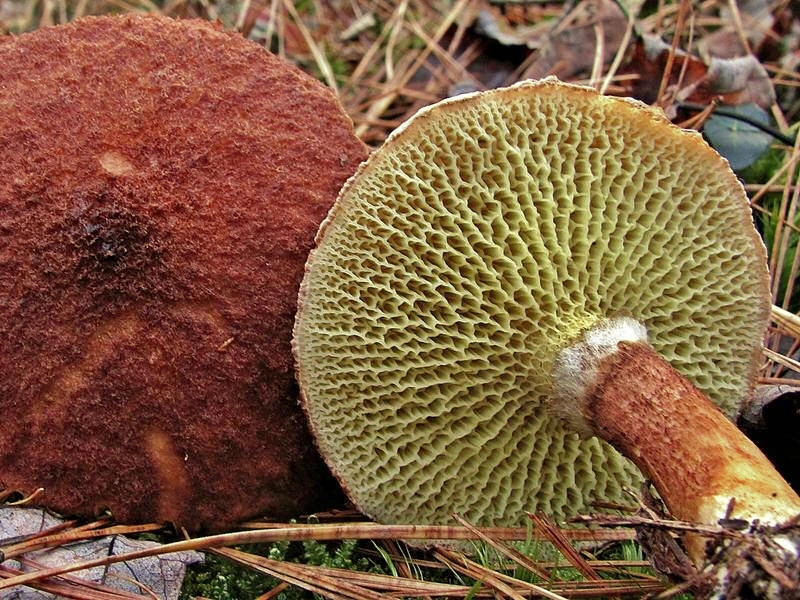
The cap is usually around 5–8 cm across when mature. It begins convex and later becomes more broadly convex or flatter.
Colors range from pale yellow-brown to rusty brown, reddish-brown, or darker chestnut tones. The surface is covered with fibrous scales or fibrillose patches rather than a thick slime layer.
This dry surface is one of the most useful ways to separate S. cavipes from many other Suillus. First Nature specifically notes that the species is much less slimy than typical members of the genus.
Pores
The pore surface is yellow when young. The pores are large, angular, and often compound or elongated rather than small and round.
This can give the underside a somewhat radial or maze-like appearance. In bolete terminology, this kind of pore arrangement is often described as boletinoid.
The pore surface usually does not show dramatic blue bruising.
Tubes
The tubes are short and yellow. They often run slightly down the stem, producing a decurrent appearance.
This feature is useful because many other Suillus have pores that meet the stem more abruptly.
Stem
The stem is usually pale or yellowish toward the top and becomes browner or more similar to the cap color lower down.
A fibrous veil can leave a ring or ring zone around the stem. Below this zone, the surface is often more fibrillose.
The defining internal feature is the hollow or chambered stem.
Why the Stem Becomes Hollow
In young specimens, the stem may not appear completely empty. Cavities can develop progressively as the fruit body matures.
Sometimes only the lower stem is hollow, while older specimens can have a much more extensively hollow interior. First Nature specifically notes that at least the lower part, and often nearly the entire stem, contains cavities.
Cutting the mushroom vertically is therefore one of the most useful identification steps.
Ring and Veil
Young mushrooms possess a partial veil covering the pore surface. As the cap expands, this veil breaks.
Remnants can remain as a fibrous ring or ring zone on the stem. Unlike the thick membranous ring of Suillus luteus, the structure may appear rather delicate.
Old specimens can lose much of this evidence, so young mushrooms are easier to identify.
Flesh
The flesh is pale to yellowish and relatively thin compared with some robust boletes. It generally does not undergo dramatic color changes when cut.
The lack of strong blue staining is useful when comparing it with unrelated boletes, but it is not enough for species-level identification.
Spore Print
The spore print is clay-brown to brownish. First Nature describes it as clay brown.
The spores are smooth, ellipsoid to subfusiform, typically around 7–10.5 × 3.5–4.5 µm.
Where Does Suillus cavipes Grow?
Suillus cavipes is an ectomycorrhizal fungus associated with larch trees in the genus Larix. This host relationship is one of the strongest identification characters.
The mushroom grows on soil beneath larch rather than directly from dead wood. It may appear singly, scattered, or in small groups.
In Britain and Ireland it is considered uncommon, while it is more frequent in parts of central Europe where suitable larch habitat is widespread.
Why Larch Is So Important
Many Suillus species show strong host specificity. For S. cavipes, finding the correct tree is often just as informative as examining the mushroom itself.
A dry, scaly, hollow-stemmed bolete beneath larch is a strong candidate. The same mushroom beneath pine, spruce, or a broadleaf tree should be approached much more cautiously.
Always confirm the host when possible.
Season
Hollow Bolete usually fruits from summer into autumn. In Britain and Ireland, records are concentrated roughly from August to October.
The exact timing depends on rainfall, temperature, altitude, and local larch distribution.
Distribution
In modern usage, Suillus cavipes is best treated as a Eurasian species complex centered in Europe and parts of Asia.
This point matters because older North American field guides frequently used the same name for morphologically similar larch-associated mushrooms.
Molecular work published in 2016 showed that the North American lineage is distinct and should use the name Suillus ampliporus.
Taxonomy
Index Fungorum currently lists Suillus cavipes (Klotzsch) A.H. Sm. & Thiers as the current name. The basionym is Boletus cavipes Klotzsch.
The species has also been placed historically in the genus Boletinus as Boletinus cavipes. Modern treatments generally retain it within Suillus, although the old genus name still appears frequently in older literature.
A 2025 multigene revision of Suillus continues to recognize the cavipes complex within the broader Boletinus-type lineage of Suillus.
Why North American Suillus cavipes Became Suillus ampliporus
For many years, similar larch-associated mushrooms on both sides of the Atlantic were called S. cavipes.
DNA analysis demonstrated that North American and Eurasian populations form separate lineages. Since S. cavipes was originally described from Europe, that name belongs to the Eurasian taxon.
The older available name Suillus ampliporus is therefore used for the North American lineage.
This distinction is especially important for identification websites because older photographs and occurrence records may still use the obsolete broader concept.
Is Suillus cavipes Edible?
Hollow Bolete has traditionally been reported as edible when thoroughly cooked, but it is generally not considered a high-quality culinary species.
The flesh is relatively thin, and older specimens can become soft or less appealing. First Nature also notes that the species is rare in Britain and should not be collected there for food.
As with other Suillus, individual gastrointestinal intolerance is possible. An uncertain identification should never be used as a basis for eating a wild specimen.
Look-Alikes
The most important look-alikes are other Suillus growing with larch. Cap texture, pore shape, ring structure, stem interior, and geography provide the strongest differences.
Suillus grevillei — Larch Bolete
Identification
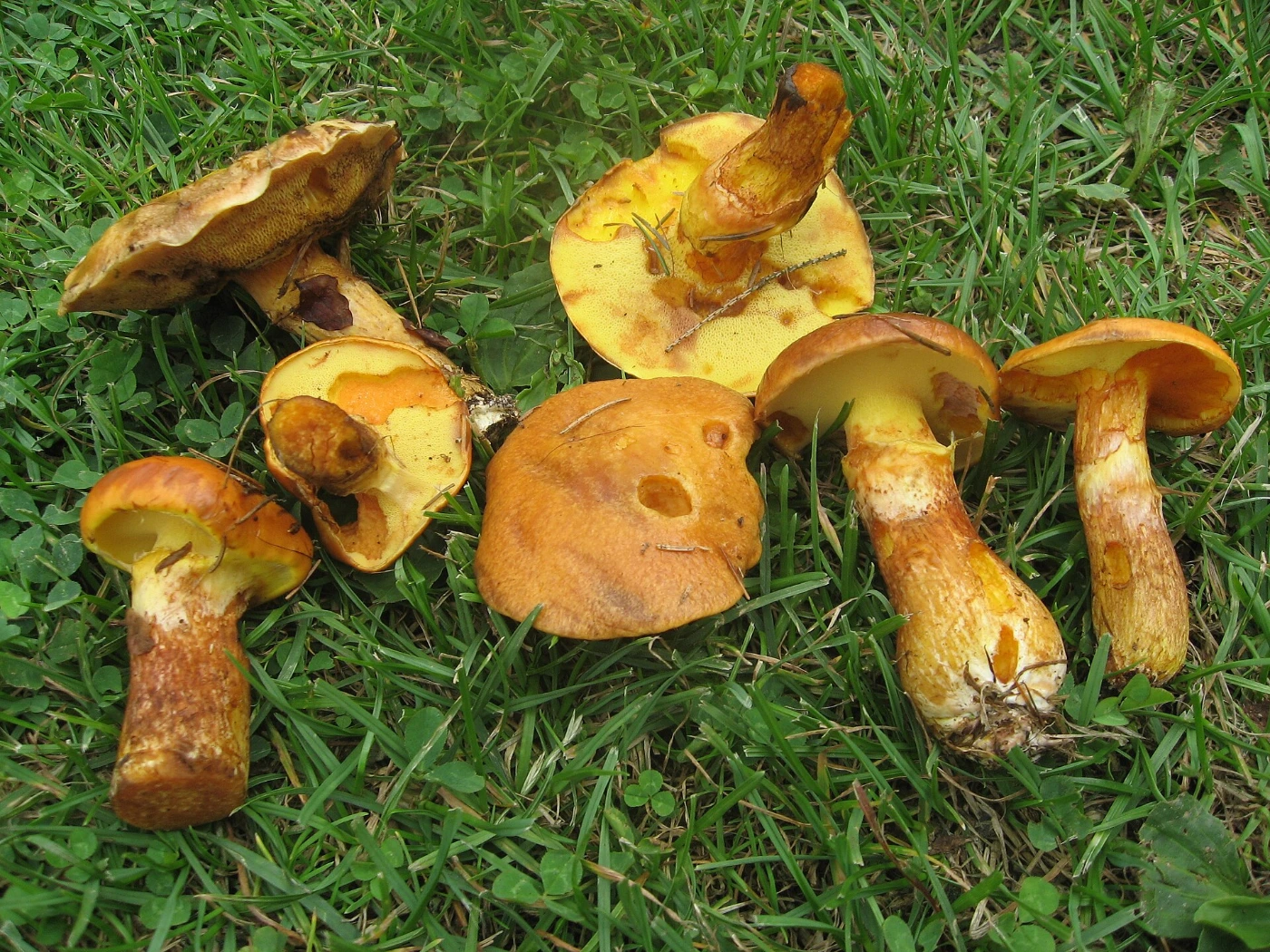
Suillus grevillei is one of the best-known larch-associated Suillus. It commonly has a yellow, golden-orange, or reddish-orange cap with bright yellow pores.
Unlike S. cavipes, the cap is typically distinctly slimy or sticky when wet. It also has a veil that leaves a ring zone on the stem.
Main Difference
Dry scaly cap + hollow stem favor Suillus cavipes. Slimy orange-yellow cap + solid stem favor Suillus grevillei.
Both grow with larch, so host tree alone cannot separate them.
Suillus ampliporus – Western Hollow Jack
Identification
Suillus ampliporus is the North American counterpart historically confused with S. cavipes. It also has a dry fibrous cap, large angular pores, a hollow stem, and an association with larch.
Morphologically, the two can be extremely difficult to distinguish.
Main Difference
The strongest practical distinction is geography.
Eurasia → favors Suillus cavipes.
North America → favors Suillus ampliporus.
Modern molecular work supports this separation.
Other Larch-Associated Suillus
Identification
Several other Suillus species form mycorrhizae with larch. They may share yellow pores, a partial veil, and similar overall proportions.
Some have more strongly slimy caps, others lack a hollow stem, and some have distinctive glandular dots or color reactions.
Main Difference
The combination dry fibrillose cap + large angular pores + hollow stem is much more characteristic of the cavipes group than of typical Suillus.
Suillus cavipes vs Suillus grevillei
| Feature | S. cavipes | S. grevillei |
|---|---|---|
| Common name | Hollow Bolete | Larch Bolete |
| Cap surface | Dry, fibrillose-scaly | Slimy / sticky |
| Cap color | Rusty brown to reddish-brown | Yellow to orange |
| Pores | Large, angular | Angular, yellow |
| Stem | Hollow / chambered | Usually solid |
| Ring | Fibrous | More evident ring zone |
| Main host | Larch | Larch |
| Best clue | Hollow stem | Slimy cap |
This is one of the most useful field comparisons because both species can occur beneath the same trees.
Suillus cavipes vs Suillus ampliporus
| Feature | S. cavipes | S. ampliporus |
|---|---|---|
| Cap | Dry, fibrous-scaly | Dry, fibrous-scaly |
| Pores | Large and angular | Large and angular |
| Stem | Hollow | Hollow |
| Host | Larch | Larch |
| Main range | Eurasia | North America |
| Historical name | S. cavipes | Often misnamed S. cavipes |
| Best clue | Geography | Geography |
Photographs alone may not reliably separate these species.
Why the Cap Is Unusual for Suillus
Most people associate Suillus with slippery or glutinous caps. Species such as S. luteus and S. grevillei fit that pattern well.
Suillus cavipes is different. Its cap is dry and fibrillose, which historically contributed to its placement in the separate genus Boletinus.
Modern phylogenetic work nevertheless places these dry-capped fungi within the broader evolutionary radiation of Suillus.
Why the Pores Look Different
The large angular pores are another unusual feature. They can be elongated radially and may look partly maze-like.
This structure is often described as boletinoid. It is particularly characteristic of the old Boletinus-type species within Suillus.
A close photograph of the pore surface is therefore especially valuable for identification.
Young vs Mature Specimens
Young specimens may have a more intact veil and a stem that is not yet obviously hollow. The cap is also more strongly convex.
As the mushroom expands, the veil tears, the pores become more exposed, and cavities inside the stem become easier to see.
Older caps can fade and the fibrous surface may become less distinct. A vertical section through a fresh mature specimen usually provides the strongest evidence.
Common Identification Mistakes
One common mistake is assuming that every larch-associated Suillus is S. grevillei. Hollow Bolete differs strongly in cap texture and stem structure.
Another mistake is rejecting Suillus because the cap is dry. The cavipes group is genuinely dry-capped despite belonging to a genus famous for slimy mushrooms.
A third mistake is identifying North American collections as S. cavipes. Current molecular evidence favors S. ampliporus for that lineage.
A fourth mistake is looking only at the outside of the stem. The internal cavity is one of the species’ most useful characters and is easily missed unless the fruit body is cut lengthwise.
How to Photograph Suillus cavipes
Start with a habitat photograph showing both the mushroom and nearby larch trees. Include larch needles, cones, or branches if possible.
Then photograph the dry cap surface, pore layer, ring zone, and complete stem. A close-up of the large angular pores is especially useful.
Finally, cut the mushroom vertically and photograph the hollow or chambered stem. This image can provide stronger evidence than cap color alone.
Can AI Identify Suillus cavipes?
AI can often recognize a Suillus cavipes-type mushroom when the dry cap, angular pores, hollow stem, and larch habitat are all visible.
Accuracy drops sharply if only the top of the cap is photographed. Without geography, AI can also confuse Eurasian S. cavipes with North American S. ampliporus.
For this group, a good identification should include both the host tree and collection region.
Interesting Facts
The species name cavipes comes from Latin roots referring to a hollow foot or stem. It describes one of the mushroom’s most characteristic features.
The fungus was historically placed in Boletinus, a genus created for boletes with features such as dry fibrous caps and large radially arranged pores. Modern molecular work has largely brought these species back into Suillus.
The cavipes lineage is also a good example of how DNA has changed mushroom geography. Mushrooms once given the same name in Europe and North America are now recognized as separate evolutionary lineages.
Frequently Asked Questions
What is the common name of Suillus cavipes?
The most widely used English name is Hollow Bolete. Hollow-Stalked Larch Suillus is another established name.
Why is Suillus cavipes called Hollow Bolete?
The stem develops internal cavities and can become extensively hollow as the mushroom matures.
What tree does Suillus cavipes grow with?
It is strongly associated with larch trees in the genus Larix.
Does Suillus cavipes have a slimy cap?
Usually not. The cap is dry and fibrous to scaly, unlike many familiar Suillus species.
What color are the pores?
They are yellow and characteristically large and angular.
Does Suillus cavipes stain blue?
Strong blue staining is not a typical feature.
What is the difference between Suillus cavipes and Suillus grevillei?
Suillus cavipes has a dry scaly cap and hollow stem. S. grevillei generally has a slimy yellow-orange cap and a solid stem.
Does Suillus cavipes occur in North America?
Older sources often reported it there, but modern molecular work separates the North American lineage as Suillus ampliporus.
Is Suillus cavipes edible?
It has been reported as edible when thoroughly cooked, but it is not considered a particularly desirable species. Rare populations should not be collected for food.
Final Identification Notes
Suillus cavipes, the Hollow Bolete, is best recognized by the combination of a dry rusty-brown fibrillose cap, large angular yellow pores, a fibrous ring zone, a hollow or chambered stem, and a strong association with larch.
The most important European look-alike is Suillus grevillei, which shares the same host but typically has a slimy orange-yellow cap and a solid stem. In North America, a nearly identical mushroom should instead be considered Suillus ampliporus under current molecular taxonomy.
The practical identification pattern is: larch habitat + dry scaly cap + large angular pores + hollow stem = strong Suillus cavipes candidate in Eurasia.
Upload a photo and get possible matches in seconds.