Eating an unidentified or toxic bolete can cause nausea, vomiting, abdominal pain, diarrhea, sweating, weakness, and other symptoms depending on the species involved. Most reported bolete poisonings are dominated by gastrointestinal symptoms, but appearance alone cannot reliably predict how serious an exposure will become.
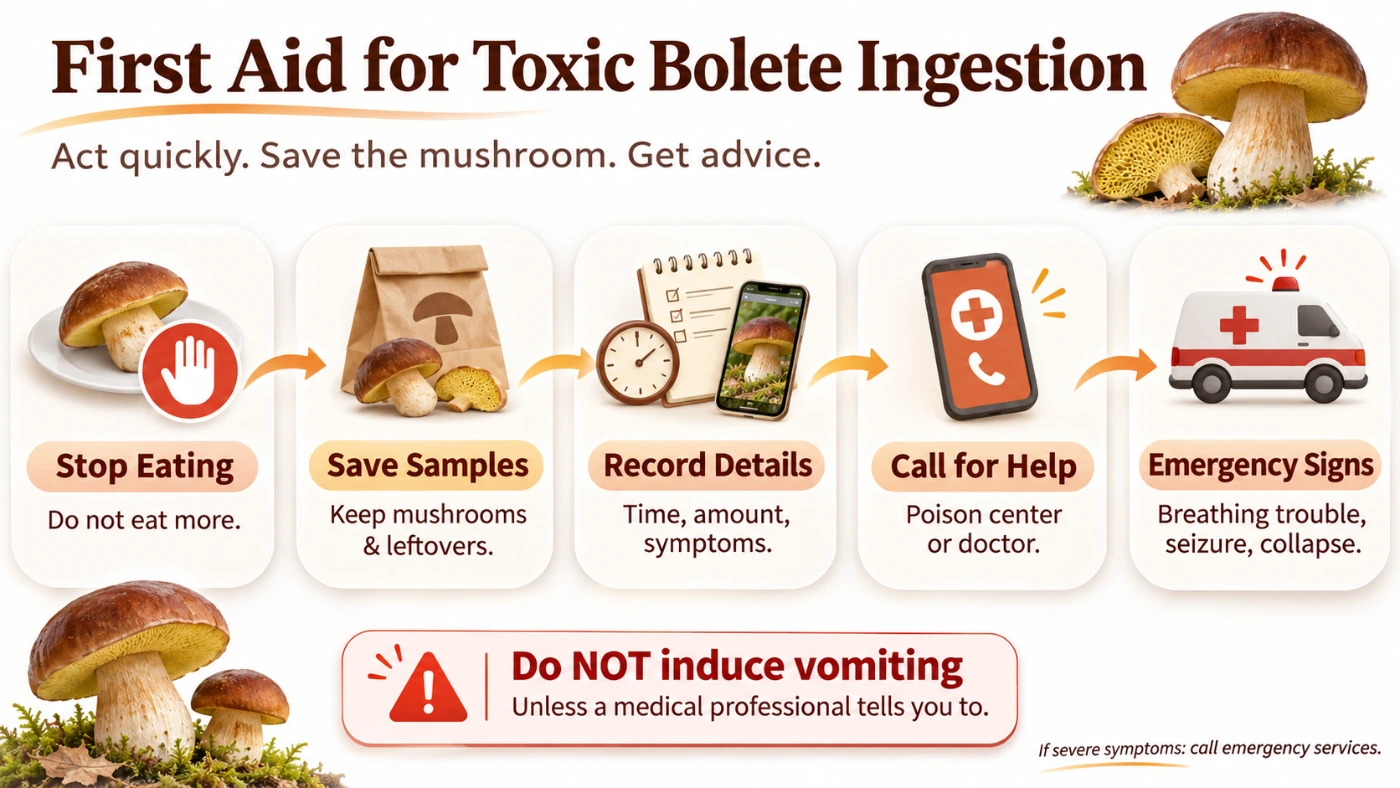
If you have eaten a suspected toxic bolete, the safest approach is to stop eating it, preserve any remaining mushroom material, record what happened, and contact a poison center or medical professional promptly. Do not wait for the mushroom to be identified before seeking advice.
⚠️ Important: Do not induce vomiting after eating a suspected poisonous mushroom unless a medical professional specifically instructs you to do so. Poison Control and modern poisoning guidelines no longer recommend deliberately causing vomiting after ingestion.
What to Do Immediately
Stop eating the mushrooms and remove the remaining food from the table so nobody else consumes it. If several people shared the meal, determine who ate the mushrooms and approximately how much each person consumed.
Contact your local poison center, medical service, or emergency department for case-specific advice. Mushroom poisonings can be difficult to evaluate from symptoms alone, and professional guidance is more useful than trying to identify a toxin from internet descriptions.
If you are in the United States, Poison Control can be reached at 1-800-222-1222. If the person collapses, develops a seizure, has difficulty breathing, or cannot be awakened, call emergency services immediately.
First Aid Checklist
- Stop eating the mushroom. Do not let anyone else eat the remaining portion.
- Contact a poison center or medical professional. Do not wait for symptoms to become severe.
- Keep mushroom samples and leftovers. They may be extremely useful for identification.
- Record the time and amount eaten. Also record when symptoms began.
- Take photographs. Photograph intact mushrooms, the underside, stem, cut flesh, and habitat if specimens remain.
- Follow professional instructions. Do not use home remedies or medications unless advised.
This information can help poison specialists distinguish a short-lived gastrointestinal reaction from a potentially more serious mushroom exposure.
Do Not Induce Vomiting
Do not attempt to make the person vomit using fingers, salt water, mustard, syrup of ipecac, or other home methods.
Modern poison-control guidance specifically advises against inducing vomiting after swallowed poisons. Vomiting can cause aspiration, additional injury, and other complications without reliably removing the toxin.
If vomiting occurs naturally, medical professionals may sometimes be able to use mushroom material in the vomit for identification. That does not mean vomiting should be deliberately triggered.
Save the Mushroom
Preserving the remaining mushroom can be one of the most useful things you do after seeking medical help.
Keep uncooked specimens, trimmings, cooked leftovers, or mushrooms collected from the same patch. The North American Mycological Association recommends placing mushroom material in a paper bag or waxed paper rather than plastic and refrigerating it until it can be examined.
Do not clean, peel, or discard diagnostic parts. The cap, pore surface, complete stem, stem base, and cut flesh can all contain important identification features.
Save the Meal as Well
If mushrooms were cooked with other ingredients, keep some of the prepared food. Do not throw away the pan contents simply because the mushrooms are no longer intact.
Fragments may still contain enough structure for an experienced identifier to recognize the genus or species group. The meal can also clarify whether several mushroom species were mixed together.
Mixed collections are particularly important because an apparently identifiable bolete does not prove that every mushroom in the meal belonged to the same species.
Take Photographs
If mushrooms remain at the collection site, photograph them before collecting additional specimens. Take both close-up and habitat photographs.
Useful images include the top of the cap, pore surface, entire stem, stem base, cut flesh, and any bruising or color changes. Also photograph nearby trees because many boletes are mycorrhizal and host association can strongly narrow the identification.
Photographs taken before cooking are much more useful than a picture of a prepared meal.
Record the Timeline
Write down when the mushrooms were eaten and when the first symptoms appeared. Do not rely on memory several hours later.
Also record approximately how much was eaten, whether the mushrooms were raw or cooked, how they were prepared, whether alcohol was consumed, and whether anyone else ate the same batch.
Clinicians use the timing and type of symptoms as part of their assessment because mushroom toxins produce different syndromes. Identification remains difficult, however, and treatment is often guided by symptoms rather than by a confirmed species name.
Common Symptoms After Toxic Bolete Ingestion
Many toxic or poorly tolerated boletes produce predominantly gastrointestinal symptoms. These can include nausea, repeated vomiting, abdominal cramps, and diarrhea.
Symptoms from gastrointestinal mushroom irritants frequently begin within a few hours. Severe vomiting and diarrhea can lead to dehydration and disturbances in electrolytes, sometimes requiring medical treatment.
Headache, weakness, dizziness, sweating, or other symptoms may also occur depending on the species and individual reaction.
When Symptoms Begin Quickly
Symptoms beginning soon after the meal often suggest a gastrointestinal irritant syndrome. NAMA describes many gastrointestinal mushroom poisonings as beginning approximately 20 minutes to four hours after ingestion.
That does not mean early-onset symptoms should simply be managed at home. Severe vomiting, diarrhea, dehydration, abnormal heart rate, confusion, breathing problems, or uncertainty about what was actually eaten still warrant professional assessment.
It is also possible for a mixed mushroom meal to contain more than one toxic species.
Delayed Symptoms Are More Concerning
Symptoms that begin many hours after a wild mushroom meal require particular caution.
Some of the most dangerous mushroom toxins outside the bolete group produce an initially symptom-free interval before serious gastrointestinal, liver, or kidney injury appears. Merck notes that delayed onset is generally more concerning than symptoms beginning within the first couple of hours, although timing alone cannot identify the toxin.
This matters because a mushroom thought to be a bolete may have been misidentified, or several species may have been cooked together.
Do not assume that delayed symptoms are harmless simply because the original collector believed every mushroom was a bolete.
When to Seek Emergency Care
Emergency medical assessment is warranted when symptoms are severe or progressing. This includes repeated vomiting that prevents fluid intake, severe diarrhea, fainting, confusion, seizures, breathing difficulty, abnormal consciousness, or signs of circulatory collapse.
A person who collapses, has a seizure, has trouble breathing, or cannot be awakened requires immediate emergency assistance. Poison Control explicitly recommends calling emergency services in these situations.
Children, older adults, and people with significant underlying medical conditions can become dehydrated more quickly and may require earlier assessment.
What About Red-Pored Boletes?
Red pores are a useful identification feature but are not a universal toxicity test. Some red-pored boletes are considered toxic or poorly tolerated, while others have different culinary histories.
Older toxicology references also associate certain red-pored bolete-type mushrooms with autonomic or gastrointestinal symptoms. Modern taxonomy has divided many fungi once called Boletus among genera such as Rubroboletus, Neoboletus, and Suillellus, so old poisoning reports may use outdated names.
The practical rule after ingestion is therefore not “red pores mean poison.” The correct response is to identify the actual mushroom while medical evaluation proceeds independently.
Rubroboletus satanas and Similar Boletes
Satanas-type boletes are among the best-known toxic bolete look-alikes in Europe. They typically have pale caps, yellow to red pores, stout stems with red coloration, and flesh that may stain blue when damaged.
Poisoning is primarily associated with gastrointestinal illness rather than the delayed liver failure characteristic of amatoxin-containing Amanitas.
This distinction is useful medically, but it should never be used to reassure someone solely from a photograph. Several large red-pored boletes resemble one another, and regional taxonomy is complex.
Blue Bruising Does Not Measure Toxicity
Blue staining is an oxidation reaction found in many bolete species. Some edible boletes blue dramatically, while some toxic species blue weakly or not at all.
The intensity or speed of blue staining therefore does not tell you whether someone needs medical attention.
Blueing remains useful for mushroom identification, but it should never be used as a first-aid decision rule.
Cooking Does Not Guarantee Safety
Cooking an unidentified bolete does not automatically make it safe. Different mushroom toxins have different chemical properties, and some adverse reactions occur even after mushrooms have been thoroughly cooked.
Poison Control warns more generally that cooking should not be regarded as a method for making poisonous wild mushrooms safe.
The same applies to boiling and discarding the water, drying, freezing, pickling, or repeatedly reheating an unknown mushroom.
Do Not Use Folk Poison Tests
Silver spoons, garlic, onions, rice, insects, milk, cap color, blue bruising, and whether an animal has eaten the mushroom are not reliable tests of edibility.
Different organisms respond differently to mushroom compounds, and appearance does not provide a universal toxicity signal.
A bolete that looks familiar can still be misidentified, especially when old, damaged, immature, or collected outside the region covered by the field guide being used.
Should You Take Activated Charcoal?
Do not take activated charcoal automatically after a mushroom exposure unless a poison specialist or medical professional advises it.
Activated charcoal is used in selected poisoning situations, and Merck notes that it may sometimes be useful for mushroom poisoning. Whether it is appropriate depends on the circumstances, timing, symptoms, and patient.
It is not a substitute for poison-center consultation or medical assessment.
Should You Drink Large Amounts of Water?
Do not force large volumes of water in an attempt to “flush out” mushroom toxins. Severe nausea and vomiting can make this ineffective or unsafe.
Fluid and electrolyte replacement can be important when gastrointestinal poisoning causes substantial losses, but the appropriate amount and route depend on the severity of the illness. Severe dehydration may require intravenous treatment.
Follow the advice of a poison center or clinician rather than attempting aggressive home treatment.
Why Exact Identification Still Matters
Medical treatment often begins before an exact species identification is available. Nevertheless, identifying the mushroom can help determine what complications clinicians should anticipate.
NAMA recommends obtaining specimens from the same location when possible after medical help has been secured. Specialist mushroom identifiers can sometimes assist poison centers and medical teams in emergency cases.
Do not delay medical care while attempting to obtain a perfect identification.
What Information Helps a Mushroom Identifier?
Useful information includes the collection location, nearby trees, substrate, cap appearance, pore color, stem markings, bruising reaction, smell, and photographs of intact mushrooms.
Also explain whether every mushroom in the basket looked identical. A mixed collection can change the interpretation of the entire poisoning event.
If the mushroom was identified by an app or AI before it was eaten, provide that result to the specialist but clearly state that it was an automated identification rather than an expert confirmation.
Can AI Identify the Mushroom After Poisoning?
AI can help narrow a specimen to a probable genus or species group when good photographs are available. It should not be used as the sole basis for deciding that medical evaluation is unnecessary.
Once ingestion has occurred, the standard of certainty changes. An uncertain image match should be treated as uncertain, and professional medical advice should take priority over app-based identification.
For emergency identification, photographs and specimens should ideally be reviewed by an experienced mycologist familiar with the local region.
What If No Symptoms Have Appeared?
Do not assume that a mushroom was safe simply because the person currently feels well.
Some mushroom poisoning syndromes have delayed onset, and an incorrect initial identification is always possible. Poison Control recommends seeking expert advice after a suspected poison exposure rather than waiting until symptoms develop.
The appropriate observation period and need for medical evaluation depend on what was eaten, how much, when it was eaten, and the person’s condition.
What If Everyone Else Feels Fine?
Different people can experience different effects after eating the same mushroom meal. Portion size, individual sensitivity, age, existing illness, and which mushroom fragments each person received may all differ.
One person remaining symptom-free therefore does not prove the batch was safe.
Anyone who ate the suspected mushrooms should be mentioned when speaking with the poison center or healthcare provider.
Pets and Toxic Boletes
Dogs can eat mushrooms growing in gardens, parks, and forests before owners have time to identify them. The same general principle applies: contact a veterinarian or veterinary poison service promptly rather than waiting for symptoms.
Keep a sample of the mushroom and take photographs of the specimens and location. Do not induce vomiting unless a veterinary professional specifically instructs you to do so.
Human poison-center instructions should not automatically be applied to animals because treatment protocols can differ.
How to Prevent a Second Exposure
Do not eat additional mushrooms from the same collection until every specimen has been reviewed. Throwing out only the one mushroom believed to be responsible is not enough if identification was uncertain.
Photograph each species separately during future foraging and keep unknown mushrooms away from edible collections.
When trying a correctly identified edible wild mushroom for the first time, eating a modest portion is also more sensible than consuming a large meal, because individual intolerance can occur even with species generally regarded as edible.
Frequently Asked Questions
What should I do first after eating a toxic bolete?
Stop eating the mushroom and contact a poison center or medical professional. Preserve remaining mushrooms and record when and approximately how much was eaten.
Should I make myself vomit?
No. Current poison-control guidance advises against deliberately inducing vomiting after ingestion unless a medical professional specifically directs you to do so.
What are the most common symptoms of toxic bolete poisoning?
Nausea, vomiting, abdominal cramps, and diarrhea are among the most common symptoms. Severe gastrointestinal illness can cause significant dehydration and electrolyte loss.
How long after eating a toxic bolete do symptoms begin?
Many gastrointestinal mushroom poisonings begin within several hours, but timing varies by species and toxin. Delayed symptoms deserve particular caution because the mushroom may have been misidentified or another species may have been present.
Does blue bruising mean the bolete is poisonous?
No. Blue bruising is an identification characteristic, not a toxicity test.
Are all red-pored boletes poisonous?
No. Red pore color alone does not determine toxicity, although several problematic bolete species have red or orange-red pores.
Can cooking destroy bolete toxins?
Cooking should not be assumed to make an unidentified toxic mushroom safe. The effect of heat varies between compounds and species.
Should I keep the mushroom after poisoning?
Yes. Keep intact specimens, trimmings, and cooked leftovers when possible because they may help an expert identify what was eaten. NAMA recommends storing mushroom samples in paper or waxed paper and refrigerating them.
Can I wait to see whether symptoms appear?
It is safer to obtain poison-center or medical advice after a suspected toxic mushroom exposure rather than deciding on your own to wait. Some serious mushroom syndromes can have delayed symptoms.
Final Notes
First aid after suspected toxic bolete ingestion is primarily about getting professional advice quickly and preserving useful evidence, not attempting to neutralize the mushroom at home.
Stop eating the mushroom, keep specimens and leftovers, photograph the mushrooms and habitat, record the amount and timing, and contact a poison center or healthcare provider. Do not induce vomiting, do not rely on folk antidotes, and do not assume cooking, blue bruising, pore color, or an AI identification can establish that an exposure is harmless.
Most toxic bolete reactions are dominated by gastrointestinal symptoms, but an unidentified mushroom meal should never be evaluated on that assumption alone. Mixed collections and mistaken identifications can expose a person to entirely different toxin syndromes, which is why medical assessment and expert identification should proceed separately.
Upload a photo and get possible matches in seconds.