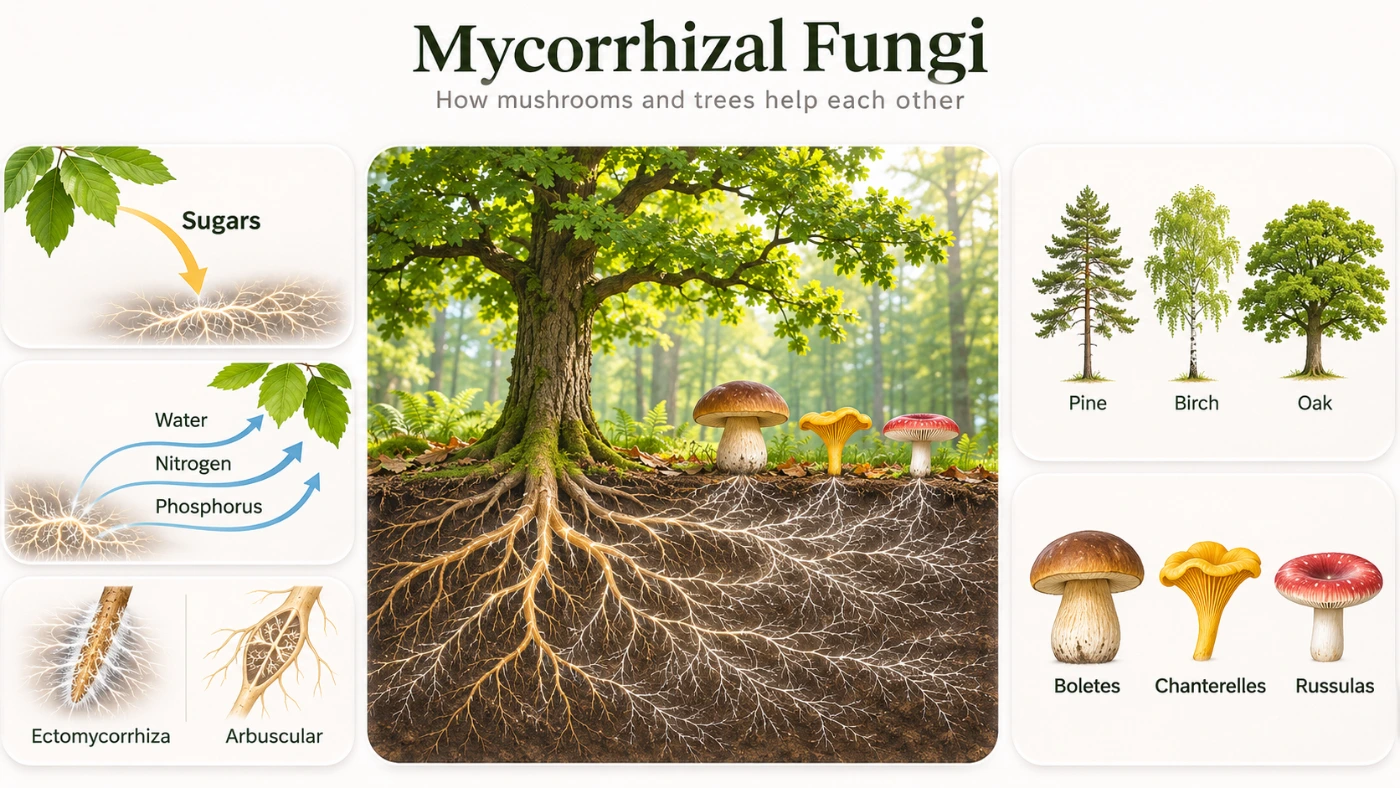
Many familiar forest mushrooms do not simply grow beneath trees by coincidence. Porcini, chanterelles, Amanitas, Russulas, milkcaps, Suillus, and many other fungi live in close partnerships with the roots of living plants.
This relationship is called mycorrhiza. The fungus extends far beyond the tree’s own fine roots and helps collect minerals and water from the soil, while the plant supplies the fungus with carbon-rich compounds produced through photosynthesis.
Mycorrhizal relationships are among the most important biological partnerships on land. Scientific reviews estimate that the great majority of land plants participate in some form of mycorrhizal association, although the type of partnership differs greatly between forests, grasslands, agricultural plants, orchids, and heathland vegetation.
⚠️ Important: Finding a mushroom beneath a particular tree does not automatically prove a mycorrhizal partnership. Some fungi grow from buried wood, dead roots, or organic debris, so substrate and other identification features must still be checked.
What Is Mycorrhiza?
The word mycorrhiza comes from words meaning “fungus” and “root.” Strictly speaking, mycorrhiza is not the fungus itself but the symbiotic association formed between fungal tissue and a plant root.
The fungus colonizes the root system and sends microscopic hyphae outward through the surrounding soil. These threads reach areas that the plant’s own roots cannot explore efficiently.
At the same time, specialized contact zones form between the fungus and the plant. These interfaces allow nutrients and carbon compounds to move between the two partners.
What Does the Fungus Give the Plant?
Fungal hyphae are much thinner than plant roots and can explore tiny pores in soil. This greatly increases the effective area from which the plant can obtain nutrients.
Phosphorus and nitrogen are among the most important resources supplied through many mycorrhizal systems. Fungal networks can also contribute to uptake of water and other mineral nutrients, especially where soil resources are difficult for roots to access.
The relationship can therefore be particularly valuable in nutrient-poor forest soils. Instead of relying only on its own root system, a tree gains access to a much larger underground collecting network.
What Does the Plant Give the Fungus?
Fungi cannot photosynthesize. Mycorrhizal fungi therefore depend heavily on plants for energy-rich carbon compounds.
The plant produces carbon through photosynthesis and transfers part of it to its fungal partner. In arbuscular mycorrhiza, research has shown that both sugars and plant-derived lipids are important components of this exchange.
This is not simply the fungus stealing food from the tree. In a functioning mycorrhizal relationship, both partners exchange resources that are difficult for the other to obtain efficiently.
A Simple Mycorrhizal Exchange
| Plant provides | Fungus provides |
|---|---|
| Photosynthesis-derived carbon | Phosphorus |
| Sugars and other carbon compounds | Nitrogen |
| Lipids in some mycorrhizal systems | Access to a larger soil volume |
| A living root habitat | Improved mineral acquisition |
| Long-term energy source | Water acquisition in some conditions |
The exact exchange varies between fungal groups, host plants, soils, and environmental conditions. Mycorrhiza should therefore be understood as a family of related symbioses rather than one identical process occurring everywhere.
The Underground Mycelium
The mushroom visible above the soil is only the reproductive structure of the fungus. Most of the organism exists underground as microscopic threads called hyphae, which together form the mycelium.
In a mycorrhizal fungus, this mycelium grows around or within plant roots and also spreads outward through the surrounding soil. A fruiting body may therefore appear several feet or meters from the trunk of its host tree.
This is why identifying the nearest tree is useful but not always sufficient. The actual root system associated with the fungus can extend well beyond the visible canopy.
Ectomycorrhiza vs Arbuscular Mycorrhiza
Two major forms are especially important: ectomycorrhiza and arbuscular mycorrhiza. Their basic purpose is similar, but they interact with plant roots in different ways.
Ectomycorrhizal fungi are particularly important for mushroom identification because many of the large forest mushrooms people collect belong to this group. Arbuscular mycorrhizal fungi are even more widespread among plants but generally do not produce the familiar large mushrooms seen in woodland.
What Is Ectomycorrhiza?
In an ectomycorrhizal relationship, fungal hyphae form a mantle around fine root tips. Hyphae also grow between root cells, creating a structure known as the Hartig net, where exchange between fungus and plant occurs.
The fungus does not normally penetrate deeply into the plant cells themselves. Instead, it creates an extensive interface around and between the cells.
Ectomycorrhizal fungi are especially associated with forest trees such as pines, spruces, firs, birches, oaks, beeches, willows, and many other woody plants.
Familiar Ectomycorrhizal Mushroom Genera
Many major mushroom genera are ectomycorrhizal. These include Boletus, Suillus, Leccinum, Amanita, Russula, Lactarius, Cortinarius, Tricholoma, Cantharellus, and Craterellus.
This explains why tree association appears so frequently in mushroom identification guides. A bolete under pine and a superficially similar bolete under oak may represent completely different species.
Host association is therefore not just ecological trivia. In many groups, it is one of the strongest identification characters available in the field.
What Is Arbuscular Mycorrhiza?
Arbuscular mycorrhizal fungi interact with roots differently. Their hyphae enter the root cortex and form highly branched structures called arbuscules inside root cells.
These structures create a large surface area for nutrient exchange without simply destroying the plant cell. They act as specialized interfaces through which mineral nutrients move toward the plant and carbon moves toward the fungus.
Arbuscular mycorrhiza is extremely widespread among land plants and is especially important in grasslands, agriculture, and many herbaceous plant communities.
Why Don’t We See Arbuscular Mycorrhizal Mushrooms?
The fungi responsible for arbuscular mycorrhiza generally do not produce large above-ground mushrooms like porcini or Amanita. Much of their life takes place as microscopic hyphae and spores in soil and roots.
This means they can be ecologically enormous while remaining almost invisible to a mushroom hunter. Their importance is much greater than their visibility would suggest.
Other Types of Mycorrhiza
Mycorrhizal biology includes more specialized forms beyond the two major groups. Orchids form distinctive fungal relationships, and plants in the heath family form ericoid mycorrhiza.
Orchid relationships are particularly unusual because tiny orchid seeds contain very little stored food. Fungal partners can provide carbon and other resources needed during germination and early development.
These specialized systems demonstrate that the boundary between “plant feeds fungus” and “fungus feeds plant” can be much more complicated than a simple two-way trade.
How Mycorrhizal Fungi Find Plant Roots
Roots release chemical compounds into surrounding soil, creating a biologically active zone known as the rhizosphere. Fungi respond to chemical signals and can grow toward suitable roots.
The plant also responds to signals produced by compatible fungi. Establishment of the partnership involves molecular recognition rather than random fungal penetration.
In arbuscular mycorrhiza, plant strigolactones and fungal signaling compounds contribute to this early communication. Once compatibility is established, the fungal hyphae colonize the root and build the nutrient-exchange structures.
Why Trees Need Fungi When They Already Have Roots
Tree roots are excellent at transporting water and nutrients through the plant, but they are relatively large compared with fungal hyphae. Microscopic fungal threads can enter much smaller soil spaces.
This effectively expands the tree’s underground reach. Instead of producing enough fine roots to explore every tiny soil pore, the plant can invest carbon in a fungal network specialized for that job.
The benefit becomes especially important where nutrients such as phosphorus or nitrogen are scarce or unevenly distributed.
Why Mycorrhizal Fungi Need Living Trees
Many ectomycorrhizal mushrooms cannot complete their normal life cycle without a compatible living host. The tree is their main source of photosynthesis-derived carbon.
This explains why many prized wild mushrooms are extremely difficult to cultivate commercially. Growing the mushroom requires recreating a living relationship among fungus, host roots, soil, climate, and microbial community rather than simply feeding fungal mycelium on straw or wood.
Oyster Mushrooms are comparatively easy to cultivate because they are saprotrophic and can obtain carbon directly from dead organic matter. Porcini and chanterelles operate very differently.
Porcini and Mycorrhiza
Porcini in the Boletus edulis group are classic ectomycorrhizal fungi. They form partnerships with living trees rather than decomposing dead wood.
Different members of the broader porcini group can associate with spruce, pine, oak, beech, and other trees. Host tree and geography can therefore help distinguish otherwise similar boletes.
Finding porcini beneath a tree does not mean the visible mushroom is attached directly to a root. The connection occurs through the underground mycelium.
Suillus and Conifers
Suillus provides one of the clearest examples of host specificity in mushroom identification. Many species are strongly associated with particular conifer groups.
Suillus luteus and Suillus granulatus are associated primarily with pine, while Suillus grevillei is strongly associated with larch.
If a supposed Larch Bolete is growing in an area with no larch roots nearby, the identification deserves reconsideration. Ecology can be as diagnostic as cap or pore color.
Leccinum and Trees
Leccinum mushrooms also illustrate the value of mycorrhizal ecology. Brown Birch Bolete, Leccinum scabrum, is strongly associated with birch.
Other Leccinum species occur with aspen, poplar, or other trees. Recognizing the host can dramatically narrow the identification before microscopic characters are considered.
Milkcaps and Host Trees
Many Lactarius and related milkcaps show strong host associations. Their latex color and cap pattern matter, but nearby trees can be equally important.
For example, Lactarius deliciosus is associated with pine, while Lactarius deterrimus is strongly associated with spruce and Lactarius salmonicolor with fir.
Three orange milkcaps can therefore look broadly similar while belonging to different ecological partnerships.
Chanterelles and Mycorrhiza
True chanterelles in Cantharellus are also mycorrhizal. They grow from soil near living trees rather than directly decomposing logs.
This provides an important identification difference from Jack-o’-Lantern mushrooms. Omphalotus species are wood decomposers and fruit from stumps, roots, and buried wood, while chanterelles participate in living root partnerships.
Substrate therefore helps separate two groups that can otherwise share bright yellow or orange colors.
Amanita and Mycorrhiza
Many Amanita species are ectomycorrhizal with trees. Death Caps, Fly Agarics, destroying angels, and many edible or non-edible Amanitas occur in forest or landscaped environments because compatible host roots are present.
This also explains how some Amanitas have spread beyond their original range. When suitable trees are planted in new regions, associated fungi can sometimes establish with them.
Introduced tree species can therefore change local fungal communities as well as vegetation.
Does One Fungus Associate With Only One Tree?
Sometimes, but not always. Host specificity ranges from extremely narrow to quite broad.
Some fungi strongly favor a particular genus of tree, while others can associate with several unrelated hosts. The relationship can also vary geographically.
For identification, host tree should therefore be treated as strong evidence rather than an absolute rule unless the fungal species is known to have very narrow host requirements.
Can One Tree Have Several Mycorrhizal Fungi?
Yes. A single mature tree can simultaneously associate with multiple fungal species.
Different fungi may dominate different roots, soil depths, seasons, or environmental conditions. The fungal community around a tree can also change as the tree ages.
This explains why a small woodland area can produce porcini, Amanitas, Russulas, Cortinarius, and milkcaps associated with the same general stand of trees.
Can Mycorrhizal Fungi Connect Different Trees?
A fungal mycelium can sometimes colonize roots belonging to more than one plant. Such connections are known as common mycorrhizal networks.
Research shows that these networks physically exist and can permit movement of nutrients and other compounds between connected plants. However, popular descriptions of a forest-wide “wood wide web” sometimes go beyond what individual experiments can demonstrate about the ecological importance or direction of these transfers.
The safest interpretation is that underground fungal networks can connect plants and influence resource movement, but forests should not be imagined as a simple intentional communication network.
Do Trees Feed Each Other Through Fungi?
Experiments have demonstrated movement of carbon, nutrients, water, and signaling-related compounds through some common mycorrhizal networks. The amount, direction, and ecological significance of those transfers vary greatly among systems.
It is therefore misleading to say simply that trees deliberately “feed” weaker trees through fungal networks. Resource transfer occurs, but the mechanisms involve fungi, source-sink relationships, environmental conditions, and competing biological interests.
Are Mycorrhizal Relationships Always Beneficial?
Not necessarily. Biological partnerships exist on a continuum rather than behaving like fixed commercial agreements.
Under favorable conditions, the fungus can substantially improve plant access to limiting nutrients. Under other conditions, the carbon cost of supporting the fungus may provide less benefit to the plant.
Research on mycorrhizal resource exchange increasingly describes these relationships as dynamic systems in which benefits depend on nutrient availability, fungal identity, plant condition, and environmental context.
Mycorrhiza vs Parasitic Fungi
A mycorrhizal fungus maintains a living partnership with its host. A parasitic fungus obtains resources from a living organism while causing damage.
The distinction is important because both may occur around living trees. Honey Fungus, for example, can behave as a pathogen of woody plants, while porcini depend on living trees through mycorrhizal association.
The presence of mushrooms near a tree therefore does not automatically mean either healthy symbiosis or disease.
Mycorrhiza vs Saprotrophic Fungi
Saprotrophic fungi obtain nutrients from dead organic material. Oyster Mushrooms on dead wood, many inkcaps, and numerous wood-decay fungi belong primarily to this ecological category.
Mycorrhizal fungi obtain carbon through living root partnerships instead. The distinction explains why some mushrooms grow from logs while others consistently appear from soil beneath particular trees.
This ecological information can eliminate entire groups during identification.
Do Mycorrhizal Fungi Decompose Organic Matter?
The distinction is not always perfectly simple. Some ectomycorrhizal fungi can use enzymes and other mechanisms that help access nutrients locked in organic material.
However, they still depend fundamentally on their relationship with living plants for carbon. Their ecological strategy differs from classic saprotrophic fungi that obtain both carbon and nutrients by decomposing dead material.
Why Mycorrhiza Matters for Forests
Mycorrhizal fungi influence how trees obtain nutrients and therefore affect forest growth, competition, and nutrient cycling. Their mycelium moves carbon into soil while simultaneously acquiring nitrogen and phosphorus.
Because different tree species associate with different fungal communities, changes to vegetation can alter the fungal community below ground. Changes to fungi can likewise influence how efficiently trees obtain resources.
Mycorrhizal biology therefore operates at both the individual tree and whole-ecosystem scale.
Why Mycorrhiza Matters for Mushroom Identification
Understanding mycorrhiza turns nearby trees into identification evidence. Instead of asking only “What color is the cap?”, you can also ask “Which living tree roots are present here?”
A yellow bolete under larch suggests a very different shortlist from a yellow bolete under pine. An orange milkcap under spruce belongs to a different ecological context than one beneath fir.
This approach becomes especially powerful when several visually similar species occupy different host niches.
How to Identify the Host Tree
Look beyond the tree immediately beside the mushroom. Roots can extend well beyond the trunk and overlap with neighboring trees.
Check leaves, needles, cones, bark, and fallen material throughout the surrounding area. In mixed woodland, several potential hosts may be present.
Photographing the habitat can preserve this information for later identification. A mushroom photographed only on a kitchen table loses one of its most useful ecological clues.
Can Mycorrhizal Mushrooms Grow From Wood?
Typical ectomycorrhizal fruit bodies arise from soil connected to root-associated mycelium rather than directly decomposing a log. However, moss and soil can accumulate over decaying wood and create confusing situations.
Winter Chanterelles, for example, can appear very close to rotten wood in mossy forest. The apparent substrate should therefore be inspected carefully rather than assumed from a photograph.
Direct emergence from solid exposed wood strongly favors a saprotrophic or parasitic fungus instead.
Why Mycorrhizal Mushrooms Return to the Same Places
The fruit body is temporary, but the underground fungus can persist with its host tree for years. When moisture, temperature, and other conditions become favorable, new mushrooms can emerge from the established mycelium.
This is why productive porcini, chanterelle, or milkcap patches may fruit repeatedly in approximately the same area. The mushrooms are new fruit bodies produced by an older underground organism.
Annual abundance can still vary dramatically because weather strongly influences fruiting.
Why Some Mycorrhizal Mushrooms Appear After Rain
Rain increases soil moisture and creates conditions suitable for fruit body development. The fungal partnership itself already existed before the mushrooms appeared.
A flush after rain therefore does not mean the fungus suddenly colonized the tree. It means an established underground mycelium has shifted resources toward reproduction.
Temperature changes can work together with moisture, which is why different mycorrhizal species fruit at different seasons.
Can You Cultivate Mycorrhizal Mushrooms?
It is much harder than cultivating saprotrophic species. You cannot simply place porcini mycelium on a bag of sterilized sawdust and expect normal fruiting.
Successful cultivation requires a compatible living plant and the establishment of the correct fungal-root relationship. Even after colonization, creating conditions that reliably trigger fruit bodies can be difficult.
This is why cultivated Oyster Mushrooms are common while commercially cultivated porcini and chanterelles remain comparatively rare.
Mycorrhiza in Gardens
Mycorrhizal fungi are not restricted to wilderness. They can occur around trees in parks, gardens, lawns, orchards, and landscaped areas.
If compatible host trees are present, Amanitas, boletes, Russulas, and other mycorrhizal mushrooms can fruit in very ordinary suburban settings.
This is especially important for poisonous mushroom safety. A Death Cap growing in a landscaped area is still participating in a root partnership even though the setting does not look like a forest.
Mycorrhiza and Introduced Trees
Planting trees outside their native ranges can sometimes transport or encourage associated fungi. Mycorrhizal fungi may spread with seedlings, nursery soil, or established host populations.
As a result, mushrooms once limited to one continent can become established elsewhere. This phenomenon is well documented for several ectomycorrhizal groups associated with introduced forestry trees.
Regional mushroom identification therefore changes over time as plant and fungal distributions shift.
Mycorrhizal Networks and the “Wood Wide Web”
The phrase wood wide web is a popular description of underground fungal networks connecting plants. It captures the basic fact that fungal mycelium can physically link multiple roots.
The analogy becomes misleading when it implies that the network functions like a deliberate forest internet. Resource transfers occur, but their ecological interpretation remains an active area of research.
A more accurate picture is a dynamic underground marketplace of roots, fungi, microbes, resources, and environmental gradients.
Common Mycorrhiza Myths
A common misconception is that every mushroom growing under a tree is mycorrhizal. Many wood-decaying fungi emerge from buried roots and can appear terrestrial.
Another misconception is that every mycorrhizal relationship is equally beneficial to both partners. The value of the exchange changes with environmental conditions and resource availability.
A third misconception is that all trees in a forest form one enormous cooperative fungal network. Networks exist, but different fungal individuals, species, hosts, and competing relationships create a much more complicated underground system.
How Mycorrhiza Helps With Photo Identification
A mushroom photograph becomes substantially more useful when ecological information accompanies it. Nearby trees can narrow a species group even when several mushrooms look almost identical.
For an ectomycorrhizal mushroom, include a habitat photograph showing likely host trees. Record whether the surrounding vegetation includes pine, spruce, fir, larch, birch, oak, beech, or other dominant hosts.
AI and human identifiers can then combine morphology with ecology instead of trying to identify the mushroom only from cap appearance.
Frequently Asked Questions
What does mycorrhizal mean?
It means that a fungus forms a symbiotic association with plant roots. The plant and fungus exchange resources through specialized contact zones.
What does a mycorrhizal fungus give a tree?
The fungus commonly helps the tree obtain mineral nutrients such as phosphorus and nitrogen. Its fine hyphae extend the effective reach of the root system.
What does the tree give the fungus?
The tree supplies photosynthesis-derived carbon compounds. Depending on the type of mycorrhiza, this can include sugars and lipids.
Are porcini mycorrhizal?
Yes. Boletus edulis and related porcini form ectomycorrhizal associations with living trees.
Are chanterelles mycorrhizal?
Yes. True Cantharellus and Craterellus species form mycorrhizal relationships and grow from soil near compatible trees rather than directly decomposing wood.
Are Oyster Mushrooms mycorrhizal?
No. Oyster Mushrooms are primarily saprotrophic wood decomposers and obtain nutrients from dead or dying woody material.
Can one fungus connect several trees?
Yes, some mycorrhizal mycelia can colonize more than one plant and form common mycorrhizal networks. The ecological consequences of these connections vary among ecosystems.
Why are mycorrhizal mushrooms difficult to cultivate?
They depend on compatible living roots and a functioning symbiosis rather than simply feeding on dead organic material. Establishing the partnership and triggering mushroom production under artificial conditions can be difficult.
Final Notes
Mycorrhizal fungi form one of the most important biological partnerships in terrestrial ecosystems. The plant provides carbon produced through photosynthesis, while the fungus extends through the soil and helps acquire nutrients such as phosphorus and nitrogen.
For mushroom identification, ectomycorrhiza is especially important because many familiar forest mushrooms — including porcini, Suillus, Leccinum, Amanitas, Russulas, milkcaps, chanterelles, Cortinarius, and Tricholoma — depend on living host trees.
The practical field lesson is simple: identify the mushroom → look at the nearby trees → determine whether the fungus is growing from soil or wood → use host association as part of the identification. In many difficult mushroom groups, knowing the tree can be almost as useful as knowing the cap color.
Upload a photo and get possible matches in seconds.