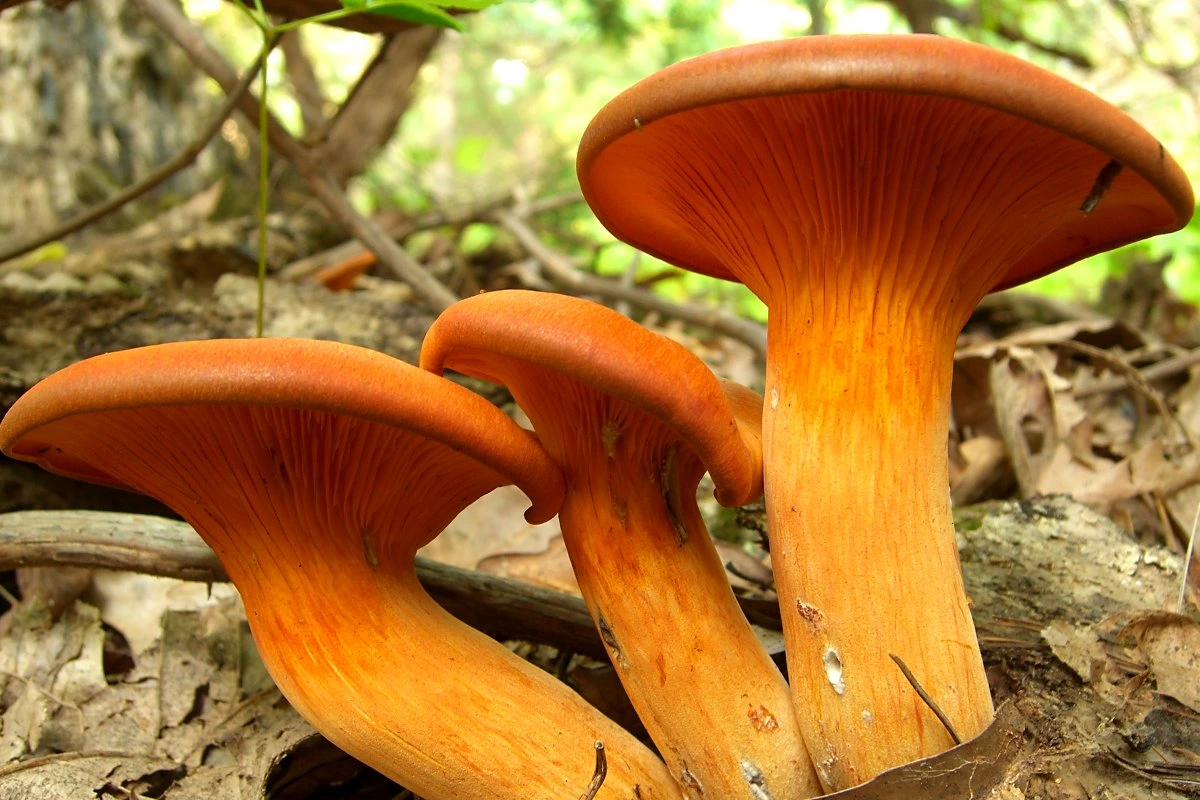
Omphalotus illudens, commonly known as the Jack-o’-Lantern Mushroom, is a striking orange wood-decaying mushroom found mainly in eastern North America and parts of northern and temperate Europe. It often appears in large, tightly packed clusters around hardwood stumps, dead trees, or buried roots.
The most useful field pattern is bright orange mushroom + true decurrent gills + dense clustered growth + hardwood substrate. Its orange color can make it look superficially like a chanterelle, but the underside and growth habit are very different.
⚠️ Important: Omphalotus illudens is poisonous and can cause severe gastrointestinal illness. Do not use orange color, smell, or apparent resemblance to a chanterelle as evidence of edibility.
Quick Identification
| Feature | Omphalotus illudens |
|---|---|
| Common name | Jack-o’-Lantern Mushroom |
| Cap color | Bright orange to pumpkin orange |
| Cap shape | Convex, later flat to shallow funnel-shaped |
| Underside | True gills |
| Gills | Orange, crowded, decurrent |
| Stem | Orange, solid |
| Ring | Absent |
| Flesh | Pale orange to orange |
| Spore print | White to cream / pale yellow |
| Bioluminescence | Gills can glow weakly green when fresh |
| Ecology | Saprotrophic |
| Substrate | Hardwood stumps, dead wood, buried roots |
| Growth | Usually dense clusters |
| Season | Late summer to autumn |
| Distribution | Eastern North America; northern and temperate Europe |
| Toxicity | Poisonous |
| Main look-alikes | True chanterelles, False Chanterelle, other Omphalotus |
What Does Omphalotus illudens Look Like?
Jack-o’-Lantern is usually unmistakably orange when fresh. The cap, gills, and stem can all share similar pumpkin-orange or yellow-orange coloration.
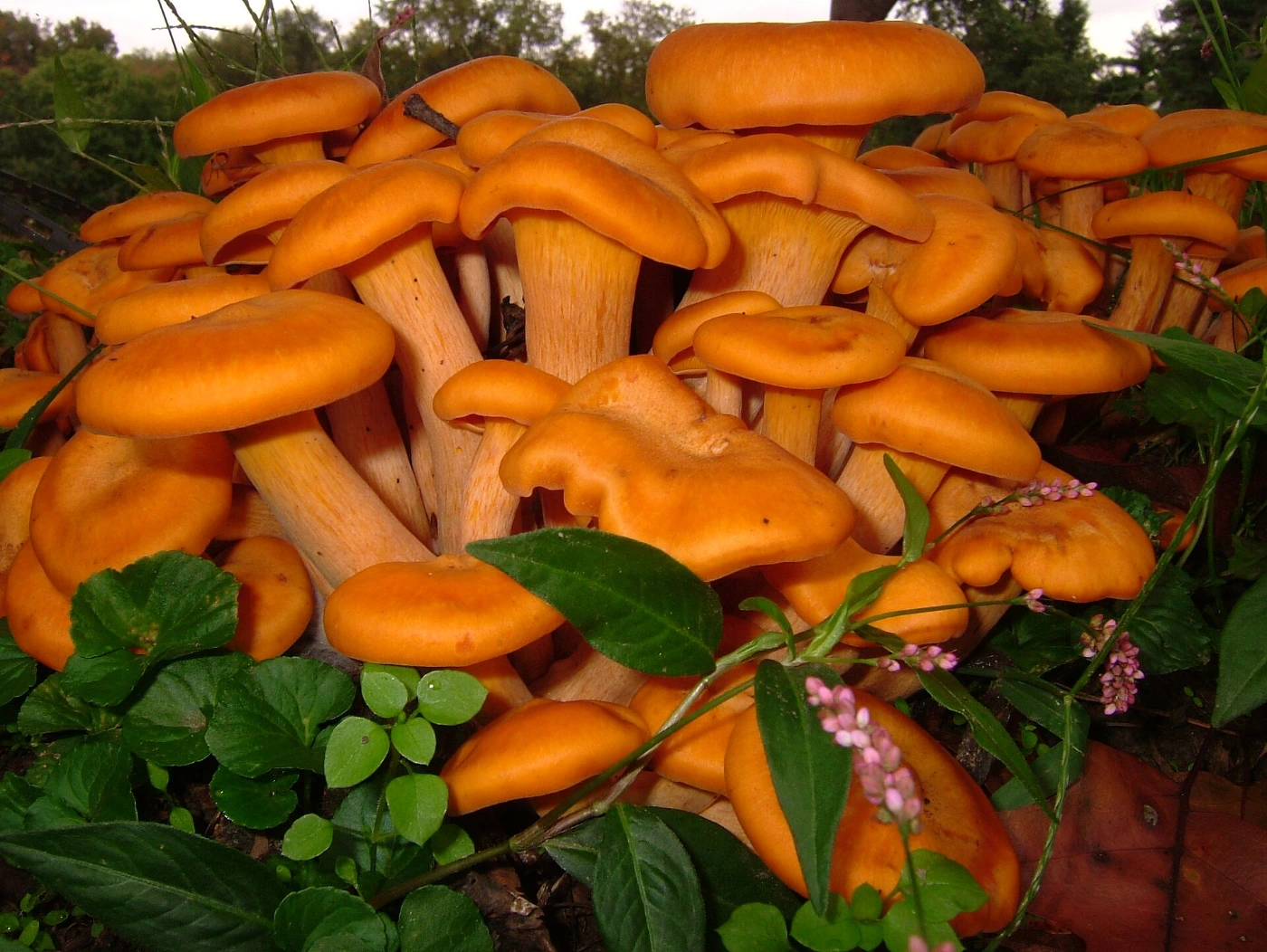
Fruit bodies are substantial rather than delicate and commonly occur in dense groups with several stems emerging close together. Mature caps often become flatter or shallowly depressed toward the center.
Cap
Young caps are convex with margins that may curl inward. As they mature, they broaden and may become nearly flat or slightly funnel-shaped.
The surface is smooth and generally dry to slightly greasy. Color varies from yellow-orange to deep pumpkin orange, with some specimens becoming darker toward the center.
True Gills
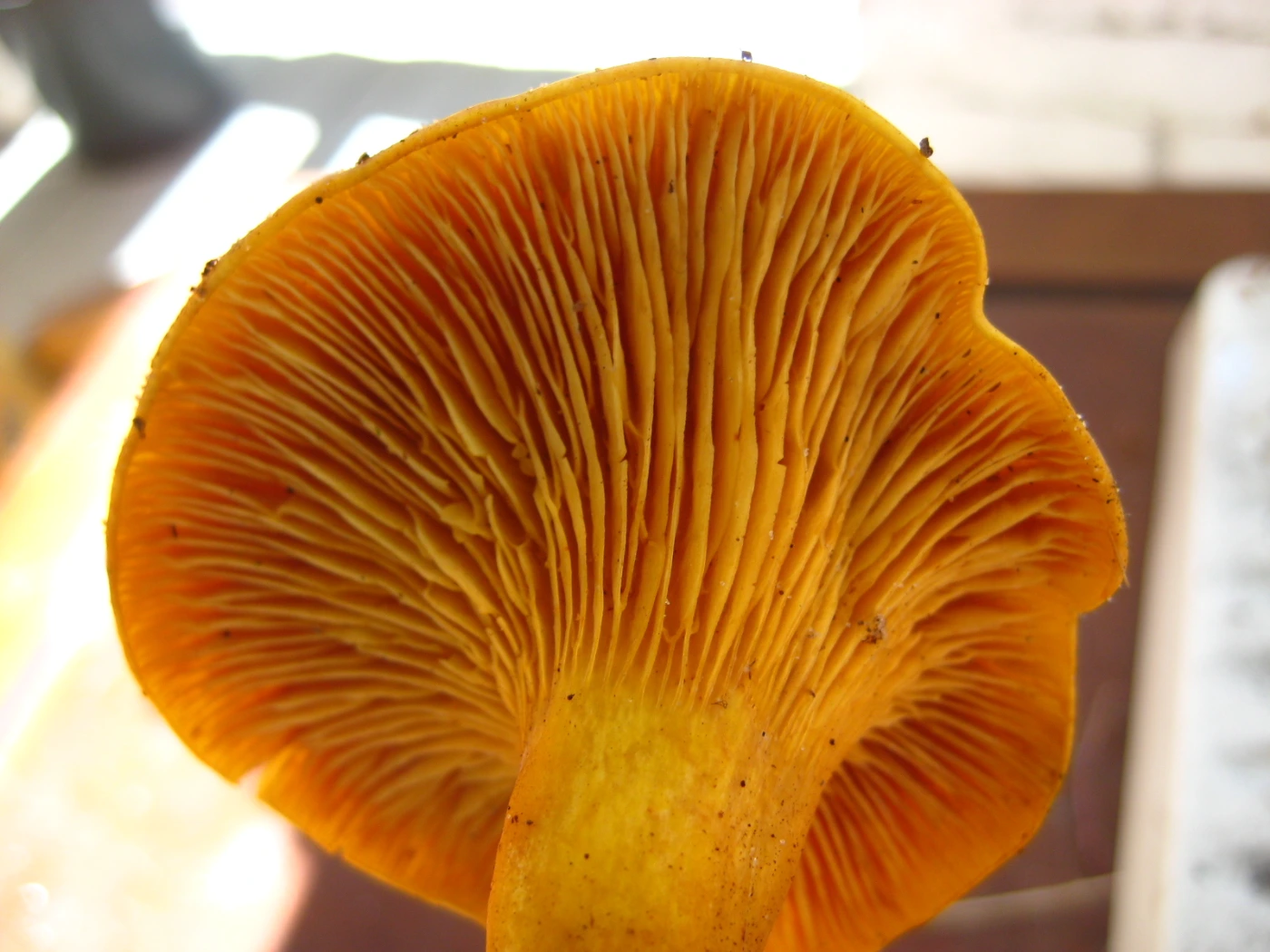
The underside is one of the most important identification characters. Omphalotus illudens has thin, blade-like true gills, not the blunt folds found on true chanterelles.
The gills are crowded and run noticeably down the stem. They are usually orange to pale orange and remain clearly separated as individual blades.
Why the Gills Matter
Chanterelle identification errors often begin when someone looks only at the orange cap. Once the underside is examined closely, the structural difference becomes much clearer.
True chanterelles have thick, blunt ridges integrated into the mushroom’s flesh. Jack-o’-Lantern has thin, distinct gills that can be separated visually as individual blades.
Stem
The stem is orange to yellow-orange and usually solid. It often tapers somewhat toward the base.
Several stems frequently arise together from the same buried piece of wood or root system. This tightly clustered growth is one of the strongest field clues.
Flesh
When sliced, the flesh is orange or pale orange rather than the distinctly pale interior typical of many chanterelles. It does not normally show a dramatic bruising reaction.
The flesh is relatively substantial and fibrous. Cutting a specimen can therefore provide another useful comparison when the underside alone is not enough.
Spore Print
The spore print is white to cream or pale yellow. This may seem surprising given the mushroom’s intense orange coloration.
Spore color alone does not identify the species, but it can help exclude several unrelated orange-gilled mushrooms with darker spores.
Where Does Omphalotus illudens Grow?
Jack-o’-Lantern is saprotrophic, meaning it obtains nutrients by decomposing dead wood. It commonly fruits from hardwood stumps, dead tree bases, and buried decaying roots, especially around oaks.
Buried roots can make the mushroom appear to be growing directly from soil. This is one reason it can be mistaken for a terrestrial chanterelle.
Why It Can Look Like It Is Growing From the Ground
A cluster may emerge several feet away from an obvious stump or tree trunk. Underground roots or buried wood can support the fungus without being visible at the surface.
If an orange mushroom appears terrestrial, examine the base and surrounding area carefully. Dense clustering is another clue that hidden wood may be present.
Season
Fruiting is most common from late summer through autumn. In much of eastern North America, Jack-o’-Lantern is particularly associated with fall mushroom season.
Rainfall can trigger large flushes around established underground wood. The same stump or root system may produce mushrooms repeatedly in favorable years.
Distribution
In North America, Omphalotus illudens is widespread mainly east of the Rocky Mountains. It also occurs in northern and temperate parts of Europe.
Regional identification is important because similar Jack-o’-Lantern species replace it elsewhere. California and much of western North America are associated instead with Omphalotus olivascens.
Does Jack-o’-Lantern Really Glow?
Yes. Fresh Jack-o’-Lantern mushrooms can produce weak greenish bioluminescence, especially from the gills.
The glow is often much weaker than photographs or illustrations suggest. It may require a completely dark room and several minutes for the eyes to adjust before it becomes visible.
Why Does It Glow?
Fungal bioluminescence is produced by a biochemical light-emitting system. In Omphalotus, the process is related to the fungal caffeic-acid-cycle pathway used by several bioluminescent mushroom lineages.
The ecological function is still studied and may involve interactions with insects or other organisms. The ability to glow is interesting, but it is not necessary for field identification.
Do All Specimens Glow?
Not all specimens produce an easily visible glow. Age, condition, temperature, and other factors can influence how obvious the luminescence appears.
A Jack-o’-Lantern that does not visibly glow can still be O. illudens. Bioluminescence should therefore be treated as a supporting feature rather than a required field test.
Is Omphalotus illudens Poisonous?
Yes. Eating Jack-o’-Lantern can cause significant gastrointestinal poisoning.
Symptoms commonly include nausea, vomiting, abdominal cramping, and diarrhea, often beginning within several hours. Published poisoning reports describe recovery in most cases with supportive medical care, but symptoms can be severe.
What Toxin Does Jack-o’-Lantern Contain?
Omphalotus illudens contains toxic illudins, including illudin S. These compounds are associated with the gastrointestinal toxicity of Jack-o’-Lantern mushrooms.
Illudin S has also attracted scientific interest because of its strong biological activity. That laboratory interest does not make the mushroom safe for consumption.
Does Cooking Make Jack-o’-Lantern Safe?
No. Jack-o’-Lantern should not be treated as an edible mushroom regardless of cooking method.
Frying, boiling, drying, freezing, or other normal food preparation does not provide a reliable way to make Omphalotus illudens safe to eat.
Look-Alikes
The most important confusion is with true chanterelles. False Chanterelle and other Omphalotus species are also useful comparisons.
Cantharellus Species — True Chanterelles
Identification
True chanterelles are yellow to orange and can have a similar funnel-shaped profile. They grow from soil in mycorrhizal association with living trees.
Their underside has blunt, fleshy false gills rather than thin blades. Chanterelles also tend to occur singly or in loose groups rather than dense fused clusters.
Main Difference
Blunt false gills + terrestrial growth = chanterelle. Thin true gills + dense growth from wood or roots = Jack-o’-Lantern.
Hygrophoropsis aurantiaca — False Chanterelle
Identification
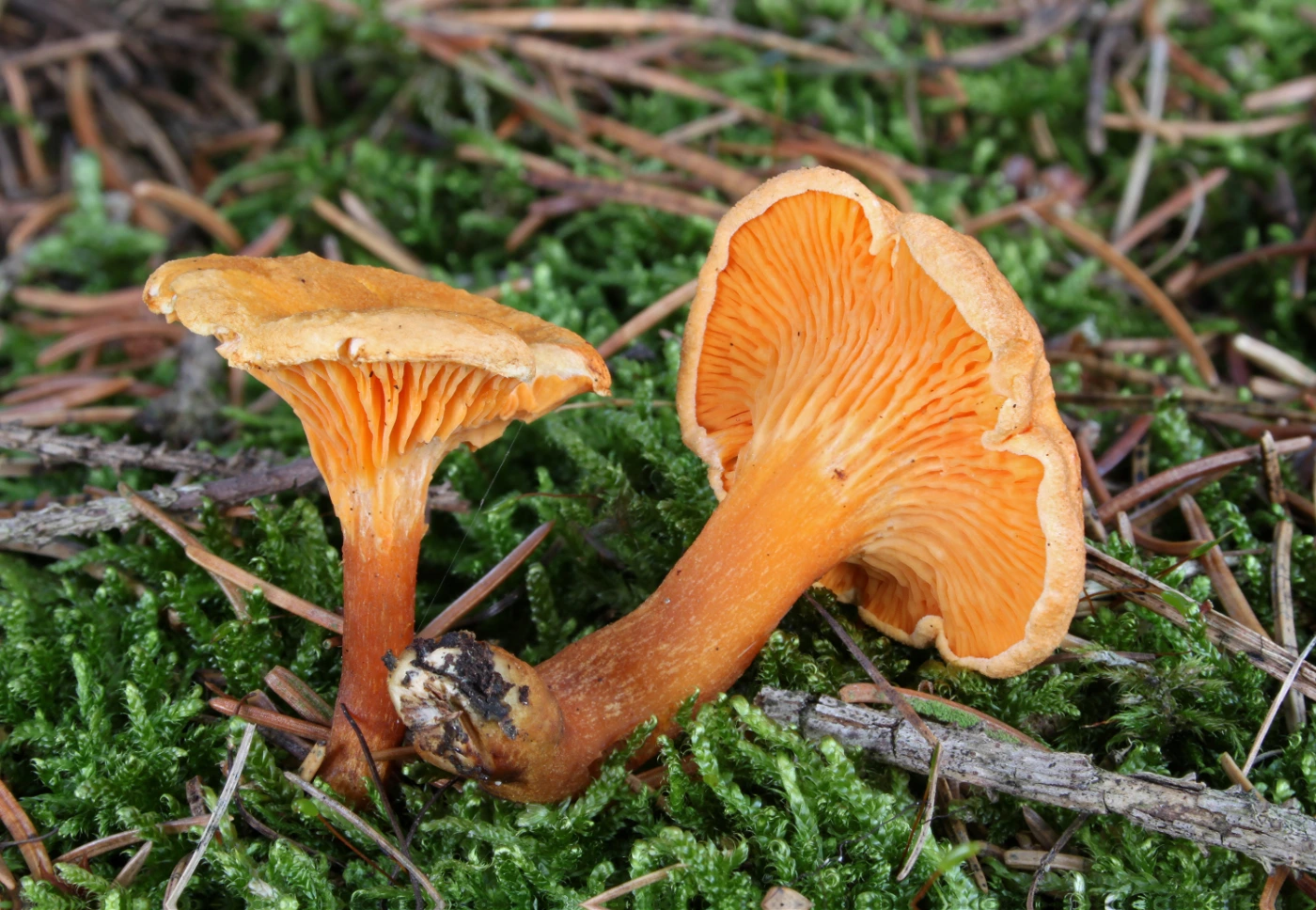
False Chanterelle is orange to yellow-orange and has true gills. This can make it appear closer to Jack-o’-Lantern than a true chanterelle does.
Its gills are usually strongly and repeatedly forked, while O. illudens has more straightforward decurrent gills. False Chanterelle is generally smaller and does not typically form the massive tightly packed clusters characteristic of Jack-o’-Lantern.
Main Difference
Smaller mushroom + repeatedly forked gills = False Chanterelle. Large clustered mushroom + non-forking decurrent orange gills = Jack-o’-Lantern.
Omphalotus olivascens — Western Jack-o’-Lantern
Identification
Omphalotus olivascens is the important western North American counterpart. It can have orange fruit bodies with olive or greenish tones mixed into the cap or other tissues.
Its growth habit is similar, with clusters developing from hardwood and buried roots. From photographs alone, the two can look extremely similar.
Main Difference
Geography is one of the strongest practical clues. Eastern North America favors O. illudens, while California and western North America favor O. olivascens.
Omphalotus olearius — European Jack-o’-Lantern
Identification
Omphalotus olearius is a closely related European species, especially associated with central and southern Europe and Mediterranean habitats. It commonly decomposes oak and olive wood.
Its caps are often brownish orange, reddish orange, or darker than typical O. illudens. Exact separation can require microscopic characters.
Main Difference
Northern and temperate Europe can support O. illudens, while Mediterranean and southern European collections are more likely to be O. olearius. Geography and microscopic examination may be necessary when ranges approach each other.
Jack-o’-Lantern vs Chanterelle
| Feature | Omphalotus illudens | True Chanterelle |
|---|---|---|
| Color | Bright orange | Yellow to orange |
| Underside | True gills | False gills |
| Structure | Thin blades | Thick blunt ridges |
| Growth | Dense clusters | Single or loose groups |
| Substrate | Wood / buried roots | Soil near living trees |
| Flesh | Orange | Usually pale |
| Spore print | White to cream | Pale |
| Toxicity | Poisonous | Many species edible when correctly identified |
| Best clue | True gills + wood | False gills + soil |
The underside is usually the fastest distinction. Growth substrate provides a second powerful clue.
Jack-o’-Lantern vs False Chanterelle
| Feature | Jack-o’-Lantern | False Chanterelle |
|---|---|---|
| Size | Often large | Usually smaller |
| Gills | True, decurrent | True, strongly forked |
| Clustering | Dense clusters common | Usually less densely clustered |
| Substrate | Hardwood / buried roots | Forest litter and woody debris |
| Color | Pumpkin orange | Orange to yellow-orange |
| Best clue | Large fused clusters | Strongly forked gills |
Neither mushroom should be confused with true chanterelles simply because all can be orange.
Omphalotus illudens vs Omphalotus olivascens
| Feature | O. illudens | O. olivascens |
|---|---|---|
| Main range | Eastern North America | Western North America |
| Cap | Bright pumpkin orange | Orange, often with olive tones |
| Gills | Orange, decurrent | Orange, decurrent |
| Growth | Dense hardwood clusters | Dense hardwood clusters |
| Bioluminescence | Present | Present |
| Best clue | Eastern geography | Western geography + olive tones |
For many field observations, location provides more useful information than small differences in shape.
How to Identify Omphalotus illudens
Start with the underside. The mushroom should have thin, crowded, orange true gills running down the stem.
Next examine how it grows. Large numbers of mushrooms emerging tightly together from a stump, tree base, or apparently terrestrial buried roots strongly support Omphalotus.
Then consider geography. A bright orange clustered Omphalotus east of the Rocky Mountains is a strong candidate for O. illudens.
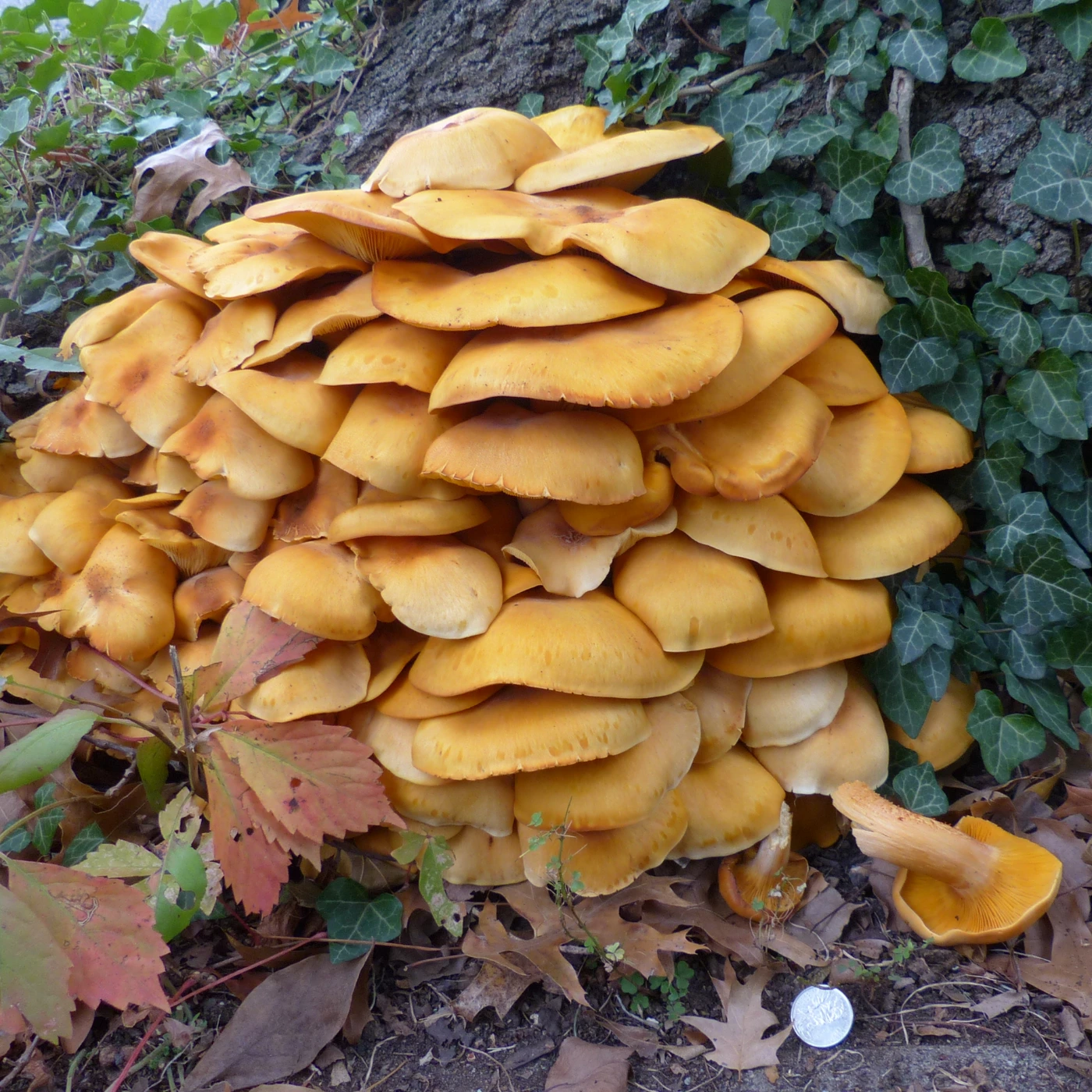
Young vs Mature Jack-o’-Lantern Mushrooms
Young caps are convex with rolled or inturned margins. The clustered stems can be tightly packed at their bases.
Older caps flatten and may become funnel-shaped or wavy. Mature clusters can become very large and visually resemble bouquets of orange mushrooms around a stump.
Why Jack-o’-Lantern Is Confused With Chanterelles
Both mushrooms can be bright orange and appear during similar parts of the year. A Jack-o’-Lantern growing from buried roots can also appear to emerge directly from soil.
The confusion disappears when the fertile surface is examined correctly. Chanterelles have blunt ridges, while Jack-o’-Lantern has unmistakable true gills.
Common Identification Mistakes
One common mistake is assuming that all orange woodland mushrooms are chanterelles. Color is one of the least reliable characters in this comparison.
Another mistake is checking whether the mushroom grows from visible wood but ignoring buried roots. Jack-o’-Lantern can appear terrestrial even though it is actually decomposing wood underground.
A third mistake is treating forked structures as proof of a chanterelle. False Chanterelle has forked true gills, so thickness and structure matter more than forking alone.
A fourth mistake is expecting every Jack-o’-Lantern to glow dramatically. Weak or invisible bioluminescence does not rule out the species.
How to Photograph Omphalotus illudens
Photograph the entire cluster before removing any mushrooms. Include the stump, tree base, or surrounding ground to document the substrate.
Then take an underside photograph showing the true gills and their attachment to the stem. A vertical cross-section can also document the orange flesh.
How to Photograph the Glow
Use freshly collected specimens and place them in complete darkness. Allow your eyes to adjust before deciding whether luminescence is visible.
For photography, a long exposure may capture a glow that is difficult to see with the naked eye. Do not use bioluminescence as the only identification test.
Can AI Identify Jack-o’-Lantern?
AI can often recognize a typical dense cluster of bright orange fruit bodies when the true gills and wood substrate are visible. An underside photograph is much more useful than a cap-only image.
Regional information is also important. An orange Omphalotus in California should not automatically be labeled O. illudens because O. olivascens is the more appropriate western species.
Interesting Facts
Jack-o’-Lantern is one of the best-known bioluminescent mushrooms. Fresh gills can emit a faint green glow that inspired the mushroom’s common name.
The genus Omphalotus contains several glowing species from different parts of the world. These include western North American O. olivascens, European O. olearius, Australian O. nidiformis, and Japanese O. japonicus.
The scientific epithet illudens means something close to “deceiving.” The name is fitting because the species has repeatedly been mistaken for edible orange mushrooms.
The genus also gave its name to illudins, a group of biologically active compounds. Illudin S was originally isolated from Omphalotus illudens and remains an important subject of chemical research.
Frequently Asked Questions
Is Omphalotus illudens poisonous?
Yes. It can cause severe nausea, vomiting, abdominal cramps, and diarrhea and should not be eaten.
Does Jack-o’-Lantern really glow in the dark?
Yes. Fresh gills can produce weak greenish bioluminescence, although the glow may be difficult to see without complete darkness.
How do you tell Jack-o’-Lantern from a chanterelle?
Check the underside and substrate. Jack-o’-Lantern has thin true gills and grows from wood or buried roots, while chanterelles have blunt false gills and grow from soil near living trees.
Does Jack-o’-Lantern grow on the ground?
It can appear to. In many cases, the mushrooms are actually growing from buried hardwood roots or other hidden wood.
What color is the spore print?
The spore print is white to creamy or pale yellow. The spores are much paler than the bright orange fruit body.
Where does Omphalotus illudens grow?
In North America it is widespread mainly east of the Rocky Mountains. It also occurs in northern and temperate Europe.
Is the western Jack-o’-Lantern the same species?
Usually not. In California and western North America, Omphalotus olivascens is the important regional species.
Can cooking make Jack-o’-Lantern edible?
No. It is a poisonous mushroom and should not be treated as food regardless of cooking method.
Final Identification Notes
Omphalotus illudens is best recognized by the combination of bright pumpkin-orange fruit bodies, thin true gills running down the stem, dense clustered growth, orange flesh, and fruiting from hardwood or buried roots.
The most important comparison is with chanterelles. Chanterelles have thick false gills and grow terrestrially in association with living trees, while Jack-o’-Lantern has true gills and decomposes dead wood.
The practical field pattern is: large orange mushroom + thin decurrent true gills + dense clusters + hardwood or buried roots = strong Omphalotus illudens candidate. In western North America, consider O. olivascens instead.
Upload a photo and get possible matches in seconds.