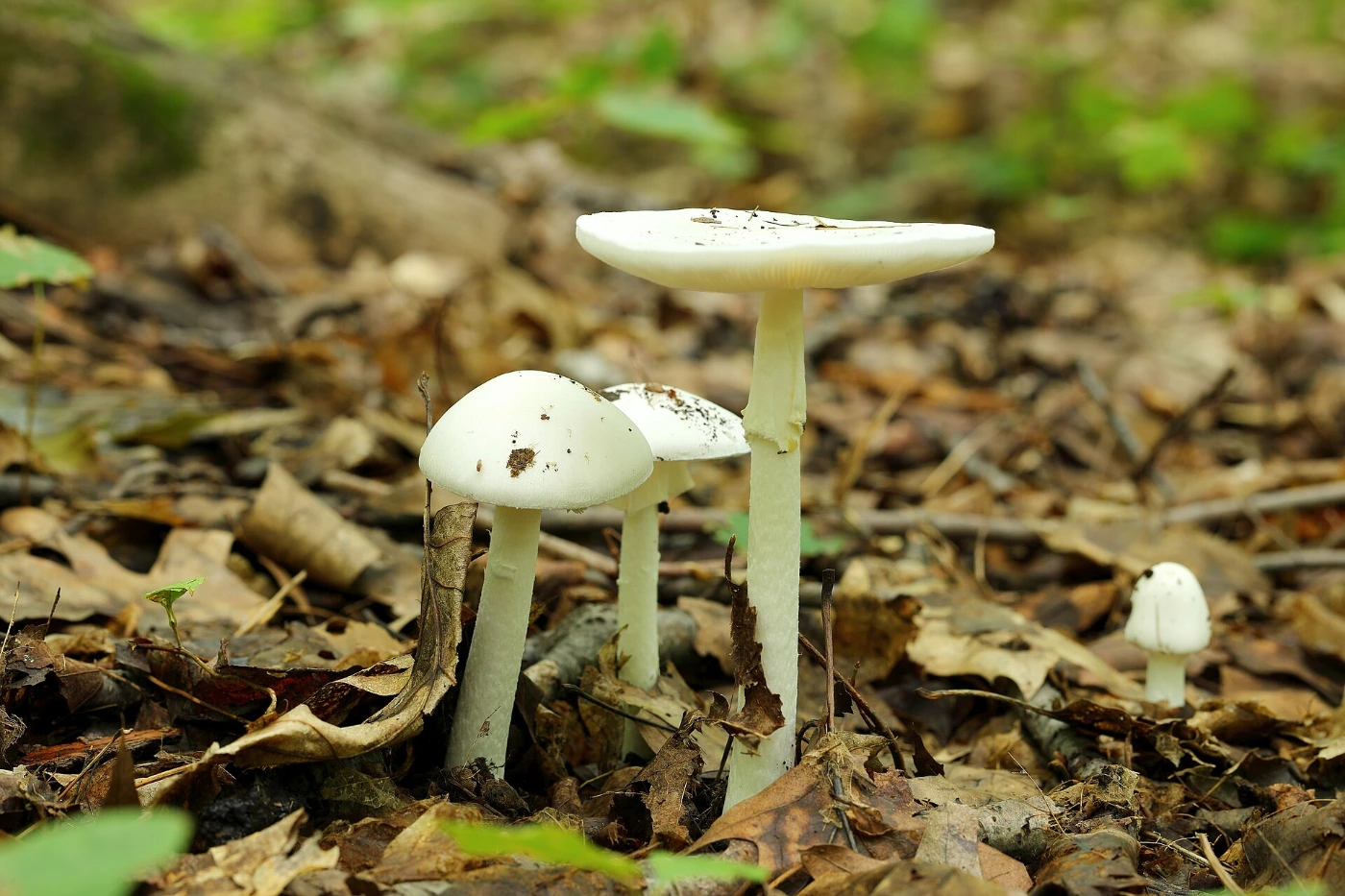
Amanita virosa, commonly known as the Destroying Angel, is a deadly poisonous white Amanita found mainly in Europe. It is recognized by its smooth white cap, crowded white gills, fragile stem ring, and large sack-like volva around the stem base.
The most useful field pattern is all-white mushroom + free white gills + ring + deep sack-like volva. The entire stem base must be excavated because the volva is often buried in soil and can easily be missed.
⚠️ Important: Amanita virosa contains amatoxins capable of causing fatal liver damage. Never taste this mushroom, and never rely on cooking, boiling, freezing, or drying to make it safe.
Quick Identification
| Feature | Amanita virosa |
|---|---|
| Common name | Destroying Angel |
| Cap | Pure white, smooth |
| Cap shape | Egg-shaped young, later bell-shaped to convex |
| Gills | White, crowded, free |
| Stem | White, fibrous |
| Ring | Thin, fragile, high on stem |
| Volva | Large, sack-like, often buried |
| Stem base | Enclosed in volva |
| Flesh | White |
| Spore print | White |
| Smell | Weak when young, unpleasant in older specimens |
| Ecology | Mycorrhizal |
| Habitat | Deciduous, mixed and some conifer woodland |
| Distribution | Mainly Europe |
| Season | Summer to autumn |
| Toxicity | Deadly poisonous |
| Main look-alikes | Amanita verna, white Agaricus, white Volvopluteus, young puffballs |
What Does Amanita virosa Look Like?
Destroying Angel is usually strikingly white from cap to stem. Young specimens can look almost pristine, while older mushrooms may develop slight cream discoloration or weathering.
The fruit body is relatively slender and elegant compared with some heavier Amanitas. A typical mature specimen combines a smooth white cap, white free gills, a fragile ring, and a pronounced volva at the base.
Cap
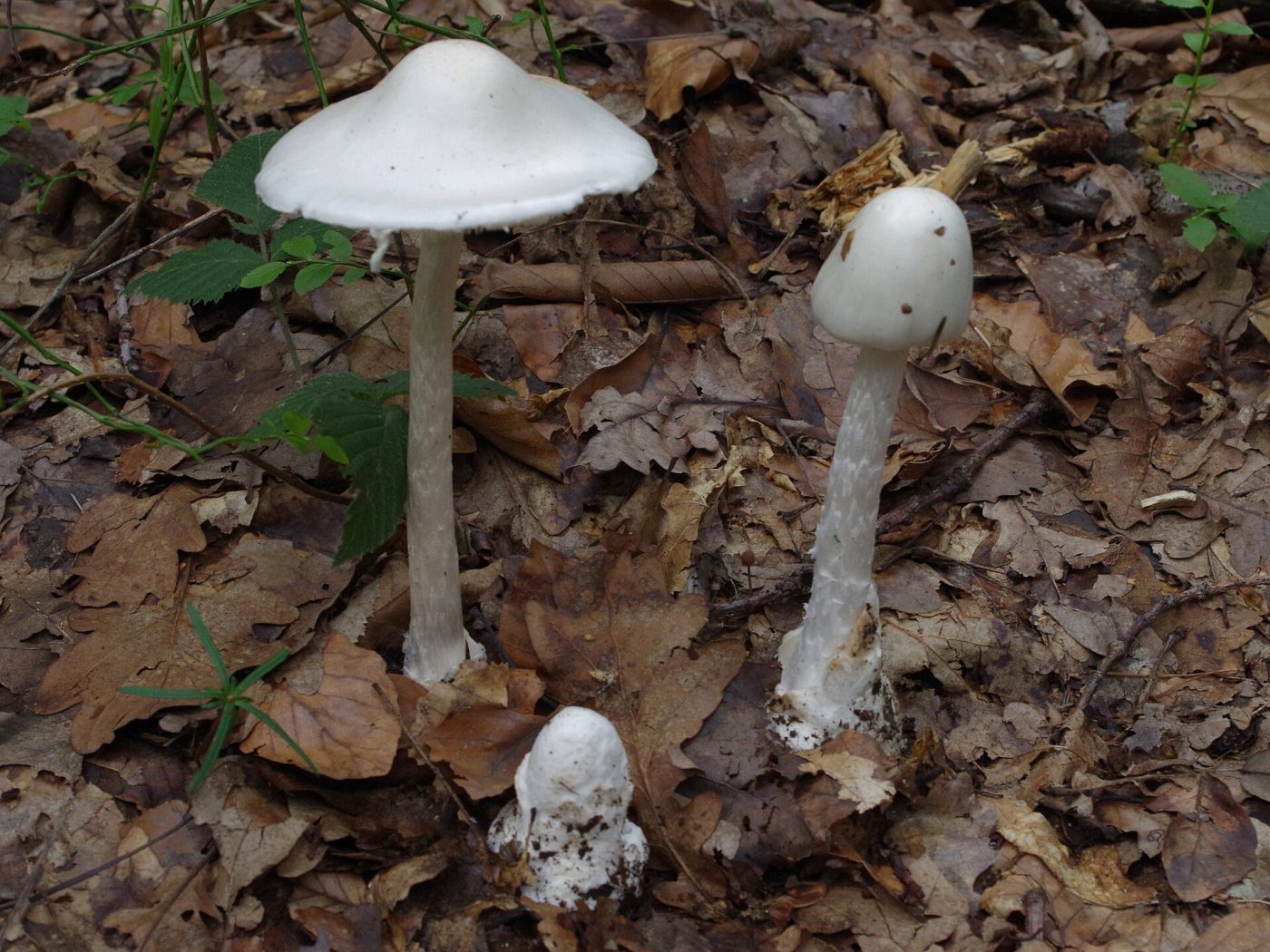
The cap is usually about 5–10 cm across and begins egg-shaped. It later becomes bell-shaped, convex, or occasionally nearly flat with a broad central rise.
The surface is pure white and generally smooth. Universal-veil remnants can occasionally occur on young caps, but they often disappear after rain.
Gills
The gills are white, crowded, and free from the stem. They remain white rather than becoming pink and then chocolate brown as in Agaricus.
This persistent white gill color is an important warning sign. A white mushroom with free white gills, a ring, and a volva should always be treated as potentially deadly Amanita.
Stem
The stem is white, fibrous, and often slightly curved. It is relatively slender compared with the width of the mature cap.
A thin, fragile ring usually sits high on the stem. Because it can collapse or disappear with age, the absence of an obvious ring in an old specimen does not automatically rule out A. virosa.
Volva
The volva is one of the most important identification characters. It forms a large, white, sack-like structure surrounding the stem base.
The problem is that it is often buried underground. Pulling or cutting the mushroom off above soil level can leave the volva behind and remove one of the most important warning features.
Why the Stem Base Must Be Excavated
When examining any pale Amanita-like mushroom, carefully remove the entire stem base from the soil. Do not simply cut it at ground level.
A buried sack-like volva combined with white gills and a ring is a classic destroying-angel pattern. This feature can be more important than small differences in cap shape.
Flesh
The flesh is white and does not show dramatic bruising reactions. It remains pale when cut.
Color change is therefore not a useful safety test. Deadly amatoxin-containing Amanitas may look clean, white, and completely ordinary inside.
Smell
Young specimens may have little noticeable odor. Mature mushrooms can develop a faint unpleasant or sickly smell.
Odor is unreliable and should never be used as the main identification character. The structural combination of gills, ring, and volva is far more important.
Spore Print
The spore print is white. This matches the persistent white gill color.
Many Amanita species also have white spores, so a spore print mainly supports genus-level identification rather than confirming A. virosa by itself.
Where Does Amanita virosa Grow?
Amanita virosa is mycorrhizal and grows in association with living trees. It occurs in deciduous, mixed, and some coniferous woodland.
In northern Europe it is particularly associated with woodland environments and can be common in Scandinavian conifer forests. It is also reported more frequently in upland or mountainous habitats in parts of Britain and Ireland.
Season
Fruiting is mainly from summer into autumn. In northern Europe, July through September is especially typical, although local timing varies with climate.
British records can extend later into autumn. Weather, elevation, and latitude all influence the exact season.
Distribution
Amanita virosa is principally a European destroying angel. It is especially associated with northern and central European regions.
The common name “Destroying Angel” is also used for different deadly Amanitas in North America. Eastern North America is better associated with Amanita bisporigera, while western North America has Amanita ocreata and related taxa.
Amanita virosa Is Not the North American Destroying Angel
This distinction is important for international mushroom identification. Older or simplified sources may use “Destroying Angel” as though it were one worldwide species.
In reality, several deadly white Amanitas share the common name. Geography should therefore always be included when identifying a white destroying angel.
Why Is Amanita virosa So Dangerous?
Amanita virosa contains amatoxins, the same toxin group responsible for many fatal Death Cap poisonings. These toxins damage cells, particularly in the liver.
A major danger is the delay between eating the mushroom and severe illness. Symptoms may begin only after significant toxin absorption has already occurred.
Symptoms of Amatoxin Poisoning
Early symptoms commonly involve severe vomiting, diarrhea, and abdominal pain. They may begin several hours after ingestion rather than immediately.
A deceptive period of apparent improvement can follow. Serious liver damage may then become apparent, and severe cases can require intensive medical treatment or liver transplantation.
Does Cooking Destroy the Toxins?
No. Ordinary cooking does not make Amanita virosa safe.
Boiling, frying, drying, freezing, or other normal food preparation methods should never be considered detoxification techniques for amatoxin-containing Amanitas.
Look-Alikes
The most dangerous confusion involves other pale mushrooms collected for food. The stem base, gill color, and veil structures are particularly important.
Amanita verna — Fool’s Mushroom
Identification
Amanita verna is another deadly white Amanita and can be extremely similar macroscopically. It also has white gills, a ring, and a volva.
Season can offer a clue because A. verna is more strongly associated with spring, while A. virosa usually fruits later. Some references also note differences in KOH reaction, but this is an advanced character rather than a beginner field test.
Main Difference
Typical fruiting season may help, but both should simply be treated as deadly white Amanitas. Separating them is not necessary for safe foraging.
Amanita phalloides — Death Cap
Identification
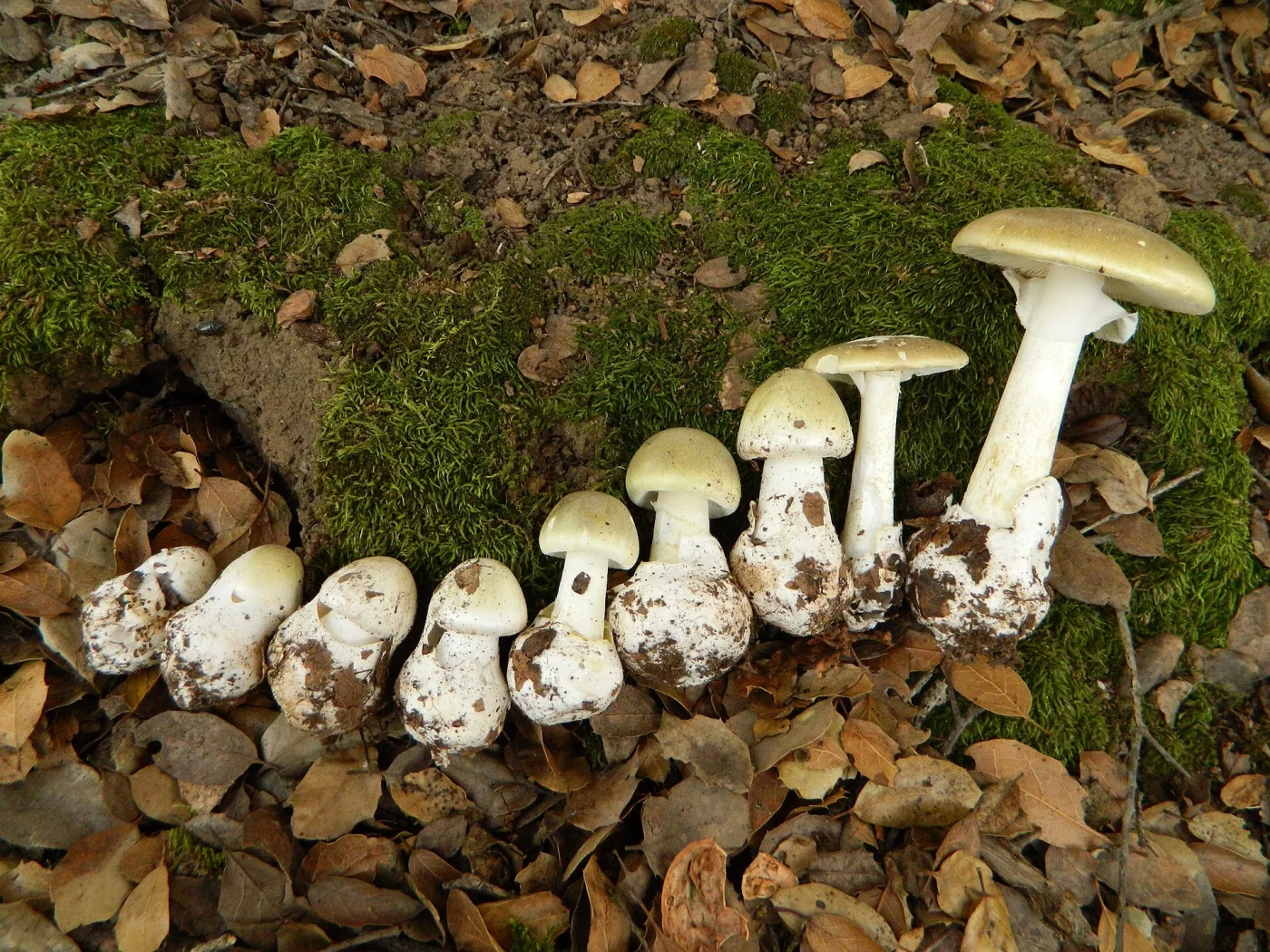
Death Cap usually has a greenish, olive, yellowish, or brownish cap rather than a pure white one. However, pale specimens can occur.
It also has white gills, a ring, and a sack-like volva. Both species contain amatoxins and can cause fatal poisoning.
Main Difference
Typical A. virosa is pure white throughout, while Death Cap usually develops a colored cap. Structurally, however, both share the dangerous white gills + ring + volva pattern.
Agaricus Species
Identification
Young white Agaricus can resemble Destroying Angel from above. They may have pale caps and a ring on the stem.
The crucial difference is the gills. Agaricus gills usually start pink or gray-pink and mature to chocolate brown, while A. virosa gills remain white.
Main Difference
Pink-to-brown gills and no volva favor Agaricus. Persistent white gills plus a sack-like volva strongly favor Amanita.
Volvopluteus and Volvariella-Like Mushrooms
Identification
Some pale mushrooms have a volva but no stem ring. Their gills can begin white and later become pink as spores mature.
This pink-spored development separates them from Amanita virosa. A volva alone is therefore not enough to identify Amanita.
Main Difference
Pink mature gills and no ring favor a pink-spored volva-bearing mushroom. White gills, ring, and volva favor A. virosa.
Young Puffballs
Identification
Very young Amanitas can remain enclosed inside the universal veil and appear as white eggs. From the outside, they can resemble small puffballs.
A vertical cut reveals the difference. An Amanita egg contains developing cap, gills, and stem, while a true young puffball has a uniform white interior.
Main Difference
Internal mushroom anatomy = Amanita egg. Uniform solid white interior = true young puffball.
Amanita virosa vs Agaricus
| Feature | Amanita virosa | Agaricus |
|---|---|---|
| Cap | White | Often white or brown |
| Young gills | White | Pink to gray-pink |
| Mature gills | White | Chocolate brown |
| Ring | Present | Present |
| Volva | Present | Absent |
| Spore print | White | Dark brown |
| Toxicity | Deadly | Varies by species |
| Best clue | White gills + volva | Brown mature gills + no volva |
This is one of the most important comparisons for mushroom collectors.
Amanita virosa vs Amanita verna
| Feature | Amanita virosa | Amanita verna |
|---|---|---|
| Color | White | White |
| Gills | White | White |
| Ring | Present | Present |
| Volva | Sack-like | Sack-like |
| Main season | Summer–autumn | More often spring |
| Toxicity | Deadly | Deadly |
| Best practical rule | Avoid | Avoid |
From a safety perspective, distinguishing the two is unnecessary. Both belong to the group of deadly white Amanitas.
How to Identify Amanita virosa
Start by examining the entire mushroom, including the stem base. Do not remove the mushroom by cutting it above the soil.
Look for free white gills, a thin ring high on the stem, and a large sack-like volva. Then consider the smooth white cap and European woodland habitat.
If the mushroom fits the combination white cap + white gills + ring + volva, treat it as a potentially deadly Amanita even if exact species identification remains uncertain.
Young vs Mature Destroying Angels
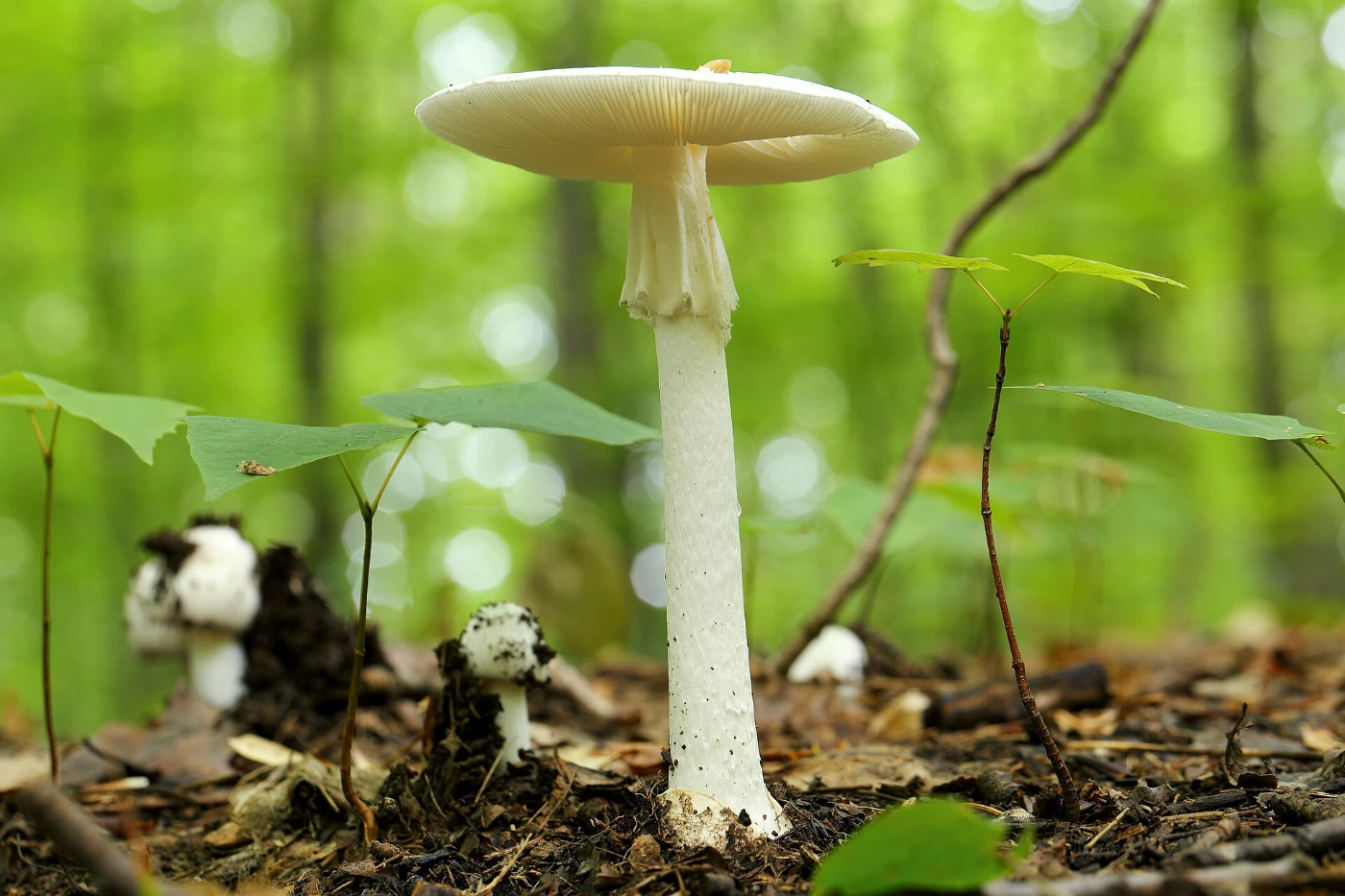
Young specimens may be enclosed within the universal veil and appear egg-like. As the mushroom expands, the cap and stem emerge while the lower veil remains as the volva.
Mature specimens develop the classic white Amanita shape. The ring may become fragile or disappear, but the volva at the base can remain an important clue.
Common Identification Mistakes
One common mistake is assuming that a clean white mushroom must be harmless. Some of the most dangerous mushrooms in the world are white Amanitas.
Another mistake is checking the cap but not the stem base. Leaving the volva underground removes one of the strongest identification characters.
A third mistake is confusing young Amanita virosa with white Agaricus. Gill color is crucial: Agaricus develops pink and later brown gills, while Destroying Angel remains white-gilled.
A fourth mistake is assuming that cooking or boiling can make the mushroom safe. Amatoxin poisoning cannot be prevented by ordinary culinary preparation.
How to Photograph Amanita virosa
Photograph the mushroom in place before removing it. Include nearby trees and the surrounding woodland habitat.
Then carefully excavate the entire stem base and photograph the volva, ring, gills, and cap. A side view that clearly shows all three major Amanita structures is especially useful.
Can AI Identify Amanita virosa?
AI can recognize a strong destroying-angel pattern when the entire mushroom is visible. The most useful image includes the white gills, ring, and complete stem base with volva.
A cap-only photograph is not sufficient for a high-risk identification. Several harmless and dangerous white mushrooms can look very similar from above.
Interesting Facts
The common name Destroying Angel is not restricted to a single species. Several deadly white Amanitas in different parts of the world share the name.
Amanita virosa was originally described from Sweden, fitting its strong association with northern Europe. Modern references continue to recognize it as one of the characteristic European destroying angels.
The volva represents the remains of the universal veil that enclosed the entire young mushroom. The ring, by contrast, comes from the partial veil that covered the gills.
This means one mushroom can show remnants of two different veil systems at once. Understanding those structures is one of the best ways to recognize dangerous Amanitas.
Frequently Asked Questions
Is Amanita virosa deadly?
Yes. It contains amatoxins and can cause fatal liver poisoning.
What does Amanita virosa look like?
It is usually entirely white, with a smooth cap, white free gills, a thin stem ring, and a large sack-like volva around the base.
Where does Amanita virosa grow?
It occurs mainly in Europe in woodland associated with living trees. It is particularly characteristic of northern European forests.
Does it have a ring?
Yes, but the ring is thin and fragile and may disappear in older specimens.
Does it have a volva?
Yes. The large sack-like volva surrounds the stem base and is often partly or completely buried.
How is it different from Agaricus?
Agaricus develops pink and eventually chocolate-brown gills and lacks a volva. A. virosa keeps white gills and has a volva.
Is Amanita virosa found in North America?
The name Destroying Angel is widely used there, but different Amanita species are usually involved. Eastern North America is especially associated with A. bisporigera, while western regions have other destroying angels.
Can cooking make Amanita virosa safe?
No. Ordinary cooking, drying, freezing, or boiling does not make amatoxin-containing Amanitas safe.
Final Identification Notes
Amanita virosa is best recognized by the combination of a pure white smooth cap, crowded free white gills, thin fragile ring, and large sack-like volva at the stem base.
The greatest practical danger is confusion with pale edible mushrooms, especially Agaricus, or with young puffballs at the egg stage. The entire stem base and gill color should always be checked.
The practical safety pattern is: white mushroom + persistent white gills + ring + sack-like volva = potentially deadly Amanita. Do not taste it, and do not rely on cooking or photo identification alone to determine safety.
Upload a photo and get possible matches in seconds.