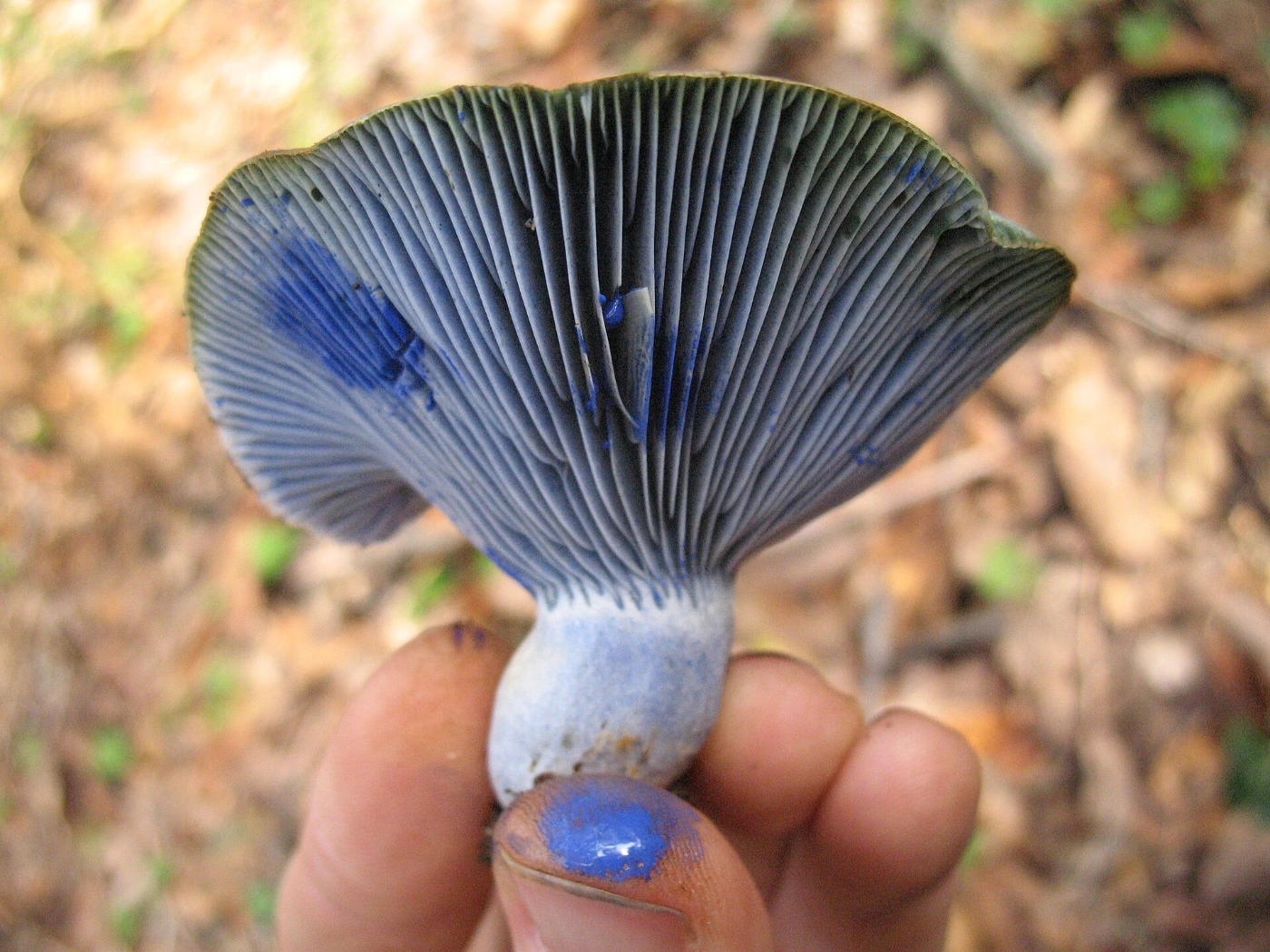
Some mushrooms change color dramatically when they are cut, pressed, scratched, or handled. Yellow flesh may turn blue within seconds, pores can become dark navy after a fingerprint, or damaged tissue may slowly shift through blue-green and brown tones.
This reaction is called bruising or staining, and it happens because damage exposes fungal chemicals to oxygen and enzymes that were previously separated inside intact cells. The resulting oxidation produces new colored compounds.
Blue bruising is especially common among boletes, but it also occurs in several unrelated mushroom groups. The same blue color does not necessarily mean that the same chemicals are involved.
⚠️ Important: Blue staining does not tell you whether a mushroom is edible, poisonous, or psychoactive. Some edible boletes turn intensely blue, some toxic species also blue, and many dangerous mushrooms do not turn blue at all.
What Causes a Mushroom to Turn Blue?
Mushroom tissue contains many naturally occurring chemical compounds. While the cells remain intact, these compounds and the enzymes capable of reacting with them may be kept apart.
Cutting or bruising destroys that separation. Oxygen enters the damaged tissue, enzymes begin chemical reactions, and new pigments can form within seconds or minutes.
Why Does the Reaction Start Only After Damage?
An intact mushroom has organized cell membranes and compartments. These structures control which chemicals come into contact with each other.
When cells rupture, their contents mix. Exposure to atmospheric oxygen then allows rapid oxidation reactions that were impossible or much slower before the tissue was damaged.
Blue Bruising in Boletes
Boletes are the mushroom group most strongly associated with blue staining. Species in several genera can turn blue when their pores, stems, or flesh are damaged.
In many Boletales, the reaction involves pigment precursors related to pulvinic acids. Variegatic acid and related compounds can oxidize after tissue damage and contribute to the striking blue coloration.
Variegatic Acid and Blue Pigments
Variegatic acid occurs naturally in several members of the Boletales. In intact tissue, it may contribute yellowish tones rather than appearing blue.
After damage, oxidation changes the molecule into intensely colored compounds. This can transform yellow mushroom tissue into blue or blue-green tissue almost immediately.
Xerocomic Acid
Xerocomic acid is another related pigment compound found in some boletes. It can participate in similar oxidation reactions.
Different species contain different mixtures and concentrations of these pigment precursors. This helps explain why one bolete may turn dark navy while another develops only a faint pale-blue stain.
Why Some Boletes Turn Blue Instantly
In fast-staining species, the necessary enzymes and pigment precursors are present in high enough concentrations for the reaction to proceed almost immediately. A fingerprint on the pore surface can become blue within seconds.
Species such as Neoboletus luridiformis can show extremely rapid and intense staining. The effect may be strongest in the yellow pore layer or exposed flesh.
Why Other Mushrooms Turn Blue Slowly
Not every reaction is immediate. Some mushrooms take several minutes to develop a noticeable blue color.
The speed depends on the species, concentration of reactive compounds, enzyme activity, tissue condition, temperature, and exposure to oxygen. Old or dry mushrooms may react much less strongly than fresh ones.
Why the Blue Color Sometimes Disappears
Blue staining is often temporary. The newly formed pigments can continue oxidizing or undergoing further chemical reactions.
As a result, blue areas may eventually become greenish, gray, brown, or nearly colorless. The appearance of the mushroom can therefore change several times after it is cut.
Why Blue Sometimes Turns Green
A combination of yellow original pigments and newly formed blue compounds can create a green appearance. Further oxidation can also generate additional color changes.
This is why some boletes move through a sequence such as yellow → blue → blue-green → brown. Watching the reaction over several minutes can provide useful identification information.
Does Blue Bruising Mean a Mushroom Is Poisonous?
No. There is no general relationship between blue bruising and toxicity.
Some edible boletes stain blue very strongly, while some poisonous boletes also stain blue. Conversely, deadly Amanitas usually do not rely on a blue bruising reaction for identification.
Does Blue Bruising Mean a Mushroom Is Edible?
No. The opposite assumption is equally unreliable.
Blue staining is an identification character, not an edibility test. You still need cap, pores or gills, stem features, habitat, host trees, smell, regional distribution, and other species-specific characters.
Does Blue Bruising Mean Psilocybin?
No. This is one of the most common misconceptions about blue-staining mushrooms.
Many boletes turn blue but contain no psilocybin. Their coloration results from completely different chemistry involving compounds such as variegatic acid and related pigments.
Why Psilocybe Mushrooms Turn Blue
In psilocybin-containing Psilocybe, injury-triggered blueing involves a different chemical system. Research has linked the reaction to oxidation of psilocin-derived compounds after tissue damage.
The resulting blue pigments are formed through reactions involving psilocin rather than bolete pulvinic-acid pigments. Therefore, a blue mushroom should never be assumed to belong to Psilocybe merely because it stains.
Boletes vs Psilocybe Blueing
The visible result can look superficially similar, but the mushrooms themselves are structurally very different. Boletes normally have pores beneath the cap, while Psilocybe species are small gilled mushrooms.
Their chemistry is also different. Blueing in a bolete is not evidence of psychoactive compounds.
Where Does Blue Staining Usually Appear?
The reaction may occur in the flesh, pores, stem surface, cap, or all of these areas. Different species have characteristic staining patterns.
In some boletes, the pore surface turns blue much more strongly than the internal flesh. In others, a cut stem becomes dark blue almost instantly.
Blue Pores
Yellow pores that become blue when touched are common in several bolete groups. Even light finger pressure can create dark blue marks.
This can be a useful field character because pore reactions are easy to test without cutting the entire mushroom. However, the intensity may weaken in old specimens.
Blue Flesh
Cutting a mushroom vertically can reveal where staining occurs inside the fruit body. Some species turn blue throughout the cap and stem flesh.
Others stain only in particular zones. The pattern and speed can therefore be more useful than simply recording “turns blue.”
Blue Stem Base
A few species show distinctive staining concentrated around the stem base. This can be especially useful when separating otherwise similar boletes.
Always photograph the complete stem before trimming it. Removing the base can eliminate a useful diagnostic feature.
Why Some Yellow Mushrooms Turn Dark Blue
Yellow and blue often occur together because many blue-staining boletes initially contain yellow pigment compounds. Damage converts some of these chemicals into darker oxidation products.
The visual contrast can be dramatic. Bright lemon-yellow flesh may become cobalt or navy blue almost instantly.
Examples of Blue-Staining Boletes
Several well-known bolete groups display this reaction. They vary considerably in pore color, stem markings, ecology, and edibility.
Neoboletus luridiformis — Scarletina Bolete
This species has yellow flesh, red pores when mature, and a stem covered with fine red dots rather than a net. Damaged tissue can turn intense blue very quickly.
The strength of the reaction is impressive but should not be interpreted as a toxicity indicator. Identification depends on the full combination of red pores, dotted stem, habitat, and staining.
Suillellus luridus — Lurid Bolete
Suillellus luridus also stains blue but differs from Neoboletus luridiformis in stem structure. Its stem typically shows a distinct reticulate net.
The pore surface becomes orange to red with age. Blue staining occurs rapidly after bruising or cutting.
Cyanoboletus pulverulentus — Inkstain Bolete
Inkstain Bolete is famous for extremely rapid dark-blue to blue-black staining. Nearly every part of the mushroom can change color after handling.
The reaction can be so strong that fingerprints become visible on the mushroom. This makes it one of the clearest examples of blue bruising in boletes.
Imleria badia — Bay Bolete
Bay Bolete has a chestnut-brown cap and yellow pores that commonly turn blue after pressure. The flesh may stain more weakly than the pores.
This contrast between pore staining and flesh staining is useful. It shows why the location of the color change should always be recorded.
Gyroporus cyanescens — Bluing Gyroporus
Gyroporus cyanescens has pale yellowish flesh that can turn striking cornflower blue when cut. The reaction is often dramatic and visually distinctive.
Despite the similar color, the chemistry and taxonomy differ from many classic blue-staining boletes. This demonstrates that blue staining has evolved in more than one fungal lineage.
Do All Boletes Turn Blue?
No. Many important boletes show little or no blue staining.
Porcini and other classic king boletes generally have white flesh that remains white when cut. Strong blue staining is therefore often useful for ruling out a typical king bolete identification.
Porcini and Blue Staining
A classic Boletus edulis-type porcini should not rapidly turn dark blue when sliced. Its flesh is usually white and relatively stable.
A strongly blue-staining mushroom that otherwise resembles porcini deserves closer examination. It may belong to another bolete genus.
Why Some Suillus Turn Blue
Most familiar Suillus do not show dramatic blue staining, but several species can show localized blue or blue-green reactions. These reactions can be especially useful in regional identification.
For example, some western North American Suillus show blue staining near the stem base. Host tree and other features still remain essential.
Does Bruising Hurt the Mushroom?
Bruising damages the fruit body but not necessarily the main fungal organism. The visible mushroom is only a temporary reproductive structure.
The main mycelium lives in soil, wood, or association with tree roots. Removing or cutting a single fruit body does not destroy the entire fungus.
Is Blue Bruising a Defense Mechanism?
It may have defensive significance in some fungi, but the exact ecological role is not always clear. Oxidation products produced after injury can potentially make damaged tissue less attractive or chemically different to predators and microbes.
However, blue staining should not automatically be described as a deliberate “warning color.” The reaction is fundamentally a consequence of fungal chemistry after tissue damage.
Why Fresh Mushrooms Stain More Strongly
Fresh mushrooms contain more active enzymes and intact chemical precursors. Their tissues are also better hydrated.
Old, dried, frozen, or weathered mushrooms may stain weakly or not at all. A missing reaction in a poor-quality specimen therefore does not always exclude a species.
Does Temperature Affect Blue Staining?
Yes. Enzyme-driven reactions are influenced by temperature.
Cold conditions can slow the reaction, while moderate temperatures may allow it to proceed faster. Very old or damaged tissue can behave differently regardless of temperature.
Does Cooking Stop the Reaction?
Heating changes or destroys many enzymes involved in bruising reactions. Once a mushroom is cooked, fresh blue staining usually no longer occurs in the same way.
Already formed pigments may also change color during cooking. Therefore, cooked appearance should not be used as a substitute for fresh identification characters.
Does Drying Preserve the Blue Color?
Not always. Blue areas can fade or turn brown during drying as oxidation continues.
Dried specimens can therefore look very different from freshly bruised mushrooms. Field notes and photographs taken immediately after cutting are much more useful.
How to Test for Blue Bruising
Press gently on the pore surface or cut a small section of flesh. Watch the area immediately and again after several minutes.
Record both the speed and intensity. “Instant dark blue,” “slow pale blue,” and “no change for five minutes” are much more informative than simply writing “blue.”
Do Not Damage Rare Mushrooms Unnecessarily
A small scratch or cut is usually enough to observe a staining reaction. There is rarely a need to crush the entire mushroom.
When documenting uncommon fungi, photograph all intact features first. Test bruising only after the habitat, cap, underside, and stem have been recorded.
Blue Bruising vs Natural Blue Color
A mushroom can naturally be blue without having a blue bruising reaction. Species with naturally blue caps or stems may show no special color change when injured.
Bruising specifically means that damaged tissue changes color. The original color and the post-injury reaction should therefore be recorded separately.
Blue Bruising vs Blackening
Some mushrooms darken to brown, gray, or black rather than true blue. In rapidly changing tissue, an intermediate blue stage may be visible only briefly.
Watching the mushroom immediately after cutting helps reveal these transitions. Photographs taken at several time intervals can be particularly useful.
Blue Bruising vs Red Staining
Other mushrooms react by becoming red or pink. Some Agaricus and several boletes show reddish oxidation reactions instead of blue.
The underlying compounds differ between groups. Staining color is therefore useful as part of a broader identification system.
How Blue Bruising Helps With Identification
The most useful observations are the location, speed, intensity, and final color. These features can narrow down bolete species considerably.
For example, one mushroom may have yellow pores that instantly turn navy, while another develops only faint blue patches after several minutes. Those are different identification patterns.
Why Bruising Should Never Be Used Alone
Many unrelated species produce similar blue reactions. Even within one genus, staining strength can vary with age and weather.
Always combine the reaction with pore color, stem markings, cap surface, host trees, habitat, smell, and geography. Bruising is evidence, not a complete identification.
How to Photograph Blue Bruising
Take a photograph before damaging the mushroom. Then make a small cut or press the pore surface and photograph the reaction immediately.
Take another photograph after one to five minutes. A sequence can show both the original color and the speed of the change.
Can AI Identify Blue-Staining Mushrooms?
AI can use blue bruising as a strong visual clue when the before-and-after reaction is documented. It is especially useful when combined with pore color and stem structure.
A single photograph of an already blue mushroom is less useful because the original tissue color is unknown. Habitat and host trees remain important.
Common Identification Mistakes
One common mistake is assuming that blue staining means a mushroom contains psilocybin. Many completely unrelated boletes turn blue because of different chemical reactions.
Another mistake is treating blue bruising as a toxicity test. Edible and poisonous mushrooms can both show the reaction.
A third mistake is recording only whether a mushroom turns blue. The speed, intensity, location, and subsequent color changes can provide much more information.
A fourth mistake is testing an old or dry mushroom and concluding that it belongs to a non-staining species. Aging can weaken the reaction substantially.
Interesting Facts
Some blue-staining boletes change color within only a few seconds. The transformation can be fast enough to watch in real time immediately after a knife passes through the flesh.
The blue color is often not present as a blue pigment in the intact mushroom. It is created only after damage triggers oxidation of precursor chemicals.
Different fungal groups have independently developed blueing reactions. Boletes and psilocybin-containing mushrooms can therefore produce similar visible colors through very different chemistry.
Blue staining can also disappear almost as dramatically as it appears. Continued oxidation may turn the tissue green, brown, or gray within minutes or hours.
Frequently Asked Questions
Why does a mushroom turn blue when I touch it?
Pressure damages the cells and allows oxygen, enzymes, and chemical precursors to interact. Oxidation then creates colored compounds in the damaged tissue.
Do blue-staining mushrooms contain psilocybin?
Not necessarily. Many blue-staining boletes contain no psilocybin and turn blue through entirely different chemical reactions.
Are blue-staining boletes poisonous?
Some are edible, some are not recommended, and some can cause poisoning. Blue staining alone cannot determine edibility.
Why do some boletes turn blue instantly?
They contain the necessary pigment precursors and active enzymes in concentrations that allow oxidation to proceed very quickly after injury.
Why does the blue color sometimes fade?
The blue compounds continue to react chemically. They may transform into green, brown, gray, or less intensely colored products.
Do porcini turn blue?
Typical porcini in the Boletus edulis group generally do not show strong rapid blue staining. A strongly blue-staining bolete should be investigated as another species.
Can a mushroom turn blue only on the pores?
Yes. Some species show much stronger staining on the pore surface than in the flesh.
Does cooking remove mushroom toxins if the mushroom turns blue?
Blue staining has no general relationship with toxin destruction. Cooking requirements and toxicity depend on the particular species.
Final Notes
Blue bruising happens when mushroom tissue is damaged and previously separated chemicals, enzymes, and oxygen are allowed to react. In many boletes, oxidation of compounds related to variegatic acid and other pulvinic-acid derivatives contributes to the blue color.
The reaction varies enormously between species. Some mushrooms turn dark blue within seconds, others slowly become pale blue, and many do not change color at all.
Most importantly, blue does not mean poisonous, edible, or psychoactive. The practical identification approach is: observe the original color → bruise or cut a small area → record where and how quickly it turns blue → watch for later color changes → combine the reaction with all other mushroom features.
Upload a photo and get possible matches in seconds.