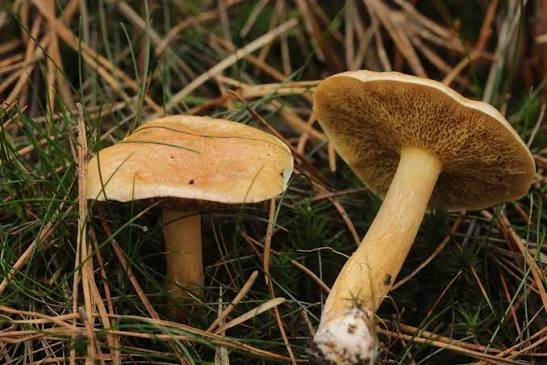
Suillus bovinus, commonly known as the Bovine Bolete, is a yellow-brown to orange-brown bolete that grows in association with pine. It has a sticky cap when wet, unusually large and irregular pores, and a ringless stem.
The most useful field pattern is yellow-brown sticky bolete + large angular pores + no ring + pine habitat. Compared with Slippery Jack and Weeping Bolete, it usually looks duller and has a more open, irregular pore surface.
⚠️ Important: Suillus bovinus is generally regarded as edible when correctly identified and properly cooked, but it is not considered one of the best-textured boletes. As with other Suillus, some people may experience gastrointestinal upset.
Quick Identification
| Feature | Suillus bovinus |
|---|---|
| Common name | Bovine Bolete |
| Cap color | Yellow-brown, ochre, orange-brown |
| Cap surface | Sticky when wet, less slimy when dry |
| Underside | Pores, not gills |
| Pore color | Yellow to olive-yellow |
| Pore shape | Large, angular, irregular |
| Stem | Pale yellow to brownish |
| Ring | Absent |
| Glandular dots | Usually weak or absent |
| Flesh | Pale yellow |
| Bruising | Little or no strong blue staining |
| Spore print | Olive-brown |
| Ecology | Mycorrhizal |
| Main host | Pine |
| Habitat | Pine woodland, heaths, sandy soils |
| Season | Summer to autumn |
| Edibility | Edible when correctly identified and cooked |
| Main look-alikes | Suillus granulatus, Suillus luteus, other pine boletes |
What Does Suillus bovinus Look Like?
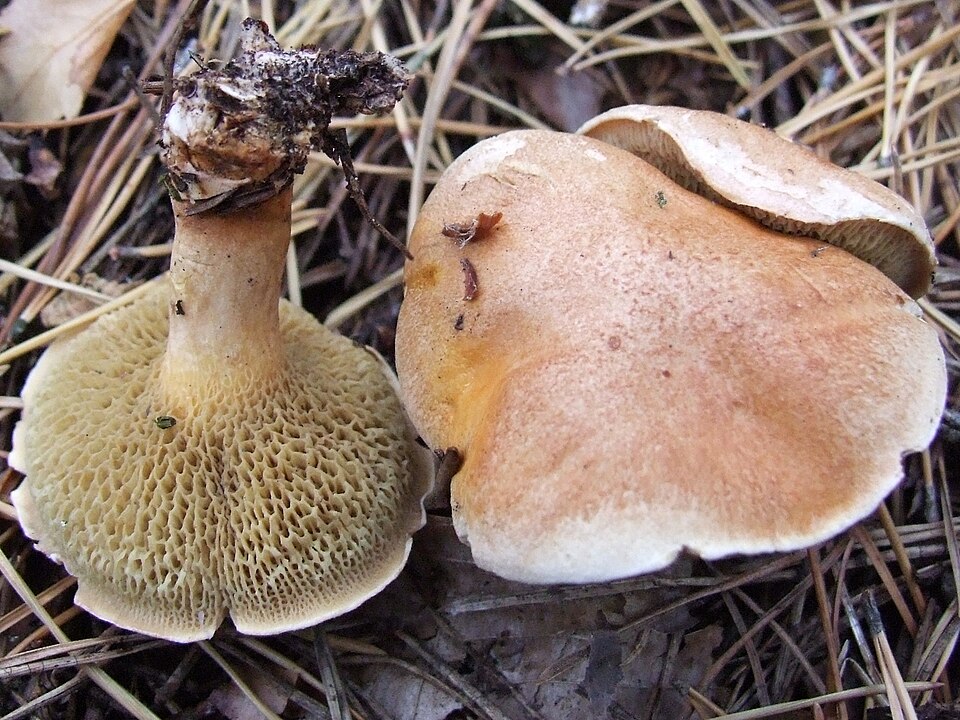
Bovine Bolete is usually more subdued in color than many other Suillus. The cap ranges from ochre and yellow-brown to orange-brown and can become sticky after rain.
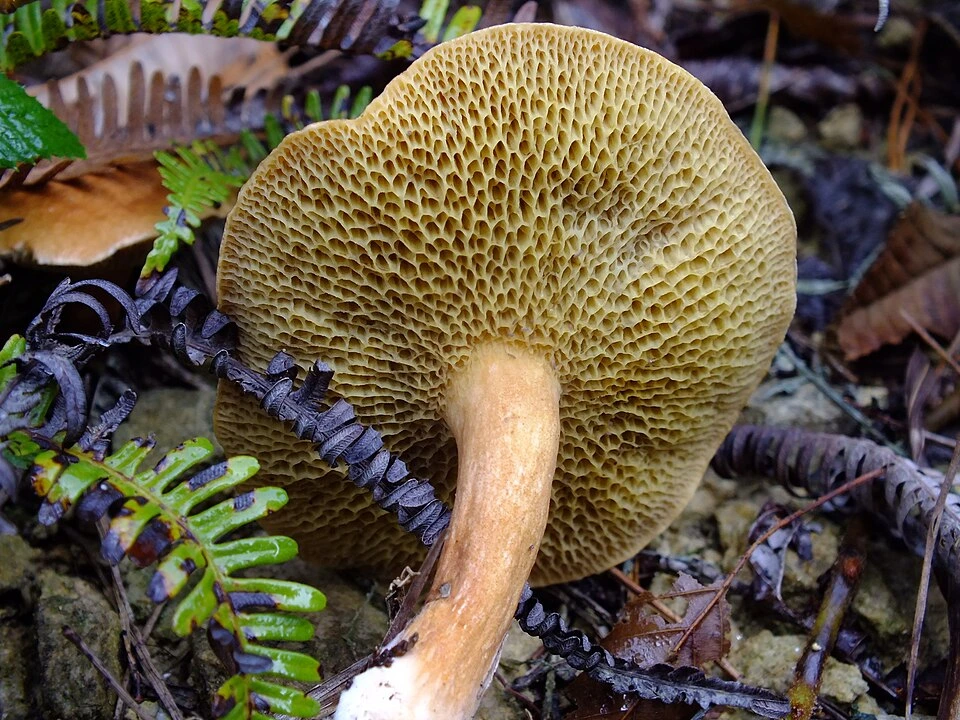
The underside is particularly distinctive. Instead of small round pores, S. bovinus often has broad, irregular, angular pores that can look almost stretched or maze-like.
Cap
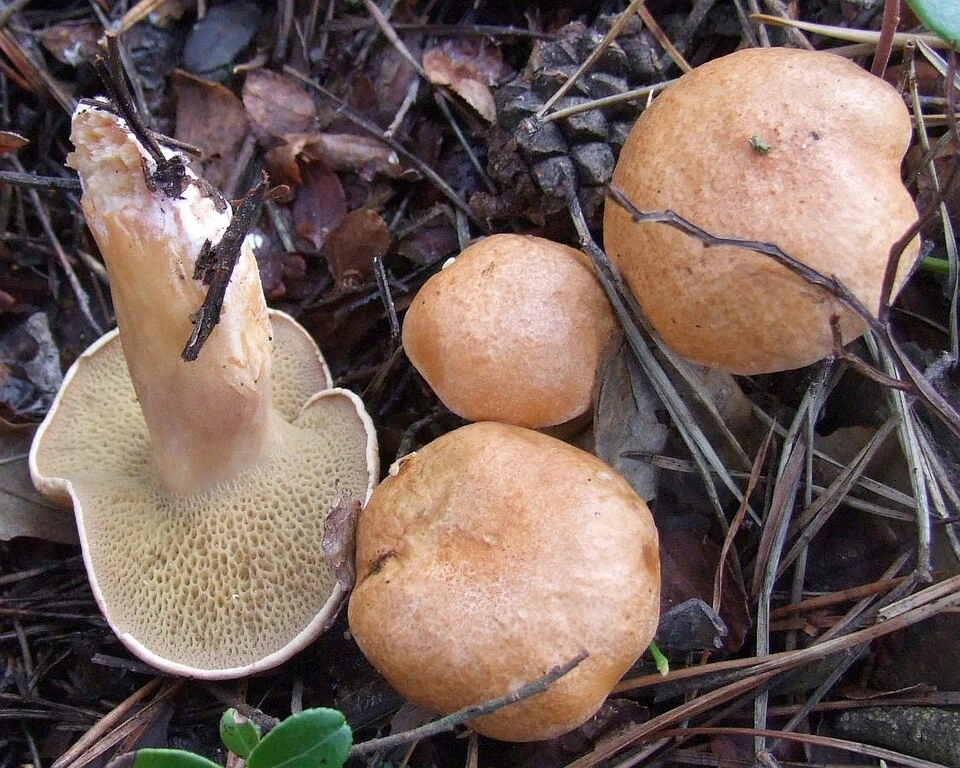
Young caps are convex and gradually flatten with age. Mature caps may become somewhat irregular or wavy.
The surface is smooth and sticky when wet but may dry to a more matte or slightly greasy finish. The color is usually dull yellow-brown rather than dark chocolate or bright orange.
Cap Color
Typical colors include ochre, tan, yellow-brown, orange-brown, and muted cinnamon. The center may be darker than the margin.
Weather can change the appearance significantly. Wet caps look darker and glossier, while dry specimens can appear pale and dull.
Sticky Cap
The cap is viscid in damp conditions, but usually not as dramatically slimy as Suillus luteus. In dry weather, the stickiness may be barely noticeable.
This makes pore structure and host tree more useful than cap texture alone.
Pores
The pore surface is one of the best identification features. Pores are yellow when fresh and often become more olive or brownish with age.
They are relatively large and angular rather than tiny and round. In older mushrooms, the pore surface can look almost honeycomb-like.
Tubes
The tubes are yellow and relatively short. They can become softer and darker as the mushroom matures.
In old specimens, the pore layer can become spongy and less attractive for cooking. Young fruit bodies are usually much firmer.
Stem
The stem is usually slender to moderately stout and often similar in color to the cap or slightly paler. It lacks a ring.
The surface is fairly plain compared with the glandular-dotted stem of Suillus granulatus. The base may become slightly darker with age.
No Ring
The absence of a ring is important. Suillus bovinus is a ringless species.
This immediately separates it from Suillus luteus, which has a conspicuous ring.
Flesh
The flesh is pale yellow to cream-yellow and relatively soft. It does not usually show strong blue staining after cutting.
The texture can become watery in older mushrooms. This is one reason the species is often considered lower quality than firmer boletes.
Smell
The smell is mild and not especially distinctive. It may be slightly earthy or mushroom-like.
Odor is not a major identification character. Pores, ring absence, and pine habitat are more useful.
Spore Print
The spore print is olive-brown. This is typical for many boletes.
A spore print can support the identification but is usually not necessary when the field characters are clear.
Where Does Suillus bovinus Grow?
Bovine Bolete is strongly associated with pine. It forms a mycorrhizal relationship with living pine roots.
It commonly grows in pine woodland, sandy soils, heaths, and nutrient-poor areas where suitable pines occur.
Pine Woodland
Pine habitat is the strongest ecological clue. The species often appears beneath Scots pine and other pines.
It can fruit in open woodland, forest edges, or heath-like environments. Several mushrooms may appear in loose groups or arcs.
Sandy and Acidic Soils
S. bovinus often favors acidic, sandy soils. This is one reason it is common in pine forests and heathland.
The habitat can look relatively poor in nutrients compared with richer deciduous woodland. Such ecological context helps distinguish it from unrelated boletes.
Season
The main fruiting period is summer through autumn. In mild regions, fruiting can continue late into the season.
Rainfall has a strong effect. After wet weather, the caps become more obviously sticky and fresh fruit bodies can appear in numbers.
Distribution
Suillus bovinus is widespread across Europe and northern Eurasia in association with pine. It is especially common where suitable pine forests are extensive.
Like several Suillus, it may also occur outside its original range where host pines have been introduced.
Is Suillus bovinus Edible?
Bovine Bolete is generally considered edible when correctly identified and thoroughly cooked. However, it is usually rated as mediocre rather than choice.
The flesh is soft and can become watery. Young firm specimens are better than older fruit bodies.
Should You Peel the Cap?
The cap skin can be removed if the surface is particularly sticky or dirty. This can improve texture.
Peeling is optional and does not affect identification. It should only be done after the mushroom has been confidently identified.
Should You Remove the Pore Layer?
Older pore layers can become soft and spongy. Removing them can improve the texture of mature specimens.
Young mushrooms usually have firmer pores and need less trimming.
Look-Alikes
The closest look-alikes are other pine-associated Suillus. Ring presence, pore size, glandular dots, and cap color are especially useful.
Suillus granulatus — Weeping Bolete
Identification
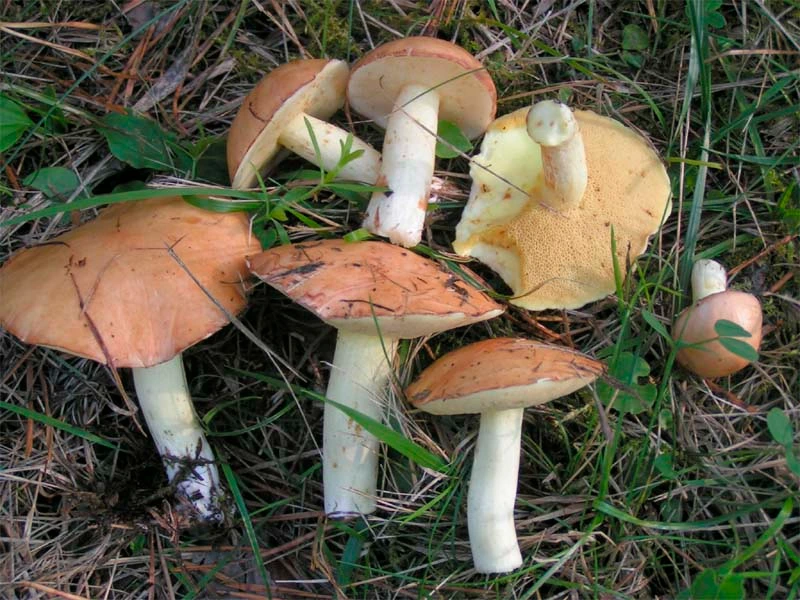
Suillus granulatus has a yellow-brown to orange-brown sticky cap and grows with pine. It also lacks a ring.
Young pores often produce small droplets, and the upper stem usually has distinct glandular dots.
Main Difference
Suillus bovinus has larger, more angular pores and a plainer stem. S. granulatus has smaller pores, pore droplets, and more obvious glandular dots.
Suillus luteus — Slippery Jack
Identification
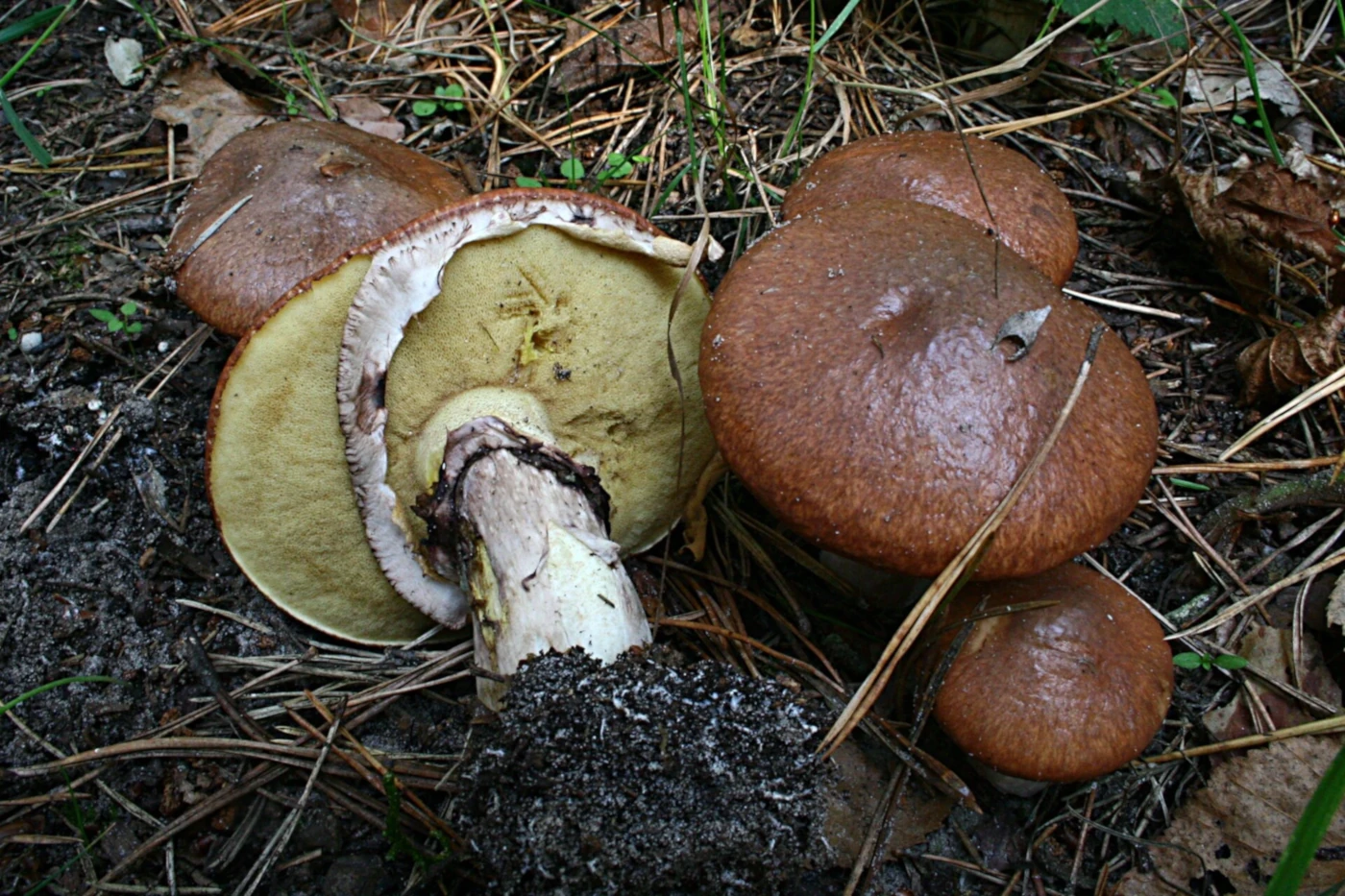
Suillus luteus has a dark brown, strongly slimy cap and yellow pores. It grows with pine.
The key difference is the distinct stem ring. The cap is also usually darker and much more obviously glutinous.
Main Difference
Ring present = Suillus luteus. Ring absent with large angular pores = Suillus bovinus.
Suillus variegatus — Velvet Bolete
Identification
Suillus variegatus also grows with pine but usually has a drier, more finely velvety cap. Blue staining can sometimes occur.
The pores are generally smaller and the cap texture less slimy.
Main Difference
A dry velvety cap and possible blue staining favor S. variegatus. Sticky cap and large irregular pores favor S. bovinus.
Other Pine Boletes
Identification
Several other boletes grow with pine and may have yellow pores. Some can overlap in cap color.
Check for reticulation, strong blue staining, red pores, or other stem markings. These features can point to completely different genera.
Main Difference
The combination of a ringless stem and broad angular pores is especially useful for Suillus bovinus.
Suillus bovinus vs Suillus granulatus
| Feature | Suillus bovinus | Suillus granulatus |
|---|---|---|
| Cap | Yellow-brown, sticky | Yellow-brown, sticky |
| Ring | Absent | Absent |
| Pores | Large, angular | Smaller, rounder |
| Droplets | Usually absent | Common in young specimens |
| Stem | Relatively plain | Glandular dots |
| Host | Pine | Pine |
| Best clue | Large irregular pores | Pore droplets + dots |
These two can grow in the same type of habitat. The pore structure is one of the fastest ways to separate them.
Suillus bovinus vs Suillus luteus
| Feature | Suillus bovinus | Suillus luteus |
|---|---|---|
| Cap | Ochre to orange-brown | Dark brown |
| Cap surface | Sticky | Very slimy |
| Ring | Absent | Present |
| Pores | Large, angular | Smaller |
| Host | Pine | Pine |
| Best clue | No ring + large pores | Ring + dark slimy cap |
The ring is the easiest distinction.
How to Identify Suillus bovinus
Start with the host tree. A yellow-brown bolete beneath pine is a good first clue.
Then check the stem for a ring. If there is no ring, examine the pore surface closely.
Large, irregular, angular pores combined with a relatively plain stem strongly support Suillus bovinus.
Young vs Mature Bovine Boletes
Young mushrooms usually have convex caps and bright yellow pores. The flesh is firmer and the pore surface more compact.
Mature specimens flatten, become softer, and develop increasingly large and irregular pores. Their caps may also lose much of the original stickiness.
How Rain Changes the Appearance
Rain darkens the cap and makes it look shinier and more viscid. Forest debris can stick to the surface.
Dry weather makes the cap much less distinctive. Under those conditions, the large pore openings become especially important for identification.
Common Identification Mistakes
One common mistake is calling every ringless pine Suillus Suillus granulatus. Several species lack rings.
Another mistake is relying on cap color alone. S. bovinus overlaps heavily in color with other yellow-brown Suillus species.
A third mistake is ignoring pore shape. The unusually large and irregular pores are one of the strongest characters of this species.
How to Photograph Suillus bovinus
Take a habitat photograph that includes nearby pine needles, cones, or the host tree. This documents the ecological association.
Then photograph the cap, underside, and complete stem. A close-up of the pores is especially valuable because pore shape is one of the main identification features.
Can AI Identify Bovine Bolete?
AI can often recognize a typical specimen when the large angular pores, ringless stem, and pine habitat are visible. Cap-only photographs are much less reliable.
Include an underside image whenever possible. This provides far more diagnostic information than the top of the cap.
Interesting Facts
The common name Bovine Bolete refers to the species’ traditional association with cattle in older naming traditions, although the mushroom itself has no special relationship with cows.
Its pore surface is unusually open for a Suillus. Mature specimens can develop a strikingly irregular pattern that looks very different from the fine sponge of many boletes.
Like other Suillus, the species forms a close ecological partnership with conifers. The visible mushroom is only the temporary fruiting body of a much larger underground mycorrhizal network.
The species can also fruit quite abundantly. Productive pine woodland may contain numerous fruit bodies spread over a relatively large area.
Frequently Asked Questions
Why is Suillus bovinus called Bovine Bolete?
It is an old common name and does not indicate a direct ecological relationship with cattle. The species is primarily associated with pine trees.
Does Suillus bovinus have a ring?
No. The stem is ringless, which helps separate it from Slippery Jack.
What do the pores look like?
They are relatively large, angular, and irregular. This is one of the most useful identification features.
Does it turn blue when cut?
Strong blue staining is not typical. If a specimen rapidly turns blue, another bolete may be more likely.
What trees does it grow with?
It is mainly associated with pine. Pine woodland and heath are typical habitats.
Is Suillus bovinus edible?
It is generally regarded as edible when correctly identified and properly cooked. However, its soft texture means it is not usually considered a choice edible.
How is it different from Suillus granulatus?
S. granulatus usually has smaller pores, glandular dots, and may produce droplets from young pores. S. bovinus has broader angular pores and a plainer stem.
How is it different from Slippery Jack?
Slippery Jack has a distinct stem ring and usually a darker, more strongly slimy cap. Bovine Bolete has no ring.
Final Identification Notes
Suillus bovinus is best recognized by the combination of a yellow-brown to orange-brown sticky cap, large angular yellow pores, ringless stem, little or no blue staining, and pine habitat.
The closest comparisons are Suillus granulatus and Suillus luteus. Pore shape, glandular dots, and ring presence usually separate them quickly.
The practical field pattern is: yellow-brown pine bolete + no ring + broad irregular pores = strong Suillus bovinus candidate.
Upload a photo and get possible matches in seconds.