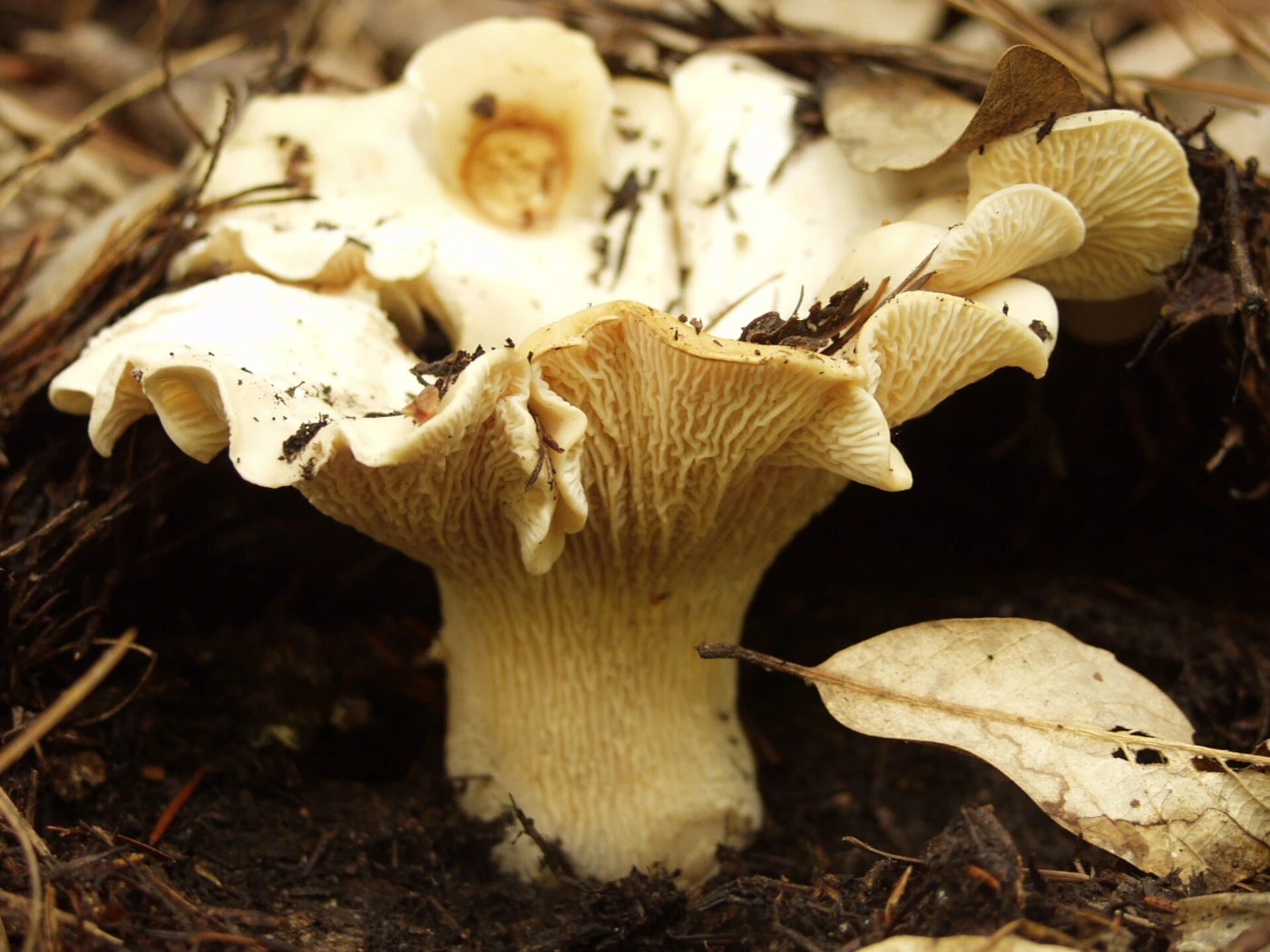
Cantharellus subalbidus, commonly known as the White Chanterelle, is a pale chanterelle native to western North America. It is recognized by its cream-white to ivory cap, thick blunt false gills, solid fleshy stem, and tendency to develop yellowish or brownish stains after handling or age.
The most useful field pattern is white to cream chanterelle + thick false gills + solid flesh + yellow-brown bruising + western conifer forest habitat. It can look very different from the familiar golden chanterelles, but its structure is unmistakably chanterelle-like once the underside is examined.
⚠️ Important: White color alone is not enough for identification. Several pale gilled mushrooms can look superficially similar, so always confirm the false-gill structure, solid stem, terrestrial growth near trees, and absence of a ring or volva.
Quick Identification
| Feature | Cantharellus subalbidus |
|---|---|
| Common name | White Chanterelle |
| Cap color | White, ivory, cream |
| Cap shape | Convex, later flat to funnel-shaped |
| Cap margin | Wavy or irregular with age |
| Underside | Thick false gills / ridges |
| Ridge color | White to cream |
| Stem | Solid, fleshy, pale |
| Ring | Absent |
| Volva | Absent |
| Flesh | White to cream, firm |
| Bruising | Yellowish to brownish |
| Smell | Mild to fruity |
| Spore print | Pale |
| Ecology | Mycorrhizal |
| Habitat | Conifer and mixed forest |
| Distribution | Western North America |
| Season | Mainly autumn to winter |
| Edibility | Edible when correctly identified |
| Main look-alikes | Pale chanterelles, Oyster-like mushrooms, white Amanita, Leucopaxillus |
What Does Cantharellus subalbidus Look Like?
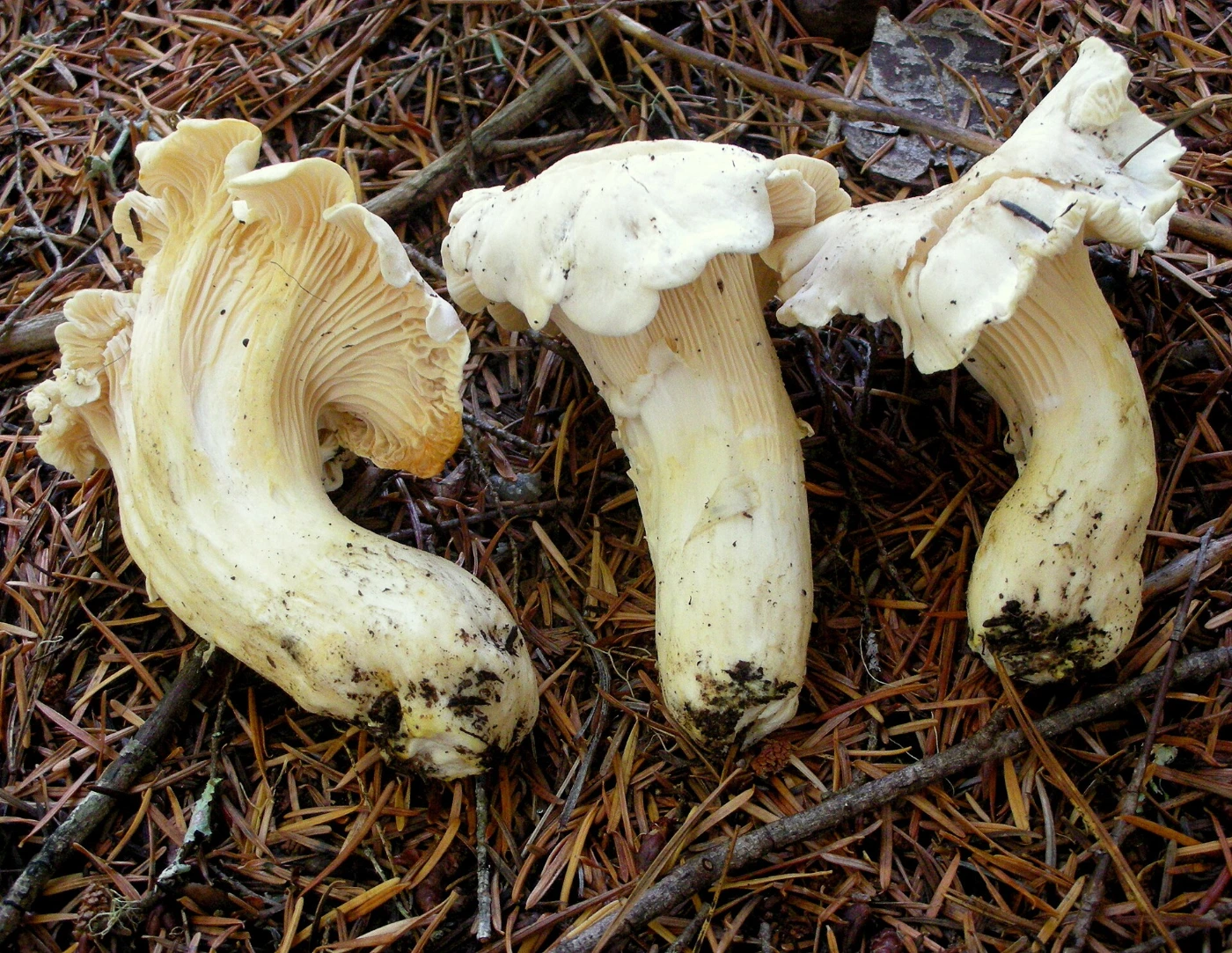
White Chanterelle has the same general architecture as other true chanterelles, but the fruit body is much paler. Fresh specimens may be almost pure white, while older mushrooms often develop cream, yellowish, or brownish tones.
The cap is thick and fleshy rather than thin or delicate. Mature fruit bodies often become broad and irregular, with wavy margins and a shallow central depression.
Cap
Young caps are convex and relatively smooth. As the mushroom matures, the center can flatten or become slightly depressed.
The margin often becomes lobed or wavy. Mature fruit bodies can develop an asymmetrical, irregular shape that is typical of many chanterelles.
Cap Color
The cap is usually white to ivory when fresh. Cream or pale buff tones can appear with age.
Handling and weathering can produce yellowish or brownish stains. These discolorations are especially useful because they help distinguish the mushroom from some uniformly white look-alikes.
False Gills
The underside is one of the most important identification features. Instead of thin blade-like true gills, Cantharellus subalbidus has thick, blunt ridges that run down the stem.
These ridges may fork and cross-connect. They are part of the flesh of the mushroom rather than separate delicate blades.
Why False Gills Matter
False gills immediately place the mushroom in the chanterelle-like group. Thin, sharp, crowded gills point toward a completely different fungus.
This distinction is more reliable than color. A white mushroom with true gills should not be identified as White Chanterelle.
Stem
The stem is solid, fleshy, and usually tapers gradually into the cap. There is no abrupt boundary between stem and cap.
The color is white to cream and may yellow or brown after handling. There is no ring and no volva.
Flesh
The flesh is firm, dense, and pale throughout. It is more substantial than the flesh of many thin white woodland mushrooms.
When cut, the interior remains pale but may slowly develop yellowish or brownish discoloration. The stem is solid rather than hollow.
Bruising and Staining
One of the useful characters is the tendency of damaged areas to become yellowish, buff, or brownish. This can appear on the cap, ridges, or stem.
The reaction is not usually dramatic or instant. It develops more gradually than the blue bruising seen in many boletes.
Smell
Fresh White Chanterelles can have a mild fruity or apricot-like smell, similar to other chanterelles. The aroma may be subtle.
Odor should be treated as supporting evidence only. False gills, texture, and habitat are much stronger characters.
Spore Print
The spore print is pale, usually cream to faintly yellowish or pinkish. This matches the general pale appearance of the mushroom.
A spore print is rarely necessary when the structural characters are obvious. It becomes more useful when comparing unusual pale gilled mushrooms.
Where Does Cantharellus subalbidus Grow?
White Chanterelle is a mycorrhizal mushroom associated with living trees. It grows from soil rather than directly from logs or stumps.
It occurs mainly in western North American forests, especially in coniferous and mixed woodland. Douglas fir, hemlock, pine, madrone, and other regional trees can be important depending on location.
Pacific Northwest
The Pacific Northwest is one of the strongest regions for White Chanterelle. Moist conifer forests provide suitable habitat during the cool wet season.
The species can occur alongside other chanterelles, including Pacific Golden Chanterelle. Mixed chanterelle fruitings are therefore possible in productive forest.
Northern California
White Chanterelle also occurs in northern California and other parts of the western coast. Fruiting is strongly influenced by autumn and winter rainfall.
In California, the species is especially relevant after the dry season ends. November through winter can be productive in suitable coastal and northern habitats.
Season
White Chanterelle is mainly a late-season mushroom. Fruiting commonly occurs from autumn into winter.
Exact timing depends on rainfall, elevation, and coastal influence. In mild western forests, fruiting may continue after many other mushrooms have disappeared.
Distribution
Cantharellus subalbidus is a western North American species. It is not simply a white form of the European Cantharellus cibarius.
This regional distinction is important. White chanterelles in Europe and western North America should not automatically be given the same species name.
Is Cantharellus subalbidus Edible?
White Chanterelle is generally regarded as edible when correctly identified and in good condition. It is valued similarly to other true chanterelles.
The flesh is firm and works well in sautés, sauces, soups, and other cooked dishes. Older specimens can become tough, waterlogged, or insect-damaged.
Look-Alikes
The main look-alikes are other pale chanterelles and white woodland mushrooms. The false-gill structure is the most important first step in separating them.
Cantharellus formosus — Pacific Golden Chanterelle
Identification
Pacific Golden Chanterelle has a yellow to orange-yellow cap rather than a white one. Its underside has the same thick chanterelle ridges.
It occurs in similar western conifer forests and can overlap in season. Structurally the two species are very similar.
Main Difference
Color is the easiest distinction. C. formosus is golden-orange, while C. subalbidus is white to cream.
Cantharellus californicus — California Chanterelle
Identification
California Chanterelle is a large golden species strongly associated with oak woodland. It can become much larger and heavier than White Chanterelle.
Its cap and ridges are yellow to orange rather than white. Habitat also differs, especially in California.
Main Difference
Oak habitat plus golden coloration favors C. californicus. Conifer forest plus pale white coloration favors C. subalbidus.
Pale Forms of Other Chanterelles
Identification
Some normally yellow chanterelles can fade considerably in dry or old conditions. This can make them look much paler than expected.
Check whether the mushroom is uniformly white from youth or simply faded with age. Regional ecology and staining behavior can help.
Main Difference
True White Chanterelle is naturally pale rather than merely weathered. It often develops yellow-brown bruising on an otherwise ivory fruit body.
Leucopaxillus Species
Identification
Some Leucopaxillus species are large, pale, and grow from soil in woodland. Their caps can be white or cream.
The underside has true gills rather than blunt chanterelle ridges. The flesh may also be tougher or more fibrous.
Main Difference
Thin blade-like gills point toward Leucopaxillus. Thick fleshy ridges favor White Chanterelle.
White Amanita Species
Identification
White Amanita can be pale, fleshy, and woodland-associated. Dangerous destroying angels may be almost entirely white.
They have true gills, usually a stem ring, and often a volva at the base. These features are absent in Cantharellus subalbidus.
Main Difference
Ring, volva, and true white gills indicate Amanita. White Chanterelle has no ring or volva and has false gills.
Oyster-Like Mushrooms
Identification
Some pale wood-growing mushrooms can resemble white chanterelles from above. Oyster Mushrooms, Angel Wings, and other shelf fungi may have fan-shaped pale caps.
They grow directly from wood and usually have true gills. White Chanterelle grows from soil near trees.
Main Difference
Direct growth from a log or stump rules out Cantharellus subalbidus.
White Chanterelle vs Pacific Golden Chanterelle
| Feature | Cantharellus subalbidus | Cantharellus formosus |
|---|---|---|
| Cap | White to cream | Yellow to orange |
| False gills | White to cream | Yellow-orange |
| Bruising | Yellow-brown | May discolor but remains golden |
| Habitat | Western conifer forest | Western conifer forest |
| Stem | Pale, solid | Yellowish, solid |
| Best clue | Naturally white fruit body | Golden-orange coloration |
The two can share habitat and season. Overall color is usually enough to separate typical specimens.
White Chanterelle vs White Amanita
| Feature | White Chanterelle | White Amanita |
|---|---|---|
| Underside | False gills | True gills |
| Ring | Absent | Often present |
| Volva | Absent | Often present |
| Stem | Solid, blends into cap | More clearly separated |
| Ecology | Mycorrhizal | Mycorrhizal |
| Spore color | Pale | White |
| Best clue | Thick blunt ridges | Ring + volva + true gills |
This is an important safety comparison. Any pale mushroom with true gills should be examined carefully before being considered a chanterelle.
How to Identify Cantharellus subalbidus
Start with the underside. Thick blunt ridges that fork and run down the stem strongly support a chanterelle identification.
Then check the color and flesh. A naturally white to cream fruit body with solid firm flesh and yellow-brown staining fits C. subalbidus well.
Finally, consider geography and habitat. Western North American conifer or mixed forest strongly supports the species.
Young vs Mature White Chanterelles
Young mushrooms are usually compact and pale, with rounded caps and relatively shallow ridges. The margins may remain tucked downward.
Mature fruit bodies become broader and more funnel-shaped. Wavy margins and yellow-brown discoloration become more obvious with age.
How Weather Changes the Appearance
Wet weather can make the cap slightly darker or more cream-colored. Mud and forest debris may also cling to the pale surface.
Dry weather can cause edges to crack or curl. Older exposed mushrooms may appear much more yellow or brown than fresh ones.
Common Identification Mistakes
One common mistake is assuming that every white chanterelle-like mushroom is simply a pale Cantharellus cibarius. Western North America has its own distinct species.
Another mistake is identifying by cap color without checking the underside. True gills immediately point away from Cantharellus.
A third mistake is ignoring the substrate. White Chanterelles grow from soil in association with trees, not directly from dead wood.
How to Photograph Cantharellus subalbidus
Take a habitat photograph before picking the mushroom. Include surrounding needles, leaves, and nearby trees if possible.
Then photograph the underside and full stem. A side view showing the blunt ridges and their continuation down the stem is especially useful.
Can AI Identify White Chanterelle?
AI can often recognize typical specimens when the pale cap, false gills, solid stem, and western forest habitat are visible. Exact confidence improves when geography and host trees are provided.
A top-down photo alone is much less useful. White woodland mushrooms are too diverse for reliable identification from cap color only.
Interesting Facts
White Chanterelle is one of the clearest examples of how diverse the genus Cantharellus really is. Not all chanterelles are yellow or orange.
Its pale fruit bodies often become more colorful after handling. Yellowish and brownish stains can appear on areas that were initially almost pure white.
The species is also strongly regional. It is characteristic of western North America rather than being a pale version of a European chanterelle.
Like other chanterelles, it cannot be separated from its ecology. The fungus lives in partnership with tree roots, and the visible mushroom appears only when seasonal moisture and temperature become suitable.
Frequently Asked Questions
Why is Cantharellus subalbidus called White Chanterelle?
Fresh fruit bodies are naturally white to cream rather than golden-yellow. This pale coloration is one of the most obvious features of the species.
Does White Chanterelle have true gills?
No. It has thick blunt ridges, or false gills, that run down the stem.
Does it turn yellow when handled?
It can develop yellowish or brownish stains after bruising, handling, or age. This reaction is useful for identification.
Where does White Chanterelle grow?
It occurs in western North America, mainly in coniferous and mixed woodland. The Pacific Northwest and northern California are important regions.
Does it grow on logs?
No. True chanterelles grow from soil in mycorrhizal association with living trees.
Is White Chanterelle edible?
Yes, it is generally regarded as edible when correctly identified and properly cooked. Only fresh, sound specimens should be used.
How is it different from Pacific Golden Chanterelle?
White Chanterelle is naturally ivory to cream, while Pacific Golden Chanterelle is yellow to orange. Both have similar false-gill structure.
Can it be confused with a white Amanita?
From above, pale woodland mushrooms can be confusing. Amanitas have true gills and may have a ring and volva, while White Chanterelle has blunt false gills and lacks both structures.
Final Identification Notes
Cantharellus subalbidus is best recognized by the combination of a white to cream fleshy cap, thick blunt false gills, solid pale stem, yellow-brown bruising, and western North American forest habitat.
The most important comparisons are other chanterelles and pale white woodland mushrooms. False-gill structure, substrate, ring absence, and western geography usually separate the species effectively.
The practical field pattern is: white fleshy chanterelle + blunt decurrent ridges + solid stem + yellow-brown staining + western conifer forest = strong Cantharellus subalbidus candidate.
Upload a photo and get possible matches in seconds.