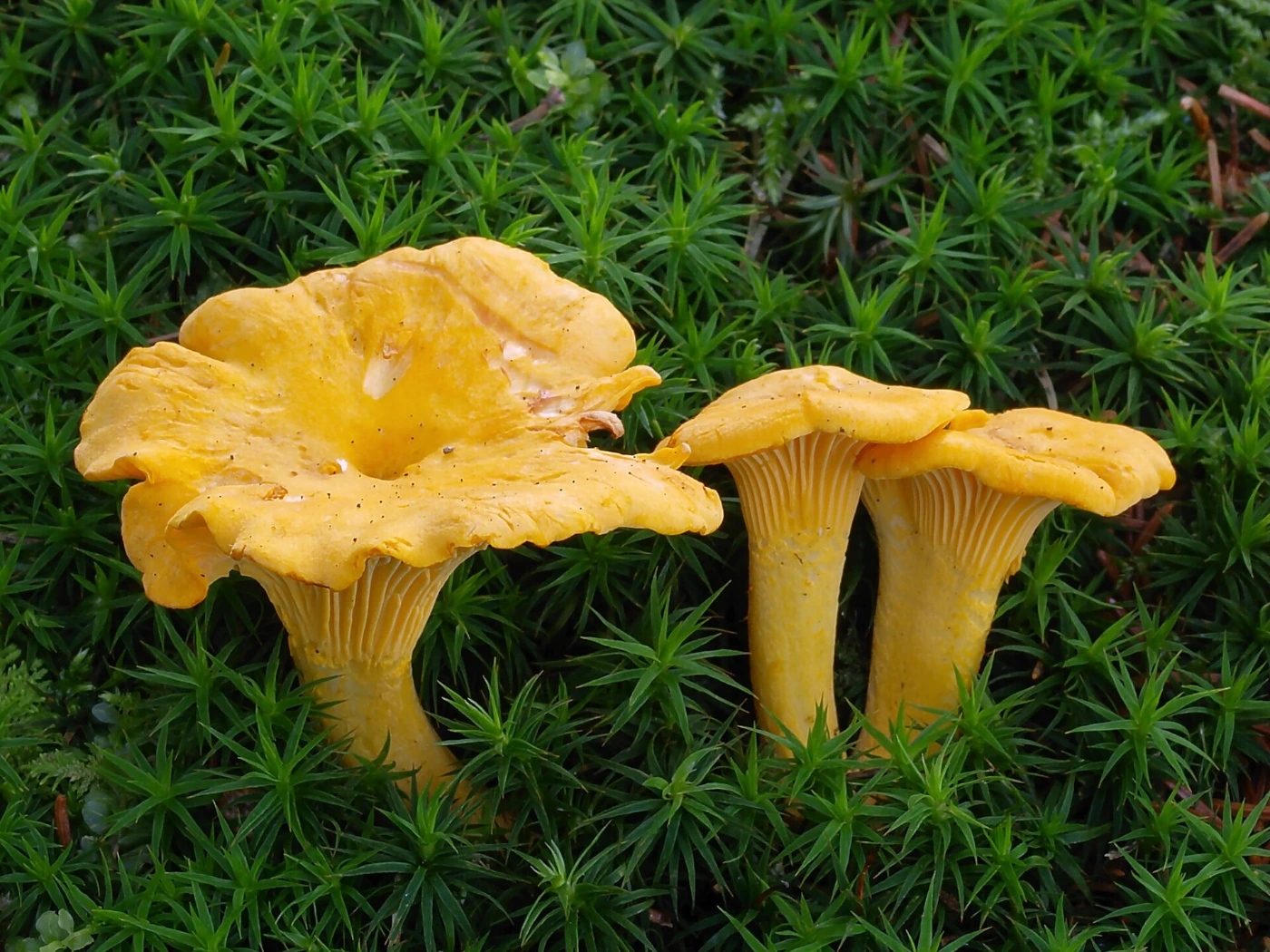
Cantharellus cibarius, commonly known simply as the Chanterelle or Golden Chanterelle, is one of the best-known edible wild mushrooms in Europe. It is recognized by its yellow to golden cap, thick blunt false gills, solid flesh, and mycorrhizal growth near living trees.
The most useful field pattern is golden fleshy mushroom + thick forked false gills + solid stem + growth from soil in woodland. Cap color can vary, but the underside structure is much more reliable than shade alone.
⚠️ Important: Not every golden chanterelle is Cantharellus cibarius. North America has multiple regional chanterelle species, including Cantharellus formosus, C. californicus, and others, so geography matters.
Quick Identification
| Feature | Cantharellus cibarius |
|---|---|
| Common name | Chanterelle / Golden Chanterelle |
| Cap color | Yellow to golden-yellow |
| Cap shape | Convex, later flat to funnel-shaped |
| Cap margin | Wavy or irregular with age |
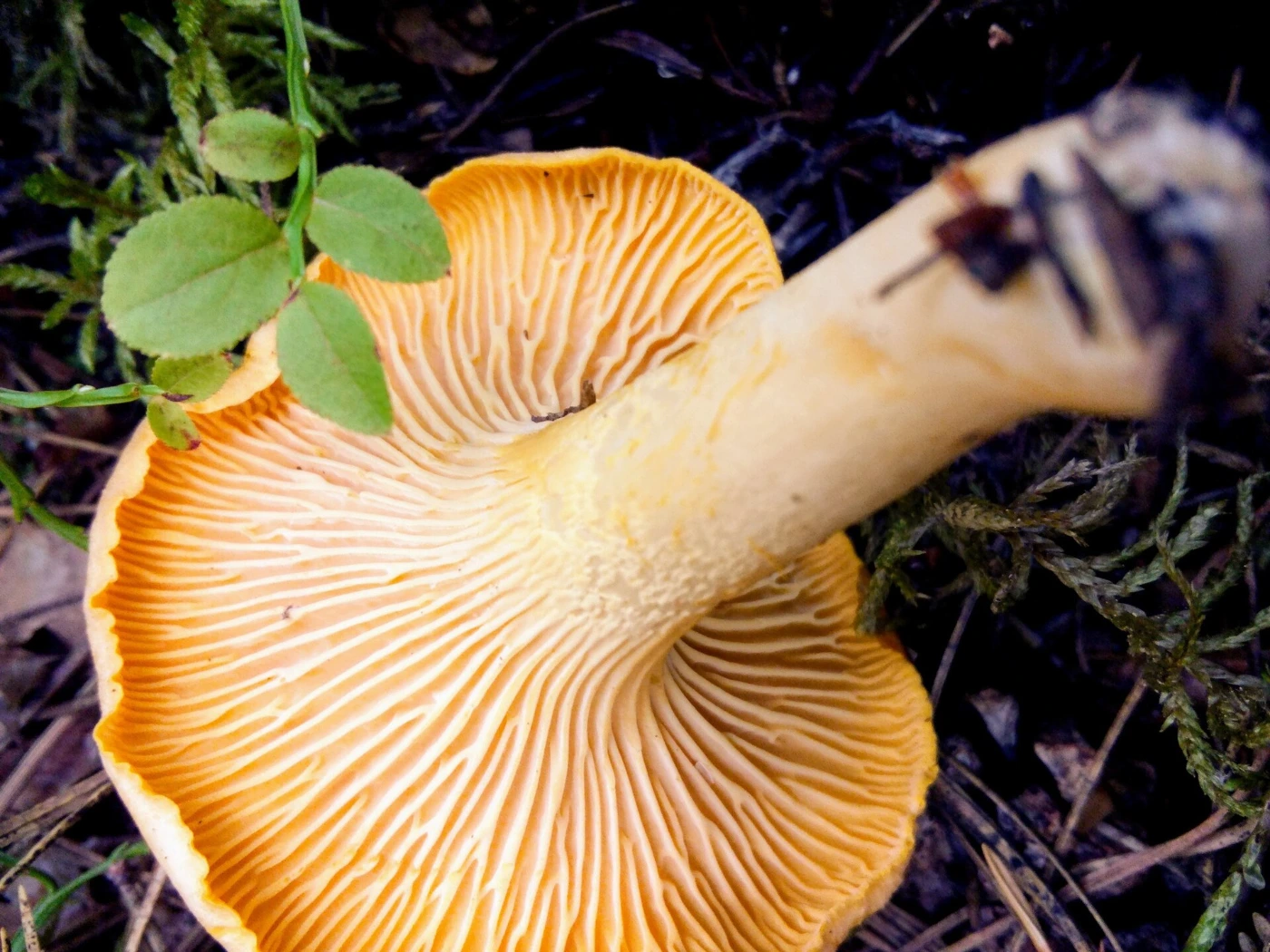
| Underside | False gills / blunt ridges |
| Ridges | Forked, decurrent |
| Stem | Solid, yellow to pale yellow |
| Ring | Absent |
| Volva | Absent |
| Flesh | White to pale cream |
| Smell | Often fruity, apricot-like |
| Spore print | Pale cream to yellowish |
| Ecology | Mycorrhizal |
| Habitat | Deciduous and coniferous woodland |
| Common hosts | Beech, oak, birch, pine, spruce |
| Season | Summer to autumn |
| Distribution | Mainly Europe and nearby regions |
| Edibility | Edible when correctly identified |
| Main look-alikes | False Chanterelle, Jack-O’-Lantern, other Cantharellus |
What Does Cantharellus cibarius Look Like?
The Chanterelle is a fleshy yellow mushroom with a smooth cap and distinctive underside. Young specimens are rounded or convex, while mature ones become flatter and often develop a depressed center.
The cap and stem usually form one continuous shape rather than looking sharply separated. Mature mushrooms often become irregular, with wavy or lobed margins.
Cap
The cap is yellow to egg-yolk yellow and usually smooth. It may be slightly paler in dry conditions or darker when wet.
Young caps are convex with rolled margins. As they mature, the center flattens or becomes shallowly funnel-shaped.
Cap Color
Typical C. cibarius is golden-yellow, but individual mushrooms can range from pale yellow to deeper orange-yellow. Weather and age can alter the intensity considerably.
Color alone should never be used to identify the species. Several unrelated orange and yellow mushrooms can look very similar from above.
False Gills
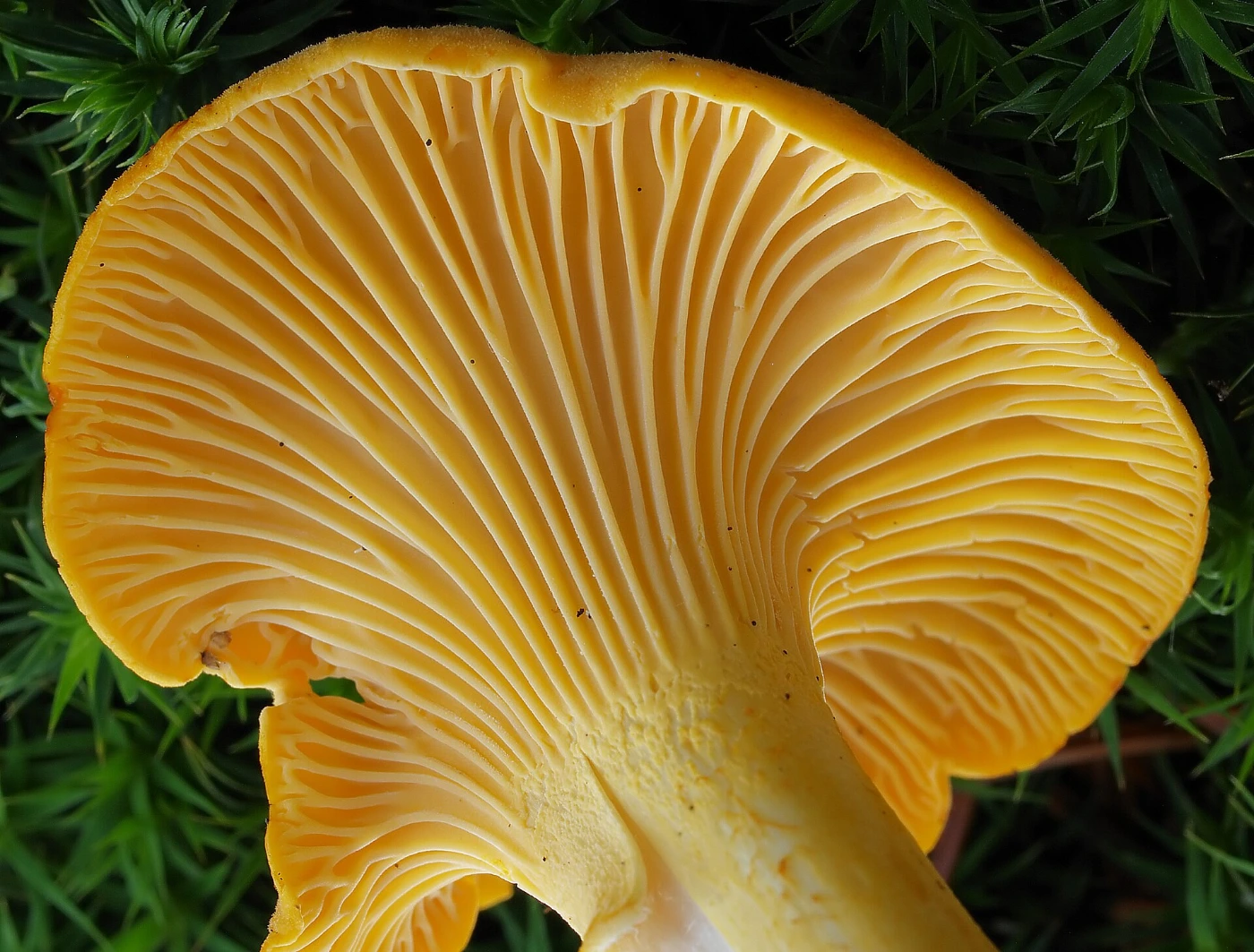
The underside is the most important feature. Instead of thin blade-like gills, Cantharellus cibarius has thick, blunt ridges that run down the stem.
These ridges frequently fork and cross-connect. They are part of the flesh of the mushroom rather than separate structures attached beneath the cap.
Why False Gills Matter
False gills separate true chanterelles from some of their most important look-alikes. False Chanterelle has thin true gills, even though they can be repeatedly forked.
Jack-O’-Lantern mushrooms also have true gills. A careful underside view is therefore much more useful than cap color.
Stem
The stem is solid, fleshy, and usually similar in color to the cap or slightly paler. It often widens gradually upward into the cap.
There is no ring and no volva. The stem should not be hollow in a typical mature C. cibarius.
Flesh
The flesh is firm and pale, usually white to cream inside. It does not normally show dramatic color changes when cut.
Its texture is relatively dense compared with many soft gilled mushrooms. This firmness contributes to the species’ culinary value.
Smell
Fresh Chanterelles often have a mild fruity aroma frequently compared with apricots. The smell can be subtle in some specimens.
Odor is useful supporting evidence, but it is not strong enough to identify the species by itself.
Spore Print
The spore print is pale, typically cream to yellowish. It is much lighter than the darker prints produced by many unrelated gilled mushrooms.
A spore print is rarely necessary when the false gills and ecology are clear. It becomes more useful when dealing with unusual or damaged specimens.
Where Does Cantharellus cibarius Grow?
Cantharellus cibarius grows from soil in association with living trees. It is mycorrhizal and does not grow as a decomposer directly from dead wood.
The species occurs in both deciduous and coniferous woodland. Tree association varies by region.
Deciduous Woodland
Beech and oak woodland are classic habitats. Chanterelles may appear among moss, leaf litter, and relatively open forest soil.
Birch can also be associated with fruiting. Productive patches may return to the same woodland areas over multiple seasons.
Coniferous Woodland
The species can also occur with pine, spruce, and other conifers in parts of Europe. Forest type therefore does not have to be broadleaf-only.
Soil, moisture, and local host trees influence abundance. Some regions are much more productive than others.
Season
The main season is summer through autumn. Fruiting often begins after periods of sustained rain and continues while soil remains moist.
In warmer regions, fruiting can start earlier. In cooler or northern areas, late summer and autumn may be more important.
Distribution
Cantharellus cibarius is primarily a European species in the modern narrower sense. It is widespread across much of Europe.
Older field guides often used the name more broadly for golden chanterelles in North America. Modern taxonomy has shown that many of those collections belong to other species.
Not Every Golden Chanterelle Is Cantharellus cibarius
This is one of the most important taxonomic points for international identification. A golden chanterelle in Oregon, California, or eastern North America should not automatically be labeled C. cibarius.
Regional species include Cantharellus formosus in the Pacific Northwest and Cantharellus californicus in California. Exact identification should always take geography into account.
Is Cantharellus cibarius Edible?
Yes, Cantharellus cibarius is widely regarded as an excellent edible mushroom when correctly identified and properly cooked. It has a long history of culinary use across Europe.
Its firm flesh and fruity aroma work well in sautés, sauces, soups, and other cooked dishes. Older specimens can become tougher or more insect-damaged.
Look-Alikes
The main look-alikes are orange or yellow mushrooms that share a similar funnel-shaped profile. The underside structure and growth substrate usually provide the fastest separation.
Hygrophoropsis aurantiaca — False Chanterelle
Identification
False Chanterelle has an orange to yellow-orange cap and frequently grows in coniferous woodland. From above, it can resemble a true chanterelle closely.
The underside has thin, crowded, repeatedly forked true gills. These are much sharper and more delicate than the blunt ridges of Cantharellus cibarius.
Main Difference
Thick fleshy false gills = true chanterelle. Thin blade-like forked gills = False Chanterelle.
Omphalotus Species — Jack-O’-Lantern
Identification
Jack-O’-Lantern mushrooms are orange and can form large clusters. They have true gills and grow directly from wood, stumps, roots, or buried woody material.
Several Omphalotus species are poisonous and can cause severe gastrointestinal symptoms. Their clustered growth habit is often striking.
Main Difference
Growth from wood + true gills + dense clusters = Omphalotus. Growth from soil + false gills = Cantharellus.
Cantharellus pallens — Pale Chanterelle
Identification
Cantharellus pallens is generally paler and often has a whitish bloom over the cap when young. It can grow in similar European broadleaf woodland.
Its underside is chanterelle-like, with thick false gills. The difference can be subtle in older specimens.
Main Difference
A paler, whitish-bloomed young cap supports C. pallens. Classic golden coloration is more typical of C. cibarius.
Cantharellus amethysteus — Amethyst Chanterelle
Identification
Amethyst Chanterelle has violet or purplish scales on the cap surface. These can be strongest when the mushroom is young.
The underside remains yellow and chanterelle-like. The unusual purple surface pattern is the easiest clue.
Main Difference
Purplish cap scales point toward C. amethysteus. A smoother golden cap fits C. cibarius.
Cantharellus formosus — Pacific Golden Chanterelle
Identification
Pacific Golden Chanterelle is a western North American species with yellow-orange colors and false gills. It can look broadly similar to European C. cibarius.
Its geography is the main distinction. It is associated with Pacific Northwest conifer forests.
Main Difference
Western North America strongly favors C. formosus, not C. cibarius.
Chanterelle vs False Chanterelle
| Feature | Cantharellus cibarius | Hygrophoropsis aurantiaca |
|---|---|---|
| Underside | Thick false gills | Thin true gills |
| Gill/ridge shape | Blunt, fleshy | Sharp, crowded |
| Forking | Common | Very common |
| Flesh | Firm | Softer |
| Ecology | Mycorrhizal | Saprotrophic |
| Best clue | False gills | True gills |
Forking alone is not enough. Both mushrooms can show branching, so ridge thickness and structure are more important.
Chanterelle vs Jack-O’-Lantern
| Feature | Cantharellus cibarius | Omphalotus spp. |
|---|---|---|
| Underside | False gills | True gills |
| Growth | Soil near trees | Wood or buried roots |
| Clusters | Scattered or loose groups | Often dense clusters |
| Flesh | Pale inside | Orange-yellow |
| Toxicity | Edible when correctly identified | Poisonous |
| Best clue | Blunt ridges | Thin true gills |
This is the most important dangerous comparison. Always check both underside and substrate.
How to Identify Cantharellus cibarius
Start with the underside. Thick blunt ridges that fork and run down the stem strongly support a true chanterelle.
Then check the stem and flesh. The mushroom should be solid, fleshy, and pale inside.
Finally, consider geography. In Europe, a typical golden chanterelle may fit C. cibarius, while North American specimens often belong to other species.
Young vs Mature Chanterelles
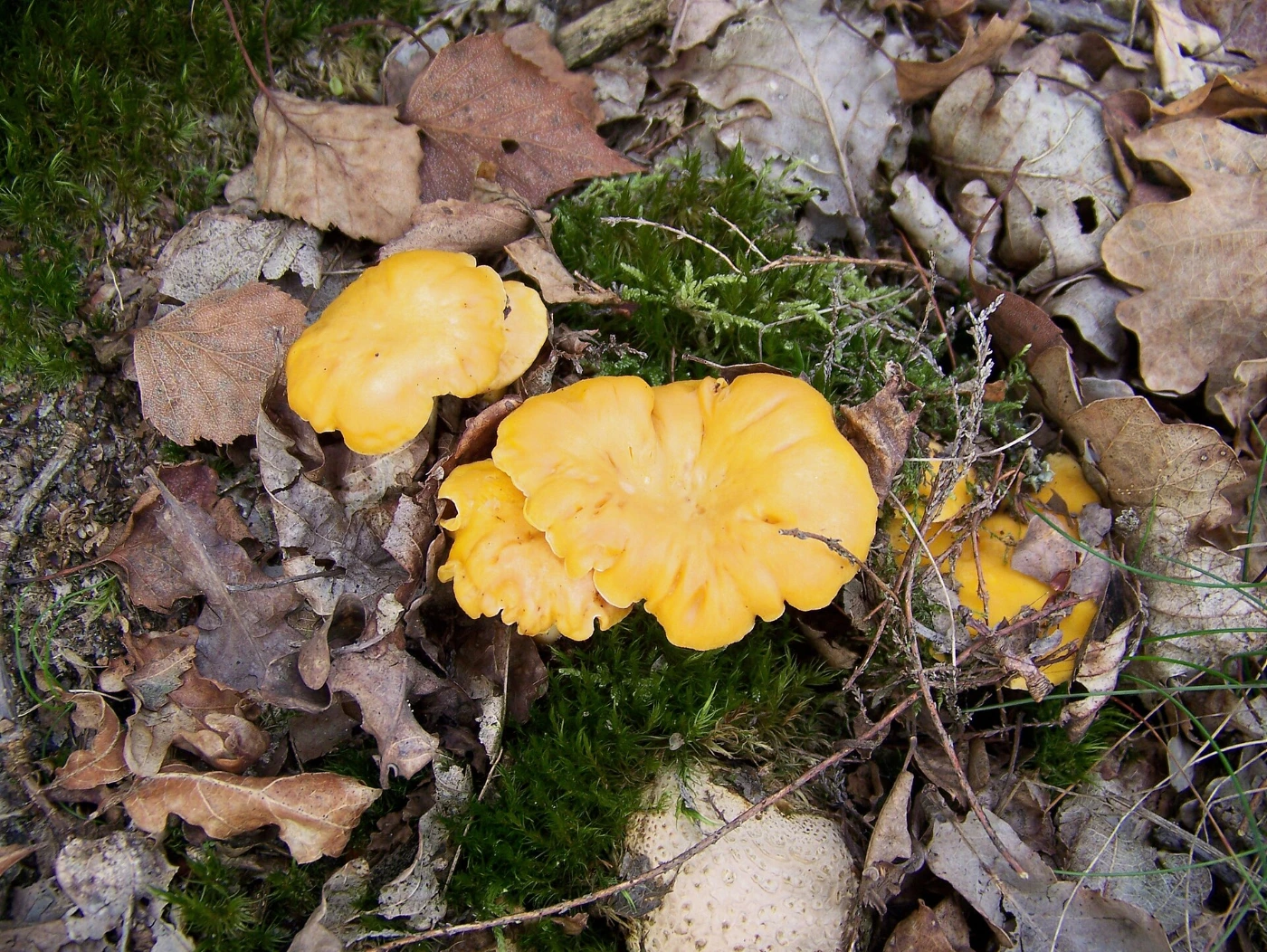
Young mushrooms are compact and often have a rounded cap with a tucked margin. Their false gills may still be shallow.
Mature specimens become wider, flatter, and more irregular. The edges often turn wavy, and the false gills become more pronounced.
How Weather Changes the Appearance
Rain can deepen the yellow color and make the mushroom look more saturated. Dry weather can fade the cap toward pale yellow.
Old specimens may also become stained or brownish along the edges. This is why structural characters are more reliable than exact cap color.
Why Chanterelles Return to the Same Places
The underground mycelium can remain associated with the same trees for many years. Fruiting occurs only when moisture and temperature become suitable.
This is why productive patches can return repeatedly. The exact location may shift as the fungal network expands through the soil.
Why Chanterelles Appear After Rain
Rain restores moisture to the soil and helps trigger fruit body development. A single brief shower may not be enough if the woodland is very dry.
Sustained or repeated rainfall usually produces better conditions. Soil moisture matters more than surface wetness alone.
Common Identification Mistakes
One common mistake is calling every golden chanterelle Cantharellus cibarius. This is particularly inaccurate in North America.
Another mistake is using cap color alone. False Chanterelle and Jack-O’-Lantern can both be orange or yellow.
A third mistake is relying on forking. True and false chanterelle structures can both fork, but only true chanterelles have thick blunt ridges.
How to Photograph Cantharellus cibarius
Take a habitat photo before picking the mushroom. Include surrounding trees, leaf litter, moss, and soil.
Then photograph the underside and full stem. A close side view showing the false gills is usually the most useful image for identification.
Can AI Identify Cantharellus cibarius?
AI can often recognize a true chanterelle when the false gills, solid stem, and woodland habitat are visible. Species-level confidence depends strongly on geography.
A golden chanterelle from North America should not automatically be labeled C. cibarius. Regional species information is essential.
Interesting Facts
Chanterelles are difficult to cultivate on a commercial scale because they depend on living tree roots. This is very different from saprotrophic mushrooms such as Oyster Mushrooms.
Their famous apricot-like scent is produced by volatile aromatic compounds. The strength varies between individual mushrooms and weather conditions.
The false gills are not ordinary gills that have simply become thicker. They are folds of the fertile surface integrated into the mushroom’s flesh.
The species name cibarius refers to food or edibility. This reflects the mushroom’s long-standing reputation as an important edible species.
Frequently Asked Questions
Is Cantharellus cibarius the same as every Golden Chanterelle?
No. The name is most appropriate for European populations, while North America contains several other golden chanterelle species.
Does Cantharellus cibarius have true gills?
No. It has thick blunt false gills that run down the stem.
What does a Chanterelle smell like?
Fresh specimens often have a mild fruity smell compared with apricots. The scent may be weak in old or dry mushrooms.
Does it grow on wood?
No. It grows from soil in mycorrhizal association with living trees.
What trees does it grow with?
Beech, oak, birch, pine, spruce, and other trees can serve as hosts depending on region.
Is Cantharellus cibarius edible?
Yes, it is considered an excellent edible mushroom when correctly identified and properly cooked.
How can you distinguish it from False Chanterelle?
Check the underside. C. cibarius has thick blunt ridges, while False Chanterelle has thin blade-like true gills.
What is the most dangerous look-alike?
Jack-O’-Lantern mushrooms are the most important poisonous comparison. They have true gills and usually grow in clusters from wood or buried roots.
Final Identification Notes
Cantharellus cibarius is best recognized by the combination of a golden-yellow fleshy cap, thick blunt false gills, solid stem, pale interior, fruity odor, and terrestrial growth in European woodland.
The most important look-alikes are False Chanterelle and Jack-O’-Lantern. True gills immediately point away from Cantharellus, while direct growth from wood is another strong warning sign.
The practical field pattern is: golden fleshy mushroom + blunt decurrent ridges + solid stem + growth from soil near trees = strong Cantharellus candidate. In Europe, this may support C. cibarius; in North America, regional species should be considered first.
Upload a photo and get possible matches in seconds.