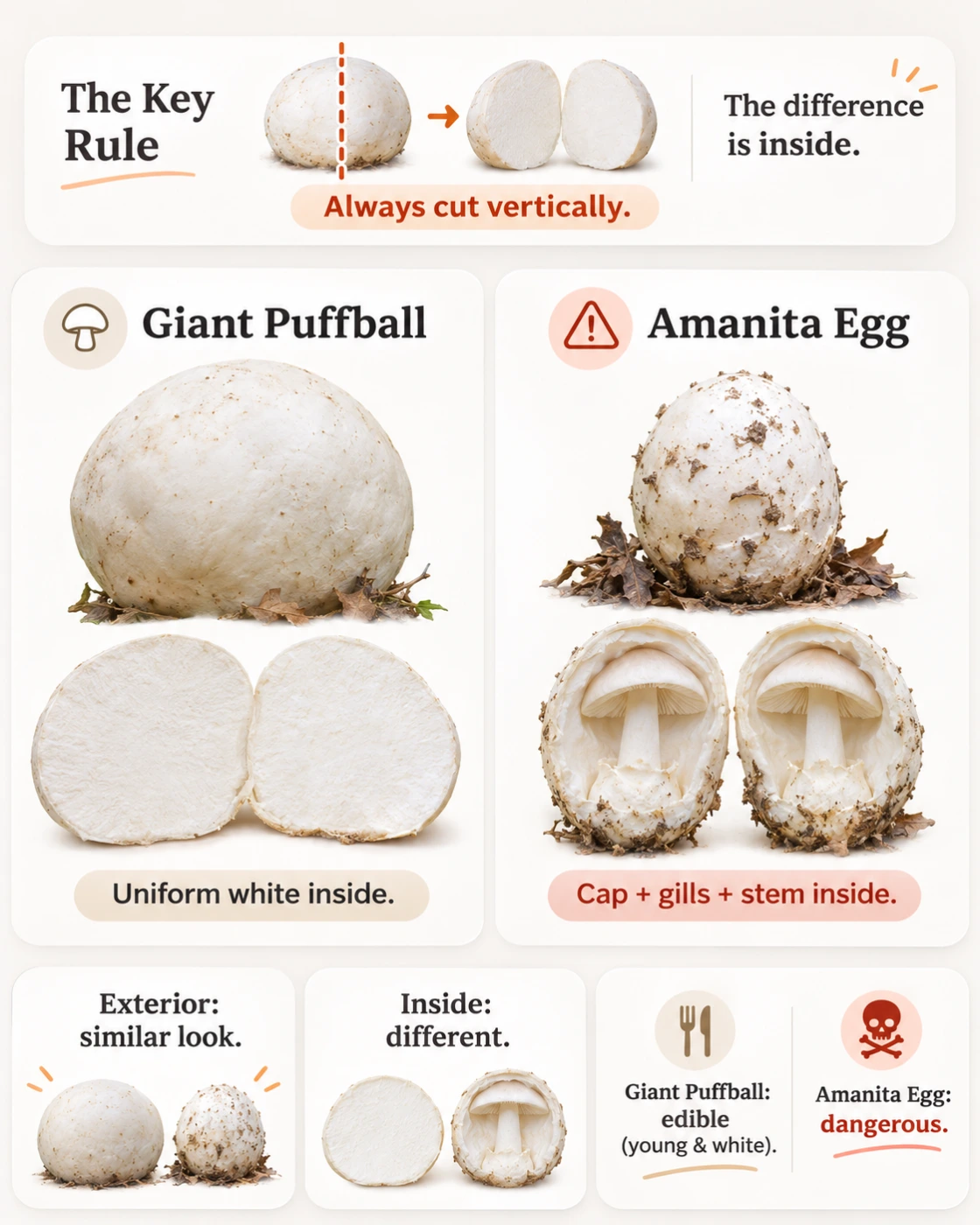
A young Giant Puffball and an unopened Amanita can both appear as smooth white balls emerging from the ground. From the outside, this similarity can be dangerous because an immature Amanita may still be enclosed inside its universal veil and hide the cap, gills, stem, ring, and volva that would normally make it recognizable.
The safest and most useful distinction is internal structure. A young Giant Puffball should be solid and uniformly white throughout, while an Amanita egg contains the developing anatomy of a normal mushroom inside.
⚠️ Important: Never identify a puffball for food from its exterior alone. Cut every specimen vertically from top to bottom before considering it edible.
Quick Comparison
| Feature | Giant Puffball | Amanita Egg |
|---|---|---|
| Typical example | Calvatia gigantea | Young Amanita spp. |
| Outer shape | Round to irregular ball | Egg-shaped to round |
| Stem visible outside | Absent | Usually hidden when very young |
| Gills visible outside | Absent | Hidden inside |
| Interior when young | Uniform pure white | Developing cap, gills, stem visible |
| Internal texture | Homogeneous | Layered / structured |
| Volva | Absent | Universal veil forms outer covering |
| Mature development | Turns yellow/olive/brown internally | Opens into normal Amanita mushroom |
| Edibility | Edible only when young, white, and correctly identified | Some species deadly poisonous |
| Best clue | Solid white interior | Internal mushroom anatomy |
What Is a Giant Puffball?
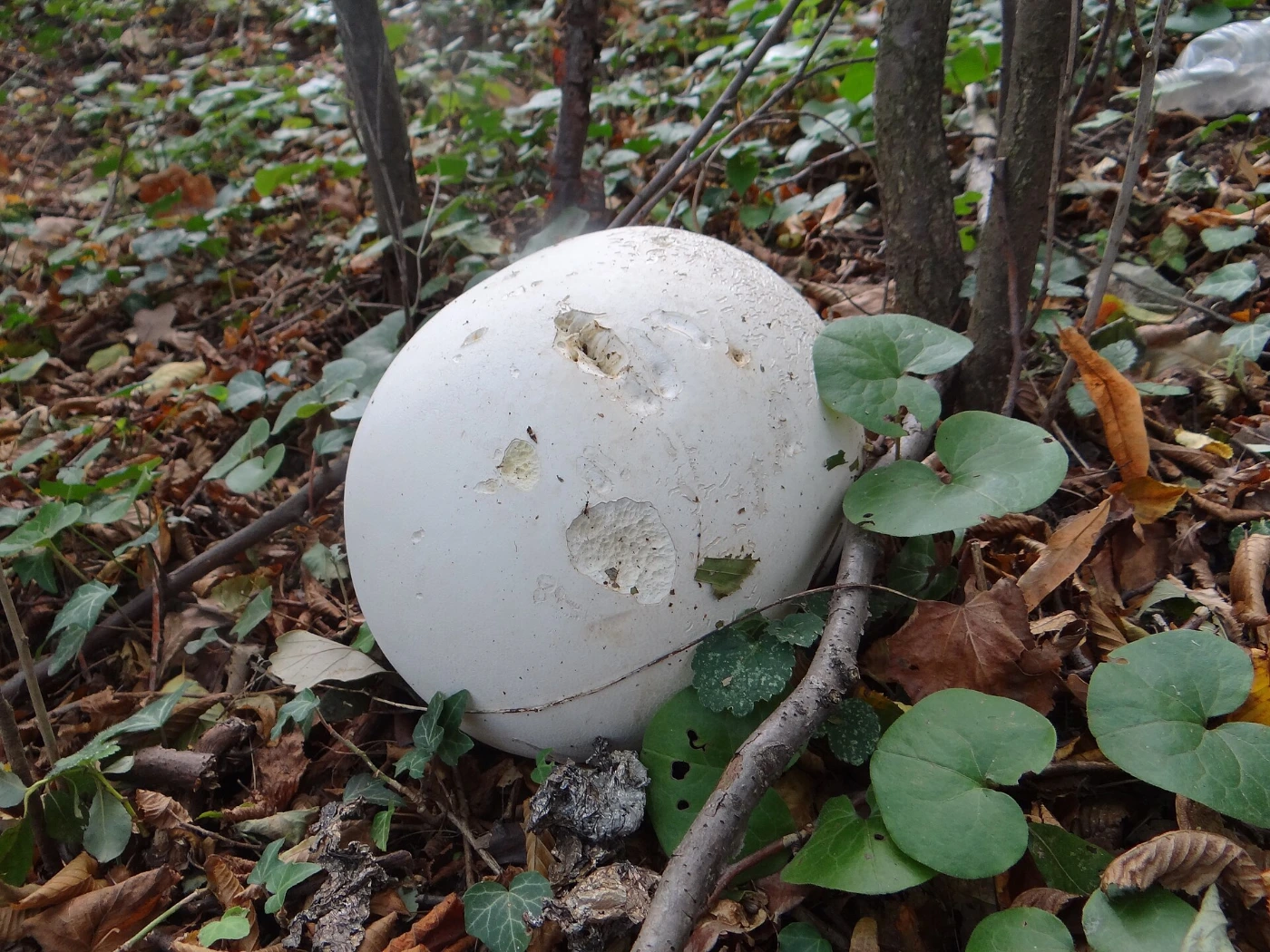
The Giant Puffball, Calvatia gigantea, is a large spherical fungus that can grow from the size of a grapefruit to much larger. Unlike ordinary cap-and-stem mushrooms, it does not develop gills or a conventional stem.
Young specimens contain a solid mass of white tissue called the gleba. As the mushroom matures, this internal tissue changes from white to yellowish, olive, and eventually brown as spores develop.
What Is an Amanita Egg?
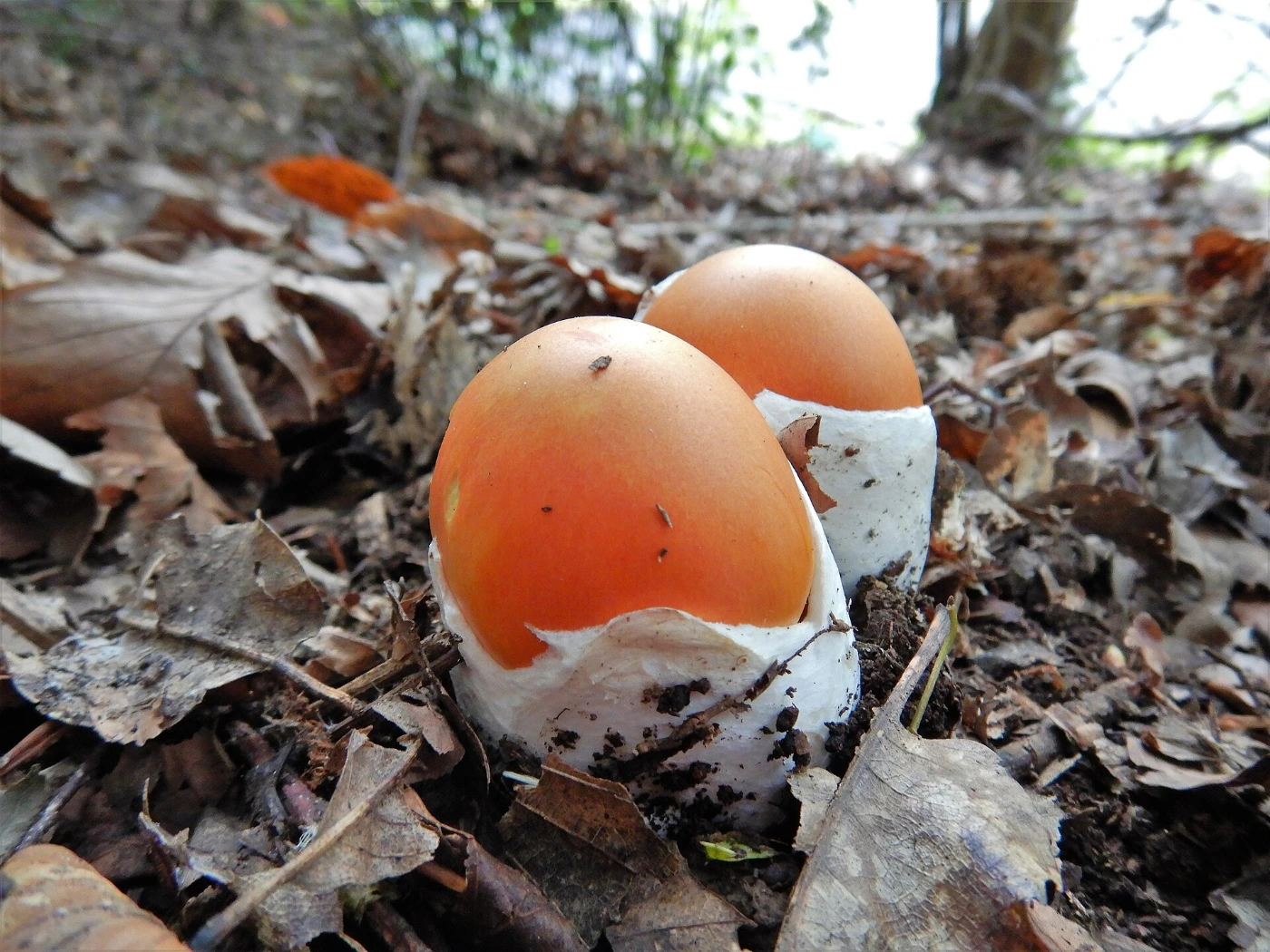
An Amanita egg is a very young Amanita fruit body that is still enclosed within the universal veil. At this stage, the mushroom may look like a white oval or ball sitting partly underground.
Inside, however, the mushroom has already begun forming a cap, gills, and stem. Once the veil breaks, these structures expand and the familiar Amanita shape emerges.
The Most Important Test: Cut It in Half
A vertical cut is the single most important step in this comparison. Slice the specimen from the top through the base so the entire interior is visible.
A true young Giant Puffball should look like one continuous block of white flesh. An Amanita egg reveals distinct internal structures, often with a miniature cap above folded gills and a developing stem below.
Giant Puffball Interior
The inside of a fresh young Giant Puffball should be completely white and uniform. There should be no outline of a cap, no gills, no central stem, and no separate layers resembling a mushroom.
The flesh may be dense and slightly spongy, but its structure remains homogeneous. Any internal yellowing, olive coloration, or brown development indicates that the puffball is maturing.
Amanita Egg Interior
Amanita eggs often show a surprisingly clear mushroom silhouette when cut vertically. The future cap may appear as a curved structure near the top, with pale gill lines beneath it.
A developing stem runs through the center, and the universal veil surrounds the entire structure. In some specimens, the internal details are extremely obvious even before the mushroom has broken through the outer covering.
Why Exterior Appearance Is Unreliable
Young Amanitas can be smooth, pale, and nearly spherical. Soil, rain, and damage can also obscure the outer veil and make the shape appear even more puffball-like.
Giant Puffballs can also vary considerably in shape. They may be round, flattened, irregular, or lobed, so shape alone is not enough to separate them safely.
Does Size Help?
Size can help but is not a reliable safety test. Giant Puffballs often become much larger than Amanita eggs, sometimes reaching impressive dimensions.
The problem is that small young Giant Puffballs can overlap in size with Amanita buttons. A specimen only a few centimeters across must therefore be cut just as carefully as a larger one.
Outer Surface
Young Giant Puffballs usually have a white to cream outer skin that may be smooth or slightly textured. The surface becomes more yellowish or brownish with age.
Amanita eggs may also be white and smooth, although fragments of the universal veil can create slightly uneven patches. These differences are too subtle to replace the internal cut test.
Base and Attachment
Giant Puffballs attach to the ground through a relatively small base or root-like connection. They do not have a true stem buried inside.
An Amanita egg develops around a central stem structure. When mature, the lower veil remains can form a volva around the stem base.
What Happens as a Giant Puffball Matures?
The internal white tissue gradually becomes yellow, olive, and eventually brown as spores develop. At this stage, the mushroom is no longer suitable for eating.
Mature Giant Puffballs may become soft or powdery inside. Eventually, the outer wall breaks down and spores are released.
What Happens as an Amanita Egg Matures?
The internal mushroom expands until it ruptures the universal veil. The cap opens, the gills become visible, and the stem elongates.
Veil remnants may remain as patches on the cap or as a volva around the stem base. Depending on the species, a ring can also develop from the partial veil.
Why Amanita Eggs Are Dangerous
Several Amanita species contain powerful toxins. Some destroying angels and Death Cap relatives contain amatoxins capable of causing severe liver failure and death.
A very young deadly Amanita can therefore look deceptively simple from the outside. The toxins are present even though the adult identifying structures are still hidden.
Death Cap Eggs
Young Amanita phalloides can emerge as pale egg-like structures. Once opened, they reveal the developing cap, white gills, and stem inside.
The outer veil becomes the volva around the mature stem base. Because Death Cap contains amatoxins, mistaking an unopened specimen for a puffball can be extremely dangerous.
Destroying Angel Eggs
White destroying angels can be even more deceptive because the mature mushroom remains almost entirely white. Their unopened stages can resemble small white puffballs closely.
A vertical cut exposes the internal mushroom structure. This is why sectioning is essential whenever a supposed puffball is small enough to overlap with Amanita size.
Giant Puffball vs Death Cap Egg
| Feature | Giant Puffball | Death Cap Egg |
|---|---|---|
| Exterior | White to cream | White to pale |
| Shape | Round or irregular | Egg-shaped |
| Interior | Uniform white | Cap + gills + stem |
| Volva | None | Universal veil / volva |
| Mature form | Spore mass inside ball | Cap-and-stem mushroom |
| Toxicity | Edible only when young and correct | Deadly poisonous |
| Best clue | Homogeneous interior | Visible internal anatomy |
The interior is far more useful than cap or surface color. Even a pale Death Cap egg should reveal layered mushroom structures when cut correctly.
Giant Puffball vs Destroying Angel Egg
| Feature | Giant Puffball | Destroying Angel Egg |
|---|---|---|
| Exterior color | White | White |
| Interior | Homogeneous | Structured |
| Gills | Never present | Developing inside |
| Stem | Never present | Developing inside |
| Ring | None | May develop later |
| Volva | None | Present as veil structure |
| Best clue | Solid white flesh | Hidden mushroom anatomy |
This is one of the most important comparisons for white puffballs. The similar external color makes the cut test essential.
What Does “Uniform White Interior” Really Mean?
Uniform means the inside should have the same texture and color from one side to the other. There should be no central column, curved cap outline, radiating lines, or separate tissues.
A pale ring, layered pattern, or visible gill structure should stop the identification immediately. A true young puffball does not contain a miniature mushroom inside.
What If the Inside Is Yellow?
A yellow interior means the puffball has begun maturing. It should not be treated as a young edible puffball.
The internal tissue eventually becomes olive or brown as spores form. Only completely white immature tissue fits the usual edible stage.
What If the Inside Is White but Slightly Layered?
Layering is a warning sign. The critical feature is not just color but also structure.
If the specimen contains separate internal zones or anything that resembles cap, gills, or stem, do not identify it as a puffball. Amanita tissue can remain entirely white while still showing obvious anatomy.
Other Puffball Look-Alikes
Amanita eggs are the most dangerous comparison, but they are not the only spherical fungi. Earthballs such as Scleroderma can also resemble puffballs from the outside.
Earthballs usually develop a dark purple-brown or black interior and have a thicker, tougher outer wall. They are not edible and should be separated from true young puffballs.
Giant Puffball vs Earthball
Earthballs typically have a coarse, thick, sometimes cracked surface. Their internal tissue becomes dark much earlier than the gleba of an edible young puffball.
A young Giant Puffball should be pure white and relatively uniform. A dark gray, purple, brown, or black interior rules it out.
Does a Giant Puffball Have Gills?
No. A true puffball never develops gills at any life stage.
If gills are visible anywhere inside, the specimen is not a puffball. This remains true even if the mushroom is completely enclosed inside a white outer layer.
Does a Giant Puffball Have a Stem?
No conventional cap-and-stem structure develops. There may be a short attachment point at the base, but not a hidden central stem.
A recognizable stem inside a cut specimen strongly indicates another mushroom. In a white egg-like fruit body, Amanita becomes an important possibility.
Can Giant Puffballs Grow Near Trees?
Yes. Habitat alone cannot safely separate them from Amanita.
Giant Puffballs often occur in grassland, meadows, lawns, woodland edges, and nutrient-rich ground. Amanitas are mycorrhizal and occur near trees, but overlap in general habitat is possible.
Can Giant Puffballs Grow in Groups?
Yes. Several Giant Puffballs can occur in the same area, sometimes forming loose groups or arcs.
Amanitas can also fruit in groups. Growth pattern therefore does not replace examining the interior.
Can an Amanita Egg Be Very Small?
Yes. Early-stage Amanita fruit bodies can be quite small and remain partially buried.
This is exactly the size range where confusion with small puffballs becomes most dangerous. Every small white spherical mushroom intended for food should be sectioned.
Can an Amanita Egg Be Large?
Some Amanita buttons can become surprisingly substantial before opening. A large white egg-shaped specimen should therefore not be assumed safe based on size.
The vertical cut remains the definitive practical check. Size is only supporting information.
How to Cut a Puffball Correctly
Cut directly through the center from the top to the bottom. Avoid only slicing off a small piece from one side.
The goal is to reveal the entire internal profile. A central cut makes hidden cap, gills, or stem structures much easier to see.
Why a Horizontal Cut Is Less Useful
A horizontal slice can miss some of the internal anatomy of an Amanita. Depending on where the cut passes, it may show only pale tissue.
A vertical section displays the cap-to-stem organization much more clearly. It is therefore the preferred safety check.
Can You Identify a Puffball From a Photo?
A photograph of the outside is not enough when Amanita eggs are a possibility. Even experienced identifiers need to see the interior.
For photo identification, include one image of the whole specimen and another of the vertical cross-section. This makes the distinction much clearer.
Can AI Tell a Giant Puffball From an Amanita Egg?
AI can often distinguish them if the specimen is cut vertically and the internal structure is clearly visible. A homogeneous white interior supports puffball, while organized mushroom anatomy strongly supports Amanita.
An exterior-only image is much less reliable. No photo-based system should be used to declare an unopened white mushroom safe to eat without a sectioned view.
Common Identification Mistakes
One common mistake is assuming that every white ball on the ground is a puffball. Very young Amanitas can look almost identical from above.
Another mistake is checking only the color of the interior. White Amanita tissue can still be dangerous, so the key question is whether the inside is homogeneous or structured.
A third mistake is cutting only a small section from the side. A complete vertical section gives a much clearer view of hidden anatomy.
A fourth mistake is using size as a safety test. Small puffballs and Amanita eggs can overlap considerably in size.
Are Giant Puffballs Edible?
Young Giant Puffballs are generally considered edible when correctly identified and while the interior remains completely white and homogeneous. They should be cooked rather than eaten raw.
Once the interior begins turning yellow, olive, or brown, the mushroom is past the desirable stage. Correct identification must still happen before any culinary consideration.
Does Cooking Make an Amanita Safe?
No. Cooking does not reliably destroy amatoxins in deadly Amanita species.
Boiling, frying, freezing, drying, or other ordinary preparation methods cannot turn a poisonous Amanita into a safe mushroom. Identification must happen before cooking.
Interesting Facts
Amanita eggs demonstrate how dramatically a mushroom can change during development. What begins as a simple white oval can open into a tall mushroom with a cap, gills, ring, and volva.
Giant Puffballs follow a completely different developmental plan. They produce spores inside the enclosed fruit body rather than on exposed gills or pores.
The cross-section therefore reveals not just a safety difference but two fundamentally different mushroom anatomies. One contains a developing cap-and-stem mushroom, while the other is essentially a single enclosed spore-producing body.
Large Giant Puffballs can eventually produce enormous quantities of spores. Their internal tissue changes almost completely from white edible gleba to mature powdery spore mass.
Frequently Asked Questions
What is the easiest way to tell a Giant Puffball from an Amanita egg?
Cut the specimen vertically through the center. A young Giant Puffball is uniformly white inside, while an Amanita egg contains developing cap, gills, and stem.
Can an Amanita egg be completely white inside?
Yes, the tissue itself may be white. The important difference is internal structure, not simply color.
Should every puffball be cut before eating?
Yes. A vertical section confirms both that the specimen lacks hidden mushroom anatomy and that the interior is still completely white.
What if I see lines inside the mushroom?
Any structure resembling gills, a stem, a cap outline, or separate tissue layers is a warning sign. Do not identify that specimen as a puffball.
Can Giant Puffballs have a stem inside?
No. They may have a small external attachment point, but there should be no central internal stem.
Can an Amanita egg look perfectly round?
Yes. Young specimens can be round or oval enough to resemble puffballs.
Is a yellow puffball still edible?
No. Yellowing shows that the internal spore tissue is beginning to mature and the mushroom is past the ideal young stage.
What is the most dangerous puffball look-alike?
Young Amanita species, especially deadly destroying angels and Death Cap relatives, are the most important safety concern because their mature identifying structures can still be hidden.
Final Identification Notes
The distinction between Giant Puffball and Amanita egg should never depend on exterior appearance alone. Both can appear as white rounded mushrooms emerging from soil.
A young Giant Puffball should have completely white, homogeneous flesh with no cap, gills, stem, or internal layers. An Amanita egg contains the developing anatomy of a cap-and-stem mushroom, even while everything remains enclosed inside the universal veil.
The practical safety rule is: cut every supposed puffball vertically from top to base → look for a completely uniform white interior → if you see any internal mushroom structure, do not treat it as a puffball.
Upload a photo and get possible matches in seconds.