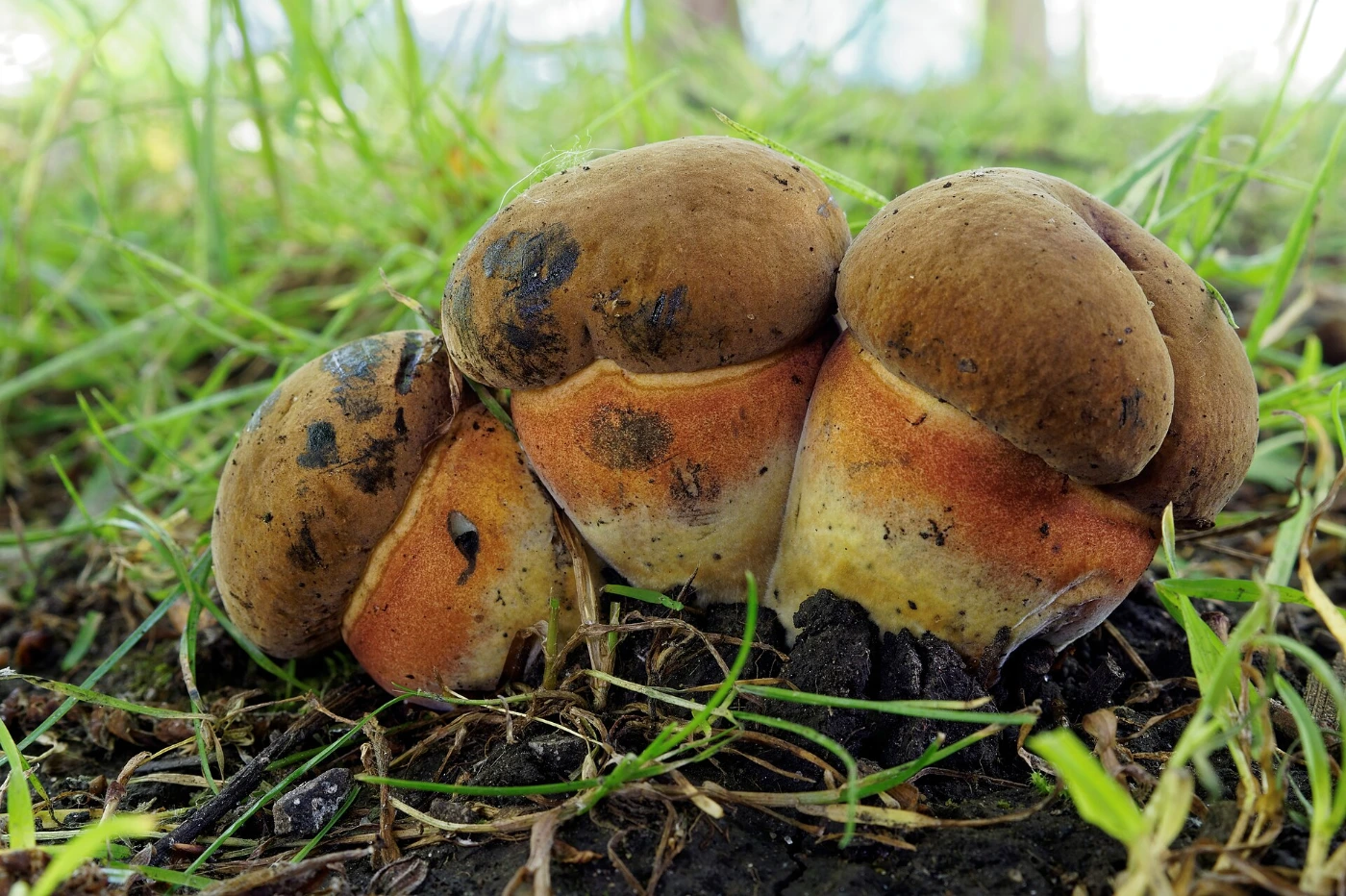
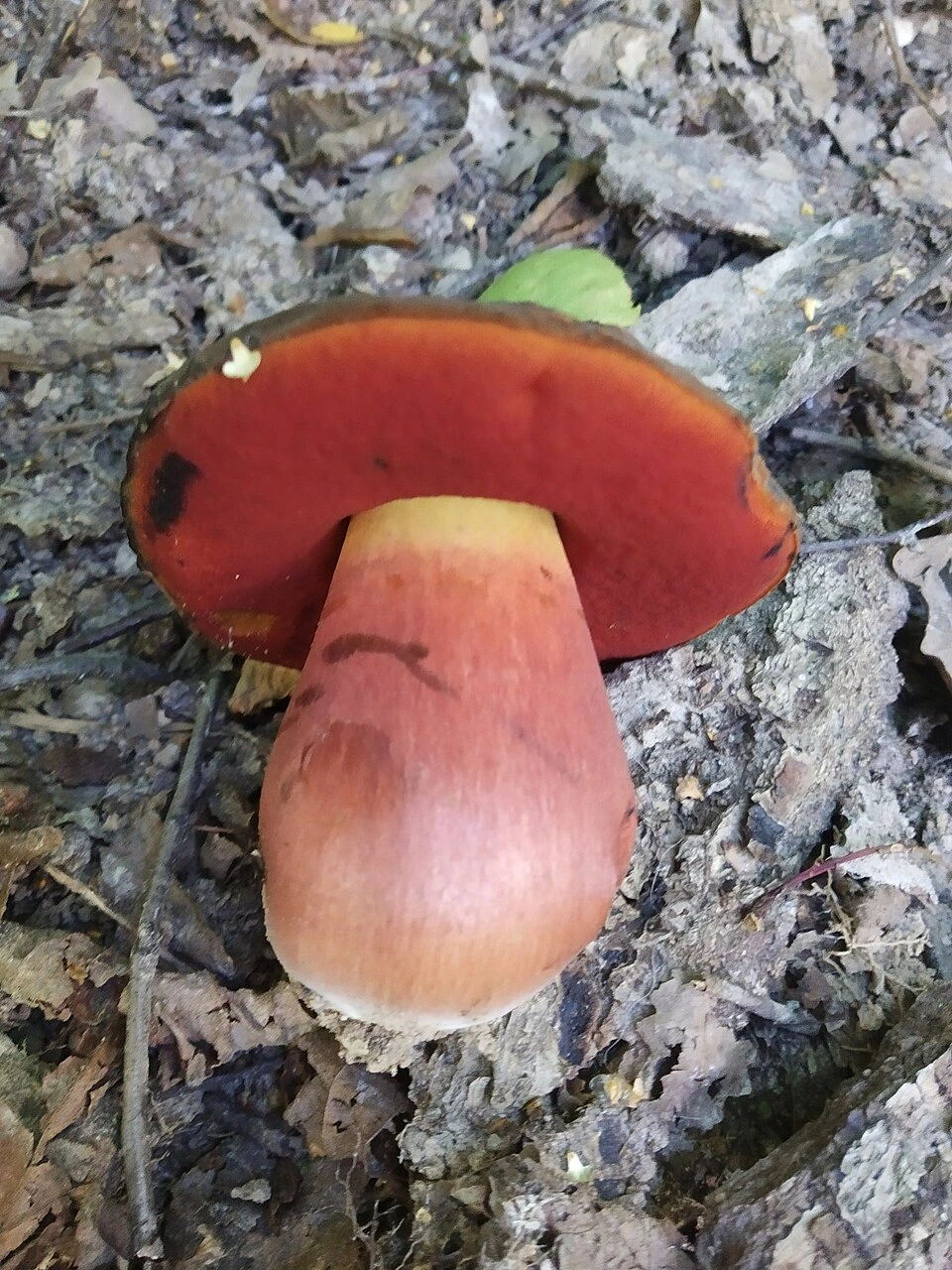
Neoboletus luridiformis, commonly known as the Scarletina Bolete, is a robust bolete with a dark brown cap, yellow flesh, red pores, and a stem densely covered with tiny red dots. When cut or bruised, the yellow flesh can turn deep blue almost immediately.
The most useful field pattern is dark cap + red pores + red-dotted stem without a net + extremely rapid blue staining. It is one of the most dramatic blue-staining boletes in Europe and can look alarming even though blue bruising itself does not indicate toxicity.
⚠️ Important: Red pores and blue staining are not enough for safe identification. Several similar boletes differ in edibility or toxicity, so check the stem pattern, cap color, habitat, and complete fruit body before considering an identification.
Quick Identification
| Feature | Neoboletus luridiformis |
|---|---|
| Common name | Scarletina Bolete |
| Cap | Dark brown, chestnut, bronze |
| Cap surface | Finely velvety when young, smoother with age |
| Underside | Pores, not gills |
| Young pores | Orange to red |
| Mature pores | Bright red to rusty red |
| Tubes | Yellow |
| Stem | Yellow beneath dense red dots |
| Reticulation | Absent |
| Flesh | Yellow |
| Bruising | Very rapid deep blue |
| Spore print | Olive-brown |
| Ecology | Mycorrhizal |
| Main hosts | Beech, spruce and other trees |
| Season | Summer to autumn |
| Main look-alikes | Suillellus luridus, Rubroboletus satanas, other red-pored boletes |
What Does Neoboletus luridiformis Look Like?
Scarletina Bolete is usually a substantial mushroom with a thick stem and a broad, fleshy cap. Cap color varies from pale brown and bronze to dark chocolate brown, while the pore surface beneath becomes orange-red to vivid red.
The contrast becomes even stronger when the mushroom is cut. Yellow flesh rapidly changes to intense blue or blue-green, sometimes within only a few seconds.
Cap
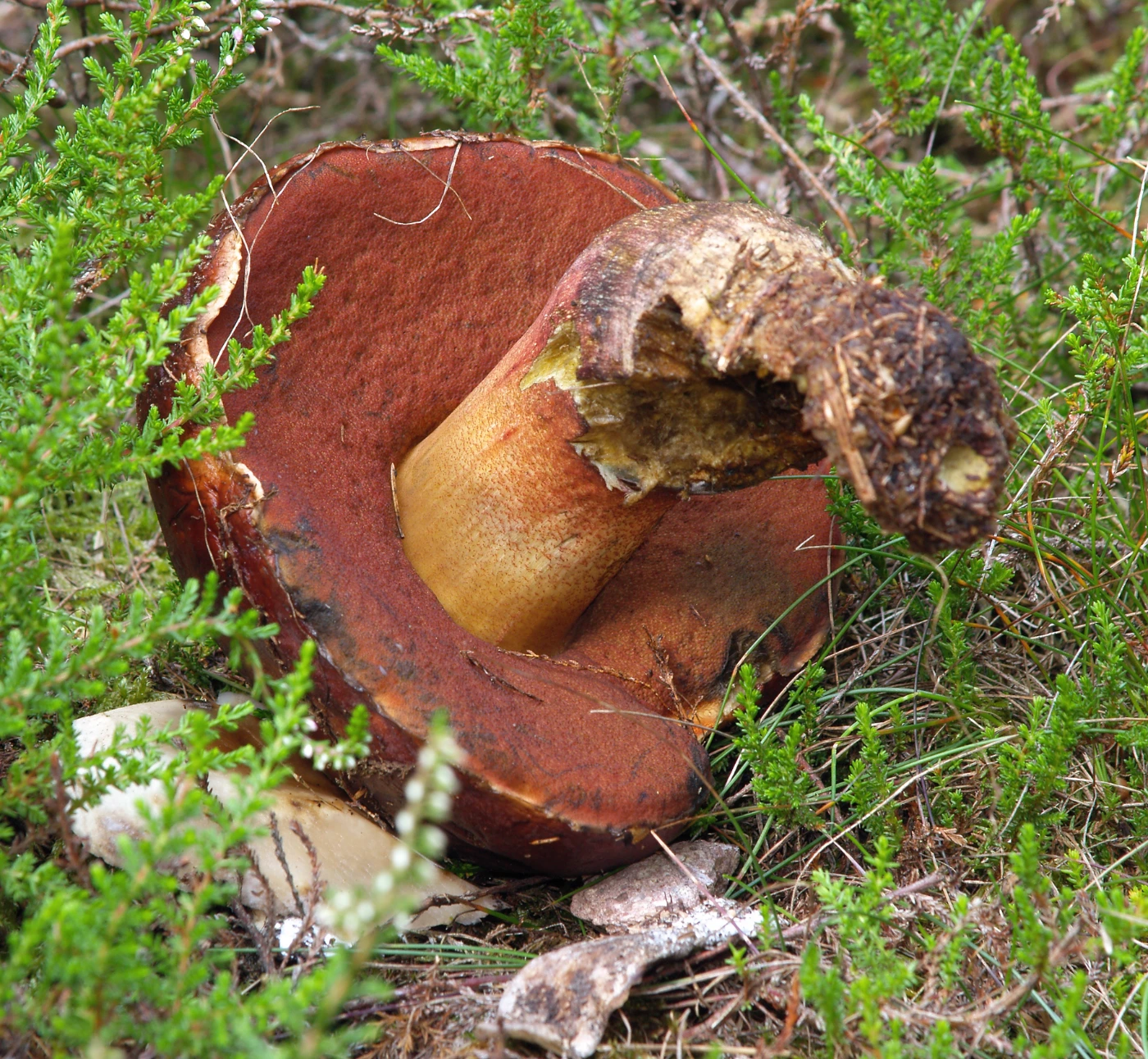
The cap begins convex and may remain strongly rounded while young. Mature specimens broaden and flatten somewhat but usually retain a thick, robust appearance.
Colors range from brown and chestnut to coppery bronze or very dark chocolate. Young caps may have a fine downy texture, becoming smoother and sometimes slightly shiny with age.
Pores
Young pore surfaces may begin orange before becoming bright red. As the mushroom ages, the pores can become darker or rusty red.
Touching or pressing the pore surface usually produces a rapid dark blue reaction. This reaction can be much faster and stronger than in many other boletes.
Tubes
The tubes beneath the pores are yellow. Cutting through them exposes tissue that rapidly turns blue-green.
This yellow-to-blue transformation is particularly conspicuous in fresh specimens. Older or dry mushrooms may react less strongly.
Stem
The stem is stout and yellow beneath a dense covering of tiny red dots. These dots can merge visually at a distance and make the stem appear generally reddish.
Looking closely is important because the dots are one of the key identification characters. A hand lens can help distinguish individual dots in strongly colored specimens.
Red Dots, Not a Red Net
The stem pattern is one of the best ways to distinguish Scarletina Bolete from similar species. Neoboletus luridiformis has many separate red dots rather than a reticulate network.
This difference is especially useful when comparing it with Suillellus luridus. That species characteristically develops a red net-like pattern on the stem, whereas N. luridiformis remains dotted.
Flesh
The internal flesh is yellow before exposure to air. When the mushroom is sliced, damaged areas can become dark blue almost immediately.
The staining can occur throughout the cap and stem. After some time, the intense blue may fade or shift toward duller colors as oxidation continues.
Why Does It Turn Blue?
Blue staining is caused by oxidation reactions that begin when cells are damaged and fungal chemicals come into contact with oxygen and enzymes. Similar reactions occur in several unrelated groups of boletes.
The reaction is an identification feature rather than a toxicity test. Both edible and poisonous boletes can turn blue, while many dangerous mushrooms show no blue staining at all.
Smell
The smell is generally mild and not particularly useful for identification. It may simply be described as mushroom-like.
Unlike some strongly aromatic species, Scarletina Bolete should be identified primarily through morphology and ecology. Cap, pores, stem markings, and bruising provide much stronger clues.
Spore Print
The spore print is olive-brown. This is typical of many members of the bolete family and helps confirm the broader group.
Spore-print color is less useful for separating Scarletina Bolete from closely related red-pored species. Stem ornamentation and cap characters usually provide better field evidence.
Where Does Neoboletus luridiformis Grow?
Scarletina Bolete is mycorrhizal and grows from soil in association with living trees. It occurs in deciduous and coniferous woodland, with documented associations including beech and spruce.
It often favors acidic soils, which can help separate it ecologically from some other red-pored boletes. Woodland edges, clearings, and mossy forest ground can all be productive habitats.
Season
The main fruiting season is summer through autumn. In Britain and Ireland, records are particularly common from August to October.
Timing varies with geography, rainfall, elevation, and temperature. Warm wet periods can trigger substantial fruitings.
Distribution
The species is widespread across Europe and is well known from many European woodland habitats. Similar-looking red-pored boletes elsewhere require careful regional identification.
Older literature may use names such as Boletus luridiformis or Boletus erythropus for mushrooms placed in this group. Modern sources commonly use Neoboletus luridiformis.
Is Neoboletus luridiformis Edible?
Scarletina Bolete is reported as edible when correctly identified and thoroughly cooked. However, it belongs to a difficult group containing similar red-pored boletes, including species that should not be eaten.
For that reason, it is not an ideal beginner mushroom. Identification should be based on the complete combination of characters rather than red pores or blue bruising alone.
Look-Alikes
Several red-pored boletes can resemble Neoboletus luridiformis. The most useful comparison features are stem ornamentation, cap color, pore color, habitat, and the form of blue staining.
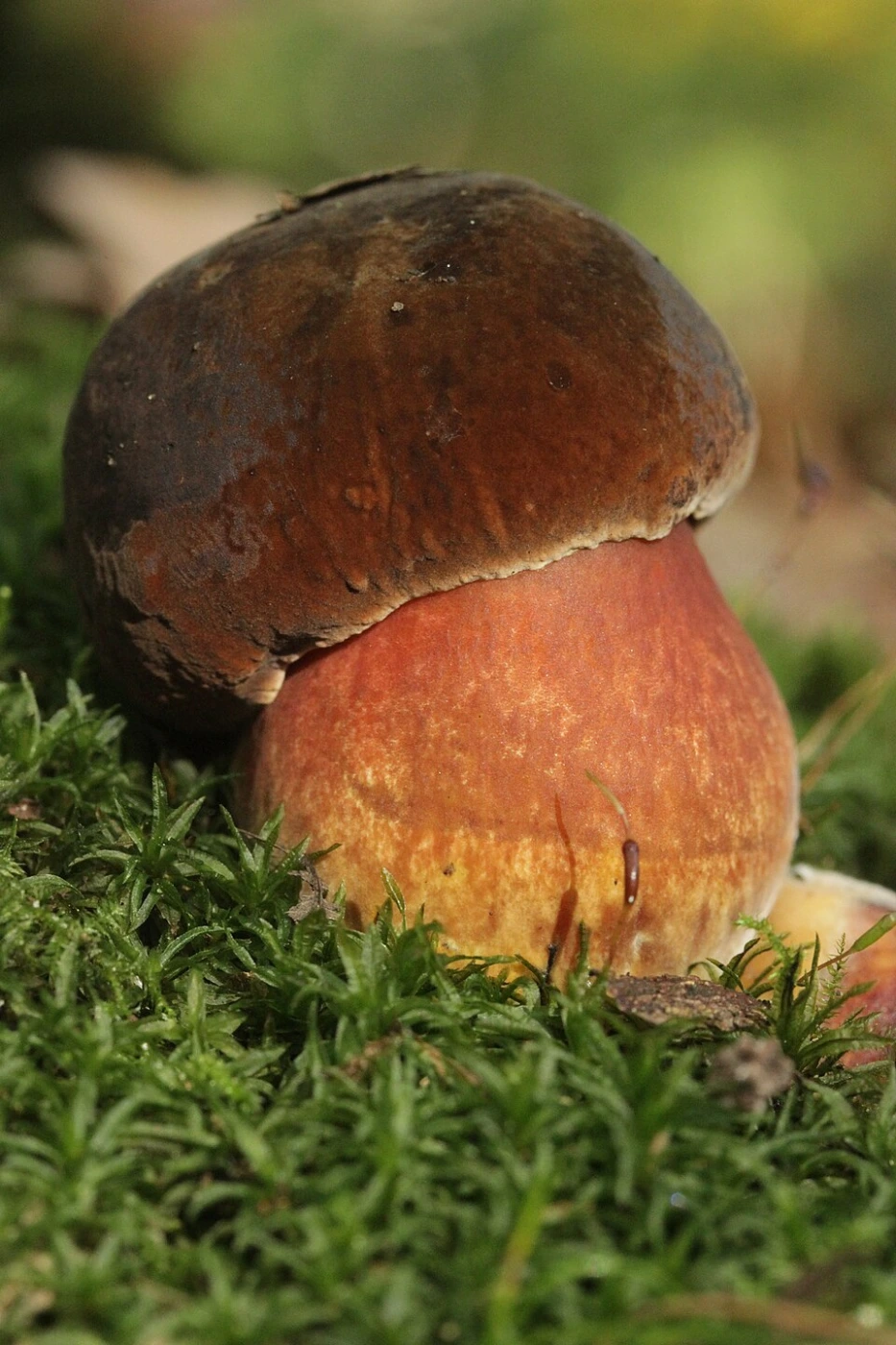
Suillellus luridus — Lurid Bolete
Identification
Suillellus luridus also has yellow flesh, orange-red to red pores, and rapid blue staining. It can therefore look extremely similar at first glance.
The stem normally has a conspicuous reddish reticulation, forming a net-like pattern. This is fundamentally different from the separate red dots covering the stem of Scarletina Bolete.
Main Difference
Red dots without a net = Neoboletus luridiformis. Red reticulate network = Suillellus luridus.
Rubroboletus satanas — Satan’s Bolete
Identification
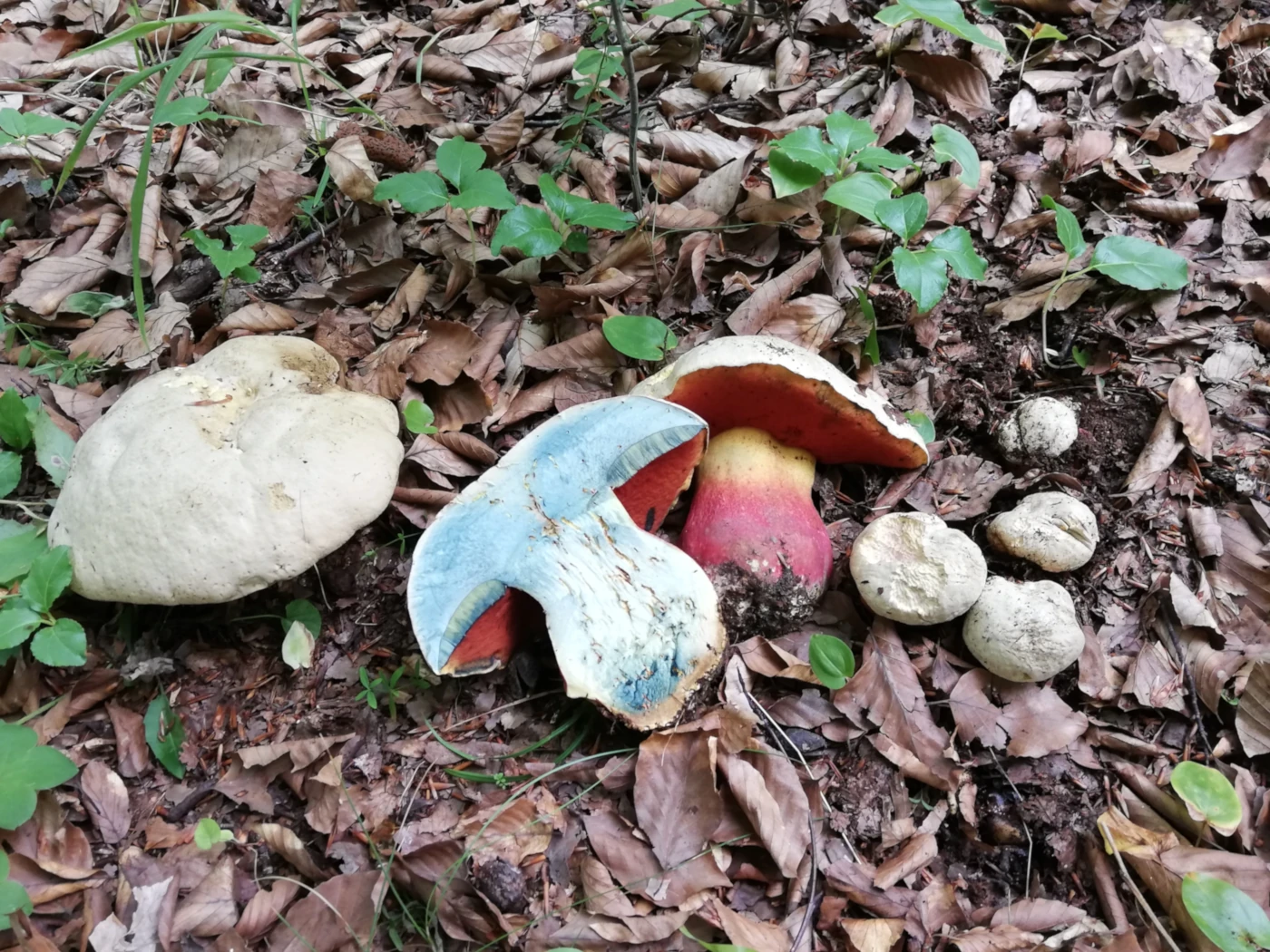
Satan’s Bolete is a large red-pored species with a very pale, whitish, or chalky cap. The stem is usually stout to bulbous and develops prominent reddish reticulation.
It tends to occur in warmer habitats and often favors calcareous soils. This ecological preference contrasts with the frequently acidic woodland habitat of N. luridiformis.
Main Difference
A pale whitish cap, bulbous stem, and red net strongly favor Rubroboletus satanas. A brown cap and densely red-dotted non-reticulate stem favor Scarletina Bolete.
Other Red-Pored Boletes
Identification
Several European boletes combine yellow flesh, red pores, and blue staining. Some have yellow or orange caps, others have reticulated stems, and staining intensity varies considerably.
A red pore surface therefore identifies a group rather than a species. Always examine the entire stem and cap rather than relying on the underside alone.
Main Difference
For N. luridiformis, the strongest combination is the brown cap + densely red-dotted stem + no reticulation + very rapid blue staining.
Neoboletus luridiformis vs Suillellus luridus
| Feature | Neoboletus luridiformis | Suillellus luridus |
|---|---|---|
| Cap | Brown to dark chocolate | Olive-brown to brown |
| Pores | Orange-red to red | Orange-red to red |
| Stem | Tiny red dots | Red net |
| Reticulation | Absent | Present |
| Flesh | Yellow | Yellow |
| Blue staining | Very rapid | Rapid |
| Best clue | Dotted stem | Netted stem |
This is one of the most useful distinctions among European red-pored boletes. Look closely rather than treating a generally reddish stem as sufficient evidence.
Neoboletus luridiformis vs Rubroboletus satanas
| Feature | Neoboletus luridiformis | Rubroboletus satanas |
|---|---|---|
| Cap | Brown / chocolate | Pale gray-white |
| Stem | Red dots | Red reticulation |
| Stem shape | Stout but usually less bulbous | Often strongly bulbous |
| Pores | Red | Red |
| Blue staining | Strong and rapid | Variable |
| Typical soil | Often acidic | Often calcareous |
| Best clue | Dark cap + dots | Pale cap + red net |
The difference in cap color is often obvious in typical specimens. Stem pattern should still be checked because color can vary.
How to Identify Neoboletus luridiformis
First confirm that the mushroom has pores rather than gills. Then check for orange-red or red pores and yellow flesh that rapidly turns blue when damaged.
Next examine the stem very closely. Numerous individual red dots without a net strongly support Scarletina Bolete.
Finally, consider the cap and habitat. A brown to chocolate cap in woodland with beech, spruce, or other suitable trees fits the expected pattern well.
Young vs Mature Scarletina Boletes
Young specimens often have firm convex caps and compact orange-red pores. Their stems can be vividly patterned with red dots over yellow tissue.
Older mushrooms become broader, softer, and darker. Pores may turn rusty, and stem markings can become less sharply defined as colors merge.
How Fast Does It Turn Blue?
Fresh flesh can turn blue virtually immediately after being cut. The pore surface may respond just as dramatically to pressure.
This rapid reaction is characteristic but not unique. Always combine staining speed with stem pattern and cap characteristics.
Does Blue Staining Mean It Is Poisonous?
No. Blue bruising has no simple relationship to toxicity.
The reaction is produced by chemical oxidation in damaged tissue. Some edible boletes stain strongly, while some toxic species do the same.
Can Blue Staining Identify It by Itself?
No. Many boletes can develop blue or blue-green tissue after bruising.
The diagnostic value comes from the combination of rapid blue staining and a densely red-dotted stem without reticulation. Blue alone is much too broad a character.
Common Identification Mistakes
One common mistake is confusing red dots with a red net. When the stem is heavily colored, separate dots can appear almost continuous unless viewed closely.
Another mistake is assuming that every red-pored, blue-staining bolete is Scarletina Bolete. Several genera share this appearance.
A third mistake is assuming blue staining means the mushroom is poisonous. It is a chemical response, not an edibility test.
A fourth mistake is ignoring habitat and soil. Ecology can provide useful supporting evidence when several visually similar species are possible.
How to Photograph Neoboletus luridiformis
Take a photograph of the intact mushroom before touching it. Include the cap, habitat, and nearby trees whenever possible.
Then photograph the pore surface and the complete stem at close range so the red dots are visible. Finally, cut the mushroom and take images immediately and again after several minutes to document the staining reaction.
Can AI Identify Scarletina Bolete?
AI can recognize typical specimens when the cap, red pores, complete stem, and blue staining are all visible. A photograph showing only the cap provides much weaker evidence.
A particularly useful set includes one habitat image, one underside image, one close-up of the stem, and one freshly cut cross-section. This provides the characters needed to distinguish dotted and reticulated species.
Interesting Facts
Scarletina Bolete can produce one of the fastest visible staining reactions among common European boletes. Yellow tissue can change to intense blue before a freshly cut mushroom has even been fully photographed.
The blue pigment is not a sign that the mushroom was blue inside before cutting. The color develops only after tissue damage triggers oxidation reactions.
The species has also moved through several scientific names as bolete taxonomy has been reorganized. Older references commonly place it in Boletus, while modern treatments place it in Neoboletus.
Its similarity to Suillellus luridus is reflected in the name luridiformis. In practice, however, the stem pattern provides a surprisingly effective way to separate typical specimens.
Frequently Asked Questions
What is the easiest way to identify Neoboletus luridiformis?
Look for red pores, a brown cap, yellow flesh that rapidly turns blue, and a stem covered in tiny red dots. The absence of a red net is particularly important.
Does Scarletina Bolete have a net on the stem?
No. The stem is covered with individual red dots rather than reticulation.
How is it different from Suillellus luridus?
Suillellus luridus typically has a red net-like pattern on the stem. N. luridiformis has separate red dots.
Why does the flesh turn blue?
Damage exposes fungal compounds to oxygen and enzymes, triggering oxidation and the formation of blue-colored products. The process can occur extremely rapidly.
Does blue staining mean the mushroom is poisonous?
No. Blue staining occurs in both edible and toxic boletes and cannot determine edibility.
What color are the pores?
They become orange to bright red and eventually more rusty with age. Bruising usually turns them dark blue.
What trees does Neoboletus luridiformis grow with?
It forms mycorrhizal associations with trees including beech and spruce. Exact host associations vary across its range.
Is Neoboletus luridiformis edible?
It is reported as edible when correctly identified and thoroughly cooked. Because it can be confused with other red-pored boletes, confident identification is essential.
Final Identification Notes
Neoboletus luridiformis is best recognized by the combination of a brown to dark chocolate cap, orange-red to red pores, yellow flesh, extremely rapid blue bruising, and a stem densely covered with tiny red dots rather than a net.
The most important comparison is Suillellus luridus. Both can have red pores and strongly blue-staining flesh, but S. luridus has stem reticulation while Scarletina Bolete has separate red dots.
The practical field pattern is: dark brown bolete + red pores + yellow flesh turning instantly blue + red-dotted non-reticulate stem = strong Neoboletus luridiformis candidate.
Upload a photo and get possible matches in seconds.