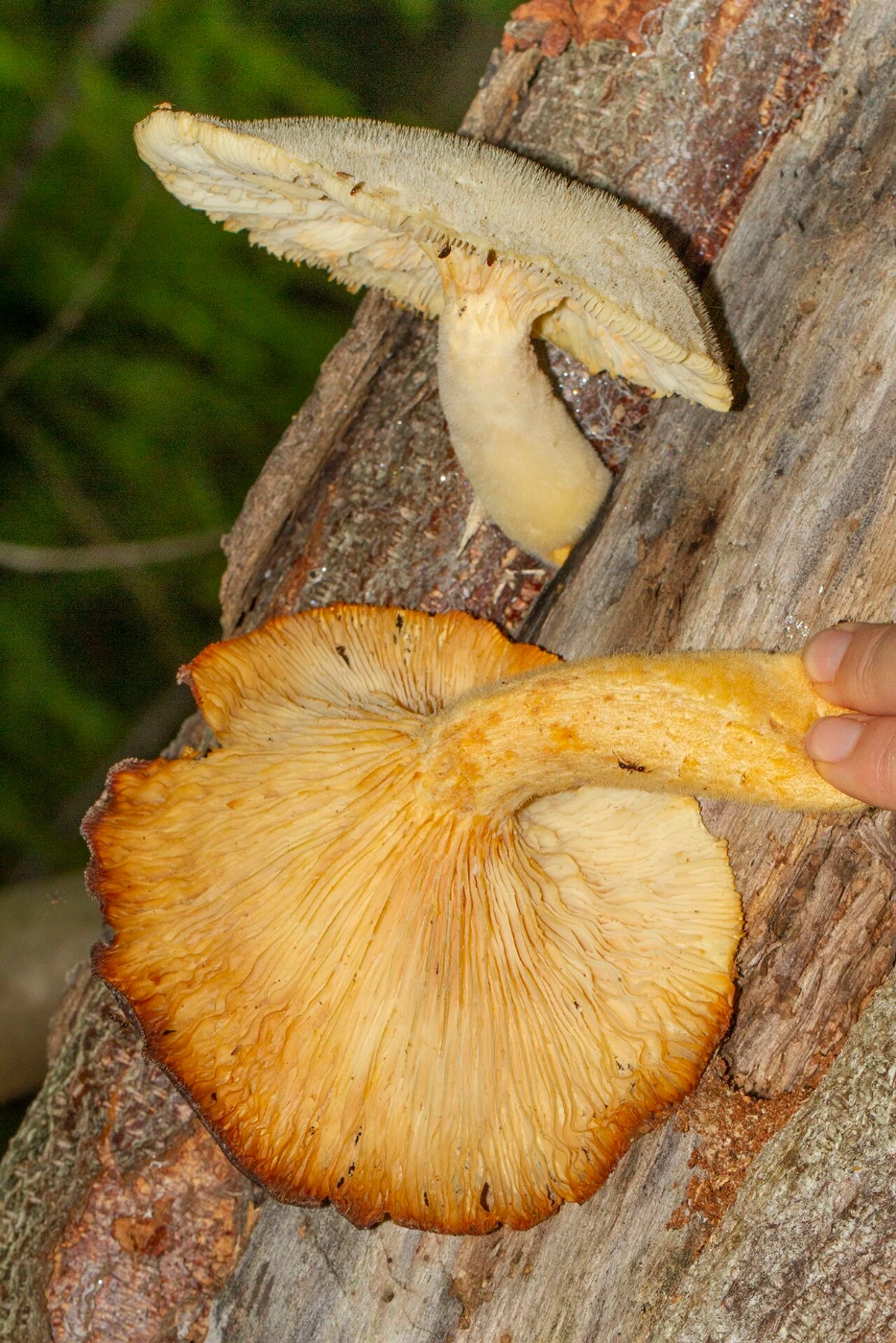
Pleurotus levis, commonly known as the Lynx Paw Oyster, is a pale wood-growing oyster mushroom found mainly in North America. It is recognized by its white to cream or pale yellow fruit bodies, decurrent gills, thick flesh, and a cap surface that can appear finely hairy or fuzzy.
The most useful field pattern is large pale oyster mushroom + hairy or finely fuzzy cap + decurrent gills + growth on hardwood. Compared with the classic Oyster Mushroom, Pleurotus levis is often more robust and can develop yellowish tones or yellow bruising.
⚠️ Important: Pale wood-growing mushrooms should not be identified from cap shape alone. Check the gills, stem attachment, substrate, cap texture, and regional distribution before considering a species-level identification.
Quick Identification
| Feature | Pleurotus levis |
|---|---|
| Common name | Lynx Paw Oyster |
| Cap color | White, cream, pale yellow |
| Cap surface | Finely hairy, fuzzy, or tomentose |
| Cap shape | Convex to broadly fan-shaped |
| Gills | White to cream, decurrent |
| Stem | Present, often short to substantial |
| Ring | Usually absent or not prominent |
| Flesh | Thick, white to pale |
| Bruising | Can yellow with damage |
| Spore print | White |
| Ecology | Saprotrophic |
| Substrate | Dead hardwood |
| Distribution | Mainly North America |
| Season | Spring through autumn |
| Main look-alikes | Pleurotus dryinus, P. ostreatus, P. pulmonarius |
What Does Pleurotus levis Look Like?
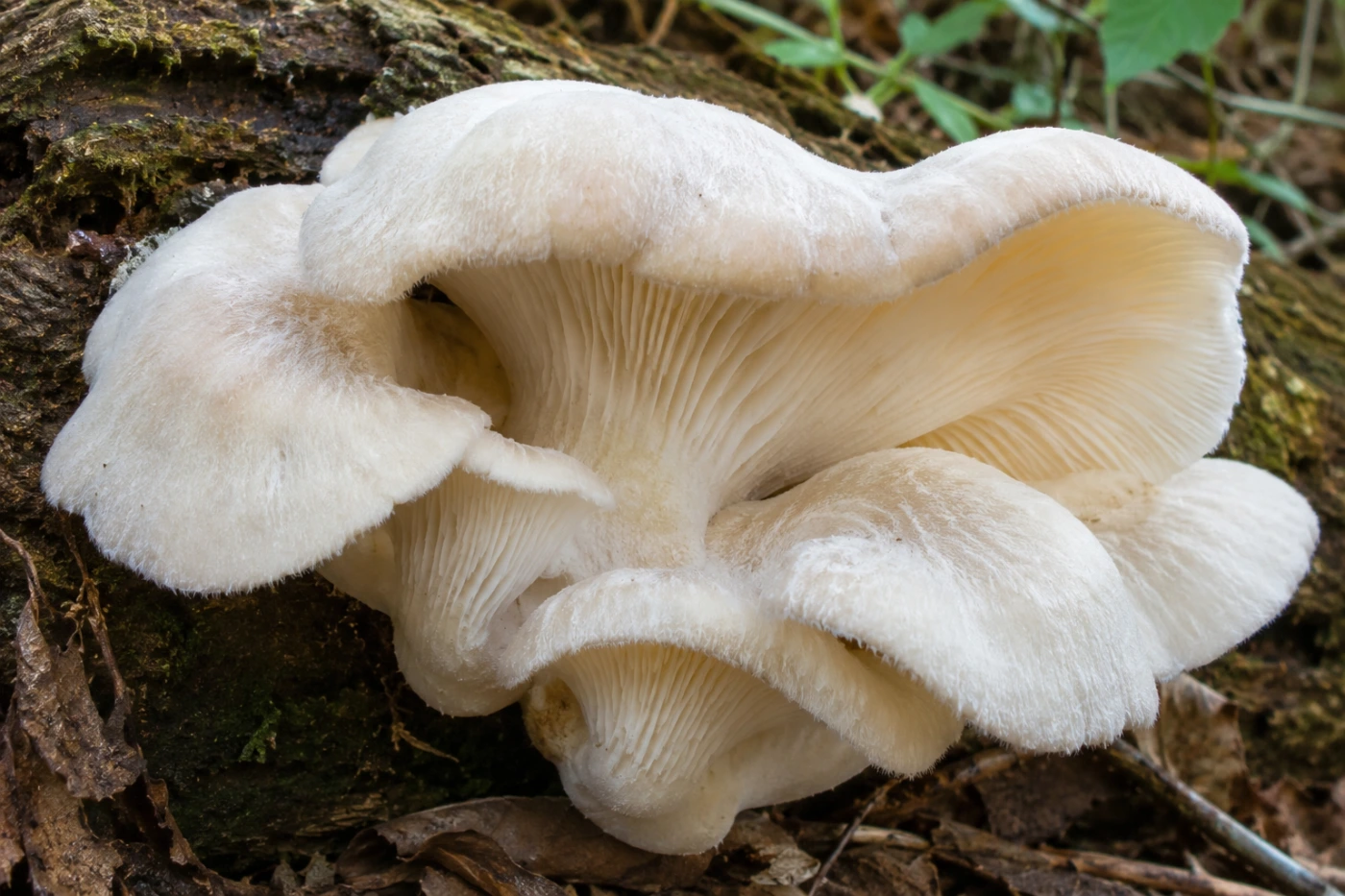
The Lynx Paw Oyster is generally larger and thicker than many familiar oyster mushrooms. Fresh fruit bodies are white to cream, sometimes developing pale yellow tones as they age.
The cap surface is particularly useful. Fine hairs or a soft fuzzy texture can give the mushroom a slightly shaggy appearance, which helps explain the common name “Lynx Paw Oyster.”
Cap
The cap can be convex when young and later become broadly expanded or irregular. It may remain more rounded than the strongly shell-shaped caps of typical Pleurotus ostreatus.
Color ranges from white through cream to pale yellow. Older or weathered mushrooms may become more strongly yellowish.
Hairy Cap Surface
One of the most distinctive characters is the fine hairiness or tomentose texture of the cap. This can be subtle in older specimens but is often easier to see in fresh mushrooms.
The surface may look soft rather than smooth and glossy. This distinguishes it from many ordinary oyster mushrooms, which usually have smoother caps.
Gills
The gills are pale and clearly decurrent, meaning they run down the stem. This is a classic oyster-mushroom character.
They begin white to cream and can become more yellowish with age. The gills are usually relatively crowded.
Stem
Unlike some oyster mushrooms with extremely reduced stems, P. levis can develop a noticeable stem. It may be eccentric or partly central depending on how the fruit body emerges from the wood.
The stem is pale and solid. Its size can vary considerably between specimens.
Flesh
The flesh is thick and firm compared with many other oyster mushrooms. Fresh specimens can feel surprisingly substantial.
Cut surfaces may develop yellowish discoloration. Yellow bruising or aging tones can be useful supporting characters.
Spore Print
The spore print is white. This is typical for the genus Pleurotus.
Because several oyster species also produce white spores, spore-print color confirms the broader group but does not separate P. levis by itself.
Where Does Pleurotus levis Grow?
Pleurotus levis is a wood decomposer. It grows on hardwood rather than from soil.
Documented substrates include hickory and other deciduous trees. It can occur on logs, trunks, and dead or decaying hardwood.
Season
The species can appear from spring through autumn. Fruiting depends strongly on moisture and local temperature.
This relatively broad season helps separate it from species with more restricted fruiting periods, but season alone is not enough for identification.
Distribution
Pleurotus levis is primarily a North American species. It is recorded from the southeastern United States and other parts of the continent, and literature also reports it from Mexico and Honduras.
Because oyster mushroom taxonomy can be complicated, regional records are useful. Morphology should be considered together with location.
Is Pleurotus levis the Veiled Oyster?
Usually, no. The common name Veiled Oyster is most consistently applied to Pleurotus dryinus, which develops a partial veil and often leaves veil remnants or a ring zone.
Pleurotus levis is more commonly called Lynx Paw Oyster. Some older or secondary sources may blur the distinction, so the scientific name is more reliable than the common name.
Pleurotus levis vs Pleurotus dryinus
| Feature | Pleurotus levis | Pleurotus dryinus |
|---|---|---|
| Common name | Lynx Paw Oyster | Veiled Oyster |
| Cap | Pale, hairy/fuzzy | Pale, fibrillose/scaly |
| Veil | Not the main feature | Partial veil present when young |
| Ring | Usually absent or unclear | May leave ring or ring zone |
| Gills | Decurrent | Decurrent |
| Substrate | Hardwood | Hardwood |
| Bruising | Can yellow | Often yellows with age/damage |
| Best clue | Fuzzy cap | Veil remnants / ring |
The veil is the strongest practical difference. Young P. dryinus may show tissue connecting the cap margin and stem, while P. levis is better recognized by its hairy cap surface.
Pleurotus levis vs Pleurotus ostreatus
Classic Oyster Mushroom, Pleurotus ostreatus, usually has a smoother gray, brown, or grayish-tan cap. It commonly grows in overlapping shelf-like clusters.
P. levis is generally paler, more robust, and more finely hairy. The stem may also be better developed.
Main Difference
Pale fuzzy cap and thick fruit body favor P. levis. Smooth gray-brown shell-shaped clusters favor P. ostreatus.
Pleurotus levis vs Pleurotus pulmonarius
Pleurotus pulmonarius is typically pale and can overlap strongly in overall color. It often fruits during warmer weather and forms thinner, smoother caps.
The cap surface of P. levis is more hairy or fuzzy. The thicker flesh and more substantial build are also useful.
Main Difference
Thin smooth pale oyster = more likely P. pulmonarius. Thick pale hairy oyster = stronger P. levis candidate.
Look-Alikes
Pleurotus dryinus — Veiled Oyster
Identification
Veiled Oyster has a pale cap, decurrent gills, and a short-lived partial veil. Young mushrooms may show veil fragments hanging from the cap edge or a ring-like zone on the stem.
The cap is often fibrillose or scaly rather than simply smooth. It also commonly grows on hardwood, especially oak and maple.
Main Difference
A visible partial veil or ring zone strongly favors P. dryinus.
Pleurotus ostreatus — Oyster Mushroom
Identification
The classic Oyster Mushroom usually forms clustered shelves with gray to brown caps. The stem is often very short or lateral.
The cap surface is generally smoother than in P. levis. The overall fruit body is often less thick and less hairy.
Main Difference
Gray-brown smooth caps favor P. ostreatus. Pale fuzzy caps favor P. levis.
Pleurotus pulmonarius — Phoenix Oyster
Identification
Phoenix Oyster is usually pale cream to white and can be confused with P. levis. It often has a thinner cap and smoother surface.
It also tends to fruit in warmer weather than P. ostreatus. Habitat and cap texture become useful when comparing pale oyster species.
Main Difference
A distinctly fuzzy or hairy cap is a stronger clue for P. levis.
Does Pleurotus levis Have a Veil?
A persistent or obvious veil is not the defining character of P. levis. This is one reason the common name Veiled Oyster should generally be reserved for P. dryinus.
If a young oyster mushroom has a clear partial veil stretching between the cap and stem, P. dryinus becomes a stronger candidate.
Does Pleurotus levis Turn Yellow?
It can develop yellowish tones with age or after damage. The gills and flesh may also become more cream or yellow than when fresh.
This yellowing is useful but not unique. P. dryinus can also yellow after bruising or aging.
Is Pleurotus levis Edible?
It is reported as edible, but it is less commonly collected than familiar oyster species. Texture may be firmer or tougher in mature specimens.
As with any wild oyster mushroom, correct identification comes first. Similar-looking wood-growing fungi should be excluded before culinary use.
How to Identify Pleurotus levis
First confirm that the mushroom is growing directly from hardwood. A pale mushroom arising from soil is not a typical Pleurotus levis pattern.
Next examine the underside. The gills should be pale and run clearly down the stem.
Then inspect the cap surface. Fine hairs or a fuzzy texture, combined with a thick pale fruit body and North American hardwood habitat, strongly support the identification.
Young vs Mature Mushrooms
Young specimens tend to be paler and more compact. Their cap texture may be easier to see before weathering smooths the surface.
Older mushrooms broaden, yellow, and become tougher. Cap hairs can become less obvious, which makes identification more difficult.
Common Identification Mistakes
One common mistake is calling every pale oyster mushroom Pleurotus ostreatus. Several Pleurotus species can be white or cream.
Another mistake is calling P. levis the Veiled Oyster without checking for a true partial veil. That name is more consistently associated with P. dryinus.
A third mistake is ignoring cap texture. The fine hairiness of P. levis is one of its most useful visible characters.
How to Photograph Pleurotus levis
Photograph the entire cluster on the wood before removing it. Include enough of the trunk or log to show the substrate.
Then take close-ups of the cap surface, gills, and stem. Side lighting is especially useful because it makes fine cap hairs easier to see.
Can AI Identify Pleurotus levis?
AI may recognize it as an oyster mushroom relatively easily, but exact species identification is more difficult. Several pale Pleurotus species overlap strongly in shape and color.
Cap texture, veil presence, substrate, geography, and season all improve the result. A single top-down image is usually not enough.
Interesting Facts
The common name Lynx Paw Oyster refers to the soft hairy appearance of the cap. The texture can be much more obvious when seen close up than from a normal standing distance.
Pleurotus levis also illustrates why oyster mushroom identification is more complicated than it first appears. White or cream oyster-shaped mushrooms can belong to several different species.
Taxonomy has not always been treated consistently across databases and field guides. Some sources link P. levis closely with P. dryinus, while others continue to recognize them separately.
Frequently Asked Questions
What is Pleurotus levis commonly called?
It is most commonly called the Lynx Paw Oyster. The name Veiled Oyster is generally used for Pleurotus dryinus.
What color is Pleurotus levis?
It is usually white to cream or pale yellow. Older specimens can become more yellowish.
Does it have gills?
Yes. The gills are pale and strongly decurrent, running down the stem.
Does Pleurotus levis grow on wood?
Yes. It is a wood decomposer associated mainly with hardwood.
How is it different from Pleurotus dryinus?
P. dryinus has a partial veil when young and may retain a ring or veil remnants. P. levis is better known for its finely hairy cap.
How is it different from Oyster Mushroom?
Classic P. ostreatus usually has smoother gray to brown caps. P. levis is generally paler, thicker, and hairier.
Can Pleurotus levis bruise yellow?
Yes. The flesh or surface may develop yellowish discoloration after damage or with age.
Is Pleurotus levis edible?
It is reported as edible when correctly identified, although mature specimens may be relatively tough.
Final Identification Notes
Pleurotus levis is best recognized by the combination of a white to cream or pale-yellow cap, fine hairy or fuzzy surface, decurrent pale gills, thick flesh, yellowish bruising, and growth on North American hardwood.
The most important comparison is Pleurotus dryinus. A clear partial veil or ring zone points more strongly toward the true Veiled Oyster, while a distinctly fuzzy pale cap supports Lynx Paw Oyster.
The practical field pattern is: large pale oyster + hairy cap + decurrent gills + hardwood substrate + North American distribution = strong Pleurotus levis candidate.
Upload a photo and get possible matches in seconds.