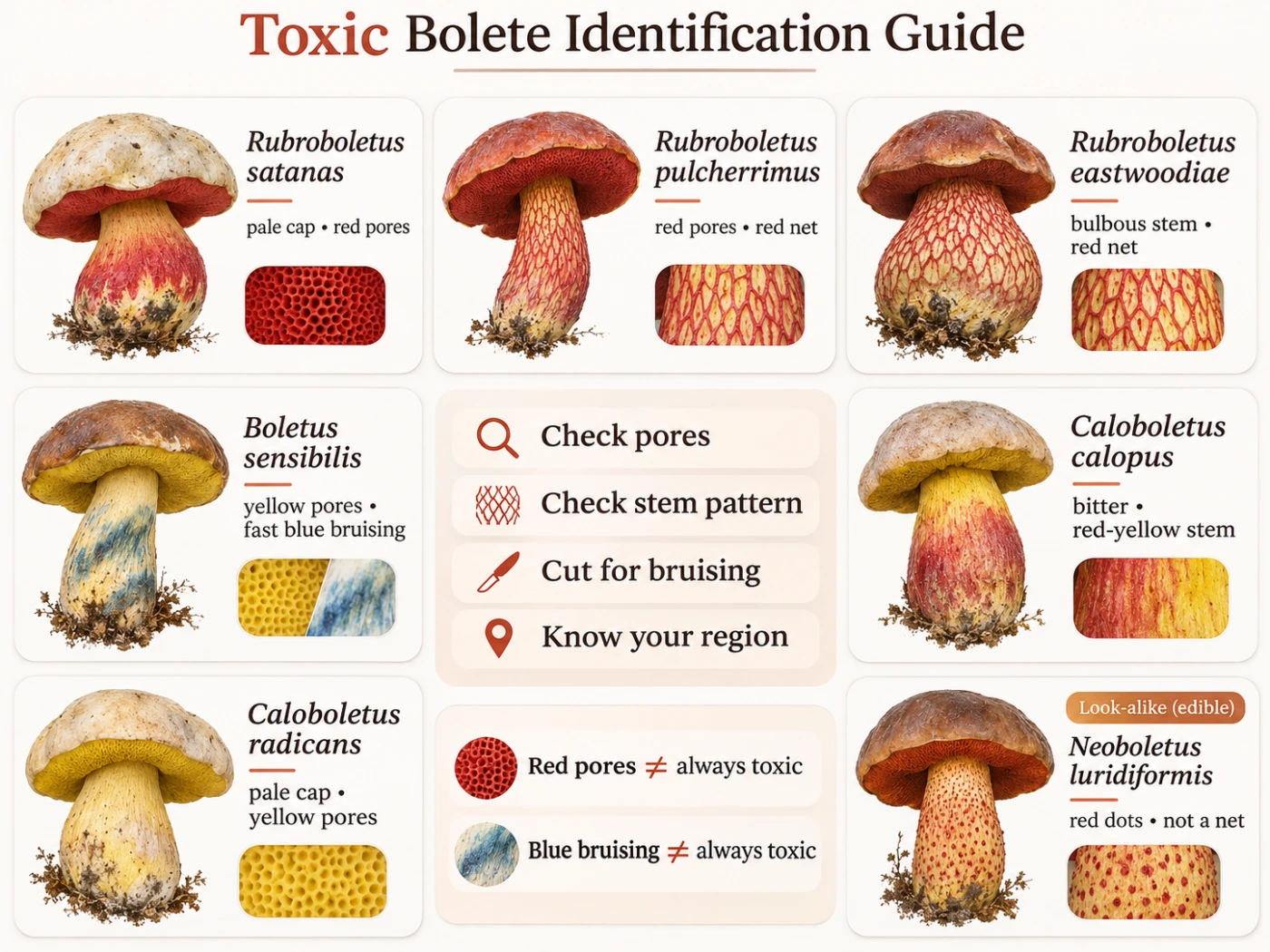
Boletes are often considered easier to identify than gilled mushrooms because most have a sponge-like pore surface beneath the cap. However, some boletes can cause severe gastrointestinal poisoning, and a few North American species have been associated with more serious outcomes.
The most important rule is that no single feature identifies a toxic bolete. Red pores, blue bruising, a bitter taste, or a bright stem can all be useful clues, but none of them alone tells you whether a mushroom is poisonous.
⚠️ Important: Never use this guide as an edibility test. A bolete should be identified to species or a reliably understood regional group before it is eaten, and photo identification alone is not enough to make a wild mushroom safe.
How to Recognize a Bolete
Most typical boletes have pores rather than gills beneath the cap. These pores open into vertical tubes that can usually be separated from the cap flesh as a spongy layer.
The stem may be smooth, dotted, reticulated with a net-like pattern, or covered with rough scabers. These stem characters are often more useful than cap color because many species change appearance with age and weather.
A typical bolete identification should consider the cap, pore color, bruising reaction, stem ornamentation, flesh color, host trees, soil, season, and geographic region.
Are Red-Pored Boletes Poisonous?
Not all red-pored boletes are poisonous. This is one of the most persistent oversimplifications in mushroom identification.
For example, Neoboletus luridiformis has red pores and turns intensely blue when cut, yet it is considered edible when correctly identified and thoroughly cooked in parts of Europe. On the other hand, Rubroboletus satanas also has red pores and is poisonous.
The practical lesson is that red pores are a caution signal, not a toxicity test. They should make you slow down and examine the complete mushroom carefully.
Does Blue Bruising Mean a Bolete Is Poisonous?
No. Blue staining is caused by oxidation reactions in damaged tissue and appears in both edible and toxic boletes.
Some safe or traditionally eaten boletes stain blue strongly, while many toxic mushrooms do not stain blue at all. The speed and location of blueing can help identify a species, but it cannot determine whether that species is safe to eat.
Key Features to Check
The first useful character is the pore surface. Note whether it is white, yellow, orange, red, or olive and whether touching it causes blue, brown, or another color change.
Next examine the stem. A red reticulate net, separate red dots, dark scabers, or an unusually swollen bulbous base can dramatically narrow the possibilities.
Finally, cut the mushroom and observe the flesh. Record both the original color and how quickly it changes after exposure to air.
Toxic and Dangerous Boletes to Know
The species below are among the most important poisonous or high-risk boletes for European and North American identification. Their distribution differs substantially, so names should not be transferred automatically between continents.
Rubroboletus satanas — Devil’s Bolete
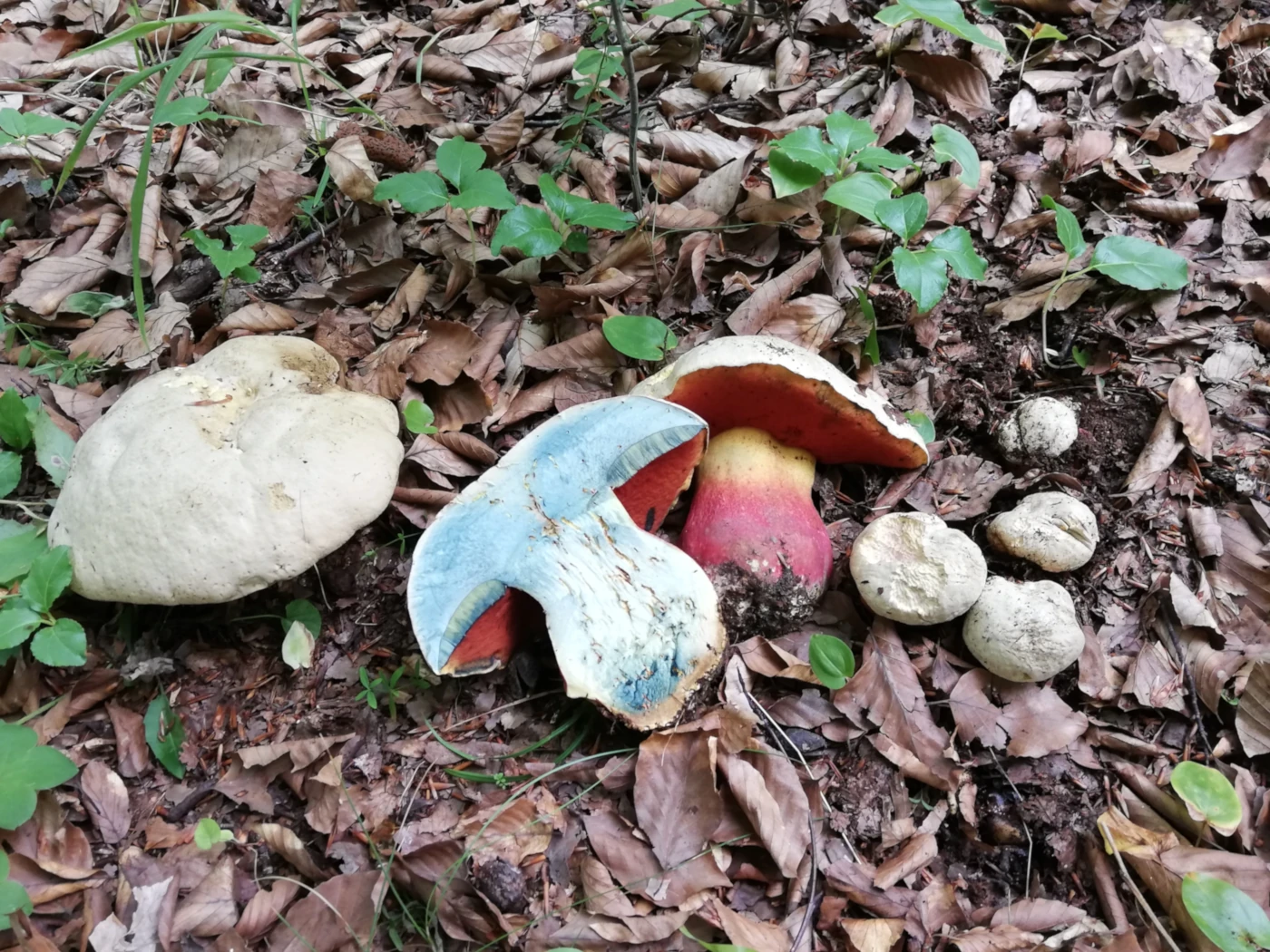
Rubroboletus satanas, also called Satan’s Bolete or Devil’s Bolete, is one of Europe’s best-known poisonous boletes. It is a large mushroom with a very pale whitish to gray cap, red to orange-red pores, and a thick bulbous stem with reddish coloration or reticulation.
The flesh may stain pale blue when cut, but the reaction is often less dramatic than in some edible red-pored boletes. It is especially associated with oak and beech on chalky or limestone-rich soils in warmer parts of Europe.
Identification
Look for the combination of a pale chalky cap, red pores, very thick bulbous stem, and red stem markings. Mature specimens may also develop an unpleasant odor.
This is a very different overall build from the darker-capped Neoboletus luridiformis. Habitat on calcareous soil also supports the identification.
Main Difference
Pale cap + massive bulbous red-marked stem + red pores = strong Rubroboletus satanas pattern.
Rubroboletus pulcherrimus — Beautiful Satan’s Bolete
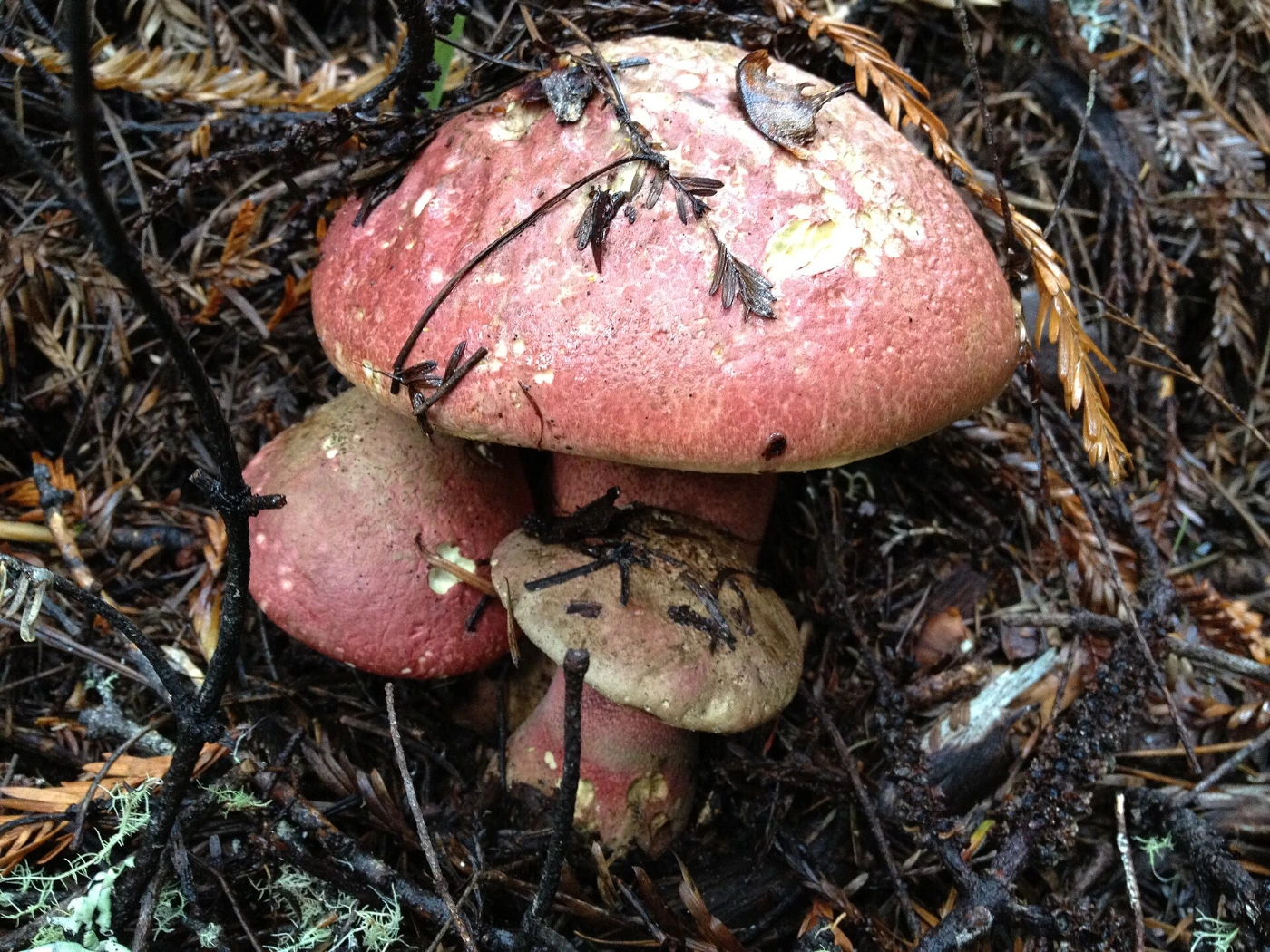
Rubroboletus pulcherrimus is an important toxic bolete of western North America, especially the Pacific Northwest and northern California. It has a reddish-brown to pinkish cap, dark red pores, and a large reddish stem with prominent red reticulation.
The yellow flesh and pore layer turn blue after injury. Historical poisoning reports include serious illness, and toxicology sources advise avoiding this group of large red-pored boletes.
Identification
The species is robust, with a thick club-shaped stem and a strongly reticulate red surface. The pore mouths remain dark red and stain blue when bruised.
It occurs in western conifer and mixed forests, including habitats with fir, hemlock, Douglas fir, and tanoak.
Main Difference
Dark red pores + reddish-brown cap + large red-reticulate stem + western North America = strong Rubroboletus pulcherrimus candidate.
Rubroboletus eastwoodiae — Western Satan’s Bolete
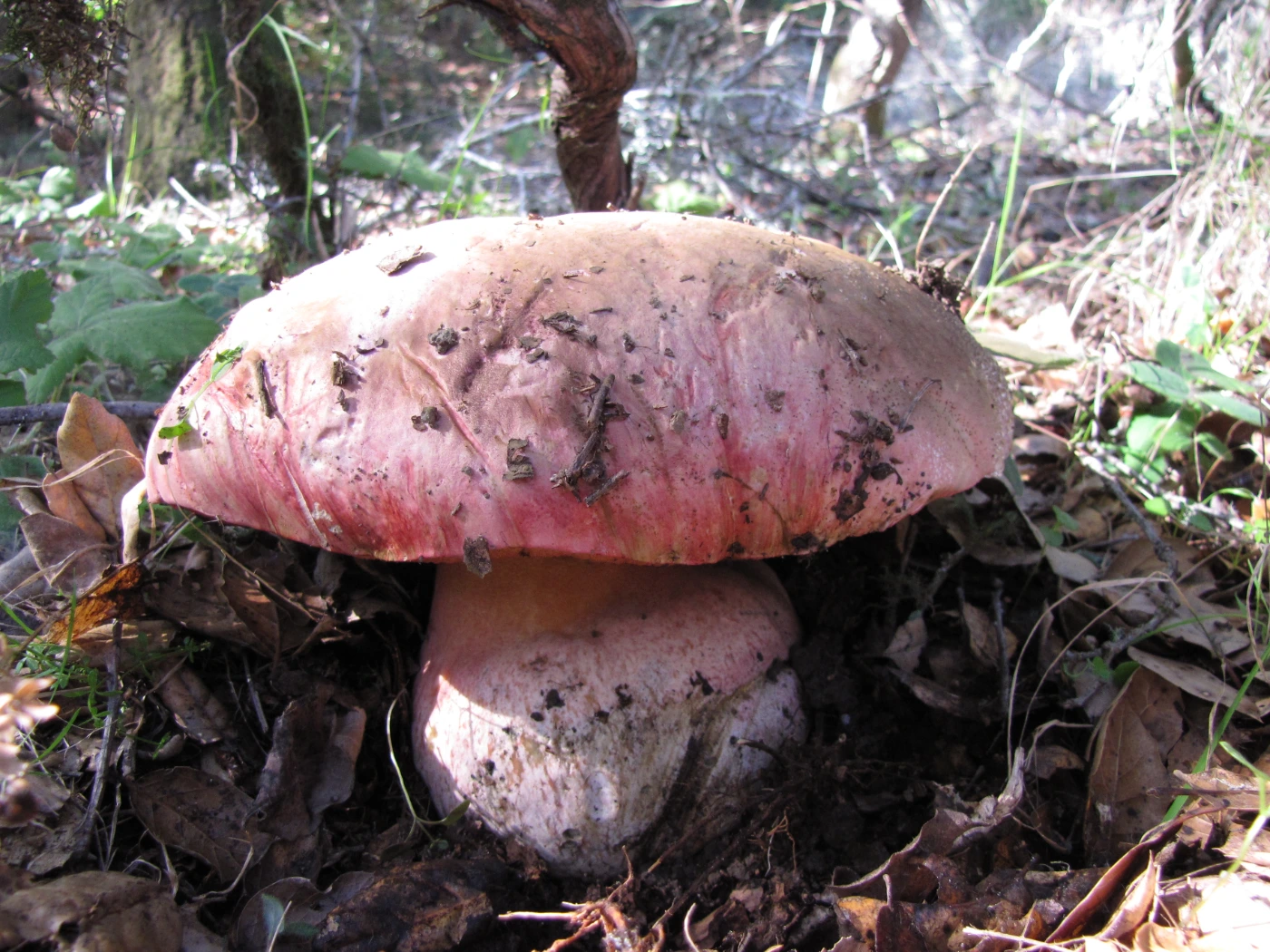
Rubroboletus eastwoodiae is another western North American Satan’s bolete, particularly associated with California oaks. Older literature often confused or misapplied the European name Boletus satanas to western American material.
Typical specimens have a pale gray to pale olive-buff cap, dark red pores, and an abruptly swollen or bulbous stem with pink to wine-red reticulation. The flesh and pore surface bruise blue.
Identification
The unusually broad bulbous stem base is one of the most useful characters. Coast live oak habitat in California is another strong clue.
The cap is usually much paler than that of R. pulcherrimus. Both should be treated as mushrooms to avoid.
Main Difference
Pale cap + abruptly bulbous red-reticulate stem + oak habitat in California = Rubroboletus eastwoodiae pattern.
Boletus sensibilis — Sensitive Bolete
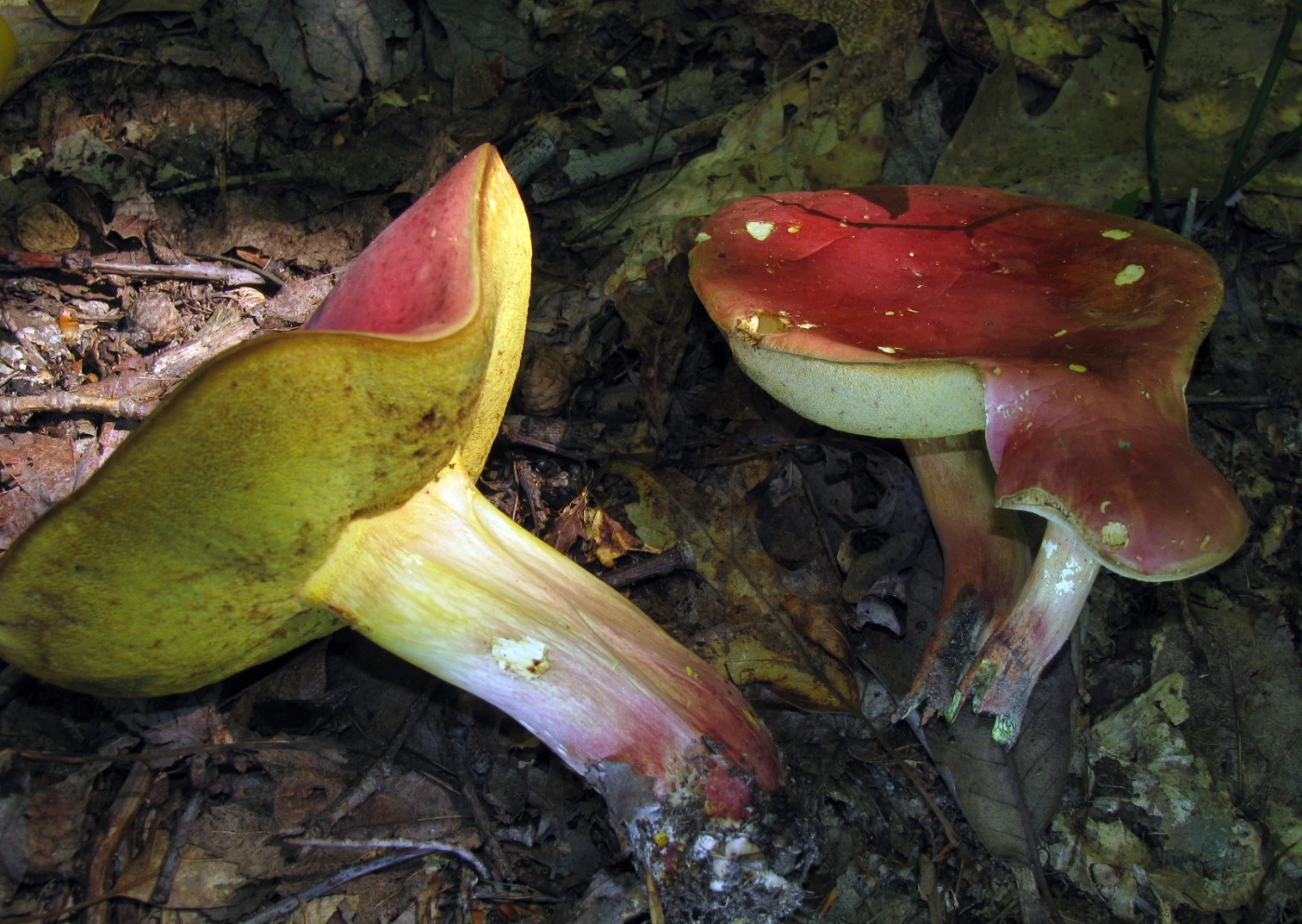
Boletus sensibilis is a North American bolete with a pinkish-red to reddish cap, yellow pores, and yellow flesh. It is notable for rapidly and strongly turning blue when bruised.
It has been associated with gastrointestinal poisoning and is generally treated as non-edible. One of the identification difficulties is its resemblance to edible bicolor-type boletes.
Identification
The cap can be rosy, pink-red, or reddish brown, while the stem is mainly yellow with varying reddish tones. A strong, fast blue reaction may occur on the cap, pores, stem, and flesh.
Some specimens have a distinctive curry-like odor. The combination of rapid widespread staining and eastern North American hardwood habitat is useful.
Main Difference
Fast intense blue staining throughout the mushroom is much more characteristic of B. sensibilis than of many edible bicolor-type boletes.
Inedible Boletes That Can Resemble Toxic Species
Some boletes are not considered highly poisonous but should still not be treated as edible. Their appearance can also overlap with more dangerous species, making them useful to recognize.
Caloboletus calopus — Bitter Beech Bolete
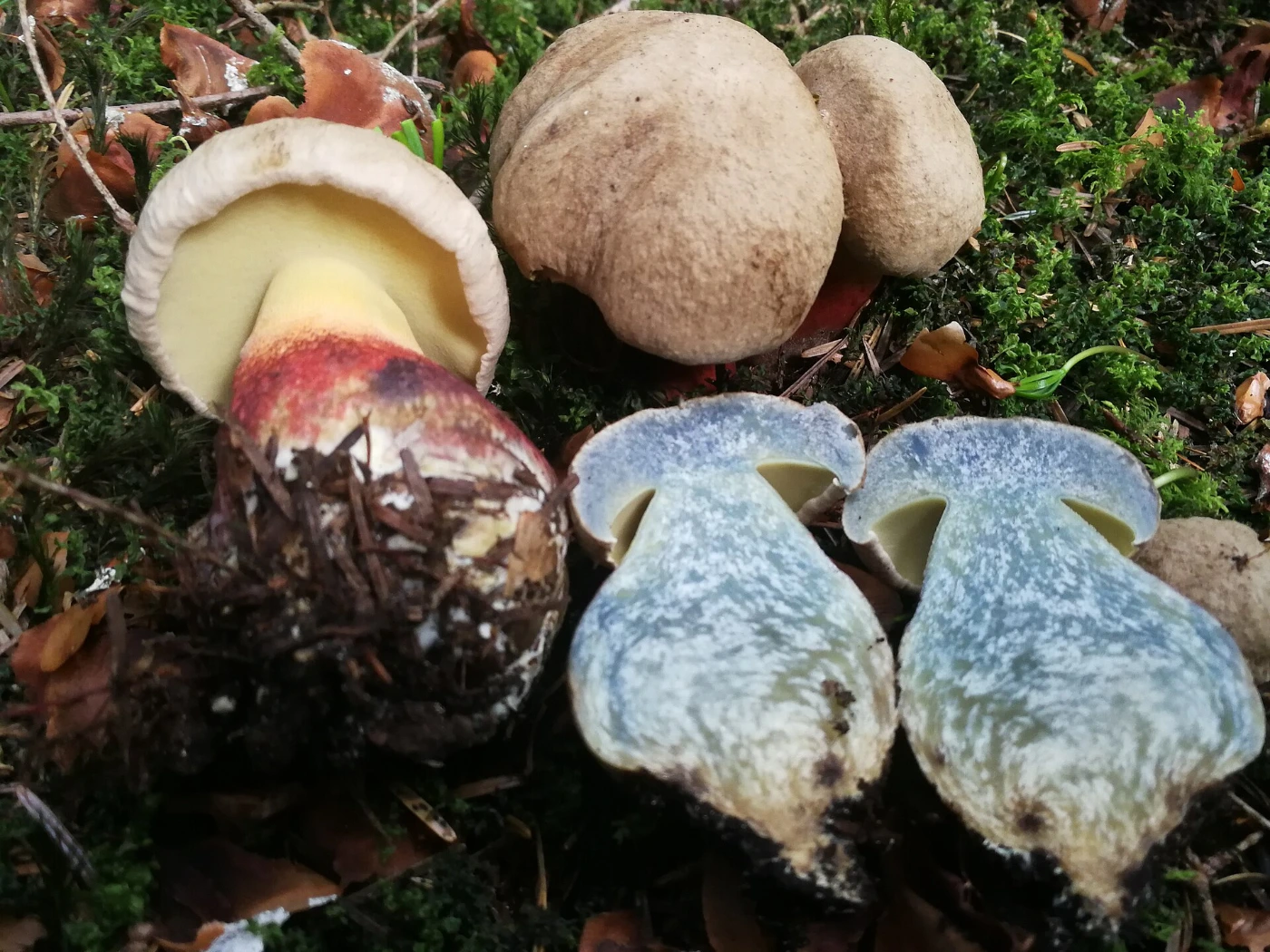
Caloboletus calopus has a pale cap, yellow pores, and a striking stem that is yellow above and reddish below, often with reticulation. The flesh can stain blue after cutting.
Its intensely bitter taste makes it inedible, and field guides caution that it can resemble more seriously poisonous red-pored boletes.
Caloboletus radicans — Rooting Bolete
Caloboletus radicans has a pale smoky-gray to buff cap, yellow pores, and a yellow reticulate stem that often tapers or roots into the soil. The flesh and pores can turn pale blue when damaged.
It is extremely bitter and not considered edible. It grows mainly with oak and sometimes beech on neutral to alkaline soils.
These species illustrate why yellow pores do not automatically mean a bolete is safe.
Toxic Bolete vs Edible Red-Pored Bolete
One of the most important European comparisons is between Rubroboletus satanas and Neoboletus luridiformis. Both can have red pores and blue-staining flesh, yet their overall appearance differs substantially.
| Feature | Rubroboletus satanas | Neoboletus luridiformis |
|---|---|---|
| Cap | Pale white to gray | Brown to dark chocolate |
| Pores | Orange-red to red | Red |
| Stem | Massive, bulbous, often reticulate | Red dots, no net |
| Flesh | Pale, blues moderately | Yellow, blues very rapidly |
| Soil | Often calcareous | Often acidic |
| Status | Poisonous | Edible when correctly ID’d and thoroughly cooked |
| Best clue | Pale cap + red net | Dark cap + red dots |
The stem pattern is especially useful. N. luridiformis has red dots rather than a reticulate network, while many Rubroboletus species show a more obvious red net.
Red Dots vs Red Reticulation
A red stem can look uniformly colored from a distance, but close inspection often reveals an important difference. Some species have many individual red dots, while others have raised lines forming a net.
This distinction is central when separating Neoboletus luridiformis from several red-reticulate boletes. A close-up photograph of the stem is therefore one of the most useful images for identification.
Pale Caps Deserve Extra Attention
Several problematic boletes combine a pale cap with striking pore or stem colors. Rubroboletus satanas, R. eastwoodiae, Caloboletus calopus, and C. radicans are examples.
That does not mean every pale-capped bolete is toxic. It simply means that a pale cap combined with red stem markings, strong staining, or unusual pore colors deserves careful species-level identification.
Bitter Taste Is Not a Safety Test
Some inedible boletes, such as Caloboletus calopus and C. radicans, are extremely bitter. However, toxicity cannot be determined safely by tasting unknown mushrooms.
A mushroom can be dangerous without tasting bitter, and tasting potentially toxic species is unnecessary. Visual and ecological identification should come first.
Regional Taxonomy Matters
European names are frequently misapplied to North American boletes. Rubroboletus satanas, for example, is a European species, while western North America has species such as R. eastwoodiae and R. pulcherrimus.
Likewise, red-pored boletes in eastern North America have their own regional taxonomy. A photograph that resembles a European field guide should not automatically receive the European species name.
European Toxic Bolete Pattern
In Europe, the most important high-risk group includes large pale or reddish boletes with red pores, swollen stems, and complex red reticulation. Rubroboletus satanas is the classic example.
However, some edible boletes also have red pores and blue staining. The safe approach is therefore not to memorize a color rule but to identify the entire mushroom.
North American Toxic Bolete Pattern
North America contains several problematic red-pored or rapidly blue-staining boletes. Western species such as R. pulcherrimus and R. eastwoodiae are especially important, while Boletus sensibilis is relevant farther east.
Older North American literature can be confusing because names have changed and European species names were sometimes applied too broadly. Current regional references are much more useful.
What Symptoms Can Toxic Boletes Cause?
Many bolete poisonings primarily cause gastrointestinal symptoms such as nausea, vomiting, abdominal cramps, and diarrhea. Onset is often within several hours, although timing varies.
Some western North American reports involving large red-pored boletes have raised concern about more severe outcomes. Because species-level identification can be difficult, suspected poisoning should be treated seriously.
What to Do After Suspected Bolete Poisoning
If someone becomes ill after eating a wild bolete, contact a poison center or medical service promptly. Do not wait for the mushroom to be identified perfectly before seeking help.
Keep any uncooked mushrooms, cooked leftovers, photographs, and information about where they were collected. These details can help an expert determine the likely species.
Does Cooking Make Toxic Boletes Safe?
No general cooking rule can make a toxic bolete safe. Some boletes that are eaten traditionally require thorough cooking, but that does not mean cooking neutralizes all toxins in all species.
Do not use boiling, frying, drying, freezing, or repeated water changes as a substitute for identification. A mushroom known to be poisonous or uncertain should simply not be eaten.
Common Identification Mistakes
One frequent mistake is assuming that every blue-staining bolete is toxic. This incorrectly excludes several edible species and does not reliably identify dangerous ones.
Another mistake is assuming that every red-pored bolete is poisonous. Red pores should increase caution, but species such as Neoboletus luridiformis demonstrate why the rule is too simplistic.
A third mistake is identifying only from cap color. Stem ornamentation and pore structure often provide much stronger diagnostic information.
A fourth mistake is using European names for North American mushrooms without checking regional taxonomy. This can create exactly the kind of error that matters most in toxic look-alike groups.
How to Photograph a Suspected Toxic Bolete
Photograph the intact mushroom in place before handling it. Include nearby trees and the surrounding habitat because host association can narrow the identification substantially.
Then photograph the pore surface, entire stem, and stem base. Take a close-up of any reticulation, dots, or unusual color patterns.
Finally, cut one specimen vertically and photograph the flesh immediately and again after several minutes. The location and speed of blue staining can be diagnostically important.
Can AI Identify a Toxic Bolete?
AI can use cap color, pore color, stem markings, bruising, habitat, and geography to narrow the possibilities. It performs much better when several photographs show the whole mushroom rather than a single cap.
However, distinguishing difficult bolete groups can require microscopy, chemical reactions, or specialist knowledge. AI identification should therefore not be used as a final decision that a wild bolete is safe to eat.
Frequently Asked Questions
Are all red-pored boletes poisonous?
No. Some edible species have red pores, including Neoboletus luridiformis when correctly identified and appropriately prepared.
Are all blue-staining boletes poisonous?
No. Blue bruising is a chemical oxidation reaction and occurs in both edible and toxic species.
What is the most famous poisonous bolete?
Rubroboletus satanas, the Devil’s Bolete, is one of the best-known poisonous European boletes. It has a pale cap, red pores, and a thick reddish stem.
Are there toxic boletes in North America?
Yes. Important examples include Rubroboletus pulcherrimus, R. eastwoodiae, and Boletus sensibilis.
Does a bitter bolete mean it is poisonous?
Not necessarily. Some very bitter boletes are simply inedible, while toxicity and bitterness do not consistently correlate.
Can yellow-pored boletes be toxic or inedible?
Yes. Species such as Caloboletus calopus and C. radicans have yellow pores but are not considered edible.
Does cooking destroy bolete toxins?
Not reliably. Cooking should never be used to make an unidentified or known poisonous bolete safe.
What features are most useful for toxic bolete identification?
Pore color, stem markings, bruising reaction, cap color, host trees, soil type, geography, and overall build are all important. No single feature is sufficient.
Final Notes
There is no universal visual rule for identifying toxic boletes. Red pores do not automatically mean poisonous, blue staining does not automatically mean dangerous, and yellow pores do not guarantee edibility.
The most important high-risk mushrooms include European Rubroboletus satanas and western North American species such as Rubroboletus pulcherrimus and R. eastwoodiae. Rapidly blue-staining Boletus sensibilis is another important North American species to recognize.
The practical approach is: check the pores → inspect the entire stem → distinguish dots from reticulation → cut the flesh and record staining → identify nearby trees → consider geography → determine the species before discussing edibility.
Upload a photo and get possible matches in seconds.