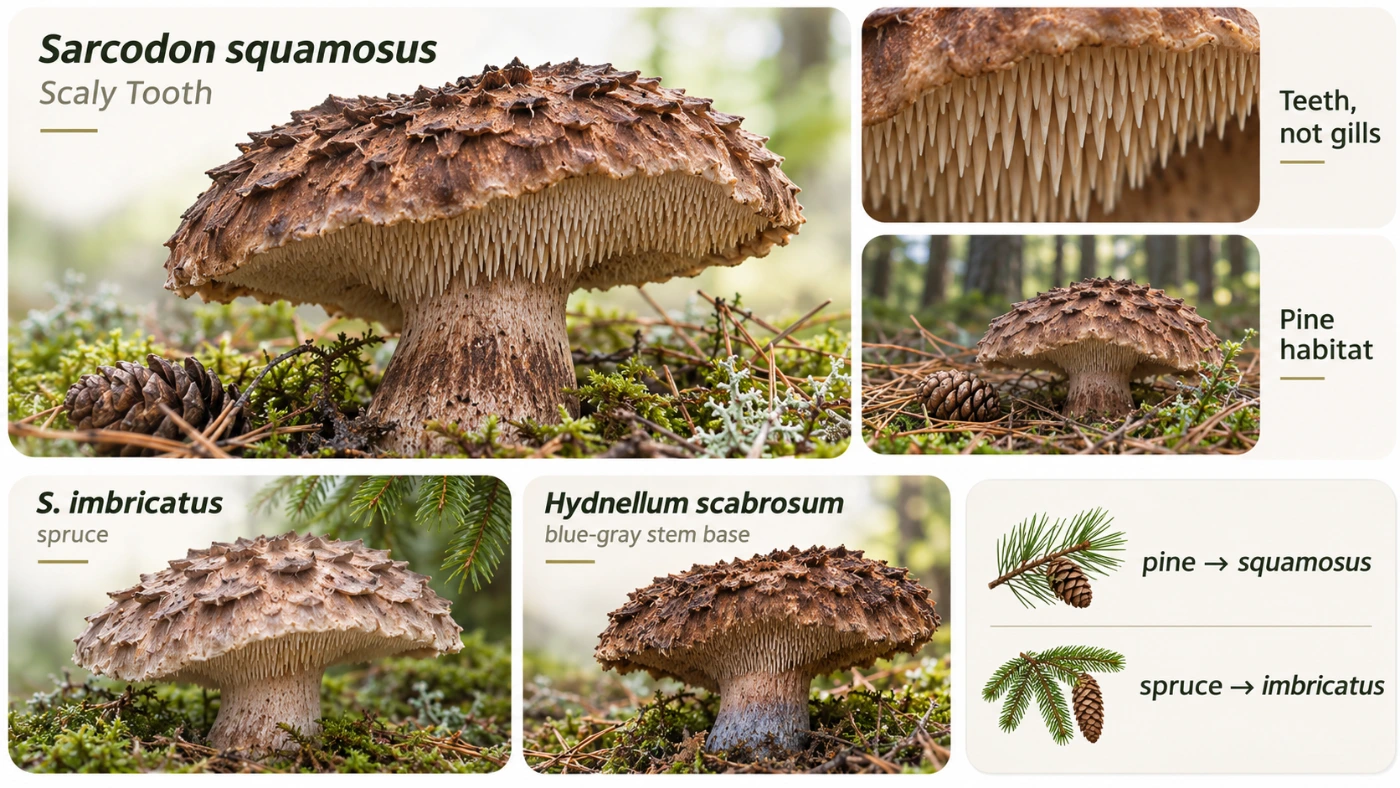
The Sarcodon squamosus Group is a practical identification concept for large, brown, scaly tooth fungi centered on Sarcodon squamosus, commonly known as the Scaly Tooth. These mushrooms have thick caps covered with coarse overlapping scales and, instead of gills or pores, bear hundreds of downward-pointing teeth beneath the cap.
The name “Sarcodon squamosus Group” should not be interpreted as a formally recognized taxonomic rank. It is useful in field identification because S. squamosus has historically been confused with several similar stipitate tooth fungi, particularly Sarcodon imbricatus, and photographs alone may not always provide enough evidence for confident species-level identification.
The strongest field pattern for true Sarcodon squamosus is large brown scaly cap + pale teeth + stout central stem + growth on soil beneath pine. Host tree is especially important because S. squamosus and S. imbricatus were historically treated as the same mushroom but are now recognized as different species with different mycorrhizal associations.
⚠️ Important: Large scaly tooth fungi can be difficult to identify from photographs alone. Host tree, cap structure, stem base, taste characteristics, microscopy, geography, and sometimes DNA sequencing may be required to separate similar species reliably.
Quick Identification
| Feature | Sarcodon squamosus Group |
|---|---|
| Main species | Sarcodon squamosus |
| Common name | Scaly Tooth |
| Growth form | Cap and central stem |
| Cap | Brown to dark brown, heavily scaly |
| Underside | Teeth / spines rather than gills or pores |
| Teeth | Pale when young, brownish with age |
| Stem | Thick, pale to brownish |
| Flesh | Thick, whitish |
| Spore print | Brown |
| Ecology | Ectomycorrhizal |
| Main host of S. squamosus | Pine |
| Typical habitat | Conifer woodland |
| Season | Summer to autumn |
| Main look-alike | Sarcodon imbricatus |
| Other comparisons | Hydnellum scabrosum, other Sarcodon |
| Edibility | Reported as edible in some sources but often bitter; not recommended for casual foraging |
What Is the Sarcodon squamosus Group?
In a practical identification system, the group includes mushrooms that resemble Sarcodon squamosus closely enough that a photograph may not immediately allow species-level separation. These fungi share a thick fleshy cap, brown coloration, conspicuous scales, and a toothed fertile surface.
Historically, this confusion was genuine even among mycologists. S. squamosus was repeatedly lumped with Sarcodon imbricatus, and many older collections labeled S. imbricatus may actually represent S. squamosus.
For MushroomID, the group concept is therefore useful when visual evidence strongly supports a large scaly Sarcodon but the host tree or other distinguishing information is missing.
Sarcodon squamosus — Scaly Tooth
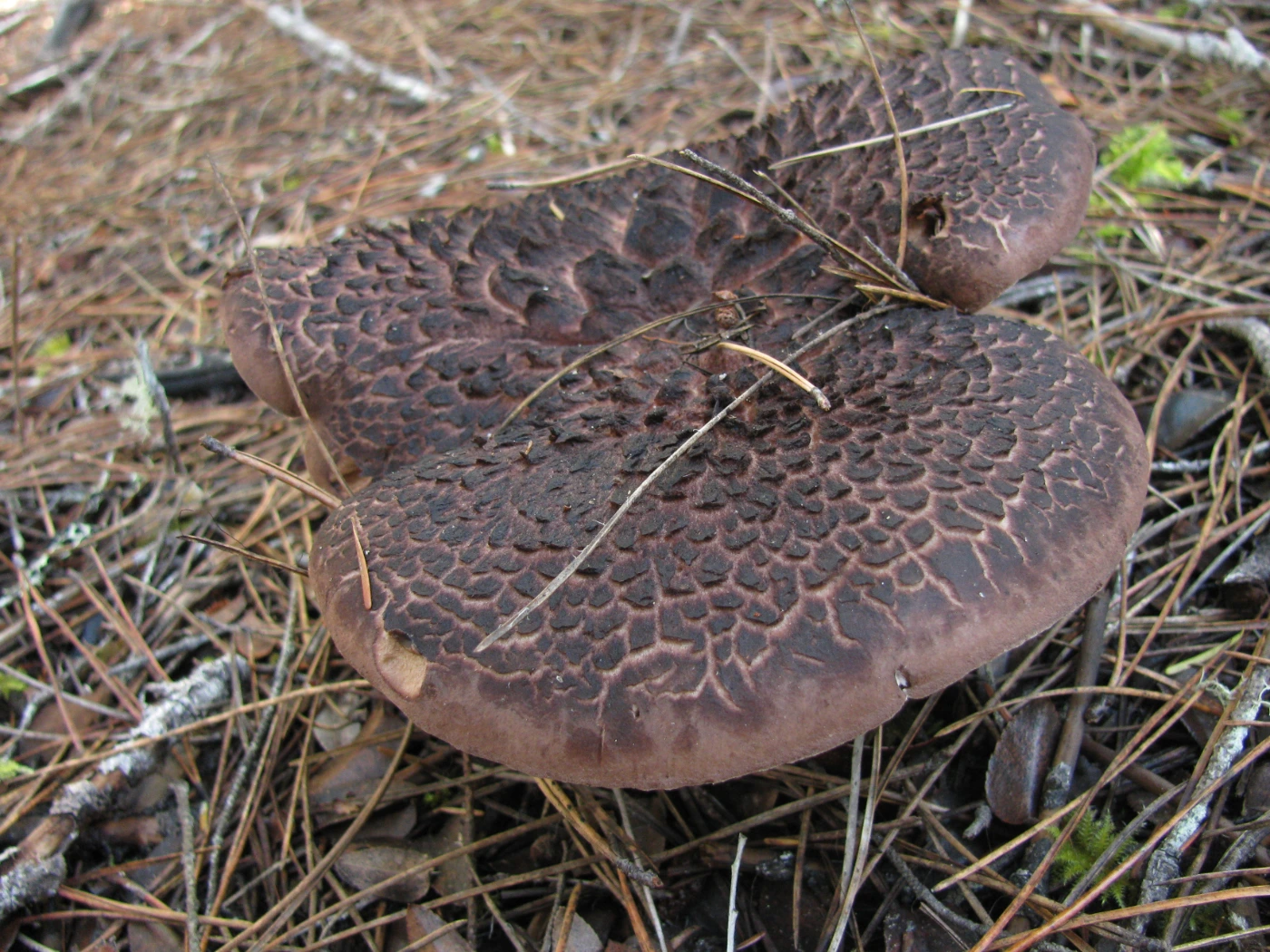
Sarcodon squamosus is the central species in the group. Index Fungorum and Species Fungorum currently recognize Sarcodon squamosus (Schaeff.) Quél. as the accepted name, with Hydnum squamosum as its basionym.
The English common name Scaly Tooth reflects its two most obvious features. The cap is covered with coarse brown scales, while the underside consists of numerous downward-pointing teeth.
Cap
The cap is large, thick, and usually brown to dark reddish-brown or vinaceous-brown. Young fruit bodies begin convex but can become flatter with age.
The surface breaks into prominent overlapping scales arranged more or less concentrically. Scales toward the center are usually larger and more strongly raised, while those near the margin tend to be smaller and flatter.
Some specimens become very dark, especially in the central portion of the cap. Cap coloration alone is variable and should not be used to separate S. squamosus from S. imbricatus.
Scales
The scales are one of the most conspicuous features of the mushroom. They can look like overlapping roof tiles, pinecone scales, or the patterned surface of a reptile.
Compared with S. imbricatus, S. squamosus tends to have somewhat smaller scales and a darker cap overall. These differences are useful but not absolute, which is why host tree remains a much stronger identification clue.
Teeth
The underside of the cap is covered with soft spines rather than gills. In mature mushrooms these teeth can reach approximately 4–10 mm long.
Young teeth are whitish or pale buff. As spores mature, they gradually become gray-brown to purplish-brown.
The teeth are relatively fragile and can break or detach when handled. This feature immediately places the mushroom among the stipitate hydnoid fungi rather than ordinary gilled mushrooms.
Stem
The stem is central, sturdy, and usually pale when young. It gradually becomes brownish as the mushroom ages.
Typical stems are approximately 4–8 cm long and 1–3 cm thick, although large fruit bodies can exceed these dimensions. The stem base does not normally show the distinctive blue-gray coloration found in some important look-alikes.
Flesh
The flesh is thick, firm, and pale when young. It may become somewhat brownish with age.
The odor is generally weak or indistinct. Taste is commonly described as mild to somewhat bitter or astringent, and bitterness can increase in mature specimens.
Spore Print
The spore print is brown. Individual spores are roughly rounded to elliptical and have a strongly ornamented surface with irregular projections.
Published measurements commonly place the spores around 6.5–8 × 5–6.5 µm. Microscopy can support identification but does not replace ecological information when separating closely related species.
Why Are They Called Tooth Fungi?
Tooth fungi produce spores on vertical spines rather than flat gills or pores. The increased surface area of the teeth provides space for spore-producing cells.
In Sarcodon, these teeth hang from the underside of a recognizable cap. This makes the genus very different in appearance from crust-forming tooth fungi even though both use spine-like structures for spore production.
Where Does Sarcodon squamosus Grow?
Sarcodon squamosus is an ectomycorrhizal fungus that grows on the ground beneath trees. It forms a symbiotic relationship with the roots of its host rather than decomposing dead wood.
The most important host is pine. The molecular and morphological study that separated S. squamosus from S. imbricatus found S. squamosus associated with Pinus, whereas S. imbricatus was associated with Picea.
Pine Association
Pine is one of the strongest practical identification clues for S. squamosus. In Europe it is particularly associated with pine woodland, while North American reports also frequently place it beneath pines.
In parts of Canada it can fruit abundantly in Jack Pine stands. Some populations form large arcs, rows, or scattered groups on the forest floor.
A large scaly Sarcodon beneath spruce should therefore raise suspicion for S. imbricatus rather than S. squamosus.
Mycorrhizal Ecology
The fungus exchanges nutrients with living tree roots. The tree supplies carbohydrates produced through photosynthesis, while the fungal network can assist the tree in obtaining water and mineral nutrients.
Because of this relationship, S. squamosus cannot be understood simply as a mushroom growing “near” pine. Its presence is linked to an underground ecological partnership with the tree.
This is why recording nearby vegetation is so important when identifying stipitate tooth fungi.
Season
Fruit bodies usually appear during summer and autumn. In Britain, published field guides give a season roughly from June through October, although timing varies considerably with climate.
In milder parts of western North America, fruiting can continue into early winter. Moisture, soil temperature, and local climate strongly affect emergence.
Distribution
Sarcodon squamosus occurs in Europe and is also reported from parts of North America. Historical distribution records must be treated cautiously because the species was confused with S. imbricatus for much of the twentieth century.
Older records labeled simply “Sarcodon imbricatus” cannot always be assigned confidently without revisiting specimens or ecological information.
Why Sarcodon squamosus Was Confused With Sarcodon imbricatus
For decades, mycologists commonly treated the two forms as a single species. Both are large brown tooth fungi with coarse scales and very similar microscopic characters.
An important clue emerged from mushroom dyeing. Collections growing with pine produced different colors on wool from collections growing with spruce.
Johannesson and colleagues later compared morphology with ITS DNA sequences and demonstrated that the two forms represented distinct species. Their 1999 study recognized S. squamosus with pine and S. imbricatus with spruce.
Look-Alikes
The most important comparisons are other large stipitate tooth fungi. Host tree, cap scale structure, stem-base color, taste, and cap depression are often more useful than overall brown coloration.
Sarcodon imbricatus
Identification
Sarcodon imbricatus is the classic look-alike. It has a large brown cap covered with coarse overlapping scales and a pale toothed underside.
The cap often becomes more strongly depressed in the center than typical S. squamosus. Its scales also tend to be larger and the overall cap may appear somewhat paler.
Main Difference
The strongest field distinction is the host tree:
Pine → favors Sarcodon squamosus.
Spruce → favors Sarcodon imbricatus.
This ecological distinction was supported by molecular evidence and is much more useful than trying to identify the species from cap color alone.
Sarcodon squamosus vs Sarcodon imbricatus
| Feature | S. squamosus | S. imbricatus |
|---|---|---|
| Common appearance | Dark brown scaly tooth | Brown scaly tooth |
| Cap | Often darker | Often somewhat paler |
| Scales | Usually smaller | Often larger |
| Central depression | Usually less pronounced | Often deeper |
| Main host | Pine | Spruce |
| Spore print | Brown | Brown |
| Teeth | Pale → brown | Pale → brown |
| Dye reaction | Bluish-green shades | Grayish-beige shades |
| Best clue | Pine association | Spruce association |
These differences work best when several characters agree. A single ambiguous cap photograph is not enough for reliable separation.
Hydnellum scabrosum
Identification
Hydnellum scabrosum can also produce a brown scaly cap and toothed underside. Older fruit bodies may look surprisingly similar to Sarcodon squamosus.
The stem base, however, often develops a distinctive blue-gray to dark bluish coloration. The taste is also described as strongly bitter.
Main Difference
Bluish stem base + strongly bitter taste favor Hydnellum scabrosum.
Typical S. squamosus has a paler stem base and a much milder taste.
Other Sarcodon Species
Identification
Other Sarcodon species can also have brown caps and toothed undersides. Some begin relatively smooth and develop scales only with age, while others have different odors, chemical reactions, or host associations.
In Southwest China, molecular research has shown that superficially similar scaly Sarcodon sold in markets under names such as S. imbricatus, S. aspratus, or S. squamosus can actually represent multiple distinct taxa.
Main Difference
There is no universal visual feature that separates every species. Geography and molecular taxonomy become increasingly important outside the well-studied European squamosus–imbricatus comparison.
Why Geography Matters
The name Sarcodon squamosus has historically been applied broadly to scaly tooth fungi in several regions. Modern molecular studies increasingly show that similar-looking populations may belong to different species.
This is especially relevant in Asia, where studies of market-collected stipitate hydnoid fungi have revealed much greater diversity than older morphology-based identification suggested.
A mushroom resembling European S. squamosus in China should therefore not automatically receive that name from photographs alone.
Young vs Mature Specimens
Young Scaly Tooth mushrooms usually have convex caps with relatively compact scales. The underside is pale, and the flesh remains firm and whitish.
As the mushroom ages, the cap expands and scales become increasingly prominent. The teeth darken as spores mature, while the cap may become flatter or irregular.
Very old specimens often become darker, tougher, and more bitter. Their exaggerated scales can make them look more distinctive while simultaneously obscuring useful younger features.
Is Sarcodon squamosus Edible?
The species has traditionally been reported as edible in some regions, especially when young. Other sources describe it as bitter or astringent and do not recommend it as a culinary mushroom.
This disagreement is another reason not to treat a photo-level “Sarcodon squamosus Group” identification as an edibility determination. Similar tooth fungi may differ in bitterness, taxonomy, regional use, and culinary reputation.
Older mushrooms are generally considered especially undesirable because the flesh becomes tougher and bitterness may increase.
Traditional Use for Dyeing
Scaly Sarcodon mushrooms have a notable history in natural textile dyeing. S. squamosus can produce blue-green shades on wool under suitable dyeing conditions.
This characteristic played an unexpected role in modern taxonomy. Differences noticed by mushroom dyers helped draw attention to the fact that pine-associated and spruce-associated “S. imbricatus” behaved differently.
Those observations eventually contributed to the reinstatement of S. squamosus as a separate species.
Why Host Trees Matter More Than Cap Color
Brown pigmentation changes with age, rainfall, sunlight, and individual variation. A dark specimen of S. imbricatus can overlap visually with a paler S. squamosus.
Host association is biologically more meaningful because these mushrooms form ectomycorrhizal partnerships with particular trees.
For this group, a photograph showing the surrounding forest can therefore be more valuable than an extremely close photograph of the cap.
Common Identification Mistakes
One common mistake is identifying every large scaly tooth fungus as Sarcodon imbricatus. Many older books used that name broadly, but pine-associated specimens may actually represent S. squamosus.
Another mistake is relying entirely on the cap scales. Scale size and darkness overlap and are less reliable than ecology.
A third mistake is forgetting to examine the stem base. A blue-gray base can point away from Sarcodon squamosus and toward species such as Hydnellum scabrosum.
A fourth mistake is applying European species names automatically to similar Asian or North American mushrooms. Molecular studies have shown that stipitate tooth fungi contain substantial cryptic diversity.
How to Photograph the Sarcodon squamosus Group
Photograph the mushroom from above to document the scale pattern, but do not stop there. Turn one fruit body carefully enough to photograph the teeth without removing all ecological context.
Include the complete stem and stem base. Then take a wider photograph showing nearby pine, spruce, or other potential host trees.
Photographs of needles, cones, bark, and the surrounding forest can be particularly useful. For this group, host-tree evidence may decide between two species that otherwise look almost identical.
Can AI Identify the Sarcodon squamosus Group?
AI can usually recognize the general pattern of a large scaly stipitate tooth fungus when the cap and toothed underside are both visible. Identification becomes much less reliable when only the upper surface is photographed.
Separating S. squamosus from S. imbricatus requires ecological context. If the photograph is accompanied by confirmed pine habitat, S. squamosus becomes much more likely; confirmed spruce substantially favors S. imbricatus.
For poorly studied regional populations, the appropriate result may remain Sarcodon squamosus Group rather than forcing a species name.
Interesting Facts
Sarcodon squamosus was originally described as Hydnum squamosum by Jacob Christian Schäffer in 1774. The currently accepted combination in Sarcodon dates from Quélet’s nineteenth-century classification.
The species is also a good example of how non-microscopic observations can contribute to taxonomy. Different wool-dye colors produced by pine- and spruce-associated mushrooms helped reveal that the traditional S. imbricatus concept contained more than one species.
The genus belongs to the family Bankeraceae in the order Thelephorales. Like many members of this group, S. squamosus is ectomycorrhizal rather than a wood-decomposing fungus.
Frequently Asked Questions
What is the common name of Sarcodon squamosus?
The accepted English common name is Scaly Tooth. The name refers to its strongly scaled cap and toothed fertile surface.
Is Sarcodon squamosus Group a formal taxonomic name?
No. It is best treated as a practical identification grouping for mushrooms resembling S. squamosus when the available evidence does not permit confident species-level identification.
What trees does Sarcodon squamosus grow with?
Pine is the key host association. This is one of the most important distinctions from Sarcodon imbricatus, which is primarily associated with spruce.
What is the difference between Sarcodon squamosus and Sarcodon imbricatus?
S. squamosus generally grows with pine and tends to have a darker cap with somewhat smaller scales. S. imbricatus is associated with spruce and often has larger scales and a more strongly depressed cap center.
Does Sarcodon squamosus have gills?
No. The underside is covered with downward-pointing teeth or spines.
What color is the spore print?
The spore deposit is brown.
Is Scaly Tooth edible?
Some sources describe young fruit bodies as edible, while others consider the mushroom too bitter or astringent to recommend. An uncertain group-level identification should never be used as evidence that a mushroom is safe to eat.
Why was Sarcodon squamosus confused with Sarcodon imbricatus?
The two species are extremely similar in overall appearance. Molecular research, host-tree association, morphological differences, and even differences in textile dye colors eventually demonstrated that they are separate species.
Final Identification Notes
The Sarcodon squamosus Group is best recognized by the combination of a large brown cap with coarse overlapping scales, a pale toothed underside, thick central stem, terrestrial growth, and ectomycorrhizal association with conifers.
For true Sarcodon squamosus, pine is the strongest ecological clue. A similar mushroom beneath spruce should bring Sarcodon imbricatus to the top of the comparison list, while a blue-gray stem base and strong bitterness may suggest Hydnellum scabrosum.
The practical identification pattern is: large scaly brown cap + teeth instead of gills + stout stem + pine habitat = strong Sarcodon squamosus candidate. When the host tree or regional taxonomy is uncertain, Sarcodon squamosus Group is a more defensible identification than forcing a species-level result from appearance alone.
Upload a photo and get possible matches in seconds.