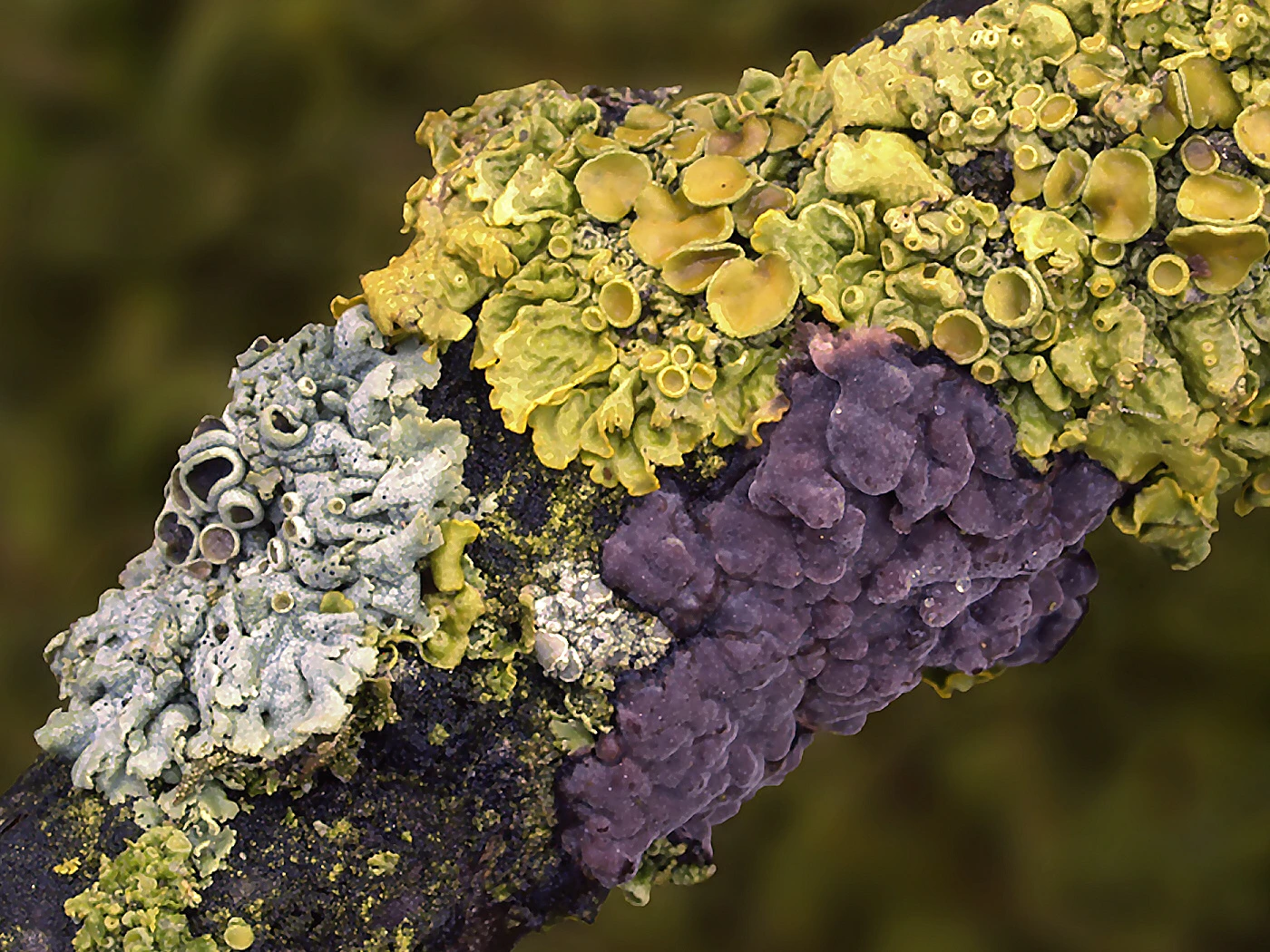
Peniophora quercina, commonly known as Oak Crust, is a thin crust fungus that grows mainly on dead oak twigs and small branches. Unlike familiar mushrooms with caps and stems, it forms flat waxy patches directly on the wood.
Fresh specimens are usually pale lilac, violet-gray, or pinkish-gray. As they dry, the crust becomes harder and often curls away from the bark at the edges, exposing a dark brown to almost black underside.
The most useful field pattern is thin lilac-gray crust + dead oak branch + smooth waxy surface + dark curled edges when dry. This combination makes Oak Crust one of the easier Peniophora species to recognize in the field.
Quick Identification
| Feature | Peniophora quercina |
|---|---|
| Common name | Oak Crust |
| Growth form | Resupinate crust |
| Color when moist | Pale lilac, violet-gray, pinkish-gray |
| Color when dry | Pinkish to gray, often darker |
| Surface | Smooth to slightly uneven, waxy |
| Margin | Can lift and curl away from bark |
| Underside | Dark brown to blackish when exposed |
| Stem | Absent |
| Cap | Absent |
| Main substrate | Dead oak wood |
| Ecology | Saprobic |
| Season | Visible year-round |
| Spore shape | Curved cylindrical / allantoid |
| Edibility | Inedible |
| Main look-alikes | Stereum gausapatum, Stereum hirsutum, Stereum subtomentosum, other Peniophora |
What Does Oak Crust Look Like?
Oak Crust does not develop a conventional mushroom shape. Instead, the fruiting body spreads flat across the bark like a thin layer of wax or paint.
Individual patches may begin as small rounded areas and gradually merge into larger irregular sheets. On suitable oak branches, the fungus can cover substantial sections of the bark.
The fertile surface is usually smooth or only slightly uneven. When moist, it can look soft and waxy, while dry specimens become firm and much less flexible.
Color
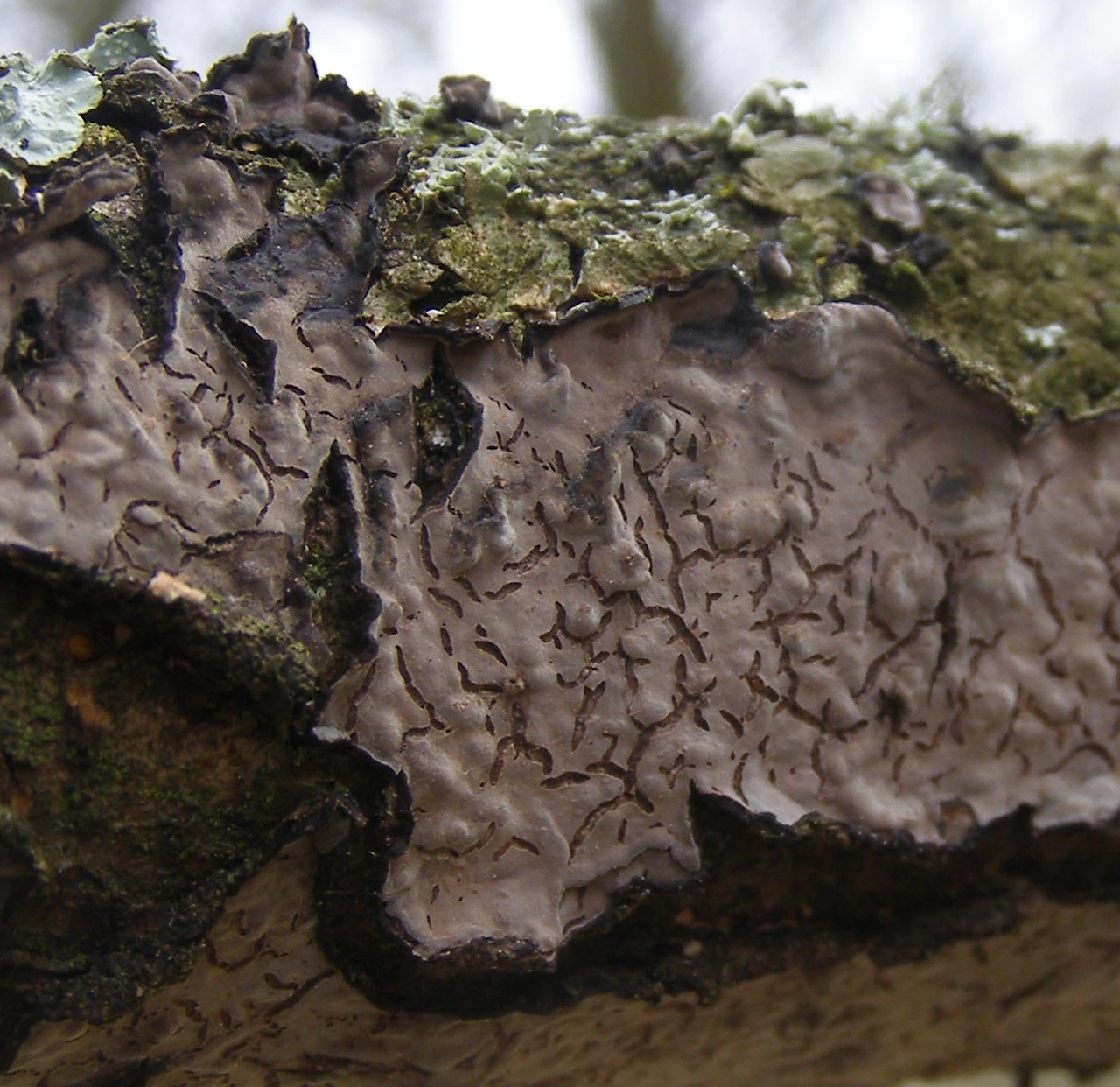
Fresh Oak Crust is often easiest to recognize by its unusual lilac-gray or pinkish-violet coloration. The color can be subtle, especially in shaded woodland.
Dry weather changes the appearance significantly. The surface may become duller pink, gray, or brownish, while the margins contract and expose the much darker lower surface.
This difference between wet and dry appearance is one of the strongest identification characters.
Fruiting Body
The fruiting body is resupinate, meaning it lies flat against the substrate rather than producing a cap or bracket.
It is usually only a few millimeters thick. First Nature describes mature fruit bodies as approximately 1–3.5 mm thick, with a surface that can be smooth or somewhat uneven.
The fungus may remain tightly attached to the wood when young. Older or very dry specimens often begin to lift at the margins.
Why the Edges Curl
As Oak Crust loses moisture, the fruiting body contracts. The edges can pull away from the bark and curl outward.
This exposes the dark basal surface beneath the pale fertile layer. The result is a distinctive blackish or dark brown outline around dried patches.
Many other crust fungi remain firmly attached to the substrate even when dry, so this curling behavior can be extremely useful in the field.
Surface Texture
When damp, Oak Crust has a smooth, waxy appearance. It may feel slightly soft or pliable compared with dry specimens.
As it dries, the surface becomes harder and tougher. It does not become fleshy like a typical mushroom and remains very thin.
There are no pores, gills, or teeth visible to the naked eye.
Stem and Cap
Oak Crust has neither a stem nor a true cap. The entire visible fruiting body is attached directly to the wood.
This growth form separates it immediately from bracket fungi and most conventional woodland mushrooms.
Spores
The spores are smooth and curved-cylindrical, often described as allantoid or sausage-shaped. First Nature gives a typical size range of approximately 8–12 × 3–4 µm.
Microscopic characters can help confirm the identification when several similar crust fungi grow on the same substrate.
Spore Print
Spore-print information for very thin crust fungi is less useful in ordinary field identification than it is for gilled mushrooms. Different field sources describe the deposit as pale to pinkish, while practical identification relies much more heavily on fruiting-body color, drying behavior, microscopy, and substrate.
For Oak Crust, the host tree and the characteristic curling dark-backed crust are considerably more informative than attempting a conventional spore print.
Where Does Oak Crust Grow?
Oak Crust grows primarily on dead wood of oak trees in the genus Quercus. Dead attached twigs and small branches are particularly characteristic substrates.
It can also occur on fallen oak material beneath the tree. Some sources note occasional records from other broadleaf wood, but oak remains by far the most important field clue.
Dead Attached Branches
One of the best places to search is among dead oak branches that remain attached to living trees. Thin branches with intact bark can support long strips or patches of Oak Crust.
The fungus may therefore be overlooked by people searching only on fallen logs or large stumps.
Small dead branches lying beneath mature oak trees are also worth examining carefully.
Ecology
Oak Crust is primarily saprobic, obtaining nutrients by decomposing dead wood. It contributes to the gradual breakdown of fallen and standing dead branches.
Although it may occasionally appear on dead parts of living trees, it should not automatically be interpreted as the organism that killed the branch.
Crust fungi form an important part of woodland decomposition systems even though their fruiting bodies are much less conspicuous than large bracket fungi.
Season
Oak Crust can be found throughout the year because the tough fruiting bodies persist on branches. Moist weather often makes fresh specimens more visible because their lilac or pinkish-gray coloration becomes stronger.
Spore production may be more seasonal, but the physical crust can remain recognizable for long periods. First Nature lists it as visible throughout the year.
Distribution
Peniophora quercina is widely recorded in European temperate woodland wherever suitable oak substrate occurs. The common English name Oak Crust is formally recognized in the British Natural History Museum species database.
Records outside Europe should be interpreted with regional taxonomy in mind. Crust fungi can be difficult to identify from photographs alone, and superficially similar Peniophora species occur on other continents.
Taxonomy
The currently accepted scientific name is Peniophora quercina (Pers.) Cooke. Index Fungorum lists it as the current name in the family Peniophoraceae within the order Russulales.
The species was originally described as Thelephora quercina. Historical synonyms also include Corticium quercinum, Auricularia corticalis, and Peniophora pezizoides.
Why Is Oak Crust in the Order Russulales?
The order Russulales contains far more than the familiar Russula and Lactarius mushrooms. It also includes several crust-forming and wood-decaying fungi.
Oak Crust belongs to the family Peniophoraceae. Its flat growth form looks completely different from a brittlegill, but molecular and microscopic relationships place these fungi within the same broader order.
Is Oak Crust Edible?
No. Oak Crust is considered inedible and has no culinary value.
The fruiting body is extremely thin, tough, and leathery rather than fleshy. First Nature describes it as tough, tasteless, and inedible.
It is better regarded as a woodland decomposer and identification species rather than a foraging mushroom.
Look-Alikes
Several crust and bracket fungi can grow on oak. Substrate, surface texture, fruiting-body thickness, and whether the margins form true brackets are the most useful distinctions.
Stereum gausapatum — Bleeding Oak Crust
Identification
Stereeum gausapatum also grows mainly on oak and can form extensive crust-like fruiting bodies. It is generally darker and often develops reflexed or bracket-like margins.
When freshly damaged, it can produce reddish or bleeding discoloration.
Main Difference
Oak Crust is smoother, thinner, and often lilac-gray with characteristic dark curling edges. Bleeding Oak Crust tends to be darker and more obviously Stereum-like.
First Nature lists Stereum gausapatum as one of the principal look-alikes.
Stereum hirsutum — Hairy Curtain Crust
Identification
Stereum hirsutum commonly grows on dead hardwood and forms thin overlapping brackets or reflexed crusts.
Its upper surface is distinctly hairy and often zoned in yellow, orange, ochre, or brown shades.
Main Difference
A hairy zoned upper surface strongly favors Stereum hirsutum. Oak Crust has a smooth waxy lilac-gray fertile surface without a hairy cap.
Stereum subtomentosum — Yellowing Curtain Crust
Identification
Stereum subtomentosum can form spreading crusts with reflexed margins. Its upper surface is typically zoned in grayish, yellowish, orange, or cream colors.
The fruiting body is more bracket-like than typical Peniophora quercina.
Main Difference
Zoned reflexed brackets point toward Stereum subtomentosum. Flat lilac crusts that curl away from oak bark are more typical of Oak Crust.
Other Peniophora Species
Identification
The genus Peniophora contains many resupinate crust fungi that can look extremely similar. Colors range from gray and violet to orange, red, or brown depending on species.
Host tree is often one of the most valuable initial clues.
Main Difference
Peniophora quercina is strongly associated with oak and has the characteristic lilac-gray to pinkish surface with dark exposed margins when dry.
Microscopy may still be required for uncertain specimens.
Oak Crust vs Bleeding Oak Crust
| Feature | Oak Crust | Bleeding Oak Crust |
|---|---|---|
| Scientific name | Peniophora quercina | Stereum gausapatum |
| Main substrate | Oak | Oak |
| Growth form | Thin flat crust | Crust to reflexed bracket |
| Surface | Smooth, waxy | More textured |
| Typical color | Lilac-gray / pinkish | Brown to reddish-brown |
| Dry edges | Often curl and expose dark underside | Less characteristic |
| Bleeding reaction | Absent | Can redden when damaged |
| Best clue | Lilac crust with blackish curled edge | Darker Stereum with bleeding reaction |
The shared oak substrate can make these species confusing from a distance. Close inspection of the fruiting-body structure usually separates them.
Why Substrate Is So Important
Many crust fungi show strong preferences for particular wood species. In the case of Oak Crust, oak is one of the most useful clues available.
A lilac-gray crust growing on a dead oak twig deserves immediate consideration as Peniophora quercina. The same-looking crust on conifer wood or a different hardwood should be approached more cautiously.
Always identify the tree when possible.
Wet vs Dry Appearance
Oak Crust can look almost like two different fungi depending on weather conditions. Fresh damp specimens appear smooth, soft, and pale lilac or violet-gray.
Dry specimens become harder, paler or pinker, and the margins may peel back dramatically. The dark underside then becomes much more visible.
Photographing the same colony after rain and during dry weather can reveal this transformation particularly well.
Young vs Old Fruiting Bodies
Young fruiting bodies may form small isolated patches tightly attached to the bark. These gradually enlarge and merge.
Older fruiting bodies become more irregular and may lift from the substrate around their margins. Weathering can also obscure the original lilac coloration.
Fresh margins are often more useful for identification than the center of an old patch.
Common Identification Mistakes
One common mistake is assuming every flat fungus on oak is Oak Crust. Numerous Stereum, Peniophora, and other corticioid fungi can occupy the same branches.
Another mistake is identifying the species by purple coloration alone. Weather, age, and moisture can substantially alter the color.
A third mistake is ignoring the dry margin. The tendency to contract and expose a dark underside is one of the most characteristic field features.
A fourth mistake is trying to identify crust fungi from a distant photograph. Close-up structure, substrate, and sometimes microscopy are often necessary.
How to Photograph Oak Crust
Take a photograph of the complete branch first so the substrate and growth pattern are visible. Include oak leaves, buds, or bark characters when possible.
Then take close-up images of the smooth fertile surface and the edge of the crust. A dry specimen with lifted margins is especially useful because the dark underside can be documented.
If possible, photograph both moist and dry material from the same colony.
Can AI Identify Oak Crust?
AI can often recognize a Peniophora-type crust when given a clear close-up and information about the substrate. Species-level accuracy improves substantially when the branch is confirmed as oak.
A single photograph of a flat gray crust without host information is much less reliable. Several unrelated crust fungi can produce nearly identical visual patterns.
Microscopy remains useful when field characters are ambiguous.
Interesting Facts
Oak Crust is a good example of a fungus whose appearance changes dramatically with humidity. The transformation from a smooth lilac waxy crust to curled dark-edged flakes is part of its normal drying behavior.
The species name quercina refers directly to oak, from Quercus, the genus of its principal host tree.
Despite belonging to the order Russulales, Oak Crust looks nothing like the familiar cap-and-stem brittlegills of the genus Russula. Its unusual form demonstrates how diverse fruiting-body shapes can be within a single fungal order.
Frequently Asked Questions
What is Oak Crust?
Oak Crust is the common name for Peniophora quercina, a thin resupinate crust fungus that grows mainly on dead oak branches.
What color is Oak Crust?
Fresh specimens are usually pale lilac-gray, violet-gray, or pinkish-gray. Dry specimens become harder and often show dark brown to blackish margins.
Does Oak Crust grow only on oak?
Oak is by far the most characteristic substrate. Occasional records occur from other broadleaf wood, but identification away from oak requires more caution.
Why does Oak Crust curl away from the bark?
The fruiting body contracts as it dries. This causes the margins to lift and expose the darker layer underneath.
Is Oak Crust edible?
No. It is tough, thin, and considered inedible.
Does Oak Crust have pores or gills?
No. The fertile surface is smooth or only slightly uneven.
Can Oak Crust damage a living oak tree?
It is primarily saprobic and usually colonizes dead wood. Finding it on a dead branch of a living oak does not necessarily mean it caused the branch to die.
What is the main Oak Crust look-alike?
Bleeding Oak Crust, Stereum gausapatum, is one of the most important comparisons because it also occurs on oak.
Final Identification Notes
Oak Crust, Peniophora quercina, is best recognized by its thin resupinate growth, pale lilac-gray or pinkish waxy surface, strong association with dead oak branches, and tendency to curl away from the bark when dry and expose a dark underside.
The most important look-alikes are oak-associated Stereum species and other members of Peniophora. Surface texture, substrate, dry-edge behavior, and the presence or absence of reflexed brackets are the most useful field distinctions.
The practical identification pattern is: dead oak twig + smooth lilac-gray crust + curling dark-backed margins = strong Oak Crust candidate.
Upload a photo and get possible matches in seconds.