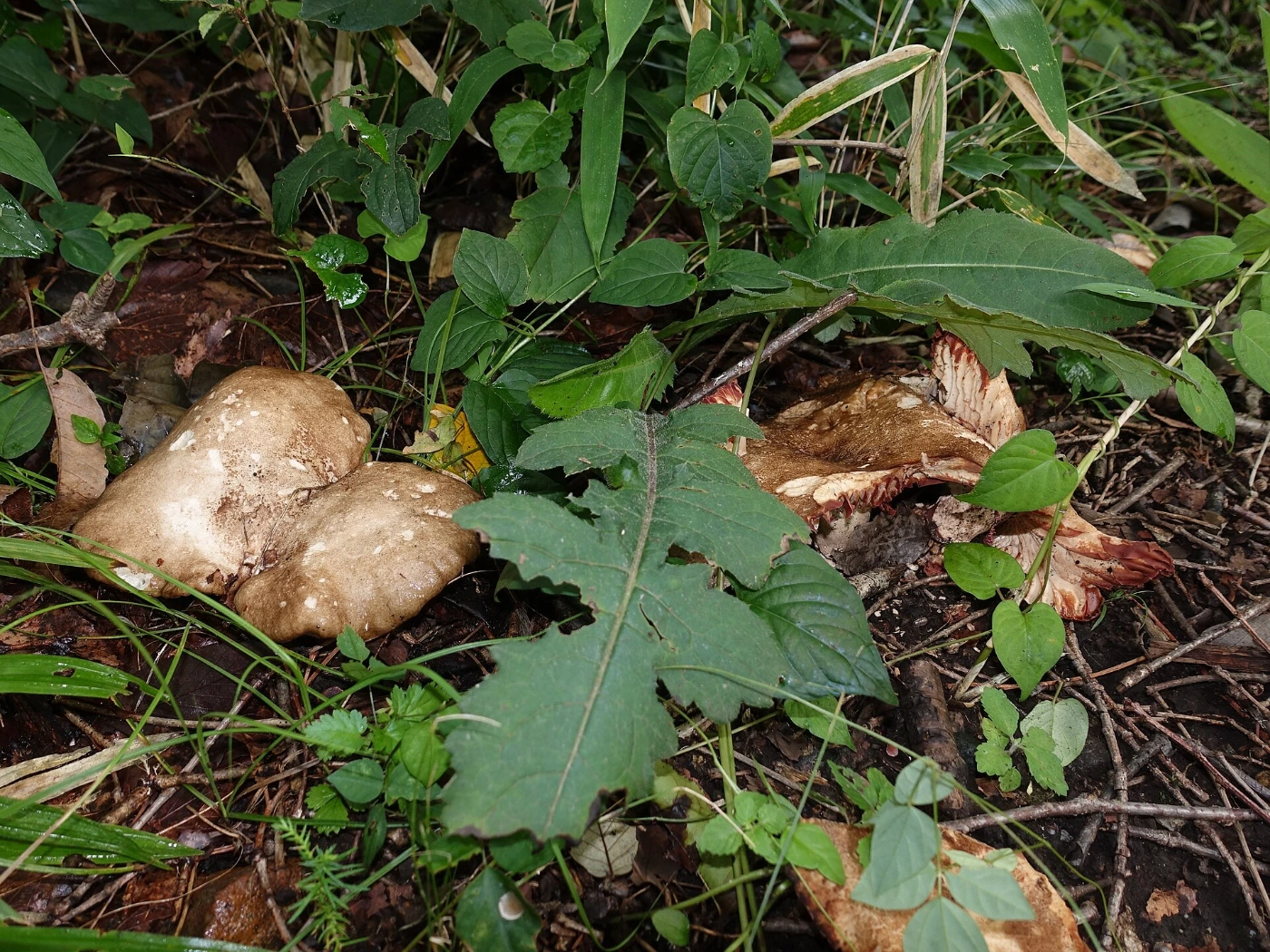
Russula subnigricans, commonly known as the Rank Russula, is a highly poisonous East Asian brittlegill associated with severe rhabdomyolysis, a condition in which skeletal muscle breaks down and releases damaging cellular contents into the bloodstream. Poisoning can progress from gastrointestinal symptoms to muscle pain, cardiac complications, kidney injury, shock, and multi-organ failure.
Rank Russula is usually medium to large, with a gray to dark brown cap, pale relatively distant gills, and a firm grayish stem. Damaged tissues may turn reddish-brown, but unlike some similar blackening Russulas, they do not typically become strongly black afterward.
The most useful field pattern is gray-brown Russula + pale relatively distant gills + reddish-brown staining without strong blackening + broadleaf woodland in East Asia. Exact identification can still be difficult because the blackening Russula group contains several closely related species.
⚠️ Important: Rank Russula can cause life-threatening rhabdomyolysis and multi-organ injury. Do not taste this mushroom or use traditional Russula taste-testing methods when this species is possible.
Quick Identification
| Feature | Russula subnigricans |
|---|---|
| Common name | Rank Russula |
| Alternative name | False Blackening Russula |
| Cap | Gray to dark gray-brown or blackish brown |
| Cap size | Usually about 5–12 cm |
| Cap shape | Convex, later depressed to funnel-shaped |
| Gills | Pale cream, relatively distant |
| Gill bruising | Reddish-brown |
| Stem | Gray-brown to darker, firm |
| Flesh | White to pale initially |
| Damage reaction | Red-brown, usually without strong later blackening |
| Ring | Absent |
| Volva | Absent |
| Spore print | Pale |
| Ecology | Mycorrhizal |
| Habitat | Broadleaf woodland |
| Season | Summer to autumn |
| Distribution | East Asia, especially China, Japan and Korea |
| Main toxicity | Rhabdomyolysis / systemic toxicity |
| Main look-alikes | Other blackening Russula |
What Does Rank Russula Look Like?
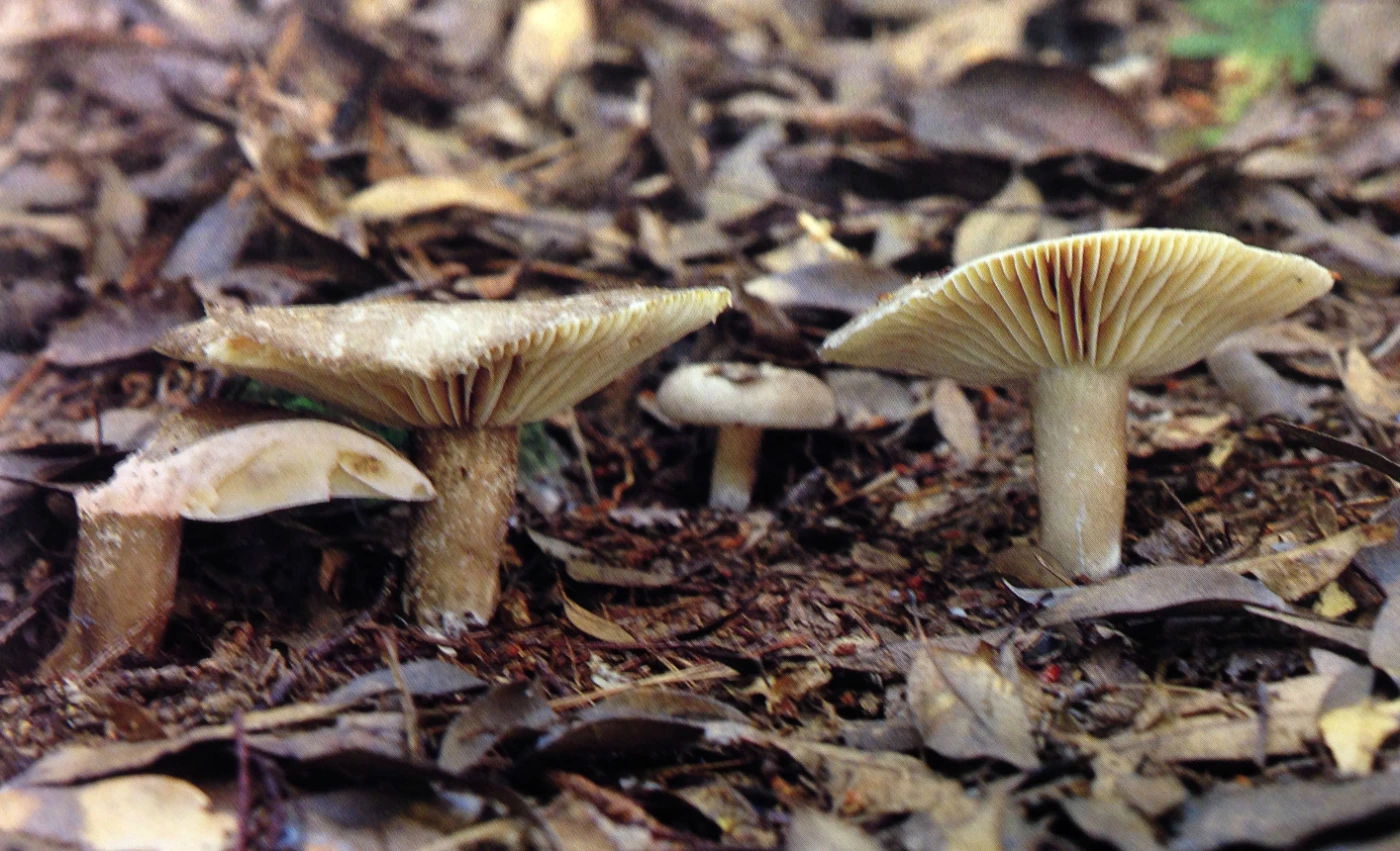
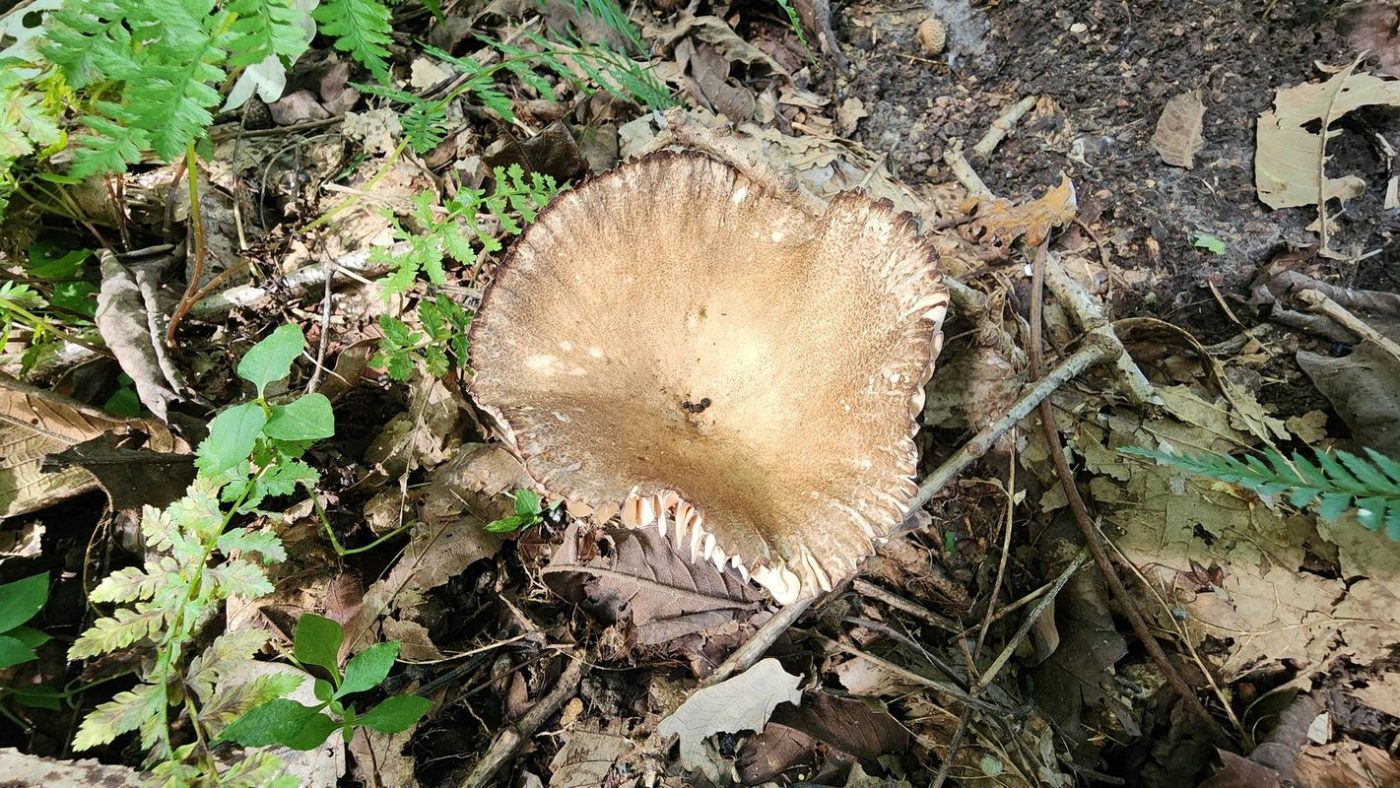
Rank Russula is a medium to fairly large brittlegill with a dull gray to brownish cap. The cap often becomes centrally depressed with age and may eventually appear broadly funnel-shaped.
The overall appearance is relatively plain compared with brightly colored Russulas. That makes the species particularly dangerous because it does not look obviously toxic.
Cap
The cap is generally about 5–12 cm across. It begins convex and later becomes flatter with a depressed center.
Colors range from gray and gray-brown to dark brown or almost blackish brown. The surface can become darker with age or weathering.
Gills
The gills are pale cream and relatively widely spaced compared with many other Russula species. When injured, they can turn a light reddish-brown.
A key point is what happens afterward. In typical Rank Russula, this reddish discoloration does not progress into the strong blackening characteristic of some closely related blackening brittlegills.
Stem
The stem is stout, firm, and generally gray-brown to somewhat darkened. It lacks both a ring and a volva.
Like other Russula, the flesh tends to break cleanly rather than bend fibrously. This brittle texture is useful for recognizing the genus, but it does not identify the species.
Flesh
Fresh flesh is pale or whitish. After cutting or bruising, reddish or reddish-brown discoloration may develop.
The sequence of color change is important. Some related Russulas redden first and then become distinctly black, while R. subnigricans is noted for failing to develop that strong final blackening reaction.
Why the Color Change Matters
The group around Russula nigricans contains several superficially similar gray or dark Russulas. Their flesh-reaction patterns have historically been used to help separate them.
Rank Russula is particularly notable because damaged tissue may redden without the dramatic later blackening expected from classic Blackening Brittlegill.
Spore Print
The spore print is pale, consistent with the general Russula pattern. This helps separate the mushroom from dark-spored genera but is not particularly useful for species-level identification.
Microscopy, molecular identification, and regional experience may be needed when similar blackening Russulas occur together.
Where Does Rank Russula Grow?
Rank Russula grows from soil in mycorrhizal association with living broadleaf trees. In Japan, it is particularly associated with forests containing Castanopsis and related Fagaceae.
Chinese poisoning records also show substantial importance in subtropical and southwestern regions, especially Yunnan and Hunan. These areas support exceptionally diverse broadleaf forest communities.
Season
Fruiting occurs mainly during summer and autumn. This overlaps with the main wild mushroom collecting season in East Asia.
Warm, wet weather can produce large flushes of Russulas, making accidental inclusion among edible collections more likely.
Distribution
Rank Russula is primarily an East Asian species. Poisoning has been documented in China, Japan, and Korea.
A large recent clinical series showed that most investigated cases came from southwestern China, particularly Yunnan Province, where wild mushroom gathering is widespread.
Is Rank Russula Poisonous?
Yes. Rank Russula is highly poisonous and can be fatal.
The characteristic severe syndrome is rhabdomyolysis, where skeletal muscle cells break down rapidly. This releases muscle proteins and electrolytes into the blood and can cause kidney injury, dangerous cardiac effects, shock, and multi-organ failure.
What Toxin Does Rank Russula Contain?
Research has identified cycloprop-2-ene carboxylic acid as an important compound associated with the rhabdomyolysis syndrome. Related compounds have also been isolated from the mushroom.
The complete toxicological picture is still being investigated, but the practical conclusion is clear: this mushroom should never be eaten.
What Is Rhabdomyolysis?
Rhabdomyolysis is the rapid destruction of skeletal muscle. Damaged muscle cells release myoglobin, potassium, enzymes, and other substances into the bloodstream.
This can produce severe muscle pain and weakness. Myoglobin can damage the kidneys, while electrolyte disturbances can trigger dangerous heart rhythms.
The syndrome is very different from ordinary gastrointestinal mushroom poisoning.
How Quickly Do Symptoms Begin?
Symptoms can begin within a few hours. This distinguishes Rank Russula poisoning from several delayed mushroom syndromes such as amatoxin or orellanine poisoning.
The relatively rapid onset does not mean the poisoning is mild. Serious systemic injury can follow the initial gastrointestinal symptoms.
Early Symptoms
The first symptoms are often nausea, vomiting, abdominal discomfort, and diarrhea. This can resemble ordinary gastrointestinal mushroom poisoning at first.
Muscle symptoms may develop later as rhabdomyolysis progresses. Increasing weakness or widespread muscle pain after eating wild mushrooms is particularly concerning.
Muscle Symptoms
Diffuse muscle pain and weakness are among the most characteristic signs of severe Rank Russula poisoning. Blood creatine kinase levels can rise dramatically as muscle tissue breaks down.
Dark urine may develop because myoglobin from damaged muscle is filtered by the kidneys.
Heart and Liver Effects
Severe poisoning can involve more than skeletal muscle. Cardiac injury, abnormal heart rhythms, and laboratory evidence of liver injury have also been documented.
In severe cases, multi-organ failure can develop. This is why Rank Russula poisoning should not be treated as a simple gastrointestinal illness.
Kidney Injury
Rhabdomyolysis can damage the kidneys because myoglobin and other products released from destroyed muscle accumulate in the bloodstream.
Acute kidney injury can become a serious complication, especially when dehydration, low blood pressure, or electrolyte disturbances are also present.
Can Rank Russula Poisoning Be Fatal?
Yes. Fatal cases have been documented in China, Japan, and Korea.
Modern Chinese mushroom-poisoning surveillance continues to identify Russula subnigricans as a cause of serious rhabdomyolysis outbreaks and deaths.
Is There an Antidote?
There is currently no specific antidote for Rank Russula poisoning. Treatment is supportive and focuses on protecting the kidneys, heart, circulation, and other organs while monitoring muscle breakdown.
Severe cases may require intensive hospital care and blood-purification techniques. This is medical management and not something that can be attempted at home.
Does Cooking Make Rank Russula Safe?
No. Rank Russula should never be considered edible or treated as a mushroom that can be detoxified through ordinary cooking.
Drying, boiling, frying, or other processing should not be assumed to remove the toxic risk. Complete avoidance is the correct safety approach.
Look-Alikes
The most important look-alikes are other darkening or blackening Russulas. Species-level identification can be difficult even for experienced mushroom identifiers.
Russula nigricans — Blackening Brittlegill
Identification
Russula nigricans is a large gray-brown brittlegill with unusually distant, thick gills. Damaged flesh typically reddens and then gradually turns black.
The cap also darkens strongly with age.
Main Difference
Red then black staining strongly supports R. nigricans. Rank Russula may redden but does not typically progress to the same strong blackening.
The two can still be difficult to separate reliably from field appearance alone.
Other Blackening Russulas
Identification
Several other species belong to the blackening Russula complex and can share gray or brown caps, brittle flesh, and reddish staining.
Differences can involve gill spacing, speed and sequence of color changes, microscopic spores, chemical reactions, and habitat.
Main Difference
There is no simple single-feature separation. When Rank Russula occurs regionally, uncertain blackening Russulas should not be treated as edible.
Rank Russula vs Blackening Brittlegill
| Feature | Rank Russula | Blackening Brittlegill |
|---|---|---|
| Scientific name | R. subnigricans | R. nigricans |
| Cap | Gray to dark brown | Gray-brown to blackish |
| Gills | Pale, relatively distant | Very distant and thick |
| Damage reaction | Reddish-brown | Red then black |
| Final blackening | Weak / absent | Strong |
| Main region | East Asia | Wider temperate distribution |
| Toxicity | Highly poisonous | Different toxicological profile |
| Best clue | Red without strong blackening | Clear red-to-black sequence |
Because the group is taxonomically difficult, these characters should not be used as an edibility test.
Why Rank Russula Can Be Mistaken for Other Russulas
Many Russula species share the same basic construction: brittle white flesh, no ring, no volva, pale spores, and a central stem.
Dark cap colors also occur in several unrelated species. Without observing gill spacing, staining sequence, ecology, and region, visual identification can remain uncertain.
This makes Rank Russula particularly unsuitable for beginner foraging.
Why Tasting Russulas Is Dangerous Here
Some traditional Russula identification methods involve briefly tasting a tiny amount of raw flesh and spitting it out to judge whether it is mild or acrid.
That technique is inappropriate where Rank Russula may occur. A highly toxic species should never be deliberately tasted as part of amateur identification.
Use morphology, ecology, microscopy, and regional expertise instead.
Young vs Mature Rank Russula
Young mushrooms may have a lighter gray cap and relatively pale tissues. The central depression becomes stronger as the cap expands.
Older fruit bodies darken and can resemble other blackening Russulas more closely. Damage and age can also obscure the normal staining sequence.
Fresh specimens of different ages from the same patch provide much more useful evidence than a single old mushroom.
Common Identification Mistakes
One common mistake is assuming that all dark Russulas are variations of Russula nigricans. East Asia contains several similar taxa with very different toxicological significance.
Another mistake is looking only for blackening. Rank Russula is important precisely because its damaged tissue may redden without the strong subsequent blackening expected from classic Blackening Brittlegill.
A third mistake is treating early gastrointestinal symptoms as ordinary stomach upset. Severe rhabdomyolysis can develop after the initial vomiting and nausea.
A fourth mistake is assuming that quickly developing symptoms cannot represent a life-threatening mushroom poisoning. Rank Russula poisoning can begin within only a few hours.
What to Do After Suspected Ingestion
Seek urgent professional medical advice after suspected Rank Russula ingestion. Do not wait for severe muscle pain or dark urine to appear.
Keep remaining mushrooms, cooked leftovers, and photographs when possible. Exact identification can assist clinicians because the expected syndrome differs substantially from amatoxin poisoning.
If muscle pain, severe weakness, dark urine, arrhythmia, breathing difficulty, or reduced consciousness develops, emergency medical assessment is required.
How to Photograph Rank Russula
Photograph the mushroom in place before handling it. Include the surrounding trees and forest habitat.
Then photograph the cap, gills, complete stem, and a vertical cross-section. Take additional photographs after several minutes to document whether damaged tissue becomes red, brown, gray, or black.
The timing of color changes can be diagnostically useful.
Can AI Identify Rank Russula?
AI may recognize a blackening-Russula-type mushroom, but species-level identification from photographs is difficult.
This is particularly true because R. subnigricans belongs to a complex group in which current taxonomy and morphological boundaries remain challenging.
AI should therefore not be used to determine that a similar Russula is safe to eat.
Interesting Facts
Rank Russula was formally described by Japanese mycologist Tsuguo Hongo in 1955.
The species is unusual because its most important poisoning syndrome is myotoxicity, not classic liver failure or simple gastrointestinal irritation.
Its misleading resemblance to ordinary dark Russulas has contributed to severe poisoning incidents in East Asia.
The alternative English name False Blackening Russula reflects one of its most important identification characteristics: damaged tissues can redden but generally fail to show the strong final blackening of Russula nigricans.
Frequently Asked Questions
What is the common name of Russula subnigricans?
The most useful English common name is Rank Russula. False Blackening Russula is also sometimes used.
Is Rank Russula poisonous?
Yes. It is highly poisonous and can cause severe rhabdomyolysis, multi-organ injury, and death.
What is rhabdomyolysis?
It is the rapid destruction of skeletal muscle. Muscle breakdown products can damage the kidneys and cause dangerous electrolyte and cardiac complications.
How quickly do symptoms begin?
Symptoms can begin within a few hours after ingestion.
What are the first symptoms?
Nausea and vomiting are common early symptoms. Abdominal pain and diarrhea can also occur before muscle symptoms become obvious.
Does Rank Russula turn black when damaged?
Typical specimens may develop reddish-brown staining but do not show the same strong subsequent blackening characteristic of some related Russulas.
Where does Rank Russula grow?
It is an East Asian woodland mushroom associated with broadleaf trees and has caused important poisoning incidents in China, Japan, and Korea.
Can cooking make Rank Russula safe?
No. It should never be eaten or deliberately processed as food.
Final Identification Notes
Rank Russula, Russula subnigricans, is best recognized as a gray to dark brown East Asian brittlegill with pale relatively distant gills, firm grayish stem, and reddish-brown damage reactions that do not typically progress to strong blackening.
The most important comparison is with other members of the blackening Russula group. Because the taxonomy and field separation are difficult, uncertain dark Russulas in regions where Rank Russula occurs should never be treated as edible.
The practical safety pattern is: East Asian dark Russula + pale distant gills + reddish staining without strong blackening = consider Rank Russula and do not eat it. If gastrointestinal symptoms are followed by muscle pain, severe weakness, or dark urine after wild mushroom ingestion, rhabdomyolysis requires urgent medical evaluation.
Upload a photo and get possible matches in seconds.