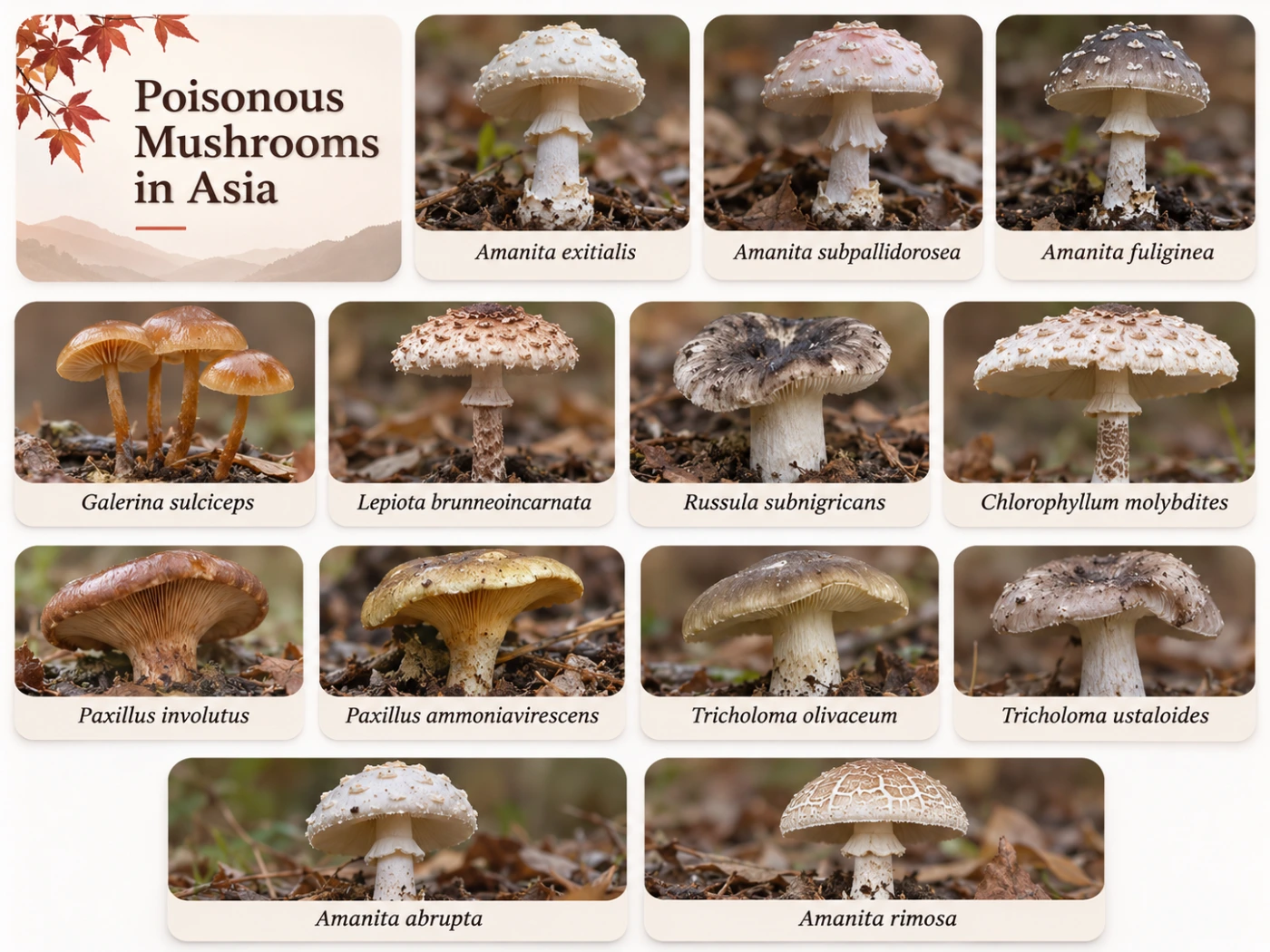
Asia contains some of the richest mushroom diversity in the world, ranging from boreal forests of Siberia and northern Japan to subtropical mountains of southern China and tropical forests of Southeast Asia. Poisonous mushrooms occur throughout this enormous region, and many of the most dangerous species differ from those familiar in Europe or North America.
The most serious risks include amatoxin-containing Amanita, Galerina, and Lepiota, muscarine-producing fibrecaps, gastrointestinal species such as Chlorophyllum molybdites, and unusual Asian mushrooms associated with rhabdomyolysis, kidney injury, or other severe syndromes.
China provides some of the most detailed modern surveillance data. In 2025 alone, investigators recorded 828 mushroom-poisoning incidents affecting 2,165 people and identified 138 poisonous mushroom species, including 34 that had not previously been documented in Chinese poisoning incidents.
⚠️ Important: There is no universal visual rule for recognizing poisonous mushrooms in Asia. Regional taxonomy, habitat, host trees, mushroom structure, spore color, and expert identification all matter, and photo identification alone should never be used to decide that a wild mushroom is safe to eat.
Poisonous Mushrooms in Asia at a Glance
| Species | Main regional relevance | Main risk |
|---|---|---|
| Amanita exitialis | Southern China and East Asia | Fatal amatoxin poisoning |
| Amanita subpallidorosea | China and East Asia | Fatal amatoxin poisoning |
| Amanita fuliginea group | China and East Asia | Acute liver failure |
| Galerina sulciceps | China and parts of Asia | Fatal amatoxin poisoning |
| Lepiota brunneoincarnata | China and wider Eurasia | Fatal amatoxin poisoning |
| Russula subnigricans | East Asia | Rhabdomyolysis |
| Chlorophyllum molybdites | Warm Asia | Severe gastrointestinal poisoning |
| Toxic Inocybe / Inosperma | Widespread | Muscarine syndrome |
| Paxillus species | Temperate Asia | Hemolysis / serious toxicity |
| Various toxic Tricholoma | China and East Asia | Gastrointestinal or systemic poisoning |
This is not an exhaustive list. Chinese surveillance alone had linked approximately 280 species with poisoning incidents by the end of 2025, showing how incomplete any short continental list must be.
Why Mushroom Identification in Asia Is Especially Difficult
Asia spans an enormous range of climates and ecosystems. A mushroom found in Hokkaido may have little relevance to tropical Thailand, while a poisonous species common in Yunnan may be absent from northern China or Korea.
Taxonomy also changes rapidly. Many Asian fungi were historically given European names because they looked similar, but molecular work has shown that visually similar mushrooms can represent different regional species.
This problem is particularly important in Amanita, Russula, Tricholoma, Inocybe, and bolete groups. A European field guide should therefore not be used as the only identification source for mushrooms collected in Asia.
Why China Is Important for Mushroom Poisoning Research
China has one of the world’s largest systems for documenting mushroom poisoning. Wild mushroom foraging and market sales are widespread, while fungal diversity is exceptionally high.
Between 2012 and 2023, Chinese public-health surveillance recorded 653 mushroom poisoning incidents involving 3,229 poisoning cases and 710 deaths in the reporting system analyzed by researchers. Acute liver failure accounted for the largest share of fatal clinical syndromes.
Recent annual investigations continue to add new toxic species. In 2024, 110 poisonous mushroom species were identified from poisoning cases, while 2025 monitoring identified 138.
Amanita exitialis — A Major Asian Deadly Amanita
Amanita exitialis is one of the most important deadly mushrooms in southern China. It belongs to the amatoxin-containing destroying-angel group and has repeatedly caused fatal acute liver failure.
The mushroom is pale to white, with white gills, a ring, and a volva around the stem base. These structures place it in the same practical danger pattern as other deadly Amanitas.
In 2022, A. exitialis caused seven deaths in 14 documented Chinese incidents involving 41 patients. It remained among the most lethal mushrooms in subsequent surveillance, causing three deaths in 2025.
Identification
Look for an Amanita-like mushroom with persistent white gills, a ring, and a sack-like or structured volva at the base.
The entire stem base must be excavated because the volva may be buried beneath soil or leaf litter.
Main Danger
Amanita exitialis contains amatoxins. Symptoms may be delayed for many hours before severe vomiting and diarrhea begin, followed by liver injury.
Amanita subpallidorosea
Amanita subpallidorosea is another deadly amatoxin-containing Amanita documented from China and East Asia. It has been implicated repeatedly in fatal poisoning incidents.
Chinese surveillance identified it among the most lethal mushrooms of 2024 and again linked it with fatal acute liver failure in 2025.
Identification
The mushroom belongs to the deadly white or pale Amanita group and should be approached with the same caution as destroying angels.
Persistent pale gills plus a ring and volva should always be treated as a potentially deadly Amanita pattern.
Main Difference
Exact separation from other deadly Amanitas can require specialist knowledge. From a safety perspective, species-level distinction is unnecessary before deciding not to eat it.
Amanita fuliginea and Related Dark Amanitas
Not all deadly Amanitas are white. Amanita fuliginea and related Asian taxa can have gray, brown, or darker caps while still containing amatoxins.
Chinese surveillance from 2012–2023 identified Amanita fuliginea among the species responsible for the largest numbers of poisonings and deaths in investigated incidents.
This is an important reminder that the rule “white Amanita = dangerous” is incomplete. Cap color can vary substantially among deadly species.
Galerina sulciceps
Galerina sulciceps is one of the most important amatoxin-containing wood-growing mushrooms documented in China. It can be particularly dangerous because small brown wood-growing mushrooms are easy to dismiss or confuse with edible species.
In 2025, Galerina sulciceps was tied with Amanita exitialis as the most lethal identified mushroom in Chinese surveillance, causing three deaths.
A 2024 clinical report described a mass poisoning involving Galerina cf. sulciceps in Sichuan Province and confirmed amatoxin exposure using morphology, molecular identification, and toxin detection.
Identification
Typical Galerina are small brown mushrooms with true gills and rusty-brown spores. They often grow from decaying wood.
This combination can overlap with edible wood-growing mushrooms, which is why spore color and complete stem structure are especially important.
Main Danger
Some Galerina contain amatoxins and can cause fatal liver failure. A small brown mushroom growing on wood should never be treated casually.
Lepiota brunneoincarnata
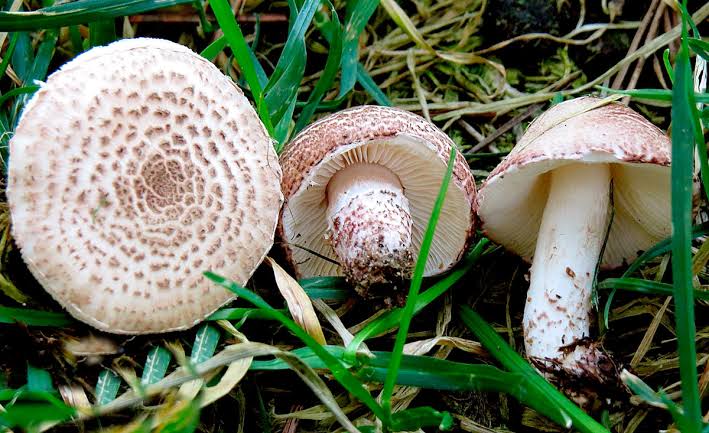
Lepiota brunneoincarnata is a small parasol-like mushroom containing amatoxins. It has been repeatedly involved in fatal poisoning incidents in China.
In 2024, it caused 14 documented incidents involving 32 patients and two deaths, making it one of the year’s most significant acute liver failure species.
Identification
The cap is pale with reddish-brown or pinkish-brown scales. The mushroom is much smaller than the familiar large edible parasols.
Small Lepiota should generally be treated with extreme caution because several species contain amatoxins.
Main Difference
A small scaly parasol-like mushroom should not be assumed to be a miniature edible parasol. Size and scale pattern can hide a very different toxicological risk.
Russula subnigricans
Russula subnigricans is one of East Asia’s most important toxic brittlegills. Unlike amatoxin-containing mushrooms, its major danger is rhabdomyolysis, a breakdown of skeletal muscle.
Chinese surveillance has repeatedly identified R. subnigricans among fatal mushrooms. It caused two deaths in 2024 and two more in 2025 surveillance.
Identification
The mushroom belongs to the brittle-fleshed Russula group. The cap is pale to grayish or brownish and can darken with age or injury.
Because many Russula species look similar, exact field identification can be difficult.
Toxicity
Rhabdomyolysis can cause severe muscle pain, weakness, dark urine, kidney injury, and potentially death.
This syndrome is fundamentally different from the liver failure caused by amatoxins.
Why Russula subnigricans Is Important
Many foragers think of Russula mainly as mild gastrointestinal irritants or edible woodland mushrooms. R. subnigricans demonstrates why that generalization is unsafe in East Asia.
A visually ordinary brittlegill can cause a serious systemic syndrome. Regional species knowledge therefore matters greatly.
Chlorophyllum molybdites — Green-Spored Parasol
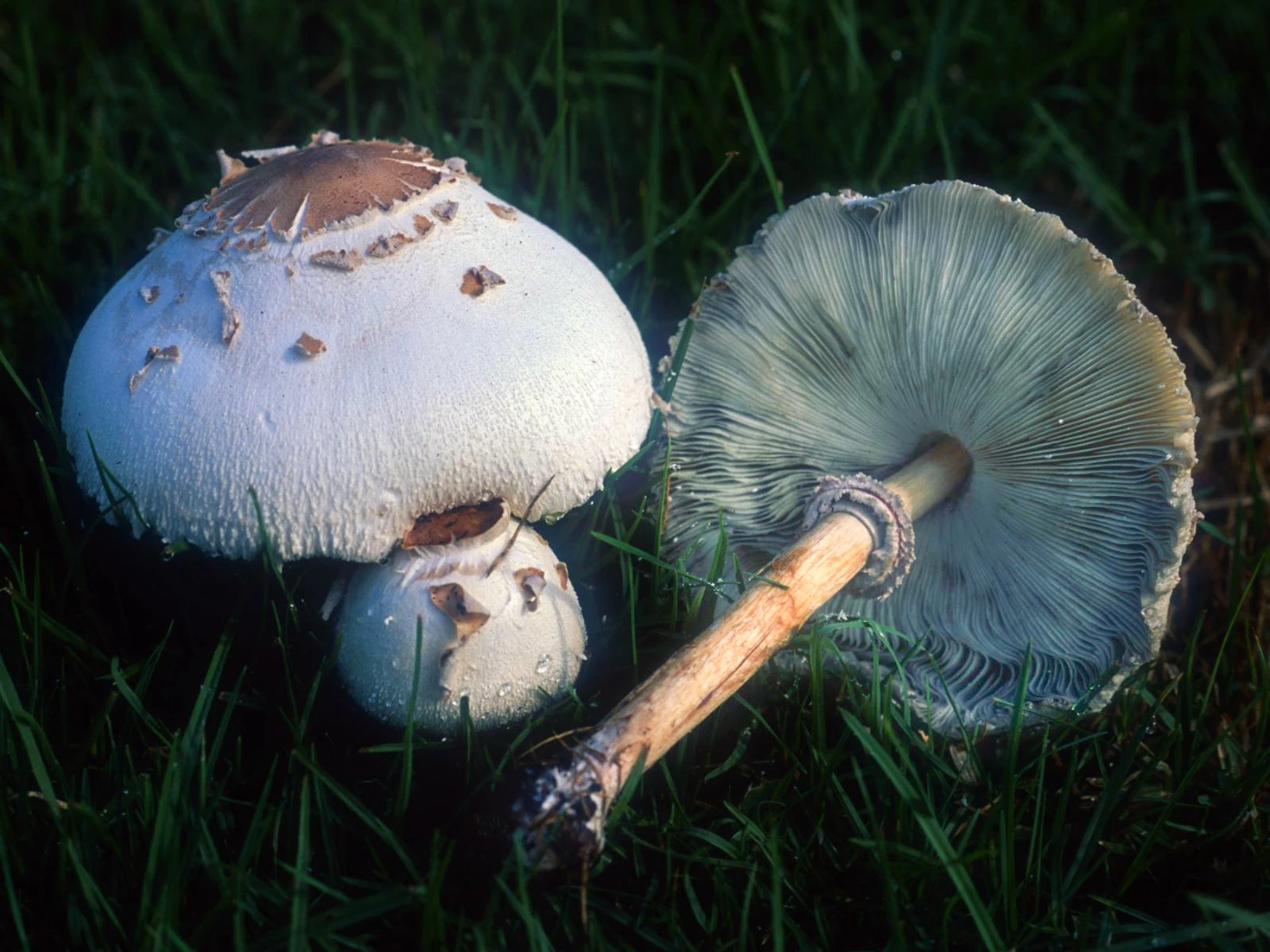
Chlorophyllum molybdites is a large poisonous parasol-like mushroom common in warm and subtropical parts of Asia. It grows in lawns, parks, fields, roadsides, and other grassy places close to people.
It was the most frequently identified mushroom in Chinese poisoning incidents in both 2024 and 2025. In 2025 alone, it was associated with 269 incidents affecting 540 people.
Identification
The cap is pale with brown scales and a prominent stem ring. Young gills are white but mature gills become gray-green or greenish.
The spore print is olive-green, which is one of the strongest identification features.
Toxicity
It primarily causes severe gastrointestinal poisoning with vomiting, diarrhea, and abdominal pain.
Although usually considered a gastrointestinal species rather than a classic deadly mushroom, Chinese surveillance recorded a fatality associated with it in 2025, showing that severe outcomes can occur.
Toxic Inocybe and Inosperma
Fibrecaps are another important Asian poisoning group. Many species contain muscarine, which overstimulates the parasympathetic nervous system.
Recent research on Chinese Inocybaceae notes that the group is both species-rich and toxicologically important, with many poisonous species dominated by muscarine chemistry.
Identification
Typical fibrecaps are small to medium-sized woodland mushrooms with fibrous or radially streaked caps. Mature gills become brownish as the spores develop.
Several genera formerly grouped under Inocybe have now been separated molecularly, making taxonomy particularly complicated.
Muscarine Symptoms
Symptoms can include heavy sweating, excessive saliva, tearing, abdominal cramps, vomiting, diarrhea, small pupils, slow heart rate, and breathing difficulty.
Onset is generally much faster than amatoxin poisoning.
Paxillus Species
Some Paxillus species occur across temperate parts of Asia and should not be treated as edible despite historical traditions of consumption.
The best-known syndrome associated with Paxillus involutus is immune-mediated hemolysis, where red blood cells are destroyed after an abnormal immune response.
Chinese surveillance in 2025 also identified Paxillus ammoniavirescens in a poisoning incident for the first time, highlighting that regional Paxillus toxicity remains an active field of investigation.
Toxic Tricholoma Species
Several Tricholoma species have been associated with poisoning in China. Some produce gastrointestinal syndromes, while others have been investigated for more systemic effects.
In 2024, Tricholoma olivaceum and T. ustaloides were newly documented as causes of gastroenteritis in Chinese poisoning cases.
The genus is particularly difficult because edible and poisonous species can be morphologically similar. Cap color, odor, gill structure, host trees, and microscopic characters may all be needed.
Poisonous Mushrooms in China
China currently has the best detailed species-level surveillance data in Asia. The diversity revealed by annual investigations makes it impossible to reduce Chinese mushroom poisoning to a handful of classic species.
In 2025, 138 poisonous mushroom species were identified from incidents spanning 27 provincial-level administrative divisions. Hunan, Guizhou, Yunnan, Sichuan, and Shandong were among the most affected regions.
The most lethal identified species that year were Galerina sulciceps, Amanita exitialis, Russula subnigricans, and Amanita abrupta.
Yunnan, Guizhou, Sichuan and Southern China
Southwestern China is especially important for wild mushroom foraging. Yunnan, Guizhou, Sichuan, and nearby regions combine exceptional fungal biodiversity with strong traditions of collecting wild mushrooms.
Historical surveillance shows that Yunnan has accounted for a particularly large share of reported Chinese mushroom poisoning incidents. Other high-incidence provinces include Hunan, Guizhou, and Sichuan.
The same biodiversity that makes these regions famous for edible mushrooms also increases the number of toxic look-alikes.
Poisonous Mushrooms in Japan
Japan has a long tradition of wild mushroom collecting and also a distinctive fungal flora. Several mushrooms found there have close relatives in Europe or North America but should not automatically receive the same species names.
Amanitas, fibrecaps, toxic Russulas, and several Tricholoma-type mushrooms are important groups. Poisoning risk increases during autumn when many edible and toxic woodland species fruit simultaneously.
Regional Japanese identification guides are therefore far more useful than attempting to transfer European edibility rules directly.
Poisonous Mushrooms in Korea
Korea shares many temperate East Asian fungal groups with northeastern China and Japan. Amanitas, Russulas, Cortinarius-type mushrooms, and other ectomycorrhizal fungi occur in similar forest ecosystems.
Mountain forests can contain both highly prized edible species and dangerous look-alikes. The safest identification approach remains species-level determination using local taxonomy.
Southeast Asia
Tropical and subtropical Southeast Asia supports a different fungal community from northern Asia. Warm-climate lawn mushrooms such as Chlorophyllum molybdites are particularly relevant in human-modified environments.
Forest diversity is extremely high, and many species remain poorly represented in general Western field guides. Familiar-looking mushrooms should therefore not be assigned European names from photographs alone.
Himalayan and South Asian Regions
The Himalayan region combines temperate, alpine, and subtropical fungal floras. Amanitas, boletes, Russulas, Lactarius, and other mycorrhizal groups can occur across strong elevation gradients.
Species composition changes rapidly with altitude and host tree. A mushroom collected beneath Himalayan conifers may belong to a regional species absent from Europe despite strong visual resemblance.
Asia Has Many Region-Specific Amanitas
One of the most important lessons from Asian toxicology is that Death Cap is not the only dangerous Amanita. Several regional species contain amatoxins and can produce the same acute liver failure syndrome.
Chinese surveillance has repeatedly implicated Amanita exitialis, A. fuliginea, A. subpallidorosea, A. rimosa, and related species.
The practical safety pattern remains the same: pale or dark Amanita + persistent pale gills + ring and/or volva = treat as potentially dangerous until identified.
Acute Liver Failure Mushrooms
Amatoxin-producing mushrooms remain the most important lethal group. Modern reviews estimate that amatoxin-containing mushrooms account for the overwhelming majority of fatal mushroom poisonings worldwide.
In China, acute liver failure has consistently been the deadliest mushroom poisoning syndrome. In 2025, ten amatoxin-producing species from Amanita, Galerina, and Lepiota were identified in acute liver failure cases.
Why Delayed Symptoms Are Dangerous
Amatoxin poisoning often begins after a long symptom-free period. Severe vomiting and diarrhea can start only after significant toxin absorption has already occurred.
A deceptive improvement phase may follow while liver injury continues. This delay is one reason amatoxin poisoning can become life-threatening before patients realize how serious the exposure was.
Any delayed gastrointestinal illness after eating wild mushrooms deserves urgent medical assessment.
Gastrointestinal Poisoning
Not all poisonous Asian mushrooms cause liver failure. Many species primarily produce vomiting, diarrhea, abdominal pain, and dehydration.
Chinese surveillance shows that gastrointestinal species account for a large proportion of incidents. Chlorophyllum molybdites is a particularly prominent example because it grows close to homes, parks, and agricultural areas.
Severe fluid loss can still become medically dangerous, especially in children, older adults, and people with underlying disease.
Rhabdomyolysis
Rhabdomyolysis is one of the more unusual severe mushroom syndromes documented in Asia. Muscle tissue breaks down and releases intracellular contents into the bloodstream.
Symptoms can include muscle pain, weakness, exhaustion, and dark urine. Severe muscle breakdown can lead to kidney injury and death.
Russula subnigricans is one of the most important Asian mushrooms associated with this syndrome.
Kidney Injury
Some poisonous mushrooms target the kidneys rather than primarily the liver. The precise species involved vary by region.
Chinese surveillance has recorded acute renal failure as one of the clinically important severe syndromes, and deaths from renal failure continued to occur in 2025.
Delayed kidney injury can make mushroom poisoning particularly difficult to recognize because the meal may have occurred days earlier.
Muscarinic Poisoning
Muscarine-containing fibrecaps and related mushrooms typically produce symptoms relatively quickly. Excessive sweating, saliva, tears, abdominal cramps, vomiting, diarrhea, small pupils, and cardiovascular effects are characteristic.
Because Asian Inocybaceae are exceptionally diverse, the exact species may be difficult to establish without microscopy or molecular identification.
From a foraging perspective, uncertain fibrecaps are best treated as non-edible.
Poisonous Mushrooms Sold in Markets
Asian mushroom poisoning is not limited to mushrooms gathered personally in forests. Wild mushrooms are also sold at markets, roadside stalls, online, and through informal supply chains.
Chinese surveillance in 2025 documented poisoning after mushrooms purchased from wild-mushroom markets, street vendors, online sellers, and even dried products.
Buying a mushroom therefore does not automatically guarantee correct species identification.
Mixed Mushroom Dishes Are Especially Difficult
A basket or meal can contain multiple species. One edible mushroom does not prove that every fruit body collected from the same forest was safe.
In China in 2025, hundreds of patients were poisoned after eating mixed mushroom dishes.
Mixed meals also make clinical diagnosis harder because several toxin syndromes can potentially overlap.
Cooking Does Not Make Poisonous Mushrooms Safe
There is no universal Asian cooking method that makes poisonous mushrooms safe. Amatoxins survive ordinary food preparation.
Traditional boiling, drying, fermentation, or repeated cooking should never replace species identification. Regional culinary traditions may safely use particular known species, but those practices cannot be generalized to look-alikes.
Why Folk Tests Do Not Work
Garlic, silver spoons, onion discoloration, insects, animal feeding, and cap color are not reliable tests for toxicity.
Poisonous mushrooms can be eaten by insects and animals that metabolize toxins differently from humans. Deadly species can also smell and taste entirely normal.
The only dependable approach is accurate identification.
How to Identify an Unknown Asian Mushroom Safely
Begin with structure rather than color. Determine whether the mushroom has gills, pores, teeth, or a smooth fertile surface.
Then examine the complete stem, including the base. Rings, volvas, cortinas, scabers, and reticulation can be critical.
Record substrate, nearby trees, bruising reactions, spore color, and geographic region. Asian mushroom identification becomes much more reliable when ecology and region accompany morphology.
Why Geography Matters
The same common name can refer to different species in different countries. A “destroying angel” in China may not be the same species as a destroying angel in eastern North America.
Likewise, Asian boletes and Russulas may closely resemble European species while belonging to distinct lineages.
A reliable species identification should therefore match both morphology and known regional distribution.
What to Do After Suspected Poisoning
Seek professional medical or poison-center advice promptly after eating an unidentified wild mushroom, especially if symptoms occur. Do not wait for exact species identification before seeking care.
Preserve uncooked mushrooms, cooked leftovers, photographs, and any remaining specimens. These can help mycologists and clinicians determine the likely toxin group.
Delayed vomiting, diarrhea, jaundice, reduced urination, severe muscle pain, confusion, or seizures require particular attention.
Common Identification Mistakes
One common mistake is using European or North American mushroom guides without considering Asian regional taxonomy. Similar appearance does not guarantee identical species.
Another mistake is assuming only Amanitas cause fatal poisoning. Asian Galerina, Lepiota, and Russula can also produce life-threatening syndromes.
A third mistake is relying on cap color. Deadly Asian Amanitas may be white, gray, brown, or darker.
A fourth mistake is assuming mushrooms bought from informal markets have already been identified safely. Surveillance data show that market-associated poisonings continue to occur.
Frequently Asked Questions
What is the most dangerous poisonous mushroom in Asia?
There is no single species for the entire continent. Amatoxin-containing Amanitas such as Amanita exitialis are among the most important causes of fatal poisoning in East Asia.
Is Amanita phalloides the main deadly mushroom in Asia?
Not everywhere. Asia has several regional amatoxin-containing Amanita species that can be more important locally than the European Death Cap.
What poisonous mushroom causes the most incidents in China?
In both 2024 and 2025, Chlorophyllum molybdites caused the largest number of documented poisoning incidents.
What mushroom causes rhabdomyolysis in Asia?
Russula subnigricans is one of the best-known East Asian species associated with severe rhabdomyolysis.
Are small brown mushrooms dangerous in Asia?
Some can be. Galerina sulciceps is a small brown amatoxin-containing mushroom that has caused fatal poisonings in China.
Can mushrooms from Asian markets be poisonous?
Yes. Poisonings have been linked to wild mushrooms sold through markets, informal vendors, and online sellers.
Does cooking destroy Asian mushroom toxins?
Not reliably. Amatoxins and several other toxin groups remain dangerous after ordinary cooking.
Why are regional guides important in Asia?
Asia has enormous fungal diversity and many region-specific species. A mushroom resembling a European species may belong to a different Asian taxon with different toxicological significance.
Final Notes
Poisonous mushrooms in Asia cannot be reduced to a short list of familiar European species. Regional Amanitas, Galerina, Lepiota, Russula, fibrecaps, Chlorophyllum, Paxillus, and Tricholoma all contribute to a complex poisoning landscape.
The most important life-threatening syndrome remains acute liver failure from amatoxin-containing mushrooms, particularly regional Amanita, Galerina, and Lepiota. Rhabdomyolysis from Russula subnigricans, muscarine poisoning from fibrecaps, and severe gastrointestinal poisoning from Chlorophyllum molybdites are also major concerns.
The practical safety rule is: identify the region → inspect the complete mushroom → check gills or pores → preserve the stem base → identify substrate and nearby trees → compare regional toxic look-alikes → never use photo similarity alone to decide edibility.
Upload a photo and get possible matches in seconds.