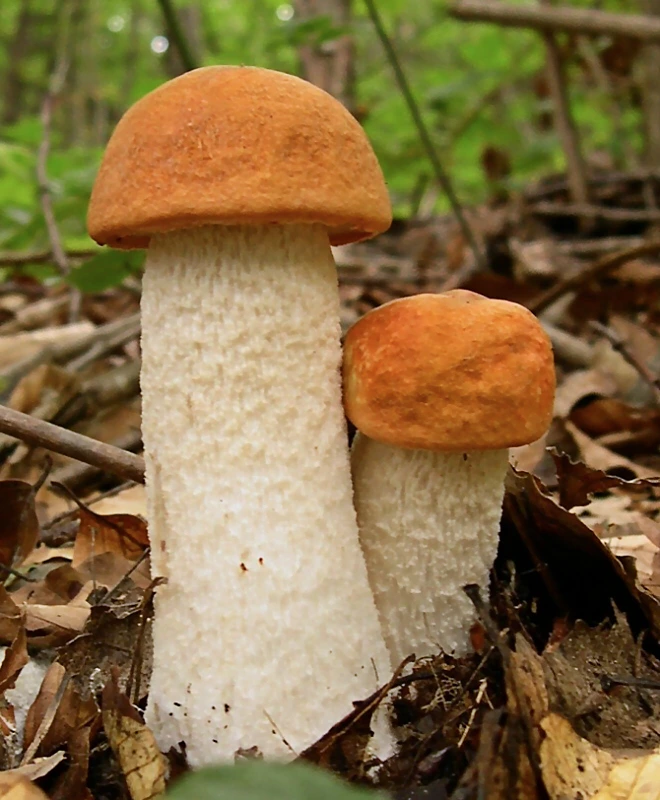
Leccinum albostipitatum, commonly known as the Aspen Bolete, is a striking orange-capped bolete associated with aspen and other Populus trees. It is recognized by its bright orange to orange-red cap, pale pore surface, long whitish stem, and unusually pale scabers when young.
The most useful field pattern is orange-red cap + pale pores + white or very pale stem scabers + growth with aspen or poplar. Compared with several other orange-capped Leccinum, the stem remains noticeably lighter, especially in young specimens.
Modern taxonomy is slightly complicated. Species Fungorum currently treats Leccinum albostipitatum as a synonym of Leccinum rufum, although L. albostipitatum remains widely used in field guides and identification resources.
⚠️ Important: Orange-capped Leccinum species can be difficult to separate from one another. Do not rely on cap color alone; check the stem scabers, bruising reactions, nearby host trees, geography, and current regional taxonomy.
Quick Identification
| Feature | Leccinum albostipitatum |
|---|---|
| Common name | Aspen Bolete |
| Current taxonomic treatment | Often treated as Leccinum rufum |
| Cap | Bright orange to orange-red |
| Cap shape | Convex, remaining fairly domed |
| Pores | Off-white to grayish |
| Stem | Long, pale, solid |
| Scabers | White to cream when young, later ginger or rusty |
| Ring | Absent |
| Flesh | White |
| Flesh staining | Wine-red, then gray to nearly black |
| Stem-base staining | Sometimes blue |
| Spore print | Olive-brown |
| Ecology | Ectomycorrhizal |
| Host | Aspen and other Populus |
| Season | Late summer to autumn |
| Main look-alikes | L. aurantiacum, L. versipelle, L. vulpinum |
What Does Leccinum albostipitatum Look Like?
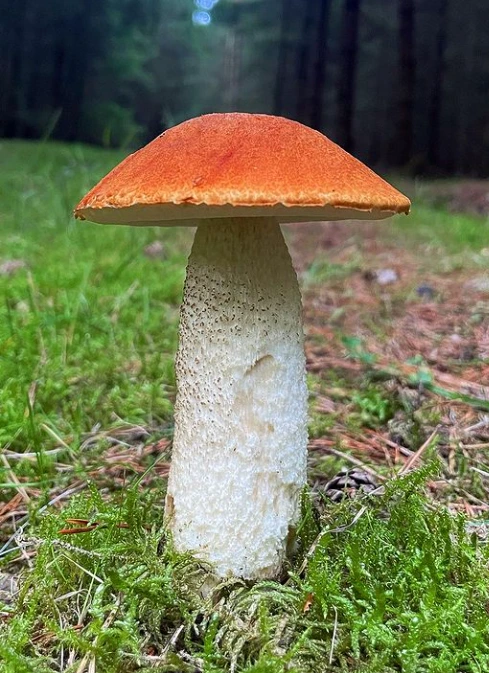
Aspen Bolete is usually a tall, sturdy mushroom with a vivid orange cap and a pale stem. The cap can reach around 5–15 cm across, while the stem may become proportionally long and thick.
The combination of a bright cap and almost white stem gives fresh specimens a particularly clean appearance. This is the feature reflected in the name albostipitatum, referring to the pale stem.
Cap
The cap is orange, orange-red, or warm reddish-orange. Young specimens are strongly convex, and mature mushrooms often remain noticeably domed rather than becoming completely flat.
The skin can extend slightly beyond the pore layer at the margin, leaving a narrow overhanging flap. This feature is common in the orange-capped Leccinum group and can be useful when examining fresh fruit bodies.
Pores
The pore surface begins off-white to pale gray rather than yellow. With age, it becomes duller and may develop gray-brown tones.
The pores are small and round when young. Bruising can produce grayish discoloration rather than dramatic blue staining.
Stem
The stem is usually long, solid, and pale. It may be slightly swollen toward the base and tapers somewhat toward the cap.
The key feature is the covering of small raised scabers. In L. albostipitatum, these scabers begin white or very pale and only later become ginger, rusty, or reddish.
Pale Scabers
The pale stem ornamentation is the feature that most strongly separates this mushroom from several similar orange Leccinum. Young specimens can look almost white-stemmed from a distance.
As the mushroom matures, the scabers may gain more reddish or rusty coloration. This means old specimens are harder to separate from nearby species using stem color alone.
Flesh
The flesh is firm and white when freshly cut. It then develops a sequence of color changes that can include wine-red, gray, violet-gray, and eventually near-black tones.
The stem base may also develop blue or blue-green discoloration. This reaction is variable and should be treated as supporting evidence rather than a single decisive character.
Spore Print
The spore print is olive-brown. The spores are elongated, typically ellipsoid to fusiform in shape.
Spore-print color confirms the mushroom as a bolete-type brown-spored fungus but does not separate closely related Leccinum species by itself.
Where Does Leccinum albostipitatum Grow?
The species is ectomycorrhizal and grows with living trees in the genus Populus. Aspen is the most characteristic host, although other poplars can also support it.
This host relationship is one of the strongest identification clues. An orange-capped Leccinum beneath birch or pine should immediately suggest a different species.
Aspen Association
Aspen roots can extend far beyond the visible trunk, so a fruit body does not need to stand directly beside the tree. A mushroom growing several meters away may still be connected to the same root system.
Always inspect the surrounding stand rather than only the nearest tree. Aspen leaves, bark, suckers, and fallen material can help confirm the host.
Season
Aspen Bolete typically fruits from late summer into autumn. British field references give a season roughly from August through November.
Timing varies with region, temperature, and rainfall. Moist late-summer weather can trigger large flushes beneath established aspen stands.
Distribution
The name Leccinum albostipitatum has been used mainly for European material associated with Populus. Because the taxonomy of orange-capped Leccinum has changed repeatedly, older records should be interpreted cautiously.
Species Fungorum now places L. albostipitatum under Leccinum rufum, which means modern databases and older field guides may use different names for the same taxon concept.
Why the Taxonomy Is Confusing
Historically, several orange-capped Leccinum were grouped together or called Leccinum aurantiacum. Later work separated populations according to host tree, scaber color, and molecular evidence.
The 2005 description of L. albostipitatum specifically emphasized the Populus-associated taxon with pale stem scabers. Species Fungorum now treats that name as a synonym of L. rufum.
For practical identification, the important point is that Aspen Bolete remains a useful field concept even when databases differ on the preferred scientific name.
Is Leccinum albostipitatum Edible?
It is generally described as edible when correctly identified and thoroughly cooked. Like several other orange-capped Leccinum, it should not be eaten raw or undercooked.
There have also been reports of adverse reactions to Leccinum species in North America, although the exact species involved are not always clear. European and North American orange-capped Leccinum should therefore not be assumed to be taxonomically identical.
Look-Alikes
The closest look-alikes are other orange-capped Leccinum. Host tree and scaber color usually provide the fastest distinctions.
Leccinum aurantiacum — Orange Bolete
Identification
Leccinum aurantiacum also has a vivid orange-red cap and pale pores. Its stem scabers are generally darker, becoming orange-brown to reddish-brown rather than remaining pale.
It can occur with aspen, poplar, oak, and other broadleaf hosts, depending on the taxonomic concept used.
Main Difference
Very pale young scabers + strong Populus association favor L. albostipitatum. Darker orange-brown scabers favor L. aurantiacum.
Leccinum versipelle — Orange Birch Bolete
Identification
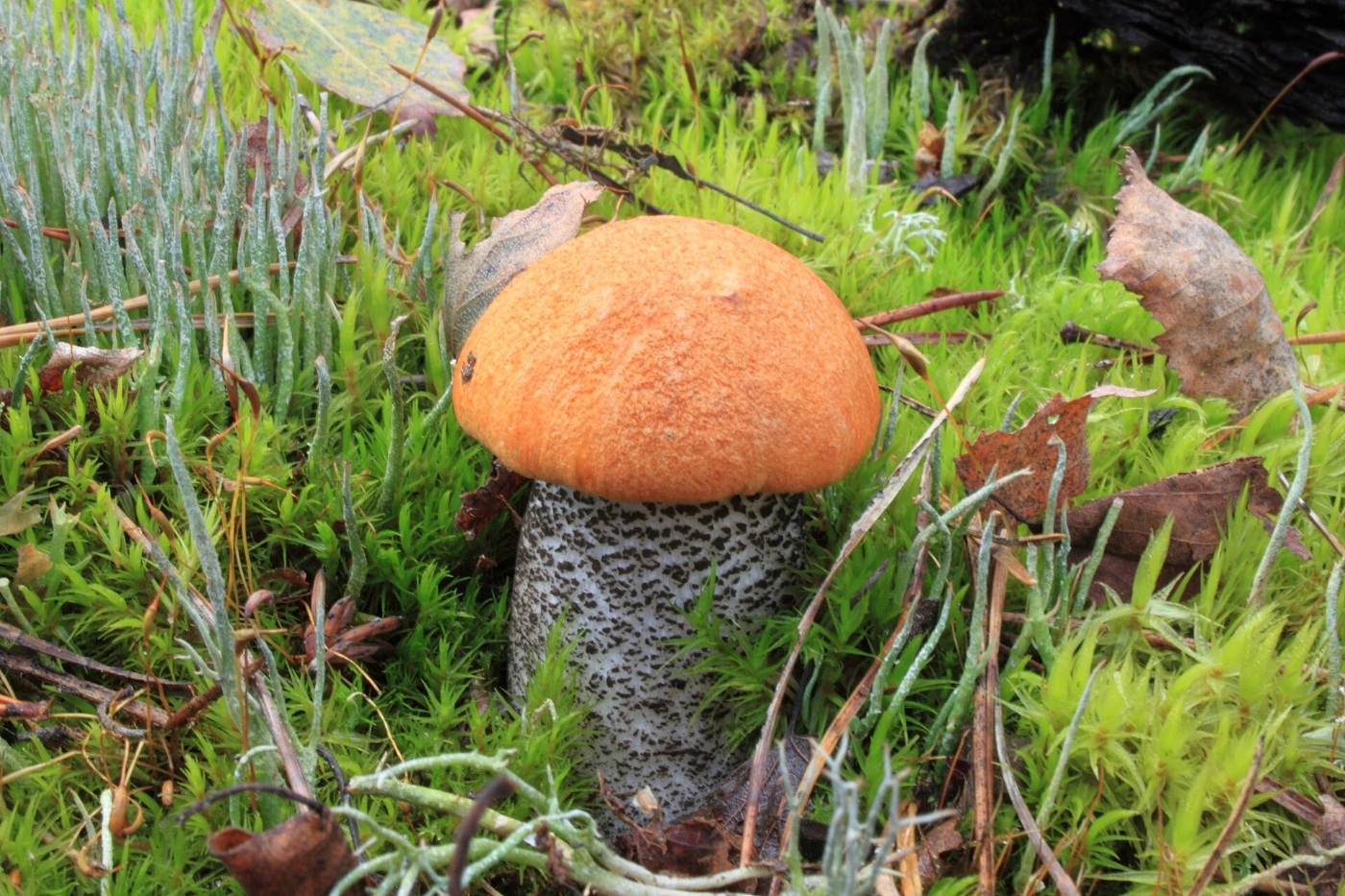
Leccinum versipelle has an orange to brick-orange cap and pale pores. Its stem is covered with conspicuous dark brown to black scabers.
The ecological clue is even stronger: it is associated with birch.
Main Difference
Birch + dark scabers = L. versipelle. Aspen + pale scabers = L. albostipitatum.
Leccinum vulpinum — Foxy Bolete
Identification
Leccinum vulpinum usually has a deeper brick-red or fox-red cap. Its stem bears darker scabers than typical Aspen Bolete.
The strongest difference is habitat. Foxy Bolete is associated with pine and spruce rather than Populus.
Main Difference
Conifer host = L. vulpinum. Aspen or poplar host = L. albostipitatum.
Aspen Bolete vs Orange Bolete
| Feature | L. albostipitatum | L. aurantiacum |
|---|---|---|
| Cap | Bright orange-red | Orange-red to fox-red |
| Pores | Pale | Pale |
| Young scabers | White / cream | Orange-brown / darker |
| Mature scabers | Ginger / rusty | Darker reddish-brown |
| Main host | Aspen / Populus | Aspen, poplar, oak and other broadleafs |
| Best clue | Pale stem | Darker scabers |
Young mushrooms are the easiest to separate because the stem coloration has not yet converged with age.
Aspen Bolete vs Orange Birch Bolete
| Feature | L. albostipitatum | L. versipelle |
|---|---|---|
| Cap | Bright orange-red | Orange to brick |
| Pores | Pale | Pale |
| Scabers | Pale | Dark brown to black |
| Host | Aspen / Populus | Birch |
| Flesh staining | Wine-red to gray-black | Similar strong darkening |
| Best clue | Pale scabers + aspen | Black scabers + birch |
This is usually a straightforward comparison when the host tree is known.
Why Host Tree Is So Important
Orange-capped Leccinum are classic ectomycorrhizal mushrooms. Many species have strong host preferences, which makes surrounding vegetation a key identification tool.
A photograph of the mushroom without the habitat can therefore lose some of the most useful evidence. When documenting a specimen, photograph nearby trees as well as the cap and stem.
Why Scaber Color Matters
Scabers are the small rough projections covering the stem of Leccinum. Their color can be pale, reddish, gray, brown, or nearly black depending on species and age.
In L. albostipitatum, the scabers are unusually pale when young. This is one of the most characteristic features of the taxon.
Young vs Mature Aspen Boletes
Young mushrooms usually show the clearest identification pattern: vivid orange cap, almost white stem, and very pale scabers.
As they mature, the stem ornamentation darkens and the cap may become duller. Old specimens can therefore resemble L. aurantiacum much more closely.
Whenever possible, examine several fruit bodies of different ages from the same patch.
Bruising and Color Changes
Cut flesh often changes through several stages rather than producing one immediate color. Wine-red or pinkish tones can develop first, followed by gray, violet-gray, or black.
The stem base may sometimes develop blue-green coloration. This kind of multistage reaction is common in orange-capped Leccinum and should be photographed over several minutes rather than judged immediately.
Common Identification Mistakes
One common mistake is calling every bright orange Leccinum L. aurantiacum. Host tree and scaber color can reveal a different taxon.
Another mistake is identifying from the cap alone. The orange cap is shared by several closely related species.
A third mistake is examining only mature specimens. Pale scabers are most informative while the mushroom is young.
A fourth mistake is ignoring taxonomic updates. The same mushroom may appear as L. albostipitatum in one source and L. rufum in another.
How to Photograph Leccinum albostipitatum
Start with a habitat photograph showing the mushroom and nearby aspen or poplar trees. Include leaves or bark when possible.
Then photograph the cap, pore surface, entire stem, and stem base. A close-up of the pale scabers is especially important.
Finally, cut one specimen vertically and photograph the flesh immediately and again after several minutes. This documents the wine-red, gray, dark, or blue-green staining sequence.
Can AI Identify Aspen Bolete?
AI can usually recognize an orange-capped Leccinum when the pale pores and scabered stem are visible. Exact species identification is harder because several taxa look extremely similar.
Adding the host tree dramatically improves the result. A bright orange Leccinum with very pale scabers beneath aspen is much more informative than a cap-only image.
Interesting Facts
The species was formally described as Leccinum albostipitatum in 2005 after taxonomic work showed that the Populus-associated pale-stemmed mushroom had been confused with other orange-capped Leccinum.
Its name literally emphasizes the pale stem, which is also one of its best practical field characters.
The taxonomic story did not end there. Current Species Fungorum treatment places L. albostipitatum within Leccinum rufum, showing how even familiar boletes can continue to change names as nomenclature and phylogeny are reassessed.
Aspen Bolete is also a good example of why ecology matters so much in bolete identification. The nearby tree may provide a stronger clue than subtle differences in cap color.
Frequently Asked Questions
What is Leccinum albostipitatum commonly called?
It is commonly known as the Aspen Bolete.
Is Leccinum albostipitatum still an accepted name?
Species Fungorum currently treats it as a synonym of Leccinum rufum. However, L. albostipitatum remains widely used in field guides and identification resources.
What trees does Aspen Bolete grow with?
It is strongly associated with aspen and other Populus species.
What color are the stem scabers?
They are white or very pale when young and can become ginger or rusty with age.
How is it different from Leccinum aurantiacum?
Typical L. albostipitatum has noticeably paler young scabers and a strong association with Populus. L. aurantiacum generally develops darker stem ornamentation.
How is it different from Leccinum versipelle?
L. versipelle grows with birch and has much darker brown to black scabers.
Does the flesh change color when cut?
Yes. It can change from white to wine-red, then gray or nearly black, with occasional blue coloration at the stem base.
Is Aspen Bolete edible?
It is generally regarded as edible when correctly identified and thoroughly cooked. As with other wild Leccinum, species identification and proper preparation remain important.
Final Identification Notes
Leccinum albostipitatum is best recognized by the combination of a bright orange-red cap, pale pores, long whitish stem with very pale young scabers, strong aspen or poplar association, and flesh that darkens after cutting.
The most important comparisons are Leccinum aurantiacum and Leccinum versipelle. Dark stem scabers with birch favor L. versipelle, while darker orange-brown scabers favor L. aurantiacum; a very pale stem beneath aspen strongly supports the Aspen Bolete concept.
The practical field pattern is: orange-red cap + pale pores + white or pale scabers + Populus host = strong Leccinum albostipitatum / Leccinum rufum candidate.
Upload a photo and get possible matches in seconds.