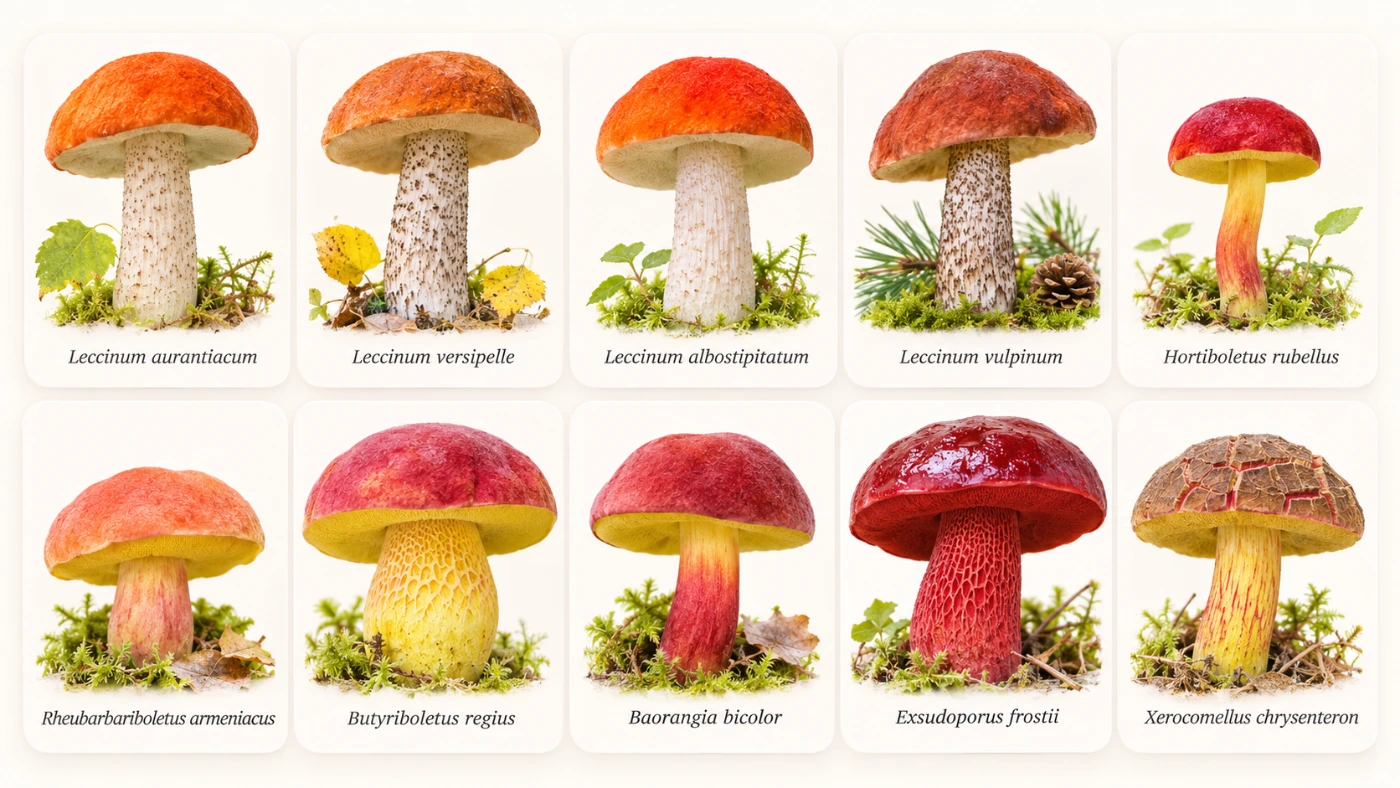
Orange and red-capped boletes include some of the most striking mushrooms in the bolete family. Their caps can range from apricot and pumpkin orange to scarlet, brick red, rose pink, and deep wine red.
Cap color alone, however, is one of the weakest ways to identify a bolete. Several unrelated genera produce red or orange caps, and the most useful differences usually come from the pore color, stem ornamentation, bruising reaction, host tree, and geographic region.
The most practical identification sequence is: check the cap → examine the pores → inspect the stem → cut the flesh → watch for bruising → identify nearby trees → consider geography.
⚠️ Important: A red or orange cap does not indicate whether a bolete is edible or poisonous. Some edible boletes have vivid red caps, while several dangerous red-pored species have pale, gray, brown, or olive caps.
Quick Identification Guide
| Species | Cap | Pores | Stem | Strongest clue |
|---|---|---|---|---|
| Leccinum aurantiacum | Orange-red | Pale | Scabers | Aspen/oak association |
| Leccinum versipelle | Orange to brick | Pale | Dark scabers | Birch |
| Leccinum albostipitatum | Bright orange | Pale | Pale scabers | Aspen + pale stem |
| Leccinum vulpinum | Brick-red | Pale | Dark scabers | Pine/spruce |
| Hortiboletus rubellus | Scarlet-red | Yellow | Red-dotted/fibrillose | Small ruby-red bolete |
| Rheubarbariboletus armeniacus | Apricot-red | Yellow | Yellow-red | Apricot cap |
| Butyriboletus regius | Rose-red | Bright yellow | Yellow, reticulate | Yellow net + little blueing |
| Baorangia bicolor | Rose to brick-red | Yellow | Red with yellow apex | North America |
| Exsudoporus frostii | Deep red | Red | Red-reticulate | Glossy red cap + red pores |
| Xerocomellus chrysenteron | Brown with red cracks | Yellow | Yellow with red fibers | Red visible in cap cracks |
These mushrooms do not belong to one single taxonomic group. Their similar cap colors evolved in several different bolete lineages.
Start With the Pores, Not the Cap
The underside is usually more informative than the upper surface. Orange and red-capped boletes can have pale gray, white, yellow, orange, or red pores.
This immediately divides them into useful groups. The orange-capped Leccinum species generally have pale pores, while Ruby Bolete and Royal Bolete have yellow pores, and some red-capped boletes such as Frost’s Bolete have red pores.
Pore color also changes with age. Always inspect fresh specimens when possible.
Pale-Pored Orange Boletes
The most familiar orange-capped bolete group is Leccinum. These mushrooms typically have pale pores and stems covered in rough projections known as scabers.
The scabers, host tree, and flesh-color changes are often much more important than subtle differences in cap color.
Scabers vs Reticulation
Scabers are separate rough dots or scales on the stem. They may be white, reddish, brown, or nearly black.
Reticulation is a raised network of interconnected lines. A bolete with a clear net rather than individual scabers belongs to a different identification pathway.
This distinction is especially useful when comparing orange Leccinum with red-capped Butyriboletus or other reticulate boletes.
Leccinum aurantiacum — Orange Bolete
Leccinum aurantiacum is one of the classic orange-capped boletes. The cap ranges from warm orange and orange-red to brick-red, while the pore surface is initially pale rather than yellow or red.
The stem is whitish and covered with scabers that begin pale or reddish-brown and darken with age. Cut flesh typically changes from white toward gray, violet-gray, or eventually darker tones.
Host Trees
Aspen and other poplars are particularly important hosts, while oak is also strongly associated with European records. Host tree is one of the best ways to separate this species from similar orange-capped Leccinum.
Main Difference
Orange-red cap + pale pores + scabers that are not black from the start + aspen/oak association = strong Leccinum aurantiacum pattern.
Leccinum versipelle — Orange Birch Bolete
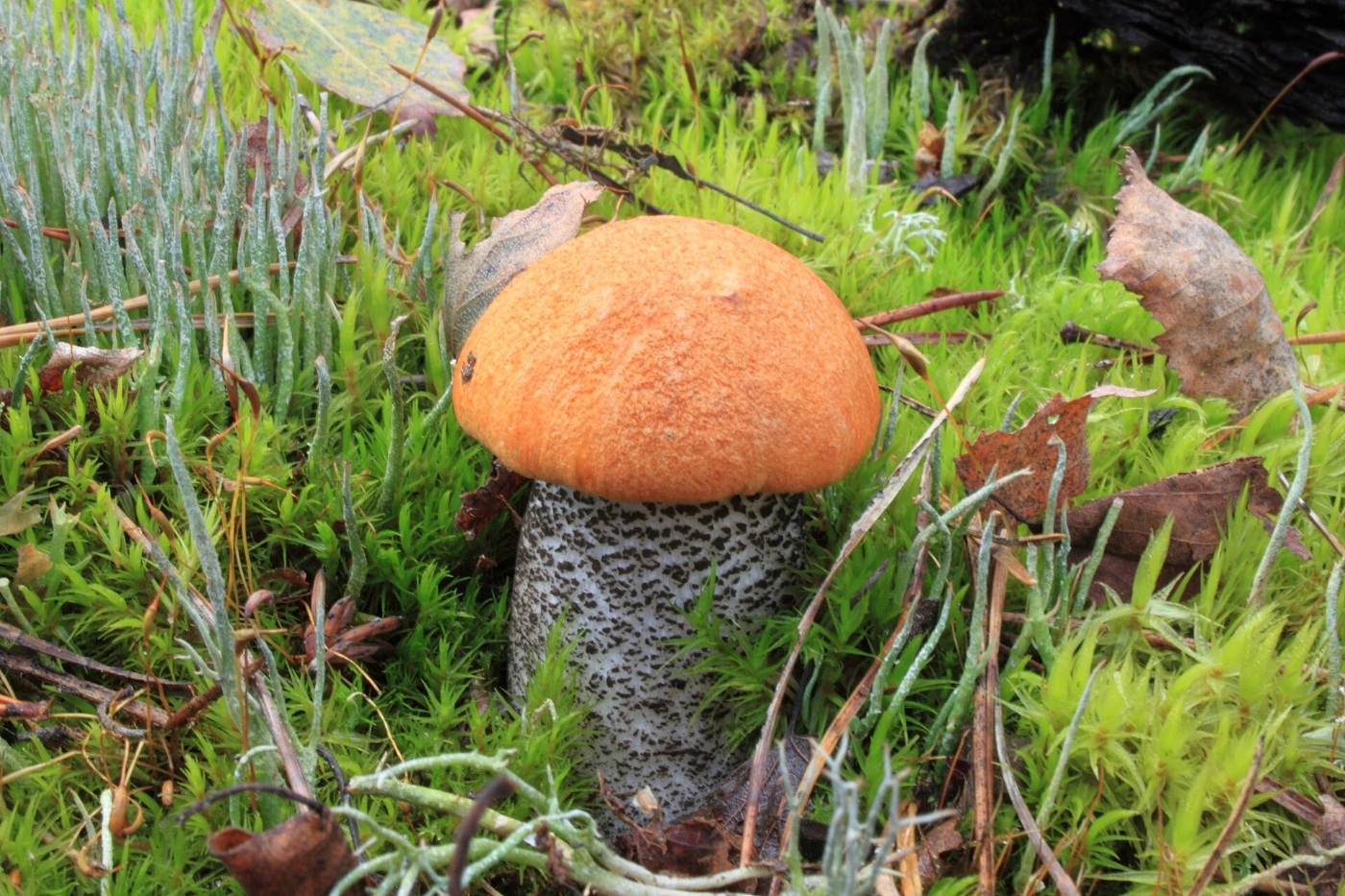
Leccinum versipelle is another orange to brick-red species, but it is strongly associated with birch. The stem is pale and covered with dark brown to black scabers.
The flesh can darken markedly after cutting and may develop blue-green coloration near the base.
Main Difference
Birch + orange cap + distinctly dark scabers = Orange Birch Bolete.
This combination is often more reliable than the exact shade of orange.
Leccinum albostipitatum — Aspen Bolete
Leccinum albostipitatum also has a vivid orange-red cap and grows with aspen or other Populus. It can therefore be extremely similar to L. aurantiacum.
The name refers to the characteristically pale stem. Young scabers are much paler and can remain white or cream for longer than in closely related species.
Main Difference
Bright orange-red cap + aspen + conspicuously pale scabers = Leccinum albostipitatum candidate.
Older specimens may become harder to distinguish because the scabers darken with age.
Leccinum vulpinum — Foxy Bolete
Foxy Bolete has a brick-red, fox-red, or deep reddish-orange cap. Like other Leccinum, it has pale pores and a scabered stem.
The major ecological clue is its association with pine and spruce, rather than birch or aspen.
Main Difference
Red-orange Leccinum under pine or spruce strongly suggests Leccinum vulpinum.
This is a good example of host tree solving a problem that cap color cannot.
Comparing the Orange Leccinum Group
| Feature | L. aurantiacum | L. versipelle | L. albostipitatum | L. vulpinum |
|---|---|---|---|---|
| Cap | Orange-red | Orange / brick | Bright orange-red | Brick / fox-red |
| Pores | Pale | Pale | Pale | Pale |
| Scabers | Pale to reddish-brown | Dark / black | Pale / white | Dark |
| Main host | Aspen, oak | Birch | Aspen | Pine, spruce |
| Flesh darkening | Strong | Strong | Strong | Strong |
| Best clue | Host + scabers | Birch + black scabers | Pale stem | Conifer host |
This table shows why “orange bolete” is not a species-level identification.
Hortiboletus rubellus — Ruby Bolete
Ruby Bolete is a much smaller mushroom than the robust orange Leccinum. Its cap is genuinely scarlet, blood-red, or ruby-red when fresh.
The pores are lemon-yellow rather than pale gray. They usually turn blue when bruised, while the slender stem is yellow with fine reddish dots or fibrils.
Habitat
Ruby Bolete often grows beneath broadleaf trees, particularly oak, and is commonly found in parks, lawns, woodland edges, and other grassy places with mature trees.
Main Difference
Small scarlet cap + yellow blue-bruising pores + slender red-and-yellow stem = Hortiboletus rubellus.
Rheubarbariboletus armeniacus — Apricot Bolete
Rheubarbariboletus armeniacus is a small bolete with a distinctive apricot, orange-pink, or reddish cap. Older specimens may deepen toward cherry-red.
Its pores are yellow and can become greenish with age. They may stain blue, while the internal flesh usually blues only weakly.
Main Difference
The apricot-colored cap is a useful starting clue. Compared with Ruby Bolete, the red coloration of the stem is generally less dominant.
Butyriboletus regius — Royal Bolete
Royal Bolete is one of the most spectacular red-capped European boletes. It has a rose-pink, carmine, or purplish-red cap over a bright yellow pore surface.
The stem is yellow and bears a fine yellow reticulation. The flesh is also yellow and usually shows little or no blue staining.
Main Difference
Rose-red cap + bright yellow pores + yellow reticulate stem + little blueing = Butyriboletus regius.
This combination separates it from many red-pored toxic boletes.
Why Pore Color Is Critical in Royal Bolete
A red cap can make Butyriboletus regius look alarming, but its pores remain yellow. They are never normally bright red like those of classic Rubroboletus species.
This is an important illustration of why cap color cannot be interpreted as a toxicity signal.
Baorangia bicolor — Two-Colored Bolete
Baorangia bicolor is a North American bolete with a rose-red, brick-red, or dull crimson cap and bright yellow pores. The stem typically combines red with a yellow zone near the top.
The pore surface stains blue, but usually more slowly and less dramatically than in strongly blue-staining toxic look-alikes.
Main Difference
Red cap + yellow pores + mostly red stem with yellow apex + eastern North American habitat = strong Baorangia bicolor candidate.
Geography is especially useful because superficially similar European species belong to different genera.
Exsudoporus frostii — Frost’s Bolete
Frost’s Bolete is an eastern North American species with a striking deep red cap. Unlike most species in this article, it also has red pores.
The cap can appear glossy or lacquered, especially when wet. The red stem carries strong reticulation, and both pores and flesh stain blue very quickly when damaged.
Young pore surfaces may produce amber-colored droplets, another useful character.
Main Difference
Glossy blood-red cap + red pores + red reticulate stem + immediate intense blueing = Exsudoporus frostii.
This is very different from orange Leccinum despite the shared red coloration above.
Xerocomellus chrysenteron — Red Cracking Bolete
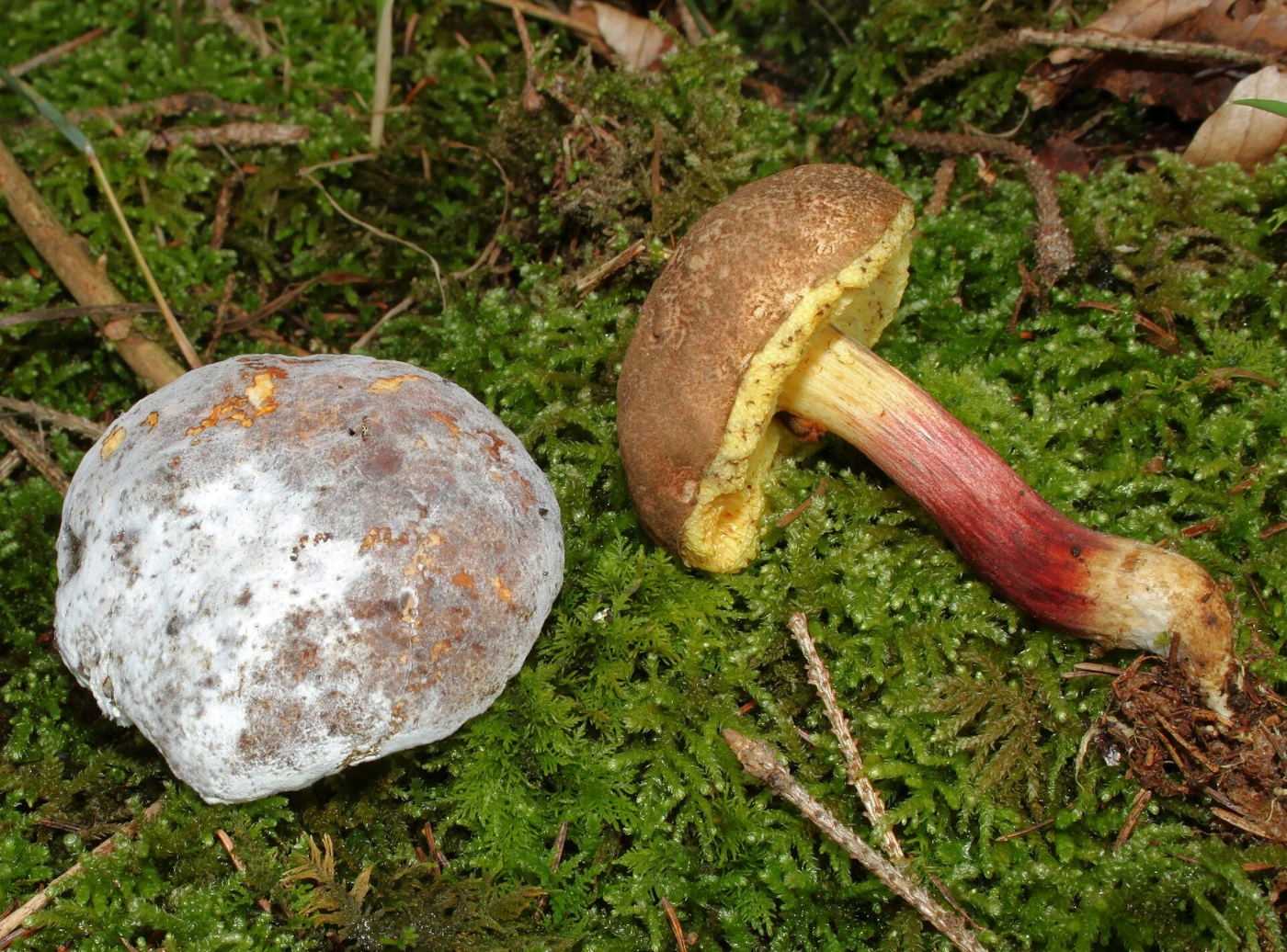
Red Cracking Bolete is somewhat different because its cap is usually brown rather than fully red. However, cracks in the cap surface expose reddish tissue beneath and can make older specimens appear strongly red-patterned.
The pores are yellow, and the stem is yellow with coral-red fibers. Blue bruising is usually weaker than in several related species.
Main Difference
Brown cap with red showing through cracks + yellow pores + red stem fibrils = Xerocomellus chrysenteron.
This species belongs in the guide because it is commonly described by observers as a “red bolete” despite the red color primarily appearing beneath the cap cuticle.
Orange Cap vs Red Pores
This distinction prevents many bolete identification mistakes.
An orange-capped bolete may have pale pores, as in Leccinum aurantiacum. A red-pored bolete may have a completely brown, gray, or whitish cap.
For example, Neoboletus luridiformis usually has a dark brown cap with red pores, while Rubroboletus satanas typically has a pale gray-white cap with red pores.
Neither is best described as a “red-capped bolete.”
Does a Red Cap Mean Poisonous?
No. Red-capped boletes include species considered edible, species of uncertain or poor culinary value, and fungi that should simply be avoided.
Color does not provide a direct toxicity signal. Royal Bolete has a vivid red cap but yellow pores, while several poisonous boletes have relatively pale caps.
The identification must come before any discussion of edibility.
Does Blue Bruising Mean Poisonous?
No. Red and orange-capped boletes illustrate this particularly well.
Ruby Bolete can blue on the pore surface, Two-Colored Bolete blues moderately, and Frost’s Bolete can blue extremely rapidly. These reactions belong to different species with very different culinary and toxicological profiles.
Blueing is an oxidation reaction and should be treated as an identification character rather than a poison test.
How to Use Bruising Correctly
Observe where the blue appears and how quickly it develops. The pore surface, cap flesh, upper stem, and stem base may react differently.
A slow pale blue reaction is not equivalent to an immediate deep navy stain. Timing can sometimes help separate otherwise similar species.
Take photographs immediately after cutting and again several minutes later.
Why Host Tree Matters So Much
Orange Leccinum species are among the clearest examples of mycorrhizal identification.
Birch strongly favors L. versipelle. Aspen is critical for L. albostipitatum and important for L. aurantiacum, while pine and spruce point toward L. vulpinum.
This makes nearby trees almost as important as the mushroom itself.
Do Not Identify Only the Nearest Tree
Roots extend far beyond trunks and overlap underground. A mushroom beside a birch can theoretically be associated with an aspen several meters away.
Inspect the surrounding stand rather than only the closest trunk. Fallen leaves, bark, cones, and seedlings can help identify potential hosts.
A habitat photograph is especially useful for later review.
European vs North American Red Boletes
Geographic context becomes increasingly important outside Leccinum. European Butyriboletus regius should not automatically be applied to a red-capped North American bolete.
North America has its own red and yellow-pored species, including Baorangia bicolor and Exsudoporus frostii. Similarity in cap color does not imply close taxonomic relationship.
Regional mushroom guides are therefore essential for this color group.
Orange Boletes With Scabers
If the mushroom has an orange or reddish cap and a pale stem covered in obvious rough scabers, begin with Leccinum.
Then identify the host tree and study the scaber color. This usually narrows the options much faster than trying to distinguish subtle shades of orange.
Flesh darkening after cutting provides additional support.
Red Boletes With Yellow Pores
A truly red cap over yellow pores points toward groups such as Hortiboletus, Rheubarbariboletus, Butyriboletus, or Baorangia depending on size, stem structure, bruising, and geography.
A small slender scarlet bolete in European parkland is a different problem from a large rose-red, reticulate bolete in old beech woodland.
Again, pore color gets you to the right branch of the identification process.
Red Boletes With Red Pores
A red cap plus red pores deserves careful examination because several strongly blue-staining species occupy this category.
Look closely at stem reticulation, cap texture, bruising speed, and geographic range. Frost’s Bolete provides a good North American example.
Do not extend the simplistic rule “red pores = poisonous.” Red-pored bolete identification requires species-level evidence.
How Weather Changes Cap Color
Sunlight, drought, and rain can dramatically change red and orange caps. Bright scarlet mushrooms may fade toward pinkish tan, while dry caps may crack and expose contrasting flesh beneath.
Wet surfaces often look darker and more saturated. Old orange Leccinum can become brown enough that the original cap color is difficult to recognize.
This is another reason color should be combined with structural features.
Young vs Mature Specimens
Young boletes generally have brighter cap colors and tighter pore surfaces. Mature mushrooms often fade and the pores become olive or duller.
Stem markings may also darken. Pale Leccinum scabers that were subtle when young can become almost black with age.
Whenever possible, compare several ages from the same patch.
Common Identification Mistakes
One common mistake is calling every orange-capped, rough-stemmed bolete Leccinum aurantiacum. Several closely related species differ mainly in host tree and scaber coloration.
Another mistake is confusing a red cap with red pores. These are completely separate characters.
A third mistake is assuming red means dangerous or blue means poisonous. Neither rule is biologically reliable.
A fourth mistake is ignoring geography and applying European names to visually similar North American species.
How to Photograph Orange and Red-Capped Boletes
Start with an intact habitat photograph that shows nearby trees. This is especially important for Leccinum.
Then photograph the cap, pore surface, complete stem, and stem base. Use a close-up to show whether the stem has scabers, dots, fibers, or a true reticulate net.
Finally, cut one specimen lengthwise and photograph the flesh immediately and after several minutes. This records the location, speed, and intensity of staining.
Can AI Identify Orange and Red Boletes?
AI can often narrow a specimen to a bolete group when the cap, pores, stem, and habitat are visible. It performs poorly when given only a photograph from above.
Tree information can dramatically improve identification of orange Leccinum. Geographic location is similarly important for red-capped Baorangia, Butyriboletus, and Exsudoporus.
Difficult species groups may still require microscopy or specialist confirmation.
Frequently Asked Questions
What is the most common orange-capped bolete?
There is no single worldwide answer. Leccinum aurantiacum is one of the classic European Orange Boletes, while several closely related species produce similar caps.
How do I identify an orange Leccinum?
Check the rough stem scabers, then identify the host tree. Birch, aspen, oak, pine, and spruce can point toward different species.
Are orange boletes edible?
Some are considered edible when correctly identified and thoroughly cooked, while others have uncertain or poor culinary value. Orange color itself provides no edibility information.
Do red-capped boletes have red pores?
Not necessarily. Royal Bolete and Ruby Bolete have red caps with yellow pores, while orange Leccinum generally have pale pores.
Does a red cap mean a bolete is poisonous?
No. Cap color does not reliably indicate toxicity.
Does blue bruising mean a red bolete is toxic?
No. Both edible and problematic boletes can stain blue.
What is the difference between scabers and reticulation?
Scabers are separate raised dots or scales, characteristic of Leccinum. Reticulation forms an interconnected raised net on the stem.
Why is the host tree important?
Many boletes are ectomycorrhizal and show strong host preferences. Nearby trees can therefore provide one of the strongest clues to species identity.
Final Notes
Orange and red-capped boletes are not a single natural group. Similar colors occur in Leccinum, Hortiboletus, Rheubarbariboletus, Butyriboletus, Baorangia, Exsudoporus, Xerocomellus, and other genera.
The best identification strategy is to look beyond the cap. Pore color separates major groups, stem scabers or reticulation narrow the genus, bruising helps distinguish similar species, and host trees plus geography often provide the final clue.
The practical field pattern is: cap color → pore color → stem pattern → bruising → host tree → region → species identification. Never use red, orange, or blue coloration as a shortcut for determining whether a bolete is safe to eat.
Upload a photo and get possible matches in seconds.